Archives for the year of: 2023

Bad things happen in all sectors. But so many bad things happen in Charterworld because there are so few controls or oversight. Public school employees typically undergo background checks, and their schools are regularly audited. The charter industry considers state regulation of any kind to be insulting.

But, lo! A charter school founder in Cleveland was arrested for being part of a human trafficking ring.

Incredible!

CLEVELAND — On Monday, Ohio Attorney General Dave Yost announced that a total of 160 people were arrested in a human trafficking crackdown initiative, known as “Operation Buyer’s Remorse.”

Among the list of 160 people who were taken into custody from Sept. 25-30 was 68-year-old John Zitzner, the co-founder of Breakthrough Charter Schools.

According to a spokesperson for the Ohio Attorney General’s Office, Zitzner was arrested by the Northeast Ohio Human Trafficking Task Force. Zitzner told task force members that “he works in education at Friend of Breakthrough Schools.” His case is being handled through the Rocky River Municipal Court.

Court records show that Zitzner was arrested on Sept. 28 in Westlake and charged with engaging in prostitution. He had his initial court appearance on Monday and is scheduled to be arraigned on Oct. 10.

What kind of person founds charter schools and engages in human trafficking and prostitution?

Since Governor Ron DeSantis engineered the hostile takeover of Florida’s progressive New College, the interim president was Richard Corcoran. Corcoran was a hard-right Speaker of the House of Representatives and Dtate Commissiober of Education, in which role he led the state’s attacks on public schools and the expansion of charter schools and vouchers. His wife founded a charter school and is now associated with the Hillsdale College Barney charter schools.

After a few months of deliberation, the hand-picked, stacked board decided to hire Corcoran as the permanent president of New College.

To be clear, he has no academic or scholarly credentials to be a college president.

He dropped out of the University of Florida and enrolled in St. Leo University, a Catholic college. After graduating, he received his law degree from Regent University, a private Christian university.

He has no previous experience as a professor, a college administrator, or a scholar. He is uniquely unqualified for a college presidency. Since he took charge of New College, one-third of the faculty has resigned, faculty have been denied tenure without reason, and students have protested the decisions of the board.

He has been successful in rightwing politics.

The original New College was founded as a school for creative, free thinkers, educated by faculty who were highly credentialed. The new DeSantis board intends to turn New College into the Hilllsdale of the South.

Corcoran claims to have boosted enrollment, which he did by recruiting athletes, not aesthetes or free thinkers.

Shani Robinson was one of the Atlanta teachers who was convicted during the Great Cheating Scandal of 2015. Almost ten years later, she and five others who refused to plead guilty are still free while appealing their convictions. Shani wrote a book about her ordeal called None of the Above, which I reviewed here. Shani’s book persuaded me that she had not cheated; she had no motivation to cheat since the scores of first-graders did not count for AYP (Adequate Yearly Progress) or for a bonus for her. She was outraged to be accused of cheating, and she resisted all plea deals that required her to plead guilty or to accuse others, even if the plea deal allowed her to walk free. She was determined to insist on her innocence rather than make a deal with prosecutors.

Now that Trump and others are accused using the RICO statute, I contacted Shani to ask her where her case stands today.

Shani wrote this account for the blog:

Most everyone I know is paying attention to the prosecution of former President Donald Trump and 18 of his allies related to an alleged conspiracy to overturn the 2020 election. Georgia’s Racketeer Influenced and Corrupt Organization (RICO) Act makes that possible. I view the proceedings with mixed feelings, as I was falsely accused and convicted under that same RICO Act during the Atlanta Public Schools (APS) Cheating Trial in 2015.

My name is Shani Robinson and I’m a former first grade teacher. I was falsely accused of cheating on my students’ standardized tests by a former co-worker, whose story changed every time she was interrogated by the Georgia Bureau of Investigation (GBI), but who was ultimately offered immunity in exchange for her testimony. Former Fulton County District Attorney Paul Howard Jr. claimed that cheating was the result of a criminal conspiracy. He used RICO—a law devised to take down the American Mafia—to throw the book at educators. I was offered a plea deal that would have whittled my potential 25-year prison sentence down to community service. But I wasn’t willing to admit guilt for something I hadn’t done and/or falsely accuse someone else. I also never received bonus money (the basis for the RICO charges) because my school didn’t reach the district targets, which were APS’s testing goals that prosecutors claimed were the main culprit behind the cheating. There was no motive for me to cheat because as a first-grade teacher, my test scores didn’t count toward the district targets.

The APS cheating case was rife with corruption from the beginning. Former Georgia Governor Sonny Perdue sent an unprecedented number of GBI agents into APS in 2010. Teachers were pulled out of their classrooms and told to speak with these agents, and in most cases, there were no attorneys present. Agents used intimidation to elicit confessions and accusations: Some educators complained that GBI interrogators threatened that they could lose custody of their children if they didn’t cooperate. Educators who maintained their innocence were asked to sign pre-written statements saying they didn’t cheat. Some of the teachers who signed the forms were still accused of cheating and were charged with making false statements and writings, a felony, because they had followed instructions and signed the statements the GBI provided. At the same time Perdue’s investigation was underway in APS, he turned around and used the same questionable test scores in an application for President Obama’s Race to the Top program and won a $400 million federal grant.

The trial was like a circus. The judge called out prosecutors on multiple occasions for improperly influencing the jury. But the judge himself was often out of line too: from telling the jury a story about a man he caught masturbating, to having a private conversation with former District Attorney Paul Howard Jr., to pressuring my co-defendants and me to take plea deals. While the prosecutorial and judicial misconduct that took place was bad enough, the mainstream media helped fuel the fire to justify the RICO charges. Their overall narrative was that educators cheated to get bonus money. This patently contradicted the GBI investigative report, which stated bonus money provided “little incentive” to cheat. One of the lead investigators on the case also stated this when he testified during the trial. Despite the flaws, the jury convicted all but one of us that was on trial.

The problem with RICO is that it criminalizes such a broad range of conduct, including acts by many people who have nothing to do with each other. RICO was originally written to attack organized crime; using such a statute against educators for cheating on standardized tests is unconscionable. Since the 2001 enactment of No Child Left Behind, a federal policy that mandated standardized testing and imposed sanctions on schools that failed to meet unrealistic goals, The National Center for Fair and Open testing documented cheating cases in nearly 40 states and Washington, DC. Only in Atlanta did educators face felony charges saddled with decades-long prison sentences.

This RICO indictment has hung over my head for the past 10 years, leading to a diagnosis of Post Traumatic Stress Disorder (PTSD). The impact of PTSD and the fallout from the trial has taken a significant toll on my family. I have 2 small children, sothe thought of going to prison and being separated from them is agonizing. There are 6 defendants, including me, still appealing convictions. We’ve all been able to remain out of prison thus far due to being on appeal bonds. But the case has been handled so poorly; the entire appeals process restarted this year with no end in sight. Millions of tax players dollars have already been spent on this trial.

 Last year brought a ray of hope: Judge Jerry Baxter granted a new sentence for a principal who was convicted, enabling her to avoid prison and do community service instead. I’m hopeful that Fulton County District Attorney Fani Willis and Judge Jerry Baxter will come to the realization that RICO was misused in our case and find a peaceful resolution. Otherwise, the APS Cheating Trial could potentially be used as a playbook for other unjust prosecutions that clog up the legal system and waste public resources.

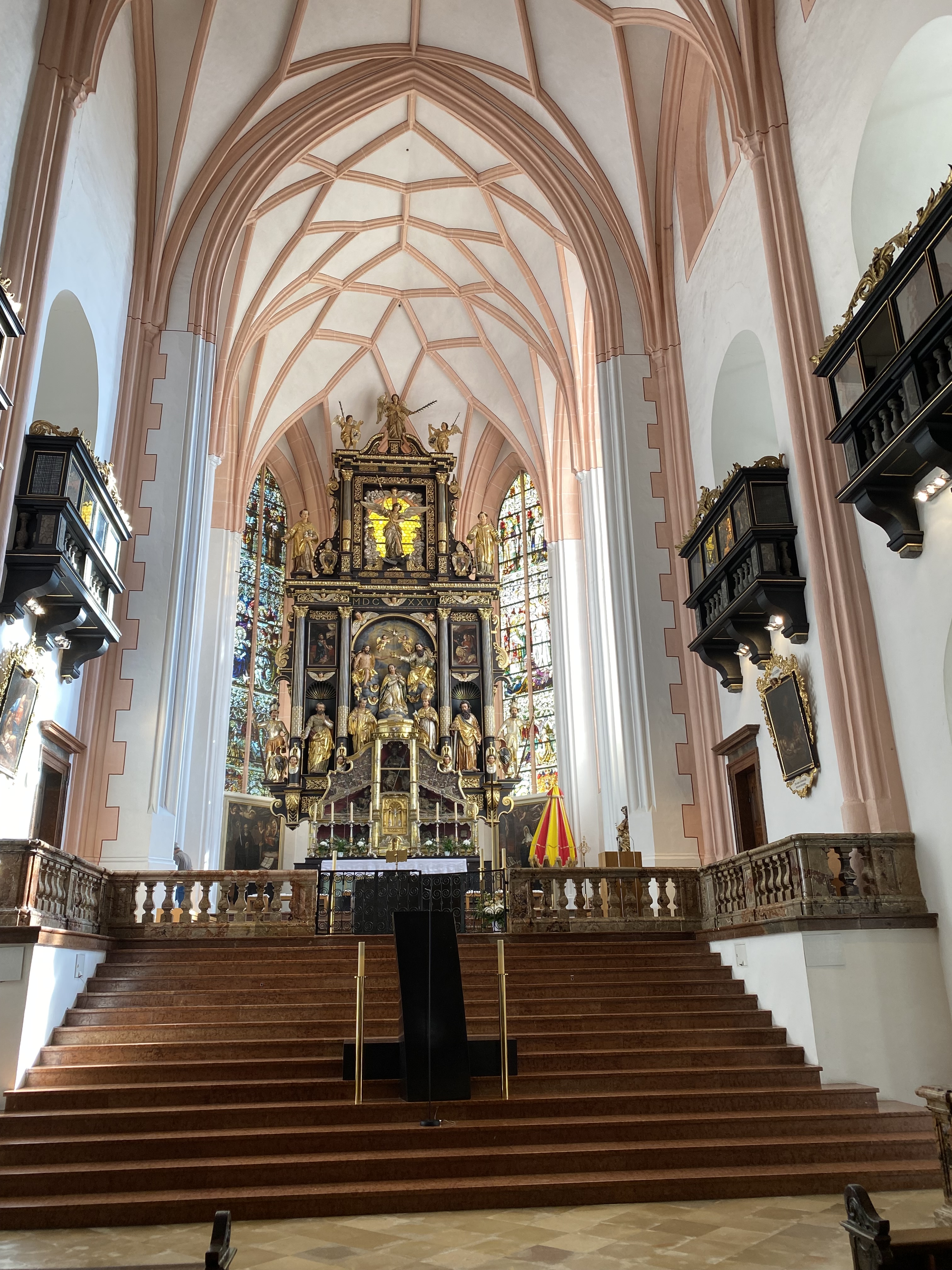
Our river cruise stopped in Linz (think Linzertorte, a busy industrial town, and we went by bus to Salzburg, the birthplace of Mozart. It is a beautifully preserved city, with a city center that has no autos, only bicycles and carriages. To call it spotlessly clean would be an understatement, although it’s full of tourists like us. Our guide was a charming woman who knew every last detail of “The Sound of Music.” She told us what the movie got right, what it got wrong. For example, when the Trapp family hikes off into the mountains to escape the Nazis, they were heading towards Germany! Oops, wrong direction. And of course, we had to see the beautiful church where Captain Trapp and Maria were “married.” Like so many churches in Austria, overflowing with beautiful ornamentation. We went to a beer garden for lunch, where we had weisswurst and beer. There are no high rises in the center, and the houses all look as though they were painted yesterday.

By the way, higher education is tuition-free in Austria and Germany but students must pass an exam to enroll.

Salzburg

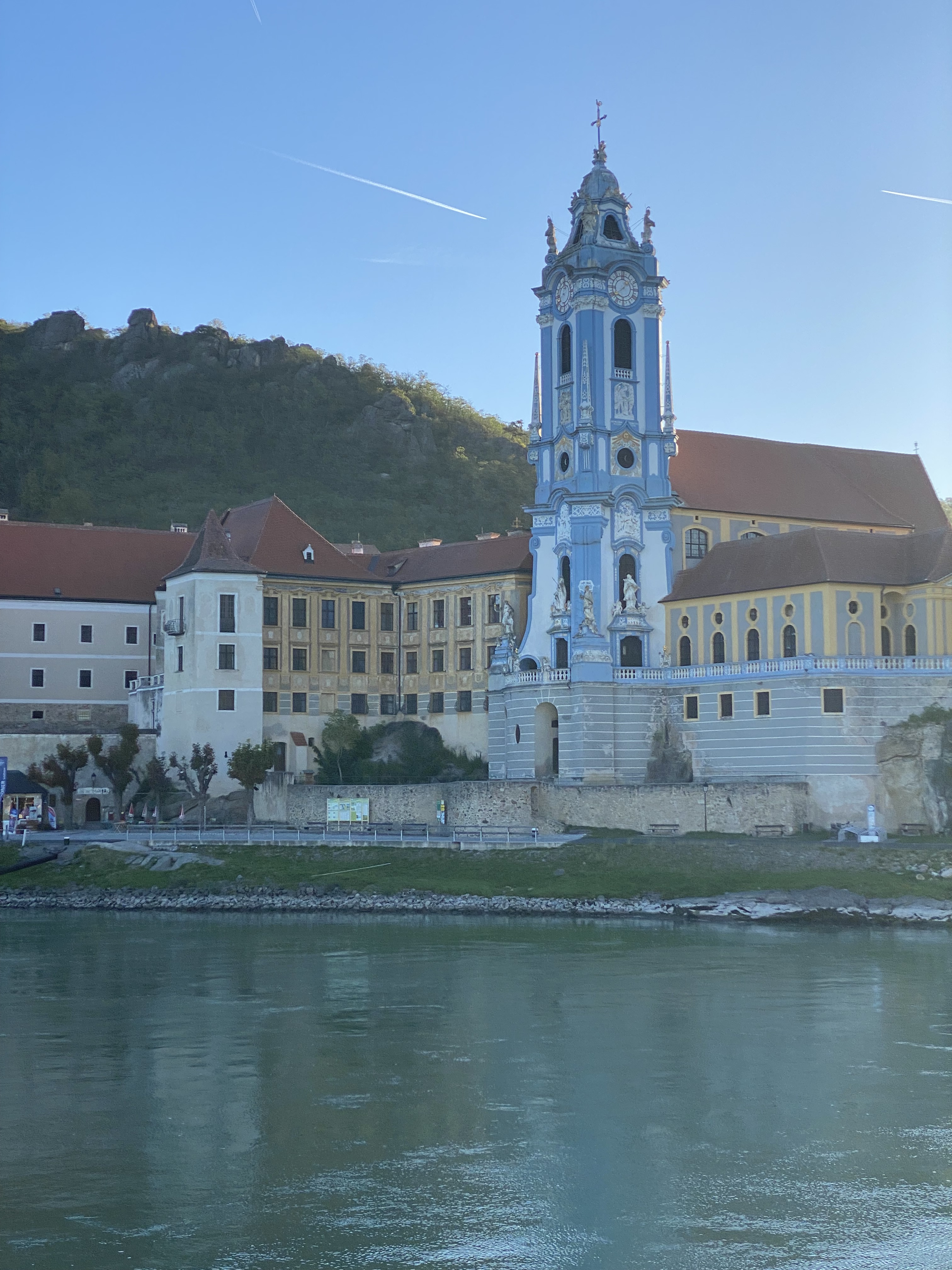
I have never been on the Danube before. We are on a river cruise that goes very slowly to interesting places in Austria and Germany. The photo here is Durnstein, a beautiful Austrian village. Here’s news: the Danube is not blue. It’s green. We expected cool weather but it has been 75-80 degrees every day (so far). Because of prolonged drought, our cruise will not make it to Nuremberg because the water levels are low. Today we went to Salzburg, which is a beautiful town with immaculate streets, beautiful churches, and lots of attention to native son Mozart.

Several authors have filed suit against Meta (Zuckerberg), Bloomberg, and other tech corporations for violating the copyright on their books. Alex Reisner has written three articles in The Atlantic about how the developers of Artificial Intelligence (AI) have used 183,000 books to train AI how to write.

Two of those 183,000 books are mine: The Death and Life of the Great American School System: How Testing and Choice Are Undermining Education and Reign of Error: The Hoax of the Privatization Movement and the Danger to America’s Public Schools. As an author, I am outraged that huge tech corporations used my books as training fodder for their profiteering.

Reissner writes:

This summer, I acquired a data set of more than 191,000 books that were used without permission to train generative-AI systems by Meta, Bloomberg, and others. I wrote in The Atlantic about how the data set, known as “Books3,” was based on a collection of pirated ebooks, most of them published in the past 20 years. Since then, I’ve done a deep analysis of what’s actually in the data set, which is now at the center of several lawsuits brought against Meta by writers such as Sarah Silverman, Michael Chabon, and Paul Tremblay, who claim that its use in training generative AI amounts to copyright infringement.

Since my article appeared, I’ve heard from several authors wanting to know if their work is in Books3. In almost all cases, the answer has been yes. These authors spent years thinking, researching, imagining, and writing, and had no idea that their books were being used to train machines that could one day replace them. Meanwhile, the people building and training these machines stand to profit enormously.

Reached for comment, a spokesperson for Meta did not directly answer questions about the use of pirated books to train LLaMA, the company’s generative-AI product. Instead, she pointed me to a court filing from last weekrelated to the Silverman lawsuit, in which lawyers for Meta argue that the case should be dismissed in part because neither the LLaMA model nor its outputs are “substantially similar” to the authors’ books.

It may be beyond the scope of copyright law to address the harms being done to authors by generative AI, and the point remains that AI-training practices are secretive and fundamentally nonconsensual. Very few people understand exactly how these programs are developed, even as such initiatives threaten to upend the world as we know it. Books are stored in Books3 as large, unlabeled blocks of text. To identify their authors and titles, I extracted ISBNs from these blocks of text and looked them up in a book database. Of the 191,000 titles I identified, 183,000 have associated author information. You can use the search tool below to look up authors in this subset and see which of their titles are included.

The article contains a search tool that anyone can use to see whether their copyrighted work was fed into the AI training process.

As an author whose works were used, I feel aggrieved. I think that all of us whose works were utilized without our knowledge or consent should be compensated.

AI is the latest iteration of big-tech’s efforts to make human beings irrelevant. AI may “learn” how to write well, but AI can never “learn” the wisdom, experiences, memories, fears, hopes, and emotions that lie behind every book.

The National Education Policy Center issued a report about the likely fiscal impact of vouchers, which finds that vouchers are a risky venture with no proven benefits. NEPC is noted for its peer-reviewed reports.

An NEPC Review funded by the Great Lakes Center

Key Takeaway: Tax-credit scholarship programs probably incur more costs than savings for state and school districts, placing financial strain on state budgets and driving the need for future budget cuts.

GRAND RAPIDS, MI (September 26, 2023) – A recent report from the Georgia Department of Audits and Accounts examines the monetary costs and benefits of the state’s Qualified Education Expense Tax Credit (QEEC), a voucher policy that provides a public subsidy for families to pay for private school tuition. A review of the report, however, contradicts its claim that the policy provides a net fiscal benefit to the state budget.

David Knight of the University of Washington reviewed Qualified Education Expense Tax Credit: Economic Analysis, and he found several methodological challenges that undermine the report’s conclusions and its usefulness.

One key claim in the report is that the tax credit results in $81 million of forgone state tax revenue per year. Another key claim is that the vouchers incentivize almost 20,000 students per year to choose private schools instead of public, thus removing the cost of educating those students from state and local budgets. Based largely on these two claims, the report concludes that QEEC provides a net fiscal benefit for Georgia’s state budget.

Professor Knight points to a lack of data about how many students per year do actually switch from public to private schools because of the voucher subsidy and incentive. In fact, existing private-school families have extremely strong incentives to accept the public subsidies. And if most of the vouchers are provided to support these students who were already planning to attend a private school, then the policy only subsidizes private school students with funding that could otherwise be returned to taxpayers or invested in the state’s public education system, which is open to all students.

While these calculations are all necessarily grounded in some speculation because of the unregulated elements of the voucher policy and the resulting lack of hard data, the most likely result of tax credit scholarship programs like QEEC is that the state and school districts incur more costs than savings, placing financial strain on state budgets that could require future cuts.

Because the report relies on unrealistic assumptions, its suggestion that program benefits outweigh costs is tenuous and risks misleading state education leaders. Instead, state leaders should invest educational dollars in policies that have a positive return on investment and therefore help, rather than harm, state and local budgets.

Find the review, by David Knight, at:
https://www.greatlakescenter.org

Find Qualified Education Expense Tax Credit: Economic Analysis, written by Greg S. Griffin and Lisa Kieffer, and published by the Georgia Department of Audits and Accounts, at:
https://www.audits.ga.gov/ReportSearch/download/29827

NEPC Reviews (https://nepc.colorado.edu/reviews) provide the public, policymakers, and the press with timely, academically sound reviews of selected publications. NEPC Reviews are made possible in part by support provided by the Great Lakes Center for Education Research and Practice: https://www.greatlakescenter.org

NBCT high school teacher Justin Parmenter has a great story to tell to launch Banned Books Week. The local leader of Moms for Liberty in Charlotte asked the local school board to ban five books from a high school. The board debated her request and rejected it. But they did say she could request that her own child be excused from reading the books she objected to. A brilliant resolution!

He writes:

Here’s some excellent news to kick off Banned Books Week.

An attempt by the Charlotte Mecklenburg Moms for Liberty chair to have five books banned from the Ardrey Kell High School media center has failed.

The school’s School Media Advisory Committee determinedthat all five books will be retained in the media center, and the objecting parent is free to restrict their own child’s access to those titles as permitted by district policy.

Students in Charlotte Mecklenburg Schools were not allowed to check out books for the first two weeks of school while the district waited to hear objections. The library pause came in response to Republicans in the North Carolina General Assembly passing a “Parents Bill of Rights” law which, among many other things, requires superintendents to create a process for objections and provide parents with access to student library records.

After two weeks with more than 140,000 students at 181 schools having no access to media centers, only five objections were lodged.

According to WSOC, all the objections were filed at one school (Ardrey Kell High School) by the same parent. Unsurprisingly, she also happens to be the chair of the local Moms for Liberty chapter, Brooke Weiss. (Moms for Liberty has embarked on a nation-wide crusade to ban books from school libraries.)

Committee meeting notes requested by Weiss and posted to the CMS public records request page show that, after thoughtful consideration and robust discussion, the committee decided to retain all five books in the Ardrey Kell media center. The committee noted that the objecting parent “may use policy to restrict access for their student by request.”

Open the link to read the board’s discussion notes.

CNN asked for and received a statement from John Kelly, retired general and Trump’s former chief of staff. Kelly confirmed Trump’s worst comments about veterans.

“What can I add that has not already been said?” Kelly said, when asked if he wanted to weigh in on his former boss in light of recent comments made by other former Trump officials. “A person that thinks those who defend their country in uniform, or are shot down or seriously wounded in combat, or spend years being tortured as POWs are all ‘suckers’ because ‘there is nothing in it for them.’ A person that did not want to be seen in the presence of military amputees because ‘it doesn’t look good for me.’ A person who demonstrated open contempt for a Gold Star family – for all Gold Star families – on TV during the 2016 campaign, and rants that our most precious heroes who gave their lives in America’s defense are ‘losers’ and wouldn’t visit their graves in France.

“A person who is not truthful regarding his position on the protection of unborn life, on women, on minorities, on evangelical Christians, on Jews, on working men and women,” Kelly continued. “A person that has no idea what America stands for and has no idea what America is all about. A person who cavalierly suggests that a selfless warrior who has served his country for 40 years in peacetime and war should lose his life for treason – in expectation that someone will take action. A person who admires autocrats and murderous dictators. A person that has nothing but contempt for our democratic institutions, our Constitution, and the rule of law.

“There is nothing more to be said,” said Kelly. “God help us.”

Indiana blogger Steve Hinnefeld reviews the damage left behind when charter schools close, often mid-year. The possibility of a sudden closing is an unadvertised disadvantage of charters. If they don’t have enough students, if there’s a financial scandal, if lots of other things, the school abruptly closes, leaving students and parents to find another school. Charter school advocates think it’s commendable when the schools close, as that is the market at work. Not so good for the students.

He writes:

Regardless of what you think about charter schools, it’s bad news when one closes unexpectedly. It’s bad for the staff. It’s bad for the people who were committed to the project. It’s especially bad for the students, who will have to find a new school, learn their way around and make new friends.

And it’s not a rare occurrence here in Indiana. A list provided by the Indiana Department of Education includes 50 charter schools that have closed or merged since Indiana began allowing charters in 2002. An analysis by Chalkbeat Indiana found at least 29 charter schools in Marion County have closed.

The latest to fold was Vanguard Collegiate, an Indianapolis middle school that opened with big plans in 2018 but struggled to enroll students. It had only 71 students in grades 5-8 last year, according to Indiana Department of Education data, and was down to about 40 this fall.

Vanguard announced two weeks ago in a letter to parents that it would close Oct. 1. “Please know that we fought hard for you, our beloved school community,” executive director Robert Marshall wrote.

In January, another Indianapolis charter school, HIM by HER, closed abruptly, sending its 200 students scrambling with three months left in the school year. The school, which launched during the COVID-19 pandemic, was authorized by Ball State University and operated for 2½ years.

One charter-school supporter commented online that Vanguard Collegiate shouldn’t have been allowed to open in the first place, Ball State shouldn’t have extended its charter last year, and it shouldn’t have been allowed to close mid-semester. Certainly, the situation could have been handled better.

The fact that the school, over five years, never managed to enroll 100 students should have been a red flag. It reported good attendance rates for a high-poverty school, but its academic performance wasn’t stellar: Only two of 61 test-takers scored proficient on both the math and English/language arts ILEARN assessments in 2023. It’s not clear what the school’s board was doing about this; board minutes haven’t been posted to the school’s website since June 2022.

Then there was the school’s most recent posted audit, covering the 2020-21 school year and submitted to the State Board of Accounts in March 2022. The audit concluded that “substantial doubt continues to exist about the ability of the school to continue as a going concern.”

Nevertheless, the school’s authorizer, the Indiana Charter School Board, approved a 5-year extension of its charter late last year. If the board had rejected the renewal request, the school could have shut down in May in an orderly fashion and its students would have had the summer to find a new school. On the other hand, it might have gone shopping for a different authorizer. That’s what happened with HIM by HER: the Indiana Charter School Board rejected its initial application, but Ball State approved it.

What happens to students when their schools close unexpectedly? Research is mixed, but there’s strong evidence that switching schools has negative academic and behavioral impacts, especially on students of color and students from low-income families – like those at Vanguard and HIM by HER.

Please open the link and finish the post.