Archives for the month of: October, 2023

Retired educator Paul Bonner succinctly summarized the error at the core of education technology:

The principle fallacy of the Ed Tech movement is the supposition that input equals output. This bias is based on the idea that the human brain is merely a biological representation of a CPU. What contemporary brain science tells us is that the mass in our cranium is just a portion of the brain that is our entire body. We cannot simply plug information into our brain matter and get a preferred result. We are sentient beings. We have touch, feel, smell, hearing, and voice to interpret and act on various stimuli in our environment. We have to be in proximity to one another and various environments to adapt to the intellectual requirements needed to interact with everything around us. The various media that make up our technological tools create an incomplete data source that inhibits the developing mind if we ignore the emotional and physical aspects of intellect that bring about motivation and creativity. What we should have learned through the pandemic is that presence in a school community is critical for learning. Technological and digital tools are no substitute for human interaction.

The next annual conference of the Network for Education (NPE) will take place very soon: October 28-29 in Washington, D.C. There are a large number of wonderful speakers and panels about the issues in U.S. education today. There is still time to sign up and join us.

Tom Ultican vividly remembers the first NPE conference he attended. It was unforgettable!

I traveled from San Diego to Chicago’s famous Drake Hotel for the Network for Public Education (NPE) conference in 2015. Karen Lewis, President of the Chicago Teachers’ Union and her union hosted the event and leaders of the National teachers unions, Lily Eskelsen García from the National Education Association and Randi Weingarten of the American Federation of Teachers were present.

Scholar author, Yong Zhao, was the day-one keynote speaker.

At the hotel early Friday evening, Anthony Cody, co-founder of NPE, standing on the entry stairs, greeted new arrivals. This tall man had developed a reputation as a renowned champion for public education. Steve Singer from Pennsylvania and T.C. Weber from Tennessee arrived right after me and I knew it was going to be special.

Karen Lewis was fresh-off leading a stunning victory by the Chicago teachers’ union. She had been planning to run for Mayor of Chicago but unfortunately was diagnosed with brain cancer. With her amazingly big heart, for the next several years, we communicated by telephone. It was stunning how she always had time for me even when sick. I miss her.

Day One

Next morning at breakfast, I met Professor Larry Lawrence, a lifelong education professional and friend of public education who just happens to live 20-miles up old Highway 101 from me. We became quite close. I wrote about Larry in my post, Breakfast with Professor Lawrence, laying out some of his awesome contributions to public education.

The first session kicked off with addresses by Chicago’s Jitu Brown and Newark student union leader, Tanisha Brown.

Jitu heads Journey for Justice and would become nationally recognized when he led a 34-day hunger strike, saving Chicago’s Dyett High School from Mayor Rahm Emanuel’s chopping block. He shared that once, a man from Chicago, claiming to be a community organizer, dipped his toe in the ocean and when it was cold, moved on. It was Barak Obama.

Tanisha Brown was part of a student movement to save Newark’s schools from being privatized and from, the authoritarian control of a former TFA member, Cami Anderson.

These two speakers got the conference off to a rousing start.

During graduate school at UCSD in 2001, I spent a lot of time looking at various reforms. Then, it meant improving education, not privatization. The work of Deborah Meyer particularly stood out. Her small class-size and student-centered efforts in both New York City and Boston were inspirational. Getting to meet her at this conference in Chicago was a special treat. She and her niece talked with me for almost an hour. NPE is one of the few places this could happen.

On the way to lunch, I encountered Annie Tan, a special education teacher, then working in Chicago. The tables were round and could seat more than 10 people. We found a table right next to the stage. It turned out that four people at our table were going to be holding the lunch-time discussion: Jennifer Berkshire, Julian Vasquez Heilig, Peter Greene and Jose Vilson.

Today, almost everyone in the fight to save public education knows Jennifer Berkshire but up until 2015, she was hiding her identity under the pseudonym, Edu-Shyster. Julian Vasquez Heilig is now the head of education at the University of Kentucky; then, he was a department chief at Sacramento State University in California. Peter Greene was a teacher blogger from rural Pennsylvania and known to some of us as the author of Crumuducation. Jose Vilson was a teacher blogger from New York City, with a large following.

Also at the table was Adell Cothorne, the Noyes Elementary school principal, famous for exposing Michelle Rhee’s DC cheating scandal.

I will always appreciate Annie Tan, leading me up to that table. It was interesting that Peter Greene, his wife, Jose Vilson and I all play the trombone. Everyone knows that trombone players are the coolest members of the band.

The main event was a presentation by Professor Yong Zhao. Everybody was impressed and highly entertained. He had just published Who’s Afraid of the Big Bad Dragon?: Why China Has the Best (and Worst) Education System in the World. His book and presentation thoroughly discredit standards and standards-based testing.

Zhao is a funny guy. In 2015, readiness was a big education issue for the billionaire boys club … readiness for college, high school and even kindergarten, were written about in all big money education publications.

He said kindergarten readiness should mean “kindergartens are ready for children.” What he wanted for his children was “out of my basement readiness” and shared a personal experience of being in a Los Angeles elevator with Kim Kardashian, observing she had “out of my basement readiness”!

Union Leaders

In 2015, Bill Gates spent lavishly to control the direction of public education, giving large handouts to education journalists, education schools and teachers unions, in support of his proposal for the national Common Core State Standards. Activists at the Chicago meeting wanted the teachers unions not to accept Gates money, the underlying issue facing Lily Eskelsen García and Randi Weingarten as they took the stage in the main room for a Q & A session moderated by Diane Ravitch.

Both García and Weingarten were excellent presenters, consummate professionals, who did not disappoint. Most of the hour, Ravitch asked questions about topics, like teacher tenure and the scurrilous attack on classroom teachers. Answers from both union leaders received big positive responses.

The last question of the day was about the unions taking donations from Bill Gates. García and Weingarten both swore that their unions would no longer accept his gifts. This was not entirely true but did lead to that outcome eventually.

I personally got a chance to speak with García about diversity, saying in southern Idaho where I grew up, it might have a larger percentage of Mormons than Utah. She joked that in the Salt Lake school district, diversity meant there were some Presbyterians in the class. Lily was genuine and warm.

Some Thoughts on NPE

Be careful about your travel itinerary… had to leave before the conference ended to catch the flight home, not realizing how much time was needed to get to the airport … will not make that mistake again.

The next NPE conference will be my sixth. That first one in Chicago awakened me to the crucial efforts Diane Ravitch, Carol Burris and the NPE board are making.

NPE is our most important organization in America fighting to preserve public education, the foundation of democracy. When we meet in Washington DC October 28 and 29, some of America’s most brilliant educators and leaders will be sharing information and firming up plans for our country. I hope you can be there.

Remember, the way public education fares directly affects how American democracy fares.

Denis Smith is a retired school administrator in Ohio who worked in the State Education Department’s office for charter schools. He writes here about the strong resistance to vouchers in Texas, compared to the collusion between legislators and religious leaders in Ohio.

You read that headline correctly.

It may come as a shock to readers to know that with all the issues confronting Ohio, it hasn’t been listed in recent surveys as the worst place to live and work. That honor, according to a new CNBC survey, goes to Texas.

The survey methodology targeted a range of issues facing the Lone Star State, with reproductive rights, health care, and voting rights identified as leading deficits that are adversely affecting the state’s citizens.

Noticeably absent from the CNBC list of top issues was education, which might come as a surprise to observers who have long deplored the low per-pupil spending for schools in one of the fastest growing states in the nation.

But there might be another reason why education didn’t pull Texas even deeper into the deficit column. As of now, and unlike Ohio, Texas does not have a universal education voucher program. In this year alone, Ohio joined 14 other states that have passed such legislation which allows taxpayers to pick up the tab for tuition at private and religious schools.

But universal vouchers haven’t happened yet in Texas, despite Gov. Greg Abbott’s strong advocacy of spreading public money around to unaccountable non-public schools.

Opposition to vouchers comes from the state’s vast rural areas, where there are few private and religious schools to choose from. That same anti-voucher argument was made in Ohio during the past legislative session, where families in rural counties would not have the same level of access for those living in metropolitan areas.

But if there is one person in the Buckeye State who almost singlehandedly pushed through the voucher bill despite spirited opposition, it would be Senate President Matt Huffman, whom Statehouse watchers have described as the bully- in-chief of Ohio politics and an aggressive champion of conveying public funds to religious schools.

By contrast, if there is one person in Texas who has been a principled leader in championing public schools and opposing vouchers for religious schools, the Rev. Charles Foster Johnson, leader of Pastors for Texas Children, would be that positive force.

What a contrast. In Ohio, we have a schoolyard bully in the person of Matt Huffman. In Texas, we have a principled pastor using a bully pulpit, a la Theodore Roosevelt, who popularized that term. But let’s not conflate the two terms, as Pastor Johnson respects constitutional limits, unlike the Ohio Senate President.

As a bully, Huffman respects nothing, and where the word principled is not followed by the term leadership. One specific example of Huffman’s lack of respect for societal norms and conventions is the Ohio Constitution and Article VI, Section 2, which clearly states a prohibition against the use of public funds to support private and religious schools:

The General Assembly shall make such provisions, by taxation, or otherwise, as, with the income arising from the school trust fund, will secure a thorough and efficient system of common schools throughout the state; but no religious or other sect, or sects, shall ever have any exclusive right to, or control of, any part of the school funds of this state.

By contrast, Pastor Johnson and his organization on September 19 released this statement opposing vouchers for religious schools in Texas. Here are some key excerpts from the statement of Pastors for Texas Children in opposition to vouchers:

Vouchers are a clear violation of the American ideal of separation of church and state.

In an unprecedented violation of God’s law of religious liberty and the American doctrine of the separation of church and state, Governor Greg Abbott this afternoon called on ministers and pastors to use God’s pulpit to push his private school voucher program.

The use of public tax dollars to subsidize religious instruction is a sin against God.

Pastors for Texas Children stands strong for the universal education of all God’s children, provided, and protected by the public trust. We oppose all attempts to privatize it for sectarian, religious, and political reasons.

As we examine the use of the bully pulpit by a Texas pastor in providing principled leadership compared to unconstitutional and unprincipled bullying by Ohio’s senate leader, the behavior of Ohio’s Catholic bishops in joining Republicans in supporting an assault on the Ohio Constitution through their advocacy of Issue One in the recent special election is a study in contrasts with the Texas pastors.

Those critical of the church’s role in trying to make it more difficult to amend the state’s constitution and thus block a popular abortion measure on the November ballot see its strong working relationship with Ohio’s Republican leadership. That relationship resulted in a gift, the universal education voucher program funding unaccountable religious schools, embedded in the new state budget.

And the constitutional prohibition for using public funds otherwise earmarked for public schools to support religious schools? Never mind Article VI, Section 2.

We can kind of do what we want,” Huffman famously said in 2022.

And he does. Clearly these words depict the image of the bully-in-chief, intent on destroying public education regardless of a clear constitutional mandate to use public funds to support a “system[note the singular form] of common schools.”

So while it is true that Texas was ranked last in the recent CNBC survey, it has allowed us to view the contrasts with Ohio as seen in its political and religious leaders. Greg Abbott is clearly the bully in Texas, and Matt Huffman plays that role in Ohio.

But we also see differences in religious leadership, where a group of courageous Texas pastors has taken a position found in their organization’s vision statement:

Pastors for Texas Children believes that public education is a human right, a constitutional guarantee, and a central part of God’s plan for human flourishing. When this sacred trust and provision of God’s common good comes under attack by the forces of privatization, we respond with prayer, service, and advocacy.

This vision is in sharp contrast with that of Ohio’s Catholic hierarchy, which has been working diligently with the state Republican leadership to scoop up public money for private purposes.

Again, never mind Article VI, Section 2.

While Ohio does not have a faith-based organization like Pastors for Texas Children to advocate for the separation of public and private monies for schools, Vouchers Hurt Ohio, a group of nearly 200 Ohio school districts, has united to sue the state and stop the unconstitutional voucher scheme. Fair minded Ohioans should pray for the success of groups like VHO who wish to honor constitutional government.

In the meantime, the blatant sabotage of public education, a slow-motion trainwreck precipitated by Matt Huffman and his church allies, is underway in Ohio. In the name of the rule of law and the constitution, let us pray for their total and unmitigated defeat.

But let us also pray for the success of Pastors for Texas Children. Despite the likes of Greg Abbott, Dan Patrick, and Ted Cruz, there are good people of faith working hard to preserve and protect democracy and constitutional government, and in every neighborhood, the public school is the most visible form of community and democracy.

Ohio pastors, let us learn and model civic virtue as practiced by a group of Texas pastors.

Amen.

Peter Greene reports on the status of Oklahoma’s attempt to open the nation’s first openly religious charter school. the State’s Attorney General thinks it’s wrong, so Oklahoma’s State Superintendent Ryan Walter (a MAGA-nut) is relying on outside help. As Peter explains, the rightwingers are flocking to Walters’ side.

He writes:

Earlier this year, Oklahoma State Attorney General Gentner Drummond issued an opinion about the prospect of the state approving a church-run charter school. He was reversing the opinion of his predecessor, saying that previous opinion “misuses the concept of religious liberty by employing it as a means to justify state-funded religion. If allowed to remain in force, I fear the opinion will be used as a basis for taxpayer-funded religious schools.”

In June, the Oklahoma Statewide Virtual Charter School Board ignored him and approved the St. Isidore of Seville virtual charter, a cyber school that was proposed by the Archdiocese of Oklahoma City in collaboration with the Diocese of Tulsa. It was in anticipation of this application that the virtual charter board asked the previous AG for an opinion in the first place.

As an AP report noted, “Archdiocese officials have been unequivocal that the school will promote the Catholic faith and operate according to church doctrine, including its views on sexual orientation and gender identity.”

And just in case you wonder if the state knew what it was doing, or was trying to preserve any plausible deniability, State Superintendent Ryan Walters supported the decision:

This decision reflects months of hard work, and more importantly, the will of the people of Oklahoma. I encouraged the board to approve this monumental decision, and now the U.S.’s first religious charter school will be welcomed by my administration.

And Governor Stitt hailed it as “a win for religious liberty and education freedom in our great state.”

Meanwhile, AG Drummond called the decision “contrary to Oklahoma law and not in the best interests of taxpayers.” Furthermore, “It’s extremely disappointing that board members violated their oath in order to fund religious schools with our tax dollars. In doing so, these members have exposed themselves and the state to potential legal action that could be costly.”

To the surprise of nobody, that lawsuit was filed before summer’s end with Oklahoma Parent Legislative Action Committee and individual parents as plaintiffs in a case that has already been busy and twisty.

The case has drawn a number of national groups to the case, including for the plaintiffs the ACLU, Americans for Separation of Church and State, and the Education Law Center.

The defendant side is a more interesting array. Drummond, having made it clear that he believes the charter proponents are dead wrong, is not using the attorney general’s office to defend them. So the school board, the state department of education, and Ryan Walters are being defended by private attorneys in Oklahoma and some other hired guns.

Two are part of the usual array of legal shops that work to defund and dismantle public education. There’s the Alliance Defending Freedom, a conservative Christian advocacy group that was incorporated in 1993 by six right-wing luminaries, including Larry Burkett, Bill Bright, and James Dobson. They are supported by a host of right-wing foundations, including the Richard and Helen DeVos Foundation. And they oppose abortion, same-sex marriage, most all LGBTQ+ rights. Their track record is sadly successful; these are the Hobby Lobby lawsuit folks. They have a summer legal training program to get Christian law students whipped up for legal careers; Justice Amy Coney Barrett taught at it. They successfully litigated against Vermont, establishing that the state must include Catholic students in its voucher program, a sort of throat-clearing for Carson v. Makin.

There’s First Liberty Institute a Christian conservative firm based in Texas, which co-took Carson v. Makin all the way to SCOTUS, as well as the case of the praying coach.

These are to be expected; getting money away from public education and into church coffers is their thing. But you get a fuller idea of who has a lot riding on this case from the third set of lawyers– the Notre Dame Religious Liberty Clinic….

A Catholic charter in Oklahoma would pretty much erase the difference between charters and vouchers, and the Catholic charter in Oklahoma serves as a proof of legal concept, so this case is a good fit for the church. It is winding through various legal twists and turns (the defendants just moved to have it dismissed), but if it ends up before SCOTUS, it could represent one more reduction of the pile of rubble that now stands where the wall between church and state used to.

Please open the link and finish the article.

In Germany, one’s religion was very important. The Bishop in every district decided which religion every parishioner must practice. Religion was at the core of conflicts, even wars. Your religion was your identity. This photograph portrays the facade of the Prince-Bishop’s palace in Passau.

Passau has a complex relationship with religion. Written into its constitution is a strong commitment to separation of church and state. But, based on an agreement dated 1924, the state is required to pay the salaries of bishops today; children can attend religious schools, so long as they abide by national standards of teaching and learning. Home schooling is not permitted

We are in Passau. The water level on the Danube River is so low that we exited our ship from the top deck, which is not customary. The water level is so low that the ship can’t go to Nuremberg. Passau has experienced dramatic floods and droughts this year. A month ago, the lower part of the town was flooded. Not an unusual occurrence in this town. But only a month later, there is a drought and water levels are very low.

Passau is a beautifully preserved model of a 15th century town. The houses are low-rise. Only the churches rise above the skyline. The streets are paved with cobblestones.

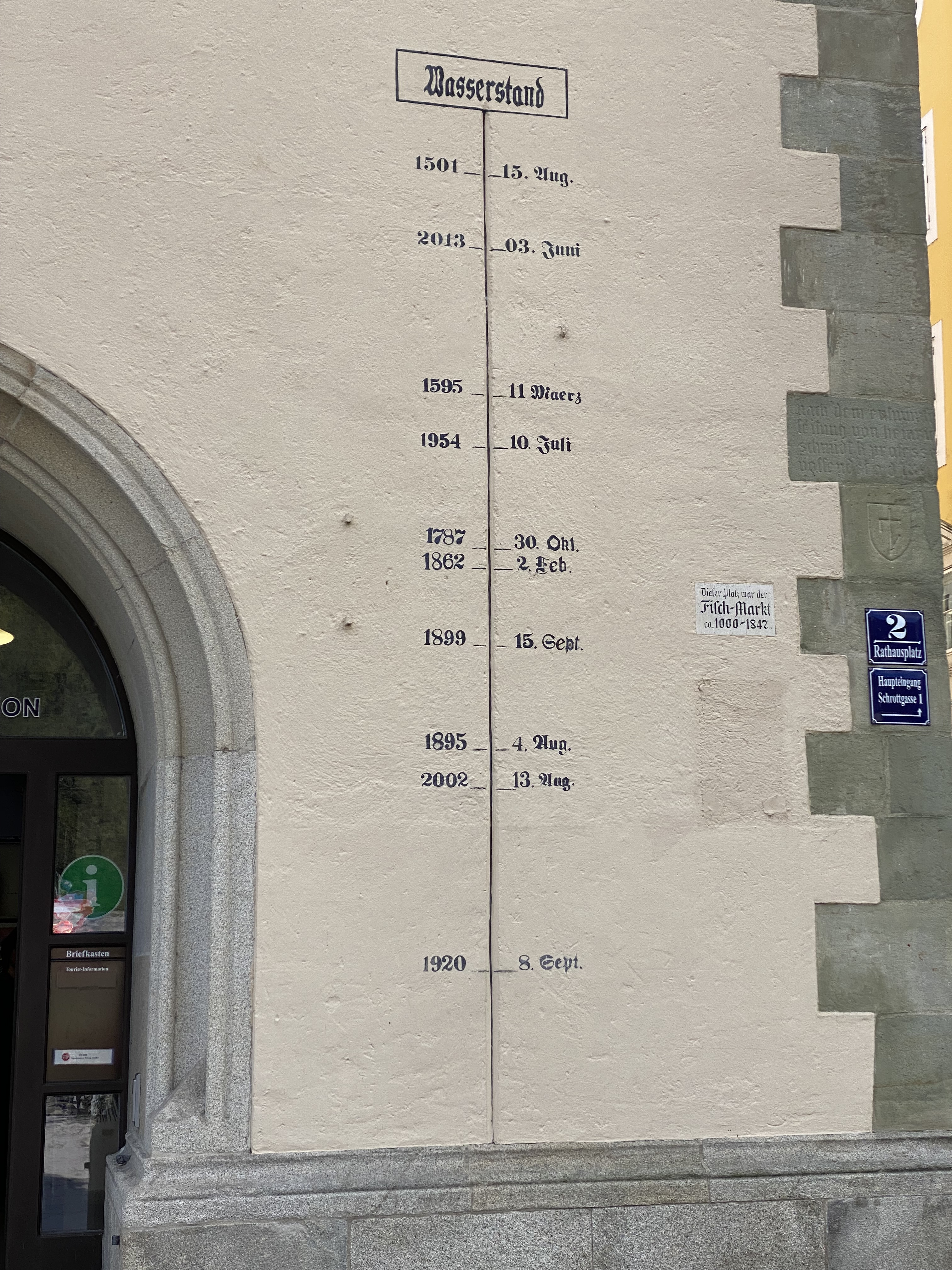
What you see in this photo is the high-water marks of historic floods. The marks are recorded on the City Hall, which fronts the Danube. You can see the marks in comparison to a lofty front door, about 10-12 feet high. The worst flood, it is believed, occurred in 1501. The second worst flood was in 2013, when the water level reached about 15′.

Our guide, a law student, said that all higher education in Germany is tuition-free. But you can’t be admitted without passing an exam. You pass more exams to check your progress. If you don’t pass the exam, you get booted out. Students who are committed to their education are likely to retain their places. Those who are not keeping up are at risk of being kicked out.

I learned that Germans put a high value on education. Parents can send their children to religious and private schools, but such schools must follow the same standards and curriculum as public schools. Home schooling is not permitted.

I asked about Jews in Passau, and our guide–a law student–said the Jews left Passau 500 years ago. Later, I googled and learned that in the fifteenth century, a petty thief confessed that he stole the Host and sold it to Jews. Ten Jews were accused of stabbing the Host until it bled. The Jews were tortured until they confessed, and they were put to death along with their accuser. In the aftermath, the synagogue and Jewish homes were burned. A few dozen Jews converted to Christianity, and the rest of the small Jewish community packed up and left Passau. https://www.jewishvirtuallibrary.org/passau

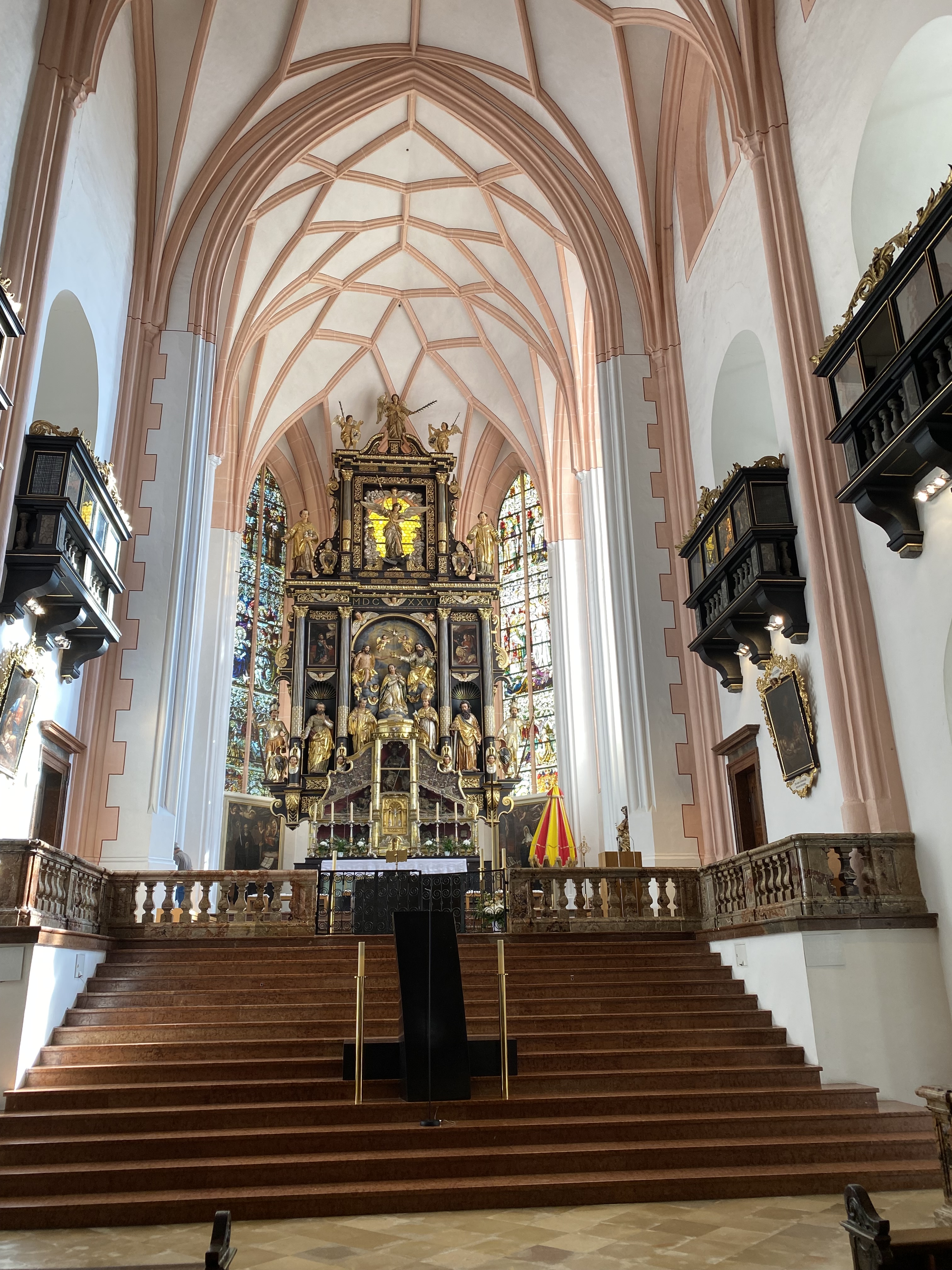
We visited the main church in town. It was stunning, a magnificent combination of gothic and baroque styles.

In the evening, back on our ship, an oompah band played, and it was delightful. I feel a keen sense of double identity, first, as an American enjoying their performance and singing along with familiar songs and polkas. (“I love to go a wandering, along the mountain track, and as I go, I love to sing, my knapsack on my back.”)

Yet as a Jew, I can’t help looking at these friendly, jovial faces and wondering whose grandfather was a Nazi. None of them? Maybe.

Mary says I’m obsessed with the Holocaust. I don’t think so. But to be in Germany and Austria is to be constantly reminded of the horrors that befell people whose only crime was to be Jewish.

Friday we visit the infamous Treblinka concentration camp in the Czech Republic. I will go there to honor the dead and to pray, “Never again.”

These are measures of how high the flood rose and the year in which it happened. The worst flood occurred in 1501. The second worst was 2013.

Bad things happen in all sectors. But so many bad things happen in Charterworld because there are so few controls or oversight. Public school employees typically undergo background checks, and their schools are regularly audited. The charter industry considers state regulation of any kind to be insulting.

But, lo! A charter school founder in Cleveland was arrested for being part of a human trafficking ring.

Incredible!

CLEVELAND — On Monday, Ohio Attorney General Dave Yost announced that a total of 160 people were arrested in a human trafficking crackdown initiative, known as “Operation Buyer’s Remorse.”

Among the list of 160 people who were taken into custody from Sept. 25-30 was 68-year-old John Zitzner, the co-founder of Breakthrough Charter Schools.

According to a spokesperson for the Ohio Attorney General’s Office, Zitzner was arrested by the Northeast Ohio Human Trafficking Task Force. Zitzner told task force members that “he works in education at Friend of Breakthrough Schools.” His case is being handled through the Rocky River Municipal Court.

Court records show that Zitzner was arrested on Sept. 28 in Westlake and charged with engaging in prostitution. He had his initial court appearance on Monday and is scheduled to be arraigned on Oct. 10.

What kind of person founds charter schools and engages in human trafficking and prostitution?

Since Governor Ron DeSantis engineered the hostile takeover of Florida’s progressive New College, the interim president was Richard Corcoran. Corcoran was a hard-right Speaker of the House of Representatives and Dtate Commissiober of Education, in which role he led the state’s attacks on public schools and the expansion of charter schools and vouchers. His wife founded a charter school and is now associated with the Hillsdale College Barney charter schools.

After a few months of deliberation, the hand-picked, stacked board decided to hire Corcoran as the permanent president of New College.

To be clear, he has no academic or scholarly credentials to be a college president.

He dropped out of the University of Florida and enrolled in St. Leo University, a Catholic college. After graduating, he received his law degree from Regent University, a private Christian university.

He has no previous experience as a professor, a college administrator, or a scholar. He is uniquely unqualified for a college presidency. Since he took charge of New College, one-third of the faculty has resigned, faculty have been denied tenure without reason, and students have protested the decisions of the board.

He has been successful in rightwing politics.

The original New College was founded as a school for creative, free thinkers, educated by faculty who were highly credentialed. The new DeSantis board intends to turn New College into the Hilllsdale of the South.

Corcoran claims to have boosted enrollment, which he did by recruiting athletes, not aesthetes or free thinkers.

Shani Robinson was one of the Atlanta teachers who was convicted during the Great Cheating Scandal of 2015. Almost ten years later, she and five others who refused to plead guilty are still free while appealing their convictions. Shani wrote a book about her ordeal called None of the Above, which I reviewed here. Shani’s book persuaded me that she had not cheated; she had no motivation to cheat since the scores of first-graders did not count for AYP (Adequate Yearly Progress) or for a bonus for her. She was outraged to be accused of cheating, and she resisted all plea deals that required her to plead guilty or to accuse others, even if the plea deal allowed her to walk free. She was determined to insist on her innocence rather than make a deal with prosecutors.

Now that Trump and others are accused using the RICO statute, I contacted Shani to ask her where her case stands today.

Shani wrote this account for the blog:

Most everyone I know is paying attention to the prosecution of former President Donald Trump and 18 of his allies related to an alleged conspiracy to overturn the 2020 election. Georgia’s Racketeer Influenced and Corrupt Organization (RICO) Act makes that possible. I view the proceedings with mixed feelings, as I was falsely accused and convicted under that same RICO Act during the Atlanta Public Schools (APS) Cheating Trial in 2015.

My name is Shani Robinson and I’m a former first grade teacher. I was falsely accused of cheating on my students’ standardized tests by a former co-worker, whose story changed every time she was interrogated by the Georgia Bureau of Investigation (GBI), but who was ultimately offered immunity in exchange for her testimony. Former Fulton County District Attorney Paul Howard Jr. claimed that cheating was the result of a criminal conspiracy. He used RICO—a law devised to take down the American Mafia—to throw the book at educators. I was offered a plea deal that would have whittled my potential 25-year prison sentence down to community service. But I wasn’t willing to admit guilt for something I hadn’t done and/or falsely accuse someone else. I also never received bonus money (the basis for the RICO charges) because my school didn’t reach the district targets, which were APS’s testing goals that prosecutors claimed were the main culprit behind the cheating. There was no motive for me to cheat because as a first-grade teacher, my test scores didn’t count toward the district targets.

The APS cheating case was rife with corruption from the beginning. Former Georgia Governor Sonny Perdue sent an unprecedented number of GBI agents into APS in 2010. Teachers were pulled out of their classrooms and told to speak with these agents, and in most cases, there were no attorneys present. Agents used intimidation to elicit confessions and accusations: Some educators complained that GBI interrogators threatened that they could lose custody of their children if they didn’t cooperate. Educators who maintained their innocence were asked to sign pre-written statements saying they didn’t cheat. Some of the teachers who signed the forms were still accused of cheating and were charged with making false statements and writings, a felony, because they had followed instructions and signed the statements the GBI provided. At the same time Perdue’s investigation was underway in APS, he turned around and used the same questionable test scores in an application for President Obama’s Race to the Top program and won a $400 million federal grant.

The trial was like a circus. The judge called out prosecutors on multiple occasions for improperly influencing the jury. But the judge himself was often out of line too: from telling the jury a story about a man he caught masturbating, to having a private conversation with former District Attorney Paul Howard Jr., to pressuring my co-defendants and me to take plea deals. While the prosecutorial and judicial misconduct that took place was bad enough, the mainstream media helped fuel the fire to justify the RICO charges. Their overall narrative was that educators cheated to get bonus money. This patently contradicted the GBI investigative report, which stated bonus money provided “little incentive” to cheat. One of the lead investigators on the case also stated this when he testified during the trial. Despite the flaws, the jury convicted all but one of us that was on trial.

The problem with RICO is that it criminalizes such a broad range of conduct, including acts by many people who have nothing to do with each other. RICO was originally written to attack organized crime; using such a statute against educators for cheating on standardized tests is unconscionable. Since the 2001 enactment of No Child Left Behind, a federal policy that mandated standardized testing and imposed sanctions on schools that failed to meet unrealistic goals, The National Center for Fair and Open testing documented cheating cases in nearly 40 states and Washington, DC. Only in Atlanta did educators face felony charges saddled with decades-long prison sentences.

This RICO indictment has hung over my head for the past 10 years, leading to a diagnosis of Post Traumatic Stress Disorder (PTSD). The impact of PTSD and the fallout from the trial has taken a significant toll on my family. I have 2 small children, sothe thought of going to prison and being separated from them is agonizing. There are 6 defendants, including me, still appealing convictions. We’ve all been able to remain out of prison thus far due to being on appeal bonds. But the case has been handled so poorly; the entire appeals process restarted this year with no end in sight. Millions of tax players dollars have already been spent on this trial.

 Last year brought a ray of hope: Judge Jerry Baxter granted a new sentence for a principal who was convicted, enabling her to avoid prison and do community service instead. I’m hopeful that Fulton County District Attorney Fani Willis and Judge Jerry Baxter will come to the realization that RICO was misused in our case and find a peaceful resolution. Otherwise, the APS Cheating Trial could potentially be used as a playbook for other unjust prosecutions that clog up the legal system and waste public resources.

Our river cruise stopped in Linz (think Linzertorte, a busy industrial town, and we went by bus to Salzburg, the birthplace of Mozart. It is a beautifully preserved city, with a city center that has no autos, only bicycles and carriages. To call it spotlessly clean would be an understatement, although it’s full of tourists like us. Our guide was a charming woman who knew every last detail of “The Sound of Music.” She told us what the movie got right, what it got wrong. For example, when the Trapp family hikes off into the mountains to escape the Nazis, they were heading towards Germany! Oops, wrong direction. And of course, we had to see the beautiful church where Captain Trapp and Maria were “married.” Like so many churches in Austria, overflowing with beautiful ornamentation. We went to a beer garden for lunch, where we had weisswurst and beer. There are no high rises in the center, and the houses all look as though they were painted yesterday.

By the way, higher education is tuition-free in Austria and Germany but students must pass an exam to enroll.

Salzburg