Archives for the month of: June, 2023

Carol Burris, executive director of the Network for Public Education, writes here about the latest disturbing development in the charter school industry—the growth of charter schools that promote a Christian Nationalist perspective. Her article was published on Valerie Strauss’s blog The Answer Sheet at the Washington Post.

Valerie Strauss introduces Carol’s article:

The religious right scored a win this week when Oklahoma’s virtual charter school boardapproved the opening of the nation’s first religious charter school, which, if it is actually allowed to open as planned in 2024 for grades K-12, will weave Catholic doctrine into every single subject that students take. Given that charter schools are publicly funded, and public schools aren’t supposed to provide religious education (although they can teach about religion), you may wonder how this school could be given permission to exist.

The decision is no surprise to people watching the way some charter schools run by right-wing organizations have been operating in recent years, pushing the boundaries of the separation of church and state embedded in the U.S. Constitution even as Supreme Court decisions have chipped away at it. Details can be found in a new report entitled “A Sharp Turn Right: A New Breed of Charter Schools Delivers the Conservative Agenda.” (See full report below.) It was written by the nonprofit Network for Public Education, a group that advocates for traditional public school districts and opposes charter schools, and has written reports in recent years chronicling waste and abuse of public funding of charter schools.

The network’s newest report looks at charter schools that it says are designed to attract Christian nationalists with specific imagery and curriculum. The student bodies of these schools are largely Whiter and wealthier than in other schools — in the charter sector and in traditional public districts — and have deep connections to people within conservative Christian movements, the report says.

Former U.S. education secretary Betsy DeVos, a leader in the movement to expand charter schools and school vouchers — which use public funds for private and religious school education — has acknowledged that her work in the education sphere is driven by desire to advance school choice as a path to “advance God’s kingdom.” Her husband, Amway heir Richard DeVos, who worked with her for decades in the school choice movement, said he was sorry that public schools “displaced” churches as the center of communities.

The charter school movement moved into new territory Monday when the Oklahoma Statewide Virtual Charter School Board approved, on a 3-2 vote, an application for the opening of a virtual school to be named St. Isidore of Seville Catholic Virtual School and run by the Roman Catholic Archdiocese of Oklahoma City and the Diocese of Tulsa. The vote will be challenged in court, and as attorney and education policy scholar Kevin Welner wrote on this blog last year, we can expect to see litigation around whether church-run charters can “successfully assert their Free Exercise rights in an attempt to run the school without restrictions on proselytizing and religiously motivated discrimination.” You can read here about howthe Supreme Court has been laying the groundwork for religious charter schools.

The new report by the Network for Public Education focuses on two types of charter schools: classical charters — which use the word “classical” in their names — and those offering “back to basics” curriculum. Diane Ravitch, an education historian and co-founder of the Network for Public Education, said in an introduction to the report that these charter schools are “the lesser-known third part” of a strategy by right-wing Christians to undermine secular public education; the others are vouchers and similar programs that use public funding for private and religious education, and book/curricular bans.

While private classical schools have a long history — emphasizing Eurocentric texts and the study of Latin and Greek — what is new is “the use of taxpayer dollars to fund them when they become or are established as charter schools,” the report said. Founders of classical charters generally reject modern instructional practices and accuse Progressive Era educational leaders such as John Dewey for removing Christian ideals from curriculum.

The Network for Public Education’s report notes that in classical private Christian schools, the curriculum focuses not only on the Western canon — Homer, C.S. Lewis and beyond — but also on scripture. “Classical charter schools emphasize ‘values’ or ‘virtues,’ which stand as shorthand for quoted scripture,” it says, which is especially true of classical charters that have opened since Donald Trump became president in 2017. “From videos posted on websites to crosses shown on the top of the school, we found example after example of charter schools presenting themselves as free private Christian schools,” the report says. It cited Liberty Common High School in Fort Collins, Colo., which celebrates “capstones” representing the “highest order of virtue and character,” including “prudence, temperance, and patriotism,” and the American Classical Charter Academy in St. Cloud, Fla., which promotes eight “pillars of character” and four “classical virtues.”

“Back to basic” schools use red, white, and blue school colors, patriotic logos and pictures of the Founding Fathers, along with terms such as virtue, patriotism and sometimes outright references to religion, the report says, citing as an example the website of the four-campus Advantage Academy in Texas, which boasts of educating students in a “faith-friendly environment.” The Cincinnati Classical Academy, another charter school, does not advertise its charter status on its website, while offering a free education with instruction in “moral character.” The American Leadership Academy in Utah posts videos its choir singing religious songs; one includes the note, “We want to help kids and adults turn to Jesus, or become Jesus people.

The fastest-growing sector of right-wing charters combines both a classical “virtuous” curriculum with “hyper-patriotism,” exemplified by charter schools that adopt the Hillsdale 1776 curriculum, which is centered on Western civilization and designed to help “students acquire a mature love for America,” its organizers say. The curriculum comes from Hillsdale College in Michigan, whose longtime president, Larry Arnn, is an ally of Trump’s and is aligned with DeVos. A Hillsdale K-12 civics and U.S. history curriculum released in 2021 extols conservative values, attacks liberal ones and distorts civil rights history, saying, for example: “The civil rights movement was almost immediately turned into programs that ran counter to the lofty ideals of the Founders.”

The Network for Public Education said that it had identified 273 open charter schools that offer a classical curriculum and/or have websites designed to attract White conservative families with for-profit management corporations running 29 percent of them, a percentage nearly twice as high as the entire charter school sector.

The new report looks at Roger Bacon Academy charter schools, run by Baker A. Mitchell Jr., which prohibit girls from wearing pants or jeans to school in order, according to a lawsuit, to ensure they are regarded as “fragile vessels” that men are supposed to take care of and honor, based on a quote from the Bible’s New Testament. (A ruling in a lawsuit challenging the dress code is on appeal to the Supreme Court after a federal judge ruled in favor of Bonnie Peltier, who objected to the unequal treatment of her daughter.) Students are also required to recite a daily oath committing them to be “morally straight” and guard “against the stains of falsehood from the fascination with experts,” while also avoiding the “temptation of vanity” and “overreliance on rational argument.”

“A Sharp Turn Right” also says one purpose of these schools is “to raise the next generation of right-wing warriors” to fight culture wars. Kyle Shideler, a senior analyst at the Center for Security Policy, an anti-Muslim organization classified as a hate group by the Southern Poverty Law Center, wrote in a recent article in the Federalist that donors should fund boot camps to train right-wingers in “the political dark arts” of organizing. In the article, he praises Hillsdale College for “the growing Christian classical school movement … for the purpose of forming young minds.”

Shideler is referring to Hillsdale’s Barney Charter School Initiative, which stems from the Barney Family Foundation, established by Stephen Barney and his wife, Lynne, in 1998. The report says it identified 59 charter schools that are open or will soon open that claim affiliation to the initiative. While Hillsdale College’s mission is to maintain “by precept and example the immemorial teachings and practices of the Christian faith,” the mission of their K-12 charter schools includes a call for “moral virtue.”

The foundation’s 990s tax forms show that in addition to its health and child-centered charities, it funds right-wing think tanks, foundations and organizations that create conservative legislation on various issued used as models by Republican-led states. One recipient has been Hillsdale College, where Stephen Barney is a trustee emeritus on the Board of Trustees. Between 2010 and 2019, the Network for Public Education identified more than $4 million earmarked for the college from his foundation. In 2010, the Barney Charter School Initiative began with a half-million-dollar contribution from the foundation, and contributions in that range have been recorded every year for which records are available, the report says.

“A Sharp Turn Right” discusses examples of Republican officeholders and party chairs who, like Oklahoma Gov. Kevin Stitt (R), aggressively push the conservative charter school agenda. Republican Heidi Ganahl, who lost to Colorado Gov. Jared Polis (D) in the 2022 gubernatorial election, is a founder of the Golden View Classical Academy. She also advocates for one of the fastest-growing Hillsdale-affiliated charter chains, Ascent Classical Academies, which operates two schools in Colorado, with plans to open four more in South Carolina, three in Colorado and at least one in North Carolina.

Read the report here.

John Merrow started a challenge to himself in 2011, on his 70th birthday. He set himself the goal of biking 70 miles, one for each year, and raising money for charity. He has done it every year since then. This year he turns 82. Can he bike 82 miles? I’m betting on John!

He writes here:

In a few days, Lord willing, I will turn 82, and that means it’s time for another attempt at biking my age. I began this exercise in putting off the inevitable in 2011, the year I turned 70. I’ve achieved my goal for 12 consecutive years, but the distance increases every year and I get a year older, so, as those financial ads warn, please remember that “past performance is no guarantee of future results.”

As I have in the past, I’m asking you to dig deep for a preferred good cause, which this year is World Central Kitchen, the remarkable charity founded in 2010 by Chef José Andres. WKC, a non-profit, is first to the frontlines–whether it’s Ukraine or countries like Haiti devastated by a natural disaster. WKC provides fresh meals in response to crises, while simultaneously working to build resilient food systems with locally-led solutions. WKC has served more than 250 million nourishing meals around the world. Charity Navigator makes it clear that 100% of your gift, which is 100% tax-deductible, will help WKC provide more meals to those in need.

Here’s an easy way to donate $820, or $82, or $8.20 to World Central Kitchen. Thank you.

Please open the link to finish reading the post.

I have sent several donations to WKC. I will send another to honor John.

If you read only one article today, read this one. It’s powerful and poignant. The article was written by Forrest Wilder and appears in the Texas Monthly, a terrific publication.

To understand why Republican legislators from rural districts helped to defeat vouchers in Texas, read this article about the schools of Fort Davis in Jeff Davis County in rural West Texas. The superintendent is a bedrock conservative who is dead set against vouchers. His schools are on the verge of bankruptcy due to the state’s Byzantine school-finance system. The state government doesn’t care. At the end, you will understand Governor Abbott’s long-term goal: to eliminate property taxes and completely privatize education.

Texas doesn’t have a mile-high city, but Fort Davis comes close at 4,892 feet. The tiny unincorporated town is nestled in the foothills of the Davis Mountains, where bears and mountain lions and elk stalk among pine-forested sky islands. Fort Davis is the seat of Jeff Davis County, whose population of 1,900 is spread among 2,265 square miles, 50 percent bigger than Rhode Island. The sparsely populated desert country of Mongolia has nearly seven times the population density of Jeff Davis County. Odessa, the nearest city to Fort Davis, is two and a half hours away. The state Capitol is six and a half.

For Graydon Hicks III, the far-flunged-ness of Fort Davis is part of its appeal. He likes the high and lonesome feel of his hometown—the “prettiest in Texas,” he says. But these days, it has never felt further from the state’s political center of gravity.

For years, Hicks, the superintendent of Fort Davis ISD, has been watching, helplessly, as a slow-motion disaster has unfolded, the result of a flawed and resource-starved public-school finance system. Over the last decade, funding for his little district, which serves just 184 K–12 students, has sagged even as costs, driven by inflation and ever-increasing state mandates, have soared. The math is stark. His austere budget has hovered around $3.1 million a year for the past six years. But the state’s notoriously complex school finance system only allows him to bring in about $2.5 million a year through property taxes.

Hicks has hacked away at all but the most essential elements of his budget. More than three-quarters of Fort Davis’s costs come in the form of payroll, and the starting salary for teachers is the state minimum, just $33,660 a year. There are no signing bonuses or stipends for additional teacher certifications. Fort Davis has no art teacher. No cafeteria. No librarian. No bus routes. The track team doesn’t have a track to train on.

But Hicks can’t cut his way out of this financial crisis. This school year, Fort Davis ISD has a $622,000 funding gap. To make up the difference, Hicks is tapping into savings. Doug Karr, a Lubbock school-finance consultant who reviewed the district’s finances, said Fort Davis ISD was “wore down to the nub and the nub’s all gone. And that pretty much describes small school districts.”

“I am squeezing every nickel and dime out of every budget item,” Hicks said. “I don’t have excess of anything.” When I joked that it sounded like he was holding things together with duct tape and baling wire, he didn’t laugh. He said: “I literally have baling wire holding some fences up, holding some doors up.”

The district’s crisis comes at a time when the state is flush with an unprecedented $33 billion budget surplus. Hicks is a self-described conservative, but he thinks the far right is trying to destroy public education. For years, the state has starved public schools of funding: Texas ranks forty-second in per-pupil spending. And yet Governor Greg Abbott is spending enormous political capital on promoting a school voucher plan, which would divert taxpayer funds to private schools. Public education, Abbott has repeatedly said, will remain “fully funded,” though public-education spending is lower now than when he took office in 2015, and the Legislature recently passed a $321.3 billion budget with no pay raise for teachers and very little new funding for schools. Unable to get his voucher plan through the regular legislative session, Abbott is threatening to call lawmakers back to Austin until he gets his way.

Lieutenant Governor Dan Patrick, long a champion of vouchers, is backing legislation that would attempt to appease rural Republican legislators—a bloc long wary of vouchers—by offering $10,000 to districts that lose students to private schools. Hicks can barely contain his anger when he hears such talk. He has been lobbying state leaders for years to fix the crippling financial shortages that plague districts like his. “Take your assurances and shove ’em up your ass,” he says, before softening a bit. “I’m so tired. I’m so frustrated. We have tried. I have fought and fought and fought.”

With each passing month, his rural district inches closer to financial ruin. If nothing changes by next summer or fall, Fort Davis will have depleted its savings. He doesn’t know the exact day that his school district will go broke, but he can see it coming.

It’s easy enough to grasp the basic problem in Fort Davis. But what’s going on beneath the surface is another story.

During my twenty years of reporting on Texas politics, I’ve often heard that only a handful of people in the state understand the school-finance system, with its complicated formulas, allotments, maximum compressed tax rates, guaranteed yields, and “golden pennies.” A former colleague of mine, who once spent months trying to make sense of the topic, warned me against writing about it. Karr, the school finance consultant, compares the process of making sense of our public education funding to encountering a fire at a roadside cotton gin on some lonely West Texas highway. “You drive off into that smoke and you might never drive out,” he said. “You might end up getting killed.”

A thorough explanation of the system is the stuff of graduate theses, but the broad strokes are straightforward enough. How a school district is funded begins with two key questions: How much money is the district eligible for? And who pays for it?

Here it’s helpful to use a venerable school finance analogy: buckets of water. The size of a school district’s bucket—how much money it’s entitled to—is largely determined by the number of students in attendance. Every district receives at least $6,160 per pupil, an amount known as the basic allotment, an arbitrary number dreamed up by the Legislature and changed according to lawmakers’ whims.

At this point in the article, Wilder goes into the intricacies of school finance in Texas. Very few people understand it. All you need to know is that some districts are lavishly funded while others, like Fort Davis, are barely scraping by and may go bankrupt.

Hicks is not alone in thinking the opaqueness is intentional. “They make it just as complicated as they can,” he said of state officials. “Because how do you explain something so complicated to the average voter?” In other words, if constituents can’t easily grasp the perplexing and unnecessarily knotty framework, it’s tougher to hold officials accountable for budget decisions.

Though the spreadsheets may be head-spinning, they tell a story. In a state where some wealthy suburban communities build $80 million high school football stadiums, Fort Davis ISD is one of many rural communities literally struggling to keep the lights on.

I first heard from Hicks in March 2021, when he emailed state officials and journalists with a dire message: “What, exactly, does the state expect us to do? What more can we do? What more do our children need to be deprived of? At what point does our community break?” Hicks has received few answers, even as his situation has grown more desperate.

When I visited him in April, we met in his office, where he keeps a book on Texas gun laws, a photo of his West Point 1986 graduating class (which included Donald Trump’s secretary of state Mike Pompeo), and a list of quotes from General George Patton (“Genius comes from the ability to pay attention to the smallest details”). Hicks, who’s stout and serious and talks in a sort of shout-twang because of partial hearing loss, wore a cross decorated in the colors of the American flag. He was eager to show me the fine line he walks between fiscal prudence and dilapidation. The first lesson came as he stood from his desk and I noticed the holstered handgun on his hip. The district, he explained, can’t afford to hire a school security officer, so he and eleven other district employees carry firearms.

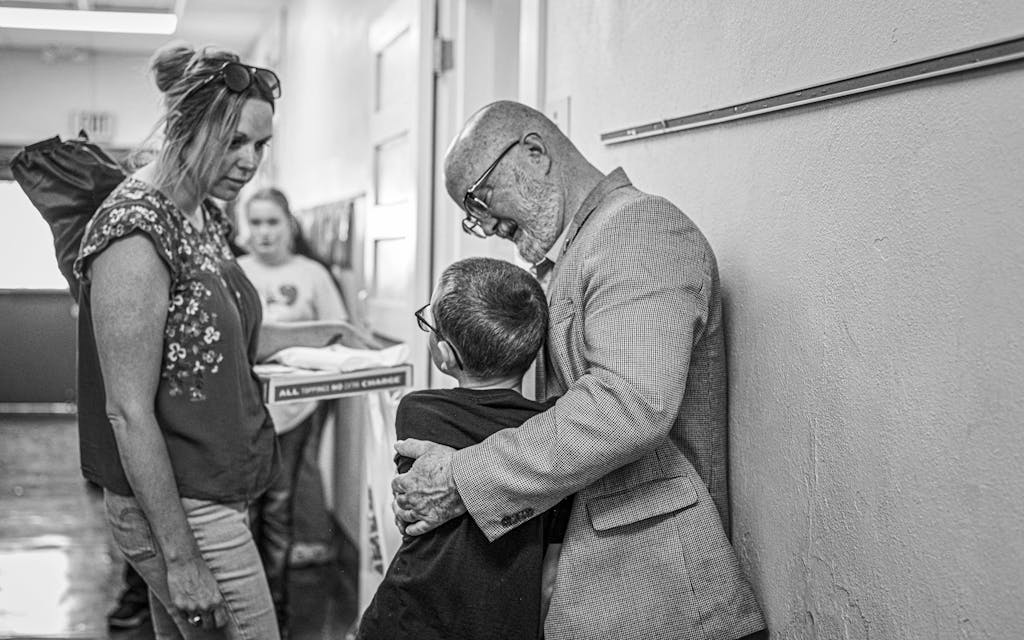
His family has been in the area since the 1870s, when federal soldiers still pursued Comanche and Apache from the town’s namesake garrison. His great uncle was one of the first superintendents of Fort Davis ISD. (At one point, Hicks showed me a copy of his great-uncle’s 1942 master’s thesis, “The Early Ranch Schools of the Fort Davis Area.”) Later, as we were walking around campus, Hicks’s ten-year-old grandson, a thin fourth-grader wearing blue-rimmed glasses and blue jeans tucked into a pair of cowboy boots, ran up to Hicks and gave him a hug.

Fort-Davis-Superintendent-Graydon-Hicks-grandson-Dirks-Anderson-Elementary-School-BW
Superintendent Hicks hugs his grandson in the hallway at Dirks-Anderson Elementary School in Fort Davis.Photograph by Maisie Crow

Both the elementary school and the high school—where Hicks graduated in 1982—were built in 1929, Hicks explained. Walking through their timeworn hallways is to step back in time. In places, the plaster is flaking off the original adobe walls. The elementary school gym floor is bubbling up because of a leak under the foundation. The wooden seats in the high school auditorium have never been replaced. The urinals in the elementary school are original too. The newest instructional facility, a science lab, was built in 1973. In the summer, Hicks mows the football field, the same one he played on five decades ago. “Every bit helps,” he said.

The funding challenges create all manner of ripple effects. Hicks has trouble recruiting and retaining teachers, and some students drift away from school without extracurriculars to hold their interest. “You lose teachers, then you start losing kids, and then your funding gets worse,” he said. “It’s a circle-the-drain kinda thing. And it’s really speeding up for Fort Davis.”

The first problem is the size of the district’s bucket. For the last decade, TEA has calculated that Fort Davis’s Tier I annual allotment is between $2 million and $2.5 million, well short of its already spartan $3.1 million budget.

And then there’s the matter of how that bucket is filled. In the 2011–2012 school year, the state covered two-thirds of Fort Davis’ entitlement, about $2.1 million. Today, it chips in about $150,000, a 93 percent decrease. How to explain that change?…

In June 2019, the Big Three figures in state government—Abbott, Patrick, and then–House Speaker Dennis Bonnen—gathered at an elementary school in Austin for an almost giddy bill-signing ceremony. As a bipartisan group of lawmakers watched, Abbott signed into law House Bill 3, an $11.6 billion package of property tax cuts and education funding that had received near-unanimous support in both the House and Senate, a rarity in the highly polarized Legislature. “This one law does more to advance education in the state of Texas than any law that I have seen in my adult lifetime,” said Abbott.

For almost a year, an appointed commission of experts had met to discuss how to overhaul the school-finance system, issuing a report in December 2018 that called on the Lege to “redesign the entirety of our state’s funding system to reflect the needs of the 21st century.” HB 3 was the by-product of that prompt. Lawmakers rejiggered many of the system’s outdated formulas, offered pay raises to teachers, fixed some of the most glaring inequities, and reduced the amount of money recaptured by the state from property-wealthy districts. Most important, HB 3 represented a much-needed infusion of cash for struggling schools. The basic allotment was raised from $5,140 to $6,120 per student.

But HB 3 also exacerbated disparities among property-wealthy and property-poor districts. Because of changes to the way Tier II enrichment funding works, some communities were able to cut tax rates and generate significant new revenues from their tax base. For others, a minority of districts, HB 3 actually created new problems. Around 10 percent of districts saw a decrease in formula funding. This year, Alpine has $220,000 less than it would have had under the old system, even as some of the richest districts in the state—tiny West Texas communities with lots of oil wealth—saw their funding explode. Rinehart contrasts Alpine, which has almost no mineral wealth, with Rankin ISD, 130 miles northeast in the Permian Basin oil patch. While Alpine’s funding went down 2 percent, Rankin’s went up 339 percent. Even though Rankin is projected to return close to $100 million in recapture payments to the state this year, the district is fabulously wealthy. “Alpine’s budget is $10 million,” Rinehart points out. “Rankin’s is $14 million. We educate a thousand kids and they educate three hundred kids. So they are a third of our size and have a budget 40 percent larger than ours.”

Rinehart doesn’t begrudge Rankin’s wealth—she recently served as assistant superintendent there—but uses the Alpine–Rankin comparison as a “wild” example of how HB 3 exacerbated inequities, making the rich richer and the poor poorer.

Hicks, too, has noticed. “Rankin just built a whole new school,” he told me. “They got a new fieldhouse, a new gym. Two new science labs. A turf practice field, a turf game field. A new track, a new stadium. And my buildings were built in 1929.” Rankin is planning to build ten new “teacherages”—district-funded housing for teachers, important to attracting and retaining talent in areas with scant or affordable residences.

Jeff Davis County, on the other hand, has no oil and gas and very little industry; any school debt would thus be borne by homeowners through bonds. Hicks’s district has never issued a bond, in part because it would be unlikely to pass; the voters wouldn’t support a tax increase. The school’s ag barn was built in 2019 with local donations. The band program, suspended for nine years as a cost-saving measure, was only revived in 2023 after a philanthropist left his estate to the school.

To be sure, Alpine and Fort Davis are outliers. Most districts saw an immediate boost to their finances from HB 3, and advocates celebrated a meaningful investment in public education after $5.4 billion in devastating cuts in 2013. But even for those districts, the sugar rush from HB 3 didn’t last long. According to Chandra Villanueva, the director of policy and advocacy at the progressive nonprofit Every Texan, the $1,000 increase in the basic allotment was “roughly enough to cover one year of inflation….”

The property tax system and the school finance system are inextricably linked, Rube Goldberg–style. Twist a dial here and a light will come on over there. Slip a gear here and spring a leak there. As state lawmakers have prioritized tax cuts over public education funding, the trade-offs have grown clearer. This year represents a potential turning point. But rather than trying to solve the problem using the $33 billion budget surplus—a generational bonanza—Abbott and Patrick have overwhelmingly focused their attention on property tax cuts and a school-voucher plan loathed by almost everyone in public education, in part because it would threaten to strip even more funding from school districts.

The just-completed regular session was a bloodbath. The 88th Legislature began in January with the governor and lieutenant governor promising to pass a transformative voucher program and a record-setting $17 billion in property-tax cuts. Funding for public education, often a banner issue, was scarcely discussed. Even the House, the friendlier chamber toward public education, only proposed raising the basic allotment by $140, from $6,160 to $6,300 per student—far less than the $1,500 increase needed to keep up with inflation since 2019, according to the Texas American Federation of Teachers. But in the end, teachers and public schools got virtually nothing.

Teachers and administrators were stunned. Zeph Capo, the president of Texas AFT, called it a “joke.” HD Chambers, the executive director of the Texas School Alliance, accused Patrick and Abbott of playing a “hostage game” with Texas’s teachers and public school students by tying education funding to vouchers. “It’s pretty simple. The governor and Senate says, ‘If you don’t give us the kind of vouchers we want, we’re not giving you any money.’” The House refused to budge, and the regular session concluded without a deal on property tax relief, vouchers, and other GOP priorities.

Now, the governor has promised to convene multiple special sessions to take up the unresolved issues. The first special session began three hours after the regular one ended, and effectively wrapped up less than 24 hours later, with the House rejecting the Senate property-tax plan, passing its own program consisting solely of property-tax compression, and then abruptly adjourning. Abbott threw his support behind the House plan. The message to the Senate was clear: take it or leave it. If the Senate yields, the House version would push some school districts down to as low as $0.60 per $100, with no new source of revenue to backfill for the reduced funding in case of a bad economy.

Abbott has said his goal is to completely eliminate the main school property tax. In such a scenario, Texas’s thousand-plus school districts would be at the mercy of the Legislature for funding—a troubling scenario, says Villanueva. She suspects vouchers would then become inevitable. “At that point, it’s like, ‘You know what, we don’t have the money to fund schools. Everyone take five thousand bucks, figure it out for yourselves.’”

That day, if it ever comes, may still be far off. But the education system is in crisis right now, and unlike previous hard times, the state is flush with cash. The pain, Chambers says, is being intentionally inflicted by Abbott and Patrick. “Because of this one pet project that the governor has”—vouchers—“they are purposely creating a financial environment where every school district in Texas is being set up to fail.”

The result is that Texas schools, already operating on “shoestring budgets,” will have a harder time attracting and retaining educators, said Josh Sanderson, the deputy executive director of the Equity Center, a nonprofit that represents six hundred Texas school districts. They will run up deficits. They may have to cut extracurriculars and athletic programs. Some, like Fort Davis, may become insolvent and be forced to consolidate with another district, an often painful process.

As we were sitting in his red pickup with the engine idling outside his office, Hicks told me that he’d given up on lobbying the Legislature. He mentioned again that Patrick and other GOP lawmakers are trying to destroy public education by using vouchers to privatize schools, and he said that most other politicians “don’t give a shit about West Texas.” But for the time being he was still fighting: writing op-eds, firing off plaintive missives, asking concerned citizens to contact their legislators.

Toward the end of our visit, I asked Hicks what’s going to happen to his schools. “I don’t know,” he said. “I’m not patient enough to spend time with assholes in Austin, and I’m not rich enough to buy any votes.” TEA has suggested consolidating with another district—most likely nearby Valentine ISD—but Hicks said this would harm both Fort Davis and the other district.

He seemed resigned to his role as a Cassandra warning of impending doom, destined to be ignored. He reminded me that his grandson goes to school here, and that the painful road ahead feels both personal and existential. “If you don’t have a school,” he said, “you don’t have a community.”

Two months later, Hicks called me with some news. He’d decided to resign this summer, joining the mass exodus of school leaders that have fled the profession in the past few years. To anyone who closely follows public education in Texas, his reasoning was tragically familiar: He said he was too tired to fight anymore.

Paul Cobaugh is a military veteran who retired as a Chief Warrant Officer who worked in special operations in communications and narrative strategies. He writes a blog about national security called “Truths About Threats.”

He wrote here about the loathsome Ohio Congressman Jim Jordan.

Cobaugh writes:

This is a short TAT. After all, it is the weekend. This morning, a friend posted on LinkedIn, a copy of the letter Jim Jordan sent to AG, Merrick Garland. That is what pushed me to my keyboard before resuming chores. Endless words will be written after the historical indictment of a former president. I will bring you a very different perspective on that indictment that very few will address, as I wade into this national security nightmare the beginning of next week. In the meantime… please consider my brief thoughts below, not for my sake but for all of ours. “All politics are local.”

The public square in Urbana, Champaign County, Ohio

Okay, I admit that I have a special disgust for Congressman, Jim Jordan. I will though be fair in this short post.

From a political perspective, any honest and well-informed person knows that Jordan was and in some ways, still is a Seditionist and enabler of the Jan 6th armed rebellion. He is also the Rep for the small Ohio town, where I attended 7th grade thru high school graduation. In my view, one of the finest small towns in the nation. Urbana, Ohio, the county seat of Champaign County numbered around 9000 people at the time, the biggest town in the county.

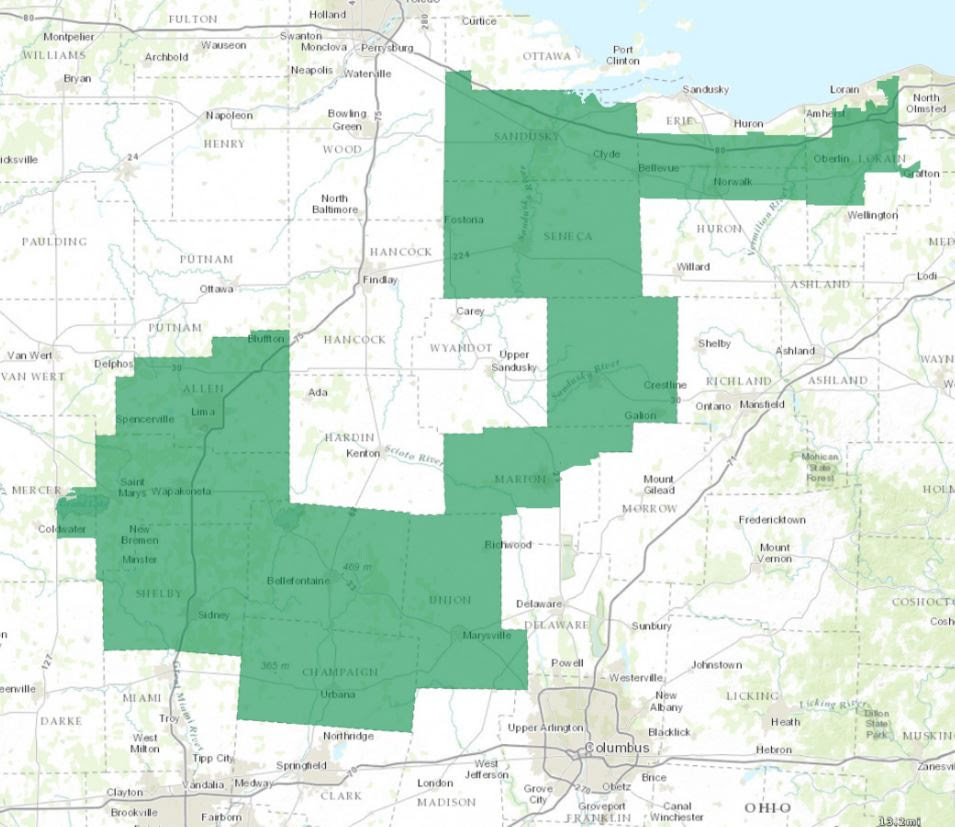
Now Jordan, is the rep of one of the most gerrymandered districts in the country. When I lived in Urbana, Ohio in the late 60’s and early 70’s, our local congressman was exceptionally well liked and respected. Clarence, “Bud” Brown represented what the Republican Party could have been, had they not deviated to scorched earth politics under the leadership and tutelage of Newt Gingrich. America has never been the same since. Don’t see this as an endorsement of the so-called, “other side” but as a statement of clear-eyed facts.

Jim Jordan’s, Ohio 4th Congressional District

This letter by Jordan to the AG, Merrick Garland shows in detail and Jordan’s own hand, the level of false narratives and utter dishonesty that keeps today’s MAGA-controlled GOP afloat. For those who have been warning about this and other indictments based on reality, research, and the opinions of elite experts, this is just another “hail Mary”, mis/ disinformation campaign designed to empower those who’ve proved that they will believe anything, if it suits their political identity. My personal and professional opinion of Jordan sees him as one of the most unethical and dangerous members of Congress.

What I once knew as a community of hardworking mostly rural Ohioans with remarkable grace, compassion and honesty, is now burdened by the weight of being sold snake oil by traitors and conmen who can’t even spell, “American values.” They largely operate on the traitorous narratives of FOX news. Fortunately there is still a solid core of great Americans in my home town but sadly, they are a minority. Even the Trumpists are some of the nicest people you will ever meet. The manipulation of their political identity by unethical, professional influencers, some domestic and some foreign, has resulted in Seditionists like Jordan and his ilk, leading the worst threat to our democracy since the Civil War.

The pain I feel for my hometown, is being played out all across America in small and large towns. The extraordinary work by U.S. Department of Justice, has thrown a hand grenade into their political identity. Now, with DOJ’s meticulously assembled public case being the news of the day, Jordan is launching a full-scale mis and disinformation campaign to support a known traitor. Not one person in Urbana would have tolerated this in my youth, despite being in one of the most reliable Republican Congressional districts in the nation.

Yes, I would also love to scream the words, “I told you so” but that will not heal America. Many Americans who were victimized by foreign and domestic malign influencers, are beginning to realize that they have been badly duped. Give them an open invite back into reality without the derision. They are family, friends and colleagues. Tragically, those who resist reality will likely never recover, because the level of indoctrination that leads to public displays of extremism, more often than not, is like rabies, mostly incurable.

It’s time for all Americans to realize that our fellow citizens are not enemies because they have different beliefs. Our Constitution, based on our founding principles, guarantees our right to our own beliefs, false or not. It’s really up to those who are willing to debate over facts and reality, to heal this nation for America’s sake, not a politcal party. It will be those who adhere to what it means to be a truly patriotic American, left, right or otherwise to put our nation, back on the path of progress, respectability and strength.

Truism: If you vote for honesty, integrity and our true American, founding principles… folks like Jim Jordan would never be in office. However you vote, we can never again allow any extremist movement to have so much say in our government, that they can once again threaten what so many have died to preserve.

Wishing everyone the most enjoyable weekend,

Paul

Ruth Ben-Ghiat, a historian of fascism and autocracy, says that Special Counsel Jack Smith’s 3-minute speech moved her to tears.

She explains why in this post on her blog Lucid:

Welcome back to Lucid, and a big hello to all new subscribers. I started Lucid in 2021 to separate the signal from the noise in politics and provide big-picture thinking about authoritarianism and threats to democracy in the US and around the world. I use my skills as a historian to identify the patterns and dynamics at work in the news that comes at us every day.


In honor of the Department of Justice indictment of Donald Trump, which is only possible because we live in a democracy, for the next week I am offering a 50% discount on the first year of Lucid so that more people can have access to bonus content like this and to the community that has developed from my weekly live Q&As. You can subscribe or convert your current subscription to paid here: (open the link to see the offer).

The bare-bones conference room, with its ugly folding table and florescent lighting overhead. The standard-issue podium at which Jack Smith, Special Counsel at the Department of Justice, stood with his understated attire and not-made for television haircut. There was no glamour and no media buzz as Smith announced the unsealing of a historic indictment against former president Donald J. Trump for “violations of our national security laws as well as participating in conspiracy to obstruct justice.”

All of it moved me to tears.

Special Counsel Jack Smith press conference, June 8, 2023. C-Span.

As an American, I was outraged when I read the indictment. As a scholar of authoritarianism and one of the first people to label Trump as a threat to our freedoms, I was unsurprised at its content. Trump’s proprietary vision of governance was familiar to me, as was his supremely venal attitude. In the strongman world there are no boundaries between public and private. The leader believes it is his right to possess and exploit for personal benefit anything in the nation, from natural resources to economic assets to information—the latter being the most valuable currency.

“Forced out of the White House after his coup attempt failed, beset by financial worries and multiple investigations, how could Trump fail to cast his greedy eyes on the vast store of classified information available to him?” I wrotein Aug. 2022.

Democracy does not churn out telegenic images of demagogues commanding cheering crowds of fanatics. It does not produce dramatic images of coups, whether old-school takeovers with tanks on the streets or today’s radicalized civilian armies assaulting government buildings, as in the US and Brazil.

Democracy has its rituals and rites of passage, but the everyday work of democracy –a political system built on cultivating consensus, rather than lackeys implementing decisions by one man–can seem boring to those who crave theatrics. It entails endless discussions and careful deliberation in Congress and statehouses around the nation.

And so, Jack Smith appeared in his drab institutional surroundings to deliver a message of historic import. In just over three minutes, he informed the public of the status of the investigation he has overseen while also expressing support for some of the most foundational values of democracy and civil society.

Commitment to National Security

In healthy democracies both liberal and conservative politicians share a commitment to protecting their country’s national security. That’s no longer the case in America, where the GOP has left conservatism behind to become an autocratic entity. Republican lawmakers now align with far-right authoritarian parties and governments in Hungary, Russia, and Brazil that see democratic America as an enemy to be taken down.

Add in the GOP’s loyalty to a cult leader who will sell out anyone and anything for more power and profit, and we have a tragic situation: many Republican lawmakers are no longer committed to America’s national security. This shift is partly responsible for the Republican demonization of the Federal Bureau of Investigation (FBI), America’s support for NATO (and Ukraine), and the Department of Justice.

Moreover, as Rep. Jim Jordan’s sham House Select Subcommittee on the Weaponization of the Federal Government has made clear, Trump loyalists do not want the FBI to clean house of extremists, including those apparently loyal to Putin. That is why Jordan defended Steve Friend, an FBI agent who had his security clearance revoked. Friend refused to investigate Jan. 6 insurrectionists, transferred FBI documents to an unauthorized flash drive, and contributed to Kremlin propaganda outlets Russia Today and Sputnik.

This is why Jack Smith started his speech by recognizing the importance of protecting our national security and those who enforce it:

“The men and women of the US intelligence community and the armed forces dedicate their lives to protecting our nation and its people. Our laws that protect national defense information are critical for the safety and security of the United States, and they must be enforced. Violations of those laws put our country at risk.”

Rule of Law

Since today’s autocrats often keep elections going, elections are no longer the main metric of democracy. Instead, we look to accountability and the existence of an independent judiciary to measure democratic health. Both are fundamental to the principle of rule of law, which Jack Smith emphasized in his speech, identifying it as

“a bedrock principle of the Department of Justice. And our nation’s commitment to the rule of law sets an example for the world. We have one set of laws in this country, and they apply to everyone. Applying those laws, collecting facts, that’s what determines the outcome of an investigation. Nothing more, and nothing less.”

We have one set of laws in this country, and they apply to everyone. This bears repeating because authoritarianism is about getting away with crime. When the judiciary has been neutralized, the press threatened into silence, and security services made into tools of the autocrat, then the leader becomes untouchable, no matter how many crimes he commits.

This indictment interrupts that trajectory. I know where that road leads, and how much we stand to lose. This is why Jack Smith’s speech moved me.

I thought I would ignore the story you have read about in every publication: the unprecedented indictment of a former President of the United States. Special Counsel Jack Smith released the indictment yesterday, and I read every word. It is a dramatic narrative of a man who was determined to hold onto state secrets, storing them in public spaces, hiding them when necessary, completely indifferent to the law governing classified documents. The irony, as the indictment points out, is that Trump repeatedly lambasted Hillary Clinton in 2016 for being careless with state secrets and promised to enforce the law if elected.

If you haven’t read the indictment, please do so. At the least, it may make you wonder how Republicans can bring themselves, even now, to echo Trump’s claims that he is the victim of a witch-hunt.

Heather Cox Richardson summarizes the events of the past 24 hours and the underlying issues: can a former President be forgiven for taking home highly classified documents and refusing to give them back when asked? For not only refusing to return them but hiding them from those authorized to collect them? What were his motives? Just to show them off to prove what a big man he is? Or to sell them to foreign agents? Vanity or greed?

And my question: Why are Republicans stridently defending a man who knowingly put the lives of our military at risk and endangered our national security? Have they no shame? Why do they put their loyalty to Trump (or fear of him) above the nation’s security and their oath of office?

She writes:

At 3:00 today, Washington D.C., time, Special Counsel Jack Smith delivered a statement about the recently unsealed indictment charging former president Donald J. Trump on 37 counts of violating national security laws as well as participating in a conspiracy to obstruct justice.


Although MAGA Republicans have tried to paint the indictment as a political move by the Biden administration over a piddling error, Smith immediately reminded people that “[t]his indictment was voted by a grand jury of citizens in the Southern District of Florida, and I invite everyone to read it in full to understand the scope and the gravity of the crimes charged.”


The indictment is, indeed, jaw dropping.
It alleges that during his time in the White House, Trump stored in cardboard boxes “information regarding defense and weapons capabilities of both the United States and foreign countries; United States nuclear programs; potential vulnerabilities of the United States and its allies to military attack; and plans for possible retaliation in response to a foreign attack.” The indictment notes that “[t]he unauthorized disclosure of these classified documents could put at risk the national security of the United States, foreign relations, the safety of the United States military, and human sources and the continued viability of sensitive intelligence collection methods.”


Nonetheless, when Trump ceased to be president after noon on January 20, 2021, he took those boxes, “many of which contained classified documents,” to Mar-a-Lago, where he was living. He “was not authorized to possess or retain those classified documents.” The indictment makes it clear that this was no oversight: Trump was personally involved in packing the boxes and, later, in going through them and in overseeing how they were handled. The employees who worked for him exchanged text messages referring to his personal instructions about them.


Mar-a-Lago was not an authorized location for such documents, but he stored them there anyway, “including in a ballroom, a bathroom and shower, an office space, his bedroom, and a storage room.” They were stacked in public places, where anyone—including the many foreign nationals who visited Mar-a-Lago—could see them. On December 7, 2021, Trump’s personal aide Waltine Nauta took two pictures of several of the boxes fallen on the floor, with their contents, including a secret document available only to the Five Eyes intelligence alliance of the U.S., Australia, Canada, New Zealand, and the United Kingdom, spilled onto the floor.


The indictment alleges that Trump showed classified documents to others without security clearances on two occasions, both of which are well documented. One of those occasions was recorded. Trump told the people there that the plan he was showing them was “highly confidential” and “secret.” He added, “See, as president I could have declassified it….Now I can’t, you know, but this is still a secret.”


This recording undermines his insistence that he believed he could automatically declassify documents; it proves he understood he could not. In addition, the indictment lists Trump’s many statements from 2016 about the importance of protecting classified information, all delivered as attacks on Democratic presidential nominee Hillary Clinton, whom he accused of mishandling such information. “In my administration,” he said on August 18, 2016, “I’m going to enforce all laws concerning the protection of classified information. No one will be above the law.”


The indictment goes on: When the FBI tried to recover the documents, Trump started what Washington Post journalist Jennifer Rubin called a “giant shell game”: he tried to get his lawyer to lie to the FBI and the grand jury, saying Trump did not have more documents; worked with Nauta to move some of the boxes to hide them from Trump’s lawyer, the FBI and the grand jury; tried to get his lawyer to hide or destroy documents; and got another lawyer to certify that all the documents had been produced when he knew they hadn’t.


Nauta lied to the grand jury about his knowledge of what Trump did with the boxes. Both he and Trump have been indicted on multiple counts of obstruction and of engaging in a conspiracy to hide the documents.


Eventually, Trump had many of the boxes moved to his property at Bedminster, New Jersey, where on two occasions he showed documents to people without security clearances. He showed a classified map of a country that is part of an ongoing military operation to a representative of his political action committee.


Trump has been indicted on 31 counts of having “unauthorized possession of, access to, and control over documents relating to the national defense,” for keeping them, and for refusing “to deliver them to the officer and employee of the United States entitled to receive them”: language straight out of the Espionage Act. Twenty-one of the documents were marked top secret, nine were marked secret, and one was unmarked.


These documents are not all those recovered—some likely are too sensitive to risk making public—but they nonetheless hold some of the nation’s deepest secrets: “military capabilities of a foreign country and the United States,” “military activities and planning of foreign countries,” “nuclear capabilities of a foreign country,” “military attacks by a foreign country,” “military contingency planning of the United States,” “military options of a foreign country and potential effects on United States interest,” “foreign country support of terrorist acts against United States interests,” “nuclear weaponry of the United States,” “military activity in a foreign country.”


Smith put it starkly in his statement, “The men and women of the United States intelligence community and our armed forces dedicate their lives to protecting our nation and its people. Our laws that protect national defense information are critical to the safety and security of the United States and they must be enforced. Violations of those laws put our country at risk.”


On Twitter, Bill Kristol said it more clearly: “These were highly classified documents dealing with military intelligence and plans. What did Trump do with them? Who now has copies of them?” Retired FBI assistant director Frank Figliuzzi noted that there is a substantial risk that “foreign intelligence services might have sought or gained access to the documents.”


There is also substantial risk that other countries will be reluctant to share intelligence with the United States in the future. At the very least, it is an unfortunate coincidence that the Central Intelligence Agency in October 2021 reported an unusually high rate of capture or death for foreign informants recruited to spy for the United States.


Since Trump supporters have taken the position that Trump’s indictment over the stolen documents is the attempt of the Biden administration to undermine Trump’s presidential candidacy, it is worth remembering that Trump’s early announcement of his campaign was widely suspected to be an attempt to enable him to avoid legal accountability. Attorney General Merrick Garland appointed Special Counsel Jack Smith precisely to put arms length between the administration and the investigations into Trump.
Smith noted today, “Adherence to the rule of law is a bedrock principle of the Department of Justice. And our nation’s commitment to the rule of law sets an example for the world. We have one set of laws in this country, and they apply to everyone. Applying those laws. Collecting facts. That’s what determines the outcome of an investigation. Nothing more. Nothing less.
“The prosecutors in my office are among the most talented and experienced in the Department of Justice. They have investigated this case hewing to the highest ethical standards. And they will continue to do so as this case proceeds.”


Smith added: “It’s very important for me to note that the defendants in this case must be presumed innocent until proven guilty beyond a reasonable doubt in a court of law. To that end, my office will seek a speedy trial in this matter. Consistent with the public interest and the rights of the accused. We very much look forward to presenting our case to a jury of citizens in the Southern District of Florida.”


Likely responding to MAGA attacks on the FBI and the rule of law, Smith thanked the “dedicated public servants of the Federal Bureau of Investigation, with whom my office is conducting this investigation and who worked tirelessly every day upholding the rule of law in our country,” before closing his brief statement.


The indictment revealed just how much detailed information Smith’s team has uncovered, presenting a shockingly thorough case to prove the allegations. Trump’s lawyers will have their work cut out for them…although the team has shifted since this morning: two of Trump’s lawyers quit today. The thoroughness of the indictment also suggests that Trump and his allies might have reason to be nervous about Smith’s other investigation: the one into the attempt to overturn results of the 2020 election.


Some of Trump’s supporters are calling for violence. After Louisiana representative Clay Higgins appeared to be egging on militias to oppose Trump’s Tuesday arraignment, Democratic senate majority leader Chuck Schumer (D-NY) and House minority leader Hakeem Jeffries (D-NY) issued a joint statement calling for “supporters and critics alike to let the case proceed peacefully in court.” Legal scholar Joyce White Vance noted that it was “extremely sad for our country that this isn’t a bipartisan statement being made by leaders from both parties.”

Notes:
https://www.justice.gov/opa/speech/special-counsel-jack-smith-delivers-statement
https://www.cnn.com/2023/06/09/politics/walt-nauta-trump-indicted/index.html

https://storage.courtlistener.com/recap/gov.uscourts.flsd.648653/gov.uscourts.flsd.648653.3.0_2.pdf
https://www.nola.com/news/politics/clay-higgins-urges-war-over-trump-indictments-author-says/article_db78acde-0701-11ee-af01-73c2414fd4d7.html
https://www.nytimes.com/2023/06/09/us/politics/trump-indictment-lawyers-trusty-rowley.html
https://www.nytimes.com/2021/10/05/us/politics/cia-informants-killed-captured.html
https://www.cornellpolicyreview.com/the-executive-records-recovered-from-mar-a-lago-and-the-c-i-a-s-missing-informants/
https://www.law.cornell.edu/uscode/text/18/793
Twitter links:
BillKristol/status/1667332834514616320
JRubinBlogger/status/1667287186616754177
JoyceWhiteVance/status/1667277258183065601
petestrzok/status/1667276941043351555
djrothkopf/status/1667237607388880922
petestrzok/status/1667276952439324674?s=20

Parent advocate Carl J. Petersen thinks there’s something fishy about the school building boom in Los Angeles. It makes no sense. Enrollment is declining. Why so many new schools?

He suspects it’s about making room for more charter schools.

He begins:

Decades of changing demographics have left public schools and charters competing for a share of the shrinking school-age population. This shift was predicted by the LAUSD years before it occurred and should have resulted in dramatic changes to how many new facilities the District planned to build. Instead, Monica Garcia led efforts to greatly expand the number of classrooms available in Los Angeles.

Perhaps by design, Garcia’s building spree has left charter schools with an opportunity to claim “empty “space on District campuses using PROP-39. At one school I visited during my 2017 campaign in BD2, the campus appeared to be built with a separate entrance for a charter school. The waste of taxpayer money was not an accident.

Over 15 years into the demographic shift, the use of scarce education funding to build more capacity has not stopped. A tour of a neighborhood near the intersection of North Vermont and West 1st Street near Korea Town provides an example.

Before charter schools, this small area had two campuses: Virgil Middle School, which was built in 1914, and Frank del Amo Elementary School. Despite the decades-long reduction in the number of school-age children, the Value chain of charters built a brand new building for the Everest Value School. Across the street, the Central City Value Charter High School was opened in what appears to be a converted commercial space. While enrollment declines are continuing in both public and charter schools, the Bright Star charter school chain is building the Rise Kohyang High School across the street from Virgil.

In addition to these five school campuses that will be located within blocks of each other, the Virgil campus hosts two other separate schools. The Sammy Lee Medical and Health Services Magnet is an elementary school operated by the LAUSD. The Citizens of the World charter chain has also forced one of its franchises onto the campus using PROP-39.

Please open the link and read on.

Mitch Randal, a pastor in Norman, Oklahoma, and CEO OF Good Faith Media, published his opposition to the state’s recent decision to fund a religious virtual charter school.

Randal wrote:

The Oklahoma Statewide Virtual Charter School Board voted 3-2 to approve using state funds to support a new Catholic school this week. One of the board members voting “yes” was installed to their post last Friday, according to Tulsa World.

The board’s actions began creating the first religious charter school supported by taxpayer dollars in the United States. The online school, St. Isidore of Seville Catholic Virtual School, will be managed and operated by the Roman Catholic Archdiocese of Oklahoma City and the Diocese of Tulsa.

Oklahoma’s previous Attorney General, John O’Connor, issued a non-binding 15-page opinion in December 2022 suggesting that Oklahoma’s restriction of taxpayer funds from being used for religious schools would most likely be found unconstitutional by the United States Supreme Court.

Education Week reported, “O’Connor had concluded that recent U.S. Supreme Court decisions authorizing the inclusion of religious schools in choice programs such as tax credits for scholarship donations, and tuition assistance meant that the high court would likely not ‘accept the argument that, because charter schools are considered public for various purposes, that a state should be allowed to discriminate against religiously affiliated private participants who wish to establish and operate charter schools.’”

St. Isidore of Seville Catholic Virtual School’s application asked for $2.5 million to serve a potential 500 students in the first year. That will be $2.5 million taken away from public schools to support private religious education.

O’Connor’s successor, Gentner Drummond, withdrew the opinion earlier this year, stating, “Religious liberty is one of our most fundamental freedoms.”

Drummond continued: “It allows us to worship according to our faith, and to be free from any duty that may conflict with our faith. The opinion as issued by my predecessor misuses the concept of religious liberty by employing it as a means to justify state-funded religion.”

While some Christian conservatives, such as Oklahoma’s State Superintendent Ryan Walters, praised the board’s decision, other politicians and faith leaders criticized its actions, characterizing them as unconstitutional and a direct violation of the Establishment Clause.

After the 3-2 vote in favor of funding St. Isidore of Seville Catholic Virtual School, Drummond reiterated his opinion that this decision was improper. “The approval of any publicly funded religious school is contrary to Oklahoma law and not in the best interest of taxpayers,” he said.

“It’s extremely disappointing that board members violated their oath in order to fund religious schools with our tax dollars,” Drummond said. “In doing so, these members have exposed themselves and the State to potential legal action that could be costly.”

Clark Frailey, executive director for Pastors for Oklahoma Kids, commented: “By authorizing a public school that is explicitly affiliated with a particular religion, Oklahoma is endorsing that religion and entangling the government in religious affairs.”

“In addition,” Frailey continued, “the proposed school is to be funded by taxpayer dollars. This clearly misuses public dollars, as it would fund religious indoctrination of children.”

Historically, Oklahoma has been notoriously guilty of using taxpayer dollars to indoctrinate children with religious doctrines. Many times, Good Faith Media has called attention to the misguided and violent actions occurring at Chilocco Indian Agricultural Boarding School.

Thousands of Indigenous children were taken from their families and provided “Christian” education using taxpayer funding. Hiding behind a compassionate mission to educate Indigenous children, the actual objective was to assimilate them into white Protestant doctrines.

While no one suggests the Oklahoma Catholic Diocese is following this model, the dangers of using taxpayer dollars are ominous. Besides taking precious funding away from public education to fund private religious charters, using taxpayer money violates the religious liberty of others not wanting to support religious teachings.

Should taxpayers be forced to support religious teachings contradictory to their belief systems? Will there be any oversight of the use of taxpayer money used at religious schools?

Like public schools, do religious schools have to accept all students or can they discriminate? Will religious schools need curriculum to be approved? If so, who decides? Can any religious sect apply for funding?

Americans United for Separation of Church and State responded, “It’s hard to think of a clearer violation of the religious freedom of Oklahoma taxpayers and public-school families than the state establishing the nation’s first religious public charter school.”

AU went on to point out the unconstitutionality of the action: “State and federal law are clear: Charter schools are public schools that must be secular and open to all students. No public-school family should fear that their child will be required by charter schools to take theology classes or be expelled for failing to conform to religious doctrines. And the government should never force anyone to fund religious education.”

“Funding private religious schools with public dollars violates core legal principles protecting religious freedom for all,” said Amanda Tyler, executive director of BJC (Baptist Joint Committee for Religious Liberty).

Paul Brandeis Raushenbush, CEO of Interfaith Alliance, told The Independent that this would “open the floodgates for taxpayer-funded discrimination.” He added: “Taxpayer money should never be used to fund religious instruction, and it is now up to the state to at least ensure St. Isidore abides by the federal nondiscrimination protections guaranteed in public schools.”

The decision by the Oklahoma Statewide Virtual Charter School Board is clearly a disregard for the democratic principles established by the nation’s founders.

Thomas Jefferson’s words in his letter to the Baptists of Danbury, Connecticut, are as crucial today as they were in 1802: “I contemplate with sovereign reverence that act of the whole American people which declared that their legislature should ‘make no law respecting an establishment of religion, or prohibiting the free exercise thereof,’ thus building a wall of separation between Church & State.”

Mitch Randall headshot

Mitch Randall

CEO of Good Faith Media.

goodfaithmedia.org

Azar Nafisi was teaching American literature in Iran at the time of the revolution in 1979. Because she refused to wear the mandated head covering, she was forced to leave the university. She continued to teach her students in her home. She moved to the United States in 1997. In 2003, she published Reading Lolita in Teheran, which was a huge bestseller. She became an American citizen in 2008. Please open the link and read the interview in full. It appeared on the website of American Purpose.

Since the 1979 Iranian Revolution, Azar Nafisi has championed literature as an act of resistance against threats to freedom and imagination. To read dangerously, as Nafisi puts it, is to arouse curiosity and challenge the status quo. 

Sahar Soleimany sat down with the critically acclaimed Iranian-American author to talk about the importance of resistance writers at a time of heightened threats to democracy, parallels between her own experience in revolutionary Iran and the recent Iranian protest movement, and how the act of “telling” can help keep this movement alive.

Sahar Soleimany: You’re a writer, but you’re also an admirer of great authors. One that you cite often is James Baldwin. What about Baldwin’s life and work particularly speak to you?

Azar Nafisi: I first read James Baldwin in college. In the 70s, we were participating in all sorts of protests. Baldwin was part of those protests, but it wasn’t until many years later that I discovered that he was much more important than just being a leader in the civil rights movement.

When I returned to the United States in 1997 and started re-reading a lot of the writers that I had read during my college years, my attitude had changed. At that point, I had lived in the Islamic Republic for eighteen years and could understand the oppression and the humiliation and the outrage and anger that I found in Baldwin’s works. For Baldwin, the civil rights struggle was never just a political movement. The fight against racism was an existential one. His survival as a human being depended on it and that is what makes him so relevant to all times. Now in America, I see so many trends that move toward totalitarianism. I tell myself, thank God for James Baldwin, because his point of view is instinctively anti-totalitarian, anti-oppression.

SS: So many great works of American literature, including Baldwin’s, have become the subject of book bans across the country. You have written and spoken extensively about living under a totalitarian regime in Iran where authors were—and still are—often censored, jailed, or even killed for their work. What parallels can you draw from your own lived experience in Iran and how concerned are you about the state of democracy in the United States?

AN: One of the first symptoms of the totalitarian mindset is banning books because writing and reading entail a search for truth. Baldwin saw himself as a witness to truth and had to reveal that truth. Totalitarian mindsets, whether in the United States of America or the Islamic Republic of Iran, are scared of truth.

While we may not torture or kill writers and dissidents, there still is a totalitarian threat against liberal democracies—it’s what [Uguccione] Sorbello called “sleeping consciousness,” or atrophy of feeling. We have become intellectually lazy. We don’t want to hear or see or have any connection with those who are not just opposed to us, but are different from us. We want to be comfortable.

People keep saying, “I’m not comfortable with that.” These books that are banned—they’re not comfortable. They disturb us. But as Baldwin said, “Writers are here to disturb the peace.” Life is not about comfort. If you cannot tolerate being disturbed by a book, how can you tolerate being disturbed by life itself? In fact, imagination and ideas help us to confront the discomforts of life.

Right now, the most important thing for our democracy is to celebrate and return to the life of imagination and ideas, and accept that freedom is not something that’s given to you. Even when you live in a free and open society, you still need to nurture and pursue that freedom. You never reach it, but you constantly move toward it, and that is one of our great challenges today. Freedom and imagination go hand in hand. We are in danger right now from ourselves.

SS: Has there been any instance in your own writing where your right to free expression was challenged by a publisher or the public?

AN: I had that experience in Iran, but not yet in the United States. In Iran, when my first book came out, it was on [Vladimir] Nabokov, and it sold out pretty much the same year that it was published. They banned the book. They didn’t allow it to be reprinted. My friends tell me that now they can’t even find it on the black market. One of the reasons that I left Iran was because I wanted my freedom of expression. I wanted to be able to talk to my people without lying to them, without being censored. That was made impossible by the regime.

That is why I came here, and that is why I’m so sensitized about things that are happening here, because I have seen how it happens. It happens when we think it can’t happen to us. I remind people that in the last century, western democracies did not just bring us democracy. They also brought us fascism and communism. That can be repeated; everything that has happened before can happen again…..

Azar Nafisi is an editorial board member of American Purpose and author of the national bestseller, Reading Lolita in Tehran: A Memoir in Books (2003), which spent over 117 weeks on the New York Times bestseller list and has been translated in 32 languages.

Sahar Soleimany is a Middle East research associate in foreign and defense policy studies at the American Enterprise Institute.