Retired teacher Christine Langhoff calls out the editorial board of The Boston Globe, which advocates for mayoral control of the schools, despite the wishes of the citizenry. Langhoff is right. Mayoral control is undemocratic, and it does not have a record of success. The mayor is not an educator. She or he may stack the leadership of the school system with cronies or—best case scenario—clueless business-school graduates. Mayoral control was tried and failed in Detroit and Chicago. New York City has had mayoral control since 2002 and that political arrangement has increased the number of charter schools, closed scores of schools, destabilized neighborhoods, and produced no notable improvements.
Langhoff writes:
Last year, 80% of Boston voters approved an elected school committee (a campaign that owes much of its organizing to a presence on Twitter, by the way). Now the process is underway, as the state would have to approve such a move.
This morning, the Boston Globe has published a disgusting editorial, calling for the abolition of any school board in the capital city. Reed Hastings would be proud. Who cares what citizens want, when the billionaires hellbent on privatization want something else?
“There are certainly problems with the city’s current school governance system, in which the mayor appoints all members of the seven-person school committee. But if the city is to overhaul school governance, the way forward shouldn’t be to switch to a popularly elected school committee — an antiquated way of managing schools in the 21st century. Instead, Boston should get rid of the body and centralize control of the schools in the mayor’s office.” (Boston Globe)
And while the Supreme Court looks to originalism to undermine our rights, The Globe (or more likely the Barr Foundation, to whom the newspaper of record outsources its education coverage) would throw out centuries of history of governing public schools in Massachusetts:
“Ending a school committee may seem radical, since local school board elections are so ingrained in American tradition. But the local school board, and its considerable power over the education of children in a geographic area, is a particularly North American phenomenon, and something of an accident of history. The colony of Massachusetts required towns to establish and pay for schools in 1647, in a law known as the Old Deluder Satan Act, and local control of schools — and local responsibility for funding them — has endured since.” (Boston Globe)
Funny, I doubt the same people would call for dissolving all school boards across the state, especially not in those wealthy towns where these writers likely live, and whose elected school boards they serve on.
I just made a donation to the AFT’s emergency fund to buy generators for Ukraine. As you probably know, Russia is losing on the battlefield so has targeted Ukraine’s infrastructure. Thecc Cc winter has begun, and Russia has destroyed power stations that generate heat, water supplies and light. Russia is making war on the civilian population, hoping to reduce their circumstances so that they die of the cold and/or starvation. Making war on the civilian population is a war crime, but Russia is determined to destroy Ukraine regardless of international norms.
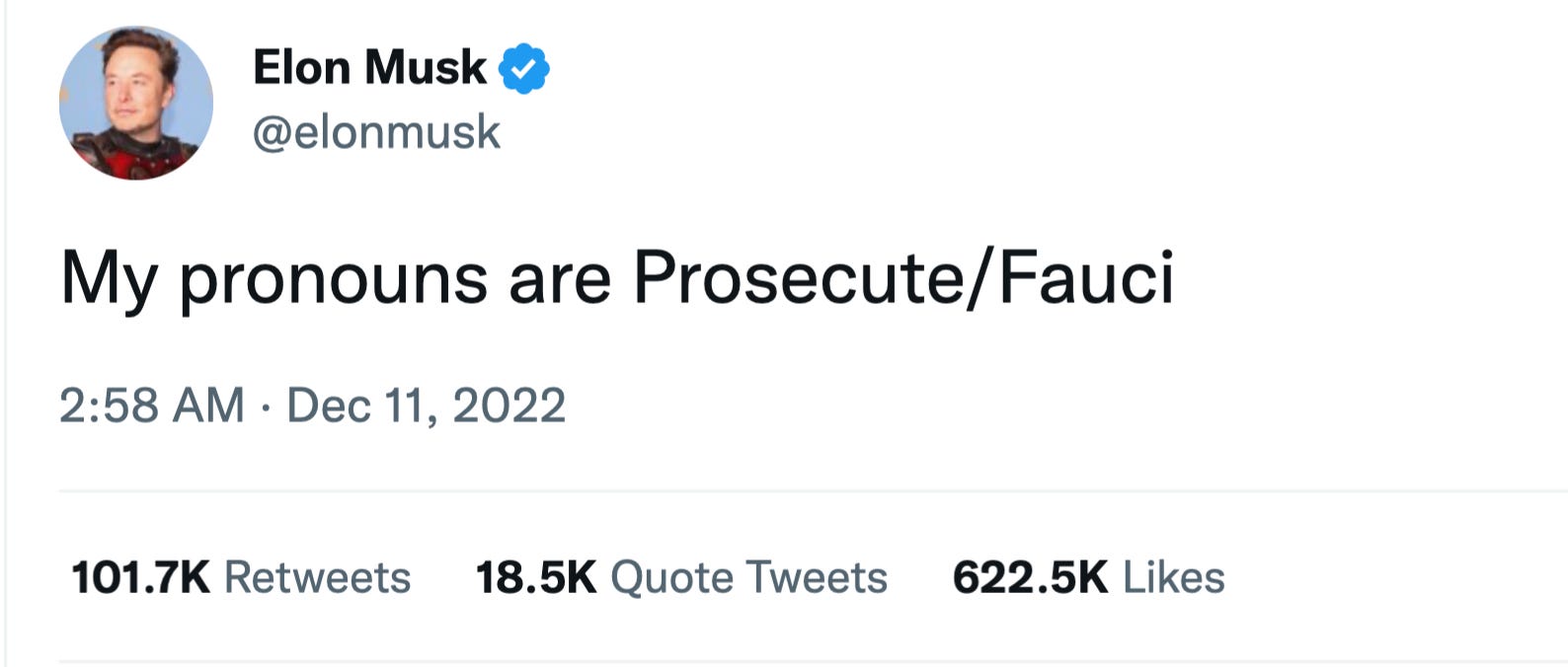
Dan Rather and his colleague Elliott Kirschner wrote a tribute to Dr. Anthony Fauci on his retirement. They noted that the anti-VAXX conspiracy theorists have been howling for Dr. Fauci’s scalp. Surprisingly, Elon Musk joined the anti-science mob with a hostile tweet.
They write:
One of the most dedicated public servants in this nation’s history is stepping down after decades of government service. That this same man is being scurrilously attacked by the world’s richest man on a rapidly degenerating social media platform is a sad but instructive snapshot of our times.
Dr. Anthony Fauci has served presidents since Ronald Reagan. He has led efforts against infectious diseases ranging from HIV/AIDS to Ebola to, of course, Covid-19. His work and dedication have saved countless lives. And for much of his career, he was viewed with great respect on both sides of the political aisle.
But we all know what happened. Fauci has become a target for the anti-science, conspiracy-theory-marinated movement stoked by the former president. And today, Elon Musk sent out a tweet that epitomizes the debasement. Like a smirking bully on the schoolyard, he wrote; My pronouns are Prosecute/Fauci.
Many online were quick to point out how Musk had earlier tweeted favorably about vaccines. And they noted how he has been staggeringly wrong about the pandemic, which he said early on would just disappear. Plus, for what exactly is Fauci supposed to be prosecuted? You have to be fluent in crazy conspiracy theories to start trying to answer that question.
But even to try to debate on the merits is to have already lost.
This isn’t about facts and the truth. This is about scoring political points. It is about flooding our global discourse with horse manure. It is about attacking the very notion of expertise. It is about saying everything can be true so nothing is true. It is about intimidating scientists and health officials. It is about feeding the MAGA crowd with the red meat of a sacrificial lamb.
Who is the real Elon Musk? With all his money and power, why does he pander to the MAGA crowd?
Josh Cowen, a professor at Michigan State University, has been a voucher researcher for two decades. The more he studied vouchers, the more he realized that they harm children. In this post, he looks at the students who use a voucher, but change their minds and return to public schools.
Cowen writes:
Author: Josh Cowen
We don’t talk enough about children who give up their school vouchers.
One of the many problems with the “Education Freedom” marketing campaign for school privatization—and it’s a problem with the market approach to education more generally—is that schools are anything but products to sample.
Betsy DeVos likes to say that schools shouldn’t be “one size fits all.” She’s conceding more than she knows with that analogy because unlike clothing, or a car you can test drive down at the Ford dealer, there’s a real cost to trying a school on and having it fail to fit.
Study after study has shown how harmful school mobility is for kids, both those who actually move between schools and those whose classrooms are full of peers coming in and out.
“The research literature suggests that changing schools can harm normal child and adolescent development by disrupting relationships with peers and teachers as well as altering a student’s educational program.”
And in the general population of public school children, we know who’s likely to be more mobile. They’re students of color, students from families with lower levels of income, students with special academic needs, and students with housing insecurity.
No one’s saying student mobility isn’t an issue for public schools, but public educators don’t see student churn as a feature instead of a bug. For example, a key element of the federal McKinney-Vento Act designed to help homeless kids is a set of best practices to help kids stay in one single public school even if they can’t remain in one stable home environment.
States with large-scale voucher programs are beginning to report out statistics for how many users come from public or private schools each year. And by the way these statistics put a lie to the claim from activists that vouchers are needed for families to choose, because we know from states like Arizona, New Hampshire, and Wisconsin that more than 75% of voucher kids were already in private school without taxpayer support.
But now we need more statistics reported on the mirror image: how many new students give up their vouchers each year. Recent numbers from Florida indicate roughly 60% of new voucher users give the voucher up after just a couple of years.
Think about that number as the voucher equivalent of a public school mobility or drop-out rate—both statistics used by critics to help indict public educational quality.
When I was working on an official evaluation of Milwaukee’s voucher program more than a decade ago, I led two reports on exactly these sorts of children. We found that around 15% of kids gave up their vouchers every year. Meaning that, as in Florida, more than half the kids we were studying left private schools over a short period of time!
Who were those kids? They were more likely to be Black, lower scoring on the state exam, and more likely to be enrolled in schools that had lots of other voucher-using kids (i.e. newer schools that popped up to take tax dollars once the program was created, rather than more established private institutions).
What happened when they left? Well actually that was a bit of good news. In still the only study to track kids over time after giving up their vouchers, we found that they enrolled in Milwaukee Public Schools and then improved substantially after arriving. The shame of it was they had to lose some academic growth in the voucher program before their parents realized it was a poor fit and fixed the problem.
Sometimes though, kids may even want to stay in their private school but the school itself shuts down and they have to move anyway. Voucher activists pushing an entrepreneurial approach to education don’t talk enough about the consequences of failure. For example, in Milwaukee, 41% of private schools that ever took tax dollars eventually shut down.
Imagine what critics of public schools would be saying right now if public schools had a 41 percent failure rate!
We’re not talking about a local Burger King that shuts down and a family has to drive a few extra blocks to get that Whopper they crave from the next closest franchise. Or has to go to Taco Bell or Arby’s instead. We’re talking about potentially major academic and social setbacks for kids.
Finally, there’s one more reason voucher leavers matter—and it’s a bit technical so bear with me. Social scientists prioritize randomized control designs to estimate impacts of policy interventions. And when randomization isn’t possible, we try to find approaches that come close.
The problem that student exits from voucher programs causes for researchers is they create additional hurdles to estimating accurate impacts of those programs. All of the randomized studies of voucher programs have showed similar exit rates to our study in Wisconsin.
And in at least one study of Louisiana vouchers, the authors had to acknowledge that those exits—precisely the students who as in Wisconsin were not doing well in the program—probably caused any positive estimates of the program to be overstated. There are techniques researchers can use to adjust for that error, but no one agrees on exactly the right approach, so it continues to be a problem.
So to summarize: we need to know a lot more about kids who give up their vouchers. Most importantly because the evidence we do have tells us that school mobility is on balance a setback for kids, and we know kids exiting voucher programs are already more likely to be at some form of risk than those who stay.
But we also need to know because as a practical matter, voucher exits can cause analytical hurdles to studies estimating voucher impacts on learning or on educational attainment.
And what that means is that in the future, if voucher supporters trumpet a new study—credible or otherwise—that purports to show positive impacts over time, the very first question we need to ask is: how many kids left the program because it wasn’t working for them?
Based on the data already available, the answer will be another indictment for voucher programs.
I read this obituary in the Boston Globe, and I found myself wishing that more of us could be like Sabina. By her measure, most of us fall short. But let us honor the incredible example she set. She defines the term “force of nature.”
During two decades as an activist, Sabina Carlson Robillard became a significant leader in humanitarian relief efforts as she insisted that the voices of those being assisted should always be the most prominent in every discussion.
“While you’re listening to me, there are 1.5 million conversations happening on the ground, and I’m here to ask you all how we’re listening to them,” she said at a 2010 conference in Boston about her work in Haiti earlier that year after an earthquake killed more than 200,000 people.
She had turned 22 several weeks before that speech and was a seasoned activist. Years earlier in middle school, she began participating in protests and “was already thinking deeply about people who were suffering throughout the world,” said her father, Ken Carlson.
After being diagnosed with clear cell sarcoma four years ago while she was pregnant, Ms. Robillard, who lived in Cambridge, stayed busier than most of her healthiest colleagues.
She worked as a consultant and an operations officer with humanitarian nonprofits, and helped raise her daughter and stepdaughter while being treated for cancer. Ms. Robillard even texted her academic adviser from her Massachusetts General Hospital room the day before she died on Nov. 16, at age 34, to schedule a meeting a few days later with her Tufts doctoral advisory committee.
“In an unassuming way, she changed the course of how lots of money and people engaged in Haiti,” said her friend Jess Laporte of Waterbury, Vt., a Haitian-American climate and racial justice activist who works with nonprofits.
She worked as a consultant and an operations officer with humanitarian nonprofits, and helped raise her daughter and stepdaughter while being treated for cancer. Ms. Robillard even texted her academic adviser from her Massachusetts General Hospital room the day before she died on Nov. 16, at age 34, to schedule a meeting a few days later with her Tufts doctoral advisory committee.
“In an unassuming way, she changed the course of how lots of money and people engaged in Haiti,” said her friend Jess Laporte of Waterbury, Vt., a Haitian-American climate and racial justice activist who works with nonprofits.
Dan Maxwell, a Tufts University professor who was Ms. Robillard’s academic adviser, first met her when she was a Tufts sophomore.
“She was already well known as a force of nature on campus when she was 18 or 19 years old,” he said.
And though more recently she was a doctoral student, he said, “she was also like a colleague, and in many ways a leader the rest of us followed.”
Ms. Robillard was the lead author for a 2021 report, prepared with Teddy Atim and Maxwell, which called on international relief organizations to adopt a “localization” approach — letting local groups and individuals participate in planning and administration, rather than excluding them, as so often was done in the past.
In October, the US Agency for International Development issued a draft “Policy for Localization of Humanitarian Assistance” that cited the Tufts report and drew upon its findings.
“I was certainly happy to see her live long enough to see that kind of high-level validation of her work,” said Maxwell, who added that Ms. Robillard was defined by her sense of certainty in the field and in her writing.
“She had a North Star,” he said. “She knew where she was going, she knew what was right. While she didn’t force people to agree with her, she could be pretty insistent about what was right and what was wrong.”
The correct approach, she often said, was to listen instead of impose an outsider’s view.
After the January 2010 earthquake in Haiti, “what I saw firsthand was how much Haitians wanted to have their voices heard in the response,” Ms. Robillard wrote for the website of CDA Collaborative Learning Projects, an international nonprofit based in Cambridge for which she worked.
Early on, Ms. Robillard channeled her determination into helping others.
“Sabina was always defined by a tremendous sense of empathy,” her father said. “Her empathy was her sixth sense. She always thought of others before herself, even when she was a very, very young child.”
She also was a multi-instrument musician, an accomplished slam poet, and a leader of Amnesty International and gay-straight alliance groups while in high school.
Initially intending to study creative writing at Tufts, Ms. Robillard was soon involved with humanitarian work, spending months away from the university in 2009 to work as an intern with refugees in South Sudan.
She graduated the following year with a bachelor’s degree in community health and peace and justice studies, and subsequently received a master’s in applied community change and peace building. Tufts later honored Ms. Robillard for her humanitarian work.
For the past dozen years, she worked for nonprofits and aid groups including the International Organization for Migration. She was part of the IOM’s response to the Ebola outbreak in Guinea several years ago, and its response to a cholera outbreak in Haiti.
Fluency in French and Haitian Creole made her particularly effective in Haiti, where she had lived in Cite Soleil, a crowded, impoverished part of the Port-au-Prince metropolitan area. And she used her language skills to elevate the voices of those who lived in Haiti.
A presentation at her memorial service featured her quote: “Why isn’t localized humanitarian aid focused on letting communities determine and lead the work in building their own future?”
Among those she met in Haiti was Louino Robillard, a community leader known as Robi, whom she married in Port-au-Prince in December 2012, and with whom she collaborated.
With marriage came additional roles as stepmother to his daughter, Dayana Robillard, and parent to the couple’s 4-year-old daughter, Anacaona.
Discoloration under Ms. Robillard’s left eye, initially thought to be benign, appeared in 2017. While she was pregnant the following year, tests showed it was a malignant tumor, and the cancer later spread to her lungs.
Continuing to work for four years, even during her final full day alive, “Sabina wrote Ana e-mails over the last four years — 356 e-mails, knowing she wasn’t going to be around,” her mother said.
In addition to her parents, husband, stepdaughter, and daughter, all of Cambridge, and her brother, Ms. Robillard leaves her maternal grandmother, Luba Lepidus of Somerville.
Ms. Robillard’s husband will bring her ashes to Pak Nan Ginen, a park and reforestation project they cofounded in Saint-Raphael, Haiti, where he plans to build a memorial. Because Haiti is severely deforested, “she wished to use her ashes as soil to plant trees,” he said.
Chef Jose Andres created an organization called World Central Kitchen that goes wherever there is hunger and feeds people. Their mission right now is to serve food and deliver water to the people on the front lines in Ukraine.
Since the invasion of Ukraine began, WCK teams have provided more than 180 million meals to people in need. However, families still need our support as they head into what will likely be the toughest winter of their lives. By fueling our work, you’re helping us bring hope and comfort to communities across Ukraine—and now, a generous WCK donor is matching all gifts up to $10 million made now through December 31 for Ukraine. Make a donation today to double your impact. HELP US CONTINUE OUR EFFORTS IN UKRAINE
Ground report from José in Kherson
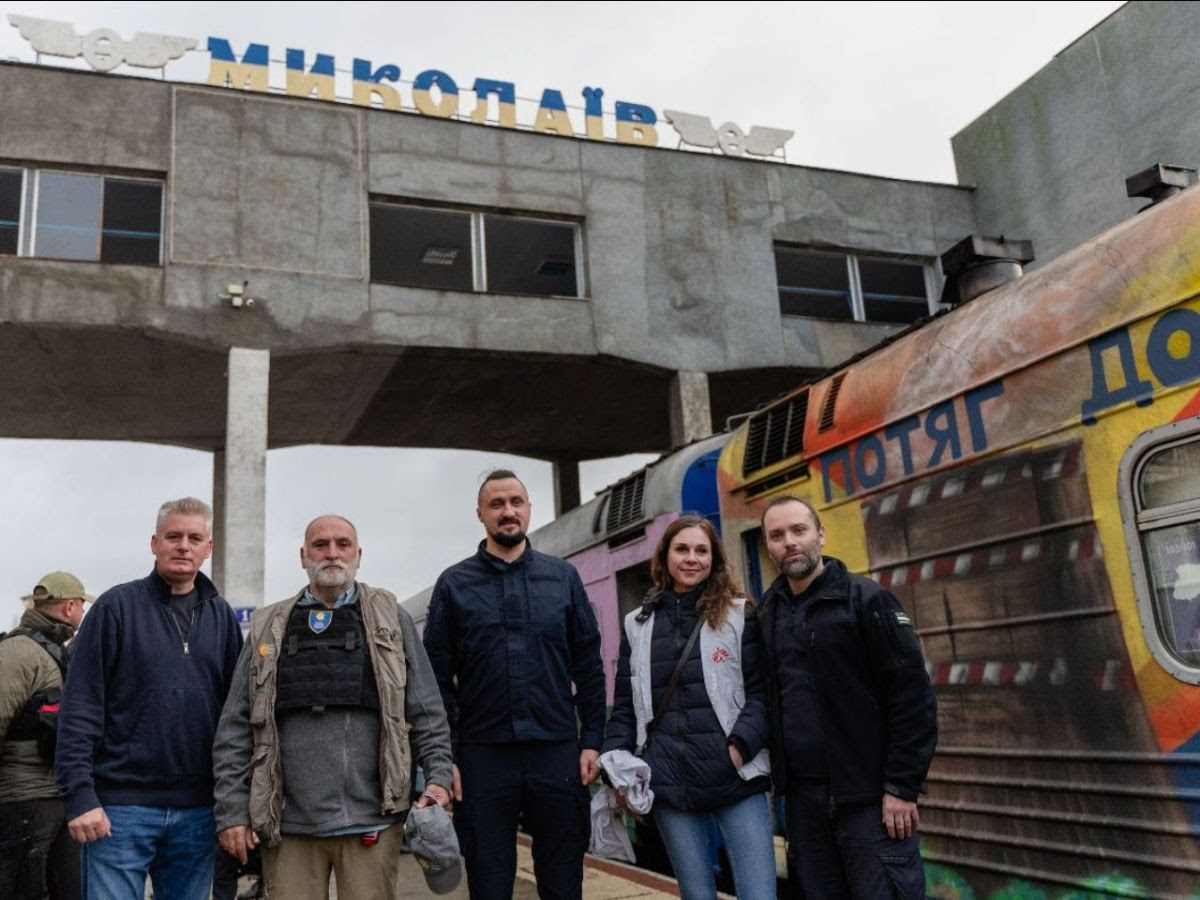
On November 11, after eight long months of occupation, the southern Ukrainian city of Kherson was liberated. Having arrived as soon as we were permitted to enter Kherson, WCK local teams were greeted with hugs and tears of joy while delivering food kits. Several days later, José arrived in Ukraine, keeping his promise of returning to Kherson once it was liberated. Below, José shares a ground report from his trip, detailing the growth of our response since WCK first arrived in the newly liberated city.
Yes, WCK has been able to previously support some local restaurants cooking for neighbors in Kherson and safely delivered food kits to frontline communities in the region…we even delivered a generator and fixed the broken water supply for five nearby villages. But no matter how much we wanted to do more, we were unable to reach so many families who were possibly going hungry because of Russia’s brutal occupation. In Kherson, residents lived without basic necessities, cut off from the rest of Ukraine…so many feared for their lives for eight long months. So when Ukraine’s troops entered Kherson on November 11, our WCK team knew we had to be there immediately next to the people, as soon as it was safe to do so.
When I arrived in Kherson on November 16, our WCK team had been delivering food aid each day, working on how we could increase our support every time we returned to the city. What I saw when I first got to Kherson… people celebrating, children were walking the streets with Ukrainian flags, it was a moment I will never be able to describe. But reality sets in as the day goes on and night falls, and people go home without electricity, food, or water. It’s still dangerous too…earlier in the morning a mine left behind exploded inside the train station. Thankfully no one was hurt. During our distribution we also heard shelling as the frontline is not too far away.
Still, when we were doing our food distribution, people remained calm and didn’t mind standing in the rain. I went around and spoke to families who told me they did not have much food at home. This is how WCK meets the needs. We work with the community and everyday we learn and get better.
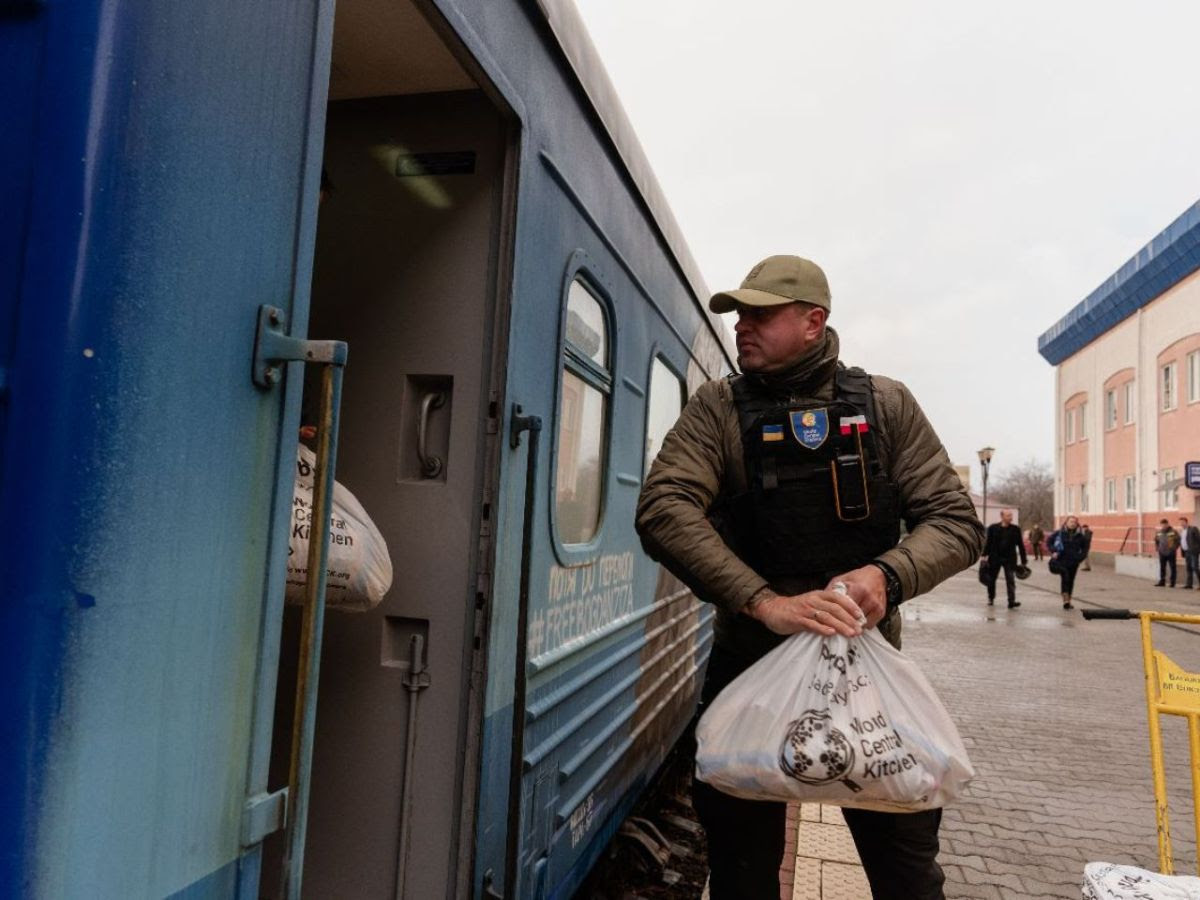
We travel neighborhood by neighborhood, delivering thousands of food kits to families.
Now we’ve been delivering and have been talking to the people, we’re growing our distributions across different neighborhoods to make sure we reach as many families as we can. For residents with gas and able to cook at home, we’re providing 30lb food kits filled with the majority of Ukrainian products. We are also bringing thousands of plates cooked from our WCK Food Truck in Mykolaiv.
WCK’s Food Truck in Mykolaiv has the capacity to cook up to 5,000 meals. Once the food is prepared, we package it for delivery.
It’s been amazing to see how fast our WCK teams in Ukraine have been able to scale and adapt to the challenges of every situation. With safety systems in place, the Relief Team is moving quickly so people are not gathering or staying outdoors for a long time. Delivery has also been difficult because access to Kherson is still limited, roads are destroyed, and rain has made things very muddy, but WCK keeps going no matter what!
Bringing aid to Kherson is challenging—roads are damaged and rain is causing mud.
There is also no water in Kherson and many people are collecting it directly from the Dnipro river. Filling nine large, 5,000 liter barrels, we delivered and installed water distribution sites throughout the city for residents to drink and cook with. In the next few days, we will install more water sites. WCK now has water distribution sites set up across the city, and we’ll keep expanding.
During my trip I also witnessed a special moment in Ukrainian history—the restoration of trains to and from Kherson. As Ukraine continues to fight for freedom and liberty they are sending a powerful message to the world that they can overcome anything. These are trains of hope, connecting Ukraine again.
Throughout our response, WCK has worked closely with our friends at Ukrainian Railways to transport critical supplies across the country, so we were very proud to stand alongside them during this amazing accomplishment. I rode on the first train to Kherson from Mykolaiv with nearly 200 other people. Some were returning home, some were going to see their relatives, but there were also people who simply decided to be there on this beautiful day. And for WCK, we brought along thousands of food kits with us!
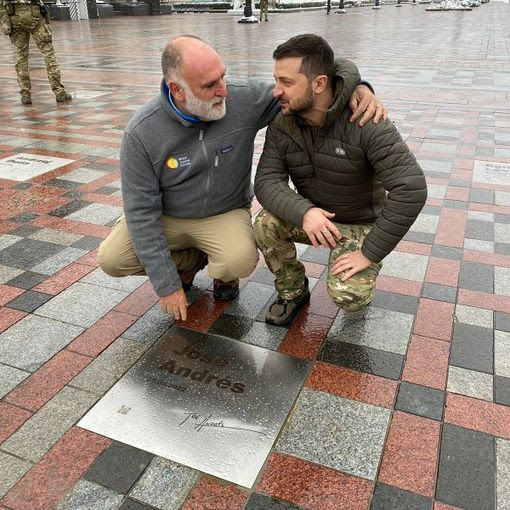
Before I left Ukraine, I took another trainfrom Kherson to Kyiv where I was honored to meet with President Zelenskyy. He presented me with the Order of Merit honor, something that I humbly accepted not for me, but in recognition of the thousands of Ukrainian Food Fighters I get to work with every single day. It is these people who are the heroes behind WCK’s efforts…the people who make the impossible, possible and have been working tirelessly for months under uncertain circumstances to get food to communities in need.
It is why we have been in Ukraine since the very beginning. We know we cannot solve every problem, but the very least WCK can do is make sure that food and water is not another issue people living under attack have to be worried about. We promised the people of Ukraine that as cities become liberated we would be there.
.
So in Kherson, standing shoulder-to-shoulder with WCK teams as they got food and water so fast to families in need, was one of the proudest moments of my life. It is because of WCK Food Fighters and supporters around the world that we are the only large-scale food aid in the city. Together, we will all help Kherson, and other regions around Ukraine, get through the long, hard winter. Thank you for your support and for continuing to believe in our mission.
Former Secretary of Education Betsy DeVos recently spoke at Calvin University in Michigan. As one of the university’s most prominent graduates, her remarks were received with respect.
Dr. John Walcott, a professor of education at Calvin University, wrote an article for the school newspaper in which he expressed respectful disagreement with her ideas. The full article is worth reading. It takes courage for a professor to take issue with a state and national leader such as DeVos, especially in a religion-focused university.
Be sure to open the link and read the comments.
He began:
On Nov. 17, Calvin University hosted an event with Betsy DeVos. DeVos served as Secretary of Education during the Trump administration and is a graduate of Calvin University. In making the announcement, President Boer described the event as part of efforts “to hear from people who bring diverse backgrounds and perspectives to important conversations.”
DeVos served as Secretary of Education during the Trump administration and is a graduate of Calvin University. In making the announcement, President Boer described the event as part of efforts “to hear from people who bring diverse backgrounds and perspectives to important conversations.”
I understand and respect the desire of our university to welcome to our campus a distinguished alum who has a long history of involvement at local, state and national levels. Furthermore, I agree that it is important to provide space for “diverse perspectives” and “important conversations.” We must strive to be a community willing to ask tough questions and engage deeply with important issues in our world.
I believe that an opportunity for additional engagement with these issues is especially necessary because of the problematic nature of much of what Secretary DeVos proposes when it comes to education. For example, her call to support “students and not systems” fails to recognize that student learning can be supported by teachers, curriculum, financial resources, school administrators and, yes, in many cases may even require a building conducive to learning. It is easy to demonize systems, but the use of this sort of false dichotomy is ultimately unproductive.
In that spirit, I suggest that we continue the conversation started at this event. The event used an interview format that did not provide opportunity for the sort of conversation and debate that are required to dig deeply into important issues related to educational policy and the state of education in our nation. Near the close of the event, Secretary DeVos stated her ongoing desire to “debate and advance” the policies for which she advocates. I agree that we need to debate these policies and, as a university community, think deeply about issues that relate to education and political engagement and how God calls us to seek justice and be agents of renewal in our world.
I believe that an opportunity for additional engagement with these issues is especially necessary because of the problematic nature of much of what Secretary DeVos proposes when it comes to education. For example, her call to support “students and not systems” fails to recognize that student learning can be supported by teachers, curriculum, financial resources, school administrators and, yes, in many cases may even require a building conducive to learning. It is easy to demonize systems, but the use of this sort of false dichotomy is ultimately unproductive.
We also need to carefully consider Secretary DeVos’ focus on parental choice and individual rights as the basis of her calls to change our educational system. This perspective ignores the function of our schools as a public good, an institution at the core of our desire to promote democratic values and the flourishing of all students. We need to think carefully about the purpose of education in a democratic society and about the role of public schools that have been part of our nation’s commitment to education since before the writing of the U.S. Constitution. Our call to seek justice and be agents of renewal in our world may push us to prioritize the needs of our community and of the most vulnerable in our society over individual rights.
As an educational scholar and researcher, I recognize the need to carefully examine the impacts of policies that use the language of choice and freedom on student learning and on public schools. For example, advocates for school vouchers, which allow parents to use public education funds for tuition in private schools, argue that these policies can be the key to improving student outcomes while ignoring research that does not support these claims. For example, Dr. Christopher Lubienski (Director of the Center for Evaluation and Policy Analysis at Indiana University), summarizing research since 2015, states that “every study of the impacts of statewide voucher programs has found large, negative effects from these programs on the achievement of students using vouchers.”
A thorough discussion will explore the impact of DeVos-supported policies on school funding. Recent reports from Florida note that this year, school vouchers will divert $1.3 billion from public schools, and reports from states like Arizona, New Hampshire and Wisconsin show that the overwhelming majority (80%, 89% and 75%) of students utilizing vouchers were already in private schools before the programs began. We need to ask if public funds should be given to schools that are in some cases not required to comply with regulations related to special education, federal civil rights laws and curriculum standards. We should engage critically in questions regarding the role of teachers’ unions before dismissing out of hand their role in public education. And we should critically examine the rhetoric that is currently a part of the so-called “culture wars,” especially as it relates to education. I am concerned that Secretary DeVos has contributed to a misrepresentation of critical race theory and may be perceived as aligning with groups and individuals that have advanced a harmful narrative directed at the LGBTQ+ community.
These are just a few of the many complex and vitally important issues that need to be a part of a deeper conversation. I am not criticizing the decision to host Secretary DeVos, a distinguished graduate with years of activism in the public sphere. However, as a faculty member in the School of Education, it is important to me that the broader educational community understands that this does not signal an endorsement of her policies and perspectives by the School of Education. And I remain hopeful that we, as a community, will embrace the opportunity to not only offer diverse perspectives, but also engage deeply in important conversations of what it means to think deeply, act justly and live wholeheartedly as Christ’s agents of renewal in the world.
Professor Maté Wierdl teaches college-level mathematics in Tennessee; he is a native-born Hungarian and travels there regularly. In this post, he reviews the teachers’ strike in Hungary, which has dragged on for more than a year.
Throughout the strike, the Hungarian government has shown its disdain for the teachers’ union and the teachers. American right-wingers love the growing authoritarianism of the Hungarian government, even inviting Hungarian President Victor Orban to speak at the annual meeting of CPAC, the conservative political action committee.
Wierdl writes:
Hungarian teachers have been openly protesting for almost a year now. The formal protests began in January. As a response, Orbán, Hungary’s Prime Minister, basically took away the teachers’ right to strike (they cannot skip their teaching obligations while they “strike”), and quite a few protesters have been fired from their jobs. Just this week, 8 teachers were fired since they protested during school hours.
Why the protests? I think Hungarian teachers used to have a pretty good job. But in recent years, their load increased a great deal, more testing was introduced and kids need to go to school more. I have to say, I see the US influence, which shouldn’t be a surprise to anyone after seeing in the news that Orbán was invited to the US to give the keynote address at CPAC, and then he paid a visit to Trump.
I have many teacher friends and they say the main issue is not just about money but the general worsening conditions of teachers, and as a result, there is a huge teacher shortage.
Though numbers don’t tell everything, they clearly indicate serious problems. For example, here is a chart showing teachers’ salaries relative to other college educated people’s salaries (I think most of the countries’ names are recognizable; EU22 is the EU average). Note how the US (Egyesült Államokin Hungarian) and Hungary are the last two
The next chart shows the mandatory classroom hours in several European countries. Hungary is at the top (meaning, most hours) and in fact, since there aren’t enough teachers, the average teaching load is close to 27 hours. (US teachers teach even more, like 6 classes per day which means a 30 hour load)
Below, I put together some reports of the protests in the international media in the last two months.
Bloomberg writes this about today’s (Dec 2) protests
“Hundreds of Hungarian teachers joined a widening strike action across the nation’s school system following a government decision to fire more educators for protesting low pay.
“Almost 700 teachers from 71 schools walked off the job on Friday, forcing several institutions to suspend classes, according to the Teacher for Teachers Facebook page, which compiles the information.
“Thousands of students joined in solidarity, many of them placing black tape over their mouths. They decried what they called a hardline response by Prime Minister Viktor Orban’s government to silence teachers who earn among the lowest wages in the European Union.”
Nov 18
BUDAPEST, (Reuters) – Hungarian teachers, students and parents stepped up their protest calling for higher wages and education reforms on Friday, forming a 10-km (six-mile) human chain in central Budapest, with smaller rallies held across the country.
Teachers launched their “I want to teach” movement in September, calling for civil disobedience to demand higher wages for teachers and an adequate supply in the workforce. They are also protesting against restrictions on their right to strike.
Here is a video of the protests a few weeks earlier. As you can see many students support the teachers.
Oct 6:
Wednesday’s rally, which started with students forming a chain stretching for kilometers (miles) across Budapest in the morning grew into the biggest anti-government demonstration since nationalist Prime Minister Viktor Orban’s April re-election.
Protesters carrying banners saying “Do not sack our teachers” and “For a glimpse of the future, look at the schools of the present” crammed a Budapest bridge near parliament, blocking traffic amid light police presence.
Earlier this year, the Florida legislature and Governor Ron DeSantis passed a bill that they called the Parental Right in Education law, but it is widely known as the “Don’t Say Gay” law. It forbids any recognition of gender identity in grades K-3, as well as careful scrutiny of any such instruction in higher grades to be sure that it is “age appropriate” (i.e., in the eye of the beholder). Gov. DeSantis boasted on election night that Florida is where “woke goes to die.” As you will read in the article below, the governor’s general counsel defined “woke” as the “belief there are systemic injustices in America society and the need to address them.”
Surely, doesn’t everyone agree that there are no “systemic injustices in American society,” and never was such a time or thing ever ever. Since they don’t exist, the reasoning goes, there is no need to address them. The state of Florida believes that it must be illegal to teach about any systemic injustices that exist now or might have existed in the past. This law is a denial of academic freedom, plain and simple.
It is a kind of poetic justice that the sponsor of this law–Rep. Joe Harding– was indicted for wire fraud and money laundering—for claiming $150,000 in COVID recovery funds from the Small Business Administration for two businesses he owned that had no employees and no revenues. He has resigned his seat in the legislature. Karma.
The Miami Herald reported:
Florida’s State Board of Education will meet next week to scrutinize whether 10 school districts — including Miami-Dade, Broward and Hillsborough counties — are carrying out the state’s parental rights law, which have become a political lightning rod in local school board meeting and national politics in recent years.
The Florida Department of Education put the districts on notice last month when it sent superintendents letters detailing the policies and procedures that each of their districts “may not comport with Florida law.”
The law, titled Parental Rights in Education, but which critics have dubbed “don’t say gay,” prohibits classroom instruction and discussions about sexual orientation and gender identity in grades K through 3 — and in older grades if they are not “age appropriate or developmentally appropriate.”
Many of the policies the state has flagged offer protections to LGBTQ students who confide personal information to school employee by requiring their consent to divulge aspect of their sexual orientation and gender identity to guardians and parents.
In letters sent Nov. 18, Senior Chancellor Jacob Oliva flagged a range of policies and procedures at the 10 school districts and requested a status update on those policies by Friday.
In addition to Miami-Dade, Broward and Hillsborough, letters were also sent to Alachua, Brevard, Duval, Indian River, Leon, Palm Beach and the Florida School for the Deaf and the Blind.
The State Board of Education will meet on Wednesday.
Some of the policies that were flagged by the state include “best practices” policies for school personnel to not disclose the sexual orientation or gender identity of students without their input or permission; policies that say all students should be referred to by the gender pronouns and name that is consistent with their gender identity, and rules that allow students to access locker rooms and restroom that are consistent with their gender identity.
The state has also raised questions about a “racial equity policy” at the Indian River County School District. The district’s policy says it is mean to confront “the institutional racism that results in predictably lower academic achievements for students of color than for their white peers.”
Gov. Ron DeSantis has targeted such policies as he declares Florida to be the state where “woke goes to die.” During a federal court trial last week, DeSantis’ general counsel Ryan Newman, said the term “woke” refers to the “belief there are systemic injustices in America society and the need to address them.”
In Miami-Dade, the state has zeroed in on policies that aim to support transgender and “gender expansive students” in sports, locker rooms, and manners that pertain to which pronouns students want to use and what private information they want to disclose. In Broward County, policies that aim to create a “safe space for LGBTQ+ students” have come under the microscope.
The state wants to hear the status of five policies, including one that says “it is never appropriate to divulge the sexual orientation of a student to a parent without the student’s consent.” And in Hillsborough County, the state is asking the district to provide an update on two policies: a “racial equity” policy that aim to increase academic achievement for “ALL students,” and LGBTQ policies that deal with “coming out and confidentiality.”
Nicholas Tampio is a professor of political science at Fordham University. As a father, he was outraged by the Common Core, so outraged that he wrote a book about it, “Common Core: National Education Standards and the threat to Democracy.”. In New York State, the person most responsible for the quick and unpopular rollout of Common Core was State Commissioner John King. King was recently named the Chancellor of the State University of New York.
On Dec. 5, the State University of New York appointed John B. King Jr. as the new chancellor. His biography may give us clues as to his possible plan to prioritize workforce training over the liberal arts for SUNY students.
King was state commissioner of education between 2011 and early 2015. Then-chancellor of the Board of Regents Merryl Tisch hired him to implement the state’s Race to the Top plan. The plan had interlocking parts. Schools teach the Common Core learning standards in reading, writing, and math. Students take end of year tests whose scores are entered into a database. Teachers are evaluated on students’ test score growth. Schools with low test scores get taken over by the state.
One year during his reign as commissioner, 155,000 New York students refused the end-of-year Common Core tests. To his critics, King was a hypocrite for sending his own children to a private Montessori school in Albany while he was rolling out the Common Core for other people’s children.
People in the test refusal movement, such as myself, were trying to explain why we did not want an education system for our children focused on standardized testing. Alas, King and Tisch dug in their heels, and the main planks of the Regents’ reform agenda remain in place….
Race to the Top incentivized states to build a P-20 longitudinal data system. This system tracks a child from pre-school (or pre-natal) until 8 years until after they graduate from high school. Nancy Zimpher, SUNY chancellor from 2011 to 2017, was a champion of creating career pathways. King may well continue her efforts to prepare children, from an early age, for a specific job that they will do as adults.
In 2018, King told the the Silicon Valley Education Policy Summit: “Whenever I go around the country, when I talk with employers, they talk about the challenge of finding the workforce they need. They talk about the challenge of finding folks with the right skills.”
Now, SUNY press release notes that King will work to connect “K-12 schools, higher education institutions, and employers to tailor high school curriculum to meet the needs of a modern-day workforce.”
To be clear, college students should learn a wide array of skills to prepare them for the workforce. And the Education Trust advocates commendable ideals of expanding college access, improving college graduation rates, and making college affordable, particularly for students of color and students from low-income backgrounds.
Still, we ought to think about what kind of future is in store for New York students enrolling in a state university or college.
In the body of the SUNY press release, there is little indication that King values faculty governance, research, or the liberal arts. SUNY could aspire to become a world-class higher education system with laboratories, research resources, study abroad programs, libraries, and so forth. But the press release will not assuage academics who want to teach subjects that do not directly translate into jobs.
SUNY enrollment fell 20% over the past decade, a trend that started before the pandemic. SUNY could aspire to make the school attractive to bright students who can afford to go to private liberal arts colleges or universities. But the early indications are that that is not the priority of SUNY’s leadership.
Over a decade ago, Tisch and King created a K-12 education system that would funnel students into tracks based on test scores. Now, they are working together to build the rest of the P-20 system that place those children into their assigned slots.
In the near future, rich New York kids will go to expensive out-of-state or private schools. And everyone else will be placed in a career pipeline that is hard to escape.



 Diane Ravitch's blog