Archives for the month of: June, 2022

A federal court in North Carolina ruled against a charter school that required girls to wear dresses.

The charter school claimed it was not subject to federal laws against discrimination because it is not a “state actor.” Charter schools frequently claim they are not “state actors” when they violate civil rights laws or labor laws, but simultaneously say they are public schools.

An en banc federal appeals court ruled Tuesday that a public charter school in North Carolina violated the equal protection clause when it required girls to wear skirts.

The full 4th U.S. Circuit Court of Appeals at Richmond, Virginia, ruled against Charter Day School Inc. in a June 14 decision. Judge Barbara Milano Keenan wrote the majority opinion.

The Charter Day School required girls to wear skirts, jumpers or skorts based on the view that girls are “fragile vessels” deserving of gentle treatment by boys, the appeals court said.

The school had argued that the school is not a state actor subject to the Constitution, and that the federal law banning discrimination on the basis of sex in education programs did not apply to dress codes.

The appeals court ruled against the school on both arguments.

The 4th Circuit decision is the first by a federal appeals court to recognize that charter schools receiving public funds must abide by the same constitutional safeguards as traditional public schools, according to a press release by the American Civil Liberties Union.

The en banc court and a prior 4th Circuit panel agreed that sex-specific dress codes may violate Title IX of the Education Amendments of 1972. But the en banc court went further than the panel when it ruled that the charter school violated the equal protection clause

The school founder had said skirts embody “traditional values” and preserve “chivalry” and respect. Chivalry, the school founder said, is a code of conduct in which women are “regarded as a fragile vessel that men are supposed to take care of and honor.” School board members agreed with those objectives, including the goal of fostering “traditional roles” for children.

“It is difficult to imagine a clearer example of a rationale based on impermissible gender stereotypes,” the appeals court said.

Nine judges agreed with the opinion. Six dissented, in whole or in part, on the grounds that charter schools are not state actors.

A synagogue in Florida has sued the state of Florida to overturn the recently passed abortion law because it violates the freedom of religion of the members of its synagogue.

The law bans abortion after 15 weeks of pregnancy.

ST. PETERSBURG, Fla. — A new Florida law prohibiting abortion after 15 weeks with some exceptions violates religious freedom rights of Jews in addition to the state constitution’s privacy protections, a synagogue claims in a lawsuit.

The lawsuit filed by the Congregation L’Dor Va-Dor of Boynton Beach contends the law that takes effect July 1 violates Jewish teachings, which state abortion “is required if necessary to protect the health, mental or physical well-being of the woman” and for other reasons.

“As such, the act prohibits Jewish women from practicing their faith free of government intrusion and this violates their privacy rights and religious freedom,” says the lawsuit, filed Friday in Leon County Circuit Court.

The lawsuit adds that people who “do not share the religious views reflected in the act will suffer” and that it “threatens the Jewish people by imposing the laws of other religions upon Jews.”

The case is likely to be consolidated with a court challenge filed by Planned Patenthood, which seems like a mistake. The current SCOTUS is unlikely to be persuaded by Planned Parenthood, but would likely to be sympathetic to a case about denial of religious freedom.

Why should Jews be compelled to obey a state law that violates their religious principles?

O

Leonie Haimson, executive director of Class Size Matters, asks you for your help. The state legislature overwhelmingly passed a bill to require reduced class sizes in NYC. Governor Hochul has not sign it yet. If she doesn’t sign within 39 days, it’s a “pocket veto.” At the same time, NYC Mayor Eric Adams plans to cut the budget for schools. This would certainly make class size reduction impossible. Act now!

On June 3, the NY State Legislature passed S09460/ A10498, a long-needed bill to require NYC to lower class sizes, by a vote of 147 to 2 in the State Assembly and 59 to 4 in the State Senate. It calls for class size caps to be phased in over five years in all New York City public schools, whose students have long struggled from being jammed into the largest class sizes in the state.

Instead of abiding by the intent of this bill, Mayor Adams and the City Council agreed to a budget that will cut school budgets by at least $215 million, making it likely that class sizes will increase rather than decrease next fall.

Please sign this petition to Gov. Hochul to sign the class size bill as soon as possible, so that NYC schools can get on the right track towards improving learning conditions rather than undermining them. The petition is co-sponsored by Class Size Matters, the Alliance for Quality Education, NYC Kids PAC and the Education Council Consortium.

If you are like me, your head is spinning about the conflicting signals about New York City’s public schools. The state legislature voted to mandate smaller class sizes, which will cost money, but the City Council voted to cut the schools’ budget.

Leonie Haimson, executive director of Class Size Matters, encourages everyone to fight back. She has spent more than 20 years arguing for reduced class sizes as the most effective reform for schools.

Here is her message:

Dear folks – 

Sadly, late Monday night the NYC Council agreedto a city budget that will make at least $215M in cuts directly to schools, by a 44-6 vote. These egregious cuts, the largest since the Great Recession of 2007-2008, were made despite billions more in the city’s reserve fund, an expected city budget surplus of more than $1B next year, and nearly $5B in unspent federal stimulus funds meant for our schools. These cuts will likely cause class sizes to increase and the loss of critical services for kids, who are still recovering from the disruptions caused by more than two years of the pandemic.

There are three things you can do now to help us fight back:  

1.Sign our petition to Gov. Hochul, urging her to sign the new state class size bill, S09460A10498,as soon as possible, passed by the New York State Legislature on June 3 by a vote of 147 to 2 in the Assembly and 59 to 4 in the State Senate. Once she signs the bill, it will give us a legal avenue to try to reverse or limit the damage of these inexcusable cuts. The petition is co-sponsored by NYC Kids PAC, AQE and the Education Council Consortium.

2. You can also let DOE know directly how you feel about these cuts at the final C4E hearings tonight, Wed. June 15. You can sign up here, starting at 5 PM; the hearings begin at 6 PM. The public comments are required to be summarized, posted and sent to the NY State Education Department to help them decide whether to approve the city’s C4E plan. It goes without saying that “Excellence” will be harder to achieve than ever in our schools, given these devastating cuts. Some additional talking points are here.

3. Please also attend our Annual Skinny Award celebration, on Monday June 27, in which we will honor the state leaders who made the new class size bill possible.   You can find out more about our honorees and how to purchase your tickets here. This is the first fundraiser Class Size Matters has held in three years — and we can really use your support. The education leaders who will be there to receive their awards also deserve your thanks.

But don’t forget to sign our petition to Gov. Hochul today! I will be up in Albany tomorrow and will deliver it to her office if there are enough signatures by then.

Thanks, Leonie 

Leonie Haimson
Executive Director
Class Size Matters
124 Waverly Pl.
New York, NY 10011
phone: 917-435-9329
leonie@classsizematters.org
www.classsizematters.org
Follow on twitter @leoniehaimson
Subscribe to the Class Size Matters newsletter for regular updates at http://tinyurl.com/kj5y5co
Subscribe to the NYC Education list serv by emailing NYCeducationnews+subscribe@groups.io

Host of “Talk out of School” WBAI radio show and podcast at https://talk-out-of-school.simplecast.com/

None of the perpetrators of the largest charter scam in history will serve a day in prison

The Voice of San Diego calls the A3 scam “one of the largest” scams in history but I don’t know of any that scored more taxpayer dollars than A3.

A poor person would get jail time for stealing $500 or a car. These guys stole hundreds of millions and they got home detention.

The story of the A3 online charter school empire is one of the largest charter school scandals in U.S. history. The scam had several angles, the most lucrative of which involved enrolling thousands of students who never took any classes, as Voice previously reported.

A3’s 19 online charter schools raked in roughly $400 million from the state between 2015 and 2019. Sean McManus and Jason Schrock, the ringleaders, funneled some $80 million of that money into companies they controlled. Nine other people – including key lieutenants, an accountant and two former superintendents – were also charged for playing a role in the scheme to steal public funds.

Despite such an unprecedented theft, not a single person involved in the A3 case will spend a day behind bars. McManus and Schrock were both sentenced to four years – but both have already been in ankle monitors, on home confinement. They both will get credit for time served. Several other key players had their felonies reduced to misdemeanors and two defendants essentially had their charges dropped for cooperating in the investigation…

Prosecutors weighed “multiple factors including accountability, restitution and early acceptance of guilt” in resolving the case, wrote Steve Walker, the spokesman, in an email.

Walker called the resolution of the case “just” and pointed to “the unprecedented return of more than $240 million from the hands of the defendants back to those it was originally intended for, helping K through 12 students in the state.”

The leaders of the A3 grift were Sean McManus and Jason Schrock.

McManus worked in the charter school industry for several years before he opened 19 online charter schools with Schrock. A3’s first school was authorized by Dehesa Elementary School District in East County. Dehesa only had around 150 students at the time. And yet McManus and Schrock’s school went onto enroll many thousands of students. That’s because an online charter school can draw students from the county it is located in, as well as each adjoining county.

The central component of the A3 scam involved enrolling students, who never actually took any classes, into A3 schools. To boost A3’s head count, enrollment workers would approach summer athletic programs. The enrollment workers would get each summer athlete to sign what’s known as a master agreement. That master agreement would un-enroll each student from their normal school and into an A3 school for the summer. For each summer student A3 brought in several thousand dollars. Schrock and McManus paid a commission to each of their enrollment workers and gave a so-called donation, based on the number of players that signed up, as an incentive to each athletic program.

Another part of the scam involved working with private schools. A3 would approach, for instance, a small Catholic school. The students at the school would be added to A3’s attendance rolls. The state’s public education system would dispense money to A3 for each of those students. A3 would then give some of that money to the private school – some of them were struggling financially – and pocket the rest.

McManus was charged with multiple crimes that added up to as many as 40 years in prison. In the end he pleaded guilty to two counts of conspiracy to steal public funds and was sentenced to four years in state prison. He waived his rights to any revenue connected to the charter schools or any connected business, paid roughly $19 million in fines and had his 401(k) seized…

Schrock calls himself an “Educational Business Leader” on his LinkedIn profile. He lists himself as CEO of Learning Re: Defined, “a Christian company of educational leaders and program developers who cultivate and provide training modules and curriculum built to meet client needs,” according to the company’s Facebook page.

Schrock, who also faced multiple charges with a maximum penalty of roughly 40 years in prison, pleaded guilty to one count of conspiracy and one charge of breaking state conflict of interest laws. He spent 1,506 days in an ankle monitor and was credited with time served. He also paid roughly $19 million in fines and will also serve three years probation.

The article describes the other leaders of the scheme. Open the link and read about them.

.

Nora De La Cour is a high school social worker and former teacher in Massachusetts. She writes frequently about the attacks on public schools. In this brilliant article, which appeared in Jacobin, she shows how the privatizatizers have exploited the culture wars to promote their own agenda. They are not interested in better education or students. Their agenda is to destroy the public square.

In a nutshell: “A billionaire-backed network of free-market fundamentalists is ginning up controversy over “wokeness” in American schools with an ulterior motive: to demolish public education.”

Please open the link to read the article in full.

She begins:

In a Massachusetts school district neighboring the one where I work, four parents, backed by a conservative Christian organization, are suing the school committee and multiple district employees for calling students by their preferred names and pronouns without informing home. Because one of the defendants is a counselor, some of my counselor peers in the area are now on guard, afraid we could become the targets of litigation if we allow students to broach sensitive topics in our presence.

Setting aside the very real harm that kids and educators are exposed to as a result of the Right’s eagerness to linkacknowledgement of gay and trans people to sexual predation, there’s another problem here. It’s incredibly difficult to teach or counsel someone if you can’t call them what they wish to be called. Addressing students by their chosen names is a basic sign of respect that says, “I see you and I’m here to work with you.” If you need to call home to get permission first — potentially outing kids to their parents and inviting distressing blowback — you might miss the chance to form the human connection that undergirds collaborative scholarship.

Pandemic school closures reminded us that the social aspects of schooling are among the most vital for young people’s development and for society at large. Specific facts and figures (the what of school learning) can be easily forgotten and recalled with a few keystrokes. But the ability to establish a base level of trust with heterogeneous others in order to solve shared problems (the how of school learning) is absolutely essential for both a fulfilling personal life and engagement in the public square. It’s critical that educators be allowed to build that trust without fear of reprisal.

The Koch-backed parents’ rightsmovement aims to make that trust impossible. By pitting parents against schools, libertarian billionaires and Republican strategists intend to motivate voters in the short term and fully privatize K-12 education in the long term. As Christopher Rufo, the self-styled architect of the so-called war on critical race theory (CRT), has argued, “To create universal school choice [i.e., privatization], you really need to operate from a premise of universal school distrust.” Those poweringthe campaign against classroom “wokeness” are trying to hinder our ability to establish common ground from which to defend our last remaining public goods.

The illiberalism that dominates the Right can best be understood as the advanced stage of a long billionaire-funded plot to undo democracy in order to relieve capitalists of any constraints the rest of us might wish to place on them. This understanding clarifies why classrooms, the training grounds for democratic participation, are primary targets of radical right activism. If liberals are to have any hope of countering this coordinated attack, they need to remember the collective, public value of education.

Laying Siege to the Common Good

It makes sense to focus on the reactionary nature of all of this: the commitment to American exceptionalism animating the so-called CRT bans, the fresh fixation on classical education rife with chauvinist dog whistles, and the shockingly overt bigotry of the anti-LGBT “grooming” discourse. Ron DeSantis’s Florida, as some have observed, is looking more and more like Viktor Orbán’s Hungary. But while these efforts to reverse cultural change are incredibly alarming, we come up short when we try to understand what’s happening purely in terms of identity-based hatred. Intolerance has always been a feature of American politics. Why does it suddenly seem so viciously well-organized?…

Despite attention-grabbing campaigns to terrify them, a majority of public school parents remain satisfied with their children’s schooling. And massive amounts of outside funding notwithstanding, local parents’ rights candidates have in numerous cases failedto deliver decisive wins for the privatization movement. As in segregated Virginia, US families are not quite prepared to sign away their children’s right to publicly funded, democratically controlled schools. It’s the perfect time, in other words, for those looking to contest the radical right to offer a full-throated defense of public education and all public goods.

But Democrats, by and large, have been unwilling to mount that, scarcely standing up even against the horrific attacks on kids, families, and educators that we are seeing across the United States. And when you look at their record on education, it’s pretty clear why: for the past three decades of education reform, Democrats have ignored the social role that schools play in preparing children for engagement in the public square. Alongside Republicans, they have enabled the privatization of public schools. They have also privatized the ideaof schooling down to the individual level. In the view of the Democratic establishment, the sole remit of schools should be to boost “human capital.” Guided by this view, they have yoked the vision of education ever closer to the needs of employers — a kind of corporate indoctrination eerily similar to the “woke” indoctrination Rufo and his cohort tell tales about.

But Bill Clinton’s assertion that “what you earn depends on what you learn” has proven to be a dangerous oversimplification: Americans are more educated than ever before, and yet economic insecurity is rampant and rising. When public schooling is only justifiable insofar as it increases individual earning power, the case for it is wholly dependent on its utility to capitalist markets. Without acknowledging the higher collective purpose that education serves, we won’t be able to defend public schools ordemocratic governance.

Democracy or Capitalism

“Republican politicians and their strategists,” Nancy MacLean told Jacobin,

have seen . . . culture-war tactics help Jair Bolsonaro get elected in Brazil and Viktor Orbán get reelected in Hungary this spring. And, lo, the CPAC (the Conservative Political Action Committee) is traveling to Hungary . . . to learn from Orbán how to use the tools of democracy to rig the rules to achieve autocracy.

The long plot is reaching maturity.

The Right’s appeals to “the family” resonate in part because our oligarchic political system leaves families in the cold, allowing child poverty to soar even as parents spend long and exhausting hours working outside the home. Any effort to save our commons and restore a sense of public spiritedness must include a material response to the significant challenges that parents face.

We need to work fast to reclaim the places where we give one another the benefit of the doubt and collaborate in spite of our differences. Democrats can still enter the battlefield and expose the Right’s deceitful efforts to turn the public against itself. As MacLean argues, the movement Buchanan authored wants to save capitalism from democracy. We can counter it if we are willing to fight to save democracy — beginning with schools — from capitalism.
Michael Hiltzik shows that California’s strict gun laws have reduced gun deaths, although their biggest foe is the federal judiciary, especially Trump-appointed judges.

The most predictable response by the gun lobby and its political mouthpieces to calls for stricter gun laws in the wake of mass shootings is that tough laws don’t work.

You’ve probably heard all the arguments: That we already have tough laws on the books, that the problem is they aren’t enforced. Or that the legislation most often proposed wouldn’t have stopped the latest perpetrator of the latest gun-related horror, such as Uvalde gunman Salvador Ramos.

None of that is true, and California, which has some of the strictest gun laws in the nation, is the proof.

As we’ve reported before, statistics from the Centers for Disease Control and Prevention show that overall firearm deaths in California, at 8.5 per 100,000 population in 2020, easily bests the rates in states with lax controls, such as Texas (14.2 per 100,000) and Louisiana (26.3).

The disparity is especially sharp when it comes to firearm deaths of those under 18. California’s rate is about half that of the national average, less than half that of Texas, and only about one-fourth that of Louisiana. 

ADVERTISING

null

It’s true that California has not been immune from the national epidemic of mass shootings. But its laws have had a measurable, positive impact. “California has not solved the problem of mass shootings,” says Ari Freilich, state policy director at the gun safety organization Giffords. “But California children are half as likely to be shot.” 

Let’s examine the key elements of California’s laws, and how they might have interfered with the latest major gun-related outrages — the killings of 19 children and two adults at Robb Elementary School in Uvalde, Texas, on May 24, and the killings of 10 people at a supermarket in Buffalo, N.Y., on May 14.

California’s firearms regulations are among the most comprehensive in America. Assault weapons, defined partially by their manufacturer and partially by their features, have been banned since 1989. Purchasers of any firearm must do so through a registered dealer and submit to a background checkammunition sales are also regulated.

Handguns can’t be sold to anyone under 21, and with certain exceptions to transfer other firearms to anyone under 18. All purchases require a waiting period of at least 10 days, or more if certain formalities haven’t been completed, such as a firearm safety course and passage of a test. Most are barred from buying more than one gun a month.

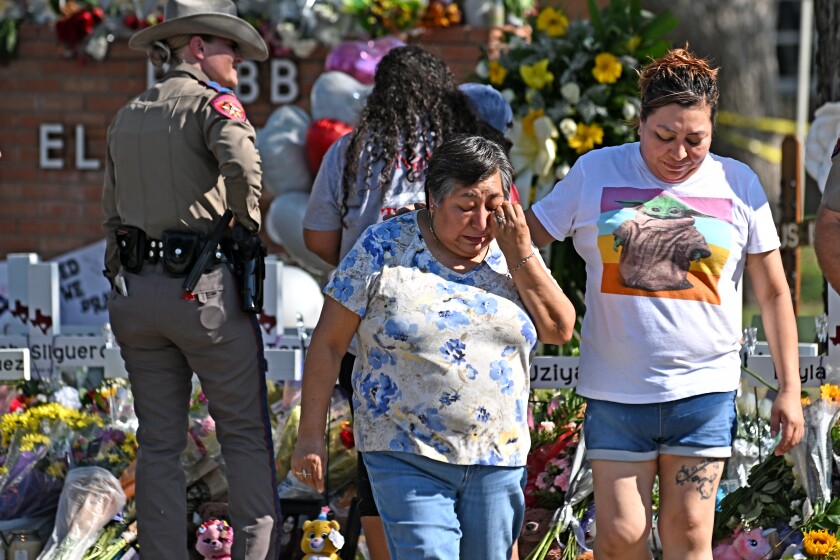
Uvalde, Texas May 26, 2022- Family members walk away after living flowers at a memorial outside Rob Elementary School in Uvalde, Texas. Nineteen students and two teachers died when a gunman opened fire in a classroom Tuesday. (Wally Skalij/Los Angeles Times)

BUSINESS

Column: Uvalde demonstrates our cowardice about guns

June 1, 2022

ADVERTISEMENT

null

Open carry of loaded firearms is generally prohibited, as is concealed carry of a loaded weapon without a license.

California also has a so-called red flag law, or “extreme risk protection orders,” which allow family members, police, employers or school personnel to alert authorities to signs of danger from a person and for a judge to order the confiscation of weapons from that person.

The California constitution has no provision protecting the right to bear arms. State law preempts all local initiatives.

Anand Giridharas, author of “Winners Take All,” was interviewed on the “Morning Joe Show” and delivered a stunning rebuke to the Republicans and oligarchs who are destroying our democracy.

Polls show that an overwhelming majority of Americans want background checks for gun buyers, a modest hurdle. Yet Republicans will not permit any limits on gun buyers, and some Republican-controlled states have eliminated any restrictions on gun purchases and affirm the “right” to carry a gun in public, open or concealed, without a permit.

Anand says this about children: in the view of Republicans, children enjoy the right to life only as long as they are in the womb. Once they are born, all protections are removed. Their “right to life” is less important than the right of others to carry guns. Nor do they have the right to healthcare or nutrition or anything else,

A brilliant peroration.

For several years, I have sponsored an annual lecture series about education policy at Wellesley College, my alma mater. We have had a number of distinguished speakers, including Pasi Sahlberg, Yong Zhao, Andy Hargreaves, and Eve Ewing.

This year, the invited speaker was Dr. Helen Ladd, one of the nation’s most eminent economists of education. Dr. Ladd is the Susan B. King Professor Emerita of Public Policy and Economics at Duke University. She graduated from Wellesley in 1967, earned her M.A. at the London School of Economics and her Ph.D. from Harvard University. She has written extensively about school finance, equity, choice, and accountability.

Dr. Ladd discussed how charter schools disrupt good education policy.

Any day now, the Supreme Court will issue a crucial decision that defines or redefines the relationship between church and state. The “wall of separation” between church and state has long had many exceptions. Although there are state and regional differences, the state or federal government may pay for mandated services, for school transportation, for textbooks. What the public has never paid for is tuition for religious schools. The forthcoming decision may change that. The facts have not changed, but Trump added three new members who are likely to require the state to pay tuition at religious schools. We will see.

Jan Resseger explores this issue, reviewing an analysis by Kevin Welner, who is both an education policy scholar and a lawyer.

Please open the link to read the complete post:

The Washington Post’s Valerie Strauss recently published a warning about possible unforeseen consequences of the U.S. Supreme Court’s soon-to-be-released decision in a Maine school voucher case, Carson v. Makin. The Court is expected to release its decision by the end of June.

This is a First Amendment case about the entanglement of religion with government and government funding. Strauss warns: “In Carson v. Makin, the conservative majority of the Supreme Court is likely to require Maine officials to use public funding to subsidize religious teaching and proselytizing at schools that legally discriminate against people who don’t support their religious beliefs.”

Strauss refers readers to a May 12 policy brief, The Outsourcing of Discrimination: Another SCOTUS Earthquake?, by Kevin Welner, director of the National Education Policy Center at the University of Colorado. Welner explains why the Carson v. Makin, church-state case seems so complicated and confusing: “The First Amendment prohibits laws ‘respecting an establishment of religion, or prohibiting the free exercise thereof.’ These two religion clauses have long existed in tension and in a balance. The Free Exercise Clause protects individuals’ right to practice their religion as they please, while the Establishment Clause keeps the government from (at least in some circumstances) favoring or disfavoring religion or religious institutions. But that balance has perished. A well-orchestrated push to lift the Amendment’s Free Exercise Clause above its Establishment Clause has seen a level of success enjoyed by few other legal-advocacy efforts.”

The issue in Carson v. Makin differs from a 2020 decision in Espinoza v. Montana, in which the U.S. Supreme Court found that, under the First Amendment’s Free Exercise Clause, the state could not discriminate against a school based on its religious status. Carson v. Makin is about the school’s practice—the explicit teaching of religion, which the state of Maine currently prohibits.

Welner traces the history of church-state school voucher cases: “The legal landscape for vouchers supporting private religious schools has changed 180 degrees, corresponding to the shift in the makeup of justices on the Supreme Court. Vouchers for religious schools have moved from being broadly understood to be constitutionally forbidden in (the) 1970s to constitutionally allowed in 2003, via the Zelman v. Simmons-Harris (2002) decision, to now arguably constitutionally required, at least under the Montana circumstances.” Here Welner is referring to the 2020 U.S. Supreme Court decision, Espinoza v. Montana Department of Revenue.”

Many have believed that the recent “Free Exercise” decisions—the 2020 Espinoza decision and the decision the U.S. Supreme Court will release this month in Carson v. Makin—will have little real impact on state policy. The 2002 decision in Zelman v. Simmons-Harris—based on the old Establishment Clause definition of the separation of church and state—declared that as long as states awarded the voucher to the parents and not directly to the religious school and as long as the parents made the decision to use the voucher at the religious school, vouchers did not violate the separation of church and state. Following Zelman, most states which award vouchers have already been allowing them to flow to religious schools.

In his new brief, however, Kevin Welner worries that Carson v. Makin could potentially have serious implications when religious schools violate students’ rights protected in federal law. Welner also explores, with a focus on charter schools, how the policy implications would be different in politically blue and red states.