Archives for the month of: June, 2022

Mark Joseph Stern wrote recently in Slate about the dangers embedded in the Supreme Court’s Carson v. Makin decision. In this decision, the Supreme Court ruled that the state of Maine was compelled to pay tuition at religious schools because it paid tuition at some other private schools. Stern warns that the Supreme Court is very likely to extend this concept to every state that underwrites nonsectarian private schools. The Court’s zeal for religious schools is not going to end in Maine. Please open the link and read the entire article. Make no mistake: This Supreme Court is determined to abolish any separation between church and state and to require every state to pay for religious education. So you don’t want your tax dollars to underwrite a school that would not admit your own children or grandchildren; too bad. So you don’t want to pay for Madrassas, yeshivas, or schools that teach racial hatred? Too bad.

The Republican majority on the Supreme Court claims it is dedicated to the principles of the Original Constitution, as written. They say they are Constitutional fundamentalists. This decision demonstrates how phony their “Originalism” is. The Founding Fathers were very explicit in their desire to separate religion from the state. This Court is not dedicated to the Constitution or its principles. If it were, it would never have written this decision.

He writes:

The Supreme Court’s conservative supermajority effectively declared on Tuesday that the separation of church and state—a principle enshrined in the Constitution—is, itself, unconstitutional. Its 6–3 decision in Carson v. Makin requires Maine to give public money to private religious schools, steamrolling decades of precedent in a race to compel state funding of religion. Carson is radical enough on its own, but the implications of the ruling are even more frightening: As Justice Stephen Breyer noted in dissent, it has the potential to dismantle secular public education in the United States.

Carson challenges Maine’s effort to provide quality civic education to every child in the state. The government created a tuition assistance program to help families who live in remote, sparsely populated regions without any public schools. Under the program, parents can send their kids to certain private schools, and the state covers the cost of tuition. To qualify, these schools must give students a secular education. They may be affiliated with, or even run by, a religious organization. But their actual curricula must align with secular state standards.

Two families challenged this limitation, arguing that it violated the First Amendment’s free exercise clause. Just two decades ago, this claim would’ve been laughed out of court: SCOTUS only permitted states to subsidize religious schools in 2002; at the time, it would’ve been absurd to say that states have a constitutional obligation to subsidize them. Beginning in 2017, the court began to assert that states may not exclude religious schools from public benefits that are available to their secular counterparts. And in 2020, the conservative justices forced states to subsidize religious schools once they began subsidizing secular private education.

Tuesday’s decision in Carson takes this radical theory to a new extreme, ordering Maine to extend public education funds to religious indoctrination.

The upshot of Chief Justice John Roberts’ opinion for the court is that states have no compelling interest in providing public, secular education to children. Indeed, Roberts suggests that the very concept of secular schooling is a smokescreen for “discrimination against religion”—a pretext for unconstitutional animus toward pious Americans. His opinion reaches far beyond Maine. About 37 states have amendments to their constitutions that bar government funding of religious institutions, including schools. Carson essentially invalidates those laws while undermining the broader constitutional basis for the nation’s public school system.

Roberts reached this astonishing result by overruling broad swaths of precedent respecting states’ authority to separate church and state more strictly than the U.S. Constitution requires. The court previously upheld states’ interest in avoiding the “establishment” of religion by refusing to underwrite the indoctrination of students into a particular faith. No longer. Roberts condemned Maine’s efforts to guard against religious establishment as nothing more than “discrimination against religion”—an effort to “exclude some members of the community” from public benefits “because of their religious exercise.” He also overruled a line of cases that let the government withhold funding on the basis of religious use (like indoctrination) but not religious status (like affiliation with a church). That distinction, he wrote, “lacks a meaningful application not only in theory, but in practice as well,” tossing it in the precedential dumpster.

The chief justice maintained that Carson’s rule only kicks in once a state starts sending taxpayer dollars to private schools through vouchers, tax credits, or scholarships. So, in theory, a state can send all its money to public schools and avoid constitutional concerns. Even if that’s true, the consequences are sweeping: Most states offer at least one of these programs, so Carson gives millions of families an opportunity to bail out of the public school system and demand public money for parochial education...

It’s worth pausing, as both Breyer and Justice Sonia Sotomayor did in dissent, to reflect on the victims of Tuesday’s decision. The two Maine schools that may now receive public funding are openly discriminatory, expelling students and teachers who do not adhere to evangelical Christianity. LGBTQ students, as well as straight children of same-sex couples, are not welcome, nor are LGBTQ teachers. Even custodians must be born-again Christians. One school teaches students to “refute the teachings of the Islamic religion” and believe that men serve as the head of the household. Another requires students to sign a “covenant” promising to glorify Jesus Christ and attend weekly religious services.


The Supreme Court’s conservative supermajority effectively declared on Tuesday that the separation of church and state—a principle enshrined in the Constitution—is, itself, unconstitutional. Its 6–3 decision in Carson v. Makin requires Maine to give public money to private religious schools, steamrolling decades of precedent in a race to compel state funding of religion. Carson is radical enough on its own, but the implications of the ruling are even more frightening: As Justice Stephen Breyer noted in dissent, it has the potential to dismantle secular public education in the United States.

Carson challenges Maine’s effort to provide quality civic education to every child in the state. The government created a tuition assistance program to help families who live in remote, sparsely populated regions without any public schools. Under the program, parents can send their kids to certain private schools, and the state covers the cost of tuition. To qualify, these schools must give students a secular education. They may be affiliated with, or even run by, a religious organization. But their actual curricula must align with secular state standards.

Two families challenged this limitation, arguing that it violated the First Amendment’s free exercise clause. Just two decades ago, this claim would’ve been laughed out of court: SCOTUS only permitted states to subsidize religious schools in 2002; at the time, it would’ve been absurd to say that states have a constitutional obligation to subsidize them. Beginning in 2017, the court began to assert that states may not exclude religious schools from public benefits that are available to their secular counterparts. And in 2020, the conservative justices forced states to subsidize religious schools once they began subsidizing secular private education.

Tuesday’s decision in Carson takes this radical theory to a new extreme, ordering Maine to extend public education funds to religious indoctrination.

The upshot of Chief Justice John Roberts’ opinion for the court is that states have no compelling interest in providing public, secular education to children. Indeed, Roberts suggests that the very concept of secular schooling is a smokescreen for “discrimination against religion”—a pretext for unconstitutional animus toward pious Americans. His opinion reaches far beyond Maine. About 37 states have amendments to their constitutions that bar government funding of religious institutions, including schools. Carson essentially invalidates those laws while undermining the broader constitutional basis for the nation’s public school system.

Roberts reached this astonishing result by overruling broad swaths of precedent respecting states’ authority to separate church and state more strictly than the U.S. Constitution requires. The court previously upheld states’ interest in avoiding the “establishment” of religion by refusing to underwrite the indoctrination of students into a particular faith. No longer. Roberts condemned Maine’s efforts to guard against religious establishment as nothing more than “discrimination against religion”—an effort to “exclude some members of the community” from public benefits “because of their religious exercise.” He also overruled a line of cases that let the government withhold funding on the basis of religious use (like indoctrination) but not religious status (like affiliation with a church). That distinction, he wrote, “lacks a meaningful application not only in theory, but in practice as well,” tossing it in the precedential dumpster.

The chief justice maintained that Carson’s rule only kicks in once a state starts sending taxpayer dollars to private schools through vouchers, tax credits, or scholarships. So, in theory, a state can send all its money to public schools and avoid constitutional concerns. Even if that’s true, the consequences are sweeping: Most states offer at least one of these programs, so Carson gives millions of families an opportunity to bail out of the public school system and demand public money for parochial education.

But can this distinction hold? Roberts’ bright line dims under scrutiny: Maine, after all, wanted private schools to replace public education for some students, not supplement it. And yet the court found no good reason for the state to insist that these substitute schools adhere to secular standards. Indeed, the chief justice’s rhetoric depicts education not as a state-sponsored benefit for all, but rather as a personal matter best left up to parents. There is, he claimed, no “historic and substantial state interest” in preserving secular education. If that’s true, how can any state refuse to fund religious schooling?

It’s worth pausing, as both Breyer and Justice Sonia Sotomayor did in dissent, to reflect on the victims of Tuesday’s decision. The two Maine schools that may now receive public funding are openly discriminatory, expelling students and teachers who do not adhere to evangelical Christianity. LGBTQ students, as well as straight children of same-sex couples, are not welcome, nor are LGBTQ teachers. Even custodians must be born-again Christians. One school teaches students to “refute the teachings of the Islamic religion” and believe that men serve as the head of the household. Another requires students to sign a “covenant” promising to glorify Jesus Christ and attend weekly religious services….

“Legislators,” Breyer wrote, “did not want Maine taxpayers to pay for these religiously based practices,” as doing so might violate their own faith or conscience. The majority tells these Mainers their own views don’t matter, because the First Amendment forces them to foot the bill for other people’s religious indoctrination. Doing so creates a “serious risk of religion-based social divisions,” Breyer explained, exacerbating the “religious strife” that the religion clauses “were designed to prevent.” Sotomayor put the point more sharply: “While purporting to protect against discrimination of one kind,” she wrote, “the court requires Maine to fund what many of its citizens believe to be discrimination of other kinds.”

The conservative majority, however, has perfected the art of ignoring genuine discrimination while perceiving anti-Christian persecution where none exists. In the process, they are elevating the rights of one sect over all others. Carson will not benefit any religious minorities; there are not enough Muslims or Jews to create a school in the far-flung corners of Maine. Every time Roberts uses the word “religion,” he might as well be saying “Christian.” The right will praise Carson as a triumph of religious liberty. But if you practice a religion that does not stand to gain from the ruling, your liberty does not matter to this Supreme Court.

The state board of education in Massachusetts, dominated by “reformers” is itching to take control of the Boston public school district. State takeovers have consistently failed. Failure never deters “reformers.”

Dear families, students, educators and community partners,

[Español aqui. Todos están invitados a unirnos para el foro comunitario y la protesta en DESE]  

The Receivership issue is heating up again. Yesterday, Commissioner Riley recommended that the Board vote to declare BPS an “underperforming district.” See the BTU bulletin here for more information. You are invited to join us for two events:

1) We are holding an EMERGENCY Town Hall this Sunday, June 26 from 7:00pm to 8:00pm to discuss what Commissioner Riley’s new proposal to declare BPS “underperforming” is and what would happen to BPS if the Board votes to do so. This will be a public town hall, and we encourage you to invite fellow families and students. Sign up now.

2) This Tuesday, June 28th, we will gather at 8 am outside the DESE headquarters (75 Pleasant St. in Malden) to rally against state takeover and for a BTU contract now. At 8:30am we’ll enter the meeting to watch public testimonies when the board meeting begins at 9am. RSVP at bit.ly/Rally628. There’s garage parking right next to Malden, easy Orange Line access, or if you’d like to take the bus with us from the BTU, email Daphne (dsoto@btu.org) to reserve your seat.

In solidarity,

Ari + the BTU

Sent via ActionNetwork.org. To update your email address, change your name or address, or to stop receiving emails from Boston Teachers Union, please click here.

Blogger Robert Hubbell brings clarity and reason to the abortion debate. The Court’s decision overturns a precedent that had been in place for 49 years. Both Justices Gorsuch and Kavanaugh pledged to Senators that they would not overturn roe. They lied. What now?

Hubbell writes:

There is much to discuss after the Supreme Court’s brutal ruling in Dobbs v Jackson Women’s Health, but the most important question is, “What are we going to do about it?” We have several effective paths forward and must pursue all simultaneously.

First, Alito claims he is returning the decision of reproductive freedom “to the people and their state representatives.” Let’s ignore (for the moment) Alito’s smoldering bad faith and thinly veiled contempt for the rights of women. We need to flip state legislatures to repeal antiabortion legislation and capture statewide executive offices that can veto legislation abortion bans. While this path is not an answer in every state, it can make a difference in states where the GOP margin of control is thin.

Second, we must demand that Congress pass legislation codifying Roe. That means gaining a 54-seat majority in the Senate, carving out an exception to the filibuster, and retaining control of the House. Will national legislation be challenged? Sure! Will the Supreme Court invalidate it? Possibly, but it is worth the effort.

Will national legislation be challenged? Sure! Will the Supreme Court invalidate it? Possibly, but it is worth the effort.

Third, we must break the Supreme Court. Democrats should expand the Court to thirteen justices. This path also requires holding the House, gaining a 54-seat majority in the Senate, and carving out an exception to the filibuster. Expanding the Court requires only a majority vote in both chambers of Congress and signing of the bill by the president. Will Republicans expand the Court to nineteen? Maybe. But what Republicans might do in the future shouldn’t deter us now. Will tit-for-tat expansions of the Court undermine its legitimacy? It is far too late for that.

Fourth, reproductive choice must be on the ballot in every race. Republicans have finally achieved what they wanted—no right to abortion and no exceptions for rape or incest. We must make every Republican running for every office in the land own the GOP position on abortion in its ugliest manifestation. The outcome in Dobbs is opposed by a strong majority of Americans and should provide a basis for a sweeping Democratic victory in 2022.

Finally, the right to same-sex marriage, same-sex relations, contraception, and other privacy-based rights must be on the ballot in every race. Justice Clarence Thomas’s concurrence declared war on those rights and invited reactionary legislatures to pass laws to serve as test cases. We would be foolish to assume that the other members of the reactionary majority will not follow his lead, given a chance.

None of these approaches will be easy or provide a complete answer. Readers have already sent emails that preemptively identify the problems with some of these approaches and dismiss their chances of success. But these are the paths available to us. We can choose to pursue them or do nothing. We must pursue them relentlessly until we have regained control of every branch of government, including the Supreme Court. Only then can we reverse the ruling in Dobbs and preserve other liberties grounded in the same right to privacy that supported reproductive rights for a half-century.

We are the majority, and American democracy presumes majority rule while protecting the rights of the minority. Republicans are attempting to reverse that presumption by seeking to impose permanent minority rule with no protection for the rights of the majority. That cannot stand. It will not stand. But it is up to us to restore the natural balance to democracy. It is not enough that we vote with greater passion or conviction. We must motivate those who did not believe this day would not come or who were not paying attention. We can do that—if we act with greater passion, conviction, and urgency.

The ruling.

Alito’s final decision is a judicial insult. In a single blow, he has demoted American women to second-class citizens. It is filled with venom and contempt in addressing a contentious issue on which people of good faith can disagree. He refers to physicians as abortionists when they seek to save a woman’s life or terminate a pregnancy forced on a teenager by a rapist. He misrepresents, minimizes, and dismisses the burdens and risks of pregnancy. He substitutes his Catholic dogma for judicial analysis.

Alito’s final version of his opinion changed little from the draft leaked last month. As such, it retains the dishonesty and intellectual sophistry of the “deeply rooted tradition” analysis contained in the draft—an analysis that deliberately misrepresents the American tradition relating to abortion. See Aaron Tang in The Los Angeles Times, Op-Ed: The Supreme Court flunks abortion history.

But most ominously, Alito’s “deeply rooted” analysis signals Alito’s intent to attack other privacy-based rights, such as same-sex marriage. Alito dissented in the Court’s decision recognizing same-sex marriage, Obergefell v. Hodges. Alito wrote in Obergefell, as follows:

          To prevent five unelected Justices from imposing their personal vision of liberty upon the American people, the Court has held that “liberty” under the Due Process Clause should be understood to protect only those rights that are ‘deeply rooted in this Nation’ s history and tradition.’ And it is beyond dispute that the right to same-sex marriage is not among those rights.

There it is: Alito’s analysis in overruling Roe v. Wade does not stop with reproductive rights. It reaches to same-sex marriage. He said so in his dissent in Obergefell. And Justice Thomas made that explicit in his concurrence in Dobbs:

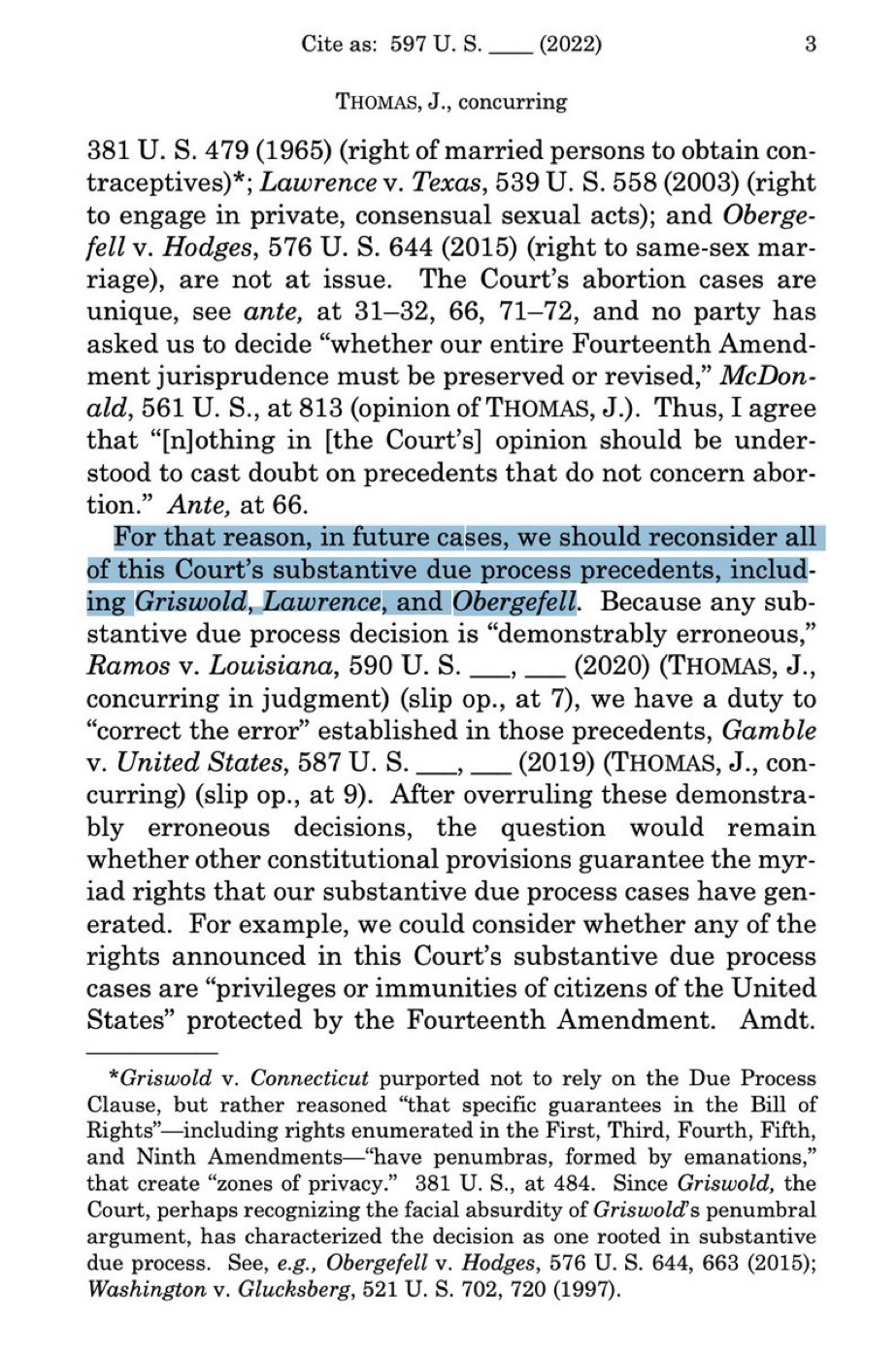
          In future cases, we should reconsider all of this Court’s substantive due process precedents, including Griswold, Lawrence, and Obergefell.

Griswold recognized the right to use contraceptives of choice; Lawrence recognized the right to enter into a same-sex relationships; and Obergefell recognized the right of same-sex couples to marry. Justice Thomas notably omitted a right based on “substantive due process precedents”—the right of members of different “races” to marry, a right first granted in Loving v. Virginia in 1967. If the Court reverses Loving v. Virginia, Thomas’s marriage to Ginny Thomas would be illegal in some states.

For a longer discussion of the threat to other rights, see Mark Joseph Stern in Slate, The Supreme Court decision overruling Roe v. Wade puts marriage equality in immediate jeopardy.

It will take weeks to understand the implications of Justice Alito’s decision, but a good place to start is with Ian Millhiser’s analysis in Vox, The Roe v. Wade abortion decision, explained.

Finally, for a discussion of self-inflicted damage to the Court’s legitimacy, see Dahlia Lithwick, in Slate, Roe v. Wade overturned: The Supreme Court will pay for abortion decision.

The corruption and illegitimacy of the Supreme Court.

As currently constituted, the Supreme Court is illegitimate and corrupt. It is illegitimate because two justices appointed by Trump resulted from norm-busting “rules” made up by Mitch McConnell on the fly. Gorsuch sits in a seat stolen from an Obama appointee, and Barrett sits in a seat that belonged to the incoming president.

The Court is corrupt because Gorsuch, Kavanaugh, and Barrett lied to the Senate about their pre-determined intent to overrule Roe v. Wade. And it is corrupt because Justice Thomas has refused to recuse himself from cases in which his wife assisted in an attempted coup.

The trust of the American public in the Court has plummeted to an all-time low of 25%. It will decline further if the January 6th Committee proves that Ginny Thomas funneled information about Court deliberations to John Eastman. It will fall further if the Committee demonstrates that Justice Thomas knew of and condoned his wife’s insurrectionist activities.

Jennifer Rubin succinctly summarizes the death blow to the Court’s legitimacy in her column in WaPo, The Supreme Court eviscerates abortion rights and its own legitimacy. Per Rubin,

The hypocrisy and intellectual dishonesty of the court’s right-wing justices lead to the conclusion that they have simply appointed themselves super-legislators free to impose a view of the United States as a White, Christian and male-dominated society despite the values, beliefs and choices of a majority of 330 million modern Americans.

The court’s decision may result in women’s deaths. But it has certainly killed off what is left of the court’s credibility. And for that, there is no solution in sight.

Concluding Thoughts.

On a day like today, it does not feel right to end on an optimistic note. Rather, we should acknowledge the anger, frustration, fear, and grief that tens of millions of women in America are feeling after the ruling. There will be a time to rally and rejoin the fight for the dignity and equality of women—a fight we will win.

But today, we should acknowledge what women have lost and give them the time and space to absorb and recover from a once-in-a-generation shock. As they do, everyone in their lives should let them know we are at their side every step of the way. Walk along in silence and listen. Nothing can be “fixed” today, but we can begin the long journey back in the coming days.

Ken Paxton is State Attorney General in Texas and as such is the state’s top law enforcement official.

On the day after the massacre of 19 children and two teachers in Uvalde, he said that “God always has a plan.” This is a variation on “thoughts and prayers.”

Paxton opposes gun control.

Karen Tumulty of the Washington Post wrote:

When thoughts and prayers seem inadequate in the wake of a tragedy, you can always blame God for what happened.

That would seem to be how Texas Attorney General Ken Paxton (R) sees it after a mass shooting at an elementary school in Uvalde, Tex., took the lives of 19 children and two of their teachers. The carnage came just 10 days after a gunman with allegedly racist motives mowed down 10 shoppers and employees — all of them Black — in a Buffalo supermarket.

In a podcast interview recorded the day after the May 24 shooting at Robb Elementary School and unearthed last week by Salon, Paxton was asked by North Texas pastor Trey Graham what he might say to the victims’ families.

“I’d have to say, look, there’s always a plan. I believe God always has a plan,” the attorney general replied. “Life is short no matter what it is.”
It was all in God’s plan. That’s a suggestion we often hear from pious, well-meaning people when other words fail in the face of an unspeakable, inexplicable tragedy. The idea is that some day we will all understand that larger purpose of our suffering. It is meant to be a balm.

But those words sound more like a shrug when an elected leader — and in this case, one who is his state’s top law enforcement officer — offers that as an explanation for a horror that was preventable and exacerbated by human error. Worse, it is a dereliction of responsibility and of the imperative to do something to prevent something like this from happening again, as it has happened over and over.

Jan Resseger has established a reputation for writing well-researched, fearless articles about unjust education policies. In this post, she reviews a new book about the roots of corporate education reform. I have already ordered it.

She writes:

I remember my gratitude when, back in 2010, I sat down to read Diane Ravitch’s The Death and Life of the Great American School System, which connected the dots across what I had been watching for nearly a decade: the standards movement, annual standardized testing, the operation of No Child Left Behind’s test-and-punish, Mayor Bloomberg’s promotion of charter schools in New York City, and the role of venture philanthropy in all this.

Now over a decade later, many of us have spent the past couple of months worried about pushback from the charter school sector as the the U.S. Department of Education has proposed strengthening sensible regulation of the federal Charter Schools Program. We have been reminded that this program was launched in 1994, and we may have been puzzled that a federal program paying for the startup of privately operated charter schools originated during a Democratic administration.

Lily Geismer, a historian at Claremont McKenna College, has just published a wonderful book which explains how the New Democrats—Bill Clinton, Al Gore, and the Democratic Leadership Council—brought a political and economic philosophy that sought to end welfare with a 1996 bill called the “Personal Responsibility and Work Opportunity Reconciliation Act” and envisioned privately operated charter schools to expand competition and innovation in the public schools as a way to close school achievement gaps. Geismer’s book is Left Behind: The Democrats’ Failed Attempt to Solve Inequality. The book is a great read, and it fills in the public policy landscape of the 1990s, a decade we may never have fully understood.

In the introduction, Geismer explains where she is headed: “Since the New Deal, liberals had advocated for doing well and doing good. However, the form of political economy enacted during the new Deal and, later, the New Frontier and Great Society understood these as distinct goals. The architects of mid-twentieth century liberalism believed that stimulating capital markets was the best path to creating economic growth and security (doing well). The job of the federal government, as they saw it, was to fill in the holes left by capitalism with compensatory programs to help the poor, like cash assistance and Head Start, and to enact laws that ended racial and gender discrimination (doing good). In contrast, the New Democrats sought to merge those functions and thus do well bydoing good. This vision contended that the forces of banking, entrepreneurialism, trade, and technology… could substitute for traditional forms of welfare and aid and better address structural problems of racial and economic segregation. In this vision, government did not recede but served as a bridge connecting the public and private sectors.” (p. 8)

Geismer devotes an entire chapter, “Public Schools Are Our Most Important Business,” to the Clinton administration’s new education policy. She begins by telling us about Vice President Al Gore’s meetings with “leading executives and entrepreneurs from Silicon Valley. The so-called Gore-Tech sessions often took place over pizza and beer, and Gore hoped for them to be a chance for the administration to learn from innovators of the New Economy…. One of these meetings focused on the problems of public education and the growing achievement gap between affluent white suburbanites and students of color in the inner city…. The challenge gave venture capitalist John Doerr, who had become Gore’s closest tech advisor, an idea… The tools of venture capital, Doerr thought, might offer a way to build new and better schools based on Silicon Valley’s principles of accountability, choice, and competition… Doerr decided to pool money from several other Silicon valley icons to start the NewSchools Venture Fund. NewSchools sat at the forefront of the concepts of venture philanthropy. Often known by the neologism philanthrocapitalism, venture or strategic philanthropy focused on taking tools from the private sector, especially entrepreneurialism, venture capitalism, and management consulting—the key ingredients in the 1990s tech boom—and applying them to philanthropic work… Doerr and the NewSchools Fund became especially focused on charter schools, which the Clinton administration and the Democratic Leadership Council were similarly encouraging in the 1990s.” (pp. 233-234)

As she explains, the Clinton administration bought the idea that charter schools would be an effective way to end poverty. It encouraged the growth of the charter sector, not realizing that it was creating an industry that would fight accountability, lobby for more federal funding, and ignore frequent scandals and frauds.

It is a cautionary tale that reminds us that the best way to fight poverty is to raise incomes, create jobs, and support labor unions that will defend the rights of working people and advocate for higher wages and benefits.

Justice Clarence Thomas warns us which other decisions are likely to fall, under the reign of the authoritarian Trump Court: the right of married couples to buy contraceptives; the decriminalization of consensual gay sex in the privacy of one’s home; and gay marriage. Notice he left out the Loving decision, which made interracial marriages legal. Was that to protect his own marriage?

As expected, the US Supreme Court overturned Roe v. Wade, which stood for half a century as a guarantee of women’s reproductive rights. About half or more states have already passed or are about to pass laws banning abortions, even for women who were victims of rape or incest, even for women whose life is in danger. The “right to life” so prized by anti-abortion activists does not include the life of the woman.

As was not quite so expected, the Supreme Court gutted the Miranda rights of people who are arrested. Police may fail to tell prisoners of their legal rights, including their right to remain silent.

The Trump Court is remaking and redefining the law in a radical way. There is nothing “conservative” about their willingness to toss out precedent. There is something very radical about the jackhammer they are using to change social and legal norms.

Women will die because of the Court’s decision to throw out Roe, which several of them pledged in public not to do. The old coat hanger routine and the unlicensed abortionists will return. Women who can afford to flee to a state where abortion is available will do so. Those who can self-medicate with Internet anti-abortion drugs will do so, although some states are trying to ban Internet abortion drugs (will they open every package to every woman of child-bearing age?).

The Court’s decision on New York’s gun law is terrifying. Be prepared to see armed men (and women, don’t forget Congresswoman Lauren Bobert) strolling through your neighborhood or shopping malls. If the six justices actually think that open carry is a fine idea, why won’t they permit it in their own courtroom?

Make no mistake: the current majority on the Supreme Court is not conservative; it is radical, in its reckless disregard for precedent and the safety of citizens.

The Court is not libertarian; its decisions require millions of people to abide by their cramped view of the way things ought to be. The state must fund religious schools, no matter how bigoted and discriminatory they are, if the state funds any private schools. States and cities must not protect their public by enacting laws that prevent them from openly carrying a deadly weapon.

We can expect even more intrusive decisions, valuing property rights over human rights, corporate rights over workers’ rights.

We will be living with this narrow-minded, bossy, intrusive Court for many years. My generation has failed. I look to the enlightened young people, the product of America’s much-maligned public schools, to reverse course in the future and preserve this fragile experiment in democracy from the ideologues who seek to destroy it.

For an insightful assessment of how the Supreme Court’s decision on abortion will affect women in Texas, read this article in The Texas Monthly.

An excerpt:

An excerpt: As trigger laws go into effect around the country, Texans seeking surgical abortions will likely find themselves in either Kansas or New Mexico, the two nearest states where the procedure will remain legal—though both have a limited number of clinics, which is likely to make scheduling an appointment difficult. Kansas has four clinics, which currently serve 530,000 potential patients of reproductive age. Now the state’s clinics will be the nearest alternative for 7.7 million such patients, according to theGuttmacher Institute, a nonprofit group that researches reproductive health. New Mexico, which has seven clinics, will be the nearest option for 1.9 million potential patients, the vast majority of whom will be Texans.

What about abortion pills?

Medication abortions, which are nonsurgical and administered by taking a two-dose regimen of pills that terminate a pregnancy, are currently illegal in Texas after the seventh week of pregnancy; after HB 1280 goes into effect on July 24, medication abortions, which are currently the most common type of abortions in Texas, are included in the total ban on the procedure in the state.

As of last December, Texas law also forbids the shipment of pills that induce an abortion “by courier, delivery, or mail service.” It’s unclear how Texas officials plan to enforce this law, as many U.S. and international organizations offer the pills by mail, or whether those who seek care after a self-administered abortion could face criminal charges under HB 1280, depending on how the law is applied.

Legislators see the Supreme Court ruling as a green light to outlaw abortion and criminalize anyone who performs one. The penalties are as stiff as murder.

Friends in Oklahoma sent the charging document that lays out the evidence against the founders of the Epic Charter School. They are accused of skimming off millions of dollars. The charging document explains how they did it.

Is this happening in your state? The biggest charter frauds seem to occur in virtual charters like the A4 scam in California, which siphoned off hundreds of millions of taxpayer dollars before it was discovered.

The online charter sector not only has abysmal academic records, but it’s ripe pickings for scammers. The founders of Epic charter schools in Oklahoma are charged with multiple counts of embezzlement, racketeering and other crimes.

Oklahoma Watch reports:

Epic Charter Schools’ founders, who were arrested Thursday, shifted millions of school dollars to company credit cards, which were used to make political campaign donations, fund a lobbyist and pay personal expenses like vacations, the Oklahoma State Bureau of Investigation alleges in court documents.

Following a yearslong investigation into alleged embezzlement of taxpayer funds, the co-founders of the state’s largest online school were arrested Thursday, along with the longtime chief financial officer, court records show.

David Chaney, 43, Ben Harris, 46, and Josh Brock, 40, were booked into the Oklahoma County Detention Center Thursday morning. Each is charged with racketeering, embezzlement, obtaining money by false pretense, conspiracy to commit a felony, violating the Oklahoma Computer Crimes Act, submitting false documents to the state and unlawful proceeds.

Investigators said the men ran a complicated criminal enterprise using the online charter school and a for-profit company, Epic Youth Services.

The scheme has cost the state more than $22 million, according to the OSBI.

The charges involve co-mingling of funds, excessive and unnecessary management fees, use of Oklahoma tax dollars in California, political influence, concealment of profits, submission of false invoices and the illegal use of employees.

One of the school’s largest recruitment tools, the learning fund, was used to conceal illegal purchases, agents alleged. For the learning fund, Epic makes at least $1,000 available to each student annually in a virtual account. Parents can allocate those dollars for curriculum, laptops and extracurricular activities.

Parents don’t receive the money directly. Instead, they request a purchase from Epic and the school transfers the money to Epic Youth Services, which pays the vendor.

Chaney and Harris used a separate bank account to make learning fund purchases, and investigators found Chaney and Harris didn’t return unused learning fund dollars.

The account received nearly $145 million between 2015 and 2021. More than 50 times, Chaney, Harris and Brock transferred public funds from the learning fund account to the private bank account for Epic Youth Services, which was then used to pay a lobbying firm. Capital Gains, a lobbying firm run by Robert Stem, a longtime friend of Harris’, was paid more than $500,000.

Please open the link to read the rest of the story. Campaign contributions go a long way towards avoiding accountability.

Amy Frogge is a parent of children in the Nashville public schools, a lawyer, and served two terms on the Metro Nashville school board. When she read in Chalkbeat that the Philadelphia school board had hired a consulting firm to advise its new superintendent, she was stunned. The consulting firm would be paid a fee of $450,000 for its advice. But what stunned her was that the firm was operated by the former Superintendent of Nashville, who had left under a cloud. This was the same superintendent who brought to Nashville a leadership team that included former Baltimore County superintendent Dallas Dance. Shortly after Dance was brought to Nashville, he was convicted and imprisoned on charges relating to consulting fees on a no-bid contract, which he lied about on financial disclosures.

Frogge sent the following letter to Philadelphia school board members:

Good morning-

My name is Amy Frogge. I am an attorney and former eight-year member of the Metro Nashville school board, where I served as both Vice Chair and Chair. 

I was deeply disturbed to see that your school district has entered into a contract with Joseph and Associates: https://philadelphia.chalkbeat.org/2022/6/21/23177395/consulting-firm-will-get-450000-to-help-new-philly-superintendent This article includes comments from two Nashville board members who claim that Shawn Joseph left our school district merely due to personality conflicts, when nothing could be further from the truth.

I know the contract has been finalized, but I am reaching out to you as a warning. When Joseph arrived in Nashville, his former supervisor from another school district reached out to me as well, and I wish I had heeded the warnings. I voted to hire him and remained his strong supporter until I finally realized what was happening behind the scenes.

When Shawn Joseph and his team arrived in Nashville, we were hit by millions of dollars in no-bid contracts and an array unqualified, highly paid consultants. Unauthorized purchasing increased sevenfold, which meant Joseph and his team were not following proper contract procedures. Joseph negotiated contracts in violation of state law, and he could not account for the spending of $1.5 million on a no-bid contract that he awarded to someone he knew and brought with him from another school district. He repeatedly misled the school board and split contracts so that they would not come to the board for approval. In addition, our district endured what was described as a “morale crisis,” and the school board had to hire an independent firm to assess the district’s new Human Resources department. It concluded that employee morale was the lowest it had ever been and that Joseph’s team was engaging in “unconscionable” practices. By the time Joseph left, the state recommended revocation of his state license. This is all just the tip of the iceberg. Here is a short summary of just some of the problems we encountered: https://www.newschannel5.com/news/newschannel-5-investigates/what-you-need-to-know-about-shawn-josephs-controversies There is much more. I have never before or after experienced such corruption and dysfunction.

Shawn Joseph’s severance agreement included a gag order for school board members to prevent us from speaking even truthfully about our experiences. Three of us had to sue to remove the clause from agreement, and we just won the lawsuit. That is the reason I am able to reach out to you today.

I just attended an education conference in your lovely city, and I hate to see Philadelphia go down the same path. I would be happy to speak with any of you about our experiences. Please feel free to call or email me.

Amy Frogge