Archives for the month of: August, 2019

ON TAP Today from the American Prospect
AUGUST 20, 2019

Meyerson on TAP

How the Media Should Cover Corporations Now.

Yesterday’s restatement of corporate purpose from the Business Roundtable is a clear acknowledgment that America’s economic pooh-bahs have realized they’re about as popular as a strain of bacteria. There is much to be said about this about-face, in which the Roundtable said that the purpose of American corporations is no longer to maximize shareholder value at the expense of all other corporate stakeholders, but rather to treat those stakeholders—including employees, consumers, and communities, as well as shareholders—as equals. I’ll say more at greater length later this week.

For now, though, here’s a suggestion to the business page editors of American newspapers: Now that shareholder value isn’t the be-all and end-all of corporate purpose, you need to supplement your business coverage with indices of more than a corporation’s share prices. How about posting the median wage of its employees, and the ratio of CEO pay to median worker pay alongside the daily share value? How about posting (it’s OK to use abbreviations) whether a particular corporation offers defined benefit pensions (DBFs) or 401(k)s, paid sick days (PSDs—you get the point), paid family leave, and paid vacation time—for starters. How about listing the number of U.S. employees and whether a company is unionized or not?

Obviously, media outlets devoted to Milton Friedman’s nostrums, which have done more to destroy the American middle class over the past 40 years than any other body of thought, will have no interest in listing more than the share price. But the general welfare of the vast majority of the American people depends primarily on wages and benefits, not share values. How about conforming your economic coverage to ’muricans’ actual needs? ~ HAROLD MEYERSON

!

Copyright (C) 2019 The American Prospect. All rights reserved.
THE AMERICAN PROSPECT | 1225 I Street NW, Suite 600 | Washington, D.C. 20005 | U.S.A.

Steve Bullock entered the Democratic primary race late, and he starts at the back of the pack.

He needs to have 130,000 individuals contributions in order to qualify for the next debate.

I am asking you to send Steve Bullock $1 to keep him on the stage and to encourage him to talk about what he has done to improve public schools in Montana.

What he has going for him is two things:

1) he is the only candidate in the stage who won re-election in a red state that went for Trump by 20 points. In other words, he knows how to connect to people as a problem-solver who listens. He proved that he can win in a red state.

2) he has a solid pro-public education record. Montana has only two charter schools and both are under the direct supervision of local school districts. They exist because the district needs them, not because an entrepreneur or a charter chain has decided to open a charter.

Steve Bullock is unabashedly pro-public education and pro-union. NPE Action examined his record and gave him high marks for his commitment to public schools.

I am not asking you to support Steve Bullock. I have not endorsed him or anyone else.

I encourage you to send him $1 so you can be counted as a contributor and help him earn a place in the next big debate.

When teachers in West Virginia launched the Education Spring of 2018, one of their demands was “no charter schools.” The state’s public schools are already underfunded, and public school teachers had low pay compared to nearby states. The teachers understood that the addition of charter schools would mean fewer resources for public schools. Given that West Virginia is a largely rural state, there was no need or demand for a parallel school system of private contractors.

The legislature and governor agreed to the teschers’ demands but proceeded to double cross them by passing a charter law.

Charter advocates were thrilled. Another conquest for privatization.

But now charter advocates are “perturbed.” In fact, they are truly dismayed and having a hissy fit. They are downright ticked off.

It seems West Virginia law allows only school districts to authorize charters.

That is very very bad in charter land because districts are unlikely to welcome entrepreneurs, amateurs, and corporate raiders to tap their resources and cherrypick the students they want.

The National Alliance for Public [sic] Charter Schools won’t provide any assistance because they are so displeased. Its crack TFA alum, Emily Schultz, expressed her displeasure with West Virginia law; she previously was in charge of charters for the state of Alabama (which has a grand total of two charter schools).

Imagine that! A local school district having the right to decide who can open on their turf and poach their students!

When then Governor Christie and then Mayor Cory Booker persuaded billionaire Mark Zuckerberg to give $100 million to impose corporate reform on Newark, performance pay for teachers was the heart of their plan. Pay the “best” teachers for getting high scores, eliminate “bad” teachers, and Newark schools would be transformed.

In a major blow to the corporate reform movement, the latest teacher contract in Newark just eliminated performance pay.

It didn’t work in Newark, and it hasn’t worked anywhere else. It is a zombie idea. Teachers aren’t holding back, waiting for a bonus to goad them on. They are doing the best they know how. With help and support, they can improve, but not because of rewards and threats.

https://www.chalkbeat.org/posts/newark/2019/08/15/merit-pay-was-the-heart-of-a-revolutionary-teachers-contract-in-newark-now-the-cory-booker-era-policy-is-disappearing/

In 2012, Newark teachers agreed to a controversial new contract that linked their pay to student achievement — a stark departure from the way most teachers across the country are paid.

The idea was to reward teachers for excellent performance, rather than how many years they spent in the district or degrees they attained. Under the new contract, teachers could earn bonuses and raises only if they received satisfactory or better ratings, and advanced degrees would no longer elevate teachers to a higher pay scale.

The changes were considered a major victory for the so-called “education reform” movement, which sought to inject corporate-style accountability and compensation practices into public education. And they were championed by an unlikely trio: New Jersey’s Republican governor, the Democratic-aligned leader of the nation’s second-largest teachers union, and Facebook founder Mark Zuckerberg, who had allocated half of his $100 million gift to Newark’s schools to fund a new teachers contract.

“In my heart, this is what I was hoping for: that Newark would lead a transformational change in education in America,” then-Gov. Chris Christie said in Nov. 2012 after the contract was ratified.

Seven years later, those changes have been erased.

Last week, negotiators for the Newark Teachers Union and the district struck a deal for a new contract that scraps the bonuses for top-rated teachers, allows low-rated teachers to earn raises, and gives teachers with advanced degrees more pay. It also eliminates other provisions of the 2012 contract, which were continued in a follow-up agreement in 2017, including longer hours for low-performing schools.

“All vestiges of corporate reform have been removed,” declared a union document describing the deal.

Fraud after fraud is associated with virtual charter schools, especially when they are created by entrepreneurs with the purpose of making money. They do make money, but they don’t educate students. Why do legislators and governors allow this scam to proliferate? Every educator should shout their outrage at the ripoffs, happening in state after state. Virtual charter schools are the epitome of “education reform” as hoax.

John Thompson of Oklahoma describes the Oklahoma scam here.

An Oklahoma State Bureau of Investigation affidavit alleges that Epic Charter Schools’ co-founders, David Chaney and Ben Harris, split at least $10 million in profits from 2013 to 2018. The Epic scandal offers some unique insights into both the for-profit charter’s culture and the nature of the school privatization movement, as well as the downsides of online instruction in an age of corporate school reform.

Chaney and Harris allegedly recruited “ghost students” from homeschools and sectarian, private schools “for the purpose of unlawfully diverting State Appropriated Funds to their own personal use.” Epic established a $800 to $1000 per student learning fund for students who were not on the State Department of Education (SDE) “conflict list,” meaning that they were not enrolled in a public school; the state would have known of the illegal dual enrollment had names appeared in both lists. Those students were known as “members of the $800 club,” and their supposed instructors were known as “straw teachers.”

Affidavit: Epic Charter Schools used ‘ghost students’ to embezzle state funds

The following are details that reveal crucial facts relevant to online charters across the nation.

First, the OSBI search warrant cited a case which apparently reveals intent to defraud. A convicted felon, identified as LDW, saw Epic as an opportunity for an “economic windfall.” LDW and her uncertified staff did not require students to work the hours required by the state to earn credit for a full school day. And then there was an interesting twist to the LDW story.

LDW’s research told her that dual enrollment was illegal. So, she converted her school into a“learning center” under the “Epic Model.” LDW made a “‘vague reference” and “implied” that she “‘may have” learned about the Epic model from the Epic website.” Apparently, she justified the acceptance of the $800 per student learning fund money not as “tuition,” but as “before and after care” and “tutoring fees.” Parents didn’t necessarily know or consent to the new model, but LDW sent a document entitled “General Assurance” to David Chaney asserting that she “was not doing anything ‘illegal.’”

The OSBI thus seems to be presenting the case that Epic was illegally draining money from the state, and that Chaney and Harris helped choreograph the illegalities.

Second, Epic’s state funding expanded dramatically, up to $112 million annually, as public schools endured huge budget cuts. Epic also used, or misused, the state’s charter conversion law to take over rural school districts through what one superintendent calls “predatory marketing,” using misleading advertising in “aggressive attempts to attract students and teachers from surrounding school districts even in the middle of the academic year.” And it planned to expand further. Epic had sought to take over the troubled Swink district, but that and the plan to expand in Texas and Arkansas have been put on hold.

Public School’s Switch to Charter Allows Epic to Operate Rural District

https://www.tulsaworld.com/news/local/education/southeastern-

Probe threatens Oklahoma virtual school expansion into Texas

So, Oklahoma was on the path towards even larger online charter scandals, such as in California, Ohio, Florida, and Indiana. And the investigation of the $180 million Florida school and the $40 Indiana fraud might be especially pertinent. It’s not just the way that their virtual school operators “shrug off blame.” More importantly, Florida and Indiana privatizers have the ears of many Oklahoma “reformers.”
Two Indiana virtual schools face swift closure as they shrug off blame for enrollment scandal

https://www.houstonchronicle.com/news/texas/article/Probe-threatens-Oklahoma-virtual-school-expansion-14277159.php
https://chalkbeat.org/posts/in/2019/07/25/two-indiana-virtual-schools-face-swift-closure-as-they-shrug-off-blame-for-enrollment-scandal/

And, third, that brings us to the Oklahoma Council for Public Affairs, Governor Stitt, and legislators who see choice as the panacea which could make Oklahoma a “Top Ten” state. Earlier this summer, the OCPA was bragging about the agenda they would push next year. It then touted Stitt’s support for vouchers and Florida’s education reform plan. In addition to claiming that reforming the state’s funding formula could produce transformative gains, it praised Indiana’s reforms. The OCPA’s claims that fixing Oklahoma’s imperfect but basically good funding formula could fix our schools on the cheap are completely divorced from reality.
https://www.ocpathink.org/post/a-next-generation-school-agenda-for-oklahoma

https://www.ocpathink.org/post/gov-stitt-are-we-done-absolutely-not

Oklahomans paying to educate ‘ghost students’ in numerous districts

Fourth, After Epic’s scandal became public, however, it’s taken alt truth to a new level. It first doubled-down on the politics of personalized vilification of educators and opponents.
Epic quickly replied to Jennifer Palmer’s journalism in Education Watch with insults but without facts. It claimed that the Oklahoma Watch article “implies that ALL Epic’s administrators are evil, skanky people hell bent on destruction of Oklahoma’s public education system.” Epic also argued that Palmer’s work linking such gamesmanship with incentives tied to accountability metrics is “more fiction than a Steven King novel.” They also called it “nefarious.”
After the OSBI’s search warrant was revealed, however, Epic’s responses have become completely bizarre. Whether you believe it needs some updating or not, Oklahoma’s funding formula is based on solid evidence and logic. But the OCPA and Sen. Gary Stanislawski, the Chair of the Senate Education Committee, say that the “weighted average” for funding different types of students in different grades is a system that funds “ghost students.” Equally absurd, the American Legislative Exchange Council, the OCPA, and Sen. Stanislawski claim that the “daily membership” formula funds “ghost students.” Worst of all, the Education Chair buys into the spin about Oklahoma’s formula, “It’s a legal way to rob other school districts.”
It must be stressed that the tactic of answering fact-based charges about “ghost students” with made-up attacks on solid, established funding systems for being schemes to fund made-up “ghost students” is not new and preceded the Oklahoma scandal. The OCPA drew on ALEC’s “Report Card on Education,” praising the way “Indiana Seizes the Hammer, Enacts Comprehensive Reform.” Not surprisingly, it promoted vouchers, charter expansion, undermining teachers’ rights, A-F Grade Cards, and “The Way of the Future: Digital Learning.” If the governor or legislative leaders would bother to follow the OCPA link to the 2012 ALEC report, they would learn that included no evidence that ghost students existed or that improvements resulted from their changes.

Fifth, in fact those “reforms” failed. During the four years after reforms were implemented, the four key tests on the reliable NAEP test scores showed gains of .25 points per year, meaning that student performance remained basically flat. Since they were supposed to be a civil rights campaign against the “low expectations” perpetrated by bad teachers, who were poorly trained and not held accountable by school systems, and defended by bad teachers unions, it is especially important to remember that Indiana’s economic achievement gap increased from 2013 to 2017.

NAEP State Profiles

NAEP State Profiles

Sixth, these alt facts lead to one of the worst aspects of ideology-driven, market-driven reform. Online charters like Epic inflict financial harm on schools. They help some students but hurt many more. Some of the worst damage, however, is inflicted on the principles of public education and our democracy.

Epic et.al have undermined public schools by slandering educators and education advocates. Their statistical and financial gamesmanship has been bad enough. It is their willingness to say anything and to falsely demonize opponents that has most corrupted our constitutional democracy. And that may be the saddest truth about the tragic results of the school privatization era.

The Education Research Alliance at Tulane University has accomplished a spectacular feat with its latest report about the “academic progress” (or lack thereof) of the all-charter district in New Orleans. The report claims that the disruption strategy of school takeovers and closures is responsible for the academic improvements in the district, but at the same time admits “The average school improved from the first to the second year after it opened, but school performance remained mostly flat afterwards. Schools starting off above the state average saw slightly declining performance in later years.” Furthermore, “quality peaked around 2013 and has either stagnated or started to decline during 2014-2016.”

So, here is the New Orleans model: Close almost all public schools. Replace them with private charters. Fire all the teachers. Replace most of the teachers with inexperienced, ill-trained TFA recruits. Close low-performing charters and replace them with other charters. Keep disrupting and churning. In the first two years, scores will go up, then stall. By year eight, “quality” will stagnate or decline. The schools will be highly stratified and racially segregated. The few high-performing schools will have selective admissions.

Here is the report, released this morning.

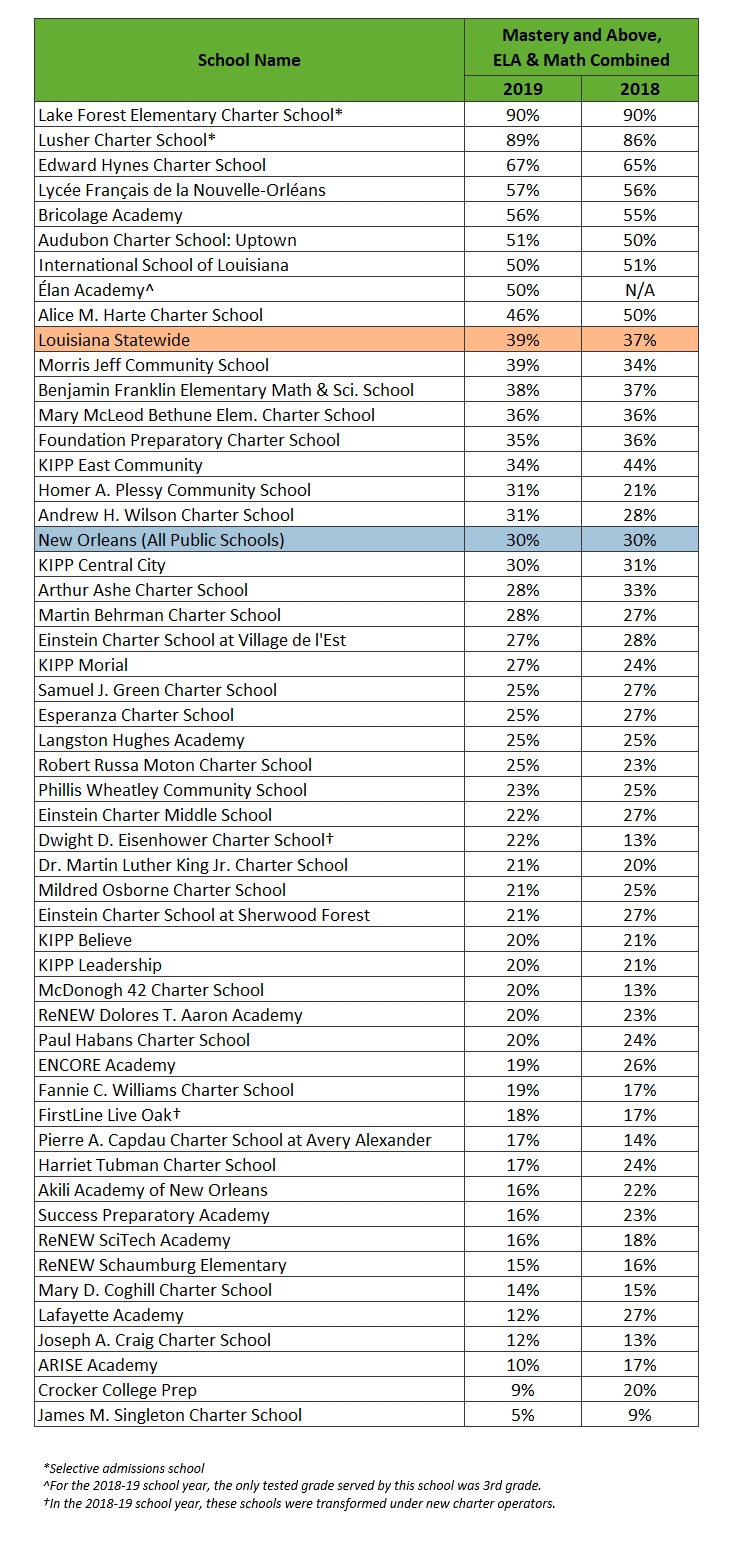
This report should be read in tandem with the latest state scores, which shows the all-charter district lagging far below state average scores, actually declining. Most charter schools in New Orleans, as detailed in this link prepared by a pro-charter organization, are very low-performing. The high-scoring schools have selective admissions.

New Orleans is one of the lowest performing districts in one of the lowest-performing states.It is a model of how privatization increases stratification and segregation. It should not be copied elsewhere.

But the report claims the success of the venture in school closings and privatization! Remember that the Education Research Alliance won a $10 million grant from Betsy DeVos after its report last year claiming the success of the privatization experiment.

Here is the press release for today’s report:

Study shows average public school quality has increased in New Orleans since Hurricane Katrina as a result of school closures, takeovers, and charter openings

New Orleans – The quality of New Orleans’ public schools improved considerably after Hurricane Katrina as a result of performance-based closures and takeovers, as well as charter openings, according to a new study from Education Research Alliance for New Orleans (ERA-New Orleans) at Tulane University. The study also found that variation in school quality has decreased, which means fewer students are in very low-performing schools.

Now an all-charter district, New Orleans public schools have returned to the control of the local school board. The city’s education leaders face challenging decisions about the district’s role in in school improvement, especially when and how the district should help support low-performing schools or take over these schools. This study provides insight into how these decisions can affect school quality.

“There are two main paths to improving the city’s schools: improving the ones we have or replacing them,” said ERA-New Orleans Director and lead author Douglas Harris. “Our findings suggest that we’ve been more successful with closing and taking over low-performing schools.”

The study’s authors analyzed data from 2002-2016 and found that the average New Orleans public school improved from the first to the second year after opening, but school performance remained mostly flat after the second year.

The study also examined factors beyond academic achievement to better understand how the city’s schools have evolved.

“The number of extracurricular activities that schools say they offer has increased over time,” co-author and ERA-New Orleans research analyst Alica Gerry said. “Also, there may have been a slight upward trend in the variety of school options in the city after the reforms, though this could just reflect school marketing rather than actual program offerings.”

“Students now have access to a wider range of higher quality schools than they did before, even in the first few years of reform,” Harris said. “School closures and takeovers should be a last resort, but they also show some promise when schools are consistently low-performing.”

The study’s authors are Douglas Harris (Tulane University), Lihan Liu (Tulane University), Alica Gerry (Tulane University), and Paula Arce-Trigatti (Rice University).

The novice journalist is likely to read the claims made about New Orleans—that outcomes improved because of charters and closing schools with low scores—and assume that this strategy of disruption is the key to good results. But unless they read the report closely, they may not notice that gains ended after the first or second year of an experiment now in its 15th year.

Expect more headlines about the New Orleans “miracle,” about the stagnation of market-based reforms in a city where most schools “perform” far below state averages.

One of my favorite columnists is Teresa Hanafin of the Boston Globe, who writes the daily Fast Forward, which always cites interesting tidbits from the Old Farmers’ Almanac, plus her observations on the news:

Trump has another Golf Recovery Monday, with nothing on his public schedule, although it may last more than one day since it’s actually a Vacation Recovery.

A few things from the weekend:

— Federal Reserve Chairman Jerome Powell, European countries that are our allies, and executives, editors, and reporters at various and sundry US newspapers and TV networks have been working together to secretly develop a nefarious plan to wreck the economy so that Trump won’t be reelected. Oh, sorry — I should have said that’s the latest paranoid conspiracy theory Trump is spouting.

— Millions of US residents who were ineligible to vote in the 2016 election voted anyway, and a good number of them voted many times, costing Trump New Hampshire’s four electoral votes (Hillary Clinton beat him there) as well as the popular vote (Clinton received almost 2.9 million more votes than Trump). Oh, sorry — I should have said that’s another paranoid conspir … oh, never mind.

— On Thursday evening, the Log Cabin Republicans — a collective of LGBTQ members of the GOP — changed their mind about Trump and endorsed him in the 2020 election. They didn’t give him the nod in 2016, but this time around, they said he has advanced LGBTQ rights and helped the GOP move past “culture wars” during his tenure.

Those poor saps.

The very next day, Trump asked the Supreme Court to let companies fire workers just for being transgender. This isn’t any sort of religious thing. This is any company, any time, no special reason other than the gender identity of an employee.

After each mass shooting, Trump promises to take action, to get tough, etc. Then he hears from the NRA and passes the ball to Congress. In the Senate, Mitch McConnell sends any restrictions on guns to the trash heap.

James Hohman writes in the Power Post:

Following his now well-established pattern after mass shootings, Trump continues to back away from his initial support for “strong background checks.” When the bodies are still being buried – whether after Las Vegas, Parkland, Fla., or El Paso – the president proclaims that he will take meaningful action to address the epidemic of gun violence. But as public attention wanes, and he faces pushback from the National Rifle Association, Trump returns to saying the problem that needs to be addressed is actually mental health.

“It’s the people that pull the trigger, not the gun that pulls the trigger,” Trump said last night on the tarmac in New Jersey, as he prepared to fly back to Washington after 10 days at the golf club he owns there. “We have a very, very big mental health problem, and Congress is working on various things and I will be looking at it. … They have bipartisan committees working on background checks and various other things. And we’ll see. I don’t want people to forget that this is a mental health problem. I don’t want them to forget that because it is. It’s a mental health problem.”

There have always been lots of violent people in the world, but they did not always have such easy access to weapons of war and massive magazines. Mass shootings did not used to happen with such regularity, and they did not used to be so deadly.

Asked last night if he’ll support universal background checks, Trump was curt and noncommittal. “I’m not saying anything,” he replied. “I’m saying Congress is going to be reporting back to me with ideas. And they’ll come in from Democrats and Republicans. And I’ll look at it very strongly. But just remember, we already have a lot of background checks, okay? Thank you.”

If mental health is the cause of gun violence, why did Trump roll back an Obama-era regulation that prevented people with a history of mental illness from buying guns? What is this administration doing to help people with mental health issues?

In New Orleans, the nation’s first all-charter district, a quarter of students are “chronically absent.”

But help is on the way! A new initiative, funded by the DeVos Foundation and the Grand Rapids public Schools, will educate students and parents about why it is a very bad idea to miss school.

The state board of education in Colorado has decided to turn over schools in three districts to a for-profit management corporation that claims it can turn the schools around, at a cost of millions of dollars. Where there the firm has ever turned any schools around before isin doubt. The political connections of the firm are not.

Read here about the story and a deep dive into the history of MGT Consulting.

In all cases, the state board gave districts the go-ahead to pay millions of school district dollars for MGT Consulting, a for-profit management firm, to virtually take over the schools. The move has elicited hope from some that the company can improve student performance after everything the districts have tried has failed. But the contracts have prompted condemnation from critics who say the firm has a dubious track record and is diverting tax dollars to private profits at a time when every cent should be spent on student needs…

Leaders of the Florida-based MGT say they specialize in allocating public money more effectively while improving teacher effectiveness in the classroom and school culture. Its management process includes sub-contracting areas of school work to other companies, and it boasts completing over 10,000 projects in many states and abroad over several decades.

MGT is more than just a school testing consultant. The limited liability corporation also consults for other government agencies, including conducting impact studies of privatizing public prisons, according to its website. MGT’s current chief executive officer also co-founded a consulting and lobbying firm tapped into a national network of for-profit education institutions, Republican education reformers, the testing industry and charter schools.

That’s part of what draws controversy as public school academia question the motives of a company headed by pro-school voucher officials working to save failing public schools — for profit…

The group began its work in the 1970s but has been led in its current iteration since 2015, when Trey Traviesa first appears as MGT’s title manager in Florida state records.

Traviesa is a longtime Floridian and former Republican state representative for the Tampa Bay area. He became a lobbyist, venture capitalist, banker and charter school co-founder after serving in Florida’s House of Representatives from 2004 to 2008.

While serving in the state House, Traviesa sponsored legislation to expand Florida’s school voucher program. That program created incentives for corporations to pay for mostly low-income students to leave their school districts and attend private schools.

MGT was hired largely on the basis of its claims of success in Gary, Indiana.

Chalkbeat wrote about the situation in Gary, which is inconclusive and certainly not a demonstration of success:

It’s early to say anything definitive. In 2017, MGT won a four-year contract to manage schools in Gary, Indiana. The deal is potentially worth about $11.4 million, if the state funds the contract for all four years and if the company meets performance goals.

Gary’s school district has about 5,000 students enrolled this year, down from about 11,000 ten years ago. The students in Gary overwhelmingly qualify for free or reduced price lunch, a measure of poverty, like in Adams 14, but only a handful of students are learning English as a second language.

In Gary, the state ordered an emergency manager to come in not only for academic problems, but because the enrollment decline and fiscal mismanagement problems landed the district deep in debt. MGT took over the responsibilities of the superintendent and the school board, at the state’s request, and reports directly to state officials.

The work has been controversial. Some lawmakers called for removing the firm when it was discovered that Tony Bennett, who was state superintendent in Indiana from 2008 through 2013, is a partner in the Strategos Group, which acquired MGT in 2015. Lawmakers argued that the policies Bennett rolled out in his time as state superintendent contributed to Gary’s financial problems that led the state to require an external manager.

MGT has not been removed, however, and Bennett doesn’t have an active role in the management of the district. According to news reports citing state officials, since the takeover, the Gary district has decreased its debt, slowed its enrollment decline, and purchased new textbooks. The latest state rating of the district has also improved slightly.

In other words, MGT has been in charge of Gary (which former state chief Tony Bennett tried to destroy) for one year. It has not created a successful turnaround, there or anywhere else.

Was the Colorado State Board of education influenced by Governor Jared Polis, who has a long record as a supporter of school choice, having founded two charters himself?