Archives for the month of: March, 2019


In this excellent post, Arthur Camins makes an important point. Education is not a race or the stock market. Every student should be a winner. 

“Education is not like chess or dice or the stock market. It is not about outsmarting an opponent. So, enough with all the talk about students and schools who excel by beating the odds.

“We don’t need a few more opportunities for students to beat the odds. We need to eliminate odds– a euphemism for inequality– as the primary determinant in whether or not young people get a high quality education. That is a far larger project than choosing schools, designing the right standards and tests, hiring and firing teachers, or giving parents the ability to opt out of struggling local public schools. It is a systemic project, not an individual child project, and just about schools. It is what we need to do. It is what we can do.

“Better yet, we need to drop the gambling metaphor entirely. Getting a high-quality education to prepare for life, work, and citizenship should not be a game of chance. It should be a guaranteed right for all students, regardless of the level of their parent’s income, social status, education background, or race.”

 Tom Ultican discovered a program called iReady that has magnificent marketing, but he says it is awful. If he spoke Yiddish, he would say it is “schlock” or “dreck.” Worse than the program is that stuff like this is pushed by the federal government. They like to waste your money. Ultican posted this entry a year ago but it has taken on a life of its own. One mother who reviewed it called it not iReady but “iSCAM.”


iReady is an economically successful software product used in public schools, by homeschoolers and in private schools. It utilizes the blended learning practices endorsed by the recently updated federal education law known as the Every Student Succeeds Act (ESSA). iReady employs competency-based education (CBE) theory which is also advocated by ESSA. The outcome is iReady drains money from classrooms, applies federally supported failed learning theories and undermines good teaching. Children hate it.

Public education in America contends with four dissimilar but not separate attacks. The school choice movement is motivated by people who want government supported religious schools, others who want segregated schools and still others who want to profit from school management and the related real estate deals. The forth big threat is from the technology industry which uses their wealth and lobbying power to not only force their products into the classroom, but to mandate “best practices” for teaching. These four streams of attack are synergistic.

Profiting from Education Law

A group of billionaires with varying motives are using their vast wealth to shape America’s education agenda to their own liking. The last rewrite of the Elementary and Secondary Education Act of 1965 called ESSA was larded up with provisions like the big money for technology which is listed in Title’s I and IV. It also specifies generous grants to promote both “blended learning” and “personalized learning.” (See page 1969 of the official law.) Charter schools, vouchers and social impact bonds are promoted in ESSA. All these initiatives drain money from the classroom and none have been credibly shown to improve education outcomes.

Read his post to learn the history of iReady, which started innocently enough as a workbook series in 1969. Then an equities investor took over, and all of a sudden the whole spectrum of money-grabbing hedge funders and know-it-all billionaires get into the picture. Even Jeb Bush.

A cautionary tale that begins with money and ends with money.

I just finished reading Noliwe Rooks’ superb book, Cutting School: Privatization, Segregation, and the End of Public Education (The New Press). Please buy a copy and read it. It is a powerful analysis of racism, segregation, poverty, the history of Black education (and miseducation), and their relationship to the current movement to privatize public education. She dissects the profitable business of segregation.

You will learn how cleverly the captains of finance and industry have managed to ignore the root causes of inequality of educational opportunity while profiting from the dire straits of poor children of color. In fact, as she shows, financiers and philanthropists have used and misused Black children throughout our history, for their own benefit and glory, not the children’s.

The book is both highly contemporary and at the same time, probably the best history of Black education that I have read. Rooks understands that the fight for equality runs through the schoolhouse door, and she documents how white elites have managed to block access, narrow access, or literally steal from Black families trying to gain access to high-quality education. She knows that charter schools and vouchers are a sorry substitute for real solutions. She understands that the rise of the profit-driven education industry has benefited the profiteers far more than the Black children they claim to be “saving.” “Saving poor kids from failing schools” turns out to be a lucrative business, though not for the kids.

Rooks invents a new term to describe the current “reform” movement: Segrenomics. In her telling, a sizable number of entrepreneurs and foundations, and organizations like Teach for America, have enriched themselves while advertising their passion for equity. Segregation and poverty have given them a purpose, multiple enterprises, career paths, and profit.

My copy of the book is covered with underlinings, stars, asterisks, and other notations, as is my way when I become enthusiastic while reading.

She bluntly states, “The road necessarily traveled to achieve freedom and equality in the United States leads directly through public education…Schools that educate the wealthy have generally had decent buildings, money for materials, a coherent curriculum, and well-trained teachers. Schools that educate poorer students and those of color too often have decrepit buildings, no funds for quality instructional materials, and little input in structure or purpose of the curriculum, and they make do with the best teachers they can find.” Differences based on class and color have been a constant in American history, and they remain so today.

She notes the rise of the for-profit industry in education, now associated with charter schools, cybercharters, and other forms of school choice. The new for-profit arrangement, which she calls “segrenomics, is “the business of profiting specifically from high levels of racial and economic segregation…The desire that some have to profit from racial and economic segregation in education, coupled with the active desire members of segregated communities of color have for quality education, has led to our current moment where quality education is for some a distant mirage, and the promise to provide it is profitable for others.”

Rooks was director of the African American studies program at Princeton University for a decade and is now director of graduate Africana studies at Cornell University. She interacted frequently with idealistic elite white college students who could not understand her skepticism about the “reform movement.”

Rooks describes the past thirty years as an era when “government, philanthropy, business, and financial sectors have heavily invested in efforts to privatize certain segments of public education; stock schools with inexperienced, less highly paid teachers whose hiring often provides companies with a ‘finders’ fee’; outsource the running of schools to management organizations; and propose virtual schools as a literal replacement for—not just a supplement to-the brick and mortar education experience. The attraction, of course, is the large pot of education dollars that’s been increasingly available to private corporate financial interests…Charter schools, charter management organizations, vouchers, virtual schools, and an alternatively certified, non-unionized teaching force represent the bulk of the contemporary solutions offered as cures for what ails communities that are upward of 80 percent Black or Latino.” Such policies are never prescribed for affluent white communities, she notes.

She suggests that those who seek to profit from racial and economic segregation should be penalized. Without a real and meaningful penalty, the profit-seekers will continue business as usual.

The fundamental argument of her book is that public education for Native American, Black, Latino, and poor youth is being purposefully unraveled, while wealthy elites are plundering the money that should have been spent on their education.

Rooks recounts the history of Teach for America, which had its beginnings at Princeton University. Wendy Kopp had an idea, visited corporate chieftains, raised money, created a powerful board of directors, and started an enterprise that became fabulously wealthy. Rooks observes that she didn’t spend time talking to the students or parents or the communities that she planned to save. TFA created a career path for idealistic and ambitious elite college graduates, who wanted to try their hand at teaching without committing to it as a professional obligation. TFA offered more benefits to those who joined it, she writes, than to those it claimed it wanted to “save.” It provided a resume builder and an entrée into powerful financial and political networks.

She analyzes a number of well-known “reform” organizations, not only TFA, but Democrats for Educational Reform and Students for Educational Reform. The latter was also founded at Princeton, by students who realized that their venture was so lucrative, so swaddled in grants from foundations, that they dropped out of college to tend to the millions heaped upon them. Helping poor children, it turned out, was indeed a rewarding business. She sees TFA, DFER, and SFER through the lens of segrenomics, business ventures that depended on “saving” poor children without disrupting the institutional and systemic roots of poverty and racism that engulf the world in which they live. She calls out “reformers” for their insistence that they could safely ignore segregation or poverty, because their aspirations alone would be enough to “fix” the lives of poor children.

Her richly documented history of Black education in the nineteenth and early twentieth centuries is fascinating. In the nineteenth century, most Blacks lived in the South, and the whites who controlled the segregated South did as little as they could get away with to educate Black children. Some opposed doing so, while others thought that Blacks should be equipped with no more than basic literacy and vocational training so that they could contribute to the economy, albeit as manual workers. In the main, the Northern philanthropists adjusted their ideals to the white Southerners’ low esteem for people of color. The philanthropists contributed money to build schools for Black children, but required impoverished Black communities to raise matching funds if they wanted a school. Given the desperate poverty of those communities, raising the matching funds required enormous sacrifice. In one of the most moving passages in the book, she describes a 1925 meeting in a small rural town in Alabama, where a Black representative of the Rockefellers’ General Education Board met with the sharecroppers to discuss raising money to build a school. The representative wrote to his supervisors that “’one old man, who had seen slavery days, with all of his life’s earnings in an old greasy sack, slowly drew it from his pocket, and emptied it on the table.’ He then turned to address the crowd and said, ‘I want to see the children of my grandchildren have a chance, and so I am giving my all.’ What he had to offer was $10. The sum total he had been able to save throughout the totality of his life.’” The assembled crowd raised $1,300 that night and eventually contributed $6,500 to match the gift of the Rockefellers.

As I read this, I felt a mix of emotions. Tremendous sadness but also rage at the Rockefellers, who could have just opened their wallets and given the community the school they so desperately wanted and needed without demanding such sacrifice. The foundation officer who read this account from Alabama must have had a heart of stone. The same stories about penurious philanthropists were repeated across the South, where local white officials typically diverted (stole) money meant for Black education and reapportioned it to white schools.

I have read other histories of Black education, but none that so deftly tied together the past and the present. The term “segrenomics” aptly captures the financiers’ fascination with “helping” black children but avoiding any change in the social policies that might lift their families out of poverty and promote genuine integration. The fact that philanthropists today eagerly underwrite segregated charter schools and insist that TFA  or merit pay or standardized tests can cure poverty represents continuity with their nineteenth century counterparts.

Rooks brings valuable historical, sociological, and philosophical insight into contemporary debates. Her analysis echoes the argument made by Anand Giriharadas in his bookWinners Take All: when the wealthiest elites claim that they are “saving” the world, beware. They are actually protecting the status quo and their own dominant position in society.

You will enjoy watching this YouTube video in which Professor Rooks explains her views about education reform, elite white students, and the lingo of reform. 


The Superintendent of Sarasota County in Florida notes that the state is offering bonuses of $9,000 to “highly effective” teachers, and two-thirds of teachers in his county are “highly effective.” The actual number, he says, might be even higher.

The ratings are based mainly on test scores, although most teachers don’t teach the subjects tested annually. Bonuses do not count towards pensions.

Surely, the Governor doesn’t want to give big bonuses to most teachers.

Florida ranks about 46th in the nation in teachers’ salaries.

The Governor and State Commissioner Richard Corcoran announced their plans to the state’s 67 Superintendents.

Bowden: Legislative priorities have great impact on schools and teachers

Prior to the opening session of the Legislature, Gov. Ron DeSantis signed three education-related executive orders on key topics — the elimination of Common Core standards, a Jobs of the Future initiative and improved safety and security in our schools.

In addition, Commissioner of Education Richard Corcoran noted priorities for his office that include teacher bonuses as part of the Best and Brightest program; tuition forgiveness programs for new teachers; Base Student Allocation (BSA) increases and a continued commitment to the Safe Schools program.

Sarasota County Schools…are closely monitoring proposed changes to the Best and Brightest bonus program that has significant impact to teachers in our school district. Currently, the Best and Brightest program provides annual bonuses of $800 for teachers earning an “effective” rating and $1,200 for “highly effective” teachers. In addition, there is another $6,000 for highly effective teachers with an SAT or ACT score at the 80th percentile and above.

Governor DeSantis has proposed to replace the current program with a single $9,000 bonus for highly effective teachers serving at a school whose state grade rose by at least 1 percent and eliminate the SAT/ACT requirement.

Although there are many drawbacks to compensating teachers using bonuses, a $9,000 bonus to recognize the best teachers in our school district is a significant reward. It is clear the state wants to circumvent the collective bargaining process by offering these bonuses, which are not subject to collective bargaining.

The school district and the teachers union are charged with developing a Teacher Evaluation System that identifies teachers as highly effective, effective, developing/needs improvement or unsatisfactory. The state would then use these marks to compensate teachers with a bonus according to their score.

In 2017-18, approximately 67 percent of our teachers were rated highly effective based on the current evaluation system. There are many more teachers in our school district worthy of a highly effective rating; however, the current evaluation system rates them lower.

If the union were to negotiate a new collective bargaining agreement and work with district leaders to develop a new and improved evaluating system before the end of the school year, more teachers would be eligible for the $9,000 bonus this year as recommended by the governor — that’s a significant bonus!

Sarasota County Schools is blessed to have incredibly dedicated teachers who work to inspire our students every day. They deserve to be recognized and compensated to the fullest extent possible based on state requirements.

I am hopeful the school district and union officials can come to the table soon as both contracts are set to expire at the end of this school year. The goal is to reward our teachers and classified staff for their hard work and dedication.

In addition, I hope we can join forces to effect positive change in Tallahassee as the Legislature works to create fundamental adjustments to the education system.

I look forward to continued conversations with state leaders, school superintendents and the union to help our A-rated school district be even more effective for our students, staff and community.

Dr. Todd Bowden is the superintendent of Sarasota County Schools.

https://www.heraldtribune.com/opinion/20190317/bowden-legislative-priorities-have-great-impact-on-schools-and-teachers

If you are a parent or educator in Florida, please let your faith leader know about a new organization that is forming to stop the privatization of public schools. The initiative is led by Charles Foster Johnson, who has brought together similar groups in other states. The first meeting is March 26.

Rev. Johnson is a great friend of public schools who believes in separation of church and state. He is an active member of the Network for Public Education.

He writes below about the launch of a new pro-public education group and an event that is coming up at the Florida Capitol on March 26.

Rev. Johnson writes:

“The group is called Pastors for Florida Children and it is comprised of ministers and lay-leaders of all faiths across the state.   

“There will be an organizational meeting on Tuesday afternoon March 26 at approx. 1:30 p.m. and then a press conference and prayer circle at the Capitol at 3:30 p.m. Again this legislative session, our public schools are taking a beating in Tallahassee and I hope you agree that a group like this has the potential to be incredibly powerful!  Similar groups in other states have made a big difference for public schools.

“If you can attend, I will forward your name and contact information to the organizers so they can contact you with the details. 

“Can we count on you for March 26th?

“Please Reply with RSVP for lunch count or questions to charlie@charlesfosterjohnson.com or suzii.paynter@gmail.com


“Sincerely,

Rev. Charles Foster Johnson

Executive Director, Pastors for Children”


Follow Pastors for Children   http://pastorsfortexaschildren.com/

Valerie Jablow, parent activist in D.C., seems to know the District’s laws better than the members of the City Council.

She knows that the city can’t just give away or lease property to charter schools without following the law. Apparently the City Council doesn’t know that.

Read this account. Apparently the City Council is ready and willing to hand off public schools without going through legally required process.

In one instance, the city leased a property to a charter owner, who in turn sublet it back to the city and is making $200,000 a year on the deal!

Does anyone care about protecting the students and property of the D.C. public schools or are they just an afterthought?


Nancy Bailey reflects on the sudden upsurge in concern about reading instruction and what might be behind it.

I share her reaction to the latest “crisis in reading” because I wrote a book in 2000 (“Left Back”) that traced controversies over reading instruction back to the 19th century, to Horace Mann’s day. The big “CRISIS” was in the 1950s when Rudolph Flesch wrote “Why Johnny Can’t Read” (not enough phonics, too much Dick-and-Jane and whole-word), through the National Reading Panel, Reading First, etc.

It is a wonder that anyone can actually read anything. But Nancy says we can do more without attacking teachers and ed schools. For sure, TFA doesn’t know how to teach reading in the five weeks of preparation they get.


In this post, Matthew Gardner Kelly of Pennsylvania State University  explains why demands for charter moratoriums are growing.

The root of the problem is money. Public schools in most states were hurt by the recession of 2008 and funding never recovered. Adding competition with charters made the financial situation worse.

“In Pennsylvania, the local district makes a tuition payment to the charter school enrolling each student from that district. The payment is based on per-pupil spending for similar students. For example, if a fourth grader leaves a public school in the Pittsburgh School District to attend a charter, the Pittsburgh School District is required to pay the charter school $16,805.99 – which is the average amount the district spends on a student in the district.

“At first glance, it perhaps makes sense to have money follow the children. The problem is that increased charter enrollments rarely allow a district to save as much as they lose in charter tuition. As a result, without additional revenue from state governments or local taxes, districts are forced to make budget cuts and spend less on the students who remain in traditional public schools.

“Consider an example. Bethlehem Area School District paid $25 million in charter school tuition payments in 2017. It was not possible to save $25 million with the students gone, however, because of the way the students were distributed across the district.

“The students enrolled in charter schools came from 13 different grades in 22 different schools. Since students moving to a charter were rarely all of the students from a single school, grade or class, the district was not able to reduce staff or close classes to help cover the charter tuition payments. If next year’s third grade class goes from 28 students to 26 students in a school, district officials still need to keep that third grade class open. They cannot pay that teacher 2/28th less, heat 2/28th less of that classroom, or reduce the operation of electricity in that classroom by 2/28th.

“Yet, if the class went from 28 to 26 students because two students enrolled in charters, the district needs to make tuition payments for the missing students. When those payments are repeated and distributed unevenly across schools and grades, it adds up to millions of dollars. Students move between districts all the time, but nowhere near the scale– nor with the fiscal impact – that takes place because of charter expansion. Bethlehem Area School District had 1,900 students, about 12 percent of the district’s population, enrolled in charter schools in 2017.”

This kind of fiscal drain is unsustainable. The vast majority of students are harmed so that 12% can go to charters. If it continues, the public schools will be irreparably damaged. This is not sound policy.


Our reader, Laura Chapman, was interested in the sponsorship of the Education Writers Association, whose annual meeting will feature Betsy DeVos. No matter how odious her views, journalists should hear her and question her.

She wrote:


You have to pay $125 to attend this Education Writers Association event and do some writing on education.

It is not surprising that the Education Writers Association has selected DeVos as a major speaker. I conclude that by looking at the list of “Current Sustaining Funders”—all known for undermining public education while posturing about saving children from “underperforming schools.”

Here are the current “Sustaining Funders:”

Bill & Melinda Gates Foundation, Carnegie Corporation of New York, The Joyce Foundation, The Kern Family Foundation, The Kresge Foundation, Lumina Foundation, Nellie Mae Education Foundation, Pritzker Children’s Initiative, The Wallace Foundation, The Walton Family Foundation, William and Flora Hewlett Foundation, William T. Grant Foundation.

The Education Writers Association also invites groups to pay for programs like this one as well as its website, newsletters, blogs, and printed programs for regional meetings. Those who foot the bill are called “Sponsors.” The list of past Sponsors is a curious mix of non-profits, for-profits, and national organizations of educators. Following is my grouping and parenthetical comments on past Sponsors of the Education Writers Association.

Membership Organizations:

American Council on Education (leaders of about 1,700 accredited, degree-granting institutions); American Federation of Teachers (about 1.7 million members, all levels of education); National Education Association (about 3 million members, all levels of education); Council of Chief State School Officers (public officials in charge of state departments of elementary and secondary education, plus the District of Columbia, Department of Defense Education, Bureau of Indian Education, and the five U.S. extra-state jurisdictions—promoters of the Common Core).

Higher Education Institutions:
California State University; National University; Stanford Graduate School of Education; Strayer University; University of Connecticut Neag School of Education; University of Chicago Urban Education Institute; University of Nevada, Las Vegas; University of Southern California.

Academic Research and Advocacy Organizations:
American Institutes for Research.org (holding company for contract researchers in the social sciences); Learning Policy Institute (academic research, President and CEO Linda Darling-Hammond)

Organizations with Megabuck Funding:
Big Picture Learning, The Met School.org (network of career high schools);
The Broad Center.org (bang-for-the-buck corporate training for leaders in education); Data Quality Campaign.org (Gates funded to promote computer-coded national database on every student, teacher, and school); EdChoice.org (promotes market-based education, not public schools);
Education Trust.org (promotes high stakes tests to expand market for charter schools, choice). Say Yes to Education, Weiss Institute.org (software and metrics for college/career readiness programs in selected communities, read by grade three, etc. Weiss’ wealth came from money management): Strada Education Network.org (postsecondary career connections with this subsidiary—Economic Modeling LLC, offering predictive analytics about labor force needs and talent pipelines);

For-Profit Ventures:
Chan Zuckerberg Initiative.com (promotes technology, data use in education); CollegeVine.com (college admission and SAT prep); GetaTutor.com (broker for online tutoring services); n2y.com (online resources special education); Pearson.com (marketer of instructional materials and tests); Scholastic.com (multinational publishing and media company in education)

Public Relations/Marketing Firms:
GMMB.com (PR firm, political messaging); HagerSharp.com (PR firm, branding and Messaging); Widmeyer Communications — A Finn Partners Company (PR firm, digital marketing);

Testing Organizations:
The College Board.org (marketer of SAT and AP tests and test-prep materials); Educational Testing Service.org (contractor/provider of tests—NAEP, GRE, PRAXIS, others)

Foundations:
American Financial Services Association Education Foundation (consumer education, especially about credit cards);
The Broad Foundation (supports the arts, medical sciences, and charter schools); Edwin Gould Foundation (helps incubate non-profits in education);
Woodrow Wilson National Fellowship Foundation (awards fellowships to emerging leaders for the academy and public service).

SPONSORSHIP FEES:
There are tiers of “sponsorship” for the website and other activities/events of the Education Writers Association. The highest fees are for website advertising— four-week purchase of announcement space options include: “Run of site – $ 5,000;
Blogs – $ 2,000;
Jobs – $ 2,000;
Events – $ 1,200;
Single overview page – $600.
For all of the advertising options the Education Writers Association “maintains editorial control over all programming and content.” https://www.ewa.org/sponsorship-info/sponsored-messaging

It would be interesting to see a timeline of the sponsors. I’d guess that the long list of “past sponsors” includes many short time and one-timers. I hope that this program will cause many sponsor to flee. Devos is menace to education.

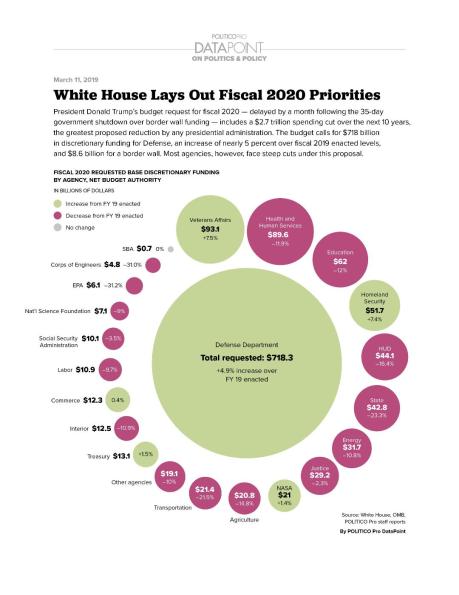
The graphic below shows clearly where Trump’s priorities are and where they are not. A big boost to the military and border security. Deep cuts to Medicare, Medicaid, Social Security, the Environmental Protection Agency, the National Science Foundation, Labor, Interior, Agriculture, Justice, Housing, Energy, Education, Transportation, and everything else that has to do with social/human/non-military needs.

oil