Archives for category: Higher Education

This is a thoughtful essay on a crucial problem: shrinking enrollments in higher education and the budget cuts to meet them. Julian Vasquez Heilig lays out the problem and the typical response. He thinks there is a better way and he describes it.

Heilig is on the faculty of Michigan State University and is a national expert on topics such as diversity, equity and inclusion.

He writes:

The warning signs are no longer theoretical. Schools are closing. Colleges are preparing layoffs. Faculty buyouts are spreading. Academic programs are disappearing. Dorm beds are sitting empty. Classrooms are thinning out. Tax revenue is weakening. State appropriations are uncertain. Consultants are being hired and paid millions to identify “efficiencies.” Boards are quietly discussing mergers and closures. American education is entering a period of deep instability.

This is not only a crisis for presidents and superintendents. It is a crisis for communities. When a school closes, a neighborhood loses more than a building. When a college cuts faculty and staff, a region loses jobs and opportunity. When families question whether education is worth the price, the consequences ripple through local economies and democracy itself.

In this article, I first define the problem. Enrollment pressure, funding instability, demographic change, and political attacks are converging across K-12 and higher education. These pressures are already producing closures and painful restructuring. But this is not only a warning. At the end, I turn to what communities can do through politics, public pressure, local organizing, accountability, and leadership selection before the choices become narrower.

The Warning Signs Are Already Here

At my own institution, public projections suggest new student enrollment could decline somewhere between 3 and 5 percent this year. If those projections hold, that would mark a return to consecutive enrollment declines after the gains achieved during my years as provost. During that period, we reversed an almost decade-long enrollment slide.

That is alarming because this moment was supposed to be the “high water mark” before the demographic cliff. WICHE projects that the total number of high school graduates will peak around 2026 and then decline steadily through 2041. Universities were supposed to be maximizing enrollment now. Instead, some are struggling while the student pool remains historically large.

In many ways, education is being pushed into an arena where resources are shrinking and the odds are being rewritten before many institutions understand the rules.

The Old Survival Strategies Are Running Out

Much of higher education survived the past several years through strategies that are becoming unsustainable. Institutions poured millions into financial aid discounting. They leaned harder into full-pay families. They expanded retention offices and predictive analytics systems. They built student success centers and advising infrastructure. They spent heavily on marketing and enrollment staff.

Ironically, retention and enrollment strategy helped save some institutions from earlier financial pressure. During my time in executive leadership, we understood that higher education had entered a new era of competition. Universities were no longer competing only over prestige. They were competing over affordability and survival.

Financial aid, student success infrastructure, and community partnerships became essential tools. Institutions that moved aggressively like Arizona State and Georgia State often stabilized themselves. Institutions that remained complacent fell further behind.

But even enrollment growth stories now face new threats. Federal research funding is unstable. State appropriations remain uncertain. Inflation is pressuring budgets. Some states like Michigan have seen stronger FAFSA activity. Yet many families are questioning the value of higher education. Political attacks have also weakened public trust while threatening research capacity and institutional autonomy.

Please open the link to read Heilig’s creative proposals for meeting the crisis.

About a dozen years ago, I heard from Ted Dintersmith. I didn’t know anything about him other than that he was a venture capitalist who was interested in education reform. My hackles went up, because the term “venture capitalist who was interested in education reform” immediately conjured up images of Democrats for Education Reform,” a faux group that is dedicated to charter schools, Teach for America, evaluating teachers by student test scores, and union-busting.

When I thought about the people in this category, I thought about very wealthy men like Ravenal Boykin Curry IV, Whitney Tilson, John Perry, Ken Griffin, Jeff Yass, Daniel Loeb, Arthur Rock, Joel Greenblatt, Bruce Rauner, and Paul Tudor Jones. They are financiers who have committed millions to the cause of privatizing public schools. They are united in their contempt for public schools, teachers, and unions.

So I was wary of Ted and suspicious of his motives. And I pushed him aside, thinking he was part of the cabal of know-it-all entrepreneurs with a zeal to reform (privatize) public schools.

So, I now publicly admit that I was wrong. Ted has traveled the country, visiting schools and listening. He knows how hard teachers work, and he admires them. He has teamed up with some savvy people, like Tony Wagner and the late Sir Ken Robinson, to produce films and write books.

When I recently read his latest article, I realized that I had completely misjudged Ted. He doesn’t want to destroy public schools or privatize them. He wants to make them better. He wants students to love school and learn what they need to know to make informed choices.

He has seen some good charter schools (as I have), but he knows that a few hundred charter schools won’t lead to the transformation of tens of thousands of public schools. And–my thought–to the extent that charter schools defund public schools, they create more problems, more inequities.

So, I hereby apologize to Ted Dintersmith for prejudging him and for lumping him with the Billionaire Boys Club, those who see school transformation as a hobby.

When you read this post you will see that he doesn’t have all the answers, but he is asking the right question.

He writes:

About these notes: Always Monday. Always short. Always free. Always about civil society’s future. At times, interesting. If this was forwarded to you, subscribe here.

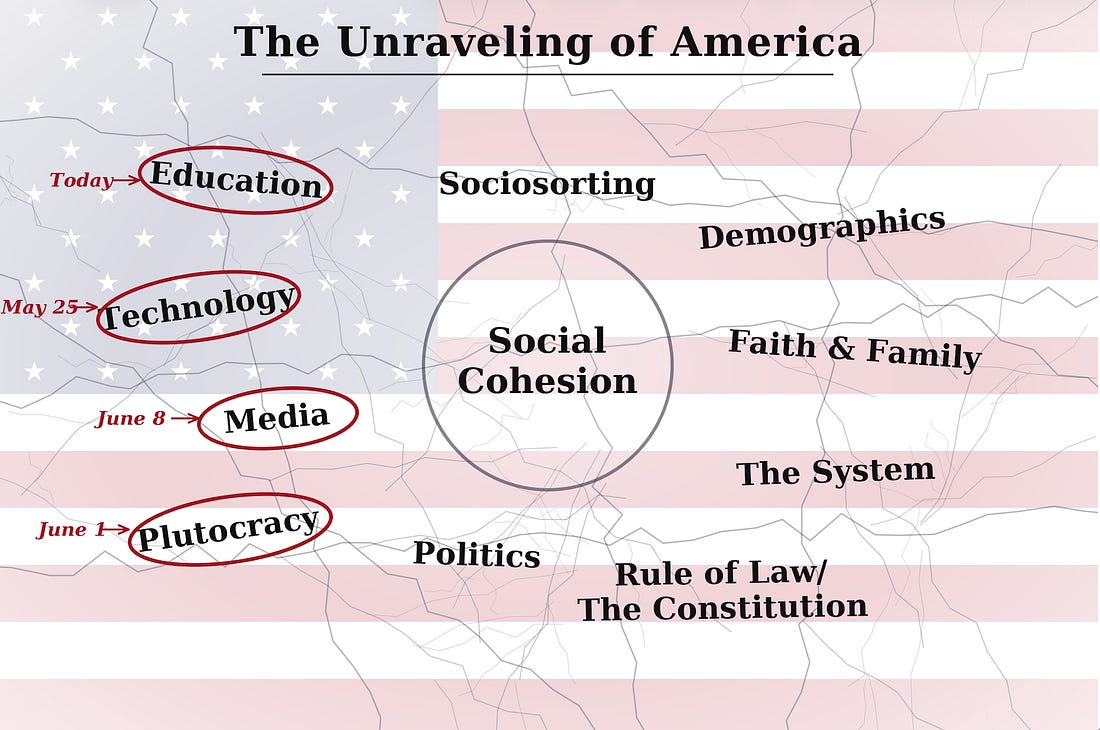
First, thanks for your feedback on my recent posts. My goal of late is to explore the various factors causing America to unravel. Toward a systems model of the forces undermining America’s democracy, moral compass, and social cohesion. Today, education.

For five decades, U.S. education policy has been driven by two goals: test scores and college. The No Child Left Behind Act in 2002. Then in 2010, Common Core. Obama’s rallying cry: “By 2020, the United States will once again lead the world in college completion.” Our all-consuming education focus. With massive collateral damage.

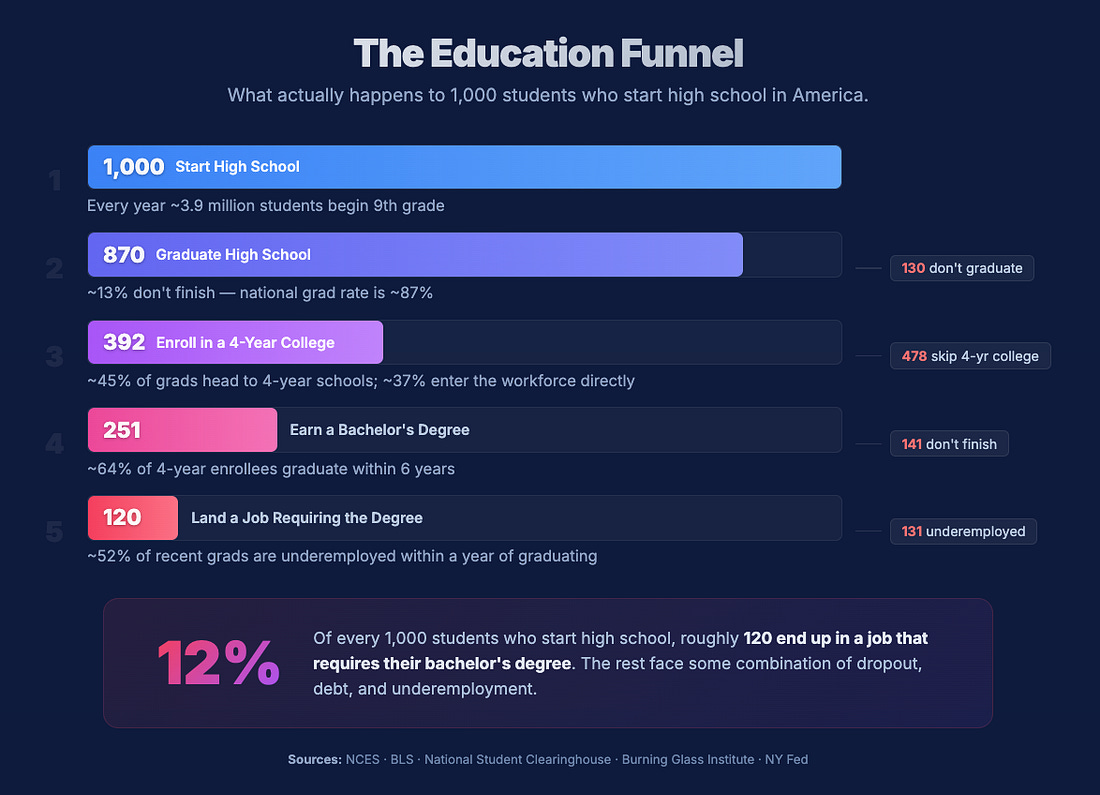
Let’s start with the funnel. While the college path works out well for some, most end up on the wrong side of education’s Bell Curve. Over half go directly to career, lacking a hirable skill and often with gutted self-esteem. Of those heading off to college, half don’t finish. Of those who graduate, half don’t get any kind of dream job. A system that’s produced some 43 million adults burdened by $1.8 trillion of student loan debt.

With a boost from Harvard-educated JFK, America grew to equate a prestigious college degree with human worth. This equivalence worked its way into news stories, movies, television shows, commercials . . . and labor markets. Prestige employers (that’s you, Goldman Sachs and McKinsey) made an elite college degree the essential hiring criterion. Less glamorous companies (that’s you, Sherwin-Williams) made a college degree mandatory for promotions. Rich families push their kids from the womb toward an Ivy+ degree. Poor families want the same for their kids. University research teams (that’s you, Georgetown) produce skewed studies touting a massive $1.2 million earnings lift for college grads. The Federal government opens the spigot for readily-obtained, impossible-to-shake student loans.

We’d like to think that America’s education system levels the playing field, but it does the opposite. The SCOTUS 1973 San Antonio Independent School District v. Rodriguez says it’s just fine for U.S. public schools to be largely funded by local property taxes. Rich kids are showered with resources’; poor kids show up to school hungry. Test scores point to an education ‘achievement gap’ that gets pinned on our teachers – not America’s staggering income inequality. The system’s winners feed elite colleges that educate more students from the richest 1% of families than from the bottom 50%. For more, read Paul Tough’s book The Inequality Machine.

With college placements as the measure of success, America’s K12 schools became college-ready test-prep institutions. Pit kids in dog-eat-dog competitions: class rank, SAT scores, AP scores, college placement. A barrage of state- and Federally-mandated multiple-choice exams that rank kids, teachers, schools, districts, and states. Clear marching orders for K12 schools – train kids to perform well on multiple-choice exams and get them off to some college.

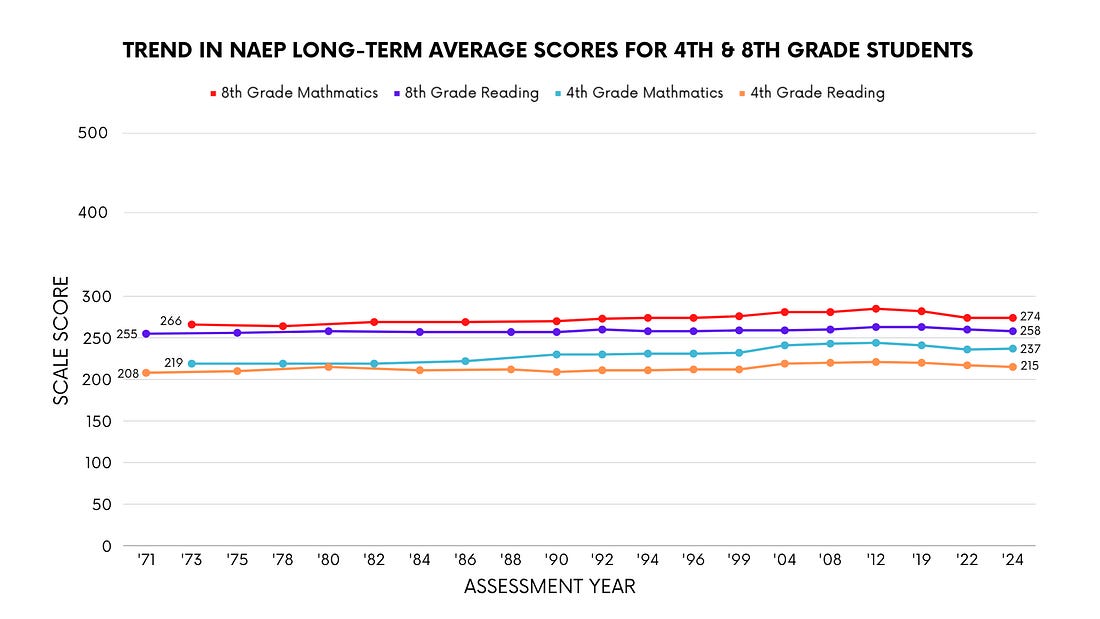
To this day, America relies on two numbers to define the education quality of a school, district, state, nation, and human. Math and reading scores. That’s it. Don’t believe me? Just note what journalists write and what policymakers cite. We’ve pushed generations of young Americans to get those damn test scores up. No worries if we short-change career-based learning, civics, history, and art. No worries if we disenage kids and demoralize teachers. No worries if a relentless focus on rote learning crushes a child’s curiosity, creativity, joy, and agency. No worries if kids get the soul-sucking message that what matters in life is outcompeting others on pointless tasks. Education priorities that encapsulate the classic definition of insanity – doing the same thing over and over, expecting different results.

So many reforms, so little change

During their formative K12 years, America’s kids take more than 100 standardized exams. These cost-minimizing exams are expressly designed to be graded by a computer. And if a computer can grade a task, it can do that task. In every sense, we push kids to develop rote skills that machines handle flawlessly. Already, AI aces every assignment and exam required to graduate magna cum laude from Harvard. Reading exams call for regurgitating what’s put in front of you – perfect training for conspiracy-absorbing adults. Math exams are tied to esoteric micro-procedures (e.g., factoring polynomials) that adults never use. Yet we chase these scores, for decades, making no progress, ignoring Goodhart’s Law: “Any measure that becomes a target ceases to be a good measure.”

There you have it. America’s colossal education botch. Train kids to perform rote tasks. Crush out the essential human traits of curiosity, audacity, creativity, agency, and joy. Standardize what’s taught and tested to produce data that ranks and sorts — rather than helping each child develop their distinctive human potential. Most get a chronic ‘you lack proficiency’ message in a system that heaps advantage on the affluent. Botched priorities, paving the way to our current nightmare. A populace unable and unwilling to critically analyze the torrent of lies coming from the White House. A populace that holds its nose to vote for a convicted felon who rails on the ‘educated elite.’ A boiling cauldron of resentment, corruption, and anti-science vitriol. As to how this has worked out, read David Brooks’ fascinating How the Ivy League Broke America.

I don’t offer these views on education casually. For the past fifteen years, I’ve immersed myself in this world. I’ve visited hundreds of schools, and convened thousands of conversations, all across America. I celebrate the bright spots in my books (What School Could Be: Insights and Inspiration from Teachers Across America) and films (Most Likely to Succeed and Multiple Choice). But I’ve seen the failure. Failure caused by an obsolete system and failed accountability measures. Our classroom teachers are heroes. It’s not easy to fight the system, but many do. Give special thanks to the teachers in your life, who persevere despite being shortchanged on pay, respect, and trust. They endure in an entrenched system that has churned out generations of young adults ill-prepared for career, citizenship, and life. A system sowing the seeds for democracy’s collapse.

Three Bold Ideas

Career-Based Learning for All: My recent film Multiple Choice showcases a mainstream public school district that immerses all high-school kids in career-based learning across a range of skills (e.g., carpentry, welding, healthcare, cybersecurity, digital media, AI). Better for the career-bound and, a bit surprisingly, better for the college-bound. The key is making career-based learning essential for all kids, not just ‘those’ kids who don’t resonate with academic curriculum.

Finland: America can learn much from Finland. Their remarkable education progress resulted from a budget crisis that forced them to choose between data and educator excellence. They dumped all standardized tests and focused on developing outstanding classroom teachers – better training, more pay, loads of respect. Finnish kids spend comparatively little time on ‘school’; even high-schoolers have just six hours of class time and homework during the school week. Lots of time for play and exploration. A well-educated populace. For more, read Pasi Sahlberg’s Finnish Lessons.

Accountability: Base accountability on a child’s growing ability to create and carry out initiatives that help make their world better. Portfolios of purpose, not a checklist of counterproductive numbers. Check out New York’s Performance Standards Consortium or read Tony Wagner’s Mastery.

Bonus Idea: Long talked about, America would be well-served if every high school graduate engaged in public service — lifting up their community while developing important skills. Those going on to college bring maturity and real-world experience to years often wasted on beer pong. Those eschewing the college path are off and running with purpose and skills. Young Americans across all demographics in a melting pot that bridges our current demographic and political divides.

Nervously

Ted

Federal courts are overturning bans that tell college professors what they are not allowed to teach. And more campuses are taking a stand.

At the Texas Tech University system, the American Association of University Professors and its Texas affiliate are the latest to do so.

The Dallas Morning News reported:

Two faculty groups filed a federal lawsuit Wednesday to block the Texas Tech University System from implementing its policies on how professors can discuss race, gender and sexual orientation in the classroom.

The suit, which marks a major legal challenge against a Texas university system over increased restrictions on what can be taught, focuses on two memos issued by Texas Tech Chancellor Brandon Creighton in the last academic year.

One memo, sent in December, banned content that advocates for one race or sex as “inherently superior to another” and prohibited faculty from teaching that there are more than two sexes. The second memo, sent in April, ordered universities to cut all academic degrees “centered on” sexual orientation and gender identity.

The two groups, the national American Association of University Professors and its Texas chapter, argue Creighton’s policies violate their First and Fourteenth Amendment rights.

Who is named 

The lawsuit names Creighton, a former Republican lawmaker, as a defendant, as well as the nine members of the system’s Board of Regents. Representatives from the Texas Tech University System did not immediately respond to a request for comment.

“This case presents an extraordinary system of censorship in higher education,” the suit reads, “in which professors in the Texas Tech University System are prohibited from teaching the most basic scholarship, while at the same time not fully comprehending the contours of prohibitions that place them under threat of losing their employment and livelihood.”

The groups in the lawsuit say the system’s policies “suppress” professors’ constitutionally protected speech and “obscure documented history, facts and theories.”

In one instance, a law professor was blocked from teaching information about race related to the landmark Supreme Court case Dred Scott v. Sandford, which ruled that Black people were not U.S. citizens, according to the filing. The lawsuit against Texas Tech also says that medical faculty have been instructed to remove content about treating transgender patients and racial minorities. Professors are not named in the filing.

Allegations 

The lawsuit argues that Creighton’s policies violate professors’ Fourteenth Amendment rights to due process because its language is “so vague and ambiguous” that they are “unable to discern what is, and is not, permissible.” That ambiguity, the filing says, has led to a chilling of speech.

An anthropology professor at the University of Tennessee-Knoxville wrote a comment on her private Facebook page after Charlie Kirk was murdered. She was not sorry. Her post was forwarded to university officials, and she was fired.

She sued and said that the University had punished her for exercising her First Amendment rights. She won in court and was awarded $1.9 million. She did not get her job back. The university board approved the settlement. It must now be approved by the Governor and Attorney General.

The Washington Post reported:

The University of Tennessee at Knoxville reached a $1.9 million settlement with a former professor who was fired after she criticized slain conservative activist Charlie Kirk.


Tamar Shirinian, who had been an anthropology professor at the university, sued the university’s chancellor, the state university system president and the faculty senate president, claiming that the school violated her constitutional rights by retaliating against her. Her lawsuit said her speech was protected by the First Amendment.

The settlement, which was approved Monday night in a meeting of the University of Tennessee Board of Trustees Audit and Compliance Committee, does not restore her faculty position. Some other people have prevailed in similar First Amendment cases.

A Reuters investigation found that more than 600 people were “suspended, fired, disciplined or investigated in a sweeping backlash.”

Shirinian wrote a very uncharitable comment on her Facebook page, assuming that it would be read by her circle of friends:

Shirinian wrote in a private Facebook post after the shooting, “The world is better off without him in it. Even those who are claiming to be sad for his wife and kids …. like, his kids are better off living in a world without a disgusting psychopath like him and his wife, well, she’s a sick f*#k for marrying him so I don’t care about her feelings.”


Someone forwarded her post to a state representative who had lashed out at people in higher education who were critical of Kirk’s views. Within days of the shooting, campus Chancellor Donde Plowman began termination proceedings.

Professor Shirinian promptly wrote a letter of apology to the Chancellor, saying that her comments were “ineloquent and heartless.” She said she condemned political violence; her letter was insensitive, she said, but she did not advocate political violence.

John Oliver took a piercing look at Ron DeSantis’s takeover of New College in Sarasota.

When DeSantis first became governor of Florida, a legislator told him about this little bed of radicalism, and DeSantis admitted that he had never heard of it. But then he realized that attacking it and remodeling it would help build his resume for his bid for the Presidency.

New College was, like Hampshire College, a progressive institution where there were no grades and students could design their own courses. It attracted free-thinking students and professors, and this was intolerable to people like DeSantis. The fact that it was funded by the state made it vulnerable to political interference.

DeSantis decided that New College’s inclusion of gender studies and its welcoming of LGBT students was, in fact, a pretext for indoctrinating students into a Communist, socialist, anti-American way of thinking.

New College was woke, and the governor had to take control. He ousted the president and the board of trustees and replaced them with rightwing allies and political buddies. The new president of New College had no experience in higher education but had been Republican Speaker of the House in Florida.

One new board member, Chris Rufo, was an anti-woke crusader who wanted to turn New College into a model for how to take control of progressive colleges and turn them into rightwing colleges.

It’s a harrowing story. Set aside some time and watch it. The best part might be the new Dean at comedy night telling a story about exposing himself to a 7-year-old girl. He thought it was funny.

More than 600 faculty in STEM fields at the University of California signed a letter asking for the restoration of the SAT or ACT for students who want to major in STEM fields, according to the Chronicle of Higher Education. They complained that too many students enroll in STEM classes without adequate preparation.

Absent a test requirement, the faculty said, too many severely unprepared students were choosing STEM majors, where they were certain to fail.

It calls on university leaders to reinstate the requirement that applicants for STEM-intensive majors submit SAT or ACT math scores. In 2020, under legal pressure and equity concerns, the system eliminated that requirement and urged public colleges to start accepting more students from impoverished high schools. Critics said the testing requirement unfairly favored privileged students and wasn’t the best predictor of college success.

“The SAT/ACT mathematics requirement is not an obstacle to equity; rather, it is a prerequisite for it,” the letter, which was distributed by faculty members in the math department at the University of California at Berkeley but signed by faculty members systemwide, said.

“Failing to measure preparation gaps does not remove barriers; it moves them into the classroom, where they become harder to overcome. An admissions process that ignores foundational readiness does a disservice to the most vulnerable students.”

Without standardized-test results or other reliable readiness measures, it’s hard to know which students are actually prepared for STEM majors, the letter says.

For those of us who have criticized standardized tests, based on their inherent flaws and their current overuse, this is a reminder that these instruments are valuable for some purposes. In highly competitive fields, like the STEM subjects, it makes no sense to admit college students whose skills are inadequate to the challenge. College professors should not be expected to teach midddle-school math.

Those colleges that choose an open-admission policy are free to do so.

But where the field of study requires a certain level of preparation, students should demonstrate that they are ready and prepared as a condition of admission.

Universities that don’t like standardized tests could offer their own test.

Which brings us back to the opening of the 20th century, when a large number of colleges created the College Entry Examination Board to devise a common test that would demonstrate whether or not students were ready for college.

The Board administered a test each year that assessed students’ knowledge and ability in courses. The “college boards,” as they were known, required full answers to thoughtful questions. They were not standardized and machine-scored. Students were told in advance which works of literature would be assessed and read them to be prepared.

The “college boards” were read and scored by college and high school faculty.

The hand-written exams were replaced by the standardized exams in 1941, on Pearl Harbor day. The leaders of the CEEB sacrificed the old style exams with the onset of the war. It was a move they had wanted to make, to save money and time.

Ever since, we have struggled with the reality that some kind of test was necessary to demonstrate college readiness, alongside the awareness that the standardized tests are biased in favor of students with higher family incomes. They are also biased in favor of students who attended good schools with experienced teachers, advanced classes, and ample resources.

Florida, under the thumb of its rightwing extremist Governor Ron DeSantis, has had a hard time hiring a new president for its state university.

Last year, the search committee selected Santo Ono, the president of the University of Michigan, as its candidate. However, the university’s Board of Governors voted against the nomination of Ono because of his work to diversify the University of Michigan, which was contrary to the anti-DEI policies that DeSantis championed.

Now the search committee has selected Stuart Bell, the president of the University of Alabama, to be the president of the University of Florida.

The Chronicle of Higher Education reported that rightwingers are outraged by the choice of Bell. They contend that Bell is a proponent of DEI.

Under Bell’s decade-long tenure at the University of Alabama, Black and Latino enrollment doubled after he launched an aggressive diversity campaign in response to a series of racist incidents…

Opposition to Stuart Bell’s nomination to be president of the University of Florida grew this week with several prominent conservative activists, a Trump appointee, and a U.S. senator weighing in.

Activists from the Manhattan Institute argued that Bell is an ideologue who during his tenure as president of the University of Alabama discriminated against white people in his efforts to diversify the student body and faculty.

Even the Secretary of Education Linda McMahon suggested that the University of Florida should pick a different president, not Bell, tainted by DEI.

The Trump administration is suing Smith College–one of the nation’s most elite women’s colleges–for admitting transgender women to its student body, a policy adopted in 2025. Trans women were male at birth,

My own college–also an elite women’s college–asked the student body in 2023 about whether to admit trans women. The final vote was not disclosed but it passed; students appeared to be strongly supportive of the change. When the New York Times wrote about the debate at Wellesley, my classmates and I had our own debate. Like the old fogies we are, we were uncomfortable that our stodgy, traditional alma mater was admitting men who transitioned to become female.

But when I visited the campus, I saw a different reality. The students really don’t care about gender identity. They welcome other students and close ranks around those who are vulnerable. Wellesley is a women’s college; the students welcome others who identify as female. It’s a non-issue.

But it’s not a non-issue to the Trump administration. At every opportunity, it tries to eliminate the very existence of trans people. And that’s why it is now taking legal action against Smith.

The Boston Globe wrote about the new offensive against Smith College:

NORTHAMPTON — For more than a decade, Smith College, one of the nation’s largest and most prestigious all-women schools, has admitted self-identified transgender women, with little public blowback. 

But after the election of President Trump to a second term, Smith’s policy inevitably caught the attention of an administration consumed with eliminating any form of diversity practices in higher education. Late Monday, the federal government announced it had opened a civil rights investigation of Smith for its admission of transgender women. 

Smith got on the administration’s radar via a conservative watchdog group in 2025, when the college awarded Admiral Rachel L. Levine, a transgender woman and former US assistant secretary for health under President Joe Biden, an honorary degree and invited her to be one of the speakers at the school’s commencement ceremony that May. 

At the time, the news “piqued my interest as to what the policies were relative to single-sex admissions and gender identity at the college,” because Smith receives federal funding, said Sarah Parshall Perry, vice president of the conservative group, Defending Education.

In June 2025, Perry filed a federal civil rights complaint with the US Department of Education that has since morphed into a government investigation probing whether Smith’s admissions policy violates Title IX, the law prohibiting sex discrimination in education programs that receive federal assistance.

The investigation could have implications for other women’s colleges, including Mount Holyoke and Wellesley, which both admit transgender women.

“Title IX contains a single-sex exception that allows colleges to enroll all-male or all-female student bodies — but the exception applies on the basis of biological sex difference, not subjective gender identity,“ the US Education Department’s Civil Rights office said in a statement Monday.

“An all-girls college that enrolls male students professing a female identity would cease to qualify as single sex under Title IX,” the statement said.

A spokesperson for Smith said the school is aware of the investigation and “fully committed to [Smith’s] institutional mission and values, including compliance with civil rights laws,” but “does not comment on pending government investigations.”

Levine, the first openly transgender federal official to be confirmed by the Senate, is a favorite target of Republicans, drawing particularly intense criticism for her opposition to government-imposed restrictions on transgender care for minors, which she has called a health equity issue. The Trump campaign featured her image in ads attacking Kamala Harris on trans rights issues in the 2024 presidential race.

The Defending Education complaint argues Smith discriminates against “biological women” by admitting students whose assigned sex at birth was male but identify as female, while barring students whose assigned sex at birth was female but identify as male.

The US Department of Education did not respond to a Globe request for more information on Tuesday.

Perry, who served as a high-level official in the Department of Education during the first Trump term, said the investigation should encourage Smith to agree to a resolution with the administration.

“Smith College, obviously, is under no obligation to receive federal funding, but once they do, they have to follow federal civil rights law,” she said. “Smith can’t have its cake and eat it, too, by saying, ‘We’ll give lip service to Title IX, but we will violate the spirit, letter, history, and plain text of Title IX at the same [time].’ ” 

If Smith wants to keep its current policies, she added, it can rely on private and state funding instead.

Shiwali Patel, senior director of education justice at the National Women’s Law Center, said the probe is proof the Trump administration is more interested in “focusing on fake problems than addressing the actual issues that women and girls are facing in education.” Patel also argued that admissions to private undergraduate colleges are exempt from Title IX’s requirements. 

“The Department of Education’s investigation into Smith College is not civil rights enforcement. It’s the weaponization of Title IX and its protections,” she said.

Within hours of the Trump administration’s announcement of the investigation Monday, colorful chalk messages began to appear all over Smith’s campus: “You belong here,” “We love our trans sisters,” “Trans people belong at Smith.”

The college also alerted the campus community about the investigation via an email that shared mental health and other resources. 

“We recognize that this development is very difficult for our community,” wrote Alexandra Keller, dean of the college and vice president for campus life.

Margot Audero, a transgender woman in her senior year at Smith, understands her college’s need to be cautious, but she also wants to hear its leaders speak up.

“This does fundamentally change the calculus,” she said. “Smith no longer has the option of staying out of the spotlight. . . . I do think they have the opportunity to loudly state their values.”

The Smith investigation is part of the White House’s broader campaign against transgender rights. On his first day back in office, Trump pledged to “defend women’s rights” by recognizing sex as immutable and binary — biologically male or female — and ordered federal agencies to “ensure grant funds do not promote gender ideology.”

The administration has since pursued a raft of antitrans policies, from blocking federal funding to hospitals that provide gender-affirming care to minors to mandating the removal of transgender personnel from the military. It even changed Levine’s name on her official portrait to her previous name, NPR reported.

The legal and political fight has resurfaced divisions over the difference between sex and gender, along with what it means to be a women’s college today. Both Smith and Wellesley have evolved significantly since first opening their doors around 150 years ago, while Mount Holyoke College, founded in 1837, is the most gender-inclusive of the trio.

Mount Holyoke dubs itself “the leading gender-diverse women’s college” and welcomes everyone but cisgender men (who identify as male, in accordance with their assigned sex at birth). Wellesley admits students who live and consistently identify as women.

Smith currently “considers for admission any applicants who self-identify as women,” including those who are cis, trans, and nonbinary, according to its website. The college changed its admissions policy to include self-identified transgender women in May 2015, amid pushback from some alumnae. 

Genny Beemyn, director of the Stonewall Center at the University of Massachusetts Amherst, a resource for the LGBTQ+ community on campus and beyond, wasn’t surprised by the DOE investigation of Smith. 

What is surprising is that “it took this long, quite honestly, given the [Trump] administration’s hatred of trans people,” Beemyn said.

As a nonbinary educator who often speaks publicly about transgender issues at schools across the country, Beemyn is receiving far fewer invitations as colleges keep a low profile to avoid the glare of the Trump administration. 

Campuses are “scared to do trans events, to have trans speakers, to demonstrate that they support trans rights . . . because they’re so fearful of being targeted, being singled out, being attacked, maybe having federal funds taken away,” Beemyn said, adding that institutions should be careful, but not invisible in the fight.

Beemyn noted that they’ve also heard from transgender students at UMass Amherst and other schools “who are feeling like they don’t have a lot of support because their administrations are not coming forward and saying, ‘We support you.’ And that makes a difference.”

Last fall after Perry filed her complaint, Smith president Sarah Willie-LeBreton told the Globe she hadn’t heard from the DOE and wasn’t prepared to “offer legitimacy” to it by commenting. “Our admissions policies are firmly within the law,” she said at the time, “and we’re very proud of those policies.” 

Now that a federal investigation of Smith has been announced, “The proof will be what Smith decides to do in response: if they capitulate, or if they stand up and say, ‘This is something we value, and we are not going to give into the administration,’ ” Beemyn said.

In what appears to be a historic turnout, voters in Hungary ousted Viktor Orban!

This is great news for NATO and bad news for Trump and Putin, who lauded Orban as the future of Europe. MAGA loved Orban, who claimed to have created an “illiberal democracy.”

Orban was a European version of Trump, censoring or closing down anyone who disagreed with him. He harmed freedom of the press, universities, and the judiciary. He stridently opposed LGBT rights.

The victory of Peter Magyar, who seems to have won more than 2/3 of the seats in Parliament, means a new day for Hungary, NATO, and the European Union.

Vivek Ramaswamy is running for governor of Ohio.

Stephen Dyer, former legislator, current budget watchdog, warns that Ramaswamy wants to close some of Ohio’s institutions of higher education and make the cost of college even higher for the families of Ohio.

Vivek’s proposal to close public colleges follows years of Republican disinvestment in higher education and public education. Rising costs cause enrollments to decline. Declining enrollments are then an excuse to close colleges.

Why does Ohio want a less-educated public?

Please open the link to his excellent article to read the footnotes.

Dyer writes:

They’re hoping you don’t notice.

Notice that for 30 years, Ohio Republicans have slowly starved higher education funding, which has made the $1 million promise of a college education less attainable for middle-class families.

They’re hoping you fall for the anti-college mythology — they waste money, are giving kids diplomas for basket weaving, are full of hippies. Whatever. They don’t care. Just buy it, already!

They want you to blame anyone but them, even though it’s all their fault.

A personal note. I’m a tuition-paying parent for a public university student.

It’s now more expensive to send my son to Ohio State as an in-state resident than it was for my parents to send me to Tufts University in the 1990s.

Yeah. That’s crazy.

But that cost hike wasn’t because Ohio State is so inefficient or concerned with basket weaving majors that I’m paying through the nose for my son’s education¹. 

Nope.

Ohio Republicans made this happen. They’ve steadily made the unattainably expensive college degree a reality since they started dominating the statehouse and Governor’s mansion in 1994. In fact, it seems the two things they’ve consistently done from a public policy perspective is de-fund both public K-12 education and higher education.

The numbers don’t lie.

So, for example, in 1979, 11.6% of the state budget went to pay for the State Share of Instruction (SSI) — the direct funding portion of the state’s higher education budget that essentially subsidizes in-state tuition (it does more than that, but trying to keep it simple). That was the highest proportion on record.

Next year, it will be 4.7% — the lowest on record. 

If the state committed as much of the state budget to SSI next year as it did in 1979, the state would be providing $3.2 billion more just to SSI. 

How much is that, you ask?

In the 2024-2025 school year, the total tuition collected by all 2-year and 4-year public higher education institutions by all students, in-state and out-of-state, was $3.6 billion

That’s right. 

If Ohio had maintained the same commitment to its college students that it did in 1979, we could have tuition free — or essentially free — 2- and 4-year public universities for every Ohio resident … and then some. 

But we don’t even have to go back to 1979. If you went back to the last time the percentage of SSI funding went up under Gov. Ted Strickland in the 2009-2010 school year, you’d have another $1.6 billion. Or if you went back to the first year Republicans had complete governmental control — 1994-1995, you’d have $1.8 billion.

Wanna bet whether Ohio’s public 4-year institutions would be facing an “enrollment crisis” if tuition were reduced this much, Vivek?

Yet for some reason, Ramaswamy seems to want to make closing University of Akron and Kent State University — and the elimination of tens of thousands of jobs — a tentpole of his gubernatorial bid. 

As a former stat legislator who used to represent parts of Summit and Portage counties — where those two universities reside — I’m gonna say that’s certainly a strategy.

A fucking stupid one. 

But it’s a strategy.

This is not rocket science. As state commitment drops, the burden placed on college students and their families increases. The correlation is strong, as my buddy Claude pointed out here²:

Notice there’s a little blip in the percentage during the FY10 and FY11 years. Just as a reminder, those were the only two years of a politically divided legislature and Democratic Governor.

As an aside, you’ll recognize a similar blip on the state share of public K-12 education funding during this same period — the only year on record that more state than local property tax funding paid for Ohio’s public schools. 

By the way, did I mention this all good stuff happened in a budget I helped negotiate during the height of the Great Recession? Please excuse my shameless public policy prowess plug (and alliteration).

Every other year on that chart, Ohio Republicans controlled every lever of power. And the pattern is clear:

  1. Defund the state funding stream that makes college affordable for working families
  2. Make that option far less affordable for those same families
  3. Then when fewer students attend the universities that rely on first-generation students (Kent State and University of Akron come to mind, don’t they Vivek?), blame the universities
  4. Count on everyone both not noticing the steady drain of resources while they get hooked by the “out-of-touch” higher education narrative 
  5. Call on the schools to stop focusing on educating our students and instead become corporations’ training arms
  6. Or, in the case of the Ohio GOP’s billionaire gubernatorial candidate, shut them down

This is all Republicans’ fault. They didn’t have to do this. There wasn’t some crisis that forced them to divest from SSI since they took power. 

In fact, according to the most recent Grapevine report, while student share of higher education cost has gone up since 1980, it’s been by 18 percentage points nationally. 

In Ohio, that increase has jumped 24 points. 

The average Ohio student has to come up with 57 percent of their higher education cost. The national average is 39 percent — still way too high for a country that has to rely on innovation to dominate the world economy. 

But Ohio is 46 percent worse than that. 

In only 10 states do families have to pay a higher share of the higher education freight than Ohioans.

Since 1980, Ohio has cut its appropriations for higher ed overall by 14.8 percent. The national average over that period was a 13 percent increase.

Look. I know Vivek wants to shutter two of the state’s main economic and intellectual engines because they struggle with enrollment. But that struggle isn’t because of what he says — inefficiency, lack of excellence (whatever that is), etc.

I think that spending 30 years dropping the share of the state budget going to subsidize tuition below 5 percent for the first time ever might explain why fewer kids go to college in Ohio than they used to and why enrollment at first-generation universities — whose students typically come from working-class backgrounds — has struggled to grow. 

Yeah

That sure as hell seems more likely than whatever the fuck Vivek is imagining under his Jimmy Neutron hair.