Here is a Sunday special by one of my favorite writers, Greg Olear.
Please open and read to the end. He takes the topic and relates it to the present moment, when many of us fear that our republic is in mortal danger, as fascism swirls around us.
He writes:
Dear Reader,
A Shropshire Lad is a collection of 63 short poems, written in London by a classics scholar who had never once been to Shropshire, involving young men living, working, drinking, wooing, ruing, philosophizing, and dying in the British countryside. The narrator of most of the poems, the titular “lad of Shropshire,” is called Terence, who sometimes is, and sometimes is not, a stand-in for the actual author, A.E. Housman.
The book was published in 1896, when Housman was 37 years old, and did not exactly fly off the shelves. But many of the poems touch on the theme of mortality—particularly, of young men dying before their time—and therefore sales picked up during the Boer War and, especially, the Great War.
A number of the Shropshire poems have been set to music; there are almost 50 different songs that use “Loveliest of Trees, the Cherry Now” for lyrics.
Between their simple earnestness, melancholy bent, and wide literary renown, the poems lend themselves well to parody. You can get the gist of the entire collection from a few of the short spoofs. Pre-fascist Ezra Pound wrote a nice one, in 1911:
O woe, woe, People are born and die, We also shall be dead pretty soon. Therefore let us act as if we were dead already.
Hugh Kingsmill trod this same ground in 1920:
What, still alive at twenty-two, A clean upstanding chap like you?
I cannot track down the full text, but “Loveliest of cheese, the Cheddar now,” by the pseudonymous Terence Beersay, made me chortle. Even Dorothy Parker, no comic slouch, took a whack at Housman:
I never see that prettiest thing— A cherry bough gone white with Spring— But what I think, “How gay t’would be To hang me from a flowering tree.”
Housman claimed not to find any of the Shropshire parodies funny, which seems to me unlikely—although, being an academic who devoted most of his intellectual energy to Latin poetical scholarship, he wasn’t exactly Robin Williams with the jokes. From what I can gather, he was something of a fusspot.
But he was able to laugh at himself, or at least to recognize the prevailing darkness of his signature work. The penultimate poem in A Shropshire Lad, “Terence, This is Stupid Stuff,” attacks this head-on—as if Housman knows what the critics would say, and hits them with a preemptive strike. The text is a dialogue between Terence, who writes the depressing poems, and one of his friends, who is forced to read the depressing poems. Housman never tells us where they are when this exchange takes place, but I imagine them sitting at a pub, when, after a few pints of liquid courage, the friend offers some brutally honest criticism:
‘Terence, this is stupid stuff: You eat your victuals fast enough; There can’t be much amiss, ‘tis clear, To see the rate you drink your beer. But oh, good Lord, the verse you make, It gives a chap the belly-ache. The cow, the old cow, she is dead; It sleeps well, the horned head: We poor lads, ‘tis our turn now To hear such tunes as killed the cow. Pretty friendship ‘tis to rhyme Your friends to death before their time Moping melancholy mad: Come, pipe a tune to dance to, lad.’
His buddy is saying, basically, “Dude, why so pouty? No one wants to read this depressing shit. I know you’re not really this much of a downer, because I see how you knock down the pints of ale. Maybe try writing something upbeat, that we can dance to.”
And Terence replies:
Why, if ‘tis dancing you would be, There’s brisker pipes than poetry. Say, for what were hop-yards meant, Or why was Burton built on Trent?
Burton-on-Trent is the brewing capital of Britain—like referencing Milwaukee or Latrobe, PA or Anheuser-Busch, St. Louis, Missouri. The “peers” he refers to next include, according to the footnote at The Housman Society, “Michael Arthur Bass, baron (1886) and Edward Cecil Guiness, baron (1891):”
Oh many a peer of England brews Livelier liquor than the Muse,
And this alliterative couplet, comparing one of the greatest of British poets to beer, is chef’s kiss:
And malt does more than Milton can To justify God’s ways to man.
But for all the magical powers of alcohol to improve our mood, drunkenness does not make the pain go away—not really:
Ale, man, ale’s the stuff to drink For fellows whom it hurts to think: Look into the pewter pot To see the world as the world’s not. And faith, ‘tis pleasant till ‘tis past: The mischief is that ‘twill not last. Oh I have been to Ludlow fair And left my necktie God knows where, And carried half way home, or near, Pints and quarts of Ludlow beer: Then the world seemed none so bad, And I myself a sterling lad; And down in lovely muck I’ve lain, Happy till I woke again. Then I saw the morning sky: Heigho, the tale was all a lie; The world, it was the old world yet, I was I, my things were wet, And nothing now remained to do But begin the game anew.
The world is full of woe and rue, you see, and we are wise to prepare ourselves for the bad stuff that’s coming down the pike, not ignore it or pretend it doesn’t exist. Poetry helps accomplish this more effectively than pints of Bass or Guiness:
Therefore, since the world has still Much good, but much less good than ill, And while the sun and moon endure Luck’s a chance, but trouble’s sure, I’d face it as a wise man would, And train for ill and not for good. ‘Tis true, the stuff I bring for sale Is not so brisk a brew as ale: Out of a stem that scored the hand I wrung it in a weary land. But take it: if the smack is sour, The better for the embittered hour; It should do good to heart and head When your soul is in my soul’s stead; And I will friend you, if I may, In the dark and cloudy day….
In the fall of 2025—which, at the rate we’re going, might also wind up being the fall of the Republic—this strikes me as sound advice. Too many Americans are sleepwalking through the Trump horrors, and while this “antiwokeness” might keep them docile, it will not protect them from what’s coming. The newsfeed, meanwhile, is so toxic that we risk succumbing to its fascist poison. We must make like Mithradates and take it all in small doses….
The Trump administration used a threat to try to cow leading universities to abandon their independence. The administration called their offer a “Compact,” but in reality it was an offer of protection money. The old way of the Mafia: “Pay us and we will make sure no one breaks your windows or vandalizes your store.”
M.I.T. became the first university to reject an agreement that would trade support for the Trump administration’s higher education agenda in exchange for favorable treatment.
The proposal, called the “Compact for Academic Excellence in Higher Education,” was sent to nine universities and would require colleges to cap international student enrollment, freeze tuition for five years, adhere to definitions of gender and prohibit anything that would “belittle” conservative ideas.
In a letter on Friday to the Trump administration, M.I.T.’s president, Sally Kornbluth, wrote that the university has already freely met or exceeded many of the standards outlined in the proposal, but that she disagrees with other requirements it demands, including those that would restrict free expression.
“Fundamentally, the premise of the document is inconsistent with our core belief that scientific funding should be based on scientific merit alone,” Dr. Kornbluth wrote.
A White House spokeswoman, Liz Huston, said in a statement that “any university that refuses this once-in-a-lifetime opportunity to transform higher education isn’t serving its students or their parents — they’re bowing to radical, left-wing bureaucrats.”
“The best science can’t thrive in institutions that have abandoned merit, free inquiry, and the pursuit of truth,” she added. “President Trump encourages universities to join us in restoring academic excellence and common sense policies.”
The White House has said it wants responses from the universities by Oct. 20. The other eight colleges are the University of Arizona, Brown University, Dartmouth College, the University of Pennsylvania, the University of Southern California, the University of Texas, Vanderbilt University and the University of Virginia.
The compacts have been deeply unpopular among faculty members, who view them as yet another political intrusion into the affairs of academia. They argue that the Trump administration is threatening the independence of American higher education by cutting hundreds of millions of dollars in research funding to force top universities to adopt its agenda.
The pro-charter funders are made up of billionaires, charter school operators, and big-money privatizers.
Among the donors to school board elections are billionaire Philip Anschutz, the richest man in Colorado; he was also a funder of the anti-public school documentary titled “Waiting for Superman,” which claimed falsely that charter schools are the answer to all the problems of public schools.
Other billionaire donors include Netflix founder Reed Hastings and John Arnold, a former trader at Enron.
Then there’s an alphabet series of organizations, some of which use fancy names–the equivalent of Parents for Public Schools– to hide the fact that they are pro-charter.
It’s hard for the average voter to make sense of the election with so many groups endorsing certain candidates.
Tto cut through the hype and propaganda of the charter lobby requires a wise ally.
Mike DeGuire has the experience and wisdom to sort out the charter groups from the true friends of students, teachers and public schools.
Patti Vasquez has the story that Trump voters need to hear. Their farms are failing, their property taxes are rising, their schools are closing, their hospitals are going broke…and they need to know why the cost of living is soaring.
She writes:
Tensions are crazy high right now. Many of us are angry at the chaos, the violence, at watching everything we warned about come true. But the way to turn this around isn’t through matching their hate. It’s through relentlessly showing working Americans what’s actually happening.
Every foreclosed farm is a Trump voter who could be reached. Every parent facing a $372 per student education cut is persuadable. Every suburban Republican watching their property taxes explode while their services disappear is a potential ally against authoritarianism.
Democrats- we need to start talking about the bills people can’t pay. Healthcare costs. Housing prices. Grocery bills. School budgets. Property taxes. These aren’t just economic issues – they’re proof that MAGA governance is a scam that hurts the very people who vote for it.
Red states handed Trump his victory. Now they’re getting destroyed by it.
Across Texas, Florida, Kentucky, and Ohio – the heart of MAGA country – cities are slashing services, gutting education, and watching their budgets implode. Fort Worth is scrambling to close a $17 million deficit. Kentucky depends on federal funds for 30% of its budget – funds Trump is cutting. Florida faces a potential $7 billion shortfall while spending $505 million to enforce Trump’s immigration policies.
The leopards are feasting in Trump country. Unfortunately, we’re all on the menu.
Texas delivered Trump his biggest victory margin. Texas is now delivering the biggest budget disasters. Houston officials are calculating how much of their $6.7 billion budget will vanish under Trump’s spending freeze. San Antonio depends on $325.5 million in federal funds that keep low-income families housed. Dallas has the worst taxpayer burden in Texas at $13,000 per person.
“If confusion and chaos were the goal, mission accomplished,” San Antonio Mayor Ron Nirenberg said about Trump’s policies.
These are the suburban Republicans who drive $80,000 F-150 Platinums to HOA meetings in master-planned communities. The ones who post Facebook rants about “welfare queens” while their kids attend publicly-funded schools, drive on federally-funded roads, and drink water from government-maintained systems. They genuinely believed economic devastation was reserved for “those people” in blue cities.
Meanwhile, rural America collapses. Farms bankrupted by tariffs, China refusing to buy American soybeans, rural hospitals shuttering after the “big beautiful bill” gutted their funding. They told themselves they were different. They had real jobs. Good insurance. They were insulated.
While MAGA was outraged by drag queens and library books, Trump quietly withheld $6.8 billion in federal education funds Congress had already approved. After-school programs serving 1.4 million children are shutting down. Trump’s proposed budget cuts Department of Education funding by 15% and eliminates all $1.3 billion for English language learners. In Kentucky – deep Trump country – the highest-poverty schools could lose $372 per student.
These are their kids’ schools. They voted to destroy them because they were mad about pronouns. But math is “woke” now, while inspecting children’s genitals for sports is a legislative priority.
MAGA voters never understood that Red states are “taker states.” They receive far more federal money than they send to Washington. Kentucky is among the top five nationally, receiving 30.1% of its budget from federal funding. That’s $4,850 for every person. Indiana gets 25.7%. Ohio takes 21%. Even Florida depends on the federal government for 32% of its budget.
They mock California and call it a liberal hellscape. The sunshine state sends more to Washington than it gets back. It’s subsidizing them.
The “big beautiful bullshit bill” cuts the federal aid keeping their states alive. Medicaid for rural hospitals, education money for schools, infrastructure funds for roads. They voted to kill the very things keeping them afloat.
State Senator Paul Bettencourt insists cities aren’t “starved” because they can just ask voters to raise taxes. Sure, Paul. The same voters who elected officials promising to eliminate taxes will happily vote to raise them.
Austin is asking voters to approve a 20% property tax increase just to maintain basic services. That’s an extra $303 per year before the real cuts hit. When ACA subsidies expire, health insurance premiums will spike between $360 and $1,860 per person annually. Dallas, Fort Worth, Houston are all facing massive tax increases or complete service collapse.
They believed they were voting against taxes. They voted for the biggest property tax increases in history.
While red state cities collapse, Wall Street thrives. JD Vance’s investment fund profits from the economic chaos. When cities sell assets or privatize services, private equity swoops in. When family farms fail, agribusiness giants buy the land at fire-sale prices.
The Penn Wharton Budget Model, Trump’s own “alma mater” – projects his tariffs will reduce GDP by 8% and wages by 7%. A middle-income family faces a $58,000 lifetime loss. That’s not Woke spin, that’s Wharton.
Trump’s “One Big Beautiful (Bullshit) Bill” slashes non-defense discretionary spending by $163 billion. It creates $5 trillion in revenue losses while gutting everything from education to infrastructure. The only thing beautiful about it is if you’re a billionaire getting another tax cut.
MAGA voted to “take back our country.” Private equity took their cities instead.
Texas Republicans who spent decades claiming government is the problem are discovering what happens when government can’t afford to function.
But, we all suffer for their choices.
Blue states will bail them out. Again. Our federal tax dollars will flow to states that voted to destroy themselves.
They voted to hurt all of us. For what? Trans athletes? Immigrants picking strawberries? Masks during a pandemic?
But, maybe their pain is our opportunity to show them exactly who did this to them.
Russia has a recurring mystery: very rich and prominent men keep falling to their deaths, with no explanation. Just recently, the publisher of Pravda suffered the same unfortunate fate.
Vyacheslav Leontyev, 87, had been the publisher of Pravda since 1984. It is believed that he jumped from the window of his fifth-floor apartment. Police officials think he had a “nervous breakdown.”
There have been around two dozen mysterious deaths of Russian top businessmen and other officials since the Kremlin launched its full-scale invasion of Ukraine in 2022.
Pravda, which means Truth, was the official newspaper of the ruling Communist Party until the collapse of the Soviet Union in December 1991
In July, Roman Starovoit, a transport minister, was found dead in a reported suicide just hours after the Kremlin had announced his dismissal. Police said he shot himself with a handgun. Unconfirmed Russian media reports say that he was under investigation over the theft of at least one billion roubles (£9.3 million), which was allocated for the construction of defences on the border with Ukraine.
Last month, a former Russian state property and customs official who was facing years in prison over corruption charges is said to have killed himself after escaping a courtroom in St Petersburg. Boris Avakyan, who held an Armenian passport, fled to the Armenian consulate and was discovered dead in a lavatory there, police said.
Also last month, the headless body of Alexey Sinitsyn, a leading Russian business manager, was found under a bridge in Kaliningrad, Russia’s Baltic exclave. A car tow rope was reportedly attached to his body and a police source told Vedomosti, a Russian newspaper, that he may have committed suicide. The source did not clarify how.
Despite Trump’s relentless demand to win the Nobel Peace Prize, he did not. He says he ended 6 or 8 wars in his few months in office. Just days ago, he brokered a ceasefire in Gaza.
But consider the criteria:
He united the opposition; check.
He resisted the militarization of his society. Fail.
He has promoted democracy. Fail.
They say there’s always next year. But if you fail to meet the criteria, no way.
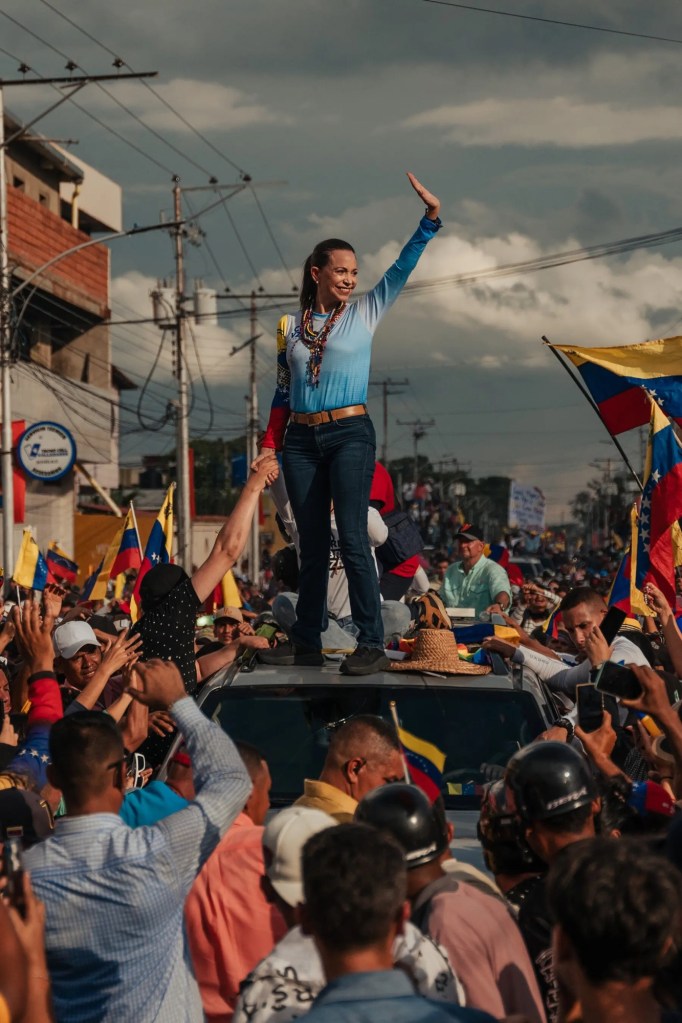
Venezuelan opposition leader Maria Corina Machado was awarded the Nobel Peace Prize for 2025 for her efforts to promote democracy at a time when an increasing number of countries slide into authoritarianism.
She receives the prize worth 11 million Swedish kronor ($1.2 million) “for her tireless work promoting democratic rights for the people of Venezuela and for her struggle to achieve a just and peaceful transition from dictatorship to democracy,” the Oslo-based Norwegian Nobel Committee said in a statement Friday.
Machado, 58, “has led the struggle for democracy in the face of ever-expanding authoritarianism in Venezuela,” the Committee said. She leads the Vente Venezuela opposition party and has worked to unite pro-democracy forces in the country.
In her life before politics, she studied engineering and finance and had a short career in business before establishing a foundation that helps street children in Caracas.
Machado “meets all three criteria stated in Alfred Nobel’s will for the selection of a Peace Prize laureate,” the Committee said. “She has brought her country’s opposition together. She has never wavered in resisting the militarization of Venezuelan society. She has been steadfast in her support for a peaceful transition to democracy.”
María Corina Machado at a rally in Guanare, Venezuela, in 2024.Credit…Adriana Loureiro Fernandez for The New York Times
Fact one: The U.S. leads the world–by far– in the number of mass shootings.
Fact two: Perpetrators of mass shootings are overwhelmingly men and boys. 98% of Mass shootings are committed by males. 2% by females. 1% by transgender people.
Fact three: Mass shootings are increasing.
Could it be because the U.S. has the weakest gun control laws in recent history and in comparison to other nations with similar populations?
When Trump selected Linda McMahon as U.S. Secretary of Education, she knew that her job was to close down the Department. She has not been able to reach that goal yet, but she has devised means to impose Trumpian policies on the public schools, by threatening to withhold federal funding unless they comply.
ProPublica reports that McMahon has a much larger goal: she has surrounded herself with aides whose goal is clear: to eliminate public schools entirely.
Education Secretary Linda McMahon has been clear about her desire to shut down the agency she runs. She’s laid off half the staff and joked about padlocking the door.
But the department is not behaving like an agency that is simply winding down. Even as McMahon has shrunk the Department of Education, she’s operated in what she calls “a parallel universe” to radically shift how children will learn for years to come. The department’s actions and policies reflect a disdain for public schools and a desire to dismantle that system in favor of a range of other options — private, Christian and virtual schools or homeschooling.
Over just eight months, department officials have opened a $500 million tap for charter schools, a huge outlay for an option that often draws children from traditional public schools. They have repeatedly urged states to spend federal money for poor and at-risk students at private schools and businesses. And they have threatened penalties for public schools that offer programs to address historic inequities for Black or Hispanic students.
McMahon has described her agency moving “at lightning rocket speed,” and the department’s actions in just one week in September reflect that urgency.
The agency publicly blasted four school districts it views as insubordinate for refusing to adopt anti-trans policies and for not eliminating special programs for Black students. It created a pot of funding dedicated to what it calls “patriotic education,” which has been criticized for downplaying some of the country’s most troubling episodes, including slavery. And it formed a coalition with Turning Point USA, Hillsdale College, PragerU and dozens of other conservative groups to disseminate patriotic programming.
Officials at the Education Department declined to comment or answer questions from ProPublica for this story.
At times, McMahon has voiced support for public schools. But more often and more emphatically she has portrayed public schools as unsuccessful and unsafe — and has said she is determined to give parents other options.
To carry out her vision, McMahon has brought on at least 20 political appointees from ultraconservative think tanks and advocacy groups eager to de-emphasize public schools, which have educated students for roughly 200 years.
Among them is top adviser Lindsey Burke, a longtime policy director at The Heritage Foundation and the lead author of the education section in Project 2025’s controversial agenda for the Trump administration.
In analyzing dozens of hours of audio and video footage of public and private speaking events for McMahon’s appointees, as well as their writings, ProPublica found that a recurring theme is the desire to enable more families to leave public schools. This includes expanding programs that provide payment — in the form of debit cards, which Burke has likened to an “Amazon gift card” — to parents to cobble together customized educational plans for their children. Instead of relying on public schools, parents would use their allotted tax dollars on a range of costs: private school tuition, online learning, tutors, transportation and music lessons.
More than 8 in 10 elementary and secondary students in the U.S. go to a traditional public school. But Burke expects that public schools will see dramatic enrollment declines fueled by both demographic and policy changes.
Addressing an interviewer in an April podcast, she noted: “We’re going to have a lot of empty school buildings.”
In a 2024 podcast, Noah Pollak, now a senior adviser in the Education Department, bemoaned what he sees as progressive control of schools, which he said has led to lessons he finds unacceptable, such as teaching fourth graders about systemic racism.
“And so the work that I do is trying to come up with creative policy ideas to stop that, to turn back the tide, to figure out ways that conservatives can protect these institutions or build new institutions,” said Pollak, who has been an adviser to conservative groups.
As tax dollars are reallocated from public school districts and families abandon those schools to learn at home or in private settings, the new department officials see little need for oversight. Instead, they would let the marketplace determine what’s working using tools such as Yelp-like reviews from parents. Burke has said she is against “any sort of regulation.”
President Donald Trump himself said in July that the federal government needs only to provide “a little tiny bit of supervision but very little, almost nothing,” over the nation’s education system except to make sure students speak English.
Advocates for public schools consider them fundamental to American democracy. Providing public schools is a requirement in every state constitution.
Families in small and rural communities tend to rely more heavily on public education. They are less likely than families in cities to have private and charter schools nearby. And unlike private schools, public school districts don’t charge tuition. Public schools enroll local students regardless of academic or physical ability, race, gender or family income; private schools can selectively admit students.
Karma Quick-Panwala, a leader at the Disability Rights Education and Defense Fund, which advocates for disabled students, said she wants to be optimistic. “But,” she added, “I’m very fearful that we are headed towards a less inclusive, less diverse and more segregated public school setting.”
Allison Rose Socol, a policy expert at EdTrust, an organization focusing on civil rights in schools, decried what she called the “demo crew” in McMahon’s office. Socol described McMahon’s push to help grow private school enrollment through taxpayer-funded vouchers and other means as a “great American heist” that will funnel money away from the public system.
“It’s a strategic theft of the future of our country, our kids and our democracy,” she said.
“Lead as Christians”
Attention on McMahon often focuses on her former role as CEO of World Wrestling Entertainment. It was no different on the day of her Senate confirmation hearing, when journalists and social media delighted in noting that seated behind her was her son-in-law, the retired wrestler known as Triple H.
Little attention was paid to the conservative education activists in the front row from Moms for Liberty, which has protested school curricula and orchestrated book bans nationwide; Defending Education (formerly Parents Defending Education), which has sued districts to fight what it calls liberal indoctrination; and the America First Policy Institute, co-founded by McMahon after the first Trump administration.
Now two people who once served at Defending Education have been named to posts in the Education Department, and leaders from Moms for Liberty have joined McMahon for roundtables and other official events. In addition, at least nine people from the America First Policy Institute have been hired in the department.
AFPI’s sweeping education priorities include advocating for school vouchers and embedding biblical principles in schools. It released a policy paper in 2023, titled “Biblical Foundations,” that sets out the organization’s objective to end the separation of church and state and “plant Jesus in every space.”
The paper rejects the idea that society has a collective responsibility to educate all children equally and argues that “the Bible makes it clear that it is parents alone who shoulder the responsibility for their children.” It frames public schooling as failing, with low test scores and “far-left social experiments, such as gender fluidity.”
The first AFPI leader pictured in that report is McMahon.
Linda McMahon testifies at her Senate confirmation hearing for secretary of education. Seated behind her are, from left to right, son Shane McMahon, Defending Education’s Nicole Neily, the former wrestler Paul Levesque (also known as Triple H), daughter Stephanie McMahon, Erika Donalds of the America First Policy Institute, and Moms for Liberty co-founder Tiffany Justice. (Win McNamee/Getty Images)
AFPI and the other two nonprofit groups sprang up only after the 2020 election. Together they drew in tens of millions of dollars through a well-coordinated right-wing network that had spent decades advocating for school choice and injecting Christianity into schools.
Ultrawealthy supporters include right-wing billionaire Richard Uihlein, who, through a super PAC, gave $336,000 to Moms for Liberty’s super PAC from October 2023 through July 2024.
Defending Education and AFPI received backing from some of the same prominent conservative foundations and trusts, including ones linked to libertarian-minded billionaire Charles Koch and to conservative legal activist Leonard Leo, an architect of the effort to strip liberal influence from the courts, politics and schools.
Maurice T. Cunningham, a now-retired associate professor of political science at the University of Massachusetts, studied the origins and connections of parents’ rights groups, finding in 2023 that the funders — a small set of billionaires and Christian nationalists — had similar goals.
The groups want “to undermine teachers unions, protect their wealthy donors from having to contribute their fair share in taxes to strengthen public schools, and provide profit opportunities through school privatization,” he concluded. The groups say they are merely trying to advocate for parents and for school choice. They didn’t discuss their relationship with donors when contacted by ProPublica.
These groups and their supporters now have access to the top levers of government, either through official roles in the agency or through the administration’s adoption of their views.
When the department created an “End DEI” portal to collect tips about diversity, equity and inclusion initiatives in schools, it quoted Moms for Liberty co-founder Tiffany Justice in the press release. She encouraged parents to “share the receipts of the betrayal that has happened in our public schools.” Moms for Liberty referred to the portal as the “culmination” of Justice’s work. (Federal judges ruled against some of the administration’s anti-DEI actions and the department took the controversial portal down in May.)
Asked what percentage of children she imagines should be in public schools going forward, Justice, who is now with The Heritage Foundation’s political advocacy arm, told ProPublica: “I hope zero. I hope to get to zero.”
She and others say most public schools don’t teach students to read, are dividing children over race and are secretly helping students to change genders — familiar claims that have been widely challenged by educators.
When Trump signed an executive order in March to dismantle the Education Department, Justice sat in the first row, as she had at McMahon’s confirmation hearing. The president praised her, along with various governors and lawmakers. “She’s been a hard worker,” he said.
Defending Education’s Nicole Neily, who was also at McMahon’s confirmation, stood next to McMahon when the secretary announced an investigation into the Maine Department of Education for keeping records from parents about student gender identity plans. Defending Education has filed civil rights complaints against colleges and school districts and has been successful in having its causes taken up by the Trump administration.
In an email, Neily told ProPublica she is proud of the work that Defending Education has done to challenge schools that have supported DEI in their curricula and have allowed students to hide their gender identity from parents. She singled out teacher unions and “radical education activists” while blaming drops in student achievement on “the education-industrial complex.”
“The sooner this stranglehold is broken, the better,” she wrote.
McMahon’s tenure also has been marked by an embrace of religion in schools. She signaled that priority when she appointed Meg Kilgannon to a top post in her office.
Kilgannon had worked in the department as director of a faith initiative during the first Trump term and once was part of the Family Research Council, an evangelical think tank that opposes abortion and LGBTQ+ rights.
She has encouraged conservative Christians to become involved in what she’s described as “a spiritual war” over children and what they’re being taught in public schools.
Reached by phone, Kilgannon told ProPublica, “I have no comment,” and hung up.
Overhauling “Government Schools”
Betsy DeVos, the Michigan billionaire who was education secretary in Trump’s first term, cheered on July 4 this year when Congress instituted America’s first federal voucher program. It came in the form of a generous tax credit program to encourage voucher expansion at the state level. Families can start accessing the aid beginning Jan. 1, 2027.
DeVos once said she wanted “to advance God’s kingdom” through vouchers for religious schools and has funneled vast amounts of her family fortune into advocating for school choice. She called the passage of the federal measure “the turning point in ending the one-size-fits-all government school monopoly.”
An article in The Federalist, a conservative publication, boiled down the implications into one headline: “How Trump’s Big, Beautiful Bill Will Help Kids Escape Failing Government Schools.”
But school choice isn’t the only tool that Trump’s education leaders are using to target public schools. McMahon has gutted the Education Department’s civil rights division, where lawyers and other federal employees work to ensure all students can access public school, free from discrimination.
The administration rolled back protections for LGBTQ+ students and students of color, prioritized investigating discrimination against white and Jewish students, and launched aggressive investigations of states and districts that it says refused to stop accommodating transgender students.
It has rescinded official guidance that said schools had to provide language help and other services for students who are learning English, contradicting long-established federal law.
And Trump officials have repeatedly cast public schools as dangerous even as the agency canceled about $1 billion in training grants for more school mental health professionals — money that had been authorized by Congress to help prevent school shootings. The administration now says it plans to resume paying out a fraction of that funding, which would be used for school psychologists.
Over and over, the department has used the threat of pulling federal funding to force compliance with new directives and rapid shifts in policy. The department, for instance, threatened to withhold money from schools that did not verify they were ending diversity initiatives, which were designed to address inequitable treatment of Black, Native and Latino students.
In August, the department announced it was withholding millions of dollars in grants from five northern Virginia school districts that had refused the department’s demands to bar transgender students from using restrooms and locker rooms that aligned with their gender identity. The districts argued that complying would mean defying Virginia law and a 2020 federal appeals court ruling.
Nevertheless, the Education Department told the districts that until they acquiesced to the agency’s bathroom rules they would have to pay expenses up front and request reimbursement. McMahon wrote to districts that “Lindsey Burke is available to answer any questions.”
The Fairfax County Public Schools sued and in a legal filing said it faced losing $167 million this school year, money that it was relying on to provide meals to students, support programs for children with disabilities, help English-language learners and enhance teacher training. The federal department has argued that it has discretion to withhold funding and admonished the district for taking the agency to court.
In this atmosphere, public school advocates are particularly concerned about what will happen to funding for Title I grants, which is the federal government’s largest program for schools and is aimed at helping students from low-income families. In early September, House Republicans proposed slashing more than $5 billion from the $18.4 billion earmarked for Title I, putting at risk reading and math teachers, tutors and classroom technology.
At the same time, under McMahon, the Education Department is trying to redefine how states and districts can spend the money.
In three guidance letters so far this year, the agency encouraged states to divert some Title I money away from public school districts. One suggested paying for outside services, such as privatized tutoring. Another urged states to use Title I money to benefit low-achieving students who live within the boundaries of a high-poverty public school but attend private schools.
McMahon is prepared to loosen even more rules on the money. The federal dollars currently are distributed to districts using a formula. Project 2025 calls for Title I to be delivered to states as block grants, or chunks of money with few restrictions. McMahon has encouraged states to ask her to waive rules on spending the money.
Critics of this approach fear that Title I money could eventually be used in ways that undermine public schools — on private school vouchers, for example.
Public school advocates like William Phillis, a former official at the Ohio Department of Education, fear the change would devastate public schools.
“I just know any block grant or any funding that would be left up to state officials on Title I money would be misappropriated in terms of the intent,” Phillis said. “Block grants to Ohio would go to the private sector.”
A spokesperson for the Ohio Department of Education and Workforce did not respond to requests for comment.
Rainey Briggs, chief of operations for Des Moines Public Schools in Iowa, said he supports parental choice but worries that public schools will suffer financially and will not have the resources to stay up to date.
And he fears that right-wing narratives around public schools, the distrust and lack of support for highly trained district leaders — whether from some parents or politicians — could lead accomplished educators to walk away.
“Public education is irreplaceable,” he said, citing its commitment to serve every child regardless of their background or circumstance.
Those influencing Trump’s education agenda disagree.
“If America’s public schools cease to exist tomorrow, America would be a better place,” Justice told ProPublica.
Dr. Paul Offit is a medical doctor who specializes in children’s infectious diseases. He is appalled by the actions and policies of Robert F. Kennedy Jr., because they endanger the health of our nation, especially children.
Robert F. Kennedy Jr. is a disgrace to his family name. He should not have been put in charge of public health. Not only is he totally unqualified, but his beliefs about medicine are dangerous.
Dr. Offit writes:
On April 15, 2025, Dr. Fiona Havers, an epidemiologist at the CDC, presented data on the impact of COVID-19 on children the previous year. She found that COVID-19 had caused thousands of children to be hospitalized; 20 percent of whom were admitted to the intensive care unit. Virtually all were unvaccinated, half were previously healthy, and 152 had died, most less than 4 years of age. The conclusion was clear; young children in the United States who had never been vaccinated will still benefit from a COVID-19 vaccine. Although the pandemic was over, the virus wasn’t.
Six weeks later, on May 27, 2025, Robert F. Kennedy Jr., the Secretary of Health and Human Services (HHS), in a video posted on X, said that COVID-19 vaccines would no longer be recommended for young, healthy children. When asked to provide evidence for this unilateral, behind-closed-doors decision, he couldn’t. This week, the American Academy of Pediatrics (AAP) released its own recommendations. Consistent with the CDC’s findings—and in direct contrast to Kennedy’s edict—the AAP stated, “Infants and children 6 to 23 months of age are at high risk for severe COVID-19…All infants and children in this age group [should] receive the 2025-2026 COVID-19 vaccine…Those who are previously unvaccinated should receive an initial series.”
Hours after the AAP released its statement, Kennedy fired back, posting on X that the AAP was engaging in a “pay-to-play scheme to promote commercial ambitions of AAP’s Big Pharma benefactors.” Kennedy linked to a page showing that the AAP’s Friends of Children Fund, a charity that focuses on adolescent mental health and suicide prevention, had received donations from several vaccine makers. Kennedy also claimed that the medical journal that published the AAP’s recommendations, Pediatrics, was part of this same “pay-to-play scheme.” Kennedy’s actions were a tiresome rerun of his many accusations over the past 20 years. Whenever scientists, doctors, public health officials, academic institutions, scientific journals, or medical or professional societies claim that a vaccine is safe, effective, or valuable, he says that they are all in the pocket of the pharmaceutical industry. No one is to be trusted, except him.
Kennedy’s conflict-of-interest gambit is a misdirection game. If he can get the press and the public to talk about conflicts-of-interest, he can distract from his decision to recommend against COVID-19 vaccines for children that wasn’t supported by the evidence.
Then Kennedy made a veiled threat, posting on X that the “AAP should be candid with doctors and hospitals that recommendations that diverge from the CDC’s official list are not shielded from liability under the 1986 Vaccine Injury Act.” Defy me, argued Kennedy, and I will make sure that doctors and hospitals that recommend COVID-19 vaccines for young children could be sued. It was an empty threat. Doctors and hospitals are protected from liability related to COVID-19 vaccines by the PREP Act. Kennedy’s threat was yet another mean-spirited attempt at misdirection.
Pediatricians, parents, and public health officials are confused by these conflicting recommendations. Epidemiological evidence says one thing, Kennedy another. This confusion will likely result in some young children failing to receive a COVID-19 vaccine. It is also likely that some of these children will be admitted to the hospital, or intensive care unit, or die as a result. And when that happens, we won’t have to look any further than the man who for the past 20 years has been an anti-vaccine propagandist, science denialist, and conspiracy theorist to understand why.
W.H. Auden, a British American poet, wrote, “When all the mass and majesty of this world, when all that carried weight and always weighed the same, lay in the hands of others. They were small and could not hope for help and no help came.” How many children will have to suffer needlessly at the hands of RFK Jr. before someone, anyone steps up to save them?
I’m reminded that protestors against the war in Vietnam used to chant,
What happens when government data are politicized? What happens when a President fires the professionals who report the data and replace them with his loyalists?
Jack Hassard, a retired professor of science education at Georgia State University, knows what happens. Hassard followed Trump’s behavior in his first term and wrote a book called The Trump Files.
The problem with Trump has accelerated now that he is surrounded by a well-organized cabal of far-right extremists who are turning him into a dictator.
Every Friday, my mother would check the Bureau of Labor Statistics dashboard. She did this the way some families checked the weather. She was quiet and anxious, with a hand on the mouse and a furrow in her brow. The numbers told her how many people had lost work that week. They showed how fast prices were rising. The data revealed whether the rent hikes were outpacing wages again. It was her way of listening for distant thunder. Today, nevertheless, the BLS dashboard is not updating information because of the Republican led government shutdown.
The dashboard went dark the spring Trump returned to power. At first we thought it was just another funding fight, like the ones that had knocked websites offline before. But weeks passed, and the updates never came back. My mother kept refreshing the page for months, like a ritual for a ghost.
By the end of that summer, more pages were vanishing. Climate dashboards froze mid-storm season. Food insecurity surveys were “postponed indefinitely.” Vaccine data disappeared without explanation. By winter, it was as if the country had decided to stop looking at itself in the mirror.
They called it austerity. They said it was about cutting “red tape” and “freeing the agencies from bloated bureaucracy.” But everyone could feel the chill. It wasn’t just numbers that were being cut. It was the nerves that told us where the pain was.
We didn’t realize it at the time. This was how the silence began. It began not with censorship in the usual sense but with a subtraction of knowledge.
When the data stopped, arguments stopped making sense. People clung to whatever numbers their preferred networks fed them, like castaways grabbing driftwood. One station would say unemployment was rising; another insisted we were in a “golden age.” Both cited “official sources,” but the sources were gone, hollowed out or replaced by Trump’s loyalists.
At school, the teachers tried to explain inflation, but the charts they used were months out of date. Some parents started printing memes as evidence. Others stopped trusting the schools entirely.
Looking back, it’s astonishing how quickly civic discourse disintegrated once the shared factual floor cracked. We had thought democracy died in coups or riots. Instead, it died in data voids—quiet gaps that widened into abysses.
My father used to call it “the silence before the storm.” Storms were his touchstone for everything. He said the scariest part wasn’t the wind or the rain. It was the moment the air went unnaturally still. You realized the warning systems had failed.
That silence descended over our public life. When pollution monitoring sites shut down, a chemical spill in Savannah went undetected for weeks. By the time the numbers surfaced through a university backchannel, children were already sick. When the food insecurity survey was cut, hunger surged invisibly. Relief programs couldn’t track where the need was worst.
And when climate data went dark, the storms didn’t stop. They just stopped being predictable. The year the NOAA dashboards froze was the year the Atlantic hurricanes changed course mid-season. Thousands died inland, where no one expected them.
The silence didn’t come from ignorance. It came from a deliberate decision to turn off the lights.
I know you study this era, Jack, so you know the official explanations: budget cuts, “efficiency reforms,” sovereignty rhetoric. But those were just alibis. Trump understood something that too many defenders of democracy underestimated: data is power. Whoever controls the ability to measure reality controls the terms of debate.
His war on data wasn’t chaotic—it was methodical. Fire the agency heads who produce inconvenient statistics. Defund the surveys that expose inequality. Gut the climate monitors that contradict your conspiracies. Let loyal media amplify your alternate “facts.” Over time, the shared reality collapses, and the strongman narrative becomes the only stable frame left.



 Diane Ravitch's blog