John Thompson, historian and retired teacher in Oklahoma, follows the bizarre twists and turns of education policy in Oklahoma. Since the election of Ryan Walters, MAGA extremist as State Superintendent, the changes have been dizzying.

Thompson writes:

Following the lead of Texas Gov. Greg Abbott, Oklahoma State Superintendent Ryan Walters announced that the state will stop statewide standardized testing. Instead, school districts should benchmark assessments that they purchase from private vendors.

Walters did so without receiving the approval of the U.S. Education Department’s authority to choose testing vendors and assessment schedules. He also ordered the change without consulting with educators and school patrons. In other words, Oklahomans will not get to answer questions, such as:

Would they prefer state tests that hold schools accountable for Walters’ standards regarding American exceptionalism and Christianity?

Or would they prefer benchmark metrics about evidence that President Donald Trump won the 2020 presidential election, and more than 40 references to Christianity and the Bible?

Seriously, Republicans and Democrats both expressed skepticism in regard to Walters’ impossible order.  Even the Texas legislature is also divided between those who want to compare student outcomes to specific state standards, as opposed to comparing Texas students to those in other states through a norm-referenced test.

But Oklahomans need to discuss a more fundamental question:

Why in the world do we have state tests for accountability purposes? Is there any evidence that those tests have done more good than harm to teaching and learning?

During the first half of my career, educators remembered the damage done by 1980s teach-to-the-test. In the late 1990s, when State Superintendent Sandy Garrett and her science-driven team protected the autonomy of teachers, and in 1998 when percentage of Oklahoma 8th graders who were Basic or above, according to NAEP reading scores, was eight points higher than the nation’s, teachers were given an aligned-and-paced curriculum guide. However, my school’s principal had the autonomy to tell us that she knew we wouldn’t use it but asked us not to throw it away.  It could be valuable for new and/or struggling teachers. So, we were just asked to keep it on file in case a central office administrator, with a different view, dropped by our room.

Of course, the effort to get every teacher “on the same page” to improve standardized test scores was disastrous – resulting in skin-deep, in-one-ear-out-the-other instruction documented, in part, by the collapse of NAEP scores.

On the eve of No Child Left Behind, John Q. Easton warned the OKCPS that no school improvement was possible without first building a foundation of trusting relationships. Afterwards in the parking lot, our district’s great researchers agreed with Easton. But they correctly predicted that when NCLB forced us to replace Norm Reference tests (NRT), that couldn’t be taught to, with Criterion Referenced Tests (CRT) that could be taught to, that our data would be corrupted.

Accountability-driven, competition-driven Corporate School Reform was doubly destructive because misleading metrics became one of the weapons that helped drive excessive levels of school choice. It created schools like mine with intense concentrations of extreme, generational poverty and students who endured multiple traumas, known as ACEs.

And that gets to the next conversation that we need – is there any conceivable way that school grade cards could give accurate information on the quality of educators who committed themselves to the poorest children of color? Is there any way that the benefits they might provide to students in higher-performing schools could ever match the damage they do to students left behind in the highest-challenge schools?

Especially today, when immigrants are being terrorized and mental health challenges are increasing, and chronic absenteeism is surging during a time of budget cuts, who could deny that grading schools is, at best, a distraction?

For example, we need comprehensive and expensive team efforts to address chronic absenteeism. Was there any way that punishing schools for chronic absenteeism, as well as the effects of the increased stress students are experiencing, could be a solution? 

Getting back to the bipartisan conversation we need, teachers unions, numerous Democrats, Republicans, and education leaders have a long history of opposing high-stakes testing. And Senator Julia Kirt (D) explains:

“Absolutely we should have a conversation about what testing is appropriate and when, and we’ve been bringing up that conversation up for years. … But him doing it this way, I don’t think complies with state law, and it makes us all have to do a bunch of scrambling to figure out what’s happening.”

And as Republican candidate for State Superintendent Rob Miller says, when “testing becomes less about improvement and more about sorting and ranking schools. That’s not accountability, it’s a road to nowhere.”

Or, we could trust Ryan Walters’ road to Christian Nationalism …

This is a press release from the White House titled “President Trump is Right About the Smithsonian.” It describes some of the works and exhibits he wants to censor because they don’t show a positive portrayal of the U.S.

  • The National Museum of African American History and Culture debuted a series to educate people on “a society that privileges white people and whiteness” — defining so-called “white dominant culture“ as “ways white people and their traditions, attitudes, and ways of life have been normalized over time” and portraying “the nuclear family,” “work ethic,” and “intellect” as white qualities rooted in racism.
  • As part of its campaign to stop being “wealthy, pale, and male,” the National Portrait Gallery featured a choreographed “modern dance performance“ detailing the “ramifications“ of the southern border wall and commissioned an entire series to examine “American portraiture and institutional history… through the lens of historical exclusion.”
  • The American History Museum prominently displays the “Intersex-Inclusive Progress Pride flag” at its entrance, which was also flown alongside the American flag at multiple Smithsonian campuses.
  • The National Portrait Gallery features art commemorating the act of illegally crossing the “inclusive and exclusionary” southern border — even making it a finalist for one of its awards.
  • The National Museum of African Art displayed an exhibit on “works of speculative fiction that bring to life an immersive, feminist and sacred aquatopia inspired by the legend of Drexciya,” an “underwater kingdom populated by the children of pregnant women who had been thrown overboard or jumped into the ocean during the Middle Passage.”
  • The American History Museum’s “LGBTQ+ History” exhibit seeks to “understand evolving and overlapping identities such as lesbian, gay, bi-sexual, transgender, queer, transsexual, transvestite, mahu, homosexual, fluid, invert, urning, third sex, two sex, gender-bender, sapphist, hijra, friend of Dorothy, drag queen/king, and many other experiences,” and includes articles on “LGBTQ+ inclusion and skateboarding“ and “the rise of drag ball culture in the 1920s.”
  • The National Museum of the American Latino features programming highlighting “animated Latinos and Latinas with disabilities” — with content from “a disabled, plus-sized actress” and an “ambulatory wheelchair user” who “educates on their identity being Latinx, LGBTQ+, and disabled.”
  • The National Museum of the American Latino characterizes the Texas Revolution as a “massive defense of slavery waged by ‘white Anglo Saxon’ settlers against anti-slavery Mexicans fighting for freedom, not a Texan war of independence from Mexico,” and frames the Mexican-American War as “the North American invasion” that was “unprovoked and motivated by pro-slavery politicians.”

There is more. Open the link to see it.

Jan Resseger summarizes the judicial counterattack to the Trump administration’s efforts to criminalize DEI policies. It’s obvious that the Trump goal is to censor common practices that teach history, warts and all, as well as to kill programs that try to help Black and Hispanic students to succeed.

But the lower federal courts are getting their way. It remains to be seen whether the Trump-dominated U.S. Supreme Court will reverse the lower courts and allow Trump to restore his vision of a white-male dominated society.

Resseger writes:

Earlier this month, the Associated Press’s Collin Binkley broke a story that brought relief and satisfaction to the school superintendents and members of elected school boards across the nation’s 13,000 public school districts: “A federal judge… struck down two Trump administration actions aimed at diversity, equity and inclusion programs at the nation’s schools and universities.”

When she reported the story a few minutes later, the NY Times‘ Dana Goldstein highlighted its importance: “A federal judge dealt a sweeping setback on Thursday to President Trump’s education agenda, declaring that the administration cannot move forward with its plans to cut off federal funding from schools and colleges with diversity and equity programs.” But Goldstein cautions: “The legal back and forth is not likely to end any time soon… Eventually, it may be up to the Supreme Court to decide whether the president can interpret civil rights law to end racial equity efforts in schools.”

The new ruling is so important, however, that we must all pay attention. Binkley explains: “U.S. District Judge Stephanie Gallagher in Maryland found that the Education Department violated the law when it threatened to cut federal funding from educational institutions that continued with DEI initiatives. The guidance has been on hold since April when three federal judges blocked various portions of the Education Department’s anti-DEI measures.” Judge Gallagher’s decision followed a motion for summary judgment from two of the challengers to federal policy—the American Federation of Teachers and the American Sociological Association.  Judge Gallagher is a Trump appointee.

Judge Gallagher’s decision will block the implementation of the February 14 “Dear Colleague” letter that Craig Trainor, assistant secretary in the Department of Education’s Office for Civil Rights, sent to public school, colleges, and universities, in which he tried to expand the meaning of a narrow 2023 U.S. Supreme Court affirmative action decision, Students for Fair Admissions v. Harvard, as also banning any public school programs or policies designed to achieve diversity, equity and inclusion.

Thursday’s decision will also block the enforcement of the Trump administration’s April 3, 2025 demand that state education agencies and every one of the nation’s 13,000 public school districts sign a certificate promising they had eliminated all programs and policies aimed at achieving DEI.  On April 3rd, the Department of Education threatened to halt federal funding, including Title I funding for public schools serving concentrations of poor children, for schools that refused to follow its order to eliminate DEI.

Goldstein adds that the new decision, “will not lead to immediate changes for schools or colleges, because the administration’s anti-D.E.I. efforts had already been temporarily paused by Judge Gallagher and two other federal judges in April.”  The new decision will, however, ease fear among thousands of public school leaders who have been wrestling with what has seemed a looming threat from the federal government.  Some school districts have already submitted to the federal government’s threats by cancelling programs aimed at reaching students who have historically been left out or left behind.

Binkley and Goldstein both do an excellent job of exploring what the Trump administration seems to mean but never explicitly defines when it condemns its own twisted redefinition of “diversity, equity, and inclusion.” While most educators and citizens would like public schools to welcome all students inclusively, to treat students equitably, and to ensure that no children are excluded, the Trump administration has instead tried to turn programs based on these principles into crimes.

Binkley explains that the federal guidance, “amounted to a full-scale reframing of the government’s approach to civil rights in education. It took aim at policies that were created to address longstanding racial disparities, saying those practices were their own form of discrimination.”

Goldstein writes: “While there is no single definition of D.E.I., the Trump administration has indicated that it considers many common K-12 racial equity efforts to fall under the category and to be illegal. Those include directing tutoring toward struggling students of specific races, such as Black boys; teaching lessons on concepts such as white privilege; and trying to recruit a more racially diverse set of teachers. The administration has also warned colleges that they may not establish scholarship programs or prizes that are intended for students of specific races, or require students to participate in ‘racially charged’ orientation programs… The administration had also argued that because the Supreme Court overturned affirmative action in college admissions in 2023, all racially conscious education programs are illegal.”  Goldstein concludes: “But those legal interpretations were novel and untested. Judge Gallagher rejected them, writing that the (2023) anti-affirmative action ruling ‘certainly does not proscribe any particular classroom speech or relate at all to curricular choices.’ ”

In her decision on Thursday, Judge Gallagher declared the Trump administration’s ban on “diversity, equity and inclusion” an unconstitutional violation of the First Amendment’s protection of  free speech.  Goldstein reports: “In a strongly worded ruling, Judge Stephanie Gallagher… wrote that the administration had not followed proper administrative procedure, and said that its plan was unconstitutional, in part because it risked constraining educators’ free speech rights in the classroom.”

Soon after the Trump administration’s April 3rd letter threatening public school funding including Title I dollars, constitutional law professor Derek Black explained that the April 3rd letter clearly violates the First Amendment protection of free speech, as decided in a landmark, 1943 decision, West Virginia State Board of Education v. Barnette. The case involved a widespread requirement in the 1940s that public schools punish or expel students who refused to say “The Pledge of Allegiance.”

Here is how Yale Law School Professor Justin Driver describes the significance of that case in his book, The School-House Gate: Public Education, The Supreme Court, and the Battle for the American Mind:

“Barnette stands out for making three primary substantive innovations that appear at the intersection of constitutional law and education law. First, as a matter of constitutional doctrine, Justice (Robert) Jackson dramatically reconceptualized the requirement (that all students recite the “Pledge”) as raising a question not about the First Amendment’s freedom of religion but about the First Amendment’s freedom of speech… whether people of all backgrounds have an interest in avoiding government-compelled speech…. Jackson suggested that tolerating nonconformity, and even dissidence, was essential to enabling this unusually diverse nation to function.”

Driver quotes Justice Robert Jackson’s decision in the Barnette case: “If there is any fixed star in our constitutional constellation, it is that no official, high or petty, can prescribe what shall be orthodox in politics, nationalism, religion, or any other matters of opinion or force citizens to confess by word or act their faith therein.” (Justin Driver, The School-House Gate, pp. 65-66)

The Network for Public Education Action sent out the following alert. Please use the form to send a letter to your members of Congress.

Image
Image

Dear Friend of Public Schools.

They said they wouldn’t cut Title I. They lied.

Majority House leaders just dropped their FY26 education bill, slashing $12.1 billion (15%) in K-12 funding for public education. It guts the very programs that keep our public schools running — while boosting charter start-up/expansion to $500,000,000.

What they’re cutting:

  • Title I: –27% slashed — funding that provides targeted education services like remedial reading to students with maximum impact in high-poverty schools in cities and rural communities.
  • English Language Acquisition Grants: Gone.
  • Title II-A (teacher training & support): Eliminated.
  • Full-Service Community Schools: Zeroed out.

SEND YOUR EMAIL NOW

And their justification?

“Despite outsized investment, America’s public schools continue to fail children and families.”
That’s what they think of your neighborhood school.

Why this matters

Cuts of this magnitude will crowd classrooms, strip student supports, widen inequities, and push more schools into crisis — especially in rural and high-need communities.

Do these two things now

1) Email your Representative:

Use our action link to send a pre-written message in 15 seconds: Send your email now.

2) Call your Representative:

Find your member’s phone number here.
Below is a script you can use right now:
“Hello, I’m a constituent from [Representative’s name] district. I’m calling to urge the Representative to oppose the House education funding bill that cuts Title I by 27% and reduces K12 funding by 15%. These cuts will harm students and teachers in our district. Please vote NO and support full funding for public schools — not half-a-billion in funding  for charter expansion while our classrooms are being cut. Thank you.”

Now spread the word

We Can’t Do What We Do Without Your Support…

Every email we send out with our action alerts costs hundreds of dollars in addition to our other operational expenses that keep us going. We need your help. Please click on the image below to make a one-time donation, or better yet, a recurring donation. Even ten dollars a month makes a huge difference for us. Thank you in advance for your generosity that will help preserve our public schools.

DONATE HERE

Thanks for all you do! You can share this email with this link: https://npeaction.org/act-now-k12-budget-slashed-by-the-house/

Carol Burris

Network for Public Education Action Executive Director

Nine former directors of the Centers for Disease Prevention and Control wrote a joint opinion piece for The New York Times. These are men and women devoted to public health who served in both Republican and Democratic administrations. They agree that what Robert F. Kennedy Jr. is doing to the Department of Health and Human Services is outrageous and dangerous.

They write:

We have each had the honor and privilege of serving as director of the Centers for Disease Control and Prevention, either in a permanent or an acting capacity, dating back to 1977. Collectively, we spent more than 100 years working at the C.D.C., the world’s pre-eminent public health agency. We served under multiple Republican and Democratic administrations — every president from Jimmy Carter to Donald Trump — alongside thousands of dedicated staff members who shared our commitment to saving lives and improving health.

What the health and human services secretary, Robert F. Kennedy Jr., has done to the C.D.C. and to our nation’s public health system over the past several months — culminating in his decision to fire Dr. Susan Monarez as C.D.C. director days ago — is unlike anything we had ever seen at the agency and unlike anything our country had ever experienced.

Mr. Kennedy has fired thousands of federal health workers and severely weakened programs designed to protect Americans from cancer, heart attacks, strokes, lead poisoning, injury, violence and more. Amid the largest measles outbreak in the United States in a generation, he’s focused onunproven treatments while downplaying vaccines. He canceled investments in promising medical research that will leave us ill prepared for future health emergencies. He replaced experts on federal health advisory committees with unqualified individuals who share his dangerous and unscientific views. He announced the end of U.S. support for global vaccination programs that protect millions of children and keep Americans safe, citing flawed research and making inaccurate statements. And he championed federal legislation that will cause millions of people with health insurance through Medicaid to lose their coverage. Firing Dr. Monarez — which led to the resignations of top C.D.C. officials — adds considerable fuel to this raging fire.

We are worried about the wide-ranging impact that all these decisions will have on America’s health security. Residents of rural communities and people with disabilities will have even more limited access to health care. Families with low incomes who rely most heavily on community health clinics and support from state and local health departments will have fewer resources available to them. Children risk losing access to lifesaving vaccines because of the cost.

This is unacceptable, and it should alarm every American, regardless of political leanings.

To finish reading the article, open the link.

Politico posted an article about the demoralization of career foreign service officers. DOGE laid off many of the top diplomats, and everyone who remains is walking on eggshells, unsure if they will be next. It seems that Trump’s version of “America First” is actually “America Only,” and he doesn’t care about our relationships with other nations. In earlier times, he would have been called an isolationist.

Trump treats allies as enemies, but adores Putin, no matter how frequently Putin humiliates him (as he did at their meeting in Alaska, where Putin departed before a luncheon in his honor, as he did when Russian state media published nude photos of Melania before the 2024 election).

Foreign service officers are afraid of saying the wrong thing. They don’t feel free to express dissent or even to communicate, fearing that someone is watching and any disagreement will get them into trouble.

Naval Toosi reported:

President Donald Trump promised to reform American diplomacy. Insiders say he’s breaking it instead, to the point where he’s undermining his own global influence.

Eight months into Trump’s second term, more than half of U.S. ambassadorships, an unusually high amount, are vacant. Most top State Department roles are filled on an acting basis, often by people with little relevant experience. Many U.S. diplomats, especially those overseas, are largely cut out of policy talks while struggling to implement administration orders they say are confusing. Many also are too afraid to speak up because they could be fired or lose a promotion under new rules that measure their “fidelity.” They’ve already seen thousands of their colleagues pushed out and many offices dismantled.

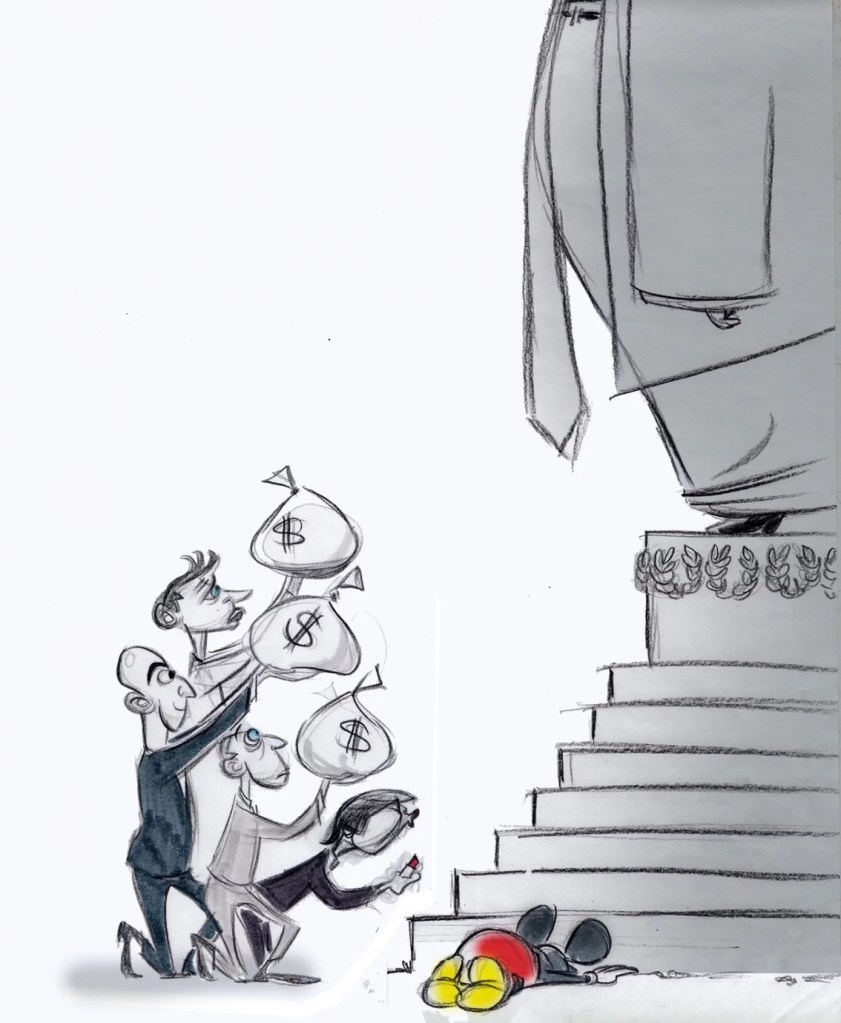
Fifteen years ago, I wrote a book about the the danger that school choice and testing posed to public schools. Its title: The Death and Life of the Great American School System: How Testing and Choice Are Undermining Education. I named a few of the billionaires funding the attacks on public schools, teachers, and unions–Bill Gates, Eli Broad, and the Walton family–calling them “The Billionaire Boys Club.” Little did I know that they were the tip of the billionaire iceberg.

My hope in 2010 was that public school supporters would block the privatization of their schools. Public schools are as American as apple pie. I wanted the public to wake up, rally around their public schools, and repel the hedge fund managers and billionaires who were funding the privatization movement.

I was too optimistic.

The attacks escalated, fueled by the political power that money buys. The major media bought the corporate reform narrative hook, line, and sinker.

Neoliberal corporate reform brought us high-stakes standardized testing, A-F ratings for schools, charter schools, school closings, and rating teachers by the test scores of their students. And cheating scandals. All to get higher test scores, which never happened.

Now, Jennifer Berkshire asks on her blog The Education Wars whether it’s all over for public schools. Jennifer appreciates the importance of public schools as community builders and civic institutions that serve the common good.

Please read her smart take on the state of public education today:

I won’t lie. If you’re a member of Team Public Education, as I am, it has been a tough summer. And if you, like me, have been sounding the alarm about the dangers of school privatization, it’s impossible to ignore the sense that the future we’ve been warning about has arrived. Five years ago, education historian Jack Schneider and I wrote a book called A Wolf at the Schoolhouse Door: the Dismantling of Public Education and the Future of School that culminated in a sort of “Black Mirror” chapter called “education a la carte.” In it, we described how the ultimate vision of school privatization advocates wasn’t simply to shift the nation’s youngsters into private schools, but to ‘unbundle’ education into a vast array of products for consumers to purchase on Amazon-like exchanges. Lest you think we were exaggerating, turn your attention to Florida, where, as Sue Woltanski documents, project unbundle has arrived with a vengence.

Florida, as usual, is slightly ahead of the curve. But the accelerating collapse of public schools in the state, chronicled in this recent New York Times story, pushed along by the now universal school voucher program, will soon be coming to a state near you. The NYT piece, by the way, was just one of many ‘are public schools over?’ stories to drop in recent weeks. The Washington Post version headed to peer in the window of the GOP vision for education. Spoiler: it entails replacing public schools with “a marketplace of school options.” Then, of course, there was the annual PDK survey of attitudes towards public education, which found both sinking approval of the nation’s schools (with the usual exception for local schools) and rising warmth towards the idea of private school vouchers. As legal scholar Derek Black put it, “The deep well of faith in public education has a disastrous leak.”

To understand what’s happening, I’m going to pause here to spend some time with yet another of the ‘are public schools through?’ stories, Chandler Fritz’s eye-opening new feature for Harper’s“The Homemade Scholar.” Fritz, a teacher and writer who pens the “Arizona Room” newsletter, took a job at a private religious microschool in order to get a close up view of Arizona’s education marketplace, what he describes as “a new frontier in American education.” I recommend paying attention to this piece because 1) Fritz is a terrific writer and 2) he provides real insights into the appeal of vouchers, or as they’re billed in AZ, education savings accounts—something my own writing rarely reckons with. 

Fritz finds a grab bag of reasons that students and parents are drawn to this particular microschool, most of which will be familiar to you: a hunger for ‘customization,’ the desire for religious instruction, the appeal of a small setting, conservative backlash against public education. But there’s another reason we don’t hear as much about—the opposition to the standardized testing that shapes every aspect of what’s left of our public schools. Fritz’s piece is long (the audio version clocks in at nearly an hour), and infuriating in parts, but his observations regarding the attitudes of these ‘education consumers’ towards standardized tests get straight to the point: they hate them.

Bad math

A similar theme pops up in Dana Goldstein’s recent portrayal of the impact of vouchers on schools in Florida’s Orange County. While three quarters of the schools in the district earned an ‘A’ or a ‘B’ on the state’s school accountability report card, parents are eager to free their kids from the burden of taking the state tests, something Florida education watchdog Billy Townsend has been tartly observing for years. Now, I mention opposition to standardized testing here because, even in our deeply divided times, it is a cause that unites parents across virtually any line of division. If you don’t believe me, head down to Texas, where, in addition to re-gerrymandering the state’s electoral maps, legislators have also been pretending to address the popular revolt against the STAAR Test.

But there’s another reason to revisit the antipathy to testing. While you’ve been distracted by the relentless tide of bad and worse news, what’s left of the education reform movement has been busy reemerging, zombie style, seemingly without having learned a single thing about why it flopped in the first place. There are overt signs of the zombie’s return—like Democrats for Education Reform trying to rally the party around a vision of education ‘abundance,’ or Andrew Cuomo, flailing in the NYC mayoral race, now rebranding himself as the education reform candidate with a pledge to shut down failing schools and replace them with new ‘schools of promise.’ Then there’s the pundit-level narrative taking shape in which education reform was working just great until the teachers unions ruined everything and/or Democrats lost their nerve.

This version of events, encapsulated in this recent David Brooks column, goes like this:

School reform was an attempt to disrupt the caste system, to widen opportunity for the less privileged. Presidents Bill Clinton and Barack Obama angered core Democratic constituencies like teachers unions in order to expand opportunity down the income scale. But now Democrats have basically given up. Joe Biden didn’t devote much energy to education reform. Kamala Harris ran for president without anything like a robust education reform agenda.

Brooks goes on to cite Michael Petrilli on the ‘Southern surge,’ the rise in test scores in Mississippi, Alabama, Louisiana and Tennessee (but not Florida) that has education reformers so excited. Kelsey Piper, authoress at the brand new outlet the Argument, is excited too. In her back-and-forth with leftist policy analyst Matt Bruenig over the question of whether giving parents cash benefits poor children, Piper comes down squarely on the side of fixing the schools.

I think school reform after school reform has served every conceivable interest group except students (who do not vote) and so have failed to meaningfully increase literacy and numeracy, even though we now have a road map for how to genuinely let every child thrive.

If you guessed that the ‘road map’ referred to here is Mississippi, you would be correct. Mississippi, by the way, is a national leader in child poverty levels, an honor that the state, which just eliminated its income tax, seems determined to hold on to.

Proxy war

Such ‘if only the band would get back together’ takes somehow miss what a flop much of our recent version of education reform turned out to be. Here’s a partial list. The backlash to Common Core on the right didn’t just help to usher in Donald Trump but played a role in transforming the GOP from the party of big business (which was all in on pushing the Common Core standards) to one dominated by aggrieved populists. And the over selling of college tapped into a well of resentment so deep that the entire system of higher education is now threatened. Then there is the relentless push to narrow the purpose of school down to standardized testing and workforce prep, a bipartisan cause that, as I argue in a forthcoming essay in the Baffler, has now been abandoned by the right in favor of education that prizes ‘virtue’ over vocation, even as many Democrats continue to beat the ‘career readiness’ drum.

I’m not the only one to point this out, by the way. Teacher-turned-writer Nora De La Cour makes a compelling case that the appeal of so-called classical charter schools is due in part to the damage done to public education by neoliberal education reform. Students at these rapidly spreading classical schools encounter the ‘great books.’ Their public school peers get “decontextualized excerpts in corporate-produced test prep materials,” writes De La Cour.

Which brings me to the main point of this piece. (Finally!) Part of what’s so frustrating about our current moment is that by leaning into a deeply unpopular vision for public schools—test them, close them, make them compete—a certain brand of Democrat is essentially incentivizing parents to seek out test-free alternatives. Consider too that we’re in the midst of a fierce intraparty debate over what Democrats need to do to win. For the education reform wing of party, the answer to the question is to go hard at teachers unions and double down on school accountability, while also embracing school vouchers. 

While this vision is inherently contradictory, it’s also a loser with voters. There may be no single less appealing sales pitch than ‘we’re going to close your school.’ Just ask former Chicago mayor Rahm Emmanuel, who was so unpopular in the city’s minority neighborhoods after shuttering 50 schools that he couldn’t run for reelection. As voucher programs expand rapidly, we’re about to enter a new era of school closures. If you don’t believe me, just check out this statement from a CATO Institute spox in response to that WaPo story on Arizona:

It’s tough for some families when their school—public or private—closes. Kids miss their friends, teachers worry about their jobs, parents have to adjust their transportation plans. But stories bemoaning public schools losing enrollment due to school choice policies are missing the point. Should parents who want a different option for their children be forced to stay in their assigned school in order to prop it up? Of course not. Public schools had a virtual monopoly on enrollment for decades, but no school can serve the unique needs of all the children who happen to live near it. As we continue down the path of more educational freedom, some schools will rise to the challenge and others will close. We shouldn’t sacrifice children’s futures in an effort to save schools that aren’t meeting their needs.

Close readers will note the moving goal posts—that we’ve moved from school choice as a means of escaping ‘failing schools’ to escaping any kind of school. But the bottom line is that we’re just supposed to accept that ‘education freedom’ means that lots of schools will be closing. Or take the ‘back to the future’ sales pitch for microschools, in which parents “form pods in church basements, barns, and any space they can find. Teachers are launching microschools in their garages.” This vision of what proponents like to call ‘permissionless education’ is one many parents, indeed entire communities, will find difficult to make sense of. It also seems like a gimme for Democrats who are trying to differentiate themselves from the right’s hostility to public schools. 

I want to end on a hopeful note, because I’ve depressed us all enough by now, but also because there are some hopeful signs out there. While the education reform zombie may be reemerging, well funded as ever, a growing number of Democrats are showing us what it sounds like to run as an unabashed advocate for public schools. There’s Graham Platner, the challenger to Susan Collins in Maine, who calls out the endless attacks on public schools and teachers as “the tip of the assault on all things public.” Or how about Nathan Sage in Iowa, who puts the defense of public education at the center of his populist platform:

Public schools are the heart of our Democracy, and Republicans are tearing them down brick by brick, while treating our heroic public school teachers like dirt. They are underfunding our public schools and are diverting billions of taxpayer dollars to private schools and into the pockets of billionaires behind them.

To this list I could add Josh Cowen and Abdul El-Sayed in Michigan, or Catelin Drey in Iowa, who, if she pulls off a win in today’s special election to fill a state senate seat in a district that Trump carried by 11 points, will end the GOP’s supermajority in that chamber. Drey, by the way, is running as a pro-public-education-candidate and an outspoken opponent of Iowa’s controversial universal school voucher program. Plenty of influential Democrats will insist that that message is a loser. That the way for Democrats to win is to run against public schools—to talk about what failures they are, why we need to get tougher on them, and how maybe we don’t actually need them after all. I think they’re wrong, and that voters agree.

Drey did win in Iowa, decisively, proving that a pro-public education stand is a winning message. Drey won 55% of the vote in a district that Trump carried. Her victory broke the Republican supermajority in the state senate.

This is the most important post you will read today or this week, maybe this month, if you care about the future of American public schools. It’s about the importance of honest research; it’s about debunking false narratives. It’s about the media printing inaccurate stories without the necessity of fact-checking. It’s about irresponsible journalism.

The Washington Post published an article loaded with inflated claims by a British journalist, Ian Birrell, about the “miracle” in New Orleans that followed the devastation caused by Hurricane Katrina in 2005.

Five years later, Obama’s Secretary of Education Arne Duncan boldly said that the hurricane was “the best thing that happened to the education system in New Orleans.” Birrell agrees with him.

In 2018, Betsy DeVos’ Department of Education allocated $10 million to fund the National Center for Research on Education Access and Choice at Tulane University (REACH). In 2023, two of the nation’s leading advocates of choice–the Walton Foundation and the City Fund–gave REACH $1 million “to jointly support a three-year research project on the system-level effects of charter schools at the national level. The goal is to learn how charter schools improve student outcomes and better understand the role of policy in fueling these changes.”

After Katrina, the state converted New Orleans into an (almost) all-charter district. All of the district’s teachers were fired, and their union dissolved. Charter chains and TFA poured into the district as did funding by the federal government and major foundations. About one-third of the students never returned after the hurricane.

Linda Darling-Hammond and her Stanford colleagues Frank Adamson and Channa Cook-Harvey studied the charterization of New Orleans in 2015. Unlike most other studies, they looked closely at student experiences as well as data. They concluded that the district was not only highly segregated by race and class, but was “one of the lowest-performing districts in one of the lowest-performing states in the nation,” not a model to be replicated.

Rutgers’ scholar Bruce Baker examined the advocates’ claims in 2019 and concluded that they overlooked or minimized two significant factors: one, demographic changes (a reduction in concentrated poverty), and two, a huge infusion of external funding.

But Birrell is not an education journalist so he seems not to have looked for views that countered the charter enthusiasts.

Gary Rubenstein, former member of TFA and career high school mathematics teacher, did the research that Birrell failed to do. He explained why there was no “miracle” in New Orleans:

It has been 20 years since Hurricane Katrina wiped out the New Orleans schools system causing it to be replaced with all charter schools. And it has been over 15 years since former Secretary of Education Arne Duncan said, based on what he considered early evidence of the success of those charter schools that Katrina was “the best thing that happened to the education system in New Orleans.” And it has been also about 15 years since educational researchers have been continuously debunking the New Orleans educational miracle.

So I was quite surprised to see that The Washington Post just published an opinion piece with the headline “‘Never seen before’: How Katrina set off an education revolution — Twenty years after the hurricane, taking stock of the miracle in New Orleans Schools.”

Reading this Op Ed was a strange experience for me. Supposedly based on recent research, it basically trotted out all the old bogus claims that I hadn’t heard anyone claim in at least ten years. Since it was The Washington Post, I figured it had to be Jay Matthews who has been known to write puff pieces (and books) about KIPP and Michelle Rhee. But these talking points were so antiquated that it would have been odd even for him to use them. No, this anachronistic Op Ed was not from any of the usual suspects but from a name I had never seen before: Ian Birrell.

Reading up on the biography of Ian Birrell, things made a bit more sense. Ian Birrell is a British journalist who has mainly written about international affairs. I’m sure he is a very competent journalist but this is his first foray into education reporting. So he heard about the New Orleans ‘miracle’ for the first time, got a totally biased ‘research’ report from Doug Harris supporting the miracle and, not knowing that there has been an ongoing battle over education reform in this country where the ‘reformers’ have all kinds of tricks for misrepresenting data to advance their agenda. So, thinking he has discovered something incredible, of course he wants to write something about it. But what he writes is completely naive since he doesn’t know the right questions to explore to get to the truth. It’s kind of like if I decided to become a nature reporter and wrote a thing about Big Foot based on just photoshopped images and unreliable first hand accounts.

The New Orleans Miracle is pretty easy to debunk if you know the right questions to ask.

So the first thing to look at is the Louisiana AP scores. Even though AP tests and the way they are sometimes misused, are not the only thing that matters in looking at a state’s education quality, colleges do look at AP scores so it is a bit of a measure of ‘college readiness.’  From the College Board website, it can be seen that Louisiana has the third worst AP passing rate in the country.

In the Washington Post Op Ed, Birrell describes the interventions after Katrina as follows: “They fired all 7,000 teachers, sidelined unions, invited ambitious experts to run the schools and offered parents almost total freedom over where to send their children.”

If he knew the full history of this he would know that the “ambitious experts to run the schools” included KIPP, the famous charter chain created by two Teach For America alums. So to measure the size of the miracle twenty years later, just check to see how the KIPP Booker T. Washington High School students are doing academically. For this I went to the recent US News & World Report data.

So the gold standard charter network in the miracle city of New Orleans has an 11% Math proficiency, a 21% Reading proficiency, and a 10% Science proficiency.

As far as AP scores at the top charter chain in the miracle city of New Orleans, the exam pass rate is just 2%.

But maybe you think I am cherry picking a KIPP school that was never mentioned in the Op Ed. In it Birrell writes about a specific ambitious expert “Among those watching the horrific Katrina news footage 20 years ago was a former corporate financier with Boeing who was planning to move into education. Ben Kleban told me in a 2010 interview how, soon after the disaster, at age 26, he moved to the city from New York to set up a school, starting in a refurbished building with 120 pupils ages 11 to 15. His venture grew fast, took over a nearby failing school, improved proficiency tests and won a national medal for its successes. “For too long,” he said, “the public school system found excuses rather than being properly accountable to parents.” He explained how he relied on “basic business practices” with a daily flow of data on attendance, discipline and classroom performance.”

So I looked up Ben Kleban to see how his school was doing. It is a little confusing but it seems like the entire charter chain he created was shut down in 2018 except maybe one school which is called Walter L. Cohen High School. For them, there are no AP passing scores reported. For their test scores, they are a little better than KIPP for math and reading but lower on science.

So what evidence did Birrell see that convinced him that the New Orleans miracle was authentic? Doug Harris has some nice graphs that shows test scores in New Orleans scores now compared to test scores in New Orleans 20 years ago. But of course this is not the proper comparison to make. The way a scientific experiment works is that if you want to measure the impact of an effect, you try to take a group and split it in half and apply the impact to half of the subjects and make the rest the ‘control group.’ So in this situation, had they not made all the New Orleans schools into charter schools but instead randomly picked half the schools and made them charters and left the other half under local control, then you could compare the results of the two groups after 20 years and, as long as the groups continued to be randomly distributed, that could be a useful way to make a comparison.

But that is not what happened since unfortunately there is no control group to compare to. It is quite possible that the scores now are lower than they would have been had Katrina never happened and the New Orleans charter experiment had never happened. But even without anything to compare to, the data from that one gold standard KIPP is, in my opinion, pretty good evidence against the miracle. Just like the way you can check the temperature of a Thanksgiving turkey by putting a meat thermometer into one spot of the Turkey, looking at what is supposed to be the best charter school is a good measure of all the schools since the KIPP is surely better than the average school there.

I thought I’d never have to debunk the New Orleans miracle again, but I guess I’m going to have to every five or ten years for each milestone anniversary of “the best thing that happened to the education system in New Orleans.”

My view: Gary Rubenstein is a national treasure. The major editorial boards should check with him before they publish stories about a “miracle” school or “miracle” district.

Concerned about RFK Jr.’s assault on vaccines, I called my local CVS pharmacist a few days ago to schedule every vaccine for which I was eligible. I got the flu vaccine and the RSV vaccine.

I asked for the COVID-19 vaccine, but was told that the latest version would not be available until mid-October. I’m in the eligible group (over 65), but no vaccine yet. When I got home, I learned that the vaccine is not available in certain states, including New York. I worry that RFK Jr. may decide to cancel the vaccine altogether.

Wajahat Ali writes on his blog, The Left Hook, about RFK Jr.’s threat to public health:

In today’s Democracy-ish, Danielle and I spend the hour discussing the most dangerous horseman of Trump’s Apocalyptic cult: RFK Jr. 

Oh, you know, the scion of the Kennedy empire who was a heroin addict, suffered from brain worms, ate exotic animals, and was described as a predator by his own cousin.

That RFK Jr., who promotes reckless and dangerous anti-vaxx conspiracies, eugenics, and has no medical background or training. That’s the wealthy, mediocre, white man that Trump has elevated as the director of America’s Health and Human Services.

I mean, what could go wrong? 

Who needs vaccines during COVID or the rise of measles? Who needs Medicaid except 20% of Americans who depend on it for healthcare? Who needs the National Institute of Health or the CDC staffed by competent, qualified professionals who have spent their lives devoted to saving lives?

Not the United States, because we aren’t a bunch of woke, weak pansies who listen to so-called experts, damn it!

Welcome to Trump and MAGA’s pro-death march led, in part, by RFK Jr. and his broligarch friendswho are perfectly fine killing Americans to make a profit and advance their white supremacist agenda. 

We bring all the receipts. It’s depressing, but it’s worth hearing to ensure you stay informed, safe, and protected.

Here’s Danielle’s write-up at DAM DIGEST:


In the United States, public health has long depended on institutions like the Centers for Disease Control and Prevention (CDC), the National Institutes of Health (NIH), and the Department of Health and Human Services (HHS). For decades—through Republican and Democratic administrations alike—these agencies functioned under a shared goal: protecting Americans’ health through science, research, and expertise.

But in recent years, that foundation has begun to crack. The appointment of Robert F. Kennedy Jr. (RFK Jr.), an outspoken anti-vaccine activist with no medical training, to lead HHS has brought that crisis into sharp focus. His presence in the nation’s top public health office signals a seismic shift—one where politics trumps science, conspiracy theories replace research, and ideology threatens lives.

The Erosion of Trust in Science

During the COVID-19 pandemic, more than one million Americans died, while public health officials faced harassment, death threats, and relentless political attacks. Former CDC Director Anthony Fauci, who spent his career working to save lives, became a target of right-wing media and extremist groups.

Instead of rallying around experts, leaders like Donald Trump and his allies downplayed the severity of the pandemic, promoted misinformation about masks and vaccines, and openly mocked scientists. This politicization of science directly fueled vaccine hesitancy, prolonging the crisis and causing unnecessary deaths.

Now, five years after the peak of the pandemic, the United States faces a resurgence of diseases once thought to be under control—measles, polio, and other preventable illnesses—precisely because vaccination rates have dropped.

RFK Jr.: Conspiracies Over Credentials

RFK Jr.’s position is especially alarming given his history of promoting anti-vaccine propagandaand debunked eugenics myths. He has falsely claimed that autism and other health conditions are caused by vaccines and even suggested that COVID-19 was “targeted to spare Jews and Black people”—a statement widely condemned as antisemitic and racist.

Despite his lack of medical training, Kennedy insists he can “diagnose” children by sight, attributing health challenges to supposed “mitochondrial issues visible in their faces.” Licensed physicians, including those trained at Harvard and Mayo Clinic, have dismissed such claims as pseudoscience.

Yet under the Trump administration, this man now wields control over Medicare, Medicaid, the CDC, NIH, and national vaccine policy—institutions responsible for the health of over 330 million Americans.

The Resignations and Walkouts

The consequences are already unfolding. After Kennedy moved to push out CDC Director Dr. Susan Monarez—a Trump appointee who nonetheless refused to abandon science—top scientists and health officials resigned in protest. Dr. Dimitri Daskalakis, a respected infectious disease expert, wrote in his resignation letter that serving under Kennedy was “untenable” because HHS leadership was no longer guided by science.

Soon after, CDC staff staged mass walkouts, warning the public that American lives are being endangered by unqualified leadership. These resignations leave critical gaps at the very moment the nation faces rising COVID variants, climate-driven disease risks, and growing vaccine hesitancy.

Cuts That Will Cost Lives

Beyond personnel, the Trump–Kennedy administration has overseen massive funding cuts:

  • $500 million slashed from vaccine research
  • $1 trillion cut to Medicaid, threatening to shutter rural hospitals and nursing homes
  • Reductions in NIH research funding
  • Cuts to foreign aid and peacekeeping operations, destabilizing global health security

These moves directly undermine America’s preparedness for the next pandemic. As climate change accelerates, experts warn that new infectious diseases are almost inevitable. Yet instead of strengthening systems, leaders are dismantling them.

The Bigger Picture: A Pro-Death Movement

This moment cannot be seen in isolation. It reflects a broader “pro-death” political movement that prizes ideology over evidence, power over public health, and partisan gain over human life. Whether it was Trump pushing “herd immunity” at the expense of vulnerable Americans, or Kennedy advancing conspiracy theories that endanger children, the pattern is clear: science is under attack.

The result? Americans are less safe, less protected, and less prepared for the crises ahead.

Why This Matters Now

The rise of unqualified, conspiracy-driven figures like RFK Jr. at the helm of America’s most critical health institutions is not just political theater—it is a direct threat to public safety. The decisions made today about vaccines, research funding, and disease response will determine whether millions live or die in the years ahead.

Public trust in science and medicine must be restored. That means demanding qualified leaders, protecting the integrity of institutions like the CDC and NIH, and pushing back against those who seek to weaponize public health for political gain.

Because as history has shown—from pandemics to polio eradication—science saves lives. Conspiracies cost them.

Secretary of Defense Pete Hegseth and Trump have embarked on a project to honor the Confederacy. Hegseth plans to restore the Confederate statues that were removed from their pedestals, although some may have been melted down.

The latest? Hegseth is bringing back the grand portrait of General Robert E. Lee in his Confederate gray uniform to West Point; it was installed in 1972.

The funniest line in the article below is the statement by the Army’s communication director, who said: “Under this administration, we honor our history and learn from it — we don’t erase it.” Considering Trump censorship of words and images at the Smithsonian, the Kennedy Center, and in all other federally-funded institutions, that statement is ridiculous.

Perhaps even funnier is the renaming of military bases for obscure soldiers who had the same last name as Confederate generals.

The New York Times reported:

The Pentagon is restoring a portrait of Gen. Robert E. Lee, which includes a slave guiding the Confederate general’s horse in the background, to the West Point library three years after a congressionally mandated commission ordered it removed, officials said.

The 20-foot-tall painting, which hung at the United States Military Academy for 70 years, was taken down in response to a 2020 law that stripped the names of Confederate leaders from military bases.

That legislation also created a commission to come up with new base names. In 2022, the commission ordered West Point to take down all displays that “commemorate or memorialize the Confederacy.” A few weeks later, the portrait of General Lee with his slave in the background was placed in storage.

It was not clear how West Point could return General Lee’s portrait to the library without violating the law, which emerged from the protests that followed George Floyd’s killing by Minneapolis police officers in 2020.

“At West Point, the United States Military Academy is prepared to restore historical names, artifacts, and assets to their original form and place,” said Rebecca Hodson, the Army’s communications director. “Under this administration, we honor our history and learn from it — we don’t erase it.”

Both President Trump and Defense Secretary Pete Hegseth have been outspoken in their desire to restore Confederate names and monuments that were removed over the last five years. Mr. Hegseth recently called for returning a memorial to the Confederacy that was removed from Arlington National Cemetery at the recommendation of Congress. In a social media post this month, Mr. Hegseth said the Arlington statue “never should have been taken down by woke lemmings.”

Earlier this summer, Mr. Trump and Mr. Hegseth restored the names of Confederate generals to the Army’s bases, but with a twist seemingly designed to avoid running afoul of the 2020 law. Mr. Hegseth and his staff found obscure soldiers who served honorably and shared a last name with the Confederate generals.

Rather than simply reinstate the name of General Lee to an Army base in Virginia, the Pentagon honored Pvt. Fitz Lee, a Black soldier who fought in the Spanish-American War. In the case of Fort Bragg, named for Braxton Bragg, an incompetent Confederate general, Mr. Hegseth celebrated Pvt. Roland L. Bragg, who fought in the Battle of the Bulge during World War II.

The naming commission’s initial order to remove General Lee’s portrait was complicated by the general’s long history with the Army and the academy. General Lee graduated near the top of his West Point class and served as the academy’s superintendent from 1852 to 1855. His name and likeness were all over the campus.

The commission decided that portraits of General Lee in his blue Army uniform should remain. But the divisive painting of General Lee in his Confederate gray uniform was hauled away. The commission also recommended that West Point’s Lee Barracks, Lee Road, Lee Gate, Lee Housing Area and Lee Area Child Development Center all be renamed.