Gary Smith, the Fletcher Jones professor of economics at Pomona College in California, has solved the financial problems of higher education with a Swiftian “modest proposal.” Read it.

Two imminent threats to higher education are bloated bureaucracies and clever chatbots. Herewith, I humbly propose a straightforward way to solve both problems.

I will use Pomona College, where I have taught for decades, as a specific example of how easily my proposal might be implemented. In 1990, Pomona had 1,487 students, 180 tenured and tenure-track professors, and 56 administrators — deans, associate deans, assistant deans and the like, not counting clerical staff, cleaners and so on. As of 2022, the most recent year for which I have data, the number of students had increased 17 percent, to 1,740, while the number of professors had fallen to 175. The number of administrators had increased to 310, an average of 7.93 new administrators per year. Even for a college as rich as Pomona, this insatiable demand for administrators will eventually cause a budget squeeze. Happily, there is a simple solution.

Pomona’s professor-administrator ratio has plummeted from 3.21 to 0.56. A linear extrapolation of this trend gives a professor-administrator ratio of zero within this decade. This trend can be accelerated by not replacing retiring or departing professors and by offering generous incentives for voluntary departures. To maintain its current 9.94 student-faculty ratio, the college need only admit fewer students each year as the size of its faculty withers away. A notable side effect would be a boost in Pomona’s U.S. News & World Report rankings as its admissions rate approaches zero.

And just like that, the college would be rid of two nuisances at once. Administrators could do what administrators do — hold meetings, codify rules, debate policy, give and attend workshops, and organize social events — without having to deal with whiny students and grumpy professors.

The college could continue to be called a college, since the Merriam-Webster Dictionary defines “college” as “an institution offering instruction usually in a professional, vocational, or technical field.” There would just be a shift in focus from young students looking to delay entering the job market to administrators looking to build their résumés as they move up the administrator ladder.

Colleges do not need traditional students or professors. In fact, these are generally a drain on resources in that student revenue does not cover faculty salaries. The elimination of professors and students would greatly improve most colleges’ financial position.

In general, administrators are paid for by a college or university’s endowment. As of December, Pomona’s endowment was $2.8 billion. The annual payout from its endowment is set at between 4.5 and 5.5 percent of the average value of the endowment over the preceding five years. A 5 percent payout would provide each of 310 administrators an annual allotment of $450,000, which would easily provide generous compensation, a wide variety of benefits, and frequent travel to conferences and workshops worldwide.

There would continue to be some expenses for clerical staff, cleaners and so on, but renting out the now-empty dormitory apartments and selling the now-empty classrooms to private businesses and government agencies would almost certainly not only cover these expenses but also add to the endowment and allow the hiring of additional administrators.

The college might slightly modify its mission statement, which currently begins: “Throughout its history, Pomona College has educated students of exceptional promise.” An updated mission statement might begin: “Pomona College is dedicated to sustaining and advancing the careers of administrators of exceptional promise.”

Obviously, each institution of higher learning would use its own endowment, properties and other assets to determine the equilibrium number of administrators that could be supported.

If all colleges and universities follow my suggestion, there will be a small problem in that college students will no longer have colleges to go to. This is easily resolved by tapping the second existential threat to higher education — ChatGPT and other chatbots. All higher-education courses could be done online via bots with no need for expensive classrooms, dorm rooms and other physical facilities.

Instead of paying college costs currently approaching $100,000 a year, students could earn their degrees conveniently and inexpensively from the comfort of their own homes. Moreover, they would be given access to bots that they can use to take tests and write any essays required by the instructor bots. The students’ test answers would no doubt be perfect, and their essays would be persuasive and error-free, which would allow all students to be given A grades without having to disrupt their lives by attending classes, listening to lectures or reading. Win-win.

College and universities would be places for administrators to advance their careers. Education would be student bots interacting with instructor bots.

Everything will be for the best in this best of all possible worlds.

Juan Perez Jr. of Politico painted a portrait of the State Superintendent who is leading the charge to put God into America’s classrooms. Whose God? The God of Protestants? Catholics? Jews? Muslims? Buddhists? Hindus? Or which sect of any of these religions or the scores not listed here? And what about atheists?

There is good reason that our Founding Fathers wanted to separate church and state. They were well aware of the havoc and wars that religious sectarians had inflicted on Europe for centuries. They did not want to import that religious divisiveness here. So while they were perfectly willing to praise religion in general, they wanted every sect to practice its own religion and they wanted to bar the state from imposing any religion. They made that clear in the First Amendment to the Constitution.

Ryan Walters of Oklahoma is leading the charge to make America’s schools religious. He knows that the rightwing domination of the U.S. Supreme Court has taken a sledgehammer to the wall that was supposed to separate church and state in recent rulings; consequently, states may now fund religious schools. SCOTUS unleashed the recent wave of voucher legislation in red states.

TULSA, Oklahoma — “You are at Ground Zero of the left’s war on education,” Oklahoma State Superintendent of Public Instruction Ryan Walters told the crowd inside a barbecue joint on a blazing August afternoon last year.

The day’s Tulsa County Men’s Republican Club meeting opened with a prayer, the Pledge of Allegiance and an ovation for the gathering’s featured speaker. Walters, a 38-year-old ex-teacher, was not here just to chat up a friendly audience and raffle off some Newt Gingrich and Rush Limbaugh books. He was here to make a case that, in a country he sees as corrupted by liberal indoctrination and beset with a civil war over young minds, God has a place in public schools.

“I’m going to get to the biggest assault that you see,” Walters said to the hushed gathering of predominantly older, white voters. Something, he said, “that makes the left the most mad”: “If you say a prayer. If you mention God. If you were to even quote the Declaration of Independence and say we’re endowed — by who? — our Creator with certain inalienable rights. Folks, that is key to our young people’s understanding of what made this country great.”

Walters became superintendent, a role that oversees all public education in the state, a year ago after winning a commanding margin during 2022’s midterm elections, and he’s quickly catapulted himself to the forefront of social conservatives’ influence over education just as the 2024 presidential election promises enormous consequences for American schooling. Wielding a doctrine of brimstone-salted classroom policy, he is the incarnation of a post-pandemic GOP school takeover attempt that has boiled over from local boards to higher-profile jobs like state superintendent and beyond.

Walters has tried to use his office to back a courtroom battle over the nation’s first public religious charter school — a Catholic institution that would be financed by taxpayers but free to teach, enroll and expel students based on faith-based doctrines just like a private parochial school.

Supporters view the concept as the natural outcome of a growing school choice movement that claims legal backing from a conservative-controlled Supreme Court. Opponents say it’s the next frontier in a “full-on assault on church-state separation and public education.” Either way, Walters and his allies are advocating an enormous shift in how schools work in the United States.

But he hasn’t restricted himself to just that cause. He’s instead interjected himself into a consistent string of news cycles. He’s described teacher unions as Marxist terrorist organizations (in the same state where domestic terrorists bombed a federal building and killed 168 people three decades ago). He explored a takeover of the Tulsa Public Schools system, Oklahoma’s biggest, after a fight with the district’s former leader that ultimately led to her resignation. He appointed Chaya Raichik, the far-right social media star who runs the Libs of TikTok account, to a state library committee in January, months after her criticism of a satirical video from a Tulsa school librarian sparked bomb threats.

His staunch opposition to LGBTQ+ rights has come under increasing national focus over the past month following the death of Nex Benedict, a 16-year-old nonbinary student in Owasso who, according to a preliminary medical examiner report, died from an apparent suicide after a bathroom altercation at their high school. Last week, Benedict’s family released more detailsthat documented “numerous areas of physical trauma over Nex’s body that evidence the severity of the assault” while calling on public officials and schools to “come together to prevent any other family from having to suffer through the heartache now borne by Nex’s loved ones.”

Hundreds of civil rights, education and LGBTQ+ organizations have demanded legislators remove Walters from office and investigate his department, asserting his conduct “shows a willful rejection of his duty to protect the health and welfare of the children in Oklahoma’s public schools.” In response, his office said: “Superintendent Walters will never back down to a woke mob.”

Walters has addressed lawmakers in Washington on Capitol Hill and spoken at the past year’s biggest conservative gatherings. He endorsed Donald Trump’s 2024 presidential bid — after, he said, receiving a call from the former president himself.

But unlike some of his ideological allies, Walters must tend to more than messaging. He is responsible for running a massive, complex government agency that oversees more than $3 billion in spending plus the education of hundreds of thousands of young people. While his hard-line politics have put him at the vanguard nationally, and often in line with the Republican base, his views have alienated an unexpected cohort of former allies and fellow conservatives in Oklahoma — and prompted a battery of unflattering coverage from a dogged corps of local journalists.

Last year state Republican Gov. Kevin Stitt removed Walters as education secretary, another role he’d been appointed to and in which he was serving simultaneously. A flood of employees has abandoned the state education agency, including high-profile departures who have publicly criticized Walters’ leadership and sued him for wrongful termination. An Oklahoma City-area school district is also suing Walters’ office, challenging orders to remove two books — including the 2003 novel The Kite Runner — from its high school libraries after the state library committee proclaimed they contained pornographic material. The superintendent’s office used state resources to hire a communications firm tasked with boosting Walters’ national profile, according to one local investigation that has raised questions about improper spending.

“What’s a shame is that he and I — we didn’t agree on a lot of things — but we agreed on public education and educating our kids,” said Republican state Rep. Mark McBride, an assistant floor leader and education appropriator who now is one of Walters’ fiercest conservative critics. “Since he got elected, he just has gone off the rails. I can’t support much of anything he does.”

Walters is also facing more potential legal trouble; the FBI and Republican Attorney General Gentner Drummond have looked into questions surrounding Walters’ campaign and a prior role he held leading a prominent education nonprofit once known as Every Kid Counts Oklahoma, according to four people familiar with the probes. Democrats have sought to impeach him. Republicans have subpoenaed him.

“My speculation, and I have heard that he’s made this comment, is that he would like to run for governor,” said McBride, who proposed legislation to curb the superintendent’s power soon after Walters took office. “I’m sure that he might consider himself as a [federal] secretary of Education … or something like that if he’s crazy enough.”

Yet if Walters is chastened by his array of opponents, he does not show it publicly. In a statement to POLITICO Magazine, Dan Isett, a Walters spokesperson, said staff departures were necessary to “end a union stronghold in Oklahoma’s education,” that Walters has never been interviewed or subpoenaed by federal investigators, and that “the liberal media and jealous liberal activists” have sought to undermine the superintendent.

And after Tulsa’s GOP gathering emptied, Walters compared his work to one of his political idols. “He took some hard-line stands,” Walters told me of Winston Churchill in a slight Oklahoma drawl, between sips of sweet tea. He wore a black “W.W.J.D.” band around his wrist. Dressed in designer blue jeans, a navy sportcoat and brown roper boots, Walters seemed at ease as he deployed Fox News-ready talking points, peppered his answers with ‘Yes, sir’ and never raised his voice.

“Oklahomans see very clearly, the left are the ones who politicized the classroom,” Walters told me. “My goal is to take those politics and rid them from the classroom.”

Years before he captivated crowds at national rallies for influential conservative groups such as Moms for Liberty, Walters was his hometown’s star teacher.

He grew up in McAlester, a predominantly white southeastern Oklahoma town of about 18,000 people that is home to the state’s infamous penitentiary, a major Army ammunition plant and a string of prominent state Democrats.Walters said he was enchanted as a kid by classroom lessons on American history. He credits his childhood educators, plus supportive parents who serve as a minister and elementary education director at a local church, for nurturing his interest in teaching. He left home for college, attending Harding University, a private Christian institution in Arkansas. But a year after he graduated in 2010, he was back at McAlester High as a teacher.

His first year in the classroom was challenging. He later remembered that it hit him “like a ton of bricks.” But he proved popular both with students and the administration at his alma mater and soon was teaching Advanced Placement history and government courses. He was named McAlester’s teacher of the year in February 2015 and five months later was picked as one of 12 finalists for the state’s highest teaching honor. “An outstanding educator,” Walters was quoted as saying at the time, “can transcend racism, poverty, and all other barriers that stand between a child and success.”

He developed a reputation as a charismatic instructor and tennis coach with a Twitter habit and a regular classroom wardrobe of suits and skinny ties. But in the early days, he largely kept his politics to himself. His online feed was filled with posts admiring Bachelor in Paradise and Game of Thrones, and predictions that Hillary Clinton would win the 2016 presidential election. “You can hear this from my former students; they didn’t know I was conservative,” Walters said.

Walters does not offer much detail on the precise events that shaped his current politics. Former students and some of his onetime colleagues have told me and other journalists that they have trouble reconciling Walters’ political persona with the person they once knew. Walters didn’t seem keen on answering more questions about his evolution, either. He and his advisers were eager to talk when I first started reporting this story last year. But Walters canceled follow-up interviews as controversies piled up through the winter and spring.

Walters did suggest, though, that some of his political views intensified around the time he was nominated for the state’s teacher of the year award. He claims educators he encountered during that time “lashed out” at his support for school choice, though it’s not clear how stridently he made his views known publicly. He also remembered defending Thomas Jefferson during one teacher training that he said criticized the founder’s legacy as a slaveholder. His hard-right views later “crystallized” during his campaign, he said.

“I had these moments where I started to see what’s going on,” Walters said. “There was this dramatic shift, even in a state like Oklahoma, towards these associations and groups in place that are pushing a viewpoint that I just don’t see out of most Oklahomans.”

He started writing op-eds for conservative media outlets The Federalist and Daily Caller, where he suggested defying “unconstitutional court rulings” and criticized the Supreme Court decision that legalized gay marriage. Yet he hadn’t fully adopted his current culture warrior persona. In 2018, he served on a committee that helped write the state’s straightforward social studies curriculum — and praised the final product in 2019 without a single complaint about the type of “woke ideology” he denounces today.

Randy Hughes, McAlester’s former superintendent, would later describe Walters as “one of the most remarkable educators to have served students at McAlester Public Schools.”

And that could have been the extent of Walters’ career, if it wasn’t for a major political patron.

“This guy is nothing without the governor,” said one knowledgeable Oklahoma power broker who requested anonymity to discuss Walters because of the volatile political situation. “He is coaching tennis in McAlester without Kevin Stitt.”

The governor has said the two became friends after meeting at high school tennis tournaments during Stitt’s 2018 campaign while his daughter was competing, and Walters was coaching one of the other teams. “I just knew that his heart was all about kids, it was all about outcomes and it was all about becoming top 10 in education,” Stitt said of Walters in a 2021 Harding University video feature about Walters.

After the governor took office in 2019, Stitt appointed Walters to serve as a member of the state’s Commission for Educational Quality and Accountability. Weeks later, Walters became the executive director of Oklahoma Achieves, a nonprofit established by the state Chamber of Oklahoma in 2013 to advocate on education with the business community.

When he took the job, Walters insisted that he be allowed to continue teaching at McAlester — and start a new second teaching gig at an Oklahoma City high school — in a kind of hybrid in-person and virtual role that augured the sort of classes endured by millions beginning the following year. In the first Covid-19 summer of 2020, Oklahoma Achieves folded into a new nonprofit — with Walters still at the helm — called Every Kid Counts Oklahoma.

Stitt soon announced a $30 million federally funded school pandemic assistance program that featured private education tuition subsidies and grants for families to purchase remote learning curriculum, technology or tutoring. Every Kid Counts Oklahoma and Walters were responsible for awarding the remote learning funds.

The U.S. Education Department and local investigators later documented significant problems with how Oklahoma administered and spent school pandemic assistance funds. Authorities said Walters, in his role at Every Kid Counts Oklahoma, organized a meeting with a company known as ClassWallet before the state gave the firm a no-bid, $18 million contract to help administer Stitt’s tuition and remote learning initiatives. Those programs were also beset with improper spending and insufficient documentation, authorities said.

Back in 2020, though, those issues weren’t yet public knowledge. That September, Stitt cited Walters’ pandemic spending leadership when the governor appointed him as the state’s education secretary. Less than a year later, Walters launched his campaign for state superintendent.

Walters’ entry into electoral politics came at a time when Covid-19 and the country’s racial reckoning had Oklahoma primed to fight over education. Two months before Walters officially launched his campaign in July 2021, Stitt signed state laws that curtailed school mask mandatesand barred educators from requiring courses or teaching concepts that cause individuals to “feel discomfort, guilt, anguish or any other form of psychological distress” due to their race or gender.

During the campaign, Walters praised H.B. 1775, the state’s race and gender teaching requirement, when the American Civil Liberties Union launched a still-ongoing lawsuit to overturn the law. He said the Biden administration was “way out of line” after a state mask mandate ban sparked a fight with the White House. “Only a parent should be able to make the decision if their child receives the vaccines or wears a mask to school,” Walters said while hundreds of mask and vaccine opponents rallied at the state capitol.

By early 2022, Walters’ campaign was defined by taking stances on everyday education issues — such as early childhood reading, school choice, and private sector-friendly school reform — and weaponizing them with a culture war message that resonated with social conservatives. Republican Govs. Glenn Youngkin and Ron DeSantis had already pioneered similar models in Virginia and Florida, noted Matt Langston, Walters’ main campaign aide who would eventually become his chief policy adviser after he took office.

“You can take education and put it into a much broader worldview,” Langston told me. “And that becomes a way of building a very credible base of individuals who may not be ‘education voters,’ but they are looking at it and saying ‘We’re very frustrated. We are very disenchanted with a lot of things that are happening within the country and the state.’”

Social media became a focal point for the campaign’s strategy. That left Walters facing a choice between positive messages that garnered a handful of retweets and impressions, or something darker.

“To be clear, in Oklahoma, our schools are not going to go woke,” Walters said in a widely shared March 2022 video that praised the country’s Christian roots after a religious group criticized his embrace of the state race and gender law. He then wrote in a Fox News op-edthat “the far-left’s attempts to destroy our nation’s history and indoctrinate our children must be stopped.”

📣 Want more POLITICO? Download our mobile app to save stories, get notifications and more. In iOS or Android.

The next month Walters attacked a Stillwater Public Schools policy that had allowed students to use bathrooms corresponding with their gender identity, a policy that had been in place for years without incident, according to the district. “You have chosen radicals over your students, ideology over biology, and ‘wokeness’ over safety,” Walters told the board. The firestorm garnered more media coverage and culminated later in the year with a state law that restricted transgender students’ restroom use.

“When you start looking at those comparisons,” Langston said, “whether he weighs in on ‘We need more teacher pay’ or ‘Our teachers are the greatest here in the state and this is why’ versus rolling out a position on ‘We have to stop porn in schools,’ or ‘We have to stop liberal indoctrination’ — it’s not even close to the amount of attention either one of those gets.”

The strategy paid off. Walters won 41 percent of the vote in a four-way GOP primary, then 53 percent in a party runoff. During the general election, he didn’t stray from appealing to the conservative base. He called to revoke the licenseof a high school teacher who resigned in opposition to Oklahoma’s banned-concepts law and accused his opponents of supporting “radical gender theory.” Former Education Secretary Betsy DeVos and her spouse each donated to Walters. Americans for Prosperity and other national conservative groups sent hundreds of thousands of dollars to support Walters. Texas Republican Sen. Ted Cruz was another backer, and Walters posed for selfies with Youngkin ahead of the election.

Walters won with nearly 57 percent of the general election vote — putting him at the forefront of a new wave of Republican state school chiefs in Arizona, Idaho, Georgia, South Carolina and Wyoming.

The protesters crowded against the barricades outside Moms for Liberty’s summit in Philadelphia last summer may not have known about the teacher from McAlester. But one of the country’s most influential conservative education groups offered an ideal venue to build Walters’ national profile.

“The reality is the forces that you all are fighting — these are folks that want to destroy our society,” Walters told the gathering’s Republican audience during a panel with education chiefs from South Carolina, Arkansas and Florida.

“They want to destroy your family,” Walters said. “And they want to destroy America as we know it. This is the fight that we’re in, folks. The stakes couldn’t be higher.”

Walters has asserted that his political opponents are waging “civil war” against children and conspiring to topple religion, and he’s defended a highly disputed conservative philosophy that rejects the separation of church and state. “There’s no basis for it in the Constitution,” Walters told me. “This was not something the Founders talked about. This wasn’t a core fundamental principle. And what we’ve seen is the left weaponize this term to actually mean the state will promote atheism and target any other faiths.”

Instead, Walters wants to inject religion into public schooling. Last year, he called to enforce an Oklahoma law that requires a daily minute of silence at schools — and said students must be told they can pray during that time. He seized onto a dispute over a graduation ceremony prayer delivered by a Tulsa Public Schools board member amid a broader clash with former district chief Deborah Gist over academics and financial controls. (Walters even floated a state takeover of the district before Stitt downplayedthe idea and Gist stepped down amid pressure from the superintendent and his allies.)

But most significantly, Walters has used his megaphone to support Oklahoma’s campaign to open explicitly religious public charter schools.

Religious liberty and public schools have tangled in the Supreme Court for decades. Yet church leaders and conservative advocates say Oklahoma’s campaign for religious public schools promises a monumental leap for school choice and religious liberty. Instead of simply giving families subsidies they can use on private school tuition — as other states have implemented — this new model promises a direct injection of taxpayer funds into religious schools that can hire educators, enroll students and teach classes based on church doctrine.

“We’re all looking at the same end in mind,” said Brett Farley, executive director of the Catholic Conference of Oklahoma, “which is ultimately breaking the monopoly of public schools on education so that parents have real, universal choice. That’s the end goal.”

A series of conservative arguments lie at the center of this campaign: Judeo-Christian beliefs are historically bound with education in the United States. Government has improperly imposed secular standards on public schools in an infringement on religious liberty. And public funding must support religious schools if the public is going to pay for education at all.

Some of those views got a boost from three Supreme Court cases that expanded faith-based institutions’ access to public funds — Carson v. Makin in 2022, Espinoza v. Montana Department of Revenue in 2020, and Trinity Lutheran Church of Columbia v. Comer in 2017.

Former Oklahoma Attorney General John O’Connor, while leaving office after losing his primary to now-AG Drummond, cited those cases when he declared in 2022 that the state could not block churches from using taxpayer dollars to create public schools that teach religion like private schools.

Want to read more stories like this? POLITICO Weekend delivers gripping reads, smart analysis and a bit of high-minded fun every Friday. Sign up for the newsletter.

Catholic authorities used O’Connor’s nonbinding opinion to justify their attempt to open the St. Isidore of Seville Catholic Virtual School, which would be the country’s first public charter to function as a religious institution. Groups aligned with the conservative legal movement and its financial architect, Leonard Leo, have promoted the publicly funded Christian school in the hopes of creating a test case that would change the Supreme Court’s interpretation of the First Amendment’s separation of church and state.

“The Supreme Court has been wrong. There is no separation of church and state in the Constitution or Declaration of Independence. It doesn’t exist,” Walters told a convening of the Family Research Council in Washington, D.C., last fall. “So we will bring God back to schools and prayer back in schools in Oklahoma, and we will fight back against that radical myth.”

The idea has divided even conservatives. Drummond withdrew O’Connor’s opinion under the argument that it misused “the concept of religious liberty by employing it as a means to justify state-funded religion” and he is suing to stop the school from opening. An array of civil rights groups, faith leaders and secular organizations have also sued to block the school and excoriated the embrace of religious orthodoxy in public education.

“What’s happening with Ryan Walters and his cabal is happening all around the country, as part of this emboldened Christian nationalist movement,” said Rachel Laser, who leads Americans United for Separation of Church and State. “And one of their key frontiers for making America a Christian nation and retaining their power and privilege in America is a takeover of public schools.”

Walters had weathered a bumpy start in office. Stitt reappointed him to continue serving as education secretary in January 2023, which would have granted Walters sweeping authority in an unusual double-barreled state role if lawmakers approved. But Drummond, the new Republican AG, soon opined that Walters could not legally hold two state offices, and later said the superintendent’s unilateral attempt to require schools to notify parents if their child changed their gender identity and ban “pornographic” library content should be voided. Just months into the job, Walters’ new employees told journalists the education department had become “toxic” after he took office.

“The culture changed within a matter of weeks,” said one of Walters’ former colleagues, who requested anonymity to discuss the superintendent’s tenure. “The real fear that people felt across the agency was not only that they might be fired but that they would be caught up in something illegal and they would be responsible for it. I had never seen a culture like that.”

In response to written questions about the staffing turmoil, Dan Isett, the department’s director of communications, said: “Many of the staff departures have been necessary and long needed to end a union stronghold in Oklahoma’s education. Change is sometimes difficult and necessary.”

In April 2023, Stitt replaced Walters as education secretary with an Oklahoma State University professor. People close to the situation told me Walters was furious to be cut from a second role.

His replacement, Katherine Curry, then resigned just months after taking office citing the “complexity and political environment” surrounding the secretary job. Curry later told The Oklahoman that the state superintendent’s office would not turn over information on how the agency budgeted and spent money. Another department grant official, Pamela Smith-Gordon, abruptly left her office in the fall citing similar concerns. She also told the Tulsa Worldthat she never saw Walters in the office.

“I don’t know if he doesn’t know what the job is that he ran for, or if he’s scared to do the job that he ran for, or he doesn’t know how to do the job that he ran for. What I do know is that he isn’t doing it,” Gist, the former head of Tulsa schools, told me a few days before she resigned. “The superintendent’s actions have made it clear that he’s focusing on political talking points rather than the real work of serving the community.”

‘We’re being overshadowed by the antics of our state superintendent’

New controversies continue to blossom. Walters pushed out an Oklahoma City-area principal who moonlights as a drag queen. Walters reposted an altered version of a librarian’s satirical video that spurred school bomb threats when it was amplified by the Libs of TikTok account. Benedict’s death is now the subject of a federal Education Department civil rights investigation. Hostile onlookers are not an unusual presence at state board meetings.

And questions swirl about the superintendent’s potential legal entanglements and ability to work with policymakers. The FBI and state attorney general have investigated Walters’ stewardship of federal pandemic relief funds and activities related to campaign and nonprofit roles he held before winning office, according to four people with knowledge of the investigations who requested anonymity to discuss the sensitive matter. (Walters resigned his nonprofit job upon taking the superintendent position last year.) The Oklahoman first reported the existence of the FBI’s investigation.

Walters has not been formally accused of criminal wrongdoing. Drummond’s office declined to comment, saying it does not speak on the existence or nonexistence of any investigation. FBI policy prohibits confirming or denying the existence of an investigation, a bureau spokesperson said. Allegations of criminal conduct are reviewed by the FBI for their merit, the spokesperson added, but such reviews do not necessarily result in a full investigation.

Walters told me in August that he was not aware of whether he was a target of any state or federal investigation. “Ryan Walters has never been subpoenaed or questioned by federal law enforcement,” the superintendent’s spokesman said this month in a statement. “This has been an active lie promoted by the liberal media and jealous liberal activists. Superintendent Walters is transparent with taxpayer dollars and every program that he’s involved in.”

People with knowledge of the matter said federal agents have asked some of Walters’ former colleagues and supporters about the superintendent’s campaign fundraising and reporting practices. Former colleagues told me they witnessed the superintendent’s executive assistant at Every Kid Counts Oklahoma collecting campaign donations for Walters at fundraisers, raising questions about whether firewalls were in place to isolate Walters’ government work from the nonprofit and his political campaign. Authorities have also sought information on lax controls related to the millions of federal pandemic relief dollars that Walters helped oversee in his former nonprofit role.

Oklahoma State Auditor Cindy Byrd’s office is in the final stages of conducting a forensic audit of the state education department, a highly detailed investigation that often helps prosecutors investigate criminal allegations. The U.S. Education Department also conducted a routine review of the state’s implementation of federal programs earlier this year and is finalizing a report that will be shared with Walters’ office.

At the same time his national profile has increased, Walters has at times been sidelined on education policy at home. Oklahoma lawmakers have approved a massive tax credit program for private school tuition, teacher pay raises worth thousands of dollars, a $150 million school safety program, literacy programs and hundreds of millions of dollars in new education funding. “We did every bit of that without our state superintendent,” Republican state Rep. Rhonda Baker told me. “Because we knew that he could not be part of it or the whole thing would blow up.”

“In Oklahoma, the legislature is really trying to move the needle in education,” said Baker, a veteran educator and chair of key education committees in her chamber. “And frustratingly enough, we’re being overshadowed by the antics of our state superintendent.”

McBride, Baker and state House Speaker Charles McCall subpoenaed Walters for a series of records in late December, including his emails from his tenure at Every Kid Counts Oklahoma. Walters responded to most of their inquiries but said he couldn’t provide any emails. Lawmakers have managed to obtain a trove of his messages anyway, McBride told me. Ongoing controversy over Walters’ national media campaign has prompted notable criticism from Stitt and McCall. Walters’ office did not respond to questions about whether the superintendent believes he still has the governor’s support.

But even as he faces dissent from sectors of his party at home, his meteoric rise in the national spotlight hasn’t slowed down. Walters demurs when asked about his political ambitions, including a gubernatorial run. His spokesman added: “While he has many options for the future, those choices are for a later date.”

Even some of Walters’ detractors agree that he’s tapped into deep-seated anger over a changing country. “He has become a lightning rod for decades of frustration,” Robert Franklin, a former Democrat who switched parties and leads the state’s virtual charter school board, told me.

You can hear that from the voters at the Tulsa County Men’s Republican Club, or the Christian radio personalities who urge followers to take back their schools on long stretches of interstate that span between Oklahoma City, Tulsa, McAlester and beyond. A new generation is now in power.

“Folks are sick and tired of people that say one thing to get elected and go in and do the exact opposite once elected,” Walters told me last summer. “I looked every voter in the eye throughout the entire campaign and I told them what I was going to do.”
Rick Perlstein writes in The American Prospect about a conversation with a friend who is a journalist in Texas. His friend describes how his native state is run by men who are determined to stamp out every last vestige of democracy in Texas. The Republican Party keeps moving to the extreme and crushing reasonableness and sanity. The result is a fascist state where all power is concentrated in the hands of Gregg Abbott, Dan Patrick, and far-right fascists.

Perlstein writes:

I made a friend a few years back, a young journalist at a newspaper in a smaller Texas city, bored with his work and seeking out conversation on the kind of things I write about. As time went on, however, he just wanted to talk about escape. “A local city I cover, as a matter of habit, appeals every single public records request,” went a typical plaint. “In a state that hasn’t completely lost its mind, maybe the solution is to reach out to the AG’s office. Except in Texas, you’re trying to get an indicted man who might have helped with January 6 to act on behalf of the public.”

At the end of that year, he approached me on the horns of a dilemma: take a job offer as a beat reporter at a daily in a big Texas city, or quit journalism and find some job at a do-gooder nonprofit. The guy’s dog was named “Molly Ivins.” I told him I didn’t think he had much choice. Alas, he took this graybeard’s advice. Things since have been hardly more rewarding.

One day: “Working on a deep dive into how the state of Texas fails to protect intellectually disabled people from predatory guardians. Depressing stuff.”

Another day: “A thing that really irks me about covering conservative dustups is how profoundly dishonest the whole thing is … When it comes time to write, you have two options. Either cut through the BS and call it what it is; then they’ll tell you you’re just biased. Or you can try to finesse it and sound insane.”

Another: “I also just finished a story about how domestic violence homicides are through the roof in Texas (even as overall homicide rates have declined), but we don’t have the infrastructure to really know how bad conditions have become. It turns out when you turn women into second-class citizens and make guns easily accessible, that doesn’t go well.”

A couple of weeks back, he shared with me a dark epiphany: He no longer felt hope. Thought it might be high time to get the hell out of his native state forever. He asked if there was anything out there that gave me hope. Having reached the “Forget it, Jake, it’s Chinatown” stage of my relationship with the United States (in part thanks to his testimony from the front lines), I had no comfort to offer.

I did, however, have a suggestion. He could tell me about what all this was like. I could let you listen in. Forthwith, an edited and annotated transcript of my conversation with a man I’ll call Lonely Star. Though it’s not so much that he’s lonely; he has manyanguished compatriots who feel the same way. It’s just that they feel like there’s less they can do about it with every passing day.

Please open the link and read their conversation. It’s enlightening and frightening.

Robert Hubbell summarizes Trump’s goals, as he explained them to TIME magazine in an interview. They sound remarkably fascistic. All power to the imperial President. No checks or balances. Remember and ask yourself: is this the country we want to live in? I suppose we should be glad that Trump is turning 80 this year. With any luck, he won’t have time to abolish the Constitution and make himself President-for-life.

Hubbell writes:

On a day of many important stories, the most important news came from Donald Trump’s interview with Time Magazine. See Donald Trump on What His Second Term Would Look Like | TIME. In the interview, Trump confirmed that he will attempt to exercise dictatorial powers in a second term.

We have been warned.

We ignore Trump’s threats at our peril and the peril of our democracy.

In describing his fever dream of autocratic powers, Trump said he would take (or allow) the following actions:

  • Allow states to monitor the pregnancies of women to ensure they comply with abortion bans (a grotesque violation of liberty, privacy, and dignity).
  • Fire US attorneys who refuse to prosecute defendants targeted by Trump (a violation of US norms dating to the creation of the Department of Justice).
  • Initiate mass deportations of alleged illegal immigrants using the US military and local law enforcement (neither of which are authorized to enforce US immigration law).
  • Pardon insurrectionists who attacked the Capitol on January 6.
  • Prosecute President Biden (for unspecified and non-existent crimes).
  • Deploy the National Guard to cities and states across America—likely those with predominately Democratic populations (presumably under the Insurrection Act, a deployment would violate the terms of the Act and implementing regulations).
  • Withhold funds from states in the exercise of his personal discretion (a violation of the Impoundment Control Act of 1974).
  • Abandon NATO and South Asian allies if he feels the countries are not paying enough for their own defense.
  • Shutter the White House pandemic-preparedness office.
  • Fire tens (hundreds?) of thousands of civil servants and replace them with Trump acolytes with dubious qualifications (other than loyalty to Trump).

Most readers of this newsletter understand the seriousness of Trump’s threats and are working tirelessly to prevent a second Trump term. But tens of millions of Americans seem oblivious or apathetic in the face of an imminent and dire threat.

If elected, will Trump succeed in achieving any of his stated goals? No—not if Democrats continue their resistance in the courts, in Congress, in state legislatures, and in the hearts and minds of most Americans.

However, whether Trump succeeds in achieving his stated objectives is beside the point. He will attempt to do so—and his attempts will tear at the fabric of democracy and destroy legal norms that have served as the bedrock of our republic since its founding.

To be clear, I am not attempting to frighten readers of this newsletter. To the contrary, I believe that we can and will defeat Trump—or outlast him, whatever it takes. But the interview confirms that we are not frantic alarmists exaggerating the threat posed by Trump.

No, far from it.

When we challenge the milquetoast, both-siderism reporting of the media or the normalization of Trump by spineless politicians, we are not overreacting. We are sounding the alarm in a responsible, necessary way. For reasons that defy comprehension, our warnings have been unheeded—often dismissed, minimized, or patronized.

We must redouble our efforts. Commit the above list to memory. Copy the URL so you can forward this newsletter or the Time Magazine article to friends, colleagues, and complete strangers who doubt that Trump is a danger to democracy. Pick two or three issues and be prepared to discuss them when the moment arises. We have been warned—and we must act accordingly. 

Catherine Rampell, opinion writer for the Washington Post, recently explained the positive effect that immigrants have on our economy. She is not advocating “open borders,” nor am I. She is describing the role that immigrants play in boosting our national well-being. We need more legal immigrants.

She writes:

Don’t want more immigrants in this country? Then tell grandma she can never retire.

As I’ve noted before, immigrants are driving the U.S. economic boom. That is: The United States has escaped recession, hiring growth has exceeded expectation, and inflation has cooled faster than predicted — all largely because immigration has boosted the size of the U.S. labor force. Don’t just take my word for it; ask the Federal Reserve chair or Wall Street economists.

After a stretch of depressed immigration levels — primarily driven by Donald Trump’s hobbling of the legal immigration system — the number of immigrants coming here began to rebound mid-2021. Immigrants are more likely to be working-age than native-born Americans, so their arrivals helped solve a number of problems facing the U.S. economy.

For instance, some of our pandemic-related supply-chain woes were related to worker shortages in critical fields such as construction and food processing. An influx of new workers helped fill those vacancies and unsnarl stuck supply chains. In other cases, immigrants have been willing to take jobs that native-born Americans are unwilling to do, such as the backbreaking work of harvesting potatoes, building homes and caring for the elderly. They’re also filling high-tech positions that Americans cannot do because there are insufficient numbers of us with the necessary skills. And they are creating entirely new job opportunities by launching new businesses — something immigrants do at much higher rates than the native-born.

And then there are the jobs we native-born Americans might theoretically be willing and able to fill, but there simply aren’t enough of us around to fill them. The arithmetic is clear: Boomers are retiring and U.S. birthrates have plummeted. Absent immigration, the U.S. working-age population would be either flat or soon shrinking.

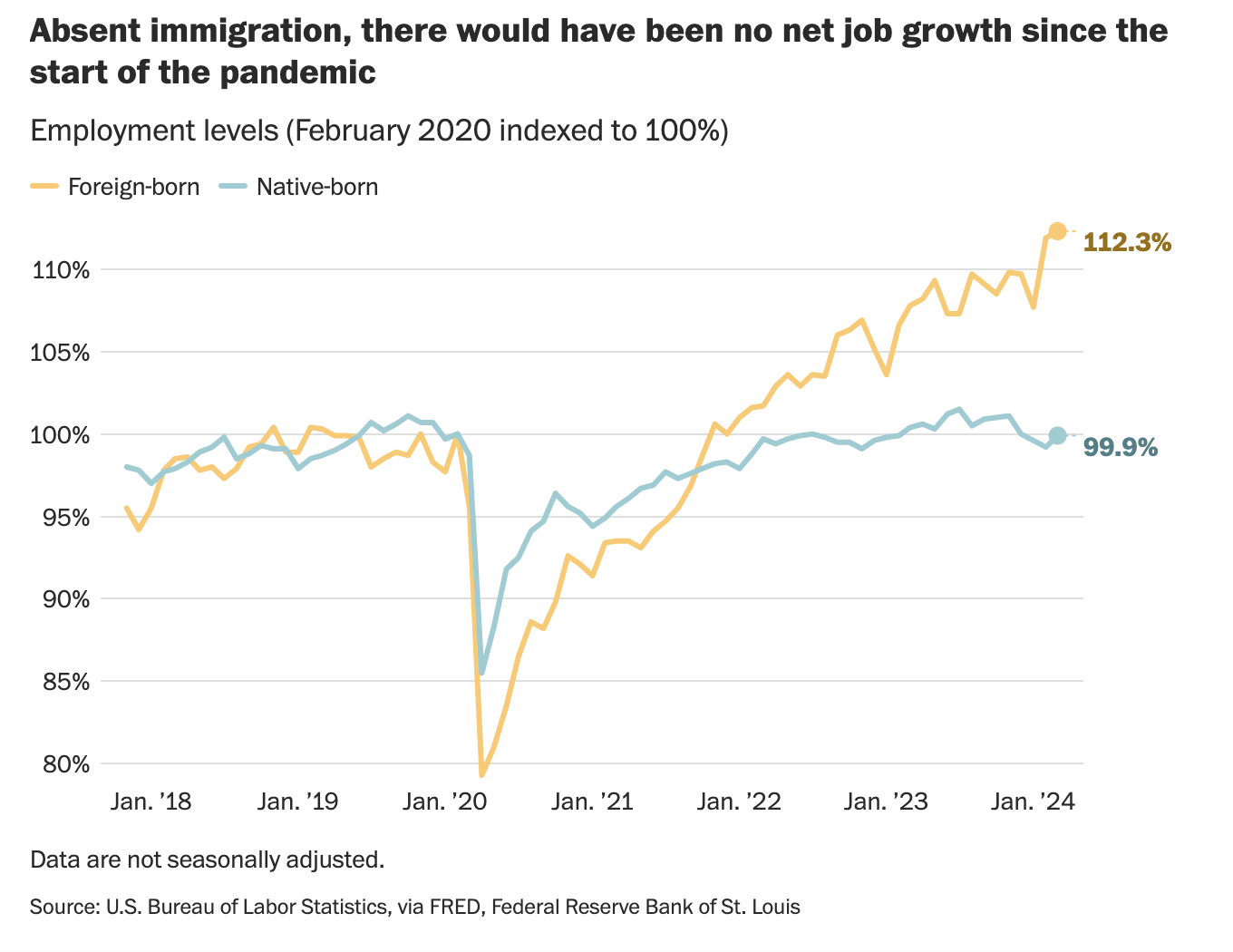
As a result, all of the new job growth since the pandemic, on net, has been due to foreign-born workers. That is, if you stripped away immigrants, there would be no more people employed today than was the case before covid.

On many dimensions, our ability to attract global talent to our shores is a blessing. But this being an election year, and demagogues being demagogues, right-wing pundits and political operatives have worked to darken these bright statistics.

Fox News refers to Bidenomics as a “migrant job fair.” The Republican-aligned Heritage Foundation alleges that “Americans have been completely left behind in this economy,” citing as evidence that fact I just mentioned: that all the net new job growth is accounted for by immigrants.

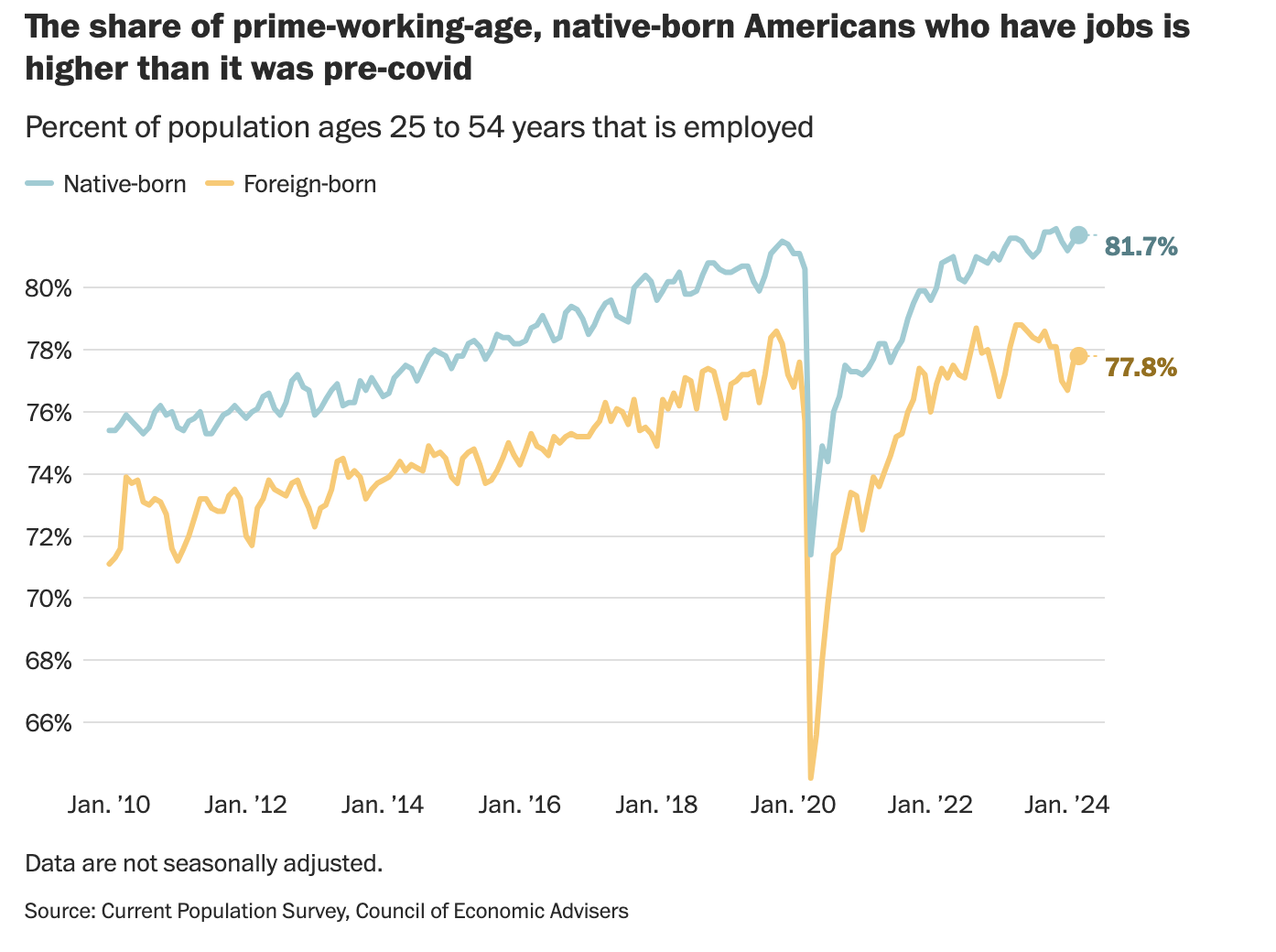
But the labor market is not zero-sum, and native-born workers happen to be doing extraordinarily well, too. In fact, the share of native-born Americans considered “prime working age” (25 to 54 years old, so after traditional college-going years and preretirement) who have jobs is higher than it was pre-pandemic. There just aren’t enough of us, in total, to fill all the jobs that employers are creating as boomers retire.

It’s true that overall, native-born Americans are less likely to be in the workforce today than in years past, but that’s entirely due to aging.
To put a finer point on it, there’s so much demand for workers now that even the most marginal American workers, such as teenagers and people with disabilities, are doing unusually well in the labor market. Ironically, some parts of the country complaining loudest about immigration today are the same places trying to loosen limits on child labor because their worker shortages are so acute.

It’s almost like there’s a simpler, more mutually beneficial solution at hand.

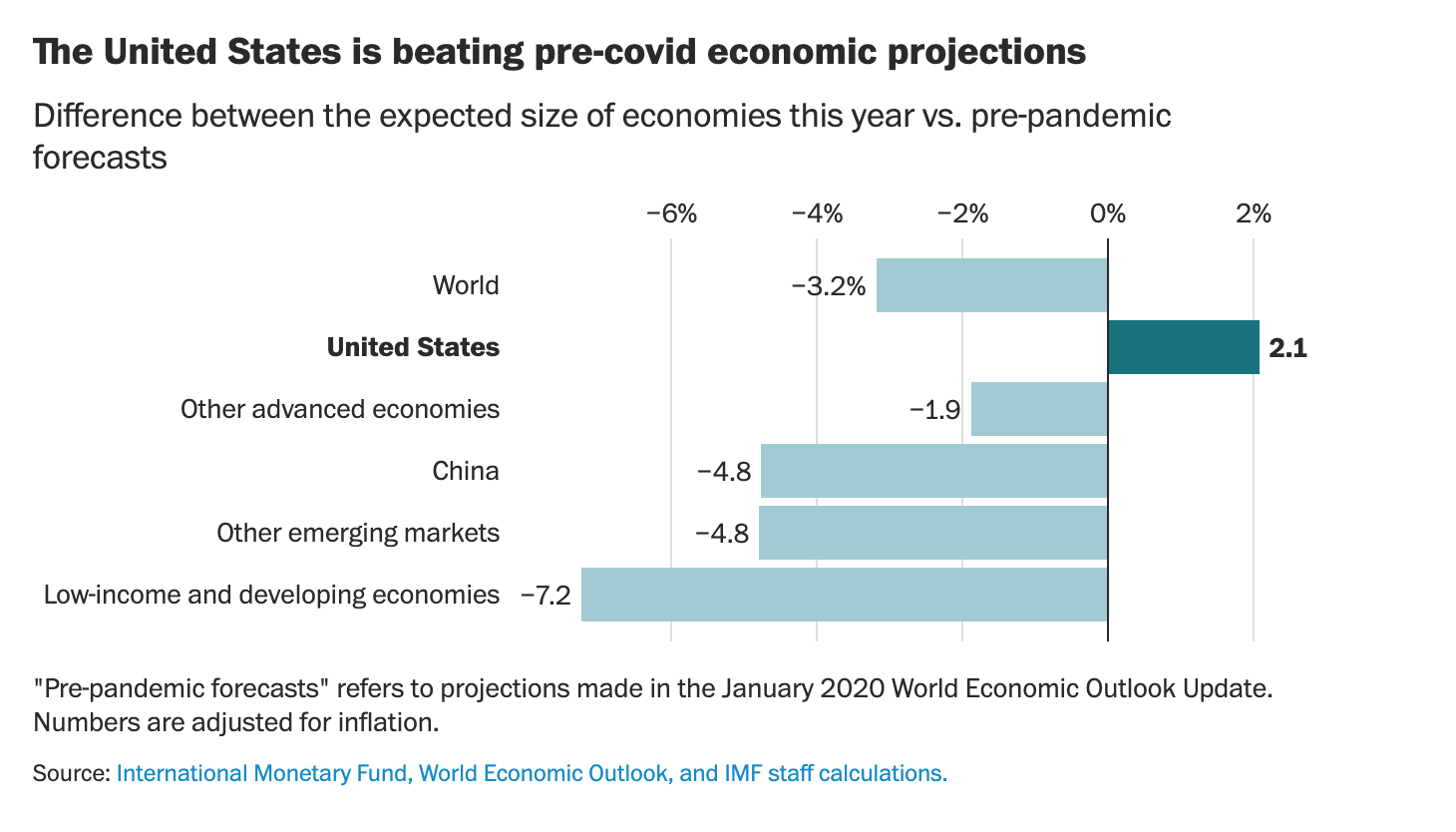
Some other countries would love to have the problems we have — to have so many talented people clamoring to replace retiring boomers (or care for them) and to infuse their economies with new skills, ideas, businesses and drive. The influx of new talent has not only helped us beat recent recession predictions; it’s also helped us best our competitors in Asia and elsewhere, where demographic challenges are dragging on growth. The U.S. economy is one of the only places in the world right now that is doing even better than expected before the pandemic began.

And, if current immigration trends continue — which they might not, depending who wins in November — immigration is likely to boost our fortunes in the years ahead: The Congressional Budget Office recently revised upward its 10-year gross domestic product projections by $7 trillion, attributing the increase to immigration-driven labor force growth. Our longer-term fiscal challenges also look better, since immigrants pay taxes and are much less likely than native-born Americans to (ever) qualify for benefits, including programs such as Medicare and Social Security.

Yet, somehow, the Trumpy right argues that greedy, freeloading immigrants are simultaneously stealing both our jobs and our precious tax dollars. In reality, they’re beefing up both.

The highly restrictive ban on abortion passed in 1864 was repealed by the Arizona Senate today, as two Republicans broke with their party to join all Democratic Senators.

Arizona lawmakers secured enough votes on Wednesday to repeal an abortion ban that first became law when Abraham Lincoln was president and a half-century before women won the right to vote.

A bill to repeal the law appeared to be on track to narrowly pass in the Republican-controlled State Senate with the support of every Democratic senator and two Republicans who were breaking with anti-abortion conservatives in their own party. If it passes as expected, it would go to Gov. Katie Hobbs, a Democrat, who is expected to sign it.

The vote taking place Wednesday afternoon was the culmination of a fevered effort to repeal the law that has made abortion a central focus of Arizona’s politics.

The New York Times reported:

Two Republican state senators, T.J. Shope and Shawnna Bolick, joined with Democrats on Wednesday to force that repeal bill to a vote over furious attempts by far-right Republicans to block it.

The 1864 law had gathered dust on the books for decades. But it exploded into an election-year flashpoint three weeks ago when a 4-2 decision by the State Supreme Court, whose justices are all Republican-appointed, said the ban could now be enforced because of the overturning of Roe v. Wade.

Before casting her pivotal vote, Ms. Bolick stood up and began a long, deeply personal speech describing her own three challenging pregnancies, including one that ended with an abortion procedure in her first trimester because the fetus was not viable.

“Would Arizona’s pre-Roe law have allowed me to have this medical procedure even though my life wasn’t in danger?” she asked.

Carol Burris reports on an important decision in Vermont:

By a 19-9 vote, the Vermont Senate refused to approve Zoie Saunders, a former strategist for the for-profit Charter Schools USA, as the new Superintendent of Instruction in Vermont.

Saunders, a Florida resident, had worked briefly for a Florida public school district (3 months) even as she was applying for the Vermont position. She was Republican Governor Scott’s choice.According to a source in the state, “Senators in opposition spoke eloquently about her complete lack of vision (her best vision communication to a Senator in individual conversation was – schools in Middlebury should partner with Middlebury College) and her lack of relevant public education experience.”

The Governor is given great deference regarding his appointees. However, there was a groundswell of opposition to her appointment among Vermont citizens who feared she would bring charters to the state and expand the private school town tuition program. There was also great concern for her lack of experience in public schools. NPE Action stood in opposition to her appointment. 


You can read more about the controversy here: 

https://www.sevendaysvt.com/news/zoie-saunders-gov-scotts-pick-for-education-secretary-faces-questions-about-her-qualifications-40628713 “The Senate of Vermont took a courageous stand that will surely raise the ire of the Governor who last night tried to delay their vote. Hopefully, Governor Scott will come back with a candidate worthy to serve Vermont’s families.

Unfortunately, Governor Scott did not come back with a better candidate. He appointed Ms. Saunders as “interim commissioner.”

The Vermont Senate is comprised of 22 Democrats and seven Republicans.

Florida’s six-week ban on abortion went into effect today.

A reader who calls him/herself Quickwrit posted the following excellent thoughts about anti-abortion laws:

THE NINTH AMENDMENT that gives Clarence Thomas the constitutional right to live in an interracial marriage also gives women the constitutional right to abortion: The 9th Amendment says that rights, like the right to interracial marriage and the right to abortion, do not have to be stated in the Constitution in order to be constitutional rights because The Ninth Amendment says: “The enumeration in the Constitution of certain rights shall not be construed to deny or disparage others retained by the people.”

The current Supreme Court ruling on abortion not only violates the 9th Amendment, it violates the religious rights of many citizens. The ruling is supportive of the teaching of the Roman Catholic Church to which the six majority Justices belong.

The Bible gives commandments on a very, very long list of more than 600 laws on everything from divorce to gluttony or stealing — yet the Bible says nothing about abortion. Why is that? If abortion was even as important as gluttony and stealing, it would have been mentioned in the Bible.

Out of more than 600 laws of Moses, which includes the 10 Commandments, NONE — not one — comments on abortion. In fact, the Mosaic law in Exodus 21:22-25 clearly shows that causing the abortion of a fetus is NOT MURDER. Exodus 21:22-25 says that if a woman has a miscarriage as the result of an altercation with a man, the man who caused miscarriage should only pay a fine that is to be determined by the woman’s husband, but if the woman dies, the man is to be executed: “If a man strives with a woman with child, so that her fruit depart from her, and yet there is no harm to the woman, he shall be punished according to what the woman’s husband determines and he shall pay as the judges determine.” So, the miscarriage is treated like the destruction of property, not murder.

There are Christian denominations that allow abortion in most instances; these Christian denominations include the United Church of Christ and the Presbyterian Church USA. The United Methodist Church and Episcopal churches allow abortion in cases of medical necessity, and the United Universalist Association also allows abortion.

Most of the opposition to abortion comes from fundamentalist and evangelical Christians who believe that a full-fledged human being is created at the instant of conception. But that is a religious BELIEF and religious beliefs cannot be recognized by the government under the Establishment Clause of the First Amendment of our Constitution. Moreover, the belief that a fetus is a human person, complete with a soul, is a Christian interpretation of the Jewish Bible — the Old Testament. But, Jewish scholars whose ancestors wrote the Old Testament and who know best what the words mean say that is a wrong interpretation of their writings.

Christians largely base their view that a fetus is a complete human being and that abortion is murder on the Jewish Bible’s Psalm 139: “You knit me together in my mother’s womb…You watched me as I was being formed in utter seclusion as I was woven together in the dark of the womb. You saw me before I was born.”

But who better to translate the accurate meaning of Psalm 139 than the Jews who wrote it? And Jewish scholars point out that Psalm 139 merely describes the development of a fetus and does not mean that the fetus has a soul and is a person. In fact, the Jewish Talmud explains that for the first 40 days of a woman’s pregnancy, the fetus is considered “mere fluid” and is just part of the mother’s body, like an appendix or liver. Only after the fetus’s head emerges from the womb at birth is the baby considered a “nefesh” – Hebrew for “soul” or “spirit” – a human person.

The idea that full-fledged human life begins at conception is a sectarian religious belief that isn’t held by the majority of religions, including a number of mainstream Christian religions.

Therefore, any local, state, or federal law that holds that full-fledged human life begins at conception is unconstitutional because such laws are made in recognition of an establishment of religion and violate the Establishment Clause of the First Amendment.

THE COURT BENDS THE FACTS: The University of London scientist whose research is cited by the Supreme Court in its ruling to take away abortion rights says that his research has been misinterpreted by Justice Alito and the Supreme Court’s activist conservative majority. Neuroscientist Dr. Giandomenico Iannetti says that the Court is ABSOLUTELY WRONG to say that his research shows that a fetus can feel pain when it is less than 24 weeks of development. “My results by no means imply that,” Dr. Iannetti declares. “I feel they were used in a clever way to make a point.” And Dr. John Wood, molecular neurobiologist at the University, points out that all serious scientists agree that a fetus can NOT feel pain until at least 24 weeks “and perhaps not even then.” Dr. Vania Apkarian, head of the Center for Transitional Pain Research at Chicago’s Feinberg School of Medicine, says that the medical evidence on a fetus not feeling pain before 24 weeks or longer has not changed in 50 years and remains “irrefutable”.

LIFE OF WOE: In its 1973 Roe v. Wade ruling upholding abortion rights, the Supreme Court set “viability” — the point at which a fetus can survive outside of the womb — as the dividing line after which some restrictions can be imposed on abortion rights. The pending ruling by current activist conservative majority on the Court will do away with the concept of viability, yet even with all of today’s medical miracles to keep a prematurely born or aborted fetus alive, of all the tens of thousands of cases, 90% OF FETUSES BORN AT 22 WEEKS DO NOT SURVIVE, and data shows that the majority of those that manage to be kept alive live the rest of their lives with a combination of BIRTH DEFECTS that include mental impairment, cerebral palsy, breathing problems, blindness, deafness, and other disorders that often require frequent hospitalizations during their lifetimes.

As I write this, I’m watching the New York Police Department remove protestors from Hamilton Hall at Columbia University. On CNN, a retired federal judge, who was a student at the university in 1968, compares then and now. She says that the students in Hamilton Hall will likely be charged with trespassing, vandalism, maybe disorderly conduct or resisting arrest. As defined by the ACLU, the university has the right to define time, place, and manner of demonstrations and protests. Breaking into a building, smashing windows, and occupying it are not expressions of free speech.

Columbia University has about 36,000 students; possibly 500 were protesting, not all of them students.

Which brings me to the question that is the subject of this post:

“Are the campus protests advancing peace in the Middle East?”

I believe the answer is a resounding “NO!”

I believe that students should be protesting against both Israel and Hamas, for different reasons. Neither wants peace.

Students are right to condemn the Netanyahu government for its relentless bombardment of Gaza, causing tens of thousands of deaths, destroying buildings, schools, universities, homes, hospitals, mosques, and other cultural sites. Students are right to demand an end to the killing and bloodshed.

But students should recognize that Hamas is a terrorist organization that is not worthy of their acclaim. Hamas is dedicated to the eradication of the state of Israel. Both its 1998 charter and its 2017 charter make clear that its purpose is to eliminate the state of Israel:

“20. Hamas believes that no part of the land of Palestine shall be compromised or conceded, irrespective of the causes, the circumstances and the pressures and no matter how long the occupation lasts. Hamas rejects any alternative to the full and complete liberation of Palestine, from the river to the sea…” (2017)

“27. A real state of Palestine is a state that has been liberated. There is no alternative to a fully sovereign Palestinian State on the entire national Palestinian soil, with Jerusalem as its capital.” (2017)

Students should demand the return of all the Israeli hostages, alive and dead.

Students should call for an early election in Israel to allow Israelis to hold the Netanyahu regime accountable, first, for its failure to protect the Gaza border from invasion; second, for its brutal tactics in Gaza; and third, for Netanyahu’s failed policy of placating Hamas, passing along subsidies to it, expecting that it would abandon terrorism. At the same time, he has tried to cripple the PLO, which is the government of the West Bank Palestinians and was a party to the Oslo accords, in which the PLO and Israel agreed to begin planning for two states. Netanyahu courted Hamas and undermined the PLO to prevent any movement towards a two-state solution.

This disastrous policy came to fruition on October 7. A senior Hamas official pledged to repeat the atrocities of October 7 “again and again” until Israel is destroyed.

Both sides must eventually accept a plan to cease hostilities. Both sides must eventually agree to an exchange of Israeli hostages for Hamas prisoners. Both sides must eventually agree to a two-state solution. Other states—Egypt, Jordan, Saudi Arabia, the U.S., France, Germany, and the UK— must guarantee the borders and security of the two states, as well as the reconstruction of Gaza.

The only way this war will end is if both parties agree to sit down and negotiate a settlement. Are the pro-Hamas, pro-Palestinian demonstrations making such negotiations more or less likely? My own view is that the protestors’ one-sided embrace of Hamas makes Hamas less willing to negotiate because with every passing day, they win the public opinion war.

Politically, the demonstrations hurt President Biden. Sympathizers of the protesters may choose not to vote. Michigan, with its significant Muslim population, may go to Trump. The irony is that Trump, the beneficiary of the protests, sought a total ban on Muslim immigration after his inauguration, and he is very close to Netanyahu and his far-rightwing coalition.

If I could send one message to all the demonstrators, it would be this: Seek peace, not a Hamas victory. Put pressure on both sides to end this terrible war and to pursue a just and stable peace.

Chris Tomlinson, a columnist for The Houston Chronicle, writes here about the audacious, mendacious plan of Lt. Governor Dan Patrick to destroy public schools. Patrick was a talk-show host like Rush Limbaugh before he entered politics. In Texas, the Lt. Governor has more power than the Governor, so his actions must be closely scrutinized.

Dan Patrick hates public schools. He wants to abolish them and replace them with vouchers.

Tomlinson explains Dan Patrick’s malevolent plan:

Lt. Gov. Dan Patrick’s fantasy of abolishing property taxes would set the state up for financial failure and end public education as we know it by placing a greater burden on low- and medium-income Texans.

The most powerful man in Texas politics wants you to believe he’s looking out for homeowners, but there’s always an unacknowledged goal for significant initiatives like this one. You need only look at who deposited $3 million in Patrick’s campaign account and who gave the record $6 million donation to Gov. Greg Abbott to boost private religious schools.

As lieutenant governor, Patrick appoints the leaders of Senate committees, sets their agendas and decides whether a piece of legislation gets a vote. Patrick also rewards senators who appease him and punishes those who don’t with his fat campaign war chest.

Last week, the lite guv ordered the Senate Finance Committee to “determine the effect on other state programs if general revenue were used to fully replace school property taxes, particularly during economic downturns.”

Rising property taxes are directly correlated to the growing cost of housing in Texas. When home or apartment values go up, so do taxes, and the two combined create a crisis across the country.

Median property taxes in Texas rose 26% between 2019 and 2023, according to data from real estate research firm CoreLogic, and first reported by Axios, an online news agency. In four years, the median payment rose to $4,916 from $3,900 as property values nationwide grew 40%.

Texas has crazy property taxes due to a convoluted system that protects the wealthy and pushes the burden of paying for government services onto low- and middle-income families.

To understand how and why, Texans must remember that we pay for schools through property taxes levied by school districts. The state is forbidden from collecting a property tax, so the Legislature depends primarily on sales taxes and severance taxes levied on oil and gas production.

The Texas Constitution also forbids an income tax, perpetuating the myth Texas is a low-tax state. The wealthy, who spend less of their income on retail purchases and real estate, get off easier than in other states. But the half of Texans who struggle to make ends meet pay a higher proportion of their income in sales and property taxes.

Most states rely on the proverbial three-legged stool of income, property and sales taxes to fairly charge families and businesses based on their ability to pay. Texas relies on only two legs, and Patrick is talking about kicking away one of them.

Patrick’s command comes less than a year after the Legislature took $18 billion from sales taxes and oil and gas severance taxes to pay down school taxes. Most of that money came from high crude oil and natural gas prices and a roaring economy that generated huge sales tax returns. The move marked the first tax reduction paid by most property owners in decades.

Ending property taxes is part of the Republican Party of Texas platform, but it would require collecting $73.5 billion from the remaining leg of the stool, the sales tax.

The state sales rate is 6.25%, while local authorities can collect up to 2% more. The Texas Taxpayers and Research Association in 2018 calculated the sales taxes would need to reach 25% to replace property taxes.

Right-wing fantasists will point at Texas’ colossal budget surplus last year as proof that lawmakers will only need to raise sales taxes a tiny bit. However, anyone who’s lived in Texas for a decade or more knows the fossil fuel business goes through boom-and-bust cycles.

During a bust in 2011, Texas lawmakers slashed school funding by $4 billion. When the money runs out, the Republicans who control every lever of power in Texas do not hesitate to sacrifice public education to avoid raising taxes. Even with last year’s windfall, they refused to give teachers a raise.

This is where school vouchers and property taxes collide. The billionaires backing Abbott and Patrick believe public schools are Marxist, woke indoctrination factories. They want to give parents vouchers to choose Christian nationalist indoctrination factories exempted from state or federal oversight.

The vouchers, though, are insufficient to cover private school tuition, so families must pay the difference. The GOP hopes to create a system in which the state pays a defined amount and normalizes parents’ paying the rest.

Don’t be fooled by promises of lower taxes; this is about killing public schools by underfunding them and shifting more of the burden onto young families and off the wealthy.

This malicious proposal could be politically palatable. There are some five million public school students in Texas. There are more than six million privately owned homes. The population of Texas is majority-minority, like the public school students. The Republican-dominated legislature is overwhelmingly white. Do the math. The people with the power, the people who pay the most property taxes, are white. Do they want to pay property taxes for other people’s children?

Award-winning opinion writer Chris Tomlinson writes commentary about money, politics and life in Texas. Sign up for his “Tomlinson’s Take” newsletter at houstonhchronicle.com/tomlinsonnewsletter or expressnews.com/tomlinsonnewsletter.