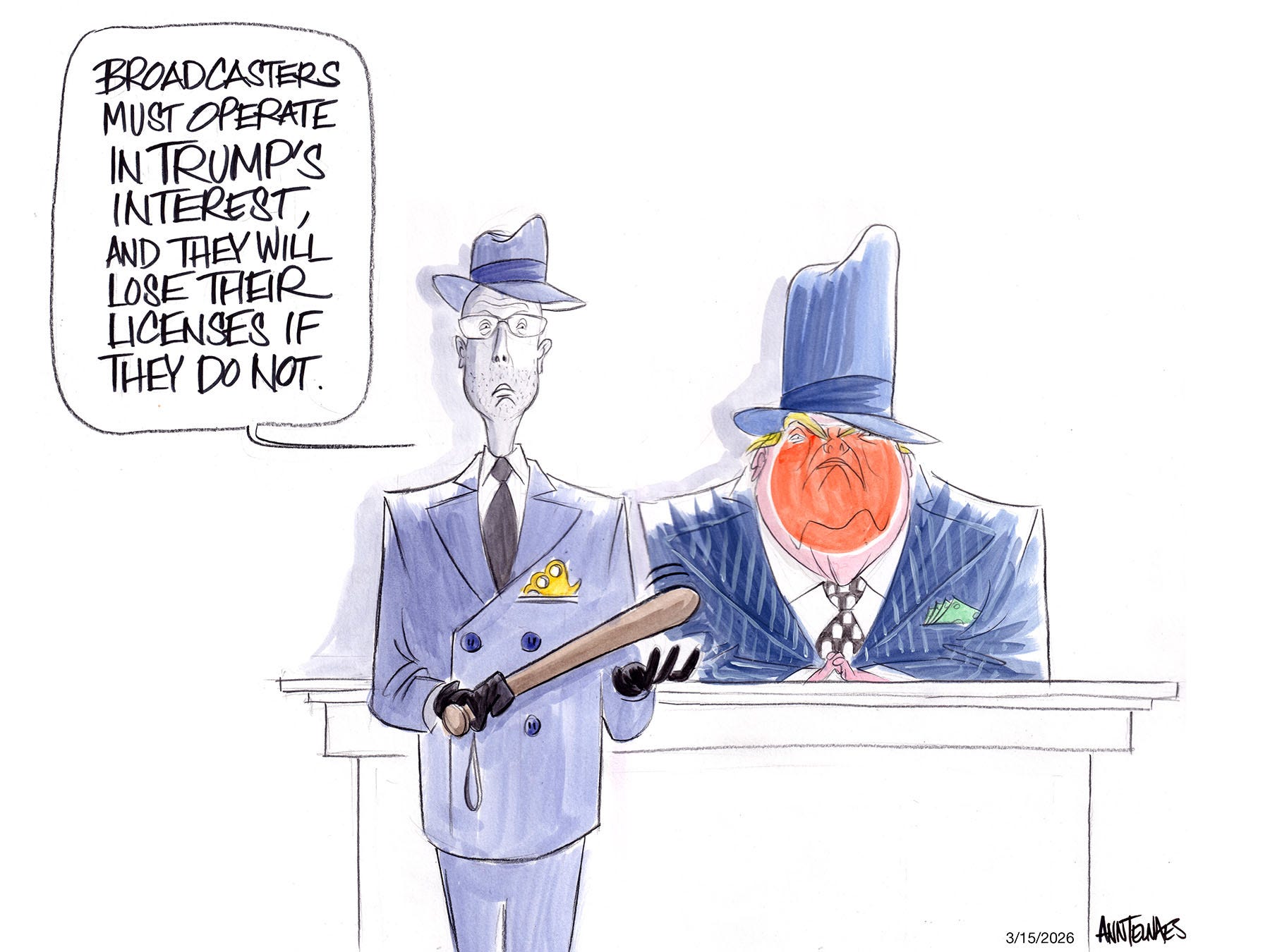
The Wall Street Journal gave front-page coverage to this new study, which concludes that American consumers are paying for Trump’s tariffs. This is a direct refutation of Trump’s claims that other nations are paying to access American markets, that the trillions collected for tariffs will eventually replace income taxes and pay for all the government’s expenses.

Guess who is paying for tariffs? We are!

FRANKFURT—Americans, not foreigners, are bearing almost the entire cost of U.S. tariffs, according to new research that contradicts a key claim by President Trump and suggests he might have a weaker hand in a reemerging trade war with Europe.

Trump has repeatedly claimed that his historic tariffs, deployed aggressively over the past year as both a revenue-raising and foreign-policy tool, will be paid for by foreigners. Such assertions helped to reinforce the president’s bargaining power and encourage foreign governments to do deals with the U.S.

A relatively brisk growth and moderate inflation last year, even as growth in Europe and other advanced economies remained sluggish.

The new research, published Monday by the Kiel Institute for the World Economy, a well-regarded German think tank, suggests that the impact of tariffs is likely to show up over time in the form of higher U.S. consumer prices.

The findings don’t mean that the tariffs are a win for Europe—on the contrary. German exports to the U.S., which have rocketed in recent years, have contracted sharply in the past year.

The German research echoes recent reports by the Budget Lab at Yale and economists at Harvard Business School, finding that only a small fraction of the tariff costs were being borne by foreign producers.

By analyzing $4 trillion of shipments between January 2024 and November 2025, the Kiel Institute researchers found that foreign exporters absorbed only about 4% of the qpart burden of last year’s U.S. tariff increases by lowering their prices, while American consumers and importers absorbed 96%.

James Fallows is a veteran journalist who has published widely and was a regular columnist for The Atlantic. Early on in his career, he was chief speechwriter for President Carter.

He visited Greenland in the past year and has some sage thoughts about the idiocy of trying to seize it.

He wrote on his Substack blog:

This morning on Fox, two well-matched intellects: Maria Bartiromo and Ted Cruz. Next to them is a Fox-produced map making Greenland look bigger than China, which in reality is more than four times its size. And on a par with the whole of Africa, which in fact is nearly 15 times as large. Fox is famous as the main source of real-time intel for the person who has assumed one-man control of US military, economic, and diplomatic relations with the world. What could go wrong?

This post includes a reprise of some previous items on Greenland, especially from this post one week ago. But as news has evolved, and as the insane idea of taking over Greenland has moved closer to alliance-destroying “reality,” and as a handy one-place guide to the main issues, I offer this update:

I’m not expert on Greenland. But at least I’ve been there, last spring for nearly a week. Which is a week more than the current US President, his Secretary of State (who is also his National Security Advisor), or his Secretary of Defense can claim, among them. And I’ve been reading about the place, and asking people about it, before that and ever since. Which I doubt any of them have done.

Here are my main suggestions if you find yourself in a “Wow, this Greenland situation, what do you think??” conversation any time soon.

1) This crisis is all coming from someone’s gut. Not from anyone’s brain.

Maybe you want to keep this to yourself, rather than leading with it in the conversation. But it’s worth knowing: Does the Trump-era obsession with Greenland seem completely irrational? That’s because it is—as no less an authority than Trump himself has told us.

The most self-aware part of Trump’s recent hours-long gabfest with NY Times reporters, and among the most self-damaging, was the “why Greenland?” exchange.

The Times team didn’t put it exactly this way, but the implied setup for their question was: With brutal war ongoing in Ukraine, with carnage in Gaza, with regime change in Venezuela, with upheaval in Iran, with federal troops occupying major cities, with tariffs upending world economies, and so on, why on Earth are you even talking about Greenland?

Here’s how the Q-and-A played out, with emphasis by me.

David Sanger [NYT]: Why is ownership [of Greenland] important here?

Trump: Because that’s what I feel is psychologically needed for success…. Ownership gives you things and elements that you can’t get from just signing a document…

Katie Rogers [NYT]: Psychologically important to you, or to the United States?

Trump: Psychologically important for me. Now, maybe another president would feel differently, but so far I’ve been right about everything.

Give Trump credit, this one time, for honesty. Give him demerits on every other count. What he’s doing to all the rest of us is crazy. But, in a moment like Tony Soprano on the psychiatrist’s couch with Dr. Melfi, he’s looking into himself and seeing a deeper truth.

Because the feeling of ownership is “psychologically important” for this one damaged man, the US is throwing alliances and interests built over centuries into a bonfire. Great. But not what Hamilton, Madison, and Jefferson had in mind.

2) The US has nothing to gain by ‘owning’ Greenland. Zero.

Actually less than zero, into the negative range.
The military bases the US might want, to patrol activity over the Arctic? Especially as melting ice opens more sea lanes? We already have treaty rights to operate as many bases as we could want.

The Chinese and Russian boats allegedly crowding the waters around Greenland? Bullshit. Check out MarineTraffic.com, VesselFinder.com, ShipFinder.co, etc (the rough maritime counterparts of FlightAware and ADSB-Exchange in aviation) to see for yourself.

The “rare earths” that are so prized? As mentioned before, the “mining” terrain in Greenland is about as challenging as any in the world. Even as glaciers melt at a quickening pace, the average thickness of the ice cap over Greenland is more than one mile. There are simply no roads in the country—none, at all—to connect potential mining sites with ports.
What you see in Greenland, apart from tiny settlements on the coast, is ice. Melting ice, yes.

But still a stupendous amount of it. Rare earth miners may eventually go to work there. But it will be a very long time. And the US doesn’t need to “own” this territory to buy their output. If and when there is any.

And this is not even to get into all the burden of maintaining Greenland, if the US took it over. Health care. Education. Food. Transport to remote locations. Adjudicating indigenous rights versus those of the central government.

People in the US grumble about the challenges of remote rural locations. This is on an entirely different scale.

Denmark already has agreed to open Greenland to every security and economic ambition the US might have. And meanwhile, Denmark is juggling all the challenges of this semi-autonomous state.
One man’s sense of what is “psychologically important, to me” might matter to him. It should matter less to us, than Tony Soprano’s did to his mob.

3) No one wants us there. Zero.

Greenlanders have complex feelings about their “mother” country, Denmark. The ties are deep. So are the desires for independence. Greenland is self-governing, and has its own flag, its own culture, its own ambitions—as we heard from everyone we met. But nearly everyone we met had studied in Denmark, and spoke Danish, and had relatives there.

That’s complicated. By contrast, the view of US takeover is simple. No!

There is more but you half to open the post and subscribe to finish it.

When Trump selected Robert F. Kennedy Jr. to lead the Department of Health and Human Services, the nation’s leading source of research and policy about health, many critics worried that Kennedy’s adherence to conspiracy theories about vaccines would cloud his judgment.

During his Senate confirmation hearing, Senator Bill Cassidy–a medical doctor–asked Kennedy if he would promise that he would not apply his personal views to the vaccine schedule. Kennedy promised. But, of course, once he was confirmed as Secretary of the Department of Health and Human Services, he broke his promise. He fired all the members of his advisory committee on vaccines and replaced them with his own choices.

Recently Kennedy released a new childhood vaccine schedule, which eliminated some vaccines that had been standard. Organizations of medical professionals were aghast. Until now, guidance from the HHS and Centers for Disease Control were reliable sources for guidance.

Many states responded to Kennedy’s bad advice by determining to ignore the federal recommendations and make their own decisions.

The Boston Globe reported:

Governor Maura Healey released new guidance on childhood vaccinations Wednesday, countering Health Secretary Robert F. Kennedy Jr.’s recent overhaul of the schedule. 

On Jan. 5, the Trump administration reduced the number of vaccinations it recommends for all children, framing the decision as a way to increase public trust by backing only the most important shots.

Unlike the federal government, Massachusetts continues to recommend that every child receive inoculations for hepatitis B, rotavirus, flu, COVID, and RSV, following guidance from the American Academy of Pediatrics. Under Kennedy, the Centers for Disease Control and Prevention now recommends these shots only for children at high risk or when doctors encourage them in what’s called “shared decision-making,” in which doctors and patients collaborate on treatment decisions

Insurance will continue to cover all vaccinations for children. 

The federal rollback caused outrage among doctors and health authorities, mainly because it came amid a particularly deadly flu season. The flu has killed 66 people in Massachusetts so far this season, including four children, double the number of deaths reported at this time last year. 

The federal changes came without any new evidence casting doubt on the decades of data showing vaccines for children are safe and effective.

“The decision to change CDC’s childhood immunization schedule is reckless and deeply dangerous,” said Dr. Robbie Goldstein, the state public health commissioner, in a statement Wednesday. “It replaces decades of transparent, evidence-based guidance with uncertainty.”

Hail and farewell, 2025!

Before that year is entirely forgotten, I want to say that it was one of the worst years in my life.

I learned in college that a sample of 1 is not useful for science, but it means plenty to me.

A year ago, a monstrous, lying braggart was sworn into office. A grifter and conman returned to fill his pockets and those of his family and friends, to double his net worth and to accept emoluments from foreign countries, send armed men to inflict brutality on blue cities, disregarding the Constitution.

In only one year, he has shredded our nation’s standing in the world, inflicted terror on our cities, alienated our allies, abandoned efforts to improve the environment, attacked our schools and universities, gloried in bigotry, and devastated the federal civil service.

He sends federal agents or the National Guard into urban districts, to terrorize the residents. People are snatched from their cars, their workplaces, the streets, even as they protest that they are citizens, that they have rights, that they want a lawyer. Their protests are ignored as a pack of masked men grab them, handcuff them, throw them to the ground, punch and kick them in their heads and bodies. Some are detained and disappeared into a network of prisons, then deported without due process. Some are imprisoned for days or weeks, then released.

Is this America? Never in my life have I been stopped by military officers and asked for my papers,

The cold-blooded murder of Renee Good was followed not by an investigation or apology but by smearing her and her wife as terrorists who were somehow responsible for her fate and deserved to die.

Who are these masked men? Why are they so violent? Are they Proud Boys? KKK? J6 insurrectionists?

Every day, I wonder if this is how decent Germans felt as Hitler took power and destroyed civil society.

What is happening to my country? To our Constitution? To the rule of law?

As I watch our values and rights degraded by power-mad politicians, I fight to preserve my body.

In the spring, I learned after my annual mammogram that I had breast cancer. I learned that I had invasive ductal cancer in my right breast, which required surgery. The post-surgery analysis revealed that not all the cancer was removed. The “margins” were not clear. So back I went for another surgery on the same site.

Radiation–five straight days of it–followed. it left me tired, but otherwise apparently successful.

I was reluctant to take a daily pill of anti-cancer medicine because of the numerous side effects. But I did and I suffered the predicted side effects. I had pain in my hips and joints. That was November.

Meanwhile I had a new mammogram. It showed that I had a new cancer, this time in my left breast. The surgeon recommended another surgery, and this time she got it all out. It was a tiny tumor, different from the first one. But a cancer nonetheless.

Radiation begins today, January 20, the first anniversary of Trump’s return to office. What a coincidence, cancer in my body, cancer in our nation.

It has been a nightmare year, for the country and for me personally. To make matters worse, our beloved dog Mitzi died. Through all of the personal trauma, my wife Mary stood by me steadfastly, through thick and thin, demonstrating her determination and love.

In a few weeks, we expect to get another dog. We will survive.

It remains to be seen whether our country will survive a second Trump term, another round of brutality inflicted on our norms, our values, our fellow citizens and our neighbors, our faith in our electoral system and our laws.

In 2023, the state of Texas took control of the Houston Independent School District because of an absurd state law that allows a state takeover of an entire district if only one school is “failing” for five years. In Houston, that one school was Phyllis Wheatley High Schol, which had disproportionately high numbers of students with disabilities, English language learners, and impoverished students. Wheatley was improving, but not enough to avert the takeover.

HISD went to court to block the takeover by the state, but eventually lost in 2023.

The State ousted the board and installed a new superintendent, former military officer Mike Miles, who had had a rocky tenure as superintendent in Dallas (teachers left in droves in response to Miles’ autocratic style.) Miles also started charter schools.

Miles imposed a standardized “New Education System” and ousted experienced (but noncompliant) principals.

A new study conducted by the Educatuon Research Center at the University of Houston found that a significant number of students and teachers had left the district since the state takeover. The beneficiaries of this exodus were charter schools–especially YES Prep and KIPP–and nearby school districts.

HISD enrolls about 168,400 students this year. It has lost 13,000 students since the takeover in 2023. Enrollment is growing in other districts, not declining.

Loss of enrollment means loss of state and federal funding.

The biggest enrollment losses occurred in schools closely implementing Mike Miles’ mandates. Researchers “found that campuses strictly implementing reforms lost more students. Certain magnet and specialty program schools with more autonomy gained students.”

Researchers said that this exodus from public schools to charter schools did not happen statewide.

The exodus of experienced teachers has led to a sharp increase in first-year teachers and uncertified teachers. The number of first-year teachers increased by 562 teachers, or 64.7%, since the takeover, according to the UH research center…

Area school districts and charters are hiring more HISD teachers after the first year of the takeover than they did previously, according to the report. Fort Bend ISD hired the most former HISD teachers, bringing on 207. Katy ISD ranked second in 2024–25, followed by Cypress-Fairbanks ISD.

The share of uncertified teachers in HISD’s teacher workforce increased to nearly 20% in 2024-25, even though research shows certified and experienced teachers improves student success.

Templeton said there is a trend of relying more on uncertified teachers statewide, but not to the extent seen in HISD.

“The increase in uncertified teachers and the increase of novice teachers … that increase was greater in HISD than the other districts surrounding it,” Templeton said.

Teacher turnover soared in Dallas when Mike Miles became Superintendent. In his first year, he ruled as an autocrat, and nearly 1,000 teachers quit. Over his three years, the rate of teacher resignations increased from the low teens to about 22% annually.

The deal with charters, we are frequently told, is a trade of autonomy for accountability. Let charters do things their own way, charter fans say. If they can’t produce, then shut them down. Hold them accountable.

Except somehow the accountability parts keeps not happening, as in North Carolina, where a couple of failing cyber charters have been renewed despite their continued failure to produce results.

North Carolina Cyber Academy and North Carolina Virtual Academy opened in 2015, the state’s first two cyber charters. That was just a year before the charter school industry itself issued a blistering report about the many ways in which cyber charters fail students and families. That’s the same year that charter-friendly CREDO issued a report indicating that students in cyber charters might as well just take a year-long nap. And of course it is five years before the nation launched the biggest experiment ever in distance learning and found that pretty much nobody was a fan.

NCVA appears to be actually operated by Stride (formerly K-12), a cyber charter business that has a list several miles long of misadventures and misbehaviors, much as one would expect from a business that is centered on making money and not all that interested in educating young humans. 

The two schools have underperformed, scoring straight D’s on the state’s evaluation system (NCVA did better than a D in 2023, the only time either school did so). North Carolina’s Charter Schools Review Board mostly didn’t seem to care as they renewed the two schools for another five years. As reported by T. Keung Hui for the Herald-Sun

“We’re renewing two schools for five years that have been continually low performing for all 10 years and have not met growth, except one school for one year, and yet the enrollment is almost 2,500 in one and 4,000,” said Rita Haire, a Review Board member. “Do they not understand the quality of education that’s being delivered?”

Much like cyber charters in Pennsylvania, the two North Carolina cybers are sitting on a huge pile of taxpayer dollars—  $16 million at Virtual Academy and $9.7 million at Cyber Academy. Maybe, some board members observed, that money could be spent on making the educational program results suck less (I’m paraphrasing). 

Bruce Friend is chair of the review board, runs a virtual academy of his own, and thinks cyber charters are just awesome. He says that the schools draw students who “transition” in and out through the year, which is why many states use them as alternative schools. I’m not sure which states he’s talking about, but at any rate, when he was cheerleading for North Carolina to get on the cyber charter train, his pitch was that flexibility and personalized education and building confidence. Nothing about a holding pen for students “transitioning” in and out. That’s a version of a standard cyber charter argument, which is that cybers get a disproportionate share of students who are already in academic trouble and come to cybers already behind the curve. I expect there is some truth to that, but if that is the cyber charter customer base, and they know it’s their customer base, why have they not gotten any better at educating those students? 

The Herald-Sun asked both cybers to offer a response. NCVA hasn’t so far (which is on brand for Stride), but NCCA chief Martez Hill said that it’s great to be renewed. His only offer to push back on the perception that they aren’t doing a great job is to note that NCCA has graduated more than 1,000 students in the last five years. This is no great achievement, since NCCA can graduate anyone they want to graduate. 

The board apparently doesn’t have a lot of flexibility. One member complained that they would pick apart the pieces of a bricks and mortar charter to hold them accountable, but can’t do that with the cybers. They also have no flexibility to, say, renew for only two or three years, but either had to okay a five year renewal or none at all.

None at all seems like the correct choice here, but that’s not how seven of the ten-member board saw it, so North Carolina taxpayers get another five years of not-particularly-effective cyber chartering with no real accountability and no reason to think these charters will do any better in the next five years than they have in the previous ten. But at least they’ll have autonomy

SNOPES, the fact-checking site, reviewed claims that the ICE agent who killed Renee Good acted in self-defense because she was trying to run him over.

SNOPES determined that the basis of this claim was an AI-generated video that contained multiple indicators of being a fake.

It determined:

Rating: Fake 

After a U.S. Immigration and Customs Enforcement officer fatally shot Renee Nicole Good, 37, in Minneapolis on Jan. 7, 2026, social media users shared an image appearing to show Good’s car aimed toward and about to hit the officer.

The image spread on social media platforms such as Reddit and X. “Any questions?” one Facebook user posted, apparently assuming the image was authentic. 

However, the image was fake. Using reverse image search tools, we traced it to a post from X user @ScummyMummy511, who acknowledged using artificial intelligence to create it. The AI-generated depiction also did not match the scene shown in multiple credible videos and photos of the shooting, further proving it wasn’t authentic.  

Multiple credible analyses of videos from the shooting contradicted claims that Good was attempting to run over the officer and found that the wheels of her vehicle were turned away from him right before the shooting. (After a Minnesota news outlet released the agent’s own cellphone video on Jan. 9, Vice President JD Vance was among officials who said the footage showed he had fired his gun in self-defense.)

But Good did not try to run him over. The officer fired three shots, two of which struck her in the chest, a third in the arm. None of those shots were necessary. The ICE officer did not fire his gun in self-defense. And the Department of Justice will not investigate the killing, contrary to standard policy. Half a dozen investigators in the Civil Rughts Division of the Justice Depsrtnent resigned to protest the decision not to investigate.

Anne Applebaum, journalist and historian, writes frequently about European politics. She has been a member of the Washington Post editorial board and is now a contributor to The Atlantic, where this article appeared. She won a Pulitzer Prize for her book Gulag: A History.

She writes here about his latest missive, in which he said he was going to take Greenland (from Denmark) because he didn’t win a Nobel Peace Prize (awarded by the Nobel Committee in Norway.)

Let me begin by quoting, in full, a letter that the president of the United States of America sent yesterday to the prime minister of Norway, Jonas Gahr Støre. The text was forwarded by the White House National Security Council to ambassadors in Washington, and was clearly intended to be widely shared. Here it is:

Dear Jonas:

Considering your Country decided not to give me the Nobel Peace Prize for having stopped 8 Wars PLUS, I no longer feel an obligation to think purely of Peace, although it will always be predominant, but can now think about what is good and proper for the United States of America. Denmark cannot protect that land from Russia or China, and why do they have a “right of ownership” anyway? There are no written documents, it’s only a boat that landed there hundreds of years ago, but we had boats landing there, also. I have done more for NATO than any person since its founding, and now, NATO should do something for the United States. The World is not secure unless we have Complete and Total Control of Greenland. Thank you! President DJT

One could observe many things about this document. One is the childish grammar, including the strange capitalizations (“Complete and Total Control”). Another is the loose grasp of history. Donald Trump did not end eight wars. Greenland has been Danish territory for centuries. Its residents are Danish citizens who vote in Danish elections. There are many “written documents” establishing Danish sovereignty in Greenland, including some signed by the United States. In his second term, Trump has done nothing for NATO—an organization that the U.S. created and theoretically leads, and that has only ever been used in defense of American interests. If the European members of NATO have begun spending more on their own defense (budgets to which the U.S. never contributed), that’s because of the threat they feel from Russia.

Yet what matters isn’t the specific phrases, but the overall message: Donald Trump now genuinely lives in a different reality, one in which neither grammar nor history nor the normal rules of human interaction now affect him. Also, he really is maniacally, unhealthily obsessive about the Nobel Prize. The Norwegian Nobel Committee, not the Norwegian government and certainly not the Danish government, determines the winner of that prize. Yet Trump now not only blames Norway for failing to give it to him, but is using it as a justification for an invasion of Greenland.

Think about where this is leading. One possibility, anticipated this morning by financial markets, is a damaging trade war. Another is an American military occupation of Greenland. Try to imagine it: The U.S. Marines arrive in Nuuk, the island’s capital. Perhaps they kill some Danes; perhaps some American soldiers die too. And then what? If the invaders were Russians, they would arrest all of the politicians, put gangsters in charge, shoot people on the street for speaking Danish, change school curricula, and carry out a fake referendum to rubber-stamp the conquest. Is that the American plan too? If not, then what is it? This would not be the occupation of Iraq, which was difficult enough. U.S. troops would need to force Greenlanders, citizens of a treaty ally, to become American against their will.

For the past year, American allies around the world have tried very hard to find a theory that explains Trump’s behavior. Isolationism,neo-imperialism, and patrimonialism are all words that have been thrown around. But in the end, the president himself defeats all attempts to describe a “Trump doctrine.” He is locked into a world of his own, determined to “win” every encounter, whether in an imaginary competition for the Nobel Peace Prize or a protest from the mother of small children objecting to his masked, armed paramilitary in Minneapolis. These contests matter more to him than any long-term strategy. And of course, the need to appear victorious matters much more than Americans’ prosperity and well-being.

The people around Trump could find ways to stop him, as some did in his first term, but they seem too corrupt or too power-hungry to try. That leaves Republicans in Congress as the last barrier. They owe it to the American people, and to the world, to stop Trump from acting out his fantasy in Greenland and doing permanent damage to American interests. He is at risk of alienating friends in not only Europe but also India, whose leader he also snubbed for failing to nominate him for a Nobel Prize, as well as South Korea, Japan, Australia. Years of careful diplomacy, billions of dollars in trade, are now at risk because senators and representatives who know better have refused to use the powers they have to block him. Now is the time.

In case you are wondering why Trump has been threatening to invade Greenland, even though it violates international law and is sure to destroy NATO, the answer is here. In this note, which was circulated to European leaders, Trump explains. He’s threatening to seize Greenland because he didn’t win a Nobel peace Prize.

Do you think he will calm down now that Venezuela’s Maria Machado gave him her Nobel Peace Prize?

Do you think the Nobel Prize Committee (which is not controlled by the government of Norway) will be bullied into giving a Nobel Peace Prize next year to mollify him? Bullying seems to be an essential part of “the art of the deal.”

In 1964, Dr. Martin Luther King Jr. won the Nobel Peace prize. At the time, he was the youngest person ever to receive the award, at age 35.

The Nobel Peace Prize 1964 was awarded to Martin Luther King Jr. “for his non-violent struggle for civil rights for the Afro-American population”

The Nobel Foundation Archive

Is Trump more jealous of Dr. King or Barack Obama?

I say “Obama,” because I expect that Trump doesn’t know that Dr. King won the award.

Dr. King’s “Letter from a Birmingham Jail” was written in April 1963. Dr. King wrote in response to a public statement by Birmingham religious leaders who called on Dr. King to be patient and not to engage in demonstrations that would provoke resistance.

This context in which he wrote the letter appears on the website of The Martin Luther King, Jr. Research and Education Institute at Stanford University.

In April 1963 King and the Southern Christian Leadership Conference (SCLC) joined with Birmingham, Alabama’s existing local movement, the Alabama Christian Movement for Human Rights (ACMHR), in a massive direct action campaign to attack the city’s segregation system by putting pressure on Birmingham’s merchants during the Easter season, the second biggest shopping season of the year. As ACMHR founder Fred Shuttlesworth stated in the group’s “Birmingham Manifesto,” the campaign was “a moral witness to give our community a chance to survive” (ACMHR, 3 April 1963). 

The campaign was originally scheduled to begin in early March 1963, but was postponed until 2 April when the relatively moderate Albert Boutwell defeated Birmingham’s segregationist commissioner of public safety, Eugene “Bull” Connor, in a run-off mayoral election. On 3 April the desegregation campaign was launched with a series of mass meetings, direct actions, lunch counter sit-ins, marches on City Hall, and a boycott of downtown merchants. King spoke to black citizens about the philosophy of nonviolence and its methods, and extended appeals for volunteers at the end of the mass meetings. With the number of volunteers increasing daily, actions soon expanded to kneel-ins at churches, sit-ins at the library, and a march on the county building to register voters. Hundreds were arrested. 

On 10 April the city government obtained a state circuit court injunction against the protests. After heavy debate, campaign leaders decided to disobey the court order. King declared: “We cannot in all good conscience obey such an injunction which is an unjust, undemocratic and unconstitutional misuse of the legal process” (ACMHR, 11 April 1963). Plans to continue to submit to arrest were threatened, however, because the money available for cash bonds was depleted, so leaders could no longer guarantee that arrested protesters would be released. King contemplated whether he and Ralph Abernathy should be arrested. Given the lack of bail funds, King’s services as a fundraiser were desperately needed, but King also worried that his failure to submit to arrests might undermine his credibility. King concluded that he must risk going to jail in Birmingham. He told his colleagues: “I don’t know what will happen; I don’t know where the money will come from. But I have to make a faith act” (King, 73). 

On Good Friday, 12 April, King was arrested in Birmingham after violating the anti-protest injunction and was kept in solitary confinement. During this time King penned the Letter from Birmingham Jail” on the margins of the Birmingham News, in reaction to a statement published in that newspaper by eight Birmingham clergymen condemning the protests. King’s request to call his wife, Coretta Scott King, who was at home in Atlanta recovering from the birth of their fourth child, was denied. After she communicated her concern to the Kennedy administration, Birmingham officials permitted King to call home. Bail money was made available, and he was released on 20 April 1963. 

In order to sustain the campaign, SCLC organizer James Bevel proposed using young children in demonstrations. Bevel’s rationale for the Children’s Crusade was that young people represented an untapped source of freedom fighters without the prohibitive responsibilities of older activists. On 2 May more than 1,000 African American students attempted to march into downtown Birmingham, and hundreds were arrested. When hundreds more gathered the following day, Commissioner Connor directed local police and fire departments to use force to halt the demonstrations. During the next few days images of children being blasted by high-pressure fire hoses, clubbed by police officers, and attacked by police dogs appeared on television and in newspapers, triggering international outrage. While leading a group of child marchers, Shuttlesworth himself was hit with the full force of a fire hose and had to be hospitalized. King offered encouragement to parents of the young protesters: “Don’t worry about your children, they’re going to be alright. Don’t hold them back if they want to go to jail. For they are doing a job for not only themselves, but for all of America and for all mankind” (King, 6 May 1963). 

In the meantime, the white business structure was weakening under adverse publicity and the unexpected decline in business due to the boycott, but many business owners and city officials were reluctant to negotiate with the protesters. With national pressure on the White House also mounting, Attorney General Robert Kennedy sent Burke Marshall, his chief civil rights assistant, to facilitate negotiations between prominent black citizens and representatives of Birmingham’s Senior Citizen’s Council, the city’s business leadership. 

The Senior Citizen’s Council sought a moratorium on street protests as an act of good faith before any final settlement was declared, and Marshall encouraged campaign leaders to halt demonstrations, accept an interim compromise that would provide partial success, and negotiate the rest of their demands afterward. Some black negotiators were open to the idea, and although the hospitalized Shuttlesworth was not present at the negotiations, on 8 May King told the negotiators he would accept the compromise and call the demonstrations to a halt. 

When Shuttlesworth learned that King intended to announce a moratorium he was furious—about both the decision to ease pressure off white business owners and the fact that he, as the acknowledged leader of the local movement, had not been consulted. Feeling betrayed, Shuttlesworth reminded King that he could not legitimately speak for the black population of Birmingham on his own: “Go ahead and call it off … When I see it on TV, that you have called it off, I will get up out of this, my sickbed, with what little ounce of strength I have, and lead them back into the street. And your name’ll be Mud” (Hampton and Fayer, 136). King made the announcement anyway, but indicated that demonstrations might be resumed if negotiations did not resolve the situation shortly. 

By 10 May negotiators had reached an agreement, and despite his falling out with King, Shuttlesworth joined him and Abernathy to read the prepared statement that detailed the compromise: the removal of “Whites Only” and “Blacks Only” signs in restrooms and on drinking fountains, a plan to desegregate lunch counters, an ongoing “program of upgrading Negro employment,” the formation of a biracial committee to monitor the progress of the agreement, and the release of jailed protesters on bond (“The Birmingham Truce Agreement,” 10 May 1963). 

Birmingham segregationists responded to the agreement with a series of violent attacks. That night an explosive went off near the Gaston Motel room where King and SCLC leaders had previously stayed, and the next day the home of King’s brother Alfred Daniel King was bombed. President John F. Kennedy responded by ordering 3,000 federal troops into position near Birmingham and making preparations to federalize the Alabama National Guard. Four months later, on 15 September, Ku Klux Klan members bombed Birmingham’s Sixteenth Street Baptist Church, killing four young girls. King delivered the eulogy at the 18 September joint funeral of three of the victims, preaching that the girls were “the martyred heroines of a holy crusade for freedom and human dignity” (King, “Eulogy for the Martyred Children,” 18 September 1963). 

Footnotes

“The Birmingham Truce Agreement,” 10 May 1963, in Eyes on the Prize, ed. Carson et al., 1991. 

Douglas Brinkley, “The Man Who Kept King’s Secrets,” Vanity Fair (April 2006): 156–171.

Eskew, But for Birmingham, 1997. 

Hampton and Fayer, with Flynn, Voices of Freedom, 1990. 

King, Address delivered at mass meeting, 6 May 1963, FRC-DSI-FC

King, Eulogy for the Martyred Children, 18 September 1963, in A Call to Conscience, ed. Carson and Shepard, 2001.

King, Shuttlesworth, and Abernathy, Statement, “For engaging in peaceful desegregation demonstrations,” 11 April 1963, BWOF-AB.

King, Why We Can’t Wait, 1964.

Shuttlesworth and N. H. Smith, “Birmingham Manifesto,” 3 April 1963, MLKJP-GAMK. Back to Top

Stanford

The Martin Luther King, Jr. Research and Education Institute