What exactly is Elon Musk’s DOGE team doing? Who are they? This article in The New York Times seeks to answer those questions.

The article was written by Theodore Schleifer, Nicholas Nehamas, Kate Conger, and .

At the end of his third week bulldozing through the federal government, Elon Musk sat down to give Vice President JD Vance a 90-minute briefing on his efforts to dismantle the bureaucracy. Mr. Musk was not alone.

Invited to join him on Thursday morning in Mr. Vance’s stately ceremonial office suite in the Eisenhower Executive Office Building, next to the White House, were a clutch of young aides whose presence at federal agencies has served as a harbinger of the upheaval that would follow them.

Across the federal government, civil servants have witnessed the sudden intrusion in the last two weeks of these young members of the billionaire’s team, labeled the Department of Government Efficiency. As Mr. Musk traipses through Washington, bent on disruption, these aides have emerged as his enforcers, sweeping into agency headquarters with black backpacks and ambitious marching orders.

While Mr. Musk is flanked by some seasoned operatives, his dizzying blitz on the federal bureaucracy is, in practice, largely being carried out by a group of male engineers, including some recent college graduates and at least one as young as 19.

Unlike their 20-something peers in Washington, who are accustomed to doing the unglamorous work ordered up by senior officials, these aides have been empowered to break the system.

Of the roughly 40 people on the team, just under half of them have some previous ties to the billionaire — but many have little government experience, The New York Times found. This account of their background and activities is based on public records, internal government databases and more than 20 people familiar with their roles, who spoke on the condition of anonymity out of fear of retaliation.

Some on the Musk team are former interns at his companies. Others are executives who have served in his employ for as long as two decades. They all appear to have channeled his shoot-first, aim-later approach to reform as they have overwhelmed the bureaucracy.

A 23-year-old who once used artificial intelligence to decode the word “purple” on an Ancient Greek scroll has swiftly gained entree to at least five federal agencies, including the Centers for Medicare and Medicaid Services, where he has been seeking access to sensitive databases. He was part of a group that helped effectively shutter the United States Agency for International Development, joined by the 19-year-old, a onetime Northeastern student who was fired from a data security firm after an investigation into the leaking of internal information, as Bloomberg first reported.

In the past week, his aides have descended upon the Education, Energy, Housing and Urban Development, Health and Human Services, Transportation and Veterans Affairs Departments, along with the National Oceanic and Atmospheric Administration, the Federal Emergency Management Agency and the Consumer Financial Protection Bureau, according to people familiar with their activities.

Mr. Musk has praised his team as talented and relentless, defending its work as crucial to rooting out what he perceives as wasteful spending and left-wing ideology in the federal government.

“Time to confess,” he wrote on X this week. “Media reports saying that @DOGE has some of world’s best software engineers are in fact true.”

Mr. Musk did not respond to a request for comment.

On Friday, Mr. Trump told reporters that he was “very proud of the job that this group of young people, generally young people, but very smart people, they’re doing.

“They’re doing it at my insistence,” he added. “It would be a lot easier not to do it, but we have to take some of these things apart to find the corruption.”

Even as Mr. Musk’s team members upend the government, their identities have been closely held, emerging only piecemeal when the new arrivals press career officials for information and access to agency systems.

The opacity with which they are operating is highly unusual for those working in government. Aside from those conducting classified or intelligence work, the names of public employees are not generally kept secret.

Harrison Fields, a White House spokesman, said the cost-cutting team has gone through the same vetting as other federal employees, but declined to say what the vetting consisted of or whether Mr. Musk’s aides have security clearances.

The Times identified members of Mr. Musk’s initiative through internal emails identifying their roles and interviews with employees across the government who have interacted with them. None of the Musk aides responded to requests for comment.

The secrecy, Musk allies have said, is necessary so the team members do not become targets.

Several of Mr. Musk’s aides have resisted being listed in government databases out of fear of their names leaking out, according to people familiar with the situation. Others have worked to remove information about themselves from the internet, scrubbing résumés and social media accounts.

When their names have been made public by news organizations such as Wired, they have been scrutinized by online sleuths. Mr. Musk has asserted, falsely, that the exposure of their roles is a “crime,” and X has removed some posts and issued suspensions to those who publicize their identities.

One Musk aide whose name surfaced, Marko Elez, a 25-year-old former employee of X, resigned on Thursday, according to a White House official, after The Wall Street Journal revealed that he had made racist posts on X, writing in one message that “you could not pay me to marry outside of my ethnicity.” Mr. Elez, a former employee at both X and xAI, Mr. Musk’s artificial intelligence company, was one of two staff members affiliated with Mr. Musk’s team who had gained access to the Treasury Department’s closely held payment system.

Mr. Elez was among those who had been invited to attend Mr. Musk’s meeting with the vice president before he resigned, according to documents seen by The Times. On Friday, Mr. Musk called for The Journal reporter to be fired and said he was reinstating Mr. Elez, a move that both the president and the vice president said they supported. “We shouldn’t reward journalists who try to destroy people,” Mr. Vance posted on X.

A spokesman for Mr. Vance declined to comment.

Some of Mr. Musk’s top advisers are more seasoned. Senior players include Brad Smith, a health care entrepreneur and an official during President Trump’s first term; Amy Gleason, a former U.S. Digital Service official who has been helping at the Centers for Medicare and Medicaid Services; and Chris Young, a top Republican field operative whom Mr. Musk hired as a political adviserlast year. Others bring extensive private sector backgrounds, including from firms like McKinsey and Morgan Stanley.

But Washington is a town where much is run by twentysomethings. And much of Mr. Musk’s handiwork — gutting federal websites, demanding access to internal systems, sending late-night all-staff emails and asking veteran employees to justify their jobs — is being executed by young aides, some of them pulling all-nighters as they burrow into agencies.

Last week, young representatives of Mr. Musk’s team with backpacks stuffed with a half-dozen laptops and phones arrived at the headquarters of U.S.A.I.D., demanding access to financial and personnel records. On Friday, a dozen stayed into the night, powered by a bulk order of coffee. The next day, the agency’s website went dark.

At the Education Department alone, as many as 16 team members are listed in an employee directory, including Jehn Balajadia, who has effectively served as Mr. Musk’s assistant for years.

At the Office of Personnel Management, the nerve center of the federal government’s human resources operation, a small group of coders on Mr. Musk’s team sometimes sleep in the building overnight. They survive on deliveries of pizza, Mountain Dew, Red Bull and Doritos, working what Mr. Musk has described as 120-hour weeks.

At the General Services Administration, another central hub for Mr. Musk’s aides, beds have been installed on the sixth floor, with a security guard keeping people from entering the area.

While most senior employees wear suits, the aides favor jeans, sneakers and T-shirts, sometimes under a blazer, with one sporting a navy-blue baseball cap with white lettering reading “DOGE.”

The culture clash is evident. Perhaps unsurprisingly, career employees who have worked for decades in the government have bristled at taking orders from the young newcomers. One coder has openly referred to federal workers as “dinosaurs.” Some staff members at the personnel office, in turn, derisively call the young men “Muskrats.”

As they assess the workings of the government, Mr. Musk’s aides have been conducting 15-minute video interviews with federal workers. Some of their questions have been pointed, such as querying employees about whom they would choose to fire from their teams if they had to pick one person. At times, the aides have not turned on their cameras or given their last names, feeding suspicion.

In one video interview heard by The Times, a young team representative who introduced himself by his first name said he was an “adviser” to government leadership and a startup founder. He pressed the interviewee to describe their contributions with “highest impact” and to list any technical “superpowers.”

It is not always clear which employees are formally part of the team. Even the putative head of the department, Steve Davis, a decades-long lieutenant of Mr. Musk who has accompanied the billionaire on his meetings in Washington, has not been formally announced.

Many of Mr. Musk’s aides, including Mr. Davis, hold multiple roles simultaneously, working for one of the team’s central hubs — the personnel office or the General Services Administration — while also maintaining email addresses and offices at other agencies.

Luke Farritor, who won the award for using artificial intelligence to decipher an ancient scroll, joined Mr. Musk’s initiative after dropping out of the University of Nebraska-Lincoln to pursue a fellowship funded by the billionaire PayPal founder Peter Thiel. A former SpaceX intern, Mr. Farritor, in preparation to join the team, started learning COBOL, a coding language considered retrograde in Silicon Valley but common in government.

He and Rachel Riley, a former McKinsey consultant who works closely with Mr. Smith, are now both listed as employees in the Office of the Secretary at the Department of Health and Human Services. This week, they requested access to payment systems at the Medicare agency, according to a document seen by The Times.

Mr. Farritor, who also has email accounts at the General Services Administration, the Education Department and the Centers for Disease Control and Prevention, was at the Energy Department on Wednesday, and has told others that he is getting deployed to additional agencies. He is one of about a half-dozen aides who are holed up in a corner around the G.S.A. administrator’s offices, interviewing tech staff members about their work.

Other figures often on hand include Ethan Shaotran and Edward Coristine, who have been accompanying a top Musk ally, Thomas Shedd, who oversees the agency’s tech division. Mr. Shaotran, a 22-year-old Harvard student, was part of a team that was the runner-up in a hackathon competition run by xAI last year.

Mr. Coristine, 19, graduated from high school in Rye, N.Y., last year, according to a school magazine that noted his outstanding performance on the Advanced Placement exams. Nowadays, he has an email address at the Education Department.

Before joining the government, Mr. Coristine was fired in June 2022 from an internship at Path, an Arizona-based data security company, after “an internal investigation into the leaking of proprietary company information that coincided with his tenure,” the company said in a statement Friday.

One Musk acolyte has leaned into his new status as a Washington celebrity.

Gavin Kliger, a newly minted senior adviser at the personnel office, wrote a Substack post this week titled “Why DOGE: Why I gave up a seven-figure salary to save America” — and asked users to pay a $1,000-per-month subscription fee to read it.

The post behind the paywall appeared to have been left intentionally blank, according to users who saw it.

Mr. Kliger, 25, a software engineer, amplified a message posted on X in December by Nick Fuentes, one of the country’s most prominent young white supremacists, which mocked those who celebrate their interracial families. The post was removed from Mr. Kliger’s page after The Times inquired about it. He did not respond to requests for comment.

Mr. Kliger and Mr. Farritor were among those who obtained access to U.S.A.I.D. websites and tried to get into a secure area at the agency before being turned away by security last week, according to people familiar with the matter. After midnight on Monday, Mr. Kliger sent an email from a U.S.A.I.D. email account informing thousands of staff members that the agency’s headquarters would be closed.

On X, Mr. Kliger has defended cuts to the agency. He also responded to one person who criticized him as “one of the men carrying out Musk’s coup.”

“A ‘coup’ is when a duly elected president wins a democratic election and delivers on campaign promises,” Mr. Kliger wrote on X on Monday. “Got it.”

Reporting was contributed by Maggie Haberman, Mattathias Schwartz, Edward Wong, Erica L. Green, Madeleine Ngo, Zach Montague, Christopher Flavelle, Andrew Duehren, Brad Plumer, Kellen Browning and Aric Toler. Kitty Bennett contributed research.
Many federal government websites went dark after Trump took office. Medical and scientific professionals were concerned when websites containing research were shut down. One reason for the lights out was the Trump administration’s determination to remove any research that contained language that referred to diversity, equity or inclusion and any research that related to sexuality, especially references to transgender or bisexual or any LGBT issues. The Trump administration has stated that there are only two genders–male and female–and that’s it.

The news was reported by The Washington Post:

The Centers for Disease Control and Prevention removed or edited references to transgender people, gender identity and equity from its website Friday, racing to meet a late-afternoon deadline imposed by the federal Office of Personnel Management.

Whole pages about HIV testing for transgender people, guidelines for use of HIV medication and information on supporting LGBTQ+ youth health were no longer available late Friday. The page that lists vaccines recommended by the CDC’s vaccine advisory committee was also no longer available. The vaccine to protect against mpox virus is recommended for groups including transgender, nonbinary or gender-diverse people.

By Saturday, the page of vaccine-specific recommendations was back online, with no mention of the mpox vaccine.

The blog Inside Medicine reported on the pall of censorship by the feds across the scientific community. Its report included the words that triggered the DEI censors.

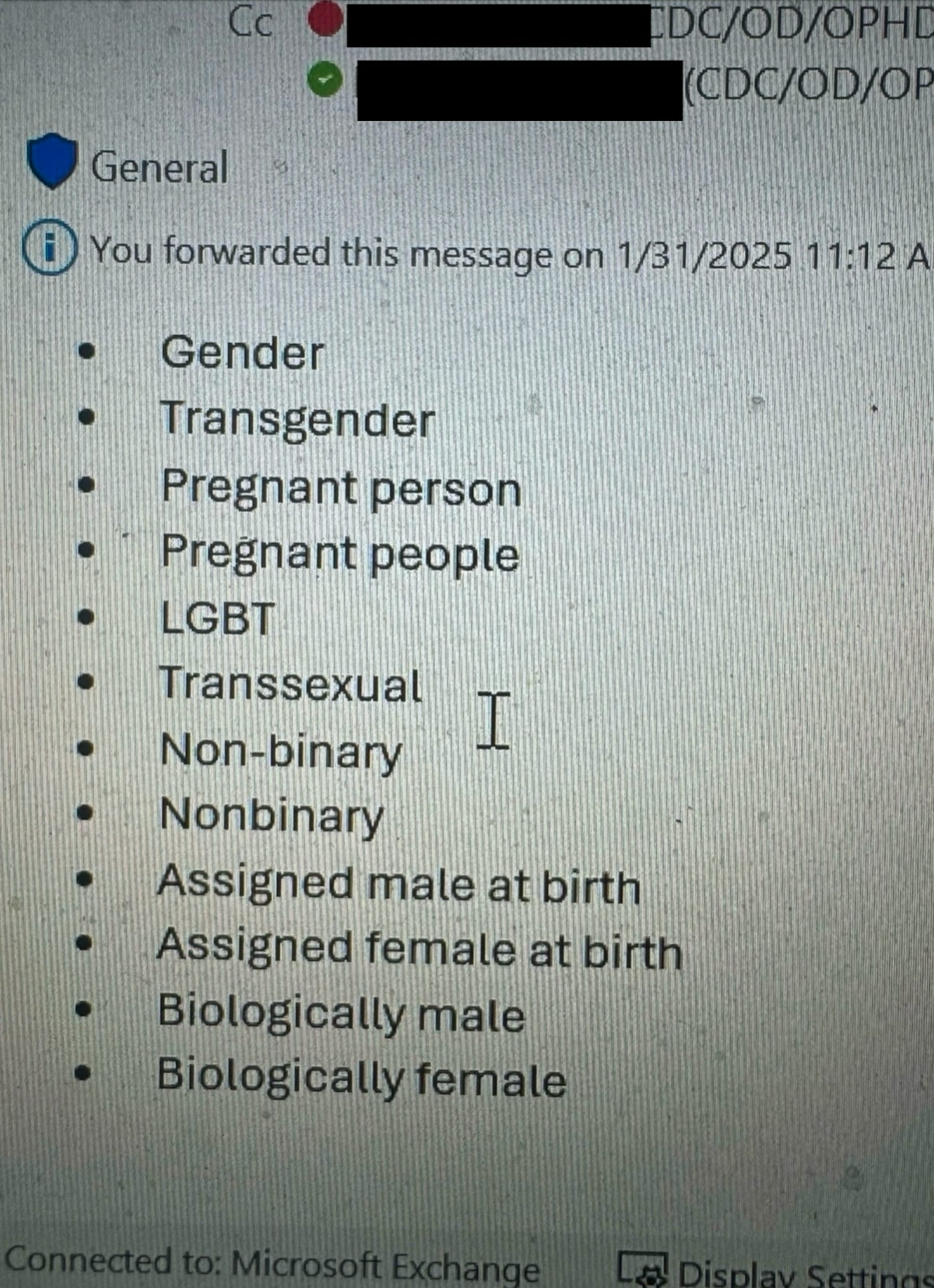
In the order, CDC researchers were instructed to remove references to or mentions of a list of forbidden terms: “Gender, transgender, pregnant person, pregnant people, LGBT, transsexual, non-binary, nonbinary, assigned male at birth, assigned female at birth, biologically male, biologically female,” according to an email sent to CDC employees (see below).”

A screenshot of a CDC email shared with Inside Medicine of a list of terms that must be removed from any CDC-authored manuscript being seriously considered or “in press” (but not yet online or in print) at any medical or scientific journal.

An expansion of an emerging censorship regime at the CDC. 

The policy goes beyond the previously reported pause of the CDC’s own publications, including Morbidity and Mortality Weekly Report (MMWR), which has seen two issues go unreleased since January 16, marking the first publication gap of any kind in approximately 60 years. Emerging infectious Diseases and Preventing Chronic Disease, the CDC’s other major publications, also remain under lock and key, but have not yet been affected because they are monthly releases and both were released as scheduled in January, prior to President Trump’s inauguration. The policy also goes beyond the general communications gag order that already prevents any CDC scientist from submitting any new scientific findings to the public.

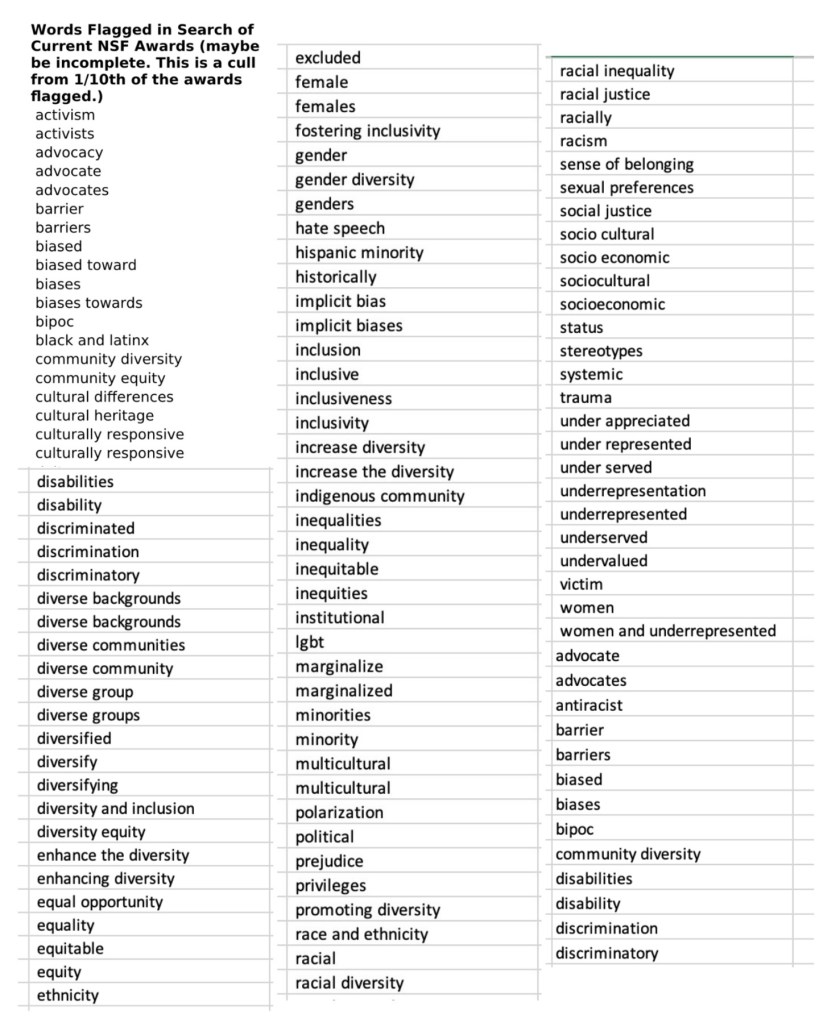
The National Science Foundation was directed to screen papers submitted for funding; it uses a list of words to flag papers that might offend the new administration.Being flagged means that the research needs a closer review to be sure that the topic is inoffensive.

Here is the NSF list:

Judd Legum and Rebecca Crosby of the blog “Popular Information” reported on censorship at the National Secutity Agency.

They wrote:

A memo distributed by NSA leadership to its staff says that on February 10, all NSA websites and internal network pages that contain banned words will be deleted. This is the list of 27 banned words distributed to NSA staff:

Anti-Racism
Racism
Allyship
Bias
DEI
Diversity
Diverse
Confirmation Bias
Equity
Equitableness
Feminism
Gender
Gender Identity
Inclusion
Inclusive
All-Inclusive
Inclusivity
Injustice
Intersectionality
Prejudice
Privilege
Racial Identity
Sexuality
Stereotypes
Pronouns
Transgender
Equality

The memo acknowledges that the list includes many terms that are used by the NSA in contexts that have nothing to do with DEI. For example, the term “privilege” is used by the NSA in the context of “privilege escalation.” In the intelligence world, privilege escalation refers to “techniques that adversaries use to gain higher-level permissions on a system or network.”

DOGE swept into the Institute of Education Sciences at the U.S. Department of Education and, following its advice, the Trump administration canceled $900 million in contracts. Bear in mind, this is the team of 20-somethings who knows a lot about software and coding. It’s unlikely that they know anything about education research.

This is the agency that I ran 30 years ago when I was Assistant Secretary of Education in the first Bush administration. At that time it was called the Office of Education Research and Improvement. I could have suggested some cuts, but certainly not $900 million!

What really bothers me is that this group of kiddies could not possibly know enough to judge the quality of the work they were canceling. Not in a day. Impossible. This was just a slash and burn operation.

ProPublica reported:

The Trump administration has terminated more than $900 million in Education Department contracts, taking away a key source of data on the quality and performance of the nation’s schools.

The cuts were made at the behest of Elon Musk’s cost-cutting crew, the Department of Government Efficiency, and were disclosed on X, the social media platform Musk owns, shortly after ProPublica posed questions to U.S. Department of Education staff about the decision to decimate the agency’s research and statistics arm, the Institute of Education Sciences.

A spokesperson for the department, Madi Biedermann, said that the standardized test known as the nation’s report card, the National Assessment of Educational Progress, would not be affected. Neither would the College Scorecard, which allows people to search for and compare information about colleges, she said.

IES is one of the country’s largest funders of education research, and the slashing of contracts could mean a significant loss of public knowledge about schools. The institute maintains a massive database of education statistics and contracts with scientists and education companies to compile and make data public about schools each year, such as information about school crime and safety and high school science course completion.

Its total annual budget is about $815 million, or roughly 1% of the Education Department’s overall budget of $82 billion this fiscal year. The $900 million in contracts the department is canceling includes multiyear agreements.

According to The Boston Globe, Trump doubled down on his intention to take control of Gaza, expel its inhabitants, and develop the Gaza Strip into a luxurious resort: The Riviera of the Middle East. He said that the Palestinians who live there would not have the right to return.

This statement is making Egypt and Jordan angry, because they have refused to accept the Palestinian Gazans for fear of Hamas terrorists on their soil. It also emboldens Netanyahu and his most extreme supporters, and it threatens to upend the ceasefire and hostage releases.

Where Trump goes, chaos goes with him.

WASHINGTON (AP) — President Donald Trump said Palestinians in Gaza would not have a right to return under his plan for U.S. “ownership” of the war-torn territory, contradicting other officials in his administration who have sought to argue Trump was only calling for the temporary relocation of its population.

Less than a week after he floated his plan for the U.S. to take control of Gaza and turn it in “the Riviera of the Middle East,” Trump, in an interview with FOX News’ Bret Baier that was set to air on Monday, said “No, they wouldn’t” when asked if Palestinians in Gaza would have a right to return to the territory. It comes as he has ramped up pressure on Arab states, especially U.S. allies Jordan and Egypt, to take in Palestinians from Gaza, who claim the territory as part of a future homeland.

“We’ll build safe communities, a little bit away from where they are, where all of this danger is,” Trump said. “In the meantime, I would own this. Think of it as a real estate development for the future. It would be a beautiful piece of land. No big money spent.”

Robert Reich is a relentless fighter for our democracy. He served in the administrations of Gerald Ford, Jimmy Carter, and Bill Clinton, in whose administration he was secretary of Labor.

He wrote recently to urge people to organize against Trump’s violations of the law.

Friends,

Before I post my Sunday cartoon, I want to share with you some thoughts about the third hellish week of Trump II.

As of Friday, Trump has signed more than 50 executive orders, covering every aspect of American life and much foreign policy. 

It’s not just that this number of executive orders is unprecedented in modern American politics. Many are unlawful, unconstitutional, or both. 

In the age of monarchs, kings issued decrees. The tsars of imperial Russia proclaimed ukases. The dictators of the 20th century made diktats. 

Trump issues executive orders.

Average people in the age of monarchs, tsars, and dictators were largely powerless. Resistance meant almost certain death. 

Many people were resigned to vulnerability. They practiced passivity. They knew no life other than repression. But their deference entrenched and ensured the power of monarchs, tsars, and dictators.

Arbitrary power depends on the acquiescence of everyone subjected to it. 

Right now, after three weeks of Trump’s “flooding the zone” (as Trumpers like to say) some of you may be feeling powerless. 

Trump wants you to feel powerless. He depends on your passivity in the face of his takeover of American democracy. 

He wants to be a strongman who can act unilaterally and arbitrarily — who can issue orders about anything that pops into his head. Purging, firing, prosecuting, or deporting anyone he wants removed. Obliterating, freezing, and pummeling any institution he wants destroyed. Unleashing the richest man in the world to do whatever the hell he wants with the government of the United States. 

If you are dumbfounded into inaction, if you don’t even want to hear the news, if you feel as though you’re living through a nightmare over which you have no control, I get it. Every other day I feel the same.

But hear me out. 

You and I have no real choice but to stand up to Trump, Musk, and their lapdogs. To allow them to bully us into submission invites more bullying, more lawlessness, more gonzo executive orders.

Last week I suggested a number of actions we can take. It wasn’t an exhaustive list, of course, only some possibilities. 

Millions of Americans — including many who have been purged from their positions of responsibility — are standing up to Trump and Musk’s tyranny. 

Republican Senator Lisa Murkowski says the Senate phone system has been receiving around 1,600 calls each minute, compared to the 40 calls per minute it usually gets — thus disrupting the system.

We are beginning to flood Trump and Musk’s zone. 

Let’s flood it out. 

This coming April 19 will mark the 250th anniversary of the battles of Lexington and Concord, which began the American Revolution and our war against monarchical power. 

Anti-royalist militia in Massachusetts refused to disperse when ordered to by British troops. A shot was fired, and the troops kept firing, killing eight of those American resisters. Later that day, the militiamen returned that fire, killing a number of British soldiers. The revolution had begun. 

Please don’t get me wrong. I do not advocate violence. I’m simply reminding you that this nation was founded on resistance to arbitrary authority. We built American democracy in the face of what seemed to be impossible odds. 

And we will never, ever give up that fight. 

My friend Harold Meyerson suggests that on April 19 we stage massive peaceful protests in every city and town — crowds of Americans celebrating the anti-monarchical uprising of 1775 and pledging their allegiance to that heritage by denouncing Trump’s increasingly autocratic rule: Thereby flooding Trump and Musk’s zone still further. 

Sounds like a good idea to me. You?

Heather Cox Richardson points out that Trump’s desire to cut the federal budgets threatens to undermine cancer research. Cutting cancer research? Yes. Is cancer research a “Marxist radical lunatic” or DEI activity?

Cancer research is important for all of us, regardless of our political views, or lack thereof. Why in the world would Trump want to cut its funding?

Yesterday the National Institutes of Health under the Trump administration announced a new policy that will dramatically change the way the United States funds medical research. Now, when a researcher working at a university receives a federal grant for research, that money includes funds to maintain equipment and facilities and to pay support staff that keep labs functioning. That indirect funding is built into university budgets for funding expensive research labs, and last year reached about 26% of the grant money distributed. Going forward, the administration says it will cap the permitted amount of indirect funding at 15%.

NIH is the nation’s primary agency for research in medicine, health, and behavior. NIH grants are fiercely competitive; only about 20% of applications succeed. When a researcher applies for one, their proposal is evaluated first by a panel of their scholarly peers and then, if it passes that level, an advisory council, which might ask for more information before awarding a grant. Once awarded and accepted, an NIH grant carries strict requirements for reporting and auditing, as well as record retention.

In 2023, NIH distributed about $35 billion through about 50,000 grants to over 300,000 researchers at universities, medical schools, and other research institutions. Every dollar of NIH funding generated about $2.46 in economic activity. For every $100 million of funding, research supported by NIH generates 76 patents, which produce 20% more economic value than other U.S. patents and create opportunities for about $600 million in future research and development.

As Christina Jewett and Sheryl Gay Stolberg of the New York Times explained, the authors of Project 2025 called for the cuts outlined in the new policy, claiming those cuts would “reduce federal taxpayer subsidization of leftist agendas.” Dr. David A. Baltrus of the University of Arizona told Jewett and Stolberg that the new policy is “going to destroy research universities in the short term, and I don’t know after that. They rely on the money. They budget for the money. The universities were making decisions expecting the money to be there.”

Although Baltrus works in agricultural research, focusing on keeping E. coli bacteria out of crops like sprouts and lettuce, cancer research is the top area in which NIH grants are awarded.

Anthropologist Erin Kane figured out what the new NIH policy would mean for states by looking at institutions that received more than $10 million in grants in 2024 and figuring out what percentage of their indirect costs would not be eligible for grant money under the new formula. Six schools in New York won $2.4 billion, including $953 million for indirect costs. The new indirect rate would allow only $220 million for overhead, a loss of $723 million.

States across the country will experience significant losses. Eight Florida schools received about $673 million, $231 million for indirect costs. The new indirect rate would limit that funding to $66 million, a loss of $165 million. Six schools in Ohio received a total of about $700 million; they would lose $194 million. Four schools in Missouri received a total of about $830 million; they would lose $212 million.

This post appeared originally on October 10, 2023. It explains why Elon Musk’s grandfather Joshua Haldeman left a prosperous life in Canada and moved his family to apartheid South Africa in 1950. He was a successful chiropractor and aviator. He was also involved in politics, but was not successful at winning elections.

Wikipedia describes Haldeman’s racism and anti-Semitism:

Haldeman was a supporter of South Africa’s apartheid policies and the ruling National Party of South Africa, telling a reporter for the extremist Die Transvaler newspaper, a tool of the Nazis in South Africa during World War II: “Instead of the Government’s attitude keeping me out of South Africa, it had precisely the opposite effect—it encouraged me to come and settle here”.[2] In 1951, he wrote an article about South Africa for the Saskatchewan newspaper, the Regina Leader-Post, defending apartheid and writing of Black South Africans: “The natives are very primitive and must not be taken seriously… Some are quite clever in a routine job, but the best of them cannot assume responsibility and will abuse authority. The present government of South Africa knows how to handle the native question.”[2][20]

Weeks after the Sharpeville massacre on 21 March 1960, Haldeman self-published The International Conspiracy to Establish a World Dictatorship and the Menace to South Africa, a 42-page response to the massacre. The United Nations passed Resolution 134, the body’s first official condemnation of apartheid and the beginning of decades of diplomatic isolation. Later Haldeman self-published a second book alleging again international conspiracies: The International Conspiracy in Health, which cast suspicion on fluoridation, vaccinations, and health insurance.[2][21]

Grandfather Haldeman was an energetic private pilot, who traveled the globe. He died in a plane accident in 1974, when Elon was only three years old. Maybe he had no influence on his grandchild.

Too bad Elon Musk didn’t stay there. He could have used his entrepreneurial brain to vitalize the economy of the African continent.

Robert Hubbell again eviscerates the efforts underway to make Trump a king or dictator, as Musk continues his raids on government offices while Trump cheers him on.

Hubbell writes:

It’s a coup. The sooner that congressional Democrats and the legacy media acknowledge that fact, the better we will be able to calibrate our response and mount an effective defense. Democrats in Congress are beginning to get the message, largely because they are being flooded with outraged calls from their constituents. See The New Republic“Disgusted” Democratic Voters Are Blowing Up Congress’s Phones.

To everyone reading this: Keep it up! In fact, redouble your efforts. There is no such thing as contacting your congressional representatives too much!

As noted yesterday, Democrats are starting to fight back in every venue possible. On Friday, Democrats and citizens who value the rule of law continued to make gains in the courts—even though it is not clear that court orders are being honored by Trump and Musk. 

Indeed, the facts suggest that DOJ lawyers are not being candid or forthcoming with federal judges—a practice also known as “lying.” Sooner or later, federal judges will figure out that they are being misled by officers of the court and then there will be hell to pay. But we are getting ahead of ourselves . . . .

On Friday, there was more (mostly) good news on the litigation front. Indeed, the DOJ seems to be strategically retreating so it can get its lies, er, I mean its “story” straight. Let’s take a look at the good news and then examine the evidence of backsliding by the administration.

Before looking at the news, let’s take a quick refresher on the Constitution and the immutable laws of the universe.


A refresher course on the Constitution and the Laws of the Universe

With the above firmly in mind, it is clear that Musk and Trump’s “cutting” spending in various agencies violates Articles I and II of the Constitution, the Impoundment Control Act of 1974, and the founding principle of separation of powers.

The “cuts” that Musk and Trump are imposing through computer hacking relate to funds that Congress has already appropriated—and which must be “duly executed” by the president. If Musk and Trump want to effectuate future cutsto budgets, they must convince Congress to pass an appropriations bill that makes such cuts.

Congressional Republicans have sat on their hands as Musk and Trump have overridden Congress’s Article I powers based on the vague excuse of “fraud,” which has never been specifically identified. Even if fraud exists, the remedy is not to override Congress’s role in the Constitution—it is to report the fraud to the DOJ for criminal prosecution and to Congress for remedial legislation.

Musk and Trump’s unlawful actions go far beyond unauthorized “cuts” accomplished by computer hacking; they extend to the extinguishment of entire agencies and departments created and funded by Congress under the authority of Article I of the Constitution.

So, the “cuts” and “closures” are not merely “controversial,” or “disputed,” or “illegal.” They overthrow the constitutional order and separation of powers by claiming that the president exercises the authority granted to Congress in Article I of the Constitution.

That is a coup. There is no other word for it.

Trump, having seized Congress’s authority under Article I of the Constitution, the open question is whether Trump will also claim the authority of the courts under Article III of the Constitution by asserting the right to decide which court orders, if any, he will obey.

Although the above sounds ominous, I remain confident and optimistic about the eventual outcome of this constitutional test. Why? because of the fourth branch of the government: the people. 

Trump and Musk will get away with their unconstitutional coup up to the point that a critical mass of the people take notice, rise up, and put a stop to the assault on the Constitution. Based on the posts in the Comment section to yesterday’s newsletter, achieving that critical mass may be closer than Trump and Musk believe.

And then there are the Second and Third Laws of the Universe: The “Law of You Broke It, You Own It,” and the Law of Unintended Consequences.” [Yesterday, I referred to the First Law of the Universe: “It is easier to break things than to fix them.”]

Taken together, the laws of the universe lead to the inevitable outcome in which something bad and unexpected happens, at which point Trump and Musk get 100% of the blame, regardless of whether they had anything to do with the event. 

We are already beginning to see that dynamic as MAGA supporters are complaining that the price of eggs continues to increase (because of avian flu that is decimating stocks of egg-laying chickens). See this (satiric) commentary in Real Clear Politics, Egg Prices Are Totally Donald Trump’s Fault!

It is also in the nature of things that everything in the universe regresses to the mean. Extreme events are rare and anomalous. They happen but then recede into the center regions of the Bell Curve, where we live most of our lives.

I do not suggest adopting a “This too shall pass” attitude. But we should recognize that as we fight to defend the Constitution, the immutable laws of the universe, the rules of probability, and the limits of human tolerance are on our side. We have every reason to be confident that we will prevail over the anti-democratic coup that is unfolding before our eyes. Let’s act like it! Act boldly and without fear!


Developments on Friday

The winning streak of coup opponents continued on Friday, with one exception. In the most significant victory, a federal judge prevented the administration from placing 2,200 USAID workers on paid leave. See press release from Democracy ForwardBreaking: Federal Judge Pauses Parts of USAID Shutdown in Response to Lawsuit.

Democracy Forward partnered with the Public Citizen Litigation Group to represent two groups of federal union employees seeking to prevent the illegal shuttering of USAID.

In the complaint, the core of the plaintiffs’ claim is set forth simply and elegantly:

Not a single one of defendants’ actions to dismantle USAID were taken pursuant to congressional authorization. And pursuant to federal statute, Congress is the only entity that may lawfully dismantle the agency.

The complaint also alleges:

  • The President of the United States has only those powers conferred on him by the Constitution and federal statutes
  • The President does not have the power under the Constitution unilaterally to amend statutes.
  • President Trump’s actions to dissolve USAID exceed presidential authority and usurp legislative authority conferred upon Congress by the Constitution, in violation of the separation of powers.

The logic made plain in the USAID complaint applies to virtually every unlawful action taken by the DOGE vandals to date.

In a second victory, a federal judge barred the FBI and DOJ from disseminating the names of the FBI agents who worked on the January 6 investigations. The judge entered an order on a stipulated consent order—i.e., a voluntary agreement between the plaintiff FBI agents (current and former) and the DOJ. The Consent Order is here: FBI Agents Association v DOJ | ORDER | 2025-02-07.

The consent order remains in effect until the hearing on a motion for preliminary inunction, or on two days’ notice, whichever is sooner.

But, in an action by employees of the Department of Labor, a federal judge denied the employees’ request for an order protecting their private information from DOGE hackers. See The Hill, Judge won’t block DOGE from accessing Labor Department systems

The order denying the AFL/CIO’s motion for temporary restraining order is here: AFL / CIO v. Dept of Labor | Order

The judge denied the request for a temporary restraining order on the ground that the plaintiffs have not yet suffered injury and, therefore, do not have standing to bring the suit at this time. The judge nonetheless scheduled a hearing on a preliminary injunction. In short, the case isn’t over.

However, even as employee unions are obtaining injunctive relief in court, it appears that Musk and Trump are continuing their march to the sea unabated. In a press availability on Friday, Trump said that he has effectively given DOGE free rein in making cuts—which, as noted above, violates Articles I and II of the Constitution and the Impoundment Control Act of 1974. See The GuardianTrump hints Musk ‘Doge’ team has free rein with Pentagon next in line for cuts.

At the press conference, Trump said,

Pressed on whether there was anything he has told Musk he cannot touch, Trump offered only a vague reply. “Well, we haven’t discussed that much,” he confessed. “I’ll tell them to go here, go there. He does it. He’s got a very capable group of people. Very, very, very, very capable.

“They know what they’re doing. They’ll ask questions, and they’ll see immediately as somebody gets tongue-tied that they’re either crooked or don’t know what they’re doing. We have very smart people going.”

No reporter asked Trump about the constitutionality or legality of Musk’s actions, asking instead whether anything is “off limits.” In response to that question, Trump said that the Department of Defense and the Department of Education are next:

I’ve instructed him to go check out education, to check out the Pentagon, which is the military. And you know, sadly, you’ll find some things that are pretty bad.

Finally, although a court order restrains Musk and DOGE from obtaining access to the Treasury payments system, Musk has managed to appoint a friend and fellow Silicon Valley venture capitalist to take charge of it. See The New RepublicElon Musk to Install DOGE Crony Amid Treasury Department Takeover.

There is no indication—yet—that Musk has violated the order prohibiting DOGE from having anything more than “read-only” access to the Treasury payment system. Still, two sources (Talking Points Memo and Wired) suggest that DOGE agents have moved beyond read-only access.

Shutting down USAID is simply unconstitutional. For all intents and purposes, USAID has ceased work and been defunded. How that happened is not clear, but the onus is on Trump to “take care that the laws are faithfully executed.” Instead, plaintiffs and legal advocacy groups are forced to play “twenty questions” and “hide the ball” with DOJ lawyers feigning ignorance of the facts.

Peter Navarro is an economist who currently serves as a trade advisor to Trump. In Trump’s first term, Navarro was also an aide on trade issues. When the January 6 commission asked him to testify, he refused. He was eventually sentenced to four months in prison for contempt of Congress.

Navarro claimed in an event sponsored by Politico that Trump’s plans to create an External Revenue Service to collect tariffs were brilliant. He predicted that tariffs would produce so much money for the government that they could eventually replace income taxes as the primary source of revenue.

Currently, Politico points out, tariffs are collected by the U.S. Customs and Border Protection Bureau. But the tariffs are paid not by the country selling the goods, but by the company importing them. Most economists predict that the price increases will be passed on to consumers, which is another way of “taxing” them.

In other words, tariffs increase inflation.

Trump has rolled out multiple executive orders that violate the law. He has installed submissive officials in key departments (like Justice) who will defend his law-breaking. The Republicans (who called Joe Biden a dictator) defend Trump’s reign of lawlessness. They have gleefully given Trump their Constitutional powers. Without a peep.

Dans Milbank advises Democrats: Don’t help him. He doesn’t need your vote.

He writes:

So, here’s a shocker: It turns out that, if you elect a felon as president of the United States, he will continue to break laws once he’s in office.

Who knew?

Ultimately, it will be up to the courts to determine which of President Donald Trump’s actions are illegal. But a case can be made — indeed, many cases already have been made in federal courts — that the new administration over the course of the last fortnight has violated each of the following laws. See if you can say them in one breath. In reverse chronological order of first enactment:

The Protecting Americans from Foreign Adversary Controlled Applications Act of 2024. The Administrative Leave Act of 2016. The Federal Information Security Modernization Act of 2014. The Affordable Care Act of 2010. The Foreign Affairs Reform and Restructuring Act of 1998. The Religious Freedom Restoration Act of 1993. The Computer Fraud and Abuse Act of 1986. The Inspector General Act of 1978. The Privacy Act of 1974. The Impoundment Control Act of 1974. The Rehabilitation Act of 1973. The Federal Advisory Committee Act of 1972. The Immigration and Nationality Act of 1952. The Administrative Procedure Act of 1946. The Public Health Service Act 1944. The Antideficiency Act of 1870.

That’s a century and a half of statutes shredded in just over two weeks. And those don’t include the ways in which Trump already appears to be in violation of the Constitution: The First Amendment’s protections of free speech and association; the Fifth Amendment’s guarantee of equal protection and due process; the Eighth Amendment’s prohibition against cruel and unusual punishment; the 14th Amendment’s promise of birthright citizenship; Article I’s spending, presentment, appropriations and bicameralism clauses; Article II’s take-care clause; and the separation of powers generally.

“The Trump administration so far has been the Advent calendar of illegality,” says Norman Eisen, whose group, State Democracy Defenders Action, has been filing lawsuits against the administration. At least seven federal judges appointed by presidents of both political parties have already blocked Trump’s moves to freeze federal funding, end birthright citizenship, extend a dubious buyout offer to government employees and deny treatment to transgender inmates.

Benjamin Wittes, who runs the popular Lawfare publication, predicts that, of the dozens of instances in which Trump is in conflict with existing law, he will ultimately lose 80 percent of the cases when they eventually arrive at the Supreme Court after 18 months or so of litigation. But that’s a long time to wait while the president’s lawlessness causes chaos and suffering. And even if the pro-Trump majority on the Supreme Court hands him a victory only 20 percent of the time, that could still fundamentally reshape the U.S. government, reducing Congress to irrelevance.

Republicans in Congress have for years asserted their Article I authority, and they howled about encroaching dictatorship when President Joe Biden did nothing more nefarious than forgive student-loan debt. (The Supreme Court struck that down.) So what are they doing about Trump usurping the powers of Congress? They’re applauding.

Sen. Thom Tillis, a North Carolina Republican, acknowledged that what Trump and Elon Musk are doing to cut off congressionally mandated funding “runs afoul of the Constitution in the strictest sense.” But, he told reporters this week, that’s “not uncommon” and “nobody should bellyache about that.”

House Speaker Mike Johnson, at a news conference Wednesday, was asked by Fox News’s Chad Pergram about the “inconsistency” of Republicans who are now “ceding Article I powers to the executive branch under Elon Musk.”

“I think there’s a gross overreaction in the media,” Johnson replied, with a forced chuckle. He admitted that what Trump is doing “looks radical,” but went on: “This is not a usurpation of authority in any way. It’s not a power grab. I think they’re doing what we’ve all expected and hoped and asked that they would do.”

These are not the words of a constitutionally designated leader of the legislative branch. These are the words of a Donald Trump handmaiden. And it is time for Democrats to treat him as such.

Democrats have been negotiating in good faith on a deal to fund the government for the rest of fiscal year 2025; the government shuts down in five weeks if funding isn’t extended. There’s no doubt that Rep. Tom Cole (R-Oklahoma), chairman of the House Appropriations Committee, and Sen. Susan Collins (R-Maine), chairwoman of the Senate Appropriations Committee, are also negotiating in good faith.

But the whole thing is not on the level. Trump has shown that he will ignore the spending bills passed by Congress and fund only those programs he supports — the Constitution, and the law, be damned. And Johnson has made clear that this is “what we’ve all expected and hoped and asked that they would do.”

In a letter to his Democratic colleagues this week, House minority leader Hakeem Jeffries said he told House GOP leaders that Trump’s efforts to cut off programs funded by Congress “must be choked off in the upcoming government funding bill, if not sooner.” But even if Democrats extracted from Republicans language in the spending bill that the programs must be funded as Congress specifies, Trump has already made clear that such a law wouldn’t be worth the paper it’s written on. And Johnson made it clear he has no intention of obliging Democrats with such a guarantee anyway; he said at his Wednesday news conference that Jeffries’s letter “laid out the foundation for a government shutdown.”

Clearly, there is no hope of good-faith negotiation with Trump, or with Johnson. Republicans control the House, Senate and White House. Let them pass a 2025 spending bill on their own. Let them raise the debt ceiling on their own. Let them enact Trump’s entire agenda on their own. They have the votes. Democrats ought not give them a single one.

Good parenting uses the idea of “natural consequences”: If your child refuses to wear her coat, let her be cold for the day. Either way, the voters will provide the consequences: FAFO. Trump knows what this means: He posted a picture of himself next to a FAFO sign, to deliver the message to Colombia’s president during their recent deportation standoff.

Democrats, by withholding their votes, will be giving Trump and Johnson some good parenting. Republicans can shut the government down. Or they can enact the sort of devastating cuts to popular programs that they like to talk about. Either way, the voters will provide the natural consequences.


The third week of the Trump presidency has been just as chaotic as the first two. Trump, who won the 2024 election promising to end wars and to put “America First,” now proposes to take over Gaza and to spend American taxpayer dollars to dismantle bombs and make it a “Riviera” on the Mediterranean. (He later clarified that Israel would handle the forced resettlement of the 2 million Palestinians there — “people like Chuck Schumer” — and then cede the Palestinian land to the United States.) The Trump-appointed chairman of the Federal Communications Commission is using his agency to assist Trump in his personal vendetta against CBS News, forcing the network to hand over unedited tapes of an interview with Kamala Harris that are the subject of a lawsuit Trump filed against CBS.

Funding was shut off to some Head Start programs for preschoolers. And the administration, though it isn’t deporting any more migrants than the Obama administration did, stepped up efforts to humiliate them and is now sending deportees to Guantánamo Bay.

Meantime, the world’s wealthiest man runs amok through the federal bureaucracy, and he appears to have access to private records of all Americans and highly classified information such as the identities of CIA operatives. He is reportedly doing this with a group of unvetted men in their early 20s — as well as a 19-year-old heir to a popcorn fortune who recently worked as a camp counselor. Musk, though he seems to be running much of the country, has exempted himself from all government disclosure and ethics requirements. But fear not: If Musk, whose companies get billions of dollars in federal contracts, “comes across a conflict of interest,” said White House press secretary Karoline Leavitt, he will — Scout’s honor — recuse himself. The administration’s attempt to induce federal employees to take a legally dubious buyout came in the form of an email with the same subject line — “fork in the road” — that Musk used to drive Twitter employees to quit.

The South Africa-born Musk, fresh from his encouragement of far-right extremists in Germany, replied “yes” this week to a post on X that said “we should allow more immigration of White South Africans.”

Musk moved to dismiss staff and shut down the U.S. Agency for International Development, which Musk calls “evil.” Maybe that’s because USAID’s inspector general was investigating the activities of Musk’s Starlink in Ukraine. But the administration and its allies rushed to justify the decision — by fabricating propaganda. At the White House, Leavitt told reporters that she was “made aware that USAID has funded media outlets like Politico. I can confirm that more than $8 million … has gone to subsidizing subscriptions.” Trump inflated the fiction further, to suggest “BILLIONS” went to “THE FAKE NEWS MEDIA AS A ‘PAYOFF’ FOR CREATING GOOD STORIES ABOUT THE DEMOCRATS.” In reality, $44,000 of USAID money went to Politico over several years — not from “payoffs” or “subsidies” but from officials subscribing to Politico Pro, as they did throughout the government (hence the $8 million). On Capitol Hill, Johnson provided a different fabrication, crediting Trump and Musk for stopping USAID from funding “transgender operas in Colombia,” “drag shows in Ecuador” and “expanding atheism in Nepal.” But it appears USAID did not fund any of those things.

The willy-nilly cancellation of all foreign aid would end lifesaving programs and various counterterrorism and counternarcotics efforts, dealing a lethal blow to U.S. soft power and driving countries into the arms of China and Russia, while hurting American farmers in the bargain. But it’s not just USAID. Trump and Musk, with their reckless and unfocused attack on federal workers, are raising the likelihood of any number of crises, at home and abroad. Their hollowing-out of the FBI and the Justice Department (with the notable exception of activities targeting Trump critics and migrants) raises the likelihood of a terrorist attack and foreign infiltration, not to mention more crime domestically. Their attempt to drive workers to quit at the CIA and NSA jeopardizes national security. Depleting the ranks of food-safety inspectors and bank regulators poses obvious dangers, as would Trump’s idea of abolishing FEMA. The administration tried to reduce personnel at the FAA — but last week’s plane crash in D.C. suddenly made it discover we need more air traffic controllers.

Yet Republican leaders on Capitol Hill either salute Trump or look the other way. They’re on their way to confirming all of Trump’s nominees, including vaccines opponent Robert F. Kennedy Jr. to run the federal government’s health programs; Tulsi Gabbard, who has a bizarre fondness for Russia, to oversee intelligence; and Kash Patel, Trump’s agent of vengeance, to run the FBI.

Senate Majority Leader John Thune (R-South Dakota) said the sort of thing Trump and Musk are doing to USAID is “probably true of any administration when they come in.” Handmaiden Johnson even welcomed the proposed U.S. takeover of Gaza, saying, contrary to reality, that it was “cheered by, I think, people all around the world.”

A few Republicans are raising objections. Collins doesn’t think Musk’s upending of USAID “satisfies the requirements of the law,” and she pronounces herself “very concerned.” But what’s the senator from Maine going to do about it? Apparently, nothing.

That will have to be up to Democrats. The out-of-power party has been bashed in the news media and by progressives for doing too little to stand up to Trump. Then, when Democratic lawmakers protested outside USAID headquarters, they were criticized for doing too much. “You don’t fight every fight,” Rahm Emanuel told Politico.

In truth, Democrats have almost no ability to stop Trump, but they do have the power, and the obligation, to stand in lockstep opposition to what the president is doing. Some of them might argue that the only way to protect certain programs, and the vulnerable people who need them, is to cut a deal with Trump and Republicans. But Trump has demonstrated abundantly that he will try to use unconstitutional means to kill off those programs regardless of what Congress does.

But if Democrats can’t stop a reckless president from creating unnecessary crises and harming millions of Americans, they certainly don’t need to give a bipartisan veneer to the atrocity. Let Republicans own the consequences of breaking government. Don’t save Trump from himself.