The death of President Jimmy Carter at age 100 reminds us of how far we have fallen as a nation. Where once we elected a man to lead the nation who was a model of honesty, integrity, humility, faith, and conviction, we just re-elected a man who lacks any principles and who lives to make more and more money. Where Carter spent his post-presidential years serving others, Trump spent four years whining and threatening revenge and retribution. Carter’s selflessness was legendary; no one has ever mentioned any selfless act ever performed by Trump.

Adam Kinzinger was one of the few Republican members of Congress who stood up to Trump. Along with Liz Cheney, he served on the Commission that investigated January 6, 2021. He left Congress and now writes a blog, commenting on current events. If the Republican Party ever breaks free of the dead hand of MAGA, Adam is one of the people who should lead it.

He wrote this tribute to Jimmy Carter:

As I sit down to reflect on the passing of Jimmy Carter, my heart is heavy with both sorrow and profound gratitude. President Carter’s life was a testament to the power of humility, faith, and a commitment to serve others. He wasn’t just a former president; he was a moral compass for our nation, a reminder of the values that should guide us as Americans and as human beings.

Born into modest beginnings in Plains, Georgia, Jimmy Carter’s faith was a cornerstone of his life. A devout Christian, Carter lived out the teachings of his faith with quiet resolve. He taught Sunday school well into his 90s, often drawing crowds who came not only to hear his words but to witness the authenticity of a man who practiced what he preached. His commitment to human dignity and compassion wasn’t confined to words or sermons—it was demonstrated through decades of action.

After leaving the White House, Carter could have easily faded into a life of comfort and prestige. Instead, he chose a path of service that extended far beyond his presidency. Through the Carter Center, he fought tirelessly for human rights, free elections, and the eradication of preventable diseases. His work in global health alone saved countless lives, exemplifying what it means to leave the world better than you found it.

Perhaps one of the most visible symbols of his post-presidential legacy was his dedication to Habitat for Humanity. Even in his later years, you could find him with a hammer in hand, building homes for families in need. This was Jimmy Carter—a man who believed that faith without works is dead, who lived his life proving that service to others is the highest calling.

In a time when our nation often feels divided, President Carter’s life offers a blueprint for unity. He believed in the power of kindness and the necessity of justice. Whether championing peace in the Middle East or advocating for marginalized communities at home, Carter’s moral clarity reminded us that politics should serve the people, not the other way around.

The country is better because of Jimmy Carter. Not just because of his policies or achievements, but because of the example he set. He showed us what leadership grounded in humility and grace looks like. He reminded us that faith can be a force for good, that it should inspire us to build bridges and extend a helping hand.

As we mourn his loss, let us also celebrate the remarkable legacy he leaves behind. May we strive to embody the values he lived by—faith, service, and an unwavering belief in the potential for good in every person. Rest in peace, President Carter. You were a beacon of light in a world that often seems dark, and your impact will endure for generations to come.

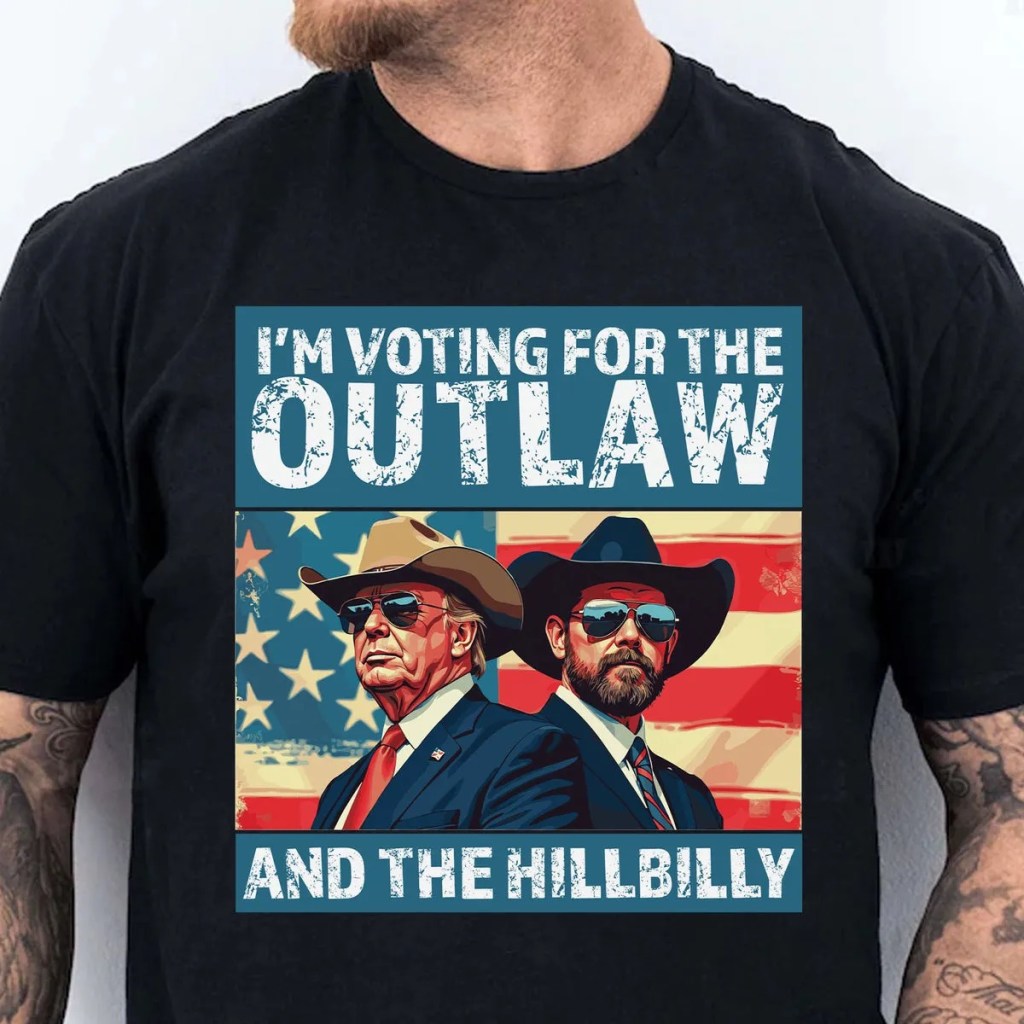
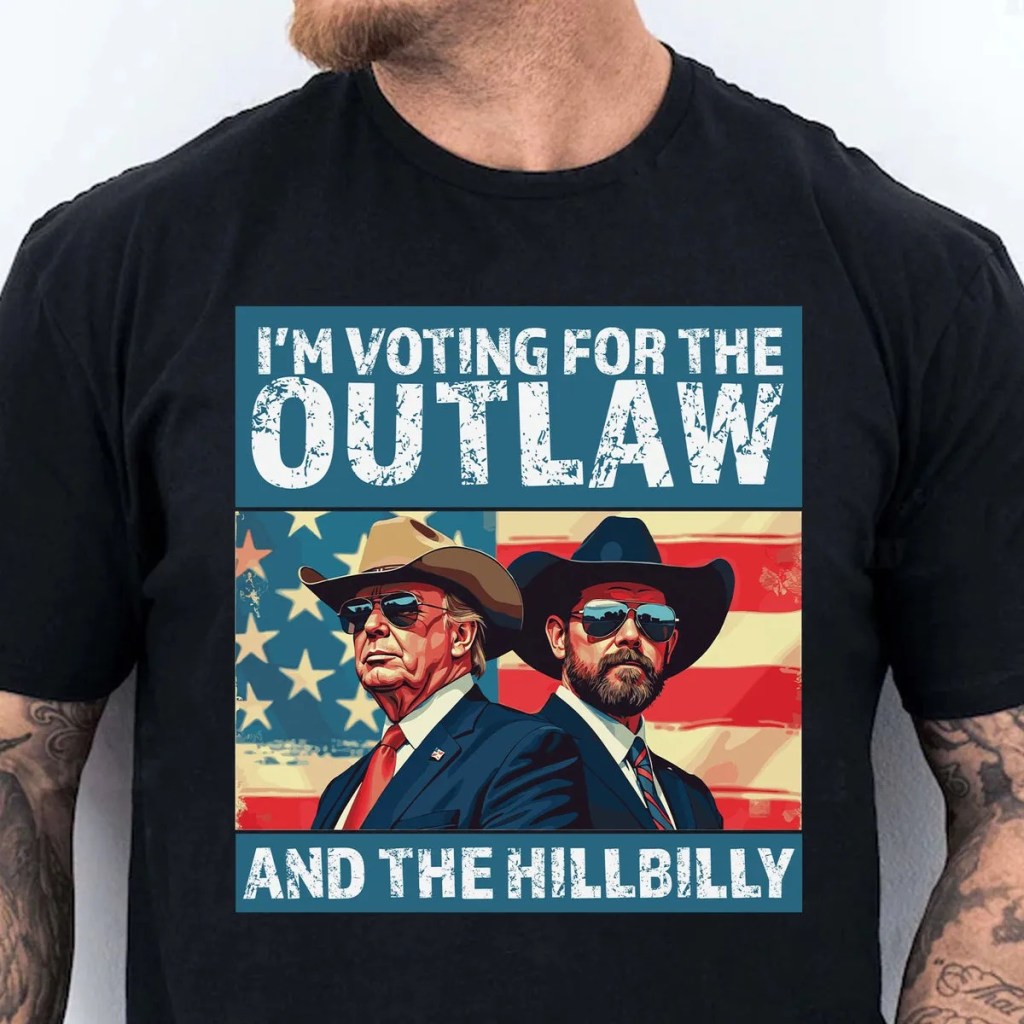
In the post at 9 a.m today, Joyce Vance included a photo of a T-shirt of Trump and Vance, billed as “the Outlaw and the Hillbilly.” Now, that’s clever marketing!

An Outlaw is often an admirable figure in westerns. He’s a folk hero. He’s the guy who goes up against the Establishment. He’s the Sundance Kid, he’s Robin Hood, he’s the handsome guy who gets the girl, he’s a lot of characters who live on the fringes of society and stand up for the little guy.

This is not Donald Trump. He is reverse Robin Hood. He steals from the poor and fattens the bank accounts of the rich. He doesn’t defend the helpless damsel, he sexually asssults her, then laughs about it and defames her. He does not stand outside society on its fringes, he owns the biggest, gaudiest mansion and installs solid gold toilet seats. Far from being handsome and buff, he is an obese old man with thinning hair and sagging jowls. He is a coward who dodged the draft five times yet pretends to be a tough guy.

As for J.D. Vance, he was once a hillbilly but that was long, long ago. Now he plays a hillbilly. He is a graduate of Yale Law School who made millions of dollars in the financial sector, where his patron was Peter Thiel, the woman-hating billionaire.

Not an Outlaw! Just a womanizing convicted felon who is a superb liar, braggart, and bully.

Not a Hillbilly! Just another far-cat who attached himself to super-rich patrons.

Trump passed one piece of legislation in his first term: a big tax cut for his billionaire buddies, corporations, and himself.

We know what his priorities are. Ego. Money. Power. Control.

He’s already forgotten about the people who voted for him. They can’t do anything for him any more. He won’t lower the price of food or gasoline or home insurance. He might take away their Social Security or Medicaid. He might cut programs they rely on.

He will take care of the people rich enough to belong to Mar-a-Lago.

Joyce Vance is a veteran federal prosecutor; she was the U.S. Attorney for the Northern district of Alabama from 2009-2017. She writes a blog called “Civil Discourse with Joyce Vance.” She usually writes about the law, the justice system, and Trump’s efforts to avoid accountability for his misdeeds. But in this post, she addresses the root cause of his appeal: low-information voters who are hoodwinked by his lies and believe he will fight for them. Ha. Not funny.

She writes:

It’s no wonder that Project 2025 calls for putting an end to the Department of Education. Trump’s electoral success depended on so-called low-information voters, members of the electorate who couldn’t or didn’t distinguish between the tough talk and tough guy image the candidate portrayed and the reality of the policies that come with his win. That’s often true for MAGA candidates, who are inexplicably able to attract the voters who are harmed by the policies they subsequently pass, as with tax cuts for the extremely wealthy and the working-class voters who didn’t benefit from them, but made them possible.

The Washington Post had this story today about the hopes of low-income voters who went for Trump in 2024, like a single mom who said she sometimes has to choose between buying toilet paper and milk and told reporters, “He is more attuned to the needs of everyone instead of just the rich … I think he knows it’s the poor people that got him elected, so I think Trump is going to do more to help us.” So far, that’s not looking good.

This very predictable reporting about voters suffering from buyers’ remorse is emerging even before Trump takes office. These people hope he won’t do exactly what he said he would during the campaign and has been focused on during his transition with programs like the Department of Government Efficiency, Elon Musk’s DOGE—cut government spending that they depend on. Whether it’s low-income people, mixed-status immigrant families, people who rely on Social Security, or parents with immune-compromised kids who rely on immunized classrooms, people voted against their own self-interest and are now facing that reality.

There are no do-overs in presidential elections. Successful disinformation campaigns or campaigns where image trumps consequences have lasting effects.

But spin, or disinformation—however you want to characterize it—designed to redirect voters away from focusing on bad facts about candidates can work, and this past election proved it. This T-shirt ad that the algorithm fed me earlier this week is an example of how Trump’s criminal conviction was sold to voters: the mythical outlaw, not the corrupt criminal. It’s hard to believe Americans fell for that, but they did, giving Trump a pass and letting him cultivate an image that was one step further out there than Sarah Palin’s maverick. 

Voters who lack the backbone of a solid education in civics can be manipulated. That takes us to Trump’s plans for the Department of Education.

Stepping on education and staunching the flow of information is a key goal for any authoritarian. Remember when Trump told an evangelical group during the campaign that if they voted in 2024 it would be the last time they had to vote? That’s something that Americans, hopefully, will not fall for, because the 2026 midterms will be key. If guardrails are going to be rebuilt, that’s where an important part of it will happen. And while we’re all burned out from the last election, this next one will matter; we will need to reengage, because a big Democratic win could staunch the bleeding from unfettered acquiescence by the legislative branch to Trump, who currently commands majorities in both chambers. That means the provision of accurate information and accurate analysis of that information to voters who will put it to use is important. But what does that look like in a country that voted for Trump?

One thing that is clear from the ease with which Trump seems to have stripped so many voters of their common sense is the need to restore civics education in this country. That’s a long-term plan and a big topic that we need to take on over time, but it’s not too early for us to begin to think about what we can do in the coming year ahead of the midterms. For one thing, if it’s right for you, even if it’s a stretch, consider running or seeking appointment to a school board. Republicans got the jump on Democrats in this arena. It’s time to catch up. Or, if that’s not in your lane, make the time to show up at school board meetings and demand civics education in our schools. Progress in this area will take time, but we can all set a good example and encourage people around us to do a better job of understanding what matters in government. Ironically, if 2017 is any indication, people caught off guard (although who knows how) by some of the worst excesses Trump is likely to engage in will be ready to be better informed and reengage in democracy. Capturing that moment will be important.

One of the goals of Project 2025 is terminating the Department of Education. There is growing Republican support for that plan at the state level by leaders who want to restore state control (much like conservatives sought restoration of abortion policy to the hands of red state officials in Dobbs). Enter Trump’s nominee to head the Department, Linda McMahon, who ran the Small Business Administration (SBA) for him from 2017 to 2019.

Trump’s appointment of the professional wrestling magnate has drawn little comment as the media has focused on Matt Gaetz, Pete Hegseth, and others. Suffice it to say she does not appear to possess much of a background in public education. She was on the Connecticut Board of Education for one year, but there has been reporting she received that appointment after lying about having a degree in education. When that report came to light while McMahon was running, unsuccessfully, for a Connecticut Senate seat, she said that “she mistakenly thought her degree was in education because she did a semester of student teaching, and that she had written to the governor’s office the previous year to correct the error after another newspaper noticed the mistake.” (I, too, did some student teaching in college, but I was always clear my degree was in political science and international relations.)

McMahon is a longtime Trump ally and financial backer, apparently key qualifications for the job. After two years at the SBA, she stepped aside to run Trump’s America First Action PAC. Other qualifications: Yahoo News reported that “Donald Trump’s nominee for education secretary was once pile-driven by a 7ft wrestler and feigned being drugged unconscious while her husband cheated on her.” Yahoo went on to recount that “Mr. Trump served as a sponsor and host for WWE events in Atlantic City in the late 1980s and years later appeared in the ring himself, when he took a razor to the head of Ms. McMahon’s scandal-ridden husband, Vince, as the wrestling boss wailed. In 2013, WWE inducted Mr. Trump into its hall of fame.” 

The National Education Association ran an editorial opposing McMahon’s confirmation. They called her “unqualified” and wrote that she “spent years pushing policies that would defund and destroy public schools.” That sounds like a good fit if your agenda involves destroying the Department of Education. Start at the top.

NEA President Becky Pringle said, “McMahon’s only mission is to eliminate the Department of Education and take away taxpayer dollars from public schools, where 90% of students – and 95% of students with disabilities – learn, and give them to unaccountable and discriminatory private schools.”

So while we begin to think about ways to repair democracy, medium-term goals like winning midterm elections, and long-term goals like restoring civics education, spare a moment for some short-term plans: write to your senators about McMahon’s nomination. It’s flying largely under the radar screen, and it should not be. Do not obey in advance, and do not make it easy for Trump to destroy democratic institutions like the Department of Education with the complicity of your state and federal elected officials. We have a lot of work to do when it comes to public education. We have to insist that free, publicly funded, high-quality education is available to every child. Our engagement as citizens is everything. Let’s get to work.

We’re in this together,

Joyce

Open the link to see the illustrations.

Allison Gill is a Navy veteran, a comedian, a podcaster, and a blogger. Her blog “Mueller, She Wrote,” was launched at the beginning of that long-ago investigation of Trump’s connections to Russia. This post appeared on her blog:

I’m not a lawyer, but usually, when the Supreme Court hears a case, they are supposed to rule on that specific case. Yet somehow, in two crucial cases about holding Donald Trump accountable for insurrection, the corrupt court went out of its way to decide on questions not before it, and create “a rule for the ages,” as Neil Gorsuch put it during oral arguments this past spring.

The first bomb they dropped to destroy accountability for Trump was their ruling overturning the Colorado Supreme Court on Section 3 of the 14th Amendment. The justices decided 9-0 that Colorado could not keep a federal candidate off the state ballot – but a 5-4 majority took it a step further by deciding that Section 3 of the 14th amendment is not self-executing; meaning Congress has to first pass legislation disqualifying Trump. An idea so wrong that even Amy Coney Barrett joined the liberal justices and objected to that part of the ruling in her concurrence.

The second bomb they dropped was the immunity ruling. Not only did they grant Trump presumptive immunity in the case before them, but they granted all presidents presumptive immunity, and took it a step further by disqualifying official acts from being used as evidence to prosecute unofficial acts.

But that’s not all! Rather than deciding which acts in the Trump case were subject to immunity, they kicked it back down to the lower court, teeing up a second interlocutory appeal on whatever the lower court ruled. That effectively added another year to the delay. Additionally, it would give the corrupt court another swing at the DoJ case on the second appeal, where I imagine they’d rip it apart once and for all. When all was said and done, they decided that they themselves would be the ultimate arbiter of rulings on official acts for criminal presidents while adding ridiculously long pre-trial appeals to the process.

That’s nothing compared to the official acts evidence part of the ruling. Again – so bad and so wrong that Amy Coney Barrett joined the liberal justices to disagree. The gist is this: let’s say you want to prosecute a president after he leaves office for accepting a million dollar bribe in exchange for an ambassadorship. And let’s say you have emails between the president and the potential ambassador explicitly stating “I will give you this ambassadorship in exchange for a million dollars.” This Supreme Court ruling says you can’t mention the appointment of the ambassador (the quo) while trying to prosecute the bribe (the quid). Absolutely bonkers.

These two rulings are the reason we can’t have nice things. That and Mitch McConnell failing to convict Trump of Insurrection after his impeachment. These decisions are the reasons Trump has not been held accountable. All because a bought-and-paid-for supreme court, funded by dark money with corporate interests before the court, needed to protect Trump from prosecution and accountability.

Were it not for the immunity ruling, Donald would have faced trial for his role in the insurrection in March of 2024. Would a conviction have made a difference in the election given he was already a 34-count convicted felon? I don’t know, but we would have had a trial were it not for the Supreme Court. The immunity ruling also contained a permission slip from Clarence Thomas in his concurrence for Aileen Cannon to dismiss the documents case, opining apropos of NOTHING that Jack Smith was probably appointed and funded improperly.

POOF. Both DoJ trials were scrapped from the pre-election calendar. But even if Trump had lost the election, there’d be a second interlocutory appeal of Judge Chutkan’s immunity determinations that would have gone all the way back up to the Supreme Court – adding at least a year to the trial calendar. Would the corrupt court have left Judge Chutkan’s ruling in place, allowing the case to go to trial? If you believe that, I have a luxury motor coach to sell you.

People have been trying to convince me that if Trump were indicted sooner, he would have gone to trial before the election and wouldn’t have been re-elected. For that to be true, you’d have to convince me that the dark money funded oligarchs on the Supreme Court would have been cool one time and allowed the trial to happen. You’d also have to convince me that people are fine electing a man convicted of 34 felonies, but not a man convicted of 38 felonies. I have my doubts.

Regardless, I will forever blame the billionaire-funded Supreme Court. They are part of the oligarchy, and were installed to dismantle democracy. 

~AG

Mercedes Schneider read a story last spring about a man who contracted polio in 1952 when he was six years, survived it, but spent the next 72 years dependent on an iron lung. Despite his limited ability to survive outside the machine, Paul Alexander finished college and law school, then practiced law. Before his death, he became a TikTok star.

When she read the story, it was interesting– but now it’s timely. After all, Trump has appointed a vaccine critic to run the Department of Health and Human services. Trump himself said in a national interview that he is skeptical about mandating vaccines for school children.

So Mercedes decided it was time to do some research about polio. Her post is engaging and brings back memories for those of us who were in school before the first vaccine was discovered and made available. We lived in terror of getting polio.

Alexander said:

In one video, Mr. Alexander detailed the emotional and mental challenges of living inside an iron lung.

“It’s lonely,” he said as the machine can be heard humming in the background. “Sometimes it’s desperate because I can’t touch someone, my hands don’t move, and no one touches me except in rare occasions, which I cherish.”

The Thought Police lost an important case in Arkansas! Score one for librarians, booksellers, and people who read books! It’s a setback for those who don’t read books, never have, never will.

Doktor Zoom writes on the blog Wonkette:

A federal judge Monday tossed out parts of an Arkansas state law that allowed librarians and booksellers to be sent to prison for up to a year for allowing minors to access “obscene” or “harmful” materials, whatever local officials might decide is “obscene” or “harmful.” Probably gay penguins.

In his ruling, US District Judge Timothy Brooks found that the law, Act 372, violated the First Amendment and also generally sucked, was overly vague, and didn’t provide adequate guidance to libraries and booksellers to help them avoid being arbitrarily prosecuted. The law created a new process for complaints and required libraries (tell you what, just assume “and booksellers” is part of every sentence, OK?) to shelve “harmful” materials in a special adults-only section, although it didn’t mandate that such a section be behind a beaded curtain like at an old video store. A similar law in Idaho — minus the librarian-jailing — is also being challenged in federal court, as are multiple other censorship laws. 

Brooks wrote that the law “deputizes librarians and booksellers as the agents of censorship; when motivated by the fear of jail time, it is likely they will shelve only books fit for young children and segregate or discard the rest,” which was of course the point. For all the Mad Moms’ insistence that they only want to protect tiny innocent kids from “obscene” materials, the actual targets of book banning tend to be anything rightwing parents dislike, especially mentions of LGBTQ people, books about race, and sex education. 

Not surprisingly, Arkansas Attorney General Tim Griffin said that while he’ll respect the ruling, he plans to appeal, and Gov. Sarah Huckabee Sanders issued a statement calling Act 372 “just common sense” because “schools and libraries shouldn’t put obscene material in front of our kids,” so there. 

Holly Dickson, executive director of the ACLU of Arkansas, said yippee, now we can poison kids’ minds, destroy the family, and kill God, or at least that’s how wingnuts will interpret what she actually said, which was 

“This was an attempt to ‘thought police,’ and this victory over totalitarianism is a testament to the courage of librarians, booksellers, and readers who refused to bow to intimidation…”

To learn more about the court decision, open the link.

Trump has repeatedly selected someone to run major government agencies who opposes the core mission of the agency.

Robert Kennedy Jr., for example, is opposed to routine public health measures.

Trump did it again. He chose a far-right critic of any government assistance to the poor to run the Department of Housing and Urban Decelopment.

ProPublica reported:

As Donald Trump’s nominee to run the U.S. Department of Housing and Urban Development, Scott Turner may soon oversee the nation’s efforts to build affordable apartments, protect poor tenants and aid the homeless. As a lawmaker in the Texas House of Representatives, Turner voted against those very initiatives.

Turner supported a bill ensuring landlords could refuse apartments to applicants because they received federal housing assistance. He opposed a bill to expand affordable rental housing. He voted against funding public-private partnerships to support the homeless and against two bills that called merely to study homelessness among young people and veterans.

Behind those votes lay a deep-seated skepticism about the value of government efforts to alleviate poverty, a skepticism that Turner has voiced again and again. He has called welfare “dangerous, harmful” and “one of the most destructive things for the family.” When one interviewer said receiving government assistance was keeping recipients in “bondage” of “a worse form to find oneself in than slavery,” Turner agreed.

Such views would seemingly place Turner at odds with the core work of HUD, a sprawling federal agency that serves as a backstop against homelessness for millions of the nation’s poor, elderly and disabled. With an annual discretionary budget of $72 billion, the department provides rental assistance to 2 million families, oversees the country’s 800,000 public housing units, fights housing discrimination and segregation and provides support to the nation’s 650,000 homeless. If Turner’s record indicates how he will direct the agency’s agenda, it is those clinging to the bottom of the housing market who have the most to lose, researchers and advocates said.

Several days ago, Elon Musk tweeted his endorsement of an extremist political party in Germany, the AfD, which is known for its xenophobic and hateful views. A number of pundits said he had thrown his support to a Neo-Nazi party. J.D. Vance soon added his praise of the extremist party.

Cynthia Miller-Idriss, a scholar of extremism, wrote at the MSNBC website, about the alarm bells that Musk and Vance set off.

She wrote:

Alarm bells sounded last week when Vice President-elect JD Vance and Trump adviser Elon Musk praised the far-right German party Alternative for Deutschland (AfD), just weeks before that country’s snap national elections are scheduled to take place.

“Only the AfD can save Germany,” Musk posted on X, prompting backlash from conservative and mainstream German leaders and the global Jewish community about a key Trump adviser’s endorsement of a party that has flirted with Nazi and white supremacist slogans and espoused dehumanizing and hateful rhetoric against immigrants and Muslims. In the wake of the criticism, Musk doubled down, writing the next day that “AfD is the only hope for Germany.”

Make no mistake: It is extremely dangerous to have an American vice president-elect and a core Trump adviser voice support for the AfD, therefore normalizing very extreme political positions.

Vance’s more tacit endorsement for AfD came in the form of a post responding to claims that AfD is dangerous. “It’s so dangerous for people to control their borders,” Vance tweeted sarcastically Saturday, implying support for the party’s anti-immigration positions. “So so dangerous. The dangerous level is off the charts.”

Make no mistake: It is extremely dangerous to have an American vice president-elect and a core Trump adviser voice support for the AfD, therefore normalizing very extreme political positions. The AfD has called for mass deportations, argued that children with disabilities should be removed from regular schools, and runs social media ads blaming immigrants for crimeand sexual violence. One anti-immigrant ad run by the AfD showed the belly of a pregnant white woman with the phrase “New Germans? We’ll make them ourselves.” Another campaign billboard used a 19th century painting of a slave market — depicting a nude, white woman having her teeth inspected by turban-clad, brown men — to warn that Europe could become “Eurabia,” a reference to a conspiracy theory favored by white supremacists.

To finish reading, open the link.

Trump’s advisers are showing their hand awfully early. Know them by those they admire.

Did you see Trump’s bizarre Christmas message? He made outlandish claims, lied, and threatened the sovereignty of other nations. Heather Cox Richardson puts his boasts into perspective. All in all, the prospects are alarming.

Trump is first and foremost an entertainer. He spent many evenings watching wrestling matches. And he had that big role on The Apprentice, which gave him a fake persona as a tough manager. He is not noted for his knowledge of domestic or foreign policy. He clearly knows nothing about history. His understanding of the Constitution seems to be hearsay. Read this post and tell me: is he ignorant, stupid, or senile?

She writes:

It is starting to seem like the best way to interpret social media posts from President-elect Donald Trump is through the lens of professional wrestling. Never a true athletic competition—although it certainly required athletic training—until the 1980s, professional wrestling depended on “kayfabe,” the shared agreement among audience and actors that they would pretend the carefully constructed script and act were real.

But as Abraham Josephine Reisman explained in the New York Times last year, Vince and Linda McMahon pushed to move professional wrestling into entertainment to avoid health regulations and the taxes imposed on actual sporting events. That shift damaged the profession until in the mid-1990s, wrestlers and promoters began to mix the fake world of wrestling with reality, bringing real-life tensions to the ring in what might or might not have been real. “Suddenly,” Reisman wrote, “the fun of the match had everything to do with decoding it.”

Nothing was off-limits, and the more outrageous the storylines, the better. “[F]ans would give it their full attention because they couldn’t always figure out if what they were seeing was real or not.” This “neokayfabe” “rests on a slippery, ever-wobbling jumble of truths, half-truths, and outright falsehoods, all delivered with the utmost passion and commitment.”

Reisman concluded that producers and consumers of neokayfabe “tend to lose the ability to distinguish between what’s real and what isn’t.” In that, they echo the world identified by German-American historian and philosopher Hannah Arendt in her 1951 The Origins of Totalitarianism. “The ideal subject of totalitarian rule is not the convinced Nazi or the convinced Communist,” she wrote, “but people for whom the distinction between fact and fiction…and the distinction between true and false no longer exist.”

Yesterday, on Christmas and the first night of Hanukkah, Trump posted a “Merry Christmas to all” message that went on to claim falsely that Chinese soldiers are operating the Panama Canal, that President Joe Biden “has absolutely no idea what he’s doing.” The heart of his message, though, was that the U.S. should take over both the Panama Canal and Canada, and that Greenland, which is a self-governing territory of Denmark, “is needed by the United States for National Security purposes,” and that “the people of Greenland…want the U.S. to be there, and we will!”

Trump’s sudden pronouncements threatening three other countries—he has been quiet about Mexico since its president pushed back on his early threats—have media outlets scrambling to explain what he’s up to. They have explained that this might be a way for him to demonstrate that his “America First” ideology, which has always embraced isolation, will actually wield power against other countries; or suggested that his claim against Panama is part of a strategy to counter China; or pointed out that global warming has sparked competition to gain an advantage in the Arctic.

The new focus on threatening other countries, virtually never mentioned during the 2024 campaign, has driven out of the news Trump’s actual campaign promise. Trump ran on the promise that he would lower prices, especially of groceries. Yet in mid-December he suggested in an interview with Time magazine that he doesn’t really expect to lower prices. That promise seems to have been part of a performance to attract voters, abandoned now with a new performance that may or may not be real.

There is also little coverage of the larger implications of Trump’s threats to invade other countries. Central to the rules-based international order constructed in the decades after World War II is that countries must respect each other’s sovereignty. Between 1942 and 1945, forty-seven nations signed the Declaration by United Nations, the treaty that formalized the alliance that stood against the fascist Axis powers. That treaty declared the different countries would not sign separate peace agreements with Germany, Italy, or Japan.

They would work together to create a world based on the 1941 Atlantic Charter, which called for the territorial integrity of nations and the restoration of self-government to countries where it had been lost, and for global cooperation for economic and social progress. In 1945, delegates from fifty nations met in San Francisco to establish a permanent forum for international cooperation.

What emerged was the United Nations, whose charter states that the organization is designed “to maintain international peace and security” by working together to stop “acts of aggression or other breaches of the peace,” and to settle international disputes without resort to war. “The Organization is based on the principle of sovereign equality of all its Members,” the charter reads. “All members shall refrain…from the threat or use of force against the territorial integrity or political independence of any state, or in any other manner inconsistent with the Purposes of the United Nations,” it reads.

Russian president Vladimir Putin is eager to tear down the international rules-based order established by the United Nations and protected by organizations like the North Atlantic Treaty Organization (NATO). His invasion of neighboring countries—Georgia in 2008, then Ukraine in 2014 and again in 2022—demonstrates his desire to return the world to a time in which bigger countries could gobble up smaller ones, the ideology that after the invention of modern weaponry meant world wars.

On Christmas Day, Russia fired more than 70 missiles and more than 100 drones at Ukraine, targeting its energy infrastructure. The Ukrainian forces shot down more than 50 of the missiles, but the attack damaged power plants, cutting electricity to different regions. Just two years ago, Ukraine began to celebrate Christmas on December 25, following the Gregorian calendar rather than the less accurate Julian calendar still favored by the Russian Orthodox Church for religious holidays. Ukraine president Volodymyr Zelensky said the change would allow Ukrainians to “abandon the Russian heritage” of celebrating Christmas in January.

Also yesterday, an undersea power cable connecting Finland and Estonia failed, following a series of cuts to telecommunications cables in the Baltic Sea in November. Today, Finland seized an oil tanker it believes cut the cables yesterday, noting that the tanker may be part of Russia’s “shadow fleet” that is waging a shadow campaign against NATO nations at the same time that it is evading sanctions against Russia.

In a joint statement today, the European Commission, which is the government of the European Union, “strongly condemn[ed]” the attacks on Europe’s critical infrastructure and said it would be proposing further sanctions to target the Russia’s shadow fleet, “which threatens security and the environment, while funding Russia’s war budget.” It emphasized Europe’s commitment to international cooperation.

Also yesterday, an Azerbaijan Airlines jet traveling from the Azerbaijan capital of Baku on its way to Chechnya crashed near Aktau, Kazakhstan, killing at least 38 of the 67 people on board. Nailia Bagirova and Gleb Stolyarov of Reuters reported today that a preliminary investigation by Azerbaijan officials suggests that Russian air defenses shot the plane down.

Newsweek’s Maya Mehrara reported that on Russian media last night, a propagandist close to Putin cheered on Trump’s demand for Greenland. “This is especially interesting because it drives a wedge between him and Europe, it undermines the world architecture, and opens up certain opportunities for our foreign policy,” nationalist political scientist Sergey Mikheyev said.

Mikheyev supports Russia’s attempt to conquer Ukraine and has called for Russia to add to its “empire” not only Finland and Poland, but also Alaska, Hawaii, and California. Last night he explained that Trump’s approach would undermine the rules-based order that has shaped the world since World War II. If Trump “really wants to stop the third world war,” he said, “the way out is simple: dividing up the world into spheres of influence.”

Mehrara noted that academic Stanislav Tkachenko said that Russia should “thank Donald Trump, who is teaching us a new diplomatic language.” He continued: “That is, to say it like it is. Maybe we won’t carve up the world like an apple, but we can certainly outline the parts of the world where our interests cannot be questioned.”

But yesterday in Georgia’s capital, Tbilisi, Armenians and Azerbaijanis joined the protesters who are filling the streets to protest the government’s attempt to tie Georgia more closely to Putin’s Russia. They hope to turn Georgia toward Europe instead.

And President Joe Biden issued a statement concerning Russia’s Christmas bombardment of Ukraine to cut heat and electricity for Ukrainians in the dead of winter. “Let me be clear,” he said, “the Ukrainian people deserve to live in peace and safety, and the United States and the international community must continue to stand with Ukraine until it triumphs over Russia’s aggression.”
Tom Loveless has been analyzing international tests for many years. Before his retirement, he directed the Brown Center on Education Policy at the Brookings Institution. Previously he was a professor at the John F. Kennedy School at Harvard University. And before that, he taught sixth grade in the public schools of California.

The news from TIMSS is that scores fell. Was the decline an after effect of the pandemic? We don’t know. There is much speculation but no certain answers.

Loveless writes:

The Trends in International Mathematics and Science Study (TIMSS) is given every four years in 4th and 8th grade math and science.  Seventy-two countries participated in 2023.  Scores are typically released in December of the year following test administration.International assessments are complicated by the sheer scope of the enterprise, including the fact that schools in the Northern and Southern Hemispheres have different school calendars. The 2023 scores were released on December 4, 2024.

U.S. scores fell sharply from 2019 to 2023, with the declines reaching conventional levels of statistical significance in math, but not science, at both grade levels. Comparing pre- and post-pandemic scores on the same test heightened interest in what the 2023 TMSS would show.  TIMSS scores are only one data point, but the 2023 results reinforce other trends evident in the other two assessments that are designed to produce valid estimates of achievement at the national level: the National Assessment of Educational Progress (NAEP) and the Programme for International Student Assessment (PISA).

Two trends stand out.

1. Larger negative effects in math than in other subjects. The most prominent explanation is that learning math is more dependent on formal instruction in schools.   

2. Gaps increased between higher and lower scoring groups along several demographic dimensions, including race, ethnicity, socioeconomic status, and the 90th and 10th percentiles (high and low achievers).Note that many of the gaps began widening before the pandemic, but Covid seemed to exacerbate thetrends.       

 In addition to the gaps that continued to widen, a gap that had disappeared in earlier TIMSS assessments suddenly re-appeared, the gap between male and female scores. In 8th grade math, for example, U.S. score differences by gender were statistically significant in 1999 and 2003, fell short of significance from 2007-2019, then widened substantially in 2023. The 14-point scale score difference recorded in 2023 (males, 495, and females, 481) is the largest U.S. gender gap in 8th grade math since TIMSS began in 1995.

The re-emergence of the gender gap is unique to TIMSS. Results of the 2024 NAEP are scheduled for release on January 29, 2025. We will see if NAEP confirms or contradicts the trends discussed here. There are reasons to believe NAEP will offer a more optimistic snapshot of U.S. achievement. First, the scores were collected a year after TIMSS, allowing for an additional year of pandemic recovery. Second, state assessments administered in 2024 have generally shown improvement, albeit at a slower pace than many hoped for or expected.