Archives for category: Vouchers

Josh Cowen, a professor of education policy at Michigan State University, has engaged in voucher research for two decades. Recently, he realized that the people and groups funding school privatization are the same as those funding other anti-democratic, extremist causes.

He writes:

There’s an old saying that “friends are the family we choose.”

The idea is that none of us played a part in the manner in whichwe were born or raised. We can’t help which city or state or country we grew up in, or whether we had two married parents or parents who divorced, whether one or both of our parents were straight or gay or whether we were only or adopted children. We can’t help which religious tradition—if any—we were raised in although we can decide for ourselves what we believe as adults.

Eventually we come to be known—and to know ourselves—by the company we choose to keep.

I spend a substantial amount of time these days talking to reporters about education policy—not just school privatization but other issues I work on like teacher retention or issues like the dreadful “read or fail” law that Michigan adopted during its Florida-mimicry days. I have a lot of experience trying to explain complicated policy areas to lay readers and writers.

By far and away the most difficult task in that activity has been explaining just how extreme, fringe and even dangerous much of the advocacy around school privatization and school vouchers actually is.

Others have reported at length how artificial the so-called “parents’ rights” groups are, but the drum that needs to be constantly tapped is that the real goal of a voucher system or its latest incarnation of “Education Freedom” is entirely radical.

Let’s walk through it.

First, when we talk about vouchers—or “scholarships” as they’re almost universally euphemized—we’re talking about a policy that’s had catastrophic impacts on student achievement. I’ve written about this here on Diane’s page and in media outlets across the country. You have to look to the COVID-19 pandemic’s impacts on test scores, or to Hurricane Katrina, to find comparable harm to academics. Vouchers are a man-made disaster, and yet the intellectual and political drivers, from Betsy DeVos to Jay Greene, are the same people who were pushing for these policies 25 years ago.

That’s one form of extremism. DeVos herself admitted the Louisiana voucher program—where voucher test score drops were nearly double what COVID did—was “not very well-conceived.” If spending decades and millions of dollars on a policy that did that kind of harm isn’t dangerously radical, I don’t know what is.

But that kind of idolatry-level obsession with a particular public policy begins to make more sense when we look at the other forms of fanatism that voucher activists have linked up with in their organizing.

There’s election denial, for one thing. Voucher activism and research is funded by groups like the Lynde and Harry Bradley Foundation—a key player in the Big Lie push to undermine confidence in the 2020 presidential outcomes. That foundation’s Board Secretary Cleta Mitchell has a starring role in the recently released January 6th Committee Report.

In a way that’s fitting. Vouchers work for kids like Donald Trump won the 2020 election. You have to suspend reality to believe either.

Next, there’s the extreme level of cruelty that voucher activists are increasingly embracing to push toward their goals. The Right-wing voucher-pushing Heritage Foundation has been pumping out screed after screed on topics ranging from book bans to diversity to transgender health care in its explicit exploitation of culture war divisions, and has all-but-encouraged the framing of public school educators as enemies to parents.

So right there that’s election denialism, anti-transgender, anti-diversity and book-banning marching arm and arm with school vouchers.

Add to that Greg Abbott’s busing of migrants to frigid northern cities on Christmas Eve and Ron DeSantis’s similar human trafficking this summer. Abbott is leading the privatization push in Texas with the help of Betsy DeVos staffers, and under DeSantis’s Don’t Say Gay policies, Florida voucher schools are newly empowered to reject LGBTQ kids and parents on the taxpayer dime.

Add further an opposition to reproductive rights. In Michigan for example, the DeVos-backed voucher initiative was led by the same political operatives running the campaign against our constitutional amendment to enshrine the right to choose, and an amendment against voter rights expansions all at the same time!

None of this is an accident. The push to privatize education isfundamentally an effort to discriminate against vulnerable children and to undermine civic institutions ranging from public schools themselves to democratic elections. It’s that extreme.

But really, none of this is new. Many of the younger reporters I talk to have no idea that the voucher movement actually began as part of the South’s “massive resistance” to integration ordered by the Brown v Board of Education decision.

In that sense, it’s hardly surprising that today’s voucher backers want to expel LGBTQ children and lean into book bans all in the name of “values.” As the author William Faulkner once said, “the past is never dead. It’s not even past.”

One of the tricks that advocates for school vouchers and other forms of privatization have been able to pull over the last two decades is to make the erosion of public education seem moderate—even reasonable.

But whether clinging for decades to a voucher policy failure that’s unprecedented in modern education, clinging in the same spirit to a failed presidential candidate’s baseless claims of an electoral victory, or a steadied push to stoke cruelty toward children as a means to an end, the school privatization movement and with it the Right’s attacks on public education are some of the most extreme forces operating today in American politics.

Extreme, and ultimately very dangerous. Defending public schools is becoming increasingly a movement to defend human rights.
Anne Nelson writes in The New Republic about 10 people you probably never heard of. Each of them is intent on destroying democracy. At the center of this group is the Bradley Foundation, a major funder of vouchers since the 1990s. Vouchers play a central role in the effort to undermine democracy. If they can take down and privatize public schools, they can do the same to other public institutions.

Here are a few of the malefactors:

Larry Arnn
President, Hillsdale College

For decades, Michigan-based Hillsdale has served as an academic partner for the religious right. The college has had a close relationship to the Council for National Policy, the secretive Christian right umbrella organization that directs so much right-wing activism, through Arnn and his predecessor, George Roche III (who left in a cloud of scandal). Hillsdale’s major donors have constituted a who’s who of the radical right, including the Koch network and leading figures from the CNP. Arnn has expanded Hillsdale’s role as a platform for the CNP’s network of megadonors, fundamentalist activists, and media outlets, providing their policy prescriptions with a thin veneer of academic respectability. The college enrolls around 1,500 students, but its leaves an outsize footprint in political messaging. Its highly politicized publication Imprimis is sent to more than six million recipients. Hillsdale operates the Kirby Center in Washington, D.C., where it has groomed young conservatives at the Capitol Hill Staff Training School, run by the Leadership Institute (see Morton Blackwell, below). Hillsdale is also playing a role in the current disruption of public education, which has been used for political leverage in Virginia and beyond. In 2020, Donald Trump appointed Arnn chair of the 1776 Commission, to promote a “patriotic” rebuttal to the 1619 Project’s racially inclusive approach to U.S. history. Hillsdale has led an ongoing campaign to politicize public schools, promoting anti–critical race theory campaigns and assisting in the launch of “affiliate” charter schools in 11 states.


Joe Seales
CEO, Right Side Broadcasting Network

RSBN serves as the equivalent of a Trump-specific C-SPAN that has carried nearly every Trump speech, rally, and town hall since July 2015, as well as full coverage of the pro-Trump Conservative Political Action Conference (CPAC). It also broadcasts a show called The Right View, with Trump daughter-in-law Lara Trump. On January 6, it livestreamed Trump’s speech inciting the march on the Capitol, and it gave live coverage to the Florida “Freedom Rally to Show Support for President Trump and January 6th Political Prisoners” a year later. In July 2021, RSBN was temporarily suspended by YouTube, but the network looked to its own app and the new pro-Trump platform Rumble to continue to carry Trump’s rallies. The radical right has been assiduously constructing a parallel media system in recent decades. RSBN, Rumble, and Trump’s new Truth Social platform complement other media initiatives, ranging from traditional fundamentalist broadcasters like American Family Radio to social sites like Gettr and Parler, in the ongoing construction of an alternate political reality for millions of followers. In March 2022, after the height of the Ottawa truckers’ protests, RSBN promoted a truckers’ convoy roundtable hosted by Representatives Matt Gaetz and Marjorie Taylor Greene, and it has offered ongoing amplification of Trump’s false election fraud claims. We can be sure that whatever Trump fabricates for future news cycles, RSBN will be repeating it.

There are eight more. How many do you know?

Josh Cowen is a researcher at Michigan State University who has studied vouchers for many years.

Recently he began writing about the failure of vouchers. They don’t “save children,” in fact, children fall behind when they use vouchers.

Join us on January 11 for a video conference with NPE President Diane Ravitch. Diane’s guest will be Josh Cowen, Professor of Education Policy at Michigan State University. Diane and Josh’s conversation will be titled School Privatization and the Education Culture Wars: The Year in Review and the Year Ahead.

Dr. Cowen has been studying school choice, teacher labor markets, and other policies for nearly two decades, and works directly with policymakers, stakeholders and media professionals to understand the consequences of various education reforms.

“Josh has drawn connections to the school culture wars, privatization, voting rights denial, and other hot-button issues,” Diane said.

RSVP NOW

The new Governor of Arkansas, Sarah Huckabee Sanders, has chosen Jacob Olivia, a member of Ron DeSantis’ education team to lead Arkansas’ schools.

Max Brantley of the Arkansas Times expects that the change in personnel indicates a new move to install vouchers and to copy other parts of disastrous and divisive education agenda.

Yep, the Cabinet appointment today by incoming Governor Sanders was a big one. She’ll be replacing Asa Hutchinson’s Education secretary, Johnny Key, with a veteran of the DeSantis administration in Florida, Jacob Oliva, senior chancellor at the Florida Department of Education, overseeing the Division of Public Schools.

Brantley quotes an opinion piece written in the district where Olivia was a superintendent before DeSantis brought him into a statewide position:

A quick search turned up this opinion piece on Oliva, by a writer who said he’d been a generally progressive school administrator in Flagler County but had drunk DeSantis’ “reactionary Kool-Aid.” It notes that, as a high school principal, Oliva initially moved to kill a student production of “To Kill a Mockingbird,” but relented after protests, a positive sign of his willingness to listen.

But the writer also said of Olivia:

I am trying to understand how you went from being one of the most progressive, innovative and inclusive superintendents in the history of Flagler County to a shill, as one of two Florida senior chancellors of education, for the single most regressive, reactionary and, frankly, just plain mean state departments of education in the nation. Something isn’t adding up.

This isn’t the Jacob Oliva we knew, unless you’ve placed a bet on Ron DeSantis becoming president and your next nameplate getting laminated in Washington. Even so: has your ambition become so primeval that you’re willing to make these Faustian bargains the way you have on covid safety measures, on gender identity, on sanitized civics and history, and now degrading math textbooks for something as innocuous–if not provably useful–as their social-emotional learning content?

I urge you to open the link and read the article, and please, please read the comments.

Last week, the Supreme Court of Kentucky declared a voucher program unconstitutional. The legislature is controlled by Republicans, the Governor is a Democrat. The ruling was met with delight by friends of public schools.

A Kentucky Supreme Court judge struck down the state’s so-called school choice program Thursday.

The state’s highest court unanimously ruled House Bill 563, officially called the Education Opportunity Account Act, as unconstitutional.

The legislation creates an almost dollar-for-dollar tax credit for Kentuckians who donate to scholarship-granting educational nonprofit organizations.

The measure sparked controversy last year and narrowly passed the Kentucky General Assembly with a 48-47 vote in the House. Kentucky Gov. Andy Beshear (D) vetoed the bill, but both the state House and Senate overrode the veto.

Opponents of the bill argued the measure would divert tax money from Kentucky public schools, while supporters said the measure would help open up new educational opportunities for families.

In the ruling, judges agreed with the bill’s critics, stating that the substance of the bill was “obvious.”

“The Commonwealth may not be sending tax revenues directly to fund nonpublic schools’ tuition (or other nonpublic school costs) but it most assuredly is raising a ‘sum… for education other than in common schools,” the ruling states.

Eddie Campbell, president of the Kentucky Education Association, a labor group that represents thousands of educators in the state, applauded the court’s decision, calling the ruling a “victory” for the state’s public schools and public school students.

“It’s always been clear to the plaintiffs and their supporters that the Kentucky Constitution prohibits any attempt to divert tax dollars from our public schools and students without putting the question to voters,” Campbell said in a statement.

“We simply can’t afford to support two different education systems — one private and one public — on the taxpayers’ dime, and this ruling supports that concern. This decision is proof that the courts continue to serve as an important check against legislative overreach,” he added.

We saw this coming. The charter movement, widely praised in the press, opened the door to school choice and consumerism. Now, as we see in Oklahoma, the state may soon have its first Catholic school charter. When the charter movement started, it promised that charter schools would be innovative, accountable, cost less than public schools and be transparent. As we have repeatedly seen, charter schools are not innovative, avoid accountability, demand the same or greater funding than public schools, and are not transparent.

Oklahoma shows where the charter movement is heading: charter schools are becoming a pathway to vouchers.

A Catholic charter school funded by taxpayer dollars is likely coming to Oklahoma soon, based on a recent ruling of the state’s outing attorney general, with support from the re-elected governor and off newly elected state superintendent of public education.

For decades, Baptists have fought against public funding of parochial schools of all kinds, but a recent series of rulings by the United States Supreme Court appears to have opened the door to that very reality. And Oklahoma’s strongly Republican leaders appear ready to walk through that door.

John O’Connor

On Dec. 1, Attorney General John O’Connor — who is Catholic — and Solicitor General Zach West wrote a non-binding legal opinion that says a current state law blocking religious institutions and private sectarian schools from state funding of public charter school programs is unconstitutional and should not be enforced.

Already, the Roman Catholic Archdiocese of Oklahoma City “states it is willing to adhere to every jot and tittle of state law and intends to apply for a charter,” reported Andrew Spiropoulos, the Robert S. Kerr Professor of Constitutional Law at Oklahoma City University and the Milton Friedman Distinguished Fellow at the Oklahoma Council of Public Affairs.

That means for the first time, government funding for public schools could also flow to Catholic schools and other faith-based schools.

And that’s not good news to Charles Foster Johnson, who helped found the group Pastors for Oklahoma Kids.

“It’s perfectly fine for those Oklahoma charter schools to become religious schools if they no longer receive public tax dollars from the people of Oklahoma,” he said. “But the last thing the devout religious folks of Oklahoma need is for their state to entangle itself in the establishment of religion through the funding of religious schools masquerading as public charter schools. All true religion, whether in congregation or class room, is voluntary and free. It must remain unencumbered by state intrusion.”

Charles Foster Johnson

Pastors for Texas Kids has noted that Oklahoma ranks 48th in the nation for per-student spending on public education. The state’s public schools serve 703,650 students, accounting for 93% of the school-age population.

Stephen Dyer is a very insightful and reliable analyst of school issues in Ohio. He used to be a legislator. He reads bills and budgets. He keeps everyone informed about the intellectual fraud that perpetuates the diversion of public funds to failing charters and voucher schools. In this post, he dissects a recent paper by the Fordham Institute, which is an outspoken advocate of school privatization. Fordham, writes Dyer, said the quiet part out loud. A few years ago, Fordham funded a study by David Figlio on vouchers in Ohio that showed their negative effects, but they try to ignore their own study.

Dyer writes:

There’s been some news coverage today of Fordham’s latest foray into fantasy — a study they claim proves EdChoice vouchers are perfectly fine and dandy for kids and taxpayers.

However, tucked away in one of their “findings” is a kind of startling admission — that EdChoice forces local school districts to rely more on property taxes to pay for educating the students in public schools.

“Combined with the decrease in enrollments, this dynamic led to a 10-15 percent increase in local revenue per pupil.”

I’m sure the study’s author(s) had no idea what they had just done. But those of us who have been saying the same thing for years sure did. This is an admission that EdChoice means that students not taking EdChoice vouchers have to rely more on local, voter approved property taxes to pay for their educations — the exact thing that the Ohio Supreme Court ruled four different times made Ohio’s school funding system unconstitutional.

“The overreliance on local property taxes is the fatal flaw that until rectified will stand in the way of constitutional compliance,” ruled Justice Alice Robie Resnick in the 4th and final DeRolph decision in 2002.

So it was nice of Fordham to admit this. However, the report went on to spend a lot of time trying to minimize the potentially existential lawsuit Ohio’s voucher program faces, as well as mocking me and others as “Chicken Littles” (because those with a winning argument always use ad hominem attacks to strengthen their position).

The study blows minimal to zero impacts on student success into enormous justification for increasing taxpayer subsidies for private school tuitions. As Michigan State’s Josh Cowen put it: “First and most important: the study presents a ton of zero impacts and tiny effects. Mostly this is a #schoolvouchers report about statistical noise, packaged as a win.”

Exactly.

Take the information on segregation. The study compares the racial makeup of voucher students with the statewide racial makeup of Ohio students. The study’s author, Stephane Lavertu of Ohio State University (who taxpayers paid $132,968 in 2019 to educate students) was very careful to only compare the racial makeup of EdChoice recipients with public school students “statewide”.

Because he knows that EdChoice voucher students don’t come from every district. They come from majority-minority districts.

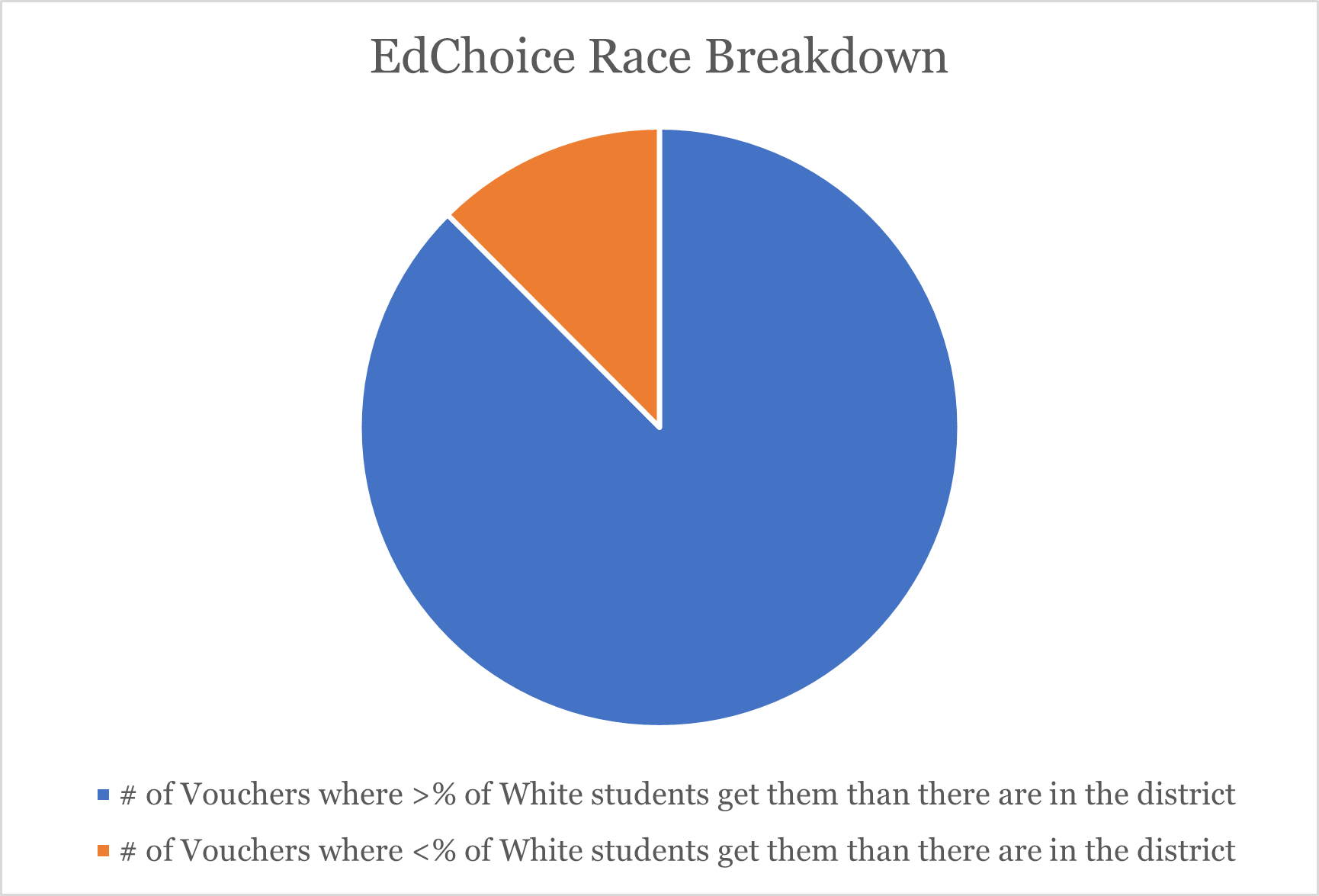
There are 95 districts that lose 10 students or more to EdChoice. In 76 of those districts, accounting for 87% of all vouchers given through the program, a higher percentage of white students take vouchers than there are in that district.

The average difference between white students taking vouchers and white students in those 76 districts was 76.2%. That means that in the districts where 87% of voucher students come from, voucher recipients are 76.2% more likely to be white than their public school counterparts.

My friends, that’s White Flight. Like, obvious White Flight.

Dear reader, do these data suggest — as Huffman wants you to think — that these segregation issues are “isolated examples”?

If 87% of voucher recipients are more likely to be white than the districts they come from, is that really “isolated”? Or is it “systemic”?

I mean in Huffman’s own district of Lima, Temple Christian takes 100% white voucher students. From a district that’s 35% white….

The vouchers worsen segregation. The students in voucher schools do worse on state tests than the public schools they left. What is more, “voucher students do worse on state tests the longer they take the voucher.”

A lose-lose, for students, for public schools, and for the state.

Nonetheless, despite failure, the state Teoublican legislature wants more vouchers and more failure!

Please open the link and keep reading this important post.

Bill Phillis, leader of the Ohio Coalition for Equity and Adequacy, reports good news in the battle against the state’s expensive and ineffective voucher program.

Private School Voucher Lawsuit Given Green Light to Go to Trial

Effort by Attorney General and Out-of-State Interest Groups to Dismiss Foiled

COLUMBUS – The lawsuit challenging the constitutionality of the harmful private school voucher program was given the green light on Friday to go to trial sometime in 2023.

Franklin County Common Pleas Judge Jaiza Page dismissed motions by Ohio Attorney General Dave Yost and out-of-state pro-private school interest groups like the Institute for Justice to dismiss the case, and instead gave the go ahead to the coalition of public schools suing the state to present their case.

“We are one step closer to proving that private school vouchers are unconstitutional, and hurt Ohio, our public school students, educators, parents, taxpayers and our communities,” said William L. Phillis, Executive Director for the Ohio Coalition for Equity & Adequacy of School Funding. “Facts matter in the court of law. The Ohio Constitution is clear. There shall be a single system of public schools, not a separate and unequal system of schools that can apply a discriminatory litmus test against students based on race, religion, income, or any disqualifying factor that strikes their fancy.”

“School board members like me owe it to our taxpayers to bring this lawsuit because my district, like so many others, has been forced to increase our property taxes with local levies to make up for the public tax dollars lost to private school vouchers. We know the vast majority of these parents are using the voucher as a refund or a rebate and they never intended to enroll their children in public schools,” said Dan Heintz, a school board member with plaintiff district Cleveland Heights-University Heights.

To read the Motion for Judgement on the Pleadings click here.

To read the Motion to Dismiss click here.

The Ohio Coalition for Equity & Adequacy of School Funding is working with Vouchers Hurt Ohio, a growing coalition of public school districts that have come together to sue the state over the unconstitutional and harmful private school voucher program.

Texas Governor Greg Abbott is determined to pass a voucher bill in the upcoming legislative session, along with voucher zealot Lt. Gov. Dan Patrick. They hope to use the culture war nonsense about public schools “indoctrinating” students on race and gender issues. They pay no attention to the research showing that students who use vouchers are likely to lose ground, academically, and learn less than in public school. Does the legislature really want to harm the state’s public schools while sending kids off to religious and private schools where they are likely to get a worse education than in public schools?

Edward McKinley of the Houston Chronicle wrote recently:

Private school vouchers were within a handful of votes of becoming Texas law in May 2005. Former Rep. Carter Casteel still remembers the constituent who confronted her in her office that day.

“He kind of threatened me, not to harm me, but that I wouldn’t be reelected if I didn’t vote for the vouchers,” Casteel, a New Braunfels Republican, said in an interview. A public school teacher and school board member before she served in the Legislature, Casteel is and was a staunch opponent of private school vouchers.

“I explained to him my position, and he wasn’t very happy, I remember that,” she said. “If you want your child to go to a private school, then that’s your choice and you spend your money, but you don’t take taxpayer dollars away.”

Debate on the floor of the Texas House stretched on for hours, and the voucher bill was gutted following a series of back-and-forth, close votes. Casteel voted no, saying publicly that she was willing to lose her House seat over it.

In a dramatic capstone to the proceedings, Rep. Senfronia Thompson ran across the floor and yanked the microphone out of the bill author’s hand, yelling for attention to a procedural mistake in the bill that led to its death.

That day was the high-water mark in efforts to pass private school vouchers in Texas.

They have been blocked by a powerful coalition of Democrats and rural Republicans in the House. In fact, the House has routinely and overwhelmingly supported a statement policy that outright bans taxpayer funds from going to private schools in sessions since.

But advocates for vouchers believe that those legislative dynamics that have been frozen for the last 17 years may finally be thawing.

As Republicans for the past year have raised alarms over what they see as liberal indoctrination in the public school curriculum — especially in the way racism and LGBT issues are taught — they’ve chalked up victories in statehouses across the country. Texas parents have carried that same fight to school board meetings, their local libraries and trustee elections. Now, Gov. Greg Abbott and Lt. Gov. Dan Patrick are calling for more of the same in the upcoming legislative session, with pledges to back ‘parents matter’ initiatives that include another voucher push.

“Families started to see there’s another dimension to school quality that’s arguably more important, which is whether the school’s curriculum aligns with their values,” said Corey DeAngelis, senior fellow with the American Federation for Children, which advocates for vouchers. “And I think that’s sparked a wave of support for school choice around the country.”

Abbott earlier this year announced his support for a policy that would allow public funds to follow students, regardless of whether they attend public schools or private schools. Shortly after, DeAngelis posted a photo of himself meeting with the governor, and “it’s happening, Texas,” has become a refrain on his popular Twitter account.

“With all the national momentum, I think a lot of people are looking toward Texas as the next step,” DeAngelis said. “It’s going to be all eyes on Texas coming up this session. And people are going to be watching.”

Eyes on Arizona, Virginia

The argument for vouchers has traditionally been that children, particularly in urban areas, are forced to attend struggling schools, when the state could instead subsidize them attending private schools nearby. One problem with this argument is that polling has often found that while people have critical views of public schools generally, they often like their own public schools just fine.

“In the past, they’ve tried to get vouchers by saying we’ve got to do something about kids trapped in failing schools. And so we’d say we’ve got all these failing schools. And then you’d look at the data and you have about 80 campuses out of about 8,500 or so that were ‘improvement required.’ So you’re looking at 1 percent,” said Charles Luke, head of the Coalition for Public Schools, which represents education groups opposing voucher policies.

“So when you’re talking about how horrible the public school system is, 99 percent of them are doing fine,” he said. “A kid takes a test and he gets a 99 on it, you wouldn’t say ‘he’s failing, I’m failing him, The system is failing him.’ You’d say, he’s doing great!”

But instead of school budgets or test scores, this time it’s culture war issues with spinoffs that include whether teachings on racism damage the self-esteem of white kids, and if it’s OK for young children to see a drag show or discuss gender identity.

“There’s this misalignment to what parents thought was going on in their schools and now their eyes have been opened, and now they say hey, hey lets fix this,” said Mandy Drogin, with the Texas Public Policy Foundation. “No more of this social justice warrior, whatever the teacher or administrator feels about pushing into our classrooms. I think that’s where you see so much momentum, and everybody feels and sees that momentum.”

The issue of private school vouchers has historically hewn closely to the culture war issues of the day. The modern voucher advocacy movement has roots connecting to efforts to resist racial integrationafter the Brown v Board of Education U.S. Supreme Court decision in 1954.

In the 1950s and ‘60s, supporters of vouchers wanted to leave “government schools” because they argued such schools were experimenting with “social engineering” and radical ideologies, education historian Jon Hale has noted, particularly desegregation. The debates from yesterday over leaving public schools because of their values mirror contemporary political arguments over how LGBTQ+ issues are discussed or the children who are undocumented immigrants attending American public schools.

One question legislative observers have had is whether those pushing vouchers will attempt to pass a universal program or a more limited one.

Teachers unions, Democrats and other public school advocates have traditionally opposed any voucher program, no matter how small, but voucher advocates have seen success in other states starting small and building out from there.

This year, however, Arizona passed a universal program, and advocates say that should be the goal in Texas.

Mayes Middleton, who served in the House in the 2019 and 2021 sessions and was elected this year to the state Senate, has filed one such bill. His would create education savings accounts, a form of vouchers, that could be used by anyone to send their kids to public school, private school, community college classes, virtual schools or home school.

This approach is the best way to maximize “parental empowerment,” he said in a Friday interview, and to capitalize on the momentum behind that movement that helped carry Virginia Gov. Glenn Youngkin to victory last year. There were also Republicans unseated in the primaries earlier this year across the state who were less supportive of voucher policies, Middleton said, which could help win additional support.

He says his bill could be particularly helpful for rural Texans who want their kids to access more flexible, hybrid home school models, as well as for people who want to send their kids to private Catholic schools but cannot afford it, many of whom he said are Hispanic. Those are groups who would need to support voucher policies for them to win passage in the Legislature.

“Look in Arizona what they did it with one-seat GOP majority in their house and senate,” DeAngelis said. “If every Republican in Arizona can show up for their platform issue, other red states should be able to follow suit as well.”

Vouchers fell far short in 2021

Public school advocates and opponents of vouchers acknowledge that the fight is going to be tighter and more intense than it has been in many years, but they feel that even with intense lobbying in support, the policies will ultimately fall short.

“These are the same issues that raised their ugly head in past sessions,” said Rep. Harold Dutton, a Houston Democrat who chaired the House Public Education Committee last session, noting that more than 100 of the 150 House members voted in favor of an amendment last year barring the state from spending public funds on private schools. “I don’t see that changing a whole lot, and certainly not being able to get a majority.”

Members of the GOP’s right wing have called for House Speaker Dade Phelan to end the practice of naming Democrats to head a limited number of committees. Some have named Dutton in particular as an obstacle last session to school choice legislation.

Dutton said he hadn’t thought about whether or not he’ll be chair again, but noted: “When vouchers failed before, the person in the chair of public education was a Republican, so what does that tell you?”

Several Republican members of Public Education, who might be in line for the chairmanship if Dutton is not selected again, have also expressed skepticism or opposition to voucher proposals. Rep. Ken King from Canadian has said, “If I have anything to say about it, it’s dead on arrival. It’s horrible for rural Texas. It’s horrible for all of Texas,” while Rep. Gary VanDeaver has said, “This sense of community is what makes Texas great, and I would hate to see anything like a voucher program destroy this community spirit.”

As promised, after Casteel’s role in the demise of the voucher bill in 2005, she lost her seat in 2006.

She noted that a prominent San Antonio businessman and GOP donor who was present in the House the day of the vote and advocated strongly for vouchers donated more than $1 million to her opponent, as the donor did for other Republicans who opposed the voucher bill that day.

“I’ve got a great family, I’ve got a great law profession, and whether I’m (there) or I go home it doesn’t make a bit of difference to me. I didn’t go there to do nothing but what’s right,” Casteel said.

“And I did. I went home. And it never came back up — until this year.”

edward.mckinley@chron.com

The Kentucky legislature enacted a voucher law limited to urban districts. Rural districts did not want vouchers.

Today that law was rejected by the state’s highest court.

First, the law was limited to only a few districts.

But most important:

The circuit court also held that the EOA Act violates Section 184 of the Kentucky Constitution which provides that “no sum shall be raised or collected for education other than in common schools until the question of taxation is submitted to the legal voters.” Applying the plain language of this section, the income tax credit raises money for nonpublic education and its characterization as a tax credit rather than an appropriation is immaterial. The circuit court cited Commonwealth v. O’Harrah, 262 S.W.2d 385, 389 (Ky. 1953), for the long-standing principle that “[i]n appraising the validity of the statute we must look through the form of the statute to the substance of what it does.” Every dollar raised under the EOA program to fund the AGOs is raised by tax credits which diminish the tax revenue received to defray the necessary expenses of government…

Finally, the circuit court concluded that the factual record necessary to consideration of the constitutional issues raised by Sections 3 and 171 of the Kentucky Constitution was not yet developed. Sections 3 and 171 prohibit payment of public money “to any man or set of men, except in consideration of public services,” and require principles of public purpose, uniformity, and equality in levying taxes. Likewise, the court deemed the record is underdeveloped on the issues pertaining to Sections 183 and 186 of the Kentucky Constitution, which require the Kentucky General Assembly to provide for “an efficient system of common schools” that is adequately and equitably funded, and that “[a]ll funds accruing to the school fund shall be used for the maintenance of the public schools of the Commonwealth, and for no other purpose.” Because the record contains no discovery, depositions, or expert testimony to establish whether the EOA Act is consistent with these constitutional requirements, the court denied summary judgment on these issues.