Archives for category: Vouchers

Stephen Dyer is a very insightful and reliable analyst of school issues in Ohio. He used to be a legislator. He reads bills and budgets. He keeps everyone informed about the intellectual fraud that perpetuates the diversion of public funds to failing charters and voucher schools. In this post, he dissects a recent paper by the Fordham Institute, which is an outspoken advocate of school privatization. Fordham, writes Dyer, said the quiet part out loud. A few years ago, Fordham funded a study by David Figlio on vouchers in Ohio that showed their negative effects, but they try to ignore their own study.

Dyer writes:

There’s been some news coverage today of Fordham’s latest foray into fantasy — a study they claim proves EdChoice vouchers are perfectly fine and dandy for kids and taxpayers.

However, tucked away in one of their “findings” is a kind of startling admission — that EdChoice forces local school districts to rely more on property taxes to pay for educating the students in public schools.

“Combined with the decrease in enrollments, this dynamic led to a 10-15 percent increase in local revenue per pupil.”

I’m sure the study’s author(s) had no idea what they had just done. But those of us who have been saying the same thing for years sure did. This is an admission that EdChoice means that students not taking EdChoice vouchers have to rely more on local, voter approved property taxes to pay for their educations — the exact thing that the Ohio Supreme Court ruled four different times made Ohio’s school funding system unconstitutional.

“The overreliance on local property taxes is the fatal flaw that until rectified will stand in the way of constitutional compliance,” ruled Justice Alice Robie Resnick in the 4th and final DeRolph decision in 2002.

So it was nice of Fordham to admit this. However, the report went on to spend a lot of time trying to minimize the potentially existential lawsuit Ohio’s voucher program faces, as well as mocking me and others as “Chicken Littles” (because those with a winning argument always use ad hominem attacks to strengthen their position).

The study blows minimal to zero impacts on student success into enormous justification for increasing taxpayer subsidies for private school tuitions. As Michigan State’s Josh Cowen put it: “First and most important: the study presents a ton of zero impacts and tiny effects. Mostly this is a #schoolvouchers report about statistical noise, packaged as a win.”

Exactly.

Take the information on segregation. The study compares the racial makeup of voucher students with the statewide racial makeup of Ohio students. The study’s author, Stephane Lavertu of Ohio State University (who taxpayers paid $132,968 in 2019 to educate students) was very careful to only compare the racial makeup of EdChoice recipients with public school students “statewide”.

Because he knows that EdChoice voucher students don’t come from every district. They come from majority-minority districts.

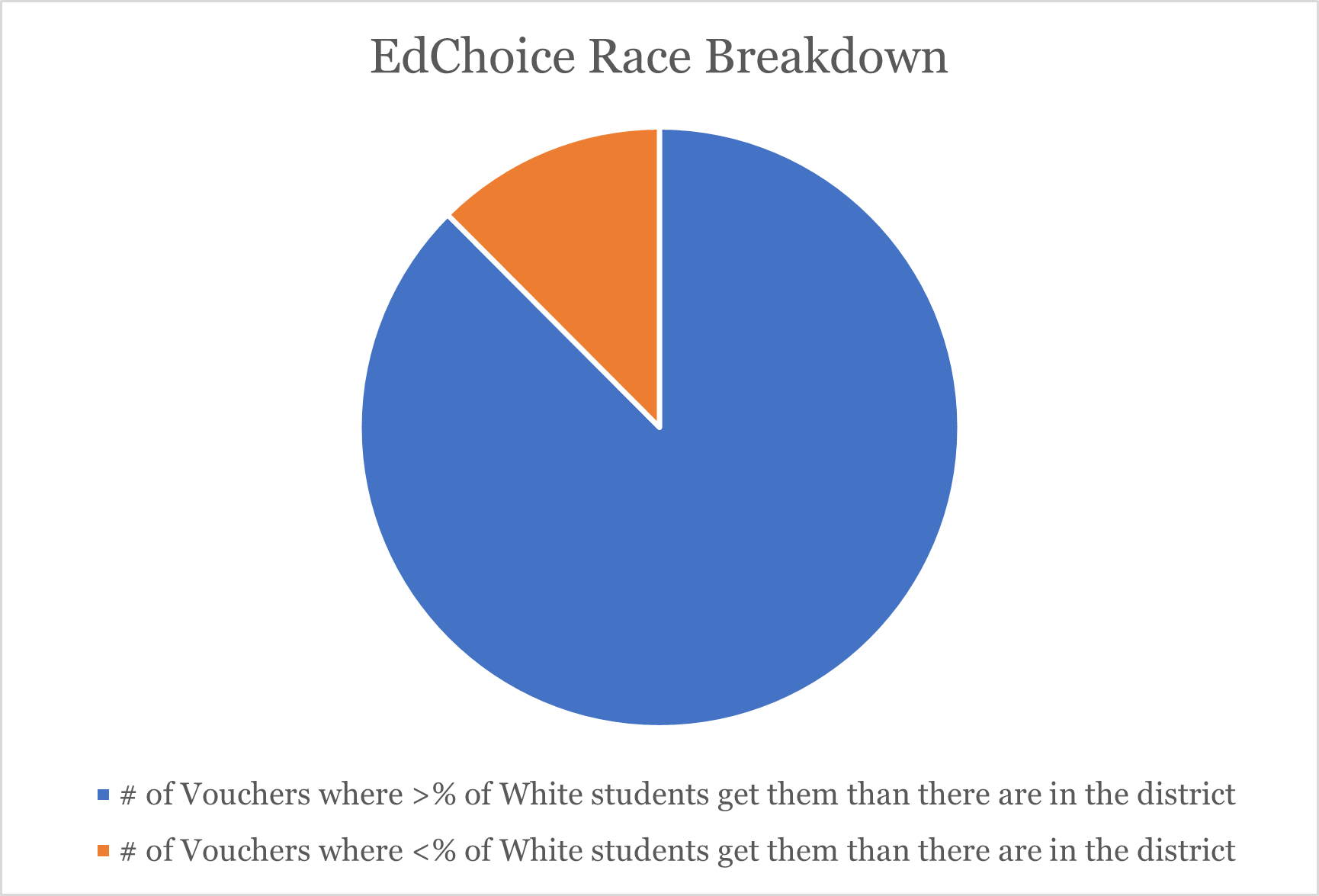
There are 95 districts that lose 10 students or more to EdChoice. In 76 of those districts, accounting for 87% of all vouchers given through the program, a higher percentage of white students take vouchers than there are in that district.

The average difference between white students taking vouchers and white students in those 76 districts was 76.2%. That means that in the districts where 87% of voucher students come from, voucher recipients are 76.2% more likely to be white than their public school counterparts.

My friends, that’s White Flight. Like, obvious White Flight.

Dear reader, do these data suggest — as Huffman wants you to think — that these segregation issues are “isolated examples”?

If 87% of voucher recipients are more likely to be white than the districts they come from, is that really “isolated”? Or is it “systemic”?

I mean in Huffman’s own district of Lima, Temple Christian takes 100% white voucher students. From a district that’s 35% white….

The vouchers worsen segregation. The students in voucher schools do worse on state tests than the public schools they left. What is more, “voucher students do worse on state tests the longer they take the voucher.”

A lose-lose, for students, for public schools, and for the state.

Nonetheless, despite failure, the state Teoublican legislature wants more vouchers and more failure!

Please open the link and keep reading this important post.

Bill Phillis, leader of the Ohio Coalition for Equity and Adequacy, reports good news in the battle against the state’s expensive and ineffective voucher program.

Private School Voucher Lawsuit Given Green Light to Go to Trial

Effort by Attorney General and Out-of-State Interest Groups to Dismiss Foiled

COLUMBUS – The lawsuit challenging the constitutionality of the harmful private school voucher program was given the green light on Friday to go to trial sometime in 2023.

Franklin County Common Pleas Judge Jaiza Page dismissed motions by Ohio Attorney General Dave Yost and out-of-state pro-private school interest groups like the Institute for Justice to dismiss the case, and instead gave the go ahead to the coalition of public schools suing the state to present their case.

“We are one step closer to proving that private school vouchers are unconstitutional, and hurt Ohio, our public school students, educators, parents, taxpayers and our communities,” said William L. Phillis, Executive Director for the Ohio Coalition for Equity & Adequacy of School Funding. “Facts matter in the court of law. The Ohio Constitution is clear. There shall be a single system of public schools, not a separate and unequal system of schools that can apply a discriminatory litmus test against students based on race, religion, income, or any disqualifying factor that strikes their fancy.”

“School board members like me owe it to our taxpayers to bring this lawsuit because my district, like so many others, has been forced to increase our property taxes with local levies to make up for the public tax dollars lost to private school vouchers. We know the vast majority of these parents are using the voucher as a refund or a rebate and they never intended to enroll their children in public schools,” said Dan Heintz, a school board member with plaintiff district Cleveland Heights-University Heights.

To read the Motion for Judgement on the Pleadings click here.

To read the Motion to Dismiss click here.

The Ohio Coalition for Equity & Adequacy of School Funding is working with Vouchers Hurt Ohio, a growing coalition of public school districts that have come together to sue the state over the unconstitutional and harmful private school voucher program.

Texas Governor Greg Abbott is determined to pass a voucher bill in the upcoming legislative session, along with voucher zealot Lt. Gov. Dan Patrick. They hope to use the culture war nonsense about public schools “indoctrinating” students on race and gender issues. They pay no attention to the research showing that students who use vouchers are likely to lose ground, academically, and learn less than in public school. Does the legislature really want to harm the state’s public schools while sending kids off to religious and private schools where they are likely to get a worse education than in public schools?

Edward McKinley of the Houston Chronicle wrote recently:

Private school vouchers were within a handful of votes of becoming Texas law in May 2005. Former Rep. Carter Casteel still remembers the constituent who confronted her in her office that day.

“He kind of threatened me, not to harm me, but that I wouldn’t be reelected if I didn’t vote for the vouchers,” Casteel, a New Braunfels Republican, said in an interview. A public school teacher and school board member before she served in the Legislature, Casteel is and was a staunch opponent of private school vouchers.

“I explained to him my position, and he wasn’t very happy, I remember that,” she said. “If you want your child to go to a private school, then that’s your choice and you spend your money, but you don’t take taxpayer dollars away.”

Debate on the floor of the Texas House stretched on for hours, and the voucher bill was gutted following a series of back-and-forth, close votes. Casteel voted no, saying publicly that she was willing to lose her House seat over it.

In a dramatic capstone to the proceedings, Rep. Senfronia Thompson ran across the floor and yanked the microphone out of the bill author’s hand, yelling for attention to a procedural mistake in the bill that led to its death.

That day was the high-water mark in efforts to pass private school vouchers in Texas.

They have been blocked by a powerful coalition of Democrats and rural Republicans in the House. In fact, the House has routinely and overwhelmingly supported a statement policy that outright bans taxpayer funds from going to private schools in sessions since.

But advocates for vouchers believe that those legislative dynamics that have been frozen for the last 17 years may finally be thawing.

As Republicans for the past year have raised alarms over what they see as liberal indoctrination in the public school curriculum — especially in the way racism and LGBT issues are taught — they’ve chalked up victories in statehouses across the country. Texas parents have carried that same fight to school board meetings, their local libraries and trustee elections. Now, Gov. Greg Abbott and Lt. Gov. Dan Patrick are calling for more of the same in the upcoming legislative session, with pledges to back ‘parents matter’ initiatives that include another voucher push.

“Families started to see there’s another dimension to school quality that’s arguably more important, which is whether the school’s curriculum aligns with their values,” said Corey DeAngelis, senior fellow with the American Federation for Children, which advocates for vouchers. “And I think that’s sparked a wave of support for school choice around the country.”

Abbott earlier this year announced his support for a policy that would allow public funds to follow students, regardless of whether they attend public schools or private schools. Shortly after, DeAngelis posted a photo of himself meeting with the governor, and “it’s happening, Texas,” has become a refrain on his popular Twitter account.

“With all the national momentum, I think a lot of people are looking toward Texas as the next step,” DeAngelis said. “It’s going to be all eyes on Texas coming up this session. And people are going to be watching.”

Eyes on Arizona, Virginia

The argument for vouchers has traditionally been that children, particularly in urban areas, are forced to attend struggling schools, when the state could instead subsidize them attending private schools nearby. One problem with this argument is that polling has often found that while people have critical views of public schools generally, they often like their own public schools just fine.

“In the past, they’ve tried to get vouchers by saying we’ve got to do something about kids trapped in failing schools. And so we’d say we’ve got all these failing schools. And then you’d look at the data and you have about 80 campuses out of about 8,500 or so that were ‘improvement required.’ So you’re looking at 1 percent,” said Charles Luke, head of the Coalition for Public Schools, which represents education groups opposing voucher policies.

“So when you’re talking about how horrible the public school system is, 99 percent of them are doing fine,” he said. “A kid takes a test and he gets a 99 on it, you wouldn’t say ‘he’s failing, I’m failing him, The system is failing him.’ You’d say, he’s doing great!”

But instead of school budgets or test scores, this time it’s culture war issues with spinoffs that include whether teachings on racism damage the self-esteem of white kids, and if it’s OK for young children to see a drag show or discuss gender identity.

“There’s this misalignment to what parents thought was going on in their schools and now their eyes have been opened, and now they say hey, hey lets fix this,” said Mandy Drogin, with the Texas Public Policy Foundation. “No more of this social justice warrior, whatever the teacher or administrator feels about pushing into our classrooms. I think that’s where you see so much momentum, and everybody feels and sees that momentum.”

The issue of private school vouchers has historically hewn closely to the culture war issues of the day. The modern voucher advocacy movement has roots connecting to efforts to resist racial integrationafter the Brown v Board of Education U.S. Supreme Court decision in 1954.

In the 1950s and ‘60s, supporters of vouchers wanted to leave “government schools” because they argued such schools were experimenting with “social engineering” and radical ideologies, education historian Jon Hale has noted, particularly desegregation. The debates from yesterday over leaving public schools because of their values mirror contemporary political arguments over how LGBTQ+ issues are discussed or the children who are undocumented immigrants attending American public schools.

One question legislative observers have had is whether those pushing vouchers will attempt to pass a universal program or a more limited one.

Teachers unions, Democrats and other public school advocates have traditionally opposed any voucher program, no matter how small, but voucher advocates have seen success in other states starting small and building out from there.

This year, however, Arizona passed a universal program, and advocates say that should be the goal in Texas.

Mayes Middleton, who served in the House in the 2019 and 2021 sessions and was elected this year to the state Senate, has filed one such bill. His would create education savings accounts, a form of vouchers, that could be used by anyone to send their kids to public school, private school, community college classes, virtual schools or home school.

This approach is the best way to maximize “parental empowerment,” he said in a Friday interview, and to capitalize on the momentum behind that movement that helped carry Virginia Gov. Glenn Youngkin to victory last year. There were also Republicans unseated in the primaries earlier this year across the state who were less supportive of voucher policies, Middleton said, which could help win additional support.

He says his bill could be particularly helpful for rural Texans who want their kids to access more flexible, hybrid home school models, as well as for people who want to send their kids to private Catholic schools but cannot afford it, many of whom he said are Hispanic. Those are groups who would need to support voucher policies for them to win passage in the Legislature.

“Look in Arizona what they did it with one-seat GOP majority in their house and senate,” DeAngelis said. “If every Republican in Arizona can show up for their platform issue, other red states should be able to follow suit as well.”

Vouchers fell far short in 2021

Public school advocates and opponents of vouchers acknowledge that the fight is going to be tighter and more intense than it has been in many years, but they feel that even with intense lobbying in support, the policies will ultimately fall short.

“These are the same issues that raised their ugly head in past sessions,” said Rep. Harold Dutton, a Houston Democrat who chaired the House Public Education Committee last session, noting that more than 100 of the 150 House members voted in favor of an amendment last year barring the state from spending public funds on private schools. “I don’t see that changing a whole lot, and certainly not being able to get a majority.”

Members of the GOP’s right wing have called for House Speaker Dade Phelan to end the practice of naming Democrats to head a limited number of committees. Some have named Dutton in particular as an obstacle last session to school choice legislation.

Dutton said he hadn’t thought about whether or not he’ll be chair again, but noted: “When vouchers failed before, the person in the chair of public education was a Republican, so what does that tell you?”

Several Republican members of Public Education, who might be in line for the chairmanship if Dutton is not selected again, have also expressed skepticism or opposition to voucher proposals. Rep. Ken King from Canadian has said, “If I have anything to say about it, it’s dead on arrival. It’s horrible for rural Texas. It’s horrible for all of Texas,” while Rep. Gary VanDeaver has said, “This sense of community is what makes Texas great, and I would hate to see anything like a voucher program destroy this community spirit.”

As promised, after Casteel’s role in the demise of the voucher bill in 2005, she lost her seat in 2006.

She noted that a prominent San Antonio businessman and GOP donor who was present in the House the day of the vote and advocated strongly for vouchers donated more than $1 million to her opponent, as the donor did for other Republicans who opposed the voucher bill that day.

“I’ve got a great family, I’ve got a great law profession, and whether I’m (there) or I go home it doesn’t make a bit of difference to me. I didn’t go there to do nothing but what’s right,” Casteel said.

“And I did. I went home. And it never came back up — until this year.”

edward.mckinley@chron.com

The Kentucky legislature enacted a voucher law limited to urban districts. Rural districts did not want vouchers.

Today that law was rejected by the state’s highest court.

First, the law was limited to only a few districts.

But most important:

The circuit court also held that the EOA Act violates Section 184 of the Kentucky Constitution which provides that “no sum shall be raised or collected for education other than in common schools until the question of taxation is submitted to the legal voters.” Applying the plain language of this section, the income tax credit raises money for nonpublic education and its characterization as a tax credit rather than an appropriation is immaterial. The circuit court cited Commonwealth v. O’Harrah, 262 S.W.2d 385, 389 (Ky. 1953), for the long-standing principle that “[i]n appraising the validity of the statute we must look through the form of the statute to the substance of what it does.” Every dollar raised under the EOA program to fund the AGOs is raised by tax credits which diminish the tax revenue received to defray the necessary expenses of government…

Finally, the circuit court concluded that the factual record necessary to consideration of the constitutional issues raised by Sections 3 and 171 of the Kentucky Constitution was not yet developed. Sections 3 and 171 prohibit payment of public money “to any man or set of men, except in consideration of public services,” and require principles of public purpose, uniformity, and equality in levying taxes. Likewise, the court deemed the record is underdeveloped on the issues pertaining to Sections 183 and 186 of the Kentucky Constitution, which require the Kentucky General Assembly to provide for “an efficient system of common schools” that is adequately and equitably funded, and that “[a]ll funds accruing to the school fund shall be used for the maintenance of the public schools of the Commonwealth, and for no other purpose.” Because the record contains no discovery, depositions, or expert testimony to establish whether the EOA Act is consistent with these constitutional requirements, the court denied summary judgment on these issues.

Josh Cowen, a professor at Michigan State University, has been a voucher researcher for two decades. The more he studied vouchers, the more he realized that they harm children. In this post, he looks at the students who use a voucher, but change their minds and return to public schools.

Cowen writes:

Author: Josh Cowen

We don’t talk enough about children who give up their school vouchers.

One of the many problems with the “Education Freedom” marketing campaign for school privatization—and it’s a problem with the market approach to education more generally—is that schools are anything but products to sample.

Betsy DeVos likes to say that schools shouldn’t be “one size fits all.” She’s conceding more than she knows with that analogy because unlike clothing, or a car you can test drive down at the Ford dealer, there’s a real cost to trying a school on and having it fail to fit.

Study after study has shown how harmful school mobility is for kids, both those who actually move between schools and those whose classrooms are full of peers coming in and out.

As Russell Rumberger, an expert in this area has succinctly summarized:

The research literature suggests that changing schools can harm normal child and adolescent development by disrupting relationships with peers and teachers as well as altering a student’s educational program.”

And in the general population of public school children, we know who’s likely to be more mobile. They’re students of color, students from families with lower levels of income, students with special academic needs, and students with housing insecurity.

No one’s saying student mobility isn’t an issue for public schools, but public educators don’t see student churn as a feature instead of a bug. For example, a key element of the federal McKinney-Vento Act designed to help homeless kids is a set of best practices to help kids stay in one single public school even if they can’t remain in one stable home environment.

States with large-scale voucher programs are beginning to report out statistics for how many users come from public or private schools each year. And by the way these statistics put a lie to the claim from activists that vouchers are needed for families to choose, because we know from states like Arizona, New Hampshire, and Wisconsin that more than 75% of voucher kids were already in private school without taxpayer support.

But now we need more statistics reported on the mirror image: how many new students give up their vouchers each year. Recent numbers from Florida indicate roughly 60% of new voucher users give the voucher up after just a couple of years.

Think about that number as the voucher equivalent of a public school mobility or drop-out rate—both statistics used by critics to help indict public educational quality.

When I was working on an official evaluation of Milwaukee’s voucher program more than a decade ago, I led two reports on exactly these sorts of children. We found that around 15% of kids gave up their vouchers every year. Meaning that, as in Florida, more than half the kids we were studying left private schools over a short period of time!

Who were those kids? They were more likely to be Black, lower scoring on the state exam, and more likely to be enrolled in schools that had lots of other voucher-using kids (i.e. newer schools that popped up to take tax dollars once the program was created, rather than more established private institutions).

What happened when they left? Well actually that was a bit of good news. In still the only study to track kids over time after giving up their vouchers, we found that they enrolled in Milwaukee Public Schools and then improved substantially after arriving. The shame of it was they had to lose some academic growth in the voucher program before their parents realized it was a poor fit and fixed the problem.

Sometimes though, kids may even want to stay in their private school but the school itself shuts down and they have to move anyway. Voucher activists pushing an entrepreneurial approach to education don’t talk enough about the consequences of failure. For example, in Milwaukee, 41% of private schools that ever took tax dollars eventually shut down.

Imagine what critics of public schools would be saying right now if public schools had a 41 percent failure rate!

We’re not talking about a local Burger King that shuts down and a family has to drive a few extra blocks to get that Whopper they crave from the next closest franchise. Or has to go to Taco Bell or Arby’s instead. We’re talking about potentially major academic and social setbacks for kids.

Finally, there’s one more reason voucher leavers matter—and it’s a bit technical so bear with me. Social scientists prioritize randomized control designs to estimate impacts of policy interventions. And when randomization isn’t possible, we try to find approaches that come close.

The problem that student exits from voucher programs causes for researchers is they create additional hurdles to estimating accurate impacts of those programs. All of the randomized studies of voucher programs have showed similar exit rates to our study in Wisconsin.

And in at least one study of Louisiana vouchers, the authors had to acknowledge that those exits—precisely the students who as in Wisconsin were not doing well in the program—probably caused any positive estimates of the program to be overstated. There are techniques researchers can use to adjust for that error, but no one agrees on exactly the right approach, so it continues to be a problem.

So to summarize: we need to know a lot more about kids who give up their vouchers. Most importantly because the evidence we do have tells us that school mobility is on balance a setback for kids, and we know kids exiting voucher programs are already more likely to be at some form of risk than those who stay.

But we also need to know because as a practical matter, voucher exits can cause analytical hurdles to studies estimating voucher impacts on learning or on educational attainment.

And what that means is that in the future, if voucher supporters trumpet a new study—credible or otherwise—that purports to show positive impacts over time, the very first question we need to ask is: how many kids left the program because it wasn’t working for them?

Based on the data already available, the answer will be another indictment for voucher programs.

Former Secretary of Education Betsy DeVos recently spoke at Calvin University in Michigan. As one of the university’s most prominent graduates, her remarks were received with respect.

Dr. John Walcott, a professor of education at Calvin University, wrote an article for the school newspaper in which he expressed respectful disagreement with her ideas. The full article is worth reading. It takes courage for a professor to take issue with a state and national leader such as DeVos, especially in a religion-focused university.

Be sure to open the link and read the comments.

He began:

On Nov. 17, Calvin University hosted an event with Betsy DeVos. DeVos served as Secretary of Education during the Trump administration and is a graduate of Calvin University. In making the announcement, President Boer described the event as part of efforts “to hear from people who bring diverse backgrounds and perspectives to important conversations.”

DeVos served as Secretary of Education during the Trump administration and is a graduate of Calvin University. In making the announcement, President Boer described the event as part of efforts “to hear from people who bring diverse backgrounds and perspectives to important conversations.”

I understand and respect the desire of our university to welcome to our campus a distinguished alum who has a long history of involvement at local, state and national levels. Furthermore, I agree that it is important to provide space for “diverse perspectives” and “important conversations.” We must strive to be a community willing to ask tough questions and engage deeply with important issues in our world.

I believe that an opportunity for additional engagement with these issues is especially necessary because of the problematic nature of much of what Secretary DeVos proposes when it comes to education. For example, her call to support “students and not systems” fails to recognize that student learning can be supported by teachers, curriculum, financial resources, school administrators and, yes, in many cases may even require a building conducive to learning. It is easy to demonize systems, but the use of this sort of false dichotomy is ultimately unproductive.

In that spirit, I suggest that we continue the conversation started at this event. The event used an interview format that did not provide opportunity for the sort of conversation and debate that are required to dig deeply into important issues related to educational policy and the state of education in our nation. Near the close of the event, Secretary DeVos stated her ongoing desire to “debate and advance” the policies for which she advocates. I agree that we need to debate these policies and, as a university community, think deeply about issues that relate to education and political engagement and how God calls us to seek justice and be agents of renewal in our world.

I believe that an opportunity for additional engagement with these issues is especially necessary because of the problematic nature of much of what Secretary DeVos proposes when it comes to education. For example, her call to support “students and not systems” fails to recognize that student learning can be supported by teachers, curriculum, financial resources, school administrators and, yes, in many cases may even require a building conducive to learning. It is easy to demonize systems, but the use of this sort of false dichotomy is ultimately unproductive.

We also need to carefully consider Secretary DeVos’ focus on parental choice and individual rights as the basis of her calls to change our educational system. This perspective ignores the function of our schools as a public good, an institution at the core of our desire to promote democratic values and the flourishing of all students. We need to think carefully about the purpose of education in a democratic society and about the role of public schools that have been part of our nation’s commitment to education since before the writing of the U.S. Constitution. Our call to seek justice and be agents of renewal in our world may push us to prioritize the needs of our community and of the most vulnerable in our society over individual rights.

As an educational scholar and researcher, I recognize the need to carefully examine the impacts of policies that use the language of choice and freedom on student learning and on public schools. For example, advocates for school vouchers, which allow parents to use public education funds for tuition in private schools, argue that these policies can be the key to improving student outcomes while ignoring research that does not support these claims. For example, Dr. Christopher Lubienski (Director of the Center for Evaluation and Policy Analysis at Indiana University), summarizing research since 2015, states that “every study of the impacts of statewide voucher programs has found large, negative effects from these programs on the achievement of students using vouchers.”

A thorough discussion will explore the impact of DeVos-supported policies on school funding. Recent reports from Florida note that this year, school vouchers will divert $1.3 billion from public schools, and reports from states like Arizona, New Hampshire and Wisconsin show that the overwhelming majority (80%, 89% and 75%) of students utilizing vouchers were already in private schools before the programs began. We need to ask if public funds should be given to schools that are in some cases not required to comply with regulations related to special education, federal civil rights laws and curriculum standards. We should engage critically in questions regarding the role of teachers’ unions before dismissing out of hand their role in public education. And we should critically examine the rhetoric that is currently a part of the so-called “culture wars,” especially as it relates to education. I am concerned that Secretary DeVos has contributed to a misrepresentation of critical race theory and may be perceived as aligning with groups and individuals that have advanced a harmful narrative directed at the LGBTQ+ community.

These are just a few of the many complex and vitally important issues that need to be a part of a deeper conversation. I am not criticizing the decision to host Secretary DeVos, a distinguished graduate with years of activism in the public sphere. However, as a faculty member in the School of Education, it is important to me that the broader educational community understands that this does not signal an endorsement of her policies and perspectives by the School of Education. And I remain hopeful that we, as a community, will embrace the opportunity to not only offer diverse perspectives, but also engage deeply in important conversations of what it means to think deeply, act justly and live wholeheartedly as Christ’s agents of renewal in the world.

The State Commissioner of Education, in New Hampshire, Frank Edelblut, home-schooled his 7 children. He doesn’t like public schools. He’s a big supporter of “backpack funding,” where students can use public funds for anything of an educational sort. At his urging, the legislature adopted a voucher plan.

But a lawsuit was recently filed claiming that the funding of the voucher plan violates the state constitution by drawing down money intended for public schools.

Garry Rayno of inDepthNH reports:

CONCORD — The new Education Freedom Account program violates state statutes by using funds earmarked for public education for private programs, according to a lawsuit filed Thursday against Education Commissioner Frank Edelblut.

The suit challenging the funding for what has been described as the most expansive voucher program in the country, claims money raised by the Lottery Commission, and money from the Education Trust Fund may only be used for adequate education grants to school districts, citing the law creating the fund in 1999.

The suit seeks an injunction blocking the state from using any more of the Trust Fund Money to fund the EFA program.

“If the state desires to operate an Education Freedom Account or similar program, whereby it grants public money for parents to utilize for private use, it must separately fund it through additional taxation or another source of funds,” the suit claims, noting there currently is no mechanism for doing so.

The New Hampshire Constitution states “all moneys received from a state-run lottery and all interest received on such moneys shall, after deducting the necessary costs of administration, be appropriated and used exclusively for the school districts of the state,” according to the suit, which also notes the money “shall not be transferred or diverted to any other purpose.”

The law only allows the money to be used to distribute adequate education grants to school districts and approved charter schools, the suit claims.

The complaint, brought by Deb Howes as a citizen taxpayer, who is also president of AFT (American Federation of Teachers)-New Hampshire, was filed in Merrimack County Superior Court.

The complaint also claims the state is delegating its duty to to provide an adequate education to a private entity, The Children’s Scholarship Fund, which runs the EFA program without any “meaningful oversight” by the state.

“The state specifically earmarked this money for public education. Instead, the state is stealing from public school students in plain sight to pay for its private voucher program,” Howes said. “Public school students are losing out on millions of dollars that are needed to fix leaky old buildings, purchase and maintain modern computer equipment, buy books and materials published at least in the last decade to support student learning, and provide more social and emotional assistance and other needs that will help students excel.”

“If Commissioner Edelblut wants to continue with his cherished voucher program, he needs to figure out a legal way to fund it,” she said, “but definitely not on the backs of public school students.”

The controversial EFA program was approved as part of the two-year budget package in 2021 after it stalled in the House, but the Senate resurrected it and put it in the budget.

Since it began, it has cost much more than Edelblut told lawmakers to expect, which was essentially $3.4 million over the biennium, but has cost $23 million over that period.

Sold as a program to help students find different educational environments in order to thrive, instead about 75 percent of the participants attended private and religious schools prior to the program’s launch last year, meaning less than 25 percent of the participants were in public schools the year before the program began.

Parents can use EFA grants for tuition and fees for private schools and private online learning programs, private tutoring services, textbooks, computer hardware and software, school uniforms, fees for testing, summer programs, therapies, higher education tuition and fees and transportation.

So the program is more expensive than expected, and 75% of the students it serves were already enrolled in nonpublic schools.

The single biggest beneficiary of the program thus far has been Amazon, presumably for books and hardware.

Josh Cowen has demonstrated repeatedly that vouchers are a very bad public investment. The students who use vouchers fall behind their peers in public schools. He has cited the research behind his conclusions. He maintains that facts and evidence matter. But many state officials don’t know the facts or just want to assuage the people who want the state to subsidize their private school tuition.

One elected official who should look at the facts and the evidence is Josh Shapiro, who was recently elected to be governor of Pennsylvania. During his campaign, he expressed support for a voucher program because it would provide “opportunity” for some students.

Josh wrote this article in the Philadelphia Inquirer to help Governor-Elect Shapiro understand the facts and the evidence.

Josh Cowen says the evidence is clear: Vouchers do not help students. They hurt.

He wrote:

Josh Shapiro — like Katie Hobbs in Arizona and Gretchen Whitmer in Michigan — is part of a class of Democratic candidates who this month won the key to the governor’s office for the next four years.

As a professor of education policy, I was struck by how public schools became a prominent issue in each of their campaigns, especially the debate over school vouchers — the use of tax dollars to fund tuition for private schools.

Unlike Hobbs and Whitmer, however, Shapiro has expressed some cautious support for vouchers — including (at least in principle) the “Lifeline Scholarship” bills that have already been introduced by the current legislature.

And since it appears that a Democratic majority in the Pennsylvania House is razor-thin, and Republicans will keep the Senate, Shapiro may be pressured or even encouraged by some to move forward with that support.

The governor-elect has defended his position by saying, “It’s what I believe,” and that vouchers provide students with additional avenues to “help them achieve success.”

Unfortunately, the data show exactly the opposite.

I used to be a cautious supporter, too. But I’ve been studying school vouchers for 17 years now, and I can say, without reservation, that study after study show that vouchers hurt academic achievement for children. That is especially true of the low-income students who would be eligible under the currently proposed plans in Pennsylvania to which Shapiro gave qualified support.

How bad are vouchers? Think about what the COVID-19 pandemic did to standardized test scores.

How bad are vouchers for students? Think about what the COVID-19 pandemic did to standardized test scores. Independent studies of voucher programs in Washington, D.C., Indiana, Louisiana, and Ohio have all shown catastrophic impacts on student achievement, with few-to-no offsetting gains on other measures such as educational attainment.

Some of the worst results have been found in Ohio, where voucher impacts on student learning were roughly twice the impact of the pandemic on academic outcomes.

Here’s another problem: Vouchers mostly just provide tax breaks to families whose kids are already in private school. In places such as Arizona, New Hampshire, and Wisconsin, we know that more than 75% of voucher applicants were in private schools anyway by the time they applied for state funding. Even those in low-income families.

As a practical matter, that could be fixed in Pennsylvania by tying voucher eligibility to time in public school first, as well as capping the fiscal loss public districts faced when students transferred to private schools — as one current proposal has done. But that’s a short-term strategy.

Over the long term, vouchers simply represent new budgetary obligations for Pennsylvania taxpayers. The governor-elect has said he doesn’t view vouchers and support for public schools as a choice — that these positions are not a mutually exclusive “either/or.”

That’s a false hope. As the experience in other states shows, there is no way that long-term commitments to funding public schools can be reconciled with commitments to underwriting vouchers.

And unlike the devastating impacts that vouchers have on kids, we know that major investments in public schools have sustained and positive effects on learning and nonacademic outcomes, such as reductions in crime.

Side by side, the evidence says investments in public schools pay off, while investments in vouchers push kids further behind.

Perhaps the only remaining argument for vouchers is simply faith-based: that tax dollars should support religious education, even if the evidence says those programs harm academics. The U.S. Supreme Court essentially did just that this summer with its ruling in Carson v. Makin, which found that voucher programs could not exclude religious schools. That ruling was in line with the court’s long-held position that vouchers can exist constitutionally.

But just because we can doesn’t mean we should.

Looking from outside the state at the Pennsylvania gubernatorial campaign, it was refreshing to hear someone like Josh Shapiro stand up for something he says he believes in — even if it rankles some supporters.

But at some point belief has to give way to facts. And the facts from across the country say vouchers are more of an anchor than a lifeline for kids.

Ohio is a state dominated by Republicans. When progressive candidates won seats on the state board in the recent election, Republicans moved swiftly to strip the state board of its powers and transfer them to a new state agency.

The state board has 19 seats. Eleven are elected. Eight are appointed by the Governor, Republican Mike DeWine.

News5 reported on the GOP plan to strip the state board of its powers.

For the first time in years, progressive candidates will control the elected seats on the executive agency, regulating if a resolution is able to pass or not. Candidates are voted on as nonpartisan candidates, however, each leans conservative or progressive and will be endorsed by a party. School board candidates tend to share their beliefs publically.

Three of the five seats up for grabs were taken by liberal candidates. Tom Jackson, of Solon, beat out incumbent Tim Miller by about 50,000 votes. Teresa Fedor, a now-former state senator from Toledo, beat opponent Sarah McGervey by more than 30,000 votes. Katie Hofmann, of Cincinnati, beat out incumbent Jenny Kilgore by around 30,000 votes.

“We’re just looking forward to getting back to Columbus and doing the people’s work,” Jackson told News 5.

Now, seven of the 11 elected seats are held by Democrats. The elected seats ensure that the total board can’t pass all resolutions it wants, since it needs a 2/3 majority. Of the 19 total seats, eight were appointed by Gov. DeWine. Now, with 12 GOP seats, a Democrat would need to switch over for policy to pass. This could change depending on attendance.

Even though Republicans hold a majority, they don’t have a 2/3 majority, and they won’t be able to pass resolutions without at least one Democrat.

Republican Governor Mike DeWine endorsed the plan to neuter the state board.

Gov. Mike DeWine said Wednesday he supports an Ohio Senate bill that would overhaul the Ohio Department of Education, gut powers from the Ohio State Board of Education and give his office more oversight of education.

“I think virtually every governor for 40 or 50 years has wanted to have more control in regard to the Department of Education,” DeWine, a Republican, told reporters. “So this governor is not going to be different. You know, I support the bill.”

Senate Bill 178 would put the Ohio Department of Education under a cabinet-level official in the governor’s office and rename the agency the Department of Education and Workforce, which would be called by the acronym DEW. The cabinet official would oversee the department, a task currently held by the state school board. The department would have two divisions: one for primary and secondary education and one for workforce training.

The 19-member state school board, made up of 11 elected members and eight members appointed by the governor, would continue to exist, but it would be stripped of most of its duties. It would oversee educator licensing and select the superintendent of public instruction, who would be a secretary to the board and an advisor to the DEW leader in the governor’s office.

“Candidly, the bill was not our idea, but I support the bill,” DeWine said. “I think what the public expects is accountability. And it’s hard to have accountability under our current system. You know, having the Department of Education with kind of a joint control between the governor’s office and the governor on certain areas, and other areas be the state elected Board of Education, I think is a very significant improvement.”

We have seen the same anti-democratic move in other states, like Indiana and North Carolina, where the legislature removed powers from the Governor or state superintendent so as to keep control of education in Republican hands, disregarding the voters’ wishes.

Josh Cowen is a veteran voucher researcher, having worked in the field for more than 20 years. He is a professor of education policy at Michigan State University. After two decades as a researcher, he concluded that vouchers are a disaster for the children who use them.

Today, he writes an inside guide to voucher research. All pro-voucher research is actually disguised advocacy for vouchers, especially if it funded or produced by the organizations listed here.

I hope you will share this post with your friends on social media, post blogs about it, and get it into the hands of journalists. The public deserves transparency.

Josh Cowen writes:


The entire base of evidence to support school vouchers comes from a small, interconnected and insular group of research-activists with direct ties to Betsy DeVos, Charles Koch, the Waltons and other privatization financers.

If you stopped reading this post right now, that’s the take-home message right there: the case for vouchers relies entirely on data and evidence contributed by what amounts to industry-funded research and advocacy on behalf of the cause.

But if you’re a journalist, an educator, or just a committed public school supporter (thank you!) and you want the links and the details, read on.

WHO’S WHO IN THE VOUCHER RESEARCH/ADVOCACY WORLD?

If you’re a professional journalist either in the education space or a broader policy/politics issue, you’ve probably heard of some of these people and certainly their institutions before. But you’re busy, you’ve got deadlines to meet and editors to approve your copy, and it’s not always easy to connect some of the important dots in this area.

But they need to be connected. The single most difficult task I’ve found in my writing on school vouchers has been to explain to journalists how the question of whether vouchers “work” for kids is not some obscure academic ivory-tower debate in which both sides have a nuanced, complicated and reasonably well-founded point.

There is credible research on one side—that vouchers are largely a negative force for student outcomes—and politically oriented reports on the other. That’s it.

So the next time you see a press release, or are given a quote, or talk off record to a voucher supporter saying that vouchers work, try this little exercise and see what you find for yourself:

STEP 1: DOES THE RESEARCH COME FROM ONE OF THE FOLLOWING ORGANIZATIONS?

• American Federation for Children: the 501(c)(4) advocacy organization co-founded by Betsy DeVos to lobby for vouchers. DeVos was so close to this group she had to recuse herself as Secretary of Education from contact with the group in her first year in government.

• Cato Institute: A Right-wing advocacy think tank co-founded by Charles Koch (although Koch later sued for lack of direct control of the group).

• EdChoice: Formerly the Friedman Foundation for Educational Choice, named for conservative economist who first proposed vouchers. Enough said.

• ExcelInEd: The advocacy group founded by Jeb Bush to expand vouchers and other conservative education priorities from the model Bush developed while he was governor of Florida.

• Goldwater Institute: A self-described libertarian think tank in Arizona that is chiefly oriented toward litigation on behalf of a number of different conservative policy priorities—most recently school vouchers.

• Harvard University Program on Education Policy and Governance (PEPG): A research center at Harvard run by Professor Paul Peterson, also of the Hoover Institution, and the father of modern-day pro-voucher research.

• Heritage Foundation: the most influential Right-wingthink tank in the country, devoted in part to privatizing schools and exploiting culture wars. Also directly tied to voter suppression efforts, per deep reporting by The New Yorker.

• University of Arkansas Department of Education Reform: A university-based doctoral training department responsible for producing nearly all of the currently active voucher research-advocates working at the institutions above today. This department was founded by a $10 million gift from the Walton Family Foundation in the early 2000s.

STEP 2: IS THE AUTHOR, CO-AUTHOR OR SOURCE FOR BACKGROUND OR ATTRIBUTION ONE OF THE FOLLOWING PEOPLE?

The Original Voucher Research-Advocates

Jay P. Greene Currently Senior Fellow at Heritage, former founding head of the University of Arkansas Department of Education Reform, received his PhD under Paul E. Peterson.

Paul E. Peterson Currently Professor at both Harvard and the conservative Hoover Institute at Stanford University, and the primary intellectual force behind the original positive voucher studies of the late 1990s.

Their Students, Colleagues and Acolytes

Lindsay Burke Currently at the Heritage Foundation and a member of GOP Governor Glenn Youngkin’s transition team.

Corey DeAngelis Currently Research Director for DeVos’s American Federation for Children group. But so much more: a regular Fox News contributor and active campaigner with far-Right governors like Kari Lake in Arizona and Kim Reynolds in Iowa.

Greg Forster Currently at EdChoice and a co-blogger with Jay Greene.

Matthew Ladner Currently at ALEC, EdChoice, Goldwater, and the Charles Koch Institute.

Martin Lueken Currently a research director at EdChoiceand former PhD student of Jay Greene and Patrick Wolf at University of Arkansas.

Mike McShane Currently a research director at EdChoiceand former PhD student of Jay Greene and Patrick Wolf at University of Arkansas.

Neil McCluskey Currently “Director of Education Freedom” at the Cato Institute and a member of the editorial board for the Journal of School Choice—a publication edited by Robert Maranto of the University of Arkansas.

Patrick Wolf Currently interim-head of the University of Arkansas Department of Education Reform, former colleague of Jay Greene and a former PhD student of Paul Peterson.

Not all of these organizations or individuals occupy the same problematic position. For example, I happen to make a point of reading everything McShane publishes, for example, because I respect his writing and the way he talks about the world even though I fundamentally disagree with his conclusions.

And the University of Arkansas group also includes a robust and insightful group of researchers examining the needs of teachers in the Ozarks and other high-poverty areas. I’m a great admirer of Professor Gema Zamarro and her students, who are doing some very important work on the role that the COVID0-19 pandemic played in teacher workforce conditions.

For that matter, some of what we know about the devasting effects of vouchers in Louisiana actually comes from Patrick Wolf’s reports. I’ve written with him myself on studies like one showing how critical strong oversight is to voucher program performance. Wolf is in fact the only person on the list abovewith a long and commendable history of publishing negative voucher impacts in top academic journals. The point here is not to disparage the individuals but to judge the insular and self-citing base of research that supports vouchers.

The point here is to be critical consumers of this line of research. Think of it this way: no news editor would release a story on an explosive topic going on the say so of a single source. At minimum that editor would require two and usually more sources. The problem for voucher advocacy research is that it is usually the only source for positive voucher impacts available. And it’s been that way for a decade or more.

What’s the take home point? It’s this: not all voucher advocates publish exclusively pro-voucher studies, but all pro-voucher studies come almost exclusively from pro-voucher advocates.

STEP 3: WHO FUNDED THE WORK YOU’RE READING OR THE SOURCE YOU’RE CITING?

One or more of the following funders—the Lynde and Harry Bradley Foundation, the Kern Family Foundation, the Koch Family Foundation, and the Walton Family Foundation—funded the original studies supporting school vouchers.

The Bradley and Koch Foundations—along with Heritage—are directly involved in Big Lie, election denialism, and voter-suppression funding, as reported by Jane Mayer of the New Yorker in painstaking detail last summer.

The next time you read a report, or talk to a source for attribution, ask first about their funding sources. If they decline to provide those sources, consider declining to report their results or their viewpoint. It is common for philanthropists to request non-disclosure of their donations—that is their right. But it is your right as a reporter, and certainly the right of your readers, to decline to print their material.

Transparency is just the name of the game for credible research. You can see my own research funding right here. You can see that I once upon a time also received grant funding from the Walton Foundation. And from Bloomberg, and the Laura and John Arnold Foundation. My only current active funding comes from the U.S. Department of Education Institute for Education Sciences—awarded to my research team while Betsy DeVos was education secretary!

Do I believe those organizations swayed my earlier research? Of course not. And the advocates above would say the same thing. But I don’t get to decide what to think and neither do they. That’s for the reader to judge, and that can’t happen without full transparency.

WHAT DOES ALL THIS MEAN?

This all may seem like inside baseball. A bunch of current and former voucher researchers arguing about who’s who and what’s what. A bunch of annoying and self-centered PhDs.

But in some sense that’s the entire point.

Whether an educator, reporter, researcher, policymaker or just avid reader of Diane’s blog here, you would be hard-pressed—if not find it absolutely impossible—to find a single study of voucher participant effects (how vouchers impact outcomes) that did not come from one of the few organizations or few individuals listed above, or a handful of others with direct ties to Greene, Peterson, or Arkansas.

That’s a problem, because what that means is that hundreds of millions of dollars, and hundreds of thousands of school children are being affected every day by the advocacy of a small group of people. In many cases advocacy disguised as objective and credible research.

As a counter point, consider this humble list of studies showing far more nuance and at times outright negative results from voucher programs. To create that list, I made a simple rule: no studies from organizations listed in Step 1 above. Notice the variety of names and the diversity of venues and outlets. That’s what a credible research base looks like.

A LITMUS TEST: IS THE PRO-VOUCHER EVIDENCE I’M READING POLITICAL/IDEOLOGICAL?

If at this point you’re still not convinced that the entire structure of pro-voucher research amounts to industry-funded research—think the Sacklers funding research on oxycontin’s addictive properties, or ExxonMobil funding research on fossil fuel environmental effects—there is also this:

Many of the organizations and individuals noted above also contribute to other areas of politically engaged conservative education reform.

Consider that Greene alone has published in the last 12 months studies arguing against the provision of gender-affirming care, against “wokeness”, and against Diversity, Equity and Inclusionoffices in both K12 and higher education.

Greene even put right in print for you to see that these culture war issues are useful to Right wing activists pushing the privatization of schooling.

In other words, pro-voucher research exists right alongside—and is often published by—the same people and organizations pushing other far-Right education outcomes. You need to know that to have a full picture of what voucher research truly says.

Pro-voucher research is pro-voucher advocacy, and pro-voucher advocacy is part of the larger effort to undermine public education, undermine a more humane approach to tolerating difference and diversity in our schools, and in many cases undermine free embrace of democracy itself.