Archives for category: Vouchers

Peter Greene, who taught for 39 years in Pennsylvania, wrote recently in The Progressive about Corey DeAngelis, who travels the nation to trash public schools and to advocate for vouchers. If you hate public schools and unions, he’s your guy. If you adore Betsy DeVos and her plans to destroy local communities and to get more children into discriminatory religious schools, he’s your guy.

Greene writes:

Corey DeAngelis is an influential, if not the most influential, voice in the rightwing campaign to demonize public schools and privatize public education. The guy’s résuméhits all the bases in the libertarian gameplan. After earning a doctorate at the University of Arkansas’s education reform program (funded bythe pro-school choice Walton family), DeAngelis helped found the Education Freedom Institute, became a senior fellow at the Reason Foundation, worked as an adjunct scholar at the CATO Institute, took up an appointment as a senior fellow at the Hoover Institution, and was hired on as a senior fellow at Betsy DeVos’s American Federation for Children.

He still holds all of those jobs, but his more common title is “school choice evangelist.” As the recent school voucher wave has surged in state after state, DeAngelis has been there to spread the word. While on tour in support of his new book, he distills the current pro-voucher argument.

In a recent talk at the Heritage Foundation, DeAngelis touched on most of the main arguments for vouchers (many of them false) and revealed a few truths about the pro-voucher strategy.

1. The Evil Unions and COVID

The villainy of the teachers union is a thread that runs through much of DeAngelis’s argument, especially related to the COVID-19 pandemic narrative. DeAngelis blames the unions (and American Federation of Teachers president Randi Weingarten) for “fear mongering” and accuses them of extorting ransom payments by holding schools hostage. The unions, he charged, used the pandemic to empower themselves and the “government schools” that he calls “a jobs program for adults.”

There’s no recognition that teachers had a legitimate fear during the pandemic or that hundreds of educators died of COVID-19. Nor did he mention the many private and non-union charter schools that also closed their doors. Every problematic decision that he cited from pandemic times is blamed on the union, with no mention that Betsy DeVos’s Department of Education provided little or no guidance to districts facing difficult decisions in an evolving situation.  

DeAngelis’s narrative argues that parents viewing Zoom school were appalled and awakened by what they saw. That oft-repeated tale stands in contrast to polls that show the vast majority of parents were satisfied with how their schools handled COVID-19. A 2022 Gallup poll found that, while the general public’s opinion of public schools is “souring,” parents’ favorable opinion of their own school matched pre-pandemic levels. The common sense conclusion to draw from this data is that people who don’t have first-hand experience with public schools are developing a low opinion of them based on some other source of information.

DeAngelis’s argument has other flaws. He claimed that the unions extracted a huge ransom from schools. But he also argued that pandemic relief funds given to schools never reached teachers and were, instead, soaked up by administrative bloat, which would seem to be a big tactical blunder on the unions’ part.

2. The Evil Unions and the Democratic Party

DeAngelis made the unusual claim that Democrats aren’t having kids, but Republicans are. But that, he said, won’t save conservatives because schools are fully “infiltrated by radical leftist union teachers.” The left uses schools as a way to control other people’s children. The Democratic Party, he added, is a fully owned subsidiary of the teachers’ union.

DeAngelis also repeated a false narrative of the National School Board Association’s supposed campaign to muzzle parents. In fall 2021, local school boards found their usually sleepy meetings had turned into wild, threatening, and even violent chaos. The NSBA turned to the Biden Administration for help, calling some of the actions “the equivalent of a form of domestic terrorism or hate crimes.” This was quickly and inaccurately cast as the Democratic administration calling parents domestic terrorists.

The resulting controversy caused the NSBA to lose some members, which DeAngelis seemed happy about. “Play stupid games, win stupid prizes,” he said.

This narrative that smears public school-friendly groups fits a general pattern of conservative attacks on groups seen as Democratic Party supporters.

Open the link to read more about the DeVos-funded public school hater who is spreading his propaganda across the nation.

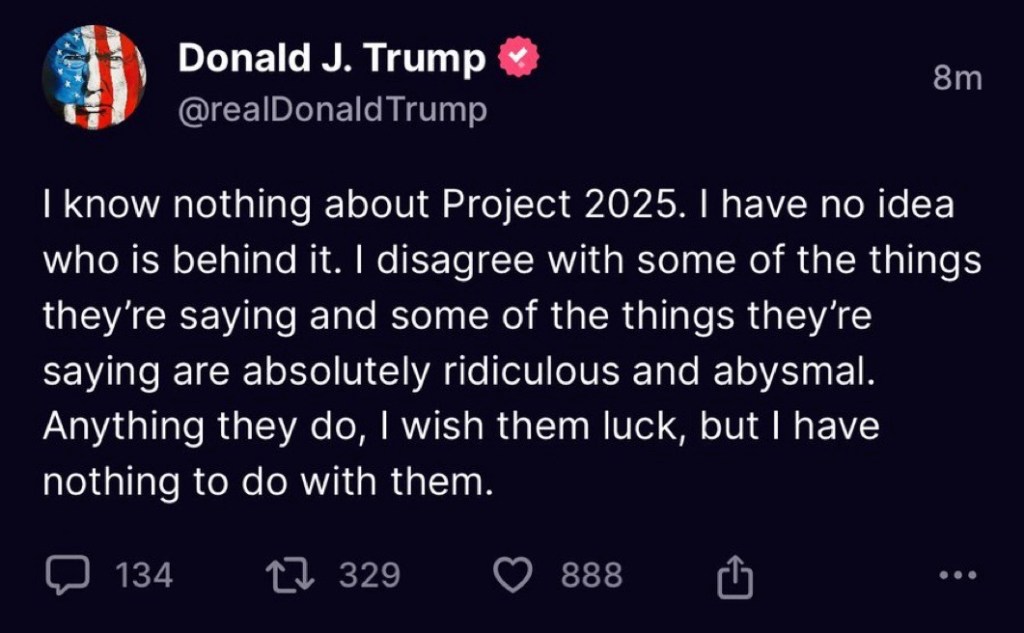
Blogger Aaron Rupar, writing at “Public Notice,sums up the goal of Project 2025, which is a lengthy tome describing the plans of the next Trump administration. The main goal, Rupar writes, is to abolish the 22nd Amendment—the one that sets limits for Presidents at two terms. Their hope: Trump for life. In recent days, Trump insisted that he knows nothing about Project 2025 or those who wrote it. That’s hard to believe since the authors served in his administration, and the project was sponsored by the Heritage Foundation. There’s a photo of Trump shaking hands with Kevin Roberts, the President of the Heritage Foundation, on the Heritage Twitter feed. Trump must have forgotten that he knows him.

Rupar writes:

Project 2025, the Republican plan to functionally annihilate not just the federal government but democracy as well if Trump wins in November, is an unceasing parade of horrors. 

Banning the abortion pill nationwide? Check. Rolling back protections for LGBTQ people? Check. Deporting literally millions of undocumented immigrants? Check. But amid each objectively horrible aim is an even more more insidious one: abolishing the 22nd Amendment, which limits presidents to two terms. It’s an unvarnished, right-out-in-the-open plan to keep Trump in office well past 2028. 

It’s not as if this is genuinely unexpected. By July 2019, Trump had “joked” at least six times about being president for life. Floating that as a possibility, as Peter Tonguette did last week over at The American Conservative, is a great opportunity to show fealty to a candidate who values loyalty over all else. 

The American Conservative is a “partner” of Project 2025, along with such luminaries as Stephen Miller’s America First Legal law firm (currently suing everyone over the mildest of diversity efforts) and the Claremont Institute, which gave us Christopher Rufo and Moms for Liberty.

As Media Matters notes, the reasoning in Tonguette’s piece is dubious at best, but that doesn’t really matter. Project 2025 doesn’t rest on solid law, respect for democracy, or an understanding of history. It rests only on the notion that Trump should be allowed to exhibit raw, vicious, and unchecked power. 

Tonguette’s piece doesn’t even bother with the pretense that getting rid of the 22nd Amendment would strengthen democracy overall. Instead, the piece is predicated on the utterly unfounded notion that when the amendment was passed, no one could have foreseen that a president would be elected to nonconsecutive terms.

While Tonguette does mention Grover Cleveland, who every schoolchild learns did indeed serve two nonconsecutive terms, he seems to think that people were perhaps unaware of him when the 22nd Amendment was passed in 1951. Tonguette handwaves away the existence of Cleveland by simply writing, “In modern times, it is virtually inconceivable that any of the ousted one-term presidents would have seriously thought of running anew against the same opponent (now the occupant of the White House) who had bested them four years earlier.” 

It’s also inconceivable that millions of Americans would line up for a candidate who incited an insurrection, is facing 91 criminal charges, was found liable for sexually abusing E. Jean Carroll, and was just recently rich-guy panhandling to pay his massive bond to appeal his civil fraud penalty in a different case, but here we are. 

Embracing autocracy … for this guy?

Like many other projects of the modern Republican Party, a newfound loathing of the 22nd Amendment is wildly hypocritical. 

Though there were multiple unsuccessful pushes for presidential term limits before the passage of the 22nd amendment, the GOP House majority prioritized the issue after Franklin Delano Roosevelt’s death in 1945. No Republicans broke the party line during key congressional votes on the amendment, but they were helped along by southern Democrats who were mad that President Harry Truman continued FDR’s liberal economic policies.

To be fair, vaguely kicking around the idea of a third term has been standard procedure for a lot of two-term presidents, with President Barack Obama saying he thought he would likely have won a third election and President Bill Clinton saying he would probably have run for a third term if possible. However, the only serious push for a third term came from President Ronald Reagan, who said in 1987 that he “would like to start a movement” to repeal the amendment because it interfered with the right to “vote for someone as often as they want to do.” Reagan said he didn’t want this for himself but would press for it going forward, but like many things he said, that was somewhat less than truthful, as Republicans fundraised off the possibility of a Reagan third term starting in 1986.

Returning to Tonguette’s argument, it rests largely on his assertion that Trump is incredibly, historically popular, so he should get a third term. This, of course, ignores the fact that Trump is not actually that popular. He lost the popular vote in both 2016 and 2020. In 2016, Hillary Clinton trounced him by 2.87 million votes, while in 2020, Biden bested him by over 7 million.

🚨 Subscribe to Public Notice 🚨

Project 2025 is about enshrining minority rule

Much of the post-2020 discussion from Republicans — the parts not about unhinged conspiracy theories — has centered around outrage that anyone could disregard Trump’s 74 million votes. It’s unclear what conservatives mean by that, save for that even when they have less support and don’t win elections, they should still run things. 

And that’s what Project 2025 is all about. Republicans want to permanently enshrine their minority policies into law despite the fact that what they want is broadly unpopular. Fifty-nine percent of Americans want abortion to be legal. Over half of registered and likely voters do not want to vote for someone who makes robbing transgender youth of health care their core issue. Nearly three-quarters of American adults want the government to take bold steps to fight climate change. 

Project 2025 is all about enacting minority rule in America immediately upon Trump’s election. To do so, Trump would first need to gut civil serviceprotections, which ensure that federal workers don’t have to adhere to the politics of any given president.

Trump tried this at the end of his term, issuing an executive order that would have made thousands of federal civil servants at-will employees. When he didn’t win a second term, he didn’t have time to implement it. Those apolitical employees — as many as 50,000 people — would be replaced with Trump loyalists. Power would be wholly consolidated in the executive branch. 

Of course, Republicans hate that the executive branch, currently led by a Democratic president, wields any power and have been engaged in a decades-long project to dismantle the administrative state. Conservatives on the Supreme Court are helping along nicely with this project. But that pendulum would swing the other way fast if Trump retakes power, at which point conservatives will again love consolidating all power in the executive branch because the administrative state will be completely beholden to Trump. 

Comparisons to historic fascist leaders once felt overblown, but with Trump declaring he’d be a dictator on day one of his presidency, those comparisons no longer seem so hyperbolic. However, Trump has much more modern analogs. Russia’s Vladimir Putin has thrashed that country’s nascent attempts at democracy, amending the constitution twice to allow him to stay in power as long as he wants. With his most recent victory last month in an election that was really no election at all thanks to widespread coercion and censorship, Putin may end up being ruler for life.

Then there’s Benjamin Netanyahu, Israel’s prime minister. In the summer of 2023, he forced a vote to curtail the power of Israel’s Supreme Court, a project his conservative government had been pursuing for months because the court doesn’t vote in lockstep with his goals. There’s also the fact that Netanyahu, like Trump, faces corruption charges and needs to be sure the courts can’t take action against him.

And finally, there’s Hungarian Prime Minister Viktor Orbán. Orbán has been the king of the culture wars in a way that Republicans can’t get enough of. In 2022, he gave a speech joking about gas chambers and warning against Europeans becoming “peoples of mixed race.” Unsurprisingly, this did not result in him getting disinvited to the Conservative Political Action Conference a short while later. Instead, Republicans loved his nationalist rhetoric so much that there is now a CPAC Hungary, where in 2023, Orbán complained about “the woke movement and gender ideology.” 

If you want a preview of what would happen in a second Trump term, look to Hungary, which now bans anything with LGBTQ content whatsoever being shared with minors, and where the constitution was amended in 2020 to define “family” only as “based on marriage and the parent-child relation. The mother is a woman, the father a man.” Orbán also hates migrants and refugees, saying that people fleeing from war in places like Syria are a threat to Christianity. He has said he will defend Hungary against “tens of millions” of immigrants. 

Trump’s vision for America is impossibly grim. It’s fueled by hate and disrespect for democracy, and the only way it can be stopped is at the ballot box in 2024, so that Project 2025 never comes to fruition.


Voucher advocates are justly frightened of state referenda. They claim that “polls show” that vouchers have public support. They don’t. The voucher forces know that every state referendum about sending public money to private schools has failed. In state after state, vouchers have been turned down by voters, typically by large margins.

I wrote a few days ago that concerned citizens in Arkansas were trying to collect enough signatures to get a referendum on the ballot for voucher school accountability. They were outmatched by big money. More than $1 million in spending defeated $8,217.

Supporters of public schools in Arkansas wanted the state to hold voucher schools to the same accountability standards as public schools. Why not? The voucher lobby has boasted for years about the superiority of private and religious schools. But the lobby goes to great lengths to shield those wonderful private schools from taking the same tests as public schools! The evidence is in: when poor kids use vouchers, they fall behind their peers in public schools. In Arkansas right now, almost all the voucher money is going to kids who never attended public schools.

Despite the efforts of some 1,200 volunteers in Arkansas, they collected only about 70,000 of the 90,704 signatures needed to put the referendum on the ballot this November. They promise to try again in 2026.

The anti-voucher group is called For AR Kids, which includes the Arkansas Conference of the NAACP, Arkansas Education Association, Arkansas Public Policy Panel, Citizens First Congress, Arkansas Retired Teachers Association and Stand Up Arkansas.

Opposition to the referendum was funded by the multibillionaire Walton family and the multibillionaire Jeff Yass from Philadelphia.

The Arkansas Advocate reported:

The measure faced opposition from Arkansans for Students and Educators and Stronger Arkansas, two ballot question committees with close ties to the governor. Additionally, the measure was opposed by Family Council Action Committee 2024, which like Stronger Arkansas also opposes the proposed abortion and medical marijuana amendments.

Arkansans for Students and Educators and Stronger Arkansas have received a total of $986,000 and $375,000, respectively, in campaign contributions, according to June financial disclosure documents. Meanwhile, For AR Kids received a total of $8,217 from donors.

Bottom line: the billionaires spent about $1.3 million to protect voucher schools free of any accountability.

The anti-voucher group had $8,217 to spend in hopes of getting the same standards for voucher schools and public schools.

Unfair. Unethical. Shameful.

Senator Bernie Sanders issued a report lambasting the billionaires who are funding the voucher movement. It’s good that someone in Washington, D.C., is paying attention to this mean spirited effort to shift public money to private and religious schools. As scholar Josh. Owen has repeatedly demonstrated, voucher schools have been a disaster for low-performing kids. The main beneficiaries are students from wealthy families whose children are already enrolled in no public schools. Texas is not mentioned in the Sanders release, but billionaires DeVos, Yass, and native Texan billionaires used their wealth to oust anti-voucher Republicans.

Common Dreams reports:

Sen. Bernie Sanders released a report Tuesday detailing how right-wing billionaires are bankrolling coordinated efforts to privatize U.S. public education by promoting voucher programs that siphon critical funding away from already-underresourced public schools.

The report notes that last year, the American Federation for Children (AFC)—an organization funded by former Trump Education Secretary Betsy DeVos—”ousted state lawmakers in Iowa and Arkansas who resisted proposals to subsidize private education in states and passed expansive private school vouchers.”

Aided by millions of dollars in funding from DeVos and her husband, “AFC’s political affiliates and allies spent $9 million to win 277 out of 368 races to remove at least 40 incumbent lawmakers,” the report adds.

The DeVos family is hardly alone in using its wealth to undercut U.S. public education. The Bradley Foundation, which has been knee-deep in efforts to privatize education in Wisconsin and across the country, spent $7.5 million in 2022 “to fund 34 state affiliates of the State Policy Network to push conservative policy agendas, including privatizing education, and $8.3 million to building a youth movement to ‘win the American Culture War.'”

“The Koch-sponsored group, American Encore, has funneled substantial amounts into state governor races and ballot initiatives around the country, including more than $1.4 million to elect Arizona’s former governor Doug Ducey in 2014 (who led the efforts to create the nation’s first universal private school voucher),” the report adds.

“For too long, there’s been a coordinated effort to sabotage our public schools and privatize our education system. Unacceptable.”

The analysis also names billionaires Jess Yass of Susquehanna International Group, Richard Uihlein of Uline, and Bernard Marcus of Home Depot, all of whom have recently donated to the School Freedom Fund—a PAC that supports voucher programs and shuttering the U.S. Education Department.

School voucher programs disproportionately benefit wealthy families, analyses have shown, while undercutting the goal of serving all students within a community.

Governor Sarah Huckabee Sanders and the Arkansas, which has a Republican supermajority, passed a voucher plan that allows the state’s voucher schools to evade the accountability required of public schools.

Outraged citizens have been gathering signatures for a referendum that would subject voucher schools to the same accountability as public schools. Today is the deadline to submit signatures. We will know soon if the rebellion against voucher schools’ freedom from accountability succeeded.

The Arkansas Times reported.

Organizers are racing to try to meet the signature threshold for an ambitious ballot initiative that would dramatically reorient the state’s K-12 education priorities and hold private schools receiving public funds to the same standards as those for public schools.

They still need thousands of signatures and face an uphill climb to meet the threshold by the July 5 deadline. We won’t know until the bitter end whether or not the group manages to get over the hump (more than a thousand volunteers are working at events across the state over the next 24 hours).

But I think it’s worth taking a moment to examine the stakes. The Arkansas Educational Rights Amendment would force the legislature to make real commitments to areas of educational need with a proven track record of improving learning outcomes. And it would force accountability on the governor’s voucher scheme, which is funneling tens of millions of dollars in taxpayer money into the pockets of private school families via a program with a long history of catastrophic failure in improving learning outcomes when states actually take the trouble to fairly measure and transparently report results at the private schools.

At a time when Republicans have total control of state government and Gov. Sarah Huckabee haughtily rules as if she has an infallible and possibly divine mandate, the education amendment would be the most comprehensive and far-reaching progressive policy victory in Arkansas since Medicaid expansion passed more than a decade ago.

Legislating by direct democracy

The education amendment is somewhat unusual for a ballot initiative, which usually present relatively straightforward “up-or-down” questions on issues like the minimum wage, casinos, weed, etc. The ballot initiative currently collecting signatures to reverse the state’s abortion ban is like that. Yes, there are details — abortions are allowed up to 18 weeks and for certain exceptions such as rape, incest and saving the life of the mother — but the fundamental issue is a yes-or-no question about whether or not abortion should be legal.

If someone wants to quibble with the headline above and say that the abortion initiative would be the biggest win in terms of liberal priorities in the state, I wouldn’t argue much. But it’s different in kind. The education amendment lays out a very broad-reaching slate of priorities and then would force the Legislature to act. It doesn’t articulate just how lawmakers should go about implementing it. It just establishes certain areas that are an absolute priority — required by law — tying lawmakers hands. The ripple effects through every aspect of the budget would be massive. It would steer the state toward a massive policy project that state leaders don’t want to do. The Legislature has prioritized vouchers and tax cuts skewed toward the wealthy and ignored issues like access to pre-k. If the public votes for this constitutional amendment, it would mandate that the Legislature make new tradeoffs.

This is why Arkansas Republican lawmakers are not fans of direct democracy. The overwhelming majority of voters in the state are going to back the candidate with an “R” by their name. But that doesn’t mean they share their narrow ideological obsessions. They will happily vote for minimum wage increases by huge majorities even if their elected officials hate it. With the advent of one-party rule, the state’s government is not responsive to issues that voters care about that don’t align with doctrinaire right-wing dogma. That’s why you’re seeing more expansive efforts to legislate from the bottom up via ballot initiative. Pre-k is popular; vouchers are not.

Equal standards and transparency for public and private schools getting vouchers

The push to put the education amendment before voters comes in the first year of Arkansas LEARNS, the education overhaul backed by Gov. Sarah Huckabee Sanders and passed by the Republican supermajority in the Legislature last year. Among the law’s most controversial provisions was the creation of a voucher program to help families cover the tuition and other costs of private schools. The program began this year and will be phased in until all K-12 students in the state are eligible to apply starting with the 2025-26 school year.

One curious feature of LEARNS is that the accountability measures it establishes for private schools accepting vouchers are not the same as those for public schools. The amendment would seek to reverse that, insisting on the same accreditation and testing for all schools receiving public funds, as well as public reporting by school of the results. This would allow citizens to see how well the voucher program is working as compared to public schools and help guide parents.

In the early days of voucher programs, advocates wanted to arrange apples-to-apples comparisons of student performance because they thought the voucher students would perform better. But once voucher programs scaled up to statewide efforts, the results were awful: Students who switched from public school to private school via voucher saw their test scores plummet to an unheard of degree — akin to the learning loss associated with a natural disaster like Hurricane Katrina or the COVID pandemic.

You might think such empirical results would give voucher advocates pause, but instead they shifted gears to trying to keep the test results secret or making comparisons impossible. Like many other new voucher programs in red states sweeping the country, Arkansas allowed private schools receiving boatloads of public money to arrange their own standards and tests, with none of the results made public. What could go wrong?

The irony here is that voucher advocates were often the ones screaming loudly about the need for accountability via testing in public schools, and pointing to those very results to disparage the quality of education in public schools. So you wind up with this very strange two-step: Voucher advocates will say something like, “these public school standards have led to lots of kids being below grade level in reading, let’s try something new.” But the measurement of how many kids are at grade level in reading is itself something we know via the standards, assessment and reporting! If voucher advocates claim to want to improve on these metrics, why wouldn’t we measure and report them at private schools, too?

I’ll let you know what happens. Republicans are terrified of voucher referenda: They always lose. To the extent that the public learns that voucher schools are actually worse than public schools and that the primary beneficiaries of vouchers are private school families whose children never attended public schools, the more likely that the public will oppose vouchers. Sending public money to private schools has never won a state referendum.

As you might have noticed, the mainstream media has not paid much attention to the reckless privatization of America’s public schools. This “movement” is a response to billionaire dollars, not to public demand. The beneficiaries are students who were already enrolled in private schools, whose parents can afford the tuition, not poor students.

It’s rare when a major TV show or newspaper features a story on the billionaire funded effort to destroy our nation’s public schools.

CNN recently aired a segment showing how Arizona was sending millions of dollars to voucher schools that discriminate against certain groups of students, while underfunding the public schools that most children attend and that accept everyone.

The feature story aired on Anderson Cooper’s CNN program. Even Ja’han Jones, who writes the blog for Joy Reid’s show, noticed the story.

CNN pointed out that rightwing evangelical churches are expanding as nearby public schools are drained of resources.

CNN reported:

Near the edge of the Phoenix metro’s urban sprawl, surrounded by a wide expanse of saguaro-studded scrubland, Dream City Christian School is in the midst of a major expansion.

The private school, which is affiliated with a local megachurch where former President Donald Trump held a campaign rally this month, recently broke ground on a new wing that will feature modern, airy classrooms and a pickleball court. It’s a sign of growth at a school that has partnered with a Trump-aligned advocacy group, and advertises to parents by vowing to fight “liberal ideology” such as “evolutionism” and “gender identification.”

Just a few miles away, the public Paradise Valley Unified School District is shrinking, not expanding. The district shuttered three of its schools last month amid falling enrollment, a cost-saving measure that has disrupted life for hundreds of families.

One of the factors behind Dream City’s success and Paradise Valley’s struggles: In Arizona, taxpayer dollars that previously went to public schools like the ones that closed are increasingly flowing to private schools – including those that adopt a right-wing philosophy.

Arizona was the first state in the country to enact a universal “education savings account” program – a form of voucher that allows any family to take tax dollars that would have gone to their child’s public education and spend the money instead on private schooling.

A CNN investigation found that the program has cost hundreds of millions of dollars more than anticipated, disproportionately benefited richer areas, and funneled taxpayer funds to unregulated private schools that don’t face the same educational standards and antidiscrimination protections that public schools do. Since Arizona’s expanded program took effect in 2022, according to state data, it has sent nearly $2 million to Dream City and likely sapped millions of dollars from Paradise Valley’s budget.

And Arizona is hardly alone: universal voucher programs are sweeping Republican-led states, making it one of the right’s most successful efforts to rewrite state policy after decades of setbacks.

This expansion of vouchers in red states was facilitated by millions of dollars spent to fund far-right legislators in state races by Betsy DeVos’s American Federation for Children and other billionaires, like Jeff Yass, a Trump supporter and the richest man in Pennsylvania. Yass said to CNN: “School choice is the civil rights issue of our time,” an oft-cited but phony claim.

In fact, school choice benefits the haves, not the have-nots, and it encourages segregation. Schools choose, not students or families.

In an internal presentation obtained by the progressive watchdog group Documented and provided to CNN, AFC boasted that it had “deployed” $250 million “to advance school choice over the last 13 years,” and that that spending had led to “$25+ billion in government funding directed towards student choice.” 

In 2018, nearly 2/3 of Arizonavoters rejected universal vouchers. Koch-funded Governor Doug Ducey kept pushing them, ignoring the will of the voters, and they were adopted in 2022. Now every student in the state can get a voucher, and most who take them come from families that can afford to pay their own tuition bills.

But unlike some other states that have adopted voucher programs, Arizona has no standardsrequiring private schools to be accredited or licensed by the state, or follow all but the most basic curriculum standards. That means there is no way to compare test scores in public schools to students in the ESA program.

“There’s zero accreditation, there’s zero accountability, and there’s zero transparency,” said Beth Lewis, a former teacher who leads an Arizona nonprofit that advocates against school privatization.

Arizona’s voucher program is busting the state’s budget. The state is facing a $1 billion deficit, caused largely by funding private schools that are discriminatory and whose academic progress is unknown.

On the other side of the Phoenix metro area, the private Valley Christian Schools received nearly $1.1 million in ESA funding last year despite facing allegations of LGBTQ discrimination in federal court. Valley Christian fired high school English teacher Adam McDorman after he voiced support for a student who came out as pansexual, McDorman alleged in a 2022 lawsuit. In an email that McDorman provided to CNN, the school’s then-principal argued that the idea that it was possible to be both “homosexual or otherwise sexually deviant and also a Christian” was a “hideous lie.”

Public schools are barred from discriminating against students because of characteristics like their religion or sexuality, but no such rules cover private schools. In court documents, Valley Christian lawyers have argued that the school had the religious liberty to fire McDorman. The school declined to comment because the case is pending.

In an interview, McDorman said his former school taught creationism as a scientific fact, and “whitewashed” American history to downplay the harms of slavery. He was surprised to learn about the level of public funding it was receiving.

Will the defunding of public schools be an issue in the Presidential election? Trump will surely boast about the progress of.school choice. Will Biden speak up against this nefarious effort to destroy public schools?

Every time I see New Hampshire Governor Chris Sununu interviewed on CNN, he plays the role of the GOP “moderate.” Don’t be fooled. When it comes to education, he’s a clone of Betsy DeVos.

Veteran New Hampshire Garry Rayno pulls away the mask of “moderate” that Sununu wears in this article in InDepthNH.

This is an important article for everyone to read, no matter where you live. It explains succinctly the true goals of the privatization movement.

He writes:

Public education has been since its inception with the work of Horace Mann, the great equalizer.

Students from poor families have been able to compete with students from the other side of the tracks, maybe not in reality, but close enough to at least have an opportunity to excel.

Many of the founding fathers understood the need for an educated public if democracy was going to survive and thrive.

A responsible citizen is an informed citizen, and that appears to be the problem today. Too many people interested in power instead of governing don’t want a truly informed public. Instead, they want enough of the public spoon fed “alternative facts,” conspiracy theories, and outright lies to ensure they retain power although they have views that are both harmful to the majority of citizens and allow the tyranny of the minority to overturn the will of the majority.

At the heart of the minority’s transformation plan is the destruction of the public school system.

New Hampshire has had a front row seat to the war on education since Chris Sununu was elected governor and named his rival for the Republican nomination in 2016, Frank Edelblut, to be Education Commissioner, a man without any experience in public education, which was the first for someone holding that position in our lifetime.

If Sununu did not know what would happen when he put Edelblut in charge of this critical state department, shame on him, because Edelblut’s one term in the House was a roadmap for his actions during his two terms as commissioner, his second ending in March 2025.

Sununu has also packed the State Board of Education with school choice advocates instead of supporters of public education, so you have the two entities in the executive branch responsible for the state’s public education systems, maybe not anti-public schools, but certainly not advocates for the state’s public education system.

According to the statutes, the education commissioner “is responsible for the organizational goals of the department and represents the public interest in the administration of improving the effectiveness and efficiency of administrative and instructional services to all public schools in New Hampshire.”

Notice it says public schools, not private schools or religious schools, or homeschooling, or learning pods, or any of the other non-public entities that are approved vendors under the state’s Education Freedom Account program, some with questionable philosophies or intent.

An attempt by lawmakers this year to better define the education commissioner’s qualifications and responsibilities to the public school system was defeated this term by the same element that pushed to establish the EFA program and then to expand it, although this year’s attempt to increase the income threshold to participate in the program failed on the last day of the session to act on bills.

The outright attacks on public education began in New Hampshire about a decade ago but gained more warriors as FreeStaters/Libertarians swelled the ranks of the House and Senate Republican members.

The attack on public education here has been much the same as it has been in other states, mostly in the south and the west, with claims of the indoctrination of students by leftwing faculty members.

They have also attacked educators directly and have tried to pack school boards — without much success — to undermine curriculum, educators and slash budgets as happened in Croydon several years ago when the annual school meeting was poorly attended due to a snowstorm.

The Republican majority in the 2021-2022 legislature passed the state’s divisive concepts law forbidding teaching controversial subjects such as institutional racism.

The law was recently found unconstitutional by a US District Court judge.

That was the same term the EFA program was approved after earlier unsuccessful attempts.

Both the EFA program and the divisive concepts law were included in the state’s biennial budget package because they were not likely to pass on their own.

The same folks also tied education into the trumped out recent outrage over the LGBTQ community and sold it as an attack on parental rights.

The intent was to start a war between parents and educators, although parents already have many of the rights touted by the anti-public school advocates.

The theory touted was that educators were keeping information from parents about their students and their sexual identification and that educators were urging students to explore different sexual identities.

Then came the book banning other areas of the country experienced like Florida where some school libraries were stripped of books.

The red herring advocates touted here came from a national app that contains almost every book published that students could access both in schools and at home, and not on school library shelves.

Some tried to enlist town and city libraries in the surveillance of children and what they read and accessed, but that did not go very far.

All of this goes to create the appearance that schools are hotbeds of leftist politics and anti-parental values, some fueled by Edelblut in an op-ed he sent to media outlets.

And despite all this ginned up controversy, local public schools that educate about 90 percent of the school age children in the state remain very popular with parents and the public at large.

If that is true, you have to ask what is behind the push to demonize public schools like political candidates demonize opponents.

Keep in mind this attack on public education occurs at the same time when the superior court’s latest education funding decision says the state does not provide enough money to cover the cost of an adequate education for every student and the way it raises its biggest contribution to public education — the Statewide Education Property Tax — is unconstitutional.

Education is governments’ —not just state government’s — single biggest expense, costing about $3.5 billion a year.

If you are a Libertarian or Free Stater who believes “taxation is theft,” destroying public schools will shift the cost directly to parents, and you could keep a lot more of your money to spend as you see fit and not for the good of society.

And if you espouse the philosophy of the Koch Foundation or former US Education Commissioner, Betsy DeVos, you not only keep more of your money, one of the largest union-backed workforces in the country will be dismantled when certified teachers are no longer needed.

Without a public education system, a child would receive the education his or her parents could afford and for many, particularly minorities, and the historically poor, that may not be much beyond the time they turn 16 and have to go to work to keep the family treading the economic waters.

And then maybe they will work for a lot less than if they had a high school, or even a college education.

And without even an adequate education, how informed will the general public be or how capable of the critical thinking needed to realize all those folks touting their parental rights really do not have their best interests at heart.

Garry Rayno may be reached at garry.rayno@yahoo.com.

Distant Dome by veteran journalist Garry Rayno explores a broader perspective on the State House and state happenings for InDepthNH.org. Over his three-decade career, Rayno covered the NH State House for the New Hampshire Union Leader and Foster’s Daily Democrat. During his career, his coverage spanned the news spectrum, from local planning, school and select boards, to national issues such as electric industry deregulation and Presidential primaries. Rayno lives with his wife Carolyn in New London.

Marilou Johanek is a veteran journalist in Ohio. She writes here about the Republican politicians who used their power to impose universal vouchers on the state. The main beneficiaries are children of the affluent who are already enrolled in private and religious schools and who can already afford the tuition. The losers are the vast majority of public school students, whose schools are underfunded.

What does the future hold for states that skimp on the education of the next generation while lavishing billion-dollar subsidies on the families of the well-off?

Johanek writes:

My way or the highway may be your boss’s motto and your cross to bear. But if that is the mantra of publicly elected officials in a representative government — as it sure seems to be in Ohio — all of us have a problem. A big one. 

The political bosses in Ohio conduct the people’s business with take-it-or-leave-it ultimatums. They’re not running a democracy; they’re dictating decisions made. They do not entertain questions about their extremist agenda to ban invented threats, ignore real ones, claw back rights, reduce women to breeders, welcome polluters to state parks, or defund public education to pay for private schools. 

When challenged over their arguably lawless mandates, Ohio Republican leaders mount a full court press to dismiss, disparage, intimidate, and circumvent countervailing forces that dare confront absolute power. Consider the all-out effort of GOP chieftains to scuttle a statewide lawsuit challenging the constitutionality of the Republican fetish to fund private schools with hundreds of millions of apparently unlimited public tax dollars.

The partisans sprang into action to protect the $1-billion-dollar-and-counting boondoggle they created last year with universal vouchers that pay private school tuition for the affluent few at the expense of the many — a majority of Ohio students who attend traditional public-school districts. Ever since GOP lawmakers — led by Ohio Senate President and go-to financier of diocesan schools Matt Huffman — opened the government dole to any private school student with their voucher change slipped into the state budget, unaccountable public spending on private schools has exploded.

The amount of tax dollars going to students already attending private, mostly religious schools tripled the first school year uncapped voucher money was there for the taking. Many of the private school families sweeping up the easy cash earn north of $250,000 annually. The initial Republican rationale for diverting state educational funding from public to parochial schools was that the public handouts offered low-income families in failing school districts access to better school options. 

But that excuse was a ruse to subsidize religious education with taxpayer money and gradually starve public education of critical financial support. The flood of public funds to prop up Catholic schools came from the same general revenue pool that was supposed to keep public school districts afloat not be shortchanged by private education giveaways.  

The fallback for fiscally depleted districts is school levies that fail more often than not. Which, as every public school parent knows, means likely cuts to staff, extracurricular programs, student support services, and capital improvements, decades overdue, shelved again.

Little wonder that more than 200 school districts across Ohio have joined a growing coalition contesting the unprecedented release of public funds to every private school family — regardless of income or quality of home district — in a lawsuit bound for trial. 

They argue the private school “EdChoice” voucher expansion breaking the public education budget violates the state constitution by creating a separate, unequal and segregated school system of privatized education bankrolled with money the state is constitutionally obligated to spend on public education alone. Meanwhile public school students go to class in crappy buildings erected in the 1950s (because there’s no money to build a new ones) and enjoy fewer, if any, electives in music and art, or reading tutors, or enough counselors, AP course offerings, gifted services, or small class sizes, etc. 

The billion-dollar windfall to offset private school tuition many families can afford would be a godsend to public schools making do with less. God bless those who choose to send their students to expensive parochial institutions. But none of us agreed to collectively finance your private school choice that, frankly, serves a private interest, not a public one.

We agreed instead to fund what serves the greater good, not what satisfies individual preference. We do the same with other public services (besides free public education) when our taxes support local law enforcement, fire protection, mental health resources, metro park amenities and other community systems that benefit everybody. The lawsuit to strike down Ohio’s harmful universal vouchers recently added the Upper Arlington school district, in a suburb of Columbus, to its ballooning list of participants.

Ohio’s Republican Lt. Gov. Jon Husted personally pressured the district to pass on the legal fight before the school board voted to join it. Ohio’s Republican Attorney General Dave Yost tried and failed to get a Franklin County court to dismiss the voucher lawsuit altogether. Huffman, the architect of the school privatization scheme in the legislature, refused to sit for a lawsuit deposition. 

He even balked at submitting written answers. Finally, the Lima Republican appealed to the Republican-majority state supreme court (he engineered) to judge him above accountability per the litigation. The GOP my-way-or-the-highway bosses aren’t finished trying to out-maneuver public school advocates fighting for fair and equitable public funding. But their secret is out. 

In the school year that just ended, taxpayers forked over a billion dollars’ worth of tuition payments for a slice of well-off students enrolled in pricey private schools. That’s not okay with public school families eying another school levy or their kids will do without. The state’s autocrats bosses should be on notice; their take-it-or-leave-it dictate on universal vouchers went too far. 

It provoked a public education crusade willing to see you in court, Messrs. Huffman, Yost and Husted. So save the trial date. It’s Nov. 4. 

Jeff Bryant, veteran education journalist, writes here about the success of community schools in Chicago, in contrast to the failed ideas of “education reform.” The latter echoed the failed strategies of No Child Left Behind and Race to the Top: testing, competition, privatization, firing staff, closing schools, ranking and rating students, teachers, principals and schools based on test scores. So-called “education reform” created massive disruption and led to massive failure.

Bryant describes the evolution of community schools in Chicago, led by grassroots leaders like Jitu Brown, where parents are valued partners.

Bryant writes:

“Until now, we haven’t even tried to make big-city school districts work, especially for children of color,” Jhoanna Maldonado said when Our Schools asked her to describe what Chicago Mayor Brandon Johnson and his supporters have in mind for the public school system of the nation’s third-largest city.

Johnson scored a surprising win in the 2023 mayoral election against Paul Vallas, a former CEO of Chicago Public Schools (CPS), and education was a key issue in the race, according to multiplenewsoutlets. Maldonado is an organizer with the Chicago Teachers Union (CTU), which is reported to have “bankrolled” Johnson’s mayoral campaign along with other labor groups, and Johnson is a former middle school teacher and teachers union organizer. What Johnson and his supporters are doing “is transforming our education system,” Maldonado said. There’s evidence the transformation is sorely needed.

For the past two decades, Chicago’s schools experienced a cavalcade of negative stories, including recurring fiscal crisis, financial scandals and mismanagement, a long downward slide in student enrollment, persistent underfunding from the state, the “largest mass closing [of schools] in the nation’s history,” and a seemingly endless conflict between the CPS district administration and CTU.

Yet, there are signs the district may be poised for a rebound.

“The people of Chicago have had enormous patience as they’ve witnessed years of failed school improvement efforts,” Maldonado said. “And it has taken years for the community to realize that no one else—not charter school operators or so-called reformers—can do the transformation. We have to do it ourselves.”

“Doing it ourselves” seems to mean rejecting years of policy and governance ideas that have dominated the district, and is what Johnson and his transition committee call, “an era of school reform focused on accountability, high stakes testing, austere budgets, and zero tolerance policies,” in the report, “A Blueprint for Creating a More Just and Vibrant City for All.”

After experiencing more than 10 years of enrollment declines between 2012 and 2022, losing more than 81,000 students during this period, and dropping from its status as third-largest school district in the nation to fourth in 2022, CPS reported an enrollment increase for the 2023-2024 school year. Graduation rates hit an all-time high in 2022. The number of students being suspended or arrested on school grounds has also declined significantly. And student scores on reading tests, after a sharp decline during the COVID-19 pandemic, have improved faster than most school districts across the country. Math scores have also rebounded, but are more comparable to other improving districts, according to a 2024 Chalkbeat article.

Johnson and his supporters have been slowly changing the district’s basic policy and governance structures. They are attempting to redefine the daily functions of schools and their relationships with families and their surrounding communities by expanding the number of what they refer to as “sustainable community schools.” The CPS schools that have adopted the community schools idea stand at 20 campuses as of 2024, according to CTU. Johnson and his transition committee’s Blueprint report has called for growing the number of schools using the sustainable community schools approach to 50, with the long-term goal of expanding the number of schools to 200.

The call to have more CPS schools adopt the community schools approach aligns with a national trend where several school districts, including big-city districts such as Los Angeles and New York City, are embracing the idea.

Community schools look different in different places because the needs and interests of communities vary, but the basic idea is that schools should address the fundamental causes of academic problems, including student health and well-being. The approach also requires schools to involve students and their families more deeply in school policies and programs and to tap the assets and resources available in the surrounding community to enrich the school.

In Chicago—where most students are non-white, more than 70 percent are economically disadvantaged, and large percentages need support for English language learning and learning disabilities—addressing root causes for academic problems often means bringing specialized staff and programs into the school to provide more academic and non-academic student and family services, often called wraparound supports. The rationale for this is clear.

“If a student is taken care of and feels safe and heard and has caring adults, that student is much more ready to learn,” Jennifer VanderPloeg the project manager of CPS’s Sustainable Community Schools told Our Schools. “If [a student is] carrying around a load of trauma, having a lot of unmet needs, or other things [they’re] worrying about, then [they] don’t have the brain space freed up for algebra. That’s just science,” she said.

“Also important is for students to see themselves in the curriculum and have Black and brown staff members in the school,” said Autumn Berg, director of CPS’s Community Schools Initiative. “All of that matters in determining how a student perceives their surroundings.”

“Community schools are about creating a culture and climate that is healthy, safe, and loving,” said VanderPloeg. “Sure, it would be ideal if parents would be able to attend to all the unmet needs of our students, but that’s just not the system we live in. And community schools help families access these [unmet] needs too.”

Also, according to VanderPloeg, community schools give extra support to teachers by providing them with assistance in all of the things teachers don’t have time to attend to, like helping families find access to basic services and finding grants to support after-school and extracurricular programs.

But while some Chicago educators see the community schools idea as merely a mechanism to add new programs and services to a school’s agenda, others describe it with far more expansive and sweeping language.

“Community schools are an education model rooted in self-determination and equity for Black and brown people,” Jitu Brown told Our Schools. Brown is the national director of Journey for Justice Alliance, a coalition of Black and brown-led grassroots community, youth, and parent organizations in more than 30 cities.

“In the Black community, we have historically been denied the right to engage in creating what we want for our community,” Brown said.

In Chicago, according to Brown, most of the schools serving Black and brown families are struggling because they’ve been led by people who don’t understand the needs of those families. “Class plays a big role in this too,” he said. “The people in charge of our schools have generally been taught to believe they are smarter than the people in the schools they’re leading.”

But in community schools, Brown sees the opportunity to put different voices in charge of Chicago schools.

“The community schools strategy is not just about asking students, parents, and the community for their input,” he said. “It’s about asking for their guidance and leadership.”

It Started with Saving a Neighborhood

Chicago’s journey of embracing the community schools movement has been long in the making, and Brown gets a lot of credit for bringing the idea to the attention of public school advocates in the city.

He achieved much of this notoriety in 2015 by leading a hunger strike to reopen Walter H. Dyett High School in Chicago’s predominantly African American Bronzeville community. Among the demands of the strikers—Brandon Johnson was a participant in the protest when he was a CTU organizer—was for the school to be reopened as a “hub” of what they called “a sustainable community school village,” according to Democracy Now.

The strike received prominent attention in national news outlets, including the New York Times and the Washington Post.

But Brown’s engagement with the community schools approach started before the fight for Dyett, going back almost two decades when he was a resource coordinator at the South Shore High School of Entrepreneurship, a school created in 2001 when historic South Shore International College Preparatory High School was reorganized into three smaller campuses as part of an education reform effort known as small schools.

Brown was responsible for organizing educators and community members to pool resources and involve organizations in the community to strengthen the struggling school. He could see that the school was being “set up,” in his words, for either closure or takeover by charter school operators.

“School privatization in the form of charter schools was coming to our neighborhood,” he said, “and we needed a stronger offer to engage families in rallying to the school and the surrounding community.”

Brown pushed for the adoption of an approach for transforming schools that reflected a model supported by the National Education Association of full-service community schools.

That approach was based on five pillars that included a challenging and culturally relevant curriculum, wraparound services for addressing students’ health and well-being, high-quality teaching, student-centered school climate, and community and parent engagement. A sixth pillar, calling for shared leadership in school governance, was eventually added.

After engaging in “thousands” of conversations in the surrounding historic Kenwood neighborhood, where former President Barack Obama once lived, Brown said that he came to be persuaded that organizing a school around the grassroots desires of students, parents, teachers, and community members was a powerful alternative to school privatization and other top-down reform efforts that undermine teachers and disenfranchise families.

Brown and his collaborators recognized that the community schools idea was what would turn their vision of a school into a connected system of families, educators, and community working together.

Open the link to continue reading this important story.
Jon Valant and Nicolas Zerbino of the prestigious nonpartisan Brookings Institution examined the Arizona voucher program and were surprised to find that it was a giveaway to the richest families in the state.

Voucher advocates did not like their findings and tried to discredit their analysis.

They responded here.

In May, we released a short Brookings report showing which families are most likely to get voucher funding through Arizona’s now-universal Empowerment Scholarship Account (ESA) program. The analysis isn’t complicated, and the results couldn’t be much clearer. A highly disproportionate share of Arizona’s ESA recipients come from the state’s wealthiest and most educated areas. That’s an important finding, even beyond Arizona, since this program is at the forefront of a wave of universal voucher initiatives that’s currently sweeping across red states (and some purple states). What happens with Arizona’s program could foreshadow what’s to come in many parts of the country.  

These universal (or near-universal) programs are much more threatening to public education systems than the smaller, more targeted voucher programs that preceded them. They raise concerns about fundamental issues such as civil rights protections and the separation of church and state. Early research and reporting points to ballooning state budgetswasteful spending, and tuition increases from opportunistic private schools. Meanwhile, hardly anything in the academic literature suggests that universal ESA programs will improve student performance. And yet, the push to remake the U.S. education system in the form of universal school voucher programs continues.  

Having entered the fray with our own analysis of a universal ESA program, we’ve gotten a close look at the information environment surrounding these recent initiatives. Suffice to say, it isn’t healthy, at least if we hope for a functional policymaking process. A network of pro-voucher interest groups, think tanks, funders, and politicians are filling an information vacuum with misleading data, faulty or disingenuous arguments, and advocacy that masquerades as research.  

Here, we’ll respond to four critiques we’ve heard from that crowd. Part of our goal is to show why their specific critiques of our work are baseless, misleading, or just kind of odd. In doing so, we also hope to illuminate how dangerous the information environment surrounding universal ESAs has become now that many state leaders are dragging their education systems into uncharted territory based on little more than ideology, political calculation, and a fingers-crossed hope that the voucher advocates aren’t leading them astray.  

Here are the critiques: 

Critique 1: We got our analysis wrong because someone else found something different  

Our main results are probably best summarized by Figure 1, below, which appeared in our original post. 

FIGURE 1

The Arizona ZCTAs (ZIP codes, basically) with the lowest poverty rates have the highest share of school-age children who received an ESA. The ZCTAs with the highest poverty rates have the lowest rates of ESA take-up. It’s an extremely straightforward analysis, and we provide a detailed description of what we did in the piece

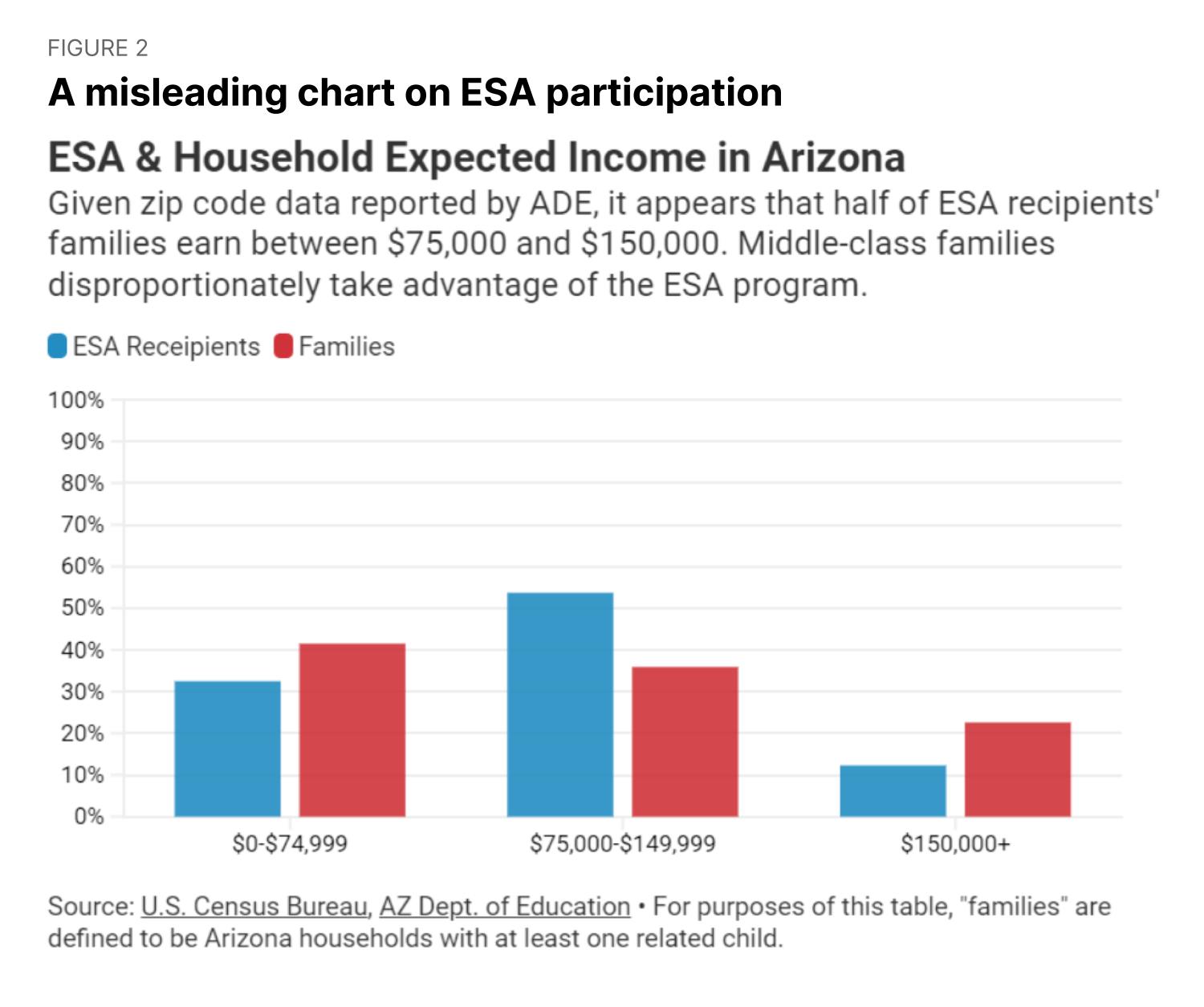
Before we published our post, an organization called the Common Sense Institute (CSI) of Arizona—a “non-partisan research organization” with several staff members from former governor Doug Ducey’s administration—looked into a similar question. CSI’s chart, below, tells a completely different story from our chart. 

A misleading chart on ESA particicpation

CSI makes it look like relatively few wealthy families in Arizona get ESAs. So, why the discrepancy?  

It’s because CSI presented an apples-to-oranges comparison that’s bound to tell that story. The data issue is subtle, but they present ZIP code-level data for ESA recipients (blue bars, on the left) and household-level data for families (red bars, on the right). Many households in Arizona make $150,000 or more, so the far-right, red bar is quite tall. However, few ZIP codes have enough households earning more than $150,000 that the median household income rises above that threshold. As a result, many ESA recipients who earn more than $150,000 aren’t included in the $150,000+ category in this chart. Instead, these households—which earn more than $150,000 themselves but live in ZIP codes where the median income is below $150,000—are included in one of the other blue bars.  

Maybe that’s an innocent mistake, but it’s certainly not an accurate representation of which Arizona residents are getting ESAs. 

Critique 2: We didn’t place Arizona’s ESA program in the proper context of its other school choice programs 

Education Next published an article from Jason Bedrick of the Heritage Foundation that accuses us of omitting key context that, if presented, would markedly change the takeaways from our analysis. Bedrick points out that Arizona’s universal ESA program exists alongside several tax-credit scholarship programs (true) and that families are prohibited from participating in the ESA and tax-credit scholarships simultaneously (also true). He then shares a few numbers, does some hand-waving, and concludes that our “fatally flawed” analysis is deeply misleading because of this omission. 

Curiously, Bedrick doesn’t show the relative size of the ESA and tax-credit scholarship programs in Arizona. Here’s the obvious chart to illustrate that comparison—one that EdNext maybe could have requested before publishing yet another round of Heritage Foundation talking points on ESAs:  

FIGURE 3

These tax-credit scholarship (TCS) programs are small relative to a large-and-growing universal ESA program that’s projected to exceed $900 million this year. On top of that, most TCS dollars are going to recipients above 185% of the federal poverty level—the threshold for reduced-price lunch eligibility. (One note: the most recent numbers available for the ESA program come from FY24, while the most recent numbers available for TCS programs come from FY23.)   

In other words, this critique—which really isn’t about the universal ESA program we analyzed in the first place—doesn’t even point to context that meaningfully changes the interpretation of our data.  

It’s important to emphasize, too, that our analysis was primarily about the high-income households that are obtaining a disproportionate share of Arizona’s ESAs. In that post, we tried to present data in the most straightforward, defensible way possible. If our goal had been to present the most damning data possible, there’s more we’d have said.  

Here’s a doozy of an example. According to U.S. Census Bureau data, Arizona has 300 ZCTAs with at least 250 children under age 18. (The other 60 ZCTAs are smaller, which makes them difficult to analyze.) Of those 300 ZCTAs, the one with the single-highest take-up rate for ESAs (236 of every 1,000 children) is the one with the single-highest median household income (about $173,000).  

Critique 3: Arizona’s ESA program is too new to assess who will participate 

Maybe the most peculiar response we’ve seen is from Mike McShane of EdChoice, who published an op-ed in Forbes.  

McShane appeals to Everett M. Rogers’ “diffusion of innovation” theory, which suggests that new technologies and ideas are adopted sequentially by different groups (from early adopters to laggards). McShane asserts that we should expect wealthier and more educated families to be the early adopters of a universal ESA program. He implores us to “think of the first people to own a personal computer, or a cell phone. They started with tech nerds and the wealthy, and eventually worked their way to everyone else.”  

Let’s play a game of “one of these things is not like the others” with personal computers, cell phones, and a universal ESA program. Yes, we’d expect wealthier families to be the first to buy computers and cell phones. Those things cost a lot of money. A universal ESA program gives you money. We might expect poorer families—with fewer resources and potentially worse public-school options—to jump first at that opportunity. Even the usual dynamic of uneven information diffusion is complicated in this context, as the ESA program was available to families with children in low-rated schools long before it became universal.  

Regardless, there’s reason for concern that vouchers will be more exclusively adopted by the wealthy over time. Jason Fontana and Jennifer Jennings studied the early implementation of a universal ESA account in Iowa. They found that private schools responded to ESA eligibility by increasing their tuition. If this response continues to play out, we might see desirable private schools becoming unaffordable to low-income families that cannot cover a growing gap between the value of their voucher and cost of enrollment. In the long term, this creates a risk of extreme stratification across the public and private sectors.  

Chile may provide a glimpse of that potential future. In a 2006 paper in the “Journal of Public Economics”, Chang-Tai Hsieh and Miguel Urquiola analyzed a universal voucher program in Chile. They found suggestive evidence that “the main effect of unrestricted school choice was an exodus of ‘middle-class’ students from the public sector… [which] had a major effect on academic outcomes in the public sector.” These patterns, along with widening achievement gaps between rich and poor, led Chile to drastically modify that program.   

Critique 4: We’re targeting ESA programs when the real villains are public schools 

A fourth set of critiques presents more conceptual arguments about education reform. Perhaps the most data-infused of these comes from The Goldwater Institute, which notes that Arizona spends a great deal of money to “subsidize public school instruction” for wealthy families. It accuses us (and/or others) of a double standard in how we object to using government funds to pay for wealthy students’ private schooling but not public schooling.  

We think this critique reveals just how far the rhetoric surrounding universal ESAs has drifted from Americans’ traditionally held views about education. Americans have long accepted—in fact, embraced—a double standard for public and private schools. Our public education system, with all its flaws, has been a foundational institution for supporting the country’s economic, social, and democratic well-being. Americans have found a rough consensus on how to approach K-12 education: provide free public schooling to everyone (including the wealthy!), allow families to pay for private education if they’d like to opt out of the public system, and maybe create a few opt-out opportunities via school choice policy for those unable to pay. 

We’ve entered a period in which conservative lawmakers are confronted with legacy-defining decisions about whether to abandon that long tradition and embrace universal vouchers at the risk of kneecapping their states’ public education systems. Worse, they’re doing it in a polluted information environment that has plenty of loud voices but hardly any credible research to guide or support their decision-making. Now that a few states—including Arizona—have taken that risky leap of faith, the least we can ask of other state leaders is to wait and see what happens