Archives for category: Vouchers

Mercedes Schneider’s reviews Betsy DeVos’s speech to her friend Jeb Bush’s Foundation for Educational Excellence.

Betsy and Jeb have this in common: They both hate public schools and have devoted their life to demeaning, belittling, and attacking the schools that 85-90% of American children attend. They are in love with consumer choice, and they would like nothing better than to direct public funds to religious schools, for-profit schools, cyber schools, and homeschooling.

As Mercedes notes, Betsy (or more likely, a speechwriter) discovered “A Nation at Risk,” The 1983 jeremiad that blamed public schools for the loss of industries to Germany and Japan. The report was written in the midst of the 1982 recession, and the commissioners decided that the schools were to blame for the downturn. When the economy recovered, no one bothered to thank the schools.

Betsy devoutly believes that choice will fix everything, but “A Nation at Risk” didn’t mention choice.

And she continues to ignore the evidence of the past 25 years of choice. Her home state of Michigan is overrun with charter schools, and its standing on NAEP fell from the middle of the 50 States to the bottom 10 from 2003 to 2013. The news out of the New Orleans all-Charter District throws cold water on the Charter Movement, as New Orleans continues to be a low-performing District in a low-performing State. The evidence on vouchers continues to accumulate, and it is not promising. In the most recent voucher studies, students actually lose ground. After three or four years, those who have not left to return to public schools catch up with their peers who stayed in public schools, but that’s probably because the weakest students left.

Now that Betsy is talking numbers, maybe she will pay attention to the research on charters and vouchers and admit that her favorite panacea is not working.

But I’m not holding my breath.

The Douglas County School Board voted unanimously to shut down its voucher program, the only one in the nation authorized by a school district. This was a big setback for the Koch brothers’ Americans for Prosperity, which lavished funding on the DougCo schools.

Douglas County is one of the wealthiest districts in the nation.

Anti-voucher parents and educators swept the rightwing school board out of Office in the November elections.

“The Douglas County school board Monday put to bed the district’s controversial Choice Scholarship program, ending a six-year battle to set up the nation’s only district-approved voucher program.

“The vote to end the voucher program, and the legal battle that went all the way to the U.S. Supreme Court, was unanimous: six to nothing. One board member, Kevin Leung, did not participate in the deliberations or the vote, fulfilling a campaign pledge that he would sit out the vote because he is a plaintiff in the lawsuit against the school district.

“Leung is one of four board members elected on a campaign pledge to end the voucher program. He initially asked to be excused from Monday’s meeting but was asked to be present as the board would also discuss its search for a permanent superintendent.

“The other three — Chris Ciancio-Schor, Anthony Graziano and new board Secretary Krista Holtzmann — all voted to end the program along with board President David Ray, Vice President Wendy Vogel and Board Treasurer Anne-Marie Lemieux.

“The Choice Scholarship was authorized in March 2011 by a conservative majority elected in 2009 and backed with tens of thousands of dollars in campaign donations from wealthy pro-voucher Republicans including Alex Cranberg of Aspect Energy and Ed McVaney, founder of software company JD Edwards.

“The program would have given a taxpayer-funded voucher, valued in 2015 at around $5,000, to up to 500 Douglas County students who lived in the district and attend Douglas County public schools for one year.

“The Choice Scholarship was the first in the nation to be authorized by a school district. Most voucher programs are created by state legislatures and are targeted to low income students in failing schools.

“Douglas County, the fifth wealthiest county in the nation, did not include an income qualifier for its voucher.

“Until recently, school board races have generally been low-key (and low-dollar) campaigns. But the big dollars spent in Douglas County and Denver on this year’s races signaled the beginning of radical change in those two school districts around the issue of school choice. In Douglas County, the hot button issue was the voucher program; in Denver, it was charter and “innovation schools.” The Denver school board hiked the number of charter schools from 17 to 60, beginning in 2010, and the number of innovation schools, similar to charters, from seven to 49.

“In June 2011, the parents group Taxpayers for Public Education filed for an injunction against the school district to block the program’s implementation. The case wound its way to the Colorado Supreme Court, which in 2015 ruled the program unconstitutional based on the state’s Blaine amendment, which bans the use of taxpayer dollars for religious purposes, including religious education.

“The district, the third largest in the state, with more than 60,000 students, received $1.8 million in donations for its legal expenses from the Daniels Fund and the Walton Family Foundation. The district appealed the Colorado high court’s decision to the U.S. Supreme Court, which sent the case back to the Colorado Supreme Court last June.

“Prior to Monday’s board vote, which took place just after 7 p.m., the board listened to more than an hour of pleas from those who wanted to make sure the new board members held to their pledge, as well as from those who wanted the voucher program to have a chance to work.

“During the board’s public comment period, every speaker who addressed the voucher program asked the board to end it.”

Here is the report from Chalkbeat Colorado.

“Public funds should not be diverted to private schools, which are not accountable to the public,” said board member Krista Holtzmann.

“The state Supreme Court, which during the summer was directed by the U.S. Supreme Court to revisit the case, will have the ultimate say in whether the legal challenge will end.

“However, the court usually does not consider moot cases, said Mark Silverstein, legal director for the ACLU of Colorado, a plaintiff in the case.

“The board’s action is a blow to conservative education reform advocates and voucher supporters in Colorado and across the country. Proponents of vouchers had hoped a victory at the U.S. Supreme Court would set a national precedent.

“The legal question at the center of the voucher debate is whether a local school district can send tax dollars to private-religious institutions. A majority of the schools that enrolled in the Douglas County voucher system, known as the Choice Scholarship Program, were religious.

“The state Supreme Court in 2015 ruled that the district could not because the Colorado Constitution forbids it. The U.S. Supreme Court gave voucher supporters renewed hope this year when, in a similar case, it issued a narrow ruling for a preschool run by a church.

“A network of voucher supporters has argued that such constitutional prohibitions, known as Blaine Amendments, are rooted in Catholic bigotry and are outdated.

“Americans for Prosperity, a political nonprofit [the Billionaire Koch brothers] that advocates for free-market policies including private school vouchers, announced Friday it was spending “five figures” to warn Douglas County parents about the board’s decision to end the program.

“The new school board must put the needs of school children before any political belief,” Jesse Mallory, the group’s Colorado director, said in a statement. “Ending this program before it even has a chance to succeed and provide real change in our communities would be extremely shortsighted. If the board believes they should deny children more educational opportunities, AFP-Colorado will hold them accountable.”

“Opponents of vouchers, who showed up in force Monday night, presented a lengthy list of claims against private schools and vouchers. Some argued that private schools discriminate against students. Others suggested vouchers were part of a scheme to privatize education.

“What happens to the educational quality of children in the community school where there is less money to work with because of the voucher outflow?” said one speaker, Barbara Gomes Barlow, who has grandchildren in Douglas County schools. “It is diminished. It’s a fiction to believe that vouchers open up choice for all students. They do not.”

“Monday’s meeting comes nearly one month after four anti-voucher candidates — Holtzmann, Anthony Graziano, Chris Schor and Kevin Leung — resoundingly won seats on the board. Their opponents campaigned to keep the legal fight alive.”

A new study of voucher programs across the country by the federal GAO found that the voucher programs were deficient in providing federal rights for student disabilities.

The GAO report says:

“Almost all of the 27 private school choice program websites provide a directory of participating schools and some provide guidance on selecting schools. However, GAO estimates that no more than half of all schools participating in any type of voucher program mention students with disabilities anywhere on their websites, according to GAO’s review of a nationally generalizable sample of websites of private schools in voucher programs. Further, GAO estimates that no more than 53 percent of private schools in voucher programs designed for students with disabilities provide disability-related information on their websites.

“GAO found private school choice programs inconsistently provide information on changes in rights and protections under the Individuals with Disabilities Education Act (IDEA) when parents move a child with a disability from public to private school. In 2001, the U.S. Department of Education (Education) strongly encouraged states and school districts to notify parents of these changes, but according to Education, IDEA does not provide it with statutory authority to require this notification. According to GAO’s review of information provided by private school choice programs, and as confirmed by program officials, in school year 2016-17, 83 percent of students enrolled in a program designed specifically for students with disabilities were in a program that provided either no information about changes in IDEA rights or provided information that Education confirmed contained inaccuracies about these changes. Officials from national stakeholder groups, private choice programs, and Education told GAO that some parents do not understand that certain key IDEA rights and protections—such as discipline procedures and least restrictive environment requirements—change when parents move their child from public to private school. Ensuring that quality information is communicated consistently and accurately to parents can help address potential misunderstanding about changes in federal special education rights.”

The results of the study are summarized here.

This is ironic because Secretary of Education DeVos boasted about vouchers for students with disabilities when she spoke to Jeb Bush’s Privatization Summit.

The summary:

“Of the 27 programs studied by the GAO, only 8 of the programs required private schools to comply with annual financial audits, meaning that the states funding the schools often had no clear understanding of the programs the investments are funding.

“The GAO also found that many of the programs lack accountability and transparency when it comes to disability protections, education standards, professional standards and information distributed to parents.

“Findings from the GAO report include:

“Only about half of the private schools participating in voucher programs provided special education or disability-related information on their websites, creating a significant problem for families making a decision about where to send their children.

“Private school voucher programs are inconsistently providing information on changes in key protections and rights under the Individuals with Disabilities Education Act (IDEA) when parents move a child with a disability from a public to a private school.

“83 percent of students who were enrolled in a program specifically designed for students with disabilities were enrolled in one that either provided no information or inaccurate information regarding the changes in IDEA rights.

“One third of the 27 programs operating in school year 2016-17 had no academic testing requirements and officials in two of the programs interviewed indicated that some private schools were unfamiliar or unequipped to administer standardized tests.

“Only one-third of the programs require schools to publically report test results.

“Only four programs provided information on the graduation rates at participating schools.

“Only an estimated 13 percent of all private schools participating in voucher programs provide student and school performance data on their websites.

“Just 17 of the programs required background checks on all employees or on employees with direct and unsupervised contact with children.”

Peter Greene has unearthed another libertarian, this one writing for CATO (founded by the Koch brothers), who explains why government should not run schools, but private corporations should.

Corey DeAngelis is a scholar (I know because he says so) who has had a busy couple of years suckling off various Libertarian teats. He’s a Fellow for the Cato Institute, policy adviser for the Heartland Institute, and a Distinguished Working-on-his-PhD Fellow at the University of Arkansas, all of this built on a foundation of a BBA (2012) and MA (2015) in economics from the University of Texas in San Antonio (because nobody understands education like economists). And while plugging away on that Masters, he worked first as the Risk Management Operations Coordinator and then the Fraud Coordinator for Kohl’s. So yet another education expert with no education background.

He also hangs out with the fine folks at the Foundation for Economic Education (FEE, not to be confused with the Jeb Bush FEE), where he writes pieces with catchy titles like “Legalizing Discrimination Would Improve the Education System” and “Governments Shouldn’t Even Certify Schools, Much Less Run Them.” So we should not be surprised to find his name attached to an article arguing that schools should belong to businesses.

A “Fraud Coordinator” for Kohl’s? Is that a security guard? Someone checking to see if customers are shoplifting? An accountant in the main office?

Carol Burris and Darcie Cimarusti of the Network for Public Education argue here that the candidates who forcefully stand up for public schools and speak out against privatization will win in November 2018.

Their evidence is the Elections of 2017.

Start with the remarkable results in Virginia.

“The most important race of 2017 was the hotly contested race for the governor of Virginia, in which a strong public education advocate, Democrat Ralph Northam, faced off against Republican Ed Gillespie. Gillespie fully embraced the entire DeVos agenda — charter expansion, online virtual schools, home schools, and vouchers in the form of tax credits and education savings accounts. There was not an inch of policy daylight between Gillespie and DeVos.

“This should come as no surprise. Gillespie received over $100,000 in campaign contributions from the DeVos family, including a donation from the Secretary’s husband, Dick DeVos. Americans for Prosperity, which is controlled by the Koch brothers, launched a digital video in which a charter school leader criticized Northam for being the vote that stopped the neo-voucher “educational savings accounts.”

“Northam, who was supported by the teachers union, has been a strong and consistent supporter of public education. As stated on his website, “Ralph took tie-breaking votes to protect Virginia’s public education from being raided with unconstitutional private school vouchers and to keep decisions about public charter schools in the hands of local school boards.”

“The election of Gillespie would have been a game changer for public education in the Commonwealth. Virginia is one of a handful of states that allow charter schools to only be authorized by local school boards. In Virginia, charters are subject to the same transparency guidelines as public schools in the state. There are only eight charter schools in Virginia, much to the chagrin of charter advocates.”

Northam, who calls himself a “friend of public schools,” will keep privatization out of the state and instead work to strengthen and improve Virginia’s public schools.”

Friends of public schools will win. Democrats who abandon public schools will not be able to take advantage of “The DeVos Effect.”

Some readers have asked for a copy of the speech that was so beautifully illustrated by the graphic posted earlier today.

I didn’t have a speech. I made notes and used them as talking points, on which I elaborated. When some in the audience (composed of progressives) insisted that charter schools were saving lives, I should have pointed out that the single biggest funder of charters is the anti-Union Walton Family Foundation, which is known for low wages and resistance to workers’ rights. About 95% of charters are non-union. The best kind of social justice that could be done by the Waltons is to pay their one million employees $15 an hour and allow them to unionize, in the stores and the charters they fund.

Here are my talking points.

“War on public sector.

“Take any public sector activity and google it with the word “privatization.”
Police, firefighters, prisons,hospitals, libraries, parks, schools—and what we once thought of as public is either privatized or under threat of privatization.

“Powerful movement—some driven by profit, some by libertarian ideology—seeks to shrink the public sector and monetize it.

“My area of specialization is education.

“There is today a full court press to privatize public education.

“How many in this room went to public schools?

“The fundamental purpose of public schools is to develop citizens, to sustain our democracy. To prepare young people to assume the duties of citizenship, to vote wisely, to understand issues, and to sit on juries.

“Our current obsession with standardized testing has corrupted the purpose of schooling. Clinton, Bush, Obama. We are now locked into a marketization approach to education: Testing, Accountability, competition, Choice. This is market-driven education, with winners and losers.

“The Bush program: NCLB. The same children were left behind.
THE Obama program: Race to the Top. Same as NCLB. Where is the top? Education is not a race.

“Test scores are fundamentally a reflection of family income and education. They are now cynically used by rightwing politicians to declare schools to be failures and set them up for privatization.

“Public education is one of the foundation elements of our democracy.
The movement to privatize public schools is a threat to democracy.

“Education Policy today is decided not by deliberation and debate but by big money.

“The Queen of Dark Money in education is now Secretary of Education.

“Betsy DeVos sees education as a Consumer good, not a civic responsibility
She has Compared choosing a school to choosing an Uber or choosing which food truck to buy lunch from. These are trivial choices, consumer choices. They are not public goods.
She really doesn’t understand the role of the public school in a community, as part of our democracy

“Dark Money, major philanthropies, and Wall Street billionaires have collaborated in attacking democratic control of schools. They have encouraged State takeovers, Charters, Vouchers. Private management. Mayoral control.

“Goals:

“School Choice, which promotes segregation by race and social class
Get rid of unions
Attacks on teaching profession.

“Venture philanthropies back Privatization: Gates, Broad, Walton, Arnold Foundation, Fisher Foundation, the Helmsley Foundation, the Wasserman Foundation, the Bloomberg Foundation, Dell Foundation, Jonathan Sackler, many more

“Dark Money funneled to state and local elections— by such groups as: Education Reform Now, Stand for Children, Families for Excellent Schools, Democrats for Education Reform, the Koch brothers, the DeVos family, the Walton family. All have the same goal: Privatization.

“Half the states now have vouchers for private schools, enacted by the legislature, despite the fact that vouchers have always been defeated in state referenda.

“Betsy DeVos paid for a voucher referendum in Michigan in 2000. It was defeated overwhelmingly. So Michigan went for unbridled Choice with charter schools, no district lines. 80% of the charters in Michigan operate for profit, more than any other state. Michigan’s standing on national tests dropped from the middle of the pack, to the bottom, between 2003 and 2013. Detroit is overrun with charters yet it continues to be the lowest scoring district in the nation.

“Milwaukee has public schools, charters, and vouchers, and all three sectors are low performing.

“Demand for vouchers is actually very low: Indiana, only 3% use them, less in Louisiana. Only 6% in charters. Yet every dollar for vouchers and charters is taken away from the schools that educate the great majority of children.

“Katherine Stewart in the current American Prospect: “Proselytizers and Profiteers.” Religious extremists in the voucher movement made “useful idiots of the charter movement.” Community public schools replaced by Corporate charter chains. Some of the biggest charter chains are owned and run by evangelicals and fundamentalists.

“The real Dark Money wants vouchers, religious schools, homeschooling, charters, anything but public schools.

“DeVos, American Federation for Children
Koch brothers, Americans for Prosperity (Libre Initiative) (AZ referendum)
ALEC— model legislation for charters, vouchers, ending certification, breaking unions.

“Public schools struggle where there is high poverty.

“Income inequality is the scourge of our society.

“Privatizing public schools won’t solve poverty.

“Hopeful signs:

*Virginia election: pro-public schools, many of the winning candidates are teachers

*Douglas County, CO, rebuff to vouchers

*upcoming referendum in AZ on vouchers, which Koch brothers want to knock off the ballot

*In 20 State referenda, vouchers have lost every single time.

*support for charters dropped from 51% to 39% in the past year, among both Democrats and Republicans, largely in response to scandals, prosecutions, and also NAACP criticism of charters.

“The origin of school choice was in segregated states fighting the Brown decision.

“Betsy DeVos is such a polarizing figure that she reminds us of the importance of public schools.”

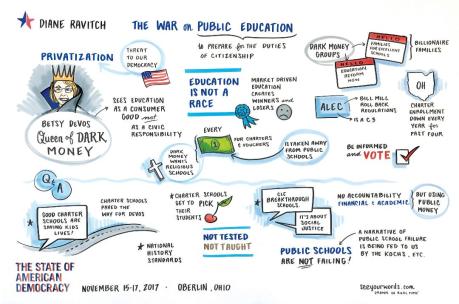
This fabulous graphic is a summary of my speech at the conference on “The State of American Democracy,” identified by the acronym SAD. The conference was sponsored by Oberlin College at the college in Oberlin, Ohio, and it will be held with different participants in three other locations over the next several months. I spoke about the “War on Public Education.” In my talk, I forgot to mention that more than 90-95% of charters are non-union, and that their primary sponsor is the Walton Family Foundation, which is anti-union. That was an important omission in an audience that is mostly comprised of progressives. Jonathan Alter, who is very knowledgeable about national politics, leapt up to defend charter schools and objected to being lumped in with the DeVos agenda, which includes both charter schools and vouchers; Jon loves KIPP. I cited Katherine Stewart, who said in her article in “The American Prospect” that religious extremists had made “useful idiots” of the charter movement.

Early in my talk, I asked how many of those in the room had gone to public schools, and about 90% of the 300 or so people raised their hands. That included the new President of Oberlin College, Carmen Twillie Ambar, who graduated from public schools in Little Rock, Arkansas. She is the first African American female president of this historic college.

This is the wonderful graphic that was created as I spoke, by a brilliant artist, Jo Byrne (seeyourwords.com):

devos

Betsy DeVos visited Douglas County before the recent election. She came, as expected, to promote vouchers. She met with a couple who had taken their child out of public school and placed him in a school for autistic children, where he is happy.

DeVos saluted their courage in seeking a different placement for their child.

But the parents are not pleased to be used as Betsy DeVos’ poster family for vouchers.

As Chalkbeat reported, the parents said they did not get a voucher for their child. The voucher would not have been much help for them. The school he attends costs $70,000 a year. The voucher, if it existed, would be worth $5,000.

“DeVos’s public words were particularly hard to take, Jennifer and Joe said, because they had met with the education secretary privately at her request. They were flattered by her interest, but felt she didn’t understand why private school vouchers would never work for them — or many other families who have children with disabilities.

“First, the dollar amount of most voucher programs is paltry compared to what it costs to pay for specialized private schools like Firefly. Tuition there is more than $70,000 a year.

“Say, there was a voucher system in place and let’s pick $5,000.” Jennifer said. “That’s not enough for placement at Firefly. It doesn’t do anything.”

“Jennifer and Joe, who own a company that sells industrial equipment, pay around half of Firefly’s tuition and their health insurance pays the rest, they said.”

With the sweeping victory of an anti-voucher slate in Douglas County, there won’t be any vouchers for the foreseeable future.

https://www.chalkbeat.org/posts/co/2017/11/15/parents-of-colorado-student-to-betsy-devos-we-are-not-a-poster-child-for-your-school-choice-agenda/

I intended to make this the only post of the day, but late last night I learned of the lawsuit in Florida challenging the disastrous HB 7069, a gift to charter operators.

So this is the last post you will see today. I want you to read it in full. The post was written by veteran journalist John Merrow with Mary Levy, a civil rights and education finance lawyer, and an education finance and policy analyst.

One of the key episodes in the short and divisive history of the corporate reform movement was the appointment of Michelle Rhee as Chancellor of the D.C. public school system. Rhee became the public face of the movement. Rhee was idolized by the media because of her take-no-prisoners style and her evident contempt for teachers and unions. Amanda Ripley wrote a cover story about Rhee for TIME magazine, which suggested that Rhee knew how to fix America’s schools. The cover showed her scowling and wielding a broom, ready to sweep out the bad teachers in D.C. Newsweek put her on its cover. I wrote a chapter about her in my book, Reign of Error, describing the adulation she received and the cheating scandal that broke on her watch. As it happened, Rhee identified one elementary school principal as exactly the kind of relentless, data-driven, no-excuses sort of person that she wanted more of. He received bonuses because of the incredible improvement of test scores. Incredible indeed, because his school was at the nexus of the cheating scandal, identified by the unusual number of erasures from wrong-to-right on standardized tests. He was soon gone. Immediately after Mayor Adrian Fenton was defeated in 2010, Rhee resigned, vowing to create a group called StudentsFirst, which would raise $1 Billion and enlist one million members. The name of the group typified Rhee’s divisive approach: education works best when students, teachers, parents, and the community work together. She never raised $1 Billion or one million members, but she actively supported vouchers and charters and gave substantial funding to candidates who would vote in the state legislature for privatization and against unions. She married the mayor of Sacramento, where she lives now. StudentsFirst merged with another anti-public school group.

But the myth of the transformation of the D.C. schools under Rhee and her successor Kaya Henderson lives on, Because to acknowledge the failure of teacher-bashing would harm the movement.

John Merrow contributed to the myth of Michelle Rhee, in a major way. To understand his credibility now, it is necessary to recognize his role in building that myth. As the PBS education correspondent, he featured her work in D.C. about a dozen times. He was a believer. But when he was doing his last show, a full hour about Rhee, he had an epiphany. Was it because she invited him to film her firing a principal? Was it the cheating scandal? Was it the effort to cover up the cheating? I don’t know. What I do know is that Merrow had the courage to change his mind. His admiration changed to doubt then to skepticism then to criticism. I understand his transformation because I have been there. I too once believed in what is deceptively called “Reform.” I saw the light. So did Merrow.

Merrow and Levy call this post “A Complete History” of Rhee’s reforms. It is one part of the history, but it is not THE Complete History. “The Complete History” would be a job of deep investigative research that would determine why Rhee, who had never been a principal or a superintendent and had taught only briefly in a privately-run contract school in Baltimore, was chosen to lead the D.C. system. It would examine the claims she made about the spectacular score gains in her classes (which G.F. Brandenburg debunked on his blog). It would investigate the negotiations among funders like Gates and Broad, who let it be known that their money would be cut off if Rhee left the district. It would delve into the district’s relations with the reactionary Walton Family Foundation, which targeted D.C. for charter saturation.

John Merrow’s knowledgeable perspective is important. The story is not all bad. He calls attention to the positive changes that occurred on Rhee’s watch. But where he comes down hard is on the mistaken idea that the route to success requires administrators who “crack down” on teachers, who offer rewards and punishments for teachers based on test scores. That strategy produces teaching to the test, score inflation, gaming the system, and narrowing the curriculum.

That is why this is the only post you are likely to see today. It is long, and it deserves your full attention.

Today, I am launching a new format for this blog.

You will not see five or seven posts. Or more.

You will receive only one post today, unless there is breaking news of great importance.

Instead of filling up your computer, I offer you one article that I hope you will read and digest and react to.

I am going to ask you to forward this article to your friends and colleagues, to anyone you know who cares about the future of this country.

Katherine Stewart just published a very important article that appears in The American Prospect called “The Proselytizers and the Privatizers.”

The subtitle is: “How religious sectarian school voucher extremists made useful idiots of the charter movement.”

She is also is the author of The Good News Club: The Christian Right’s Stealth Assault on America’s Children.

It is one of the most significant articles I have read in weeks about the current situation in American education.

It documents in detail how we have all been snookered by the religious right, who are now gobbling up taxpayers’ dollars to spread their doctrine.

It begins like this:

At the Heritage Academy, a publicly funded charter school network in Arizona, according to a lawsuit in U.S. District Court, high school students are required to learn that the Anglo-Saxon population of the United States is descended from one of the lost tribes of Israel. They are asked to memorize a list of 28 “Principles” of “sound government,” among which are that “to protect man’s rights, God has revealed certain Principles of divine law” (the ninth Principle) and that “the husband and wife each have their specific rights appropriate to their role in life” (the 26th Principle). To complete the course, students are further required to teach these principles to at least five individuals outside of school and family.

Over in Detroit, the Marvin L. Winans Academy of Performing Arts charter school—also taxpayer-funded—is a subsidiary of the Perfecting Church, a religious organization headed by Marvin L. Winans himself. Until recently, the board of WAPA consisted almost entirely of clergy, “prophets,” or prominent members of the Perfecting Church, and it appears that the views of the board are expressed directly in the practices of the school; students are required to recite a “WAPA Creed” that invokes “a super-intelligent God.”

In Texas, Allen Beck, the founder of Advantage Academy, a four-campus charter school funded by taxpayers, has said he established the schools in order to bring “the Bible, prayer, and patriotism back into the public school system, legally.”

And the American Heritage Academy, a two-campus charter school also located in Arizona, describes itself as a “unique educational experience with old-fashioned principles that have worked for hundreds of years.” The school boasts a list of “Principles of Liberty” that include “The role of religion is foundational,” “To protect rights God revealed certain divine laws,” and “Free market and minimal government best support prosperity.”

You might think that these egregious examples of church-school fusion are anomalies in the emerging charter school universe. But they are not. The charter school movement has provided shelter for religious and ideological activists who have specific theological and political goals for public education. Many of them are opposed to the very idea of public schools in the first place.

The Barney Charter Initiative’s former mission statement, which has since been taken down, declared that its goal was to “redeem” American public education and “recover our public schools from the tide of a hundred years of progressivism.” Here, a kindergarten class waits for recess at the Barney-supported Mason Classical Academy in Naples, Florida

To be clear, the charter movement in the United States is large, fragmented, and complex, and includes many individuals and groups that sincerely wish to promote and improve public education. Many charter advocates respect the separation of church and school. But a wing of the charter movement that is ideologically or religiously opposed to “government schools” was present at the charter movement’s creation, and has grown to comprise a sizable segment of the charter universe. With the election of Donald Trump and the appointment of Betsy DeVos as education secretary, it is presently empowered as never before.

In the decades before her appointment, DeVos was one of the primary architects of a First Amendment anomaly—the public funding of religious academies. In the months since she took the helm at the Department of Education, that still seems her first priority. Her meetings with educators have been populated with leaders and teachers from private, religious, and charter schools, as well as homeschooling advocates. Trump’s first budget allots $1.4 billion to bolster the school choice movement—enough funding to enable DeVos to ramp up her campaign for taxpayer-supported sectarian schools.

WHILE CHARTER SCHOOLS are supposed to be nonsectarian, many are run by operators with a distinctly religious or partisan political agenda. In order to understand the impact of this particular segment of the charter movement, one must begin with the history of the pro-voucher movement.

Vouchers first came to prominence as a way to funnel state money to racially segregated religious academies. In the aftermath of the Brown v. Board of Education decision of 1954, white Americans in the South organized massive resistance against federal orders to desegregate schools. While some districts shut down public schools altogether, others promoted “segregation academies” for white students, often with religious programming, to be subsidized with tuition grants and voucher schemes. Today, vouchers remain popular with supporters of religious schools, many of whom see public education as inherently secular and corrupt.

Vouchers are also favored among disciples of the free-market advocate Milton Friedman, who see them as a step on the road to getting government out of the education business altogether. Speaking to an audience at a convention of the American Legislative Exchange Council in 2006, Friedman said, “The ideal would be to have parents control and pay for their school’s education, just as they pay for their food, their clothing, and their housing.” Acknowledging that indigent parents might be unable to afford their children’s education in the same way that they might suffer food or housing insecurity, Friedman added, “Those should be handled as charity problems, not educational problems.”

Up in western Michigan, the combination of religious conservatism and economic libertarianism in the voucher movement found a natural home.
Up in western Michigan, the combination of religious conservatism and economic libertarianism in the voucher movement found a natural home. A century and a half ago, members of the Christian Reformed Church, a strict sect of Dutch Calvinists, settled the area around Holland, Michigan, where the conservative nature of the religion is still felt. Until several years ago, it was forbidden to serve alcohol at restaurants on Sundays. The area has also produced more than its share of ultra-conservative billionaires, among them Richard DeVos Sr., the co-founder of Amway; Jay Van Andel, his business partner; and Edgar Prince, an auto-parts magnate. In 1979, Prince’s daughter Betsy married Richard’s son, Dick Jr., making her Holland’s version of a crown princess.

Since the 1970s, Richard DeVos and his wife and children, including Dick and Betsy, have been major funders of the leading national groups on the religious right. Amway co-founder Van Andel, meanwhile, endowed and served as a trustee of Hillsdale College, which the religious right likes to cast as “the conservative Harvard.” In 1983, Betsy’s father, Edgar Prince, substantially contributed to the creation of the Family Research Council. The Edgar and Elsa Prince Foundation is a key backer to groups such as the Alliance Defending Freedom, the legal juggernaut of the religious right; and right-wing ministries and policy groups such as Focus on the Family.

The initiatives that Betsy DeVos and her husband have funded are not of the “social gospel” variety. Through their foundation, they donate money to the Foundation for Traditional Values, a nonprofit with a mission “to restore and affirm the Judeo-Christian values upon which America was established.” Shortly after its inception, the FTV distributed a book, America’s Providential History, which asserted, “A civil government built on Biblical principles provides the road on which the wheel of economic progress can turn with great efficiency.” A chapter titled “Principles of Christian Economics” posed the question “Why Are Some Nations in Poverty?” It goes on to explain that “[t]he primary reason that nations are in poverty is lack of spiritual growth. … Today, India has widespread problems, yet these are not due to a lack of food, but are a result of people’s spiritual beliefs. The majority of Indians are Hindus.”

In the mid-1990s, the FTV founded the Student Statesmanship Institute, which describes itself as “Michigan’s premier Biblical Worldview & Leadership Training for High School Students.” Betsy DeVos was listed on the SSI advisory board as recently as 2015, and has been featured as an active SSI program participant nearly as far back as the program had a functional website. SSI functions as a pipeline for Christian teens, many of whom are homeschooled or attend religious schools, seeking to engage in far-right politics. According to the SSI website, SSI “Legislative Experiences” instruct students in topics such as “Laying a Biblical Foundation, Ambassadors for Christ, Christian Citizenship, Worldviews in Action, Science and the Bible, and Debate and Communication.”

ADVERTISEMENT
James Muffett, who heads FTV and is also the founder and head of SSI, appears from time to time on the Christian homeschooling circuit, where public schools—or “government schools” as they are frequently called—are routinely maligned. He spoke at one homeschooling convention where attendees were invited to watch the anti–public education film IndoctriNation. The film casts public schools as “a masterful design that sought to replace God’s recipe for training up the next generation with a humanistic, man-centered program that fragmented the family and undermined the influence of the Church and its Great Commission.”

If you want to better understand why the pious elite of Holland, Michigan, think of public education the way they do, a good place to start might be the 2003 report from the Synod, or general assembly, of the Christian Reformed Church in North America. The church warns that “government schools” have “become aggressively and increasingly secular in the last forty years,” and claims they are engaged in “a deliberate program of de-Christianization” that is at odds with Christian morality. “Not only does there exist a climate of hostility toward the Christian faith,” the report continues, “the legitimate and laudable educational goal of multi-culturalism is often used as a cover to introduce pagan and New Age spiritualities such as the deification of mother earth (Gaia) to promote social causes such as environmentalism.” The report goes on to decry efforts, by “powerful lobbying groups” to resist “alternatives to public education such as charter schools and vouchers.”