Archives for category: Trump


SCOTUS, Explained is a newsletter written by senior correspondent Ian Millhiser. Check out more developments on the United States Supreme Court on our site.

Friends,

We just wrapped up another busy sitting at the Supreme Court — this week, the Court looks very likely to give another big win to religious employers, and maybe a little less likely to blow up Medicaid in order to spite Planned Parenthood.

But, rather than send you my write-ups of those two arguments, I will invite you instead to consider that it is unwise for Trump to target John, Brett, and Amy’s friends and law school classmates.

—Ian

Trump’s single most arrogant action

All nine of the Supreme Court justices are lawyers. All of them have friends and law school classmates in private practice. All of them sit at the apex of a legal system that depends on lawyers to brief judges on the matters those judges must decide. Many of them were themselves litigators at large law firms, where their livelihood depended on their ability to advocate for their clients without fear of personal reprisals.

So it’s hard to imagine a presidential action that is more likely to antagonize the justices President Donald Trump needs to uphold his agenda, not to mention every other federal judge who isn’t already in the tank for MAGA, than a series of executive orders Trump has recently issued. These actions aim to punish law firms that previously represented Democrats or clients opposed to Trump.

The lawyers targeted by these orders are the justices’ friends, classmates, and colleagues. It would likely be easy for, say, Chief Justice John Roberts or Justice Brett Kavanaugh to empathize with law partners who do the exact same work they once did.

The striking thing about all the law firm executive orders is that they barely even attempt to justify Trump’s decision with a legitimate explanation for why these orders are lawful.

The order targeting law firm Perkins Coie attacks the firm for “representing failed Presidential candidate Hillary Clinton” in its second sentence. The order targeting WilmerHale accuses it of engaging “in obvious partisan representations to achieve political ends,” as if Democrats do not have the same right to hire lawyers who advocate on their behalf that everyone else does.

The order targeting Jenner & Block justifies that attack because the firm once hired Andrew Weissmann, a prominent television legal commentator who, in the executive order’s words, engaged “in partisan prosecution as part of Robert Mueller’s entirely unjustified investigation” into Trump. Weissmann left Jenner in 2021.

The sanctions laid out in these orders, moreover, are extraordinary. They attempt to bar the firms’ attorneys and staff from federal buildings, preventing lawyers representing criminal defendants from engaging in plea bargaining with federal prosecutors — and potentially preventing lawyers who practice before federal agencies from appearing before those agencies at all. They also seek to strip security clearances from the firm’s lawyers, and to strip federal contracts from companies that employ the targeted law firms.

It’s hard to think of a precedent for this kind of sweeping attack on a business that did some work for a president’s political opponents. During the second Bush administration, a political appointee in the Defense Department criticized lawyers who represent Guantánamo Bay detainees and suggested that their firms’ clients should look elsewhere for legal representation. But that official apologized shortly thereafter. And he resigned his position three weeks after his widely criticized comments.

George W. Bush himself did not attempt anything even resembling the sanctions Trump now seeks to impose on law firms.

As Perkins Coie argues in a lawsuit challenging the order against that firm, these sanctions are an existential threat to the firms Trump is targeting. Perkins says that it “has nearly 1,000 active matters that require its lawyers to interact with more than 90 federal agencies,” and it fears it can’t continue many of those representations if it isn’t even allowed into the building to meet with government officials. Similarly, the firm says many of its biggest clients, including its 15 biggest clients, “have or compete for government contracts” that could be canceled unless those clients fire the firm.

Trump, in other words, is claiming the power to exterminate multibillion-dollar businesses, with over a thousand lawyers and as many support staff, to punish them for things as innocuous as representing a Democrat in 2016.

It’s hard to count all the ways these orders violate the Constitution. Perkins, in its lawsuit, alleges violations of the First Amendment right to free speech and free association, due process violations because it was given no hearing or notice of the sanctions against it, separation of powers violations because no statute authorizes Trump to sanction law firms in this way, and violations of their clients’ right to choose their own counsel — among other things.

The Trump administration has not yet filed a brief laying out its response to these arguments, but in a hearing, one of its lawyers claimed that the Constitution gives the president inherent authority to “find that there are certain individuals or certain companies that are not trustworthy with the nation’s secrets.”

Normally, when a litigant wants the courts to permit something that obviously violates existing law, they try to raise the issue in a case that paints them in a sympathetic light. But Trump has chosen to fight this fight on the most unfavorable ground imaginable.

There may be a perverse logic to Trump’s decision to fight on such unfavorable terrain. If he wins the right to punish law firms for representing a prominent Democrat a decade ago, it is unlikely that the Supreme Court will stop him from doing anything at all in the future. Most lawyers will be too scared of retaliation to even bring lawsuits challenging Trump’s actions. Already, one of the firms targeted by Trump, Paul Weiss, appears to have caved to him by agreeing to do $40 million worth of free legal work on causes supported by Trump’s White House. (Like Perkins, Wilmer and Jenner sued to block the orders targeting them.)

And, of course, if Trump’s endgame is to openly defy the courts, an obviously unconstitutional executive order targeting law firms that are in the business of suing the government is a good way to bring about that endgame quickly.

These stunning executive orders dare the courts to either make themselves irrelevant, or to trigger what could be the final showdown over the rule of law.

The anti-Thurgood Marshall strategy

If you want to understand how litigants normally proceed when they want to convince the courts to make audacious changes to the law, consider Sweatt v. Painter (1950), a case brought by future Justice Thurgood Marshall a few years before he successfully convinced the justices to declare public school segregation unconstitutional in Brown v. Board of Education (1954).

Marshall’s goal was to convince the justices that, as they eventually concluded in Brown, “separate education facilities are inherently unequal,” even if a state attempted to equalize the resources provided to segregated Black and white schools. Before he brought the much more difficult challenge to K-12 segregation, however, Marshall chose a more favorable ground to fight for integrated educational facilities: law schools.

In Sweatt, a Black man was denied admission to the University of Texas Law School solely because of his race. Rather than integrate UT, Texas opened a new law school for aspiring Black lawyers, and argued that this facility solved the constitutional problem because now Black law students could receive a similar education to the one they would receive at the state’s flagship university.

But the justices, all of whom were lawyers, understood the subtle hierarchies of the legal profession — in which where you go to law school can determine the entire trajectory of your career — all too well to be fooled by this arrangement.

As the Court’s unanimous decision explained, “the University of Texas Law School possesses to a far greater degree those qualities which are incapable of objective measurement but which make for greatness in a law school” — qualities like a reputation for excellence, and an alumni network full of successful lawyers eager to lend a hand to UT’s graduates.

Marshall, in other words, understood that, by appealing to the professional sensibilities of the justices, he could make them see that the concept of “separate but equal” is at odds with itself. And once those justices took the easy step of empathizing with law students denied access to an elite school, it was much easier to get them to see themselves in grade school students shunted into an inferior elementary school.

Trump has done the exact opposite of what Marshall did in Sweatt. And that means that the same empathy that Marshall’s clients benefited from in Sweatt and Brown is likely to cut against Trump.

Not only that, but the justices who will ultimately hear this case are likely to have unique sympathy for lawyers attacked by a politician seeking to discredit them, because many of them experienced just that in their confirmation hearings.

When Chief Justice John Roberts was nominated to the Supreme Court, for example, one of the few controversies surrounding his nomination was whether the positions he took as a lawyer representing a client could be attributed to him personally. Roberts had been a judge for only about two years when he was nominated for the Supreme Court, so his judicial record was quite thin, and some Democrats and their allies hoped to point to his work as a lawyer to discredit him. Among other things, they pointed to a brief Roberts signed as a Justice Department lawyer, which argued that Roe v. Wade should be overruled.

The White House and Senate Republicans’ defense of Roberts at the time was that a lawyer’s job is to represent their clients’ interests, even if they do not agree with the client. So it is unfair to attribute a former client’s views to their lawyer. And this was an excellent defense! The Constitution gives everyone a right to hire legal counsel to represent them before the courts. This entire system breaks down if lawyers who represent unpopular clients or positions face professional sanction for doing so.

The point is that the most powerful judge in the country, like numerous other judges who’ve had their careers probed by the Senate Judiciary Committee, has a very personal stake in the question of whether lawyers can be punished because the wrong elected officials don’t like their clients.

That does not mean that the author of the Court’s unconscionable Trump immunity decision will suddenly have an epiphany and turn against Donald Trump. But if Trump’s goal is to turn Roberts (and numerous other judges) against him, attacking lawyers who stand in very similar shoes to the ones Roberts wore 20 years ago is a pretty good way to do it.

📲  For more thoughts from Ian Millhiser, follow him on the platform he refuses to call “X” or on Threads.

The Washington Post editorial board warned that Robert Kennedy’s deep cuts at the Department of Health and Human Services will damage the economy. They will also damage the nation’s health. Kennedy is not laying off paper-pushing bureaucrats. He is firing scientists and closing divisions working on drugs and cures for dangerous diseases and conditions.

The editorial board wrote:

The market took no time to weigh in on Robert F. Kennedy Jr.’s mass layoffs at the nation’s health agencies. As Health and Human Services employees arrived to work on Tuesday to discover their badges no longer worked, stock prices for health-care and biotech companies plunged. By the end of the day, the S&P’s index for the pharmaceutical industry had dropped 4 percent.

This should be a warning to the new HHS secretary and President Donald Trump: The employees of these institutions are as essential to the U.S. economy as they are to public health.

HHS officials have defended their planned 25 percent reduction in force (affecting about 20,000 employees) as a means to achieve efficiency. They claim it will save taxpayers about $1.8 billion annually. But this amount — minuscule relative to the multitrillion-dollar federal budget — could be wiped out by the economic damage that comes from discarding broad institutional knowledge.

The Food and Drug Administration, for instance, is slated to shed 3,500 staffers, or about 19 percent of its workforce. Among those who received layoff notices on Tuesday were many experts who assist with reviews at the Office of New Drugs. The director of this office, Peter Stein, resigned after being reassigned to patient affairs. Other top leaders have also been pushed out, including Hilary Marston, the FDA’s chief medical officer, and Peter Marks, its highest-ranking vaccine scientist.

HHS insists these layoffs will not weaken the agency’s core functions, especially drug approvals — but given how many high-level positions now sit vacant, this is hard to believe. Scott Gottlieb, who was FDA commissioner during Trump’s first term, said on X that the “barrage” threatens to bring “frustrating delays for American consumers, particularly affecting rare diseases and areas of significant unmet medical need.”

The National Institutes of Health, a sturdy engine of biomedical innovation, also saw many of its leaders defenestrated. Directors of at least four of the 27 institutes that make up the agency were removed from their posts, including Jeanne Marrazzo, the country’s most senior infectious-diseases official.

Meanwhile, hundreds of other layoffs at the agency’s research centers threaten to diminish its scientific prowess. The National Human Genome Research Institute, for one, which has made countless discoveries about the roles genes play in diseases, lost dozens of staffers as well as its acting chief, Vence L. Bonham Jr., who was installed just last month.

This turmoil comes amid the administration’s attempt to slash funding that NIH provides to outside research institutions. The administration seems not to care about U.S. investments in science that have been essential to building and maintaining a strong economy.

Equally concerning is what these layoffs could mean for public health. At the Centers for Disease Control and Prevention, which is set to lose 2,400 workers (an 18 percent reduction in staff), HHS cost-cutters have erased entire offices, including those dedicated to curbing HIV, tuberculosis, tobacco use, lead poisoning, substance abuse, birth defects and many other health threats. Kennedy — who also laid off many of the department’s communications staffers — has provided little rationale for any of these cuts. But if his goal is to save money, this is the wrong strategy. By keeping health-care costs down, public health programs often bring substantial returns on investment.

What makes these risky cuts especially baffling is that they’re being made only a few years after the covid-19 pandemic taught Americans about the need for a strong public health system, and amid the worst domestic measles outbreak in years. Bird flu also has begun spreading to humans — yet among those laid off were nearly all of the leading staffers at the FDA’s Center for Veterinary Medicine, which is assisting the government with its bird flu response.

It’s true that HHS’s vast bureaucracy has long needed serious — even radical — reforms to eliminate waste and make its agencies more effective. The CDC often acted clumsily during the pandemic and struggled to communicate effectively with the public. And although the FDA was streamlined during the Biden administration, it could use innovative ideas to energize its food division — perhaps by making it a stand-alone agency.

But the job cuts this week do not amount to efficient reform. The Trump administration has shown great skill at “moving fast and breaking things,” to borrow the motto used by chief bureaucracy-smasher Elon Musk. But Trump and Kennedy should remember, too, that when “you break it, you buy it.” The damage they do to the country’s public health and biomedical research infrastructure is their responsibility, and they will bear the political consequences.

Trump has said repeatedly that “many people” have urged him to run for a third term. Who does he talk to other than sycophants?

He made clear in a recent interview that his people are looking for ways to circumvent the 22nd Amendment, which says “No person shall be elected to the office of the President more than twice…” Could that be any clearer?

One of Trump’s first executive orders attempts to eliminate birthright citizenship, which is explicitly guaranteed in the first sentence of the 14th Amendment, so it’s obvious that Trump has no respect for the Constitution despite having taken an oath to support and defend it. I would say that his failure to put his hand on the Bible explains his indifference to the Constitution but he is also indifferent to the Bible (unless he is selling it).

Of course, Trump wants a third term! What a great job he has! He can punish, insult, even prosecute his enemies. He can force powerful law firms to cower before him, he can threaten universities unless they abolish courses that he doesn’t like, he has the powers of a king because the U.S. Supreme Court said he has “absolute immunity” for anything he does as President. He could order the military to murder his critics and say it was for “national security.” Absolute immunity!

Better still, he doesn’t have to work! He flies home to Mar-a-Lago every weekend to golf. He signs a few executive orders every day. His crew of mean-spirited, hateful people does the heavy lifting; they write the executive orders. They think of new ways to diminish federal programs that help people in need. They are hard at work thinking up ways to reduce the number of people who get Medicare orcSocial Security.

Really, what Trump have to do other than sign executive orders? Not much. His staff knows not to bore him with intelligence briefings.

It’s true that he has to tolerate Little X, Elon’s snot-nosed kid, who put a booger on the Resolute Desk. (Trump was not content to order the cleaning of the historic desk, he sent it out to be completely refinished, all because of a booger.)

Great job! All expenses paid. Full-time security for Trump and all his family, and he “works” fifteen minutes a day signing executive orders that his mean team wrote.

The USA was a great country while it lasted. Will he name it Trumplandia after he has taken Canada and Greenland?

Politico analyzed four ways he could try for a third term:

  1. Repeal or revise the 22nd Amendment. But that seems highly unlikely since it would require 3/4 of the states to ratify any change in the Constitutuon.
  2. Sidestep the Constitution by having JD Vance run for President and Trump as Vice President, with Vance pledging to resign if elected so Trump can be President again.
  3. Ignore the Constitution. Trump could run again, a subservient Republican national Committee would endorse him, and a supplicant Supreme Court would comply.
  4. Defy the Constitution. Refuse to leave office. Call a national emergency and suspend another election.

All the stuff of Fascism. But none of it beyond Trump’s egotism.

Andrew Tobias writes about the stock market, politics, and life in general. In this column, he echoes what I have long believed. Wherever Trump goes, chaos follows. I am undecided about the reason for this phenomenon. On one hand, I think Trump loves chaos because he wants all eyes to be on him all the time. As a malignant narcissist, he demands your full attention so he creates a daily distraction–like renaming the Gulf of Mexico–or a daily disaster–like slapping tariffs on every other nation (except Russia and Belarus) and crashing the global economy. He is an overgrown 3-year-old whose narcissism, bigotry, and ignorance of the Constitution or history are destroying our government, our values, and the world’s respect for our nation.

Here is his latest:

Bob’s Sandwich / So Awful, Even Introverts Are Here

Condensed from the Winnipeg Free Press:


Chaos follows Trump’s ‘Liberation Day’

. . . Trump claims that the U.S. is being raped and pillaged — his words — by foreign nations, that Americans were subsidizing economies all over the world, because Americans buy more foreign products than foreign nations buy American.

But there’s a clear problem with that analysis. A trade deficit is not a debt or a subsidy.

Let’s say you want a good sandwich. Bob can make it better or more cheaply or more conveniently than you can.

You pay Bob $5. Bob hands you your sandwich.

Yes, Bob gets your money, but you get the sandwich you wanted at the price you were willing to pay. You arguably have a $5 trade deficit with Bob, because Bob didn’t buy anything from you.

Donald Trump would argue that you’re propping Bob up with a $5 subsidy.

But you didn’t subsidize Bob. Bob did not steal anything from you. You didn’t give Bob a gift — you chose to buy his sandwich for your own reasons.

Much the way Americans have chosen to buy products from Canada or any other nation — because the value or quality was worth the money.

Trump has decided to add a tariff, a tax on Bob’s sandwiches.

A host of economists have suggested what’s likely to come next — significant inflation for American consumers, chaos in the global supply chain, and, most likely, layoffs and business closures. Stock markets are already delivering their verdicts.

The irony is that, as president, Trump’s ability to levy tariffs is tangential at best — he has had to manufacture emergencies to justify his actions. And there’s been a gross failure by the legislative branch in the United States to rein him in and represent the interests of their own constituents.

The real question now is whether anyone in America will stand up to him.

The damage to Canada’s relationship is obvious and will be long-lasting — one can only imagine what that damage will be to the reputation of the U.S. globally.

The damage to America — and Americans — may be incalculable.

Tobias continues:

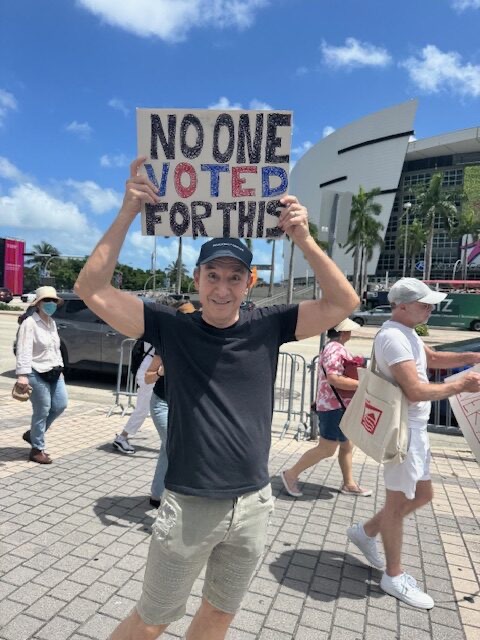
Which is why so many Americans joined more than 1,200 protests throughout the country yesterday, many carrying home-made signs like this one:

Mine said:

NATO NOT PUTIN

on the front and . . .

 . . on the back.

There were lots about Social Security and Medicare and Veterans and Fascists and . . .

LEASH YOUR DOGE

One of my favorites summed it up:

WAY TOO MUCH FOR ONE SIGN 

Inflation rising, recession looming, stocks plunging, measles spreading, medical research slashed . . . and tariffs slapped on islands from whom we import nothing (including the one with only penguins) . . . but not on Russia (from whom we imported $3.27 billion worth of goods last year).

Michael Elsen-Rooney of Chalkbeat reported that New York will not comply with Trump’s demand to ban Diversity, Equity and Inclusion. The Trump Department of Education warned states that refusal to comply might lead to a suspension of federal funding.

The Department’s demand is illegal. Federal law explicitly forbids any interference by federal officials with the curriculum or program of any public school.

Elsen-Rooney wrote:

New York will not comply with an order from President Donald Trump’s administration to certify that school districts are eliminating diversity, equity and inclusion initiatives, state Education Department officials said in a Friday letter obtained by Chalkbeat.

The letter represents some of the earliest and most forceful pushback to Thursday’s threat that gave state education agencies 10 days to guarantee that no public schools in their states have DEI programs the Trump administration deems illegal — or lose billions of dollars in federal education funding.

Federal officials cited the 2023 Supreme Court decision banning race-based affirmative action in college admissions in arguing that any school DEI program used to “advantage one’s race over another” violates federal Title VI of the Civil Rights Act.

But New York officials countered that the state has already certified on multiple occasions that it follows federal anti-discrimination law, and that the U.S. Education Department has no legal right to threaten to withhold federal funding over its own interpretation of the law.

The state Education Department “is unaware of any authority that USDOE has to demand that a State Education Agency … agree to its interpretation of a judicial decision or change the terms and conditions of [New York State Education Department]’s award without formal administrative process,” wrote Counsel and Deputy Commissioner Daniel Morton-Bentley.

“We understand that the current administration seeks to censor anything it deems ‘diversity, equity & inclusion. … But there are no federal or State laws prohibiting the principles of DEI,” Morton-Bentley continued. “And USDOE has yet to define what practices it believes violate Title VI.”

The state will not send any “further certification” of compliance with federal law, the letter concluded.

A spokesperson for the U.S. Department of Education did not immediately respond to a request for comment.

Olga Lautman keeps a close watch on Trump’s tyranny and his allegiance to Putin. She is especially appalled by his decision to abandon the thousands of Ukrainian children kidnapped by Russian troops and transported to Russia. Trump doesn’t care. Anything to make Vladimir happy.

Lautman writes:

For years, the world watched as Russia systematically kidnapped tens of thousands of Ukrainian children, erasing their identities and forcing them into Russian families. This isn’t just a war crime—it’s genocide in real time.

Now, Trump’s regime is actively helping Russia cover up this genocide. His State Department quietly terminated a crucial contract that was facilitating the transfer of evidence on Russia’s mass abduction of Ukrainian children to European law enforcement, according to The New Republic.

This decision cripples efforts to track and recover abducted children, making it harder to hold Russia accountable for what international courts have already labeled a war crime. By cutting off this support, Trump’s regime is not just abandoning Ukraine—they are actively obstructing justice.

This isn’t just inaction—it’s complicity in one of the most horrific acts of genocide and war crimes.

Russia’s War Crime: The Mass Kidnapping of Ukrainian Children

Under Putin’s direct orders, at least 20,000 Ukrainian children—though the real number may be much higher—have been stolen from Ukraine and transported to Russia. Many have been ripped from orphanages and hospitals in occupied territories, while others—despite having living relatives—have been abducted and placed in “re-education” camps designed to erase their Ukrainian identity. These children are tortured, subjected to psychological reprogramming, and stripped of their Ukrainian heritage, culture, and language. They are then forcibly granted Russian citizenship and placed with Russian families as part of an illegal state-run program aimed at assimilating them into Russian society and erasing their Ukrainian identity forever.

Russia does not even attempt to hide these hideous crimes. Grigory Karasin, head of the international committee in Russia’s upper house of parliament, openly boasted that 700,000 children from illegally occupied territories in Ukraine have been taken to Russia. The sheer scale of this state-sponsored mass abduction is staggering—one of the largest forced deportations of children in modern history. This is not just a war crime— it is clear evidence of Russia’s genocidal intent to erase Ukrainian identity by targeting children, severing them from their families, their culture, and their homeland.

The International Criminal Court recognized this as a war crime as investigations continue. In March 2023, the ICC issued arrest warrants for Vladimir Putin and Maria Lvova-Belova, Russia’s Commissioner for Children’s Rights, for the “unlawful deportation and forced transfer of Ukrainian children.” This systematic abduction is not just a violation of international law—it is genocide. Russia is not merely stealing children but destroying Ukraine’s future by erasing an entire generation.

And now, Trump, Musk, and Rubio are actively helping Russia cover up the genocide and war crimes.

Trump’s State Department Blocks Efforts to Track Abducted Ukrainian Children

Since Russia’s full-scale invasion, the U.S. State Department funded a Yale research team that tracked kidnapped Ukrainian children using satellite imagery and open-source intelligence. Their work was crucial in exposing Russia’s state-run program of forced deportation and illegal adoption, providing undeniable evidence of war crimes committed against Ukrainian children.

Now, that work is under threat. Trump’s Secretary of State, Marco Rubio, has canceled the program, cutting off funding and blocking the transfer of key evidence to European law enforcement. Without this support, it will be significantly harder to locate and rescue kidnapped children, hold Russia accountable for genocide and war crimes, and ensure that stolen children are returned to Ukraine.

The Humanitarian Research Lab at Yale worked with Ukrainian President Volodymyr Zelenskyy’s Bring Kids Back UA campaign, which has helped track and locate hundreds of abducted children, successfully repatriating approximately 1,240 so far. With funding cut off, these efforts are now at risk.

Genocide and War Crimes: What’s at Stake

Under the Genocide Convention, the forced deportation and assimilation of children meets the legal definition of genocide, as it involves forcibly transferring children from one group to another with the intent to erase their identity, conducting mass deportations under state policy, and destroying cultural, linguistic, and familial ties. The International Criminal Court has already taken action by issuing arrest warrants, but its ability to prosecute and hold Russia accountable depends on cooperation from governments like the United States.

Instead of aiding these efforts, Trump is actively sabotaging them, cutting off crucial funding for investigations and making it harder to track abducted children and bring perpetrators to justice. Even the U.S. Congress, led by Rep. Susan Wild (D-PA-7), recognizing the horror of this crime, overwhelmingly passed a resolution in 2024 condemning Russia’s abduction and forced transfer of Ukrainian children. 

Yet, Trump’s regime is doing the opposite—helping obstruct justice while aligning itself with Russia’s war crimes.

Trump’s Loyalty to Moscow

This isn’t an isolated incident—it’s part of Trump’s broader fealty to the Kremlin and his regime’s Russia-aligned policies. From cutting off military aid to amplifying Kremlin propaganda, Trump continues to systematically weaken Ukraine’s ability to defend itself while strengthening Russia’s position. Every move he makes advances Russia’s strategic goals, further undermining Ukraine’s sovereignty and the West’s ability to hold Russia accountable.

We all saw as JD Vance ambushed Zelensky in the Oval Office meant to send a clear message that the U.S. is no longer a reliable partner. Trump echoes Kremlin propaganda at every opportunity, falsely branding Zelensky a “dictator” and insisting that Ukraine must hold elections immediately—a demand that directly serves Russia’s interests, as Moscow has repeatedly attempted to assassinate Zelensky and would exploit an election to further destabilize Ukraine.

Trump’s so-called “peace plan” is nothing more than a thinly veiled attempt to force Ukraine into surrender, as he insists that Kyiv must “negotiate”—a demand that would strip Ukraine of its sovereignty and hand Putin exactly what he wants. 

Meanwhile, Trump’s State Department is actively obstructing efforts to hold Russia accountable for war crimes, cutting off support for investigations into the kidnapping and forced deportation of Ukrainian children. At every turn, Trump is working to weaken Ukraine, embolden Russia, and dismantle any accountability for Russia’s crimes—all while seeking to reestablish financial deals with Moscow and prioritizing his personal and political interests.

As part of carrying out Russia’s agenda, Trump is also attacking NATO and attempting to dismantle alliances that have kept America safe, further isolating the U.S. while handing Putin exactly what he wants.

What Can We Do?

We cannot stay silent while the U.S. government helps Russia cover up genocide. And if Trump is willing to excuse war crimes against children, what won’t he justify?

Please call your members of Congress and demand answers. Ask them why the State Department cut funding for tracking abducted Ukrainian children and why the U.S. is turning its back on accountability for Russian war crimes. 

As you know, Trump took control of The Kennedy Center and named himself chairman of the board. He kicked all Democrats off the board and named Trumpers to replace them.

Some artists cancelled, some continued to perform. Trump’s new director, Richard Grennel, canceled the national tour of a children’s show called “Finn,” because it promoted love, kindness, and tolerance.

A band called Guster was performing at The Kennedy Center on March 29, and the band leader talked about the cancellation of “Finn.” Then he invited the cast of “Finn” to join him onstage and the audience went wild.

You have to see this.

I almost cried: tears of joy.

Michael C. Bender reports in The New York Times that the Trump administration is threatening to cancel funding from schools that refuse to eliminate programs or courses that teach DEI. The administration has turned civil rights enforcement upside down and inside out. For decades, civil rights law meant protection of racial minorities and women, who were often targets of discrimination, exclusion, or unfair treatment. This administration worries most about the rights of white students.

Secretary of Education Linda McMahon clearly doesn’t know that federal law prohibits any federal official from interfering with or trying to influence curriculum.

“20 USC 1232a: Prohibition against Federal control of education. Text contains those laws in effect on April 2, 2025

§1232a. Prohibition against Federal control of education

No provision of any applicable program shall be construed to authorize any department, agency, officer, or employee of the United States to exercise any direction, supervision, or control over the curriculum, program of instruction, administration, or personnel of any educational institution, school, or school system, or over the selection of library resources, textbooks, or other printed or published instructional materials by any educational institution or school system, or to require the assignment or transportation of students or teachers in order to overcome racial imbalance.

What Secretary McMahon proposes is illegal.

Bender writes:

The Trump administration threatened on Thursday to withhold federal funding from public schools unless state education officials verified the elimination of all programs that it said unfairly promoted diversity, equity and inclusion.

In a memo sent to top public education officials across the country, the Education Department said that funding for schools with high percentages of low-income students, known as Title I funding, was at risk pending compliance with the administration’s directive.

The memo included a certification letter that state and local school officials must sign and return to the department within 10 days, even as the administration has struggled to define which programs would violate its interpretation of civil rights laws. The move is the latest in a series of Education Department directives aimed at carrying out President Trump’s political agenda in the nation’s schools.

At her confirmation hearing in February, Education Secretary Linda McMahon said schools should be allowed to celebrate the Rev. Dr. Martin Luther King Jr. But she was more circumspect when asked whether classes that focused on Black history ran afoul of Mr. Trump’s agenda and should be banned.

“I’m not quite certain,” Ms. McMahon said, “and I’d like to look into it further.”

More recently, the Education Department said that an “assessment of school policies and programs depends on the facts and circumstances of each case.”

Programs aimed at recognizing historical events and contributions and promoting awareness would not violate the law “so long as they do not engage in racial exclusion or discrimination,” the department wrote.

“However, schools must consider whether any school programming discourages members of all races from attending, either by excluding or discouraging students of a particular race or races, or by creating hostile environments based on race for students who do participate,” the Education Department said.

It also noted that the Justice Department could sue for breach of contract if it found that federal funds were spent while violating civil rights laws.

The federal government accounts for about 8 percent of local school funding, but the amounts vary widely. In Mississippi, for example, about 23 percent of school funding comes from federal sources, while just 7 percent of school funding in New York comes from Washington, according to the Pew Research Center.

“Federal financial assistance is a privilege, not a right,” Craig Trainor, the acting assistant education secretary for civil rights, said in a statement. “When state education commissioners accept federal funds, they agree to abide by federal anti-discrimination requirements.”

Glenn Kessler is the fact-checker for The Washington Post. He is careful and meticulous in his research. In this post, he analyzes Trump’s statements about tariffs.

He writes:

Trump’s speech announcing a huge increase in tariffs on American trading partners was riddled with falsehoods and misleading statements on trade that he has made for years. But now they are determining policy that will increase the costs of goods for many Americans. Here’s a quick sampling, in the order in which he made them. We’re sure we missed some — and some claims still require more checking.

“For years, hardworking American citizens who were forced to sit on the sidelines as other nations got rich and powerful, much of it at our expense. But now it’s our turn to prosper and in so doing, use trillions and trillions of dollars to reduce our taxes and pay down our national debt.”

This is exaggerated. In Trump’s telling, the United States is a poor country, beset by outside forces. Not only does the U.S. have the largest gross domestic product in the world, but its per capita GDP is much higher than any large country. For instance, GDP per capita in the U.S. is nearly $90,000, compared with $14,000 for China, $58,000 for Germany and $36,000 for Japan.

Tariffs are in effect a tax increase, one that falls heavily on lower-income workers. Economists agree that tariffs — essentially a tax on domestic consumption — are paid by importers, such as U.S. companies, which in turn pass on most or all of the costs to consumers or producers who may use imported materials in their products. As a matter of demand and supply elasticities, overseas producers will pay part of the tax if there are fewer goods sold to the U.S. Domestic producers in effect get a subsidy because they can raise their prices to the level imposed on importers.

Not only will tariffs be unlikely to reduce the budget deficit — especially if the economy sinks — but it’s a fantasy to suggest the national debt can be paid with tariffs.

“The United States charges other countries only a 2.4 percent tariff on motorcycles. Meanwhile, Thailand and others are charging much higher prices, like 60 percent, India charges 70 percent, Vietnam charges 75 percent, and others are even higher than that. Likewise, until today, the United States has for decades charged a 2.5 tariff. Think of that 2.5 percent on foreign-made automobiles. The European Union charges us more than 10 percent tariffs.”

Some of Trump’s numbers are suspect. India charges a 50 percent tariff on motorcycles, not 70 percent, and recently announced a cut to 40 percent. In any case, Harley-Davidson already got around that duty by assembling in India most of the motorcycles sold in the country.

While Trump highlights the low U.S. tariff on foreign cars, he ignores the fact that for more than 50 years the U.S. has imposed a 25 percent tariff on pickup trucks. That’s much higher than the European tariff on cars.

Moreover, Trump ignores that trade can be mutually beneficial. The European Union is the largest export market for the U.S., and if the Europeans retaliate, that will be a big loss for American manufacturers. International trade works in such a way that some countries dominate some markets and don’t compete as much in others. The French have trade restrictions on U.S. wine, just as the U.S. has trade restrictions on French clothing.

“Toyota sells 1 million foreign made automobiles into the United States, and General Motors sells almost none. Ford sells very little. None of our companies are allowed to go into other countries.”

This is misleading. Market forces, not trade, are a critical factor. American cars have fared poorly in Japan because the Japanese prefer smaller, more fuel-efficient models. But the Chinese like American cars, which, contrary to Trump’s claim, are allowed to be sold there. Until 2023, General Motors sold more cars in China than in the U.S., but sales have fallen because China has developed a preference for electric cars — where GM has lagged.

“Canada, by the way, imposes a 250 to 300 percent tariff on many of our dairy products. They do the first, the first can of milk, they do the first little carton of milk at a very low price. But after that it gets bad, and then it gets up to 275, 300 percent.”

Trump has forgotten he fixed this. The high dairy tariff was largely eliminated in Trump’s renegotiation of the North American Free Trade Agreement during his first term. Now it only kicks in after the U.S. has hit a certain level of tariff-free sales in a year — which has not yet happened.

“And with countries like Canada, you know, we subsidize a lot of countries and keep them going and keep them in business. In the case of Mexico, it’s $300 billion a year. In the case of Canada, it’s close to $200 billion a year.”

These numbers are wrong. The “subsidy” to Canada supposedly includes military benefits the U.S. provides to the NATO ally, but we fact-checked this and the numbers did not add up. In 2024, the deficit in trade in goods and services with Canada was about $45 billion. The trade deficit with Mexico was about $172 billion in 2024.

“Then in 1913, for reasons unknown to mankind, they established the income tax so that citizens, rather than foreign countries, would start paying the money necessary to run our government. Then in 1929, it all came to a very abrupt end with the Great Depression, and it would have never happened if they had stayed with the tariff policy, it would have been a much different story.”

This is nonsense history. The income tax was intended to shift the burden to wealthier Americans as the cost of tariffs fall mainly on lower-income people. Tax revenue was also considered a more stable source of funds. One big advocate for an income tax was Theodore Roosevelt, a Republican. As for the Great Depression, many historians credit the Smoot-Hawley Tariff Act, signed into law in 1930, as worsening the economic slowdown because it sparked a global trade war.

“But since the very beginning of NAFTA, our country lost 90,000 factories. Think what that is — 90,000.”

The 90,000 factories statistic is dubious. The figure comes from the Census Bureau’s Business Dynamics Statistics, which has a tool that breaks down the data. About a third of the manufacturing establishments employ four or fewer people, which hardly makes them factories. The manufacturing establishments with more than 500 people fell from 4,535 in 2000 to 3,316 in 2022. That’s a decline of about one-quarter, but the number (1,219) is much smaller than 90,000.

“And 5 million manufacturing jobs were lost while racking up trade deficits of $19 trillion. That [North American Free Trade Agreement] was the worst trade deal ever made.”

This is mostly because of China. Trump pins the blame on NAFTA but a key factor in a decline of manufacturing was China entering the World Trade Organization The nonpartisan Congressional Research Service in 2017 concluded the “net overall effect of NAFTA on the U.S. economy appears to have been relatively modest, primarily because trade with Canada and Mexico accounts for a small percentage of U.S. GDP,” though it noted “there were worker and firm adjustment costs as the three countries adjusted to more open trade and investment among their economies.”

“Apple is going to spend $500 billion. They never spent money like that here.”

Biden got a similar deal. A few months after Biden took office, Apple pledged to invest $430 billion over five years in the U.S. Adjusted for inflation, that’s $525 billion.

“If you look at China, I took in hundreds of billions of dollars in my term.”

This is false. Records maintained by U.S. Customs and Border Protection showed about $75 billion was raised on Chinese goods by the time Trump left office — most of which was paid by American consumers. (He also had to spend $28 billion to bail out farmers harmed by the loss of business to other countries when China retaliated.)

“They [China] never paid 10 cents to any other president, and yet they paid hundreds of billions.”

This is false. Tariffs have been collected on Chinese goods since the early days of the Republic. President George Washington signed the Tariff Act of 1789, when trade between China and the U.S. was already established. Tariffs on China generated at least $8 billion every year since 2009.


The Fact Checker is a verified signatory to the International Fact-Checking Network code of principle

Yesterday after the stock market closed, Trump held a press conference to announce his much-ballyhooed tariff plan. He used the opportunity to insult other nations, as is his custom. Commentators noted that he slapped tariffs on uninhabited islands. Trump believes that the greatest period in the American economy ended in 1913, when the federal government adopted the income tax. When I was a junior in high school in high school, I learned that the enactment of a federal income tax was progressive because it reduced the vast gap between the very rich and everyone else. I also learned about the Smoot-Hawley tariffs, which set off a global trade war and contributed to the Great Depression. Apparently, these topics were not taught in Trump’s elite military academy. His history classes must have been taught from the perspective of the robber barons.

The Washington Post wrote:

President Donald Trump said Wednesday that he will impose a new 10 percent tariff on all imported goods along with higher import taxes tailored for each of about 60 countries that his advisers say maintain the largest barriers against U.S. products, in a sharp turn toward the kind of protectionism that the United States abandoned nearly a century ago.

To impose the new tariffs, the president declared a national emergency, citing the annual merchandise trade deficit that the United States has run each year since 1975.

“For decades, our country has been looted, pillaged, raped and plundered by nations near and far, both friend and foe alike,” Trump said. “But it is not going to happen anymore.”

The tariff increases that the president announced had little modern precedent and would erect towering impediments to products from dozens of foreign countries, many of them poor nations that embraced exporting as a tool to escape grinding poverty….

Speaking in blunt, sometimes intemperate language, the president assailed the nation’s trading partners, including some of its closest allies, as “foreign cheaters” and “foreign scavengers” who had “ripped off Americans” for 50 years. Trump’s tone echoed the dark portrait of “American carnage” that he had sketched in his first inaugural address in 2017….

“In the short run, the effect is probably a recession. It’s going to raise the price of so many goods that can’t be made in the United States,” said economist Brad Setser of the Council on Foreign Relations. “In the long run, it’s a vision of the U.S. that is very isolated from the world.”

Jay Timmons, president of the National Association of Manufacturers, warned that his members operate on thin profit margins and cannot absorb the tariffs. Small businesses and restaurant owners issued statements decrying their added costs.

“This is catastrophic for American families,” said Matt Priest, president of the Footwear Retailers and Distributers of America.

********************************

Daniel Dale of CNN fact-checked only a few of Trump’s outlandish statements during his press conference about his tariffs. He imposed tariffs on uninhabited islands, populated only by penguins.

Dale wrote:

President Donald Trump made a series of false claims about tariffs and trade – most of which he has made before – in the Wednesday speech in which he announced a sweeping set of global tariffs.

Here is a fact check of some of Trump’s remarks.

Canada’s dairy tariffs

Trump correctly noted that Canada has tariffs exceeding 250% on some US dairy products. However, he falsely claimed that merely “the first little carton of milk” exported to Canada faces a “very low price,” but “then it gets up to 275, 300%.”null

In reality, Canada has guaranteed that tens of thousands of metric tons of imported US milk per year, not merely a single carton, will face zero tariffs at all; Canada conceded a certain guaranteed level of tariff-free US access to its dairy market as part of the United States-Mexico-Canada Agreement (USMCA) that Trump’s own first administration negotiated.

Trump also didn’t mention something the US dairy industry acknowledges: The US is not hitting its zero-tariff maximum level of exports to Canada in any category of dairy product, so the Canadian tariffs aren’t being applied; with regard to milk in particular, the US isn’t even at half of the tariff-free quota. (There is a vigorous US-Canada debate about why the US is so far from the maximum, with each country blaming the other. Regardless of who’s right, the tariffs aren’t hitting US milk.)

Trump has persistently omitted key facts about Canada’s dairy tariffs. You can read more here from a previous CNN fact check.

US trade deficit with Canada

Trump, claiming “we subsidize a lot of countries,” falsely said “it’s close to $200 billion a year” with Canada. Trump has repeatedly used this $200 billion figure to describe the US trade deficit with Canada in particular, which is actually far lower than $200 billion; official US statistics show the 2024 deficit with Canada in goods and services trade was $35.7 billion and $70.6 billion in goods trade alone.

Trump didn’t mention the trade deficit in particular this time, but even if he was intending to use the word “subsidize” more broadly, there is no basis for the claim.

Who pays tariffs

Trump repeated his frequent false claim that, because of the tariffs he imposed on China during his first term, the US “took in hundreds of billions of dollars” that “they paid.” In fact, US importers, not foreign exporters like China,make the tariff payments, andstudy after studyhas found that Americans bore the overwhelming majority of the cost of Trump’s first-term tariffs on China; it’s easy to findspecific examplesof companies that passed along the cost of the tariffs to US consumers.

Previous presidents’ tariffs on China

Trump also repeated his frequent false claim that, before his first presidency, China “never paid 10 cents to any other president” from tariffs. Aside from the fact that US importers make the tariff payments, the US was actuallygenerating billions per year in revenuefrom tariffs on Chinese imports before Trump took office; in fact, the US has had tariffs on Chinese imports since1789. Trump’s predecessor, President Barack Obama,imposed additional tariffson Chinese goods.

US wealth

Touting the supposed benefits of tariffs, Trump claimed that “the United States was proportionately the wealthiest it has ever been” from 1789 to 1913, when tariffs made up a higher percentage of federal revenue before the passage of a 1913 law reestablishing the federal income tax.

Trump didn’t explain what he meant by “proportionately the wealthiest,” but by standard measures, the US is far wealthier today than it was in the early 20th century and prior. Per capita gross domestic product isnow many times higherthan it was then.

Douglas Irwin, a Dartmouth College economics professor who studies the history of US trade policy, said in February after Trump had made similar claims, that if Trump’s unclear comments are interpreted to be about per capita income, as “economists usually take this,” it is “obviously not true,” since “real per capita income and standards of living are so much higher today than the past. … It is nice to have indoor plumbing, running water, not outhouses, etc.”

This is only part of the article. Open the link to finish reading. Dale reviews inflation, the cost of gasoline, and other issues.