Archives for category: Trump

Trump has long demonstrated his admiration for Putin. No one can say exactly why Trump admires Russia’s ruthless dictator. But Trump insists that Ukraine is responsible for Putin’s invasion of Ukraine in 2022. His lame efforts to broker an end to Russia’s war on Ukraine have robustly echoed Putin’s demands.

Heather Cox Richardson analyzes how Trump has changed American policy towards the Russian war on Ukraine. Trump’s “peace plan” gives Russia everything Putin wants:

She writes:

After previously suggesting that the U.S. would not involve European representatives in negotiations to end Russia’s war against Ukraine, Secretary of State Marco Rubio and presidential envoy Steve Witkoff met in Paris last week for talks with Ukrainian and European officials. The U.S. presented what it called “the outlines of a durable and lasting peace,” even as Russia continued to attack Ukrainian civilian areas.

A senior European official told Illia Novikov, Aamer Madhani, and Jill Lawless of the Associated Press that the Americans presented their plan as “just ideas” that could be changed. But Barak Ravid of Axios reported on Friday that Trump was frustrated that the negotiations weren’t productive and said he wanted a quick solution.

Talks were scheduled to resume today, in London, but yesterday Rubio pulled out of them. The U.S. plan is now “a final offer,” Ravid reported, and if the Ukrainians don’t accept it, the U.S. will “walk away.”

On a bipartisan basis, since 2014 the United States has supported Ukraine’s fight to push back Russia’s invasions. But Trump and his administration have rejected this position in favor of supporting Russia. This shift has been clear in the negotiations for a solution: Trump required repeated concessions from Ukraine even as Russia continued bombing Ukraine. Axios’s Ravid saw the proposed “final offer,” and it fits this pattern.

The plan would recognize Russia’s occupation of Ukraine’s Crimea and its occupation of almost all of Luhansk oblast and the portions of Donetsk, Kherson, and Zaporizhzhia oblasts Russia has occupied. This would essentially freeze the boundary of Ukraine at the battlefront.

Ukraine would promise not to join the North Atlantic Treaty Organization (NATO), the post–World War II defensive alliance that first stood against the aggression of the Soviet Union and now stands against the aggression of Russia.

Sanctions imposed against Russia after its 2014 and 2022 invasions of Ukraine would be lifted, and the United States, in particular its energy and industrial sectors, will cooperate with Russia.

In essence, this gives Russian president Vladimir Putin everything he wanted.

What the Ukrainians get out of this deal is significantly weaker. They get “a robust security guarantee,” but Ravid notes the document is vague and does not say the U.S. will participate. We have been here before. After the Soviet Union crumbled in 1991, Ukraine had the third-largest stockpile of nuclear weapons in the world. In exchange for Ukraine’s giving up those weapons, the United States, the United Kingdom, and Russia agreed to secure Ukraine’s borders. In the 1994 Budapest Memorandum on Security Assurances, they agreed they would not use military force or economic coercion against Ukraine.

Russia violated that agreement with its 2014 and 2022 invasions, making it unlikely that Ukraine will trust any new promises of security.

Under the new plan, Ukraine would also get back a small part of Kharkiv oblast Russia has occupied. It would be able to use the Dnieper River. And it would get help and funds for rebuilding, although as Ravid notes, the document doesn’t say where the money will come from.

There is something else in the plan. The largest nuclear power plant in Europe is Ukrainian: the Zaporizhzhia plant. It will be considered Ukrainian territory, but the United States will operate it and supply the electricity it produces to both Ukraine and Russia, although the agreement apparently doesn’t say anything about how payments would work. The plan also refers to a deal between the U.S. and Ukraine for minerals, with Ukraine essentially repaying the U.S. for its past support.

Ravid notes that the U.S. drafted the plan after envoy Steve Witkoff met for more than four hours last week with Putin. But the plan has deeper roots.

This U.S.-backed plan echoes almost entirely the plan Russian operatives presented to Trump’s 2016 campaign manager Paul Manafort in exchange for helping Trump win the White House. Russia had invaded Ukraine in 2014 and was looking for a way to grab the land it wanted without continuing to fight.

Special Counsel Robert Mueller’s 2019 report on Russian interference in the 2016 presidential election explained that Manafort in summer 2016 “discussed a plan to resolve the ongoing political problems in Ukraine by creating an autonomous republic in its more industrialized eastern region of Donbas, and having [Russian-backed Viktor] Yanukovych, the Ukrainian President ousted in 2014, elected to head that republic.”

The Mueller Report continued: “That plan, Manafort later acknowledged, constituted a ‘backdoor’ means for Russia to control eastern Ukraine.” The region that Putin wanted was the country’s industrial heartland. He was offering a “peace” plan that carved off much of Ukraine and made it subservient to him. This was the dead opposite of U.S. policy for a free and united Ukraine, and there was no chance that former secretary of state Hillary Clinton, who was running for the presidency against Trump, would stand for it. But if Trump were elected, the equation changed.

According to the Republican-dominated Senate Intelligence Committee, Manafort’s partner and Russian operative Konstantin Kilimnik wrote: “[a]ll that is required to start the process is a very minor ‘wink’ (or slight push) from D[onald] T[rump] saying ‘he wants peace in Ukraine and Donbass back in Ukraine’ and a decision to be a ‘special representative’ and manage this process.” Following that, Kilimnik suggested that Manafort ‘could start the process and within 10 days visit Russia ([Yanukovych] guarantees your reception at the very top level, cutting through all the bullsh*t and getting down to business), Ukraine, and key EU capitals.’ The email also suggested that once then–Ukrainian President Petro Poroshenko understood this ‘message’ from the United States, the process ‘will go very fast and DT could have peace in Ukraine basically within a few months after inauguration.’”

According to the Senate Intelligence Committee, the men continued to work on what they called the “Mariupol Plan” at least until 2018.

After Russia invaded Ukraine again in 2022, Jim Rutenberg published a terrific and thorough review of this history in the New York Times Magazine. Once his troops were in Ukraine, Putin claimed he had annexed Donetsk, Luhansk, Zaporizhzhia, and Kherson, two of which were specifically named in the Mariupol Plan, and instituted martial law in them, claiming that the people there had voted to join Russia.

On June 14, 2024, as he was wrongly imprisoning American journalist Evan Gershkovich, Putin made a “peace proposal” to Ukraine that sounded much like the Mariupol Plan. He offered a ceasefire if Ukraine would give up Donetsk, Luhansk, Zaporizhzhia, and Kherson, including far more territory than Putin’s troops occupy, and abandon plans to join NATO. “If Kyiv and the Western capitals refuse it, as before,” Putin said, “then in the end, that’s their…political and moral responsibility for the continuation of bloodshed.”

On June 27, 2024, in a debate during which he insisted that he and he alone could get Gershkovich released, and then talked about Putin’s 2022 invasion of Ukraine, Trump seemed to indicate he knew about the Mariupol Plan: “Putin saw that, he said, you know what, I think we’re going to go in and maybe take my—this was his dream. I talked to him about it, his dream.”

Now that plan is back on the table as official U.S. policy.

Ukraine president Volodymyr Zelensky has said that his country will not recognize the Russian occupation of Crimea. In this determination, he speaks for the global rules-based order the U.S. helped to create after World War II. Recognition of the right of a country to invade another and seize its territory undermines a key article of the United Nations, which says that members won’t threaten or attack any country’s “territorial integrity or political independence.” French president Emmanuel Macron and other European leaders are standing behind those principles, saying today in a statement from Macron’s office that they reject Russian territorial gains under the U.S. plan. “Ukraine’s territorial integrity and European aspirations are very strong requirements for Europeans,” the statement said.

But Trump himself seems eager to rewrite the world order. In addition to his own threats against Greenland, Canada, and Panama, in a post today on his social media site he echoed Putin’s 2024 statement blaming Ukraine for Russia’s bloody war because it would not agree to Putin’s terms. Today, Trump said Zelensky’s refusal to recognize the Russian occupation of Crimea was “inflammatory,” and he pressured Zelensky to accept the deal.

Curiously, he felt obliged to write that “I have nothing to do with Russia…”.

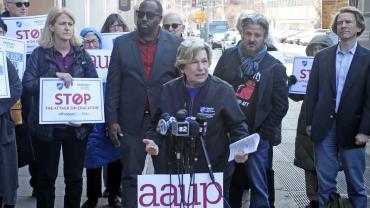
Randi Weingarten is president of the American Federation of Teachers. She is my friend.

Randi wrote:

President Donald Trump has declared war on America’s colleges and universities, demanding they bow to his demands on what they can teach and whom they can admit or hire. Trump’s illegal and autocratic actions are tantamount to a war on knowledge intended to force schools to bend the knee to his ideology and chill free speech and academic pursuit.

Weingarten announcing a lawsuit to stop the federal funding cuts at Columbia University.
Weingarten announcing a lawsuit to stop the federal funding cuts at Columbia University. CREDIT: AFT

Trump says much of his attack on higher education is in response to antisemitism on campuses. Without a doubt, there was antisemitism before the heinous actions by Hamas on Oct. 7 and the ensuing war, and it has grown since. We need to address antisemitism on campus and ensure Jewish students, and all students, feel safe. But Trump is weaponizing antisemitism investigations to attack disfavored speech and stoke culture wars, distrust and division, and to undermine higher education as a bulwark of democracy and an engine of our economy. It’s wrong, antidemocratic and unconstitutional. The administration is using Jews as an excuse to disappear students who are here legally, with immigration officials arresting and attempting to deport students who have committed no crimes—without due process, a linchpin of American democracy.

This may help Trump’s aim to divide Americans, but it won’t make campuses safer for Jewish students or answer the real issues around antisemitism. That’s one reason that a coalition of Jewish organizations released a statement saying that Trump’s actions make Jewish students and the Jewish community less safe.

Trump has launched investigations into dozens of colleges and universities and stripped billions in research grants from schools. The administration has issued demands ranging from direct government oversight of academic programs—or in the case of Columbia University, oversight of the whole institution—to dictating disciplinary policies and controlling hiring decisions. It is targeting students for exercising their First Amendment rights, and revoking visas for faculty and staff. The administration’s intent is to remake America’s higher education system in its image through blunt force.

The freedom to pursue knowledge, the freedom of expression and the freedom of speech are fundamental American rights that are foundational to a functioning democracy. America’s public schools, colleges and universities cultivate the exploration of knowledge and free expression and empower students to become engaged citizens. One of their hallmarks is that they are a marketplace of ideas where free and open discussion and disagreement is encouraged. That is enabled by ensuring our education institutions are independent from government control or coercion. When a government asserts control over what can be taught, thought or said, democracy itself is at risk.

The free pursuit of knowledge empowers Americans.

Stripping research and innovation funding to force compliance will hurt America’s competitiveness and help our adversaries outpace us in technological and other advancements. America’s university research and innovation centers have long been the envy of the world. The federal government, through federal agencies and grants, is a fundamental powerhouse and supporter of health, scientific, technology and other research. The U.S. is the world leader in this research—research that the private sector cannot and will not do on its own and that leads to discoveries, innovations, cures and advances that benefit the common good and move our society forward. Colleges and universities are also anchors of their local communities, supporting local jobs and small businesses, providing community gathering spaces, and growing industries tied to university research and innovation. 

This war on knowledge and expression must be opposed in the courts, on the streets, and by our colleges and universities.

As the largest union of higher education staff and faculty, the AFT joined our affiliate, the American Association of University Professors, to sue the Trump administration on behalf of our members for unlawfully cutting millions in federal funding for public health research at Columbia.

Last week, Harvard University boldly rejected Trump’s unlawful and unprecedented demands for government control over it. Harvard’s president wrote that “no government … should dictate what private universities can teach, whom they can admit and hire, and which areas of study and inquiry they can pursue.”

Americans have also taken to the streets to oppose this war on knowledge and freedoms. The attacks on higher education were a major focus of the April 5 Hands Off actions that mobilized tens of thousands of Americans across the country to reject Trump’s chaotic and cruel agenda.

The free pursuit and availability of knowledge empowers Americans, strengthens our economy and democracy, and is foundational for opportunity. That’s why we all must take a stand against this war on knowledge.

Under the misguided policies of Trump and Hegseth, censorship and book banning have been widespread, especially by the Defense Department. Hegseth is eager to please Trump and has stripped recognition from anyone of distinction who is female and/or non-white. Even a photograph of the Enola Gay, the plane that dropped the first atomic bomb, was taken down–because of its name. The Navajo Code Talkers were put into storage. The first women to achieve military feats and honors were mothballed. The U.S. Naval Academy removed almost 400 books from its library because of DEI (diversity, equity, inclusion) themes.

Ryan Holiday was invited to lecture at the Naval Academy a few weeks ago, as he had in the past. Shortly before he was to speak, he was asked not to mention the books that had been removed from the Academy’s library. When he refused, his speech was canceled.

Question: if the men and women of the U.S. Navy are brave enough to risk their lives, aren’t they brave enough to read a book about race and gender?

Holiday wrote in The New York Times:

For the past four years, I have been delivering a series of lectures on the virtues of Stoicism to midshipmen at the U.S. Naval Academy in Annapolis, Md., and I was supposed to continue this on April 14 to the entire sophomore class on the theme of wisdom.

Roughly an hour before my talk was to begin, I received a call: Would I refrain from any mention in my remarks of the recent removal of 381 supposedly controversial books from the Nimitz library on campus? My slides had been sent up the chain of command at the school, which was now, as it was explained to me, extremely worried about reprisals if my talk appeared to flout Executive Order 14151(“Ending Radical and Wasteful Government D.E.I. Programs and Preferencing”).

When I declined, my lecture — as well as a planned speech before the Navy football team, with which my books on Stoicism are popular — was canceled. (The academy “made a schedule change that aligns with its mission of preparing midshipmen for careers of service,” a Navy spokesperson told Times Opinion. “The Naval Academy is an apolitical institution.”)

Had I been allowed to go ahead, this is the story I was going to tell the class:

In the fall of 1961, a young naval officer named James Stockdale, a graduate of the Naval Academy and future Medal of Honor recipient who went on to be a vice admiral, began a course at Stanford he had eagerly anticipated on Marxist theory. “We read no criticisms of Marxism,” he recounted later, “only primary sources. All year we read the works of Marx and Lenin.”

It might seem unusual that the Navy would send Stockdale, then a 36-year-old fighter pilot, to get a master’s degree in the social sciences, but he knew why he was there. Writing home to his parents that year, he reminded them of a lesson they had instilled in him, “You really can’t do well competing against something you don’t understand as well as something you can.”

At the time, Marxism was not just an abstract academic subject, but the ideological foundation of America’s greatest geopolitical enemy. The stakes were high. The Soviets were pushing a vision of global Communism and the conflict in Vietnam was flashing hot, the North Vietnamese fueled by a ruthless mix of dogma and revolutionary zeal. “Marxism” was, like today, also a culture war boogeyman used by politicians and demagogues.

Just a few short years after completing his studies, in September 1965, Stockdale was shot down over Thanh Hoa in North Vietnam, and as he parachuted into what he knew would be imprisonment and possibly death, his mind turned to the philosophy of Epictetus, which he had been introduced to by a professor at Stanford.

He would spend the next seven years in various states of solitary confinement and enduring brutal torture. His captors, sensing perhaps his knowledge as a pilot of the “Gulf of Tonkin incident,” a manufactured confrontation with North Vietnamese forces that led to greater U.S. involvement in Vietnam, sought desperately to break him. Stockdale drew on the Stoicism of Epictetus, but he also leveraged his knowledge of the practices and the mind-set of his oppressors.

“In Hanoi, I understood more about Marxist theory than my interrogator did,” Stockdale explained. “I was able to say to that interrogator, ‘That’s not what Lenin said; you’re a deviationist.’”

In his writings and speeches after his return from the prison known as the Hanoi Hilton, Stockdale often referred to what he called “extortion environments,” which he used to describe his experience as a captive. He and his fellow P.O.W.s were asked to answer simple questions or perform seemingly innocuous tasks, like appear in videos, and if they declined, there would be consequences.

No one at the Naval Academy intimated any consequences for me, of course, but it felt extortionary all the same. I had to choose between my message or my continued welcome at an institution it has been one of the honors of my life to speak at.

As an author, I believe deeply in the power of books. As a bookstore owner in Texas, I have spoken up about book banning many timesalready. More important was the topic of my address: the virtue of wisdom.

As I explained repeatedly to my hosts, I had no interest in embarrassing anyone or discussing politics directly. I understand the immense pressures they are under, especially the military employees, and I did not want to cause them trouble. I did, however, feel it was essential to make the point that the pursuit of wisdom is impossible without engaging with (and challenging) uncomfortable ideas.

Seneca, the Stoic philosopher, used a military metaphor to make this very argument. We ought to read, he said, “like a spy in the enemy’s camp.” This is what Stockdale was doing when he studied Marxism on the Navy’s dime. It is what Seneca was doing when he read and liberally quoted from Epicurus, the head of a rival philosophical school.

The current administration is by no means unique in its desire to suppress ideas it doesn’t like or thinks dangerous. As I intended to explain to the midshipmen, there was considerable political pressure in the 1950s over what books were carried in the libraries of federal installations. Asked if he would ban communist books from American embassies, Eisenhower resisted.

“Generally speaking,” he told a reporter from The New York Herald Tribune at a news conference shortly after his inauguration, “my idea is that censorship and hiding solves nothing.” He explained that he wished more Americans had read Hitler and Stalin in the previous years, because it might have helped anticipate the oncoming threats. He concluded, “Let’s educate ourselves if we are going to run a free government.”

ADVERTISEMENT

SKIP ADVERTISEMENT

The men and women at the Naval Academy will go on to lead combat missions, to command aircraft carriers, to pilot nuclear-armed submarines and run enormous organizations. We will soon entrust them with incredible responsibilities and power. But we fear they’ll be hoodwinked or brainwashed by certain books?

Hitler’s “Mein Kampf” was not one of the books removed from the Naval Academy library, and as heinous as that book is, it should be accessible to scholars and students of history. However, this makes the removal of Maya Angelou’s “I Know Why the Caged Bird Sings” inexplicable. Whatever one thinks of D.E.I., we are not talking about the writings of external enemies here, but in many cases, art, serious scholarship and legitimate criticism of America’s past. One of the removed books is about Black soldiers in World War II, another is about how women killed in the Holocaust are portrayed, another is a reimagining of Kafka called “The Last White Man.” No one at any public institution should have to fear losing their job for pushing back on such an obvious overreach, let alone those tasked with defending our freedom. Yet here we are.

The decision by the academy’s leaders to not protest the original order — which I believe flies in the face of basic academic freedoms and common sense — has put them in the now even stickier position of trying to suppress criticism of that decision. “Compromises pile up when you’re in a pressure situation in the hands of a skilled extortionist,” Stockdale reminds us. I felt I could not, in good conscience, lecture these future leaders and warriors on the virtue of courage and doing the right thing, as I did in 2023 and 2024, and fold when asked not to mention such an egregious and fundamentally anti-wisdom course of action.

In many moments, many understandable moments, Stockdale had an opportunity to do the expedient thing as a P.O.W. He could have compromised. He could have obeyed. It would have saved him considerable pain, prevented the injuries that deprived him of full use of his leg for the rest of his life and perhaps even returned him home sooner to his family. He chose not to do that. He rejected the extortionary choice and stood on principle.

Thomas Friedman is not an alarmist. He has been writing about foreign policy for The New York Times for many years. He has written about crisis after crisis. But now we are an unprecedented point in our history. An unhinged ignorant man is President. Probably he is being manipulated by others. And at times, he acts on whims and grievances.

On any day, he comes up with some dangerous idea. He is ruining most people’s life savings. Eliminating or disabling federal agencies. Attacking academic freedom; extorting major law firms and universities. Trampling on the rule of law and the Constitutuon. There is no rationale or ending to his madness.

Friedman admits he is fearful for the future of our country. So am I. Trump is demolishing all established relationships, antagonizing allies, aligning us with Putin’s goals, and breaking whatever he can. Why? Either he is crazy or stupid or acting on Putin’s behalf. I believe it’s all of the above.

Friedman writes:

So much crazy happens with the Trump administration every day that some downright weird but incredibly telling stuff gets lost in the noise. A recent example was the scene on April 8 at the White House where, in the middle of his raging trade war, our president decided it was the perfect time to sign an executive order to bolster coal mining.

“We’re bringing back an industry that was abandoned,” said President Trump, surrounded by coal miners in hard hats, members of a work force that has declined to about 40,000 from 70,000 over the last decade, according to Reuters. “We’re going to put the miners back to work.” For good measure, Trump added about these miners: “You could give them a penthouse on Fifth Avenue and a different kind of a job and they’d be unhappy. They want to mine coal; that’s what they love to do.”

It’s commendable that the president honors men and women who work with their hands. But when he singles out coal miners for praise while he tries to zero out development of clean-tech jobs from his budget — in 2023, the U.S. wind energy industry employed approximately 130,000 workers, while the solar industry employed 280,000 — it suggests that Trump is trapped in a right-wing woke ideology that doesn’t recognize green manufacturing jobs as “real” jobs. How is that going to make us stronger?

This whole Trump II administration is a cruel farce. Trump ran for another term not because he had any clue how to transform America for the 21st century. He ran in order to stay out of jail and to get revenge on those who, with real evidence, had tried to hold him accountable to the law. I doubt he has ever spent five minutes studying the work force of the future.

He then returned to the White House, his head still filled with ideas out of the 1970s. There he launched a trade war with no allies and no serious preparation — which is why he changes his tariffs almost every day and no understanding of how much the global economy is now a complex ecosystem in which products are assembled from components from multiple countries. And then he has this war carried out by a commerce secretary who thinks millions of Americans are dying to replace Chinese workers “screwing in little screws to make iPhones.”

But this farce is about to touch every American. By attacking our closest allies — Canada, Mexico, Japan, South Korea and the European Union — and our biggest rival, China, at the same time he makes clear he favors Russia over Ukraine and prefers climate-destroying energy industries over future-oriented ones, the planet be damned. Trump is triggering a serious loss of global confidence in America.

The world is now seeing Trump’s America for exactly what it is becoming: a rogue state led by an impulsive strongman disconnected from the rule of law and other constitutional American principles and values.

And do you know what our democratic allies do with rogue states? Let’s connect some dots.

First, they don’t buy Treasury bills as much as they used to. So America has to offer them higher rates of interest to do so — which will ripple through our entire economy, from car payments to home mortgages to the cost of servicing our national debt at the expense of everything else.

“Are President Trump’s herky-jerky decision-making and border taxes causing the world’s investors to shy away from the dollar and U.S. Treasuries?” asked The Wall Street Journal’s editorial page on Sunday under the headline, “Is There a New U.S. Risk Premium?” Too soon to say, but not too soon to ask, as bond yields keep spiking and the dollar keeps weakening — classic signs of a loss of confidence that does not have to be large to have a large impact on our whole economy.

The second thing is that our allies lose faith in our institutions. The Financial Times reported Monday that the European Union’s governing “commission is issuing burner phones and basic laptops to some U.S.-bound staff to avoid the risk of espionage, a measure traditionally reserved for trips to China.” It doesn’t trust the rule of law in America anymore.

The third thing people overseas do is tell themselves and their children — and I heard this repeatedly in China a few weeks ago — that maybe it’s not a good idea any longer to study in America. The reason: They don’t know when their kids might be arbitrarily arrested, when their family members might get deported to Salvadoran prisons.

Is this irreversible? All I know for sure today is that somewhere out there, as you read this, is someone like Steve Jobs’s Syrian birth father, who came to our shores in the 1950s to get a Ph.D. at the University of Wisconsin, someone who was planning to study in America but is now looking to go to Canada or Europe instead.

You shrink all those things — our ability to attract the world’s most energetic and entrepreneurial immigrants, which allowed us to be the world’s center for innovation; our power to draw in a disproportionate share of the world’s savings, which allowed us to live beyond our means for decades; and our reputation for upholding the rule of law — and over time you end up with an America that will be less prosperous, less respected and increasingly isolated.

Wait, wait, you say, but isn’t China also still digging coal? Yes, it is, but with a long-term plan to phase it out and to use robots to do the dangerous and health-sapping work of miners.

And that’s the point. While Trump is doing his “weave” — rambling about whatever strikes him at the moment as good policy — China is weaving long-term plans.

In 2015, a year before Trump became president, China’s prime minister at the time, Li Keqiang, unveiled a forward-looking growth plan called “Made in China 2025.” It began by asking, what will be the growth engine for the 21st century? Beijing then made huge investments in the elements of that engine’s components so Chinese companies could dominate them at home and abroad. We’re talking clean energy, batteries, electric vehicles and autonomous cars, robots, new materials, machine tools, drones, quantum computing and artificial intelligence.

The most recent Nature Index shows that China has become “the leading country globally for research output in the database in chemistry, earth and environmental sciences and physical sciences, and is second for biological sciences and health sciences.”

Does that mean China will leave us in the dust? No. Beijing is making a huge mistake if it thinks the rest of the world is going to let China indefinitely suppress its domestic demand for goods and services so the government can go on subsidizing export industries and try to make everything for everyone, leaving other countries hollowed out and dependent. Beijing needs to rebalance its economy, and Trump is right to pressure it to do so.

But Trump’s constant bluster and his wild on-and-off imposition of tariffs are not a strategy — not when you are taking on China on the 10th anniversary of Made in China 2025. If Treasury Secretary Scott Bessent really believes what he foolishly said, that Beijing is just “playing with a pair of twos,” then somebody please let me know when it’s poker night at the White House, because I want to buy in. China has built an economic engine that gives it options.

The question for Beijing — and the rest of the world — is: How will China use all the surpluses it has generated? Will it invest them in making a more menacing military? Will it invest them in more high-speed rail lines and six-lane highways to cities that don’t need them? Or will it invest in more domestic consumption and services while offering to build the next generation of Chinese factories and supply lines in America and Europe with 50-50 ownership structures? We need to encourage China to make the right choices. But at least China has choices.

Compare that with the choices Trump is making. He is undermining our sacred rule of law, he is tossing away our allies, he is undermining the value of the dollar and he is shredding any hope of national unity. He’s even got Canadians now boycotting Las Vegas because they don’t like to be told we will soon own them.

So, you tell me who’s playing with a pair of twos.

If Trump doesn’t stop his rogue behavior, he’s going to destroy all the things that made America strong, respected and prosperous.

I have never been more afraid for America’s future in my life.

More than 100 universities joined forces to oppose the Trump administration’s efforts to control their curriculum, their hiring policies, and their admissions policies. The initial statement was released this morning and almost another 100 universities signed on.

The Trump administration’s threat to academic freedom by suspending federal funding and threatening the universities’ tax-exempt status alarmed the universities and spurred them to resist the administration’s unprecedented effort to stifle academic freedom.

CBS News reported:

Washington — More than 100 U.S. universities and colleges, including Harvard, Princeton, Penn, Brown, MIT, Cornell and Tufts issued a joint letter Tuesday condemning President Trump’s “political interference” in the nation’s education system. 

The move comes a day after Harvard University sued the Trump administration, which announced an initial funding freeze of $2.2 billion and later signaled its intention to suspend an additional $1 billion in grants. The moves came after weeks of escalation between the administration and Harvard, which had rejected the administration’s demands to change many of the school’s policies and leadership, including auditing the student body and faculty for “viewpoint diversity.”

“We speak with one voice against the unprecedented government overreach and political interference now endangering American higher education,” Tuesday’s letter read. 

“We are open to constructive reform and do not oppose legitimate government oversight. However, we must oppose undue government intrusion,” it said, adding: “We must reject the coercive use of public research funding.” 

Mr. Trump has sought to bring several prestigious universities to heel over claims they tolerated campus antisemitism, threatening their budgets and tax-exempt status and the enrollment of foreign students.

The letter said the universities and colleges were committed to serving as centers where “faculty, students, and staff are free to exchange ideas and opinions across a full range of viewpoints without fear of retribution, censorship, or deportation.”

“Most fundamentally,” the letter reads, “America’s colleges and universities prepare an educated citizenry to sustain our democracy.

“The price of abridging the defining freedoms of American higher education will be paid by our students and our society. On behalf of our current and future students, and all who work at and benefit from our institutions, we call for constructive engagement that improves our institutions and serves our republic.”

Reuters reported that other higher education institutions added their names to the statement, which now has nearly 200 signatories.

The New York Times reported today that some of Harvard’s major donors were urging it to settle with the administration. Eventually, the government’s threats to take control of the university made a settlement impossible.

Trump’s war on our federal government continues unabated. Among his least noticed targets is data collection. If we don’t collect data, we don’t know where to focus our efforts and where we are succeeding or failing. Trump is not smart enough to figure this out on his own. Someone put this malevolent plan in action on his behalf. We know he is destroying our government, firing essential personnel, closing down Congressionally authorized agencies by eliminating their staff. But we don’t yet know why. He is not cutting waste, fraud, and abuse. He is literally disabling every department. Is he the Manchurian Candidate or is it Musk? The attack on data collection appears to be a direct hit on knowledge.

Alec MacGillis of Pro Publica wrote this report:

More children ages 1 to 4 die of drowning than any other cause of death. Nearly a quarter of adults received mental health treatment in 2023, an increase of 3.4 million from the prior year. The number of migrants from Mexico and northern Central American countries stopped by the U.S. Border Patrol was surpassed in 2022 by the number of migrants from other nations.

We know these things because the federal government collects, organizes and shares the data behind them. Every year, year after year, workers in agencies that many of us have never heard of have been amassing the statistics that undergird decision-making at all levels of government and inform the judgments of business leaders, school administrators and medical providers nationwide.

The survival of that data is now in doubt, as a result of the Department of Government Efficiency’s comprehensive assault on the federal bureaucracy.

Reaction to those cuts has focused understandably on the hundreds of thousands of civil servants who have lost their jobs or are on the verge of doing so and the harm that millions of people could suffer as a result of the shuttering of aid programs. Overlooked amid the turmoil is the fact that many of DOGE’s cuts have been targeted at a very specific aspect of the federal government: its collection and sharing of data. In agency after agency, the government is losing its capacity to measure how American society is functioning, making it much harder for elected officials or others to gauge the nature and scale of the problems we are facing and the effectiveness of solutions being deployed against them.

The data collection efforts that have been shut down or are at risk of being curtailed are staggering in their breadth. In some cases, datasets from past years now sit orphaned, their caretakers banished and their future uncertain; in others, past data has vanished for the time being, and it’s unclear if and when it will reappear. Here are just a few examples:

The Department of Health and Human Services, now led by Robert F. Kennedy Jr., laid off the 17-person team in charge of the National Survey on Drug Use and Health, which for more than five decades has tracked trends in substance abuse and mental health disorders. The department’s Administration for Children and Families is weeks behind on the annual update of the Adoption and Foster Care Analysis and Reporting System, the nationwide database of child welfare cases, after layoffs effectively wiped out the team that compiles that information. And the department has placed on leave the team that oversees the Pregnancy Risk Assessment Monitoring System, a collection of survey responses from women before and after giving birth that has become a crucial tool in trying to address the country’s disconcertingly high rate of maternal mortality.

The Centers for Disease Control and Prevention has eviscerated divisions that oversee the WISQARS database on accidental deaths and injuries — everything from fatal shootings to poisonings to car accidents — and the team that maintains AtlasPlus, an interactive tool for tracking HIV and other sexually transmitted diseases.

The Environmental Protection Agency is planning to stop requiring oil refineries, power plants and other industrial facilities to measure and report their greenhouse-gas emissions, as they have done since 2010, making it difficult to know whether any of the policies meant to slow climate change and reduce disaster are effective. The EPA has also taken down EJScreen, a mapping tool on its website that allowed people to see how much industrial pollution occurs in their community and how that compares with other places or previous years.

The Office of Homeland Security Statistics has yet to update its monthly tallies on deportations and other indices of immigration enforcement, making it difficult to judge President Donald Trump’s triumphant claims of a crackdown; the last available numbers are from November 2024, in the final months of President Joe Biden’s tenure. (“While we have submitted reports and data files for clearance, the reporting and data file posting are delayed while they are under the new administration’s review,” Jim Scheye, director of operations and reporting in the statistics unit, told ProPublica.)

And, in a particularly concrete example of ceasing to measure, deep cutbacks at the National Weather Service are forcing it to reduce weather balloon launches, which gather a vast repository of second-by-second data on everything from temperature to humidity to atmospheric pressure in order to improve forecasting.

Looked at one way, the war on measurement has an obvious potential motivation: making it harder for critics to gauge fallout resulting from Trump administration layoffs, deregulation or other shifts in policy. In some cases, the data now being jettisoned is geared around concepts or presumptions that the administration fundamentally rejects: EJScreen, for instance, stands for “environmental justice” — the effort to ensure that communities don’t suffer disproportionately from pollution and other environmental harms. (An EPA spokesperson said the agency is “working to diligently implement President Trump’s executive orders, including the ‘Ending Radical and Wasteful Government DEI Programs and Preferencing.’” The spokesperson added: “The EPA will continue to uphold its mission to protect human health and the environment” in Trump’s second term.) The White House press office did not respond to a request for comment.

Laura Lindberg, a Rutgers public health professor, lamented the threatened pregnancy-risk data at the annual conference of the Population Association of America in Washington last week. In an interview, she said the administration’s cancellation of data collection efforts reminded her of recent actions at the state level, such as Florida’s withdrawal in 2022 from the CDC’s Youth Risk Behavior Survey after the state passed its law discouraging classroom discussion of sexual orientation. (The state’s education secretary said the survey was “inflammatory” and “sexualized.”) Discontinuing the survey made it harder to discern whether the law had adverse mental health effects among Florida teens. “States have taken on policies that would harm people and then are saying, ‘We don’t want to collect data about the impact of the policies,’” Lindbergsaid. “Burying your head in the sand is not going to be a way to keep the country healthy.” (HHS did not respond to a request for comment.)

Making the halt on data gathering more confounding, though, is the fact that, in some areas, the information at risk of being lost has been buttressing some of the administration’s own claims. For instance, Trump and Vice President JD Vance have repeatedly cited, as an argument for tougher border enforcement, the past decade’s surge in fentanyl addiction — a trend that has been definitively captured by the national drug use survey that is now imperiled. That survey’s mental health components have also undergirded research on the threat being posed to the nation’s young people by smartphones and social media, which many conservatives have taken up as a cudgel against Big Tech.

Or take education. The administration and its conservative allies have been able to argue that Democratic-led states kept schools closed too long during the pandemic because there was nationwide data — the National Assessment of Educational Progress, aka the Nation’s Report Card — that showed greater drops in student achievement in districts that stayed closed longer. But now NAEP is likely to be reduced in scope as part of crippling layoffs at the Department of Education’s National Center for Education Statistics, which has been slashed from nearly 100 employees to only three, casting into doubt the future not only of NAEP but also of a wide array of long-running longitudinal evaluations and the department’s detailed tallies of nationwide K-12 and higher education enrollment. The department did not respond to a request for comment but released a statement on Thursday saying the next round of NAEP assessments would still be held next year.

Dan Goldhaber, an education researcher at the University of Washington, cast the self- defeating nature of the administration’s war on educational assessment in blunt terms: “The irony here is that if you look at some of the statements around the Department of Education, it’s, ‘We’ve invested X billion in the department and yet achievement has fallen off a cliff.’ But the only reason we know that is because of the NAEP data collection effort!”

Shelly Burns, a mathematical statistician who worked at NCES for about 35 years before her entire team was laid off in March, made a similar point about falling student achievement. “How does the country know that? They know it because we collected it. And we didn’t spin it. We didn’t say, ‘Biden is president, so let’s make it look good,’” she said. “Their new idea about how to make education great again — how will you know if it worked if you don’t have independent data collection?”

“Reality has a well-known liberal bias,” Stephen Colbert liked to quip, and there have been plenty of liberal commentators who have, over the years, taken that drollery at face value, suggesting that the numbers all point one way in the nation’s political debates. In fact, in plenty of areas, they don’t.

It’s worth noting that Project 2025’s lengthy blueprint for the Trump administration makes no explicit recommendation to undo the government’s data-collection efforts. The blueprint is chock full of references to data-based decision-making, and in some areas, such as immigration enforcement, it urges the next administration to collect and share more data than its predecessors had.

But when an administration is making such a concerted effort to stifle assessments of government and society at large, it is hard not to conclude that it lacks confidence in the efficacy of its current national overhaul. As one dataset after another falls by the wayside, the nation’s policymakers are losing their ability to make evidence-based decisions, and the public is losing the ability to hold them accountable for their results. Even if a future administration seeks to resurrect some of the curtailed efforts, the 2025-29 hiatus will make trends harder to identify and understand.

Who knows if the country will be able to rebuild that measurement capacity in the future. For now, the loss is incalculable.

Jesse CoburnEli HagerAbrahm LustgartenMark OlaldeJennifer Smith Richards and Lisa Song contributed reporting.

A Trump loyalist wrote an article in Politico blaming Defense Secretary Pete Hegseth for chaos and dysfunction at the Defense Department.

Before he was confirmed by the Senate, critics warned that the FOX News host had minimal administrative experience and was completely unqualified to lead one of the nation’s largest bureaucracies. He had run two small veterans’ groups into the ground and was fired from both.

In addition, the media reported that Hegseth conducted yet another Signal chat about bombing targets that included unauthorized people, including his wife, his brother, his personal lawyer, and a dozen other friends.

In the following article, John Pullyer predicts that Trump will replace Hegseth swiftly.

John Ullyot is former chief Pentagon spokesman and led communications at the National Security Council and the Department of Veterans Affairs in President Donald Trump’s first term. He resigned from the Pentagon last week. He was a senior communications adviser on Trump’s 2016 campaign.

It’s been a month of total chaos at the Pentagon. From leaks of sensitive operational plans to mass firings, the dysfunction is now a major distraction for the president — who deserves better from his senior leadership.President Donald Trump has a strong record of holding his top officials to account. Given that, it’s hard to see Defense Secretary Pete Hegseth remaining in his role for much longer.

The latest flashpoint is a near collapse inside the Pentagon’s top ranks. On Friday, Hegseth fired three of his most loyal senior staffers — senior adviser Dan Caldwell, deputy chief of staff Darin Selnick and Colin Carroll, chief of staff to the deputy secretary of Defense. In the aftermath, Defense Department officials working for Hegseth tried to smear the aides anonymously to reporters, claiming they were fired for leaking sensitive information as part of an investigation ordered earlier this month.

Yet none of this is true. While the department said that it would conduct polygraph tests as part of the probe, not one of the three has been given a lie detector test. In fact, at least one of them has told former colleagues that investigators advised him he was about to be cleared officially of any wrongdoing. Unfortunately, Hegseth’s team has developed a habit of spreading flat-out, easily debunked falsehoods anonymously about their colleagues on their way out the door.

On Friday, POLITICO reported that Hegseth’s chief of staff, Joe Kasper, was leaving his role. Kasper had requested the investigation into the Pentagon leaks, which reportedly included military operational plans for the Panama Canal and a pause in the collection of intelligence for Ukraine.

Hegseth is now presiding over a strange and baffling purge that will leave him without his two closest advisers of over a decade — Caldwell and Selnick — and without chiefs of staff for him and his deputy. More firings may be coming, according to rumors in the building.

In short, the building is in disarray under Hegseth’s leadership.

The New York Times published a leaked plan to reorganize the Trump State Department; Rubio disowned it. Its goal is to align the State Department and foreign policy with Trump’s “America First” agenda. It’s a very scary vision of Fortress America, cut off from the rest of the world, with no concern for democracy, climate change, human rights, or Africa.

The Times reported:

A draft of a Trump administration executive order proposes a drastic restructuring of the State Department, including eliminating almost all of its Africa operations and shutting down embassies and consulates across the continent.

The draft also calls for cutting offices at State Department headquarters that address climate change and refugee issues, as well as democracy and human rights concerns.

The purpose of the executive order, which could be signed soon by President Trump, is to impose “a disciplined reorganization” of the State Department and “streamline mission delivery” while cutting “waste, fraud and abuse,” according to a copy of the 16-page draft order obtained by The New York Times. The department is supposed to make the changes by Oct. 1.

Some of the proposed changes outlined in the draft document would require congressional notification and no doubt be challenged by lawmakers, including mass closures of diplomatic missions and headquarters bureaus, as well as an overhaul of the diplomatic corps. Substantial parts of it, if officials tried to enact them, would likely face lawsuits.

Elements of the executive order could change before final White House review or before Mr. Trump signs it, if he decides to do so. Neither the State Department nor the White House National Security Council had immediate comment on the draft order early Sunday.

Secretary of State Marco Rubio wrote a short comment on social media after this article was published calling it “fake news…”

Major structural changes to the State Department would be accompanied by efforts to lay off both career diplomats, known as foreign service officers, and civil service employees, who usually work in the department’s headquarters in Washington, said current and former U.S. officials familiar with the plans. The department would begin putting large numbers of workers on paid leave and sending out notices of termination, they said.

The draft executive order calls for ending the foreign service exam for aspiring diplomats, and it lays out new criteria for hiring, including “alignment with the president’s foreign policy vision.”

The draft says the department must greatly expand its use of artificial intelligence to help draft documents, and to undertake “policy development and review” and “operational planning.”

The proposed reorganization would get rid of regional bureaus that help make and enact policy in large parts of the globe.

Instead, the draft says, those functions would fall under four “corps”: Eurasia Corps, consisting of Europe, Russia and Central Asia; Mid-East Corps, consisting of Arab nations, Iran, Pakistan and Afghanistan; Latin America Corps, consisting of Central America, South America and the Caribbean; and Indo-Pacific Corps, consisting of East Asia, Southeast Asia, India, Bangladesh, Sri Lanka, Nepal, Bhutan and the Maldives.

One of the most drastic proposed changes would be eliminating the bureau of African affairs, which oversees policy in sub-Saharan Africa. It would be replaced by a much smaller special envoy office for African affairs that would report to the White House National Security Council. The office would focus on a handful of issues, including “coordinated counterterrorism operations” and “strategic extraction and trade of critical natural resources.”

The draft also said all “nonessential” embassies and consulates in sub-Saharan Africa would be closed by Oct. 1. Diplomats would be sent to Africa on “targeted, mission-driven deployments,” the document said.

Canada operations would be put into a new North American affairs office under Mr. Rubio’s authority, and it would be run by a “significantly reduced team,” the draft said. The department would also severely shrink the U.S. embassy in Ottawa.

Donald Trump showed his vicious, vengeful character in his Easter message, where his hatred was on full display. He posted it on his social media platform TRUTH SOCIAL. Does he know what Easter is about?

Donald J. Trump

@realDonaldTrump

Happy Easter to all, including the Radical Left Lunatics who are fighting and scheming so hard to bring Murderers, Drug Lords, Dangerous Prisoners, the Mentally Insane, and well known MS-13 Gang Members and Wife Beaters, back into our Country. Happy Easter also to the WEAK and INEFFECTIVE Judges and Law Enforcement Officials who are allowing this sinister attack on our Nation to continue, an attack so violent that it will never be forgotten! Sleepy Joe Biden purposefully allowed Millions of CRIMINALS to enter our Country, totally unvetted and unchecked, through an Open Borders Policy that will go down in history as the single most calamitous act ever perpetrated upon America. He was, by far, our WORST and most Incompetent President, a man who had absolutely no idea what he was doing — But to him, and to the person that ran and manipulated the Auto Pen (perhaps our REAL President!), and to all of the people who CHEATED in the 2020 Presidential Election in order to get this highly destructive Moron Elected, I wish you, with great love, sincerity, and affection, a very Happy Easter!!!

Today is a good day to reflect on hypocrisy. The Trump administration is deeply entwined with two groups: evangelical Christians and Elon Musk’s DOGE team. The White House has frequent prayer meetings, issues proclamations written by evangelical leaders, and even has offices in the Weat Wing for Trump’s spiritual advisors.

Meanwhile, Trump empowered DOGE to ransack every federal agency, fire staff by the tens of thousands, and shutter agencies that were established by Congress. Many fear that Medicaid, Medicare, and Social Security will suffer deep cuts.

The result will be not “efficiency,” but inefficiency. Worse, people will die if they cannot afford to pay for health care and do not get their Social Security because their local or regional office has been closed and they do not have a cell phone or computer.

The prime example of DOGE slaughter of an agency that has saved millions of lives is USAID. Foreign aid has had bipartisan support for decades. It brings food, medicine, and medical clinics to desperately poor people around the globe. American farmers supply the grains that are exported and lose billions of dollars.

But most important, millions of people will die because of the cutoff of drugs and food.

This is rank cruelty. This is obscene. This is a crime.

What do the evangelicals who surround Trump say about this? Clearly they influence his words but not his deeds. Jesus spoke about love, compassion, healing the sick, feeding the hungry, welcoming the stranger. What do they say about withdrawing drugs and food from millions of the needy and poor?

Today is a good day to ask, What would Jesus do?

David Remnick, editor of The New Yorker, interviewed Dr. Atul Gawande about his work at USAID. He was especially interested in learning Dr. Gawande’s views about the likely consequences of the evisceration of USAID.

Remnick writes:

It is hard to calculate all the good that Atul Gawande has done in the world. After training as a surgeon at Harvard, he taught medicine inside the hospital and in the classroom. A contributor to The New Yorker since 1998, he has published widely on issues of public health. His 2007 article in the magazine and the book that emerged from it, “The Checklist Manifesto: How to Get Things Right,” have been sources of clarity and truth in the debate over health-care costs. In 2014, he published “Being Mortal: Medicine and What Matters in the End,” a vivid, poetic, compassionate narrative that presents unforgettable descriptions of the ways the body ages and our end-of-life choices.

Gawande’s work on public health was influential in the Clinton and Obama Administrations, and, starting in November, 2020, he served on President Joe Biden’s covid-19 Advisory Board. In July, 2021, Biden nominated him as the assistant administrator for the Bureau of Global Health at the U.S. Agency for International Development, where he worked to limit disease outbreaks overseas. Gawande, who is fifty-nine, resigned the position on the day of Donald Trump’s return to the Presidency.

When we spoke recently for The New Yorker Radio Hour, Gawande, usually a wry, high-spirited presence, was in a grave mood. There were flashes of anger and despair in his voice. He was, after all, watching Trump and Elon Musk dismantle, gleefully, a global health agency that had only lately been for him a source of devotion and inspiration. As a surgeon, Gawande had long been in a position to save one life at a time. More recently, and all too briefly, he was part of a vast collective responsible for untold good around the world. And now, as he made plain, that collective has been deliberately cast into chaos, even ruins. The cost in human lives is sure to be immense. Our conversation has been edited for clarity and length.

President Biden appointed you as the assistant administrator for global health at U.S.A.I.D., a job that you’ve described as the greatest job in medicine. You stepped down on Trump’s Inauguration Day, and he immediately began targeting U.S.A.I.D. with an executive order that halted all foreign aid. Did you know, or did you intuit, that Trump would act the way he has?

I had no idea. In the previous Trump Administration, they had embraced what they themselves called the “normals.” They had a head of U.S.A.I.D. who was devoted to the idea of development and soft power in the world. They had their own wrinkle on it, which I didn’t disagree with. They called it “the journey to self-reliance,” and they wanted to invest in Africa, in Asia, in Latin America, to enable stronger economies, more capacity—and we weren’t doing enough of that. I actually continued much of the work that had occurred during that time.

Tell me a little bit about what you were in charge of and what good was being done in the world.

I had twenty-five thousand people, between D.C. and sixty-five countries around the world, working on advancing health and protecting Americans from diseases and outbreaks abroad. The aim was to work with countries to build their systems so that we protected global health security and improved global outcomes—from reducing H.I.V./aids and other infectious diseases like malaria and T.B., to strengthening primary health-care systems, so that those countries would move on from depending on aid from donors. In three years, we documented saving more than 1.2 million lives after covid alone.

Let’s pause on that. Your part of U.S.A.I.D. was responsible, demonstrably, for saving 1.2 million lives—from what?

So, covid was the first global reduction in life expectancy in seventy years, and it disrupted the ability across the world to deliver basic health services, which includes H.I.V./aids [medications], but also included childhood immunizations, and managing diarrhea and pneumonia. Part of my target was to reduce the percentage of deaths in any given country that occur before the age of fifty. The teams would focus on the top three to five killers. In some places, that would be H.I.V.; in some places that would be T.B. Safe childbirth was a huge part of the work. And immunizations: forty per cent of the gains in survival for children under five in the past fifty years in the world came from vaccines alone. So vaccines were a big part of the work as well.

What was the case against this kind of work? It just seems like an absolute good.

One case is that it could have been more efficient, right? Americans imagine that huge sums of money go to this work. Polls show that they think that a quarter of our spending goes to foreign aid. In fact, on a budget for our global health work that is less than half the budget of the hospital where I did surgery here in Boston, we reached hundreds of millions of people, with programs that saved lives by the millions. That’s why I describe it as the best job in medicine that people have never heard of. It is at a level of scale I could never imagine experiencing. So the case against it—I woke up one day to find Elon Musk tweeting that this was a criminal enterprise, that this was money laundering, that this was corruption.

Where would he get this idea? Where does this mythology come from?

Well, what’s hard to parse is: What is just willful ignorance? Not just ignorance—it’s lying, right? For example, there’s a statistic that they push that only ten per cent of U.S.A.I.D.’s dollars actually got to recipients in the world. Now, this is a willful distortion of a statistic that says that only ten per cent of U.S.A.I.D.’s funding went to local organizations as opposed to multinational organizations and others. There’s a legitimate criticism to be made that that percentage should be higher, that more local organizations should get the funds. I did a lot of work that raised those numbers considerably, got it to thirty per cent, but that was not the debate they were having. They’re claiming that the money’s not actually reaching people and that corruption is taking it away, when, in fact, the reach—the ability to get to enormous numbers of people—has been a best buy in health and in humanitarian assistance for a long time.

Now the over-all agency, as I understand it, had about ten thousand people working for it. How many are working at U.S.A.I.D. now?

Actually, the number was about thirteen thousand. And the over-all number now—it’s hard to estimate because people are being turned on and off like a light switch—

Turned on and off, meaning their computers are shut down?

Yeah, and they’re being terminated and then getting unterminated—like, “Oops, sorry, we let the Ebola team go.” You heard Elon Musk say something to that effect in the Oval Office. “But we’ve brought them back, don’t worry.” It’s a moving target, but this is what I’d say: more than eighty per cent of the contracts have been terminated, representing the work that is done by U.S.A.I.D. and the for-profit and not-for-profit organizations they work with, like Catholic Relief Services and the like. And more than eighty per cent of the staff has been put on administrative leave, terminated, or dismissed in one way or the other.

So it’s been obliterated.

It has been dismantled. It is dying. I mean, at this point, it’s six weeks in. Twenty million people with H.I.V., for example—including five hundred thousand children—who had received medicines that keep them alive have now been cut off for six weeks.

A lot of people are going to die as a result of this. Am I wrong?

The internal estimates are that more than a hundred and sixty thousand people will die from malaria per year, from the abandonment of these programs, if they’re not restored. We’re talking about twenty million people dependent on H.I.V. medicines—and you have to calculate how many you think will get back on, and how many will die in a year. But you’re talking hundreds of thousands in Year One at a minimum. But then on immunization side, you’re talking about more than a million estimated deaths.

I’m sorry, Atul. I have to stop my cool journalistic questioning and say: This is nothing short of outrageous. How is it possible that this is happening? Obviously, these facts are filtering up to Elon Musk, to Donald Trump, and to the Administration at large. And they don’t care?

The logic is to deny the reality, either because they simply don’t want to believe it—that they’re so steeped in the idea that government officials are corrupt and lazy and unable to deliver anything, and that a group of young twentysomething engineers will fix it all—or they are indifferent. And when Musk waves around the chainsaw—we are seeing what surgery on the U.S. government with a chainsaw looks like at U.S.A.I.D. And it’s just the beginning of the playbook. This was the soft target. This is affecting people abroad—it’s tens of thousands of jobs at home, so there’s harm here; there’s disease that will get here, etc. But this was the easy target. Now it’s being brought to the N.I.H., to the C.D.C., to critical parts of not only the health enterprise but other important functions of government.

So the National Institutes of Health, the Centers for Disease Control and Prevention, and other such bureaucracies that do equal medical good will also get slammed?

Are being slammed. So here’s the playbook: you take the Treasury’s payment system—doge and Musk took over the information system for the Treasury and the payments in the government; you take over the H.R. software, so you can turn people’s badges and computer access on and off at will; you take over the buildings—they cancelled the leases, so you don’t have buildings. U.S.A.I.D.—the headquarters was given to the Customs and Border Protection folks. And then you’ve got it all, right? And then he’s got X, which feeds right into Fox News, and you’ve got control of the media as well. It’s a brilliant playbook.

But from the outside, at least, Atul, and maybe from your vantage point as well: this looks like absolute chaos. I’ve been reading this week that staff posted overseas are stranded, fired without a plane ticket home. From the inside, what does it look like?

One example: U.S.A.I.D. staff in the Congo had to flee for their lives and watch on television as their own home was destroyed and their kids’ belongings attacked. And then when they called for help and backup, they could not get it. I spoke to staff involved in one woman’s case, a pregnant woman in her third trimester, in a conflict zone. They have maternity leave just like everybody else there. But because the contracts had been turned off, they couldn’t get a flight out, and were not guaranteed safe passage, and couldn’t get care for her complications, and ended up having to get cared for locally without the setup to address her needs. One person said to me, as she’s enduring these things, “My government is attacking me. We ought to be ashamed. Our entire system of checks and balances has failed us.”

What’s been the reaction in these countries, in the governments, and among the people? The sense of abandonment must be intense on all sides.

There are broadly three areas. The biggest part of U.S.A.I.D. is the fema for disasters abroad. It’s called the Bureau for Humanitarian Assistance, and they bring earthquake response; wildfire response; response in conflicts, in famines. These are the people who suit up, and get assistance, and stabilize places where things are going wrong.

The Global Health Bureau, which I led, is the second-largest part of the agency, and that does work around diseases and health threats, as well as advancing health systems in low- and middle-income countries around the world. There’s coöperation on solving global problems, like stopping pandemics, and addressing measles outbreaks, and so on.

The third is advancing countries’ economies, freedom, and democracy. John F. Kennedy, when he formed U.S.A.I.D. in 1961, said that it was to counter the adversaries of freedom and to provide compassionate support for the development of the world. U.S.A.I.D. has kept Ukraine’s health system going and gave vital support to keep their energy infrastructure going, as Russia attacked it. In Haiti, this is the response team that has sought to stabilize what’s become a gang-controlled part of the country. Our health teams kept almost half of the primary health-care system for the population going. So around the world: stopping fentanyl flow, bringing in independent media. All of that has been wiped out completely. And in many cases, the people behind that work—most of the people we’re working with, local partners to keep these things going—are now being attacked. Those partners are now being attacked, in country after country.

What you’re describing is both human compassion and, a phrase you used earlier in our conversation, “soft power.” Describe what that is. Why is it so important to the United States and to the world? What will squandering it—what will destroying it—mean?

The tools of foreign policy, as I’ve learned, are defense, diplomacy, and development. And the development part is the soft power. We’re not sending troops into Asia and Africa and Latin America. We’re sending hundreds of thousands of civilians without uniforms, who are there to represent the United States, and to pursue common goals together—whether it’s stemming the tide of fentanyl coming across the border, addressing climate disasters, protecting the world from disease. And that soft power is a reflection of our values, what we stand for—our strong belief in freedom, self-determination, and advancement of people’s economies; bringing more stability and peace to the world. That is the fundamental nature of soft power: that we are not—what Trump is currently trying to create—a world of simply “Might makes right, and you do what we tell you,” because that does not create stability. It creates chaos and destruction.

An immoral universe in which everybody’s on their own.

That’s right. An amoral universe.

Who is standing up, if anyone, in the Administration? What about Secretary of State Marco Rubio, whom you mentioned. What’s his role in all of this? Back in January, he issued a waiver to allow for lifesaving services to continue. That doesn’t seem to have been at all effective.

It hasn’t happened. He has issued a waiver that said that the subset of work that is directly lifesaving—through humanitarian assistance, disaster relief, and so on, and the health work that I used to lead—will continue; we don’t want these lives to be lost. And yet it hasn’t been implemented. It’s clear that he’s not in control of the mechanisms that make these things happen. doge does not approve the payments going out, and has not approved the payments going out, to sustain that work.

The federal courts have ruled that the freeze was likely illegal and unconstitutional, and imposed a temporary restraining order saying that it should not be implemented, that it had to be lifted—the payment freeze. Instead, they doubled down. And Marco Rubio signed on to this, tweeted about it earlier this week—that over eighty per cent of all contracts have now been terminated. And the remaining ones—they have not even made a significant dent in making back payments that are owed for work done even before Trump was inaugurated.

There’s always been skepticism, particularly on the right, about foreign aid. I remember Jesse Helms, of North Carolina, would always rail about the cost of foreign aid and how it was useless, in his view, in many senses. I am sure that in your time in office, you must have dealt with officials who were skeptical of the mission. What kind of complaints were you getting from senators and congressmen and the like, even before the Trump Administration took over in January?

It was a minority. I’ll just start by saying: the support for foreign-aid work has been recognized and supported by Republicans and Democrats for decades. But there’s been a consistent—it was a minority—that had felt that the U.S. shouldn’t be involved abroad. That’s part of an isolationist view, that extending this work is just charity; it’s not in U.S. interests and it’s not necessary for the protection of Americans. The argument is that we should be spending it at home.

They’re partly playing into the populist view that huge portions of the budget are going abroad, when that’s not been the case. But it’s also understandable that when people are suffering at home, when there are significant needs here, it can be hard to make connections to why we need to fight to stop problems abroad before they get here.

And yet we only recently endured the covid epidemic, which by all accounts did not begin at home, and spread all over the world. Why was covid not convincing as a manifestation of how a greater international role could help?

Certainly that didn’t convince anybody that that was able to be controlled abroad—

Because it wasn’t.

Because it wasn’t, right. And covid did drive a significant distrust in the public-health apparatus itself because of the suffering that people endured through that entire emergency. But I would say the larger picture is—every part of government spending has its critics. One of the fascinating things about the foreign-aid budget, which has been the least popular part of the budget, is that U.S.A.I.D. was mostly never heard of. Now it has high name recognition, and has majority support for continuing its programs, whether it’s keeping energy infrastructure alive in Ukraine, stabilizing conflicts—whether it’s Haiti or other parts of the world—to keep refugees from swarming more borders, or the work of purely compassionate humanitarian assistance and health aid that reduces the over-all death rates from diseases that may yet harm us. So it’s been a significant jump in support for this work, out of awareness now of what it is, and how much less it turns out to cost.

So it took this disaster to raise awareness.

That’s human nature, right? Loss aversion. When you lose it is when you realize its value.

Atul, there’s been a measles outbreak in West Texas and New Mexico, and R.F.K., Jr.—who’s now leading the Department of Health and Human Services—has advised some people, at least, to use cod-liver oil. We have this multilayered catastrophe that you’ve been describing. Where could the United States be, in a couple of years, from a health perspective? What worries you the most?

Measles is a good example. There’s actually now been a second death. We hadn’t had a child death from measles in the United States in years. We are now back up, globally, to more than a hundred thousand child deaths. I was on the phone with officials at the World Health Organization—the U.S. had chosen measles as a major area that it wanted to support. It provided eighty per cent of the support in that area, and let other countries take other components of W.H.O.’s work. So now, that money has been pulled from measles programs around the world. And having a Secretary of Health who has done more to undermine confidence in measles vaccines than anybody in the world means that that’s a singular disease that can be breaking out, and we’ll see many more child deaths that result from that.

The over-all picture, the deeper concern I have, is that as a country we’re abandoning the idea that we can come together collectively with other nations to do good in the world. People describe Trump as transactional, but this is a predatory view of the world. It is one in which you not only don’t want to participate in coöperation; you want to destroy the coöperation. There is a deep desire to make the W.H.O. ineffective in working with other nations; to make other U.N. organizations ineffective in doing their work. They already struggled with efficiency and being effective in certain domains, and yet they continue to have been very important in global health emergencies, responding and tracking outbreaks. . . .

We have a flu vaccine because there are parts of the world where flu breaks out, like China, that don’t share data with us. But they share it with the W.H.O., and the result is that we have a flu vaccine that’s tuned to the diseases coming our way by the fall. I don’t know how we’ll get a flu vaccine this fall. Either we’ll get it because people are, under the table, communicating with the W.H.O. to get the information, and the W.H.O is going to share it, even though the U.S. is no longer paying, or we’re going to work with other countries and be dependent on them for our flu vaccine. This is not a good answer.

I must ask you this, more generally: You’re watching a President of the United States begin to side with Russia over Ukraine. You’re watching the dismantlement of our foreign-aid budget, and both its compassion and its effectiveness. Just the other day, we saw a Columbia University graduate—you may agree with him, disagree with him on his politics, but who has a green card—and ice officers went to his apartment and arrested him, and presumably will deport him. It’s an assault on the First Amendment. You’re seeing universities being defunded—starting with Columbia, but it’ll hardly be the last, etc. What in your view motivates Donald Trump to behave in this way? What’s the vision that pulls this all together?

What I see happening on the health side is reflective of everything you just said. There is a fundamental desire to remove and destroy independent sources of knowledge, of power, of decision-making. So not only is U.S.A.I.D. dismantled but there’s thousands of people fired—from the National Institutes of Health, the C.D.C., the Food and Drug Administration—and a fundamental restructuring of decision-making so that political judgment drives decision-making over N.I.H. grants, which have been centralized and pulled away from the individual institutes. So the discoveries that lead to innovations in the world—that work has a political layer now. F.D.A. approvals—now wanting a political review. C.D.C. guidance—now wanting a political review. These organizations were all created by Congress to be shielded from that, so that we could have a professional, science-driven set of decisions, and not the political flavor of the moment.

Donald Trump’s preference, which he’s expressed in those actions and many others, is that his whims, just like King Henry VIII’s, should count. King Henry VIII remade an entire religion around who he wanted to marry. And this is the kind of world that Trump is wanting to create—one of loyalty trumping any other considerations. So the inspectors general who do audits over the corruption that they seem to be so upset about—they’ve been removed. Any independent judgment in society that would trump the political whims of the leader. . . . The challenge is—and I think is the source of hope for me—that a desire for chaos, for acceding to destruction, for accepting subjugation, is not a stable equilibrium. It’s not successful in delivering the goods for people, under any line of thinking.

In the end, professionally organized bureaucracies—that need to have political oversight, need to have some controls in place, but a balance that allows decision-making to happen—those have been a key engine of the prosperity of the country. Their destruction will have repercussions that I think will make the Administration very unpopular, and likely cause a backlash that balances things out. I hope we get beyond getting to the status quo ante of a stalemate between these two lines of thinking—one that advances the world through incremental collective action that’s driven around checks and balances as we advance the world ever forward, and one in which a strongman can have his way and simply look for who he can dominate.

Right now, Robert F. Kennedy, Jr., is the head of H.H.S. His targets include not only vaccine manufacturers but the pharma industry writ large. But he’s talked a lot, too, about unhealthy food in the American diet—to some extent, he’s not wrong. Do you see any upside in his role in pushing this so-called Make America Healthy Again idea?

Of course there is good. I mean, we as a country have chronic illness that is importantly tied to our nutritional habits, our exercise, and so on. But for all our unhealthiness, we’ve also had an engine of health that has enabled the top one per cent in America to have a ninety-year life expectancy today. Our job is to enable that capacity for public health and health-care delivery to get to everybody alive, I would argue, and certainly to get it to all Americans.

What’s ignored is that half the country can’t afford having a primary-care doctor and don’t have adequate public health in their communities. If R.F.K., Jr., were taking that on, more power to him. Every indication from his history is that this is an effort to highlight some important things. But how much of it’s going to actually be evidence-driven? He’s had some crazy theories about what’s going to advance chronic illness and address health.

I’d say the second thing is the utter incompetence in running things and making things work. They’ve utterly destabilized the National Institutes of Health, the Centers for Disease Control, the F.D.A.

Explain that destabilization—what it looks like from inside and what effects it’ll have.

One small example: doge has declared that all kinds of buildings are not necessary anymore. That includes the headquarters of the Department of Health and Human Services. They’re saying, “Oh, everybody has to show up for work now, but you won’t have a building to work in anymore.”

No. 2 on the list is F.D.A. specialized centers around the country. There’s a laboratory in St. Louis where they have specialized equipment for testing food and drugs for safety. And so that whole capability—to insure that your foods and your medications are able to be tested for whether they have contaminants, whether they are counterfeit—that’s a basic part of good nutrition, good medicine, that could be pulled away.

Whether it’s maintaining the building infrastructure, maintaining the staff who are being purged sort of randomly left and right, or treating them not like they’re slaves but actually bringing good work out of everybody, by good management—that is what’s not happening.

I have the feeling that you, even in a short time, loved being in the federal government. What I hear in our conversation is a sense of tragedy that is not only public but that is felt very intimately by you.

I did not expect that going into government would be as meaningful to me as it was. I went into government because it was the covid crisis and I was offered an opportunity to lead the international component of the response. We got seven hundred million vaccines out to the world. But what I found was a group of people who could achieve scale like I’d never seen. It is mission-driven. None of these people went into it for the money; it’s not like they’ve had any power—

I assume all of them could have made more money elsewhere.

Absolutely. And many of them spent their lives as Foreign Service officers living in difficult places in the world. I remember that Kyiv was under attack about eight weeks after I was sworn in. I thought I was going to be working on covid, but this thing was erupting. First of all, our health team, along with the rest of the mission and Embassy in Kyiv, had to flee for safety. But within a week they were already saying, “We have T.B. breaking out, we have potential polio cases. How are we going to respond?” And my critical role was to say, “What’s going to kill people the most? Right now, Russia has shut down the medical supply chain, and so nearly a hundred per cent of the pharmacies just closed. Two hundred and fifty thousand H.I.V. patients can’t get their meds. A million heart patients can’t get their meds. Let’s get the pharmacies open.” And, by the way, they’ve attacked the oxygen factories and put the hospitals under cyberattack and their electronic systems aren’t functioning.

And this team, in four weeks, moved the entire hospital record system to the cloud, allowing protection against cyberattacks; got oxygen systems back online; and was able to get fifty per cent of the pharmacies open in about a month, and ultimately got eighty per cent of the pharmacies open. That is just incredible.

Yes, are there some people that I had to deal with who were overly bureaucratic? Did I have to address some people who were not performing? Absolutely. Did I have to drive efficiency?

As in any work . . .

In every place you have to do that. But this was America at its best, and I was so proud to be part of that. And what frustrated me, in that job, was that I had to speak for the U.S. government. I couldn’t write for you during that time.

Believe me, I know!

I couldn’t tell the story. I’ve got a book I’m working on now in which I hope to be able to unpack all of this. It is, I think, a sad part of my leadership, that I didn’t also get to communicate what we do—partly because U.S.A.I.D. is restricted, in certain ways, from telling its story within the U.S. borders.

If you had the opportunity to tell Elon Musk and Donald Trump what you’ve been telling me for the past hour, or if they read a long report from you about lives saved, good works done, the benefits of soft power to the United States and to the world and so on—do you think it would have any effect at all?

Zero. There’s a different world view at play here. It is that power is what matters, not impact; not the over-all maximum good that you can do. And having power—wielding it in ways that can dominate the weak and partner with your friends—is the mode of existence. (When I say “partner with friends,” I mean partner with people like Putin who think the same way that you do.) It’s two entirely different world views.

But this is not just an event. This is not just something that happened. This is a process, and its absence will make things worse and worse and have repercussions, including the loss of many, many, maybe countless, lives. Is it irreparable? Is this damage done and done forever?

This damage has created effects that will be forever. Let’s say they turned everything back on again, and said, “Whoops, I’m sorry.” I had a discussion with a minister of health just today, and he said, “I’ve never been treated so much like a second-class human being.” He was so grateful for what America did. “And for decades, America was there. I never imagined America could be indifferent, could simply abandon people in the midst of treatments, in the midst of clinical trials, in the midst of partnership—and not even talk to me, not even have a discussion so that we could plan together: O.K., you are going to have big cuts to make. We will work together and figure out how to solve it.”

That’s not what happened. He will never trust the U.S. again. We are entering a different state of relations. We are seeing lots of other countries stand up around the world—our friends, Canada, Mexico. But African countries, too, Europe. Everybody’s taking on the lesson that America cannot be trusted. That has enormous costs.

It’s tragic and outrageous, no?

That is beautifully put. What I say is—I’m a little stronger. It’s shameful and evil. ♦︎