South Dakota is one of the few states that has not allowed charter schools, the schools that are paid for with public funds but managed by private boards.
Democrats oppose charter schools because they take money away from real public schools, which are usually underfunded.
Republicans love charter schools because they own the door to the next step: vouchers. Charters tell the public that schools are a consumer choice, not a civic duty.
Blogger Meg White posted on her WordPress blog (@reflectionsined) about Senator Bernie Sanders’ opposition to vouchers, which are overwhelmingly used by students who are already enrolled in private schools and are free to discriminate. The Trump administration has passed voucher legislation and is encouraging the spread of vouchers. In theory, vouchers enable poor students to transfer to better schools. In practice and in reality, vouchers are a subsidy for the rich.
Meg is an advocate for public schools and co-author of a valuable book about desegregation in New Orleans and how it affected one school: William Frantz Public School: A Story of Race, Resistance, Resiliency, and Recovery in New Orleans.
Last week, Senator Bernie Sanders (D-VT) released a report that addresses the federal school voucher program. In the report, Sanders charges that “The Trump administration’s school privatization agenda threatens our nation’s public schools and harms working-class students, students with disabilities, and students from diverse religious backgrounds” (forbes.com). Sanders is a ranking member of the Health, Education, Labor, and Pensions Committee (HELP).
Sanders said, “President Trump and his billionaire campaign contributors have been working overtime to create a two-tier education system in America: private schools for the wealthy and well-connected and severely under-funded public schools for low-income and working-class students. That is unacceptable. This report makes clear that vouchers are being used to benefit private schools that reject students because they have a disability or because of their religion, and benefit some of the wealthiest families in America. Trump’s voucher program will only make a bad situation even worse(sanders.senate.gov).
The report analyzed state-level school voucher programs, including 111 SGOs and 1,600 voucher-accepting private schools across eleven states.
The report finds that school voucher programs:
Subsidize private education for the rich. School vouchers, on average, cover just 39% of middle school private school tuition across the sampled states. Even with a private school voucher, tuition prices are often out of reach for working-class families, meaning that the vouchers function as a subsidy to the rich who can already afford to pay for private education.
Allow private schools to systematically deny admission to students with disabilities, limit how many students with disabilities they serve, only serve children with certain types of disabilities or charge extra tuition. While public schools must provide all students with the same opportunities to learn and excel, 48% of private schools analyzed in this report choose not to provide all students with disabilities with the services, protections and rights provided to those students in public schools under the IDEA.
Enable private schools to discriminate against students based on their religion. This report finds that despite the fundamental right of freedom of religion enshrined in our constitution, voucher programs benefit private schools that discriminate against students based on their religious beliefs. Specifically, 17% of private schools reviewed in this report charge different tuition rates based on the family’s religious beliefs.
Benefit private schools that lack basic credentialing, accountability and transparency requirements. Fewer than half of states reviewed require private schools to be accredited, while even fewer require student learning assessments. Unacceptably, only two states require teacher credentials in private schools receiving vouchers (sanders.senate.gov).
“Bottom line, in my view, we should be strengthening and expanding public education, the foundation of American democracy, where Black and White and Latino, rich and poor kids come together in one room” rather than privatizing public education, Sanders said (k-12.com).
The report comes ahead of a HELP Committee hearing where Arizona Education Association President Marisol Garcia will testify about the harms of private school vouchers in her state, which has the nation’s largest universal school voucher program and is a cautionary tale for the rest of the nation. The state is now spending nearly $1 billion annually on private school vouchers, while public schools are being forced to shut down (sanders.senate.gov).Researchers found that the use of vouchers in Arizona is highest in affluent school districts, and lowest in poorer school districts. More than half of voucher students came from the wealthiest quarter of zip codes in the state, with median incomes ranging from $81,000 to $178,000. Most of those students have never attended public schools (azmirror.com).
After Florida cleared the way in 2023 for any family in the state to get a taxpayer-funded school voucher regardless of income, students signed up in droves. Enrollment in the voucher program has almost doubled to half a million children. But by the end of the 2024-25 school year, the program cost $398 million more than expected. When students switched between public schools and voucher-funded programs, tax dollars did not move with them as lawmakers had promised. “On any given day, Florida’s education department did not know where 30,000 students were going to school and could not account for the $270 million in taxpayer funds it took to support them, according to the state Senate Appropriations Committee on Pre-K-12 Education” (msn.com). in 2023, of the 122,895 new students who signed up for vouchers, 69% (84,505) were already in private school, 13% (16,096) came from public schools, and the remainder were new kindergarteners (ncpecoalition.org).
According to the Arkansas Department of Education, 95% of the participants in the state’s universal voucher program had never attended public schools before receiving a voucher (ncpecoalition.org).
Most students in Indiana’s voucher program come from well-off families. During the 2022-2023 school year, voucher recipients were more likely to come from families that made more than $100,000 per year than families that made less than $50,000 per year (the74million.org).
Since Ohio expanded its voucher program to wealthy families, the percentage of low-income students using vouchers in Cleveland fell from 35% to 7%. Now, most Ohio voucher students did not attend public schools before they took a voucher: the percentage of voucher students statewide who had already attended a private school in the year prior jumped from 7% in 2019 to almost 55% in 2023 (ncpecoalition.org).
State-provided data shows that about two-thirds of students receiving vouchers in Iowa’s new statewide program were already attending private schools before getting taxpayer money for tuition. Only about 13% of voucher recipients had ever previously attended a public school (ncpecoalition.org).
Savannah Newhouse, Department of Education Press Secretary commented, “Opponents of President Trump’s Education Freedom Tax Credit are quick to lecture about equity and fairness, but they’re fighting to keep families trapped in failing government-run schools and environments that don’t meet kids’ needs. The reality is this historic tax credit, funded entirely from private philanthropic dollars, puts parents in the driver’s seat—supporting scholarships that can be used for tutoring at public schools, tuition, and essential services for students with disabilities. Expanding school choice levels the playing field so that every family, no matter their income or needs, can better prepare their child for success”. (forbes.com).
Sure, because it’s working so well.
Public Schools in the U.S. educate 90% of the children. Strengthening and supporting public education is essential to maintaining a fair and equitable society. As Sanders’ report illustrates, universal voucher programs serve as a taxpayer-funded subsidy for the wealthy, leaving working-class families behind. Diverting billions of dollars to unregulated private schools not only creates massive budget shortfalls but also destabilizes neighborhood schools that serve the vast majority of American children.
These are my reflections for today.
If you like what you’re reading, consider sharing and following my blog via email.
Garry Rayno, veteran journalist in New Hampshire, understands the war on public education. He knows that privatization is meant to diminish public education. He knows that it is sold by its propagandists as a way to help the neediest students. He knows this is a lie intended to fool people. He knows that the children who are hurt most by the war on public education are the most vulnerable students.
You might rightly conclude that the war on public education is a clever hoax.
Rayno writes:
“The true measure of any society can be found in how it treats its most vulnerable members.”
The quote is often attributed to Mahatma Gandhi, but is also similar to words from British UN Ambassador Matthew Rycroft.
What better measure of treating the most vulnerable than the public education system open to all, not just those with the resources to send their children to private or religious schools.
Public education is often called the great equalizer providing the same learning opportunities to a community’s poorest children to the richest in stark contrast with today’s political climate driven by culture wars and fear of diversity, equality and inclusion.
Public education has provided an educated citizenry for businesses, government and political decision making for several hundred years.
Public education is the embodiment of “the public good,” as it provides a foundation for a well-lived life that is both rewarding and useful to others.
But for the last few decades there has been a war on public education driven by propaganda, ideology and greed.
While the war has intensified in the last decade, it began with the US Supreme Court’s landmark Brown vs. the Board of Education of Topeka decision in 1954 declaring racial segregation in public schools a violation of the 14th Amendment’s equal protection clause.
The decision overturned the court’s earlier Plessy vs. Ferguson decision which established the separate-but-equal provision for public education.
The Brown decision required the desegregation of public schools sending a tidal wave through the south reaching north to Boston.
The southern oligarchs who never really believed the South lost the Civil War soon colluded with others like them to develop a system to bypass their obligation to pay to educate black kids. Instead they established “segregation academies” where their children could learn in a homogeneous setting.
The system was created with the help of libertarian economist James Buchanan who touted the belief that the most efficient government is one run by the wealthy and educated (the oligarchs) because the regular folks are driven by self interest which makes government inefficient, and most importantly, costly through higher taxes.
This philosophy continues today as libertarians and other far right ideologues want to privatize public education because it takes too much of their money in taxes, and a humanities-based public education induces children to develop beliefs different from their parents, which once was the norm for American families.
It is not by happenstance we see parental bills of rights, opt outs, open enrollment and greater and greater restrictions on what may be taught, along with increased administrative work loads piled onto public education by politicians in Concord as they double down on refusing to do the one simple thing the state Supreme Court told them to do 30 years ago, provide each child with an adequate education and pay for it.
Instead they have pushed a voucher system costing state taxpayers well over $100 million this biennium, with 90 percent of it paying for private and religious school tuition and homeschooling for kids who were not in public schools when their parents applied for grants if they ever were in public schools.
Most of the voucher system expansion occurred under the Chris Sununu administration with his back-room-deal appointed Education Commissioner Frank Edelblut.
Edelblut nearly beat Sununu in the 2016 Republican primary for governor for those with short memories.
Sununu sent his children to private schools while he was governor and Edelblut homeschooled his children.
Public education during the eight years of the Sununu administration was not a priority although 90 percent of the state’s children attend public schools.
And it is not coincidence that after the Republican House resurrected House Bill 675 which would impose a statewide school budget cap, that Gov. Kelly Ayotte’s small DOGE team — led by two “successful businessmen” — issued its long awaited report and one category targeted schools following the legislature’s Free State agenda of greater transparency and efficiencies, seeking Medicaid and insurance reimbursements and reforming school audit requirements.
HB 675 failed to find enough support last session because it violates the once sacred “local control ideal” often touted for local government.
House Majority Leader Jason Osborne, R-Auburn, issued a press release linking the report and the bill.
“HB 675 applies the findings of the report where they matter most. When dollars are committed and taxpayers are on the hook, HB 675 puts power back into the hands of the voter by requiring a higher threshold of consent,” he said.
Yes a higher threshold which means the will of the majority is nullified by a minority.
State lawmakers fail to acknowledge they provide the least state aid to public education of any state in the country. Instead local property taxpayers pay 70 percent of public education costs and should be able to set their school budget and various other realms usurped by state lawmakers without a “higher threshold of consent.”
The battlefield in the war on public education shifts over time. It began with religious and political ideology; moved into gender and sexual identification; parental rights, including who decides whether school materials and books are appropriate; school choice such as open enrollment, which will exacerbate the already great divide between property poor and wealthy school districts; and is now positioned to impact the most vulnerable of public school children, those with disabilities.
Last week special education administrators gathered for their annual meeting and to celebrate 50 years of the Individuals with Disabilities Education Act (IDEA) to improve access to education and to integrate classrooms to include those with disabilities.
Today’s special education services and supports are lights overcoming the darkness of institutionalization or stay-at-home kids separated from their peers in public schools.
Many children with disabilities were told to stay home and not to attend school as there were no specialized services or therapies for them.
But services are expensive as federal lawmakers knew they would be, promising to pay 40 percent of the cost, but reneging on that promise and paying only about 13 percent.
In New Hampshire, most of the remainder is paid by local property taxpayers.
The state pays little until a student’s costs reach three-and-a-half times the state’s per-pupil average or about $70,000.
But state lawmakers have also failed to live up to their obligation to pay their state of the catastrophic costs, so local school districts are reimbursed at less than 100 percent.
Last session lawmakers approved an 80 percent threshold as the low end of the reimbursement scale.
Special education costs are difficult to predict and a budget can be blown quickly if a couple students needing costly special education services move into a district.
The federal government is potentially moving the Office of Special Education from the Department of Education to the Department of Health and Human Services which local special education administrators said would change the goal from education to a health model which would imply there is a remedy or an illness.
And they said it is the first step back down the road they began traveling 50 years ago when students with disabilities were institutionalized or warehoused in one facility.
Several bills to come before the legislature this session will explore going back to centralized facilities to provide services and supports and explore if the private sector can better provide the services, which is consistent with the libertarian ideal of private education.
Great strides have been made in the last 50 years allowing people with disabilities to lead productive and rewarding lives independently, but that could change as lawmakers focus on costs and greater efficiencies, and the political climate seeks a homogenous environment without minorities, disabilities or vulnerable people.
Distant Dome by veteran journalist Garry Rayno explores a broader perspective on the State House and state happenings for InDepthNH.org. Over his three-decade career, Rayno covered the NH State House for the New Hampshire Union Leader and Foster’s Daily Democrat. During his career, his coverage spanned the news spectrum, from local planning, school and select boards, to national issues such as electric industry deregulation and Presidential primaries. Rayno lives with his wife Carolyn in New London.
The Network for Public Education sponsored a conversation between me and Carol Burris about my new book: AN EDUCATION: HOW I CHANGED MY MIND ABOUT SCHOOLS AND ALMOST EVERYTHING ELSE.
Tom Ultican had a successful career in the private sector when he made a decision that changed his life: He became a teacher of physics and advanced mathematics in California. After he retired, he became blogging about education. He became one of the most perceptive investigators of the powerful people and dark money behind the organized attacks on public schools.
I am delighted to present his review of my just-published memoir, titled AN EDUCATION: HOW I CHANGED MY MIND ABOUT SCHOOLS AND ALMOST EVERYTHING ELSE (Columbia University Press).
An Education; How I Changed My Mind About Schools and Almost Everything Else, is highly recommended especially for the thousands of us who consider her a friend. Diane is a very generous person with both her time and resources. I first met Diane through her blog in 2014, then in person at the 2015 NPE conference in Chicago. It was in this time period that she started posting some of my articles on her blog while simultaneously informing me about who was working to destroy public education. At the time, I did not realize what a privilege this was. Her latest book is an intimate memoir that introduces us to Diane Rose Silverstein of Houston, Texas born July 1, 1938. It tells the story of a Jewish Texan from of large struggling family becoming politically influential and a national treasure.
On a page following the dedication page, she quotes Ralph Waldo Emerson:
“Foolish consistency is the hobgoblin of little minds, adored by little statesmen and philosophers and devines.”
I knew that Diane had made a big change and reversed herself on test based accountability and other school reform agendas driven by conservatives and neoliberals. However, the courage this change took and the depth of her reversal were profoundly illuminated by reading this book.
Although growing up in a Roosevelt supporting family and being a registered Democrat, she became deeply conservative. Diane served on the board of the Thomas B. Fordham foundation, contributed to the Manhattan Institute and was a member of the Koret Task Force with the likes of Eric Hanushek and E. D. Hirsch Jr. Her best friends personally and politically all supported the ideas she abandoned. By reversing herself, she walked away from professional security and long held personal friendships. It was courageously principled but must have been a personally daunting move.
Me and Diane
The best part of “An Education” for me was Diane’s recounting growing up in Houston and going to a segregated public school. Her experience was just so relatable. She liked all the music my oldest sister liked. Cheating was rampant in her school just like mine and like her; I let my classmates copy my work. My rural Idaho school was kind of segregated but that was because only white people and a few Mexican families lived in the community. The Mexican kids were very popular in our school. I never met a Black person until I was a senior in high school and had only seen a few through a car window when vacationing in Kansas City. It was wonderful to find some commonalities.
I had studied engineering, worked in Silicon Valley and pretty much ignored education. But I did hear from Diane and her friends about what a failure public education had become. By 1999, I became tired of hearing about people becoming rich off their stock options, working on the next greatest hard drive or dealing with the atrocious San Jose traffic. I decided to return to San Diego and do something to help public education by enlisting in a master of education program at the University of California San Diego (UCSD).
The UCSD program was oriented toward constructivist education which I really liked. I read books by Alfie Kohn and papers by Lisa Delpit and was ready to revolutionize public education. Then I got to my first job at Bell Jr. High School and discovered that the teachers there were well informed pros with lots of experience. By comparison, I was not nearly as competent as most of them.
It was then that I started to see that I had been bamboozled about how bad public schools were and started looking for like minded people. Two books, David Berliner’s and Eugene Glass’s “50 Myths and Lies that Threaten America’s Public Schools” and Diane Ravitch’s “The Death and Life of the Great American School System” were like water for the thirsty. Soon after that, I found Diane’s blog and joined the Network for Public Education (NPE) along with many other public school advocates.
I saw Diane at the 2015 NPE conference in Chicago’s Drake Hotel. It was an absolutely inspiring event with a keynote by the amazing Yong Zhao. Although we started communicating a little by email, I did not meet Diane personally until NPE 2016 in Raleigh, North Carolina. It was there that the Reverend William Barber gave a truly inspiring speech.
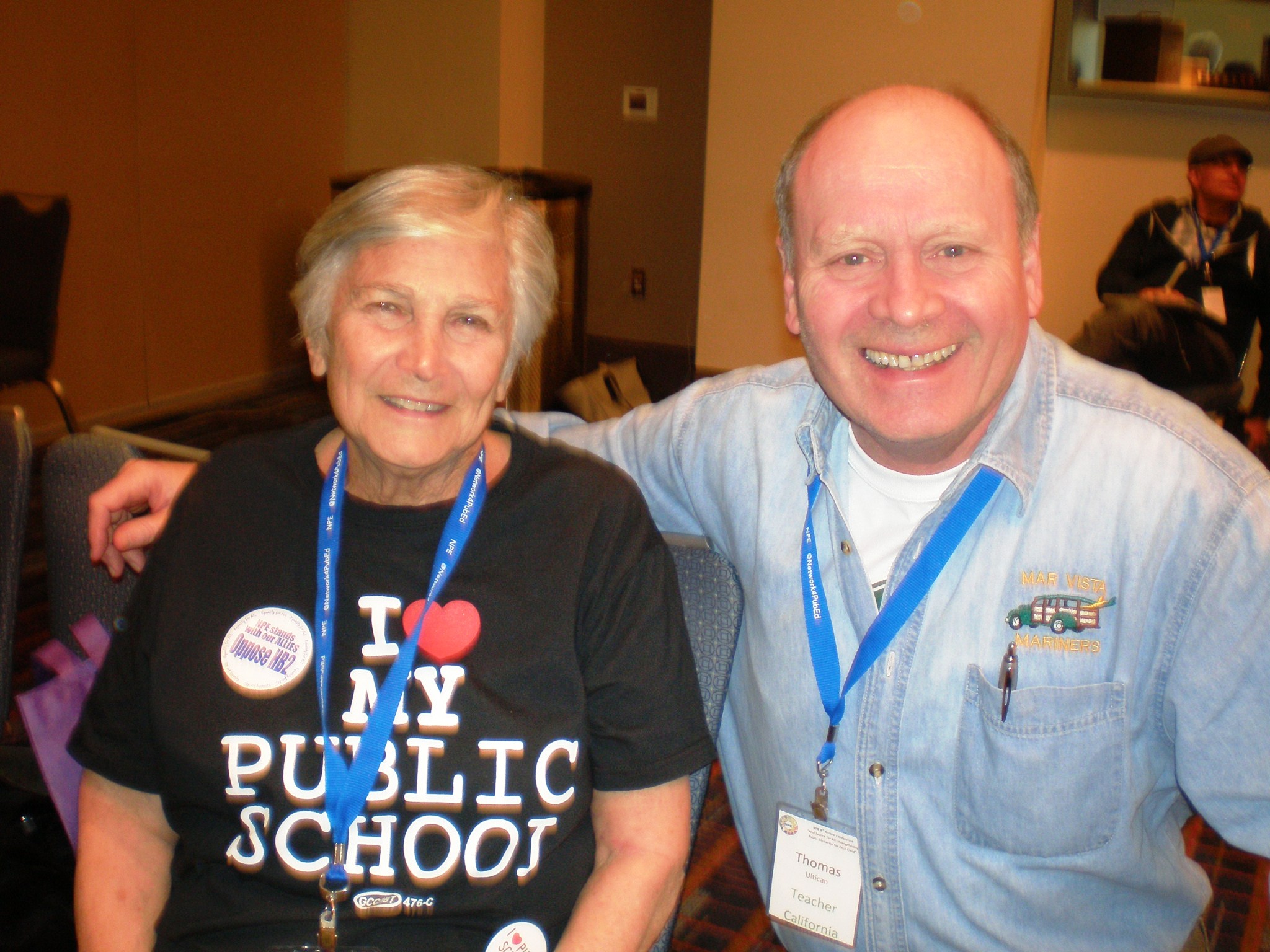
Tom Ultican and Diane Ravitch in Raleigh (by Ultican)
In addition, Colorado’s Governor Jared Polis is an enthusiastic supporter of charter schools, having opened two himself. Michael Bennett, one of the state’s U.S. Senators, is also a champion of charters, a former superintendent of the Denver public schools, and plans to run for governor. The mayor of Denver, Mike Johnston, is a former Teach for America activist and state legislator, who supports charter schools and authored a harsh teacher evaluation bill.
Mike DeGuire, former principal in Denver Public Schools, uncovered the dark money supporting the “reform” candidates. They include billionaires Philip Anschutz, the richest man in Colorado, Reed Hastings of Netflix, and John Arnold, former Enron trader.
Despite this lineup of big money and political heavyweights, the public in key districts chose their public schools.
She writes:
Swoosh — that’s the sound of money flushed down the toilet by Denver Families Action on their expensive-but-weak candidates for Denver Public Schools Board of Education. Bravo — that’s the sound of praise from Denver voters for Denver’s public-school teachers.
The mission of Denver Families Action led by Clarence Burton and Pat Donovan was to flip the Denver Board to a pro-choice, pro-charter majority. Many experts in the public-education sector see pro-choice advocacy as a lead-in to school vouchers.
In Denver, charter schools essentially serve the purposes of private school voucher programs. These schools and networks get tax dollars to operate their schools but have private, unelected school governance. The oversight of hundreds of millions of public dollars spent by these charters is at stake. Wealthy elite donors plunk down additional millions of dollars to support these education programs with accompanying tax write-offs.
Meanwhile, DPS had to close neighborhood schools recently due to low population and dropping revenues. The disruption from these school closures played out in Xochitl Gaytán’s southwest District 2. Gaytán was the only incumbent endorsed by the Denver Classroom Teachers Association. She is on record as rejecting future neighborhood school closures. She defeated her Denver Families’ opponent 57% to 42%, a big number with a big message.
Amy Klein-Molk ran against former district employee Alex Magaña in a head-to-head for the at-large board seat. Magaña had an ongoing dispute with DPS Superintendent Alex Marrero over the administration of Beacon innovation network of middle schools. Marrero found mismanagement and acted to dissolve the network. Beacon sued the district and lost. Klein-Molk crushed Magaña 55% to 44%, a nice 11-point spread.
Further confounding school district elections, Douglas County voters turned out its conservative majority. The “community not chaos” slate will seek to refocus the district away from contentious political issues, of which there are many and good luck with that. The slate emphasized teacher recruitment and retention based on a stable, positive work environment. Like other metro area districts, declining enrollment in older neighborhoods and increasing populations in newer neighborhoods create important, bottom-line challenges around opening and closing schools.
Pueblo County put up a split decision in its hotly contested school board races pitting public teacher-backed, public school-supporting candidates against parents rights, Christian education-oriented conservatives. In District 60, one candidate from each side won. In District 70, two public-school supporting candidates won and one non-aligned candidate took a seat.
In resounding support for providing good nutrition for school children, voters across the state supported propositions LL and MM. State residents on the high end of income, $300,000-plus, will contribute more tax dollars to the food-for-all school meals program by reducing state income tax deductions. This change will produce $95 million to fill the funding gap in the nutrition program.
What’s interesting about this result is 785,000 voters said NO to the tax increase in MM, or 35%. About 8% of Colorado taxpayers earn more than $300,000 per year, so quite a few people voted to allow wealthier individuals to keep their charitable contributions at the higher level. That’s the base of people against any tax increases for any reason.
Based on these overall results, several implications emerge where public education connects with taxation and the 2026 governor election connects to public education policy.
Great Ed Colorado and other groups will seek to offer a tax initiative of some sort to bring more money into the state’s school finance budget. The school nutrition vote put 65% of voters into the “we will nourish the kids with food” camp. It’s unknown whether nourishing kids with food also extends to nourishing kids with learning.
The governor’s race between U.S. Sen. Michael Bennet and Attorney General Phil Weiser contains the public education and tax increase intersection. The Taxpayer’s Bill of Rights, TABOR, creates much of Colorado’s taxation and state finance problems. The federal government’s animus to our state politics puts another kink into how Colorado can fund Medicaid, public schools, and an array of other needs adequately.
Sen. Bennet has received gobs of campaign money from wealthy east coast and west coast money-people who support school choice, charters and probably vouchers. Their preference is for public schools to turn charter or, better yet, private. Sen. Bennet will have to explain exactly how that will work in Colorado. Does he want more than $10 billion in public tax dollars to move to oversight by unelected charter boards with schools presenting curriculum that doesn’t meet state standards? Will he support changes to TABOR to bring in more tax dollars for school finance?
Attorney General Weiser will have to address the same questions with concrete offers. Right now, he supports a “livable wage” for teachers and down-payment assistance for teachers to live where the teach. He will “stand strong” for public schools and against privatizing. But will he go after TABOR reform and counter lack of transparency in charter-school governance?
This election gives hints. Voters supported the public in public schools and providing students with nourishment to flourish in school. The next election will decide whether public schools will flourish in teaching and learning as well.
Paula Noonan owns Colorado Capitol Watch, the state’s premier legislature tracking platform.
The big money promoting privatization in Denver tried to capture the Denver school board, but was defeated by candidates endorsed by the Denver Classroom Teachers Association.
Chalkbeat Colorado reported:
Denver school board candidates backed by the teachers union won all four open seats Tuesday, unofficial election returns show, making it likely the board’s current balance of power will hold.
Eleven candidates were vying for four seats on the seven-member Denver school board.
Union-backed candidates won by commanding leads in three of the races and a solid lead in the fourth, according to unofficial returns. Two of the three incumbents who ran for reelection, Michelle Quattlebaum and Scott Esserman, lost their seats.
Teachers union-backed board members have controlled the board of Colorado’s largest school district for the past six years. Members who support charter schools and other education reform strategies gained a bigger foothold in 2023 and had a chance to flip the board majority this year.
Now, the board will continue to be composed of four members who were endorsed by the teachers union and three who were backed by reform interests.
Denver Classroom Teachers Association President Rob Gould called the early returns on Tuesday a victory of “people over money.” Like in past elections, reform groups were on track to outspend the teachers union, according to the latest campaign finance reports.
You may have read about Josh Cowen . He’s a professor of Education Policy at Michigan State University. For twenty years, he worked on voucher research, hoping to find definitive evidence that vouchers helped the neediest kids–or didn’t.
About two years ago, he concluded that the answer was clear: vouchers do not help the neediest kids. Most are claimed by kids who never attended public schools. In other words, they are subsidies for families who already pay for private schools. When low-income kids use vouchers, the academic results are abysmal. He concluded that the best way to improve the schooling of American students is to invest in public schools.
Josh did his best to stop the billionaire-funded voucher drive. He published a book about the evidence, called The Privateers. He wrote articles in newspapers across the nation. He testified before legislative committees.
He concluded that the most important thing he could do is to run for Congress. He’s doing that and needs our help. I’ve contributed twice. Please give whatever you can.
Public schools need a champion in Congress.
Josh writes:
Hey everyone. You may have heard that I’m running for Congress in my home district in Michigan. It’s one of the most important seats to flip next year for Democrats to retake the US House. I’m hoping you’d consider chipping in today to help us meet a big deadline by 9/30.
I’m probably the most prominent congressional candidate in the country running in part on the idea that we need to stand up for and renew our public schools.
I took on Betsy DeVos and the Koch operation all over the country, trying to stop school voucher schemes. I’m a union member and work closely with labor—check out my book excerpt about vouchers in AFT’s New Educator right now!—and I was just given NEA’s highest honor, the Friend of Education award. Diane herself won a few years back—I’m truly honored.
But the DeVoses and a MAGA Texas billionaire are going to spend big here to hold Congress and defund schools. Former MI GOP Governor Rick Snyder is planning to raise $30 million to make 2026 the “education election” for Republicans in Michigan. This is the same guy at the helm when kids were poisoned in Flint. And the same guy responsible for the disastrous EAA charter school fiasco.
My GOP opponent is the Koch’s bagman in Michigan. This is a guy who eked out a win in our district just last year when Elissa Slotkin had to give up her seat to run for Senate. So it’s a very winnable race. But we need help.
Last month just for starters: 14 statewide and local school and community leaders in Michigan endorsed us. Last week, UNITE HERE!, the big hospitality workers union, endorsed our campaign. And just this week, Dr. Jill Underly, the statewide elected chief of Wisconsin public schools, announced her support. You may remember that Dr. Underly beat back Elon Musk’s plan to buy the off-year elections just this spring in her state. She showed how a strong, positive message of standing up for public schools and standing up to billionaires can win a swing state election.
We can do that too. So I’m asking for your help to close this month strong.
Mike DeGuire is a veteran educator in Denver. He says it’s time to take stock and assess the damage that “reform” has inflicted on students and public schools in Denver.
Is public education a public or a private good? This issue is at the heart of the school choice debate sweeping the country.
Advocates for school choice are advancing policies that move us toward the privatization of our schools, treating our children’s futures as commodities rather than community investments. This well-funded bi-partisan coalition promotes privatization through charter school expansion, vouchers, tax credits, and education savings accounts. Republicans use the words “parental rights, freedom and competition,” while neoliberal Democrats brand it as “innovation and expanding opportunity.”
Public education is one of the last shared institutions that binds us together across race, class, and geography; when we weaken it, we weaken democracy itself.
The result is the same for communities when privatization becomes a reality in red states with vouchers or in blue cities where most charter schools are located. Vouchers segregate schools by class and race, diminish the importance of community, and severely limit funding for public schools.
Charter schools operate like private schools, create competition for students, often have unelected boards. Additionally, the charter schools, not the community, get to determine who enrolls, who stays, and what kind of learning takes place. As marketplace ideology takes over, public dollars and democratic control move from local neighborhood schools to private boards and political operatives.
Denver Public Schools (DPS) shows how this movement works in a blue city, and why it matters now in Trump’s vision of America’s education system.
Different slogans, same destination
On the right, and in most Republican-led states, legislatures enacted policies to privatize education with vouchers and education savings accounts (ESAs) designed to route public funds to private and/or religious schools. Often, these tactics originate with model bills written and promoted by the American Legislative Council (ALEC) and their allies. The goal is to let public dollars “follow the child,” which means diverting them away from democratically governed school districts.
On the neoliberal Democratic side, the mechanism is the charter-centric “portfolio model.” Local school boards often elected with large amounts of pro-reform money approve policies to close or “restart” neighborhood schools. Then they open new charters, bring in “operators” deemed to be “effective,” and the district “manages” the schools and their networks like an investment portfolio.
This storyline was supercharged under the Obama administration’s Race to the Top, which rewarded states for removing barriers to charter growth and for aggressively initiating school “turnarounds.”
The overlap with Republicans and Democrats is structural. Both sides define schooling as a marketplace and shift authority from elected school boards to private actors, like charter boards, appointed authorities, and national nonprofits. In their book, “Wolf At the Schoolhouse Door,” Jack Schneider and Jennifer Berkshire describe “how Republicans and Democrats joined to support failed policies whose ultimate goal was to eliminate public education and replace it with a free-market approach to schooling.”
Charles Siler, who worked as a lobbyist for the libertarian Goldwater Institute, told the Washington Post that “Charter schools are part of the incremental march towards full privatization. In many ways, charter schools are the gateway to total public-school dismantling.” Since vouchers are unpopular with the public and some lawmakers, Siler continued, “privatizers have to engage in incrementalism, and they use different names to create a sort of moving target.”
Both camps sell the public on privatization by claiming that “failing test scores” prove neighborhood schools, especially those serving Black and Brown students, are broken beyond repair. They argue the racial achievement gap is proof that these schools must be shut down and replaced with charters through “school choice.”
This narrative is deeply misleading. First, decades of research show that standardized test scores mostly measure socioeconomic status and neighborhood inequality, not the quality of individual schools. Poverty, housing insecurity, and systemic racism drive disparities, not the mere fact of attending a district school.
Second, the research demonstrates that replacing schools with charters has not closed achievement gaps. Denver Public Schools illustrates the point: after years of churn, closures, and huge charter expansion, racial disparities in achievement persist. Black and Latino students continue to score lower on state tests than white peers — not because they are “trapped in failing schools,” but because privatization has siphoned resources from their neighborhoods, destabilized communities, and ignored root causes.
Bipartisan funding for similar goals
The funding networks and foundations knitting these free-market agendas together are deep-pocketed and bipartisan. For instance, the conservative Walton Family Foundation underwrites charter startups and charter facilities nationwide, spending well over $1 billion on this effort. The majority of their political spending goes to Republican causes, with over 2/3 of their PAC money going to Americans for Prosperity, founded by the Koch brothers.
In his book, “Kochland: The Secret History of Koch Industries and Corporate Power in America,” journalist Christopher Leonard describes how the American Legislative Exchange Council (ALEC), a Koch-funded right-wing group, creates model legislation which can be introduced in state legislatures. Many of these bills aim towards privatizing schools by implementing voucher programs.
City Fund raised millions, largely from Netflix founder Reed Hastings and hedge fund manager John Arnold, to spread charter schools in over 40 cities through portfolio management systems and by bankrolling local political action groups. While Hastings supports Democratic causes, he is opposed to teacher unions and believes that local school boards should be abolished. Arnold, also a Democrat, gifted the KIPPcharter network millions, and like many billionaires today, is seen as cozying up to the Trumpadministration for influence.
The Bradley Foundation and ALEC financed the policy and political infrastructure for vouchers and ESAs for decades. The Bradley Foundation, the Colorado-based Coors family, and the Koch foundation were three of the six billionaire families that funded Project 2025, which has been the playbook for Trump since he took office in January.
Many of these same philanthropic and political dollars fund both a Republican voucher push and a Democratic-branded charter expansion — two lanes of the same privatizing highway.
Denver: a “portfolio” laboratory
Denver is often cited by education reformers as a national model as it implemented unified enrollment, systematic school closures, and rapid charter school growth. But the backstory behind who paid for these policies is less sanguine. A Network for Public Education report details how Denver Public Schools became a neoliberal “experiment,” using a web of nonprofits and political groups to expand charters and restructure the school district.
Both Republicans and Democrats contributed large amounts of money in Denver school board elections to promote corporate reforms, such as teacher pay for performance, school choice systems, and enrollment zones. In the 2017 DPS school board election, billionaires gave huge sums to the Denver candidates favoring charter school expansion. According to a report from the Network for Public Education Action, these included “Colorado billionaires Phillip Anschutzand Kenneth Tuchman, and out-of-state billionaires John Arnold of Texas and the Alice, Jim and Stuart Waltons of Arkansas.”
Both sides define schooling as a marketplace and shift authority from elected school boards to private actors, like charter boards, appointed authorities, and national nonprofits.
Meanwhile, years of churn and school closures left communities reeling. Even reform-friendly analyses concede that the “portfolio model” era meant opening lots of charters and closing or “replacing” dozens of neighborhood schools. Researchers studying this model have cited significant concerns with the efficacy of the model, including equity issues, narrow reliance on test scores, instability and churn, tensions among schools, and loss of democratic control and community voice.
In a 2016 article, progressive education advocate David Osborne documented that “Since 2005 [Denver] has closed or replaced 48 schools and opened more than 70, the majority of them charters.”
The billionaires’ money helped maintain a pro-charter majority school board until 2019 when teacher union-backed candidates were elected because of organized community backlash to the reforms and unrest after a teacher-led strike that year. That shift caused alarm bells among the billionaire backers of the pro-charter movement. They moved quickly to expand their funding to two political action groups in Denver.
RootED and Denver Families for Public Schoolsreceived over $38 million from Reed Hastings’ City Fund organization, which they used to promote their pro-charter agenda through grants to charter schools, local think tanks, and other community groups. Their efforts paid off in the 2023 school board election, when three of their endorsed candidates won their elections after Denver Families Action spent nearly $1 million to promote their campaign.
Outside spending has transformed Denver board elections into major dark money funding events, with the 2023 election hitting $2.2 million, just shy of the 2019 record of $2.3 million.
In an op-ed for Charter Folks, Clarence Burton and Pat Donovan, leaders for Denver Families for Public Schools, described their plans to repeat the 2023 wins in the upcoming November 2025 school board election. They may spend some of their vast resourcesfrom City Fund to sway voters.
In the next four years, DPS faces continued enrollment declines, and district leaders seem inclined to approve more closures to rebalance finances. That is the portfolio playbook’s endgame: when money is scarce, close neighborhood schools and expand privately run options. If successful in electing their endorsed candidates, Denver Families Action is poised to help that happen.
Do charters drain district resources? What the evidence says
District leaders and parents feel the fiscal squeeze when enrollment flows to charters. Fixed costs don’t disappear just because 5% or 10% of students leave. Research consistently warns that losses to enrollment can trigger costs that are not fully “variable” — you can’t cut 1/20th of a teacher or 1/10th of a bus route. Studies from New York and other locales estimate significant per-pupil losses in host districts as charter school share rises.
A policy brief from the National Education Policy Center summarizes the structural mechanisms that occur with fixed costs, diseconomies of scale, and shifting student composition. The brief describes how “a network of philanthropists and wealthy donors have reshaped the political economy of school finance, advocating for school voucher policies, charters, and privatization in the face of declining public-school enrollments.”
Pro-charter think tanks argue the picture is “mixed,” especially longer-term if districts close schools and cut staffing, the very things communities have fought against. But even those reviews concede there are short-term inefficiencies and significant harms. In practice, these policies mean closures, layoffs, and program cuts in neighborhood schools.
This bipartisan push undermines neighborhood schools, deepens inequality, and places corporate interests above the common good.
Trump-world raises the stakes
Under President Trump’s second term, privatization is not just encouraged; it’s federal policy. A January 29, 2025, White House directive ordered the Education Department to steer states toward using federal formula funds to support K-12 “choice” initiatives, which was a direct push for vouchers and related schemes.
Trump’s “Agenda47” likewise spotlights universal school choice as a signature plank, tied to dismantlingprior civil-rights guidance and reshaping federal oversight. Plans to weaken or abolish the Education Department are framed as clearing the path for parental choice.
Trump’s Education Secretary Linda McMahon increased the federal department budget for charter schools by $60 million to a historic record of $500 million. At the closing session of the National Democratic Governors Association meeting, McMahonstressed to the governors they should open charterand micro-schools to promote more competition. This is the Republican Lane, wide open.
The Heritage Foundation’s Project 2025 promoted federal tax credits for vouchers, which are now approved federal legislation. The CEO of Democrats for Education Reform is pushing Democratic governors to use these new federal vouchers to expand learning opportunities for economically disadvantaged students or lose “free federal money.”
The policy highway already built by the neoliberal Democrats (charter growth, closures, portfolio management) has made it easier for a voucher-first administration to push public taxpayer dollars out of democratically governed systems. That’s the interlock: Democrats normalized the market; Trump-world aims to privatize the whole store.
The bottom line
Denver is not an outlier — it’s a warning. A bipartisan coalition normalized the idea that public education should be run like an investment portfolio, where schools are opened, closed, and “reconstituted” based on technocratic dashboards and political spending. The Trump administration’s voucher agenda, promoted for decades by the Koch brothers and other conservatives accelerates the same logic, now directs federal policy to help states route public dollars out of public governance altogether.
If we believe education is a public good — funded equitably, governed democratically, and accountable locally — the public must see charter expansion and vouchers as two halves of the same privatization project. When education is treated as a public good, it is essential for democracy, civic participation, economic stability, and social cohesion.
Every child deserves an equal chance in life. Therefore, education must remain a public good — not a marketplace where opportunity is limited to the school’s choice of selecting students. The question isn’t whether our schools should be run like private businesses. It’s whether we are willing to fight for education as a right, not a privilege.
And, if the public cares about our children’s future,they need to vote, organize, and promote legislation accordingly.
Mike DeGuire, Ph.D., is the vice chair of Advocates for Public Education Policy. He has been a teacher, district level reading coordinator, executive coach, and a principal in the Denver metro area for most of his education career. He also worked as a leadership consultant for several national education organizations, and as an educator effectiveness specialist with the Colorado Department of Education. His writing is also featured on a4pep.org.
John Kuhn is the superintendent of schools in Abilene, Texas. He was hired by the Abilene school board in April 2024. He previously served as superintendent in three small districts in Texas. The Abilene board introduced him this way
Dr. John Kuhn brings 27 years of proven experience in public education to Abilene ISD. Prior to joining the Abilene ISD team, Dr. Kuhn most recently served as Superintendent of Schools for Mineral Wells ISD. He has also served as superintendent of Perrin-Whitt CISD and as a high school principal, assistant principal, teacher, and bus driver in the Mineral Wells and Graford Independent School Districts.
I met John Kuhn at a conference of the Network for Public Education about a dozen years ago. At that time, he was superintendent of the Perrin-Whitt Distrist, which has about 320 students, half of whom are economically disadvantaged.
John is one of the most eloquent champions of public education that I’ve ever met. I remember him saying, “Send me the kids you don’t want. Send me the kids who don’t speak English. Send me the kids who are struggling to learn. Send me the kids with disabilities. I’m in a public school and we will teach them all.” Or words to that effect. I’m hoping he will be a keynote speaker at our next conference in Houston in April 2026. He’s the leader we need!
He posted this letter on his Facebook page and it drew a massive response and national attention.
Gosh where to begin? I’m eligible to retire in January, and I don’t want to because I feel like I owe the good people who hired me and this great community at least a few years of blood sweat and tears. I work for a great school board in a city I’ve absolutely fallen in love with. But holy moly do I want to pack it in right now. The burden is heavy.
Yesterday I spent hours at an update listening to the impacts on teachers and admins at public schools of bill after bill passed by our lege. Did you know that one bill says teachers are going to be required to catalogue every book in their classrooms? Kindergarten teachers have hundreds of tiny books. With what time? When?
Did you know that another bill says nurses can’t provide any health care whatsoever and counselors can’t provide any emotional support whatsoever without a written permission slip from parents? The bill language is so poorly written that—despite what it clearly says in black and white English—the bill author sent out a clarification saying nurses can provide a band-aid to a kid who is bleeding. He wouldn’t have to send out a clarification if they wouldn’t pass dumb bills—but legislators have been convinced by political groups who hate public schools that everyone inside them are wicked, evil people.
Did you know about the other new bill that says school administrators who work on the side as refs or one-act-play judges at any school anywhere are subject to a $10k fine per offense for working those jobs if they each individually don’t present a contract to their school board.
That doesn’t apply to me, but I know tons of APs and principals who ref and judge student drama contests. In fact, there’s a huge shortage of both, so if they didn’t do it, we’d be in an even bigger bind in trying to put on games. Again, the bill author had to put out a “clarification” claiming the bill doesn’t mean what it clearly says.
Because they refused to listen to the input of our educator groups—groups, by the way, that they are trying to get defunded because they consider them “taxpayer funded lobbyists” for representing school districts and municipalities.
There is a political movement to pull the teeth of local officials at schools and on city councils and county commissioners courts so that all we have is centralized state leadership. So local yokels like yours truly have to be continually demonized and legislated into submission.
I haven’t even talked about vouchers draining our public schools of resources so those education dollars can go toward private schools that aren’t subject to the crushing bureaucracy. I haven’t event talked about the new testing bill—the one that replaces STAAR with the 3x per year Death STAAR that, like its predecessor tests is solely owned and controlled by the TEA commissioner and is not norm-referenced so Texas student results can be compared to other states, which would keep things honest and prevent the manipulation of student results for political narrative-building.
Anyway, I go to a conference all day listening to this stuff the day after Republican Charlie Kirk is murdered and months after a Democratic state senator is murdered, and I just keep thinking, is it worth it? I can retire and keep to myself until I die of old age. I can just fish every single day. I can travel. I can camp. I can sleep in.
And I get to my hotel room and find some social media commenter calling my teachers “demons” because they assigned an chapter of the amazing book Extremely Loud and Incredibly Close as a reading passage for a freshman honors English class. This is a book written in the voice of a nine-year-old boy who lost his dad on 9/11 in the terrorist attack on the twin towers. It’s an award winning book. But the passage has the word “shit” in it. And it has a vulgar term that I’m told the teacher was unfamiliar with it. And it has a crude joke about talking butts, which I was a nine-year-old boy and that’s the kind of crudeness we giggle at, so the author was pretty spot on. It also has the word “pussy” but that was what the kid called his cat, but the Facebook post highlighted it as part of making a case that this book was inappropriate.
Thing is, it’s likely valid that this book should be restricted to older kids—17 and 18 year olds. It’s worth noting that this was assigned to only the honors kids because the other passage that the class was reading—also related to 9/11–was at too easy a reading level. So these poor teachers are trying to find something for advanced kids to read, and they don’t have time, and they’re making a good faith effort to push kids to Meets and Masters because they care (and if our A-F grade is too low, there is outrage over that too). And they pick this award-winning book. They decide one “shit” is tolerable. They aren’t offended by the word “pussy” because it literally isn’t a bad word in the context. They get it approved by a colleague.
And they are called “DEMONS.” (Ironically, in the comments of the outrage post, they’re also called “assholes,” which is literally worse than “anus,” which is one of the words the parent highlighted and took offense to, but nobody scolded the commenter for that vulgarity. What’s good for the goose… Commenters also typed “wtf” and “WTH,” which mean “what the fuck” and “what the hell” but nobody accused them of “grooming” children. Selective outrage, anyone.
Who needs this? Is everybody serious? Does everyone just feel absolutely compelled to post their moral superiority online by attacking perceived enemies they’ve never met or shared a meal with.
Our country is no longer capable of living in community. We’ve been driven to our corners. It is barely possible to be a public servant anymore. I totally get why our city manager retired.
My teachers aren’t demons. They may have made a mistake in assigning this book to 15-year-olds rather than 17-year-olds, and for that there are people online saying they need to be fired. Today Incredibly Loud and Extremely Close is likely temporarily coming off our library shelves while we review our book challenge policies. Read the book. It’ll make you cry.
We can’t win in public ed anymore. This is absolutely ridiculous. If I make it to December, it’s gonna be a miracle. I don’t need your sympathy replies, either. I’ll hang it up when I have to for my family and my health, and I’ll stick it out if I feel like I want to. In the meantime, I just want you to know I’m sick of politicians playing divisive politics and leaving local public servants to clean up the mess. Public schools are apolitical entities with the job of teaching kids to think critically and become awesome humans. We aren’t perfect. We have missteps, because we are human organizations. But don’t call my teachers DEMONS while you cuss in the comments.



 Diane Ravitch's blog