Archives for category: Stupid

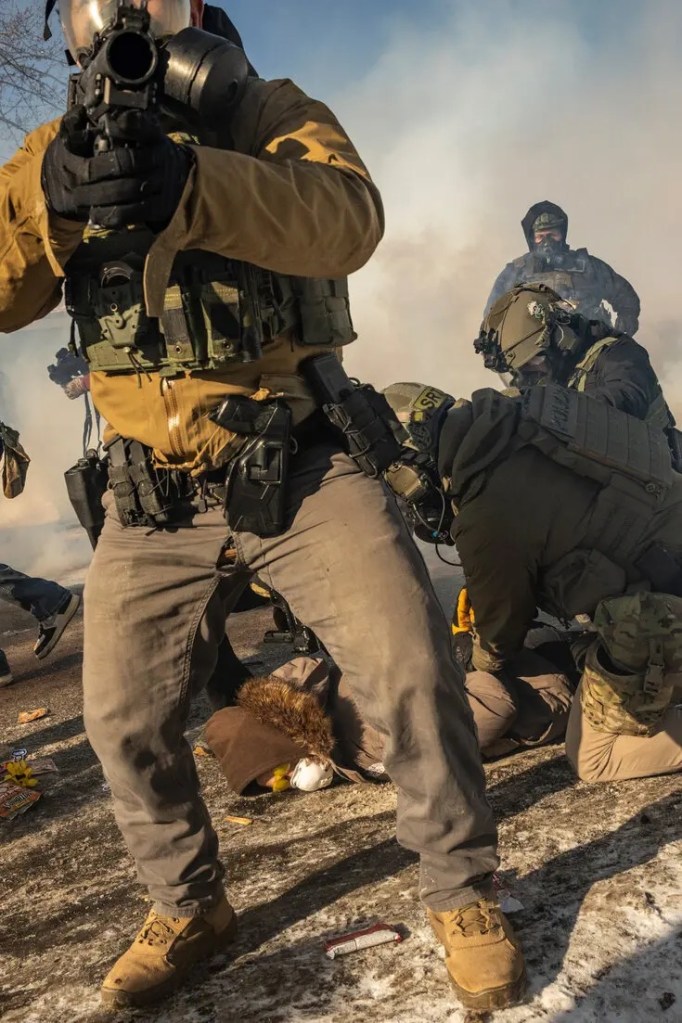
I saw this photograph in The New York Times.

It’s an ICE agent in Minneapolis, looking fearsome. His gun appears to be pointed at the photographer’s head or just over his right shoulder.

He is standing guard as other federal agents are cuffing a person who is face-down on the ground. This is a common tactic. Instead of cuffing a suspect as they stand, the armed ones throw them to the ground, face down, and three or four immobilize him or her, then cuff them.

I immediately noticed that this aggressive guy was wearing combat pants that had a large hole in them.

He doesn’t seem to wear underpants.

Do you see what I see?

What a dork!

Jennifer Rubin, ex-columnist for The Washington Post, now leads The Contrarian, a home for dissatisfied ex-Republicans and outraged democrats. She wrote the following.

Everyone saw this coming except the President.” An “unmitigated disaster of epic proportions.” Were these the words from Democrats decrying Donald Trump for failing to plan to evacuate hundreds of thousands of civilians under a blizzard of retaliatory fire raining down on the Gulf States? No, those were Republicans excoriating former president Joe Biden for the botched 2021 exit from Afghanistan. Back then, Rep. Steve Scalise (R-LA) thundered, “It’s a very dire situation when you see the United States Embassy being evacuated.”

Fast forward to last week. The Trump regime closed down three of our embassies (Saudi Arabia, Lebanon, and Kuwait), abandoning U.S. citizens in those countries. Trump’s minions failed to consider advanced planning to evacuate Americans from the region, leaving them to fend for themselves in places where missiles are flying and buildings are ablaze.

Story after story has documented Americans scaredstranded, and left to find their own transportation out of countries made dangerous by his careless whims. Many have expressed their understandably fury that their government could be so derelict. The State Department has failed spectacularly in one of its essential missions — protecting Americans around the world.

The Trump regime’s level of recklessness and indifference to human life and international order should appall all Americans. Trump’s excuse for making no evacuation plans — “Well, because it happened all very quickly” — is ludicrous, considering the U.S. and Israel apparently spent months planning the military assault. His jaw-dropping admission that Iran’s bombardment of neighboring countries in retaliation was “probably the biggest surprise” reflects how little thought he put into a war with global ramifications.

Even in Afghanistan in 2021, after initial mayhem, the State Department scrambled, mounted a all-hands-on-deck rescue operation, enlisted personnel worldwide, and evacuated over 100,000 people in just a couple weeks. We see no comparable sense of urgency now.

Foreign policy professionals who have planned and executed mass evacuations of civilians in war zones over decades blasted Trump’s negligence. State Department veteran and Middle East expert Jeffrey Feltman recently argued, “It is a complete dereliction of duty for President Trump and his administration to have been planning this war for the past month, however long it’s been since they’ve been moving assets, without planning for an evacuation of American citizens.” He expounded on the cavalier and irresponsibly failure to protect Americans:

You know, Biden rightly got criticized for the shambolic withdrawal from Afghanistan. But we’re talking now about the potential of… American citizens being trapped in 14 different countries when they could have been planning all along for how they were going to deal with this. Right now, right now, the statements are, “Use commercial means to leave.” Well, there are no commercial means to leave. There’s been some hints they’re looking at this, but they could have put all this in place.

How could they not have expected a country with a stockpile of missiles would retaliate across the region, endangering tens of thousands of Americans? Secretary of State Marco Rubio and Trump’s pathetic excuses for neglecting elemental steps to protect Americans left Democrats, ordinary people, and foreign policy insiders flabbergasted.

Sen. Andy Kim (D-N.J.) reported his office was inundated with “panicked calls from Americans stuck in the Middle East, outraged that our government has provided zero evacuation support.” Combat veteran Sen. Tammy Duckworth (D-Ill.) was outraged by the absence of any “evacuation plan for Americans in the region when he launched his reckless, needless and unconstitutional war of choice against Iran.” Others joined in denouncing the institutional malpractice. 

This display of incompetence should not surprise us, given that the MAGA crew harbors such contempt for government. The massive cuts and loss of scores of foreign policy professionals (collectively representing centuries of experience) mean institutional knowledge is scarce. DOGE cuts conducted by know-nothing twenty year olds, partisan witch hunts, early retirements, and mass resignations have hollowed out the State Department, leaving it in the hands of a skeletal staff retained for their political loyalty — not expertise and experience. (Rubio also slashed staff at the National Security Council, which is supposed to oversee interagency planning.) In any other administration, the secretary of state/national security adviser would get canned or forced to resign in disgrace after such management malpractice.

As Columbia University Professor Elizabeth Saunders explained, Trump and Rubio’s “gutting of the State Department and blowtorching of US diplomatic capacity and credibility is an accelerant to this spiraling war and will seriously undercut US/allied efforts to pick up the pieces after.” If they bollixed up something as foreseeable as evacuations, imagine what chaos will ensure when the fighting stops.

For over a year, buffoonish Cabinet secretaries and their senior advisers have demonstrated the Trump regime is no “meritocracy.” As in all corrupt regimes that value sycophancy over competence, avoidable errors multiply over time. Americans trapped in a regional war zone (not to mention our armed service and regional allies) now pay the price for an unhinged and impulsive president enabled by careless, juvenile advisers who think war is a video game.

Meanwhile, no one at the White House has the temerity to contradict Trump’s “gut” impulses. Without aides to restrain Trump’s whims (e.g., Mr. President we need to get the Americans out first), he blunders forward.

To compound the problem, MAGA’s cult of personality that necessitates Republicans abdicate their legislative responsibilities, Congress would have voted for a war powers resolution, or at the very least, initiated aggressive oversight. Alas, the Republicans (who have time to quiz the Clintons behind closed doors about the pedophile scandal) show no interest in determining how this travesty unfolded and what is being done to remedy it. Instead, Hill staffers are left to field angry calls from constituents begging for help.

Congress must rouse itself to focus on a foreign policy disaster that makes the Iraq War look like a masterstroke. Rubio and other top officials under oath and in public should answer for their lapses, account for every dime spent, and give Congress some basic information. (What is the plan to extract Americans? When does the war end? Are we now targeting civilians?) The last thing Congress should do is agree to any request, as the Trump team is reportedly contemplating, to shovel more money into the coffers of this gang of bumblers.

Unfortunately, we know how this will play out. Trump and his arrogant yes-men will never admit error, let alone apologize; Republicans on the Hill will not stir themselves to do their jobs. It will be up to the voters to throw out every elected Republican and force removal of the architects of this catastrophe. Until that happens, Americans here and abroad will needlessly suffer and die

Foreign Policy, a distinguished publication for leading scholars of foreign affairs, published an article by staff writers Keith Johnson and Christina Lu asserting that Trump’s lust to control Greenland is just plain nuts.

They wrote;

Seeking additional barrels of oil in Venezuela or digging for rare earths in ice-covered Greenland makes no sense from an economic or security point of view. And yet U.S. President Donald Trump persists, even though the costs massively outweigh the benefits.

In reality, naked resource grabs explain a lot about Trump’s dizzying foreign policy, perhaps even more so than other explanations that have been proposed. It seems Trump may have reached back even further in time for his guiding light than tariff-happy William McKinley and big-stick imperialist Theodore Roosevelt to the British and Dutch quasi-state mercantilist corporations that introduced much of the world to rapacious capitalism starting in the 17th century. The British and Dutch East India Companies did grab much of the world, usually at gunpoint. At least they got pepper, spices, and tea. All we have here is sulfurous oil and neodymium.

Gunboat diplomacy is back, only this time without the diplomacy.

Trump’s obsession with natural resources that the companies paid to extract them refuse to touch does raise several questions. Are these even the right resources to be grabbing? Is any of this legal? And most importantly, is any of this a remotely good way to promote the security of the United States?

WHEN IT COMES TO OIL, which has been a Trump obsession for decades, the answer is clearly no.

Oil demand is a tricky thing to project into the future. Some forecasters expect global demand for oil to peak within five years, while others reckon fast-growing developing economies will still be thirsty into the next decade, requiring more wells and more production. Either way, oil from Venezuela and Greenland is not the answer.

Venezuela’s oil woes have been amply demonstrated. It’s an expensive thing to produce in a place with little security and less rule of law, especially with oil languishing in the mid-$50s a barrel. The chairman and chief executive of ExxonMobil, Darren Woods, told Trump at a White House meeting last week that Venezuela was “uninvestible.” Trump then said he would ensure that Exxon was kept out of any U.S.-led Venezuela ventures—and Exxon’s stock rose on the news.

Greenland, too, is rumored to have oil: billions of barrels of it. It’s not clear if that is actually the case, because decades of exploration have hit only dry wells, but on paper, Greenland could have 8 billion barrels of oil hidden under the tundra and the whitecaps, or nearly 3 percent of Venezuela’s unattractive reserves.

But there are some daunting challenges. Most of those estimated oil resources are north of the Arctic Circle, and mostly offshore. That is not easy to access, even with climate change stretching summer on both ends. Even the oil on land is not easy to tap. There are fewer than 100 miles of paved road on an island the size of Mexico. Deep water ports, airports, pipelines, oil-export terminals, housing, clinics—all are on somebody’s to-do list to build, but not that of oil majors.

Also relevant: Since 2021, Greenland has banned further oil exploration due to environmental concerns. The only current play, a land-based oil-exploration operation on the island’s east coast with U.S. backing, relies on a grandfathered lease from years ago. That legal stricture, in the absence of a complete annexation, could complicate further U.S. efforts to tap Greenland’s possible oil.

BUT WHAT ABOUT GREENLAND’S rare earths, which Trump officials have suggested are one of the primary reasons the U.S. president is so interested in the island?

While those who focus on rare earths mining simply say the plan is “bonkers,” the real issue is that rare earths are not rare—processing facilities and magnet factories are. Which makes a race for ice-bound dodgy mining prospects in somebody else’s territory all the harder to understand.

“It certainly doesn’t make any sense as a rare-earth story,” Ian Lange, a professor in the mineral economics program at the Colorado School of Mines, recently told Foreign Policy.

Rare earths, or a set of 17 metallic elements with obscure names like neodymium and samarium, have catapulted in geopolitical importance because they power everything from F-35 fighter jets to Arleigh Burke-class destroyers. China overwhelmingly commands their global supply chains, giving it powerful leverage in its ongoing trade spat with the United States.

Sure, Greenland may have some sizable rare earth reserves, according to the U.S. Geological Survey—but so do many other countries. And a big economic question hangs over potential operations in Greenland, where no rare earth mining has ever taken place and mining itself remains a fraught and divisive issue.

The biggest problem with Trump’s resource grabs is not their lack of economic foundation, which is nil, or their legality, which is none, but with what they do for U.S. security, which is little or worse.

Also, the bulk of Greenland’s land—a whopping 80 percent—is estimated to be covered in ice. All of those factors are certain to make establishing crucial mining and processing infrastructure, already a difficult and hefty financial endeavor, even more costly and challenging.

In his pursuit of rare earths, industry experts say, Trump will likely have an easier time looking elsewhere.

AND THEN THERE’S THE QUESTION of the legality of how Trump is going about his resource grabs. Abducting heads of government to seize resources is not anywhere sanctioned in the U.N. Charter, nor is threatening to invade a NATO alliance partner to forcibly annex their territory. But rogue states are hard to red team.

Trump has waved aside centuries of international law, telling the New York Times “I don’t need international law,” because his own “morality” was the only check or balance required.

It’s not an abstruse debate. For centuries, the West has sought to paint a patina of law over the anarchy of the international system, and even today, tomes are written about revisionist powers seeking to pervert international law for their own ends. Until very recently, the United States was not among the revisionist powers.

But there’s little to be done on that front. Trump’s installed successor in Venezuela, Nicolas Maduro’s former vice president and now also acting president Delcy Rodriguez, who has been under U.S. sanctions since 2017 for human rights abuses, is according to Trump “a terrific person.” Also not entirely legal is storing the proceeds of Venezuelan oil sales the United States has carried out in an offshore account in Qatar.

THE BIGGEST PROBLEM with Trump’s resource grabs is not their lack of economic foundation, which is nil, or their legality, which is none, but with what they do for U.S. security, which is little or worse….

The great advantage the United States had, until recently, was its network of alliances: NATO, Japan, South Korea, and a multitude of others. That’s all gone now, or nearly. It is surely a sign of bungled foreign policy when Sweden dispatches troops against you.


James Fallows is a veteran journalist who has published widely and was a regular columnist for The Atlantic. Early on in his career, he was chief speechwriter for President Carter.

He visited Greenland in the past year and has some sage thoughts about the idiocy of trying to seize it.

He wrote on his Substack blog:

This morning on Fox, two well-matched intellects: Maria Bartiromo and Ted Cruz. Next to them is a Fox-produced map making Greenland look bigger than China, which in reality is more than four times its size. And on a par with the whole of Africa, which in fact is nearly 15 times as large. Fox is famous as the main source of real-time intel for the person who has assumed one-man control of US military, economic, and diplomatic relations with the world. What could go wrong?

This post includes a reprise of some previous items on Greenland, especially from this post one week ago. But as news has evolved, and as the insane idea of taking over Greenland has moved closer to alliance-destroying “reality,” and as a handy one-place guide to the main issues, I offer this update:

I’m not expert on Greenland. But at least I’ve been there, last spring for nearly a week. Which is a week more than the current US President, his Secretary of State (who is also his National Security Advisor), or his Secretary of Defense can claim, among them. And I’ve been reading about the place, and asking people about it, before that and ever since. Which I doubt any of them have done.

Here are my main suggestions if you find yourself in a “Wow, this Greenland situation, what do you think??” conversation any time soon.

1) This crisis is all coming from someone’s gut. Not from anyone’s brain.

Maybe you want to keep this to yourself, rather than leading with it in the conversation. But it’s worth knowing: Does the Trump-era obsession with Greenland seem completely irrational? That’s because it is—as no less an authority than Trump himself has told us.

The most self-aware part of Trump’s recent hours-long gabfest with NY Times reporters, and among the most self-damaging, was the “why Greenland?” exchange.

The Times team didn’t put it exactly this way, but the implied setup for their question was: With brutal war ongoing in Ukraine, with carnage in Gaza, with regime change in Venezuela, with upheaval in Iran, with federal troops occupying major cities, with tariffs upending world economies, and so on, why on Earth are you even talking about Greenland?

Here’s how the Q-and-A played out, with emphasis by me.

David Sanger [NYT]: Why is ownership [of Greenland] important here?

Trump: Because that’s what I feel is psychologically needed for success…. Ownership gives you things and elements that you can’t get from just signing a document…

Katie Rogers [NYT]: Psychologically important to you, or to the United States?

Trump: Psychologically important for me. Now, maybe another president would feel differently, but so far I’ve been right about everything.

Give Trump credit, this one time, for honesty. Give him demerits on every other count. What he’s doing to all the rest of us is crazy. But, in a moment like Tony Soprano on the psychiatrist’s couch with Dr. Melfi, he’s looking into himself and seeing a deeper truth.

Because the feeling of ownership is “psychologically important” for this one damaged man, the US is throwing alliances and interests built over centuries into a bonfire. Great. But not what Hamilton, Madison, and Jefferson had in mind.

2) The US has nothing to gain by ‘owning’ Greenland. Zero.

Actually less than zero, into the negative range.
The military bases the US might want, to patrol activity over the Arctic? Especially as melting ice opens more sea lanes? We already have treaty rights to operate as many bases as we could want.

The Chinese and Russian boats allegedly crowding the waters around Greenland? Bullshit. Check out MarineTraffic.com, VesselFinder.com, ShipFinder.co, etc (the rough maritime counterparts of FlightAware and ADSB-Exchange in aviation) to see for yourself.

The “rare earths” that are so prized? As mentioned before, the “mining” terrain in Greenland is about as challenging as any in the world. Even as glaciers melt at a quickening pace, the average thickness of the ice cap over Greenland is more than one mile. There are simply no roads in the country—none, at all—to connect potential mining sites with ports.
What you see in Greenland, apart from tiny settlements on the coast, is ice. Melting ice, yes.

But still a stupendous amount of it. Rare earth miners may eventually go to work there. But it will be a very long time. And the US doesn’t need to “own” this territory to buy their output. If and when there is any.

And this is not even to get into all the burden of maintaining Greenland, if the US took it over. Health care. Education. Food. Transport to remote locations. Adjudicating indigenous rights versus those of the central government.

People in the US grumble about the challenges of remote rural locations. This is on an entirely different scale.

Denmark already has agreed to open Greenland to every security and economic ambition the US might have. And meanwhile, Denmark is juggling all the challenges of this semi-autonomous state.
One man’s sense of what is “psychologically important, to me” might matter to him. It should matter less to us, than Tony Soprano’s did to his mob.

3) No one wants us there. Zero.

Greenlanders have complex feelings about their “mother” country, Denmark. The ties are deep. So are the desires for independence. Greenland is self-governing, and has its own flag, its own culture, its own ambitions—as we heard from everyone we met. But nearly everyone we met had studied in Denmark, and spoke Danish, and had relatives there.

That’s complicated. By contrast, the view of US takeover is simple. No!

There is more but you half to open the post and subscribe to finish it.

The Trump administration is engaged in a war against science and medicine. It has eliminated funding in many crucial areas of research conducted by universities and by the National Institutes of Health. Incalculable damage has been done to set back the search for cures for cancer, Alzheimer’s, heart disease, infectious diseases, HIV, respiratory diseases, and pediatric cancer. People will die because of the ignorance of those who close down ongoing, vital research.

Trump has consistently claimed that “climate change” is a hoax. He has said that the term “climate change” refers to the weather. He hates wind farms and has cut federal funding for them. He has hated wind farms since wind turbines were built near his Trump International Golf Links in Scotland. He sued to block them but repeatedly lost.

Now he is closing down a major hub of climate research.

The New York Times reported:

The Trump administration said it will be dismantling the National Center for Atmospheric Research in Colorado, one of the world’s leading Earth science research institutions.

The center, founded in 1960, is responsible for many of the biggest scientific advances in humanity’s understanding of weather and climate. Its research aircraft and sophisticated computer models of the Earth’s atmosphere and oceans are widely used in forecasting weather events and disasters around the country, and its scientists study a broad range of topics, including air pollution, ocean currents and global warming.

But in a social media post announcing the move late on Tuesday, Russell Vought, the director of the Office of Management and Budget, called the center “one of the largest sources of climate alarmism in the country” and said that the federal government would be “breaking up” the institution.

Mr. Vought wrote that a “comprehensive review is underway” and that “any vital activities such as weather research will be moved to another entity or location.”

USA Today first reported on the White House plans.

Scientists, meteorologists and lawmakers said the move was an attack on critical scientific research and would harm the United States.

The National Center for Atmospheric Research was originally founded to provide scientists studying Earth’s atmosphere with cutting-edge resources, such as supercomputers, that individual universities could not afford on their own. It is now widely considered a global leader in both weather and climate change research, with programs aimed at tracking severe weather events, modeling floods and understanding how solar activity affects the Earth’s atmosphere.

The center’s research has often proved useful in unexpected places, such as when its studies of downdrafts in the lower atmosphere in the 1970s and 1980s led to development of wind shear detection systems around airports that helped address the cause of hundreds of aviation accidents during that era.

It’s hard to know which member of Trump’s Cabinet is the most unhinged. Some might say it is Kristi Noem, who has a cruelty streak that she showed when she shot her dog in the head and when she glories in sending ICE to beat up immigrants and citizens and to tear families apart. Or it could be Pete Hegseth, who takes pleasure in firing military officers who rank and service far exceed his. Or it could be the Energy Secretary what’s-his-name who prefers fossil fuels and shares Trump’s antipathy to clean energy, wind or solar.

But I nominate Robert F. Kennedy Jr., who embarrasses himself almost every time he speaks.

There are many reasons to question his judgment, including his hostility to science.

He seems to have a particular contempt for Jews. His latest outrage was to convince Trump that there is a well-established link between circumcision and autism. Even in his telling, it’s not clear whether autism is “caused” by circumcision or by the Tylenol that doctors prescribe for pain.

If he were right, a striking proportion of Jewish males would be afflicted with autism. Virtually all Jewish males are circumcised.

Should Jewish families stop circumcising their male children or stop giving them Tylenol? It’s not clear.

Scientific American says that RFK Jr. and Trump are wrong about the connections among circumcision, Tylenol, and autism. The two studies upon which he relies are fundamentally flawed, they say.

Helen Tager-Flusberg, an autism researcher and a professor emerita at Boston University, calls the methods used in those studies “appalling.” Tager-Flusberg leads the Coalition of Autism Scientists, a group that advocates for high-quality autism research.

Neither study shows a causal link between circumcision—or the pain relief medications that are often prescribed along with the procedure—and higher rates of autism. In the decade-plus since each was published, autism researchers have heavily criticized these studies. And after reviewing both studies, scientists last year found no evidence supporting the claim that circumcision leads to autism or any other adverse psychological effects.

But that’s not all.

In 2022, at an anti-vaccine rally, RFK Jr. said that people forced to take vaccines were worse off than Anne Frank or other victims of the Holocaust. He subsequently apologized for his appalling remarks.

Politico reported:

Anti-vaccine activist Robert F. Kennedy, Jr., apologized Tuesday for suggesting things are worse for people today than they were for Anne Frank, the teenager who died in a Nazi concentration camp after hiding with her family in a secret annex in an Amsterdam house for two years.

Kennedy’s comments, made at a Washington rally on Sunday put on by his anti-vaccine nonprofit group, were widely condemned as offensive, outrageous and historically ignorant. It’s the second time since 2015 that Kennedy has apologized for referencing the Holocaust during his work sowing doubt and distrust about vaccines…

“Even in Hitler’s Germany, you could cross the Alps to Switzerland. You could hide in an attic like Anne Frank did,” he told the crowd.

An investigation by The Associated Press last month found that Kennedy has invoked the specter of Nazis and the Holocaust when talking about public health measures meant to save lives during the pandemic, such as requiring masks or vaccine mandates.

In July 2023, while campaigning for President, RFK Jr. attacked the COVID vaccines and said they were designed to target Caucasians and blacks.

Politico reported:

Democratic presidential candidate Robert F. Kennedy Jr. denied allegations of racism and anti-Semitism Saturday after he reportedly suggested Covid-19 could have been genetically engineered to reduce risks to Ashkenazi Jews and Chinese people.

Kennedy — a longtime vaccine skeptic who is running a longshot primary campaign against President Joe Biden — said during a Tuesday night press event that Covid-19 was “targeted to attack Caucasians and Black people.” He went on to say that “the people who are most immune are Ashkenazi Jews and Chinese.”

Kennedy believed that his comments were not anti-Semitic. But he insisted they were true.

Asked about his comments from July in which he said Covid-19 was “ethnically targeted” to spare Ashkenazi Jews and Chinese people, Kennedy acknowledged that some people could be “disturbed” by the comments. But he said he believed “they certainly weren’t antisemitic.”

“I wish I hadn’t said them, you know. What I said was true,” he said. “The only reason I wouldn’t talk publicly about this … is that I know that there’s people out there who are antisemitic and can misuse any information.”

He never offered any evidence that the COVID vaccine was designed to spare Jews and Chinese. Was it a hunch?

RFK Jr. has a problem with Jews.

Writing in the Washington Post, Fareed Zakaria explains how Trump has driven pivotal countries–like India, Brazil, and South Africa–into the embrace of our enemies: Russia, China, and North Korea. For his own bizarre and inexplicable reasons, Trump has tried to cozy up to the leaders of those countries, which have a common interest in opposing democratic countries. He has boasted about his close friendship with Putin, Xi, and Kim Jong Un, but they are laughing at him. Trump’s insane tariffs have been harsh towards our allies, which makes no sense at all.

Zakaria wrote:

Look at the pictures that dominated this week’s world news. They are vivid illustrations of the failures of President Donald Trump’s foreign policy.

The photographs that captured most attention were of China’s massive military parade and of Xi Jinping, Vladimir Putin and Kim Jong Un striding together. Those visuals were to be expected — a reminder that the West faces a determined set of adversaries who see it as their mission to destroy the Western-led international order.

What was surprising were the images from the days before, when the Shanghai Cooperation Organization hosted leaders from India, Turkey, Vietnam and Egypt, among others. All these regional powers were generally considered closer to Washington than Beijing. But a toxic combination of tariffs, hostile rhetoric and ideological demands is moving many of the world’s pivotal states away from the United States and toward China. It might be the greatest own goal in modern foreign policy.

Consider the BRICS, a grouping of countries originally meant to represent the big emerging markets of the future — Brazil, Russia, India, China and South Africa — along with several other members now, too. At meetings, three of the core countries, Brazil, India and South Africa, would generally resist the Russian and Chinese effort to turn the organization into an anti-American grouping. For decades, Washington has been building ties with these three countries, each a leader in its region, to ensure that as they grew in size and stature, they would be favorably inclined toward the United States.

But Trump has treated those pivotal states to some of his most vicious rhetoric and aggressive policies. He unleashed the highest tariff rate in the world against India. He punished Brazil with equally high tariffs and levied sanctions and visa bans against Brazilian officials. South Africa faces 30 percent tariffs, a total cutoff of foreign aid and potential sanctions against government officials.

The governments and people in these countries are outraged at their treatment. India used to be overwhelmingly pro-American. Now it is rapidly shifting toward a deep suspicion of Washington. In Brazil, President Luiz Inácio Lula da Silva’s sagging poll numbers have risen as he stands up to Trump’s bullying. In South Africa, President Cyril Ramaphosa gained stature when he politely responded to Trump’s Oval Office hectoring. It is worth remembering that other countries have nationalist sentiment, too!

There is no strategic rationale for these policy reversals. Trump is punishing Brazil because that country’s independent courts are holding accountable Trump’s ideological soulmate, Jair Bolsonaro, for his efforts to reject the results of free and fair elections. South Africa faces Trump’s ire because of a land reform law that is an attempt to address some of the vast disparities in landholding and wealth caused by decades of apartheid. These reasons have nothing to do with restoring America’s manufacturing base or reducing trade deficits. The U.S. actually runs a trade surplus with Brazil.

While Washington has been alienating these countries, China has been courting them. It has outlined a plan with Brazil for a transformative railway network connecting its Atlantic coast to Peru’s Pacific one. Xi managed to get Indian Prime Minister Narendra Modi to visit China for the first time in seven years. China has courted South Africa with trade and aid, and public sentiment in that country has moved to be quite favorably inclined toward Beijing.

We are often told that Trump likes to talk tough to get the best deal. But his policies are producing real pain and misery on the ground — people losing their jobs and many being pushed back into poverty. That’s why even if these deals are renegotiated and things settle on less brutal terms, the memories will linger. Countries will always know that Washington could treat them as it has and they will want to hedge their bets and keep strong ties with China and Russia, just in case.

American foreign policy these days is a collection of the random slights, insults and ideological obsessions of one man. In general, Trump likes smaller countries he can bully or ideological soulmates who cozy up to him. He doesn’t enjoy dealing with large, messy democracies with their own internal dynamics, pride and nationalism.

Thus, America under Trump has befriended a strange collection of strongmen, in El Salvador, Hungary, Pakistan and the Gulf monarchies. It is at odds with the democracies of India, Brazil, South Africa, Mexico, Canada and most of Europe. Does this make any sense?

Tom Nichols of The Atlantic published an article that explained why Trump is a laughing stock among other world leaders. The recent meeting of the leaders of China, Russia, North Korea, and India was convened to celebrate the victory over Japan in 1945. Trump was not invited. He proceeded to write whiny complaints on social media about being left out.

They laugh at him. They saw how Putin played Trump like a violin when they met in Alaska. The meeting was supposedly about Putin agreeing to a ceasefire in Ukraine. Trump rolled out a red carpet for Putin. Waited for him, clapped his hands in excitement as Putin approached. At the meeting’s end, Putin spoke first, which is not customary. Then he departed, skipping a lunch that Trump planned in his honor.

Putin made a fool of Trump.

The next night, Russia bombsrded Kyiv with an unprecedented number of drones and missiles, aimed at civilian targets.

Putin and the others know that Pete Hegseth is an empty suit. Trump busies himself redecorating the White House and its grounds. Trump is not a serious man. He can be ignored.

Nichols began:

The leaders of Russia, China, and North Korea are not good men. They preside over brutal autocracies replete with secret police and prison camps. But they are, nevertheless, serious men, and they know an unserious man when they see one. For nearly a decade, they have taken Donald Trump’s measure, and they have clearly reached a conclusion: The president of the United States is not worthy of their respect.

Wednesday’s military parade in Beijing is the most recent evidence that the world’s authoritarians consider Trump a lightweight. Russian President Vladimir Putin, Chinese President Xi Jinping, and North Korea’s maximum nepo baby, Kim Jong Un, gathered to celebrate the 80th anniversary of Japan’s surrender in World War II. (Putin’s Belarusian satrap, Alexander Lukashenko, was also on hand.) The American president was not invited: After all, what role did the United States play in defeating Japan and liberating Eurasia? Instead, Trump, much like America itself, was left to watch from the sidelines.

In the world of science and medicine, vaccines have been one of the greatest achievements in history. Many diseases that afflicted humanity have been eradicated, thanks to vaccines.

When I was a child, my family worried about measles, mumps, chickenpox, and worst of all, polio. Now it’s rare to hear of anyone getting those diseases, although measles is making a comeback among unvaccinated children.

Only a crackpot would oppose vaccines whose safety and effectiveness have been demonstrated for decades.

We have at least two crackpots trying to discourage vaccinations. One is the nation’s top public health official, Robert F. Kennedy Jr., who has a long record as a vaccine opponent.

Now there is the Surgeon General of Florida, Dr. Joseph A. Lapado. He has decided to eliminate all vaccine requirements for school children.

Make no mistake. This is dangerous. This encourages the spread of deadly diseases among children.

Florida plans to become the first state to end all vaccine mandates, including for schoolchildren, rejecting a practice that public health experts have credited for decades with limiting the spread of infectious diseases.

Patricia Mazzini of The New York Times reported:

Dr. Joseph A. Ladapo, the Florida surgeon general, made the announcement on Wednesday alongside Gov. Ron DeSantis, a Republican. Mr. DeSantis rose to national prominence during the coronavirus pandemic, and over time he has espoused increasingly anti-vaccine views.

“Who am I to tell you what your child should put in their body?” Dr. Ladapo, a vocal denigrator of vaccines, said to applause during an event on Wednesday in Valrico, Fla., near Tampa. “Your body is a gift from God.”

He added that the administration would be “working to end” all vaccine mandates. “Every last one of them is wrong and drips with disdain and slavery,” Dr. Ladapo said.

Dr. Ladapo has faced repeated criticism from others in his field for his stances on public health. He allowed parents to choose whether to send unvaccinated children to school during a measles outbreak in Weston, Fla., in 2024, rejecting longstanding, evidence-based public health guidelines. The misinformation he spread about Covid vaccines prompted a public rebuke from the Centers for Disease Control and Prevention in 2023.

It is unclear what the process of undoing the state’s longstanding vaccine mandates might look like. Dr. Ladapo said the Florida Department of Health, the agency he oversees, would do away with rules promulgating vaccine mandates. State lawmakers “are going to have to make decisions” as well, Dr. Ladapo said. “That’s how this becomes possible.”

All 50 states have at least some vaccination requirements for children entering school, though all allow for medical exemptions, and most allow exemptions for religious or personal reasons. The number of students receiving exemptions has been increasing in recent years, and immunization rates have been falling, according to KFF, a health policy research group.

Mr. DeSantis, who appointed Dr. Ladapo as surgeon general in 2021, also announced the creation of a commission to align Florida with goals laid out by Robert F. Kennedy Jr., President Trump’s secretary of Health and Human Services and a vocal vaccine skeptic. The commission will be headed by Casey DeSantis, the governor’s wife.

If Florida follows through on this nutty policy, the law should ban access to vaccines to the children of state officials who endorse this policy. No hypocrisy!

Politico posted an article about the demoralization of career foreign service officers. DOGE laid off many of the top diplomats, and everyone who remains is walking on eggshells, unsure if they will be next. It seems that Trump’s version of “America First” is actually “America Only,” and he doesn’t care about our relationships with other nations. In earlier times, he would have been called an isolationist.

Trump treats allies as enemies, but adores Putin, no matter how frequently Putin humiliates him (as he did at their meeting in Alaska, where Putin departed before a luncheon in his honor, as he did when Russian state media published nude photos of Melania before the 2024 election).

Foreign service officers are afraid of saying the wrong thing. They don’t feel free to express dissent or even to communicate, fearing that someone is watching and any disagreement will get them into trouble.

Naval Toosi reported:

President Donald Trump promised to reform American diplomacy. Insiders say he’s breaking it instead, to the point where he’s undermining his own global influence.

Eight months into Trump’s second term, more than half of U.S. ambassadorships, an unusually high amount, are vacant. Most top State Department roles are filled on an acting basis, often by people with little relevant experience. Many U.S. diplomats, especially those overseas, are largely cut out of policy talks while struggling to implement administration orders they say are confusing. Many also are too afraid to speak up because they could be fired or lose a promotion under new rules that measure their “fidelity.” They’ve already seen thousands of their colleagues pushed out and many offices dismantled.