Archives for category: Separation of church and state

Christian conservatives won control of the school board of the Temacula Valley Unified School District in California. The first thing they did was enact a ban on critical race theory (no doubt they could not define what they banned). A lawsuit was filed by the teacher’s union and a group of students against the board to overturn the ban. The board accepted an offer from a law firm called Advocates for Faith & Freedom to represent the district. The law firm is known for its religious advocacy.

A nonprofit Murrieta law firm with a reputation for defending Christian conservatives will represent the Temecula Valley Unified School District in a lawsuit challenging the district’s ban on critical race theory.

In a special meeting, a divided Temecula school board Wednesday night, Aug. 9, accepted an offer from Advocates for Faith & Freedom to defend the public school district against the lawsuit announced Wednesday, Aug. 2, by Public Counsel’s Opportunity Under Law project, which is suing on behalf of the Temecula teacher’s union and eight students in the district, among others.

The lawsuit, filed in Riverside County Superior Court, alleges the critical race theory ban “hinders Temecula educators’ ability to teach state-mandated content standards, prepare for the coming academic year, and support rather than stifle student inquiry.”

The Temecula school board’s conservative majority — Joseph Komrosky, Danny Gonzalez and Jen Wiersma — enacted the ban the same December night it took office, roughly a month after winning three of five board seats with the backing of conservative Pastor Tim Thompson and a Christian conservative political action committee.

At the time, the majority said critical race theory — originally a term used to describe a graduate school course of study — was hateful and divisive and taught children to judge others by skin color, not character.

Critics argue the ban whitewashes truthful and important lessons about the role of race in U.S. history. The ban sparked two walkout protests by district high school students.

Advocates for Faith & Freedom specializes in representing Christian conservatives and their causes. It fought on behalf of California Proposition 8, a 2008 ballot measure that banned same-sex marriage before being overturned in court.

Open the link to finish the article.

Public Schools First North Carolina posted the following critique of the state’s newly expanded voucher program. Before it passed, the parent-led group projected that costs would soar to $550,000,000 annually, as a result of removing income limits. Instead of “saving poor kids from failing schools,” vouchers have become a way to subsidize the tuition of students from middle-income and upper-income families who never attended any public school.

Should teachers have some type of educational background or teaching license?

Should schools that receive public dollars provide transparency for how those dollars are spent?

Should North Carolinians expect to know how well students in schools funded by tax dollars are learning?

Should we have some assurance that our tax dollars are not being used to discriminate against groups of students and/or parents?

Should the governing body (i.e. school board) of each district be elected to represent the community it serves and held accountable by voters/taxpayers?

Whether your answer to these questions is yes or no, the degree to which schools actually have policies in place or are regulated in a way to address these questions depends entirely on whether they are traditional public schools, charter schools or private schools, even though all of them may be funded by our tax dollars.

With a massive NC private school voucher program expansion in the proposed House and Senate budgets, it is worth examining which policies apply to which schools and how much the public knows about the schools they’re funding. Although more than 70% of the U.S. population lives in households without a school-aged child, having a well-educated citizenry affects everyone, so accounting for how tax dollars are spent is important.

The NC Department of Administration Division of Non-Public Education registers and monitors both conventional private schools and homeschools. Each year, the division publishes a report containing the publicly available information on private schools. It’s a thin, three page report with minimal information: number of students by school, county, and year, number and percentage of school by type (i.e. independent or religious), and number and percentage of students by sex (i.e. male or female). Taxpayers funding school vouchers see no budget on how their money is being spent and there are no public meetings or ways to the public to give input on schools procedures or policies.

No information is provided by these private schools about student achievement or population subgroups such as special education, English learner, race, ethnicity, or family income status. Lacking any such data, it’s difficult for the public to know whether students are learning or if schools are discriminating against students or families.

In fact, although voucher-accepting private schools are required to administer an achievement test each year, they are allowed to select the test, be in charge of how it is administered and the results are not made publicly available. So the public is left with no objective measure of whether students are learning anything at all.

Traditional public schools and charter schools are required to follow the state standard course of study and show the assessment results, but voucher-receiving private schools have no curriculum guidelines at all. In fact, they could even operate under an “unschooling” philosophy while accepting public tax dollars.

In traditional public schools, 100% of the teaching staff must have a license or be working toward one to provide instruction to our children. In charter schools, the requirement if that just 50% of the teacher must be certified, and in private schools the requirement drops to 0%. Teachers do not to be certified nor do they have to even have a college degree.

Traditional public schools and charter schools must also provide a minimum of 185 days (or 1,025 hours) of instruction across at least nine months. Private schools have no minimum days or hours of instruction. They are simply required to provide some instruction across nine months in a given year. Private schools are also allowed to determine their own policies and procedures for handling excessive student absences, including the maximum number of days a student may be absent and remain enrolled. Compare this to the requirement we place on public schools for students attendance and related retention policies.

Although state law does prohibit private schools from discriminating on the basis of race, color, or national origin, with no tracking mechanism in place to show that they comply or not making it a toothless requirement. And to date, state law does not require voucher-receiving private schools to follow other federal non-discrimination laws such as the Americans with Disabilities Act or Title IX. (See our report for more information), yet they would receive public tax dollars.

In contrast to the absence of private school data, the NC Department of Public Instruction makes extensive and detailed data available about student achievement, demographics, and school finances for traditional public schools and some data about charter schools. The public can find out how many students achieved a passing score on state tests, what a school or district’s demographic make-up looks like and how it has changed over time, whether students fall into special needs categories, how many disciplinary actions occurred in a given year, how much money was spent on teachers and textbooks versus facilities, and answers to just about any other question one can ask about schools. There is full transparency for tax dollars at work with public schools. Annual public audits of the financial books is required by state law and available to the public.

Traditional public school leadership is also open to public scrutiny, as the past few years have highlighted. Traditional school boards must conduct some public meetings and provide an opportunity for public comment. Not so for charter and private schools – there is no public input required or allowed.

In addition, all traditional public school board members must live within their school district and have to be elected by registered voters. These elected board members represent the communities they serve where all citizens, whether parents or not, can vote in school board elections. However, only 50% of charter school board members must reside in North Carolina and elections are not required. There are no residency or election requirements for private school board members along with no requirement that their governing boards even be shown publicly.

All North Carolinians deserve to know whether their tax dollars are being spent responsibly to create a better community for everyone. Comparing requirements between traditional public schools and private schools reveals stark differences. When tax dollars are being spent to support private schools, the public needs accountability to prevent financial fraud and poor student outcomes.

More transparency for how voucher-receiving private schools use their public funds would also help legislators make more-informed budget and policy decisions and evaluate the value of the money spent. Transparency and meaningful data are important requirements when hard-earned public tax dollars are funneled to unaccountable private schools, the same information we expect from publicly funded public schools.

Isn’t it curious that many of the same people who demanded strict accountability for public schools insist on no accountability for voucher schools?
The Arizona Republic reported an increase in new private schools that opened in response to the state’s expanded voucher program. All children, regardless of family income, can now get vouchers to spend for religious schools, private schools, online schools, or home schooling. The voucher funding will decrease funding for public schools, which enroll the vast majority of students in the state. The voucher program in Arizona was expanded despite a state referendum in 2018 in which 65% of voters opposed voucher expansion.

The story focuses on Majestic Grace Christian Academy, which opened with an enrollment of 10 or 12 students. It hopes to double its enrollment next year. Christian values infuse the teaching in every subject.

As a small private school that sprang up just this past school year, Majestic Grace exemplifies the private school revolution stemming from the universal expansion of school vouchers. It is one of many recently launched private schools taking advantage of newly available public money. But while Majestic Grace and other private schools accept public funds in the form of school vouchers, there is little public oversight of what students are learning, whether they are achieving at their grade level and the training their instructors receive…

All the students attending Majestic Grace last year were school voucher recipients, said school founder Jed Harris, the retired banker. Majestic Grace is not the first school Harris has helped open in Arizona. He also worked to launch Tipping Point Academy, a private school in Scottsdale that promises to integrate a Biblical worldview into every lesson….

Grand Canyon Private Academy, an online school for students in grades K-10 that opened this past school year, notes prominently on its website that the Arizona school voucher program will cover all of the school’s tuition, which is up to $6,500 for the full year. …

Before the 2022-23 school year began, the Empowerment Scholarship Account program served about 12,000 students. Now, more than 60,000 students receive funding through the program for private school tuition, tutors or educational materials.

While it is unclear how many of those students receive funding for private school tuition rather than special therapies or at-home learning supplies, the voucher vendor list includes many private schools.

As the school voucher program has grown so have concerns about public money supporting private schools that are poorly understood beyond their physical or virtual walls. Gov. Katie Hobbs’ office released a memo in July estimating the school voucher program will cost more than $950 million in the current budget year, leading to a budget shortfall of nearly $320 million.

Voucher opponent Beth Lewis, who heads the public school advocacy group Save Our Schools, wonders whether private schools serve students better or are just shielded from the scrutiny of public schools, which are legally bound to provide information for accountability’s sake.

“Arizona’s ESA program is the least accountable in the entire country,” said Lewis. “Public dollars are going to strip mall private schools, popping up with zero accreditation and no requirements that they adhere to curriculum or state standards. In a public school, you need to have all of those things.”

State law requires the Arizona Department of Education to give every public school — district and charter — an A through F letter grade. It is based on factors including statewide assessment tests and graduation rate.

In contrast, Arizona law’s academic requirement for a family’s acceptance of a school voucher is that “a portion of the ESA must be used in at least the subjects of reading, grammar, mathematics, social studies and science,” according to the 2023-24 school voucher parent handbook. Those subjects must also be taught in private schools under Arizona law.

Those demands do little to alleviate Lewis’ concerns about academic accountability for private schools accepting taxpayer dollars.

“If you spend five minutes writing a sentence about grammar, that is not putting together a robust education,” Lewis said.

Furthermore, students lose legal protections when they leave public schools to accept a school voucher. For instance, private school students are not protected under a federal law that governs special education, the Individuals with Disabilities Education Act, like public school students.

Private schools also have less rigorous legal requirements for staff.

Most public school employees are required by law to undergo a form of background check to ensure they don’t have a criminal history that would disqualify them from working with children. That’s not required for private schools or vendors accepting voucher dollars.

In addition, full-time, permanent classroom teachers in public schools must have at least a bachelor’s degree. There’s no similar requirement for private schools, and the voucher program only requires vendors, like tutors, to have a high school diploma when it’s related to the service they’re providing.

With school vouchers, private schools and other educational vendors are answerable to the parents, according to the head of the program, who recently resigned. While the state provides a list of vendors and schools approved to receive voucher money, it is the parent’s responsibility to ensure a provider has satisfactory credentials and provides adequate services.

The voucher schools are exempt from state testing requirements. They are not accountable to the state.

Josephine Lee of The Texas Observer conducted the following interview with the leaders of Pastors for Texas Children, Dr Charles Foster Johnson and Dr. Charles Luke.

The Texas Observer is a wonderful publication.

This year, Governor Greg Abbott made “school choice,” or vouchers, one of his top legislative priorities. He counted on riding the wave of “parent rights” crusades into the national political arena. But Texans didn’t buy it.

Since 1995, the Coalition for Public Schools in Texas has assembled a broad spectrum of religious, child advocacy, and education organizations, now with 50 groups representing some 4 million Texans. Its member organizations range from the American Civil Liberties Union to the Texas Baptist Christian Rights Commission. For 28 years, the coalition has beaten repeated efforts to privatize public schools through a voucher system. This year’s regular legislative session was no different.

Abbott and the state Senate made multiple attempts to implant vouchers—after the House voted not to use public dollars for private schools—including offers to buy off rural school districts, back-door deals to vote without any hearing, and busing in a scant showing of supporters at the governor’s expense. These were countered by thousands of emails and phone calls and dozens of opposition rallies featuring coalition members. Still, Abbott has promised a future special session on vouchers. The Texas Observer spoke with Charles Luke, who coordinates the coalition, and the Rev. Charles Johnson, who leads the member organization Pastors for Texas Children, who together suggest that Abbott give up and focus on Texans’ real needs.

TO: Can you describe Abbott’s attempts to convince rural residents to support vouchers and pit them against urban communities?

Charles Luke: There was a measure that would have given districts $10,000 for each student on a voucher if that district had less than 20,000 kids. It would be a period of two years and then after that it was upped to five years. Also, the lieutenant governor, when he was running for office and doing his tour of Texas, said he was going to bracket out the rural districts from the voucher programs. He got a lot of pushback from people saying, “If this is such a good idea, why are you leaving us out of it?” So he quickly changed his opinion and even reportedly told senators who were also using that as a talking point in their campaigns to stop talking about vouchers because it’s not popular.

What are the conditions in rural schools?

Charles Johnson: The big headline is we’re sitting on a $33 billion pot of money. And the governor wants the money to go to private schools instead of public schools. That’s the nub of the matter right there. So we didn’t get the classroom support we needed; we didn’t get the teacher salary increases, even though our classes are too full. And with teacher retention so low, you have fewer teachers working harder, longer hours without the fair pay associated with that extra effort. All this time, we have money in the bank; we have all these infrastructure needs, and we’re spending all our time using the voucher issue to hold hostage school finance.

Luke: The other issue that hasn’t been talked about is that schools are trying to make it under double-digit inflation. Everything they’re purchasing, from construction materials to food for the cafeteria, has gone up since COVID. So they’re doing all of this without any extra money. At the same time, we’re limiting their ability to raise local taxes.

Why did Abbott’s fearmongering about “critical race theory” and other efforts fail?

Johnson: Because it’s ludicrous. When [rural Texans] really look around the school, they see their family members and their church members. For example, the Baptist preacher’s wife is the principal or their teacher is the mayor’s daughter. In a rural community, where people know each other and have organic relationships, this is the key. They’ve grown up together, the children have been in school together. There are cross-racial relationships. The teacher who harbors a humanistic concern for the well-being of every child is going to guard the freedom and dignity of the child’s religious expression. But there are shrill and well-funded political interests in this country that do not want to have that kind of diversity. It does not advance a particular right-wing political agenda.

Do you think the anti-”critical race theory” narrative is on its way out then?

Johnson: Absolutely. We’re addressing all these manufactured crises that don’t have any real direct existential connection to where Texans live and what they need: a great public school for ranch kids, roads to get products to market, broadband, water. All those things are very important. That’s what we ought to be addressing here in Austin.

Luke: I think the people of Texas are just worn out. They’re angry and frustrated, and then there’s this narrative that keeps on coming up, this baloney narrative that we don’t really see happening anywhere. After decades of being in the schools, I can count on one hand the number of times somebody taught something that shouldn’t be taught. But here’s the problem: A lot of these people, who are pushing this problem and pushing the privatization of public schools, haven’t been inside a public school in years. And every time I hit a pothole that didn’t get filled in because the state spent money fighting “critical race theory,” well, that’s a frustration for me.

What should religious liberty look like in the public schools?

Johnson: This is our number one objection to the privatization of public education. The public school is the laboratory of American democracy, where children learn to respect each other across all kinds of differences. And the protection of religious liberty is a fundamental human right. Government has no proper authority over religion. Period. Now our children can already express themselves religiously in schools in all kinds of ways. They can have a silent prayer. Religious organizations can meet on their own time before or after school or during lunch hour for a prayer group. Principals spend a good bit of their time protecting individual religious expressions of children and teaching tolerance to children for all the diverse expressions of religion. One of the foundational pieces of curriculum in a public school is tolerance, respect, and anti-bullying. It is the social and emotional support that children need to grow up into full adulthood. So, it is an egregious violation of human rights for public dollars to advance a religious doctrine.

Dr. Luke gave the best response this session to [Republican state] Senator Mayes Middleton.

Luke: Mayes Middleton had asked me [during a Senate Education Committee hearing] to explain a tweet from Pastors for Texas Children: “The governor is leading in the indoctrination of children by promoting vouchers.” Well, if you’ve got a child in a religious school, be it Christian, Muslim, Jewish, or whatever, they’re gonna teach that child their religious doctrines and that’s the dictionary definition of indoctrination.

What do you foresee for Abbott’s special session on vouchers?

Johnson: If Abbott calls a special session to get a voucher program, we’ve been told by a lot of House members that the opposition to a voucher program will increase. This has already been quite an embarrassment for Abbott. Now, he wants to call the legislature back into session, after what they’ve been through these past 140 days, just to once again vote on something that they have defeated time after time after time for the last 28 years.

https://www.axios.com/local/indianapolis/2023/07/24/indiana-private-school-vouchers

Texas Governor Greg Abbott wants vouchers. He claims that polls show parents want vouchers. But they don’t, as this article shows. He says he wants “education not indoctrination,” yet advocates public money to fund schools that explicitly indoctrinate students.

He’s annoyed that he has not yet been able to twist enough arms in the Legislature to get them. He even visited private and religious schools to spread the message that parents would get tuition help from the state. But a strong coalition of Democrats and Republicans has returned him down repeatedly.

Two Texas scholars, David DeMatthews and David S. Knight, wrote an opinion piece in The Houston Chronicle explaining that the public wants better-funded public schools, not tuition for kids in private and religious schools.

They wrote:

Governor Abbott will likely call a special session on school vouchers after House Bill 100 failed to pass during the regular legislative session. But we believe a special session should instead be called to improve school safety and teacher retention, not a voucher scheme that runs counter to what Texas families want for their children.

Texas families want safe schools with a stable teacher workforce, especially following the mass shooting in Uvalde and the fact that roughly 50,000 teachers left their positions last year. In a recent statewide poll, 73 percent of Texans identified school safety, teacher pay, curriculum content and public school financing as top priorities.

In the same poll, few Texans viewed vouchers as a priority, although stark differences in opinion emerged between Democrats and Republicans. Only eight percent of Texans prioritized vouchers.

Historically, Americans with children report strong support for public schools when polled. In 2022, 80 percent of parents across the nation were completely or somewhat satisfied with the quality of education their oldest child was receiving, with little change over 20 years.

Unfortunately, some state policymakers continue to push vouchers by attacking public schools. Abbott has overseen the state’s public education system since he took office in 2015, yet only recently has he begun to claim that schools are sites of “indoctrination.”

These attacks likely contribute to Americans’ loss of confidence in public schools. In January 2019, Gallup reported that 50 percent of Democrats and 50 percent of Republicans were satisfied with public schools. By January 2022, Republican support dropped sharply to 30 percent. Democratic support remained stable.

With that background, it’s easy to believe that Texans have grown interested in vouchers. But polls showing that, we believe, are misleading.
For example, a University of Houston poll asked a sample of 1,200 Texans about their support of vouchers. The researchers concluded that 53 percent of respondents supported the policy. Yet a close examination of the data shows that the statistic leaves out approximately 12 percent of respondents — the ones who said that they “don’t know” enough to express an opinion. When the “don’t know” group is added back in, voucher supporters are in the minority.

Polls asking Texans whether they support vouchers are of little value if Texans are unfamiliar with the policy. And to make matters worse, advocacy groups have invested significant resources to mislead the public.

Texans would not support vouchers if they knew the truth. Ask yourself the following questions. What Texan would support vouchers if they knew recent studies found students using vouchers underperformed on standardized tests relative to their public school peers?

What Texan would support vouchers after learning that the cost of Arizona’s voucher program ballooned from $65 million to a projected $900 million in a few years? And that vouchers disproportionately benefited families who were already sending their children to private schools?

State policymakers pushing vouchers are not asking the right questions or presenting adequate evidence. They are being disingenuous.
A special session should focus on school safety and teacher retention, not vouchers. As more families become aware of the harm vouchers cause students, we can’t imagine that most Texans will support them.

David DeMatthews is an associate professor in the Department of Educational Leadership and Policy at the University of Texas.

David S. Knight is an associate professor of education finance and policy at the University of Washington.

Justin Parmenter, NBCT teacher in North Carolina tweeted that the the state is funding Christian fundamentalist schools with vouchers. He identified on Christian school is not academics but devotion to the words of the Bible.

He tweeted:

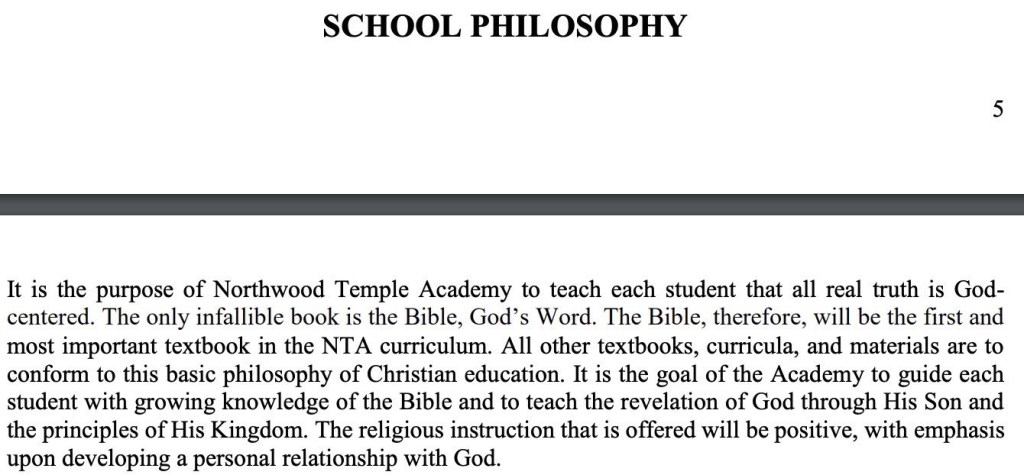
Northwood Temple Academy in Fayetteville got more than $1.1 million in NC taxpayer voucher funds this year.

Their school philosophy is “The Bible, therefore, will be the first and most important textbook in the NTA curriculum.”

They should not get public $ #nced #ncga

A reader called Quickwrit posted this comment about the clear intent of the Founding Fathers. Based on the Constitution, the Federalist Papers, and their own writings, the Founding Fathers left no doubt about the role of religion in the new nation. They wanted the government neither to support it or to regulate it, and they wanted everyone to practice their religion without hindrance. They most certainly did not want a “Christian nation” or government subsidy of religion. These are the conditions required for freedom of religion.

Quickwrit wrote:

Freedom from religion

Right in the very First Amendment of our Constitution, our Founding Fathers outlawed religion in American government at any level. Founding Father Thomas Jefferson, primary author of our Declaration of Independence, explained that the Establishment Clause of the First Amendment was written to create “a wall of separation” between our government and any religion. The U.S. Supreme Court holds that the Establishment Clause means that “Neither a state nor the federal government can set up a church. Neither can pass laws which aid one religion or all religions, or prefer one religion over another. Neither can force…a person to go to or to remain away from church against his will or force him to profess a belief or disbelief in any religion.”

Our Founding Fathers also wrote in Article VI of our Constitution that “no religious test shall ever be required as a qualification to any office or public trust under the United States.”

In short, our Constitution was written to remove all religion from our government at any level, while also allowing citizens to practice any religion they want. ANY religion.

Our Founding Fathers refused to even include any mention of God in our Constitution.

Why did our Founding Fathers do this?

George Washington, Thomas Jefferson, Benjamin Franklin and other Founding Fathers and colonists everywhere hated the fact that they had been forced to join the official Christian religion of the British government, the Anglican Church. The penalty for not joining was that the church-controlled British colonial governments would tax their property to the point that would bankrupt them. Our Founding Fathers knew first-hand that a religion-based government led to persecution of anyone who did not share the beliefs of the official government religion. So, they constitutionally banned religion of any kind from every corner of our federal and state governments.

America’s key Founding Fathers — such as George Washington, Thomas Jefferson, and Benjamin Franklin — were NOT CHRISTIANS. They were DEISTS who had been forced to become members of a Christian church. They almost never even used the word “God” but instead used words like “Creator” or “Providence” to refer to what Deists consider to be the Supreme Being.

Thomas Jefferson, whom we honor as the author of our Declaration of Independence, was so greatly angered by the Christian claim that Jesus was God that Benjamin Franklin had to reel him in from publishing a scathing attack on Christianity. So, instead, Jefferson — who admired the social teachings of Jesus — sat down with a New Testament and cut out all references in it to Jesus being God. Then, he published the result as his Bible and it became popular throughout America. The Jefferson non-Christian social Bible also became the official Bible of Congress and for decades was given to each newly-elected member of Congress.

Governor Greg Abbott of Texas likes to say that he supports vouchers because he wants “education, not indoctrination.” This is hilarious because most vouchers are used for religious schools, whose purpose is indoctrination. They certainly do not teach students to think critically, as that might refute their mission.

Tom Ultican read the recent report by the Network for Public Education about the growth of faith-infused charter schools. The report is called “A Sharp Right Turn.” If you want your child to learn critical thinking, these schools would be the wrong choice. Critical thinking means that you are encouraged to question what you are taught.

Ultican writes:

Carol Burris and team at Network for Public Education (NPE) just published, “A Sharp Turn Right” (STR). NPE President Diane Ravitch noted there are several problems associated with charter schools’ profiteering, high closure rates, no accountability…

“This new report, A Sharp Turn Right, exposes yet one more problem — the creation of a new breed of charter schools that are imbued with the ideas of right-wing Christian nationalism. These charter schools have become weapons of the Right as they seek to destroy democratically governed public schools while turning back the clock of education and social progress by a century.” (STR Pages 3 and 4)

STR focuses on two types of charter schools. One characterizes themselves as “classical academies” and the other touts “back to basics,”without noting they also employ the same “classical” curriculum. Both provide right-wing clues on their web-sites, alerting parents of alignment with Christian nationalism. Marketing is often red, white and blue, with pictures of the American founding fathers, and discussions on patriotism and virtue. Some schools include direct references to religion like Advantage Academy’s claim of educating students in a “faith-friendly environment…”

Using keyword searches, NPE identified 273 active charter schools fitting this description and noted they surely missed more. Nearly 30% of them were for-profit; about double the rate for the charter sector in general. Almost 50% of them have opened since Donald Trump was inaugurated president in 2017… (STR Page 7)

It identifies the largest charter school systems indoctrinating students with Christian nationalist ideology and discloses where they are operating. Discussing, in some depth, Hillsdale College with its Barney charter schools and the large number of new charter affiliates, the report asserts:

“What they all have in common is teaching Hillsdale’s prescriptive 1776 curriculum, which disparages the New Deal and affirmative action while downplaying the effects of slavery. Climate change is not mentioned in the science curriculum; sixth-grade studies include a single reference to global warming.” (STR Page 15)

The reality is today’s taxpayers are forced to pay for schools teaching a form of Christianity associated with white superiority; politically indoctrinating students with specific rightist orthodoxy. What happened to the principal of separation of church and state? This charter schools for indoctrination movement must be stopped before American democracy is sundered.

Ultican reviews the long-held belief in separation of church and state, and the Supreme Court’s decisions that balanced the Constitution’s protection of freedom of religion and its prohibition of any establishment of religion.

This balancing act was disrupted by Reagan’s appointment of Justice Antonin Scalia, who saw no reason to separate church and state. The appointment of Justice Clarence Thomas gave Scalia an ally. Scalia and Thomas believed that all religious activity is religious speech and therefore protected. We saw the most recent example of this reasoning in the Court’s decision holding that discrimination against gay people was acceptable if their very existence offended the religious beliefs of the service provider, since in this case she feared she might be expected to give he assent to their wedding. The Court called its license to discriminate a vindication of free speech rights.

Ultican concludes:

Time to wake up and smell the coffee; the modern Supreme Court is corrupt and needs reformation. Instead of deciding issues based on law and precedence, they create theories designed to support a political philosophy rather than showing fidelity to the constitution. This reflects a complete degradation of jurisprudence. The poorly formed decisions regularly undermine the rights and protections the founders bestowed on citizens; all while some Justices appear to be ethically compromised.

For the first time in American history, billions of taxpayer dollars are flowing to private religious schools. The STR report shines a light on charter schools with religious agendas. Even more disturbing, these new taxpayer funded privatized schools are literally indoctrination centers, teaching a depraved political ideology.

Peter Greene writes here about the latest news from Pennsylvania, where he lives. The Republican-dominated state senate passed a voucher bill. Newly elected Democratic Governor Josh Shapiro has said he supports vouchers. He’s getting lots of kudos from Rightwingers. Is this why we was elected? It’s now up to House Democrats, who have a sliver majority, to stop this giveaway to private and religious schools.

Peter Greene writes:

Choicers in Pennsylvania are so close they can taste it, and everyone has come off the bench to help push this newest bill past a governor who has said he likes vouchers just fine—under certain condition. This is from my piece from Forbes.com this morning.

Democrat Josh Shapiro made no secret of his support for school vouchers when he was campaigning for the Pennsylvania governor’s seat. Now conservatives are pushing him to put that support to work.

The Senate passed the newest school voucher bill Thursday night; House Democrats say that it will not advance. Supporters are still hoping that it can be saved in the budget process.

The Lifeline Scholarship Program has been kicking around Harrisburg in a variety of bills that presented a variety of school voucher formats as voucher supporters looked for a version that would garner enough support to pass. The current iteration is a traditional school voucher, essentially a taxpayer funded tuition subsidy for students attending private schools.

Under this bill, students in the lowest 15% of schools in the commonwealth (as determined by standardized test scores) would be eligible.

The vouchers, named a top priority by Pennsylvania’s GOP, have become a key part of the current budget negotiations in the state that is already under a court order to fix its funding system for public schools.

The voucher system would be a chance for school voucher proponents to get their foot in the door, an especially tasty victory in a state with a Democratic governor. To add to the pressure to pass, a coalition of right wing voucher fans has sent Shapiro a letter arguing for the voucher program.

Open the link to the article to find the link to the entire article in Forbes.