Archives for category: Safety

Nikhil Goyal works on the staff of Senator Bernie Sanders. His new book is about Philadelphia, which will hold the Democratic primary for Mayor on May 16. He writes in the Nation about why he supports Helen Gym.

Goyal begins by explaining why Brandon Johnson beat Paul Vallas in the Chicago mayoral election. He highlighted Vallas’ destructive record as a school privatizer in Chicago, Philadelphia, and other cities.

He writes:

A key critic of this scheme was Helen Gym, founder of Parents United for Public Education, who lamented the violence of underfunded, understaffed schools that were falling apart and mold-ridden and argued that children’s pronounced social and emotional needs were not served by zero-tolerance punishment. “We have policies to suspend, arrest, punish, and potentially imprison our children,” she wrote in the Philadelphia Public School Notebook in 2007, “but we can’t have a policy for reduced class size or textbooks or open libraries in our schools.… So what’s really violent here?”

Today, Gym is one of the leading candidates for mayor of Philadelphia and hoping to join a new class of progressive urban mayors: Chicago Mayor Brandon Johnson, Los Angeles Mayor Karen Bass, and Boston Mayor Michelle Wu. (Disclosure: I have known Gym for several years through organizing and policy work, and she is discussed in my forthcoming book about Philadelphia, Live to See the Day: Coming of Age in American Poverty.)

A zigzag line can be drawn from social movements such as Occupy Wall Street, Fight for 15, Black Lives Matter, teachers’ strikes, and Sanders’s presidential campaigns to the rise of these mayors. Together, with the backing of organized labor, they have an opportunity to reverse austerity, invest in public goods, reimagine and strengthen public safety, and save lives in American metropolises.

The next mayor of Philadelphia, the poorest large city in the country, will face daunting challenges: joblessness; poverty; gun violence; inequitable, unsafe publicschools; an opioid epidemic; and substandard, unaffordable housing. The past three years have been the deadliest in the history of the city, with some 500 killings annually—the highest per capita homicide rate among large US cities. Recently, the school district announcedthat 100 students have already been shot, including 20 killed, this year. A recent survey found that two-thirds of residents said Philadelphia is on the wrong track and identified crime as their top issue.

With election day next week, the first independent public poll shows a dead heat between the top five candidates. There’s ShopRite oligarch and chauvinist Jeff Brown, who owns a chain of supermarkets and was recently accused by the city’s ethics board of violating campaign finance law for colluding with an affiliated super PAC and a nonprofit. Real estate mogul and former city councilman Allan Domb is largely self-funded to the tune of more than $7 million. Former city controller Rebecca Rhynhart is running as a pro-charter technocrat, in the style of former mayors John Street and Michael Nutter, who have both endorsed her. Former city councilwoman and lobbyist Cherelle Parker, who backs stop-and-frisk policing, rounds out the top tier.

Like Brandon Johnson, Gym is a former public-school teacher and came of age organizing against the market-based urban school reform project. Pick virtually any social justice fight in the city since the 1990s: the closures and privatization of public schools, budget cuts, school funding lawsuits, the eviction crisis, the fight for a $15 minimum wage, the closure of Hahnemann Hospital, and the abuse scandal at the reformatory Glen Mills Schools, and one will find that Gym, who served as a city councilwoman for six years, was on the picket line, getting arrested for civil disobedience, building coalitions, testifying at or organizing hearings, or drafting and passing legislation.

As mayor, she pledges to advance an agenda that would “restore the village to our city.” Her policy platform is, naturally, centered on education, and she calls for turning every school into a community school with wraparound and trauma-informed supports; providing after-school and summer programming in schools, recreation centers, and libraries; modernizing school infrastructure; creating playgrounds for every school; and expanding youth employment. Not only will these investments improve educational outcomes, but research indicates that they will also reduce crimeand other social dislocations. Gym released a comprehensive anti-violence plan that would invest in mental health crisis response units, violence interrupters, an improved 911 response system, more detectives to improve homicide clearance rates, and other ideas. She and Johnson share a recognition that the hackneyed tactic of simply hiring more cops cannot slow the bloodshed. Gym and several candidates are also pushing for place-based interventions, such as cleaning up vacant lots, rehabilitating abandoned houses, and improving street lighting, all of which have been found to cut down on crime.

Recently, hundreds of youth engaged in raucous flash mobs and violent skirmishes in downtown Chicago and Philadelphia. Immediately, there were calls to impose a curfew, despite little to no data validating the efficacy of the measure. Mayor-elect Johnson condemned the unrest while acknowledging that we should not “demonize youth who have otherwise been starved of opportunities in their own communities.” In Philadelphia, it was telling that Gym was the only mayoral candidate to firmly oppose the new ban on unaccompanied minors after 2 PM at the Fashion District shopping mall. “We cannot criminalize young people,” she said. “There is nothing for young people to do. We actually have to go out and create some of these things for young people to go to.”

The American Rescue Plan poured billions into Philadelphia, including historic sums for public education and before-school, after-school, and summer programs. Philadelphia’s next mayor must prepare for the imminent fiscal cliffs as those Covid-19 federal relief dollars dry up in the next year or two. Pennsylvania’s regressive uniformity clause mandates flat local and state taxes, where low-income earners are effectively charged higher tax rates than the wealthiest. So the mayor will need to be creative and bold to raise new revenue—push Harrisburg for fair funding, identify and divert wasteful spending into productive programs, and crack down on corporate welfare.

If Gym is also elected, the question will be: How can Johnson and Gym wield their power to benefit working people in the face of expected relentless obstruction by corporate interests, real estate, anti-public education billionaires, and police unions? Seventy years ago, Joseph S. Clark Jr., a postwar mayor of Philadelphia, describedNew Deal/Fair Deal liberalism as “utilizing the full force of government for the advancement of social, political, and economic justice at the municipal, state, national, and international levels.” This is the vision the next mayors of Chicago and Philadelphia should renew.
For her Easter post, Mercedes Schneider wrote about the hypocrisy of those who loudly proclaim their love of Jesus, but also pass laws to put adolescents to work in dangerous low-wage jobs.

She writes:

The corporate world is short on workers, sooo, let’s see what states will pass legislation to loosen restrictions on child labor.

This drive reminds me of the blindside on K12 education that is Common Core– the justification (and assumption) being that the chief purpose K12 education is to “prepare students for 21st century jobs.”

Well, its the 21st century, and it seems that business is short on bodies, and any warm body will do.

So, on this Easter as I think of Jesus, who brought to the attention of his male-centric culture the importance of considering children as people valuable in their own right, I also think of the primarily-Republican push to feed children to the god of business and industry.

On March 14, 2023, journalist Jacob Knudsen published a piece in Axios, stunningly entitled, “Lawmakers Target Child Labor Laws to Ease Worker Shortage.”

Forget childhood. We must appease the god of business and industry.

Knudsen writes, in part,

Legislators in multiple states are invoking a widespread labor shortage to push bills that would weaken long-standing child labor laws.

Why it matters: Some bills go beyond expanding eligibility or working hours for run-of-the-mill teen jobs. They’d make it easier for kids to fill physically demanding roles at potentially hazardous work sites. …

Driving the news: A new Arkansas law signed by Gov. Sarah Huckabee Sanders (R) last week makes it easier for teens as young as 14 to work without obtaining a permit.

Between the lines: The laws and proposals have largely been introduced by Republicans but received support from some Democrats in Ohio and New Jersey. …

Zoom in: Iowa lawmakers are considering Republican legislation that would allow 14- and 15-year-olds to work in industrial laundry services and freezers at meatpacking plants. It’d also prevent many of them from receiving worker’s compensation if they are sickened, injured or killed on the job.

The Iowa law specifically excludes businesses who hire teens from any civil liability in the event they suffer harm or even death in the workplace.

Mercedes concludes:

This exploitation (make no mistake that this loosening of child labor laws in numerous states is exactly that) has at its center a lack of planning combined with the desire for a lower bottom line (and greater profits). Many of my teenaged students already drag themselves to school, only to fall asleep in class with the apology that “I had to close last night.” Therefore, making it easier for employers to squeeze even more out of school-aged employees even as society expects of them (and their schools) stellar academic results (dog whistle: test scores) is indeed speaking out of both ends of a hypocritical, corporate-adulating mouth.

Jesus loves the little children, sooo let’s exploit their labor potential, even for dangerous jobs, as we simultaneously absolve ourselves of any responsibility– even death.

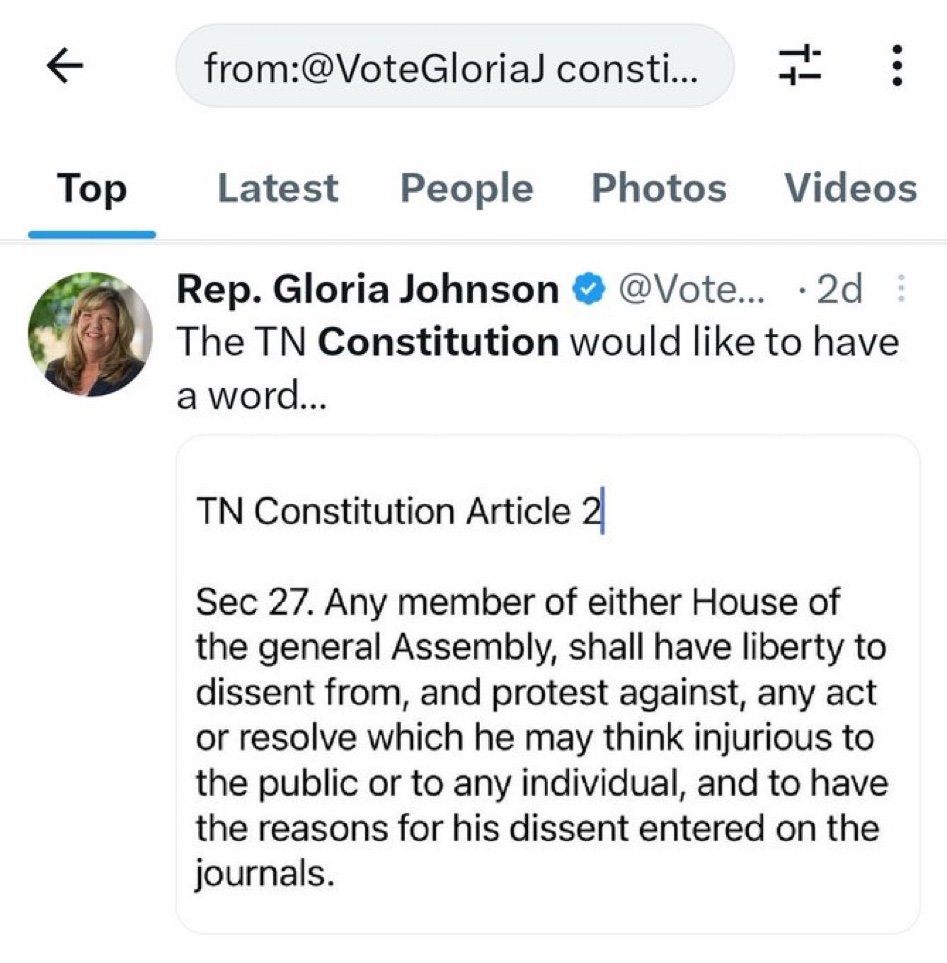
The statehouse in Nashville, Tennessee, was surrounded by parents and students demonstrating in favor of gun control and against the GOP-controlled legislature’s protection of guns. The protest follows the murder of three children and three staff members at the Coventry School in Nashville.

Three Democratic members of the legislature joined the protest, chanting with the protestors.

The GOP leadership threatened to expel the Democrats. The speaker of the House absurdly claimed that the three Democrats were encouraging an insurrection.

Parents and children held signs and shouted chants during a large protest at the Tennessee capitol last week following a deadly school shooting. And while no one was arrested or injured, Republican House Speaker Cameron Sexton is comparing the demonstration to the Jan. 6 insurrection.

During the House Floor session on Thursday — days after the Covenant School shooting — Reps. Gloria Johnson, D-Knox, Justin Pearson, D-Memphis, and Justin Jones, D-Nashville, stood up and chanted with protestors in the gallery.

Pearson and other Democrats attempted to acknowledge the large group of protesters during session, but were told to stick to the subject of the bill by Speaker Cameron.

“We listened to them and helped to elevate the issue that they are demanding justice for,” said Pearson.

House Speaker Cameron Sexton said their actions were more than a breach of decorum, comparing it to the January 6th insurrection in remarks to outlets.

“Two of the members; Representative Jones and Representative Johnson, have been very vocal about Jan. 6 and Washington, D.C., about what that was,” said Sexton. “What they did today was equivalent, at least equivalent, maybe worse depending on how you look at it, to doing an insurrection in the State Capitol.”

Sexton warned that there will likely be consequences for the trio.

“It could be removal of committees; it could be censorship; it could be expulsion from the General Assembly. Anywhere in between,” said Sexton.

Leaders in the Democratic caucus are defending their colleagues. Nashville Democrat John Ray Clemmons says he believes Speaker Sexton is exaggerating.

“You show me the broken windows, you show me anyone who went into the speaker’s office and put their chair up on his desk and trashed his office, you show me where a noose was hanging anywhere on the legislative plaza,” said Clemmons, citing damage committed during the Capitol riot, which resulted in five deaths before and after the event.

The three rebellious Democrats were stripped of their committee assignments. Their member badges were deactivated. Their telephones were disconnected.

In a press conference Monday, Jones says Sexton is more focused on politics than addressing last week’s mass shooting.

“We are members, who are standing in the well, telling our speakers and our colleagues that kids should not be murdered in school,” Jones said, “and rather than address that issue, the speaker has spent more time on Twitter this weekend talking about a fake insurrection than he did about the deaths of six people including 9-year-old children.”

It is not yet clear if the lawmakers will face expulsion. Sexton has not commented on whether they will face further discipline.

A tweet:

Three Tennessee Democrats have been stripped of their committee and subcommittee assignments by the Republican dominated legislature for speaking out against gun violence in the wake of the Nashville shooting that killed three children.

Democracy is dead in Tennessee.

@Sethaweitz

Rep. Gloria Johnson, one of the three Democrats, tweeted:

March for Our Lives is the organization created by students at Marjory Stoneman Douglas High School in Parkland, Florida, after the massacre of 14 students and three staff members on February 14, 2018. The students organized massive rallies demanding gun control. Florida Governor Rick Scott signed gun control legislation: however, in the past few days the Florida legislature rolled back the post-Parkland gun control and made it legal to carry a gun without so much as a permit.

Please note that Rep. Andy Ogles, pictured below with his family, brandishing guns, represents the district in Nashville where the Coventry School is located. His district was created as a result of a gerrymander when the legislature split Nashville in two.

This Monday, we lost three children and three adults to gun violence in yet another school shooting in Nashville, Tennessee: Cynthia Peak, 61, Katherine Koonce, 60, Michael Hill, 61, Evelyn Dieckhaus, 9, Hallie Scruggs, 9, and William Kinney, 9.

The perpetrator used an AR-15 rifle to kill three children and school staff, including a substitute teacher, custodian, and school head. Instead of using their power to act, two Tennessee Congressmembers are treating calls for gun safety legislation as a joke. Rep. Andy Ogles represents the district in Nashville where the Covenant School shooting occurred. Do you know what his response was? Thoughts and prayers. This is the same congressman who glorified guns with his family in this holiday photo:Photo of Rep Ogles' family holding assault weapons in front of a holiday treeWhen reporters asked him if he regrets even sharing that photo, he doubled down by saying, “Why would I regret a photograph with my family exercising my rights to bear arms?”

Another Tennessee lawmaker, Rep. Tim Burchett, told reporters, “We’re not gonna fix it. Criminals will be criminals.” In other words, get used to it. Of course, both of these elected officials have accepted campaign contributions from the NRA.

When corrupt, pro-NRA legislators throw their hands up and claim there’s nothing they can do to stop this country’s rampant gun violence crisis, we call BS. It’s their JOB to come up with solutions to our country’s problems — especially the number one cause of death amongst children and teenagers.

Any politician who cares more about protecting the gun lobby’s profits than saving our children from gunfire does NOT belong in Congress.

We’re calling on these two clowns— Rep. Burchett and Rep. Ogles — to resign immediately. If you agree that failure and incompetence have no place in Congress, sign our petition today →SIGN PETITION

Politicians like Rep. Burchett and Rep. Ogles have grown too comfortable repeating thoughts and prayers instead of actually delivering solutions. But we’re paying attention to their empty words, and we are prepared to do the work to elect gun safety champions to replace them in office.Thank you for all your support.In solidarity,

March For Our Lives


(P.S. Our movement is powered by grassroots supporters committed to ending gun violence. Chip in to fuel our year-round organizing work→) DONATE NOWLike on FacebookFollow on TwitterFollow on InstagramMarch For Our LivesContributions will benefit March For Our Lives Action Fund, a 501(c)(4) social welfare organization. Contributions or gifts to March For Our Lives Action Fund are not deductible for federal income tax purposes as charitable contributions.

Update your donation information here.

March For Our Lives
P.O. Box 3417
New York, NY 10008


You received this email because you signed up for communications from March For Our Lives. Copyright (C) 2021 March For Our Lives. All Rights Reserved.

After the massacre of students and teachers at Parkland High School in 2018, the Florida legislature raised the age for buying a gun from 18 to 21. That decision was just upheld by a federal appeals court.

However, the Florida legislature wants to lower the age back to 18, so as to restore the Second Amendnent rights of 18-20 year olds. What about the Second Amendment rights of younger children! Shouldn’t any child old enough to carry a gun and able to pay for one enjoy their rights too? Why should eight-year-olds go to the playground or to school without a deadly weapon? Imagine playing with your junior high friends after school, everyone locked and loaded.

With backing from Speaker Paul Renner, a House panel on Monday approved a bill that would lower the minimum age from 21 to 18 to buy rifles and other long guns in Florida.

The bill (HB 1543) would reverse part of a 2018 law that set the minimum age at 21 after a gunman killed 17 students and faculty members at Marjory Stoneman Douglas High School in Parkland. Nikolas Cruz, then 19, used a semi-automatic rifle to carry out the attack.

The Republican-controlled House Criminal Justice Subcommittee voted 12-5 along party lines Monday to approve the bill. Under the 2018 law, people under 21 can receive rifles and other long guns as gifts but cannot purchase them.

“The Florida House is restoring the ability of young adults to exercise their Second Amendment rights,” Renner, R-Palm Coast, said in a prepared statement after the vote. “Florida allows 18- to 20-year-old adults to obtain a long gun by having it gifted to them. This bill expands Second Amendment rights and improves public safety, because it requires young adults who have the intent of purchasing a long gun to go through the background check process that is consistent with Florida law.”

“The Florida House is restoring the ability of young adults to exercise their Second Amendment rights,” Renner, R-Palm Coast, said in a prepared statement after the vote. “Florida allows 18- to 20-year-old adults to obtain a long gun by having it gifted to them. This bill expands Second Amendment rights and improves public safety, because it requires young adults who have the intent of purchasing a long gun to go through the background check process that is consistent with Florida law.”

But opponents questioned why the Legislature would reverse course five years after including the 21-year-old minimum age in a broad school-safety bill that passed quickly after the Parkland shooting. Federal law prevents people under 21 from buying handguns.

“I just find it, when we are having shooting after school shooting after school shooting, there are children who are dying in my district, and this gun violence is happening by 18-, 19- 20-year-olds, that we are slapping people in the face when we’re saying, well, let them go have a gun,” Rep. Michele Rayner-Goolsby, D-St. Petersburg, said.

Monday’s vote came after a panel of the 11th U.S. Circuit Court of Appeals on Thursday upheld the constitutionality of the 2018 law. The National Rifle Association has waged a long-running legal challenge, arguing that the 21-year-old minimum age violates the Second Amendment.

It is no longer safe to vacation in Florida. The state does not care about your life. Avoid Florida. Go to Puerto Rico.

Jeff Bryant is a professional journalist who has written extensively about the failures of corporate-style school reform. This story recounts the experience of a family that accepted vouchers in Maine and learned that school choice meant that students abandon their civil rights protections when they enroll in a private school. Please open the link and read the complete article.

The harrowing story of a Maine family shows the potential perils families face when they transfer to privately run schools that are less subject to government oversight.

By Jeff Bryant

“I am the type of parent who always made sure my kids had the good teachers and always took the right classes,” said Esther Kempthorne in an interview with Our Schools. So, in 2014, when she moved with her husband and two daughters to their new home in Washington County, Maine, in a bucolic corner of the state, near the Canadian border, she made it a top priority to find a school that would be the right educational fit for their children.

“We settled in Washington County hoping to give our children the experience of attending one high school, making lasting friendships, and finally putting down some roots,” said Esther’s husband, Nathan, whose career in the military had sent the Kempthorne family traveling the world, changing schools more than 20 times in 17 years. “Both of our children were born on military bases while I was on active duty with the U.S. Navy and the U.S. Air Force,” said Nathan, whose role in military intelligence often meant that he was deployed to high-risk assignments in war zones.

“We said that when we got to Maine, we weren’t going to keep bouncing from school to school,” said Esther.

But after some firsthand experience with the education programs provided by the local public schools, the Kempthornes decided to investigate other options the state offers. One of those options was the state’s provision that allows parents who live in a district that doesn’t have a school matching their child’s grade level the choice to leave the public system and transfer their children to private schools, with the “home” public school district picking up the cost of tuition and transportation, subject to state allowance.

Because the rural district the Kempthornes lived in did not have a high school, they took advantage of that option to enroll their daughters—at taxpayer expense—in Washington Academy, an elite private school founded in 1792 that offersa college track curriculum and access to classes taught by faculty members from a nearby university.

Their decision to leave the public school system for Washington Academy seemed all the better when Esther, a naturalized U.S. citizen born in Mexico, got a full-time job teaching Spanish at the school.

Thinking back on how the Kempthorne family negotiated the school choice landscape in Maine, Nathan recalled, “I thought we were finally going to be okay.”

But the Kempthornes weren’t okay. Far from it, in 2021, the Kempthornes found themselves in the front seat of their car while they were traveling in another state, using Nathan’s iPhone to call in via Zoom and provide testimony to a Maine legislative committee on why Washington Academy, and other schools like it, pose significant threats to families like theirs and how the state needs to more heavily regulate privately operated schools that get taxpayer funding.

Fighting through tears, they spoke of “racism” and “bullying” at Washington Academy and the school administration’s unwillingness to acknowledge and address the school’s culture.

In his written testimony, Nathan wrote of “a disturbing pattern of systemic racism and institutionalized oppression, harassment, and bullying behavior based on race, ethnicity, country of origin, gender, and sexual orientation that has occurred for years at [Washington Academy].”

In her letter of resignation from the school, presented to the committee, Esther wrote of a school environment where she and her daughters, who identify as Hispanic, experienced “racist, anti-immigrant sentiments.” She wrote, “As the racist anti-immigrant rhetoric became more mainstream, we had to teach our daughters how to defend themselves without our intervention, and they did. However, such self-defense has been exhausting and stressful for my children, and it should not be their responsibility to constantly deflect harassment; rather they should be guaranteed a safe educational environment by school leaders.”

Although their daughters eventually graduated from Washington Academy and went on to college, the family became totally uprooted because of their experience at the school. Nine years after building their dream home in rural Maine, they now find themselves living in an apartment in New York City, embroiled in a years-long battle with Washington Academy and Maine officials, which has absorbed countless hours of their time and thousands of dollars of their life savings.

Esther has been unable to reenter the classroom as a full-time teacher due to the lingering effects of the traumatic experiences she had from teaching at Washington Academy, and both parents and daughters speak of long-term adverse mental health effects stemming from the years they spent at the school.

“We sold everything,” Nathan said in his spoken testimony to the committee. “We lost everything in your state and we left for our safety. Our children are completely traumatized. They lost all their friends.”

The Kempthornes’ story about the consequences of leaving the public education system for a private school is a cautionary tale about what can happen when a system designed to provide parents with taxpayer-supported private school options fails to consider the potential risks when students and parents transfer to these schools that are less subject to government oversight.

Their story is even more significant given the current trend across the country where states have increasingly been adopting charter schools, voucher programs, education savings accounts, “backpack funding,” and other so-called school choice options that use taxpayer money to fund alternatives to the public system.

These options are favored by politicians on the right and left, and, at least one state, Arizona, has a voucher program called the Empowerment Scholarship Account Program, which every student in the state is eligible to tap.

This rapid expansion of school choice options is taking place even though there is ample anecdotal evidence and a growing body of research showing that parents in a school choice marketplace often make questionable choices they sometimes come to regret.

As the Kempthornes came to learn, private education providers that are not governed within the public domain pose legal problems that parents often either don’t know about or don’t understand, and local and state government officials often either have no authority to intercede on parents’ behalf or are reluctant to assert what little authority they do have.

The Kempthorne family’s saga, which is still enduring, is a sharp counterpoint to advocates who promote school choice as a simplistic solution for families without acknowledging that transferring taxpayer-funded education services from the public to the private realm will actually complicate parents’ and students’ lives.

Bryant goes in to describe a school culture that was implicitly racist and unwilling to act in complaints of racism.

Washington Academy is one of several Maine “town academies” that benefit from what’s known as “town tuitioning,” in which private schools receive public funding from districts that “tuition out” students to the schools rather than paying to educate them in their “home” district. These Maine academies had from 80.4 to 99.3 percent of their student enrollments funded with public dollars in the fiscal year 2020-2021. Most of them also obtain additional income by operating expensive residential programs that enroll students, often from countries outside the U.S.

The practice of using town tuitioning programs as alternatives to providing public schools started in Vermont, according to Education Week, but has since spread to New Hampshire, Massachusetts, and Connecticut, as well as Maine.

Supporters of these programs call them a “model of educational choice,” according to Education Week, and although supporters of vouchers haven’t always held up town academies as their ideal, they’ve more recently been describing them as the “oldest school choice program in the nation” and calling for expanding them so that all students are eligible to attend the town academies.

But the rationale for having town academies and funding them with public money seems to no longer hold, if it ever did.

‘A Common Myth’

“A common myth is that town academies in New England exist in rural areas which have a scarcity of public schools due to the relatively low population density of families with school-aged children and a lack of funding to support district schools,” according to Bruce Baker, an education professor at the University of Miami in Florida. “But that’s not the reality.”

According to Baker, many of these schools started in the early 1800s, or earlier, as private secondary schools for their communities prior to the existence of public high schools “and in many cases,” prior to the creation of the nation’s system of public common schools. “Some, like Burr and Burton Academy in Manchester, Vermont, were originally funded by local businessmen,” he noted.

Given that origin, town academies that are in operation today are “holdovers,” according to Baker, “of what were once proxy public schools that never converted to district public schools,” although a few have, such as Bellows Free Academy in St. Albans, Vermont, which converted from private to public in 2008.

Contrary to the town academy narrative, some of the schools are in communities that have sufficient populations to educate school-aged children. For instance, New Bedford Academy in New Bedford, Massachusetts, is located in a city with a population exceeding 100,000, according to the 2021 U.S. census. Norwich Free Academy is located in Norwich, Connecticut, a community with a population of more than 40,000.

Also, the notion that town academies are needed in Maine because public schools are few and far between seems hardly the case. “The distances between publicly funded town academies and competing public high schools in Maine is often negligible,” Nathan Kempthorne wrote in an email, pointing out that the distance between Washington Academy and Machias Memorial High School in Machias is only 4.2 miles, and John Bapst Memorial High School, a town academy in Bangor, is only 2.5 miles from Bangor High School and 2.1 miles from Brewer High School.

Public schools in rural communities are quite commonplace. “More than 9.3 million—or nearly one in five students in the U.S.—attend a rural school,” according to a 2019 reportby the Rural School and Community Trust. “This means that more students in the U.S. attend rural schools than in the nation’s 85 largest school districts combined.”

Whereas rural public schools are subject to the same government oversight that all public schools are subject to, that oversight does not extend to private schools, even when they get a substantial portion of their funding from the public.

“In private schools, students end up losing basic constitutional rights and essentially don’t have due process rights,” Todd DeMitchell told Our Schools. DeMitchell is a professor emeritus at the University of New Hampshire at Manchester who studies laws governing school policies and the impact of court cases on these policies.

According to him, if the Kempthornes had their children enrolled in public schools they would have had access to certain rights protected by the U.S. Constitution, including Title 6, which addresses race, and Title 9, which addresses discrimination on the basis of sex. Washington Academy, being a private school, is exempt from these protections.

DeMitchell pointed to a 1987 decision by a federal courtthat ruled a private academy in New Hampshire had the right to fire a teacher who, contrary to school policy, grew a beard, because the school argued successfully that it was “not a state actor,” according to DeMitchell. That ruling’s logic has been extended to a potential 2023 U.S. Supreme Court case in which a North Carolina charter school is arguing that it has the right to require girl students to wear skirts at school because it also is not a state actor. (Charter schools are also privately operated schools that are funded almost exclusively with public money.)

Along with their problematic funding rationale, town academies also have issues with being truly diverse and inclusive schools. For instance, they’ve “long struggled” to serve students with disabilities, according to Baker. And the student populations of these town academies tend to be more white and affluent than their surrounding communities, with any purported claims of student diversity being largely due to their enrollments of international students in residential programs.

Please open the link to read this important article.

Jeff Bryant is a writing fellow and chief correspondent for Our Schools. He is a communications consultant, freelance writer, advocacy journalist, and director of the Education Opportunity Network, a strategy and messaging center for progressive education policy. His award-winning commentary and reporting routinely appear in prominent online news outlets, and he speaks frequently at national events about public education policy. Follow him on Twitter @jeffbcdm.

Florida leaders want to remove requirements to register and get a permit to carry a concealed weapon. In the ideal libertarian state, there would be no gun control at all. More murders, more killing. Does Florida have a minimum age requirement? That will be next to go.

Florida House Speaker Paul Renner is pushing a measure that would allow people to carry concealed firearms without a permit and without training, saying he wants to remove the “government permission slip.”

Renner had previously said that he wanted a permitless carry bill — something Gov. Ron DeSantis has also advocated for — during this year’s legislative session, which starts March 7.

He announced the legislation during a news conference Monday, surrounded by the bill’s sponsors and Florida sheriffs.

Standing alongside Renner, Hernando County Sheriff Al Nienhuis, president of the Florida Sheriff’s Association, endorsed the legislation. “I think we can assume that our citizens are gonna do the right thing when it comes to carrying and bearing arms,” he said.

Twenty-five states already have what supporters call “constitutional carry” measures, meaning they don’t require a permit to carry a concealed firearm.

Read more at: https://www.miamiherald.com/news/politics-government/state-politics/article271838402.html#storylink=cpy

However, gun lovers complained that the proposed bill doesn’t go far enough. They want every Floridian to be able to carry their gun in the open. They call it “constitutional carry,” because the Constitution doesn’t say anything about background checks, training or any of the other requirements sought or imposed by gun control advocates.

The red states are competing, it seems, to see who can go farthest to erase any limits on gun ownership and use.

The opposition to Florida’s proposed legislation to allow Floridians to carry concealed firearms without a permit or training was expected from gun safety advocates.

But at a Tuesday hearing on the bill, there were just as many disgruntled Second Amendment supporters, who said the bill didn’t go far enough because it doesn’t allow for open carry, the visible carrying of a firearm.

Only a few of the dozens of public commenters told legislators they were happy with the measure as written.

But Republican members of the House Constitutional Rights, Rule of Law & Government Operations Subcommittee passed the bill out of the committee on a 10-5 vote along party lines.

The bill now only has one other committee hearing to move through before it goes to a vote on the House floor. House Speaker Paul Renner has expressed strong support for the bill, holding a news conference last month with uniformed sheriffs to announce its filing.

Senate President Kathleen Passidomo has also expressed her support for the measure, though no matching legislation has yet been filed in the Senate. Sen. Jay Collins, R-Tampa, has said he will be the bill’s sponsor.

‘CONSTITUTIONAL CARRY’ IN PLAY

Permitless carry, often called constitutional carry by supporters, allows people within certain legal parameters to carry weapons without having to go through the permitting process.

In Florida, that includes a background check, fingerprinting, a payment of $97 for a new application and the completion of a training course, which includes firing a live round in front of an instructor. Gun carriers would be required to carry a personal ID.

Some of those gun rights advocates said Florida’s proposal is not true “constitutional carry” because it applies only to people being able to carry a concealed weapon; it doesn’t permit open carry of weapons in public and still restricts gun possession for people under the age of 21 and on college campuses.

“To call this bill constitutional carry is an insult to our intelligence,” said Bob White, the chairman of the Republican Liberty Caucus of Florida. Luis Valdes, Florida director of Gun Owners of America, said the bill is a step in the right direction compared to prior years when similar bills didn’t make it out of committees.

But he said it doesn’t go far enough. “The governor has pledged he wants constitutional carry, he didn’t pledge that he wants permitless concealed only,” Valdes said.

Should there be any age limit for purchasing or owning or carrying guns? Is 10 years old okay? How about 6? Should guns be okay in schools? How about in the legislature? Why not let prisoners carry guns? Why should they lose their “constitutional rights”?

Read more at: https://www.miamiherald.com/news/politics-government/state-politics/article272248473.html#storylink=cpy

The Republican Party seems to be descending into barbarism. In New Hampshire, one of the first acts of the new Republican-led legislature was a vote to allow weapons in its meeting place.

CONCORD – The House of Representatives debated a rule that would limit deadly weapons in the crowded Representatives Hall chamber of 400 legislators at the State House.

House Rule 64 failed 177-197 on Convening Day Wednesday of the 2023 legislative session at the State House.

A Democratic leader and a father of a young potential visitor to the State House called the vote “irresponsible.”

Supporters of the rule argued that inadvertently, or in the heat of a debate, a weapon could discharge causing tragedy, noting that often children are in the gallery who could be hurt.

It was further argued that New Hampshire does not allow weapons to be carried into courtrooms and prisons and should not be allowed in these situations.

State Rep. Matt Wilhelm, D-Manchester, the minority leader, said the rule would “restore common sense.”
But opponents noted that when law enforcement is minutes away, a gun could be a way to keep the chamber safe.

Rep. Terry Roy, R-Deerfield, asked fellow legislators to imagine if they lived in a country where carrying a weapon was not a right.

“No House rule is going to stop a House member from defending themselves,” Roy said.

For decades until 2010, House Rules prohibited the possession of weapons in the House chamber.

Democrats reinstituted the provision in 2013-14 and again in 2019-20, and Republicans have voted to repeal the restriction in all recent terms that they have held the majority.

After the vote, Wilhelm issued the following statement:

“Prohibiting deadly weapons in the House Chamber is a common-sense policy to keep legislators, staff, and the public safe as we conduct the business of the State of New Hampshire.

“When Republicans have permitted guns in the legislature, there have been numerous incidents of dropped and mishandled firearms on House property. As the parent of a fourth grader, whom I hope will visit the State House on a field trip this spring, the public’s safety is particularly top of my mind,” Wilhelm said.

I asked AFT President Randi Weingarten to respond to David Brooks’s claim that “the teachers’ unions” were to blame for long school closures during the pandemic, which caused grievous harm to students.

She answered with a resounding “NO” and sent me the following timeline. If I had NEA President Becky Pringle’s personal email, I would have asked her the same question. Being that it’s Christmas holidays, it will be several days before I can reach her. I will try.

Meanwhile, Randi sent this comprehensive rebuttal of Brooks’ allegations.

Since the first months of the pandemic, the American Federation of Teachers has worked with parents and communities to safely reopen schools and other institutions vital to the nation’s social and economic health.

Even before COVID-19, educators knew that remote education, relentlessly championed and invested in (https://www.edweek.org/technology/betsy-devos-backtracks-on-remote-learning-options-she-had-championed/2020/07) by then-Secretary of Education Betsy DeVos, was only ever a supplement, not a substitute, for in-person learning. Remote learning can serve as a backstop during a public health emergency, but only if we address equity issues, including broadband accessibility, services and support. In-person learning is a prerequisite to fostering the deep social and emotional ties and close relationships with educators that are essential to kids’ development.

Throughout the pandemic, AFT members have consistently (https://www.aft.org/press-release/new-data-shows-majority-educators-willing-go-back-school-if-key-safety) expressed (https://www.aft.org/press-release/new-poll-shows-americas-teachers-want-return-classrooms-amid-growing) support (https://www.aft.org/press-release/americas-educators-are-vaccinated-and-back-person-poll) for in-person instruction with safety protocols in place. Those protocols served as the pathway, not the barrier, to returning to classrooms. The union held (https://www.aft.org/news/latest-town-hall-dives-afts-reopen-plan) numerous (https://www.aft.org/news/member-town-hall-showcases-back-school-all-campaign)town halls (https://www.aft.org/news/words-wisdom-mark-aft-back-school-town-hall) on the crucial importance of face-to-face instruction.

Since April 2020, the AFT has published four proposals for safely reopening schools and addressing the challenges of the pandemic.1 In the fall of 2021, the AFT invested $5 million in 28 states (https://www.aft.org/press-release/major-speech-randi-weingarten-reimagines-public-education-nation-emerges) to get kids back in classrooms, through billboard and radio ads encouraging reopening as well as health fairs and vaccination clinics.

At the same time, parents in major cities often elicited (https://www.chalkbeat.org/2021/2/18/22289735/parents-polls-schools-opening-remote) a strong preference (https://www.nytimes.com/2020/12/08/world/most-families-of-color-have-chosen-remote-learning-over-an-in-person-return-to-nyc-schools.html?referringSource=articleShare) for remote learning. Charter schools were more likely (https://www.usnews.com/news/education-news/articles/2022-03-15/how-traditional-public-private-and-charter-schools-responded-to-the-pandemic) than other public schools to shift to remote learning, and stay remote, and private schools were just 4 percentage points more likely than public schools to stay open. In October 2020, Success Academy CEO Eva Moskowitz said (https://www.chalkbeat.org/2020/10/14/21516486/city-charter-schools-take-reopening-slow-similar-roadblocks-neighboring-school-districts), “The best way for us to protect teaching and learning was to stay remote and have a level of predictability.”

After a year of failed efforts under President Donald Trump, the Biden administration invested in and successfully reopened schools, with 98 percent open in January 2022 (https://www.ed.gov/news/press-releases/fact-sheet-one-year-biden-harris-administration-us-department-education-has-helped-schools-safely-reopen-and-meet-students%25E2%2580%2599-needs), compared with 46 percent a year earlier. Teachers across the country advocated for the American Rescue Plan, which included $126 billion for public K-12 schools and funding specifically to address learning recovery.

Tale of the tape

On Feb. 4, 2020, as Trump downplayed COVID-19’s seriousness (https://www.washingtonpost.com/politics/2020/04/20/what-trump-did-about-coronavirus-february/), the union held a press conference (https://www.afacwa.org/aft_afa_join_coronavirus_prevention) with Association of Flight Attendants President Sara Nelson and others to push for a coordinated response to the emerging pandemic.

In April 2020, the AFT launched its landmark plan (https://www.aft.org/press-release/aft-launches-landmark-plan-safely-reopen-americas-schools-and-communities)to safely reopen America’s schools and communities—months before many other groups, including the federal government. In July of that year, the AFT launched its detailed follow-up plan (https://www.aft.org/press-release/aft-launches-landmark-plan-safely-reopen-americas-schools-and-communities)to safely reopen school buildings.

On April 24, AFT President Randi Weingarten wrote an op-ed (https://thehill.com/opinion/education/494521-what-comes-next-for-public-schooling/) with former Education Secretary John King calling out the shortcomings of remote education and pushing for multi-week summer school to deal with learning loss.

In May 2020, Weingarten was appointed to (https://www.governor.ny.gov/news/amid-ongoing-covid-19-pandemic-governor-cuomo-announces-members-reimagine-education-advisory) New York state’s Reimagine Education Advisory Council, which was charged with safely reopening and reinventing schools.

In July 2020, the union joined (https://www.aft.org/press-release/pediatricians-educators-and-superintendents-urge-safe-return-school-fall) with the National Education Association, the American Academy of Pediatrics and the School Superintendents Association to commit to doing everything possible to safely resume in-person schooling at the start of the 2020-21 school year.

In November 2020, the AFT launched a new blueprint (https://thehill.com/opinion/education/528004-a-blueprint-to-safely-open-schools/) to reopen schools.

In January 2021, Weingarten joined Rajiv Shah of the Rockefeller Foundation to write an op-ed saying that schools could reopen (https://www.usatoday.com/story/opinion/2021/01/24/re-opening-schools-precautions-and-testing-column/6661567002/) with comprehensive testing, before the vaccine was widely available. In February 2021, Weingarten reiterated her position (https://www.wgbh.org/news/education/2021/02/05/teachers-union-president-weingarten-vaccinations-arent-precondition-for-school-reopening-but-need-to-be-priority) that vaccinations are a priority, but not a prerequisite, for in-person learning.

In February 2021, the New York Times published a profile (https://www.nytimes.com/2021/02/08/us/schools-reopening-teachers-unions.html) titled “The Union Leader Who Says She Can Get Teachers Back in School.” It reported that Weingarten was calling for schools to reopen, in person, as soon as possible.

Later that month, on NBC’s “Meet the Press,” Weingarten issued a clarion call (https://www.nbcnews.com/meet-the-press/video/full-interview-teacher-union-pres-there-s-no-perfect-solution-to-reopening-schools-101356613515?cid=sm_npd_nn_tw_mtp) for in-person learning, arguing that if the NFL could resume in-person football games, schools could resume in-person classes.

It seemed that the maniacal slaughter of students and teachers at Robb Elementary School in Uvalde, Texas, did not dampen voters’ enthusiasm for Republican Governor Greg Abbot, who does not believe in gun control. Abbot has pushed through legislation to allow people to carry guns without a permit, whether open or concealed.

I swear I do not understand why voters vote against their best interests.

The Texas Tribune reported:

“The fight goes on”: For several families of the victims killed in the shooting at Robb Elementary School in Uvalde, the election this year wasn’t like other elections. It was personal.

In May, an 18-year-old gunman killed 19 students and two teachers with a semi-automatic rifle he bought days earlier. The tragedy caused some families to become politically active. They threw their support behind Democratic gubernatorial candidate Beto O’Rourke, hoping that he would be the catalyst to change gun laws in the state.

But O’Rourke lost badly on Tuesday. And Uvalde County decisively voted for Gov. Greg Abbott.

John Lira, the Democratic candidate who challenged U.S. Rep. Tony Gonazles for the seat that represents Uvalde, joined families at a watch party Tuesday night. He said that while Abbott’s victory was “crushing,” he was proud of the families for becoming politically engaged after experiencing a tragedy.

“It just means the fight goes on,” said Lira, who also lost on Tuesday.

As the night went on, many families said their effort to force change in Texas isn’t close to being done. Jerry Mata, whose daughter Tess was killed in the massacre, consoled his oldest daughter, Faith, after the election results were announced.

“Five years from now, the media may leave, everybody may leave, but we’re not going to leave. We’re going to continue the fight and get what we deserve for our kids.”

If you visit Texas, be sure to bring or buy a gun for self-protection.