Archives for category: Religion

Steven Rosenfeld runs a project for the Independent Media Institute called “Voting Booth.” His posts are informative. This one reviews the Republican primary for Governor in Pennsylvania, where all the candidates swear fealty to Trump and the Big Lie.

He writes:

Another extreme wing of the Republican Party is emerging, and it’s not all Trump.

J.D. Vance, the Ohioan who grew up poor, joined the Marines, got a Yale law degree, wrote a bestseller about his hardscrabble upbringing, became a venture capitalist, and panned Donald Trump before becoming a convert to Trumpism and winning Ohio’s GOP primary for U.S. Senate, is one brand of 2022’s Republican candidates—a shapeshifter, as the New York Times’ conservative columnist Bret Stephens noted.

“He’s just another example of an increasingly common type: the opportunistic, self-abasing, intellectually dishonest, morally situational former NeverTrumper who saw Trump for exactly what he was until he won and then traded principles and clarity for a shot at gaining power,” Stephens said in a conversation with New York Times liberal columnist Gail Collins that was published on May 9.

But the GOP’s frontrunner for governor in Pennsylvania’s crowded May 17 primary field, state Sen. Doug Mastriano, is an entirely different Republican: a man of deep religious and political convictions who, if he wins the nomination and the general election, could be problematic for Americans who do not want elected officials to impose their personal beliefs on the wider public, whether the topic is abortion, vaccines, denying election results, or calling on God’s help to seize political power.

Mastriano’s current lead among nine candidates, with nearly 28 percent, could be taken two ways. He could be an extremist, like Trump in 2016, who won because too many contenders split the mainstream vote in a low-turnout primary. (In 2018, less than one-fifth of Pennsylvania’s voters turned out—suggesting that 2022’s winner may be nominated by as little as 5 percent of its state electorate.) Or, if Pennsylvania’s GOP were more firmly in control of its nomination process, Mastriano’s support might pale next to the establishment’s pick.

It remains to be seen if voters’ allegiances will shift as May 17approaches, especially as the Democrats’ likely nominee, Pennsylvania Attorney General Josh Shapiro, has signaled that Mastriano is the Republican he would most like to run against in the general election by launching TV attack ads. Centrist Republicans also are attacking Mastriano, but the Philadelphia Inquirer reports it’s not working.

Mastriano’s prospects, and his chances in the upcoming general election in the fall as another breed of 2022’s GOP mavericks, suggest that wider currents are roiling American politics, including, in this national battleground state, a mainstreaming of white Christian nativism.

Mastriano is a retired Army military intelligence officer and Army War College historian (whose error-filled 2014 biography of a World War I heroic Christian soldier embarrassedits university press). In uniform, he served overseas in Eastern Europe, Kuwait, Iraq, and Afghanistan. His career in elected office started in a predictable rightward fashion: proposing a bill to ban abortion. But after 2020’s election, he emerged from local ranks as an early and fervent member of Trump’s “Stop the Steal” cavalry who sought to subvert the certification of its winner, Pennsylvania native Joe Biden, who officially beat Trump by 80,000 votes.

Mastriano invited Big Lie propagandist Rudy Giuliani and others to legislative hearings. On January 6, 2021, he bussed Trump supporters to the U.S. Capitol, and newly surfaced videosshow that he followed them past police barriers. He opposed COVID-19 mandates, and in mid-2021 started calling for an Arizona-style “audit” of the state’s 2020 presidential election results. But unlike Arizona’s effort, led by the Cyber Ninjas’ Doug Logan, another deeply observant but more private Christian, Mastriano is vocal about how much his religion influences his politics.

A New Yorker profile by Eliza Griswold on May 9 characterizes Mastriano as a white Christian nationalist—a term he rejects—who, before the January 6 Capitol riot, “exhorted his followers to ‘do what George Washington asked us to do in 1775. Appeal to Heaven. Pray to God. We need an intervention.’”

On the 2020 election denial front, Mastriano is not alone. Although he was leading in a crowded field, there are other candidates for governor who have been falsely proclaiming that Democrats stole their state’s 2020 election and the presidency, and even forged Electoral College documents sent to Washington, D.C.

“If you thought Donald Trump’s endorsement of Dr. Mehmet Oz for Senate was the worst development in Pennsylvania’s 2022 GOP primaries, wait until you hear about the Republicans running for governor,” wrote Amanda Carpenter, a political columnist for the Bulwark, an anti-Trump Republican news and opinion website.

“They’re all election conspiracists.” she continued. “The only thing differentiating them is how far down the rabbit hole they go. And, there’s an excellent chance the nuttiest bunny of them all, Doug Mastriano, is going to win the primary.”

But Mastriano is not a mere Trump imitator. He is cut from an older, more gothic American political cloth: mixing a nativist piety, conspiratorial mindset, and authoritarian reflexes. The Philadelphia Inquirer characterized his unbending religiosity as belonging to the “charismatic strand of Christianity.” The New Yorker’s Griswold concluded that “Mastriano’s rise embodies the spread of a movement centered on the belief that God intended America to be a Christian nation.”

This political type is not new, wrote Kevin Phillips, a former Republican strategist and historian, in 2006 in American Theocracy: The Peril and Politics of Radical Religion, Oil, and Borrowed Money in the 21st Century, which detailed how George W. Bush’s evangelism tainted his presidency. However, Mastriano’s ascension, coupled with a Trump-fortified U.S. Supreme Court that’s poised to void a woman’s right to abortion, affirms today’s reemergence of a radical right.

“Christianity in the United States, especially Protestantism, has always had an evangelical—which is to say, missionary—and frequently a radical or combative streak,” wrote Phillips. “Some message has always had to be preached, punched, or proselytized.”

Add in Mastriano’s embrace of Trumpian authoritarianism, and the Keystone State’s leading GOP candidate for governor is proudly part of this pantheon. As the Inquirer wroteon May 4, he “often invokes Esther, the biblical Jewish queen who saved her people from slaughter by Persians, casting himself and his followers as God’s chosen people who have arrived at a crossroads—and who must now defend their country, their very lives.”

“It is the season of Purim,” Mastriano said, according to the paper’s report of a “March [campaign] event in Lancaster, referring to the Jewish holiday celebrated in the Book of Esther.” The gubernatorial candidate continued, “And God has turned the tables on the Democrats and those who stand against what is good in America. It’s true.”

A Heavy Hand?

It’s hardly new for Republicans to demonize Democrats. But under Trump, the enemies list has grown to include not just the media (Mastriano has barred reporters from rallies and abruptly ended interviews), but America’s “secular democracy” (as Kristin Kobes Du Mez, a professor of history at Calvin University and the author of Jesus and John Wayne, put it in Griswold’s piece for the New Yorker). This targeting includes the government civil servants who administer elections and the technology used to cast and count votes.

When it comes to election administration, if elected governor, Mastriano gets to appoint the secretary of state, the state’s top election regulator. He also has pledged to sign legislation to curtail voting with mailed-out ballots, which was how 2.6 million Pennsylvanians—about 38 percent of voters, including nearly 600,000 Trump voters—cast 2020’s presidential ballots. (As of May 10, nearly 900,000 voters had applied for a mailed-out ballot for 2022’s primary.) Such a policy shift, if enacted, would deeply inconvenience, if not discourage, voter turnout.

Mastriano, if elected, could also play an outsized role should the presidency in 2024 hinge on Pennsylvania’s 19 presidential electors. In the wake of the 2020 election, as Trump and his allies filed and lost more than 60 election challenge suits, one of their arguments was the U.S. Constitution decrees that state legislatures set the “time, place and manner” of elections. That authority could include rejecting the popular vote in presidential elections and appointing an Electoral College slate favoring the candidate backed by a legislative majority, which, in Pennsylvania, has been Republican since 2011’s extreme gerrymander.

Pennsylvania has been at the forefront of recent litigation over this power grab, the so-called “independent state legislature doctrine.” If elected governor, Mastriano could hasten a constitutional crisis, because under the Electoral Count Act of 1887, which was designed to say how competing slates of presidential electors are to be resolved, the governor—not the state legislature—has the final say, according to Edward B. Foley, a widely respected election law scholar.

“A key provision of the act says that if the [U.S.] House and Senate are split [on ratifying a state’s Electoral College slate], the governor of the state in dispute becomes the tiebreaker,” Foley wrote in 2016, when scholars were gaming post-Election Day scenarios in Trump’s race against Hillary Clinton. While speculating about 2024 is premature, there’s some precedent to heed.

After the 2020 election, 84 people in seven battleground states that Biden won, including Pennsylvania, sent listsof unauthorized Trump electors to the National Archives in Washington. Two of Mastriano’s primary opponents, ex-congressman Lou Barletta and Charlie Gerow, signed the fake Electoral College slates. Mastriano, however, did not.

With days to go before the primary, Josh Shapiro, the Democrats’ likely nominee for governor (he is running unopposed in the party primary) is already running anti-Mastriano TV ads seeking to tie the Republican candidate to Trump. (Incumbent Gov. Tom Wolf, a Democrat, faces term limits and cannot seek reelection.) Shapiro’s strategy to elevate Mastriano is “dangerous,” according to Inquirer columnist Will Bunch, as it affirms Mastriano’s credentials to voters and could backfire in the fall—in a replay of Trump’s 2016 victory in the state.

“A Gov. Mastriano, Shapiro’s new TV spot says, would effectively ban abortion in the Keystone State and, the narrator continues, ‘he led the fight to audit the 2020 election,’” Bunch wroteon May 8. “‘If Mastriano wins, it’s a win for what Donald Trump stands for.’ Cue the Satanic music, maybe the only clue that the Shapiro campaign thinks these are bad things. The commercial’s closing pitch: ‘Is that what we want in Pennsylvania?’”

“The answer, for far too many people in a state where the wife-cheating, private-part-grabbing xenophobe won by 44,292 votes in 2016, would, unfortunately, be ‘yes.’”

But a Mastriano primary victory would be more than the latest affirmation of the ex-president’s sway over swaths of today’s GOP. It heralds the rise of “radicalized religion,” as Phillips wrote in American Theocracyabout fundamentalists and George W. Bush’s presidency, merged with more recent Trumpian authoritarianism.

“Few questions will be more important to the 21st-century United States than whether renascent religion and its accompanying political hubris will be carried on the nation’s books as an asset or as a liability,” Phillips wrote. “While sermons and rhetoric propounding American exceptionalism proclaim religiosity an asset, a sober array of historical precedents—the pitfalls of imperial Christian overreach from Rome to Britain—tip the scales toward liability.”

Steven Rosenfeld is the editor and chief correspondent of Voting Booth, a projectof the Independent Media Institute. He has reported for National Public Radio, Marketplace, and Christian Science Monitor Radio, as well as a wide range of progressive publications including Salon, AlterNet, the American Prospect, and many others.

Voting Booth is a project of the Independent Media Institute.
Kevin Welner, an expert in education law and policy at the University of Colorado and executive director of the National Education Law Center. He writes that the U.S. Supreme Court is likely to render a decision reversing the historic American tradition of prohibiting the funding of K-12 religious school.

The Founding Fathers were clear about their antipathy to funding religious institutions. It was Thomas Jefferson who coined the phrase “a wall of separation between church and state.” That wall, which has plenty of holes in it, is about to be demolished. Perhaps we should relearn why the Founders were opposed to mixing church and state. They were well aware of the religious wars and religious persecution that had torn Europe apart for centuries. In the new nation, they believed, religious groups would thrive or fail on their own, without government intervention or direction. We are soon to see a Supreme Court dominated by so-called “Originalists” overturn the clear intentions of the Founders.

Welner notes that religious schools are not bound by civil rights laws, especially under the current Court, which places religious freedom above civil rights. This, states will be required to fund schools that indoctrinate and discriminate.

Exactly what the Founding Fathers feared.

From the National Education Policy Center:

BOULDER, CO (May 12, 2022) – In the coming weeks, the U.S. Supreme Court will hand down a series of decisions that may transform American society. One of those decisions is in a case called Carson v. Makin, the latest in a series of cases brought to expand the use of private school vouchers. This decision in Carson may be particularly radical and transformative, explains University of Colorado Boulder professor and NEPC director Kevin Welner.

In a policy memo titled, The Outsourcing of Discrimination: Another SCOTUS Earthquake?, Welner, an education law and policy scholar, contends that the majority of Supreme Court justices, in deciding Carson v. Makin, will likely adopt a rule that requires public funding in Maine to be used to subsidize religious teaching and proselytizing. But the Court may also take the nation far beyond that determination.

Specifically, the Court may require that whenever a state decides to provide a service through a non-state employee (e.g., through a contracting mechanism), the state will face the highest level of judicial scrutiny if it “discriminates” against churches and church-affiliated service providers that infuse their beliefs into the provided services. Moreover, the Court may impose that same heightened scrutiny to limit any state anti-discrimination enforcement if providers’ religious beliefs direct them to engage in that discrimination against people because of, for example, their gender identity or sexual orientation.

Welner explains that such a judicial ruling would amount to a license to outsource discrimination. While a conventional public school cannot violate a state’s anti-discrimination laws, a school run privately by a religious organization might be allowed to do so. He points in particular to charter school laws as creating this possibility, and he describes how Supreme Court cases in recent years have laid the groundwork for courts to require authorizers to grant charters to religious organizations.

“The Supreme Court is just a few small steps away from transforming every charter school law in the U.S. into a private-school voucher policy,” says Welner. In addition, he argues, charters run by religious organizations would likely gain a constitutionally protected right to discriminate against, for example, members of the LGBTQ+ community.

If this happens, states that abhor such discrimination may find themselves forced to pull back on private contracting to provide public services, ending policies that allow private operators of everything from social services like foster care, health care, prisons, and charter schools.

Find The Outsourcing of Discrimination: Another SCOTUS Earthquake?, by Kevin Welner, at:
https://nepc.colorado.edu/publication/carson-makin

Valerie Strauss of the Washington Post recently summarized the efforts by Florida Governor Ron DeSantis to destroy public schools in his state.

Florida Gov. Ron DeSantis (R) has been fighting with the Walt Disney Co. for weeks now since it angered him by criticizing a law he championed that limits discussions of gender issues in public school classrooms. But his attacks on public school districts began just as soon as he took office in 2019.

DeSantis had been governor barely a month when he offered a new definition of public education that eliminated the traditional division between public and private schools. To DeSantis and his allies, “public education” includes any school — including religious ones — that receives public funding through voucher and similar programs. “Look, if it’s public dollars, it’s public education,” he said in February 2019. “In Florida, public education is going to have a meaning that is directed by the parents, where the parents are the drivers because they know what’s best for their kids.”

That was the start of what has evolved into the most aggressive anti-public education battle waged by any governor in the country. In the past year — and especially in recent months — as he has worked to amass more than $100 million for his 2022 reelection campaign, and possibly for a 2024 Republican presidential run, he has quickened the pace of his attacks.

He has, among other things: limited what teachers can say in classrooms about race, gender and other topics and appointed anti-public education figures to his administration, including a QAnon supporter, and, as education commissioner, an employee of a charter school management organization. He has also legally empowered parents to sue school districts as part of his “parental rights” initiative and micromanaged and limited the power of local school districts.

In what his critics say is a revealing move about their educational intentions, DeSantis and Florida legislators routinely exempt charter and private/religious schools from many of the restrictions and actions they take against public school districts. For example, the law that restricts classroom discussions on gender and sex education — known as the Parental Rights in Education law — applies to a state statute dealing with school board powers, according to the Tampa Bay Times. The Florida Department of Education did not respond to a query about this.

DeSantis and his like-minded compatriots make no secret about wanting to privatize public education — arguably the country’s most important civic institution. Their “school choice” movement means expanding alternatives to public school district. They include charter schools — which are publicly funded but privately managed — as well as voucher and similar programs that use taxpayer money to pay for tuition and other costs at private and religious schools. These schools can legally discriminate against LGBTQ and other students and adults.

To these activists, public schools are not the mainstay of America’s democratic system of government that tries to instill civic values to students from different racial, ethnic and religious backgrounds. Rather, as the libertarian Cato Institute says on its website: “Government schooling often forces citizens into political combat. Different families have different priorities on topics ranging from academics and the arts to questions of morality and religion. No single school can possibly reflect the wide range of mutually exclusive views on these fundamental subjects.”
Critics say this mind-set rejects the notion that America is a melting pot that flourishes by the coming together of people from different places, backgrounds, races and religions. They also say that school “choice” efforts to use public funding for private and privately run education take vital resources away from the public districts that enroll the vast majority of the country’s schoolchildren.

They point out that the public has no way to hold private and many charter schools accountable, because their operations are not transparent. There is irony, they say, in the fact that the people pushing the “parental rights” movement seeking transparency in public school districts don’t demand it of nonpublic schools that they want funded with public funds.

Last year, DeSantis visited a Catholic school in Hialeah to sign a bill that greatly expanded voucher programs while reducing public oversight. Originally intended for students from low-income families, DeSantis’s administration now also allows vouchers to go to a family of four earning nearly $100,000.

He has also played a leading role in the right-wing movement to restrict what teachers can and can’t say in the classroom about subjects including race, racism, gender and sex education. On April 22, he signed into law the “Stop WOKE Act,” which limits how race-related topics can be discussed in public school classrooms and workplace training, while essentially accusing public school teachers of trying to indoctrinate students.

About three weeks earlier, on March 28, he signed what critics dubbed the “don’t say gay” bill that limits teachers from discussing sexual orientation or gender identity. While numerous similar bills have been considered in legislatures in years past, it was DeSantis who pushed through the first one to become law.

On April 15, his administration announced that it had rejected publisher-submitted math textbooks books for including passages his administration doesn’t like, including those it says are about critical race theory and social-emotional learning.

DeSantis’s appointments to his administration reveal his attitude about public education. On April 21, he nominated state Sen. Manny Diaz (R) — who works at an affiliate of Academica, a for-profit Miami-based charter school management firm — as the state’s new education commissioner. Diaz will almost certainly be approved by the Florida Board of Education.

Diaz — who is chief operating officer of Doral College, a private college owned by Academica — has been instrumental in the legislature in expanding charter school growth. Florida, where charter schools have virtually no oversight, has seen a raft of financial scandals related to the industry.

Ten days before appointing Diaz, DeSantis’s administration appointed Esther Byrd, an office manager at her husband’s law firm, to the Board of Education. Byrd has on social media expressed sympathy with QAnon beliefs and offered a defense of those “peacefully protesting” the confirmation of the 2020 presidential election on Jan. 6, 2021, when the U.S. Capitol was overrun by a pro-Trump mob. She has alluded to “coming civil wars.” According to the Florida Times-Union, she and her husband, state Rep. Cord Byrd (R), flew a QAnon flag on their boat.

DeSantis also appointed to the Board of Education radiologist Grazie Pozo Christie, a senior fellow for the Catholic Association who wrote an article a few years ago saying the best thing parents can do for their children is to take them out of public schools.


Last October, while discussing “parental rights” in education and touting mask-optional policies at a news conference, DeSantis invited Quisha King, a leader of the right-wing Moms for Liberty group, to join him. King has called for “a mass exodus from the public school system.”

During the pandemic, DeSantis became a leader among governors of the anti-mask movement when he issued a ban on mask mandates in public schools — and then proceeded to penalize districts that required masks in compliance with federal government recommendations. His administration withheld the salaries of some superintendents and school board members that defied him — prompting the Biden administration to promise to make up for the deficit. He has also backed a plan to withhold a total of $200 million in different funding from districts that angered him.

His wrath at local school boards that don’t do his bidding has blown apart the Republican Party’s traditional stance that local education is the business of local issues. In March, one of the bills he signed into law included a provision that limits local school board terms to 12 years — without asking local voters if that’s what they wanted.
He also established a charter school commissioner office inside the Florida Department of Education, which has the power to approve or reject applications for charter schools without local school district input. Even the National Association of Charter School Authorizers thought it was a bad idea, writing on its website:

“Once a school is approved, the Commission would have no other authorizing responsibilities and the local district would be required to do all other authorizing duties. This goes against national best practice. … This is a bad idea since research shows that an authorizer’s commitment and capacity are essential to strong charter schools.

Last June, the DeSantis administration intervened in a local decision by the Hillsborough County School Board, which met to discuss a dozen proposals to open charter schools or extend the operating agreements on others. After it voted to close four existing charters, it received a letter from the Florida Department of Education saying that unless it kept those schools open, it would lose millions of dollars in state funding.

Finally, whatever the governor’s reason, Florida was the last state to tell the U.S. Education Department how it intended to use $2.3 billion in federal American Rescue Plan funds, which had been approved by Congress to help public schools recover from the pandemic. The deadline for states to apply for the money was in June 2021. Months later, on Oct. 4, Ian Rosenblum, then deputy assistant secretary for policy and programs in the U.S. Education Department, sent a letter to the DeSantis administration noting that Florida’s delay in applying for the funding was creating “unnecessary uncertainty” for school districts that needed the cash. Florida filed it a few days later.

DeSantis’s star power in the school “choice” movement is such that one of its longtime leading figures, former education secretary Betsy DeVos — who has called public education a “dead end” — solicited DeSantis’s help to promote a petition in her home state of Michigan to establish a voucherlike program. She and her family have donated hundreds of thousands of dollars to DeSantis.

The subject of vouchers—public money for religious and private schools—has been proposed in every legislative session since 1995. Vouchers have gone down to defeat every time.

Dr. Charles Luke of Pastors for Texas Children wonders whether the voucher lobby—led by Lt. Gov. Dan Patrick—wants another showdown. How many times do you have to fail before you get the message?

Dr. Luke writes:

Vouchers have never fared well in Texas, failing each legislative session since 1995. Conversations with a variety of state legislators and Austin-based politicos indicate that while, vouchers will likely pass the Senate in the next legislative session in 2023, it is still unlikely that they will pass the House. In the regular session of the 87th Texas Legislature, the Texas House of Representatives voted overwhelmingly to prohibit state funds from being used on school voucher programs.

On top of vouchers consistently failing in the Texas Legislature, three other states have recently voted against vouchers. Oklahoma, Georgia, and Utah recently rejected private school vouchers aimed at providing state dollars to private schools.

In Oklahoma, a voucher bill that would have provided $128.5 million taxpayer dollars for private schools failed in the Senate by a narrow margin in March of this year. Senate Bill 1647, called the Oklahoma Empowerment Act, was defeated by a 24-22 vote against the bill. The bill, authored by Senate Pro Tem Greg Treat was also supported by Governor Kevin Stitt who pledged to sign the bill if it passed. Had the bill passed the Senate, it likely would have failed in the House as Speaker Charles McCall had said he would not give the bill a hearing.

Opponents of the bill cited multiple problems. Rev. Clark Frailey, the Lead Pastor of Coffee Creek Church in Edmond and the Executive Director of Pastors for Oklahoma Kids said, “In Oklahoma, there are many reasons to oppose private school vouchers that are funded by taking resources away from public schools. There are religious liberty problems, constitutional issues, and practical implications for parents. In this session, it was made quite clear by parents in rural, urban, and suburban Oklahoma communities that they want well-resourced schools in their own communities. They are not interested in being forced to transit hours a day just to have access to good schools.”

Likewise, Georgia Senators refused to pass a voucher bill supported by their Senate Pro Tem, Butch Miller. Senate Bill 601, which would have given private schools up to $6,000 per student, failed by a vote of 29-20. While supporters of the bill argued that it would give some parents more educational options, opponents pointed out that the voucher would likely be used by wealthier parents that are able to supplement tuition from their disposable income. “If you were really going to try to allow lower income families to exercise school choice, this bill would be means-tested,” said Sen. Elena Parent, an Atlanta Democrat. “Instead, it’s going to be used a lot more by individuals who already have the means.”

In February, Utah lawmakers overwhelmingly rejected a $36 million voucher bill which would have provided leveled funding for private schools based on the parents’ income. House Bill 331 was struck down by a vote of 22-53. Critics noted that, even at the highest funding level, the amount of the voucher would not have covered private school tuition for many schools in Utah. Others questioned the accountability of private schools’ use of public taxpayer dollars, pointing out that private schools are not held to the same transparency standards as public schools. “I don’t see strong accountability measures here,” said Rep. Joel Briscoe of Salt Lake City. “There’s very minimal accountability measures here and then with an opportunity to opt out.”

All the issues cited in these cases have been raised in Texas for nearly 30 years since vouchers were first proposed in the Texas Legislature.

Vouchers do not typically provide enough money to cover private school tuition, so they are often used by parents wealthy enough to send their children to private schools already. They normally do not cover transportation costs so poor parents who are often working more than one job may not be able to get their kids to a private school, even if they could afford to supplement the voucher. Many private schools are religious in nature. Should taxpayer funds be used to provide a religious education in violation of the Establishment Clause of the First Amendment?

Finally, vouchers are a redistribution of taxpayer funds to private citizens that divert funds from the common good of public education. Is it even right or just that such a thing occurs?

While some state leaders and voucher proponents claim that Texas citizens want vouchers, a recent poll has shown that parents overwhelmingly approve of Texas public schools and that 80% of them would keep their kids in their current school even if other options were available.

Steve Nelson, the retired headmaster of the Calhoun School in New York City, has spotted the ironies and hypocrisies in the GOP pandering to the “parent rights” movement.

Read the Bible and gasp at the references to incest and licentiousness.

Nelson writes:

There is a certain hypocritical Victorian flavor to the GOP these days, as they are turgid with moral rectitude when considering – gasp – transgender folks, same sex marriage or pre-marital sex, while embracing the multifaceted lecher who remains their president-in-exile. But back to children . . .

The GOP assault on CRT or any education related to race, gender or sex is partnered with the campaign for parental rights in education. Parental rights in education is further paired with the systematic and relentless attacks on public education. The logic is unassailable; if your schools insist on teaching CRT or mentioning sex despite your parental rights, then you should be empowered to send your child to a good Christian school, where they can learn about these things:

“If two men, a man and his countryman, are struggling together, and the wife of one comes near to deliver her husband from the hand of the one who is striking him, and puts out her hand and seizes his genitals, then you shall cut off her hand; you shall not show pity.” (Deuteronomy 25:11-12)

“When she carried on her whoring so openly and flaunted her nakedness, I turned in disgust from her, as I had turned in disgust from her sister. Yet she increased her whoring, remembering the days of her youth, when she played the whore in the land of Egypt and lusted after her lovers there, whose members were like those of donkeys, and whose issue was like that of horses. Thus you longed for the lewdness of your youth, when the Egyptians handled your bosom and pressed your young breasts.” (Ezekiel 23:18-21)

Keep reading!

Frank Breslin is a retired teacher in New Jersey who taught English, social studies, Latin, and German.

He wrote recently in Church & State magazine about why the Framers of the Constitution wanted separation of church and state. His article reminded me of a Tom Lehrer song in which he sang, “The Catholics hate the Protestants, the Protestants hate the Catholics, and everyone hates the Jews.” Tom Lehrer was a singer, composer, and mathematician who was popular in my college years.

He writes:

We have a long tradition in Am­erica of separation of church and state that prohi­bits government’s promotion of religion on the one hand, and interference with its free exercise on the other.

In their refusal to establish a state church or to favor one religion over another, the Founding Fathers didn’t think that religion was bad but that there was something amiss in human nature, a certain tendency, a will to power and a lust for domination, that always bore watching. It was a virus that lay dormant until its host came to power, whereupon that person or group became suddenly rabid with a mania that sought to convert, punish or persecute anyone not of their fold or persuasion. Paradoxically, the guise under which this malady manifested itself, as the history of Europe made only too plain, was religion.

The Founders thought that religion, something good in itself, could be used toward either good or bad ends, and, unless preventive measures were taken, could induce in the susceptible a madness so malignant and vicious as to destroy the very essence of religion itself. By per­secuting whoever refused to accept their religion or whose lives were deemed insufficiently righteous, those in power could impose a religious tyranny so suffocating in its grip, scope and intensity that one involuntarily thinks of barbed wire and concentration camps.

Various theories have tried to account for this bizarre aberration – the fall of Adam and Eve in the Garden of Eden, the ascent of man from beasts, innate human depravity, the Freudian “id,” defective genes or bad social engineering.

But more important than those theories themselves is the lesson to be drawn from those institutions that promise heaven on earth. Given the weak human vessels in which this religious feeling resides, even this noble sentiment could become tragically twisted and unleash on the world unspeakable horror. Immanuel Kant’s words come to mind when considering such would-be utopians and their spiritual gulags: “Nothing was ever made straight with the crooked timber of humanity.”

In government, the need for transparency, accountability and investigative journalists – assuming they haven’t been censored, ban­­ned, imprisoned or shot – is not a casual suggestion, but the sine qua non for maintaining even a pretense of institutional integrity. Human nature is self-contradictory and prone to temptation, especially when the camera’s not running or the press isn’t present. And, no matter the institution, it’s always wise to audit the books – both the official ones and the real ones hidden in the back-office safe.

Politicians, as the saying goes, campaign in poetry but govern in prose, so that we had better distrust whatever they’re saying and doing by an ironclad system of checks and balances, fact-checking and vigilant oversight. As soon as they pass a law, they’ll invite a lobbyist to insert a loophole, recalling Juvenal’s admonition, “Who shall guard the guards themselves?”

Even religion can be dragged in the mire by persecuting those of another faith or of no faith at all until, weakened by torture, the unfortunates would end their suffering by conversion or death. So, to prevent these abuses of power as had occurred in Old Europe when Catholics persecuted Protestants, Protestants persecuted Catholics, Protestants persecuted other Protestants and both Protestants and Catholics persecuted the Jews, the Founders erected a “wall of separation” between church and state as a safeguard against such outrages.

They wanted to put an end to intolerance, bigotry and sadism that wore the flattering garb of religion and spoke in the sanctimonious accents of self-promotion. They believed that what they were doing was ushering something new into this world, novus ordo seculorum or “a new order of the ages” (see the back of a one-dollar bill). America was to be a radically new experiment in government which, like ancient Athens, would show the world that free men had no need of princes and kings but could govern themselves. No wonder the royal courts of Europe hoped this fledgling experiment wouldn’t succeed lest the contagion of democracy spread to their people.

Please open the link to read the rest of the article.

Historian Heather Cox Richardson writes on her blog that Republicans want to remove federal protections on many issues and restore states’ control. Several Republican senators have spoken out against Supreme Court decisions that overturned state laws on abortion, contraception, same-sex marriage, even interracial marriage. It was Senator Mike Braun of Indiana who said that the states should decide whether people of different races should be allowed to marry, but when the negative reactions poured in, he claimed he misunderstood the question. He was unusually clear for someone who “misunderstood the question.”

It’s sad that any Republican would question the right of people of different races to marry at the very moment that the Senate is questioning a Black woman judge who is married to a white man.

The Republicans who seek to revive a system of states’ rights and long-discredited laws reveal that they long to return to the 1950s, when segregation was legal in some states, women were not allowed to buy contraceptive devices or have an abortion, and gays were in the closet.

Max Londberg of the Cincinnati Enquirer conducted an investigation of the academic results of vouchers in Ohio. His findings were appalling. The legislature doesn’t care about results or evidence or facts. It wants more vouchers, more students to fall behind their peers in public schools. Meanwhile, the public schools lose funding to pay for the vouchers. The story was originally published in August 2020, and I missed it. Scores of school districts in Ohio are suing to block the expansion of vouchers, which will undermine the quality of their schools.

He begins:

Since 2018, hundreds of millions of taxpayer dollars have been shifted away from Ohio’s public schools and into private, mainly religious ones in the form of vouchers, all to enhance academic success.

Yet those same private schools mostly failed to meet the academic caliber set by their neighboring public school districts, according to a Cincinnati Enquirer analysis of nearly 2.5 million test scores from schools in more than 150 Ohio cities during the 2017-18 and 2018-19 school years.

The analysis found that in 88% of the cities in the analysis, a public district achieved better state testing results than those private schools with an address in the same city. A majority of the eight largest urban districts — including Akron and Canton — were among those that outperformed privates.

So Ohio shifts money from successful public schools to underperforming religious and private schools. This is stupid.

Paul Bowers, previously the education journalist for the Charleston, South Carolina, Post & Courier, writes his own blog. In this post, he calls on the state legislators not to pass voucher legislation that would predictably defund the state’s already underfunded public schools. South Carolina has a large budget surplus and one of the lowest tax rates in the nation. Governor Henry McMaster announced that the surplus would be used to lower taxes instead of funding public schools and other public services.

Paul wrote the members of the S.C. Senate Education Committee in opposition to Senate Bill 935, which is an attempt to divert public school funding to private schools.

Senators Massey, Jackson, Hutto, Rice, and Talley:

I write to you as a South Carolinian and parent of 3 public school students asking you to scrap Senate Bill 935, the so-called “Put Parents in Charge Act,” which would redirect public funds to private schools via the creation of Education Savings Accounts.

Every few years, South Carolina teachers and parents have to band together to fight the latest iteration of the school voucher meme, which has spread virally across the states thanks to millions upon millions of dollars of dark-money political contributions, astroturfed special-interest groups, and a network of libertarian billionaires’ pet thinktanks. We fought this idea when New York real estate investor Howard Rich tried to buy a voucher law here in the early 2000s, and we’re fighting it again now that ALEC, Palmetto Promise, and the like are trying to ram the same idea through the Statehouse in Year of Our Lord 2022. There is truly nothing new under the sun.

As the educator Steve Nuzum has pointed out several times this year, the bill you will be considering in a subcommittee meeting on Feb. 16is largely copied from a piece of “model legislation” churned out by the American Legislative Exchange Council, a right-wing bill mill. I posit that we have enough terrible ideas to go around in this state without borrowing worse ones.

If enacted, this bill would be an obvious violation of the South Carolina Constitution, Article XI, Section 4, which states:

No money shall be paid from public funds nor shall the credit of the State or any of its political subdivisions be used for the direct benefit of any religious or other private educational institution.

Now, I am sure our attorney general would happily defend such an act against the inevitable lawsuits that would follow. I am no legal scholar, but I think it’s reasonable to assume he would employ some of the same arguments used to defend Gov. Henry McMaster when, in the thick of a global pandemic, he tried diverting $32 million worth of federal emergency funding from public schools to private schools. Notably, he lost that fight.

So, I suppose you and your colleagues in the General Assembly could enact this law, and you could win the legal battle that follows. Stranger things have happened. But the question remains whether you should go down this road.

I say no, you should not.

South Carolina’s most reactionary politicians have been clamoring for public divestment from the school system ever since radical Black Republicans created a free public school system for all in the Constitution of 1868. White supremacists clawed back at the notion of public goods with the Jim Crow Constitution of 1895; the Interposition Resolution of 1956; and the cavalcade of privatization laws, segregation academies, and district-level resegregation efforts that have continued without ceasing since Brown v. Board of Education was decided in 1954.

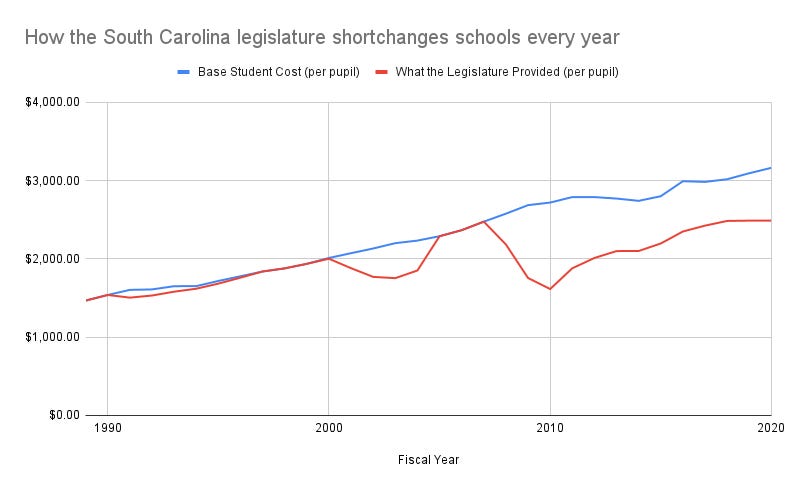
Data compiled by Steve Nuzum, via S.C. Revenue and Fiscal Affairs Office

As a matter of policy, you and your colleagues in the General Assembly have been steadily defunding public education since the start of the Great Recession. You have broken your own promises as outlined in the Education Finance Act and are currently under-funding the Base Student Cost by about a half-billion dollars per year. The results have been disastrous: Our teachers are underpaid and quitting by the thousands, classroom sizes have ballooned, our rural schools are in physical shambles, and a system of separate and unequal education along racial and economic lines has returned with a vengeance.

It is difficult to predict how much money public schools would lose as a result of Education Savings Accounts, which would allow public funds to “follow” individual students to private schools. Our state’s Revenue and Fiscal Affairs Office has tried to guess, though. According to a fiscal impact summary published in December, the ESA program could divert as much as $35 million to private schools within the first year it takes effect, depending how many families participate in the program. By 2026, they estimated the program could cost the state as much as $2.9 billion. Compounded by the General Assembly’s ongoing policy of public disinvestment, this could constitute a death blow to public schools.

The bill is built on a few faulty premises, including the underlying assumption that private schools could or would serve South Carolina students better. The authors of the bill also seem to believe that our state’s private schools could handle a sudden influx of new enrollment while accommodating students’ learning, transportation, and health needs. These are dicey propositions at best.

S. 935 is a direct attack on the notion of education as a public good. Its authors would leave us all to fend for ourselves as atomized individuals, cut loose from mutual obligations that once tied us together. For a certain type of doctrinaire conservative, this may sound like a dream scenario. For the rest of us living in the real state of South Carolina, it is a nightmare come true.

Regards,

Paul Bowers

North Charleston, S.C.