The DeVos family has poured millions into persuading the people of Michigan to endorse vouchers but they have failed. So far. In a statewide referendum in 2000 sponsored by the DeVoses, voters resoundingly rejected vouchers. Since no voucher referendum has ever passed in any state, the voucher pushers have to find another route that does not include letting voters decide.
Josh Owen thinks they may have found the strategy. He wrote the following editorial for The Detroit Free Press. His article was republished by the Network for Public Education.
Noted voucher scholar Josh Cowen wrote an op-ed for the Detroit Free Press warning Michigan that the GOP is trying yet another backdoor approach to getting vouchers into the state.
Michiganders don’t want school vouchers. But the federal government might force vouchers into Michigan, whether we want them to or not.
In the coming days, Congress will consider whether to include the “Educational Choice for Children Act” (ECCA) among many GOP priorities as part of the budget reconciliation process that will set federal spending for next year and beyond.
That bill, which GOP leaders have introduced in both the Senate and the House, is a school voucher plan mixed with a tax credit that would allow donors to divert all or part of what they owe in federal taxes to other organizations that then distribute those funds for private K-12 tuition and other private educational expenses.
Put another way, this is the federal version of the voucher plans spreading in red states across the country — except this one is nestled inside a tax shelter for mostly wealthy donors. Those donors can give either $5,000 or up to 10% of their adjusted income — whichever is greater — for $10 billion in diverted revenue in the first year alone. Then that spending cap can go up. A similar, Michigan-specific version of this scheme was unsuccessfully backed by Betsy DeVos and allies three years ago.
The new federal bill would top off voucher spending in states that have those systems already, and force vouchers into states that have don’t have or want them — states like Michigan.
Our state constitution bans state funding from going to private K-12 schools. But the new voucher tax credit could circumvent that ban by using federal dollars instead. So much for “giving education back to the states,” as the Trump Administration says it wants to do.
Heather Cox Richardson reports on the depredation of Elon Musk, whom Trump has empowered to destroy government services. This destruction is the prelude to privatization. At the Department of Agriculture, his DOGE boys laid off bird flu experts. At the Departnent of Transportation, they laid off air traffic controllers. The story was repeated across the government. Nothing is off-limits from the DOGE vandals, other than the billions of dollars awarded to Elon Musk every year. One can’t help wondering, at least I can’t, whether this crippling of our government was Putin’s idea.
Richardson wrote:
Yesterday, Treasury Secretary Scott Bessent made it clear that the Trump administration’s goal is to slash the federal government and to privatize its current services. As the stock market has dropped and economists have warned of a dramatic slowdown in the economy, he told CNBC “There’s going to be a natural adjustment as we move away from public spending to private spending. The market and the economy have just become hooked, we’ve become addicted to this government spending, and there’s going to be a detox period.”
Bessent’s comments reveal that the White House is beginning to feel the pressure of the unpopularity of its policies. Trump’s rejection of 80 years of U.S. foreign policy in order to prop up Russia’s Vladimir Putin has left many Americans as well as allies aghast. Trump’s claims that Putin wants peace were belied when Russia launched massive strikes at Ukraine as soon as Trump stopped sharing intelligence with Ukrainian forces that enabled them to shoot down incoming fire.
The administration’s dramatic—and likely illegal and unconstitutional—cuts are infuriating Americans who did not expect Trump to reorder the American government so completely. While billionaire Elon Musk and President Donald Trump repeatedly say they are cutting only “waste, fraud, and abuse” from the government, that insistence appears to be rhetorical rather than backed by fact. And yesterday, new cuts appeared to continue the gutting of government services that generally appear to be important to Americans’ health, safety, and economic security.
On Friday night, employees at the Department of Health and Human Services (HHS)—about 80,000 of them—received an email offering them a buyout of up to $25,000 if they resign and giving them a deadline of March 14 to respond. Also as of Friday, nearly 230 cases of measles have been confirmed in Texas and New Mexico, and two people have died.
The secretary of HHS, Robert F. Kennedy Jr., is frustrating even allies with his response to the outbreak. Kennedy, who has long been an anti-vaccine activist, said last week that measles outbreaks were “not unusual,” and then on Sunday he posted pictures of himself hiking above Coachella Valley in California. On Monday the top spokesperson at HHS, a former Kennedy ally, quit in protest. As Adam Cancryn of Politicoreported, Kennedy has said that the measles vaccine protects children and the community, but has said the decision to vaccinate is personal and that parents should talk to healthcare providers about their options. He has also talked a lot about the benefits of nutritional supplements like cod liver oil, which is high in Vitamin A, in treating measles. In fact, vaccines are the key element in preventing people from contracting the disease..
“It’s a serious role, he’s just a couple of weeks in and measles is not a common occurrence, and it should be all hands on deck,” one former Trump official told Adam Cancryn, Sophie Garder, and Chelsea Cirruzzo of Politico. “When you’re taking a selfie out at Coachella, it’s pretty clear that you’re checked out.”
In another blockbuster story that dropped yesterday, the Social Security Administration announced it will begin to withhold 100% of a person’s Social Security benefits if they are overpaid, even if the overpayment is not their fault. Under President Joe Biden the agency had changed the policy to recover overpayments at 10% of monthly benefits or $10, whichever was greater.
Those who can’t afford that level of repayment can contact Social Security, the notice says, but acting commissioner Leland Dudek has said he plans to cut at least 7,000 jobs—more than 12% of the agency—although its staff is already at a 50-year low. He is also closing field offices, and senior staff with the agency have either left or been fired.
Dudek yesterday retracted an order from the day before that required parents of babies born in Maine to go to a Social Security office to register their baby rather than filling out a form in the hospital. Another on Thursday would also have stopped funeral homes from filing death records electronically.
One new father told Joe Lawlor of the Portland Press Herald that he had filled out the form for his son’s social security number and then his wife got a call saying they would have to go to the Social Security office. But when he tried to call Social Security headquarters to figure out what was going on, the wait time was an estimated two hours. So he called a local office, where no one knew what he was talking about. “They keep talking about efficiency,” he said. “This seemed to be something that worked incredibly efficiently, and they broke it overnight.”
The administration did not explain why it had imposed this rule in Maine. Senator Angus King of Maine, an Independent, said he was glad the administration had changed its mind, but added that “this rapid reversal has raised concerns among Maine people and left many unanswered questions about the Social Security Administration’s motivations.”
Trump has said that Social Security “won’t be touched” as his administration slashes through the federal government.
Trump also said there would not be cuts to Medicare and Medicaid, but on Wednesday the nonpartisan Congressional Budget Office, which figures the financial cost of legislation, said that Republicans will have to cut either Medicare, Medicaid, or the Children’s Health Insurance Program in order to meet their goal of cutting at least $880 billion from the funding controlled by the House Energy and Commerce Committee. Cutting the funding for every other program in the committee’s purview would save a maximum of $135 billion, Jacob Bogage of the Washington Post noted, meaning the committee will have to turn to the biggest ticket items: healthcare programs.
Also yesterday, the Department of Homeland Security said it was getting rid of union protections for the approximately 47,000 employees of the Transportation Security Administration who screen about 2.5 million passengers a day before they can board airplanes. A new agreement in May 2024 raised wages for TSA workers, whose pay has lagged behind that of other government employees. Union leaders say the move is retaliation for its challenges to the actions of the administration toward the 800,000 or so federal workers it represents.
As Jonathan Swan and Maggie Haberman of the New York Times have reported more detail about the Cabinet meeting Trump convened abruptly on Thursday, we have learned more about Musk’s determination to cut the government. As Musk appeared to take charge of the meeting, he clashed with Secretary of Transportation Sean Duffy, who complained that Musk’s team at the Department of Government Efficiency is trying to lay off air traffic controllers.
Swan and Haberman report that Duffy asked what he was supposed to do. He continued by saying: I have multiple plane crashes to deal with now, and your people want me to fire air traffic controllers? Musk said it was a lie that they were laying off air traffic controllers, and also insisted that there were people hired under diversity, equity, and inclusion initiatives working as air traffic controllers. When Duffy pushed back, Musk said Duffy should call him with any concerns, an echo of the message he gave to members of Congress. Like them, Cabinet members are constitutionally part of the government. Musk is not.
What Musk is, according to an interview published today by Aaron Rupar and Thor Benson in Public Notice, is a businessman who believes that there is waste wherever you look and that it is always possible to do something more cheaply. Ryan Mac and Kate Conger, who wrote a book about Musk’s takeover of Twitter, Character Limit, said that creating confusion is part of the point. Musk creates drama, Conger said, to scare away workers he doesn’t want and attract ones he does.
The pain that he is inflicting on the country is not making him popular, though. Protests at Tesla dealerships that handle his cars are growing, as are instances of vandalism against Tesla dealerships and charging stations, which now number more than a dozen, including attacks with bottles filled with gasoline and set on fire. Pranshu Verma and Trisha Thadani of the Washington Post report that Tesla’s stock has dropped more than 35% since Trump took office. Tesla sales have dropped 76% in Germany, 48% in Norway and Denmark, and 45% in France.
On Thursday, another of Musk’s SpaceX rockets exploded, raining debris near south Florida and the Bahamas. The Federal Aviation Administration said 240 flights were disrupted by the debris.
The New York Times editorial board today lamented the instability that Musk is creating, noting that the government is not a business, that “[t]here are already signs the chaos is hurting the economy,” and that “Americans can’t afford for the basic functions of government to fail. If Twitter stops working, people can’t tweet. When government services break down, people can die.”
The editorial board did not let Trump hide behind Musk entirely, noting that he has increased instability not only with DOGE, but also “with his flurry of executive orders purporting to rewrite environmental policy, the meaning of the 14th Amendment and more; his on-again-off-again tariffs; and his inversion of American foreign policy, wooing Vladimir Putin while disdaining longtime allies.”
One of the things that the radical extremists in power hated about the modern American state was that it was a nonpartisan machine that functioned pretty well regardless of which party was in charge. Now Musk, who is acting as if he is not bound by the constitution that set up that machine, is taking a sledgehammer to it.
In the Public Notice interview, Thor Benson asked Ryan Mac: “What’s something about Elon’s huge role in the Trump administration that people perhaps aren’t understanding?” Mac answered that Musk is the manifestation of the nation’s extreme wealth inequality. “What happens,” he asked, “when there is unfettered capitalism that allows people to accumulate this much money and this much power?”
The Trump administration plans to roll out a massive voucher program that will be available in every state.
We know from the statistics of every voucher program that most vouchers will be claimed by students who never attended public schools. The voucher recipients are already attending religious and private schools. Their parents are able to pay tuition, but will gladly accept a government subsidy to lower their costs. In every state with universal vouchers, most are taken by students already in nonpublic schools.
We also know that vouchers will not help the poorest kids, who are likely to be rejected by good private schools and end up losing ground in substandard schools. Vouchers have not improved education in any state that adopted them. One of the nation’s most expansive voucher programs is in Florida; that state just posted its worst NAEP score in two decades. To learn more, read Josh Cowen’s The Privateers.
Nonetheless, Laura Meckler reports in The Washington Post, the Trump administration is prepared to dole out billions of federal dollars to pay for tuition at nonpublic schools, most of them religious.
Meanwhile, the public schools, which enroll nearly 90% of all K-12 students in the U.S., would receive less funding, have larger class sizes, and less money for teachers’ salaries.
Vouchers have been tested in state referenda repeatedly and have consistently, often by huge margins.
Meckler writes:
The school voucher movement has scored victories in conservative states in a quest to send public dollars to private schools, with tax money following the child. Now backers see their best chance yet to go national.
Congressional Republicans, backed by the White House, are pushing for a new tax credit that would direct billions of dollars a year to school voucher programs — and not just in conservative states.
The program would be fueled by a powerful, never-before-tried incentive: Taxpayers who donate to voucher programs would get 100 percent of their money back when they file their taxes. That means the tax break for giving to voucher programs would dwarf tax incentives for giving to churches, hospitals, food banks and every other charity.
Taxpayers who donate to other charities might qualify for a tax deduction — meaning they would not pay taxes on the dollars they contribute. But donors to voucher programs would get a dollar-for-dollar tax credit, meaning they could subtract the full value of the donation from their bottom line tax liability.
The goal is to give more families more options for their children’s education. Too many children, supporters say, are stuck in public schools that do not serve them well but cannot afford other options. A federal program would give more children in more states the opportunity to make a different choice for their education. The tax credit, they say, would encourage and allow taxpayers who want to help to do so.
One version of the plan would cost the federal government $5 billion a year in lost revenue; another version, $10 billion. At $10,000 per student, $5 billion would be enough to pay for about 500,000 vouchers, which families could use to send their children to private schools or to pay for home schooling expenses. Under a version of the bill approved by the House Ways and Means Committee last fall and a new version introduced this year, all but the wealthiest families would be eligible to receive vouchers.
“It would be transformational,” said Jim Blew, co-founder of the Defense of Freedom Institute, which advocates for school choice programs. [Blew worked for Betsy DeVos when she was Secretary of Education.] “Although the numbers are very small in the federal context, in the context of the school choice movement, these are huge numbers.”
About 46 million American children — nearly nine in 10 — attend public schools; about 5 million are enrolled in private schools, according to federal data.
But opposition is fierce from those who say these plans drain resources from public schools, which are required by law to take all children. Public school advocates are mobilizing publicly and privately against the plan, lobbying Republicans who might oppose it based on the merits or the cost.
“We’re making sure the public understands this is the greatest threat to public education we’ve ever had at the federal level,” said Sasha Pudelski, director of advocacy for AASA, the School Superintendents Association, who helps lead a coalition of more than 60 groups opposed to the voucher plan.
Pudelski noted that unlike public schools, private schools can reject students based on their religion, test scores, disability or ability to pay tuition. The vast majority of vouchers in existing state programs go to religious schools.
“It would be the first time the federal government is choosing to subsidize a secondary private system of education that can pick and choose the students it educates over the one that welcomes all,” she said.
Voters, too, have opposed these plans. In November, ballot measures to allow vouchers in Kentucky and Colorado failed, while voters in Nebraska voted to repeal a voucher program put into place by the legislature.
But the federal plan enjoys robust support from the most powerful people in today’s Republican Party. President Donald Trump has repeatedly vowed to create a federal school choice program. House Speaker Mike Johnson (R-Louisiana) and Senate Majority Leader John Thune (R-South Dakota) have both co-sponsored versions of the voucher legislation.
There goes the separation of church and state. There goes common sense. Voucher programs don’t help students. They hurt public schools, which enroll the vast majority of students. Vouchers are a huge drain on the budget.
Why should taxpayers pay tuition for wealthy families? Why should taxpayers underwrite tuition at schools that discriminate against students for any reason they want, be it race, religion, disability status, sexual orientation, or low test scores? If public schools did that, their test scores would be sky-high, but it would betray the promise of public schools: equal educational opportunity. Not for only those we choose to admit.
Former entertainment entrepreneur Linda McMahon is now U.S. Secretary of Education. She released her first statement, reiterating Trump’s attacks on “diversity, equity, and inclusion,” as well as “gender ideology” (I.e. recognizing the existence of ONLY the male-female binary and not recognizing those who are LGBT, such as Secretary of the Treasury Scott Bessent, who is openly gay).
McMahon’s views are closely aligned with those of Moms for Liberty. Check out the website of the America First Policy Forum, where McMahon was chair of the board.
This statement was released by the department’s press office.
When I took the oath of office as Secretary of Education, I accepted responsibility for overseeing the U.S. Department of Education and those who work here. But more importantly, I took responsibility for supporting over 100 million American children and college students who are counting on their education to create opportunity and prepare them for a rewarding career.
I want to do right by both.
As you are all aware, President Trump nominated me to take the lead on one of his most momentous campaign promises to families. My vision is aligned with the President’s: to send education back to the states and empower all parents to choose an excellent education for their children. As a mother and grandmother, I know there is nobody more qualified than a parent to make educational decisions for their children. I also started my career studying to be a teacher, and as a Connecticut Board of Education member and college trustee, I have long held that teaching is the most noble of professions. As a businesswoman, I know the power of education to prepare workers for fulfilling careers.
American education can be the greatest in the world. It ought not to be corrupted by political ideologies, special interests, and unjust discrimination. Parents, teachers, and students alike deserve better.
After President Trump’s inauguration last month, he steadily signed a slate of executive orders to keep his promises: combatting critical race theory, DEI, gender ideology, discrimination in admissions, promoting school choice for every child, and restoring patriotic education and civics. He has also been focused on eliminating waste, red tape, and harmful programs in the federal government. The Department of Education’s role in this new era of accountability is to restore the rightful role of state oversight in education and to end the overreach from Washington.
This restoration will profoundly impact staff, budgets, and agency operations here at the Department. In coming months, we will partner with Congress and other federal agencies to determine the best path forward to fulfill the expectations of the President and the American people. We will eliminate unnecessary bureaucracy so that our colleges, K-12 schools, students, and teachers can innovate and thrive.
This review of our programs is long overdue. The Department of Education is not working as intended. Since its establishment in 1980, taxpayers have entrusted the department with over $1 trillion, yet student outcomes have consistently languished. Millions of young Americans are trapped in failing schools, subjected to radical anti-American ideology, or saddled with college debt for a degree that has not provided a meaningful return on their investment. Teachers are leaving the profession in droves after just a few years—and citing red tape as one of their primary reasons.
The reality of our education system is stark, and the American people have elected President Trump to make significant changes in Washington. Our job is to respect the will of the American people and the President they elected, who has tasked us with accomplishing the elimination of bureaucratic bloat here at the Department of Education—a momentous final mission—quickly and responsibly.
As I’ve learned many times throughout my career, disruption leads to innovation and gets results. We must start thinking about our final mission at the department as an overhaul—a last chance to restore the culture of liberty and excellence that made American education great. Changing the status quo can be daunting. But every staff member of this Department should be enthusiastic about any change that will benefit students.
True change does not happen overnight—especially the historic overhaul of a federal agency. Over the coming months, as we work hard to carry out the President’s directives, we will focus on a positive vision for what American education can be.
These are our convictions:
Parents are the primary decision makers in their children’s education.
Taxpayer-funded education should refocus on meaningful learning in math, reading, science, and history—not divisive DEI programs and gender ideology.
Postsecondary education should be a path to a well-paying career aligned with workforce needs.
Removing red tape and bureaucratic barriers will empower parents to make the best educational choices for their children. An effective transfer of educational oversight to the states will mean more autonomy for local communities. Teachers, too, will benefit from less micromanagement in the classroom—enabling them to get back to basics.
I hope each of you will embrace this vision going forward and use these convictions as a guide for conscientious and pragmatic action. The elimination of bureaucracy should free us, not limit us, in our pursuit of these goals. I want to invite all employees to join us in this historic final mission on behalf of all students, with the same dedication and excellence that you have brought to your careers as public servants.
This is our opportunity to perform one final, unforgettable public service to future generations of students. I hope you will join me in ensuring that when our final mission is complete, we will all be able to say that we left American education freer, stronger, and with more hope for the future.
This article appeared in The New York Review of Books. As daily newspapers have shrunk or abandoned their book reviewing, the NYRB stands out as the nation’s leading journal of literature, the arts, and politics. It takes books seriously. This is an essay-review about the history of vouchers. I reviewed Josh Cowen’s outstanding book The Privateers, about the cabal that engineered the expansion of vouchers. I hope you will consider subscribing to the New York Review of Books and reading Josh Cowen’s important book.
For decades, the term “school choice”—and the programs it signifies, which divert public money to private schools—was widely and rightly dismissed as racist. Now it’s the law in thirty-three states.
Minnijean Brown, Thelma Mothershed, and Melba Pattillo, three of the first Black students to attend Little Rock Central High School, with Arkansas NAACP president Daisy Bates (third from left), 1957
Donald Trump promised that he will make public funds available to private as well as religious schools in every state, and this is what his party wants, too. Over the past quarter-century, Republicans have assailed America’s public schools by supporting vouchers, which divert money from public education systems to subsidize tuition at private and religious schools.
But most voters today do not favor vouchers. In fact, since 1967 no state referendum on vouchers has ever passed. In 2024 three states had referenda on the ballot, and vouchers were again defeated. Voters in two of those three states, Kentucky and Nebraska, cast ballots overwhelmingly for Trump—and in both states public funding for private schools was decisively rejected. The story of how Republican politicians have twisted this widespread popular opposition to vouchers into pervasive education policy across the country is one that requires a deeper historical view.
This opposition to public funding for private schools changed on May 17, 1954, when the Supreme Court ruled, in the Brown v. Board of Education decision, that de jure racial segregation in public schools was unconstitutional. The Court’s decision had little to do with school funding, but it set off a frantic search among white elected officials in the South to find, or create, a legal mechanism through which to protect racial segregation. The overwhelming majority of southern whites considered the prospect of racial integration repugnant, and their elected officials were determined to block it.
Until the mid-1950s most Americans believed that the government should not underwrite the cost of private and religious schooling. Catholic organizations had periodically sought public subsidies for their schools on grounds of fairness; as taxpayers, they said their schools were entitled to receive the same funds as public schools. But they were repeatedly rebuffed by Congress, the courts, and state legislatures; most state constitutions explicitly prohibited the use of public funds for religious school tuition.
Southern governors and legislators found the rationale and language they sought in the writings of Milton Friedman, a prominent libertarian economist at the University of Chicago, who in 1955 published an essay called “The Role of Government in Education.” The paper argued in favor of parents’ rights to choose any school they wanted, as well as educational freedom, the right for a child not to attend a neighborhood school—music to the ears of segregationists. Friedman said that the government should finance schools but should not be expected to administer them. He recommended that government distribute money—in the form of what he called vouchers—to parents for each of their school-age children, and that parents should be free to spend this allotment at any institution, whether its operations were for-profit or nonprofit, religious or secular, so long as the school met certain minimum educational standards defined by the local government.
If Black parents wanted their children to attend a segregated Black school, Friedman said, or if white parents wanted their children to attend a segregated white school, or if parents wanted their children to attend an integrated school—all should be equally free to do so. Competitive private enterprise and parental choice, he asserted, would promote a “healthy variety of schools” while making teachers’ salaries “responsive to market forces.” He predicted that private schools would “spring up to meet the demand.”
Southern governors used Friedman’s rhetoric and arguments to fight the implementation of the Brown decision. They adopted his endorsement of “freedom of choice” as well as his belief that private schools would provide a better education than “government schools”; indeed, advocates of vouchers began to refer to “public schools” as “government schools,” a term of derision that continues to appear in our ongoing debates about “school choice” today. As the historian Nancy MacLean demonstrated in “How Milton Friedman Exploited White Supremacy to Privatize Education,” a 2021 paper posted by the Institute for New Economic Thinking, Friedman taught southern leaders that the best way to protect Jim Crow schools was to use “race-neutral arguments” and to “embrace both an anti-government stance and a positive rubric of liberty, competition, and market choice.” As a result, seven states—Alabama, Mississippi, Louisiana, Virginia, North Carolina, South Carolina, and Georgia—enacted laws to subsidize the private school tuition of families fleeing the prospect of desegregated public schools.
In the following decades, existing private schools for white students expanded, and new private schools opened—“white flight academies” or “segregation academies”—to enroll students whose parents opposed racial integration. Often the enrollment of a single Black student in a previously all-white public school was enough to spur an exodus of white families. This happened in New Orleans in 1960 when six-year-old Ruby Bridges enrolled at the William Frantz Elementary School. She had to be escorted into the school each day by federal marshals, on the direct orders of the federal judge J. Skelly Wright. Each day Ruby withstood the screaming of angry white parents at the schoolhouse doors. And Ruby was the only child in her classroom; only a handful of white students remained in the school.
As late as 1965, less than 3 percent of Black children in the South attended schools with white children. Until then southern states engaged in a strategy of “massive resistance” to school integration, blocking the implementation of the Brown decision by providing “tuition tax credits” (a form of vouchers) so that white students could go to all-white private schools, by intimidating Black students so that they would not apply to attend white public schools, or by closing public schools altogether.
Virginia was at the forefront of this “massive resistance.” In 1959 its general assembly repealed the compulsory school attendance law and allowed localities to close their public schools. Prince Edward County was ordered by two courts to integrate its schools but chose instead to shutter its entire public school system. Officials provided tuition grants (vouchers) for white students to attend all-white private schools but made no such arrangements for Black children. Some Black families organized makeshift schools, but for five years there were no public schools for Black students in Prince Edward County. It wasn’t until 1968 that the Supreme Court outlawed Virginia’s tuition grants to private all-white schools.
After the passage of the Civil Rights Act in 1964 and the Elementary and Secondary Education Act in 1965, which made federal funding available to public schools, the federal government had the legal and financial tools to end resistance to integration. Federal courts across the South struck down laws authorizing public funding for vouchers and private schools, as well as any other state laws intended to block racial desegregation. The US Office of Education informed school districts across the South that they would not receive federal funding unless they desegregated promptly. Because of this well-known history, the term “school choice” was so closely associated with resistance to the Brown decision that it was widely and rightly dismissed as racist. It fell into disrepute for decades.
Now, seventy years after Brown, vouchers have not only been rehabilitated, since the 1990s they have been enacted in various forms in thirty-three states and the District of Columbia. Some of these programs are euphemistically called “education scholarships” or “tuition tax credits” or “education savings accounts,” but the fundamental principle is the same in all of them: public money pays for private school, even—in fact, most often—for religious schools. Republican-controlled legislatures in states such as Florida and Arizona enacted voucher programs that started small (in 1999 and 2011, respectively), intending to “save poor kids trapped in failing public schools” or supposedly only for children with disabilities. Over time these programs expanded, increasing the number of eligible students. Now both states have removed all limits, and every student, regardless of family income, is eligible for a tuition subsidy, at a cost to taxpayers that is expected to rise to $1 billion a year in Arizona and $4 billion in Florida.
Josh Cowen, a professor of education policy at Michigan State University, explains this remarkable turnaround of voucher policy in his superb book The Privateers: How Billiionaires Created a Culture War and Sold School Vouchers. Cowen has researched vouchers for most of his career. He worked with teams of academics who received millions of dollars in federal and philanthropic funds to study the results of voucher programs in different cities and states. Like many of his fellow researchers, he hoped that vouchers would provide better education for low-income students. But three years ago he published an article in The Hechinger Report, a nonpartisan education journal, in which he bluntly declared that vouchers were a failure.
Cowen explained that his initial enthusiasm for vouchers cooled as the evaluations were released. He participated in a study of Milwaukee’s vouchers from 2005 to 2010 that concluded that “there was very little difference on test scores” between students in public schools and carefully matched students in voucher schools. Furthermore, when low-income and Black students left voucher schools and returned to public schools, their academic performance in reading and math improved. At the same time that the Milwaukee study ended, a new report showed “shockingly bad early test score results for students in the Louisiana voucher program in the years following Hurricane Katrina.” Those poor results persisted and were replicated by studies in Ohio and Indiana.
The Privateers tells the story of how and why public policy on funding private and religious schools changed. As the consistent failure of state referenda shows, vouchers were never a popular idea; it was the politicians’ dependence on big campaign donors that made school choice a staple of Republican rhetoric. The widespread adoption of vouchers, Cowen explains, was basically a policy coup staged by billionaires who were libertarians or religious zealots or both. Cowen explains
how a small band of interconnected and insular groups of conservative advocates, tightly networked to some of the wealthiest and most influential players in right-wing US politics, invented a rationale for school privatization largely from nothing and out of nowhere.
He describes the agenda of that “network of scholars, lawyers, donors, and activists” as religious nationalism.
The main organizations in this movement to break down the wall of separation between church and state were two right-wing philanthropies, the John M. Olin Foundation and the Lynde and Harry Bradley Foundation, which funded both the Harvard professor of government Paul Peterson and the libertarian lawyer Clint Bolick. The Bradley Foundation, based in Milwaukee, supported the creation of the nation’s first publicly funded voucher program in that city in 1990 and played a crucial part in funding the three pillars of the voucher movement: research, policy advocacy, and litigation. Peterson became the point person for voucher research and advocacy; he also mentored a cohort of graduate students at Harvard who became the nation’s most prominent evaluators of voucher projects.
Bolick, who ran the libertarian Institute for Justice (funded by the billionaire Koch brothers), oversaw litigation and appeared on behalf of the Milwaukee and Cleveland voucher programs in state and federal courts. When more money was needed for research or litigation, members of a secretive right-wing group called the Council for National Policy were available to help; the CNPincluded the Koch brothers and the DeVos family, who used their fortune from the multilevel marketing company Amway to fund conservative candidates and think tanks and deployed their philanthropy to advance public funding of religious schools. Reviewing the players and their strategy, Cowen concludes that “there is nothing in education policymaking today that comes close to the conservative political apparatus accessed by and…even driving, at times, the creation of evidence on behalf of school vouchers.”
In 1990 the political scientists John Chubb and Terry Moe published Politics, Markets, and America’s Schools, in which they asserted that school choice would heal American education; the book was funded by the Olin and Bradley Foundations. Many seemed to have forgotten the racist origins of school choice. Chubb and Moe argued that small-d democratic politics was a handicap for public schools because it kept them in the grip of vested interests, like teachers’ unions and associations of school superintendents. The result of this stasis, they claimed, was poor academic performance. They maintained that “reformers would do well to entertain the notion that choice is a panacea.” School choice “all by itself,” they claimed, could transform American education. The book was a sensation in the education world because it offered a simple solution to complex problems and, of course, gave ideological and scholarly weight to the growing movement for charter schools and vouchers.
That same year, the Milwaukee voucher program started at the behest of the local Black leaders Howard Fuller, a militant social worker who became Milwaukee’s school superintendent, and Polly Williams, a state legislator. Fuller and Williams were disappointed by the academic performance of Black students in public schools. The Bradley Foundation, which was eager to see a demonstration of the success of vouchers in its hometown, quickly provided funding. The Milwaukee Parental Choice Program began as a project that enrolled 341 low-income students in seven private schools. By 1994 it had increased to 830 students in twelve schools.
The legislation authorizing the voucher program required that the students take a state test and that the results be evaluated by an independent researcher. The state superintendent, who opposed vouchers, appointed John Witte, a professor from the University of Wisconsin, to conduct the evaluation. When Witte eventually concluded that the program had minimal impact on students’ academic outcomes or attendance and that voucher recipients returned to public schools at high rates, voucher advocates denounced him as biased. Cowen says that Witte was fair and that his study was accurate.
The loudest voice deploring the negative evaluation of the Milwaukee voucher program was that of Peterson, who wrote a letter to TheNew York Times eviscerating the Witte study for minimizing the academic gains of the students and the importance of parental satisfaction. Cowen points out that Peterson was a political scientist with minimal experience in statistical evaluation. Peterson worked with his then graduate student Jay P. Greene on a study, funded by the Bradley and Olin Foundations, of the Milwaukee program. They concluded that, contrary to the state evaluation, vouchers produced significant academic benefits. The voucher system produced these positive results, they wrote, despite legislative burdens such as income limitations and the exclusion of religious schools.
Peterson and Greene’s favorable review persuaded the Republican-controlled Wisconsin legislature to renew and expand the voucher program in 1995 by including religious schools and increasing the number of participants to 15,000. The inclusion of religious schools led to a court battle that voucher advocates eventually won, litigated by Bolick and the high-powered lawyer Kenneth Starr, who later became famous for his part in the investigation of President Bill Clinton. The Bradley Foundation underwrote his firm’s fee of $300,000 for one month of work, Cowen writes.
Meanwhile the voucher push shifted to Ohio, where the Republican governor wanted Cleveland to be a model for the nation. The program was designed for low-income students, but—unlike in Milwaukee—it did not exclude religious schools; nearly all of the fifty-two participating schools were Catholic. The official evaluator, the Indiana University professor Kim Metcalf, found “few overall differences in student achievement,” but once again Peterson and Greene dismissed the official evaluation and produced their own report—this time funded by the Walton Family Foundation in addition to the Olin Foundation—which showed “large gains” for voucher students. Cowen notes that Peterson’s work was typically reported in newspaper editorials (usually the pro-voucher Wall Street Journal), not in peer-reviewed scholarly journals.
Cowen points out that Peterson’s research findings were more clearly directed toward the Supreme Court than toward other scholars: he filed an affidavit on behalf of the Cleveland program in the crucial 2002 case Zelman v. Simmons-Harris, which concerned the legality of public funding of religious schools. The Court decided 5–4 in favor of including religious schools in the voucher program—a significant reversal of numerous decisions upholding the separation of church and state. Justice Sandra Day O’Connor cited Peterson and Greene’s work in her concurring opinion.
Since that Supreme Court decision, vouchers have been sold to the public as a way to “save poor kids from failing schools.” School choice has been described as “the civil rights issue of our time” by Betsy DeVos, Ted Cruz, and Donald Trump. Republican elected officials adopted school choice as party dogma, and state after state enacted laws authorizing vouchers, despite a distinct lack of public support. Voters in Utah rejected vouchers in 2007, voters in Florida rejected vouchers in 2012, and voters in Arizona rejected vouchers in 2018, but the Republican leaders in all three states ignored the referenda and continued to expand voucher programs. Republican legislatures and state courts have also ignored explicit provisions in state constitutions that forbid the public funding of religious schools, claiming that the voucher goes to the parents, not to the religious schools where they pay for tuition. Where there’s a will, partisans find a way.
Voucher advocates continually promised academic gains, especially for the poorest students, but after 2010, as the voucher programs grew in scale, the academic results turned sharply negative. Cowen realized that poor kids were actually harmed by using them. Low-income students did not use vouchers to enroll in elite private schools, which mostly did not accept these students—either because they were behind academically or because the voucher was worth far less than the school’s tuition—but to enroll in religious schools whose teachers were uncertified or in pop-up private schools created to capture the government money. When the outcomes were disappointing, the right-wing foundations and Republican officials promoting vouchers moved the goalposts: test scores didn’t matter, they said, but graduation rates and parental satisfaction did. When the test scores and the graduation rates were surpassed by local public schools, the pro-voucher foundations, elected officials, and researchers shifted to a different rationale, one that was “always the underlying goal,” Cowen argues: to satisfy the “values” of parents. Just as segregationists in the 1950s invoked “the right of parents” to avoid integration, voucher advocates in the twenty-first century believe that parents “have the express right to use public dollars to self-segregate.”And these advocates claim that parents have the right to receive taxpayer support for their children to attend religious schools; denying them that “right,” they argue, infringes on religious freedom.
Cowen describes how he came to this understanding. From 2013 to 2016 two teams of researchers—one from MIT and another from the Walton-funded Department of Educational Reform at the University of Arkansas—reached the same dire conclusions about vouchers in Louisiana: they “caused unprecedented large, negative impacts on student achievement.” The Louisiana voucher students were mostly Black and low-income. They entered voucher schools at the fiftieth percentile in math; after a year in private school, they dropped to the twenty-sixth percentile. They improved in the second year but remained behind their peers in public schools. This was solid evidence from two separate groups of researchers “that voucher interventions actually caused damage” to the poor students they were supposed to help. Voucher advocates insisted that the experiment needed more time and that it was overregulated by the state.
The bad results kept rolling in: from Indiana, where independent evaluators documented negative outcomes in 2015; from Ohio in 2016, in a study funded by a conservative think tank; and from Washington, D.C., where evaluators found poor results in 2017 and 2018. Cowen concludes that
no explanation then or now has fully explained the learning loss displayed in locations so different as Louisiana, Indiana, Washington, and Ohio as does the simplest one: that for all of Milton Friedman’s purported brilliance, and for all the millions of dollars pumped into the effort by Betsy DeVos, Charles Koch, and the Bradley Foundation, the idea simply did not work. The bigger and more recent the voucher program is, the worse the results have been.
Republican-led states simply ignored the evidence that low-income students who used vouchers fell behind their peers in public schools, and they continued to enact the policies, thanks to large contributions from right-wing billionaires to the campaigns of like-minded state officials. Furthermore, several of the Republican-dominated states removed income restrictions and other limitations, thus abandoning the rhetoric of “saving poor kids from failing schools.” A dozen states currently have “universal” voucher programs, meaning that any family may apply for a voucher, without regard to their income. Tennessee enacted universal vouchers only weeks ago. Other states are likely to follow their lead.
Cowen reports that, with or without income restrictions, the majority of applicants to voucher programs were not trying to leave public schools; they were already attending private schools. This is the case in every state with vouchers. Right now between 65 and 80 percent of students who claim vouchers are using them to pay the tuition of private schools where they were already enrolled. Vouchers are also used in many states to pay the expenses of parents who teach their children at home. In Arizona, according to reports in The Arizona Republic and ProPublica, parents have used their “education savings accounts” to buy trampolines, swing sets, expensive Lego sets, horseback riding lessons, kayaks, trips to Disney World, chicken coops, skiing trips, cowboy roping lessons, and ice-skating lessons. Republican governor Doug Ducey led the campaign to make public funds available to all students in the state. His successor, Katie Hobbs, a Democrat, predicted in 2023 that the state’s voucher program could cost nearly $1 billion, with over 53 percent of all new funding paying for 8 percent of Arizona’s students.
Just as troubling to Cowen as the academic results of the voucher project is the publicly funded discrimination that these schools make possible. Right-wing rage in response to the pandemic enabled the eruption of the so-called culture wars over masking, vaccines, and teaching about race and sexuality in schools, as well as the presence of these topics in library books. In 2022 Christopher Rufo, the right-wing provocateur who first raised an alarm about “critical race theory” in public schools (few public school teachers had ever heard of the term; it refers to a course usually taught in law schools, if at all), called on conservatives in a speech at Hillsdale College to promote universal distrust in public schools in order to arrive at “universal school choice.” This distrust was fueled by right-wing groups, which made wild accusations about teachers allegedly “grooming” their students to be gay or Marxist, and about the curriculum allegedly turning students against their own country.
Vouchers appeal to those who want to escape lessons about racism, diversity, or gender equality. Religious and private schools that receive publicly funded vouchers are not bound by civil rights laws, and many openly bar the admission of LGBTQ+ students and the hiring of LGBTQ+ staff. Some bar students with disabilities. Some religious schools accept only students who are members of their own religion.
Trump issued an executive order on January 29 titled “Expanding Educational Freedom and Opportunities for Families,” which called for the diversion of federal funds to underwrite tuition at private and religious schools. He claimed that “rigorous research demonstrates that well-designed education-freedom programs improve student achievement and cause nearby public schools to improve their performance,” which according to Josh Cowen’s book The Privateers is not true. Trump issued the order on the same day as the release of the latest national test scores by the National Assessment of Educational Progress. Florida, which has a robust voucher program, experienced a sharp decline in its scores, the state’s lowest in twenty years on this test.
Cowen considers the manipulation of culture-war issues like race and gender to be a feature of vouchers, not a bug. Groups like Moms for Liberty and Parents Defending Freedom use the clarion call of “parents’ rights” to condemn the discussion of race and LGBTQ+ issues, as well as access to books about these subjects, in public schools. Such groups want to censor what is taught to all children, even those whose parents disagree with them and want their children to learn about race, gender, and sexuality. Imagine teachers in a segregated Black school being told by the state that they cannot teach accurate Black history. Why should those parents have no rights?
Cowen writes that the learning loss of poor children who used vouchers was larger than the learning loss caused by the pandemic, and at this point the evidence against their efficacy is overwhelming. Yet more states adopted vouchers in 2022 and 2023 than in any previous legislative sessions. Texas is the only large Republican-controlled state that has not enacted legislation to implement them, owing to the combined opposition of parent groups, Democrats, religious leaders who believe in the separation of church and state, and rural Republicans defending their district’s only public school. Yet Governor Greg Abbott has said that vouchers are his highest priority. He received millions of dollars from billionaires to defeat many of the rural Republicans who opposed vouchers. The issue will soon come to a vote in the legislature.
The reality is that when states offer charter schools and vouchers, public schools lose. Each time students leave for private alternatives, public schools must reduce their teaching staff, increase class sizes, and cut back on curricular offerings. States cannot afford to pay for three different school systems. Is the goal to eliminate public schools? That argument seems inherent to some who share Friedman-style thinking.
What does Cowen recommend?
Fund public schools. It really is that simple…. The more money we spend on schools, the better off children are, not simply academically, but in later-life outcomes like higher wages and fewer encounters with the criminal justice system.
Wealthy parents spend amply to educate their children—to make sure that they have certified teachers, small classes, a well-supplied library, and a curriculum that includes the arts and sciences as well as physical education and time for play. And, of course, wealthy children never go without food or medical care. We should give the same to all children.
Bear in mind that highly segregated private schools are subsidized by taxpayers in states that have enacted universal vouchers. The politicians today are fulfilling the fever dreams of segregationist governors in the South in the 1950s.
ProPublica reports:
Private schools in the United States are, on the whole, whiter than public schools, with fewer Black, Hispanic or Latino students. This may not be a surprising statistic because private schools can often be expensive and exclusionary, but it’s not a simple one to pin down. There is no central list of private schools in the country, and the only demographic data about them comes from a little-known voluntary survey administered by the federal government.
While reporting our project on Segregation Academies in the South last year, we relied on that survey to find private schools founded during desegregation and analyzed their demographics compared to local public school districts. Our analysis of that survey revealed, among other things, Amite County, Mississippi, where about 900 children attend the local public schools — which, as of 2021, were 16% white. By comparison, the two private schools in the county, with more than 600 children, were 96% white.
In the course of our reporting, we realized that this data and analysis were illuminating and useful — even outside the South. We decided to create a database to allow anyone to look up a school and view years worth of data.
Today, we are releasing the Private School Demographics database. This is the first time anyone has taken past surveys and made them this easy to explore. Moreover, we’ve matched these schools to the surrounding public school districts, enabling parents, researchers and journalists to directly compare the makeup of private schools to local public systems.
Until now, much of this data was difficult to analyze: While the National Center for Education Statistics, which collects the data, provides a tool to view the most recent year of Private School Universe Survey data, there was no easy way to examine historical trends without wrangling large, unwieldy text files.
As debates over school choice, vouchers and privatization of education intensify, making this repository of private school data accessible is more important than ever. The information is self-reported, but we have attempted to flag or correct some obvious inaccuracies wherever possible.
For schools, you can filter results by state, religious affiliation, school type and enrollment range. For some schools, you can also filter by founding year. By default, we only show results for schools that have responded to the survey at least once in the last few years, but you can turn off this filter to also include older data in your search results.
For public school districts, users can filter by state and sort results to see where the most students are attending private schools, as well as the gap between the district’s largest racial group and the school’s share of those same students. Because private schools can draw students from different districts, comparing their racial composition to a single district’s public schools is imperfect. Still, these comparisons can offer valuable insights into broader patterns of segregation and access.
Before the inauguration of Trump, The New York Review of Books invited me to write about his education agenda. I read three important documents in which his views and goal were spelled out: the education chapter in Project 2025; Agenda 47, Trump’s campaign document; and the website of the America First Policy Institute, the organization led by Linda McMahon, Trump’s choice for Secretary of Education. The three documents overlap, of course. Trump intends to privatize education; he despises public schools. He wants to eliminate the Department of Education. He and his supporters are obsessed with “radical gender ideology,” and they blame public schools for the very existence of transgender students. The election of Trump, it was clear, would mean the end of civil rights protections for LGBT students and a determined effort to defund and destroy public schools.
The NYRB invited me to participate in an interview.
This article is part of a regular series of conversations with the Review’s contributors; read past entries here and sign up for our e-mail newsletter to get them delivered to your inbox each week.
In “‘Their Kind of Indoctrination,’” published on the NYR Online shortly before Donald Trump’s second inauguration, Diane Ravitch writes about the troubling future of American public education. Referring to the president’s infamous remark from his first campaign—“I love the poorly educated”—Ravitch warns that his second term is likely to lead to “more of them to love.”
A historian of education, Ravitch worked on education policy in both George H. W. Bush’s and Bill Clinton’s administrations. She has spent her career analyzing the national and state policies that reshape public schools, like laws that implement high-stakes testing or that divert taxpayer money to charter schools. In addition to writing nearly two dozen books—including The Troubled Crusade: American Education, 1945–1980 (1983), Reign of Error: The Hoax of the Privatization Movement and the Danger to America’s Public Schools (2013), and, most recently, Slaying Goliath: The Passionate Resistance to Privatization and the Fight to Save America’s Public Schools (2020)—Ravitch posts regularly about American education policy on her widely read blog. Her memoirs will be published later this year by Columbia University Press.
I reached out to Ravitch to discuss the current state of American education, the forces threatening it, and her vision for how public schools can better fulfill their democratic promise.
Regina Martinez:How did you start writing about education? Were you influenced by your time in public schools in the South?
Diane Ravitch: I started writing about education when I was in college. The first paper I ever wrote was for a political science class in my freshman year at Wellesley in 1956. It was about the politics of the Houston public school system in the early 1950s, when I was a student there. Voters elected a new school board every two years, and control went back and forth between a group of far-right extremists, who saw Communists lurking everywhere, and moderates who just wanted to make sure that the schools were running well. At one point, books about Russia were removed from the high school library’s shelves. Under the moderates, we heard assembly speakers who spoke of racial and religious tolerance; under the Minute Women, the female wing of the John Birch Society, we were warned to beware of Communist influence. Also, while I was attending them, the schools were racially segregated.
In “Their Kind of Indoctrination,” you write, “One can only imagine the opprobrium that will be visited upon teachers who are not certified as patriots.” How do you imagine this will impact the teaching profession? What might it mean for teacher recruitment in the future?
The threat of political surveillance is chilling, as it would be in every profession. In many states, especially “red” states, teachers have to be careful about what they teach, what reading they assign, and how they handle topics related to race and gender. Trump recently issued an executive order stating that he would cut off the funding of schools that “indoctrinate” their students by teaching about “radical gender ideology” and racism. His effort to impose thought control is illegal but that hasn’t stopped him from trying.
This sort of political censorship is happening in K–12 schools but also in higher education. The number of people choosing to prepare to be teachers plummeted in the wake of the Bush-Obama emphasis on standardized testing. The threat of political loyalty screening can only make matters worse.
One of President Trump’s recent executive orders reauthorized federal agents to detain children at schools. What actions if any can schools, families, and students take to resist the incursion of the security state into schools?
The determination of the Trump administration to raid schools is terrifying for children and for their teachers, whose job it is to protect their students. Imagine a child being arrested in his or her classroom. It is indeed frightening. Many districts have urged teachers to get legal advice from the district legal officers. At the very least, educators should demand to see a warrant. If ICE agents are armed, resistance may be futile. Elected leaders will have to develop contingency plans, if they have not done so already.
You worked on education policy under both President George H. W. Bush and President Bill Clinton. What, if anything, was different about your work between a Republican and a Democratic administration? How do you think the Department of Education—and federal education policy more generally—has changed since the early 1990s?
I served as assistant secretary for education research and improvement under President Bush. Then President Clinton appointed me to the national testing board, known as the National Assessment Governing Board. There was a continuity of policy from the first President Bush to Clinton, and then from Clinton to the second President Bush to President Obama.
The first President Bush wanted to reform American education through voluntary measures. He convened a meeting of the nation’s governors in 1989, and they agreed on a set of six goals for the year 2000. He thought that the goals could be reached by exhortation, at no cost. The goals were indeed aspirational (they hoped, for example, that American students would be first in the world in mathematics and science by the year 2000), but no one had a plan for how to reach them, nor was there any new funding. President Clinton got credit for drafting them, so he and Bush shared that commitment. He was willing to spend real money to help states improve their schools, and added two more goals (one about teacher training, another about parent participation). He also believed that the nation should have national standards and tests. None of the goals was reached by the year 2000, except for having 90 percent of students graduate from high school. But that goal was a matter of definition. If it meant that 90 percent should graduate high school in four years, we did not meet that goal. If you counted the students who graduated in five or even six years, we surpassed it.
Since you launched your education blog in 2012, it has become a popular forum for discussions about education and democracy. Looking back, are there any positions you’ve shared on the blog that you would reconsider or approach differently today? Are there positions you took or predictions you made that you’re particularly proud of?
I started blogging two years after publication of The Death and Life of the Great American School System: How Testing and Choice Have Undermined Education. In that book, I renounced views that I had advocated for decades: competition between schools, relying on standardized testing as the measure of students, merit pay, and many other policies connected to accountability and standardization.
What I have learned in the past fifteen years has made me even more alarmed than I was then about the organized efforts to destroy public education. That book has a chapter about “The Billionaire Boys Club.” I focused on the venture philanthropy of the Bill and Melinda Gates Foundation, the Eli and Edythe Broad Foundation, and the Walton Family Foundation. These billionaires used their philanthropy strategically to fund privately managed charter schools, high-stakes standardized testing, and a system that evaluates teachers by the test scores of their students and closes schools where students got low scores. I opposed all of these measures, which were endorsed by both the second Bush administration and the Obama administration. I demonstrated in that book and subsequent books that these strategies have been failures and are enormously demoralizing to teachers. They also turned schools into testing factories, crushing creative thinking and the joy of teaching and learning.
In the years since, I have learned that “the Billionaire Boys Club” is far larger than the three families that I mentioned. In my last book, Slaying Goliath, I tried to make a list of all the billionaires and the foundations that support charter schools and vouchers, and it was long indeed. Even now, I continue to come across billionaires and foundations that should be added to the list. What I suspected was that charter schools paved the way for vouchers by treating schooling as a consumer good, not a civic responsibility. What I did not realize was that the voucher movement is even more powerful than the charter movement. Its constituency is not just right-wing billionaires like the Koch brothers and the DeVos family, but Christian nationalists, white supremacists, extremist organizations like the Alliance Defending Freedom and the American Legislative Executive Council, affluent parents who want the state to subsidize their private school tuition, and Catholic leaders who have always believed that the state should underwrite Catholic schools.
There has been a lot of discourse recently about declining rates of literacy due to AI, the pandemic, phones, or a host of other causes. How significant do you think this risk is? What might be done to reverse the trend?
I too am concerned about declining rates of literacy, as well as declining interest in literature. In my field of study, I believe that standardized testing has been a culprit in shortening the attention span of children of all ages. Students are expected to read short snippets, then to answer questions about those limited passages. In the early decades of the twentieth century, the College Board sponsored college entrance examinations in which students were assigned works of literature in advance, then asked to write about what they had read. Teachers and professors read their essays and graded them. Now the exam answers may be read by a machine or by a person hired off Craigslist to read swiftly, giving only a minute or two to each written answer.
In my dreams, I would change expectations and ask high school teachers to assign books that are worth reading, then require students to write three or four pages about why they did or did not like the book.
While I welcome the expansion of the canon to include works by women and by people of color, I would also welcome a revival of interest in the great works that were once considered the classics of Western literature. In too many high schools, the classics have not just been marginalized, they have been ousted. That is as grave an error as ignoring the works of those who are not white men.
Given the increasing momentum behind the privatization of education, how do you envision the next generation advancing public school advocacy? What do you anticipate will be their greatest challenge?
Public schools are one of the most important democratic institutions of our society. In many states, they enroll 90 percent of all students. They have always enabled children and adolescents to learn together with others who come from backgrounds different from their own. There is a major movement today, funded by right-wing billionaires, to destroy public schools and to replace them with religious schools, private schools, and homeschooling. It is called “school choice,” but the schools choose, not the students or families. Private schools are allowed to discriminate on any grounds and are not bound by federal laws that prohibit discrimination and that protect those with disabilities. Racial and religious segregation will increase. More students will attend schools whose purpose is indoctrination, not building a democratic society.
The greatest challenge facing those who believe in the value of public education is that the money behind privatization is enormous, and it is spent strategically to win political allies. To my knowledge, there is no billionaire funder for public education as there are for privatization. In the world of public education advocacy, there are no equivalents to the Koch money, the DeVos money, the Walton money, the Texas evangelical billionaires Tim Dunn and Farris Wilks, the Pennsylvania billionaire Jeff Yass. I have been president of an organization called the Network for Public Education since 2013, and our annual budget is a pittance compared to the privatizers’ organizations. One pro–school choice organization spent as much on their annual dinner party as our entire annual budget.
The other side of this struggle to save public education is the reality that important Democrats still believe that school choice helps poor Black and Hispanic kids, despite overwhelming evidence that this claim is not true and is in fact part of the hustle. Representative Hakeem Jeffries, Senator Cory Booker, Governor Jared Polis, and Senator Michael Bennett are a few of the Democrats who have dampened the interest of their party in fighting for public schools.
What makes me hopeful is that the reality is becoming clearer with every passing day: those who are concerned for the common good must support public schools, not undertake to pay the tuition of every student who chooses not to attend public schools. Privatization benefits some, not all, not even most. Public money should pay for public schools. Private money should pay for private schools.
Annie Martin and Leslie Postal of the Orlando Sentinel have repeatedly exposed the fraud baked into Florida’s voucher program. It began in 1999 with the modest ambition of offering choice to low-income students in “failing schools.” It expanded to provide vouchers for students with disabilities. In past articles, they surveyed voucher schools and identified academic deficiencies, such as uncertified teachers and principals, and Bible-based textbooks. Now, they report on what happened after the state removed all income limits in 2023. Florida now offers money for all students, regardless of family income.
Most of the students getting the voucher money are not low-income, do not have disabilities, and are not escaping bad public schools.
The students getting vouchers are already enrolled in private schools. They don’t need the extra money but they are happy to take it.
They write:
A block from Winter Park’s tony Park Avenue sits St. Margaret Mary Catholic School, where tuition can top $14,000 a year for a K-8 education.
But at this school in the heart of one of Central Florida’s wealthiest communities, about 98 percent of students used taxpayer-funded scholarships worth roughly $8,000 to help pay tuition last year.
Only three percent of St. Margaret Mary’s students got that state financial aid just one year earlier.
The change – repeated at schools around the state – is one powerful measure of how a 2023 Florida law has supercharged a school voucher initiative that was already the nation’s largest.
Once reserved for low-income students and those with disabilities, state scholarships, often called vouchers, are now available to all – and they’re fueling an unprecedented pipeline of public money, estimated at $3.4 billion this year, into private, mostly religious schools across the Sunshine State.
All that money is doing more than just expanding Florida’s voucher program. The new rules are transforming it.
Since their emergence as a conservative educational talking point four decades ago, vouchers have been pitched as a way to provide “school choice” – the opportunity for families who couldn’t otherwise afford private education to escape a substandard neighborhood public school.
But when lawmakers dropped the income limits on Florida’s programs, the key element of the 2023 law, the system became something else:
Choice for lower-income families plus a wide-open taxpayer subsidy for the better off. More than 122,000 new students started using vouchers for the first time in the 2023-24 school year, and nearly 70 percent were already in private school, many in some of Florida’s priciest institutions, according to data from Step Up For Students, the nonprofit that administers most of the state’s scholarships. About 40 percent came from families too wealthy to have qualified previously.
So in many cases the new law did not expand these new families’ options. Instead, it provided state subsidies for the choices they had previously made and were able to afford on their own.
The implications of that shift are vast, an Orlando Sentinel analysis has found.
• Voucher use has jumped by 67% since the new law was approved. • Individual private schools are seeing even bigger surges, creating new reliance on taxpayer funding. The Sentinel found nearly 250 schools where the number of students using vouchers jumped by at least 100 children in the first year after the law changed. At St. Margaret Mary, the growth pushed total annual voucher funding from $65,000 to $3.5 million – in just one example of the multi-million dollar windfalls. • A significant amount of the money is flowing to Florida’s most expensive private schools, many of which served few voucher students in the past: Campuses that advertise annual tuition of $15,000 or more added more than 30,000 voucher students last year. • The proportion of private school students with state scholarships has topped 70% this school year. Ten years ago it was less than a third. • More Florida students use vouchers — a total of 352,860 — to attend private campuses than are enrolled in public schools in Osceola, Orange and Seminole counties combined.
Program critics say Florida is now spending an inordinate amount of its education resources on the wrong people – rather than focusing on system improvements that would be good for all students.
“This is just a subsidy for wealthier people — people who already have the advantage,” said state Rep. Kelly Skidmore, a Democrat from Boca Raton who voted against the expansion.
Skidmore is among those who fear the impact of the voucher explosion on public schools – which are losing money as students shift to private education – and the implications of handing millions in taxpayer dollars to private schools over which the state has little control.
These schools are free, as the Sentinel has reported previously, to hire teachers without college degrees, teach history and science lessons outside mainstream academics and discriminate against LGBTQ students and staff. They do not face the same accountability requirements as their public counterparts, whose students’ test scores and graduation rates are publicly reported. Without such numbers for private schools, it’s difficult to assess the impact of Florida’s voucher program on the quality of education students receive.
Nevertheless, the voucher push shows no signs of abating, with more than 10% of all K-12 students in Florida now receiving the subsidy.
On Jan. 10, Gov. Ron DeSantis celebrated Florida’s “choice revolution” at Trinity Christian Academy in Jacksonville, which now enrolls more than 1,200 voucher students.
“The debate about school choice I think is over. Clearly you’re better offering choice than not offering choice,” DeSantis said.
An Orlando mother of four sent them to The First Academy, affiliated with First Baptist Church of Orlando, where high school tuition is more than $24,000 a year. Nearly 90% of the students use vouchers now, up from about 20% two years ago. She paid the full cost for her two oldest, who graduated, and can afford to pay for her two youngest, but is delighted to take the state subsidy.
Florida is spending $3.4 billion annually to subsidize the state’s most affluent families.
Is it surprising that Florida’s NAEP scores fell to their lowest point in 20 years? The state is not investing in its public schools, which enroll the overwhelming majority of its students.
Joyce Vance is a veteran prosecutor. She was the U.S. Attorney for the Northern District of Alabama from 2009-2017. She asserts that what has happened since Trump returned to the White House is not normal. He is dismantling one agency after another. He is firing highly qualified career civil servants. We are watching a coup, led by the President. He is wreaking damage on our institutions of government. Will Congressional Republicans stop him? Or
She wrote on her blog:
I don’t want to be an alarmist—I try to avoid that—but as I’m writing this, it looks like we are in the middle of a five-alarm fire. It’s day 13 of Trump 2.0. From day one, it was clear that Donald Trump was not playing by normal American constitutional rules. Of course, it has long been obvious that he didn’t intend to play by the rules, but any pretense of lawfulness was stripped away when he tried to cancel birthright citizenship with an executive order that ran afoul of the clear language in the Constitution, as confirmed in short order by two federal judges. In the following days, it became more clear that we were not okay, that nothing was right.
During his second week in office, Trump illegally fired 18 inspectors general, the people who ferret out corruption, waste, and fraud in federal agencies. It sounds like, under Trump, there will be no more of that. No independent inspectors general to poke around. Trump has made it clear that personal loyalty to him is more important than principle. Government employees, including those with civil service protections, now serve at his pleasure.
That message was driven home on January 31, when something commenters referred to as a “Friday night massacre” took place. But that historical reference to Watergate lacked resonance. In 1973, the Saturday Night Massacre took place when Archibald Cox, the special prosecutor investigating Richard Nixon, refused to drop a subpoena for the Nixon White House tapes, whose existence he had learned of when an aide, Alex Butterfield, revealed their existence during testimony before a Senate Committee investigating the Watergate break-in. Nixon sent out the order to Attorney General Elliot Richardson to fire Cox.
On October 20, 1973, Richardson refused the president’s order and resigned on the spot. Nixon turned to Deputy Attorney General William Ruckelshaus, ordering him to fire Cox. Ruckelshaus also refused and resigned. It fell to Solicitor General Robert Bork to fulfill Nixon’s order, but by then, the damage to Nixon was done. Nothing of that sort happened last night.
Archibald Cox issued a statement on his way out the door that included these memorable words, “Whether ours shall continue to be a government of laws and not of men is now for Congress and ultimately the American people.” Ten days later, on October 30, 1973, Nixon’s impeachment began, and a new special prosecutor, Leon Jaworski, was appointed in November. Later that month, a federal judge ruled Cox’s dismissal violated the rules covering special counsels.
By comparison, there hasn’t been much of a furor this weekend. Trump’s now-former lawyer, Emil Bove, the acting deputy attorney general, issued the orders to remove FBI officials. Bove wrote in a memo, “The FBI — including the Bureau’s prior leadership — actively participated in what President Trump appropriately described as ‘a grave national injustice that has been perpetrated on the American people over the last four years’ with respect to events that occurred at or near the United States Capitol on January 6, 2021.”
It’s outrageous. But, there hasn’t been much in the way of public outrage.
By the end of the day on Friday, the purge extended to senior FBI officials, including about a half-dozen executive assistant directors, some of the Bureau’s top managers who oversee criminal, national security, and cyber investigations. There were also reports of firings of senior FBI leaders, including the assistant director in charge of the FBI’s field office in Washington, D.C., and special agents in charge of field offices across the country, including Miami and Las Vegas. The special agent in charge of the Las Vegas FBI Office said, “I was given no rationale for this decision, which, as you might imagine, has come as a shock.”
This situation might seem reminiscent of the George W. Bush administration’s midterm firing of its own U.S. Attorneys, but there’s a big difference. The U.S. Attorneys were political appointees who served at the president’s pleasure. These FBI employees are career. They have civil service protections, and although they can be demoted, they cannot be fired without cause. Lawsuits might expose that, but so far, a number of the impacted FBI executives seem to be taking the option of retiring ahead of their firing date, which preserves their pensions and other retirement benefits.
DOJ’s acting leadership also instructed the FBI on Friday to turn over information about “all current and former bureau employees who ‘at any time’ worked on January 6 investigations,” according to an email acting FBI director Brian Driscoll sent out. The email included an attachment from Emil Bove suggesting those employees’ records would be reviewed to determine “whether any additional personnel actions”—i.e., more firings—“are necessary.” The FBI is one of the four law enforcement components of the Justice Department. Its director takes orders from the attorney general and the deputy attorney general.
You would have to be asleep at the switch to miss the fact that this looks like an effort to take revenge on every FBI employee involved in a Trump prosecution or a January 6-related prosecution. Prosecutors who worked on those cases were fired during the week as well. In the case of the Bush U.S. Attorneys, some, but not all of the firings allegedly involved either interfering with prosecutions of Republican politicians or failure to investigate Democratic politicians and efforts to protect the voting rights of Democratic-leaning voters. Even though these were employees who could be fired at will by the president without cause, the Justice Department Inspector General’s Reporton the matter concluded that the dismissals were “arbitrary,” “fundamentally flawed,” and “raised doubts about the integrity of Department prosecution decisions.” Actions like this do more than just punish; they instill fear in the ranks of people who need to keep their jobs. And the last thing we need with Trump in charge of a Justice Department that is willing to do his bidding and let him use the power of prosecution as a political tool.
Friday night, there wasn’t much more than a whimper from the public. Americans didn’t take to the streets. Nothing like the pink pussy hats of 2016 was evident. Some people talked about how horrible it was, but for the most part Americans went about their business. It was a win for Donald Trump, or at least, it wasn’t the loss it should have been.
Presidents are supposed to follow the law and honor their oaths. Bill Clinton was investigated while in office and interviewed by Justice Department lawyers. He was impeached. But he didn’t fire the agents and the prosecutors. Not Donald Trump. He is an anti-president who does not uphold the law, and there is no telling where it will end.
Once disobedience to the law is on the table, even adherence to absolutes—like the two term limit on holding the office of the presidency—fall into question. As James Romoser, POLITICO’s legal editor wrote yesterday, “when rulers consolidate power through a cult of personality, they do not tend to surrender it willingly, even in the face of constitutional limits. And Trump, of course, already has a track record of trying to remain in office beyond his lawful tenure.” Romoser concludes, as did I earlier in the week, that the possibility Trump will seek and secure a third term shouldn’t be dismissed with a hand wave, as some commentators have. He’s the anti-president, after all.
During Kash Patel’s confirmation hearing to head the FBI this week, he testified under oath that he wasn’t aware of any plans to punish agents involved in the Trump cases. He said, “no one will be terminated for case assignments.” He also saidthat “All FBI employees will be protected against political retribution.” Donald Trump made a liar out of him. But it’s the American people who will end up paying for it.


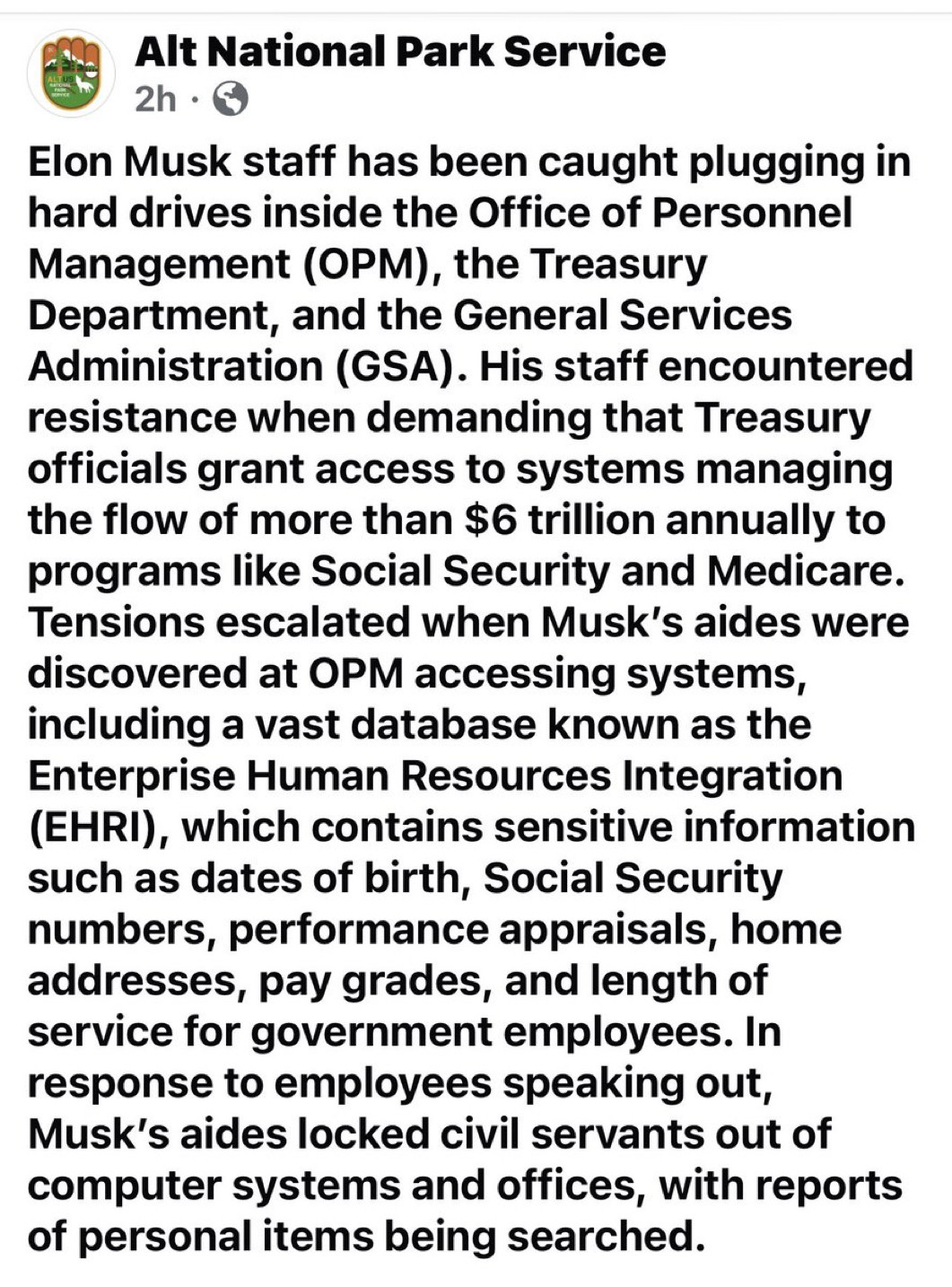

 Diane Ravitch's blog