Archives for category: Personal


Checker Finn and I used to be best buddies back in the days when I was on the other side (the wrong side) of big education issues. We became friends in the early 1980s. We created something called the Educational Excellence Network, which circulated a monthly newsletter on events and issues back in the pre-Internet days. I was a member of the board of the Thomas B. Fordham Foundation, which was created and chaired by his father and led by Checker. Checker had worked for Lamar Alexander when Lamar was Governor of Tennessee, and he recommended me to Lamar when Lamar became George H.W. Bush’s Secretary of Education. I accepted the job of Assistant Secretary of Education for Research and Counselor to the Secretary, the same job Checker had held during the Reagan administration, when Bill Bennett was Secretary of Education. We both served as members of the Koret Task Force at the Hoover Institution. As a member of Checker’s board, I opposed accepting funding from the Gates Foundation, since I thought that as a think tank, we should protect our independence and we had plenty of money. I opposed TBF becoming an authorizer of charters in Ohio, where TBF was theoretically based even though its main office was in DC. I was outvoted on both issues. As a member of the Koret Task Force, I was in regular conversation and discussion with the best conservative thinkers. Over time, however, I lost the conservative faith. I changed my mind, as I described in my book, The Death and Life of the Great American School System: How Testing and Choice Are Undermining Education. 

I became and remain a deeply skeptical critic of all the grand plans to reinvent American education, especially those that emanate from billionaires and from people who are hostile to the very concept of public education.

To my surprise, I read an article recently by Checker that captured my skepticism about the Big Ideas imposed on schools and teachers. This one was called the New American Schools Development Corporation. It was spun off during the brief time that Lamar Alexander was Secretary. It was David Kearns’ pet project. David was a former CEO of Xerox who agreed to serve as Lamar’s Deputy Secretary. He was a wonderful man and I enjoyed getting to know him. He thought like a CEO and he thought that the best way to spur innovation was to hold a contest with a big prize. (Race to the Top did the same thing and flopped.)

Checker relies on the work of a wonderful scholar named Jeff Mirel of the University of Michigan. Jeff, a dear friend of mine, died earlier this year, far too young. He was a strong supporter of public schools and a first-rate historian. I miss him.

As Checker show, the NewAmerican Schools project failed. But the $50 Million that Kearns raised from private sources was eagerly snapped up.

My reaction to Checker’s article was this: Twenty or thirty years from now, someone will write a similar article about charter schools and ask, “How could people have been so dumb as to believe that you could ‘reform’ American education by letting anyone get public money to open any kind of school? Why did they think it was a good idea to let entrepreneurs and for-profit entities open schools? Why did they allow corporate chains to take over community public schools? Why did they allow religious zealots to get public money intended for public schools? They must have lost all common sense or any sense of history!”


Let us pause and remember the men and women who lost their lives while serving in the military.

The older I get, the more I hate war.

I despise those who see war as a political tactic, those who stir up war talk to get votes.

Those who drop bombs and fire missiles to raise their poll numbers are contemptible.

There is evil in the world, for sure.

I saw it when I visited the “killing fields” in Cambodia last year.

There is a high school in Pnomh Penh that was turned into a torture camp by the Pol Pot forces.

The walls of the school are lined with photographs of hundreds and hundreds of men, women, and children, taken just before they were killed. Horrifying.

It is our challenge to be on the side of kindness, justice, charity, love, and forgiveness.

That may be hard. But in a time when so many nations have weapons of mass destruction, we have no choice.

“We must love one another or die.” (W.H. Auden).

He also wrote, in another version of the same poem, “We must love one another and die.”

Both statements are true.


I will be speaking at Pennsylvania State University in Harrisburg on April 25 at 7 pm.

I am speaking at Mukund S. Kulkarni Theatre, Penn State Harrisburg.  The address is 777 West Harrisburg Pike, Harrisburg, PA  17057.

Here is the link for the event on the campus website:  https://harrisburg2.vmhost.psu.edu/calendar/event/diane-ravitch

if you are nearby, I hope you will come and learn about the issues facing Pennsylvania and my new book, which won’t be published until next January.


I owe a huge debt of gratitude to Bob Shepherd. Bob is a professional writer, editor, graphics designer, and teacher. He has also worked in the design of assessments and curriculum. You have surely seen his many comments on this blog. He is a polymath.

A few months ago, I received a note from Bob offering to edit my new book as a gesture of appreciation for my work. I have never met a Bob except over the Internet. In 2006, he helped me with my book “The Language Police.” This time, he took on what turned out to be a nearly full-time job, reading, editing, suggesting better language, deleting my many superfluous commas, and so much more. He is a true professional. The book is now almost completely finished. I don’t know yet when it will be published and must wait to hear from my editor. I don’t even know the title. What I feel sure about is that it will change the landscape. My last ask to Bob was to request his reaction to several quotes that I wanted to use at the front of the book. He shared with me his laws of quotation and attribution. He said I could share them with you.


Bob’s Shepherd’s Laws of Quotation and Attribution in the Age of the Internet
1. In the age of the Internet, all quotations should be suspect but aren’t.
2. All quotations get improved by repeated transmission.
3. Few quotations on Internet threads resemble, even remotely, their originals, in the original source materials.
4. When in doubt, attribute a quotation, randomly, to one of the following: Aristotle, da Vinci, Lincoln, Bentham, Mill, Wilde, Churchill, Yeats, Russell, Einstein, or Gandhi. Any such attribution will be widely believed, which is all that matters.
5. When making such an attribution, don’t give the source because there isn’t one.
And finally, this, which I will leave unsourced because I am too lazy to look it up:
“You can’t believe most of what you read on the Internet.”
–Abraham Lincoln

Since you have been with me every step of the way on this book, and since many of you have shared stories that will appear in the book, I want you to be the first to know that I finished the first draft on December 31, 2018.

I am now getting my peer review committee to review it for errors, redundancy, whatever. Then it goes to the publisher.

I have proved that it is possible to blog every day and write a book of 125,000 words!

A hint: It is a hopeful book, a book that will show that the light at the end of the tunnel is NOT an oncoming train.

There is good news! The Zombie apocalypse will be repelled!

Stay tuned!

Dear Friends,

I hope you enjoy Christmas Day. As a Jew, I have great respect for people of all faiths. I believe in live and let live.

I am aware that for many people, Christmas is a sad time because they think of their childhood and their memories are aglow with presents and family, but also thoughts of loss.

The best antidote to sadness is to reach out and help others. Volunteer to work in a soup kitchen. Former President Obama visited a children’s hospital in D.C. and brought joy. A man in Arizona found a child’s list of wishes for Santa, attached to a balloon that landed on his ranch, and he tracked her down–a little girl in Nogales, Mexico–tried to find everything on her list, and brought Christmas gifts for her and her little sister. He and his wife crossed the border into Mexico to spread joy. They had lost their only child and missed having children in their lives.

There is so much good around us, and so many opportunities to do good for others.

Do whatever you can to ease the pain of those who are less fortunate than yourself.

As for this blog, here are my plans. I should take a break for the next week, but people keep sending things that I want to share. So I am going part-time. I will post whatever interests me. Maybe one post a day, or two, or three.

Stay tuned.

2019 will be a great year for the Resistance!

Diane

As readers of this blog know, Phyllis Bush writes regularly about her ongoing battle with cancer, which she derisively calls “cancer schmanzer.” In recent months, she got a colostomy bag (“Sherlock”), and she has had some rough bouts but kept her determination and humor.

Today, she has an announcement to make. She and her best friend Donna Roof got married. Since this happened on the spur of the moment, they relied on former students (an attorney and judge) to set the wheels in motion, fast.

Blessings and congratulations to the happy couple!

They live in Indiana.

Hey, Mike Pence, eat your heart out!

Just recently, Stephen Hillenburg died of ALS. He was the creator of SpongeBob Squarepants.

I loved SpongeBob for a couple of reasons. First, I watched SpongeBob videos with my grandchildren and we laughed together, inspired by SpongeBob’s relentless optimism. Second, I saw the Broadway show, “Spongebob Squarepants” and loved it–I saw it not once, but twice! The first time I wanted to see why it won 12 Tony nominations. The second time I took the grandchildren. It was the best musical I saw all season, the happiest, the most cheerful, the most inspirational, the most delightful, the wackiest. If the producers take it on tour, be sure to see it.

This is an article about the beginnings of SpongeBob Squarepants and Stephen Hillenburg’s creation of a fresh character, who is hopelessly optimistic and innocent.

I was touched by his death because in the last few years, two friends died of this dread disease: Vivian Connell, whose blog was posted here, about the progression of the disease and her determination not to let it define her. When NPE held its annual conference in Raleigh, N.C., a group of us–Bertis Downs, Phyllis Bush, Colleen Wood, and I– went to visit Vivian, an experience I will never forget. Bertis, a dear friend of Vivian, brought her a first edition of one of her favorite books, To Kill a Mockingbird.

And I also want to remember my friend Harold O. Levy, who was one of the best chancellors of the New York City public school system, who died only days ago of ALS. This is how I met Harold Levy. I wrote an op-ed criticizing some decision he made, and at 8 a.m. that morning, he called me at my home and invited me to his office. I dropped everything and went to meet him. We talked and became fast friends. How easy it is to bridge differences when you share a cup of coffee and a smile. That was Harold Levy.

As it happened, Valerie Strauss interviewed the writers of SpongeBob just a few years ago.

You will learn from her interview what advice SpongeBob offered on the subject of education.

I’m in an airplane, flying from NYC to L.A., where I will attend the annual dinner of LAANE, the Los Angeles Alliance for a New Economy. This group fought for and won a battle to raise the minimum wage. I believe and hope they will join the struggle to support public schools and save them from the clutches of the billionaires.

As I fly, I’m watching the state funeral of President George H.W. Bush. The services are very moving. People speak of his decency, his sense of honor, his humility, his dignity, his loyalty to friends and family, his patriotism, his sense of duty and courage (he volunteered for combat duty in World War II right out of high school). Trump is sitting in the front row, scowling and looking uncomfortable. It’s not about him.

The former Prime Minister of Canada spoke about Bush’s devotion to improving the environment, assuring that we have clean air to breathe and clean water to drink. Others spoke of his support for the Americans with Disabilities Act. Still others referred to his steady hand as the Soviet Union dissolved and the Cold war ended. I broke down and cried when his son George W. said that he takes comfort in knowing that his dad is now hugging Robin (the daughter who died of leukemia at age 3) and holding Barbara’s hand. Because I hope sometime I’ll meet Steven, who died of the same disease at age 2.

I won’t pretend that I saw a lot of him when I worked in his administration. I did not.

When I was Assistant Secretary of Education for the Office of Research and Improvement during the administration of President George H.W. Bush, I made only one trip to the Oval Office.

I was invited to join Secretary Lamar Alexander and Deputy Secretary David Kearns (former CEO of Xerox) to brief the President on our progress in promoting voluntary national standards.

I joined the administration in the summer of 1991, which meant that I spent only about 18-19 months in the federal government. The Democrats on the Hill told me that nothing we proposed would be enacted, so I had to settle in to the idea that whatever we accomplished would be done without any new legislation.

To those who think that President George H.W. Bush was the architect of the test-and-punish regime that has afflicted our schools since the passage of NCLB, let me assure you that this is not true. The truth is that he wasn’t very interested in education policy. His field was foreign policy, and he left education to others. If he had one lodestar in education, it was that the federal government should not mandate anything. He understood that the states were in charge. So did Lamar Alexander, who opposed anything that smacked of a “national board of education.”

The reality is that there was a bipartisan consensus around the ideas of standards-testing-accountability. Bill Clinton and George W. Bush and Barack Obama were on the same page. In 2015, when ESSA was in the birthing stage, Senator Lamar Alexander was ready to discard all the federal mandates, but the Gates-funded Education Trust lined up the civil rights groups that got millions from Gates to demand the mandate of annual testing. Yes, they insisted, children have a civil right to be tested every year!

The Democrats, led by Senator Chris Murphy of Connecticut, wanted to preserve the punishments of NCLB in the new ESSA law, but the Republicans voted them down. Warren and Sanders supported the Murphy Amendment. Fortunately, it was defeated. Ask your Democratic senators—if you have one—why they are in love with the GWB/NCLB punishments.

When I worked for the first Bush administration, we awarded grants to national professional groups to write voluntary national standards. Not much remains of that effort, other than bad memories of how the history standards went wrong after the UCLA team in charge avoided heroes and left out major figures in U.S. history, thereby outraging Lynne Cheney, who was at the time the head of the National Endowment for the Humanities. (That’s a story for another day.)

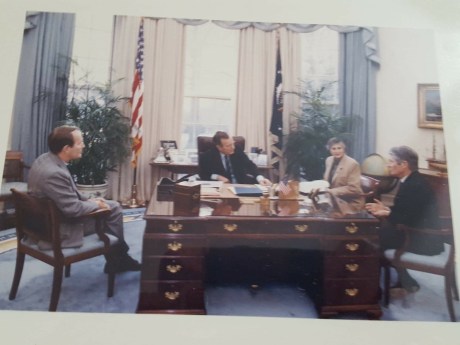
Anyway, I went over to the White House with Lamar and David. I had decided after a year on the job that the best thing I would do while in Washington was to get some great photos. We sat down facing President Bush. We talked amiably, and I inched closer to him, then closer, then closer, so that I could get a picture alongside him. Eventually I was almost behind the desk with him. This is the picture taken that day. The back of the head of Lamar, a profile of David, but President Bush and I sitting almost side-by-side behind the desk, facing the camera. My mission accomplished!

A good man, not perfect, flawed as we all are, but a man who had a sense of duty. Perhaps his funeral was his last effort to unify us in a time of deep division.

Image-1 2

In 1991, I received a phone call from Lamar Alexander inviting me to come to D.C. to talk about working in the U.S. Department of Education. I didn’t think I wanted to do it, but I was intrigued. So I flew to D.C., had lunch with Lamar and David Kearns, CEO of Xerox, and agreed to join them. Lamar had just been appointed Secretary of Education by President George H.W. Bush, and he invited David to be his Deputy Secretary. They invited me to become Assistant Secretary in charge of the Office of Research and Improvement and Counselor to the Secretary. I agreed.

Over the next 18 months, I had a wonderful job. Lamar and David were great to work with and for.

Skipping over lots of details, I had one extended visit with Barbara Bush. Her office invited me to fly with her to Houston and deliver a speech to a community group in her stead. We spent four hours together on Air Force 2, her private jet, with only one other person present, her PR woman.

I first met George H.W. Bush when Ronald Reagan was President and Bush was VP. About 25 educators were invited to a meeting in the Cabinet Room. I sat next to Vice President Bush, directly across from President Reagan. Reagan told funny stories and charmed the room. At one lull, I mentioned to VP Bush that my mother was worried about whether the Reagan administration would protect Israel. A week later, I got a photograph of those of us at the table. With it was a letter from President Reagan thanking me for my participation. There was a P.S.: “Please tell your mother I got her message,” That was the work of VP Bush. He paid attention.

When Bush was President, Lamar and David invited me to go with them one day to see the President. I jumped at the chance. He couldn’t have been nicer or more gracious. After the year that I had been in D.C., I had come to see that the best thing I could accomplish was to get some great photos (the Democratic Staff had already told me that nothing we proposed would be enacted). I sat across from the President with Lamar and David. I inched my chair closer, then closer. At some point, I was almost sitting at his side, behind his desk. He thought it was hilarious.

He was a decent man. He was honest. He was civil. He was conservative but not a crazy right winger. He was a good man.

Living at a time when the Republican Party has become completely subservient to a man who has no morals, no ethics, no scruples, I say this: I miss George H.W. Bush. I miss the kind of Republican he was. I pray that the scourge of Trumpism will soon disappear, and that what remains of the GOP rediscovers its spine, its soul, its ethics, and its brain.