Archives for category: NAEP

Carol Burris is the Executive Director of the Network for Public Education. She watched Secretary Cardona testify before various committees and was chagrined to see how ill-informed he was. She called to tell me what he said, and I was appalled by how poorly informed he was.

Why does he know so little about the defects of vouchers? Why has no one in the Department told him that most students who take vouchers are already enrolled in private and religious schools? Why has no one told him about the dismal academic performance of students who leave public schools to use a voucher? I suggest that his chief of staff invite Joshua Cowen of Michigan State University to brief the Secretary; clearly, no one in the Department has.

Why is he so ill-informed about the meaning of NAEP scores? How can he not know that “proficient” on NAEP is not grade level? Why does he not know that NAEP proficient represents solid academic performance? Why has no one told him that he is using fake data?

Why is he not speaking out loud and clear against vouchers, armed with facts and data? Why is he not speaking out against privatization of public schools? Why is he not speaking out against censorship? Why is he not speaking out against the Dark Money-funded astroturf groups like “Moms for Liberty,” whose main goal is smearing public schools? Why is the Federal Charter Schools Program still funding charter chains that are subsidized by billionaires?

He is a mild-mannered man, to be sure, but now is not the time to play nice when the enemies of public schools are using scorched earth tactics and lies. Now is the time for a well-informed, fearless voice to speak up for students, teachers, principals, and public schools. Now is the time to defend the nation’s public schools against the nefarious conspiracy to defame and defund them. Not with timidity, but with facts, accuracy, bold words, and actions.

Carol Burris writes:

Secretary of Education Cardona is a sincere and good man who cares about children and public education. However, his appearances before Congress to defend the Biden education budget have been serious disappointments. The Republican Party is now clearly on a mission to destroy public education. He must recognize the threat and lead with courage and facts. Unfortunately, he seems more interested in deflecting arguments and placating voucher proponents than facing the assault on public education head-on. 

During the April 18 budget hearing, the Republicans, who now control the committee, had four objectives: to slash education funding, to score political points at the expense of transgender students, to support vouchers, and to complain that student loan forgiveness was unfair. 

Although the Secretary pushed back on all four, his arguments were at times disappointingly uninformed. Whenever asked about proposed policies regarding including transgender students in sports, his responses were evasive and robotic. He objected to vouchers because they reduced funding for public schools but never mentioned that vouchers result in publicly funded discrimination. Overall, he missed valuable opportunities to seize the opportunity to lead with moral courage in defense of children, democracy, and public education.

Shortly into the discussion, the Secretary argued the case against budget cuts by disparaging the performance of our public schools and their students. He called NAEP reading levels “appalling” and “unacceptable,” falsely claiming that only 33% of students are reading at “grade level.”

As Diane explained in her blog on April 19, Secretary Cardona is flat-out wrong. As described on the website of the National Center for Education Statistics:

“It should be noted that the NAEP Proficient achievement level does not represent grade level proficiency as determined by other assessment standards (e.g., state or district assessments).”

He could have made far better (and more honest) arguments for why the budget should not be cut. A wealth of research shows the connection between funding and student performance. He could have explained how Title I funds help close the gap between resource-rich and resource-poor districts. He could have argued how important a well-educated citizenry is in preserving our democracy. Instead, he kept repeating that a “tsunami of jobs” was coming as though the only purpose of schooling was job training. 

Later on, Secretary Cardona defended the budget by citing the teacher shortage. However, he pivoted and argued that we did not have a teacher shortage problem but rather a “teacher respect problem,” with no explanation regarding how his budget would address that. 

I cringed when he said, “Research shows that the most influential factor in a child’s success is the teacher in front of the classroom.” No, Mr. Secretary, that is not what research shows. Research consistently shows that out-of-school factors like poverty far more influence variations in children’s academic outcomes than in-school factors. This is not to say that teacher quality does not matter—it is the most important in-school factor, but outside factors are more influential.

Sadly, Secretary Cardona’s incorrect assertion harkens back to Race to the Top thinking, resulting in ineffective and unpopular policies such as evaluating teachers by student test scores.  Much like his inaccurate remarks about NAEP scores, he used an argument from the Republican playbook–public schools and teachers are failing America’s students.

When he was recently grilled by the Education and Workforce committee on whether he favors vouchers, he still would not confront the issue head-on, repeating that he used school choice to go to a vocational high school. When pressed, he responded, “What I’m not in favor of, sir, is using dollars intended to elevate or raise the bar, as we call it, public school programming, so that the money goes to private school vouchers. What happens is, we’re already having a teacher shortage; if you start taking dollars away from the local public school, those schools are going to be worse.”

Vouchers indeed drain funding from public schools, but there are far more compelling reasons to oppose them, beginning with their ability to discriminate in admissions. A 2010 study published by his own department showed that 22% of students who got a SOAR voucher never used it. The top reasons included: no room in the private school, the school could not accommodate the child’s special needs, and the child did not pass the admissions test or did not want to be “left back.” Schools choose—an aspect of school choice that voucher proponents ignore. 

And he allowed Aaron Bean of Florida to cite 2011 SOAR graduation statistics from the American Heritage Foundation about the DC voucher program without challenging him with the findings of a 2019 Department of Education study of SOAR that showed voucher student declines in math scores and no improvement in reading when they move to a private school. The overwhelming majority of voucher students use them in the early years, making graduation rate comparisons a less meaningful statistic. Interestingly, the 2010 study found that students often left the SOAR system because there was no room for them in high schools. More than half of all voucher students who take a voucher do not continue in the SOAR voucher system. 

Was the Secretary poorly briefed? Or did he believe he would win over Republican committee members by using their arguments when defending the President’s budget?

Either way, one can only hope that when he meets with the Senate, he is better prepared and dares to say that public money belongs in public schools that educate every child.  We need a Secretary of Education that is willing to stand up, push back and use facts to dispute the Republican narrative that American education is broken, not a Secretary who reinforces it.

Nebraska was one of the few states that managed to resist privatization. But it is a well-known fact that the privatization industry cannot tolerate any state that devotes its resources to public schools open to all students. Nebraska had no charter schools, no vouchers, no Common Core, and no grounds for dissatisfaction: its scores on NAEP are strong.

But Nebraska is a red state, and the billionaires could not leave it be.The legislature passed a voucher bill, and Nebraska’s Stand for Children will fight to get it on a state referendum, as they are confident that Nebraskans will reject vouchers. That’s a good bet, as vouchers have never won a state referendum.

Image

We have some very bad news to share with you, and there’s no way to sugarcoat it: Our legislature has passed Nebraska’s first school privatization bill.

Just a while ago, 33 senators voted to pass LB 753. But we aren’t deterred; we’re determined. Over 300,000 students attend a public school in Nebraska. And there are hundreds of thousands of Nebraskans who, like us, support public schools and will stand up for what’s right.

If you’re one of those Nebraskans (and we think you are), please support our work today for Give To Lincoln Day. A gift of $20 or more will send the school privatizers a strong message: NOT IN NEBRASKA.

Give Now

Right now, somewhere not in Nebraska, DeVos and other billionaires who backed this bill are undoubtedly celebrating. Our state was one of the last to fall for their privatization schemes.

And fall we will, if Governor Pillen signs LB 753 into law. The conventional notion that public dollars should be invested in the common good and in common schools will, at that point, only be true in North Dakota, where the governor recently vetoed an eerily similar piece of legislation.

While the mega-donors like DeVos break open their champagne, our team at Stand For Schools is still hard at work – fighting to advance public education in Nebraska for ALL and getting fired up for the Support Our Schools Nebraska effort.

Please support our work today with a gift of $20 or more for Give To Lincoln Day. We can honestly say we’ve never needed your help more than we do today. Our team is ready to win this fight – whether it’s in a courtroom or at the ballot box – but we can’t do it without you.

Help Us Fight Back

PS: You can read our organization’s full statement about the the Nebraska Legislature passing LB 753 here.

Copyright © 2023 Stand For Schools, All Rights Reserved

Mailing Address:
P.O. Box 95166
Lincoln, NE 68509

Here is Stand for Schools statement, released today:

Today’s passage of LB 753 marks a dark new era for schooling in Nebraska.

The Legislature’s Education Committee considered proposals this year to make school lunches free, broadly prohibit discrimination, include student voices in curriculum decisions, and increase the poverty allowance in TEEOSA. But instead of improving the schools that serve 9 out of 10 children in our state, instead of addressing the needs of over300,000 students attending Nebraska public schools, 33 senators chose todayto prioritize giving tax breaks to the wealthy and corporations by sending tax dollars to unaccountable private schools.

They did so despite overwhelming and constantly mounting evidence that the implementation of tax-credit voucher schemes does not improve access to private schools or academic outcomes but rather marks the beginning of a devastating dismantling and defunding of public education, as it has in dozens of other states.

Policymakers who voted to pass LB 753 made the wrong choice. Statewide polling consistently shows a strong majority of Nebraskans firmly oppose school privatization measures. From Omaha to Ogallala, and Spencer to Sidney, Nebraskans take pride in our public schools because we know they are the head and heart of our urban and rural communities.

Like our fellow Nebraskans, Stand For Schools remains committed to a vision of public education that is welcoming to all students regardless of their race, religion, gender, or ability. Realizing that vision is neither easy nor politically expedient. It is, for instance, far easier to lean on out-of-state bill mills and think tanks than it is to grow our own nonpartisan solutions to nonpartisan Nebraska problems. It is far easier to demonize the education professionals who work hard in our public schools every day than it is to address crisis-level staff shortages by recruiting and retaining the qualified teachers and school psychologists our students need. It is far easier to restrict the ability of school districts to raise revenue than to finally, fully fund our K-12 public education system. And it is far easier to offload the duties of educating the next generation of Nebraskans to unaccountable private schools than to do the hard work of providing a free, fair, equitable, and excellent public school system that works for all.

Today, 33 senators chose what was easy over what was right. The consequences of their decision will be far-reaching and long-lasting. The hours the Legislature spent debating LB 735 will not compare to the years it will take to undo the damage done to public schools and the harm caused to students, their families, and their communities.

Thankfully, there are hundreds of thousands of Nebraskans who aren’t afraid of hard work, who are undeterred by today’s decision and determined to make it right. Stand For Schools is proud to join them. Together with the Support Our Schools Nebraska coalition, we will work to put LB 753 on the 2024 ballot and ensure voters’ voices are heard: Not in Nebraska.

I served on the governing board of the National Assessment of Educational Progress (NAEP) for seven years. I was appointed by President Clinton. I learned quite a lot about standardized testing during that time. I enjoyed reading test questions and finding a few that had two right answers. Two subjects where I felt confident as a reviewer, in addition to reading, were history and civics.

I was momentarily dismayed, but not surprised, to learn that the NAEP scores in history and civics had declined, as they had in reading and math, after the disruptions and closings caused by the pandemic. This is not surprising, because fewer days of instruction translates into less learning.

So we know for sure that instructional time matters. You can’t learn what you weren’t taught.

But on second thought, I realized that in these days it is almost impossible to test history and civics and get a meaningful result.

Many states, all Republican-dominated, have censored history teaching. The legislatures don’t want students to learn “divisive concepts.” They don’t want anything taught that will make students “uncomfortable.” They don’t want “critical race theory” to be taught. These ideas have been spun out at length with other vague descriptions of what teachers are NOT allowed to teach.

The people who write test questions for NAEP history are not bound by these restrictions. They are most likely writing questions about “divisive concepts” and “uncomfortable” topics. They might even ask questions that legislators might think are tinged or saturated by critical race theory.

Given the number of states that ban the teaching of accurate, factual history, it’s seems to me impossible to expect students to be prepared to take an American history test.

Even more complicated is civics. A good civics exam might ask questions about the importance of the right to vote. It might ask questions written on the assumption that vote suppression and gerrymandering are undemocratic practices that were long ago banned by the courts. Yet courts are now allowing these baleful practices to stand. How can a student understand that a discredited practice is now openly endorsed in various state laws and have not been discredited by the courts?

Civics classes typically teach that one of the great strengths of American democracy is the peaceful transition of power from one President to another. How can they teach that idea when Trump partisans insist that he won the last election and was ousted in a coup? How can teachers explain the election process when Trump says it’s rigged (he said it before the 2016 election as well)? How can students answer questions about elections and the Electoral College when Trumpers believe they were corrupted in 2020?

How can teachers teach civics when almost every GOP leader asserts that the election was stolen?

How can civics be taught when public officials defy public opinion to allow any individual to buy guns without a background check or a permit. Having bought a gun, they may wear it openly in some states and carry it concealed in some other states. Students have been practicing in case an armed killer walks into their school during the day. They need only google to learn that a majority of the public favors gun control of varying kinds. Why, they might ask their teacher, doesn’t the legislature and Congress act to protect the lives of children?

Is it worse to teach lies or to teach the truth?

John Thompson, historian and former teacher, updates us on the state of education in Oklahoma. I reported a few months ago on a secret Republican poll showing that Oklahomans overwhelmingly oppose vouchers. Wouldn’t it be great if they held a state referendum? We know they won’t.

It is virtually impossible to understand the Oklahoma State Superintendent of Schools Ryan Walters recent rant against teachers unions without understanding the reason the American Federation of Teachers president, Randi Weingarten, has been targeted by MAGAs – and vice versa. Jonathan Mahler’s New York Times article about Randi Weingarten, The Most Dangerous Person in the World offers some – but not nearly enough – perspective on why teachers, unions, and schools are under such brutal, and fact-free, inter-connected assaults.

It took the threat of “arm-twisting” by Republican Oklahoma House Speaker Charles McCall to get Ryan Walters to speak to the House Appropriations and Budget Committee. Then, as the Tulsa World reports, “Tensions flared Monday as House lawmakers grilled Oklahoma’s controversial state superintendent.” He “called teachers’ unions ‘terrorist organizations’ and accused his predecessor of running the State Department of Education into the ground.” Walters said that Joy Hofmeister had left “an absolute dumpster fire.” Presumably that is why he fired 7 employees, had 37 resignations, and eliminated 17 positions.

As the Oklahoman reports:

Lawmakers were particularly concerned with whether the agency would meet deadlines to apply for federal grants this month.

The state Education Department, which recently lost its lead grant writer, manages about $100 million in competitive grants from the federal government and over $900 million in total federal funding.”

This prompted pushback by Republican Vice Chairperson Rep. Ryan Martinez, who, like McCall, supports most of the session’s anti-public education bills, complained about a lack of transparent actions by Walters:

“If we do not receive specific grants, if we do not apply for a certain grant or if those monies are not disbursed, guess who’s trying to find the money to make sure those programs don’t go away,” Martinez said. “It’s the people on this committee.”

Walters also “accused teacher unions of demanding extra government funds in exchange for their cooperation with reopening schools during the COVID-19 pandemic.” As Nondocexplains, he added, “I don’t negotiate with folks that are going to intentionally sabotage our kids. (…) You are hurting kids intentionally to shake down the federal government for money — that’s a terrorist organization in my book.”

Then, the Oklahoman reported, Walters’ “most incendiary comments prompted groans from Democrats before the meeting came to an abrupt end.” As Walters claimed, “Democrats want to strike out any mention of the Bible from our history,” Martinez “gaveled for adjournment amid vocal objections from the minority party to Walters’ comments.”

The latest performance by Walters should be seen in the context of the best parts of Jonathan Mahler’s New York Times article about Randi Weingarten, Mahler starts with former CIA Director Mike Pompeo’s charge that Weingarten is “the most dangerous person in the world.” Then he puts it in context with similar attacks on the teachers union, such as the previous claim that former AFT president Al Shanker said, “When schoolchildren start paying union dues, that’s when we start representing the interests of schoolchildren.” Mahler adds that the highly respected researcher, Richard Kahlenberg, found no evidence that Shanker ever said such a thing.

Mahler also added context to the claims rightwingers have made that teachers unions hurt students by keeping schools closed during the Covid pandemic. I wish he had been more explicit, but implicit in his narrative is a reminder that it made sense for public health institutions, like the Center for Disease Control, to consult with organizations with knowledge of diverse conditions in schools. He notes that while suburban parents were pushing for re-openings, poor and Black parents, and families with multi-generation households, opposed the early returns to in-person instruction.

The AFT plans that are now under attack came at times when deaths and/or new variants were surging. I would add Education Week’s explanation that yes, “the pandemic has massively disrupted students’ learning,” but the story is complicated. It explained, “Reading scores for students in cities (where the AFT is strongest) stayed constant, as did reading scores for students in the West of the country.”

Yes, Covid closures led to an unprecedented decline in test scores, especially for the poorest students. But Mahler, like so many other journalists, should have looked more deeply at propaganda dating back to the Reagan administration that inappropriately used NAEP test scores when arguing that public schools are broken.

First, as Jan Resseger and Diane Ravitch noted, Mahler made:

A common error among journalists, critics, and pundits who misunderstand the achievement levels of the National Assessment of Educational Progress (NAEP). “Proficient” on NAEP is not grade level. “Proficient” on NAEP represents A level work, at worst an A-. Would you be upset to learn that “only” 40% of 8th graders are at A level in math and “only” 1/3 scored an A in reading?

Secondly, Mahler should have asked why the admittedly unprecedented (and expected) fall in NAEP scores during Covid followed a decade of stagnating or declining reading and math scores, that also disproportionately hurt low performing students. Like virtually every teacher I’ve worked with, I would argue that the pre-Covid decline was due, in large part, to test-driven, competition-driven corporate school reform. (I also suspect this is especially true of the dramatic drop in History outcomes due to instruction in that subject being pushed out of classrooms by pressure to teach-to-the test.) Had Mahler taken this into account, he likely would have understood why teachers resisted corporate reforms, and chosen his words more carefully, and would not have repeatedly labeled us as “leftists.”

Such an understanding would help explain why No Child Left Behind’s and Race to the Top’s focus on “disruptive” change prompted teachers to resist policies that undermined high-quality instruction, and undermined holistic learning, especially in high-poverty schools. It also explains why, for the benefit of teachers and students, Weingarten had to seek centrist compromises when resisting doomed-to-fail mandates by the Obama administration.

As Ravitch explains, it’s okay to disagree with Weingarten, but it makes no sense to compare her balanced approach to the rightwing zealotry of those who have attacked her so viciously. She also worries that the Times Magazine’s format and attempt to present both sides as political activists could put Weingarten in danger.

Education and education politics are political. Yes, the bipartisan corporate reforms, which a full range of educators resisted, is now “a shadow of itself;” that is due to both the inherent flaws in their reward and punish policies, and the pushback by those of us who were in schools and saw the damage it did to our students. Similarly, the CDC was correct in listening to educators and parents of students who attended schools where vaccines, social distancing and masks were, due to anti-science mandates, not implemented, especially after holidays when variants were surging.

But, Mahler and others who bend over backwards to treat the words of moderates like Weingarten, and rightwing extremists and their funders as equally true, should ask what will happen if the nation’s Ryan Walters and Mike Pompeos, and their funders succeed. Surely he understands that the argument that teachers and unions are terrorists is not equal to the counter arguments of education leaders like Weingarten, and those of us who are still fighting for what we believe is best for our schools and students.

Tim Slekar, Director of the Educator Preparation Program at Muskingum University in Ohio comments here on the recent report that NAEP scores in history and civics dropped during the pandemic. The decline should surprise no one since neither subject has mattered for the past two decades. Far more worrisome, he says, is the erosion of democracy. How do you prepare students to participate in a society where voter suppression and gerrymandering are widespread and are approved by the courts? Where members of the Supreme Court see no harm in accepting valuable gifts from billionaires? Where one of the two national political parties insists the last presidential election was stolen without any evidence? Where nominees for the highest Court testify under oath that they believe in stare decisis, then promptly overturn Roe v. Wade? Where killers stalk schools and public places because of the power of the gun lobby? Where honest teaching about political events and history is considered divisive and may be criminalized?

Slekar writes:

“In the 1930s, George Counts dared the schools to “build a new social order” comprised of an active, critical citizenry, challenging industrial society’s inequities through boldly democratic education.  In 2016, a supposedly educated population of United States citizens elected Donald Trump as its next president, ushering in what surely will be a new social order.  For decades preceding that election, social studies educators, researchers, and leaders have rejected powerful and critical social studies learning efforts in favor of superficial standards-setting and accountability talk….My guess is that Counts would not be very happy with Trump’s construct of a new social order, and my point is that standards—particularly in social studies—have been useless as instruments intended to affect how the social order Counts envisioned might be built through public education.”


I wrote the above in 2018. 40 years of devotion towards the erosion of the civic mission of history and the social studies had resulted in the election of a narcissistic reality tv show host to the presidency of the United States. There were no headlines about the dismal state of teaching and learning American history and civics in 2018. The most obscene—in-your-face evidence of civic failure was ignored.

And now America is faced with a “crisis” because of an insignificant drop in 8th graders’ test scores in US History and American Civics NAEP tests. Really? This is our national concern? Really?

What about the fact that the 8th graders tested spent significantly less time in History class than 8th graders 10 – years ago?

What about the fact that 8th graders 10 years ago spent significantly less time in History class than 8th graders 20 years ago?

Thank you Race to the Top (Obama) and No Child Left Behind (Bush).

What about the current reality of state legislatures taking the insignificant time devoted to the teaching of History and whitewashing the content that can be taught through the mandated erasure of painful truths that make some “uncomfortable?”

What about legislating penalties on teachers that involve students in that horrible civic responsibility of engaging with their elected officials?

The evidence is clear. We have a crisis of democracy. We have a morality crisis that has been legislated since 1983. The mission of public schools was purposely killed and now we have a society of grievance snowflakes that openly believe intolerance, bullying, and racism are constitutional rights.

Test score drop? Fake news!

As I wrote in an earlier post, NAEP Proficient is not the same as “grade level.” NAEP Proficient is equivalent to an A or an A-. Secretary of Education Cardona made the egregious error of saying at a Congressional hearing on April 18 that 2/3 of the students in this nation were below grade level. He was wrong.

Tom Loveless, then of the Brookings Institution (now retired), wrote an excellent article in 2016, providing a history of NAEP and explaining just how high the standard for NAEP Proficient is. He was responding to the wildly inaccurate claims of rightwing ideologues, who said the same things that Secretary Cardona said.

Here are some excerpts from his article, “The NAEP Proficiency Myth.”

Equating NAEP proficiency with grade level is bogus. Indeed, the validity of the achievement levels themselves is questionable. They immediately came under fire in reviews by the U.S. Government Accountability Office, the National Academy of Sciences, and the National Academy of Education.[1] The National Academy of Sciences report was particularly scathing, labeling NAEP’s achievement levels as “fundamentally flawed.”

Despite warnings of NAEP authorities and critical reviews from scholars, some commentators, typically from advocacy groups, continue to confound NAEP proficient with grade level. Organizations that support school reform, such as Achieve Inc. and Students First, prominently misuse the term on their websites. Achieve presses states to adopt cut points aligned with NAEP proficient as part of new Common Core-based accountability systems. Achieve argues that this will inform parents whether children “can do grade level work.” No, it will not. That claim is misleading….

Today’s eighth graders have made it about half-way to NAEP proficient in 25 years, but they still need to gain almost two more years of math learning (17 points) to reach that level. And, don’t forget, that’s just the national average, so even when that lofty goal is achieved, half of the nation’s students will still fall short of proficient. Advocates of the NAEP proficient standard want it to be for allstudents. That is ridiculous. Another way to think about it: proficient for today’s eighth graders reflects approximately what the average twelfth grader knew in mathematics in 1990. Someday the average eighth grader may be able to do that level of mathematics. But it won’t be soon, and it won’t be every student.

In the 2007 Brown Center Report on American Education, I questioned whether NAEP proficient is a reasonable achievement standard.[2] That year, a study by Gary Phillips of American Institutes for Research was published that projected the 2007 TIMSS scores on the NAEP scale. Phillips posed the question: based on TIMSS, how many students in other countries would score proficient or better on NAEP? The study’s methodology only produces approximations, but they are eye-popping….

Singapore was the top scoring nation on TIMSS that year, but even there, more than a quarter of students fail to reach NAEP proficient. Japan is not usually considered a slouch on international math assessments, but 43% of its eighth graders fall short. The U.S. looks weak, with only 26% of students proficient. But England, Israel, and Italy are even weaker. Norway, a wealthy nation with per capita GDP almost twice that of the U.S., can only get 9 out of 100 eighth graders to NAEP proficient.

Finland isn’t shown in the table because it didn’t participate in the 2007 TIMSS. But it did in 2011, with Finland and the U.S. scoring about the same in eighth grade math. Had Finland’s eighth graders taken NAEP in 2011, it’s a good bet that the proportion scoring below NAEP proficient would have been similar to that in the U.S. And yet articles such as “Why Finland Has the Best Schools,” appear regularly in the U.S. press….[3]

NAEP proficient is not synonymous with grade level. NAEP officials urge that proficient not be interpreted as reflecting grade level work. It is a standard set much higher than that. Scholarly panels have reviewed the NAEP achievement standards and found them flawed. The highest scoring nations of the world would appear to be mediocre or poor performers if judged by the NAEP proficient standard. Even large numbers of U.S. calculus students fall short.

As states consider building benchmarks for student performance into accountability systems, they should not use NAEP proficient—or any standard aligned with NAEP proficient—as a benchmark. It is an unreasonable expectation, one that ill serves America’s students, parents, and teachers–and the effort to improve America’s schools.

For the past dozen years, since the attack on public schools went into high gear, the same lie has been trotted out again and again to defame public schools. The slanderers say that 2/3 of American students are reading “below grade level.”

At Congressional hearings on the education budget on Tuesday April 18, the same ridiculous claim was made by U.S. Secretary of Education Miguel Cardona. He said that only 33% are reading at proficiency. He said this is “appalling and not acceptable for the United States. 33% of our students are reading on Grade level.” (At about 45:00).

This is nonsense. Its’s frankly appalling to hear Secretary Cardona repeating the lie spread by rightwing public school haters. He really should be briefed by officials from the National Assessment Governing Board before he testifies again.

On the NAEP (National Assessment of Educationsl Progress) tests, “proficient” does not represent grade level. Proficient is a high bar. Although the federal testing agency does not equate its achievement levels to letter grades, I would estimate (based on my seven years of experience as a member of the NAEP Governing Board) that “proficient” is about the same as an A or an A-. Do we really expect that every student merits an A? I don’t think so.

The website of the National Center on Education Statistics states clearly:

Achievement Levels

NAEP student achievement levels are performance standards that describe what students should know and be able to do. Results are reported as percentages of students performing at or above three NAEP achievement levels (NAEP Basic, NAEP Proficient, and NAEP Advanced). Students performing at or above the NAEP Proficient level on NAEP assessments demonstrate solid academic performance and competency over challenging subject matter. It should be noted that the NAEP Proficient achievement level does not represent grade level proficiency as determined by other assessment standards (e.g., state or district assessments).

Could it be any plainer? Students who score at or above NAEP Proficent “demonstrate solid academic performance and competency over challenging subject matter.” Furthermore, the NAEP Proficient level “does not represent grade level proficiency.”

Would someone please tell Secretary Cardona? When he repeats the lies of the rightwing propagandists, he maligns every teacher and student in the nation.

Someone should also inform Secretary Cardona that the NAEP achievement levels are set by panels of educators and non-educators; as such, they are subjective judgments. They have been used on a trial basis for 30 years without getting definitive clearance by testing experts commissioned by Congress to review their validity. “The latest evaluation of the NAEP achievement levels was conducted by a committee convened by the National Academies of Sciences, Engineering, and Medicine in 2016. The evaluation concluded that further evidence should be gathered to determine whether the NAEP achievement levels are reasonable, valid, and informative. Accordingly, the NCES commissioner determined that the trial status of the NAEP achievement levels should be maintained at this time.”

Please, Secretary Cardona, stop saying that “only 33% of American students can read proficiently” and that “only 33% are reading at grade level.”

It’s not true.

When asked about vouchers, Secretary Cardona said he opposes them because they take money away from public schools. That’s true, but far from the whole truth. 75-80% of vouchers subsidize students who already attend private schools. They are a transfer from the public to the affluent. Kids who leave public schools to use vouchers lose academic ground, and most return to their public school within two-three years in need of help catching up. Vouchers fund religious schools that may discriminate against students, families, and staff who do not share their religion or who are gay or who have disabilities. They choose the students they want.


Furthermore, religious schools indoctrinate. Some religious schools teach fake science and history. Religious schools force taxpayers to pay for religious views they do not share.

There are many reasons to oppose vouchers but Secretary Cardona seems unaware of them. I recommend that he invite veteran voucher researcher Joshua Cowen of Michigan State University to brief him on why vouchers for religious and private schools are a pernicious and ineffective policy.

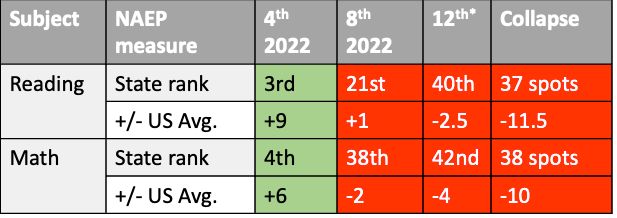
Billy Townsend, Florida blogger, has reported regularly on Florida’s gaming of NAEP scores. He writes here that Governor Ron DeSantis is carrying out Jeb Bush’s old trick to inflate 4th grade NAEP scores. He calls the governor Ron Jebsantis. The trick is third grade retention, which ensures that the lowest scoring third graders never take the fourth grade NAEP test (the kids who take the NAEP test are selected at random).

Thus, DeSantis put out a flashy press release celebrating fourth grade NAEP scores in the test scores recently released. But, as usual, DeSantis neglects to mention the collapse of eighth grade NAEP scores. Somehow the kids who were retained in third grade managed to skip fourth grade and rejoin their classmates by eighth grade.

Here are his numbers, drawn from NAEP reports:

With that in mind, here is a view of Florida’s 2022 NAEP scores peaking in elementary school and dramatically worsening with the older cohorts —- which is ALL of the red numbers after the green baseline.

I personally put no stock in the twelfth grade numbers (which Billy extrapolated) because NAEP stopped testing seniors a decade ago. Seniors know that NAEP doesn’t count and they don’t do their best. Some don’t even try. Their answer sheets had doodles, or some just picked the (A) answer to every question or some were blank.

But the stark drop from fourth grade to eighth grade says something’s fishy in Florida.

Since the two sets of NAEP scores were released recently, commentators have gone into a panic about “learning loss” and used the declines to promote their favorite reform: more of this, less of that. DeSantis even released a press release claiming falsely that Florida’s formula of ignoring the pandemic was just right (California stuck with the CDC guidelines and did at least as well, maybe better, than Florida, but Gavin Newsom did not issue a press release).

Jan Resseger has words of perspective that I sum up as: why are we surprised that learning was disrupted by the pandemic?

My question, having served on the NAEP board for seven years, is why the media and the reform crowd thinks that NAEP scores should go up every year? Why should fourth and eighth graders this year know more than fourth and eighth graders two years ago or four years ago? Isn’t it reasonable to assume that students of the same age and grade are likely to have the same scores? Yet if they do, the media sends out loud lamentations that scores are “flat.” Oh, woe! Surely we want to see a rise in the scores of the lowest scoring students, and a narrowing of gaps, but the media assumes that everyone must increase their scores or the education system is failing. This is nuts. There is little or no relationship between the test scores of students in fourth and eighth grades and the economy of the future.

Jan Resseger writes:

Are the new National Assessment of Educational Progress scores a catastrophic indication that the U.S. public schools have fallen into decline? I don’t think so.

Early this week, the National Center for Education Statistics (NCES) released a large data set from National Assessment of Educational Progress exams administered last spring to 4th and 8th grade students in U.S. public schools. Last month, NCES released scores from tests administered to a smaller group of 4th graders. Both sets of scores show that the COVID pandemic seriously disrupted schooling for the nation’s children and adolescents.

Chalkbeat’s Matt Barnum explainswhat the National Assessment of Educational Progress (NAEP) is: “The National Assessment of Educational Progress (NAEP, pronounced nape) is a test administered by an arm of the U.S. Department of Education. It’s given periodically to a representative subset of American students in math and reading in grades four and eight. Scores are broken down by state and for a select handful of cities, too. The latest results are based on tests given between January and March 2022. The previous test was given in 2019, before the pandemic… Scores from a separate NAEP exam that has been given to 9-year-olds for many decades were previously released in September.”

The NAEP scores released this week were precipitously lower than scores on the NAEP when it was administered in 2019, before COVID—particularly in 8th grade math. The Washington Post’s Laura Meckler reports: “The portion of eighth-graders rated proficient or better in math fell to 27 percent, from 34 percent in 2019… the steepest decline in more than a half century of testing.” (The fact that every year relatively few students reach NAEP’s proficient level overall is because the NAEP “proficient” cut score is set artificially high; it marks what most people would define as “advanced.”)

Some people assume that this year’s drop in NAEP scores signals a reversal of progress, the beginning of a downward spiral. Others are using the scores as evidence for their particular reform or as evidence that their state had a better policy on school closures than other states. Meckler writes: “Partisans on all sides of the education debate seized on the results to advance competing ideas about the way ahead… The test results also offered fodder for those who argue bringing students back to campuses quickly was the right move… ‘We kept schools open in 2020, and today’s NAEP results once again prove we made the right decision,’ Florida Gov. Ron DeSantis (R) said on Twitter. But the data did not establish a connection between back-to-school policies and academic performance. In California, for instance, many public schools were closed well into the 2020-21 school year and some students never saw a classroom that year. But the declines were similar to those in Texas and Florida, where schools were ordered to reopen much sooner.”

In a blog post last month when the first set of 4th grade NAEP scores was released, I shared my own assessment of what had happened. I think the scores released last month and the scores released this week show the same thing. Here is some of what I said in that post.

***

There is no cause for panic. Schooling was utterly disrupted for the nation’s children and adolescents, just as all of our lives were interrupted in so many immeasurable ways. During COVID, while some of us have experienced the catastrophic death of loved ones, all of us have experienced less definable losses—things we cannot name.

I think this year’s NAEP scores—considerably lower than pre-pandemic scores—should be understood as a marker that helps us define the magnitude of the disruption for our children during this time of COVID. The losses are academic, emotional, and social, and they all make learning harder.

Schools shut down and began remote instruction in the spring of 2020, and many stayed online through the first half of last school year. While most public schools were up and running by last spring, there have been a lot of problems—with more absences, fighting and disruption, and overwhelming stress for educators. It is clear from the disparities in the scores released last week among high and low achievers that the disruption meant very different things to different children. It is also evident that the pandemic was a jolting shock to our society’s largest civic institution. It should be no surprise, then, that the attempt to get school back on track was so rocky all through last spring…

While the NAEP is traditionally used to gauge the trajectory of overall educational achievement over time, and while the trajectory has been moderately positive over the decades, the results released last week cannot by any means be interpreted to mean a change of the overall direction of educational achievement.

Education Week’s Sarah Schwartz asked Stanford University professor Sean Reardon (whose research tracks the connection of poverty and race to educational achievement) whether “it will take another 20 years to raise scores once again.” Reardon responded: “That’s the wrong question…. The question is: What’s going to happen for these (9-year-old) kids over the next years of their lives.” Schwartz describes more of Reardon’s response: “Children born now will, hopefully, attend school without the kinds of major, national disruptions that children who were in school during the pandemic faced. Most likely, scores for 9-year-olds, will be back to normal relatively soon, Reardon said. Instead, he said, we should look to future scores for 13-year-olds, which will present a better sense of how much ground these current students have gained.”

Schwartz reports: “Students at all levels lost ground during the past two years, but lower-performing students saw the biggest drops.” The test does not in any way measure the factors that contributed to the drop in scores for students who were already struggling, but the results shouldn’t be surprising. Some children live in families with internet access and enough computers that each of several children in the family could access online instruction simultaneously, while other children’s parents had to drive them to public library or fast food outlet parking lots to find any internet access at all. Some parents had sufficient time at home to supervise children and provide assistance during online instruction, while in other families, older siblings supervised younger siblings while trying to participate themselves in online instruction. Some children and adolescents simply checked out and neglected to log-on.

H. Hurley, a reader of the blog, left the following comment, which places NAEP hysteria into context:

The cherry on the journalistic cup cake related to recent NAEP reporting was an interview by Stephanie Ruhle on her 11:00 pm MSNBC program where she rushed in, of all people, ARNE DUNCAN, to discuss the CRISIS OF THE DROPPING NAEP SCORES. Her URGENCY in her set-up and interview was almost reported as a 3 alarm fire. Poor Arne. He actually tried to calm her reactions. But her hysteria is typical related to student test scores.


Nuts!


It’s obvious to real educators that a pandemic, million COVID deaths, ZOOM schooling, kids alone at home, banning books, masking, vaccing…anti vaccing, limited computer/Internet access, Jan6, school shootings, politics, chaos everywhere….shall we go on?


On top of this craziness, when children are finally returning to school, we TEST. We test & react in horror that children didn’t know the grade level content or skills. Scores dropped….who knew? Who could have predicted that?


ACTUALLY…….Anybody with some sense!
Children living in war, migration, fleeing, homeless, famine, rising fascism, massive crime, poverty, lead poisoning, hunger, job losses, craziness, etc…..are then tested under the WORST CONDITIONS.
Meanwhile, journalists hold up those results as if our children were living under heat lamps in incubators to be educated under the best conditions.


Stop the testing madness, end poverty, stop the political madness, allow families to raise their children with proper wages, fund schools, stop destroying public schools & use the election spending zillion$ on real people for a healthy nation.


My 2¢ worth!