Archives for category: Literature

Bob Shepherd, author, editor, assessment developer, story-teller, and teacher, read a book that he loved. He hopes—and I hope—that you will love it too.

He writes:

Like much of Europe between 1939 and 1945, education in the United States, at every level, is now under occupation. The occupation is led by Bill Gates and the Gates Foundation and abetted by countless collaborators like those paid by Gates to create the puerile and failed Common Core (which was not core—that is, central, key, or foundational—and was common only in the sense of being vulgar. The bean counting under the occupation via its demonstrably invalid, pseudoscientific testing regime has made of schooling in the U.S. a diminished thing, with debased and devolved test preppy curricula (teaching materials) and pedagogy (teaching methods).

In the midst of this, Gayle Greene, a renowned Shakespeare scholar and Professor Emerita at Scripps University, has engaged in some delightful bomb throwing for the Resistance. Her weapon? A new book called Immeasurable Outcomes: Teaching Shakespeare in the Age of the Algorithm.

OK. Maybe I’ve pushed the occupation/resistance metaphor to the edge of its usefulness. Let’s try another. If Gates’s test-and-punish movement, ludicrously called “Education Reform,” is a metastasizing cancer on our educational system, and it is, then Professor Greene’s book is a prescription for how to reverse course and then practice prevention to end the stultification of education and keep it from coming back. The book is a full-throated defense of the Liberal Arts and of traditional, humane, in-person, discussion-based education in a time when Liberal Arts schools and programs are being more than decimated, are being damned-near destroyed by bean counters and champions of ed tech. Here’s the beauty and value of this book: contra the “Reformers,” Greene details the extraordinary benefits of the broad, liberal educations that built in the United States people capable of creating the most powerful, vibrant, and diverse economy in history. She makes the case (I know. It’s bizarre that one would have to) for not taking a wrecking ball to what has worked. And best of all, she does so not at some high level of abstraction, but backs up any generalizations with concrete, vivid, fascinating, moving, delightful examples from her classrooms. How do you build a world-class human? Well, you give him or her the benefits of a broad, humane, liberal arts education that confers judgment, wisdom, vision, and generosity. Greene shows us, from her own classes over three decades, exactly how that happens.

And she shows us how, under the “standards”-and-testing occupation, all that is being lost.

Years ago, I knew a fellow who retired after a lucrative, successful career. But a couple months later, he was back at his old job. I asked him why he had decided not simply to enjoy his retirement. He certainly had the money to do so.

“Well, Bob,” he said, “there’s only so much playing solitaire one can do.”

I found this answer depressing. I wondered if it were the case that over the years, the fellow had given so much time to work that when he no longer had that to occupy him, he was bored to tears. Had he not built up the internal resources he needed to keep himself happy and engaged ON HIS OWN? Greene quotes, in her book, Judith Shapiro, former president of Barnard College, saying, “You want the inside of your head to be an interesting place to spend the rest of your life.” The French novelist Honoré de Balzac put it this way: “The cultured man is never bored.” Humane learning leads to engagement with ideas and with the world, to fulfillment, to flourishing over a lifetime, to what the ancient Greeks calledeudaimonia—wellness of spirit. Kinda important, that.

In a time when Gates and his minions, including his impressive collection of political and bureaucratic action figures and bobble-head dolls, are arguing that colleges should become worker factories and do away with programs and requirements not directly related to particular jobs, it turns out that the people happiest in their jobs are ones with well-rounded liberal arts educations, and are the ones who are best at what they do. And it turns out that people taught how to read and think and communicate and be creative and flexible, people who gain a broad base of knowledge of sciences, history, mathematics, arts, literature, and philosophy, are self-directed learners who can figure out what they need to know in a particular situation and acquire that knowledge. Philosophy students turn out to be great lawyers, doctors, politicians, and political operatives. Traditional liberal arts instruction creates intrinsically motivated people.

All this and more about the value of liberal arts education Professor Greene makes abundantly clear, and she does so in prose that is sometimes witty, sometimes hilarious, sometimes annoyed, sometimes incredulous (as in, “I can’t believe I even have to protest this shit”); always engaging, human and humane, compassionate, wise, authentic/real; and often profound. As much memoir as polemic, the book is a delight to read in addition to being important politically and culturally.

Gates and his ilk, little men with big money to throw around, look at the liberal arts and don’t see any immediate application to, say, writing code in Python or figuring out how many pallets per hour a warehouse can move. What could possibly be the value of reading Gilgamesh and Lear? Well, what one encounters in these is the familiar in the unfamiliar. As I have said numerous times elsewhere, all real learning is unlearning. You have to step through the wardrobe or fall down the rabbit hole or pass through the portal in the space/time continuum to a place beyond your interpellations, beyond the collective fantasies that go by the name of common sense. Real learning requires a period of estrangement from the familiar. You return to find the ordinary transmuted and wondrous and replete with possibility. You become a flexible, creative thinker. You see the world anew, as on the first day of creation, as though for the first time. Vietnam Veterans would often say, “You wouldn’t know because you weren’t there, man.” Well, people who haven’t had those experiences via liberal arts educations don’t know this because they haven’t been there, man.

Gayle Greene has spent a lifetime, Maria Sabina-like, guiding young people through such experiences. Her classroom trip reports alone are worth your time and the modest price of this book. At one point, Professor Greene rifs on the meaning of the word bounty. This is a book by a bounteous mind/spirit about the bountifulness of her beloved liberal arts. Go ahead. Buy it. Treat yourself.  

Peter Greene highly recommends the “60 Minutes” segment about book banning and Moms for Liberty. He pins them on the essential hypocrisy at the heart of their campaign: the M4L asserts the right to deny certain books to all children in a school or a district, thus denying the “liberty” of parents who disagree with them. There is a world of difference between a parent saying “I don’t want my child to read that book” and a parent saying “ No child in that school should be allowed to read that book.”

Peter Greene writes:

If you have not seen the 60 Minutes piece on book banning, here it is. Go ahead and watch; it will be thirteen and a half minutes well spent.

There are several things on display here, not the least of which is a school district taking a sensible students-first, parents-involved approach to the issue of difficult books. 

Reporter Scott Pelley gets right to the heart of several issues. The difference between giving parents the tools to control what their own children can read (something the district also provides in spades) and trying to control what other parents can let their children read. The outrage-enhancing technique of treating isolated mistakes as proof of some widespread conspiracy.

In the midst of it all, the Moms for Liberty, with Tiffany Justice and Tina Descovich finally seen in the footage from an interview they sat for way back in October of 2023. 

The piece is tough on them. The parents that are set up to represent the district are Republican, conservative, combat veterans. Pelley in repeated voice overs points out that the Moms are evasive and avoid answering question but instead retreating to their talking points (he does not point out that they are seasoned political coms professionals, but he doesn’t portray them as cookie-baking domestics, either). Some of the talking points were so six months ago. “We don’t co-parent with the government,” said the women whose demands include forcing the government to help them with the part of parenting that involves keeping an eye on what your children read and watch. 

Their PR firm (Cavalry Strategies) was on the case this morning, emailing out the M4L transcript that includes the part that CBS didn’t include, and offering the duo for press interviews to tell their story. It’s an odd choice, because the stuff they want you to see is just more of the non-answering that CBS showed. That and they are really, really big sad that CBS chose not to air them reading the Really Dirty Parts or Certain Books. This remains one of their weirdest arguments–since this part of this book is too objectionable to read in certain situations, it must be too objectionable to be found in any situation. Like, it’s not okay for me pee on the steps of City Hall at noon, so it must not be okay for me to pee anywhere, ever.

But the question that Pelley asked was a really, really good one. The Moms led into it by saying that although they love teachers so very much, there are some “rogue teachers” out there (I can hear the ty-shirts being printed already). “Parents send their children to school to be educated, not indoctrinated into ideology.”

And so Pelley asked the obvious question– “What ideology are the children being indoctrinated into?”

And the Moms wouldn’t answer. The extended answer in their email (and some tweets) suggests that they’re talking about gender and sex stuff, and their go to example is telling five year olds that genders can be changed). 

The answer remains unclear. What exactly is the objection? What is the problem? What does “gender ideology” even mean? Because the harder I stare at it, the more it seems as if the problem is acknowledging that LGNTQ persons exist.

But in the MAGA Mom playbook, that’s not it as all, which brings us Pelley’s other fruitless attempt to get the Moms to explain what they mean by all the “groomer” language that they use on their own social media. They really didn’t want to talk about that, though they did insist that they like gay folks just fine. They didn’t attempt to address the groomer question in their responses to the 60 Minutes piece. Perhaps that’s because their premise makes no sense. 

But if you boil it all down, this is what you get.

If you acknowledge that LGBTQ persons exist in front of children, then you are grooming those children to become LGBTQ.

Part of the premise for that is an old one– if you believe that nobody is born That Way, that nobody is LGBTQ by nature, then you must believe that all LGBTQ persons are recruited.

But to jump from there to the notion that simply acknowledging that LGBTQ persons exist must only be about recruiting–that’s a hell of a leap. And it leads to the worst culture panic impulse, which is to erase those persons, to treat them as if their very existence must be a dirty secret.

And because acknowledging them is equated with grooming other children, this becomes the worst brand of othering. To make it okay to attack the Other, you have to establish that the Other represents a threat, that you need to defend yourself against them. And that makes violence against them okay.

So when Ryan Walters says that he’s not playing “woke gender games,” he’s saying that he won’t acknowledge that LGBTQ persons exist, and that anyone who does acknowledge they exist is trying to attack children and groom them and so that “woke mob” is attacking, and so it’s okay to attack back. When the Lt. Governor and gubernatorial candidate calls LGBTQ persons “filth,” particularly in the context of talking about them in school at all ever, that message is pretty clear. 

Pelley’s unanswered questions point us at the nuance missing in the Moms for Liberty outrage and panic factory, the nuance that recognizes that reasonable intelligent people can disagree about the value of certain books. In the real world, there’s a huge difference between showing six year olds graphic depictions of the ways one can use a penis and a non-graphic depiction of LGBTQ persons. There’s a vast gulf between grooming some small child for sexual abuse and simply acknowledging there are some LGBTQ persons in the world (and possibly in the classroom or the homes of class members). There’s a planet-seized difference between saying “LGBTQ persons are not extraordinary or unnatural” and saying “You should become an LGBTQ person.”  And yet, in the Moms for Liberty universe, there is no difference between any of those things. 

It’s very hard to distinguish between the opportunists and the truly panicked on this issue. The Heritage Foundations Project 2025 seems like an opportunist’s political project, but it is also shot through with what seems like a sincere and extreme LGBTQ panic. The Ziegler scandal deserves attention because it suggests that one founding M4L member is not all that freaked out about non-het sex. 

But at a certain level, it doesn’t matter whether all this LGBTQ panic is sincere or not, because as the toxic sludge filters through the culture, some people feel justified, even encouraged, in violence and mistreatment of actual human beings. No amount of carefully refined talking points will change that; only the kind of nuanced, complex conversation that doesn’t get you a special seat at the MAGA table. 

The encouraging part of the 60 Minutes piece is that it shows how ordinary folks can actually have some of those conversations. Over a hundred citizens came together to have some thoughtful consideration about the list of 97 books that were marked for removal, and they kept 92 of them. Imagine that.

The local leader of Moms for Liberty was outraged! There was a book in the elementary school library that depicted a naked child! Another showed the naked butt of a goblin! What depravity!

Judd Legum and Tesnim Zekeria at Popular Information have the story, which actually happened in Indian River County, Florida, when Jennifer Pippen of Moms for Liberty complained about Maurice Sendak’s classic In the Night Kitchen.

Pippen said the book was “pornographic” because it showed a naked little boy in a bathtub; if you peered closely, you could see that the little boy had a penis. Shocking!

The other book that offended Pippen was Unicorns Are the Worst, which depicted a goblin with a naked butt.

The answer: Draw clothing on the “pornographic” images. So now the little boy is taking a bath while wearing shorts, and the goblin has long pants on.

In other cases, the Indian River County librarians were more creative. Another book Pippin sought to remove was Draw Me A Star by Eric Carle, who is best known for The Very Hungry Caterpillar. Pippin was concerned about this image of “two adults that were naked.” She said that her concerns were addressed when the district librarians drew “board shorts on the man” and “put the girl in a bikini.” 

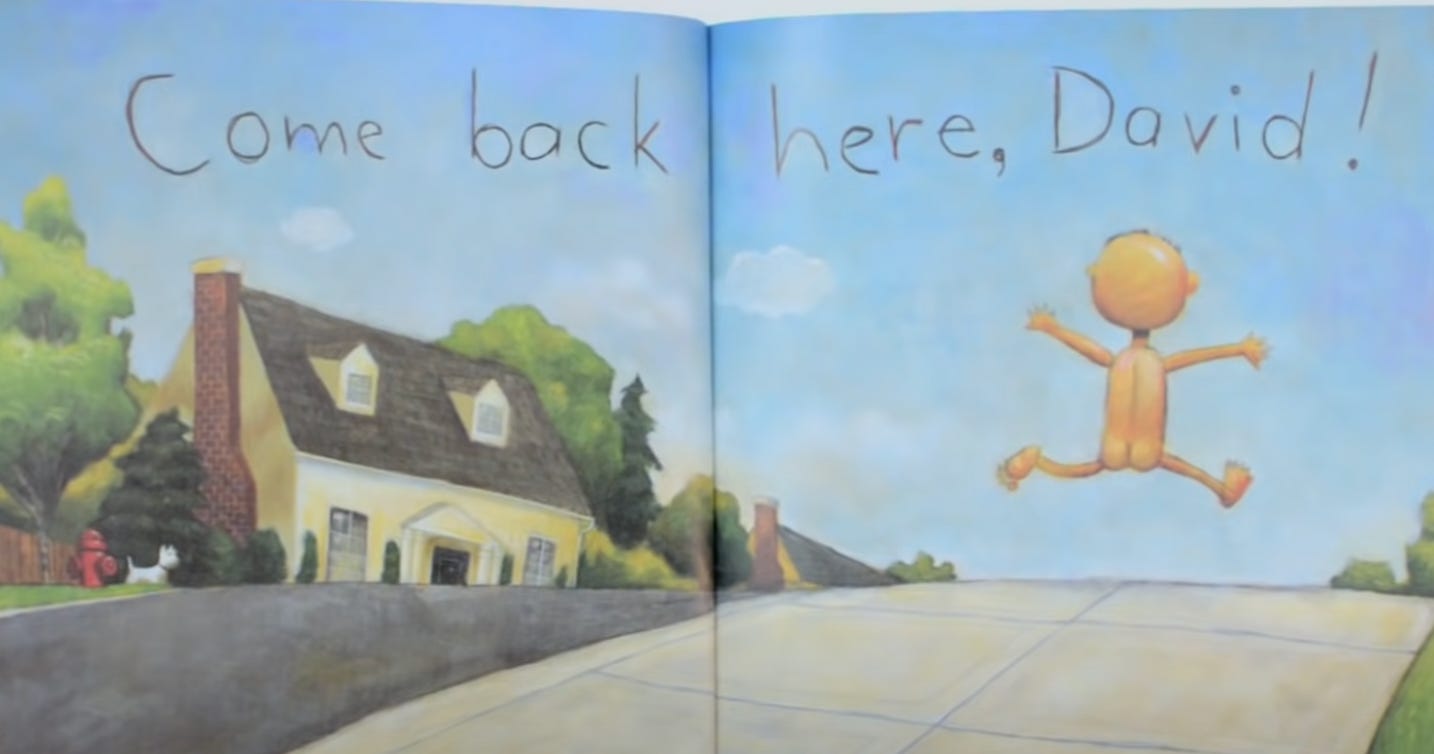
Also targeted was the book No, David! because it included this image.

Well, you simply can’t show Adam and Eve buck naked in the Garden of Eden, can you? Or can the author and illustrator of a children’s book show a boy’s butt.

It would be satisfying if the author or publisher of the targeted books sued the district for defacing them.

Greg Olear is a novelist and journalist. His blog is called “Prevail.” He is author of Dirty Rubles: An Introduction to Trump/Russia. When I was in high school, I memorized poetry. It’s a great gift. He posted this today.

Dear Reader,

Roland Flint, who taught my Introduction to Poetry class freshman year at Georgetown, gave us extra credit for memorizing poems. Back then, my now-beleaguered brain was still in top operating condition, and I loved poetry and admired the professor, so I took full advantage of this. Other, more pragmatic students chose the shortest poems they could find to memorize; to show off, and because it’s not un-useful to be familiar with 250-year-old rhyming-couplet pick-up lines, I went with “To His Coy Mistress.”

With his red beard and his paunch and the glimmer in his eye, Flint was a commanding presence, stocky and stout, and blessed with a booming baritone that he sometimes used to sing Bulgarian folk songs. (You can see him in action here.) To demonstrate what we’d have to do to earn points, he recited a poem that he himself knew by heart. It was called “Two-Headed Calf,” by Laura Gilpin, and it blew all of us away. I memorized it too, and when I’m in the right mood, I still recite it to myself, all four sentences of it, and marvel at its power to move me.

Polycephaly is a genetical blip that in bovines is a death sentence. Calves with two heads—or, more commonly, two faces—are usually stillborn. With extremely rare exceptions, two headed-calves that survive birth die in a matter of days, if not hours. Flint, who grew up on a farm in Nebraska, certainly knew more about this sort of thing than this child of the Jersey suburbs.

Here is Gilpin’s poem, which I have known by heart since 1991:

Two-Headed Calf

Tomorrow when the farm boys find this
freak of nature, they will wrap his body
in newspaper and carry him to the museum.

But tonight he is alive and in the north
field with his mother. It is a perfect
summer evening: the moon rising over
the orchard, the wind in the grass. And
as he stares into the sky, there are
twice as many stars as usual.

Three decades and change later, it still kills me every time.

Why does nature fate some of us to live long, healthy lives, while others suffer in sickness and infirmity? Is there larger purpose to this design, or is it just random probabilities—simple, brutal math?

Gilpin died young. She was a poet of acclaim—she won the Walt Whitman Award in 1976 for her first poetry collection, The Hocus-Pocus of the Universe—with degrees from Sarah Lawrence and Columbia, and taught in the city for a time. Later she became a registered nurse. She worked for Planetree, and was a tireless advocate for its patient-oriented care model. In the late summer of 2006, she was diagnosed with glioblastoma multiforme, an incurable brain cancer marked by terrible headaches, nausea, and (ironically, given that poem) double vision. She died half a year later, at age 56, right after finishing a second poetry collection, The Weight of a Soul.

After two Sundays in a row of breaking down heady novels, I intended this week to share something light, something simple and beautiful that did not require interpretation. For one thing, the news from the last seven days has been particularly bleak. For another, today is March 3—my father’s birthday. He would have been 76.

I considered writing about Roy Orbison, who my dad loved, but there was nothing I could think to say about The Big O that hadn’t already been better expressed by the likes of Bob Dylan and Bruce Springsteen. Then I remembered “Two-Headed Calf.” I hadn’t shared it previously because it is relatively recent. But as both of Gilpin’s books are currently out of print, my hope is that some attention paid to her work might convince a publisher to re-issue her collections.

As I read about Gilpin last night, I came upon her obituary, which contains a quote from one of her poems, “Life After Death,” that I’d never heard before. I tracked it down and read it. This poem, too, requires no interpretation, and seems especially appropriate for my father’s birthday. 

At the end of this ugly week, Dear Reader, I leave you with something beautiful:

Life After Death

These things I know:
How the living go on living
and how the dead go on living with them
so that in a forest
even a dead tree casts a shadow
and the leaves fall one by one
and the branches break in the wind
and the bark peels off slowly
and the trunk cracks
and the rain seeps in through the cracks
and the trunk falls to the ground
and the moss covers it
and in the spring the rabbits find it
and build their nest
inside the dead tree
so that nothing is wasted in nature
or in love.

When an education story is featured by a major media outlet like CNN, you can bet it’s captured mainstream attention.

Many educators have worried about the pernicious agenda of “Moms for Liberty,” which arrived on the scene in 2021 with a sizable war chest.

What is that agenda? Defaming public schools and their teachers. Accusing them of being “woke “ and indoctrinating students to accept left wing ideas about race and gender. Banning books they don’t like. Talking about “parental rights,” but only for straight white parents who share their values.

M4L got started in Florida, as do many wacky and bigoted rightwing campaigns, but it has been shamed recently by the sex scandal involving one of its co-founders, Brigitte Ziegler. The two other co-founders dropped her name from their website, but the stain persists.

CNN reports that this rightwing group is encountering stiff opposition from parents who don’t share their agenda and who don’t approve of book banning.

The story begins:

Viera, FloridaCNN —

In Florida, where the right-wing Moms for Liberty group was born in response to Covid-19 school closures and mask mandates, the first Brevard County School Board meeting of the new year considered whether two bestselling novels – “The Kite Runner” and “Slaughterhouse-Five” – should be banned from schools.

A lone Moms for Liberty supporter sat by herself at the January 23 meeting, where opponents of the book ban outnumbered her.

Nearly 20 speakers voiced opposition to removing the novels from school libraries. One compared the book-banning effort to Nazi Germany. Another accused Moms for Liberty of waging war on teachers. No one spoke in favor of the ban. About three hours into the meeting, the board voted quickly to keep the two books on the shelves of high schools.

RELATED ARTICLEOusted Florida GOP leader Christian Ziegler won’t be charged with sexual battery

“Why are we banning books?” asked Mindy McKenzie, a mom and nurse who is a member of Stop Moms for Liberty, which was formed to counter what it calls a far-right extremist group “pushing for book banning and destroying public education.”

“Why are we letting Moms for Liberty infiltrate our school system?”

Last May, I wrote about a punitive law in Texas that terrified the state’s 300 or so independent bookstores. The law, House Bill 900, required bookstores to rate every book they sold—now and in the past— to school libraries.

The bookstores sued to overturn to the law, arguing that the administrative burden of complying would put most of them out of business.

Their suit succeeded at the District Court level. Then it advanced to the very conservative Fifth Circuit Court of Appeals, and the plaintiffs were fearful. [A sign of the times: Back in the 1960s and 1970s, when the federal courts were constantly challenged to enforce the Brown decision of 1954, the Fifth Circuit was considered highly liberal in facing down segregationists.]

But to the delight of the booksellers, the Fifth Circuit sided with them.

The Texas Monthly reported:

The lawsuit, which was filed by Houston’s Blue Willow Bookshop and Austin-based BookPeople, along with a group of free speech organizations, argued that HB 900’s requirement essentially compelled the private businesses to engage in speech by requiring them to create a rating system for the materials they sold.

…the Fifth Circuit issued an uncommon ruling against the state, rejecting arguments from the Texas Education Agency—the suit’s lead defendant—that claimed that requiring booksellers to rate books was a mere administrative task. “This process is highly discretionary and is neither precise nor certain,” the court’s opinion read. “The statute requires vendors to undertake contextual analyses, weighing and balancing many factors to determine a rating for each book,” a process the opinion said was “anything but the mere disclosure of factual information.”

The plaintiffs had several issues with the law—tasking short-staffed booksellers with reading every single book any customer wanted to order would be an impossible task, for instance—but, according to Blue Willow owner Valerie Koehler, the real sticking point was being required by law to offer opinions on the contents of the books she sold. “I think common sense has prevailed,” she told Texas Monthly. “It’s not really up to the vendor to rate these books, where they’re compelling us to rate a book that they could then say, ‘No, that’s not a good rating.’ They were making us take a stand, and then were still in charge of whether our standards were right or not.”

The future of the law is still undecided—representatives from the office of the attorney general and the Texas Education Agency did not return requests for interviews—but the state would face an uphill battle with the Supreme Court after losing at the typically reliable Fifth Circuit. Koehler is accordingly optimistic—and reflective—about the struggle.

“We’ve never said, ‘We’re not going to carry that book because we don’t believe in it.’ We’ll carry it on our shelves if we think someone is going to come in and ask for it. That’s what we do as a business,” she said. “I didn’t take a stand against Greg Abbott; I took a stand as a business, for common sense, and my First Amendment rights as a bookseller.”

Governor Ron DeSantis claims that Florida isn’t banning books, which may be technically true, yet demonstrably false. Librarians and school district officials are removing books from school and classroom libraries to comply with state law, until the books have been screened for any offensive sexual or racial language.

PEN America reported that more than 1,600 books have been removed from circulation until they have received approval from school officials. The big joke in Escambia County is that a dictionary is in the Escambia list of books that possibly violate the law. Actually, five dictionaries!

But many other books are on Escambia’s list that have been read by generations of students.

Is it fair to say that such lists are censorship or banning? I say yes. What do you think?

PEN America posted this statement:

It has come to this: Escambia County, Florida, schools have banned the dictionary.

Five dictionaries are on the district’s list of more than 1,600 books banned pending investigation in December 2023, along with eight different encyclopedias, The Guinness Book of World Records, and Ripley’s Believe it or Not – all due to fears they violate the state’s new laws banning materials with “sexual conduct” from schools.

Biographies of Beyoncé, Lady Gaga, Oprah Winfrey, Nicki Minaj, and Thurgood Marshallare on the list, alongside The Autobiography of Malcolm X and Black Panther comics by Ta-Nehisi Coates. The Feminism Book was banned along with The Teen Vogue Handbook: An Insider’s Guide to Careers in Fashion.

The list obtained by the Florida Freedom to Read Project also includes Anne Frank’s Diary of a Young Girl, The Adventures and the Memoirs of Sherlock Holmes and Agatha Christie’s Death on the Nile. The Princess Diaries and 14 other books by Meg Cabot have been taken from libraries, alongside books by David Baldacci, Lee Child, Michael Crichton, Carl Hiassen, Jonathan Franzen, John Green, John Grisham, Stephen King (23 of them), Dean Koontz, Cormac McCarthy, Celeste Ng, James Patterson, Jodi Picoult,and Nicholas Sparks. Conservative pundit Bill O’Reilly’s two books, Killing Jesus and Killing Reagan, were also banned pending investigation.

PEN America, Penguin Random House, and a diverse group of authors joined with parents and students in Escambia County for a first of its kind federal lawsuit alleging that an earlier set of book bans and restrictions violate their rights to free speech and equal protection under the law. A hearing in the case is scheduled for Wednesday, Jan. 10.

If you open the link, you can see the list of banned books in Escambia County.

Here are a few that caught my eye:

Books of Greek and Roman myths

Baroque and Rococo Art

Five books by Maya Angelou

James Baldwin, Go Tell It on the Mountain

Emily Brontë, Wuthering Heights

Sixteen books by Meg Cabot

Albert Camus, The Stranger

Agatha Christie, Death on the Nile

Sandra Cisneros, The House on Mango Street

Multiple books about sexually transmitted diseases

Charles Dickens, A Tale of Two Cities

Charles Dickens, David Copperfield -Adapted for Young Readers

Ralph Ellison, Invisible Man

Five novels by William Faulkner

Gustave Flaubert, Madame Bovary

Gabriel Garcia Marquez, Love in the Time of Cholera and One Hundred Years of Solitude

William Golding, Lord of the Flies

I’m stopping here. You get the drift. Scan the rest of the list and see what you think.

Leslie Postal of the Orlando Sentinel reported the list of banned books.

Please scan the list and let me know which you think should never be banned. Are there any on the list that you think should not be in any 3-8 classroom? Any that should not be available in high school?

Here is a list of the 673 books removed from teachers’ classroom shelves in Orange County for fear they might violate state law and rules on “sexual conduct:” Some might be returned to shelves after further review.

“In the Belly of the Beast,” Jack Henry Abbott
“The Pool Was Empty,” Gilles Abier
“The Poet X,” Elizabeth Acevedo
“With the Fire on High,” Elizabeth Acevedo
“Call Me By Your Name,” Andre Aciman
“Things You Shouldn’t Say Past Midnight,” Peter Ackerman
“Half of a Yellow Sun,” Chimamanda Ngozi Adichie
“Changes,” Ama Ata Aidoo
“River of Darkness,” Rennie Airth
“Say You’re One of Them,” Uwem Akpan
“Simon Vs. The Homo Sapiens Agenda,” Becky Albertalli
“The Upside of Unrequited,” Becky Albertalli
“The Absolutely True Diary of a Part-Time Indian,” Sherman Alexie
“The House of the Spirits,” Isabel Allende
“In the Midst of Winter,” Isabel Allende
“The Blood of Flowers,” Anita Amirrezvani
“Wintergirls,” Laurie Halse Anderson
“Me and Earl and the Dying Girl,” Jesse Andrews
“The Haters,” Jesse Andrews
“I Know Why The Caged Bird Sings,” Maya Angelou
“Singin’ and Swingin’ and Gettin’ Merry Like Christmas,” Maya Angelou
“Lucy in the Sky,” Anonymous
“And Eternity,” Piers Anthony
“On a Pale Horse,” Piers Anthony
“Four Plays,” Aristophanes
“From Blood and Ash,” Jennifer L. Armentrout
“Storm and Fury,” Jennifer L. Armentrout
“City of the Lost,” Kelley Armstrong
“Mosquitoland,” David Arnold
“Damsel,” Elana K. Arnold
“Infandous,” Elana K. Arnold
“Red Hood,” Elana K. Arnold
“What Girls Are Made Of,” Elana K. Arnold
“Oryx and Crake,” Margaret Atwood
“The Handmaid’s Tale,” Margaret Atwood
“The Handmaid’s Tale: The Graphic Novel,” Margaret Atwood
“The Testaments,” Margaret Atwood
“Alias Grace,” Margaret Atwood
“Hag-Seed,” Margaret Atwood
“Madd Addam Trilogy,” Margaret Atwood
“The Blind Assassin,” Margaret Atwood
“The Clan of the Cave Bear,” Jean M. Auel
“The Clan of the Cave Bear, The Valley of Horses, The Mammoth Hunters
(Earth’s Children, #1-3),” Jean M. Auel
“The Tale of John Barleycorn: From Barley to Beer,” Mary Azarian
“My Friend Dahmer,” John “Derf” Backderf
“Six of Crows,” Leigh Bardugo
“Dance Nation,” Clare Barron
“Wise Young Fool,” Sean Beaudoin
“Herzog,” Saul Bellow
“The Color Master,” Aimee Bender
“The Seven Rays,” Jessica Bendinger
“Glimpse,” Stacey Wallace Benefiel
“The History Boys,” Alan Bennett
“Mr. Darcy Takes a Wife,” Linda Berdoll

“Best in Show,” Laurien Berenson
“Dark Eye,” William Bernhardt
“Friday Night Lights: A Town A Team And A Dream,” H.G. Bissinger
“Geektastic,” Holly Black
“Red Glove,” Holly Black
“I Was a Teenage Fairy,” Francesca Lia Block
“Sex on the Brain,” Deborah Blum
“Forever…,” Judy Blume
“Midwives: A Novel,” Chris Bohjalian
“Bronxwood,” Coe Booth
“The Best American Short Stories 2015,” T.C. Boyle
“The Road to Wellville,” T.C. Boyle
“The Darkest Minds,” Alexandra Bracken
“The Dark Garden,” Eden Bradley
“The Mists of Avalon,” Marion Zimmer Bradley
“Forever in Blue: The Fourth Summer of the Sisterhood,” Ann Brashares
“The Last Summer of You and Me,” Ann Brashares
“The Sisterhood of the Traveling Pants,” Ann Brashares
“Electric Girl,” Michael Brennan
“The Demon’s Surrender,” Sarah Rees Brennan
“Monkey Man,” Steve Brewer
“Over the Edge,” Suzanne Brockmann
“Candy,” Kevin Brooks
“Angels & Demons,” Dan Brown
“The Bridges of Madison County (musical),” Jason Robert Brown
“A Secret Splendor,” Sandra Brown
“Above and Beyond,” Sandra Brown
“In a Class by Itself,” Sandra Brown
“Lethal,” Sandra Brown
“Seduction by Design,” Sandra Brown
“Send No Flowers,” Sandra Brown
“Unspeakable,” Sandra Brown
“Doing It,” Melvin Burgess
“The Neon Rain,” James Lee Burke
“The Glister,” John Burnside
“Running with Scissors,” Augusten Burroughs
“Summer and the City,” Candace Bushnell
“The Carrie Diaries,” Candace Bushnell
“Kindred,” Octavia E. Butler
“Kindred: A Graphic Novel Adaptation,” Octavia E. Butler
“El Gigante Solitario,” Mary Cappellini
“Xenocide,” Orson Scott Card
“How Beautiful the Ordinary: Twelve Stories of Identity,” Michael Cart
“The Bloody Chamber and Other Stories,” Angela Carter
“Kisses From Hell,” Kristin Cast
“Chosen,” P.C. Cast
“Marked,” P.C. Cast
“The Big Sleep,” Raymond Chandler
“The Big Sleep; The High Window; The Lady in the Lake; The Long
Goodbye; Playback; Farewell, My Lovely,” Raymond Chandler
“Stories and Early Novels: Pulp Stories / The Big Sleep / Farewell My
Lovely / The High Window,” Raymond Chandler
“The Year of Living Awkwardly,” Emma Chastain
“Pieces,” Stephen Chbosky
“The Perks of Being a Wallflower,” Stephen Chbosky
“The Perks of Being a Wallflower YA edition,” Stephen Chbosky
“The Lady and the Unicorn,” Tracy Chevalier
“My Wicked Wicked Ways,” Sandra Cisneros
“The Tesla Testament,” Eugene Ciurana
“Chain Of Iron,” Cassandra Clare
“Chain Of Thorns,” Cassandra Clare
“Queen of Air and Darkness,” Cassandra Clare
“The Red Scrolls Of Magic,” Cassandra Clare
“Little Bee,” Chris Cleave
“The Girls,” Emma Cline
“Ready Player One,” Ernest Cline
“Scooter Girl,” Chynna Clugston-Flores
“Disgrace,” J.M. Coetzee
“Naomi and Ely’s No Kiss List,” Rachel Cohn
“Nick and Norah’s Infinite Playlist,” Rachel Cohn
“Finding Yvonne,” Brandy Colbert
“The Goats,” Brock Cole
“American Gangster,” Max Allan Collins
“Brules: A Novel,” Harry Combs
“The Lords of Discipline,” Pat Conroy
“Captain Marvel,” Gerry Conway
“Coma: A Novel,” Robin Cook
“Leviathan Wakes,” James S.A. Corey
“Heroes,” Robert Cormier
“Scarpetta,” Patricia Cornwell
“Three Complete Novels: Postmortem, Body Of Evidence, All That
Remains,” Patricia Cornwell
“Postmortem,” Patricia Cornwell
“Nearly Gone,” Elle Cosimano
“A Veil Removed,” Michelle Cox
“The Bondwoman’s Narrative,” Hannah Crafts
“First Semester,” Cecil R. Cross II
“Running Loose,” Chris Crutcher
“Balzac and the Little Chinese Seamstress,” Sijie Dai
“Esperanza Rising,” Julie Danneberg
“Cendrillon,” Luc Darbois
“Sir Apropos of Nothing,” Peter David
“The Westing Game,” Beatrice G. Davis
“Never Cry Werewolf,” Heather Davis
“Corelli’s Mandolin,” Louis de Bernieres
“Gates of Paradise,” Melissa de la Cruz
“Sunset Boulevard,” Zoey Dean
“Tall Cool One,” Zoey Dean
“American Beauty,” Zoey Dean
“The Feeling of Falling in Love,” Mason Deaver
“The Girl Before,” J.P. Delaney
“The Inheritance Of Loss,” Kiran Desai
“This Lullaby,” Sarah Dessen
“The Brief Wondrous Life of Oscar Wao,” Junot Díaz
“Blade Runner (do Androids Dream of Electric Sheep),” Philip K. Dick
“Don’t Get Caught,” Kurt Dinan
“Strangers She Knows,” Christina Dodd
“These Shallow Graves,” Jennifer Donnelly
“Room,” Emma Donoghue
“The Cases that Haunt Us,” John E. Douglas
“November Blues,” Sharon M. Draper
“Panic,” Sharon M. Draper
“House of Sand and Fog,” Andre Dubus III
“A Stolen Life: A Memoir,” Jaycee Dugard
“Submarine,” Joe Dunthorne
“Paso a Paso,” José Antonio Echeverria
“The Circle,” Dave Eggers
“Perfect Chemistry,” Simone Elkeles
“The Authority,” Warren Ellis
“Invisible Man,” Ralph Ellison
“The Gathering,” Anne Enright
“The Painter from Shanghai,” Jennifer Cody Epstein
“The Round House,” Louise Erdrich
“Sophomore Undercover,” Ben Esch
“Like Water For Chocolate,” Laura Esquivel
“Middlesex,” Jefferey Eugenides
“The Horse Whisperer,” Nicholas Evans
“Sleepless,” Thomas Fahy
“Ask the Dust,” John Fante
“Bad Days In History,” Michael Farquhar
“The Comedy Writer,” Peter Farrelly
“White Oleander,” Janet Fitch
“Madame Bovary,” Gustave Flaubert
“Dark Places,” Gillian Flynn
“Sharp Objects,” Gillian Flynn
“Separation of Power,” Vince Flynn
“Extremely Loud and Incredibly Close,” Jonathan Safran Foer
“The Carnival at Bray,” Jessie Ann Foley
“The Guest List,” Lucy Foley
“The Pillars of the Earth,” Ken Follett
“World Without End,” Ken Follett
“Come Back,” Claire Fontaine
“If I Stay,” Gayle Forman
“Just One Day,” Gayle Forman
“The Jane Austen Book Club,” Karen Fowler
“Joy Special of the Day,” Elaine Fox
“You Hear Me?,” Betsy Franco
“Palo Alto,” James Franco
“Dime,” E. R. Frank
“Cold Mountain,” Charles Frazier
“The Likeness,” Tana French
“Anansi Boys,” Neil Gaiman
“The House of Bernarda Alba,” Federico García Lorca
“Chronicle of a Death Foretold,” Gabriel García Márquez
“Love in the Time of Cholera,” Gabriel García Márquez
“Annie on My Mind,” Nancy Garden
“Killjoy,” Julie Garwood
“Eat, Pray, Love,” Elizabeth Gilbert
“Howl and Other Poems,” Allen Ginsberg
“Girl in Pieces,” Kathleen Glasgow
“Fat Kid Rules the World,” Kelly L. Going
“Bee Season,” Myla Goldberg
“Kenang-Kenangan Seorang Geisha (Memoirs of a Geisha),” Arthur Golden
“Memoirs of a Geisha,” Arthur Golden
“Sister Mischief,” Laura Goode
“A Reliable Wife,” Robert Goolrick
“Forever for a Year,” B.T. Gottfred
“The Handsome Girl & Her Beautiful Boy,” B.T. Gottfred
“The Nerdy and the Dirty,” B.T. Gottfred
“Tomorrow Girls,” Eva Gray
“An Abundance of Katherines,” John Green
“Looking for Alaska,” John Green
“Will,” John Grayson
“Paper Towns,” John Green
“Sex Plus: Learning, Loving and Enjoying Your Body,” Laci Green
“The Quiet American,” Graham Greene
“None Of The Above,” I.W. Gregorio
“Changeling,” Philippa Gregory
“The Other Boleyn Girl,” Philippa Gregory
“A Time to Kill,” John Grisham
“The Firm,” John Grisham
“John Grisham Value Collection: A Time to Kill, The Firm, The Client,”
John Grisham
“From Where I Watch You,” Shannon Grogan
“Water For Elephants,” Sara Gruen
“The Freedom Writers Diary,” Erin Gruwell
“Snow Falling On Cedars,” David Guterson
“A Map of the World,” Jane Hamilton
“We’ll Always Have Summer,” Jenny Han
“The World’s Strongest Librarian,” Joshua Hanagarne
“Fly Away,” Kristin Hannah
“The Art of Fielding,” Chad Harbach
“Jude the Obscure,” Thomas Hardy
“Chocolat,” Joanne Harris
“The Lollipop Shoes,” Joanne Harris
“The Silent Wife,” A.S.A. Harrison
“Plainsong,” Kent Haruf
“The Best 100 Poems of Gwen Harwood,” Gwen Harwood
“Necropolis,” Jordan L. Hawk
“Second Skin,” John Hawkes
“The Girl on the Train,” Paula Hawkins
“Catch-22,” Joseph Heller

“The Collected Plays,” Lillian Hellman
“Demian the Story of Emil Sinclairs Youth,” Hermann Hesse
“Demian. Die Geschichte von Emil Sinclairs Jugend.,” Hermann Hesse
“Siddhartha (Dual-Language),” Hermann Hesse
“Siddhartha: A Novel,” Hermann Hesse
“Skin Tight,” Carl Hiaasen
“The Island,” Elin Hilderbrand
“Rethinking Normal: A Memoir in Transition,” Katie Rain Hill
“Here Comes Santa Claus,” Sandra Hill
“Royal Assassin,” Robin Hobb
“The Dress Lodger,” Sheri Holman
“Watch Me,” A.J. Holt
“November 9,” Colleen Hoover
“Heart Bones,” Colleen Hoover
“Hopeless,” Colleen Hoover
“It Ends With Us,” Colleen Hoover
“It Starts With Us,” Colleen Hoover
“Layla,” Colleen Hoover
“Losing Hope,” Colleen Hoover
“Regretting You,” Colleen Hoover
“Verity,” Colleen Hoover
“Confess,” Colleen Hoover
“Ugly Love,” Colleen Hoover
“Impulse,” Ellen Hopkins
“Burned,” Ellen Hopkins
“Collateral,” Ellen Hopkins
“Crank,” Ellen Hopkins
“Fallout,” Ellen Hopkins
“Identical,” Ellen Hopkins
“Love Lies Beneath,” Ellen Hopkins
“People Kill People,” Ellen Hopkins
“Perfect,” Ellen Hopkins
“Tilt,” Ellen Hopkins
“Tricks,” Ellen Hopkins
“I Never,” Laura Hopper
“The Changeling,” Kate Horsley
“The Kite Runner,” Khaled Hosseini
“A Thousand Splendid Suns,” Khaled Hosseini
“Taken at Dusk,” C.C. Hunter
“Brave New World,” Aldous Huxley
“M Butterfly,” David Henry Hwang
“Icy Sparks,” Gwyn Hyman Rubio
“A Widow for One Year: A Novel,” John Irving
“The World According to Garp,” John Irving
“Never Let Me Go,” Kazuo Ishiguro
“Bit of a Blur,” Alex James
“Fifty Shades Series,” E.L. James
“Green River Killer: A True Detective Story,” Jeff Jensen
“No One to Trust,” Iris Johansen
“All Boys Aren’t Blue,” George M. Johnson
“Truly Devious 3-Book Box Set,” Maureen Johnson
“The Graduate,” Terry Johnson
“Choice Words,” Peter H. Johnston
“The Recognition of Sakuntala,” Arthur William Ryder Kalidasa
“Scent of Danger,” Andrea Kane
“Confessions of a Not It Girl,” Melissa Kantor
“The Big Bad Wolf Tells All,” Donna Kauffman
“Milk and Honey,” Rupi Kaur
“The Sun and Her Flowers,” Rupi Kaur
“Summer in the City of Roses,” Michelle Ruiz Keil
“Street Dreams,” Faye Kellerman
“Mr. Ding’s Chicken Feet,” Gillian Kendall
“The DUFF: Designated Ugly Fat Friend,” Kody Keplinger
“YOU: A Nove,” Caroline Kepnes
“On The Road,” Jack Kerouac
“The Book of Longings,” Sue Monk Kidd
“Four Past Midnight,” Stephen King
“Dolores Claiborne,” Stephen King
“Lisey’s Story,” Stephen King
“Night Shift,” Stephen King
“The Drawing of the Three,” Stephen King
“The Wastelands,” Stephen King
“Under the Dome,” Stephen King
“Prodigal Summer: A Novel,” Barbara Kingsolver
“Confessions of a Shopaholic,” Sophie Kinsella
“Shopaholic and Baby,” Sophie Kinsella
“Fear the Hunters,” Robert Kirkman
“Miles Behind Us,” Robert Kirkman
“Don’t Say a Word,” Andrew Klavan
“Primary Colors,” Joe Klein
“Sex, Drugs, and Cocoa Puffs,” Chuck Klosterman
“Gender Queer: A Memoir,” Maia Kobabe
“City of Night,” Dean Koontz
“Twilight Eyes,” Dean Koontz
“The Bear Went Over the Mountain,” William Kotzwinkle
“Born on the Fourth of July,” Ron Kovic
“The Pirate,” Jayne Ann Krentz
“The Poppy War,” R F. Kuang
“Dark Triumph,” Robin La Fevers
“Grave Mercy,” Robin La Fevers
“The Namesake,” Jhumpa Lahiri
“I Know This Much Is True,” Wally Lamb
“Search for Safety,” Paul Langan
“Survivor,” Paul Langan
“Liar,” Justine Larbalestier
“My Sister Rosa,” Justine Larbalestier
“The Splendid and the Vile,” Erik Larson
“Recipe Box,” Sandra Lee
“Furyborn,” Claire Legrand
“Mystic River,” Dennis Lehane
“The Grass Is Singing,” Doris Lessing
“Another Day,” David Levithan
“Dexter Is Delicious,” Jeff Lindsay
“Last Night at the Telegraph Club,” Malinda Lo
“The Dirt on Sex,” Justin Lookadoo
“Character, Driven,” David Lubar
“The Bourne Identity,” Robert Ludlum
“The Robert Ludlum Value Collection: The Bourne Identity, The Bourne
Supremacy, The Bourne Ultimatum,” Robert Ludlum
“Brave New Girl,” Louisa Luna
“Game,” Barry Lyga
“I Hunt Killers,” Barry Lyga
“Boy Toy,” Barry Lyga
“A Court of Frost and Starlight,” Sarah J. Maas
“A Court of Mist and Fury,” Sarah J. Maas
“A Court of of Wings and Ruin,” Sarah J. Maas
“A Court of Silver Flames,” Sarah J. Maas
“A Court of Wings and Ruin,” Sarah J. Maas
“House of Earth and Blood,” Sarah J. Maas
“A Court of Thorns and Roses,” Sarah J. Maas
“Fall on Your Knees,” Ann-Marie MacDonald
“Easter Rising,” Michael Patrick MacDonald
“Guyaholic,” Carolyn Mackler
“The Hike,” Drew Magary
“Son of a Witch,” Gregor Maguire
“Wicked: The Life and Times of the Wicked Witch of the West,” Gregory Maguire
“Wicked: Memorias de una bruja mala,” Gregory Maguire
“The Natural,” Bernard Malamud
“Nectar in a Sieve,” Kamala Markandaya
“Slightly Single,” Wendy Markham
“Blue is the Warmest Color,” Jul Maroh
“A Game of Thrones,” George R.R. Martin
“A Dance with Dragons,” George R.R. Martin
“A Feast for Crows,” George R.R. Martin
“A Storm of Swords,” George R.R. Martin
“The Mystery Knight,” George R.R. Martin
“The Official A Game of Thrones Coloring Book,” George R.R. Martin
“A Clash of Kings,” George R.R. Martin
“Jackie “The Joke Man” Martling’s Disgustingly Dirty Joke Book,” Jackie Martling
“Paper Dollhouse,” Lisa M. Masterson
“Strange Intimacy,” Anne Mather
“Amy & Roger’s Epic Detour,” Morgan Matson
“The Secret Diary of Anne Boleyn,” Robin Maxwell
“The Good Lord Bird,” James McBride
“Perfect Fifths,” Megan McCafferty
“Second Helpings,” Megan McCafferty
“Freedom’s Choice,” Anne McCaffrey
“All the Pretty Horses,” Cormac McCarthy
“No Country for Old Men,” Cormac McCarthy
“Outer Dark,” Cormac McCarthy
“Man o’ War,” Cory McCarthy
“Sold,” Patricia McCormick
“The Revolution of Little Girls,” Blanche McCrary Boyd
“The Beauty Queen of Leenane,” Martin McDonagh
“Sophomore Switch,” Abby McDonald
“Amsterdam,” Ian McEwan
“Atonement,” Ian McEwan
“On Chesil Beach,” Ian McEwan
“Duquesa by Default,” Maura McGiveny
“Beautiful Disaster,” Jamie McGuire
“The Memory of Running,” Ron McLarty
“Lonesome Dove,” Larry McMurtry
“Everything You Want Me to Be,” Mindy Mejia
“Talking in the Dark,” Billy Merrell
“Life and Death: Twilight Reimagined,” Stephenie Meyer
“Pretty Woman,” Fern Michaels
“The Real Deal,” Fern Michaels
“The Authority,” Mark Millar
“Circe,” Madeline Miller
“The Song of Achilles: A Novel,” Madeline Miller
“Paradise Lost and Paradise Regained (The Signet Classic Poetry
Series),” John Milton
“Paradise Lost,” John Milton
“Let’s Talk About It: The Teen’s Guide to Sex, Relationships, and
Being a Human (A Graphic Novel),” Erika Moen
“All My Friends Are Dead,” Avery Monsen
“Watchmen,” Alan Moore
“Camp Confidential,” Melissa J. Morgan
“The Year of Secret Assignments,” Jaclyn Moriarty
“The Center of Everything,” Laura Moriarty
“Seikai 1,” Hiroyuki Morioka
“The Bluest Eye,” Toni Morrison
“Beloved,” Toni Morrison
“Paradise,” Toni Morrison
“Song of Solomon,” Toni Morrison
“Kafka on the Shore,” Haruki Murakami
“Heart of Stone,” C.E. Murphy
“Dead End,” Jason Myers
“Street Love,” Walter Dean Myers
“Peace, Love, and Baby Ducks,” Lauren Myracle
“Rhymes with Witches,” Lauren Myracle
“Shine,” Lauren Myracle
“L8R G8R,” Lauren Myracle
“The Infinite Moment of Us,” Lauren Myracle
“ttfn,” Lauren Myracle
“TTYL,” Lauren Myracle
“yolo,” Lauren Myracle
“The Art of Hana-Kimi,” Hisaya Nakajo
“Skin,” Donna Jo Napoli
“Linden Hills,” Gloria Naylor
“The Men of Brewster Place,” Gloria Naylor
“The Women of Brewster Place,” Gloria Naylor
“Like a Love Story,” Abdi Nazemian
“Getting Somewhere,” Beth Neff
“On the Volcano,” James Nelson
“Suite Francaise,” Irene Nemirovsky
“The Sympathizer,” Viet Thanh Nguyen
“We Are All Made of Molecules,” Susin Nielsen-Fernlund
“Holding Up the Universe,” Jennifer Niven
“Breathless,” Jennifer Niven
“Everlasting,” Alyson Noël
“Evermore,” Alyson Noël
“Night Star,” Alyson Noël
“Where I end and You Begin,” Preston Norton
“Sweat,” Lynn Nottage
“Plague in the Mirror,” Deborah Noyes
“Back Roads,” Tawni O’Dell
“Beasts,” Joyce Carol Oates
“The Assignation: Stories,” Joyce Carol Oates
“We Were the Mulvaneys,” Joyce Carol Oates
“Panic,” Lauren Oliver
“Before I Fall,” Lauren Oliver
“When the Emperor was Divine,” Julie Otsuka
“Ars Amatoria,” Ovid
“Metamorphoses,” Ovid
“Where the Crawdads Sing,” Delia Owens
“Choke,” Chuck Palahniuk
“Invisible Monsters Remix,” Chuck Palahniuk
“Lullaby,” Chuck Palahniuk
“In Order to Live,” Yeonmi Park
“The Dogs of Babel,” Carolyn Parkhurst
“Learning Tree,” Gordon Parks
“Bel Canto,” Ann Patchett
“The Patron Saint of Liars,” Ann Patchett
“Honeymoon,” James Patterson
“Private,” James Patterson
“Sail,” James Patterson
“Sam’s Letters to Jennifer,” James Patterson
“Sideways,” Alexander Payne
“A Day No Pigs Would Die,” Robert Newton Peck
“The Leftovers,” Tom Perrotta
“Out Stealing Horses,” Per Petterson
“Prague,” Arthur Phillips
“Fishtailing,” Wendy Phillips
“A Spark of Light,” Jodi Picoult
“Handle with Care,” Jodi Picoult
“Picture Perfect,” Jodi Picoult
“The Pact: A Love Story,” Jodi Picoult
“The Storyteller,” Jodi Picoult
“The Tenth Circle,” Jodi Picoult
“Nineteen Minutes,” Jodi Picoult
“A Year and a Day,” Leslie Pietrzyk
“Thirst No. 1,” Christopher Pike
“Thirst No. 2,” Christopher Pike
“Thirst No. 4,” Christopher Pike
“Thirst No. 5,” Christopher Pike
“Into White,” Randi Pink
“It Doesn’t Have to Be Awkward: Dealing with Relationships, Consent,
and Other Hard-to-Talk-About Stuff,” Drew Pinsky
“Yes Please,” Amy Poehler
“Tinisima,” Elena Poniatowska
“Behind the Shadows,” Patricia Potter
“The Whistling Toilets,” Randy Powell
“The Cabin,” Natasha Preston
“The Cellar,” Natasha Preston
“Caves Graves,” Natalie Prior
“Jane Swann’s Way,” Marcel Proust
“La Belle Sauvage,” Philip Pullman
“Burning Glass,” Kathryn Purdie
“The Family,” Mario Puzo
“Gabi, a Girl in Pieces,” Isabel Quintero
“The Elegant Gathering of White Snows,” Kris Radish
“The Fountainhead,” Ayn Rand
“Modern Love,” Andrew Rannells
“Punkzilla,” Adam Rapp
“Beautiful,” Amy Reed
“The Cute Girl Network,” M.K. Reed
“Such a Fun Age,” Kiley Reid
“The Seven Husbands of Evelyn Hugo,” Taylor Jenkins Reid
“Stop in the Name of Pants!,” Louise Rennison
“Stone Fox,” John Reynolder
“Wide Sargasso Sea,” Jean Rhys
“The Vampire Armand,” Anne Rice
“The Witching Hour,” Anne Rice
“Life,” Keith Richards
“Juliet Takes a Breath,” Gabby Rivera
“Redeeming Love,” Francine Rivers
“The Atonement Child,” Francine Rivers
“Gulp: Adventures on the Alimentary Canal,” Mary Roach
“Birthright,” Nora Roberts
“The True and Outstanding Adventures of the Hunt Sisters,” Elisabeth Robinson
“Normal People,” Sally Rooney
“Jack of Hearts (and other parts),” L.C. Rosen
“Portnoy’s Complaint,” Philip Roth
“The Casual Vacancy,” J.K. Rowling
“The God of Small Things,” Arundhati Roy
“All of Us with Wings,” Michelle Ruiz Keil
“Elegies for Angels Punks and Raging Queens,” Bill Russell
“The Dead-Tossed Waves,” Carrie Ryan
“Leviathan Wakes,” James S.A. Corey
“And They Lived …,” Steven Salvatore
“Bait,” Alex Sanchez
“Once a King, Always a King,” Reymundo Sanchez
“Option B,” Sheryl Sandberg
“The Fool’s Run,” John Sandford
“Vampire, Interupted,” Lynsay Sands
“Push,” Sapphire
“Blindness,” José Saramago
“Jesus Land: A Memoir,” Julia Scheeres
“Uses for Boys,” Erica Lorraine Scheidt
“The Reader,” Bernard Schlink
“The Beginning of Everything,” Robyn Schneider
“Bully,” Jim Schutze
“The Invisible Life of Addie La Rue,” V.E. Schwab
“The Gift of Forgiveness,” Katherine Schwarzenegger Pratt
“Living Dead Girl: A Novel,” Elizabeth Scott
“Lucky,” Alice Sebold
“The Lovely Bones,” Alice Sebold
“Naked,” David Sedaris
“Peony in Love,” Lisa See
“Writing My Wrongs,” Shaka Senghor
“Equus,” Peter Shaffer
“Skin and Bones,” Sherry Shahan
“Demon Apocalypse,” Darren Shan
“Forbidden Knowledge,” Roger Shattuck
“Tweak,” Nic Sheff
“The Stone Diaries,” Carol Shields
“Sea Glass: A Novel,” Anita Shreve
“Alichino,” Kouyu Shurei
“The Food Chain,” Nicky Silver
“If I Was Your Girl,” Ni-Ni Simone
“Wilder,” Andrew Simonet
“The Straight Girl’s Guide to Sleeping with Chicks,” Jen Sincero
“The Silence and the Roar,” Nihad Sirees
“The Primal Blueprint,” Mark Sisson
“Prep: A Novel,” Curtis Sittenfeld
“You Think It, I’ll Say It,” Curtis Sittenfeld
“Stay In Line,” Teddy Slaterguess
“A Thousand Acres,” Jane Smiley
“The Way I used to Be,” Amber Smith
“Joy in the Morning,” Betty Smith
“Tree Grows In Brooklyn,” Betty Smith
“The Geography of Girlhood,” Kirsten Smith
“Betwixt,” Tara Bray Smith
“Anatomy of a Boyfriend,” Daria Snadowsky
“Sadar’s Keep,” Midori Snyder
“No Visible Bruises,” Rachel Louise Snyder
“MARS,” Fuyumi Soryo
“Summer on Wheels,” Gary Soto
“The Prime of Miss Jean Brodie,” Muriel Spark
“It Happened to Nancy,” Beatrice Sparks
“At First Sight,” Nicholas Sparks
“Message in a Bottle,” Nicholas Sparks
“Nights in Rodanthe,” Nicholas Sparks
“The Guardian,” Nicholas Sparks
“The Rescue,” Nicholas Sparks
“The Wedding,” Nicholas Sparks
“Small Town Girl,” Lavyrle Spencer
“Everyone likes Eggs,” Jerry Spinelli
“Star (French Edition),” Danielle Steel
“The Gift,” Danielle Steel
“East of Eden,” John Steinbeck
“Still Missing,” Chevy Stevens
“Earth (the book) A Visitors Guide to the Human Race,” Jon Stewart
“Every Last Word,” Tamara Ireland Stone
“Marcelo in the Real World,” Francisco X. Stork
“Until the Twelfth of Never,” Bella Stumbo
“Sophie’s Choice,” William Styron
“We Should Hang Out Sometime,” Josh Sundquist
“The Kitchen God’s Wife,” Amy Tan
“The Valley of Amazement,” Amy Tan
“American Colonies,” Alan Taylor
“Just Friends,” Billy Taylor
“The Spectacular Now,” Tim Tharp
“Concrete Rose,” Angie Thomas
“The Loners,” Lex Thomas
“Picking Cotton,” Jennifer Thompson-Cannino
“Blankets,” Craig Thompson
“First Time,” Meg Tilly
“Sigh, Gone,” Phuc Tran
“Milk Glass Moon,” Adriana Trigiani
“Stuck in Neutral,” Terry Trueman
“The RattleRat,” Janwillem Van de Wetering
“Red Thunder,” John Varley
“Sia Martinez and the Moonlit Beginning of Everything,” Raquel Vasquez Gilliland
“Y: The Last Man,” Brian K. Vaughan
“When We Make It,” Elisabet Velasquez
“The Covenant of Water,” Abraham Verghese
“Shojo Beat,” Viz Media
“Dicey’s Song,” Cynthia Voight
“All I Want is Everything,” Cecily Von Ziegesar
“Don’t You Forget about Me,” Cecily Von Ziegesar
“Tempted,” Cecily Von Ziegesar
“You Know You Love Me,” Cecily Von Ziegesar
“It Had To Be You,” Cecily Von Ziegesar
“Slaughterhouse-Five,” Kurt Vonnegut Jr.
“Slaughterhouse-Five: The Graphic Novel,” Kurt Vonnegut Jr.
“The Color Purple,” Alice Walker
“Black White and Jewish,” Rebecca Walker
“We All Looked Up,” Tommy Wallach
“A Thousand Country Roads: An Epilogue to The Bridges of Madison
County,” Robert James Waller
“The Bridges of Madison County,” Robert James Waller
“The Glass Castle,” Jeannette Walls
“Stargazing,” Jen Wang
“Salvage the Bones,” Jesmyn Ward
“Numbers,” Rachel Ward
“Something Worth Saving,” Sandi Ward
“The Graduate,” Charles Webb
“Girl Boy Etc,” Michael Weinreb
“Chasing Harry Winston,” Lauren Weisberger
“Little Altars Everywhere: A Novel,” Rebecca Wells
“A Certain Slant of Light,” Laura Whitcomb
“The Professor and the Madman,” Simon Winchester
“Happiness Sold Separately,” Lolly Winston
“A Man in Full,” Tom Wolfe
“The Interestings,” Meg Wolitzer
“Turkish Delight,” Jan Wolkers
“Brighter than Gold,” Cynthia Wright
“Native Son,” Richard Wright
“Blu’s Hanging,” Lois-Ann Yamanaka
“Revolutionary Road,” Richard Yates
“Armageddon Summer,” Jane Yolen
“The Sun Is Also a Star,” Nicola Yoon
“Everything, Everything,” Nicola Yoon
“Nothing But Your Ski,” Cathy Ytak

Compiled by staff writer Richard Tribou. Source: List obtained by the Florida Freedom to Read Project and confirmed by Orange County Public Schools.

Leslie Postal of the Orlando Sentinel reported the banned books list in Orange County. I haven’t read most of them, but several of the banned books that I had read were very surprising to me.

The next post will identify all the books on the list.

Postal wrote:

A total of 673 books, from classics to best-sellers, have been removed from Orange County classrooms this year for fear they violate new state rules that ban making “sexual conduct” available to public school students.

The list of rejected books, which the district began compiling during the summer, will get another review from Orange County Public Schools staff, so some could eventually be put back on shelves. But for now, teachers who had them in their classrooms have been told to take them home or put them away so students cannot access them.

The books run the gamut, from John Milton’s 17th-century epic poem “Paradise Lost” to John Grisham’s 1991 New York Times bestseller “The Firm.” John Steinbeck’s “East of Eden” and John Irving’s “The World According to Garp” made the list, too.

The list also includes popular novels by Stephen King, Sue Monk Kidd and Jodi Picoult, classics like “A Tree Grows in Brooklyn,” “Jude the Obscure,” and “Madame Bovary,” and award-winning books like “A Thousand Acres,” “Beloved,” and “Love in the Time of Cholera.”

The books that surprised me most were:

PARADISE LOST

A TREE GROWS IN BROOKLYN

MADAME BOVARY

BRAVE NEW WORLD

Do you think teenagers will rush to read Milton’s Paradise Lost or Flaubert’s Madame Bovary now that they are banned?

The next post will have the full list.

Writing in the Washington Spectator, veteran voucher researcher Josh Cowen reports that 2023 was a good year for some very bad ideas, many supported by prominent rightwingers and Dark Money, whose sources are hidden.

He finds it unsurprising that the voucher movement works closely with book banners and efforts to humiliate LGBT youth.

Cowen is a professor of education policy at Michigan State University who has studied vouchers since 2005.

He writes:

Over the past 12 months, the decades-long push to divert tax dollars toward religious education has reached new heights. As proclaimed by EdChoice—the advocacy group devoted to school vouchers—2023 has been the year these schemes reached “escape velocity.” In strictly legislative terms, seven states passed new voucher systems, and ten more expanded existing versions. Eleven states now run universal vouchers, which have no meaningful income or other restrictions.

But these numbers change quickly. As late as the last week of November, the Republican governor of Tennessee announced plans to create just such a universal voucher system.

To wit: successful new voucher and related legislation has come almost exclusively in states won by Donald Trump in 2020. And even that Right-ward bent required substantial investment—notably by heiress and former U.S. Education Secretary Betsy DeVos and the Koch network—in state legislative campaigns to oust voucher opponents. Instructively, many of those opponents were often GOP legislators representing rural districts with few private schools to benefit.

As a scholar who has studied voucher systems—including through research funded by conservative organizations—I have been watching these developments with growing concern. It can all be difficult to make sense of, so let’s walk through it.

Vouchers Hurt Kids, Defund Public Schools and Prop-Up Church Budgets

First, why are these new voucher schemes such bad public policy? To understand the answer, it’s important to know that the typical voucher-accepting school is a far cry from the kind of elite private academy you might find in a coastal city or wealthy suburban outpost. Instead, they’re usually sub-prime providers, akin to predatory lenders in the mortgage sector. These schools are either pop-ups opening to cash in on the new taxpayer subsidy, or financially distressed existing schools desperate for a bailout to stay open. Both types of financially insecure schools often close anyway, creating turnover for children who were once enrolled.

And the voucher results reflect that educational vulnerability: in terms of academic impacts, vouchers have some of the worst results in the history of education research—on par or worse than what COVID-19 did to test scores.

Those results are bad enough, but the real issue today is that they come at a cost of funding traditional public schools. As voucher systems expand, they cannibalize states’ ability to pay for their public education commitments. Arizona, which passed universal vouchers in 2022, is nearing a genuine budget crisis as a result of voucher over-spending. Six of the last seven states to pass vouchers have had to slow spending on public schools relative to investments made by non-voucher states.

That’s because most new voucher users were never in the public schools—they are new financial obligations for states. The vast majority of new voucher beneficiaries have been students who were already in private school beforehand. And for many rural students who live far from the nearest private school, vouchers are unrealistic in the first place, meaning that when states cut spending on public education, they weaken the only educational lifeline available to poorer and more remote communities in some places. That’s why even many GOP legislators representing rural districts—conservative in every other way—continue to fight against vouchers.

Vouchers do, however, benefit churches and church schools. Right-wing advocacy groups have been busy mobilizing Catholic school and other religious school parents to save their schools with new voucher funding. In new voucher states, conservatives are openly advocating for churches to startup taxpayer-funded schools. That’s why vouchers eventually become a key source of revenue for those churches, often replacing the need to rely on private donations. It’s also why many existing religious schools raise tuition almost immediately after vouchers pass.

The Right-Wing War on Public Schools

Victories for these voucher bills is nothing short of an ascendent Right-wing war on public education. And the link to religious nationalism energizes much of that attack.

Voucher bills have dovetailed almost perfectly with new victories for other priorities of the Religious Right. Alongside vouchers, anti-LGBTQ+ legislation has also increased: 508 new bills in 2023 alone, according to the American Civil Liberties Union. As has a jump in legislation restricting book access in schools and libraries, with more than half of those bans targeting books on topics related to race and racism, or containing at least one LGBTQ+ character.

It is also important to note the longstanding antipathy that Betsy DeVos, the Koch Network, and other long-term voucher backers have toward organized labor—including and especially in this case, teachers’ unions. And that in two states that passed vouchers this year—Iowa and Arkansas—the governors also signed new rollbacks to child labor protections at almost the exact same time as well.

To close the 2022 judicial session, the Supreme Court issued its latest expansion of voucher jurisprudence in Carson v. Makin, holding that states with private school voucher programs may not exclude religious providers from applying tax dollars specifically to religious education. That ruling came just 72 hours before the Court’s decision in Dobbs v. Jackson removed reproductive rights from federal constitutional protections.

To hear backers of vouchers, book bans, and policies targeting transgender students in school bathrooms tell it, such efforts represent a new movement toward so-called “parents’ rights” or “education freedom,” as Betsy DeVos describes in her 2022 memoir. But in truth this latest push was a long time coming. DeVos is only one part of the vast network of Right-wing donors, activists, and organizations devoted to conservative political activism.

That network, called the Council for National Policy, includes representatives from the Heritage Foundation, the influential Right-wing policy outfit; multiple organizations funded by Charles Koch; the Leadership Institute, which trains young conservative activists; and a number of state policy advocacy groups funded by a conservative philanthropy called the Lynde and Harry Bradley Foundation.

It was the Bradley Foundation that seeded much of the legal work in the 1990s defending early voucher programs in state and federal courts. Bradley helped to fund the Institute for Justice, a legal group co-founded by a former Clarence Thomas staffer named Clint Bolick after a personal donation from Charles Koch. The lead trial attorney for that work was none other than Kenneth Starr, who was at the time also in the middle of his infamous pursuit of President Bill Clinton.

In late 2023, the Institute for Justice and the voucher-group EdChoice announced a new formal venture, but that partnership is just a spin on an older collaboration, with the Bradley Foundation as the tie that binds. EdChoice itself, when it was called the Milton and Rose D. Friedman Foundation, helped fund the data analysis cited by Institute lawyers at no less than the Supreme Court ahead of its first decision approving vouchers in Zelman v. Simmons-Harris (2002).

From these vantage points, 2023 was a long time coming indeed.

And heading into 2024, the voucher push and its companion “parents’ rights” bills on schoolbooks and school bathrooms show no sign of weakening.

Prior to his political career, the new Speaker of the U.S. House of Representatives, Mike Johnson, was an attorney with the Alliance Defending Freedom. That group, which itself has deep ties to Betsy DeVos’s family, has led the legal charge to rollback LBGTQ+ equality initiatives. It was also involved “from the beginning,” as its website crows, in the anti-abortion effort that culminated with Dobbs.

The Heritage Foundation has created a platform called Project 2025, which serves as something of a clearinghouse for what would be the legal framework and policy agenda for a second Trump Administration. Among the advisors and funders of Project 2025 are several organizations linked to Charles Koch, Betsy DeVos, and others with ties to the Council for National Policy. The Project’s education agenda includes dismantling the U.S. Department of Education—especially its oversight authority on anti-discrimination issues—and jumpstarting federal support for voucher programs.

A dark money group called The Concord Fund has launched an entity called Free to Learn, ostensibly organized around opposition to the teaching of critical race theory in public schools. In reality, these are active players in Republican campaign attacks around a variety of education-related culture war issues. The Concord Fund is closely tied to Leonard Leo, the Federalist Society chief, Council of National Policy member, and architect of the Roe takedown. Through the Leo connection, the Concord Fund was also instrumental in confirming Donald Trump’s judicial nominations from Brett Kavanaugh on downward.

And so while the 2023 “parents’ rights” success has been largely a feature of red state legislatures, the 2022 Carson ruling and the nexus between Leonard Leo, the Alliance Defending Freedom, and the Institute for Justice itself underscore the importance of the federal judiciary to Right-wing education activism.

Long-term, the goal insofar as school privatization is concerned appears to be nothing short of a Supreme Court ruling that tax-subsidized school vouchers and homeschool options are mandatory in every state that uses public funding (as all do) to support education. The logic would be, as Betsy DeVos herself previewed before leaving office, that public spending on public schools without a religious option is a violation of Free Exercise protections.

Such a ruling, in other words, would complete the destruction of a wall between church and state when it comes to voucher jurisprudence. Earlier Court decisions have found that states may spend tax dollars on school vouchers but, as the Right’s ultimate goal, the Supreme Court would determine that states must.

Closer on the horizon, we can expect to see each of these Right-wing groups acting with new energy as the 2024 campaign season heats up. The president of the Heritage Foundation—himself yet another member of the Council for National Policy—has recently taken over the think tank’s political arm, called Heritage Action. At the start of the year, investigative reporting linked Heritage Action to earlier voter suppression initiatives, signaling potential tactics ahead.

And the money is going to flow—they have all said as much. After Heritage’s merger of its policy and political arms, Betsy DeVos’s American Federation for Children followed suit by creating the AFC Victory Fund—a new group to spearhead its own campaign activity.

Their plan includes a $10 million base commitment to ramp up heading into 2024. “Coming off our best election cycle ever,” AFC’s announcement declared, “the tectonic plates have shifted decisively in favor of educational freedom, and we’re just getting started.” And, they warned:

“If you’re a candidate or lawmaker who opposes school choice and freedom in education – you’re a target.”

In that threat lies the reality of the latest voucher push, and of this moment of so-called parents’ rights. None of this is a grassroots uprising. “Education freedom” is a top-down, big-money operation, tied to every other political priority of religious nationalism today.

But coming at the end of this past year’s legislative successes, AFC’s warnings are also a very clear statement of what is yet to come. The push to privatize American education is only just getting started.

Vouchers have turned into a campaign to subsidize the tuition of affluent parents while cutting the funding of public schools. This does not augur well for the health and future of our nation.