Archives for category: Justice

William S. Becker is a former U.S. Department of Energy central regional director who administered energy efficiency and renewable energy technologies programs. He is executive director of the Presidential Climate Action Project, a nonpartisan initiative founded in 2007 to develop action plans for facing the climate crisis.

In this post, he proposes ways to restore the integrity of the U.S. Supreme Court.

The U.S. Supreme Court is the ultimate authority on the Constitution and the nation’s laws. But who judges the justices when they violate the public trust? 

It’s not a hypothetical question. In recent decisions and revelations, the current court has shown it is co-opted by right-wing ideology and corrupted by a certain ex-president trying to escape justice on more than 90 felony charges

So, who ultimately judges the justices?  

As usual, the answer is voters. Our Supreme Court must abide by higher standards for objectivity and fairness than any other government institution. Yet public respect for the court has been declining for years.  

Earlier this month, a Politico poll found that a big majority of Americans want Donald Trump to stand trial before the November election. A third said his conviction would make a difference in how they vote, but 75 percent don’t fully trust the Supreme Court to be fair and nonpartisan.   

Unfortunately, voters have no direct authority to restore the court’s integrity. The people’s recourse is to elect a Congress willing to force the court to reform. The next opportunity is Nov. 5. 

So, what are the several ways the Roberts Court has undermined public trust?  

Until recently, it refused to subscribe to the ethics standards set for other members of the federal judiciary. Even after the news media found at least two members engaged in apparent conflicts of interest, the justices hesitated for months before adopting an ethics code. It turned out to be neither binding nor enforceable

Second, the court has abandoned the standard of judging without fear or favor. Its conservative majority has bent over backward to protect Trump from accountability for his role in the Jan. 6, 2021, insurrection. The justices even agreed to hear Trump’s specious claim that he enjoys total immunity for his alleged crimes. It delayed oral arguments until next April, making it unlikely Trump’s trial will occur before the election

In another case, the justices decided to protect Trump by rewriting the Constitution rather than enforcing it.  

The 14th Amendment disqualifies people from public office if they swear to support the Constitution, then aid an insurrection. It says oath-swearing insurrectionists can escape disqualification only with a two-thirds vote of the House and Senate. The court’s conservatives gave Congress a new role, saying no insurrectionist can be sanctioned unless Congress says so, apparently on a case-by-case basis. So, a highly partisan body, rather than the Constitution, will make these decisions. 

Third, the justices disregard “settled laws” decided by and repeatedly affirmed by previous courts. The most egregious example was its reversal of Roe v. Wade. Now, state politicians decide whether women have the right to make their own reproductive decisions. The court also gutted the landmark Voting Rights Act of 1965, reasoning, perhaps naively, that racism is no longer a problem in the South. 

Fourth, the court opened the floodgates for corporations to make unlimited anonymous monetary contributions to political campaigns. The majority reasoned unrealistically that campaign contributions don’t influence how members of Congress vote. It also stretched credulity by ruling that money is speech and corporations are people. As a result, corporations and wealthy Americans gained even more power to shape the nation’s laws to their benefit

So, Supreme Court reform should be a top objective for voters this year. That requires a Congress committed to the goal. In a previous article, I pointed out that Congress has the necessary powers. Democrats (ideally joined by moderate Republicans and independents) should promise to use them if voters give them a trifecta: control of the White House, House, and Senate.  

Congress could: 

  • Allow President Biden to create better ideological balance on the court by adding four new justicesduring his second term; 
  • Establish by rule that the Senate’s duty in confirming Supreme Court nominees includes maintaining ideological balance on the court. The rule also should require that the Senate act on presidential appointments to the court regardless of their proximity to elections
  • Require the Judicial Conference of the United States to create and enforce a strict code of ethics for justices, including mandatory disclosure of potential and apparent conflicts of interest. The code should require justices to recuse themselves from cases where real or apparent conflicts exist; 
  • Establish term limits of 18 years for justices and require them to retire at or before age 70. This would bring the Supreme Court in line with the District of Columbia and 32 states that have set mandatory retirement ages for appellate court judges; 
  • Send President Biden legislation to restore Roe v. Wade and a strong Voting Rights Act as the laws of the land; 
  • Pass legislation to strengthen the Federal Elections Commission, end gerrymandering and voter suppression, and eliminate unlimited and anonymous campaign contributions.  
  • By statute or proposed constitutional amendment, clarify that the president of the United States a) does not have absolute immunity for violating laws, b) can be prosecuted while in office, and c) can be permanently disqualified from public office under Section 3 of the 14th Amendment without an act of Congress. 
  • Under Article III of the Constitution, strip federal appellate courts including the Supreme Court of jurisdiction over certain classes of cases, including those involving women’s reproductive rights and the obligation of governments to protect “public trust assets” for current and future generations. 
  • Discourage growing abuses of the First Amendment by racists, militants, domestic terrorists, accelerationists and other extremists by compelling the court to define unprotected speech by contemporary standards. For example, pass a law that clarifies when predictions of civil violence and “blood baths” cross the line into true threats; when hate speech becomes discriminatory harassment; and when threats of violence or death constitute unprotected “true threats.” 

These and other commitments for reforming the Supreme Court should be part of the next Congress’s Contract with America. 
Between January 2017 and January 2021, Trump stacked the federal courts with rightwing ideologues. Three were added to the U.S. Supreme Court. Many more were approved for federal District Courts and Appellate Courts. We are now seeing the results of putting extremists in charge of consequential decisions. Women’s reproductive rights, a 50-year-old precedent, were overruled and left to the states. Some have imposed bans that prevent abortions even in cases of rape, incest, and to protect the life of the mother.

In the current instance, the U.S. Supreme Court gave Texas approval to implement Senate Bill 4, a state law that takes precedence over federal law in regulating the international border with Mexico. For at least a century, federal courts have ruled that federal law governs international borders.

To complicate matters, the Fifth Circuit Court of Appeals has issued a stay on implementation of SB 4. Decades ago, the Fifth Circuit was one of the most liberal appeals courts, and it took the lead in enforcing desegregation. It is now one of the most conservative courts.

The Washington Post described the conflicting court decisions as “whiplash:

The law’s fate is yet another flash point in the nation’s polarized debate over immigration, which Republican candidate and former president Donald Trump has made a central theme of his campaign against Biden. Whatever the 5th Circuit decides, the status of the law is likely to end up back before the Supreme Court.
The high court’s order Tuesday afternoon set off a fast-moving round of legal maneuvering in the lower court that has kept the law’s status in limbo.

The Supreme Court urged the 5th Circuit to decide quickly whether the law would remain in effect while litigation continues, and hours later a three-judge panel said it would convene a hearing by Zoom on Wednesday morning.
Then, in a highly unusual move, just after 11 p.m. Tuesday, two of the judges on the 5th Circuit panel blocked enforcement of the law in advance of the Wednesday hearing.

The brief order did not explain the reasoning of the two judges — Priscilla Richman, a nominee of George W. Bush, and Irma Carrillo Ramirez, a Biden nominee. The dissenting judge — Andrew Oldham, a Trump nominee — said only that he would have allowed the law to remain in effect before Wednesday’s hearing.

“It’s Ping-Pong,” Efrén C. Olivares, director of strategic litigation and advocacy at the Southern Poverty Law Center, said in a phone interview, describing the back-and-forth rulings.

Olivares said it is unclear whether the three-judge panel will rule immediately, since a preliminary injunction from a lower court remains in place, and the state law is not in effect. Texas conceivably could ask the full circuit court to review the panel’s decision blocking the law temporarily, he said, but he noted that is uncommon.

The law makes it a state crime for migrants to illegally cross the border and gives Texas officials the ability to carry out their own deportations to Mexico.

How they will do so remains unclear. The Mexican government said Tuesday that it would not accept anyone sent back by Texas and condemned the law as “encouraging the separation of families, discrimination and racial profiling that violate the human rights of the migrant community.”

Mexico President Andres Manuel Lopez Obrador on Wednesday referred to the Texas law as Draconian.

“It disrespects human rights, it’s a completely dehumanizing law, it’s anti-Christian, unjust, it violates precepts and norms of human co-existence, Lopez Obrador said. “It doesn’t just violate international law but [the teachings of] the Bible. I say this because those who are applying these unjust, inhumane measures go to church, they forget that the Bible talks about treating the foreigner well, and of course, loving your neighbor.”

The Texas law was passed last year as part of Republican Gov. Greg Abbott’s push to expand the state’s role in immigration enforcement — historically the purview of the federal government and its jurisdiction over international borders.

The Supreme Court’s decision drew dissent from the three liberal justices, two of whom said the majority was inviting “further chaos and crisis in immigration enforcement.”

“This law will disrupt sensitive foreign relations, frustrate the protection of individuals fleeing persecution, hamper active federal enforcement efforts, undermine federal agencies’ ability to detect and monitor imminent security threats, and deter noncitizens from reporting abuse or trafficking,” wrote Justice Sonia Sotomayor, joined by Justice Ketanji Brown Jackson…

Luis Miranda, a spokesman for the Department of Homeland Security, said federal immigration agencies do not have the authority to assist Texas with the implementation of the state law. The only deportations that U.S. agents are allowed to conduct must involve federal orders, he said.


“Immigration is within the exclusive purview of the federal government,” Miranda said in a statement.


U.S. District Court judge David A. Ezra temporarily blocked the Texas law last month, saying it was probably unconstitutional and “could open the door to each state passing its own version of immigration laws.” Ezra said the law intruded into federal matters even more than an Arizona immigration law that the Supreme Court partially struck down in 2012.


But the 5th Circuit quickly froze Ezra’s decision without explanation and said the Texas law could be enforced, at least temporarily, unless the Supreme Court weighed in.

The Supreme Court did weigh in, allowing Texas to control the border. And a panel of 5th Circuit judges froze the law’s implementation.

Think about it. The U.S. Supreme Court recently decided that one state (Colorado) couldn’t disqualify an oath-breaking insurrectionist because each state would write its own rules. Now the SCOTUS allows one state to control its international border. This makes no sense.

Here is some additional background.

LoneStarLeft, a Texas blogger named Michelle Davis, was horrified by the SCOTUS approval of SB 4. She wrote yesterday:

Today, the Supreme Court ended the pause on SB 4’s implementation and allowed this blatantly unconstitutional law to be enforced while litigated in court. This ruling does not indicate that the law is constitutional; only Texas can implement it while it is being challenged. This is terrible news for many of Texas’ residents. 

SB4 would grant Texas Law Enforcement Officers the authority to deport undocumented immigrants independently, bypassing due process and federal oversight. This move by Texas Republicans aims for quick political gains. The bill would allow officers and state agencies to escort individuals to ports of entry to guarantee adherence. Should immigrants resist compliance with a directive to return, they could be accused of a second-degree felony, risking up to 20 years of incarceration.

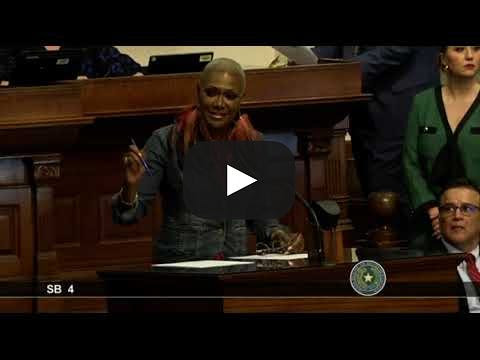
Watch Representative Jolanda Jone (D-Harris County) blast this SB4 as it went through the House: 

…Now, under Texas law, any Keystone Cop can decide to drive a person they deem undocumented to the international border and demand they go back into Mexico (even if they are not from Mexico). If the person doesn’t walk across the bridge, they are arrested and imprisoned for up to twenty years.

The Constitution of the United States of America states that the Federal Government’s job is to manage international treaties, our borders, and citizenship issues. SB4 crosses a major line.

Here is a statement put out today by the Mexican Government: 

This bill will even remove people who have been here for decades, living lawfully and paying taxes.

Within SB4, the term “alien” is defined as an individual who is neither a citizen nor a lawful permanent resident. Thus, a person who was once denied a visa but presently holds a valid visa (for example, tourism or marriage) is STILL considered committing an offense, even though they are lawfully present in the country.

Cruelty is the point.

SB4 passed straight down party lines. Every single Republican voted for it, and every single Democrat voted against it. When they tell you who they are, you need to listen. A lot of non-voters need to become voters, the GOP’s authoritarian laws are on our door step…

ALL Latinos should be very concerned right now. 

This immigration law will allow any brown person to be rounded up for any possible violation. SB4 will allow any law enforcement agent in Texas (even school resource officers) the ability to demand a brown person prove they are a citizen (“Show Me Your Papers”). If that person can’t prove their citizenship, they risk deportation to Mexico, no matter their origin. 

The law’s implementation will lead to racial profiling, separate families, and harm Black and brown communities across the state, regardless of immigration status. 

That directly conflicts with the United States Constitution, which states that everyone, regardless of race or immigration status, has the freedom to move and thrive.

Republicans have already committed to opening up shuttered prisons to make room for 80,000 immigration prisoners. Under SB4, police will act as immigration agents and arrest people who “look” like they’re undocumented. Half of Texans are Latino and could “look” undocumented to a racist cop.

Following a vigorous debate on the blog about the Supreme Court’s decision to reverse Colorado‘a disqualification of Trump from the ballot, our reader Democracy reviews the article in The Atlantic by Laurence Tribe and Michael Luttig. (It is available on The Atlantic website for a free trial.)

Democracy writes:

I don’t know who titled the piece by Luttig and Tribe in The Atlantic, but I thought it was both brilliant and accurate. The title:

“Supreme Betrayal”

These are some of the most compelling passages in the article:

“What ought to have been, as a matter of the Constitution’s design and purpose, the climax of the struggle for the survival of America’s democracy and the rule of law instead turned out to be its nadir, delivered by a Court unwilling to perform its duty to interpret the Constitution as written. Desperate to assuage the growing sense that it is but a political instrument, the Court instead cemented that image into history. It did so at what could be the most perilous constitutional and political moment in our country’s history, when the nation and the Constitution needed the Court most—to adjudicate not the politics of law, but the law of the politics that is poisoning the lifeblood of America.”

Bam!

“As the extraordinary array of amicus briefs filed in Trump v. Anderson made clear, the voluminous historical scholarship exploring the origins of the disqualification clause and its intended operation left no genuine doubt that the Colorado Supreme Court got it exactly right in its decision explaining why the former president was ineligible to ‘hold any office, civil or military, under the United States,’ certainly including the presidency.

The Colorado Supreme Court entered into some extensive fact-finding in declaring Trump an insurrectionist. None of those facts has been questioned, even at the Supreme Court, where the justices just tiptoed around the factual issues and pretended they didn’t exist. Oh, but they did:

https://www.usatoday.com/picture-gallery/news/nation/2021/01/07/front-pages-capture-chaos-riots-us-capitol/6577931002/

Back to Luttig and Tribe, and the three “liberal” justices:

“For Justices Sonia Sotomayor, Elena Kagan, and Ketanji Brown Jackson—who wrote a separate concurrence that in parts read more like a dissent—we can only surmise that any discomfort they felt was outweighed by the extra-constitutional allure of going along with the other justices on the decision’s bottom line and thus enabling the nation’s electorate to work its will, rather than the Constitution’s. Those three justices took the opportunity to distance themselves from at least part of what the Court’s majority did by criticizing its ‘attempts to insulate all alleged insurrectionists from future challenges to their holding federal office.’ Sotomayor, Kagan, and Jackson convincingly dispatched as ‘inadequately supported as they are gratuitous’ the majority’s unnecessary holdings that only Congress can enforce the disqualification clause and that Congress’s implementing legislation must satisfy the majority’s made-up insistence upon ‘congruence and proportionality.’ Those three justices left in tatters much that all the other justices, with the exception of Amy Coney Barrett, wrote about the operation of the disqualification clause against federal officeholders, making plain that the majority’s ‘musings’ simply cannot be reconciled with the Fourteenth Amendment’s language, structure, and history.”

Luttig and Tribe note clearly that there were two “majorities” in this case. There was the 9-0 majority, that some commenters here cling to, and there was the 5-4 majority that went w-a-y too far in insulating Trump from disqualification even though he IS an insurrectionist. And that 9-0 majority? Luttig and Tribe state that the step “that all nine justices took represents a constitutionally unforgivable departure from the fundamental truth of our republic that ‘no man is above the law.’ ”

And that Colorado decision?

“… the week-long trial by the Colorado state court, which had indisputable jurisdiction to consider the matter, undoubtedly more than satisfied the constitutional requirements for disqualifying the former president under Section 3. At that trial, he was afforded every opportunity to defend himself against the charge that he had personally ‘engaged’ in an ‘insurrection or rebellion’ against the Constitution. Not a single justice suggested that the process was less than what the former president was due. That trial ended in a finding by ‘clear and convincing evidence’ that he had not only engaged in that insurrection but had orchestrated the entire months-long effort to obstruct the joint session’s official proceeding, preventing the peaceful transfer of power for the first time in American history. Not a single justice suggested that a more stringent standard of proof was required or that the courts below applied an insufficiently rigorous definition of insurrection. No justice suggested that the First Amendment or anything else in the Constitution shielded the former president from the reach of Section 3.”

And yet they shielded him.

Luttig and Tribe conclude with this:

“Our highest court dramatically and dangerously betrayed its obligation to enforce what once was the Constitution’s safety net for America’s democracy. The Supreme Court has now rendered that safety net a dead letter, effectively rescinding it as if it had never been enacted.”

I’m curious. Is there anyone commenting on this blog who genuinely believes that Trump is NOT an insurrectionist?

I watched clips of yesterday’s hearings about the report of Robert Hur, who was selected by Merrick Garland to be Special Counsel to investigate Biden and documents found in his home and offices. The big takeaway from his voluminous report was that he considered Biden’s memory to be weak and that a jury would treat him as a kindly old man with a poor memory.

Republicans wanted to use the hearings to demonstrate that Biden is senile. Democrats wanted to use the hearings to show that Trump has a worse memory than Biden and that—unlike Biden— he willfully retained top-secret documents and refused to return them.

Hur resigned from the Department of Justice the day before the hearing and hired a Trump insider to represent him.

Mary Trump includes in her post the video introduced by Eric Swalwell. It shows Trump in numerous gaffes, memory lapses, and moments of incoherence. Trump later claimed all the clips were generated by AI.

Not included is the question posed by Eric Swalwell that was shown last night on Laurence O’Donnell’s MSNBC show. Swallwell read the transcript of Hur’s interview and quoted it. At one point, the transcript says, Hur observed that Biden had “a photographic memory” of the layout of his home. Not a sign of a poor memory. Apparently the transcript portrayed Biden differently than Hur’s report.

One of the Republicans read the dictionary definition of senile and asked Hur if he believed Biden was senile. Hur did not.

The question I kept wondering was why Merrick Garland thought that it was a good idea to select a trusted Trump appointee to investigate Biden.

I have recently been watching online interviews conducted by veteran reporters at The Washington Post.

The best of them so far was the interview of Michael McFaul, former Ambassador to Russia by David Ignatius.

McFaul speaks with great authority about Alexei Navalny, Vladimir Putin, and the war in Ukraine. McFaul talks about the importance of passing new aid to Ukraine and appeals directly to Speaker Mike Johnson to let the funding bill come to a vote.

Ignatius asks him what additional sanctions might be imposed on Russia to deter its brutal invasion of Ukraine. He says the U.S. and Europe should transfer to Ukraine the billions of Russian assets that are now frozen.

When asked about the future of Russia, McFaul says that Russia is in decline now because it has driven out a million of its “best and brightest,” who have fled to other countries. If Putin had turned to democracy in 2000, he said, Russia would now be one of the richest nations in the world.

Michael McFaul on Russian presidential election and Alexei Navalny’s legacy  

The death of Kremlin critic Alexei Navalny has sparked worldwide condemnation and renewed questions about political freedom in Russia. On Monday, March 4 at 1:00 p.m. ET, former U.S. ambassador to Moscow Michael McFaul joins The Post’s David Ignatius to assess Navalny’s legacy, Russia’s upcoming presidential election and the ongoing war in Ukraine.  

By Washington Post Live

https://www.washingtonpost.com/washington-post-live/2024/03/04/michael-mcfaul-russian-presidential-election-alexei-navalnys-legacy/

Download The Washington Post app.

Transcript: World Stage: The Future of Russia with Michael McFaul

https://www.washingtonpost.com/washington-post-live/2024/03/04/transcript-world-stage-future-russia-with-michael-mcfaul/

Michael Podhorzer is a political analyst who has worked for the AFL-CIO. His is a widely respected voice thanks to the depth of his knowledge and wisdom. He maintains here that the MAGA movement is more aligned with the Confederacy than most people realize. He posted this piece soon after the U.S. Supreme Court ruled that states could not remove Trump from their ballots even though he participated in an insurrection.

I am posting it in part. Open the link to read it all.

Podhorzer writes:

Note: A version of this piece was published at The Washington Monthly 

The Supreme Court rejected Colorado’s decision to keep Trump off the ballot. Ahead of the ruling, many constitutional scholars and historians made strong legal arguments that Section 3 of the 14th Amendment disqualifies Trump from holding public office again. Others argued that if the Supreme Court upheld a Colorado high court ruling it would compromise the legitimacy of our democratic process. 

Here, I want to use this episode to show how the debate itself was really about the legitimacy of America itself. 

Since the January 6, 2021, insurrection, there has been speculation about whether America might break apart as it did in 1861. Some even fear that removing Trump from the ballot will ignite a new civil war. But when we describe what happened in the 19th century and what we fear coming now as a “Civil War,” we undermine the legitimacy of the American nation. We put the secessionists then—and the MAGA movement now—on an equal footing with the legitimate American government. By doing so, we not only mislabel the threats that Trump and MAGA represent, but also underestimate their dangers.

The original designation of the military engagement from 1861 through 1865 was the “War of Rebellion.” This wasn’t just the Union’s perspective; the Confederate States understood themselves to be seceding to form an independent “slaveholding republic.” They called themselves “rebels.” It was not a civil war in which combatants fought to control one nation. 

The leaders of what I call the Red Nation, which has 10 of the 11 Confederate states at its core, consistently reveal that they do not recognize the legitimacy of the United States. (See the Appendix of my post on “The Two Nations of America” for more on how I define Red Nation.) They continue to be in the same relationship with America today as the Confederate states were before the War of Rebellion—unwilling to acceptthe legitimacy of the federal government, even if, in most periods, they have acquiesced to its superior force.

When the 14th Amendment was ratified in 1868, it was obvious why Section 3 was included. When a nation cannot disqualify from public office those who have sought to destroy it, it casts doubt on its own legitimacy. That is especially true of the unrepentant Trump. Even Confederate generals admitted they lost by swearing allegiance to the United States. Trump still insists that he didn’t lose. Meanwhile, most Republicans dodge whether President Joe Biden won the election legitimately by grudgingly acknowledging that Biden is president. 

The MAGA faction is not “conservative,” and even calling it “extremist” misses the point dangerously. Those advocating for conservative and even extreme policies should be welcome in a democratic polity. But those acting in ways that reject legitimately constituted authority are neither conservative nor extreme. They are criminal. Thus, if we hope to be a single America, then we must acknowledge that those who claim that the 2020 election was stolen, decry the prosecution of Trump as a crime, call those convicted for their January 6 crimes “political hostages,” and claim that the Rio Grande is Texas’s to defend and not the federal government’s, do not recognize the legitimacy of the United States. They, like their Confederate ancestors, are not patriots. 

When the Constitution was ratified in 1788, the free states saw it as most of us do today—enshrining a government for a unified nation. To the enslaving states, however, the Constitution did not create a single nation. Rather, as Texas Governor Gregg Abbott and two dozen other Red States say, it is merely a “compact” among the states. Due to the gravity of threats from abroad (Britain, France, Spain) and at home (Native Americans and enslaved people), the enslaving states agreed to a mutual defense pact (the Constitution) only insofar as they were confident that it protected their “peculiar institution.” 

At Appomattox, Virginia, in 1865, the Confederates did not surrender so much as acknowledge that their best hope to preserve their “way of life” was not on the battlefield where they were badly outmatched but in a campaign of terror against Reconstruction. Once the South had made Reconstruction too costly to continue, it enacted Jim Crow Constitutions and updated its forced labor economy. This is a well-told story, for example, in Heather Cox Richardson’s How the South Won the Civil War. 

Our devotion to an “America” that strives to be a “government of the people, by the people, for the people” has never been accepted by the Confederate faction, which has always been (and remains) committed to theocracy. We believe that the warrant for government is “the consent of the governed”; they believe its legitimacy is God-given….

Cutting the Branches, Leaving the Roots

Consider Germany, which is rightly credited for taking responsibility for the Holocaust. Last summer, I visited Berlin and saw how robust these efforts have been. For example, the sidewalks in residential neighborhoods have been broken up by Stolpersteine—stumble blocks—which call attention to the homes the Nazis stole from Jews and, where known, the fate of those Jews. But it’s not as if there aren’t similar landmarks commemorating our past, including the Legacy Museum/Lynching Memorialin Montgomery, Alabama, the National Center for Civil and Human Rights in Atlanta, Georgia, and the National Museum of African American History and Culture in Washington, D.C. 

No, the real difference is exactly the difference between conceptualizing today’s toxic politics as “civil war” or “polarization” instead of a rebellion. In Germany, the idea that there would be monuments or streets named after Adolf Hitler or his generals is unthinkable. No popular culture there valorizes those who fought for the Führer or waxes nostalgic for a lost way of life. There’s no bawdy comedy, The Dukes of Bavaria

Please open the link to read this provocative article in full.

George Conway is a constitutional lawyer and a conservative Republican who is an outspoken critic of Donald Trump. His tweets are memorable, as are his appearances on MSNBC, where he is often a guest. He also writes for The Atlantic, where he published his commentary on the Supreme Court’s latest Trump decision. Conway was initially dubious about Colorado’s case for disqualifying Trump but, upon reflection, decided that the Constitution plainly required the Supreme Court to exclude him from the ballot. In his view, the case was not decided on its merits and the legal argument was “utterly flimsy.”

In this post, he analyzes the decision and points out its inconsistencies and fallacies. I am quoting only his conclusion. If you want to read it in full, open the link or subscribe to The Atlantic:

This case wasn’t about legal reasoning; it was about fear. Fear from all the justices, conservatives and liberals, about the impact on the Court of removing Trump from the ballot. And the second paragraph of Justice Barrett’s opinion bleeds fear onto the page. “This is not the time to amplify disagreement with stridency,” she writes. Was that directed at any of her colleagues? Justice Sotomayor’s opinion is hardly strident at all, as far as Supreme Court separate opinions go, even if it makes little more sense than the majority’s. “The Court has settled a politically charged issue in the volatile season of a Presidential election,” Barrett continues. “Particularly in this circumstance, writings on the Court should turn the national temperature down, not up. For present purposes, our differences are far less important than our unanimity: All nine justices agree on the outcome of this case. That is the message Americans should take home.”

Each of these sentences is true. But why say this? Why not let the Court’s unanimity of judgment and reasoning speak for itself, including that of Sotomayor’s concurrence? Because Justice Barrett—and, I suspect, all the justices—were terrified by the case and what it actually required them to do: affirm Trump’s disqualification.

That may sound depressing, but I see reason to take heart. To be sure, it’s a shame, because this was one circumstance where it would have been nice for the Supreme Court justices to show the courage that some of their colleagues in the lower courts have shown when faced with Trump—judges like Lewis Kaplan, in the Carroll case; Tanya Chutkan, in the federal January 6 case; Justice Arthur Engoron in Trump’s New York civil fraud case; and Justice Juan Merchan, in the upcoming New York criminal case stemming from Trump allegedly cooking his books to pay off an adult-film star. Ultimately, though, litigation will not save us from Trump, and no one should believe that it will.  

But litigation will have done its part—even Trump v. Anderson, with its dearth of reasoning and not-quite-satisfactory result. Because there was one very important thing the Court didn’t do yesterday. It didn’t cast one word of doubt, and expressed not a hint of a disagreement with, the amply supported factual conclusion reached by the Colorado courts: Donald Trump engaged in an insurrection. Just as Trump today stands as an adjudicated sexual abuser, so too he remains an adjudicated insurrectionist. It is up to us, as voters, to make use of those findings come November.

Put another way: You can’t always get what you want, but if you try sometimes, you get what you need.

David French is a regular columnist for The New York Times. He writes here about the radical implications of the Supreme Court ruling on Trump’s eligibility to run for president.

As of Monday, March 4, 2024, Section 3 of the 14th Amendment of the Constitution is essentially a dead letter, at least as it applies to candidates for federal office. Under the U.S. Supreme Court’s ruling that reversed the Colorado Supreme Court’s decision striking Donald Trump from the state’s primary ballot, even insurrectionists who’ve violated their previous oath of office can hold federal office, unless and until Congress passes specific legislation to enforce Section 3.

In the aftermath of the oral argument last month, legal observers knew with near-certainty that the Supreme Court was unlikely to apply Section 3 to Trump. None of the justices seemed willing to uphold the Colorado court’s ruling, and only Justice Sonia Sotomayor gave any meaningful indication that she might dissent. The only real question remaining was the reasoning for the court’s decision. Would the ruling be broad or narrow?

A narrow ruling for Trump might have held, for example, that Colorado didn’t provide him with enough due process when it determined that Section 3 applied. Or the court could have held that Trump, as president, was not an “officer of the United States” within the meaning of the section. Such a ruling would have kept Trump on the ballot, but it would also have kept Section 3 viable to block insurrectionists from the House or Senate and from all other federal offices.

A somewhat broader ruling might have held that Trump did not engage in insurrection or rebellion or provide aid and comfort to the enemies of the Constitution. Such a ruling would have sharply limited Section 3 to apply almost exclusively to Civil War-style conflicts, an outcome at odds with the text and original public meaning of the section. It’s worth noting that, by not taking this path, the court did not exonerate Trump from participating in an insurrection.

But instead of any of these options, the court went with arguably the broadest reasoning available: that Section 3 isn’t self-executing, and thus has no force or effect in the absence of congressional action. This argument is rooted in Section 5 of the amendment, which states that “Congress shall have power to enforce, by appropriate legislation, the provisions of this article.”

But Section 5, on its face, does not give Congress exclusive power to enforce the amendment. As Justices Elena Kagan, Sotomayor and Ketanji Brown Jackson pointed out in their own separate concurring opinion, “All the Reconstruction amendments (including the due process and equal protection guarantees and prohibition of slavery) ‘are self-executing,’ meaning that they do not depend on legislation.” While Congress may pass legislation to help enforce the 14th Amendment, it is not required to do so, and the 14th Amendment still binds federal, state and local governments even if Congress refuses to act.

But now Section 3 is different from other sections of the amendment. It requires federal legislation to enforce its terms, at least as applied to candidates for federal office. Through inaction alone, Congress can effectively erase part of the 14th Amendment.

It’s extremely difficult to square this ruling with the text of Section 3. The language is clearly mandatory. The first words are “No person shall be” a member of Congress or a state or federal officer if that person has engaged in insurrection or rebellion or provided aid or comfort to the enemies of the Constitution. The section then says, “But Congress may by a vote of two-thirds of each house, remove such disability.”

In other words, the Constitution imposes the disability, and only a supermajority of Congress can remove it. But under the Supreme Court’s reasoning, the meaning is inverted: The Constitution merely allows Congress to impose the disability, and if Congress chooses not to enact legislation enforcing the section, then the disability does not exist. The Supreme Court has effectively replaced a very high bar for allowing insurrectionists into federal office — a supermajority vote by Congress — with the lowest bar imaginable: congressional inaction.

As Kagan, Sotomayor and Jackson point out, this approach is also inconsistent with the constitutional approach to other qualifications for the presidency. We can bar individuals from holding office who are under the age limit or who don’t meet the relevant citizenship requirement without congressional enforcement legislation. We can enforce the two-term presidential term limit without congressional enforcement legislation. Section 3 now stands apart not only from the rest of the 14th Amendment, but also from the other constitutional requirements for the presidency.

In one important respect, the court’s ruling on Monday is worse and more consequential than the Senate’s decision to acquit Trump after his Jan. 6 impeachment trial in 2021. Impeachment is entirely a political process, and the actions of one Senate have no bearing on the actions of future Senates. But a Supreme Court ruling has immense precedential power. The court’s decision is now the law.

It would be clearly preferable if Congress were to pass enforcement legislation that established explicit procedures for resolving disputes under Section 3, including setting the burden of proof and creating timetables and deadlines for filing challenges and hearing appeals. Establishing a uniform process is better than living with a patchwork of state proceedings. But the fact that Congress has not acted should not effectively erase the words from the constitutional page. Chaotic enforcement of the Constitution may be suboptimal. But it’s far better than not enforcing the Constitution at all.

Robert Hubbell is outraged by the Supreme Court’s latest decision regarding the insurrection clause (Section 3 of the Fourteenth Amendment). The conservative majority on the Court usually claim to be “originalists” who scrutinize the language in the Constitution and divine the intent of those who wrote it.

In this case, the language was crystal clear. Any officer of the federal government who swore an oath to defend the Constitution and then participated in an insurrection against the Constitution was disqualified from running again for office. But the majority said that the official who had engaged in insurrection must first be subject to a Congressional vote; that language is not in the Constitution although there is specific language about the vote needed to remove the disqualification.

Hubbell was furious that Clarence Thomas was allowed to vote in this case since his wife was an active participant in the plot to overturn the election. He should have recused himself but that would require an ethical compass that the justice lacks.

Here is an excerpt from Hubbell’s post. You should open the link and read it in full.

He writes:

The most important lesson from Monday’s disqualification ruling is that the Supreme Court is broken beyond repair. The reactionary majority made that fact abundantly clear by unilaterally amending the Constitution to remove the Insurrection Clause from the 14th Amendment. 

Those sworn to protect the Constitution are dismantling it. The protectors of the Constitution have become its adversary in order to protect a failed insurrectionist who has promised a second effort to overthrow the Constitution. (“I said I want to be a dictator for one day.”)

There are many reasons to ensure that Donald Trump is not elected to the presidency in 2024. Rehabilitating and reforming the Court is chief among them. Sadly, reforming the Court is below the radar for most voters. But the lawless reactionary majority has already denied women the full protection of the liberty clause of the 14th amendment; it is refusing to enforce the clear intent of the 14th to ensure that descendants of enslaved people have a meaningful right to vote and equal protection under law. And the logical force of the Dobbs opinion strongly suggests that the Court will withdraw existing protections for same-sex marriage, contraception, and “inter-racial” marriages.

Monday’s opinion is a clear warning to all Americans that the threat to their liberties is immediate and real. Those who seek to protect existing liberties (and reclaim those already abrogated Court) must vote as if their freedoms depend on the outcome of the 2024 election—because they do! 

The Court has abandoned the Constitution; the last line of defense is the American people exercising their most fundamental right—the right to elect their representatives, who can (in turn) enlarge the Court and limit its jurisdiction.

There is abundant evidence that many Americans are not inspired by either presidential candidate or feel betrayed, forgotten, or ignored by the political process. But one candidate will seek to defend their freedoms by preserving and enforcing the Constitution (in part, by reforming the Court). The other has promised to overturn the Constitution “for one day”—which means “overturn the Constitution” period. The duration of a suspension of the Constitution is irrelevant.

Feelings of anger and upset over Monday’s ruling are understandable and warranted. But the most appropriate response is to redouble our efforts to defeat Trump. Nothing else matters. If we achieve that goal, we can work to advance all other goals. If we do not, we will be at the mercy of a renegade majority on the Court and an out-of-control, aspiring dictator for four years.


What happened?

On Monday, the Court overruled the Colorado Supreme Court’s decision removing Trump from the Colorado primary ballot. The opinion is here: 23-719 Trump v. Anderson (03/04/2024).

The ruling was ostensibly 9-0 with three justices writing a concurring opinion that reads like a dissent and a concurrence by Amy Coney Barrett that criticized the overreach of reactionary majority. In fact, as explained below, the ruling was 5-4, meaning that Justice Thomas’s refusal to recuse himself (as required by statute and rule) was outcome-determinative. Justice Thomas’s corruption saved Donald Trump’s slot on the Colorado ballot.

Distilled to its essence, the US Supreme Court’s ruling in Trump v. Anderson removed the Insurrection Clause from Section 3 of the 14th Amendment.


How did the Court effectively remove the Insurrection Clause from the 14th Amendment?

The 14th Amendment creates a self-executing disqualification for insurrectionists who previously took an oath to support the Constitution. The self-executing nature of that disqualification is consistent with other provisions of the 14th Amendment (equal protection, due process) that are likewise self-executing—as are other qualifications on the presidency (such as age, citizenship, and tenure of residency in the US).

Despite the plain language of the 14th Amendment—which creates a bar to holding federal office based on the conduct of the insurrectionist standing alone—the Court ruled that the Insurrection Clause is ineffective unless Congress affirmatively passes legislation that conforms to narrow prescriptions of the Court’s opinion in Trump v. Anderson.

The reactionary majority ignores that Section 3 of the 14th Amendment speaks to the role of Congress in enforcing the Insurrection Clause. It says that Congress can remove an insurrectionist’s disqualification by a two-thirds vote. But under the Court’s ruling in Trump v. Anderson, Congress can prevent any disqualifications of insurrectionists by simply refusing to pass the enabling legislation prescribed by the reactionary majority.

As Justice Sotomayor wrote in her concurring opinion,

It is hard to understand why the Constitution would require a congressional supermajority to remove a disqualification if a simple majority could nullify Section 3’s operation by . . . declining to pass implementing legislation.

As George Conway noted on Monday on MSNBC, the reactionary majority arrived at its conclusion by simply ignoring the language of the Constitution. The reactionary majority regularly uses the text of the Constitution as a cudgel when they want to deny liberties embraced by the language of the Constitution. But when they seek to ensure that a failed insurrectionist and aspiring dictator remains on the ballot, they act as if the text of the Constitution does not exist.

A reader wrote to me after the issuance of the opinion and asked, “What can we do?” My answer is this:

Elect Democrats. Reform the Court. Defend the Constitution. Preserve Democracy.


Anand is a brilliant writer and thinker who blogs at The Ink. Consider subscribing.

Here is his take on the Supreme Court’s decision to delay judgment on Trump’s claim of absolute immunity for criminal actions while he was president.

Yesterday the right-wing-dominated Supreme Court decided to step in and rescue Donald Trump’s presidential aspirations, agreeing to hear his claim of broad immunity and to delay his federal trial on charges of election interference stemming from his involvement in the January 6 insurrection. But it’s much worse than that. We agree with Timothy Snyder that this is no simple stalling tactic. By taking up the question of whether a single American citizen is above the law — simply by entertaining a question that shouldn’t be — the right-wing justices are undermining the legitimacy of the Court itself, and the very notion of a nation of laws.

The Supreme Court is attempting to end its own life as an institution above politics. If it has been doing moving in this direction for some time, this week it came to a head.

This can only be read as a blow to democracy itself. With this stay now in place, it’s unlikely that any trial could be concluded by (and even more likely that it will be delayed entirely until after) Election Day. Of course, at that point, should Trump win re-election, the case would not move forward at all: the Justice Department would be unlikely to pursue a case against a newly elected president, and of course in his second term Trump could stop the proceedings entirely. Which, of course, is the plan.