Archives for category: International

At the start of the second Trump administration, Trump unilaterally created a fake “Department of Government Efficiency,” led by Elon Musk. Only Congress can create or eliminate Departments. According to the Constitution, the House of Representatives is responsible for funding and defunding the federal government.

Trump ignored the Constitution and Congress and let Musk and his team ransack the Federal Government, fire thousands of civil servants, and close agencies at will. DOGE decisions were made not by experts but by Musk and his team, most of whom were young men in their 20s, even a teenagers. From their point of view, their greatest accomplishment was to copy massive amounts of personally identifiable data from the Treasury Department and the Social Security Administration.

While DOGE slashed and burned agencies and Departments with abandon, the cruelest cut of all was the near-total elimination of foreign aid. Millions of people in impoverished countries relied on U.S. AID for food, medicine, and medical care. The aid is gone. Hundreds of thousands of people died. If you say it in the active tense, Trump and Musk murdered “hundreds of thousands of people” whose lives depended on US AID. The food aid was more than a humanitarian impulse: American farmers lost at least $2 billion that was used to pay them to supply food for US AID.

Matt Johnson wrote for MS NOW:

“We spent the weekend feeding USAID into the wood chipper,” Elon Musk boasted in February, shortly after President Donald Trump gave him permission to hack his way through the federal government. As a “special government employee” with no oversight running the “temporary organization,” the Department of Government Efficiency, or DOGE, Musk destroyed the 64-year-old humanitarian agency in a matter of days, abruptly halting deliveries of lifesaving medicine, emergency food aid and many other forms of support to the poorest people on the planet. This was done in the name of DOGE’s mission to “maximize governmental efficiency and productivity.”

Musk claimed that DOGE would slash government spending by “at least $2 trillion,” but it ended up saving a microscopic fraction of that figure. Now that DOGE has been disbanded, Musk claims “We were a little bit successful” — but admits that he wouldn’t do it again

Musk tried his hand at government, shrugged and moved on. The same can’t be said for the people who are dead and dying thanks to the DOGE-led onslaught on the U.S. Agency for International Development. “No one has died as [a] result of a brief pause to do a sanity check on foreign aid funding,” Musk declared in March. According to models created by Boston University epidemiologist Brooke Nichols, hundreds of thousands of people have in fact died as a result of eliminated and disrupted aid. 

It’s impossible to calculate the ultimate human toll of shuttering USAID. The U.S. was responsible for 40% of the total foreign aid tracked by the United Nations in 2024, and much of the infrastructure that delivered this aid has now been destroyed. Beyond the frozen payments for active aid projects, partner organizations have closed, supply chains for medicine and food deliveries have been severed and staff who administered and monitored programs have been fired. Early warning systems for starvation and infectious diseases have shut down. 

The individual stories are harrowing. A South Sudanese child with HIV died from pneumonia because he didn’t receive the medication necessary to sustain his immune system. People participating in studies were abandonedwith experimental drugs in their systems and medical devices in their bodies. Cases of acute malnutrition at refugee camps have surged

In the MAGAverse, none of this is true because USAID was never an aid organization to begin with. Mike Benz, a right-wing influencer who has accused the agency of being a terror organization and subverting governments around the world, was a big influence on Musk’s assault on USAID, which Benz called the “Terror Titanic.” Like Musk before him, Benz has now been appointed as a special government employee to investigate his allegations that USAID was a massive covert influence operation and front for the CIA. 

Benz’s campaign is just the latest example of MAGA propaganda using USAID as a convenient political scapegoat. DOGE viewed the takeover of USAID as an opportunity to find instances of “viral waste,” which could be broadcast to the American people as a justification for its other cost-cutting efforts. One example cited by White House Press Secretary Karoline Leavitt was the “50 million taxpayer dollars that went out the door to fund condoms in Gaza.” Trump later declared that the money had been “sent to Gaza to buy condoms for Hamas.” 

There was just one problem: The money was actually for family planning in a province of Mozambique called Gaza….

This is not the full article. Open the link to read the rest.

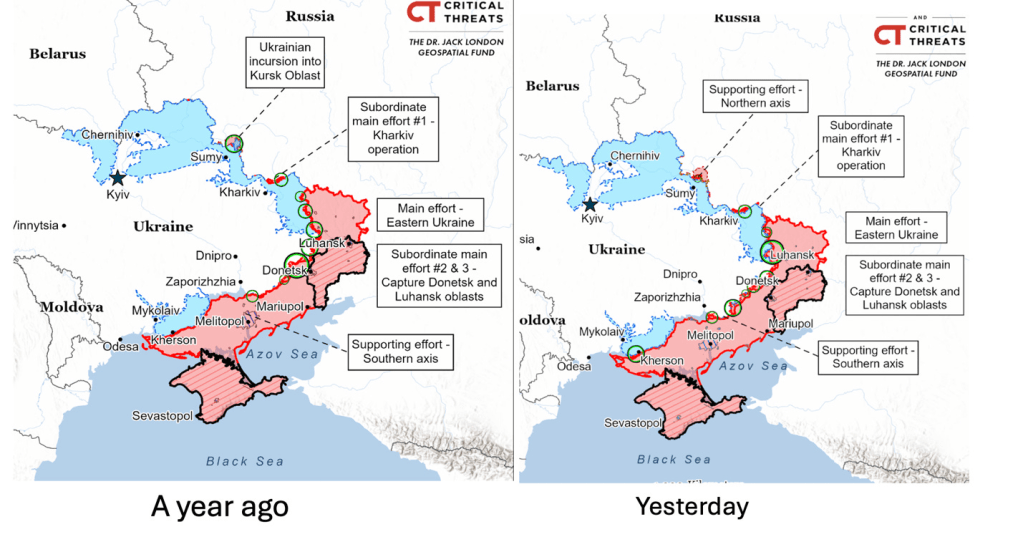
Make no mistake. Trump is Putin’s ally. Putting Trump in charge of negotiations to end the war in Ukraine is akin to putting the fox in charge of guarding the henhouse. On more than one occasion, Trump has sent his emissaries to devise a “peace plan” without asking Ukraine or the representatives of Europe to participate in the discussions.

Trump campaigned by claiming that he could end the war in a single day. All that was required would be a phone call to his good friend Putin.

That hasn’t happened, but Trump continues to threaten to cut off all aid to Ukraine unless Zelensky capitulates to Putin’s demands. These demands would give Putin everything he wants.

Max Boot spelled out the situation in The Washington Post:

Russia’s barbaric assault on Ukraine continues: A single Russian drone and missile strike on an apartment block in western Ukraine last week killed at least 31 civilians. Meanwhile, Russia is ramping up its campaign of sabotage in Europe: Polish authorities blamed the Kremlin for a Nov. 15 explosion on a rail line used to transport supplies to Ukraine. As German Chancellor Friedrich Merz said recently, Europe “is not at war” but it is also “no longer at peace” with Russia.

The growing threat from Vladimir Putin’s despotic, expansionist regime calls for Churchillian resolution, unity and strength on the part of the transatlantic alliance. Instead, Neville Chamberlain-style irresolution and confusion reigns on both sides of the Atlantic. The situation is far more concerning in the United States than in Europe, with the Trump administration having seemingly endorsed, at least for now, a “peace plan” that would give Russia a victory at the negotiating table that it hasn’t earned on the battlefield.

The Europeans have stepped up, providing weapons and funding to Ukraine as U.S. support has dried up. The European Union has a plan to do even more by sending Kyiv some $200 billionin frozen Russian assets as a “loan” that would likely never be repaid. Obviously, given the current corruption scandal in Kyiv, safeguards on the disbursement of the money would be needed. But this is a vital — indeed, irreplaceable — source of funding that can keep Ukraine afloat for years. Yet tiny Belgium, where most of the funds are frozen, is wringing its hands and holding up the plan. There is no Plan B: Europe has to send the Russian funds or else Ukraine will run out of money. So why dither and delay?

As for the peace plan floated by the White House last week: The 28-point plan amounts to a holiday wish list from the Kremlin. It would require Ukraine to cede the entire Donbas region — even the parts that Russian troops have been unable to conquer — and to cut the size of its armed forces by roughly a third. Ukraine would not be allowed to join NATO, and NATO would not be allowed to dispatch peacekeeping troops to Ukraine. Ukraine would hold elections within 100 days and “all Nazi ideology” would be “prohibited”; this is Kremlin code for toppling the Zelensky government. Russia isn’t being asked to limit the size of its armed forces or to hold elections; all the demands are on Ukraine.

What does Ukraine get in return? A separate draft agreement specifies that in the event of renewed Russian aggression, the United States could respond with “armed force, intelligence and logistical assistance, economic and diplomatic actions.” But the U.S. wouldn’t be compelled to do anything. Ukraine would be left to rely on a worthless Russian pledge of “nonaggression” — something it already promised in the 1994 Budapest Memorandum.

This isn’t a peace plan. It’s a blueprint for Ukraine’s capitulation. If implemented, it would turn this pro-Western, democratic nation, which has been courageously resisting Russian aggression since 2014, into a Kremlin colony….

In the New York Times, Thomas Friedman was scathing in his view of the Trump-Putin “peace plan.”

He predicted that Trump would not get the Nobel Peace Prize, which he covets, but would certainly win the ““Neville Chamberlain Peace Prize” — awarded by history to the leader of the country that most flagrantly sells out its allies and its values to an aggressive dictator.”

He wrote:

This prize richly deserves to be shared by Trump’s many “secretaries of state” — Steve Witkoff, Marco Rubio and Dan Driscoll — who together negotiated the surrender of Ukraine to Vladimir Putin’s demands without consulting Ukraine or our European allies in advance — and then told Ukraine it had to accept the plan by Thanksgiving…

If Ukraine is, indeed, forced to surrender to the specific terms of this “deal” by then, Thanksgiving will no longer be an American holiday. It will become a Russian holiday. It will become a day of thanks that victory in Putin’s savage and misbegotten war against Ukraine’s people, which has been an utter failure — morally, militarily, diplomatically and economically — was delivered to Russia not by the superiority of its arms or the virtue of its claims, but by an American administration…

He was the British prime minister who advocated the policy of appeasement, which aimed to avoid war with Adolf Hitler’s Germany by giving in to his demands. This was concretized in the 1938 Munich Agreement, in which Chamberlain, along with others in Europe, allowed Germany to annex parts of Czechoslovakia. Chamberlain boasted it would secure “peace for our time.” A year later, Poland was invaded, starting World War II and leading to Chamberlain’s resignation — and his everlasting shame.

To all the gentlemen who delivered this turkey to Moscow, I can offer only one piece of advice: Be under no illusions. Neither Fox News nor the White House spokeswoman Karoline Leavitt will be writing the history of this deal. If you force it upon Ukraine as it is, every one of your names will live in infamy alongside that of Chamberlain, who is remembered today for only one thing:

This Trump plan, if implemented, will do the modern equivalent. By rewarding Putin’s unprovoked invasion of Ukraine based on his obsession with making it part of Mother Russia, the U.S. will be putting the whole European Union under Putin’s thumb. Trump’s message to our allies will be clear: Don’t provoke Putin, because as long as I am commander in chief, the United States will pay no price and we will bear no burden in the defense of your freedom.

Which is why, if this plan is forced on Ukraine as is, we will need to add a new verb to the diplomatic lexicon: “Trumped” — to be sold out by an American president, for reasons none of his citizens understand (but surely there are reasons). And history will never forget the men who did it — Donald Trump, Steve Witkoff, Marco Rubio, Dan Driscoll — for their shame will be everlasting.

As a Wall Street Journal editorial on Friday put it: “Mr. Trump may figure he can finally wash his hands of Ukraine if Europe and Ukraine reject his offer. He’s clearly sick of dealing with the war. But appeasing Mr. Putin would haunt the rest of his presidency. If Mr. Trump thinks American voters hate war, wait until he learns how much they hate dishonor. … A bad deal in Ukraine would broadcast to U.S. enemies that they can seize what they want with force or nuclear blackmail or by pressing on until America loses interest.”

Mind you, I am not at all against a negotiated solution. Indeed, from the beginning of this war I have made the point that it will end only with a “dirty deal.” But it cannot be a filthy deal, and the Trump plan is what history will call a filthy deal.

Even before you get to the key details, think of how absurd it is for Trump to strike a deal with Putin and not even include Ukraine and our European allies in the negotiations until they were virtually done. Trump then declared it must be accepted by Thursday, as if Ukraine’s president, Volodymyr Zelensky, who has a parliament that he needs to win acceptance from, could possibly do so by then, even if he wanted to.

As my Times colleague David Sanger observed in his analysis of the plan’s content: “Many of the 28 points in the proposed Russia-Ukraine peace plan offered by the White House read like they had been drafted in the Kremlin. They reflect almost all Mr. Putin’s maximalist demands.”

Ukraine would have to formally give Russia all the territory it has declared for itself in eastern Ukraine’s Donetsk and Luhansk regions. The United States would recognize that as Russian territory. No NATO forces could be based inside Ukraine to ensure that Russia could never invade again. The Ukrainian military would be capped at 600,000 troops, a 25 percent cut from current levels, and it would be barred from possessing long-range weapons that could reach Russia. Kyiv would receive vague security guarantees from the U.S. against a Russian re-invasion (but who in Ukraine, or Moscow, would trust them coming from Trump?).

Under the Trump plan, $100 billion in frozen Russian assets would be put toward U.S.-led efforts to rebuild and invest in Ukraine, and the U.S. would then receive 50 percent of the profits from that investment. (Yes, we are demanding half of the profits generated by a fund to rebuild a ravaged nation.)

Trump, facing blowback from allies, Congress and Ukraine, said Saturday that this was not his “final offer” but added, if Zelensky refuses to accept the terms, “then he can continue to fight his little heart out.” As always with Trump, he is all over the place — and as always, ready to stick it to Zelensky, the guy fighting for his country’s freedom, and never to Putin, the guy trying to take Ukraine’s freedom away.

What would an acceptable dirty deal look like?

It would freeze the forces in place, but never formally cede any seized Ukrainian territory. It would insist that European security forces, backed by U.S. logistics, be stationed along the cease-fire line as a symbolic tripwire against any Russian re-invasion. It would require Russia to pay a significant amount of money to cover all the carnage it has inflicted on Ukraine — and keep Moscow isolated and under sanctions until it does — and include a commitment by the European Union to admit Ukraine as a member as soon as it is ready, without Russian interference.

This last point is vital. It is so the Russian people would have to forever look at their Ukrainian Slavic brothers and sisters in the thriving European Union, while they are stuck in Putin’s kleptocracy. That contrast is Putin’s best punishment for this war and the thing that would cause him the most trouble after it is over.

This would be a dirty deal that history would praise Trump for — getting the best out of a less than perfect hand, by using U.S. leverage on both sides, as he did in Gaza.

But just using U.S. leverage on Ukraine is a filthy deal — folding our imperfect hand to a Russian leader who is playing a terrible one.

There is a term for that in poker: sucker.

James Traub wrote anoter excellent analysis of Trump’s “peace plan.” It would be worth your while to open the link and read in full.

He concludes:

My first reaction on reading the Trump Administration’s 28-point peace plan for Ukraine was shame. That’s a different emotion from the anger I feel when Trump does something deplorable at home, like use the Justice Department to terrorize his enemies. When he abandons people elsewhere I feel ashamed of my country before the world.

This latest exercise in coercive diplomacy does not merely give the Russians what they want and deprive the Ukrainians of what they need. What is extra specially Trumpian, and thus shameful, about the proposal is that its second beneficiary is the United States. Point 10 guarantees the United States “compensation” for the completely unspecified security guarantees alluded to in Point 5. From whom? The plan doesn’t say, but presumably the answer is Ukraine, from which Trump demanded a preposterous $500 billion earlier this year in exchange for ongoing support. So we will profiteer off Ukraine’s subjection….

If the United States walks away, we will have vindicated Putin’s belief that in the end nothing matters except force. We will leave Europe to live in fear of an emboldened Russia. We will have washed our hands of a democratic and patriotic nation.

We have seen many repulsive sights in the Oval Office since Trump was sworn in last January. The covering of the room in fake gold ornaments is an abomination. Trump’s rude treatment of Zelensky was an outrage.

But the top abomination, at this moment, was his loving embrace of Saudi Arabia’s Crown Prince Mohammed bin Salman, who should be reviled for his brutal murder of journalist Jamal Khashoggi.

What next? A Presidential Medal of Honor for Putin?

Trump has many personal commercial ties to Saudi Arabia. Cynically speaking, Trump is building alliances by making personal deals with potentates who increase his family wealth. Surely, we cannot forget that MBS arranged to give Son-in-law Jared Kushner $2 billion after Trump left office in 2021. Kushner had no experience in financial investing. His background was real estate. Now, Trump’s real estate buddies Steve Witkoff and Howard Lutnick, are Trump’s envoys to Russia, the Middle East, and other hotspots. They too (and their children) are taking in millions and billions, because they are in “the room where it happens.”

The New York Times wrote recently about how Lutnick’s sons are making lucrative deals , which are helped by the fact that their father is Secretary of Commerce. “But never in modern U.S. history has the office intersected so broadly and deeply with the financial interests of the commerce secretary’s own family, according to interviews with ethics lawyers and historians…”

The New York Times also chronicled the ways that billionaire Steve Witkoff’s sons are cashing in with investments in the Middle East and in cryptocurrency, building on their father’s connection to Trump.

This is not what the Founders intended.

But maybe those of us who worry about abstract ideas like ethics and laws are in the wrong. Maybe the best way to make a deal with the devil is to get in bed with him, speak his language, and buy his friendship. That’s Trump’s way. And nobody does it better.

Sabrina Haake writes:

Trump just threw a lavish state party to welcome a Saudi murderer. He defended the murderer’s crime, blamed the victim, and viciously attacked a reporter for asking the question on everyone’s mind: What about Jamal Khashoggi?

Of all the shameful metaphors for the corruption, ignorance, and rot presently infecting the White House, this one wears the Trump crown.

A brutal regime dismembers its critic

Jamal Khashoggi was a US resident and journalist for the Washington Post during its halcyon years, before it fell to corporate interests that now serve Trump.

Khashoggi was also a frequent critic of the Saudi government. He frequently criticized the royal ruling family, not for their lavish lifestyles, but for their suppression of dissent, their refusal to allow free speech among the Saudi people, and their widespread human rights abuses.

On Oct. 2, 2018, Khashoggi was murdered in Istanbul. He had gone to see about a visa for his Turkish fiancée at the Saudi consulate’s office, where he was attacked, stangled, and dismembered.

A recording made by Turkish intelligence agents in the building captured the whole gruesome ordeal: Khashoggi could be heard struggling against Saudi guards of the royal Crown Prince as his killing was recorded, complete with screams, the sounds of strangulation, then quiet, before a bone saw was heard dismembering his body.

US Intelligence knows bin Salman did it

In 2021, US intelligence reports concluded that Saudi Arabia’s Crown Prince Mohammed bin Salman, aka “the Bone Saw Prince,” had personally ordered the operation.

The US Director of National Intelligence supplied reasons supporting that conclusion, including:

· bin Salman’s total control of decision-making in the Saudi Kingdom;

· The direct involvement of bin Salman’s key adviser in the brutal attack, along with members of his personal security team; and

· bin Salman’s stated support for using violence to silence critics of the Saudi government abroad, including Khashoggi.

US intelligence added that, “Since 2017, the Crown Prince has had absolute control of the Kingdom’s security and intelligence organizations, making it highly unlikely that Saudi officials would have carried out an operation of this nature without the Crown Prince’s authorization.”

Despite these publicly available facts, Trump treated bin Salman to an unusually lavish state reception, complete with military officers in full dress carrying both Saudi and American colors. As the US taxpayer-funded Marine band played, Trump and Mr. Bone Saw were treated to a fly-over of advanced fighter jets, samples of the 48 F-35 jets Trump already sold to Saudi Arabia, despite national security concerns that China would be able to steal the aircraft’s advanced technology.

Trump courts a murderer to line his own pockets

Trump’s personal wealth has increased by over $3 billion since his return to office, largely from ethics-adjacent crypto schemes, foreign real estate deals, meme coins that have no value, and overt pay to play transactions. His lavish courtship of bin Salman fits neatly into the same corrupt pattern, promoting Trump’s illegal,private, for-profit interests.

The Trump Organization now has multiple, large-scale projects pending in Saudi Arabia, including a new Trump Tower and a Trump Plaza development in the works in Jeddah, along with two other projects planned in Riyadh. These deals are publicly known; it’s likely billions more are exchanging hands under the table.

Trump is also in private partnership with the Saudi-owned, “International Luxury Real Estate Developer,” Dar Global. There’s also a separate $2 billion deal where an Abu Dhabi-based, UAE-backed investment firm used a cryptocurrency from the Trump family’s venture, World Liberty Financial, to invest in another crypto exchange, profiting Trump royally.

And no one has forgotten Trump’s son in law, Jared Kushner’s, $2 billion private “investment” fee from the Saudis, packaged when Saudi Arabia’s Public Investment Fund (PIF) announced a $55 billion acquisition. Kushner’s fee is widely regarded as payment for providing political cover and guaranteeing Trump’s regulatory protection. After the PIF’s own advisors initially rejected the deal, bin Salman personally overruled them and pushed it through.

Trump didn’t mention these deals this week when he rolled out the red carpet on taxpayers’ dime, but claimed instead with trademark ambiguity that the Saudis were going to “invest as much as $1 trillion in the US.”

Trump endorses the unthinkable

Journalists around the world, not to mention Khashoggi’s family, had to endure the nightmare of watching Trump fawn all over bin Salman. In every photo from the mainstream media, Trump couldn’t keep his hands off him, as if Trump were absorbing Saudi wealth through his fingers.

Tuesday, when journalist Mary Bruce asked bin Salman about intelligence reports concluding that he ordered the Khashoggi murder, Trump jumped in, answering for him. “He knew nothing about it! You don’t have to embarrass our guest by asking something like that.”

Trump then suggested Khashoggi got what he had coming for criticizing the government, saying, “A lot of people didn’t like that gentleman (Khashoggi) that you’re talking about, whether you like him or didn’t like him, things happen.”

After sending this chilling message to his critics, Trump then attacked Bruce for asking a “horrible,” insubordinate,” and “just a terrible question,” dressing her down in garbled syntax before cameras of the world with, “You’re all psyched up. Somebody psyched you over at ABC and they’re going to psych it. You’re a terrible person and a terrible reporter,” and later demanded that ABC lose its broadcast license.

Saudi Arabia’s Crown Prince Mohammed bin Salman is condemned throughout the civilized world as a brutal 5th Century pariah. Trump just spent a taxpayer fortune to rebrand him “one of the most respected people in the world” to elevate and promote Trump’s own private business ventures.

It is fitting that Trump committed this atrocity in a formerly dignified room recently desecrated with tacky gold medallions. The Oval Office is now a bordello whose pimp is selling America to the highest bidder, and we, his trafficked victims, are letting him do it.

Sabrina Haake is a columnist and 25+ year federal trial attorney specializing in 1st and 14th A defense. Her Substack, The Haake Take, is free.

Elon Musk’s SpaceX, which owns a worldwide telecommunications system and builds space rockets, has significant investments by Chinese nationals. ProPublica says there are likely concerns about national security, or should be.

Justin Elliott and Joshua Kaplan of ProPublica reported:

Elon Musk’s SpaceX has taken money directly from Chinese investors, according to previously sealed testimony, raising new questions about foreign ownership interests in one of the United States’ most important military contractors.

The recent testimony, coming from a SpaceX insider during a court case, marks the first time direct Chinese investment in the privately held company has been disclosed. While there is no prohibition on Chinese ownership in U.S. military contractors, such investment is heavily regulated and the issue is treated by the U.S. government as a significant national security concern.

“They obviously have Chinese investors to be honest,” Iqbaljit Kahlon, a major SpaceX investor, said in a deposition last year, adding that some are “directly on the cap table.” “Cap table” refers to the company’s capitalization table, which lists its shareholders.

Kahlon’s testimony does not reveal the scope of Chinese investment in SpaceX or the identities of the investors. Kahlon has long been close with the company’s leadership and runs his own firm that acts as a middleman for wealthy investors looking to buy shares of SpaceX.

SpaceX keeps its full ownership structure secret. It was previously reported that some Chinese investors had bought indirect stakes in SpaceX, investing in middleman funds that in turn owned shares in the rocket company. The new testimony describes direct investments that suggest a closer relationship with SpaceX.

SpaceX has thrived as it snaps up sensitive U.S. government contracts, from building spy satellites for the Pentagon to launching spacecraft for NASA. U.S. embassies and the White House have connected to the company’s Starlink internet service too. Musk’s roughly 42% stake in the company is worth an estimated $168 billion. If he owned nothing else, he’d be one of the 10 richest people in the world.

National security law experts said federal officials would likely be deeply interested in understanding the direct Chinese investment in SpaceX. Whether there was cause for concern would depend on the details, they said, but the U.S. government has asserted that China has a systematic strategy of using investments in sensitive industries to conduct espionage.

If the investors got access to nonpublic information about the company — say, details on its contracts or supply chain — it could be useful to Chinese intelligence, said Sarah Bauerle Danzman, an Indiana University professor who has worked for the State Department scrutinizing foreign investments. That “would create huge risks that, if realized, would have huge consequences for national security,” she said.

SpaceX did not respond to questions for this story. Kahlon declined to comment.

The celebrated author Azar Nafisi will speak at Wellesley College on October 29 at 4 p.m. as part of the annual Diane Silvers Ravitch 1960 lecture series. She will speak in Alumnae Hall. Dr. Nafisi will answer questions after the lecture.

Her topic: READ DANGEROUSLY: THE SUBVERSIVE POWER OF LITERATURE IN TROUBLED TIMES.

Drawing from her life between Iran and the U.S., Nafisi will explore how literature defies repression—whether under the Islamic Republic or the rise of Trump. In times of crackdown on women, culture, minorities, and rights, literature opens spaces of freedom where authoritarianism seeks to closethem. Today, imaginative knowledge is more vital than everin the fight for democracy.

The lecture will be live-streamed.

Azar Nafisi wrote one of the best books I have ever read: Reading Lolita in Tehran.

The book was a sensation. It was on the New York Times bestseller list for over two years.

Dr. Nafisi was born in Tehran. She received her Ph.D. at the University of Oklahoma. She returned to Iran in 1979, after the Iranian Revolution, and taught English literature at the University of Tehran. In 1981, she was expelled from the university for refusing to wear the mandatory Islamic veil.

She returned to the U.S. in 1997 and acquired American citizenship in 2008.

She has written many books about literature and how it can change our lives.

The public is welcome and admission is free.

I hope to see you there!

Russia has a recurring mystery: very rich and prominent men keep falling to their deaths, with no explanation. Just recently, the publisher of Pravda suffered the same unfortunate fate.

Vyacheslav Leontyev, 87, had been the publisher of Pravda since 1984. It is believed that he jumped from the window of his fifth-floor apartment. Police officials think he had a “nervous breakdown.”

The Times of London reported:

There have been around two dozen mysterious deaths of Russian top businessmen and other officials since the Kremlin launched its full-scale invasion of Ukraine in 2022. 

Old Russian Pravda newspaper.

Pravda, which means Truth, was the official newspaper of the ruling Communist Party until the collapse of the Soviet Union in December 1991

In July, Roman Starovoit, a transport minister, was found dead in a reported suicide just hours after the Kremlin had announced his dismissal. Police said he shot himself with a handgun. Unconfirmed Russian media reports say that he was under investigation over the theft of at least one billion roubles (£9.3 million), which was allocated for the construction of defences on the border with Ukraine.

Last month, a former Russian state property and customs official who was facing years in prison over corruption charges is said to have killed himself after escaping a courtroom in St Petersburg. Boris Avakyan, who held an Armenian passport, fled to the Armenian consulate and was discovered dead in a lavatory there, police said. 

Also last month, the headless body of Alexey Sinitsyn, a leading Russian business manager, was found under a bridge in Kaliningrad, Russia’s Baltic exclave. A car tow rope was reportedly attached to his body and a police source told Vedomosti, a Russian newspaper, that he may have committed suicide. The source did not clarify how.

Despite Trump’s relentless demand to win the Nobel Peace Prize, he did not. He says he ended 6 or 8 wars in his few months in office. Just days ago, he brokered a ceasefire in Gaza.

But consider the criteria:

  1. He united the opposition; check.
  2. He resisted the militarization of his society. Fail.
  3. He has promoted democracy. Fail.

They say there’s always next year. But if you fail to meet the criteria, no way.

Bloomberg News reported:

Venezuelan opposition leader Maria Corina Machado was awarded the Nobel Peace Prize for 2025 for her efforts to promote democracy at a time when an increasing number of countries slide into authoritarianism.

She receives the prize worth 11 million Swedish kronor ($1.2 million) “for her tireless work promoting democratic rights for the people of Venezuela and for her struggle to achieve a just and peaceful transition from dictatorship to democracy,” the Oslo-based Norwegian Nobel Committee said in a statement Friday. 

Machado, 58, “has led the struggle for democracy in the face of ever-expanding authoritarianism in Venezuela,” the Committee said. She leads the Vente Venezuela opposition party and has worked to unite pro-democracy forces in the country.

In her life before politics, she studied engineering and finance and had a short career in business before establishing a foundation that helps street children in Caracas. 

Machado “meets all three criteria stated in Alfred Nobel’s will for the selection of a Peace Prize laureate,” the Committee said. “She has brought her country’s opposition together. She has never wavered in resisting the militarization of Venezuelan society. She has been steadfast in her support for a peaceful transition to democracy.”

María Corina Machado at a rally in Guanare, Venezuela, in 2024.Credit…Adriana Loureiro Fernandez for The New York Times

No contest!

Trump spoke at the United Nations today, where he put his personal opinions, his arrogance, and his vanity on display.

ABC reported:

President Donald Trump delivered a combative speech to the United Nations General Assembly on Tuesday morning, lambasting the international body while touting the work of his administration.

Trump spared no criticism in the hourlong address, beginning with his predecessor former President Joe Biden before taking aim at world leaders on everything from migration to the Russia-Ukraine war.

“One year ago, our country was in deep trouble. But today, just eight months into my administration, we’re the hottest country anywhere in the world, and there is no other country even close,” he said at the top of his remarks.

Trump touted the U.S. as having the “strongest” borders, military and relationships around the world.

The president then turned his attention the United Nations, accusing it of not living up to its promise and even accused it of bringing on more problems.

“What is the purpose of the United Nations?” Trump asked. “It has such tremendous, tremendous potential. But it’s not even coming close to living up to that potential. For the most part, at least for now, all they seem to do is write a really strongly-worded letter and then never follow that letter up. It’s empty words and empty words don’t solve war. The only thing that solves war and wars is action.”

Trump accused the organization of ignoring conflicts around the world that he says he solved, casting himself as a peacemaker.

“Everyone says that I should get the Nobel Peace Prize for each one of these achievements,” Trump said. “But for me, the real prize will be the sons and daughters who lived to grow up with their mothers and fathers because millions of people are no longer being killed in endless and inglorious wars.”

Richard Drew/AP – PHOTO: President Donald Trump addresses the 80th session of the United Nations General Assembly, in New York City, Sept. 23, 2025. 

Trump threatens Russia sanctions, but says Europe must do more

Trump said the United States is prepared to enforce a “very strong round of powerful tariffs” on Russia should Moscow not be ready to make a peace deal.

But he said other countries need to pull back on buying Russian oil and energy products “otherwise we’re all wasting a lot of time.”

“Europe has to step it up. They can’t be doing what they’re doing. They’re buying oil and gas from Russia while they’re fighting Russia. It’s embarrassing to them,” Trump said.

Trump also took a moment to criticize China and India, calling them the main sponsors of the war in Ukraine because of their purchases of Russian oil.

The president has threatened for months to impose harsher economic penalties on Russia but has yet to do so. He didn’t say on Tuesday what it would take for him to determine Russia doesn’t want peace, though he said the war is “not making Russia look good, it’s making them look bad.”

Jeenah Moon/Reuters – PHOTO: President Donald Trump addresses the 80th session of the United Nations General Assembly, in New York City, Sept. 23, 2025. 

Trump bashes world leaders on migration, green energy

Trump said other countries should be modeling the U.S. on the issue of immigration.

“Not only is the U.N. not solving the problems it should, too often it’s actually creating new problems for us to solve,” Trump said. “The best example is the No. 1 political issue of our time, the crisis of uncontrolled migration. It’s uncontrolled. Your countries are being ruined.”

To leaders gathered in the conference hall, Trump said: “Your countries are going to hell.”

He also encouraged leaders to reject policies geared toward fighting climate change and global warming, calling climate change “the greatest con job ever” and touting his administration’s withdrawal from the Paris Agreement.

“If you don’t get away from this green scam, your country is going to fail,” Trump said.

Shannon Stapleton/Reuters – PHOTO: President Donald Trump addresses the 80th United Nations General Assembly at U.N. headquarters in New York City, September 23, 2025. 

Trump demands Hamas release hostages, disagrees on Palestinian statehood

On Israel’s war against Hamas in Gaza, Trump said the world has to “come together” to “end the war in Gaza.” He reiterated that he wanted to see the hostages released immediately, but offered no clear path forward on progressing negotiations.

Trump continued to express his disagreement with countries moving to recognize Palestinian statehood. Several key U.S. allies, most recently France, have announced they are recognizing a Palestinian state.

“Now, as if to encourage continued conflict, some of this body is seeking to unilaterally recognize a Palestinian state. The rewards would be too great for Hamas terrorists for their atrocities,” Trump said.

Trump instead called for a united message from the body for Hamas to release hostages.

“Those who want peace should be united with one message: release the hostages now. Just release the hostages now. Thank you,” Trump said.

Trump also boasted about his poll numbers, which he said were the highest ever. His approval rating is 37%.

The New York Times published a shocking story about the enrichment of the Trump family by two big deals that were supposed to be unrelated but probably were not.

Trump selected his close friend Steve Witkoff as his Middle East envoy, although Witkoff has no prior experience as a diplomat. Witkoff is a real estate lawyer and a developer, also a billionaire. Witkoff is also Trump’s special envoy to Putin. Witkoff’s son Zach is a partner in the crypto business with Eric Trump and Don Trump Jr. They are partners in World Liberty Financial.

This summer, Steve Witkoff, President Trump’s Middle East envoy, paid a visit to the coast of Sardinia, a stretch of the Mediterranean Sea crowded with super yachts.

On one of those extravagant vessels, Mr. Witkoff sat down with a member of the ultrarich ruling family of the United Arab Emirates. He was meeting Sheikh Tahnoon bin Zayed Al Nahyan, a trim figure in dark glasses who controls $1.5 trillion of the Emiratis’ sovereign wealth.

It was the latest engagement in a consequential alliance.

Over the past few months, Mr. Witkoff and Sheikh Tahnoon had become both diplomatic allies and business partners, testing the limits of ethics rules while enriching the president, his family and his inner circle, according to an investigation by The New York Times.

At the heart of their relationship are two multibillion-dollar deals. One involved a crypto company founded by the Witkoff and the Trump families that benefited both financially. The other involved a sale of valuable computer chips that benefited the Emirates economically.

While there is no evidence that one deal was explicitly offered in return for the other, the confluence of the two agreements is itself extraordinary. Taken together, they blurred the lines between personal and government business and raised questions about whether U.S. interests were served.

In May, Mr. Witkoff’s son Zach announced the first of the deals at a conference in Dubai. One of Sheikh Tahnoon’s investment firms would deposit $2 billion into World Liberty Financial, a cryptocurrency start-up founded by the Witkoffs and Trumps.

Two weeks later, the White House agreed to allow the U.A.E. access to hundreds of thousands of the world’s most advanced and scarce computer chips, a crucial tool in the high-stakes race to dominate artificial intelligence. Many of the chips would go to G42, a sprawling technology firm controlled by Sheikh Tahnoon, despite national security concerns that the chips could be shared with China.

Those negotiations involved another key White House official with ties to the tech industry and to the Middle East: David Sacks. A longtime venture capitalist, Mr. Sacks serves as the administration’s A.I. and crypto czar, a newly created position that has allowed him to shape tech policy even as he continues to work in Silicon Valley.

This story must have rattled Trump because a few days after it appeared, Trump filed a $10 billion lawsuit against The New York Times, for defamation.

Lawrence O’Donnell of MSNBC commented that this may be the most ridiculous lawsuit ever filed and explains the dubious mega deals that enriched the Trump and the Witkoffs.

O’Donnell naturally wonders what Republicans would say if Biden were involved in a deal like that. Yet they are silent about Jared Kushner getting a $2 billion investment from the Saudis and the Trump sons getting another $2 billion.

Writing in the Washington Post, Fareed Zakaria explains how Trump has driven pivotal countries–like India, Brazil, and South Africa–into the embrace of our enemies: Russia, China, and North Korea. For his own bizarre and inexplicable reasons, Trump has tried to cozy up to the leaders of those countries, which have a common interest in opposing democratic countries. He has boasted about his close friendship with Putin, Xi, and Kim Jong Un, but they are laughing at him. Trump’s insane tariffs have been harsh towards our allies, which makes no sense at all.

Zakaria wrote:

Look at the pictures that dominated this week’s world news. They are vivid illustrations of the failures of President Donald Trump’s foreign policy.

The photographs that captured most attention were of China’s massive military parade and of Xi Jinping, Vladimir Putin and Kim Jong Un striding together. Those visuals were to be expected — a reminder that the West faces a determined set of adversaries who see it as their mission to destroy the Western-led international order.

What was surprising were the images from the days before, when the Shanghai Cooperation Organization hosted leaders from India, Turkey, Vietnam and Egypt, among others. All these regional powers were generally considered closer to Washington than Beijing. But a toxic combination of tariffs, hostile rhetoric and ideological demands is moving many of the world’s pivotal states away from the United States and toward China. It might be the greatest own goal in modern foreign policy.

Consider the BRICS, a grouping of countries originally meant to represent the big emerging markets of the future — Brazil, Russia, India, China and South Africa — along with several other members now, too. At meetings, three of the core countries, Brazil, India and South Africa, would generally resist the Russian and Chinese effort to turn the organization into an anti-American grouping. For decades, Washington has been building ties with these three countries, each a leader in its region, to ensure that as they grew in size and stature, they would be favorably inclined toward the United States.

But Trump has treated those pivotal states to some of his most vicious rhetoric and aggressive policies. He unleashed the highest tariff rate in the world against India. He punished Brazil with equally high tariffs and levied sanctions and visa bans against Brazilian officials. South Africa faces 30 percent tariffs, a total cutoff of foreign aid and potential sanctions against government officials.

The governments and people in these countries are outraged at their treatment. India used to be overwhelmingly pro-American. Now it is rapidly shifting toward a deep suspicion of Washington. In Brazil, President Luiz Inácio Lula da Silva’s sagging poll numbers have risen as he stands up to Trump’s bullying. In South Africa, President Cyril Ramaphosa gained stature when he politely responded to Trump’s Oval Office hectoring. It is worth remembering that other countries have nationalist sentiment, too!

There is no strategic rationale for these policy reversals. Trump is punishing Brazil because that country’s independent courts are holding accountable Trump’s ideological soulmate, Jair Bolsonaro, for his efforts to reject the results of free and fair elections. South Africa faces Trump’s ire because of a land reform law that is an attempt to address some of the vast disparities in landholding and wealth caused by decades of apartheid. These reasons have nothing to do with restoring America’s manufacturing base or reducing trade deficits. The U.S. actually runs a trade surplus with Brazil.

While Washington has been alienating these countries, China has been courting them. It has outlined a plan with Brazil for a transformative railway network connecting its Atlantic coast to Peru’s Pacific one. Xi managed to get Indian Prime Minister Narendra Modi to visit China for the first time in seven years. China has courted South Africa with trade and aid, and public sentiment in that country has moved to be quite favorably inclined toward Beijing.

We are often told that Trump likes to talk tough to get the best deal. But his policies are producing real pain and misery on the ground — people losing their jobs and many being pushed back into poverty. That’s why even if these deals are renegotiated and things settle on less brutal terms, the memories will linger. Countries will always know that Washington could treat them as it has and they will want to hedge their bets and keep strong ties with China and Russia, just in case.

American foreign policy these days is a collection of the random slights, insults and ideological obsessions of one man. In general, Trump likes smaller countries he can bully or ideological soulmates who cozy up to him. He doesn’t enjoy dealing with large, messy democracies with their own internal dynamics, pride and nationalism.

Thus, America under Trump has befriended a strange collection of strongmen, in El Salvador, Hungary, Pakistan and the Gulf monarchies. It is at odds with the democracies of India, Brazil, South Africa, Mexico, Canada and most of Europe. Does this make any sense?