Archives for category: Immigration

In an interview with the New York Times. NYC Schools Chancellor spoke up for immigrants and the public schools. It was refreshing to see his refusal to fall into the traps set by naysayers who badmouth the schools.

Troy Closson interviewed Mr. Banks:

As the school year opens for an American education system facing multiple crises, one education leader is staking out a curious stance. He is sublimely optimistic.

Public schools in the United States lost more than one million students between 2019 and 2022. The deluge of cash relief distributed during the coronavirus pandemic is drying up. And in a politically polarized era, fresh fights over what students learn in class are continuing to emerge.

But David C. Banks, the New York City schools chancellor, whose national profile rose this spring after his unyielding testimony at a House hearing on antisemitism in schools, argues in a recent interview that the state of urban education is not so bad.

All the woes of urban school districts can be found in New York, a diverse city that is contending with a major influx of homeless migrants. But in a departure from Mayor Eric Adams’s warnings that the migrant crisis is upending city life, Mr. Banks described the arrival of immigrant children as a boon.

As many states retreat from the teaching of race and identity in schools amid rising controversies, the chancellor doubled down on the value of those lessons in New York.

And he said that the rise of artificial intelligence did not represent an alarming threat of chatbot-enabled cheating, but a chance to transform education for the better.

As half of American adults say the education system is heading in the wrong direction, Mr. Banks argued that the “No. 1 thing” his administration had achieved was starting to rebuild faith in public schools.

The interviewer’s question are printed in bold.

New York City has enrolled nearly 40,000 new migrant children since July 2022. Are schools feeling the strain?

For some of the schools, the migrants coming here has been a godsend because we’ve lost so many other kids. Some schools were being threatened with whether we’re going to be able to keep the doors open. 

I push back on a lot of the kind of negative politics that people talk about with migrants. This is a city of immigrants. I mean, that’s the uniqueness of New York. 

We never make it easy for immigrants who are coming. But they find their way. And the same thing is going to happen here.

Many schools spent the earliest stages of the migrant crisis meeting basic needs. Now what do teachers and principals tell you is their biggest challenge in supporting new arrivals?

We’ve got over 5,000 teachers who are either bilingual or English-as-a-new-language teachers who are doing everything that they can possibly do. We need more. 

If you want to see New York City schools at their best, look at how these teachers have responded to the migrant crisis. It’s incredible. They’ve partnered kids with other kids who are serving as buddies for them. They’ve got mentors from older grades.

So I don’t hear a major cry from schools.

This administration has championed expanding popular programs to win back families, and celebrated last year’s enrollment uptick. But New York City has 186,000 fewer children and teenagers today than it did in 2020, and birthrates are on the decline. What does that mean for the future of the school system?

New York City is a very expensive place to live in. But we didn’t go from one million to 100,000. We still have over 900,000 kids and families.

Some of these things are happening beyond anything that I can do. There was a huge migration of Black folks back to the South. It’s more affordable for them to be in a place like South Carolina. Nothing I can do about that.

A big part of my job is to make the case for why we think the public schools would be a great place for you and your family. For years, the Department of Education used to play defense on media, the narrative. And I think we’re doing a better job with getting that word out.

GOOD JOB, CHANCELLOR BANKS!

Every so often, someone writes in to say that immigrants are hurting the economy, and in particular, they are taking jobs away from native-born workers. Sometimes they quote economist Paul Krugman, who writes a regular column for The New York Times, to make their point. See, they say, even Paul Krugman agrees with me.

But not so fast. Krugman recently wrote this column, where he takes the opposite view.

He wrote:

On the eve of the 2020 election Donald Trump, in a post on the platform formerly known as Twitter, told voters that “This election is a choice between a TRUMP RECOVERY or a BIDEN DEPRESSION.” Not quite. Since President Biden took office, the United States has gained 15.7 million jobs.

Trump, however, has been dismissing the good news on employment, claiming that all the job gains are going to illegal immigrants. In my most recent column I addressed his further claim that immigration has had a devastating effect on Black workers. (It hasn’t.)

What is true, however, is that a lot of recent employment growth has involved immigrants. But have their job gains come at the expense of the native-born?

No. But how do we know that? And how should we think about the effect of recent immigration on jobs?

Before I present numbers, there are three qualifications to consider.

First, while we have monthly estimates for employment that distinguish between native-born and foreign-born workers (although they don’t separate out the undocumented), these numbers aren’t adjusted for seasonal variation. Rather than try to roll my own seasonal adjustment, I’ll just use 12-month averages, which are good enough for current purposes.

Second, many experts believe that the standard numbers, based on the Current Population Survey, underestimate the recent surge in immigration. I’ll note where this makes a difference, but it doesn’t change the overall picture.

Finally, when you’re looking at recent job growth, it matters what you choose as your starting point. Biden inherited an economy still depressed by the effects of Covid-19, and some of the job growth on his watch reflected a recovery from that depressed state. It arguably makes more sense to compare the current economy with the economy on the eve of Covid. I’ll do it both ways, looking at both job growth since 2020 and job growth from the prepandemic year 2019.

OK, here we go. First, let’s compare average employment in the 12 months ending in June 2024 with employment in 2019 and employment in the pandemic year 2020.

Since 2020 there have been large increases in employment of both native- and foreign-born workers, but much of that reflected recovery from the pandemic slump. Compared with the prepandemic economy, job gains have been much smaller, especially for the native-born. So immigrants have accounted for most job growth — perhaps more than the chart says, if immigration has been understated — although not all of it.

The question, however, is whether the jobs immigrants have taken would have gone to native-born workers if immigration had been lower.

Well, if immigrants were stealing our jobs, we’d expect to see a sharp rise in unemployment among the native-born. We don’t. The unemployment rate among native-born workers is near a historic low.

But some anti-immigrant crusaders argue that unemployment is only low because immigrants have driven native-born Americans entirely out of the labor force; you’re only counted as unemployed if you’re actively seeking a job.

Indeed, the share of native-born adults in the labor force — employed or unemployed — has fallen slightly since 2019.

But this was both predictable and predicted, not because of immigration but as a result of the aging of the native-born population. Congressional Budget Office projections published in January 2020 — when nobody knew that either the pandemic or the immigration surge were coming — had already forecast a decline in the labor force participation rate as baby boomers retired.

So the near stagnation of native-born employment isn’t a demand-side issue, in which people aren’t working because they can’t find jobs. It is instead a supply-side issue, in which people aren’t working because they’ve reached retirement age. We’ve been able to achieve large increases in overall employment only because working-age immigrants have been coming to America. If we didn’t have the immigrants, we wouldn’t have the jobs.

What about the impact of immigration on wages? A few decades ago many economists, myself included, believed that immigrants with low levels of formal education were in effect competing with native-born workers who also lacked degrees. But most labor economists now believe that immigrants don’t do much head-to-head competition with native-born workers; they bring different skills and take different jobs. And the past few years, with elevated immigration, have also been an era of exceptional growth in wages for the worst paid.

So none of these negative claims about the effects of immigration hold up. But are there important positive effects? (Aside from the benefits to the immigrants themselves, which can be really large — I am very glad, for multiple reasons, that my grandparents left the Russian Empire.)

There’s a good although not ironclad case that immigration has helped limit inflation in recent years. Normally, as Jerome Powell, chair of the Federal Reserve, recently noted, immigration is more or less neutral in its effects on inflation: Immigrants expand supply, but they also contribute to demand. In the aftermath of the pandemic, however, the huge sums spent on aid pumped up demand; this burst of demand was easier to accommodate without sustained inflation because immigration made it possible to achieve rapid growth in employment.

In the longer run, the big story is fiscal. Adult immigrants tend to be working age, which means that they will spend years paying taxes before they become eligible for Medicare and Social Security, which constitute a large part of federal spending. And while this point is a bit brutal, undocumented immigrants are especially good for the budget, because they pay payroll taxes (which are collected by employers) without being eligible for future benefits.

So, no, immigrants aren’t taking our jobs. Everything that happens in the economy hurts someone: There are no doubt some places where immigrants have driven up housing costs, or where native-born Americans or legal immigrants have faced increased job competition. But the scare stories don’t match the facts.

To see Krugman’s nifty graphics, taken from the Buteau of Labor Statistics, please open the link.

Malena Galletto, the daughter of immigrants from Argentina, was accepted at 28 colleges, including all eight Ivy League colleges. Malena attended the Bronx High School of Science, one of the city’s most selective high schools, where she had a 97% average. Malena is the first in her family to attend college.

Malena has decided to go to Harvard.

When you hear Donald Trump rant about immigrants, accuse them of horrible criminal behavior, think of Malena.

It is 7 p.m. on March 28th, 2024. Malena Galletto ’24 sat in her dad’s car on their way to a family friend’s house for a long weekend. In the back seat, Galletto sat with her laptop opened to the eight college portals that released their decisions. Dartmouth, Brown, Cornell, Harvard, Yale, Princeton, Columbia, and University of Pennsylvania. 

Having received an encouraging letter from Columbia a few weeks prior, Galletto opened the Columbia decision first. She rejoiced at her first acceptance of the day. She then opened Dartmouth, followed by Brown and Cornell, and eventually Harvard, Yale, University of Pennsylvania, and Princeton. By the end of the night, Malena had gotten into all eight ivies.  

In total, Galletto applied to 28 colleges in the United States, hopeful that she would get into at least one of them. She was accepted to all 28 universities that she applied to. Galletto is an Argentinian-American who grew up in Washington Heights, and she embraces her Latin culture. Growing up, she was strongly immersed in the Tango community. 

Galletto: “My mom loves dancing. I spent so much time watching her and her friends Tango, that dancing is just a part of me. I think that I probably learned to Tango before I learned to walk.” 

Galletto’s culture is one of the most important things for her. Galletto believes that preserving Argentinian culture through celebrating the traditional dance of Tango is crucial for keeping it alive and thriving. Growing up in Washington Heights in Manhattan, Galletto had a first hand account of how the pandemic negatively impacted the Tango community. Due to social distancing, cultural activities and showcases were canceled, giving a devastating blow to the whole community.  

Galletto: “Despite these challenges, over the past couple of years, we have been focused on ensuring that Argentinian cultural heritage remains active. Efforts to keep the community engaged have been paramount, as we are continuing to find innovative ways to connect and celebrate our traditions, despite the restrictions. This includes everything from increasing our outreach to hosting virtual concerts. As I was preparing for college applications, this commitment to cultural preservation was a significant part of my application, since it is such a big part of who I am and my story.”

Throughout her fight for preserving her culture and maintaining her passions for education, Galletto recognizes her mom as her biggest cheerleader and motivation. 

Despite being the valedictorian of her high school, Galletto’s mother did not get the opportunity to attend college. 

Galletto: “My mom was the valedictorian of her high school, and she has always emphasized the importance of education. She believes that education opens up a world of opportunities, and she has always pushed me to prioritize my education. This has been crucial for me, as I have been looking to strike the perfect balance for maintaining my grades and also to continue fighting for what I believe in.”

Galletto: “Being first-generation and of low-income, navigating the complexities of college was daunting. I did not have the generational wisdom passed down by parents who attended college, so not understanding the process felt a little like stumbling in the dark. However, the process was made a lot less challenging thanks to the generosity of the Bronx Science Foundation. Their abundance of resources helped me decipher the intricacies of the applications, financial aid, and campus life. For someone like me, the first person in my family to attend college, those resources were not just helpful — they were transformative. They empowered me to chase my dreams despite the odds stacked against me.”

InDepthNH.com seems like a funny place to get a first-hand report from Eagle Pass, Texas, the epicenter of the border crisis that we hear about every day. But Arnie Alpert, a veteran journalist from New Hampshire, traveled to Eagle Pass to see for himself. What he discovered was that the locals were not too happy with the focus on their town. Several locals told him there were more military in their town than migrants.

The bottom line is that Governor Abbott and the GOP have manufactured a crisis. No one wants open borders. Our immigration system is broken. When Republicans and Democrats in the Senate agreed on a bill to fix it, Trump sent a message to his allies in the House to reject the bipartisan bill so he could use the issue in his campaign. Governor Abbott will continue to demagogue the issue for his own political benefit.

Alpert begins:

EAGLE PASS, Texas—The border between Eagle Pass, Texas, and Piedras Negras in the Mexican state of Coahuila used to be open, like the one between Derby Line, Vermont and Stanstead, Quebec.  “We used to just go back and forth all the time,” recalls Amerika Garcia Grewal, who grew up in the small city by the Rio Grande. “The same way we drove downtown to get tacos, years ago, we might have driven into Piedras to get tacos and come back.”

Now the border is fortified.  First, there’s the infamous wall, built over several administrations to keep out migrants.  In Eagle Pass, it’s an expanse of fencing with closely spaced vertical metal bars, stretching for miles near the Rio Grande.  But in recent years, the wall has been supplemented with lines of shipping containers and concertina wire along the riverbank.  Armed soldiers are stationed on top of the containers. Fan boats operated by several state and federal agencies speed up and down the river, perhaps looking for or perhaps trying to scare migrants who might wade across the river to ask for asylum in the land of the free.  

Customs and Border Protection (CBP), the division of the Department of Homeland Security generally just called the Border Patrol, has responsibility under federal law for enforcing laws controlling travel into the United States.  But in 2021, the state of Texas launched Operation Lone Star, dramatically escalating its own involvement in border enforcement.  Under Lone Star, thousands of Texas National Guard members and state police have been stationed at the border.  Texas’ Republican governor, Greg Abbott, Lone Star’s initiator and chief publicist, has labeled the influx of migrants an “invasion.”   

The operation is centered at Shelby Park, a 47-acre expanse lying between the river and the city’s downtown business district, underneath one of the bridges to Piedras Negras.  For years it’s been the place where local residents gathered for picnics, golf, community events, fishing, and watersports. 

Having already declared a State of Emergency due to unauthorized immigration, Abbott booted the Border Patrol out of the park on January 11 and surrounded it with more fencing.  Now, the residents of Eagle Pass have no access to most of their own park, which has become the stage for Abbott’s political performance art.

Recent visitors to Shelby Park have included Speaker of the House Mike Johnson with 64 GOP members of Congress on January 3, and Donald Trump on February 29.  Twelve GOP governors, including Chris Sununu, were there with Abbott on February 4.  “Texas Governor Greg Abbott was clear – they need our help,” Sununu reported afterward. 

Nine days after his Texas trip, Sununu asked the Legislative Fiscal Committee for $850,000 to send fifteen members of the NH National Guard to Texas to join Operation Lone Star, which he said would support “security activities at the southern United States border to protect New Hampshire citizens from harm.” 

“Fentanyl is pouring in, human trafficking is occurring unabated, and individuals on the terrorist watch list are coming in unchecked,” the governor told the legislators, who granted his request on February 16. 

Fifteen New Hampshire soldiers, all volunteers, are in Texas now, winding up a two-month deployment.  According to Lt. Col. Greg Heilshorn, the New Hampshire Guard’s Public Affairs Officer, they are based at Camp Alpha, upriver from Eagle Pass in Del Rio. 

When I told Lt. Col. Heilshorn that I’d be traveling to Eagle Pass and would like to see what our Guard members would be doing, he said I’d need to get permission from Todd Lyman, a Public Affairs Officer at the Texas Military Department.  After a few calls and messages, I received an email saying, “We are not able to accommodate your request at this time.”

I arrived in Eagle Pass on May 19 and approached the guarded gate at Shelby Park the next morning.  There, I asked if I could walk to the boat ramp to take some photos.  A courteous soldier told me I would have to call Sgt. Allen. 

Sgt. Allen said I would have to talk to his superior, Major Perry.  Sgt. Allen also said a request to speak with members of the NH National Guard would be handled by Major Perry’s superior, Todd Lyman.  He suggested I speak to the NH Guard’s public affairs officer.    

Major Perry did not return my phone call. 

The following day I drove with another photojournalist to the site of Camp Eagle, an 80-acre military base under construction on the outskirts of Eagle Pass.  A man from a company that rents construction equipment directed us to a white trailer, where I met Chuck Downie of Team Housing Solutions.  After telling me about his family’s place on Moultonborough Neck, Downie told us we could not be there without permission from the Texas Military Department.  One of his colleagues escorted us from the property.

We were also escorted by a Border Patrol agent from a farm adjacent to the Rio Grande where we were photographing fan boats and the buoys which Gov. Abbott had installed as a river barricade.  For the record, I thought we had permission to be there. 

“If there’s an invasion, it’s from the military,” says Jessie Fuentes, a retired communications professor who runs a canoe and kayak rental business. “There’s more military in our community than there are migrants, thousands and thousands of military from 13 different states.”

“How would you feel if all of a sudden, your community was locked up with soldiers and you couldn’t go into your favorite park? Because it has concertina wire around it or shipping containers or armed guards or you can’t access your own river and your green space?” asked Fuentes, a member of the Eagle Pass Border Coalition, a grassroots organization.  “So yeah, the only invasion we got here is from the military and the Texas governor.”

Texas has already spent more than $11 billion on Lone Star, and that money’s going somewhere.  Camp Eagle is being built by Team Housing, which has a $117 million contract.  Storm Services LLC has its logo on Camp Charlie, located next to Maverick County Airport, where Texas National Guard members are based.  Camp Alpha, where the NH Guard members are staying, is according to tax records owned by Basecamp Solutions LLC.  An article in a Del Rio paper from the time the property was purchased, though, said the owner was Team Housing.  Both LLCs are owned by Mandy Cavanaugh, from New Braunfels, so maybe it doesn’t matter.  

The local immigrant detention prison is owned by the GEO Group, which according to a February 20 Newsweek article “reported one of its most profitable years amid the growing demand for immigration detention facilities.”  GEO operates 11 facilities in Texas.

The $11B doesn’t count the money being spent by other states to send troops to Texas.  Missouri has just approved $2.2 million for a deployment.  Louisiana is sending its third rotation of soldiers. There’s “a lot of money being spent,” said Steve Fischer, who I met while he was walking his dog near the gated and guarded entrance to Shelby Park. 

Fischer, who has served as a county attorney and owns a home 2000 feet from the Mexican border in El Paso, came to Eagle Pass to run a public defender program representing people charged with crimes under Operation Lone Star. 

When I told him about Gov. Sununu getting $850,000 for the two-month New Hampshire deployment, Fischer said, “He’s wasting that money.”

As of two weeks ago, Fischer said, “Lone Star has not gotten one single fentanyl case.”  All Lone Star is doing, he said, is charging people with felonies for driving undocumented immigrants to work sites. 

Amrutha Jindal, who runs the larger Lone Star Defenders office, confirmed that most of the Lone Star felony charges are for people pulled over for driving undocumented migrants.  There are very few drug cases, she said.  Most arrests are for criminal trespass, including many cases where migrants seeking asylum were misdirected by law enforcement officers onto property where they could be arrested.    

Jindal said migrants who post bonds to be released from jail and are then deported forfeit the funds, as much as $3000, when they are unable to appear in court for hearings because they are barred from re-entry into the United States.  The money, presumably, is kept by the counties. 

Please open the link to finish reading the article.

John Thompson writes about Oklahoma’s conflicting views about immigration. On one hand is strong anti-immigrant sentiment: on the other is the recognition that the state needs workers. He writes from his perspective as a teacher.

Oklahoma’s new anti-immigration law, HB 4156, “makes entering and remaining in Oklahoma a crime if a person entered the United States unlawfully.” As the Oklahoman reports, it makes:

“Impermissible occupation” as a first offense a misdemeanor punishable by a year in county jail and/or a maximum $500 fine.

Subsequent arrests will be felonies punishable by up to two years in prison and/or a maximum $1,000 fine. In both cases, offenders will be required to leave the state within 72 hours of their conviction or release from custody, whichever comes later.

The American Civil Liberties Union further explains that when state officers, who are unfamiliar with complex federal laws, take over the enforcement of those laws, racial profiling is likely for both immigrants to Oklahoma and travelers from other states.

In the wake of HB 4156, we must remember the lessons of recent history while fact-checking the propaganda that drove it. Around the turn of the century, an economist guiding the Oklahoma City MAPS for Kids process worried that because of the decline of White and Black student enrollment, it was already too late to save the Oklahoma City Public School System from financial collapse. And, as it turned out, the district survived because of immigration, which increased Hispanic enrollment from around 20% to becoming the majority of students.

Now, the OKCPS is more than 58% Hispanic, and that immigration is a part of the reason why Oklahoma City was 6th in nation’s urban population growth from 2010 to 2020. As the Oklahoma City’s Hispanic population became the fastest-growing demographic, increasing by 42% since 2010. As it grew to 21% of the city’s population, the state’s Hispanic residents grew to 490,000.

It also must be remembered that this growth occurred despite the anti-immigrant HB 1804 law of 2007 which “was considered the most far-reaching immigration law in the United States.” But it also cited far-right Republicans who opposed it. As business people found it impossible to fill their jobs, support for anti-immigrant legislation eventually declined. 

Soon after the law was passed, one of my best students, an immigrant from Mexico, disappeared for several months. After returning, he said that his family was driving down a highway when they were stopped by a policeman, who said that he wouldn’t turn them over to the Immigration and Customs Enforcement (ICE) if they got down on their knees and begged for mercy. My student said that the rest of his family complied, but they were still deported.

Then, a Black student with serious disabilities reached out, shook his hand, and borrowed words from the day’s lesson, “Welcome to Oklahoma.”

Many times I visited majority-Hispanic schools whose parking lots, due to HB 1804, were monitored by law enforcement officers who would arrest immigrants when they brought their kids to schools.

But many other times, I heard conservatives, and business leaders, express admiration for hard-working, families and push back against the law.  As the Daily Oklahoman reported, “Critics contend HB 1804 is all talk and hate: a law with 24 provisions that’s neither slowed nor curbed undocumented workers from coming to the state.”

As immigration took off, I witnessed the way that “Hurt people hurt people.” Immigrant parents often told me that elementary schools were very welcoming, but problems occurred in high-challenge middle schools, as was true in my high school; it was mostly students who had endured multiple traumas who attacked immigrants. At first, I’d see shrinking convoys of Hispanic students rushing to classes with their heads down, seeking to avoid abuse by students who had Serious Emotional Disturbances (SEL).

I then witnessed inspiring leadership which transformed students’ attitudes. For example, due to false information being spread, fights between White and Black students were spreading across the entire John Marshall H.S. building and property. A Mexican-American linebacker took control, first by organizing the football team into peacemakers. The entire school then saw and admired the way he kept recruiting students of all races into calming classmates down.

I was also awed by the way that the immigrant ethic brought classroom learning to a higher level. It got to the point when I was guest-teaching middle schoolers and I teased them, “You aren’t 8th graders. I’ve never seen 8th graders like you. You must be seniors claiming to be in middle school.” The kids laughed, but we all recognized the truth expressed in such a statement.

After retiring, I came back to an alternative school for students with a felony rap (whether they earned it or not).  We couldn’t be as open in discussing race and cultural backgrounds as in a regular class. So, a female student would discreetly visit me before class for in-depth discussions. One day I was saying, “The best thing I’ve seen in my adult lifetime was …” But then the class walked in and she rushed to her seat. The next day she came early and asked, “What was the best thing you’ve seen?” I replied, “This wave of Hispanic immigration!”

The student rushed to Hispanic young women and told them what I’d just said. They high-fived each other and shared my words with Black and White young ladies, who celebrated them, and then they shared them with Hispanic, Black and White guys.  In one of my most wonderful experiences in the classroom, the entire classroom celebrated the accomplishments of immigrants.

Today we must also fact check the claims that drove the passage of HB 4156. A great source for truth-telling is a presentation by Edurne Pineda, the Head Consul for the Oklahoma City consulate of Mexico.  She acknowledged that immigration is a complex issue, and there are negative situations that must be addressed. Controlling the border requires cooperation between American and Mexican authorities. And it is noteworthy that Mexico has around 15,000 more border agents than the U.S. And exports to Mexico support millions of American jobs.

But Ms. Pineda makes a powerful case for rejecting the false narratives behind the law, and for the positive effects of immigration, and how “Oklahoma’s future is closely intertwined” with its benefits. Only about 20% of today’s immigrants to America are from Mexico. But, she explains, almost 16% of U.S. commerce is with Mexico, as opposed to 11.3% with China.  Moreover, undocumented immigrants contribute $13 billion per year for Social Security benefits that they can’t receive.

Fortunately, HB 4156 is likely to face legal challenges. Unfortunately, even though Oklahoma City’s Chief of Police Wade Gourley is seeking to minimize the harm, the law will promote racial stereotyping and deter immigrants from reporting crimes.

And the public needs to understand that immigrants are incarcerated at a rate that is 60% lower than for people born in the U.S. Moreover, over 49 years, only 9 immigrants attempted a terrorist attack; only 3, who were from Albania, crossed from the Mexican border.

Today’s question is whether Oklahomans will be influenced by facts, as well and common decency. Will we respond as we did after the 2007, and reject a law that was “all talk and hate?” Or has another two decades of propaganda permanently changed us? And will we take full advantage of the social and economic benefits that come from immigration?   

Thank you to the best of our citizens, the immigrants who come to seek the American Dream, as our parents, grandparents, and ancestors did.

Six citizens died in the tragic collapse of the Francis Scott Key Bridge in Baltimore. All were immigrants. They were working on the bridge in the middle of the night, repairing potholes, when the bridge was hit by a massive tanker that had lost power. Think of them the next time someone starts spouting off about immigrants as criminals. Immigrants actually have a lower crime rate than native-born Americans.

Campbell Robertson of The New York Times wrote:

The body of the sixth and final victim who died in the collapse of the Francis Scott Key Bridge in Baltimore was found on Tuesday, officials said, bringing to a close a difficult salvage mission after the country’s deadliest bridge collapse in more than a decade.

The victim, José Mynor López, 37, was a member of a work crew that had been filling potholes on the bridge when it was struck on March 26 by the Dali, a container ship on its way to Sri Lanka that apparently lost power after leaving the Port of Baltimore.

Five of his co-workers also died in the collapse, though it took six weeks to find all of the bodies, a daunting task that required divers to sift through mangled steel and crumbled concrete amid swift currents in murky water. Two other workers were rescued from the waters in the hours after the collapse.

All of the men who died were immigrants, from El Salvador, Guatemala, Honduras and Mexico. Mr. López was from Guatemala and had come to Baltimore for a better life, his brother, Jovani López, told The New York Times. He was married with two young children, a boy and girl, Jovani López said.

Robert Hubbell summarizes Trump’s goals, as he explained them to TIME magazine in an interview. They sound remarkably fascistic. All power to the imperial President. No checks or balances. Remember and ask yourself: is this the country we want to live in? I suppose we should be glad that Trump is turning 80 this year. With any luck, he won’t have time to abolish the Constitution and make himself President-for-life.

Hubbell writes:

On a day of many important stories, the most important news came from Donald Trump’s interview with Time Magazine. See Donald Trump on What His Second Term Would Look Like | TIME. In the interview, Trump confirmed that he will attempt to exercise dictatorial powers in a second term.

We have been warned.

We ignore Trump’s threats at our peril and the peril of our democracy.

In describing his fever dream of autocratic powers, Trump said he would take (or allow) the following actions:

  • Allow states to monitor the pregnancies of women to ensure they comply with abortion bans (a grotesque violation of liberty, privacy, and dignity).
  • Fire US attorneys who refuse to prosecute defendants targeted by Trump (a violation of US norms dating to the creation of the Department of Justice).
  • Initiate mass deportations of alleged illegal immigrants using the US military and local law enforcement (neither of which are authorized to enforce US immigration law).
  • Pardon insurrectionists who attacked the Capitol on January 6.
  • Prosecute President Biden (for unspecified and non-existent crimes).
  • Deploy the National Guard to cities and states across America—likely those with predominately Democratic populations (presumably under the Insurrection Act, a deployment would violate the terms of the Act and implementing regulations).
  • Withhold funds from states in the exercise of his personal discretion (a violation of the Impoundment Control Act of 1974).
  • Abandon NATO and South Asian allies if he feels the countries are not paying enough for their own defense.
  • Shutter the White House pandemic-preparedness office.
  • Fire tens (hundreds?) of thousands of civil servants and replace them with Trump acolytes with dubious qualifications (other than loyalty to Trump).

Most readers of this newsletter understand the seriousness of Trump’s threats and are working tirelessly to prevent a second Trump term. But tens of millions of Americans seem oblivious or apathetic in the face of an imminent and dire threat.

If elected, will Trump succeed in achieving any of his stated goals? No—not if Democrats continue their resistance in the courts, in Congress, in state legislatures, and in the hearts and minds of most Americans.

However, whether Trump succeeds in achieving his stated objectives is beside the point. He will attempt to do so—and his attempts will tear at the fabric of democracy and destroy legal norms that have served as the bedrock of our republic since its founding.

To be clear, I am not attempting to frighten readers of this newsletter. To the contrary, I believe that we can and will defeat Trump—or outlast him, whatever it takes. But the interview confirms that we are not frantic alarmists exaggerating the threat posed by Trump.

No, far from it.

When we challenge the milquetoast, both-siderism reporting of the media or the normalization of Trump by spineless politicians, we are not overreacting. We are sounding the alarm in a responsible, necessary way. For reasons that defy comprehension, our warnings have been unheeded—often dismissed, minimized, or patronized.

We must redouble our efforts. Commit the above list to memory. Copy the URL so you can forward this newsletter or the Time Magazine article to friends, colleagues, and complete strangers who doubt that Trump is a danger to democracy. Pick two or three issues and be prepared to discuss them when the moment arises. We have been warned—and we must act accordingly. 

Catherine Rampell, opinion writer for the Washington Post, recently explained the positive effect that immigrants have on our economy. She is not advocating “open borders,” nor am I. She is describing the role that immigrants play in boosting our national well-being. We need more legal immigrants.

She writes:

Don’t want more immigrants in this country? Then tell grandma she can never retire.

As I’ve noted before, immigrants are driving the U.S. economic boom. That is: The United States has escaped recession, hiring growth has exceeded expectation, and inflation has cooled faster than predicted — all largely because immigration has boosted the size of the U.S. labor force. Don’t just take my word for it; ask the Federal Reserve chair or Wall Street economists.

After a stretch of depressed immigration levels — primarily driven by Donald Trump’s hobbling of the legal immigration system — the number of immigrants coming here began to rebound mid-2021. Immigrants are more likely to be working-age than native-born Americans, so their arrivals helped solve a number of problems facing the U.S. economy.

For instance, some of our pandemic-related supply-chain woes were related to worker shortages in critical fields such as construction and food processing. An influx of new workers helped fill those vacancies and unsnarl stuck supply chains. In other cases, immigrants have been willing to take jobs that native-born Americans are unwilling to do, such as the backbreaking work of harvesting potatoes, building homes and caring for the elderly. They’re also filling high-tech positions that Americans cannot do because there are insufficient numbers of us with the necessary skills. And they are creating entirely new job opportunities by launching new businesses — something immigrants do at much higher rates than the native-born.

And then there are the jobs we native-born Americans might theoretically be willing and able to fill, but there simply aren’t enough of us around to fill them. The arithmetic is clear: Boomers are retiring and U.S. birthrates have plummeted. Absent immigration, the U.S. working-age population would be either flat or soon shrinking.

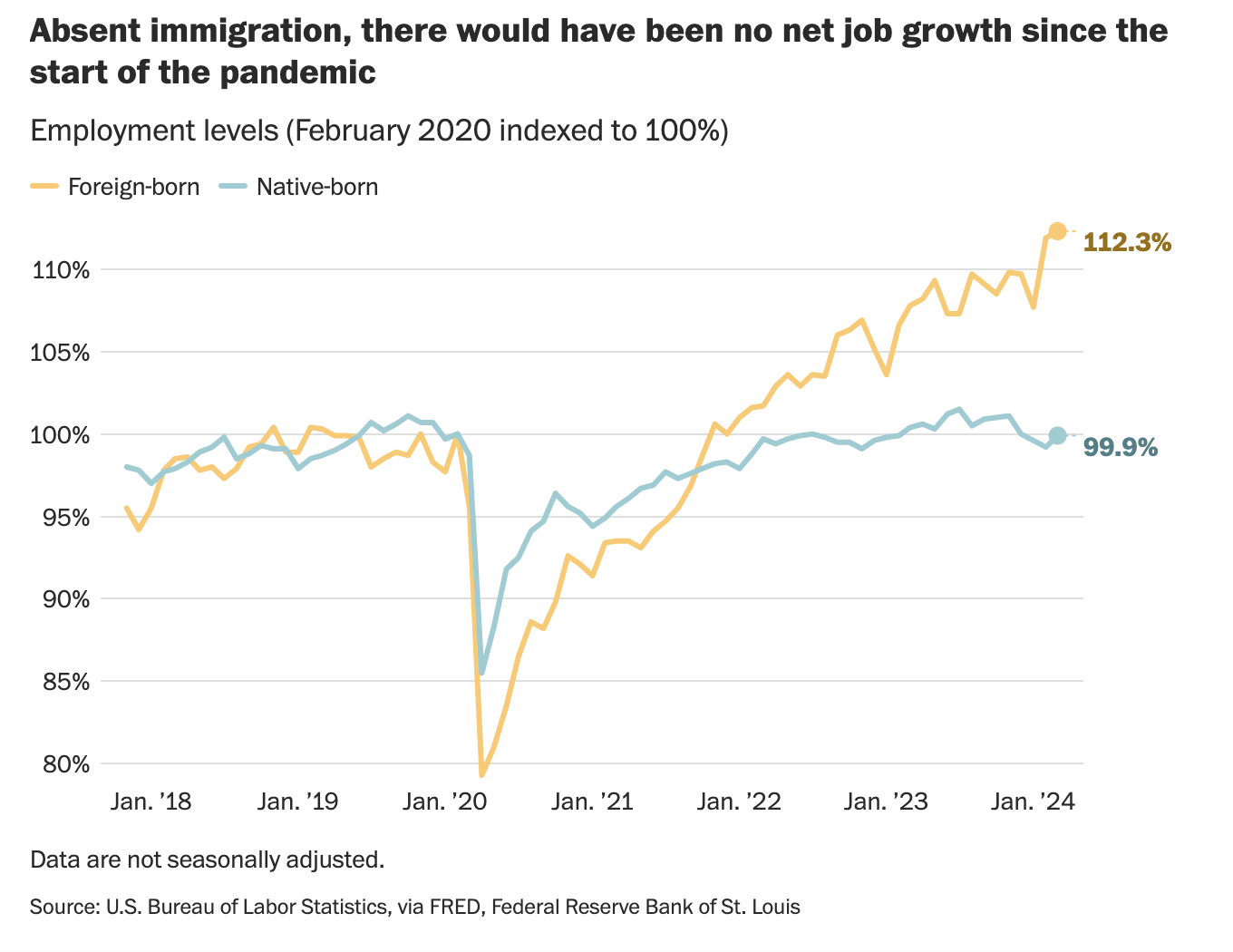
As a result, all of the new job growth since the pandemic, on net, has been due to foreign-born workers. That is, if you stripped away immigrants, there would be no more people employed today than was the case before covid.

On many dimensions, our ability to attract global talent to our shores is a blessing. But this being an election year, and demagogues being demagogues, right-wing pundits and political operatives have worked to darken these bright statistics.

Fox News refers to Bidenomics as a “migrant job fair.” The Republican-aligned Heritage Foundation alleges that “Americans have been completely left behind in this economy,” citing as evidence that fact I just mentioned: that all the net new job growth is accounted for by immigrants.

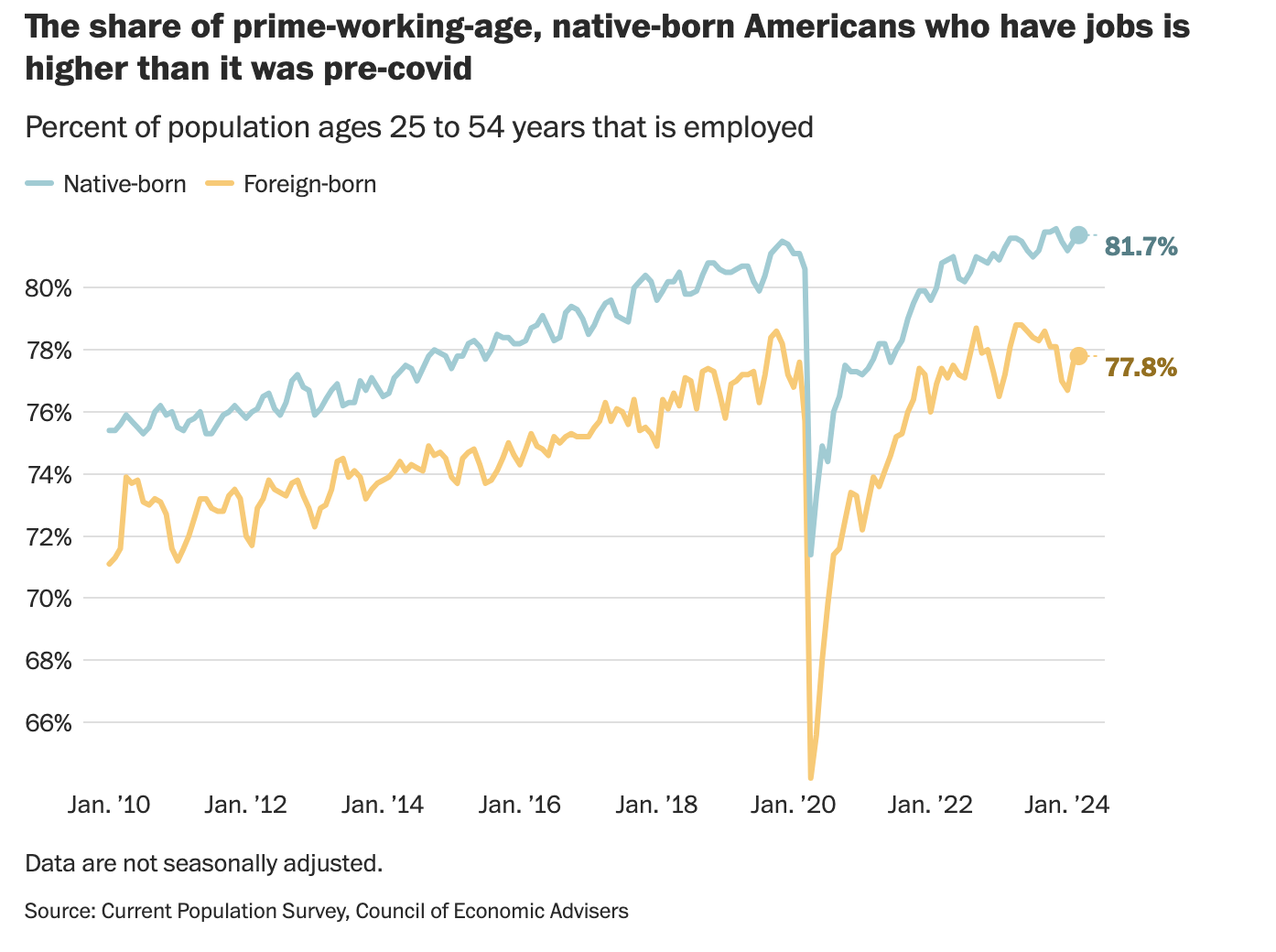
But the labor market is not zero-sum, and native-born workers happen to be doing extraordinarily well, too. In fact, the share of native-born Americans considered “prime working age” (25 to 54 years old, so after traditional college-going years and preretirement) who have jobs is higher than it was pre-pandemic. There just aren’t enough of us, in total, to fill all the jobs that employers are creating as boomers retire.

It’s true that overall, native-born Americans are less likely to be in the workforce today than in years past, but that’s entirely due to aging.
To put a finer point on it, there’s so much demand for workers now that even the most marginal American workers, such as teenagers and people with disabilities, are doing unusually well in the labor market. Ironically, some parts of the country complaining loudest about immigration today are the same places trying to loosen limits on child labor because their worker shortages are so acute.

It’s almost like there’s a simpler, more mutually beneficial solution at hand.

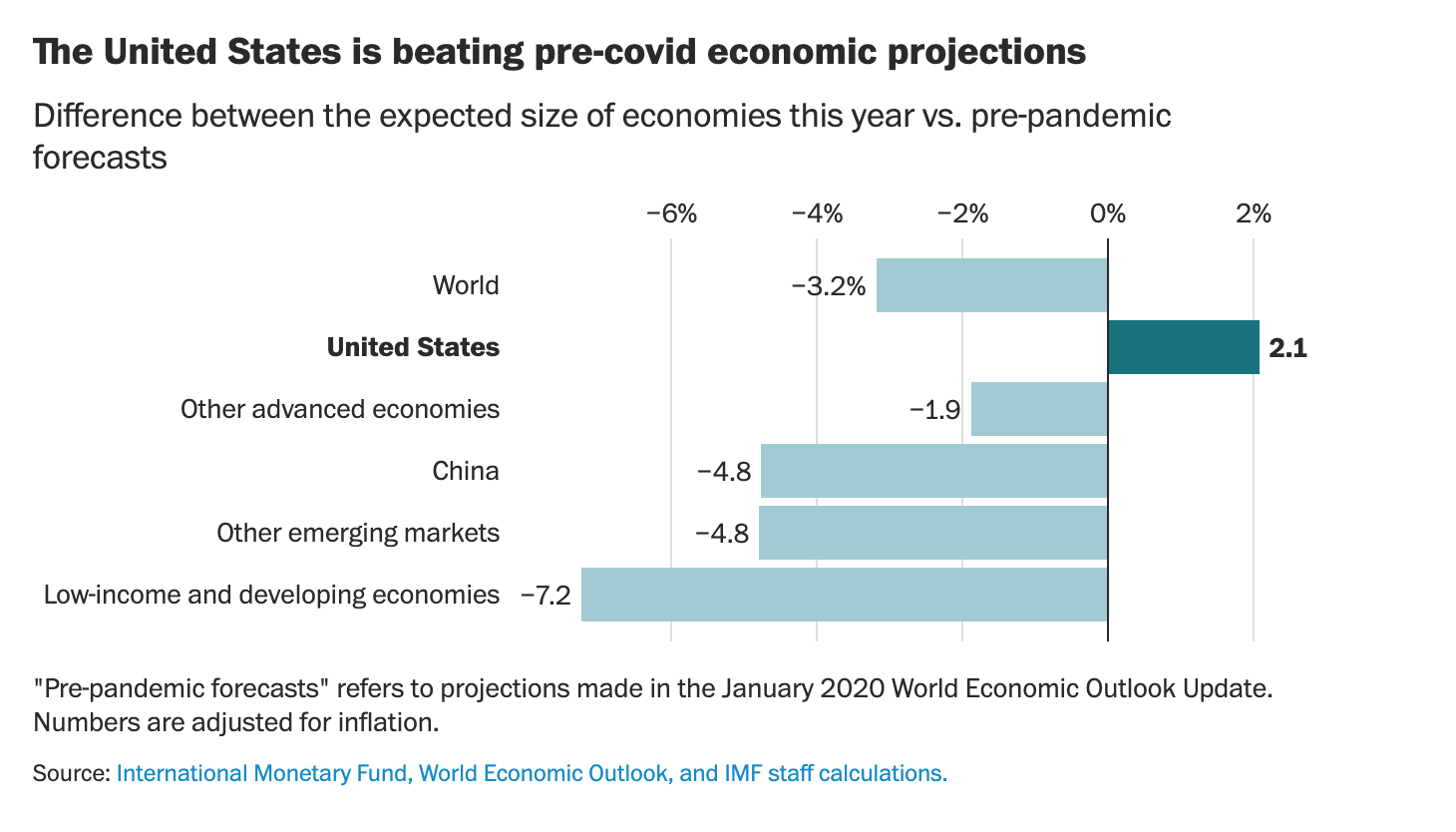
Some other countries would love to have the problems we have — to have so many talented people clamoring to replace retiring boomers (or care for them) and to infuse their economies with new skills, ideas, businesses and drive. The influx of new talent has not only helped us beat recent recession predictions; it’s also helped us best our competitors in Asia and elsewhere, where demographic challenges are dragging on growth. The U.S. economy is one of the only places in the world right now that is doing even better than expected before the pandemic began.

And, if current immigration trends continue — which they might not, depending who wins in November — immigration is likely to boost our fortunes in the years ahead: The Congressional Budget Office recently revised upward its 10-year gross domestic product projections by $7 trillion, attributing the increase to immigration-driven labor force growth. Our longer-term fiscal challenges also look better, since immigrants pay taxes and are much less likely than native-born Americans to (ever) qualify for benefits, including programs such as Medicare and Social Security.

Yet, somehow, the Trumpy right argues that greedy, freeloading immigrants are simultaneously stealing both our jobs and our precious tax dollars. In reality, they’re beefing up both.

Ohio has experienced population decline but one city is growing: Columbus. Peter Gill of the Columbus Dispatch explains that new immigrants have fueled population growth and the local economy.

He writes:

Kikandi Lukambo has reinvented himself many times in his life.

After war forced him, his parents and siblings to flee their home in the Congo, he became a tailor, catering to the fashionable ladies of Kampala, the Ugandan capital.

Nearly a decade later, in 2015, the U.S. Refugee Admissions Program resettled Lukambo in Columbus. He quickly found a job with a perfume manufacturer, then at a distribution warehouse.

Recently, he founded a transportation business that shuttles other immigrant workers — including people from Somalia, Afghanistan, Syria and elsewhere — to and from their workplaces in Greater Columbus.

Sitting in Kivu Transportation Services’ small office in the Northland neighborhood recently, Lukambo, 37, spoke of his gratitude for the opportunities Ohio has afforded him.

“(Ohio) has a very good reputation of employment,” he said. “We have the best life here.”

Lukambo, who became an American citizen in 2022, also found love locally. Four months ago, he and his fiancée Wedny Dauphin, an immigrant from Haiti, became parents to a baby boy.

Foreign-born people like Lukambo and Dauphin have been essential to Columbus’ population growth and economy in recent years, according to new government data and local economists.  

Because native-born Americans are having fewer children and are moving away from Ohio, the state’s population shrunk by about 13,000 between mid-2020 and mid-2023. But it would have shrunk by about 61,000 more if it weren’t for the flow of immigrants moving in, according to Census Bureau estimates.

In Columbus — Ohio’s fastest-growing metro area— international immigrants accounted for more than half of the population growth over the three years, according to the bureau

This includes everyone from refugees like Lukambo to high-skill workers on H-1B visas, people admitted based on family ties and undocumented individuals. Franklin County’s largest foreign-born groups come from Asia, followed by Africa and then Latin America.

Mark Partridge, an urban economist at Ohio State University, told The Dispatch that population expansion comes with certain growing pains, such as greater demand for housing and public services like schools. 

But he said immigrant-driven population growth is a “first-order factor” benefitting the region’s economy — in contrast to shrinking cities like Youngstown, where relatively few immigrants settle.

“Population growth drives demand for businesses. … And (likewise), population growth (increases) the supply of workers that firms want to hire,” he said.

“It’s easy to scapegoat immigrants. … However, if it wasn’t for immigration in a state that struggles retaining population like Ohio, we would have much faster population loss. Once you start losing population, it’s pretty easy to turn into a vicious cycle downward.”

Lukambo had never driven a car before moving to the U.S. nine years ago. Soon after arrival, he and his brother paid another Congolese refugee $1,000 to teach them how to drive so they could get to work, he said.

While his job at a warehouse provided some stability, Lukambo dreamed of starting his own business. At first, he thought of starting a language school for other immigrants, since he speaks English fluently. But then he realized that very few of his potential students would have a means of transportation to get to class. This insight led him to start the transportation company, which now has contracts with a sawmill in Newark, the refugee resettlement agency Jewish Family Services and elsewhere.

Lukambo and Dauphin drive vans for their company while also working other jobs — Lukambo is a weekend supervisor at a Macy’s warehouse in Groveport, and Dauphin works for Cheryl’s Cookies in Westerville.

“I don’t really take time off,” Lukambo, who works seven days a week, said with a chuckle.

Bill LaFayette, an economist who owns the local consulting firm Regionomics, told The Dispatch that immigrants are good for the economy in part because Columbus-area firms are in desperate need of workers.

“Our employment growth has been somewhat stunted since mid-2022, just because there aren’t enough workers,” LaFayette said. “(Immigrants) tend to be younger than the population as a whole, and they tend to be more likely in the labor force.”

LaFayette said that immigrants are also significantly more likely than native-born people to become entrepreneurs.  

“My guess is that (is because) they have pulled up stakes and moved to a completely different part of the world, and they are inherently risk-takers,” he said.

He pointed to Morse Road as an area with an abundance of immigrant-owned businesses, which he said retain a greater percentage of their sales revenue within the local economy than national chains.

Studies also show that immigrants are a boon to the local tax base.

In 2019, immigrants in the Columbus metro area paid $712.4 million in state and local taxes, according to a study commissioned by the city of Columbus and Franklin County.

And a new study by the U.S. Department of Health and Human Services found that refugees and asylees contribute more on average in tax revenue than they cost in expenditures to federal, state and local governments.

LaFayette said immigrants contribute to the growing demand for affordable housing in Columbus, but this is an inevitable byproduct of economic growth — no matter where workers are coming from.

“Whether you come from Cleveland or Calcutta, you still need a place to live,” he said.

Skeptics of immigration sometimes raise concerns about immigrants taking jobs away from native-born people, but LaFayette said this is not a concern in central Ohio, at least not right now.

“Our unemployment rate’s barely above 3%. … All you’ve got is pretty much frictional unemployment — people going from one job to another,” he said. “We need everybody we can get.”

Another criticism is that even if immigrants do not take jobs away from native-born Americans, by expanding the labor pool, they can drive down wages in certain fields

Partridge, the Ohio State professor, said economists still debate the size of this effect, though most agree it is small. He believes that low-wage workers are most affected, but “it’s not a massive effect.” On the other hand, he said immigrants often come up with innovations or insights that help firms expand into markets abroad — boosting wages for high-skill workers.

As Columbus’ foreign-born population continues to grow, Lukambo hopes to expand his business by partnering with more employers and by offering driving classes for newly arrived immigrants.

“I’m under obligation to help other people — because I don’t like to see people struggling the way I struggled with at the beginning when I came here,” he said.

Lukambo said many of his relatives and friends from his refugee camp in Uganda resettled elsewhere in the U.S. But when they come to visit Columbus, he makes the pitch for them to relocate here — which, increasingly, they accept.

“(Congolese) people used to say, ‘Ohio is like a village. Ohio is not a really good state.’ But with time … a lot of refugees and a lot of immigrants are coming here. … With the economy, you can be at least successful with one job, and you manage your time and you feel like you are having a good life,” he said.

“Ohio is growing.”

Peter Gill covers immigration and new American communities for The Dispatch in partnership with Report for America. You can support work like his with a tax-deductible donation to Report for America here:bit.ly/3fNsGaZ.

pgill@dispatch.com

@pitaarji

In 1958, Senator John F. Kennedy of Massachusetts published a book titled A Nation of Immigrants. During the years of the Soviet Union’s existence, politicians liked to point out that Communist nations locked their borders to keep people from moving out, while we welcomed those who managed to escape from Communism. It may be hard to remember in a climate where immigrants are demonized and called rapists and murderers, but our nation used to boast of its immigrant heritage.

In this article, Heather Cox Richardson reflects on that heritage and points out that the Republican Party championed immigration. She does not mention the immigration restriction acts of the late 19th and early 20th centuries, which excluded or limited admission of Asians, Italians, Russians, Poles, and others who were not Northern Europeans (Nordics).

In the past days, we have learned that the six maintenance workers killed when the bridge collapsed were all immigrants, natives of Mexico, Honduras, Guatemala, and El Salvador. Around 39% of the workforce in the construction industry around Baltimore and Washington, D.C., about 130,000 people, are immigrants, Scott Dance and María Luisa Paúl reported in the Washington Post yesterday. 

Some of the men were undocumented, and all of them were family men who sent money back to their home countries, as well. From Honduras, the nephew of one of the men killed told the Associated Press, “The kind of work he did is what people born in the U.S. won’t do. People like him travel there with a dream. They don’t want to break anything or take anything.”  

In the Philadelphia Inquirer today, journalist Will Bunch castigated the right-wing lawmakers and pundits who have whipped up native-born Americans over immigration, calling immigrants sex traffickers and fentanyl dealers, and even “animals.” Bunch illustrated that the reality of what was happening on the Francis Scott Key Bridge when it collapsed creates an opportunity to reframe the immigration debate in the United States.

Last month, Catherine Rampell of the Washington Post noted that immigration is a key reason that the United States experienced greater economic growth than any other nation In the wake of the coronavirus pandemic. The surge of immigration that began in 2022 brought to the U.S. working-age people who, Director Phill Swagel of the nonpartisan Congressional Budget Office wrote, are expected to make the U.S. gross domestic product about $7 trillion larger over the ten years from 2023 to 2034 than it would have been otherwise. Those workers will account for about $1 trillion dollars in revenues. 

Curiously, while Republican leaders today are working to outdo each other in their harsh opposition to immigration, it was actually the leaders of the original Republican Party who recognized the power of immigrants to build the country and articulated an economic justification for increased immigration during the nation’s first major anti-immigrant period. 

The United States had always been a nation of immigrants, but in the 1840s the failure of the potato crop in Ireland sent at least half a million Irish immigrants to the United States. As they moved into urban ports on the East Coast, especially in Massachusetts and New York, native-born Americans turned against them as competitors for jobs.

The 1850s saw a similar anti-immigrant fury in the new state of California. After the discovery of gold there in 1848, native-born Americans—the so-called Forty Niners—moved to the West Coast. They had no intention of sharing the riches they expected to find. The Indigenous people who lived there had no right to the land under which gold lay, native-born men thought; nor did the Mexicans whose government had sold the land to the U.S. in 1848; nor did the Chileans, who came with mining skills that made them powerful competitors. Above all, native-born Americans resented the Chinese miners who came to work in order to send money home to a land devastated by the first Opium War.

Democrats and the new anti-immigrant American Party (more popularly known as the “Know Nothings” because members claimed to know nothing about the party) turned against the new immigrants, seeing them as competition that would drive down wages. In the 1850s, Know Nothing officials in Massachusetts persecuted Catholics and deported Irish immigrants they believed were paupers. In California the state legislature placed a monthly tax on Mexican and Chinese miners, made unemployment a crime, took from Chinese men the right to testify in court, and finally tried to stop Chinese immigration altogether by taxing shipmasters $50 for each Chinese immigrant they brought.   

When the Republicans organized in the 1850s, they saw society differently than the Democrats and the Know Nothings. They argued that society was not made up of a struggle over a limited economic pie, but rather that hardworking individuals would create more than they could consume, thus producing capital that would make the economy grow. The more people a nation had, the stronger it would be.

In 1860 the new party took a stand against the new laws that discriminated against immigrants. Immigrants’ rights should not be “abridged or impaired,” the delegates to its convention declared, adding that they were “in favor of giving a full and efficient protection to the rights of all classes of citizens, whether native or naturalized, both at home and abroad.”

Republicans’ support for immigration only increased during the Civil War. In contrast to the southern enslavers, they wanted to fill the land with people who supported freedom. As one poorly educated man wrote to his senator, “Protect Emegration and that will protect the Territories to Freedom.”

Republicans also wanted to bring as many workers to the country as possible to increase economic development. The war created a huge demand for agricultural products to feed the troops. At the same time, a terrible drought in Europe meant there was money to be made exporting grain. But the war was draining men to the battlefields of Stone’s River and Gettysburg and to the growing U.S. Navy, leaving farmers with fewer and fewer hands to work the land. 

By 1864, Republicans were so strongly in favor of immigration that Congress passed “an Act to Encourage Immigration.” The law permitted immigrants to borrow against future homesteads to fund their voyage to the U.S., appropriated money to provide for impoverished immigrants upon their arrival, and, to undercut Democrats’ accusations that they were simply trying to find men to throw into the grinding war, guaranteed that no immigrant could be drafted until he announced his intention of becoming a citizen. 

Support for immigration has waxed and waned repeatedly since then, but as recently as 1989, Republican president Ronald Reagan said: “We lead the world because, unique among nations, we draw our people—our strength—from every country and every corner of the world. And by doing so we continuously renew and enrich our nation…. Thanks to each wave of new arrivals to this land of opportunity, we’re a nation forever young, forever bursting with energy and new ideas, and always on the cutting edge, always leading the world to the next frontier. This quality is vital to our future as a nation. If we ever closed the door to new Americans, our leadership in the world would soon be lost.”

The workers who died in the bridge collapse on Tuesday “were not ‘poisoning the blood of our country,’” Will Bunch wrote, quoting Trump; “they were replenishing it…. They may have been born all over the continent, but when these men plunged into our waters on Tuesday, they died as Americans.”