Archives for category: Gates Foundation, Bill Gates

Carol Burris, executive director of the Network for Public Education, points out that the once promising charter school industry is now in decline. Fifteen years ago, promoters of charter schools boasted of charter school miracles, of closing achievement gaps and saving poor kids who were “stuck in failing public schools.”

The charter industry lobby won federal funding for charter school expansion. Bill Gates put millions into charters and subsidized a propaganda film to sell the public on the remarkable success of privately run charter schools.

But the miracle dissolved. Some of the “best” charters were selecting their students carefully and/or dropping students who fell behind. Many charters failed. Others folded. Some closed because of low enrollment. Some closed because their owners were corrupt. it’s not a lack of money. The federal government is now pouring $500 million every year into charter growth.

The movement is in decline because the magic is gone.

Carol Burris wrote about the decline of the charter industry in The Progressive:

Thirty years ago, charter schools stood for possibility. At their inception in the 1990s, they were supposed to be nimble, innovative, community-driven alternatives to traditional public schools—labs of experimentation led by teachers and grounded in equity. But in 2025, the movement finds itself at a turning point, not because it succeeded, but because it strayed too far from its original vision.

The first installment of a new report, titled “Charter School Reckoning: Decline, Disillusionment, and Cost,” by the National Center for Charter School Accountability (NCCSA) lays bare a system in decline. Closures are accelerating. Enrollment is stagnating. And beneath the rhetoric of “choice” and “opportunity,” a harsh reality has emerged: a sector in retreat, propped up by unchecked federal funding and powerful lobbying interests.

In the first six months of 2025 alone, fifty charter schools announced their closures. Some disappeared with less than a week’s warning. These schools join more than 160 others that vanished during the previous year. Between school years 2022-23 and 2023-24, the number of charter schools in the United States increased by only eleven. Last September, North Carolina’s Apprentice Academy closed days after opening for the school year. Ohio’s Victory Charter gave families two weeks’ notice. In Minnesota and Texas, charter schools folded before winter break. And last month, just weeks before the new school year was set to begin, yet another charter school in Colorado closed its doors. 

And yet, federal investment in the charter school industry hasn’t skipped a beat. The U.S. Department of Education’s Charter Schools Program (CSP), created in 1994 to provide seed money to start charter schools, began with a modest $4.5 million. It now burns through half a billion taxpayer dollars a year. Much of that money is awarded by private contractors who are paid to review applications who provide minimal vetting. Their decisions are based solely on what’s written in grant applications—inviting exaggerated claims and even fiction. One 2022 federal audit found that nearly half the schools promised by Charter Management Organization grant recipients never materialized.

Even more troubling, many of the charter schools that have opened with the help of CSP funding have collapsed. The NCCSA report notes that of the fifty closures so far in 2025, nearly half had received a combined $102 million in federal start-up and expansion grants, according to a search of U.S. Department of Education and state databases.

So why does the funding from the federal government continue to flow? One reason is a myth that refuses to die: the million-student waitlist to get into charter schools. This talking point, originally peddled in 2013 by the National Alliance for Public Charter Schools, resurfaced in June 2025 by U.S. Education Secretary Linda McMahon during a Senate hearing. But the figurewas debunked more than a decade ago.

The stark truth is that demand for charter schools is often overestimated. Low enrollment is the number one reason charters shut down. A 2024 study by NCCSA and the Network for Public Education found that nearly half of all charter school closures between 2022 and 2024 were due to insufficient enrollment. Of the fifty closures in the first half of 2025, twenty-seven cited low enrollment as the primary cause.

Consider Florida’s Village of Excellence Academy, which closed with just one day’s notice in January 2025. Its enrollment had fallen from 230 in 2020 to just seventy-eight students. The school is not an anomaly. In 2023-24, 12 percent of all charter schools enrolled fewer than 100 students. 

Meanwhile, at the other extreme, mega-charters such as Commonwealth Charter Academy (CCA) in Pennsylvania have student populations that are ballooning beyond reason. CCA, a virtual charter school with students across Pennsylvania, now enrolls more than 23,000 students—making it the largest K-12 school in the country. It spent nearly $9 million on advertising in the 2022-23 school year alone and $196 million on real estate since 2020—for a cyber school that delivers its instruction without the need for brick-and-mortar buildings. But student outcomes are dismal: just 11 percent proficiency in English, 4.7 percent proficiency in math, and a graduation rate far below the state average.

Then there’s Highlands Community Charter in California, a school that billed itself as a second chance for adults but instead became a case study in fraud. According to a state audit, Highlands took more than $180 million in funding to which it was not eligible and spent the money inappropriately. The school paid $80,000 for staff to attend a conference at a luxury hotel in Hawaii. Teachers were also employed without proper credentials, often because there was only one teacher for every fifty-one students. Graduation rates were between 2 and 3 percent. Following the audit, the entire board has resigned in disgrace and the state has requested a $180 million reimbursement.

This is not innovation. It’s exploitation of taxpayers and at-risk students.

And yet, federal dollars continue to pour into this shrinking, scandal-prone industry. Policymakers invoke waitlists that don’t exist. Authorizers, who are supposed to oversee charter schools, look the other way, incentivized by per-pupil funding kickbacks. Taxpayers are footing the bill for schools that fail to open, fail to serve, or fail to survive.

The question is no longer what charter schools were once meant to be. It’s whether the sector can be reformed at all. As Congress considers the next education budget, we urge lawmakers to ask: Why are we funding growth that isn’t happening? Why are we subsidizing failure? It’s time to stop chasing the ghost of what charter schools might have been—and start holding the system accountable for what it has become.

Every once in a while, I read an article that is so important and so powerful that I want to give it as much attention as possible. This is such an article. Please read it and share it. Post the link on every social media site. Send it to school board members and journalists.

The article was written by Dr. Maurice Cunningham, a retired Professor of Political Science at the University of Massachusetts. Cunningham has been studying “dark money” in education for years. It was published by “Our Schools” and “Independent Media Institute.”

If you want to understand the attacks on public schools, on teachers, and on teachers’ unions, read this article. If you want to understand how the organized groups that smear public schools got started, read this article. If you read a story about two or three “moms” sitting around their kitchen table and worrying whether the teachers at the local public school are indoctrinating their children, read this article. If those “moms” raised over $1 million in their first year, read this article.

They have fooled many journalists. Don’t let them fool you!

Cunningham warns:

“These groups are the creation of deep-pocketed conservative networks, not “grassroots” advocates.

By Maurice Cunningham

“If your mother says she loves you, check it out” is a bromide drilled into every journalist. So it is baffling why, if an interest group includes the words “moms” or “parents,” it is just taken at its word, especially when a little digging can reveal that many of these groups are the creations of billionaires out to destroy public education.

As the author of Dark Money and the Politics of School Privatization, I have been following billionaire-backed education interest groups for more than a decade. Since big money lacks public credibility, it often masquerades as organizations claiming to represent the interests of “parents,” “moms,” “educators,” and “families.” The concocted stories about how these groups were created are often repeated by an incurious press, which misses the opportunity to tell its readers a more interesting story: how billionaires and right-wing activists pour money into upbeat-sounding organizations to further their aim of privateering our public school system.

These astroturf operations have been proliferating resulting in serious negative impacts. Consider the havoc wreaked on some school boards by Moms for Liberty (M4L). M4L even got into presidential politics in 2024, boosting Donald Trump, at the behest of the donors, who co-founder Tina Descovich termed as M4L’s “investors.”

Consider a November 2024 Washington Post story on Linda McMahon’s nomination to be secretary of education. The article contrasted remarks from National Education Association (NEA) President Becky Pringle with an alternative view from Keri Rodrigues, founding president of the National Parents Union (NPU), which the reporter Laura Meckler called “a grassroots group,” thus giving the impression that NEA and NPU are similar organizations.

They are not. NEA is a well-established teachers’ union that credibly claims 3 million members and is governed by a democratic structure. NPU appeared on the scene in 2020, surfing in on millions of dollars from the foundations of American oligarchs, including the Walton family, Mark Zuckerberg, and Charles Koch.

In 2024, Rodrigues, a fixture at education privateering groups, told the Boston Globe that NPU could get its message to “250,000 families to vote against” a ballot question sponsored by the teachers’ union and would “put that network to work.”

There is zero evidence that this extensive network exists or that it did anything on the ballot question. There is also no proof to validate Rodrigues’s claimthat the organization has 1.7 million members nationally.

A 2021 Washington Post article introducing Moms for Liberty chronicled its claimed rapid rise without raising questions about how it grew so fast. The story simply provided the M4L narrative of its creation story, centered around former Florida school board members Descovich and Tiffany Justice. It omitted M4L’s third co-founder Bridget Ziegler, though it did quote her husband, Christian Ziegler, about the group’s political potency.

Bridget Ziegler served briefly on the M4L board and was replaced by GOP campaign consultant Marie Rogerson. Christian Ziegler was then the powerful vice-chair of the Florida Republican Party and a key Trump supporter. (In 2023, the Zieglers became famous for a threesome scandal. She quickly resigned from her executive position with the Leadership Institute, an established training institution for right-wing activists. Christian was removed from his perch as chair of the Florida Republican Party.)

The Post October 2021 story featured a photo of Descovich pulling aside, Superman style, a white jacket to reveal the group’s logo t-shirt while posing next to an American flag. The questions about the group’s ties to the Republican Party and suspicious financing were laughed off by the founders of M4L. The Post followed up a month later by printing an op-ed by Descovich and Justice.

NPU, M4L, and similar groups organize as nonprofit corporations under sections 501(c)(3) and 501(c)(4) of the Internal Revenue Service Code. As nonprofits, their Form 990 tax returns are made public but only in November, following the tax year. The information is skimpy but valuable. Journalists can access the Form 990s by requesting them directly from the nonprofits or from the ProPublica Nonprofit Explorer, which helps trace donors as well.

These groups leave clues that no reporter can miss:

  1. Don’t buy the phony origin stories: These organizations all claim to be about moms joining together to improve education. But in no time, they have access to millions of dollars in donations and have the services of elite law firms, pollsters, media consultants, and often, ties to the Republican Party.
  2. Follow the money: It isn’t easy in the first two years of a nonprofit’s existence, but there are signs: easy access to right-wing media, hiring expensive consultants, and big-budget conferences.
  3. Watch how these groups work: The founding leadership usually consists of veteran right-wing operatives or communications professionals with years of experience in privateering organizations.
  4. Get the big picture: Right from the beginning, M4L had obvious ties to Republican and right-wing organizations that often went unreported.
  5. Keep following the money: When nonprofit tax forms finally become public, they’ll reveal how much was donated and can help identify the top contractors and how much they were paid.

Let us expand on these insights to show how these secretive operations can be exposed right from the beginning by using Form 990.

Don’t Buy the Phony Origin Stories

The typical “moms” or “parents” creation story goes something like this: outraged by some aspect of their children’s public school education, two or three “moms” band together to attract other like-minded parents to cure the deficiencies of the system, which are always the fault of the teachers’ unions. In truth, the “moms” are agents of far-right billionaires often tied—like M4L and Parents Defending Education (PDE)—to the secretive Council for National Policy, which seeksto privateer K-12 for profit, expand Christian education, and promote homeschooling.

According to the billionaire-funded online publication the 74, NPU “is the brainchild of two Latina mothers,” Keri Rodrigues and Alma Marquez, who “had disappointing experiences with education, both as parents and students, and with advocacy groups.”

To its credit, the 74 was candid about the funding of NPU: the foundations of billionaires, including Bill Gates, the Walton family, the late Eli Broad, and Michael and Susan Dell, and organizations like the City Fund, which gets its money from Reed Hastings, John Arnold, and Walton family members, inheritors of the Walmart fortune.

Nonetheless, the tenor of the story was of a grassroots moms’ start-up. Other news outlets ignored the 74’s detailing of billionaire funding. An online search through the New York Times website supplemented with a library search through Gale OneFile showed 13 NYT stories or columns that mention the National Parents Union since the group’s public launch on January 1, 2021. Only one column by Michelle Goldberg noted that “The National Parents Union is funded by the pro-privatization Walton Family Foundation.” The Waltons are, however, the only funders Goldberg mentioned.

The New Yorker came closest to the truth in a June 2021 piece: “The Walton foundation set up the National Parents Union in January 2020, with Rodrigues as the founding president.” A review of Form 990s for NPU and the Walton Family Foundation from 2020 through 2023 that I reviewed shows that NPU accepted more than $11 million in contributions. The Walton Family Foundation donated around $3 million of that amount.

The media is failing to cover the single most important fact the public needs to know about “parents” and “moms” groups: who is supplying them with millions of dollars in funding.

As for M4L, although a few media outlets wrote it had three founders, most followed the practice of CNN, which in December 2021 omitted Bridget Ziegler and described “the two women behind Moms for Liberty, a group of conservatives that came together in January,” downplaying the fact that at that time, the state GOP vice-chair’s wife was also one of the co-founders. By January 9, 2021, soon after its incorporation, M4L’s online store was offering magnets, t-shirts, and hats, and a “Madison Meetup” package of right-wing materials.

While mainstream media was valorizing M4L’s origin story, right-wing outlets produced a steady stream of propaganda about the organization. Later in January 2021, Descovich appeared on the Rush Limbaugh Show (guest-hosted by Todd Herman). Media Matters for America found that, by July 2022, M4L “representatives have been regulars on right-wing media, appearing on Fox News at least 16 times and Steve Bannon’s “War Room” at least 14 times.”

Another supposedly grassroots parents’ group that has an origin story grounded in deception is PDE. In lodging a civil rights complaint against the Columbus, Ohio, public schools in May 2021, PDE President Nicole Neily told the Columbus (Ohio) Dispatch, “We just all work from home… We’re all working moms.”

In fact, Neily is a well-compensated political operativein the Koch network. According to the Koch-connected Speech First’s Form 990 for 2019, which was available after November 2020 and thus before PDE was founded in 2021, Neily was paid $150,000 in 2019.

Follow the Money

Due to the barriers to tracing the funding of such groups, it can be hard to follow the money, especially in the first two years of operation. But in 2021, an article in the New Yorker described how the VELA Education Fund, a partnership of the Walton Family Foundation and the Charles Koch Institute, had given NPU $700,000 in 2020 to “help people with fewer resources,” including promoting homeschooling during COVID-19. This is despite the fact that NPU was not familiar with homeschooling.

Press outlets have also overlooked funding sources of M4L. In 2021, co-founder Descovich told CNN that M4L had raised more than $300,000 through t-shirt sales, small donors, and fundraising events. However, one such event was a gala featuring former Fox News personality Megyn Kelly in June 2021, six months into M4L’s first year. The top tickets went for $20,000. The Celebrity Speakers Bureau pegged Kelly’s speaking fee as between $50,000 and $100,000. The event raised at least $57,000.

In July 2021, Descovich appeared at a Heritage Foundation virtual town hall on “Preserving American History in Schools.” By October 29, 2021, M4L was referring members to the Leadership Institute for training and sending members to the Heritage Foundation for events and other resources. Both these organizations have been part of the right-wing political firmament since the 1970s. A bit of digging showedthat M4L was deeply embedded in far-right politics. But most press accounts ignored that evidence and the public remained largely in the dark.

In April 2021, PDE headed by Neily, brought on Elizabeth Schultz as a “senior fellow,” who had worked under Trump’s Education Secretary Betsy DeVos during his first term and was a vocal anti-LGBTQ activist.

Watch How These Groups Work

These groups can be intertwined. PDE, M4L, and another faux-grassroots group, No Left Turn in Education (NLTE), all came on the scene around the same time, with NLTE being founded in 2020. PDE’s website includes a map called “IndoctriNation” with lists of affiliates across the nation. The April 15, 2021, listings (the website appears to have gone live only in March 2021) showed that most of its allies were chapters of M4L and NLTE with few actual members, according to my research in 2021.

Media reports seemed content to accept the “moms working from home” creation story despite the obvious early support from well-resourced groups.

NPU held its organizing meeting, which it claims drew representatives from all 50 states, in New Orleans in January 2020. To promote the event, NPU employedMercury Public Affairs, an international public relations firm. To draw press attention, NPU also commissioned polling from Echelon Insights, a Republican pollster that has also worked for the Walton family.

In the same year of its founding, in 2021, PDE published detailed plans, such as “How to Create ‘Woke At’ Pages,” that instruct parents on how to use secrecy to attack “woke activists” in the education system. PDE also began initiating lawsuits against local school boards, represented by the Republican law firm of Consovoy McCarthy.

William Consovoy, who passed in 2023, was in the Federalist Society, the nationwide network of conservative lawyers that helped form Trump’s picks for the U.S. Supreme Court. Consovoy had been a law clerk to Justice Clarence Thomas and represented Donald Trump during a congressional investigation. The firm also represented Trump in 2020 as he tried to intervene before the Supreme Court to stop the vote count in Pennsylvania. When PDE’s 2021 Form 990became available, it showed PDE paid Consovoy McCarthy $800,000 in legal fees.

Get the Big Picture

The clues kept coming, only to be ignored by the press.

In 2022, M4L held its first national summit in Tampa, Florida. In its reporting of the event, NBC portrayedthe group as a political powerhouse, reporting that attendees “browsed booths set up by conservative groups, including Turning Point USA, the Leadership Institute and Heritage Action, and the evangelical Liberty University” without describing these organizations for what they are—the critical infrastructure of Christian nationalism.

Media reports on the event generally ignored who the sponsors of the summit were or the amounts of their donations. The Leadership Institute donated $50,000. The Heritage Foundation and Heritage Action for America provided $10,000 each. And PDE chipped in $10,000. Meanwhile, Descovich was still peddling the story that M4L was getting by on t-shirt sales, even though an aide to Leadership Institute’s Morton Blackwell bragged about how the institute had provided the relevant training to help the group “become a national force.”

When there were questions raised about how M4L could fund such a lavish event with t-shirt sales, M4L denied any connections to deep-pocketed right-wing groups, and most news reporters presented a simple “he said, she said” account and moved on. Reporters generally missed the bigger story that the institutional right was creating and passing off phony “moms” and “parents” operations.

Keep Following the Money

Once Form 990s were filed, the deception became obvious, but that didn’t mean it got covered by big media outlets.

The 2022 Form 990 for NPU showed that Keri Rodrigues was paid $410,000 from NPU and a sister organization. She paid her husband, the chief operating officer of both organizations, $278,529. Yet, in August 2024, CBS Morning News presented Rodrigues as a typical parent worried about back-to-school shopping.

PDE’s Form 990 for 2021 was even more revealing, as exposed by True North Research’s Lisa Graves and Alyssa Bowen for Truthout in 2023. Graves and Bowen showed that PDE is deeply tied with far-right Supreme Court fixer Leonard Leo, even paying $106,938 to his for-profit consulting firm.

PDE, a brand-new operation, raised $3,178,272 in its first year in 2021. It paid Neily, who is also on the board, a total compensation of $195,688 for her 40-hour work week.

According to Speech First’s Form 990 for 2021, Neily put in an additional 20-hour week for Speech First, earning another $86,117 and a total of $281,805 from both Koch- and Leo-funded operations combined. In 2023, PDE pushed Neily’s base salary and other compensation up to $341,400. This is quite an income for a stay-at-home working mom.

The trail from NPU leads back to the Walton family and billionaire allies who have been working to undermine teachers’ unions and siphon public money to charter schools for years.

Scratch the surface of groups like M4L and PDE, and you find the Heritage Foundation, the Leadership Institute, and Leonard Leo—the elite of far-right politics who work to replace public schools with for-profit schools, religious schools, and homeschooling. These details make for a very important story that most journalists have overlooked.

Stop Being Fooled

Reporters should not be fooled by the techniques used by these fake “mom” and “parent” groups on behalf of their extremist overseers. As Naomi Oreskes and Erik M. Conway show in Merchants of Doubt: How a Handful of Scientists Obscured the Truth on Issues from Tobacco Smoke to Global Warming, these techniques have been used by “scientific” nonprofits created by the same conservative groups, including the Heritage Foundation, to contest climate change.

Many have tracked the origin of these techniques back to the tobacco industry’s fight to protect their profits from the growing body of research linking their products to cancer and other health problems.

In 1994, tobacco giant RJ Reynolds created the industry front group Get Government Off Our Back to advance a “smokers’ rights” campaign to fight against the tsunami of scientific evidence exposing the health risks of tobacco. Reynolds kept its backing a secret while promoting it as a movement of “grassroots” smokers.

Meanwhile, in his farewell address, former President Joseph R. Biden warned about how the wealthy are a big threat to democracy:

“Today, an oligarchy is taking shape in America of extreme wealth, power, and influence that literally threatens our entire democracy, our basic rights and freedoms, and a fair shot for everyone to get ahead.”

For years, the same oligarchy that threatens basic rights has been threatening our freedom to have access to a high-quality system of public education. There is no reason they should be aided by credulous reporters from trusted news sources. If we can question our moms on whether they really love us, we can question the authenticity of these moms and parent groups.

Maurice Cunningham PhD, JD, retired in 2021 as an associate professor of political science at the College of Liberal Arts, University of Massachusetts, Boston, and is the author of Dark Money and the Politics of School Privatization.
I have frequently criticized Bill Gates for his half-baked efforts to “reform” American public schools, all of which have done terrible damage to the schools.

Now Elon Musk is sticking his nose into elections in other countries, and Bill Gates is calling him out.

This article appeared in Business Insider:

Bill Gates doesn’t like how Elon Musk has involved himself in the politics of foreign countries such as the UK and Germany.

“It’s really insane that he can destabilize the political situations in countries,” Gates said in an interview with the UK newspaper The Times published Saturday.

Musk has become increasingly vocal about his views on UK and German politics in recent weeks.

Earlier this month, Musk called for the removal of British Prime Minister Keir Starmer. The TeslaCEO accused Starmer of not doing enough to prevent the rape of girls when he was Britain’s chief prosecutor from 2008 to 2013.

And on Saturday, Musk spoke virtually at a campaign rally for the Alternative for Germany, Germany’s far-right party. Germany is set to hold national elections in February.

In December, Musk said in an op-ed for Welt am Sonntag, a prominent German newspaper, that the AfD was “the last spark of hope for this country.” He also praised the party for its “controlled immigration policy.”

“I think in the US foreigners aren’t allowed to give money. Other countries maybe should adopt safeguards to make sure superrich foreigners aren’t distorting their elections,” Gates told The Times.

Musk’s political influence has increased significantly following President Donald Trump‘s victory in November. Musk spent at least $277 million backing Trump and other GOP candidates in last year’s elections.

That bet has since paid off for Musk, who called himself Trump’s “first buddy.” The billionaire has joined Trump on calls with world leaderssuch as Turkish President Tayyip Erdogan.

Gates previously criticized Musk for his obsession with going to Mars. Gates said he would rather spend money on vaccines than on rockets. Go, Bill!

If only WE had laws limiting the contributions of billionaires to political campaigns!

Perhaps you remember “Waiting for ‘Superman,'” the overhyped documentary from 2010 that made the audacious claim that public schools were failing due to “bad teachers”and that the only sane alternative was charter schools. The documentary was funded by the Gates Foundation, with the obvious purpose of smearing public schools and promoting charter schools. I reviewed the film in the New York review of Books, in a review called “The Myth of Charter Schools.” Among other flaws in the film, I pointed out that it misused and distorted NAEP data to paint a horrifying picture of public schools. I concluded it was dishonest propaganda on behalf of the privatizers.

One of the amazing, miraculous charter schools featured in the film was a residential boarding school in D.C. called SEED.

Peter Greene writes that SEED is in deep trouble and may be shuttered.

The SEED School of Washington, D.C. was in the Washington Post yesterday, accused of inaccurate records and wholesale breezing past laws that are supposed to protect students with disabilities.

If the name of this unusual charter boarding school seems vaguely familiar, that may be because back in 2010, they were one of the charter schools lovingly lionized by the documentary hit piece, “Waiting for Superman.”

Waiting for Superman” was a big hit, popularizing the neo-liberal narrative that public schools were failing because public school teachers were lazy incompetents. Every damn newspaper in the country jumped on the narrative. Roger Ebert jumped on. Oprah jumped on. NPR wondered why it didn’t get an Oscar (maybe, they posit, it was because one big emotional scene was made up). It helped sustain the celebrity brand of Michelle Rhee (the Kim Kardashian of education, famous despite having not accomplished anything). It was a slanted hatchet job that helped bolster the neoliberal case for Common Core and charter schools and test-centric education and heavy-handed “evaluation” of teachers.

And it boosted the profile of SEED, the DC charter whose secret sauce for student achievement is that it “takes them away from their home environments for five days a week and gives them a host of supporting services.”

Except it turns out that maybe it doesn’t do that after all

According to the WaPo piece, reported by Lauren Lumpkin, audits of the school suggest a variety of mistreatment of students with special needs.

SEED underreported the number of students it expelled last year. It couldn’t produce records of services it was supposed to have provided for some students with disabilities (most likely explanation–those services were never provided). Federal law says that before you expel a student with an IEP, you have meetings to decide if the misbehavior is a feature of their disability, or if their misbehavior stems from requirements of the IEP that are not being provided. 

These have the fancy name of “manifestation determination” which just means the school needs to ask– is the student acting out because that’s what her special situation makes her do, or because the Individualized Education Program that’s supposed to help deal with that special situation is not being actually done. For absurd example– is the student repeatedly late to her class on the second floor because she’s in a wheelchair? Does her IEP call for elevator transport to the second floor, and there’s no elevator in the building? Then maybe don’t suspend her for chronic lateness. 

Founded in 1998, SEED enrolls about 250 students, which seems to preclude any sort of “just lost the details in the crowd” defense. But as Lumpkin reports, questions arose.

But after receiving complaints about discipline, understaffing and compliance with federal law, the city’s charter oversight agency started an audit of the school in July. One complaint claimed school officials had manipulated attendance data and were not recording suspensions.

The audit’s findings sparked scathing commentary from charter board members and questions about SEED D.C.’s practices.

“I’m the parent of a special-needs child, and I’ve got to tell you, reading what was happening in these pages, it’s like a parent’s worst nightmare,” charter board member Nick Rodriguez told SEED D.C. leaders. “I sincerely hope that you will take that seriously as you think about what needs to happen going forward.”

Lumpkin reports that this is not their first round of problems. A 2023 audit found a high number of expulsions and suspensions compared to other charters– five times higher. A cynical person might conclude that SEED addressed the problem by just not reporting the full numbers. Inaccurate data, missed deadlines, skipping legal requirements–that’s a multi-year pattern for the school.

The school is now on a “notice of concern,” a step on the road to losing its charter and being closed down (or I suppose they could just switch over to a private voucher-accepting school).

The whole sad story of the many students who have been ill-served by SEED is one more reminder that there are no miracles in education, and no miracle schools, either. 

Really, you must remember that billionaires have feelings too. So how’s about some sympathy for Bill Gates? Yahoo News reports that he’s slipping down the list of the world’s biggest billionaires, and two of his yachts may be up for sale.

Bill Gates, the co-founder of Microsoft Corp. and a renowned philanthropist, has been slipping down the ranks of the world’s billionaires.

Despite boasting a net worth of nearly $128 billion, Gates is at No. 9 on the Forbes Billionaire Index, a significant drop from his previous position at No. 7 a month ago. This marks his lowest ranking since 1990 when he ranked 16th.

Gates has been recognized not only for his immense wealth but also for his environmental advocacy, which makes his ownership of superyachts somewhat controversial. In 2021, he paid about $25 million for his first superyacht — the Wayfinder, a 224-foot catamaran built by Astilleros Armon. The yacht is designed as a shadow vessel, typically accompanying a larger mothership, which until recently, was not disclosed to the public.

The mothership, referred to as Project 821, is under construction at Feadship. It will be one of the largest and most luxurious yachts the shipyard has built. Slated for delivery in 2024, Project 821 stretches 390 feet with an internal volume exceeding 7,000 gross tonnage (GT).

Details about the yacht have been kept under wraps, but recent leaks reveal that it is on the market for 600 million euros ($642 million). The price tag is significantly higher than previous builds by Feadship, possibly because its unfinished state offers potential buyers a chance to customize the yacht.

Alongside Project 821, the Wayfinder is also listed for sale and was spotted on the charter market earlier this year, suggesting a shift in Gates’s approach to his assets.

The reasons behind the sales are not stated, leading to speculation about his motivations. Some suggest the maintenance and operational costs of the extravagant vessels are impractical, while others speculate that Gates is intensifying his commitment to environmental causes. His past statements have highlighted his awareness of his large carbon footprint, primarily from private flights, and his ongoing efforts to mitigate his environmental impact.

“Although I don’t care where I rank on the list of the world’s richest people, I do know that as I succeed in giving, I will drop down and eventually off the list altogether,” Gates wrote in a 2022 Gates Notes blog post reinforcing his commitment to philanthropy.

This aligns with his long-standing goal of donating most of his wealth to the Bill & Melinda Gates Foundation.

These moves could signify a deeper alignment of Gates’s lifestyle with his public advocacy for sustainability and reduced consumption. Selling the yachts might be seen as Gates setting an example of reducing luxury consumption to lessen his environmental impact, reinforcing his credibility as a climate activist amid growing global concern over climate change.

What a grand role model for other billionaires! I wonder how many yachts he owns. Last I heard, Betsy DeVos owns 10. How I wish she would go into environmental activism.

But don’t feel too bad for Bill. He has a fleet of private jets and Porsches.

Given Bill’s newly modest lifestyle, I hope he devotes all his energy and philanthropy to environmental causes and public health. And recognizes the failure of his forays into education policy.

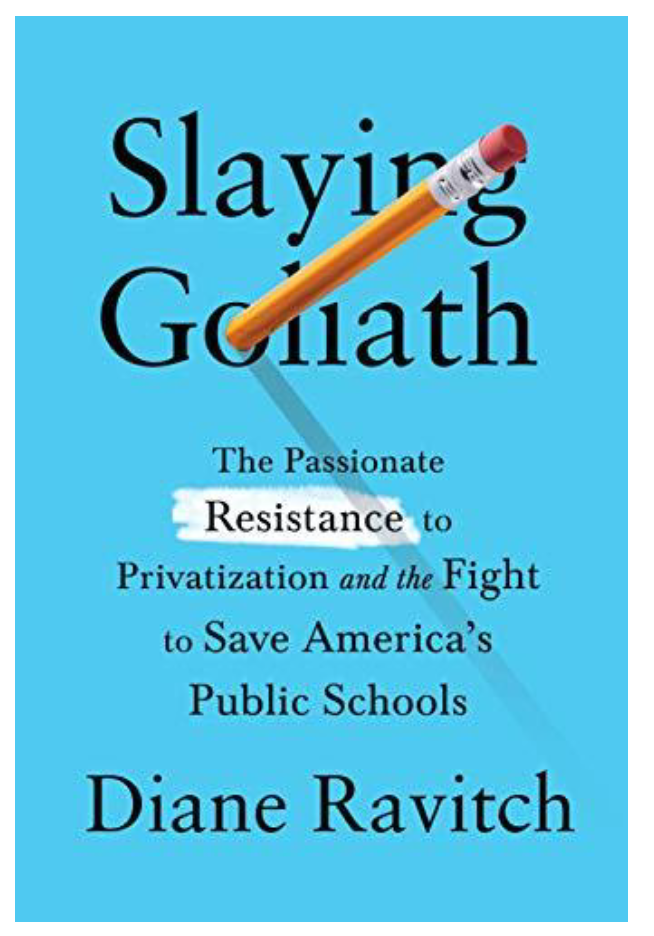
I am almost four years late in discovering this review by two scholars for whom I have the greatest respect: David C. Berliner and Gene V. Glass.

I was happy to read this review because Slaying Goliath had a checkered fate. It was published in mid-January 2020. I went on a book tour, starting in Seattle. By mid-February, I made my last stop in West Virginia, where I met with teachers and celebrated the two-year anniversary of their strike, which shut down every school in the state.

As I traveled, news emerged of a dangerous “flu” that was rapidly spreading. It was COVID; by mid-March, the country was shutting down. No one wanted to read about the fight to save public schools or about its heroes. The news shifted, as it should have, to the panicked response to COVID, to the deaths of good people, to the overwhelmed hospitals and their overworked staff.

To make matters worse, the New York Times Book Review published a very negative review by someone who admired the “education reform” movement that I criticized. I thought of writing a letter to the editor but quickly dropped the idea. I wrote and rewrote my response to the review in my head, but not on paper.

Then, again by happenstance, I discovered that Bob Shepherd had reviewed the review of my book in The New York Times. He said everything that I wish I could have said but didn’t. His review was balm for my soul. Shepherd lacerated the tone and substance of the review, calling it an “uniformed, vituperative, shallow, amateurish ‘review.’” Which it was. His review of the review was so powerful that I will post it next.

Then, a few weeks ago, I found this review by Berliner and Glass.

The review begins:

Reviewed by Gene V Glass and David C. Berliner Arizona State University, United States

They wrote:

In a Post-Truth era, one must consider the source. 

In this case, the source is Diane Rose Silvers, the third of eight children of Walter Silverstein, a high school drop-out, and Ann Katz, a high school graduate. The Silvers were a middle-class Houston family, proprietors of a liquor store, and loyal supporters of FDR.

After graduation from San Jacinto High School, she enrolled in Wellesley College in September, 1956. Working as a “copy boy”for the Washington Post, Diane met Richard Ravitch, a lawyer working in the federal government and son of a prominent New York City family. They married on June 26,1960, in Houston, two weeks after Diane’s graduation from Wellesley. The couple settled in New York City, where Richard took employment in the family construction business. He eventually served as head of the Metropolitan Transit Authority and Lieutenant Governor in the 2000s, having been appointed by Democratic Governor David Paterson.

 Diane bore three sons, two of whom survived to adulthood. Diane and Richard ended their 26-year marriage in 1986. She had not been idle. For a period starting in 1961, Diane was employed by The New Leader, a liberal, anti-communist journal. She later earned a PhD in history of education from Columbia in 1975 under the mentorship of Lawrence Cremin.

Diane was appointed to the office of Assistant Secretary of Education, in the Department of Education by George H. W. Bush and later by Bill Clinton. In 1997, Clinton appointed her to the National Assessment Governing Board (NAGB), on which she served until 2004. 

Ravitch worked “… for many years in some of the nation’s leading conservative think tanks.

Read the full pdf here.

Back in 2010, Secretary of Education Arne Duncan rolled out his Race to the Top program to reform American education. The U.S. Department of Education offered a total of $5 billion to states. To be eligible to compete for a part of the huge prize money, states had to agree to authorize charter schools, to adopt the Common Core (not yet finished), and to evaluate teachers based on the test scores of their students.

The requirement to change teacher evaluation was heated. Duncan scoffed at critics, saying they were trying to protect bad teachers and didn’t want to know the truth.

Debate over this methodology was heated.

I was part of a group of education scholars who denounced this method of evaluating teachers in 2010.

In 2012, three noted scholars claimed that teachers who raised test scores raised students’ lifetime incomes; President Obama cited this study, led by Harvard economist Raj Chetty, in his State of the Union address. It seemed to be settled wisdom that teachers who raised test scores were great, and teachers who did not should be ousted.

In 2014, the American Statistical Association warned about the danger of evaluating teachers by the test scores of their students. The ASA statement said that most studies of this method find that teachers account for 1-14% of the variation in test scores. The greatest opportunity for improvement, they said, was to be found in system-level changes.

The Gates Foundation poured hundreds of millions of dollars into districts willing to test value-added methodology, and eventually gave up. Teachers were demoralized, teachers avoided teaching in low-income districts. Overall improvements were hard to find.

Arne Duncan was a true believer, as was his successor, John King, and they never were willing to admit failure.

Teachers never liked VAM. They knew that it encouraged teaching to the test. They knew that teachers in affluent districts would get higher scores than those in less fortunate districts. Sometimes they sued and won. But in most states, teachers continued to be evaluated in part by their students’ scores.

But in New York state, the era of VAM is finished. Dr. Betty Rosa, the chancellor of the New York State Board of Regents, reached an agreement with Melinda Person, president of New York State United Teachers, to draft a new way of evaluating teachers that moves away from students’ standardized test scores.

New York state education leaders and the teachers’ union have announced an agreement to change how New York school teachers and principals are evaluated, and move away from the mandated reliance on standardized test scores.

State Education Department Commissioner Betty Rosa and New York State United Teachers President Melinda Person hand-delivered their drafted legislation Wednesday to lawmakers to create a new system that doesn’t use students’ test performance to penalize educators. The state teacher evaluation system, known as the Annual Professional Performance Review, or APPR, was modified in the 2015 budget to place a greater importance on scores.

“It’s connecting research to practice and developing strategies to ensure that teachers have the best tools and principals to make sure our young people are getting the best quality education,” Rosa told reporters Wednesday in the Legislative Office Building.

When NYSUT elected president Person last year, she said her first task was to change the teacher evaluation system, and state lawmakers said with confidence Wednesday it will happen this session.

The proposed law, which has not officially been introduced in the Legislature, would remove the requirement to base evaluations on high-stakes tests. School districts would have eight years to transition, but could make the changes faster than the required deadline.

Person argued it will support new teachers who are often burdened by the required paperwork under the current model.

“This would be a fair and a just system that would support them in becoming better educators, which is ultimately what they want to do anyway,” Person said.

The proposal was negotiated in agreement with state superintendents, principals, school boards, the PTA, Conference of Big 5 School Districts and other stakeholders. The issue has been contentious for union and education leaders for years, and both state Education Committee chairs in the Legislature said they’re thrilled with the agreement. 

“That’s such a nice thing in Albany,” said Senate Education chair Shelley Mayer, a Democrat from Yonkers. “Who can do that? Who gets agreement? It’s very hard around here.

“It takes a woman to do it,” Assembly Education chair Michael Benedetto replied with a smile.

Benedetto, a Bronx Democrat, was a classroom teacher for decades and recalled how feedback helps educators develop when done in the proper way.

“It’s like anything else — we want stability in our lives, we want to know where we’re going, how we’re going to be rated and what we’re going to be rated on, as a teacher, as a professional,” the assemblyman said.

Lawmakers will review the proposal and draft legislation in the coming weeks.

Remembering how strident were the supporters of VAM, it’s kind of wonderful to hear the collective sigh of relief in Albany as it fades away.

Bob Shepherd, author, editor, assessment developer, story-teller, and teacher, read a book that he loved. He hopes—and I hope—that you will love it too.

He writes:

Like much of Europe between 1939 and 1945, education in the United States, at every level, is now under occupation. The occupation is led by Bill Gates and the Gates Foundation and abetted by countless collaborators like those paid by Gates to create the puerile and failed Common Core (which was not core—that is, central, key, or foundational—and was common only in the sense of being vulgar. The bean counting under the occupation via its demonstrably invalid, pseudoscientific testing regime has made of schooling in the U.S. a diminished thing, with debased and devolved test preppy curricula (teaching materials) and pedagogy (teaching methods).

In the midst of this, Gayle Greene, a renowned Shakespeare scholar and Professor Emerita at Scripps University, has engaged in some delightful bomb throwing for the Resistance. Her weapon? A new book called Immeasurable Outcomes: Teaching Shakespeare in the Age of the Algorithm.

OK. Maybe I’ve pushed the occupation/resistance metaphor to the edge of its usefulness. Let’s try another. If Gates’s test-and-punish movement, ludicrously called “Education Reform,” is a metastasizing cancer on our educational system, and it is, then Professor Greene’s book is a prescription for how to reverse course and then practice prevention to end the stultification of education and keep it from coming back. The book is a full-throated defense of the Liberal Arts and of traditional, humane, in-person, discussion-based education in a time when Liberal Arts schools and programs are being more than decimated, are being damned-near destroyed by bean counters and champions of ed tech. Here’s the beauty and value of this book: contra the “Reformers,” Greene details the extraordinary benefits of the broad, liberal educations that built in the United States people capable of creating the most powerful, vibrant, and diverse economy in history. She makes the case (I know. It’s bizarre that one would have to) for not taking a wrecking ball to what has worked. And best of all, she does so not at some high level of abstraction, but backs up any generalizations with concrete, vivid, fascinating, moving, delightful examples from her classrooms. How do you build a world-class human? Well, you give him or her the benefits of a broad, humane, liberal arts education that confers judgment, wisdom, vision, and generosity. Greene shows us, from her own classes over three decades, exactly how that happens.

And she shows us how, under the “standards”-and-testing occupation, all that is being lost.

Years ago, I knew a fellow who retired after a lucrative, successful career. But a couple months later, he was back at his old job. I asked him why he had decided not simply to enjoy his retirement. He certainly had the money to do so.

“Well, Bob,” he said, “there’s only so much playing solitaire one can do.”

I found this answer depressing. I wondered if it were the case that over the years, the fellow had given so much time to work that when he no longer had that to occupy him, he was bored to tears. Had he not built up the internal resources he needed to keep himself happy and engaged ON HIS OWN? Greene quotes, in her book, Judith Shapiro, former president of Barnard College, saying, “You want the inside of your head to be an interesting place to spend the rest of your life.” The French novelist Honoré de Balzac put it this way: “The cultured man is never bored.” Humane learning leads to engagement with ideas and with the world, to fulfillment, to flourishing over a lifetime, to what the ancient Greeks calledeudaimonia—wellness of spirit. Kinda important, that.

In a time when Gates and his minions, including his impressive collection of political and bureaucratic action figures and bobble-head dolls, are arguing that colleges should become worker factories and do away with programs and requirements not directly related to particular jobs, it turns out that the people happiest in their jobs are ones with well-rounded liberal arts educations, and are the ones who are best at what they do. And it turns out that people taught how to read and think and communicate and be creative and flexible, people who gain a broad base of knowledge of sciences, history, mathematics, arts, literature, and philosophy, are self-directed learners who can figure out what they need to know in a particular situation and acquire that knowledge. Philosophy students turn out to be great lawyers, doctors, politicians, and political operatives. Traditional liberal arts instruction creates intrinsically motivated people.

All this and more about the value of liberal arts education Professor Greene makes abundantly clear, and she does so in prose that is sometimes witty, sometimes hilarious, sometimes annoyed, sometimes incredulous (as in, “I can’t believe I even have to protest this shit”); always engaging, human and humane, compassionate, wise, authentic/real; and often profound. As much memoir as polemic, the book is a delight to read in addition to being important politically and culturally.

Gates and his ilk, little men with big money to throw around, look at the liberal arts and don’t see any immediate application to, say, writing code in Python or figuring out how many pallets per hour a warehouse can move. What could possibly be the value of reading Gilgamesh and Lear? Well, what one encounters in these is the familiar in the unfamiliar. As I have said numerous times elsewhere, all real learning is unlearning. You have to step through the wardrobe or fall down the rabbit hole or pass through the portal in the space/time continuum to a place beyond your interpellations, beyond the collective fantasies that go by the name of common sense. Real learning requires a period of estrangement from the familiar. You return to find the ordinary transmuted and wondrous and replete with possibility. You become a flexible, creative thinker. You see the world anew, as on the first day of creation, as though for the first time. Vietnam Veterans would often say, “You wouldn’t know because you weren’t there, man.” Well, people who haven’t had those experiences via liberal arts educations don’t know this because they haven’t been there, man.

Gayle Greene has spent a lifetime, Maria Sabina-like, guiding young people through such experiences. Her classroom trip reports alone are worth your time and the modest price of this book. At one point, Professor Greene rifs on the meaning of the word bounty. This is a book by a bounteous mind/spirit about the bountifulness of her beloved liberal arts. Go ahead. Buy it. Treat yourself.  

Carol Burris, executive director of the Network for Public Education, wrote in The Progressive about the role of the conservative Hoover Institution as a reliable advocate for charters, vouchers, and all kinds of school choice. (When I was a conservative, I was a Senior Fellow at Hoover.)

Burris writes:

One of the original intentions of creating charter schools was to improve student learning—which is why it’s telling that proponents of “school choice” now justify charter-school and school-voucher expansion by saying they are necessary to provide parents with options other than traditional public schools.

Choice for choice’s sake—originally a secondary rationale for charters—has become the go-to line of charter school proponents. Meanwhile, measures of academic performance have faded into the backgroundas a justification for school options. Nevertheless, for years, the question of whether or not charter schools academically out-perform traditional public schools has gnawed at the industry like an annoying uncle who insists on having the last word in every family debate.

The latest attempt to prove the supposed superiority of the charter industry comes from the Center for Research for Education Outcome, or CREDO, which has taken prior stabs at the question with results that were far from convincing.

“Remarkable” was how Margaret “Macke” Raymond, CREDO’s director and author described the results of CREDO’s latest national charter school study. Her enthusiasm was infectious. The Wall Street Journal’s editorial board proclaimed that CREDO’s new evidence showed charter schools are now “blowing away their traditional school competition.”

But despite the headlines that popped up in pro-charter media, the only thing “blown away” was the truth. Like prior national studies, CREDO’s latest report, “As a Matter of Fact: The National Charter School Study III,” shows tiny average differences between charter and public school students—0.011 standard deviations in math and 0.028 standard deviations in reading. These are differences so small that the Brookings Institution’s Tom Loveless once likened them to standing on a few sheets of paper to increase one’s height.

And CREDO knows it. The organization characterized nearly identical differences in their 2009 national study as inconsequential—referring to them as “meaningless,” “small,” and possibly derived from “measurement error.”

How could “meaningless” suddenly become “remarkable” once a tiny statistical tilt in outcomes favors charter schools? The answer lies in who runs CREDO, who funds it, and the methodological problems inherent in its reports.

We tackle these points in our new Network for Public Education report, “In Fact or Fallacy? An In-depth Critique of the CREDO 2023 National Report.” Here’s a brief summary.

Who runs CREDO?

Although reporters refer to CREDO at Stanford University or Stanford’s CREDO, the relationship between CREDO and the prestigious university is complicated.

CREDO is based in the conservative, pro-charter Hoover Institution, a private think tank on the Stanford University campus. The Hoover Institution governs and finances itself without oversight or control by the university. In fact, Hoover has a “long and fraught relationship” with Stanford’s faculty and students who have objected to its lack of diversity, controversial scholarship, and conservative ideology.

What all of these funders have in common is a vested interest in charter schools and—at least in Pearson’s case—profit.

Expanding school choice is a focus of the Hoover Institution. For example, in 2021, Hoover hosted Betsy DeVos in a stop on her book tour. Secretary DeVos was introduced and praised by Raymond, who, along with her role at CREDO, refers to herself as the education program director at Hoover in the video.

Please open the link and read the rest of the article.

I apologize in advance. I am habitually skeptical of fads and movements. When a hot new idea sweeps through education, it’s a safe bet that it will fall flat in the fullness of time. If there is one consistent theme that runs through everything I have written for the past half century, it is this: beware of the latest thing. Be skeptical.

The latest thing is the “Science of Reading.” I have always been a proponent of phonics, so I won’t tolerate being pilloried by the phonics above all crowd. If you read my 2000 book, you will see that I was a critic of Balanced Literacy, which was then the fad du jour.

Yet it turns my stomach to see Educatuon journalist and mainstream dailies beating the drums for SOR. As you know, I reacted with nausea when New York Times’ columnist Nick Kristof said that the SOR was so powerful that it made new spending unnecessary, made desegregation unnecessary, made class size reduction unnecessary. A dream come true for those in search of a cheap miracle!

Veteran teacher Nancy Bailey, like me, is not persuaded by the hype. She wrote a column demonstrating that the corporate reform world—billionaires and politicians—are swooning for the Science of Reading.

She writes:

Many of the same individuals who favor charter schools, private schools, and online instruction, including corporate reformers, use the so-called Science of Reading (SoR) to make public school teachers look like they’ve failed at teaching reading.

Politicians and corporations have had a past and current influence on reading instruction to privatize public schools with online programs. This has been going on for years, so why aren’t reading scores soaring? The SoR involves primarily online programs, but it’s often unclear whether they work.

The Corporate Connection to the SoR

Bill and Melinda Gates Foundation

The Bill and Melinda Gates Foundation fund numerous nonprofits to end public education. The National Council of Teacher Quality (NCTQ), started by the Thomas B. Fordham Foundation backed by Gates and other corporations, an astroturf organization, promotes the SoR.

SoR promoters ignore the failure of Common Core State Standards (CCSS), embedded in most online programs, like iReady and Amplify. CCSS, influenced by the Gates Foundation, has been around for years.

Also, despite its documented failure ($335 million), the Gates Foundation Measures of Effective Teaching, a past reform initiative (See VAMboozled!), irreparably harmed the teaching profession, casting doubt on teachers’ ability.

EdReports, another Gates-funded group, promotes their favored programs, but why trust what they say about reading instruction? They’ve failed at their past education endeavors.

But the Bill and Melinda Gates Foundation continues to reinvent itself and funds many nonprofits that promote their agenda, including the SoR.

Former Governor Jeb Bush’s Organizations

Former Governor Bush of Florida (1999 to 2007) promoted SoR, but if children have reading problems, states should review past education policies, including those encouraged by former Governors, including Mr. Bush. His policymaking in public education has been around for a long time.

One should question, for example, Mr. Bush’s third-grade retention policy ignoring the abundance of anti-retention research showing its harmful effects, including its high correlation with students dropping out of school.

He rejected the class size amendment and worked to get it repealed. Yet lowering class size, especially in K-3rd grade, could benefit children learning to read.

As far back as 2011, Mr. Bush promoted online learning. He’s not talking about technology supplementing teachers’ lessons. He wants technology to replace teachers!

Here’s a 2017 post written in ExelInEd, Mr. Bush’s organization, A Vision for the Future of K-3 Reading Policy: Personalized Learning for Mastery. They’re promoting online learning to teach reading as proven, but there’s no consistent evidence this will work.

Here’s the ExcelinEd Comprehensive Early Policy Toolkit for 2021 where teachers often must be aligned to the SoR with Foundations of Reading a Pearson Assessment. If the teacher’s role loses its autonomy, technology can easily replace them. 

Laurene Powell Jobs and Rupert Murdoch’s Amplify

How did Rupert Murdoch’s old program Amplify become the Science of Reading?

Rupert Murdoch invested in Amplify, News Corp.’s $1 Billion Plan to Overhaul Education Is Riddled With Failures. Then Laurene Powell Jobs purchased it. Does a change in ownership miraculously mean program improvement?

Teachers from Oklahoma described how student expectations with Amplify were often developmentally inappropriate, so how is this good reading science?

Many SoR supporters who imply teachers fail to teach reading do podcasts for Amplify. Are they compensated for their work? Where’s the independent research to indicate that Amplify works?

Amplify, and other online reading programs, are marketed ferociously to school districts with in-house research relying on testimonials. When schools adopt these programs, teachers have a reduced role in students’ instruction.

Chan-Zuckerberg Initiative (CZI) and Their Data Collection

Priscilla Chan pushes Reach Every Reader, including prestigious universities that write SoR reports.

Why must they collect data involving children and their families?

CZI promotes the Age of Learning and ABC Mouse for young children. The reviews of this program appear primarily negative.