Archives for category: Fraud

Anand Giridharadas is a brilliant thinker who has a blog called The Ink. In his latest post, he prints whole sections of Trump’s incendiary campaign speech in Vandalia, Ohio, and gives a close reading to his language. (Something oddly appropriate about the location since Trump is the King of Vandals.)

Anand’s parsing of Trump’s words is incisive. I’m posting only part of it, and Anand has made this post available for free. I urge you to open the link and read it all.

He writes:

Former President Donald Trump’s fascist performance art this past weekend in Vandalia, Ohio, was ostensibly a stump speech for someone else. But you could be forgiven for forgetting that. In what was effectively his first real rally since clinching the GOP nomination, Trump offered a grim vision of America and a patchwork of unhinged tirades against his usual targets. Yet there was more to it than that.

There is little value in fact-checking the former president’s words, given that the great majority of them bore so little relationship to reality that you quickly realize their purpose could only be to destabilize reality altogether. They simply restate dozens of well-worn lies, from birtherism up through the Big Lie, interspersed with a smattering of playground insults, projection, and a stew of misunderstood economic schemes and xenophobic delusions that do the work of standing in for policy ideas. This is a hole of lies that cannot be filled with facts.

But that doesn’t mean the speech wasn’t worth paying attention to. And, being of the reading sort, we suggest there is value in reading the text, not just rage-consuming the viral videos everyone has been rehashing.

We think all Americans need to take Trump’s speech both seriously and literally as the what-you-see-is-what-you’ll-get messaging of a would-be dictator. These are things that are actually being said, in public, by a person who has already occupied the world’s most powerful position and seeks to occupy it again. It’s an advertisement for autocracy that — give it this at least — complies with the notion of truth in advertising. And as Masha Gessen has reminded us, “Rule no. 1 is to listen to and believe the autocrat.”

What we look at below is how Trump’s rhetorical performance works, how it functions. In many of these examples, the “meaning” isn’t important, and that’s why the goal here isn’t to question his command of the facts. He’s making these statements without much pretense to knowing the facts in the first place; rather, he’s looking for maximum emotional impact. He fights entirely on the battleground of emotion, and that, Ruth Ben-Ghiat has reminded us, is pretty much what autocrats have always done. 

Trump’s language here — from stabs in the back to dystopian visions of foreign nations seeking to flood the American body politic with their unwanted criminals — has plenty of precedent in the words of the strongmen of the past and present. He goes out of his way to praise Hungary’s Viktor Orbán, perhaps returning thefavor for Orban’s snub of the sitting U.S. government on his recent visit to the U.S. 

And it’s the fact that this speech follows that well-established playbook that demands we pay attention. His words may be murky. What he plans to do to us is clear.

We’ve made this piece free and open to all. We hope it will make you think about these critical issues in new ways, and give you a glimpse of the posts that go out to our supporting subscribers each week. We encourage you to join our community, and to share our work with yours! And we have a rare special offer to entice you: 20% off forever!

The Victim King

Because I’m being indicted for you and never forget our enemies want to take away my freedom because I will never let them take away your freedom.

I’m being persecuted. I think more than anybody, but who the hell knows? You know, all my life…you’ve heard of Andrew Jackson. He was actually a great general and a very good president. They say that he was persecuted as president more than anybody else. Second was Abraham Lincoln. This is just what they said. This is in the history books. They were brutal. Andrew Jackson’s wife actually died over it, they say, died of a broken heart, but she died over it. He was never quite the same.

But they say Andrew Jackson, they say Abraham Lincoln was second, but he had a, you know, in all fairness, he did have a civil war. So you would think that would cause a problem, right? So you could understand it. But nobody comes close to Trump. 

Elementary school historical analysis aside, this passage is a reminder that, more than anything, Trump relishes playing the role of the Victim King. He’s casting attacks on him as attacks on his subjects, and valiantly stepping into the breach to block the slings and arrows so his loyal supporters won’t suffer. It’s part of the personalization of leadership that’s always been at the center of cults of personality — the devotional, movement-building side of authoritarianism.

The notion that the leader acts as both weapon and human shield is a central rhetorical tool in the arsenal of autocrats. And of course he’s done this better — or maybe just “more” — than anybody. More than Lincoln; more than Jackson. 

Trump’s victimhood here is absolute. He’s devoted himself entirely to protecting his flock. An attack on him is an attack on them; a win for him a win for them.

We dig here more deeply into Trump’s pursuit of absolute power through his performance of weakness.

The Horst Wessel song

And you see the spirit from the hostages, and that’s what they are, is hostages. They’ve been treated terribly and very unfairly. And you know that. And everybody knows that. And we’re going to be working on that soon. The first day we get into office, we’re going to save our country, and we’re going to work with the people to treat those unbelievable patriots, and they were unbelievable patriots and are. You see the spirit, this cheering. They’re cheering while they’re doing that. And they did that in prison. And it’s a disgrace, in my opinion. 

Here Trump returns the favor, in a sense, to his shock troops. The speech opened with a playback of “Justice for All,” the MAGA fundraising release by the “J6 Prison Choir” that interpolates Trump reciting the Pledge of Allegiance over a backing track of the inmates singing “The Star-Spangled Banner.” 

The track is meant as a legal defense effort for the January 6 insurrectionists, but the role it plays here is to define those insurrectionists as true patriots, and to link Trump’s own persecution with that endured by his most devoted followers — the ones who’ve demonstrated their willingness to go into battle on his account. It’s a barter of martyrdoms.

This, as with the rest of the rhetoric here, is a classic authoritarian strategy. If you consider the insurrectionists cast in the role of Sturmabteilung(“SA,” the original paramilitary forces of the Nazi Party) martyr Horst Wessel (Ashli Babbitt specifically, though the group as a whole plays the same part generally here), this patriotic mashup recalls the Nazi anthem.

The Big Lie

I happen to think we won most of the country. You want to know the truth. If the voting…if the voting were real, I actually think we won most of the country.

Central to Trump’s identity is infallibility, and, given that, his mass popularity is without question. Again, this is classic autocratic positioning. Thus his obsessions with ratings, with polls, with casting primary victories that were never in doubt as fantastic triumphs.

Jokes about huge numbers aside (and the speech is rife with riffs on poll results), there is simply no way that he could have lost a legitimate electoral contest, and any such contest he might have lost would be, by definition, illegitimate. One need only look to Vladimir Putin’s “landslide” victory this week for an example of the way elections function in an authoritarian state.

The Big Lie is Trump’s truth, and it’s not just a boast. It’s key to the story he’s trying desperately to sell to the crowd, the story of a guy who can’t lose.

I was asking Jim Jordan about it because he was commenting that we have the largest crowds in the history of politics. Nobody comes close. If Ronald Reagan came to a place called Dayton, Ohio — have you heard of it? If he came to Dayton, Ohio, honestly, J.D., if he had three or 400 people in a ballroom, that would be great. We get 25-30,000 people for a small rally…We had 88,000 people show up in South Carolina.

An addendum: In his bid for recognition as the greatest of all Republicans, Trump is even willing to throw Ronald Reagan under the bus if it helps make the case.

Not even people

They’re very smart, very streetwise. And I would do the same thing. If I had prisons that were teeming with MS-13 and all sorts of people that they’ve got to take care of for the next 50 years, right? Young people, they’re in jail for years. If you call them people, I don’t know if you call them people. In some cases, they’re not people, in my opinion. But I’m not allowed to say that because the radical left says that’s a terrible thing to say…

We have so many people being hurt so badly and being killed. They’re sending their prisoners to see us. They’re sending and they’re bringing them right to the border and they’re dropping them off and we’re allowing them to come in. And these are tougher than anybody we’ve got in the country. These are hardened criminals. And we’ve got hundreds of thousands of them. 

If you take Trump at his word here — and we think you should — the leaders of countries around the world are conspiring to conduct an organized invasion, deploying their criminals to the United States in order to submerge it in violence. On one level, there’s nothing here but racism and xenophobia, but this works on the level of the conspiratorial ideas of mysterious foreign threats to the body politic that have long been part and parcel of the autocrat’s appeal. 

Migrants, in this account, aren’t fleeing refugees or people looking for a better life against all odds, but have been mobilized and directed against the U.S., a superhuman and yet subhuman army, “dropped off” by a shadowy cabal of foreign interests who aren’t content merely to sell us cheaper cars and fentanyl precursors.

Just insert “bankers” or “Jews” or “capitalist roaders” or even “globalists” here and you’re on the right track towards understanding what Trump’s trying to do.

Migrant crime

These are the roughest people you’ve ever seen. You know, now we have a new form of crime. I call it Biden migrant crime, but it’s too long. So let’s just call it migrant crime. We have a new category. You know, you have vicious crimes. You have violent crimes. You have all these. Now we have migrant crimes, and they’re rough. They’re rough. And it’s going to double up. And you see what’s happening. 

You know, throughout the world right now, I don’t know if you know this. Crime is way, way down. You know why? Because they sent us their criminals. That’s why. It’s true. It’s true. They sent, you know, Venezuela is down 66 percent because they sent us their gang members and gangsters. They sent us their drug dealers and their murderers. They’re all coming into our country. And Venezuela now, their crime is down 66 percent.

The supposed statistics here are just a “gish gallop,” in which the speaker simply overwhelms the opponent (or in this case the audience) with a flurry of inaccurate statements, knowing that the very attempt to correct them will both derail any reasonable argument and delay a response until the time has run out.

But this, again, is the story of the alien threat, here described as entering at the behest of their domestic collaborator, Joe Biden. It’s a “stab-in-the-back” accusation (there are several in the speech), in which a leader is identified as a secret traitor, betraying the nation to foreign interests.

The truth is that crime rates are down worldwide, and these statistics are pulled out of the air. The fear people have of the loss of control of the border, and of what it means to be “American” is real, however — even if Trump’s helped in its creation — and that’s what he’s playing to so effectively.

Please open the link and continue reading this insightful exegesis of Trump’s rhetoric. He is a talented orator. So was Hitler.

The editorial board of Cleveland.com and the Plain-Dealer were taken aback by the facts reported about vouchers by their reporter Laura Hancock (posted in previous time slot). The Ohio legislature expanded vouchers so almost every family is eligible, even if they never sent their child to public school. The editorial board believed that vouchers were supposed to help poor kids escape low-performing schools, and they urge the legislature to return to the original purpose.

What is disappointing about this editorial is that it fails to recognize that the original purpose of vouchers has already proven to be a disaster. In the only statewide evaluation of vouchers, sponsored by the choice-friendly Thomas B. Fordham Institute, poor children who took vouchers fell even farther behind their peers in the public schools they left. (See summary, on p. 7, concluding that students who left public schools for voucher schools performed worse than if they had remained in their public school).

This finding—that voucher students who leave public schools perform worse—has been replicated in every voucher program. Voucher students don’t go to elite private schools. Typically they go to voucher schools that do not have certified teachers and that are allowed to discriminate on any grounds.

Voucher scholar Josh Cowen of Michigan State University has assembled the powerful negative effects of vouchers on kids who transfer from public schools. The results in Ohio are the worst.

I wish the editorial board of Cleveland.com and the Plain-Dealer had seen these data before they wrote the following editorial. The facts are in: Vouchers don’t help poor kids who leave struggling public schools.

The editorialists wrote:

Last June, when the Ohio House passed Amended Substitute House Bill 33, the two-year state budget, sending it to Gov. Mike DeWine’s desk for his signature, House Majority leadership celebrated the “landmark” expansion of EdChoice school vouchers, loosening income caps to make voucher benefits available to all Ohio families.

“Along with funding public education, the budget makes a landmark investment in school choice with a universal voucher program,” the statement from House Republican leadership said. “This program is designed to safeguard lower-income families and offers options beyond traditional public schools. By expanding access to vouchers, Ohio ensures parents can make the best decisions for their children’s education.”

But data from implementation of this “landmark investment in school choice … designed to safeguard lower-income families” suggest it did very little to provide school choice or to help low-income families.

Instead, parents in affluent communities like Rocky River, Westlake and Bay Village with kids already in private and parochial schools appear to have taken immediate advantage of the new eligibility rules. Families of four up to 450% of poverty levels (that is, earning up to $135,000 a year) now qualify for full taxpayer-funded vouchers, and those making more money qualify for partial vouchers.

Ohio’s legislature, to be true to its stated school-choice motive, should rewrite the rules to guarantee that this money goes to children in underperforming schools, possibly relying on state report cards to set the standard.

Cleveland.com’s Laura Hancock looked at before-and-after numbers and found that students on EdChoice vouchers shot up from 16 to 309 in the Rocky River school district; 41 to 581 in Westlake; and 13 to 229 in Bay Village.

Hancock then compared public-school enrollment trends to judge if this was primarily a move out of public schools, or a subsidy for kids already in private and parochial schools.

The evidence points strongly to the latter. Rocky River public school enrollment dropped by only 22 students, not 309. Bay Village enrollment dropped by 30 students, not 229. Westlake schools recorded 19 fewer students this year compared with last academic year — not 581. Similar patterns were seen in other affluent school districts, from Strongsville and North Royalton to Brecksville-Broadview Heights.

By contrast, in the Cleveland public schools, where more than 8,000 students now get school vouchers through the much-older Cleveland school voucher program, which dates to 1996, those on EdChoice vouchers increased only slightly, from 9 to 28.

In even more impoverished East Cleveland, EdChoice recipients dropped from 12 last academic year to less than 10 this year.

And the money is now almost gone.

“The legislature budgeted $397.8 million for EdChoice-Expansion this year,” Hancock reports. “As of Feb. 26, the state had spent $387.5 million.”

Advocates of the universal voucher program suggested to Hancock that, as word gets out, more people will use the vouchers as intended next school year, to switch from low-performing public schools to a private or parochial option.

But it seems unlikely those now on the EdChoice expansion vouchers would be displaced to make room for lower-income students.

In other words, lacking conscious, targeted efforts to make sure low-income Ohioans in poor-performing schools primarily benefited, Ohio’s EdChoice expansion as implemented was not the school-choice program Statehouse leaders promised.

The data suggest instead it became just a big taxpayer subsidy for those students already in private schools.

That should outrage every Ohio taxpayer — and every parent of students in struggling districts who were supposed to benefit.

Also raising red flags were the absence of reciprocal obligations on the part of private and parochial schools taking these taxpayer-funded vouchers to show they are a higher-quality alternative to public schools.

The lack of transparency and data-reporting guardrails forces parents making “school choice” for academic reasons, rather than out of religious or other motivations, to blindly assume that a private or parochial school is the best choice, without actual data on educational performance.

This is particularly troubling given Ohio’s history of funding for-profit charter schools without such guardrails. That’s how the now-shuttered Electronic Classroom of Tomorrow managed to make off with $117 million in wrongly paid taxpayer funds, based on a 2022 state audit — mostly for falsely reporting students ECOT never had.

The General Assembly needs to revisit its universal vouchers program to ensure that this nearly $400 million in Ohio taxpayer money is buying true school choice as promised for students mired in poor-performing public schools who most need quality alternatives.

Republicans have followed their cult leader Trump in raising alarms about an “immigrant crime wave.” Which, of course, is Biden’s fault.

But as Judd Legum and Tesnim Zekeria explain at their blog “Popular Information,” these claims are not true. In fact, the crime rate is lower among undocumented immigrants than it is among American citizens.

They write:

Republican politicians and sympathetic media outlets are claiming that America is in the midst of a violent “crime wave,” driven in part by undocumented immigrants. New data, however, demonstrates that there was not a spike in violent crime in 2023. Instead, across America, rates of violent crime are dropping precipitously — and the decline is especially pronounced in border states. 

In January 2024, the Republican National Committee claimed that “crime continues at historic highs in Democrat-run cities.” Representative Jim Jordan (R-OH) declared in February 2024 that “[i]n Joe Biden’s America you get…cities plagued with crime.” These claims, however, are not supported by facts. 

The most comprehensive look at violent crime in the United States in 2023 will come when the FBI publishes its national Uniform Crime Report. But that will not happen until the fall. But, as crime analyst Jeff Asher explains in his newsletter, the FBI report is based on individual Uniform Crime Reports submitted by each state. Asher identified 14 states that have released their Uniform Crime Reports publicly. The data has not been completely finalized and could be adjusted slightly before formally submitting it to the FBI. But this data is the best early look at violent crime trends last year. 

Asher found that both murder and violent crime declined in 12 of 14 states. 

The only states that saw murders increase or stay flat, Rhode Island and Wyoming, had a very small number of total murders relative to other states — 28 and 14, respectively. This confirms previously available data from major cities in 2023 that showed sharp declines in murder and a smaller, but still significant, decline in violent crime. St. Louis and Baltimore saw their lowest murder rates in about a decade. Detroit was on pace for its lowest murder rate since 1966. 

Republicans and aligned media outlets claim that undocumented immigrants are driving the purported increase in crime. In a recent speech at the border, Former President Donald Trump falsely claimedthat the “United States is being overrun by the Biden migrant crime.” Trump has made the issue a central focus of his campaign. 

Other politicians are following Trump’s lead. On a March 3rd appearance on Fox News, Senator Marco Rubio (R-FL) said that “[w]e face a growing migrant crime wave because Biden has released into America tens of thousands of illegal migrants who were criminals in their own country.” In Arizona, Kari Lake – a Trump ally who is currently running for Senate – claimed Biden was allowing “literal foreign armies” to cross the border. The House GOP also issued a press release this month with the headline: “Joe Biden’s Open Borders Have Unleashed A Catastrophic Crime Wave Across The Country.”

On Fox News, “migrant crime” has emerged as a coverage staple in less than two months. Host Jesse Watters told viewers in late February that “[t]here is a migrant crime spree killing Americans.” According to the Washington Post, “Fox News hosts, guests and video clips have mentioned ‘migrant crime’ nearly 90 times” in the month of February.

Notably, the two border states that have completed their Uniform Crime Reports saw particularly sharp declines in murder in 2023, with 15% drop in Texas and 8.8% drop in Arizona. Both states also saw significant declines in violent crime overall. If undocumented immigrants were driving a violent crime surge, as Republicans and some media outlets suggest, you would expect to see it show up in the data from Texas and Arizona. 

Every act of violent crime is significant, and the modern media environment allows news of individual offenses — like the alleged murder of Laken Riley by an undocumented immigrant — to travel widely. But Asher told Popular Information that “discussion of an increasing violent crime trend driven by migrants is lacking in any factual basis.” He noted that “violent crime rates in Texas border counties have remained relatively low and below both the rest of Texas and the US as a whole” over the last decade. That is not the kind of data one would expect to see “if a surge in violent crime was being driven by migrants.” Therefore, Asher said, “any hypothesized increases in crime committed by migrants is either too small to show up in reported crime data or the hypothesized increases are not occurring.”

Republicans, including the National Republican Campaign Committee (NRCC), are also claiming that “noncitizen crime including, homicide, burglary, battery, and sexual offenses has risen 514.7% since Biden took office.” This is false. 

The data linked to by the NRCC tracks people who are arrested at the border by U.S. Customs and Border Protection (CBP) that have a prior criminal record in any country. It has nothing to do with new crimes that occurred in the United States. The most common prior convictions for people arrested at the border are illegal crossing and other immigration offenses. As Aaron Reichlin-Melnick, an expert at the American Immigration Council, notes, the CBP arrested over 2 million people at the border in Fiscal Year 2023, which covers October 1, 2022 to September 30, 2023. Of those arrestees, just 6,477 (0.3%) had a prior criminal conviction unrelated to their immigration status. 

Researchers who studied the issue have found that undocumented immigrants are less likely to commit crimes than American citizens. From 2012 to 2022, undocumented immigrants were 14% less likely to be convicted of murder and 41% less likely to be convicted of any criminal offense. Similar research by Michael Light at the University of Wisconsin found lower rates of “homicides, sexual assaults, violent crimes, property crimes, traffic and drug violations” among undocumented immigrants. [Emphasis added.]

If the biggest charter chain in Texas is under investigation for financial finagling, is it the right time to let that charter chain expand? Well, it’s Texas, so of course!

The Network for Public Education thinks that’s a rotten idea. It’s wrong. It’s unethical. so we issued this press release.

Texas Ed Department Approves Scandal-ridden Charter Chain’s Expansion

 For immediate release:

Within days of appointing conservators to manage the IDEA charter chain, the Texas Education Agency gives it the green light to expand. 

Contact: Carol Burris

cburris@networkforpubliceducation.org

(646) 678-4477

There is a major financial and ethical charter scandal in Texas, and the Network for Public Education is outraged. The same day that the Texas Education Agency (TEA) announced the appointment of a management team for IDEA charter schools following years of inappropriate spending, the charter chain submitted a request for a massive expansion that would add ten new charter campuses in Texas.

On March 6, the TEA announced it appointed two conservators to oversee IDEA charter schools following its investigation into multiple allegations of financial mishandling. Two days later, the TEA approved that expansion without public comment or meaningful notice.

Scandals involving IDEA include the following:

The charter chain obtained nearly $300,000,000 from the U.S. Department of Education to expand to 123 schools. Following an audit, the Department is now demanding that IDEA return $28 million to be paid using Texas taxpayer dollars.

NPE President Diane Ravitch has been following the charter chain’s scandals for years. “The IDEA charter chain has a long-established reputation for spending millions on luxury items for its leaders while paying executives private-sector salaries. The grifting at public expense must stop. When one Houston school received failing grades, TEA took over the entire district. In this case, TEA appointed a conservator from another charter chain and then approved IDEA’s expansion in a shady insider deal.”

According to Network for Public Education Executive Director Carol Burris, “The scandals involving this federal Charter School Program (CSP) recipient are breathtaking. As shocking as seems, it is possible this new expansion of the corrupt IDEA charter chain will be financed through CSP grant money. We all foot the bill.”

The Network for Public Education is a national advocacy group whose mission is to preserve, promote, improve, and strengthen public schools for current and future generations of students.

                                                                   ###

Network For Public Education

Mailing Address:

Network for Public Education
PO Box 227
New York City, NY 10156

Email:
info at networkforpubliceducation.org

Phone:
(646) 678-4477

IDEA, the largest charter chain in Texas, was just placed under conservatorship by the state education agency because of ongoing financial transgressions, self-dealing and conflicts of interest.

The state of Texas gave more than $800 million last year to IDEA. The federal Charter Schools Program—which is rank with waste, fraud, and abuse—has gifted IDEA with $300 million. It was a favorite of Secretary of Education Betsy DeVos.

For years, both the state and the U.S. Department of Education have been aware of IDEA’s profligate spending. This is the charter chain that wanted to lease a 6-passenger private jet for $15 million for its executives. This is the chain that bought luxury box seats for the San Antonio Spurs basketball games. This is the chain that gave its founder a golden parachute of $900,000 when financial abuses forced him out.

When there is so much that is fraudulent in the chain’s spending, can you trust its reports about enrollment, grades, test scores, and graduation rates? Business leaders in San Antonio saw IDEA as a great replacement for public schools. They were hoodwinked.

The Texas Tribune reported:

Texas’ largest charter school network has been placed under conservatorship by the Texas Education Agency after a years-long investigation into improper spending within the system of 143 schools.

The arrangement, announced Wednesday, is part of a settlement agreement between IDEA Public Schools and the TEA. IDEA had been under investigation since 2021 following numerous allegations of financial and operational misconduct.

It was revealed that IDEA officials used public dollars to purchase luxury driver services as well as $15 million to lease a private jet, just two weeks after promising TEA it would be “strictly enforcing” new fiscal responsibility policies put in place in response to ongoing investigations, as reported by San Antonio Express-News.

The revelations led the district to conduct an internal investigation, resulting in the firing of JoAnn Gama, former superintendent and co-founder of IDEA. Gama later filed a lawsuit against IDEA claiming wrongful termination. IDEA came to a $475,000 settlement with Gama in January. This followed co-founder and CEO Tom Torkelson’s departure in 2020; he was given a $900,000 severance package.

The charter school district serves about 80,000 students in K-12. The schools are independently run but publicly funded with state dollars, having received about $821 million in state funding in 2023-2024 school year.

Under conservatorship, the conservators will have the authority to oversee and direct any action of the district, facilitate a needs assessment, conduct onsite inspections and support the creation of a plan to address corrective action concerns. They will also report back to the agency regarding the district’s progress in completing necessary corrective activities.

The conservators will not fully take over the governance of the district. But if the district doesn’t make the necessary corrective measures that the conservators outline for them, a takeover could be possible in the future…

The news follows the TEA takeover of Houston Independent School District in June following years of poor academic performance at a single campus within the district, among other factors.

Jan Resseger reports that the wild expansion of vouchers in Ohio has worked as predicted: they confer public money on students who already attend private and religious schools. They do not benefit children who are poor. The claim that they would “help poor children escape failing schools” was a hoax.

Maybe voucher advocates believed it thirty years ago, when no one knew how vouchers would work. But now we know. The evidence from every state with vouchers shows the same result: the overwhelming majority of vouchers are used by students who never attended public schools. The more states expand vouchers, the more they subsidize affluent families. And the poor kids who take vouchers fall behind their peers in public schools.

She writes:

The Cleveland Plain Dealer placed Laura Hancock’s expose about Ohio’s wildly expanded school voucher program on the front page above the fold in Sunday’s paper. It is good to see this dangerous threat to public schooling—inserted into the state budget with minimal public discussion—receiving the attention it deserves.

Hancock’s message? Ohio isn’t helping poor kids in public schools, the original promise of Ohio’s first voucher program in Cleveland in the 1990s. Instead, the new vouchers are a gift to middle income and wealthy families whose children are already enrolled in private and parochial schools:

“The number of Cuyahoga County students (students in greater Cleveland) receiving state-funded scholarships to attend private schools has skyrocketed this year after state lawmakers expanded a voucher program, but state data suggests that doesn’t necessarily mean more kids have opted out of public schools. Across the county’s 31 districts, the number of students receiving tuition payments in the EdChoice-Expansion scholarship… has increased nearly four-fold, from 2,500 students last year to nearly 9,200 this year. Those districts, however, have not seen a corresponding loss in student population, indicating that most of the families newly benefiting from the vouchers were already enrolled in private schools rather than fleeing a school district.”

Hancock profiles, for example, three of Cleveland’s middle and upper income suburbs where the vouchers now serve as a tuition-reimbursement entitlement for families of students already paying private school tuition: “Enrollment in Rocky River City School District fell by just 22 students between last year and this year, even though the number of kids receiving vouchers shot up from 16 to 309. In Bay Village City School District, there are 30 fewer students despite a voucher jump from 13 to 229. Westlake City School District has 19 fewer students; vouchers in the district spiked from 41 to 581.”

Hancock lists the ten Ohio public school districts with the largest growth in students accepting a voucher under Ohio’s huge expansion of school vouchers this year.  Three are exurbs of Cleveland; one is a shared exurb of Cleveland and Akron; one is an exurb of Akron; one is an exurb of Columbus, and four are exurbs of Cincinnati. In every one of these districts, according to data from the Ohio Department of Education, the median income is far above the state’s median of $41,132.59. In Indian Hill, a Cincinnati suburb, the median income is $96,508.50. Median income in Hudson, part of suburban Cleveland and Akron, is $82,183.00, and in Olentangy, a Columbus exurb, median income is $79,892.50.

Why are the ten school districts with so many students taking vouchers for the first time all wealthy suburbs? Hancock explains: “because the legislature… removed income eligibility caps for EdChoice-Expansion. Last year, the cap was 250% of the federal poverty level for a scholarship, or $75,000 for a family of four. Now there are no income caps, although families only get partial scholarships when they earn above 450% of the poverty level, or above $135,000 for a family of four.”

Hancock adds that the state is giving away a whole lot of money in each voucher: $6,167 for grades K-8 and $8,407 for grades 9-12. Thomas S. Poetter, a professor at Miami University of Ohio, who recently edited the new Vouch for This!, adds that the vouchers are worth more than the state school funding formula has established as the base cost public schools are expected to spend per student—the amount that includes the state and local contributions required by the school funding formula. Poetter writes: “(T)he fact remains that the state will be spending more per pupil on individual children in private high schools with its voucher program… than it will for individual public school students across the state… That has been the case for nearly the entire life of the EdChoice ‘Scholarship’ program (it’s a voucher program) but it really hits home with the high figures coming at us in the new budget. And just think of all that could be done in our public schools to better our offerings… if we weren’t sending more than $1 billion a year into private hands to be used in ways that none of us would ever approve of in public education….” (Vouch for This!, pp. 130-131)

Hancock quotes Troy McIntosh from the Ohio Christian Education Network and the Center for Christian Virtue enthusing about the new voucher expansion. She quotes Senator Andy Brenner, Chair of the Ohio Senate Education Committee, explaining that families ought to get the vouchers because they are paying taxes and therefore ought to get a personal reward for their children. She adds that after the voucher expansion, “the Catholic Diocese of Columbus is looking to potentially build schools in areas that currently don’t have a Catholic school.”

Hancock’s article omits one urgently important issue with Ohio’s new voucher expansion: over half the state’s counties are rural and entirely lack a private school where students might potentially carry a voucher. The expansion of private school tuition vouchers will shift the distribution of money from the state’s school foundation budget away from the state’s rural school districts because private school tuition vouchers can be used only by students in areas where private schools exist—places with larger and more concentrated populations.  In a report last year for the Ohio League of Women Voters (You should scroll down and then download report.), Susan Kaeser explains: “Most of the public school population is concentrated in Ohio’s 8 largest urban counties, and so is the private school population. The 8 largest counties have 46% of the public school population and 71% of the private school students…  Public education is the only consistently available education choice in Ohio’s 46 small counties, those with less than 8,000 public school students… Private schools across these 46 counties serve a total of only about 7,000 students.” “Rural taxpayers underwrite private choice in the state—but not where they live.”

Hancock reminds readers that “over 130 public school districts… are suing the state over the constitutionality of the vouchers.”  Coincidentally on Sunday, the Plain Dealer also published a commentary by William Phillis, Executive Director of the Ohio Coalition for Equity and Adequacy of School Funding, which is a co-plaintiff with the public school districts in the Vouchers Hurt Ohio lawsuit.  Phillis provides the history, beginning in 1819, of Ohio’s efforts to establish and support public education.  Our system of public common schools, Phillis reminds us, is protected by the language of the 1851 Ohio Constitution in Article VI, section 2: “Convention delegates crafted language that required the legislature to secure, by taxation, a thorough and efficient system of common schools and clarified that religious sects or other sects shall not control any part of school funds of the state.”

The school voucher explosion for the wealthy that was slipped into Ohio’s FY 2024-2025 state budget last summer epitomizes what we were warned about last year in the conclusion to The School Voucher Illusion, edited by experts Kevin Welner, Gary Orfield, and Luis A. Huerta and published by the Teachers College Press: “As currently structured, voucher policies in the United States are unlikely to help the students they claim to support. Instead, these policies have often served as a facade for the far less popular reality of funding relatively advantaged (and largely White) families, many of whom already attended—or would attend—private schools without subsidies. Although vouchers are presented as helping parents choose schools, often the arrangements permit the private schools to do the choosing… Advocacy that began with a focus on equity must not become a justification for increasing inequity. Today’s voucher policies have, by design, created growing financial commitments of taxpayer money to serve a constituency of the relatively advantaged that is redefining their subsidies as rights—often in jurisdictions where neighborhood public schools do not have the resources they need.” (The School Voucher Illusion: Exposing the Pretense of Equity, p. 290)

A secret recording of a lobbyist’s meeting in 2016 showed the true face of the voucher movement in Tennessee and elsewhere.

The lobbyist, an official with Betsy DeVos’s Tennessee Federation for Children, made clear that Republican legislators who opposed vouchers would face harsh retribution. He pledged that anti-voucher Republican legislators would be challenged in a primary by well-funded opponents committed to pass vouchers. Money would come in from out-of-state billionaires and millionaires to knock off Republicans who voted against vouchers.

The story came from NewsChannel 5 in Nashville.

NASHVILLE, Tenn. (WTVF) — A secret recording reveals how ultra-wealthy forces have laid the groundwork for the current debate in the Tennessee legislature over school vouchers by using their money to intimidate, even eliminate, those who dared to disagree.

In the recording obtained by NewsChannel 5 Investigates from a 2016 strategy session, Nashville investment banker Mark Gill discusses targeting certain anti-voucher lawmakers for defeat as a form of “public hangings.” At the time, Gill was a member of the board of directors for the pro-voucher group Tennessee Federation for Children.

Using their vast resources to defeat key incumbents, Gill argues, would send a signal to other lawmakers in the next legislative session…

Tennessee Gov. Bill Lee has teed up the issue this year with a plan for school vouchers that would send hundreds of millions of taxpayer dollars to private schools.

It follows a years-long effort by school privatization forces to elect lawmakers who would vote their way and to destroy those who would not.

In the 2016 recording, Mark Gill discusses the prospect of turning against Republican Rep. Eddie Smith from Knoxville because Smith had voted against a bill designed to cripple the ability of teacher groups to have dues deducted from teachers’ paychecks.

Gill has served on the Tennessee Board of Regents overseeing the state’s community and technical colleges since 2019.

“Think about it,” Gill says.

“What better way to say to people, OK, you want us to fall on our sword for you, to spend thousands of dollars — which I did personally — to get you elected, and you come up here and do this sh*t. Let me just show you what the consequences of that are,” Gill says…

At the time, Gill was also considering targeting Republican Judd Matheny from Tullahoma because Matheny was viewed as being too close to Tennessee teachers and would be a good “scalp” to hang on the school privatizers’ efforts.

“He also has, I think, put himself in a position where his scalp could be very valuable to all school reformers,” Gill says, noting Matheny’s relationship with the Tennessee Education Association. “He is one of the people who has bought the TEA line that you need to side with the TEA because of the teachers and that’s your safest route.”

The reporter for NewsChannel 5 played the recording for J.C. Bowman, leader of the Professional Educators of Tennessee.

Bowman was stunned.

“Judd Matheny was a conservative — a big Second Amendment guy. Some of the names they mention in there — conservative all the way through. So you are going to eat your own…”

NewsChannel 5 Investigates noted to Bowman that Gill was not talking about convincing lawmakers that the Tennessee Federation for Children was right on the issue of school vouchers.

“No, they are not even making that comparison,” the teacher lobbyist agreed.

“If you put this issue on the ballot — and that’s what I would say, put it on the ballot — vouchers would lose.”

A March 2022 NewsChannel 5 investigation revealed how the battle over education in Tennessee is largely financed by out-of-state billionaires and millionaires.

Last fall, NewsChannel 5 Investigates obtained a proposal — submitted to a foundation controlled by the billionaire Walton family of Walmart fame — detailing a plan by school privatization forces to spend $3.7 million in 2016 on legislative races in Tennessee.

That same year, The Tennessean reported on an Alabama trip where Gill had hosted five pro-voucher lawmakers for a three-day weekend at his Gulf Shores condo.

“I don’t think anybody is going to get unseated without some substantial independent expenditures coming in there,” Gill says, acknowledging that wealthy special interests would need to spend a lot of money to knock off lawmakers who did not vote their way.

That strategy was apparent in 2022 when Republicans Bob Ramsey and Terri Lynn Weaver were targeted and defeated. 

Weaver was among those Republicans who in 2019 refused to bow to pressure to vote for school vouchers.

And like these ads taken out against Bob Ramsey, Weaver also faced attacks from school privatization forces for supposedly being a corrupt career politician — attacks funded by so-called dark money.

“Tremendous amounts of money, much of which is outside money, [the] money was not from my district,” Weaver said. “They slander you. They want to win — and they’ll do anything to do it.”

Bowman said Gill’s strategy represents “the absolute destruction of people.”

We wanted to know, “Is there anyone on the public education side of the debate playing this sort of hardball politics?”

“None that I know of,” Bowman said. “I know of nobody playing that.”

To read the complete article and to listen to the recording, open the link.

Robert B. Hubbell writes a sensible blog about politics today. In this post, he eviscerates the proposal by Ezra Klein of The New York Times that Biden should step down before the Democratic National Convention and let the delegates choose a replacement.

Why should he step down? Because of his age.

Why should he stay in the race? Because he has been an excellent President, and he is the Democratic Party’s best candidate to beat Trump. Because Biden is wise and thoughtful, and Trump is neither. Because Biden respects the Constitution and Trump does not. Because Biden wants to defend democracy, and Trump does not. Because Biden understands the value of international alliances, and Trump wants to destroy them.

Hubbell writes:

Republicans and Russian trolls and bot farms will continue to spread disinformation about President Joe Biden to an eager American press and the surprisingly insecure American public. The report of special counsel Robert Hur has caused otherwise sober Democratic supporters and observers to consider a terrible proposal by Ezra Klein that Joe Biden drop out at the Democratic convention and anoint a different Democratic candidate who will begin campaigning for the presidency with three months to go and a ten-point deficit (at least). For my views on Klein’s proposal, read on!

Ezra Klein creates a small panic in the Democratic Party.

I received a steady stream of emails over the weekend asking me to comment on Klein’s proposal—something I did at length in Friday’s newsletter. (Always a puzzler when that happens; I try not to take offense.) Most of the emails commented favorably on Ezra Klein’s proposal. Others who support Biden and recognize that it would be terribly risky to switch from Biden at the last moment want to have a “respectful conversation” about the idea of Biden dropping out.

Expletive deleted! (Rhymes with “bulls-eye” and “base-hit.”)

At root, Klein’s idea credits the falsehood being promoted by Robert Hur, Trump, Fox News, and Putin’s army of bots that Joe Biden is incompetent to hold the presidency. We cannot fall for the false narrative that Joe Biden is unfit merely because he is 80 and is not the same person he was at 70 or 60 or 40 or 30.

Worse, having a ‘respectful public conversation’ about the proposal allows Republicans to change the narrative from the fascist rhetoric that Trump is spewing each day to a made-up controversy that is the functional equivalent of the “But her emails . . . ” fake controversy that the press swallowed hook, line, and sinker in 2016.

Every second people spend talking about Ezra Klein’s ridiculous idea is a second that we are not discussing Trump’s threat to abandon NATO, round up millions of immigrants, turn the FBI into a political hit squad, jail Joe Biden’s family, banrefugees from Gaza, begin “strong ideological screening of all immigrants, reboot his ban on travelers from Muslim-majority nations, and start his presidency as a “dictator for a day” (which, by the way, is the same thing as “a dictator,” because once you overthrow the Constitution to become a dictator, you cannot repair that wound.)

For example, at a rally over the weekend, Trump said the following:

I’m also going to indemnify all police officers and law enforcement officials throughout the US to protect them from being destroyed by the radical left . . . Once [criminals] see things happening that they never thought would happen to them, it’ll all stop overnight.

Let’s unpack Trump’s statement. He promises that he will protect and hold harmless (i.e., indemnify) police officers who “do things” to criminals “they never thought would happen to them,” a clear reference to police brutality. Trump is proposing a jack-booted police force that uses violence “with impunity” against “criminals” who have yet to be convicted of any crimes!

Every American citizen, media outlet, and political writer—including Ezra Klein—should spend every waking minute from now until November 5, 2024 telling anyone who will listen that Trump has proposed the creation of the equivalent of the Nazi Brown Shirts—a thuggish paramilitary that used violence and intimidation to fuel Hitler’s rise to power.

Trump’s threat to “indemnify” law enforcement for doing “things criminals never thought would happen to them” is not in the same universe of concern about the fake controversy over Joe Biden’s age. Every minute wasted on Joe Biden’s age is a minute not talking about Trump’s promise to unleash a violent police force on presumed-to-be-innocent-until-proven-guilty American citizens.

Many observers will say, “But Trump doesn’t really mean it. He can’t indemnify police officers from brutality.” Okay, I accept the argument: Trump is, therefore, spewing despotic fantasies that have no grounding in reality—a profound form of mental illness incompatible with being president of the U.S. And yet, sober Democrats who support Joe Biden want to waste our time asking to consider having a “respectful” conversation about Joe Biden’s age.

Those “sober Democrats” are doing Trump’s (and Putin’s) work, even if their intentions are pure and patriotic.

The flaws in the plan are too numerous to catalog, but here are a few:

Every replacement candidate (except one) starts with a 10 to 12 percentage point deficit to Trump, whereas Joe Biden is polling (at least) even with Trump. As Simon Rosenberg wrote on Sunday,

This week’s independent general election polling of registered voters finds a close, competitive race (Biden-Trump): Emerson 44-45 Economist/YouGov 44-44 Morning Consult 42-43 And a reminder that Biden led 47-45 (2 pts) in last NYTimes poll.

But in polling done in February, Gavin Newsom trails Trump by 10 points and Gretchen Whitmer trails by 12 points. (So far as I can tell, Pennsylvania Governor Josh Shapiro isn’t being polled nationally, only in Pennsylvania.)

But guess who is within striking distance of Trump (3 points)? Vice President Kamala Harris—who is never mentioned by readers who suggest that it is a good idea for Biden to step aside.

Why pass over the candidate in the strongest position (according to polls) to succeed Joe Biden in favor of candidates who sit at the bottom of a deep gravity well? I will let the readers suggesting the “Biden steps aside strategy” answer that question, but Josh Marshall of Talking Points Memo describes what would happen if Biden steps aside and Kamala Harris is passed over:

I think if Biden stepped aside and then Harris was passed over, that would be like lighting a stick of dynamite at the center of the Democratic coalition. 

There are no easy or obvious answers, but plenty of bad ones. Ezra Klein’s proposal pretends that none of the bad answers exist.

Finally, there are no “party bosses” to manage the Democratic Party’s selection process if Biden were to step aside. With no primary election results to guide the process, the 72-hour race on the convention floor for the nomination would be “nasty, brutish, and short.”

So, please, can we stop talking about the Ezra Klein strategy? It is a horrible idea because Joe Biden is a strong candidate who is an incumbent president with a phenomenal track record of success. He has the wisdom and experience to guide the nation through a difficult time. And he beat Donald Trump in 2020. He can do so in 2024.

The last point (even though I said “finally” above), is that it is incredibly disrespectful to the hundreds of thousands of Americans working their tails off to elect Joe Biden to suggest that their work is part of a big game of, “Just kidding, made you look!” They believe in Joe Biden and are willing to work hard for him because they believe in him. Let’s not abuse their well-placed trust in and admiration for Joe Biden.

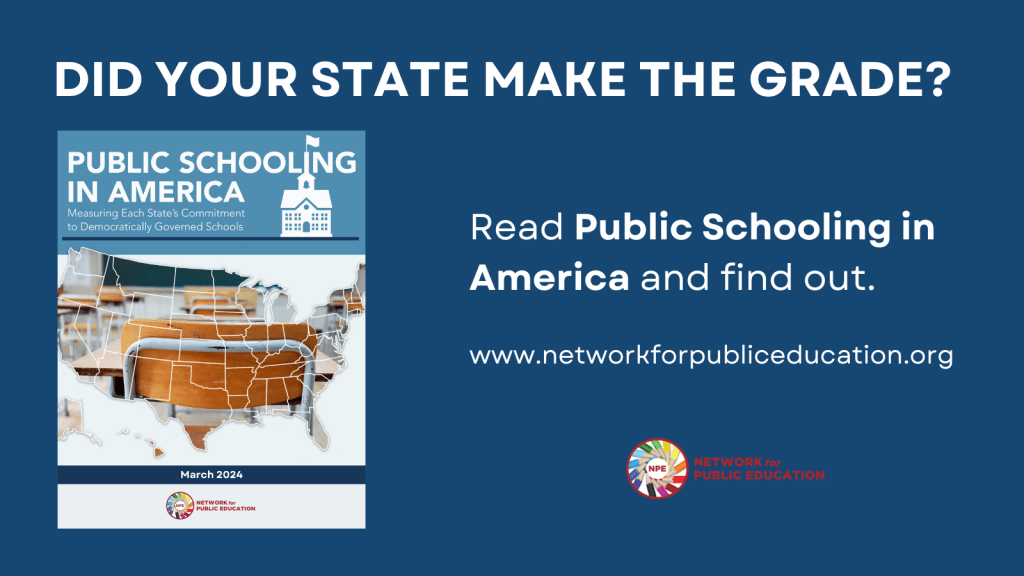
The Network for Public Education released a report card today grading the states on their support for democratically-governed public schools. Which states rank highest in supporting their public schools? Open the report to find out.

Measuring Each State’s Commitment to
Democratically Governed Schools

EXECUTIVE SUMMARY


Neighborhood public schools remain the first choice of the overwhelming majority of Ameri-
can families. Despite their popularity, schools, which are embedded in communities and gov-
erned by elected neighbors, have been the target of an unrelenting attack from the extreme
right. This has resulted in some state legislatures and governors defunding and castigating
public schools while funding alternative models of K-12 education.

This 2024 report, Public Schooling in America: Measuring Each State’s Commitment to
Democratically Governed Schools
, examines these trends, reporting on each state’s commit-
ment to supporting its public schools and the children who attend them.

What We Measure

We measure the extent of privatization in each state and whether charter and voucher laws
promote or discourage equity, responsibility, transparency, and accountability. We also rate
them on the strength of the guardrails they place on voucher and charter systems to protect
students and taxpayers from discrimination, corruption and fraud.

Recognizing that part of the anti-public school strategy is to defund public schools, we rate
states on how responsibly they finance their public schools through adequate and equitable
funding and by providing living wage salaries for teachers.

As the homeschool movement grows and becomes commercialized and publicly funded,
homeschooling laws deserve public scrutiny. Therefore, we rate states on laws that protect
children whose families homeschool.

Finally, we include a new expansive category, freedom to teach and learn, which rewards
states that reject book bans, and the use of unqualified teachers, intolerance of LGBTQ stu-
dents, corporal punishment, and other factors that impinge on teachers’ and students’ rights.

How does your state rank?

Pamela Lang, a journalist and graduate student in Arizona, wrote for The Hechinger Report about her futile search for a school that would enroll her son, who has special needs. Despite Arizona’s budget-busting voucher program, she and he were turned away again and again. It’s time for her to check out her local public school, where her son would get the services he needs and he could not be rejected.

Please read her account.

If you live in Arizona, school choice may be coming to your neighborhood soon. As someone who has had more school choice than I know what to do with, I can tell you what may feel like a shocking surprise: Private schools have the power to choose, not parents.

I live in Phoenix, where the nearby town of Paradise Valley is getting ready to offer the privatization movement’s brand of choice to families. The district has indicated that it will likely vote to close four public schools due to insufficient funds. If this happens, other districts will probably follow: The state’s recent universal voucher expansion has predictably accelerated the diversion of money from public to private schools.

Arizona approved use of school choice vouchers, called Empowerment Scholarship Accounts, or ESAs, in 2011 on the promise that they were strictly for children with special needs who were not being adequately served in the public school system. The amount of funds awarded to qualified students was based on a tiered system, according to type of disability.

Over the years, the state incrementally made more students eligible, until full expansion was finally achieved in 2022. For some students, the amount of voucher money they qualify for is only a few thousand dollars, nowhere near enough to cover tuition at a private school. Often, their parents can’t afford to supplement the balance. However, my son, who is autistic, qualified for enough to cover full tuition.

I took him out of public school in 4th grade. Every school I applied to seemed to have the capability to accommodate his intellectual disability needs but lacked the willingness. Eventually, I found a special education school willing to accept him. It was over an hour from our home, but I hoped for the best. Unfortunately, it ultimately was not a good fit.

I then thought Catholic schools would welcome my son, but none of them did. One Catholic school principal who did admit him quickly rescinded the offer after a teacher objected to having him in her class.

The long list of general, special-ed, Catholic and charter schools that turned my son away indicate how little choice actually exists, despite the marketing of ESA proponents.

There was a two-year period where I gave up and he was home without social opportunities. I was not able to homeschool, so a reading tutor and his iPad became his only access to education.

I then tried to enroll him in private schools for students with disabilities.

These schools were almost always located in former office suites in strip malls with no outdoor access. My son’s current school shares space with a dialysis center in a medical building, while a former school was located in a small second-floor suite in a Target plaza.

Once a private school admits your child, they can rescind admission without cause. Private schools are at leisure to act as virtual dictatorships, and special-ed schools in particular are notorious for keeping parents at a distance…

Education is a human right, and public schools, open to all, are the guardians of this right. What privatizers call choice does not really exist.

Please open the link and read the article in full.