Jason Garcia, investigative reporter, explains how giant for-profit charter chain Academica plans to grab a bigger share of local property taxes. Academica long ago figured out the importance of working with the right lobbyists and contributing generously to the right politicians. Their efforts have paid off in bigger profits.
In late February, toward the end of this year’s regular legislative session, Republican leaders in the state Senate introduced a measure to make public school districts across Florida give a bigger share of local property taxes to privately run charter schools. The idea seemed to catch some senators by surprise when it was presented to the Senate Finance & Tax Committee as part of a larger package of proposed tax cuts and changes. The charter school provision prompted an extended round of sometimes-confused questioning during the hearing; Sen. Ed Hooper, a Republican from Clearwater who is a part of the Senate GOP leadership team, confessed that even he did not fully understand it. But there was someone who knew about the property tax plan in advance: Academica Corp., the charter school management giant that stands to profit from the change. Records obtained by Seeking Rents show that the sponsor the Senate tax package shared a draft of the charter school language with a lobbyist for Academica the week before it was filed for the rest of the public to see. An aide to Sen. Bryan Avila (R-Miami Springs) emailed the still-secret tax-sharing scheme to Academica lobbyist Andreina Figueroa with a one-word subject line: “Review.”
Rxan Smith writes on his blog about America’s broken prison system. We spend more on prisons than any other nation and have the highest recidivism. Our “get-tough” approach to crime is a failure, and a very costly one.
Here’s an uncomfortable math problem nobody in Washington wants to do out loud:
America spends $182 billion per year locking people up.
That’s billion. With a B. Every year.
Not to rehabilitate. Not to reduce crime. Not to make you safer.
Just to warehouse human beings in a system so thoroughly designed to fail that two out of every three people released from prison are arrested again within three years.
Our country’s criminal justice system does not offer criminal justice, and it’s barely worthy of being called a system at all.
It’s a revolving door — and somebody built that door on purpose, installed it at taxpayer expense, and charges you rent every time it spins.
Uncomfortable Truth About “Tough on Crime”
For fifty years, American politicians — left, right, and everything in between — have campaigned on being “tough on crime.”
You know what “tough on crime” actually produced?
*The largest incarcerated population on earth: over 2 million people
*A recidivism rate of 67% within 3 years of release
*A $182 billion annual price tag that grows every year
*Communities so stripped of working-age adults that poverty compounds across generations
“Tough on crime” didn’t reduce crime. It industrialized it.
It turned human failure into a growth industry — complete with lobbyists, quarterly earnings calls, and a political class that discovered you can always raise money by scaring people.
Meanwhile, Norway — with its functional approach — runs a prison system with a 20% recidivism rate.
Ours is 67%.
Norway’s isn’t radical. It’s just effective. The difference? They decided prisons should actually produce people who don’t go back.
The Numbers Behind the Nightmare
Let’s get specific, because the specifics are infuriating:
The Scale
*United States incarcerates 655 people per 100,000 — highest rate on earth
*Rwanda is second. We beat Rwanda. Let that land.
*43% of inmates are Black Americans, who represent 13% of the population
*Average cost per inmate: $39,000 per year — more than a year at many state universities
The Recidivism Machine
*67% of released prisoners are rearrested within 3 years
*83% are rearrested within 9 years
*People released with less than $50 in their pocket, a bus ticket, and a criminal record that disqualifies them from housing, jobs, and student loans
*Then we act surprised when they come back
The Private Prison Problem
*Private prison companies manage roughly 8% of inmates but spend millions lobbying for longer sentences, mandatory minimums, and policies that ensure full occupancy
*CoreCivic and GEO Group spent over $25 million on lobbying and political donations between 2000-2020
*They are literally paid to make sure prisons stay full…
What We Got Instead of Rehabilitation
The American philosophy of incarceration rests on three pillars, all of which are broken:
Deterrence: The idea that long sentences scare people away from crime.
Reality: Most crimes are not committed by people weighing a rational cost-benefit analysis. They’re committed by desperate, mentally ill, or addicted people who aren’t doing the math. The death penalty states don’t have lower murder rates. The math doesn’t work.
Incapacitation: Lock them up so they can’t hurt anyone.
Reality: The average sentence ends. People come out. If they come out with zero support, no job prospects, and the same addiction or mental illness that got them there — you haven’t solved the problem, you’ve aged it.
Punishment: They did something wrong; they should suffer.
Reality: Fine. But suffering without any change in behavior just produces someone who suffered. If we want public safety, we need to care about what happens after the punishment ends.
We skipped the part where any of this was supposed to work.
What Rehabilitation Actually Looks Like
Other countries figured this out. We just refused to copy the homework.
The Norwegian Model (No, It’s Not Soft. It’s Smart.)
Halden Prison in Norway has a music studio, a jogging trail, a kitchen where inmates learn to cook, and individual cells with windows. Guards eat lunch with inmates. The focus is on preparing people to live normal lives.
Result: 20% recidivism rate.
The cynical American response: “That’s not punishment.”
The functional response: “Their prisons actually work.”
Jason Garcia is an investigative reporter who focuses on Florida politics. His blog Seeking Rents should be read by every Floridian, as well as anyone who cares about government ethics.
In this post, he shows how corporations buy the votes they need to pass bills that hurt the public interest.
The votes are for sale. The public can’t compete with the corporations. Except at the ballot box.
Question: Why does the public re-elect these scoundrels?
Garcia writes:
Florida lawmakers banked $14 million in campaign contributions on the day before the start of the 2026 legislative session, according to a Seeking Rents review of first-quarter campaign finance reports.
The avalanche of donations recorded on Jan. 12was, in part, the result of an annual fundraising orgy that takes place in Tallahassee on the eve of every lawmaking session. Legislators are forbidden from raising money during their 60-day session, which means they — and the special interests seeking to buy access and influence in the state Capitol — must scramble to beat the opening gavel.
Much of that last-minute money was essentially laundered through intermediaries — like political committees controlled by lobbyists or campaign consultants — that make it difficult to the trace the true origins of many donations.
For example, one of the biggest session-eve spenders this year was “A Stronger Florida,” a political committee linked to the lobbying firm Rubin Turnbull & Associates, which records show doled out more than $500,000 to more than three dozen legislators. Recent large donors to the lobbyist-controlled committee include the billionaire-run insurance firm Ryan Specialty, for-profit hospital owner HCA, online casino operator ARB Interactive, and Outpost Brands, which sells loosely regulated products infused with an opioid-like extract.
But two companies stand out for the amount of last-minute money they dropped on Florida’s Republican-controlled Legislature: Gun manufacturer Sig Sauer Inc. and home insurer Slide Insurance, both of whom, records show, showered nearly $500,000 on legislators on the final day of pre-session fundraising.
More than 30 lawmakers deposited a combined $480,000 in donations from Sig Sauer on Jan. 12— including House Speaker Danny Perez (R-Miami), Senate President Ben Albritton (R-Wauchula), incoming House Speaker Sam Garrison (R-Fleming Island), incoming Senate President Jim Boyd (R-Bradenton) and Sen. Jay Trumbull (R-Panama City), each of whom took $50,000 apiece via various fundraising committees they control.
The mass cash infusion came as Sig Sauer was lobbying those same lawmakers to pass a bill shielding the company from legal exposure related to a company-made pistol that can allegedly “ghost fire” without anyone pulling the trigger.
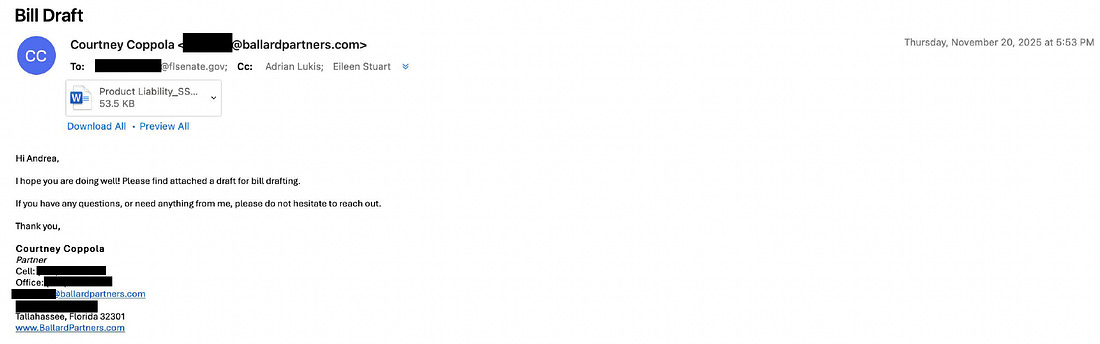
Emails and text messages obtained by Seeking Rents show lobbyists for Sig Sauer gave the original draft of the legislation to Trumbull and Rep. Wyman Duggan (R-Jacksonville), who received a $50,000 donation from the company in December.
Lobbyists for Sig Sauer emailed an aide to Sen. Jay Trumbull a draft of the legislation that became Senate Bill 1748.
The Sig Sauer bill passed the House of Representatives by a 75-29 vote but was unable to get through the Senate. The legislation could be resurrected in the future, though, particularly with the support of a legislator like Trumbull, who is in line to become president of the Senate after the 2028 elections.
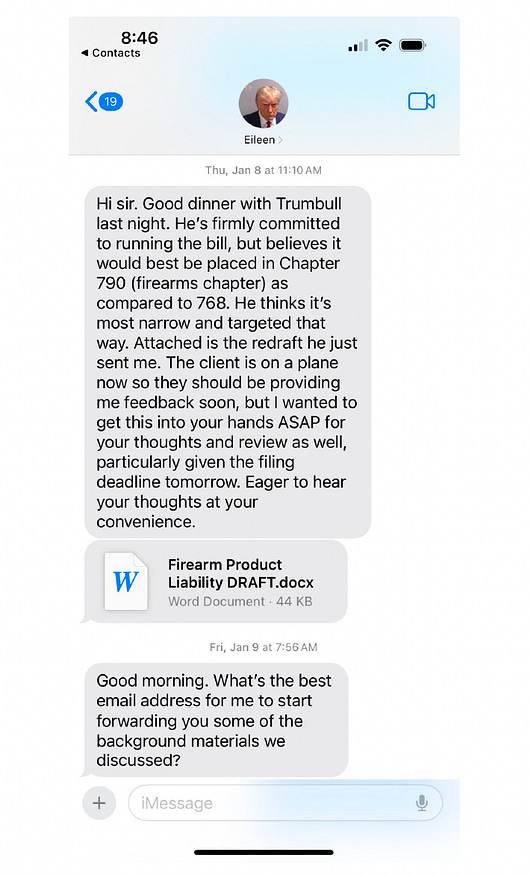
Another text message obtained by Seeking Rents — sent by Eileen Stuart, a lobbyist for Sig Sauer, to Duggan, the House bill sponsor — shows that Sig Sauer representatives dined with Trumbull shortly before the session began. The lobbyist described the future Senate president as “firmly committed” to the legislation.
A text message from Sig Sauer lobbyist Eileen Stuart to Rep. Wyman Duggan.
Meanwhile, more than 40 lawmakers reported a combined $469,000 on Jan. 12 from Tampa-based Slide Insurance, which has become one of Florida’s moreinfamousinsurancecompaniessince launching in 2021.
It’s not clear what specific bills or issues the now-publicly traded company lobbied lawmakers on this session.
But the House of Representatives attempted tolimit the ability of insurance companies to shift money between affiliates and subsidiaries in order to avoid state laws prohibiting excess profits. And Slide has been particularly aggressive in the past when it comes to using internal transactions to move money across its corporate structure.
The profit-stripping legislation breezed through the House by a 106-3 vote. But it was never given a single hearing in the Senate.
Senate leaders were, it turns out, the biggest beneficiaries of Slide’s session-eve contributions.
Records show that a fundraising committee chaired by Boyd, the incoming Senate president, took $170,000 from Slide — more than a third of all the money the company donated on Jan. 12.
The No. 2 recipient? Trumbull, who will follow Boyd as Senate president and who took $45,000 from Slide Insurance the day before session began.
Now, all the contributions that Sig Sauer and Slide made the day before session went to Republicans — which makes sense, since Republicans hold supermajorities in both chambers of the Legislature (as well as the Governor’s Office and all three statewide elected Cabinet posts) and have complete control over the agenda in the Capitol.
But to be very clear, plenty of corporate interests buying access in Tallahassee also make sure to spend a bit of money currying favor with some Democrats, too.
A particularly interesting example: The new campaign-finance reports show that the giant landowner behind the “Blue Ribbon Projects” bill gave $10,000 on Jan. 12 to a committee controlled by Rep. Christine Hunschofsky (D-Parkland), the incoming House Democratic Leader.
It could perhaps help explain how the legislation — which would have enabled the largest landowners in Florida to develop city-sized projects on rural tracts of land with minimal local oversight — managed to pick up a handful of Democratic votes in each of the threeHousecommittees it passed this session, despite opposition from environmental groups and local governments.
The Blue Ribbon Projects bill ultimately failed in the Senate — but just barely.
Norm Eisen was the White House ethics officer during the Obama administration. There were no financial scandals during the Obama administration; President Obama did not profit from his office during his presidency.
The financial conflicts of interest during the Trump administration are too numerous to mention.
This post is also an advertisement for The Contrarian, where this post appeared. It is a premier site for those trying to save democracy from Trump’s authoritarianism and grifting.
Eisen writes:
When I was the Obama White House ethics czar during the Great Recession, I would not even allow the president to refinance his modest family home in Chicago. He was regulating the banks in a time of crisis, and it wouldn’t have looked right.
That’s not exactly the approach that President Trump, his cronies, and their families have adopted. I’ve written before about the Top 10 most outrageous corruption scandals of this administration. This week, my Democracy Defenders Fund colleagues and I added another item to the list. Working with former New Jersey Attorney General Matt Platkin, we filed a complaint with the Securities and Exchange Commission urging it investigate ALT5 Sigma(ALTS).
This company boasts Trump’s son Eric as a board member and Trump Special Envoy Steve Witkoff’s son Zach as its board chair. Its history in recent months is one of serious failures of compliance, breakdowns of governance, and profoundly concerning financial connections with another Trump and Witkoff-linked venture, World Liberty Financial (WLF).
The story starts in August, when ALTS told the world that it had raised $1.5 billion through various investment vehicles. ALTS then moved the money to WLF by buying $750 million of its $WLFI governance tokens, about 7% of total supply. As detailed in our letter, “ALTS appears to have steered as much as $500 million of private investor money directly into the pockets of the Trump family and their associates.” When this money hit their wallets, Zach Witkoff (co-founder and CEO of WLF) and Eric Trump (also a WLF co-founder) assumed leadership roles on the board of ALTS.
These facts give rise to questions that are of the utmost importance to the integrity of our financial markets and of our democracy, as our letter explains. The most profound: who were the investors who funded the ALTS $WLFI purchase–and did they do so in order to get in the good graces of the Trump administration?
The concerns about this transaction are only deepened by what went on in the period in and around this massive financial transfer to WLF. In August, ALTS disclosed that several months earlier a Rwandan court had ruled that ALT5 Sigma Canada Inc., a subsidiary of the company, and its former principal were criminally liable for illicit enrichment and money laundering, ordering imprisonment, fines, and dissolution of the subsidiary. Shortly thereafter, the CEO of ALTS was suspended without explanation, auditors changed multiple times within just a few weeks, and the company failed to meet the due date for filing its annual report. It’s little wonder that ALTS was at risk of being delisted from Nasdaq and its share price has plummeted. Despite the immense capital influx from these transactions, the share piece has declined by around 75%. The company is looking at hundreds of millions of dollars in losses for the 2025 fiscal year.
Given these troubling data points, our letter urges the SEC’s Enforcement Division to “carefully examine these issues because they indicate, both individually and collectively, that ALTS may have engaged in a number of securities violations, thereby harming investors and financial marketplace writ large.” This is not just a story about corporate governance. It is a test of whether the rules that protect investors and the integrity of American markets still apply when political power and private profit intersect.
Our SEC letter calling for an investigation of ALTS is just one of many similar filings we’ve made. This one is outrageous enough that even Trump’s SEC may investigate. But whatever they do, we’re laying down a marker for the press, the public and other enforcement authorities. Whether for state attorneys general and securities regulators, a future more independent Congress, or future federal regulators, there will be a trail of breadcrumbs to follow. Meanwhile, we must all demand answers.
Our ability to continue pushing back against Trump and his cronies’ web of dubious dealings is, of course, supported by your paid subscriptions. We are deeply grateful that you Contrarians make this work possible as well as our weekly pro-democracy Contrarian coverage. See for yourself in this week’s roundup of our best content produced by my terrific colleagues:
Jen Rubin wrote on the cascade of civil and political failures behind Trump’s genocidal threats on Tuesday: “some muddled tale of a diplomatic breakthrough should in no way diminish the illegality, the horror, or the frightful intrusion of religious zealotry into our politics.”
Brian O’Neill wrote on how Trump and Israeli Prime Minister Benjamin Netanyahu may be helping to produce the strongest Islamic Republic since 1979. “It would be one of the great strategic self-inflicted wounds in Middle East policy.”
On the podcast this week, Jen spoke with Robert P. Jones about Defense Secretary Pete Hegseth’s crusader rhetoric and the dangers of Trump’s “refrigerator-magnet style” theology, and with Joyce Vance about Iran after the ceasefire, the Republicans finding a shred of conscience, and more.
Norman Ornstein thinks it’s time to call an emergency an emergency and invoke the 25th Amendment. “We have a malignant narcissistic psychopath as president, with control over the military and the atomic arsenal, who is deteriorating mentally before our very eyes.”
Stacey Young wrote on just how much Pam Bondi’s reign as AG degraded the Justice Department: an exodus of talent, criminal cases shut down, an utter loss of good faith with the courts and more. “Now, the best way we can fight for the department is from the outside.”
Sen. Sheldon Whitehouse (D-RI) joined Jen to consider the next attorney general—and the next vacant cabinet seat—amid war with Iran. “I think Kash Patel stands a very good chance of being shown the door.”
Stacey Abrams wrote on how Republicans have made disadvantaged communities a scapegoat for failed economic policies, including a Texas comptroller who quietly decertified more than 15,000 minority- and women-owned businesses in December.
Annastacia Belladonna-Carrera of Common Cause reminded us that, despite what the Trump regime claimed, ICE has never left Minnesota and is continuing operations across the state. “The media may not be all over it … but the need is still there.”
John Boyd, founder of the Black Farmers Association, spoke to April Ryan to sound the alarm on Trump’s devastating attack on small and minority farmers. “There’s going to be a lot of generational land that changes hands.”
Jennifer Weiss-Wolf wrote on how the Trump administration is putting the onus on states to fund social services — while making it impossible for them to provide those services.
Amid the many hype and doom cycles about AI, Adam Conner of the Center for American Progress gave us a breakdown of what AI is actually doing right now — to the economy, to warfare, to your job.
Josh Levs wrote on the problem with AI summaries having taken the place of traditional media as the first source of information for many, even when it comes to war — and how this is compounded by the media’s acquiescence to AI-first search.
Tim Dickinson gave us a rundown of all the things Trump is naming after himself, which somehow includes both the Institute of Peace and the “most lethal warship ever built” at the tip of the iceberg.
Meredith Blake checked in with the second lady, who thinks kids should read more but doesn’t have much to say about the Trump administration defunding libraries (or anything else).
Azza Cohen took a nuanced look at Giorgia Meloni, Italy’s first female prime minister, as both gender-empowerment opportunist and persevering target of media sexism. “That a woman can be the head of a political party named ‘brothers’ is some kind of ironic victory.”
This week, we saw anti-war protests nationwide in New York, Illinois, Washington, D.C., Missouri, Tennessee, and more. Get help organizing from Indivisible, find protests in your area at mobilize.us, and send us your protest photos at submit@contrariannews.org.
Rep. Sylvia Garcia (D-TX) joined Jen Rubin with an update on the ongoing standoff over ICE funding and why there is still cause for hope. “The point really is people’s freedoms … so we’re not going to vote for one more penny until these reforms are done.”
Carron J. Phillips wrote on how the 2026 Women’s Final Four will be deservedly remembered for one thing — and it wasn’t the championship game. “Sports are more enjoyable when what’s at stake is more than the final score.”
This column is based on our letter and associated materials
Thank you for being part of The Contrarian. Share this piece to help spread the word.
In Arizona, the state charter board did the right thing: it planned to close an online charter school with a long record of failure. But the owner of the charter school was a big Republican donor. And he was a multi-millionaire, who had been richly rewarded by his ownership of Primavera. He had a meeting of the minds with the State Superintendent of Schools, Tom Horne. Horne is a strong believer in choice. Suddenly, Primavera’s grades were recalculated and closure of the piggy bank was off the table.
PHOENIX — For more than a year, Arizona’s largest online charter school, Primavera, and its multi-millionaire owner, Damian Creamer, faced the very real possibility of being shut down.
Plagued by poor academic performance and mounting scrutiny, the State Charter Board had already taken multiple steps toward revoking the school’s charter in 2025.
But in a surprising turn of events, Primavera has been given a lifeline — thanks to an intervention from Republican State Schools Chief Tom Horne.
The decision sparked frustration among board members who had spent months working toward closure.
Longtime board member James Swanson, reflecting the general mood of the 11-member board.
He said the board acted within its authority to hold Primavera accountable after students recorded “D” letter grades for three consecutive years ending in 2024.
Board Chairwoman Jessica Montierth echoed that sentiment after the 9-2 vote, noting the significant time and effort invested in the case.
“Our authority is based on following through with policy and procedure, and that’s what we have done,” she said, adding that the outcome was difficult to accept given the circumstances.
The controversy surrounding Primavera intensified following a 12News investigation early last year.
The 12News Investigates report in February 2025 revealed that the school’s owner, Creamer, had paid himself $24 million since 2017.
At the same time, the school consistently underperformed academically as the Charter Board gave Primavera its worst annual rating four times: Falls Far Below Standard. Two times, Primavera got the second-worst rating: Does Not Meet Standard.
The free-wheeling at Primavera is a byproduct of Arizona’s loosely regulated charter school industry that allows owners to make as much money as possible for years with public funds.
But in March 2025, the Charter Board formally voted to begin the process of shutting the school down after it received three consecutive annual “D” letter grades.
Creamer, who did not attend Tuesday’s meeting, previously attributed the low grades to administrative errors.
He argued that Primavera should have been evaluated under alternative school standards rather than traditional ones.
And he appealed directly to Horne, after having the support of Republican leaders who also lobbied the Charter Board on his behalf.
“We’re so grateful for Tom Horne,” Creamer, a major GOP donor, said during a press conference in mid-March 2025. “For working with us so that we can correct this administrative error.”
Horne twice that month said he wasn’t going to intervene.
“My first priority for all public schools is academic success,” Horne said in March 2025. “It is important that charters and district schools alike are held accountable for the quality of education they provide. The Board’s action demonstrates that these are not just words, but actions. Primavera is being held accountable and losing its ability to operate because of poor academic results.”
Horne, however, later allowed Primavera to privately meet with his staff and present new records to his office.
The board accused Horne of taking the “unprecedented steps of retroactively reclassifying Primavera from a traditional school to an alternative school, reopening prior-year data, and allowing the submission of additional information.”
That was key because traditional charter schools are evaluated under higher academic measures, while alternative schools, which typically serve higher-risk or non-traditional student populations, are evaluated with different performance expectations.
It’s unclear when Horne, who is currently in a tight re-election campaign against Treasurer Kimberly Yee for the GOP nomination, made all of the changes.
But Charter Board officials on Tuesday said Horne’s intervention resulted in the Department of Education indicating the school would have received three Alternative “C” grades instead of three “D” grades under the traditional model.
The board, in a statement, said this “after-the-fact rewrite of Primavera’s academic performance fundamentally changed the facts underlying the Board’s case long after enforcement had begun, effectively removing the Board’s ability to proceed under its established authority.”
Remember, “it’s all about the kids! No child should be trapped in a failing charter school! Parents know best!”
With the rapid spread of vouchers, which are busting the budgets of several states and tearing down the wall of separation between church and state, it’s easy to overlook the danger posed by charter schools. Charter schools are a strong step towards vouchers, replacing neighborhood schools with consumerism. Almost 90% of American students attend public schools. We should be funding those schools, not schools operated by private boards and religious groups.
Dr. Shawgi Tell reminds us that charter schools continue to breed corruption and fraud, as they drain resources from public schools. Charter schools are not subject to the same accountability as public schools. They operate under private management, which shields them from the accoubtabilty to which public schools are subject. Without oversight or accountability, bad things happen.
Dr. Tell is a professor of education at Nazareth University in Rochester, New York.
He writes:
Even though they make up only 8% of schools in the country, crimes, scandals, and arrests take place at a robust tempo in the nation’s privately-operated charter schools.
These non-stop wrongdoings usually include fraud, embezzlement, harassment, and a range of sex crimes.
This is not surprising given the weak accountability, transparency, and background checks that have plagued the crisis-prone charter school sector for more than 30 years.
A small sample of headlines from just this year speaks volumes:
Do such horrible things happen in traditional public schools and private religious schools? Yes they do, but when looking at scale, scope, frequency, and proportionality, they are considerably more rampant in charter schools, which are deregulated businesses governed by unelected private persons.
The privatization and marketization of education lends itself to such phenomena on a broad scale. Privatization increases corruption and lowers standards across a broad range of operations, roles, and services. Converting public programs and services into capital-centered programs and services usually enriches a handful of people while harming the public interest in the process. When programs and services focused on uplifting people and society are transformed into profit-maximizing entities, the majority suffers.
See here for more examples of charter school crimes and scandals.
Shawgi Tell (PhD) is the author of Charter School Report Card. He can be reached at stell5@naz.edu
Attorney Dina Doll wrote this article for the Meidas Touch Network. She describes the ways that Trump is moving government funds–your taxes–directly into his pockets. The man’s a wizard.
She writes:
Davos, Switzerland. 2026 Jan 22. President Donald Trump participates in the Board of Peace Signing Charter Announcement and Signing Ceremony at the Annual Meeting of the World Economic Forum. Editorial credit: Robert V Schwemmer / Shutterstock.com
You didn’t buy the Bible. You didn’t mint the coin. You didn’t sign up for Trump University or bid on the NFTs or book a room at Mar-a-Lago. You opted out of every scheme, every hustle, every grift and it didn’t matter. Because while you were watching an illegal war burn through a billion dollars a day and TSA workers suffered because Congress couldn’t find the money to pay them, Trump was doing something quieter. He was taking yours.
Trump has grifted his entire life. Now he’s just taking it.
The State Department transferred $1.25 billion in foreign aid to Trump’s Board of Peace, pulling $1 billion from international disaster assistance, $200 million from peacekeeping operations, and $50 million from international organizations. Money that Congress authorized for hurricanes and refugees, moved without a congressional vote, into a fund that Trump created by executive order and controls personally. When reporters asked the State Department about it, a spokesperson said they had nothing to announce at this time.
The Board of Peace has one defining characteristic. Trump controls it forever. He named himself chairman for life. No audits. No transparency requirements. No conflict of interest rules. Countries pay $1 billion into a fund he runs to get a seat at the table. It has transferred nothing to Gaza, disclosed nothing about its spending, and received $1.25 billion of your disaster relief money without a word of explanation.
When he leaves the White House he keeps the fund. That is not a loophole. That is the design.
Of course, that’s not the only action Trump has recently taken to pay himself straight from the taxes Americans pay to the federal government. Trump filed a $10 billion lawsuit against the IRS over the leak of his tax records by a contractor. The problem, beyond the absurdity of the number, is that Trump controls the government he is suing. He confirmed it himself: “I’m supposed to work out a settlement with myself.” The DOJ attorneys who would defend against this lawsuit serve at his pleasure. Bondi is literally the only thing protecting the American people from Trump’s attempt to steal billions of our hard-earned money. Which means, there is an ineffective counsel sitting at the defense table for the American people, Trump on the other side of the negotiating table and Treasury Secretary Scott Bessent ready to sign the check.
He went from selling people something worthless to skipping the transaction entirely.
Disaster relief money in a fund he controls forever. A $10 billion lawsuit against himself with your money as the prize. A billion dollars a day on an unauthorized war while TSA workers went without pay and American healthcare credits slashed.
There was always money. It just wasn’t going to you.
The grift required something from you. A purchase. A click. A willing suspension of disbelief. You could say no to the Bible. You cannot opt out of your tax dollars. You have already paid. The question is whether enough people understand what is being done with that money to make enough noise that someone has to answer for it.
Americans do not like cheaters. The reason the fraud of Trump’s University landed everywhere it landed was because the story was simple. He took money from people who trusted him and gave them nothing back.
This is that story. Bigger numbers. Higher office. No brochure required.
Tell someone who doesn’t know. The noise is the only friction left.
The Department of Political Science at the University of Gothenburg in Gothenburg, Sweden, publishes an annual report on the state of democracy around the world. In the recently published report, the authors made clear that democracy in the world is in retreat. Nowhere has it declined as dramatically as in the United States.
A special section of the report is focused on the United States. Under Trump, democracy in the USA is under attack. The President has centralized power in his office. The Republican-dominated Congress has ceded almost all of its Constitutional powers to Trump. The word “almost” may be an overstatement, as it’s difficult to remember an issue when Congress said no to a Presidential power grab.
The V-DEM report begins its special section about the “autocratization” of power in the United States:
*Under Trump’s presidency, the level of democracy in the USA has fallen back to the same level as in 1965.
Yet the situation is fundamentally different than during the Civil Rights era. In 2025, the derailment of democracy is marked by executive overreach undermining the rule of law, along with far-reaching suppression and intimidation of media and dissenting voices.
*The speed with which American democracy is currently dismantled is unprecedented in modern history.
*Legislative Constraints – the worst affected aspect of democracy – is losing one-third of its value in 2025 and reaching its lowest point in over 100 years.
*Civil Rights and Equality before the Law are also rapidly declining, falling to late 1960s levels.
*Freedom of Expression is now at its lowest level since the end of WWII.
*Electoral components of democracy remain stable. Election-specific indicators are re-assessed only in electoral years, and the 2025 scores are based on the quality of the 2024 elections.
The scale and speed of autocratization under the Trump administration are unprecedented in modern times. Within one year, the USA’s LDI score has declined by 24%; its world rank dropped from 20th to 51st place out of 179 nations. The level of democracy on the LDI is dwindling to 1965 level – the year that most regard as the start of a real, modern democracy in the USA.
Yet the deficiencies of American democracy today are fundamentally different from that of the Civil Rights era. As the V-Dem data and other evidence below show, the autocratization now is marked by executive overreach, alongside attacks on the press, academia, civilliberties, and dissenting voices.
The Most Dramatic Decline in American History
In 2023, the USA scored 0.79 on the LDI – shortly before the 2024 election year when first deteriorations were registered. The scores plummeted to 0.57 in 2025 (Figure 22). With such a sharp drop on the LDI, the level of democracy at the end of 2025 is back to the 1965 level. Symbolically, that is the year that most analysts consider the USA began its transition to a real democracy.
Democracy in the USA is now at its worst in 60 years. We are not alone in this assessment. Professor Steven Levitsky at Harvard University says the regime in the USA is now some type of authoritarianism. The Century Foundation argues that “American democracy is already collapsing…”
By magnitude of decline on the LDI, the 2025 plunge is the largest one-year drop in American history going back to 1789 – that is, in the entire period covered by V-Dem data. Only Trump 1.0 compares, when the LDI in the USA fell from 0.85 to 0.73 in four years, bringing the country back to its 1976 level and far below the regional average (Figure 22). American democracy survived Trump 1.0 but did not recover fully.
One notable shift is the transformation of the Republican Party to endorsing a far-right, nationalist, and anti-pluralist agenda. Nationalist, anti-liberal, far-right parties and leaders have largely driven the “third waveof autocratization.” Yet the USA stands out as the only case where such movement seized control over one party in a rigid two-party system.
Please open the link and read the report to review the sources and to understand how dramatically democracy has been undercut during the first year of Trump’s second term.
The Founding Fathers thought they had written a Constitution that would prevent the rise of tyranny. They were wrong.
A reader who calls himself “Gitapik” shares his experience with the introduction of new technology into the special education programs for which he was responsible in New York City public schools.
He wrote:
As a former tech guy for our five District 75 special education sites in Brooklyn, I had quite a ride on this tech roller coaster. I was in on it from the beginning.
I applied for and received multiple very large state grants in technology. Once the money was received, I would choose, order, and facilitate installation of what technology went where in all the sites. From classroom computers, iPads, laptops, Attainment Stations, and Smartboards to full scale labs. It was a very big undertaking.
This also included conducting professional development classes and individual training session sessions…very often to an unappreciative audience.
My sales pitch was always the same: this is a wonderful tool for you to incorporate into your standard every day teaching methods. You can turn it on and off in order to create interest and spur on new ideas. I would even give examples of how I, a teacher, would do a class, using the different devices.
This would’ve been all well and good if it hadn’t been so naïve on my part. I witnessed firsthand how the technology went from being a tool for the teacher to the teacher being the tool of the technology. Might sound like a catchy phrase, but looking back on it I can’t help but see it for what it was. A planned takeover of the school systems.
I could go into specifics, but this is getting pretty lengthy as it is.
Michael Mulgrew, the president of the United Federation of Teachers in New York City recently endorsed the use of AI in the classroom. He said he had met with top officials who had assured him that teachers and administrators would have a voice in how the technology would be applied. I would like to have his ear, knowing what I know. It’s the same sales pitch as was given to me. They just want to get their foot in the door
Audrey Watters is one of the best–maybe the very best–writers about Ed-tech. As she has documented in her writings, including her book, Teaching Machines, the quest for a cheap and mechanical way to replace teachers with efficient devices has a long history. A few people dream of endless profits, but the promise of better teaching by machines has never been realized.
This morning I attended one of the new NYC Chancellor’s public “conversations,” his administration’s initiative to “engage directly with communities to reflect on what safety, academic rigor, and true integration look like in practice.” There were about one hundred folks in attendance, including members of the AI Moratorium for NYC schools, who were there to leaflet beforehand (and were vastly outnumbered, I should note, by the NYPD).
As the aforementioned name suggests, this coalition of local organizations is asking for a two-year moratorium on AI in the city’s schools, pointing to the growing opposition to AI and (in their words) “to evidence that it represents substantial risk to student privacy, cognitive development and skills, critical thinking, creativity, mental health, and the environment.” I’d add that it represents substantial risk more broadly: to labor (teachers’, librarians’, translators’, social workers’) and to democracy itself.
And really, what’s the rush?! I mean, other than the desperate need of the tech sector to prove that the trillions of dollars invested in this endeavor will soon show some profit and that – unlike crypto and Web 3.0 – this isn’t just some giant fraud being perpetrated so executives can buy more private islands.
I’ve said repeatedly (but didn’t articulate into any open mic at the meeting because I still very much feel like a new New Yorker), this recent push for “AI” is yet another grandiose and grotesque experiment on children – one that no one asked for and few want. Another grandiose and grotesque experiment on all of us.
We have lived through decades and decades now of repeated digital promises — we’ll be better, faster, stronger, more connected, what have you — and none of the computational fantasies have really come to fruition, certainly not for everyone. We are not more productive (despite now being asked to work so much more, clicking away on our devices at all hours of every day); we are not smarter; and most importantly, we are not better. (A tiny group of men are, on the other hand, now richer than any other humans have ever been in all of history. So there’s that.) Our public institutions are crumbling, in no small part because these men are fully and openly committed to the failure of democracy, having positioned themselves to profit mightily from years of neoliberalism. “AI” marks the further (and they hope, final) consolidation of their power – not just the privatization and monopolization of all information under their control, but the automation of the dissemination and replication of knowledge. These men are more than happy to sell a story, a system that trains all of us, but particularly young people, to become entirely dependent on and subservient to computational machinery; they are more than happy for us to sacrifice our cognitive capabilities, our creativity, our agency, our decision-making, our morality, to solidify their crude oligarchal dreams of total efficiency, total financialization, total domination.
We should know by now that this stuff is almost entirely wretched – we do, right? I mean, at this stage, I’d be deeply embarrassed if I was out there, trying to argue that this stuff is any damn good. And yet here comes Silicon Valley and education reform, hand-in-hand once again, trying to peddle disruption and innovation and their long war on “one size fits all education,” armed with their algorithmic bullshit and billionaire board members.
It doesn’t help, I think, that there are several prominent technology journalists who keep falling for / perpetuating this stuff, who loudly insist in caps-lock-on prose that “THERE IS NO EVIDENCE!!!111” that devices are bad for children. (The irony, of course, is after they repeat this claim — and with such certainty — they turn around and point to dozens of stories of the most batshit–crazynews about the horrors of digital culture.)
And maybe part of the problem too is just that: we are so steeped in the insanity of techno-capitalism, the insanity of techno-capitalists that some folks are losing track of what aberrant behavior really is. Cory Doctorow writes a bit about this this week, offering “three more AI Psychoses” — a response, in part, to Samantha Cole’s excellent piece in 404 Media, “How to Talk to Someone Experiencing ‘AI Psychosis’.”
I wonder if it isn’t simply that “AI” delusions are ubiquitous (at this stage, I’m thinking these delusions are experienced by almost everyone, not just a tiny fraction of “AI” users); it’s that many of these delusions are unrecognizable as such because they reflect precisely the sort of sociopathy long embraced by Silicon Valley’s Ayn-Randian, libertarian set. “Here’s to the crazy ones” indeed.
[A] great embarrassing fact… haunts all attempts to represent the market as the highest form of human freedom: that historically, impersonal, commercial markets originate in theft. – David Graeber, Debt…
If plagiarism is wrong and bad and theft is wrong and bad and schools are duty-bound to help instill these values in students, how can they justify adoption of a technology that is, at its core, built on stolen work and whose purpose is the extrusion of text to be passed off as one’s own thinking and writing?
I invite you to open the link and continue reading this thought-provoking article.




 Diane Ravitch's blog