Archives for category: For-Profit

Filippa Mannerheim is a Swedish high school teacher and a critic of Sweden’s experiment in school privatization.

She writes.

Dear Sweden, let me tell you what a school is.

A school educates and dares and can demand effort. Sweden has forgotten what a school is. High school teacher Filippa Mannerheim gives a lesson to a country that has lost its grip.

Dear Sweden, since you seem to have completely lost your composure, here is a short, educational guide to help you along in your confused state.

Sweden, let me tell you what school is: A school is an academic place for knowledge and learning. A school is the nation’s most important educational institution with the aim of equipping the country’s young citizens with knowledge and abilities, so that they can develop into free and independent individuals, protect the country’s democratic foundations and with knowledge and skills contribute to the country’s continued prosperity – in times of peace as well as in troubled times .

A school is not a joint-stock company with profit as the main incentive. A school is a joint community building. A school has educated, subject-knowledgeable, qualified teachers with high status, good working conditions and great professional freedom. These teachers teach the country’s children in the country’s language.

A school has employed – not hired – resource staff: special teachers, school nurse, study and vocational guidance counselors, IT staff, janitors. A school does not have non-qualified persons behind the chair.

A school gives children who are falling behind extra support from trained special teachers. A school does not hand out digital tools or ineffective adaptations as substandard substitutes for extra support, just because it is cheaper.

A school has appropriate premises: adequately sized classrooms, an auditorium, a sports hall, a music hall, a home economics room with a kitchenette, crafts and lab rooms. A school has adequate equipment for theoretical and practical teaching, such as musical instruments, craft tools, laboratory equipment, teaching aids, working IT equipment and large amounts of fiction in class sets.

A school has a school library with trained librarians who keep an eye on the world, buy books, hold book talks and contribute with unique expertise in fiction and non-fiction, information search and source criticism. A school does not have a repository of some randomly selected books donated by parents and call this a “school library”. A school library is not “access to a public library”.

A school has a large school yard where children can jump rope, jump fence, play football, play marbles, play ghost ball, King and run around. A school yard is not a paved patch outside an apartment building.

A school is an architectural building – a proud landmark – adapted to a unique activity, namely teaching the country’s children. A school is not a bicycle cellar or an industrial premises where students get “theoretical skills” or a gym card at Sats, which is called “sports education” because it is cheaper.

A school is not a private playground for calculating corporate groups and corrupt ex-politicians who want to make a career in business. If you think so, you have seriously misunderstood what school is.

A school sells nothing because knowledge cannot be sold or bought. A school has a canteen that serves a well-planned lunch based on the Swedish Food Agency’s guidelines for a good and nutritious meal. A school does not send teenagers out to buy their daily lunch at a hamburger chain using a food stamp.

A school does not compete with other schools for school fees or easily taught students. A school has no incentive to set satisfaction ratings, as rating is a pressure-free exercise of authority – not a means of competition and a way to fish for new school customers.

A school educates and dares and can demand effort. A school is a community foundation, not a sandwich board for demanding parental customers. A school has an obvious consensus on what knowledge is and how it is taught using methods that rest on a scientific basis.

A school has teachers who conduct well-planned teaching, not teachers who send students home with work that parents are expected to help with in order for the school’s profit to be greater. A school has teachers who see themselves as academics and public servants, not marketers and influencers who hawk vacuum cleaners with the help of their students via Instagram accounts.

A school is an area where politicians strive for cooperation, long-termism, stability and the best interests of the citizens. A school is not allowed to become a bat in national political debates about cap issues or grades from year 4. The word “school” and “lobbyism” are never used in the same sense. A school system without a market is not a “communist government”.

We live in a country that has lost all understanding of what school is. We live in a country where the politicians have let go of the country’s own school system and are selling it off, piece by piece, to international companies.

We live in a country where students and parents get an image that school can be anything, however, anywhere and an image of themselves as school customers instead of parents and students. This is dangerous for the individual but even more dangerous for the nation at large.

Sweden, now you know what school is. What do you do with that knowledge?

By Filippa Mannerheim

Filippa Mannerheim is a high school teacher in Swedish and history, as well as a school debater. She attracted a lot of attention in the winter of 2020 with her open letter to Sweden’s Riksdag politicians on Expressen’s culture page, “Swedish school is a shame – you politicians have failed”.

David Lapp, director of policy research for Research for Action in Philadelphia, recently wrote about the money wasted on Cybercharters in Pennsylvania. Apparently, the industry has a strong hold on the Pennsylvania legislature. There is no other reason that it continues to thrive.

During the worst of the pandemic, schools closed for reasons of safety and caution. Cybercharters boomed to fill the gap. But with physical schools open, the truth must be told about Cybercharters: they are a poor substitute for real schools.

Lapp writes:

When the COVID-19 pandemic forced schools into remote learning instruction many Pennsylvania policymakers expressed deep concerns. Many lamented the impact on mental health when students stopped receiving in-person learning and the important social skills that develops. Many were upset by the evidence of significant learning loss that accompanied the switch to virtual instruction.

The Pennsylvania General Assembly even enacted a new law allowing students to voluntarily repeat a grade to make up for lost educational opportunities.

This year policymakers should consider bringing that same energy to a similarly harmful and even more wasteful form of remote learning. One that’s been growing for more than two decades and reached a boiling point during the pandemic. I’m talking about the soaring enrollment growth and accompanying financial cost of Pennsylvania’s cyber-charter school expansion.

There’s solid research both nationally and in Pennsylvania that cyber-charter schools have an “overwhelmingly negative” impact on student learning. The learning loss students experience from virtual instruction in cyber-charter schools appears similar to the learning loss students experienced from virtual instruction during the pandemic.

For each year a student is enrolled in cyber-charter school they are also more likely to experience chronic absenteeism and less like to enroll in post-secondary education.

There’s also clear evidence that spending on cyber-charter school expansion comes at the expense of students receiving in-person learning in school districts and brick & mortar charter schools, where more effective instruction is provided. In fact school districts—which pay for cyber-charter tuition from their own school budgets—have indicated that charter tuition is now their top budget pressure.

It’s easy to understand why. Pennsylvania already had the highest cyber-charter school enrollment in the country and then enrollment grew by 22,618 additional students during the pandemic. Districts are now spending over $1 billion dollars a year on cyber-charter tuition, reflecting an increase of $335 million from before the pandemic. These surging expenses impacted the vast majority of school districts in the state.

Cyber-charter tuition likely represents the most inefficient spending in Pennsylvania school finance. For one, the cyber-charter system is redundant. Both before and since the pandemic, most school districts continue to offer their own virtual schools. Secondly, the tuition rates mandated under current PA law require districts to pay cyber-charters more than it actually costs to operate virtual schools. And finally, when students leave for cyber-charter schools, districts must of course still operate their own brick & mortar schools for remaining students, only now with fewer resources….

In Research for Action’s recent report, The Negative Fiscal Impact of Cyber Charter Enrollment Due to COVID-19, we estimated that the tuition increase in just one year of the pandemic, from the 2019-20 and 2020-21 school years, led to between $290 to $308 million of additional stranded costs borne by school districts. Nearly the entire amount of increases in school district total expenditures statewide in 2020-21 were accounted for by increases in school district tuition payments to charter schools, most of which were for cyber-charters specifically.

Meanwhile, this tuition spike has left cyber-charters in Pennsylvania flush with surplus resources. More than half of the additional funding cyber-charters received from districts in 2020-21 was not even used for student expenses. Rather, cyber- charters funneled over $170 million into their general fund balances that, unlike school districts, have no statutory limits.

Carol Burris knows every detail of the U.S. Department of Education’s new regulations for charter schools. She has studied them closely and written about what they mean. They are a reasonable effort to create accountability for the expenditure of hundreds of millions of dollars a year on charter schools. The federal Charter Schools Program began in 1994 as a $4 million annual fund to start new charter schools. In the nearly three decades since then, the program has grown (in response to the powerful charter lobby) to $440 million a year. The program, until now, has been unregulated. It has been riddled with waste, fraud, and abuse. As two well-documented reports (see here and here) by the Network for Public Education demonstrated, a large number of charters received federal funding but never opened or closed soon after opening. While the original intent of the program was to jumpstart small, teacher-led or mom-and-pop charters, the program grew into a slush fund for big charter chains, grifters, and slick, for-profit entrepreneurs.

The U.S. Department of Education wisely decided it was time to set some rules. Federal funding comes with rules.

Billionaire Mike Bloomberg knows none of this context. He recently wrote (or one of his aides wrote) an uninformed article in the Washington Post about the Department’s new regulations for the Federal Charter School Program. He falsely claimed that the regulations were a “victory” for the charter industry, even though the charter industry fought the regulations vigorously. Bloomberg’s article was a lame attempt to put a happy face on a major defeat for the charter lobbyists.

Carol Burris responded:

Michael Bloomberg embarrassed himself with his recent op-ed published in the Washington Post entitled “Charter School Change is a Victory for Children.” It would appear that given the efforts and funding that his organization put into blocking Charter School Program reforms, he now feels the need to take an unearned victory lap.

Bloomberg begins his op-ed by thanking the Biden Administration for listening to parents and editorialists—like himself. After participating in the month-long hate fest that claimed the President was “at war with charter schools,” he and his allies at the National Alliance for Public Charter Schools are likely eager to creep out of the doghouse.

In addition to its heated rhetoric insulting the President and telling Secretary Cardona to back off, the charter lobby deliberately spread misinformation regarding the U.S. Department of Education’s then-proposed Charter School Program reforms. They falsely claimed that over-enrollment in district schools and cooperation with a public school district were prerequisites to obtaining CSP funding. Bloomberg used his influence to write op-eds that parroted the campaign of misinformation.

As I explained here in the Washington Post Answer Sheet, neither claim was valid. Now, Bloomberg once again twists the truth with three additional false narratives in his recent op-ed.

The first is as follows.

“The Department of Education’s original proposal could have prevented public charter schools with long wait lists from expanding or replicating if the district schools were under-enrolled.”

This was inaccurate when he first wrote it and is still untrue. Under-enrollment was an example of one of the ways charter schools could demonstrate need. Waiting lists, special missions, and other ways to show need were always allowed. This was clarified by the Department long before the final regulations were published.

The second false claim in his op-ed is:

“It [proposed regulations] would have prioritized funding for public charter schools that enter into formal contracts with district schools, making charters dependent on the good will and good faith of schools that may see them as competitors.”

Mr. Bloomberg better check again.

Priority 2 (charter/district cooperation) is still in the regulations as an invitational priority this year. Invitational is one of three levels of priority. The proposed regulations never stated which level priority 2 would have. The priority, by being retained, also opens the door for priority 2 to become a higher priority in the coming years.

And finally:

“And it would have restricted public charters from receiving early implementation funding that can be crucial to the process of opening a school. The proposal was amended to prevent those outcomes.”

The amendment he refers to (see below) was a change without distinction. Those implementation funds cannot be used; therefore, the original restriction, for all intents and purposes, is still intact.

This is the minor change between the proposed and final regulations, as explained by the Department here.

“We amended Assurance (f) to remove the requirement that applicants provide an assurance that they will not “use or provide” implementation funds for a charter school until after the eligible applicant has received an approved charter and secured a facility so that applicants are required only to provide an assurance that they will not “use” implementation funds prior to receiving an approved charter and securing a facility.”

If the schools cannot use the funds, whether or not they are “provided” is irrelevant.

I do not know who penned this op-ed for Mr. Bloomberg. But I do know this. His buddies at the National Alliance for Public Charter Schools, likely with his financial support, spent a king’s ransom trying to get the U.S. Department of Education to scrap or delay the regulations. In the process, they alienated members of Congress, especially powerful House Appropriations Chair Rosa De Lauro, as well as members of the Department. Their campaign was relentless, nasty, and very expensive.

But in the world of Michael Bloomberg, the truth is flexible, and he can use the influence derived from his fortune to put in print whatever “truth” suits his purpose.

However, those of us who have followed this carefully know the deal. As charter devotee, Jeanne Allen tweeted to the National Alliance’s Nina Rees, who was also trying to claim victory, “You should probably read thoroughly the final CSP #charterschool rules. All 135 pages. Not only did nothing really change, but the explanations make it worse than it was to start.”

Florida is led by a Republican governor and legislature determined to crush public schools. The state is overrun by unregulated voucher schools, where teachers and principals need no certification. Some of these openly discriminate and indoctrinate. The Orlando Sentinel ran a series about the voucher schools called “schools without rules.”

Florida has a thriving charter industry, many of them operated by for-profit corporations.

Now the state has passed a new law making it easier to open new charter schools and suck money out of the public schools.

As this rampant privatization continues, Governor DeSantis keeps up a barrage of attacks on public schools and their teachers, accusing them of “indoctrinating” their students with anti-racist views and “grooming” children to be transgender.

The Houston Chronicle reports that a participant in the January 6 assault on the U.S. Capitol is likely to be elected to the Texas State Board of Education. She has pledged to fight “critical race theory” (i.e. teaching about racism) and to support charter schools.

Underscoring Texas lawmakers’ rightward lurch on education issues in recent years, the candidate likely to replace a moderate Republican on the State Board of Education in a district outside Houston is a right-wing activist who participated in protests at the U.S. Capitol on Jan. 6, 2021.

After winning the primary in March, the front-runner in the District 7 race is Julie Pickren, a former trustee for Alvin Independent School District. Pickren was voted off that board last year after her participation in the protest at the U.S. Capitol was revealed — the basis of a campaign against her by the Brazoria County NAACP.

Pickren is a former delegate to the GOP’s national and state conventions, her LinkedIn says, and on Facebook she blamed antifa, rather than Trump supporters, for violence during the Capitol riot, a claim that other Republicans have made without proof. She declined a request for an interview….

Republicans have moved further to the right on education issues in Texas over the past 18 months. Earlier this summer, Gov. Greg Abbott announced his support for private school vouchers and endorsed a “Parental Bill of Rights” to give parents more power over what and how their kids are taught in schools. Last year, the Legislature passed and Abbott signed a slew of conservative bills relating to education, including restrictions on how social studies can be taught and on transgender children playing school sports.

At the local level, school board politics have become increasingly heated, with often angry discussions over diversity and equity policies in the schools. Parent groups have organized PACs in opposition to what they view as progressive activism in education, raising substantial amounts of money to reshape local school boards around the state.

Next year’s State Board of Education is set to be more conservative, with Robinson leaving as well as two other Republicans who lost their March primaries to opponents supported by right-wing PACs. There are currently nine Republicans and six Democrats serving on the board.

The board’s core responsibilities include writing Texas’ public school curriculums, managing the permanent fund that backs debt taken out by schools, and deciding whether to allow new charter schools in the state; Pickren has said she supports adding more of them.

Moderate pushed out

The District 7 seat opened up last year, when the Legislature during redistricting moved incumbent Matt Robinson into a different district so he couldn’t run for re-election. Robinson, a doctor from Friendswood, has said he feels Republican political leaders in the state did this intentionally because they did not believe he was sufficiently supportive of charter schools and other conservative policy goals.

In a rare move in today’s increasingly polarized politics, Robinson is endorsing the Democrat in the race, Galveston ISD teacher Dan Hochman, to be his successor.

Why?

“Because he’s running against Julie Pickren. And she will be bad for public education,” Robinson said.

In lists of the most important issues to her campaign, Pickren has named ridding public schools of critical race theory, an academic theory that critics use as a catchall term to describe diversity and equity initiatives as well as discussion of systemic or historical racism. Pickren is also supportive of “parents rights” initiatives such as those espoused by Abbott.

“She is leading a fight, an assault on public education that’s going on right now. It’s not among all Republicans, but it’s among a good number and she’s kind of leading that fight. And the idea that critical race theory is going on in most schools and most districts, which is entirely false. So her overall approach is, in my view, anti-public education,” Robinson said…

Soul of public education

Hochman acknowledged that he’s facing an uphill climb in the race, as the district leans conservative. Pickren’s campaign has spent about $40,000 so far, while Hochman’s has spent about $10,000. Hochman said his campaign bank account currently had less than $100 in it…

“It really, truly is a fight for the soul of public education in the state of Texas, which is failing right now,” Hochman said of the race. Hochman added that he would oppose expansion of charter schools.

“I’m up against a woman who is clearly anti-public education. She’s being funded by the far right, whose agenda has been publicly clear that they want to dismantle public education and replace it with private schools and charter schools so they can push through a far-right Christian agenda in schooling. And that’s not like a conspiracy, that’s been pretty much out in the open.”

edward.mckinley@chron.com

Lisa Haver is a retired teacher and prominent advocate for the public schools of Philadelphia. Those public schools have been subject to state takeover, privatization, and every other failed reformy tactic. She hoped that those bad old days were over. They are not. The new board hired an inexperienced superintendent who needed the help of a much-criticized consulting firm at a cost of $450,000.

She expressed her frustration in this article.

After years of pain and frustration that included the closing of neighborhood schools, privatization driven by standardized tests, crumbling infrastructure, and more than one debacle, the people of Philadelphia were psyched for new leadership in the school district.

The door to new priorities seemed to open with the arrival of Tony Watlington as the next superintendent.

But that door slammed shut before his tenure had even begun with the news that he’d brought in a Tennessee-based consulting firm to help him navigate his first year in the job. In May, the Board of Education voted unanimously and without deliberation to approve a one-year contract with Joseph & Associates. Price tag: $450,000. The board approved this contract — the last on a list of 92 official items — near the end of an 8-hour meeting.

According to a recent Chalkbeat article, the board hired the consulting firm to help Watlington “connect with people,” assist in assembling his transition team, and develop a 5-year plan for the district. Watlington said he asked for the contract so he could “hit the ground running by Day 1,” according to The Inquirer.

Apparently, Watlington decided the district’s current leadership of 16 department chiefs and 15 assistant superintendents could not help him do that, and that people from Tennessee could educate him about the district’s history and needs better than the people who live and work in Philly.

The Alliance for Philadelphia Public Schools, the organization I co-founded, has reported on and analyzed the spending priorities of the district since 2012. We intended to ask the board directly why they hired Joseph & Associates, but all five APPS members who tried to sign up to speak at the June meeting were denied.

Last winter, in public town halls held for the three superintendent finalists, Watlington told parents, students, and educators he had a plan and wanted to meet with district stakeholders to hear their concerns. He didn’t say he could only do that by hiring an out-of-town consulting firm at a price higher than his own $340,000 salary.

The first official act of the new administration signals a continuation of those before him: hiring consultants and outsourcing work that should be done by district personnel. Sending resources into classrooms remains on the back burner.

The scope of the Joseph & Associates contract raises concerns for families and public education advocates for a number of reasons. Watlington said he wants the consultants to help him assess how the district can best meet the board’s “Goals and Guardrails” — a set of priorities based on standardized test data. This approach does not lend itself to creative learning or teaching. The Watlington administration should commit to funding proven reforms: smaller class size, more support staff, and reinstating school librarians.

But it’s the final phase of the Joseph & Associates contract that should sound the alarm for defenders of public education: the compilation of a 5-year “strategic plan” for the district. Many recall what happened a decade ago after the last long-range plan from an outside firm, the Boston Consulting Group: school closings and more privatization of neighborhood schools. Any plan that determines the future of the district and its ramifications for families and neighborhoods should be discussed and formulated in public meetings — not the private boardrooms of an out-of-state consulting firm.

Peter Greene reports the selling of heavily clad bunkers for classrooms to protect children against killers.

We have a problem. There are 400 million guns owned by the population. One of our major political parties is adamantly opposed to any restraint on buying and selling more guns.

Other societies insist on background checks, proof of training, safes for guns, and a dozen other ways to minimize the misuse of these deadly weapons. Even the most tepid effort to limit gun ownership will be loudly opposed in this country. The recent bipartisanship deal on gun control won’t change any of that.

The recent assassination of the former Prime Minister of Japan, which has rigid limits on gun ownership, was held up by gun lovers as proof that gun control doesn’t work. Japan had a total of ten gun deaths last year.

So, Greene points out, since we do nothing to restrict gun ownership, we create a response to the problem. Buy bunkers for children in classrooms. This could be a billion-dollar business.

PS: then there’s the case of the Uvalde elementary school. Just-released videotape showed that the police, fully armed, stayed out of the classrooms where the killer was, for 77-78 minutes. As children and teachers died, the police held back. Why? They didn’t need a key. They didn’t need more weapons. They didn’t need more armor. They needed courage.

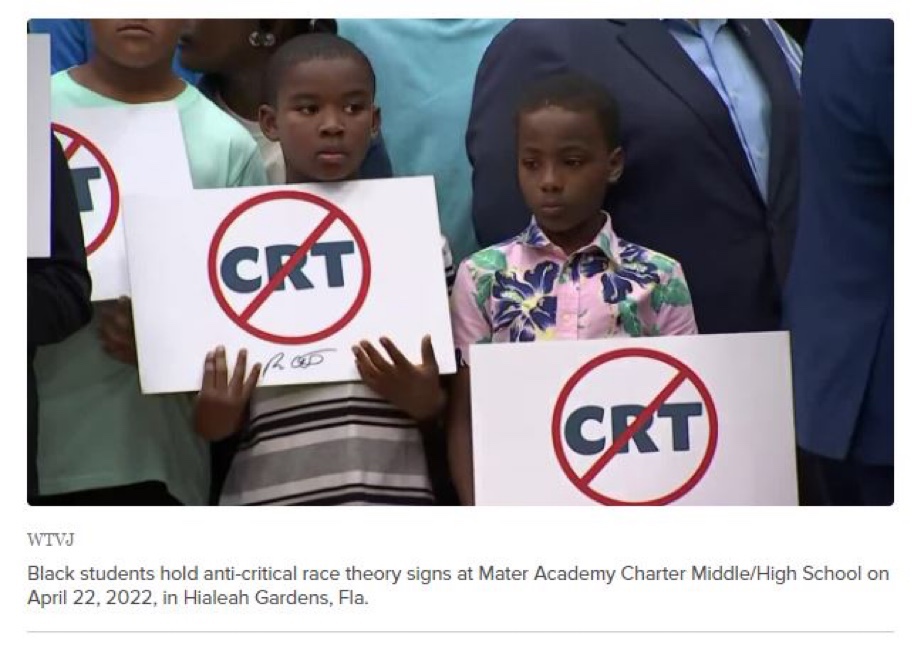
Blogger Carl Petersen posted this photo on Twitter.

Do you sincerely believe that any Black student opposes teaching about the history of racism? Isn’t it amazing to see this photograph of Black students attending the for-profit Mater Academy in Florida , holding up signs opposing critical race theory? CRT means an analysis of the roots of racism in our history, our laws, and our politics.

Governor Ron DeSantis signed the anti-CRT bill at the same charter school. He believes that teaching the truth is hateful.

Do you think these children actually oppose CRT?

Or were they indoctrinated?

For years, reformers celebrated the grand success of Ohio’s Electronic Classroom of Tomorrow. Politicians lauded it and poured money in. ECOT’s owner reciprocated by giving generously to politicians. Governor John Kasich gave the commencement address one year; Jeb Bush did another year.

But the state auditor (who was also a commencement speaker in 2015) checked the books and the whole ECOT edifice came crashing down. Ghost students, payments to companies owned by the founder, numerous ways to profit from the state’s generosity.

ECOT still owes Ohio more than $100 million.

Theodore Decker wrote in the Columbus Dispatch:

If there is such a thing as justice in this imperfect world, investigators in a federal building somewhere in Columbus are nudging ever close to it while digging into the billion-dollar boondoggle once known as the Electronic Classroom of Tomorrow.

ECOT, at one time the state’s largest online charter school, collapsed four years ago amid claims that it had taken millions in undeserved state aid.

Allegations of wrongdoing were traded by the school and state education department. Lawsuits were filed. And about 12,000 students were left in the lurch when the school imploded.

Then ECOT fell out of the public view, overtaken by a thick layer of general dirtiness at a time when political scandal was the norm from the White House to the Statehouse.

An audit just released this week, though, found that ECOT still owes the state more than $117 million.

Ohio Auditor Keith Faber on Tuesday said the shuttered school owes $106.6 million to the state Department of Education and another $10.6 million to the state Attorney General’s office.

As others have before them, Faber’s auditors found that ECOT wasn’t entitled to all the state money it received, including some in 2016 and 2017 and none in 2018.

ECOT as an entity may be gone, but for the sake of all taxpaying Ohioans, it had better not be forgotten.

Looking at the broad sweep of the ECOT swindle, it seems unfathomable that not a single indictment has been lodged against anyone in connection with its shady operations.

The main man behind ECOT was William Lager, a man with a host of Statehouse connections who founded the school in 2000. He also operated Altair Learning Management Inc and IQ Innovations LLC, which had lucrative contracts with ECOT to provide support services. After ECOT fell apart, Attorney General Dave Yost called Lager “the principal wrongdoer“ in the case.

The series of lethal blows to Lager’s empire began in 2016, when the Department of Education demanded repayment of $80 million.

But ECOT’s attendance numbers had been disputed by the state long before that, as far back as 2006. Going back even further, to 2001 and 2002, an audit determined that the state had been overpaying the school by millions.

That ECOT’s attendance numbers were disputed so early on in its existence – and how that problem regardless went unaddressed for so long by a string of governors, legislators and state officials – are looming questions that must be the stuff of any civic-minded federal prosecutor’s dreams.

And maybe, we can hope, they still are.

Yost, while still the state auditor, excoriated ECOT in 2018 and referred his findings to both county and federal prosecutors.

The feds are a secretive lot who have a habit of neither confirming nor denying the existence of any pending investigation, but there have been a few dropped clues through the years that a probe of ECOT is afoot.

One of the biggest came in 2019, when the FBI and U.S. Department of Justice subpoenaed nearly 20 years of ECOT’s campaign contribution records.

More than three years have passed since that development, but the feds also don’t have a habit of rushing their investigations.

Maybe they will wrap things up without uncovering a single instance of criminal behavior.

If you possess a lick of common sense, given what we know already, that outcome would boggle the mind.

But even if that is how an investigation concludes, prosecutors at the very least should know many more details about how ECOT and its principals were permitted to run amok for so long.

Considering Ohio’s taxpayers footed the bill, we have the right to know each and every one of them.

Denis Smith is a retired educator. After teaching for many years, he worked in the charter school office of the Ohio Department of Education. There, he learned about charter frauds and charter political influence. He wrote the following article in the Ohio Capital Journal.

He begins:

Like the famed Casablanca police captain Louis Renault, Ohio taxpayers were shocked, shocked to learn recently from the state auditor’s office that the notorious online charter school ECOT, which closed in 2018, owes the state $117 million. A “Finding for Recovery” posted last week on the auditor’s website provided the details.

The announcement by Auditor of State Keith Faber that the Electronic Classroom of Tomorrow, known familiarly as ECOT, owes the state such a huge amount for submitting inflated student enrollment data was met by a prolonged yawn among most of the state’s residents as well as media outlets.

Ohio residents were shocked, shocked at the news.

Not.

It seems that Ohioans have formed a natural immunity regarding any additional bad news about ECOT, known by some as “The School for Scandal,” with apologies to playwright Richard Brinsley Sheridan. Back in 2017, one of my articles about “The School for Scandal” likened its longevity to the Energizer Bunny and described the different meanings people derived from seeing the online charter school’s acronym. Readers also chimed in with their own descriptors:

ECOT Effectively Cleaning Ohio’s Treasury

ECOTEndlessly Cheating Ohio’s Taxpayers

ECOTEnough Corruption for Ohio Taxpayers

ECOTEasy Cash on Tap

What does not make the ECOT saga unique is that it merely mirrors much of charterdom and affirms the industry’s image as a slow-motion train wreck. Sadly, a plethora of stories about issues surrounding The School for Scandal’s improprieties published years before its demise were not catalysts for action.

But if misery loves company, ECOT, which operated at full blast draining the state’s treasury for 18 years, is but one of more than 300 failed charter schools now closed that performed with near impunity as the result of a charter-friendly design built into the Ohio Revised Code. That section of the code favors private operators for the schools and limits the amount of transparency and accountability for these constructs that are provided about 150 exemptions in law that public schools themselves are required to meet.

That charter DNA design allowed ECOT’s founder, William Lager, to form privately owned management companies to operate the school and thus limit the amount of sunshine that could be cast by auditors and those charged to provide oversight for the school. That same design for charters, which are privately operated with public funds, allowed Lager to donate generously to some of his favorite Republican politicians, including state Sen. Andrew Brenner, who currently serves as chair of the Senate Education Committee.

Over the years of its operation, as seen by his donations to the Republican leadership, it was clear that Lager was buying friends in the legislature.

“Lager is, by far, Brenner’s largest individual contributor,” the Columbus Dispatch reported in May 2018, four months after the school’s closure. Brenner pocketed $27,564 in three payments from Lager from 2015-2017, but lamely said that the money didn’t come from the school. Moreover, Brenner, a champion of the private sector and privately operated but state funded charter schools, had no qualms about accepting money from Lager, whose fortune was built upon a cash cow fed by the public treasury.

Then there is the situation with Attorney General Dave Yost. From 2013-2015, Yost spoke at ECOT graduation ceremonies and heaped praise on its supposed place in the state’s educational sector. At one of those commencements, the then-Auditor of State presented ECOT with the Ohio Auditor of State Award with Distinction, meaning the school met the standard for a “clean audit.”

Clean audit? Refer to the previous box – ECOT = Effectively Cleaning Ohio’s Treasury. In retrospect, that acronym might be appropriate.

According to the state auditor’s website, the Ohio Department of Education “determined ECOT was not entitled to a portion of the funding it had received in fiscal years 2016 and 2017, as well as none of the funding received in fiscal 2018.”

ECOT critics might pose another question: what about from 2000 to 2015?

The current situation with ECOT reminds us of the classic Thomas Nast cartoon which first appeared 150 years ago:

What Are You Going to Do About It?

More than four years after the school’s closure, that question can’t be avoided.

When it comes to this charter’s audits, some things just don’t add up, particularly when the state auditor went out of his way to praise ECOT. Yet for years some individuals in state government, particularly in the department of education, had serious concerns about the reported enrollment figures for the school, well before the praise heaped on it by then-auditor Yost.

The Auditor of State’s website shows the honor conveyed in January 2016, less than two years before the school was shuttered.

“The school’s excellent record keeping has qualified for the Auditor of State Award with Distinction,” Yost’s AOS website boasted about the nefarious online charter school.

Those familiar with the jaded history of the failed charter, with its founder’s habit of distributing widespread campaign contributions to powerful Republican officeholders, are skeptical about seeing any accountability in this election year for the school’s submission of padded student enrollment figures.

Indeed, when allegations grew in 2016 about the school’s true enrollment, Lager’s contributions to the state Republican Party and officeholders continued unabated. Moreover, a mysterious website called 3rd Rail Politics emerged that year to defend the school as well as attack those who opposed charters in general and ECOT in particular.

If all things related to ECOT have moved at a snail’s pace – or not at all – 4 ½ years after the school’s closure, skepticism about action against Lager and his acolytes in state government, who provided favorable treatment for this generous Republican mega donor, is palpable among the populace.

In 2018, Louise Valentine, Brenner’s Democratic opponent for the Senate seat he currently holds, framed the issue with Brenner and his ties to Lager and the rest of the charter industry.

“It all started with the legislators who crafted the education policies that allowed for a complete lack of oversight for these so-called schools,” she said in a Tweet. “People like @andrewbrenner took $$$$ from ECOT and then defended their lack of accountability.”

There’s that word again – accountability. But there are some astute citizens who are speaking their minds about the influence of donors in the charter industry and with the ECOT situation.

The reader comments following one of the latest Columbus Dispatch articles detailing the auditor’s Findings for Recovery against ECOT contain several comments which are illustrative of the skepticism about eventual action against Lager:

Corrupt GOP general assembly aided and abetted this scam from the beginning.

Or this:

ECOT spent millions getting the GOP elected. No worries, Bill Lager.

As Ohio citizens begin to focus on issues for the fall elections, including gun violence and the wholesale proliferation of weapons, the growing threat from right-wing domestic terrorism, reproductive rights, environmental protection and regulation, along with voting rights, we need to add one more to this list of issues: ECOT – and the charter industry itself.

What are we going to do about it? What kind of controls are in place by law and regulation to ensure the lawful expenditure of public funds consumed by a rogue online charter school? For that matter, with more than 300 “dead” Ohio charter schools that are part of the detritus created by school privatization and educational deregulation, why in heaven is the legislature considering any kind of voucher legislation that will only add more stress to our fracturing society?

If we are supposed to remember in November, we should be alert as to what actions, if any, have been put in motion to do whatever it takes to recover the lion’s share of the $117 million owed to Ohioans. And if you’re skeptical, join the club.

ECOT was supposed to provide daily a minimum of five hours of “learning opportunities” for its students. If a number of our fellow citizens start contacting their elected representatives to ask them what they’re going to do about the ECOT debacle and more regulation of charters, perhaps that might serve as a preemptive measure to stop any further action about educational vouchers. Your call will no doubt provide a learning opportunity for Republicans in the legislature to realize that with ECOT and other charter scandals, enough is too much.

One more thing. Now that we know all of this, what are we going to do about it?