Archives for category: Florida

One of the most bizarre aspects of the 2020 election-denial drama is the search for voter fraud in states that voted for Trump. Florida is Exhibit Number One, as demonstrated in this excellent article in the New York Times by Alexandra Bersin and Sharon LaFraniere. Trump won Florida handily, yet Governor Ron DeSantis felt he had to mollify Trump’s rabid base by insisting that he would root out election fraud. Did he want to increase Trump’s numbers or what? Maybe Biden really won Florida? It made no sense. Or was DeSantis grandstanding for the nutty rightwing base?

The story begins:

It resembled a political rally more than a news conference. In November 2021, exactly one year after Donald J. Trump lost the presidential election to Joseph R. Biden Jr., Gov. Ron DeSantis of Florida spoke to a raucous crowd in a hotel conference room just a few miles from Mr. Trump’s home base of Mar-a-Lago.

Their suspicions about vast election malfeasance would be heard, Mr. DeSantis promised. He was setting up an election police unit and he invited the crowd to send in tips about illegal “ballot harvesting,” nodding to an unfounded theory about Democrats collecting ballots in bulk.

The crowd whooped and waved furiously. “He gets it!” posted a commenter watching on Rumble.

But in his seven-minute, tough-on-election-crimes sermon, Mr. DeSantis, a Republican, never explicitly endorsed that theory or the many others spread by the defeated president and embraced by much of their party.

In this way, for nearly three years, Mr. DeSantis played both sides of Republicans’ rift over the 2020 election. As his state became a buzzing hub of the election denial movement, he repeatedly took actions that placated those who believed Mr. Trump had won.

Most prominent was the creation of an election crimes unit that surfaced scores of “zany-burger” tips, according to its former leader, disrupted the lives of a few dozen Floridians, and, one year in, has not yet led to any charges of ballot harvesting or uncovered other mass fraud.

Yet Mr. DeSantis kept his own views vague. Only last month — two years, six months and 18 days after Mr. Biden was sworn into office — did Mr. DeSantis, now running for president, acknowledge that Mr. Biden had defeated Mr. Trump.

DeSantis never spoke honestly to the election deniers. Instead he appeased them. His “election crimes unit” managed to find a grand total of 32 ex-felons who voted illegally. They didn’t know they were voting illegally because they received letters from the state urging them to vote and were issued voter registration cards.

Nathan Hart, a 50-year-old ex-felon from near Tampa, is among 32 people who have been arrested or faced warrants under the new initiative. Mr. Hart, who plans to appeal his conviction, said he lost his job as a warehouse worker because he had to show up in court. When he cast his ballot for Mr. Trump he had no idea he was ineligible to vote, he said.

He and others suffered so that the governor “could have a really good photo op and make himself look tough,” he said.

In the 2020 election, 11 million Floridians voted, and Trump won the state by 371,686 votes. Yet the leaders of the election fraud crusade descended on Florida, including Trump lawyer Cleta Mitchell, Michael Flynn, and Patrick Byrne, founder of Overstock.com. Local activists organized to find evidence of voter fraud. One group even delivered a box of claims to DeSantis’s mother, who sent it on to her son. None of the “evidence” or tips panned out. The search for voter fraud was a wild goose chase.

DeSantis’ much-ballyhooed election crimes unit turned over 1,500 names of potential fraudsters to local officials, which resulted in 32 arrests. A big nothing-burger.

DeSantis boasted about his crackdown on voter fraud, but never admitted that it produced no evidence of voter fraud. The only genuine fraud was the insistence by conspiracy theorists that the 2020 election was riddled with fraud.

And my initial question remains unanswered: what was the point of searching for voter fraud in a state that Trump won handily?

The Orlando Sentinel reported that the DeSantis administration used federal funds to create a new office to network with rightwing school boards, headed by Terry Stoops. DeSantis wants to stamp out anything he thinks is “woke,” that is, any instruction about racism, sexism, homophobia, or any other form of injustice or bigotry.

Leslie Postal writes:

A new Florida Department of Education employee who’s reaching out to conservative school board members makes $126,000 a year, a salary funded by a federal grant designed to boost “well-rounded educational opportunities,” health and safety and effective use of technology.

Terry Stoops was tapped in April to head the department’s new office of Academically Successful and Resilient Districts. Most of his contacts during his first months on the job were to school board members who’d been endorsed by Gov. Ron DeSantis and representatives of conservative groups, his emails and calendar show.

In April, for example, he met several school board members at a “Learn Right” summit in Sarasota spearheaded by a founder of Moms for Liberty, the conservative group launched in Florida and focused on schools.

He emailed more than a dozen school board members endorsed by the governor in the 2022 election cycle and others who had the backing of Moms for Liberty, including Alicia Farrant, elected to the Orange County School Board in November.

And in May, Stoops met with the Herzog Foundation; its goal is “Advancing Christian Education.”

Apolitical school boards have not been contacted.

DeSantis, who is running for president, told Fox News in June that if elected he would try to abolish the federal education department and other agencies. If Congress would not approve doing that, “I’m going to use those agencies to push back against woke ideology and against the leftism we see creeping into all institutions of American life,” he said in that interview on June 28…

Stoops also met with people who were not school board members but seemed to share his political views. For example, he attended a virtual meeting about American Birthright, a blueprint for how to teach students social studies that embraces “the ideals of conservative Americans.”

Stoops, who spent nearly two decades in North Carolina mostly working on education policy for the conservative John Locke Foundation, was on the executive committee that helped devise American Birthright, which was released last year.

A reader who identifies as “Democracy” left a comment here about DeSantis’ war against the College Board’s Advanced Placement (AP) courses. DeSantis manufactured a culture war issue, a familiar tactic for him, but don’t defend the AP exams: They are worthless, says he or she.

Democracy wrote:

While I certainly do not agree with — and am appalled by — the Florida dictate, I hate to see the College Board’s Advanced Placement (AP) program in the bannerhead of this issue because it makes it appear that the AP program is somehow being victimized, and it helps to propagate the AP brand.

It’s important to separate the wheat from the chaff here. The Florida requirement – state law – is part of a larger effort by conservatives (Republicans) across the country to, as USA Today put it, “restrict learning and materials about controversial topics.” Or, in other words, topics that conservatives hate to talk about: racism, misogyny, equality, sedition, tolerance, democracy, reproductive rights, climate change, sex…..

The original law required a cataloging of all books in “a school library media center.” The DeSantis-controlled Florida DOE interpreted that broadly to include classrooms. The Republican legislature amended the law to say that a school library media center is

“any collection of books, ebooks, periodicals, or videos maintained and accessible on the site of a school, including in classrooms.”

As The Sarasota Herald Tribune reported in April of this year,

“The law, governing instructional materials for classes from kindergarten to 12th grade, passed last year and holds school districts responsible for the content of all materials used in a classroom, made available in a school library or included on a reading list. It requires each book in a school library to be certified by a media specialist and for a list of these materials to be available on school websites. The law took effect in January.”

This is incredibly cumbersome, especially for elementary school teachers who have large troves of books for their students. And if it reeks of conservative religious state-imposed censorship, that’s probably because it is. As ABC News (and other media) reported, “Books targeted by conservative groups were overwhelmingly written by or about people of color and LGBTQ people, according to anti-censorship researchers.”

All of this is worrisome. It’s dangerous territory.

But that does not mean that AP is the victim. Nor should it imply that AP is actually educationally beneficial for most students. As I’ve noted here previously, more colleges and universities are either refusing to accept AP test scores for credit, or they are limiting credit awarded only for a score of 5 on an AP test. The reason is that they find most students awarded credit for AP courses are just generally not well-prepared.

Dartmouth no longer gives credit for AP test scores. It found that 90 percent of those who scored a 5 on the AP psychology test failed a Dartmouth Intro to Psych exam. A 2006 MIT faculty report noted “there is ‘a growing body of research’ that students who earn top AP scores and place out of institute introductory courses end up having ‘difficulty’ when taking the next course.” Two years prior, Harvard “conducted a study that found students who are allowed to skip introductory courses because they have passed a supposedly equivalent AP course do worse in subsequent courses than students who took the introductory courses at Harvard.”

In The ToolBox Revisited (2006) Clifford Adelman scolded those who had misrepresented his original ToolBox research by citing the importance of AP “in explaining bachelor’s degree completion. Adelman said, “To put it gently, this is a misreading.” Moreover, in statistically analyzing the factors contributing to the earning of a bachelor’s degree, Adelman found that Advanced Placement did not reach the “threshold level of significance.”

College Board executives often say that if high schools implement AP courses and encourage more students to take them, then (1) more students will be motivated to go to college and (2) high school graduation rates will increase. There are educators who parrot the College Board line. Researchers Kristin Klopfenstein and Kathleen Thomas “conclude that there is no evidence to back up these claims.”

Why do students take AP? Because they’ve been told to. Because they’re “trying to look good” to colleges in the “increasingly high-stakes college admission process,” and because, increasingly, “high schools give extra weight to AP courses when calculating grade-point averages, so it can boost a student’s class rank.” It’s a depraved stupid circle that has swept up parents, guidance counselors, administrators and school boards, teachers, and the general public – not to mention public education reporters – into the misbelief that “AP is better.” It isn’t.

One student who got caught up in the AP hype cycle –– taking 3 AP courses as a junior and 5 as a senior –– and only got credit for one AP course in college, reflected on his AP experience. He said nothing about “rigor” or “trying to be educated” or the quality of instruction, but remarked “if i didn’t take AP classes, it’s likely I wouldn’t have gotten accepted into the college I’m attending next year…If your high school offers them, you pretty much need to take them if you want to get into a competitive school.”

What do students actually learn from taking these “rigorous” AP courses and tests? For many, not much. One student remarked, after taking the World History AP test, “dear jesus… I had hoped to never see ‘DBQ’ ever again, after AP world history… so much hate… so much hate.”

And another added, “I was pretty fond of the DBQ’s, actually, because you didn’t really have to know anything about the subject, you could just make it all up after reading the documents.”

Another AP student related how the “high achievers” in his school approached AP tests: “The majority of high-achieving kids in my buddies' and my AP classes couldn’t have given less of a crap. They showed up for most of the classes, sure, and they did their best to keep up with the grades because they didn’t want their GPAs to drop, but when it came time to take the tests, they drew pictures on the AP Calc, answered just ‘C’ on the AP World History, and would finish sections of the AP Chem in, like, 5 minutes. I had one buddy who took an hour-and-a-half bathroom break during World History. The cops were almost called. They thought he was missing.”

And an AP reader (grader), related this about the types of essays he saw:

“I read AP exams in the past. Most memorable was an exam book with $5 taped to the page inside and the essay just said ‘please, have mercy.’ But I also got an angry breakup letter, a drawing of some astronauts, all kinds of random stuff. I can’t really remember it all… I read so many essays in such compressed time periods that it all blurs together when I try to remember.”

The Florida law is clearly not in the interests of kids and learning. But AP ain’t necessarily all that either.

Joshua Cowen of Michigan State University tweeted the following information from official sources in Florida:

Oh would you look at that—70% of expanded Florida #schoolvouchers users were already in private school.

Another 18% entering kindergartners.

Only 13% came from public school.


@FLBaloney @FloridaPolicy @DianeRavitch
drive.google.com/file/d/1yyl80J…

Thom Hartmann writes here about how George W. Bush and Dick Cheney cynically used the attacks of 9/11 to get us into America’s longest war. They wanted to go to war. I can’t help but think that if 537 votes in Florida had gone a different way, the world would be a different place today. It was those 537 votes that made Bush the President, not Al Gore. Remember that: Every vote counts.

Hartmann writes:

America has been lied into too many wars. It’s cost us too much in money, credibility, and blood. We must remember the lies, and tell our children about them so that memory isn’t lost…

Today is 9/11, the event that first brought America together and then was cynically exploited by George W. Bush and Dick Cheney to have a war against Iraq, followed by their illegal invasion of Afghanistan just a bit more than a year earlier.

Yet the media today (so far, anyway) is curiously silent about Bush and Cheney’s lies.

Given the costs of both these wars — and the current possibility of our being drawn deeper into conflict in both Ukraine and Taiwan — it’s an important moment to discuss our history of wars, both illegal and unnecessary, and those that are arguably essential to the survival of democracy in the world.

To be clear, I support US involvement — and even an expanded US involvement — in the defense of the Ukrainian democracy against Putin’s Hitler-grabs-Poland-like attack and mass slaughter of Ukrainian civilians. Had the world mobilized to stop Hitler when he invaded Poland in 1939 there almost certainly wouldn’t have been either the Holocaust or WWII, which is why Europe is so united in this effort.

If Putin succeeds in taking Ukraine, his administration has already suggested that both Poland and Moldova are next, with the Baltic states (Latvia, Lithuania, Estonia) also on the menu. That would almost certainly lead to war in Europe.

And China is watching: a Putin victory in Ukraine will encourage Xi to try to take Taiwan. Between the two — war in both Europe and the Pacific — we could find ourselves in the middle of World War III if Putin isn’t stopped now.

That said, essentially defensive military involvement like with Ukraine or in World War II have been the exception rather than the rule in American history. We’ve been far more likely to have presidents lie us into wars for their own personal and political gain than to defend ourselves or other democracies.

For example, after 9/11 in 2001 the Taliban that then ran Afghanistan offered to arrest Bin Laden, but Bush turned them down because he wanted to be a “wartime president” to have a “successful presidency.”

The Washington Post headline weeks after 9/11 put it succinctly: “Bush Rejects Taliban Offer On Bin Laden.” With that decision not to arrest and try Bin Laden for his crime but instead to go to war, George W. Bush set the US and Afghanistan on a direct path to disaster (but simultaneously set himself up for re-election in 2004 as a “wartime president”).

To further complicate things for Bush and Cheney, the 9/11 attacks were not planned, hatched, developed, practiced, expanded, worked out, or otherwise devised in Afghanistan or by even one single citizen of Afghanistan.

That country and its leadership in 2001, in fact, had nothing whatsoever to do with 9/11, as I detailed in depth here on August 15th of last year. The actual planning and management of the operation was done out of Pakistan and Germany, mostly by Khalid Sheik Mohammed.

The Taliban were bad guys, trashing the rights of women and running a tinpot dictatorship, but they represented no threat whatsoever to America or our allies.

Almost two decades later, though, then-President Trump and Mike Pompeo gave the Taliban everything they wanted — power, legitimacy, shutting down 9 of the 10 US air bases in that country to screw incoming President Joe Biden, and the release of 5000 of Afghanistan’s worst Taliban war criminals — all over the strong objections of the democratically elected Afghan government in 2019.

Trump did this so could falsely claim, heading into the 2020 election, that he’d “negotiated peace” in Afghanistan, when in fact he’d set up the debacle that happened around President Biden’s withdrawal from that country.

”The relationship I have with the Mullah is very good,” Trump proclaimed — after ordering the mullah who then named himself President of Afghanistan — freed from prison over the furious objection of Afghan’s government, which Trump had cut out of the negotiations.

Following that betrayal of both Afghanistan and America, Trump and the GOP scrubbed the record of their embrace of the Taliban from their websites, as noted here and here.

And the conservative Boris Johnson administration in the UK came right out and said that Trump’s “rushed” deal with the Taliban — without involvement of the Afghan government or the international community — set up the difficulties Biden faced.

“The die was cast,” Defense Minister Ben Wallace told the BBC, “when the deal was done by Donald Trump, if you want my observation.”

So, Republican George W. Bush lied us into both the Afghanistan and Iraq wars, and then Donald Trump tried to lie us out of at least one of them.

But this was far from the first time a president has lied us into a war.

— Vietnam wasn’t the first time an American president and his buddies in the media lied us into a war when Defense Secretary Robert McNamara falsely claimed that an American warship had come under attack in the Gulf of Tonkin and LBJ went along with the lie.

— Neither was President William McKinley lying us into the Spanish-American war in 1898 by falsely claiming that the USS Maine had been blown up in Havana harbor (it caught fire all by itself).

— The first time we were lied into a major war by a president was probably the Mexican-American war of 1846 when President James Polk lied that we’d been invaded by Mexico. Even Abraham Lincoln, then a congressman from Illinois, called him out on that lie.

— You could also argue that when President Andrew Jackson signed the Indian Removal Act in 1830 leading to the Trail of Tears slaughter and forced relocation of the Cherokee under President Buchanan (among other atrocities) it was all based on a series of lies.

Bush’s lies that took us into Afghanistan and, a bit over a year later into Iraq, are particularly egregious, however, given his and Cheney’s reasons for those lies.

In 1999, when George W. Bush decided he was going to run for president in the 2000 election, his family hired Mickey Herskowitz to write the first draft of Bush’s autobiography, A Charge To Keep.

Although Bush had gone AWOL for about a year during the Vietnam war and was thus apparently no fan of combat, he’d concluded (from watching his father’s “little 3- day war” with Iraq) that being a “wartime president” was the most consistently surefire way to get reelected (if you did it right) and have a two-term presidency.

“I’ll tell you, he was thinking about invading Iraq in 1999,” Herskowitz told reporter Russ Baker in 2004.

“One of the things [Bush] said to me,” Herskowitz said, “is: ‘One of the keys to being seen as a great leader is to be seen as a commander-in-chief. My father had all this political capital built up when he drove the Iraqis out of (Kuwait) and he wasted it.

“[Bush] said, ‘If I have a chance to invade Iraq, if I had that much capital, I’m not going to waste it. I’m going to get everything passed I want to get passed and I’m going to have a successful presidency.’”

The attack on 9/11 gave Bush his first chance to “be seen as a commander-in-chief” when our guy Osama Bin Laden, who the Reagan/Bush administration had spent $3 billion building up in Afghanistan, engineered an attack on New York and DC.

The crime was planned in Germany and Florida and on 9/11 Bin Laden was, according to CBS News, not even in Afghanistan:

“CBS Evening News has been told that the night before the Sept. 11 terrorists attack, Osama bin Laden was in Pakistan. He was getting medical treatment with the support of the very military that days later pledged its backing for the U.S. war on terror in Afghanistan.”

When the Obama administration finally caught and killed Bin Laden, he was back in Pakistan, the home base for the Taliban.

But attacking our ally Pakistan in 2001 would have been impossible for Bush, and, besides, nearby Afghanistan was an easier target, being at that time the second-poorest country in the world with an average annual per-capita income of $700 a year. Bin Laden had run terrorist training camps there — unrelated to 9/11 — but they made a fine excuse for Bush’s first chance to “be seen as a commander-in-chief” and get some leadership cred.

Cheney, meanwhile, was in a world of trouble because of a huge bet he’d made as CEO of Halliburton in 1998. Dresser Industries was big into asbestos and about to fall into bankruptcy because of asbestos lawsuits that the company was fighting through the court system.

Cheney bet Dresser would ultimately win the suits and had Halliburton buy the company on the cheap, but a year later, in 1999, Dresser got turned down by the courts and Haliburton’s stock went into freefall, crashing 68 percent in a matter of months.

Bush had asked Cheney — who’d worked in his father’s White House as Secretary of Defense — to help him find a suitable candidate for VP.

Cheney, as his company was collapsing, recommended himself for the job. In July of 2000, Cheney walked away with $30 million from the troubled company and the year after that, as VP, Halliburton subsidiary KBR received one of the first no-bid no-ceiling (no accountability and no limit on how much they could receive) multi-billion-dollar military contracts.

Bush and Cheney both had good reason to want to invade Afghanistan in October 2001. Bush was seen as an illegitimate president at the time because his father’s corrupt appointee on the Supreme Court, Clarence Thomas, had cast the deciding vote in the Bush v Gore lawsuit that made him president; a war that gave him legitimacy and the aura of leadership.

Cheney’s company was in a crisis, and Afghanistan War no-bid contracts helped turn around Halliburton from the edge of bankruptcy into one of the world’s largest defense contractors today.

Even Trump had to get into the “let’s lie about Afghanistan” game, in his case to have bragging rights that he’d “ended the war in Afghanistan.”

In 2019, Trump went around the Afghan government (to their outrage: he even invited the Taliban to Camp David in a move that disgusted the world) to cut a so-called “peace deal” that sent thousands of newly-empowered Taliban fighters back into the field, and then drew down our troops to the point where today’s chaos in that country was absolutely predictable.

Trump’s deal was the signal to the 300,000+ Afghan army recruits we’d put together and paid that America no longer had their back and if the Taliban showed up they should just run away. Which, of course, is what happened on Trump’s watch. As Susannah George of The Washington Post noted:

“The Taliban capitalized on the uncertainty caused by the [Trump] February 2020 agreement reached in Doha, Qatar, between the militant group and the United States calling for a full American withdrawal from Afghanistan. Some Afghan forces realized they would soon no longer be able to count on American air power and other crucial battlefield support and grew receptive to the Taliban’s approaches.”

Jon Perr’s article at Daily Kos did a great summary, with the title: “Trump put 5,000 Taliban fighters back in battle and tied Biden’s hands in Afghanistan.”

Trump schemed and lied to help his own reelection efforts, and the people who worked with our military and the US-backed Afghan government paid a terrible price for it.

As President Biden told America:

“When I came to office, I inherited a deal cut by my predecessor—which he invited the Taliban to discuss at Camp David on the eve of 9/11 of 2019—that left the Taliban in the strongest position militarily since 2001 and imposed a May 1, 2021 deadline on U.S. Forces. Shortly before he left office, he also drew U.S. Forces down to a bare minimum of 2,500.

“Therefore, when I became President, I faced a choice—follow through on the deal, with a brief extension to get our Forces and our allies’ Forces out safely, or ramp up our presence and send more American troops to fight once again in another country’s civil conflict. I was the fourth President to preside over an American troop presence in Afghanistan—two Republicans, two Democrats. I would not, and will not, pass this war onto a fifth.”

America has been lied into too many wars. It’s cost us too much in money, credibility, and blood. We must remember the lies, and tell our children about them so that memory isn’t lost.

When President Ford withdrew US forces from Vietnam (I remember it well), there was barely a mention of McNamara’s and LBJ’s lies that got us into that war.

Similarly, today’s reporting on the chaos in Afghanistan and the war to seize the Iraqi oil fields almost never mention Bush’s and Cheney’s lies and ulterior motives in getting us into those wars in the first place.

George Santayana famously noted, “Those who cannot remember the past are condemned to repeat it.”

We can’t afford to let these lies go down the memory hole, like we have the other wars we were lied into that I mentioned earlier. Sadly, it’s clear now that neither Bush nor Cheney will be held accountable for their lies or for the American, Afghan, and Iraqi blood and treasure they cost.

But both should be subject to a clear and public airing of the crimes they committed in office and required — at the very least — to apologize to the thousands of American families destroyed by the loss of their soldier children, parents, and spouses, as well as to the people of both Afghanistan and Iraq.

If the media refuses to mention the Bush/Cheney lies on this anniversary of 9/11, it’s all the more important that the rest of us use this opportunity to do so. Pass it on.
Reader Raymond F. Tirana posted a comment in which he described the end goal of the libertarian overhaul of school funding. In Kansas, Florida, and other red states, he says, they are trying to shift responsibility for funding and providing schools from the state to parents. This will not only exacerbate segregate but increase inequity. Of course, they will do this under false pretenses, claiming to “widen opportunities” and to “save poor children from failing schools.” Don’t believe them.

He wrote in a comment:

What will really happen once the state offloads all responsibility for educating children: Inevitably, the budget will be slashed each year (Kansas is already enacting a flat tax that will decimate the State’s ability to raise revenue – people remember Koch Industries is based in Kansas, right?) until the public schools are forced to fold and Kansas parents will be lucky to get any crumbs from their masters to be used toward the education of their kids. This was Milton Freidman’s fantasy, and we are close to seeing it realized in Kansas, Florida and other states, as parents sit by and let their children’s future be stolen from them.

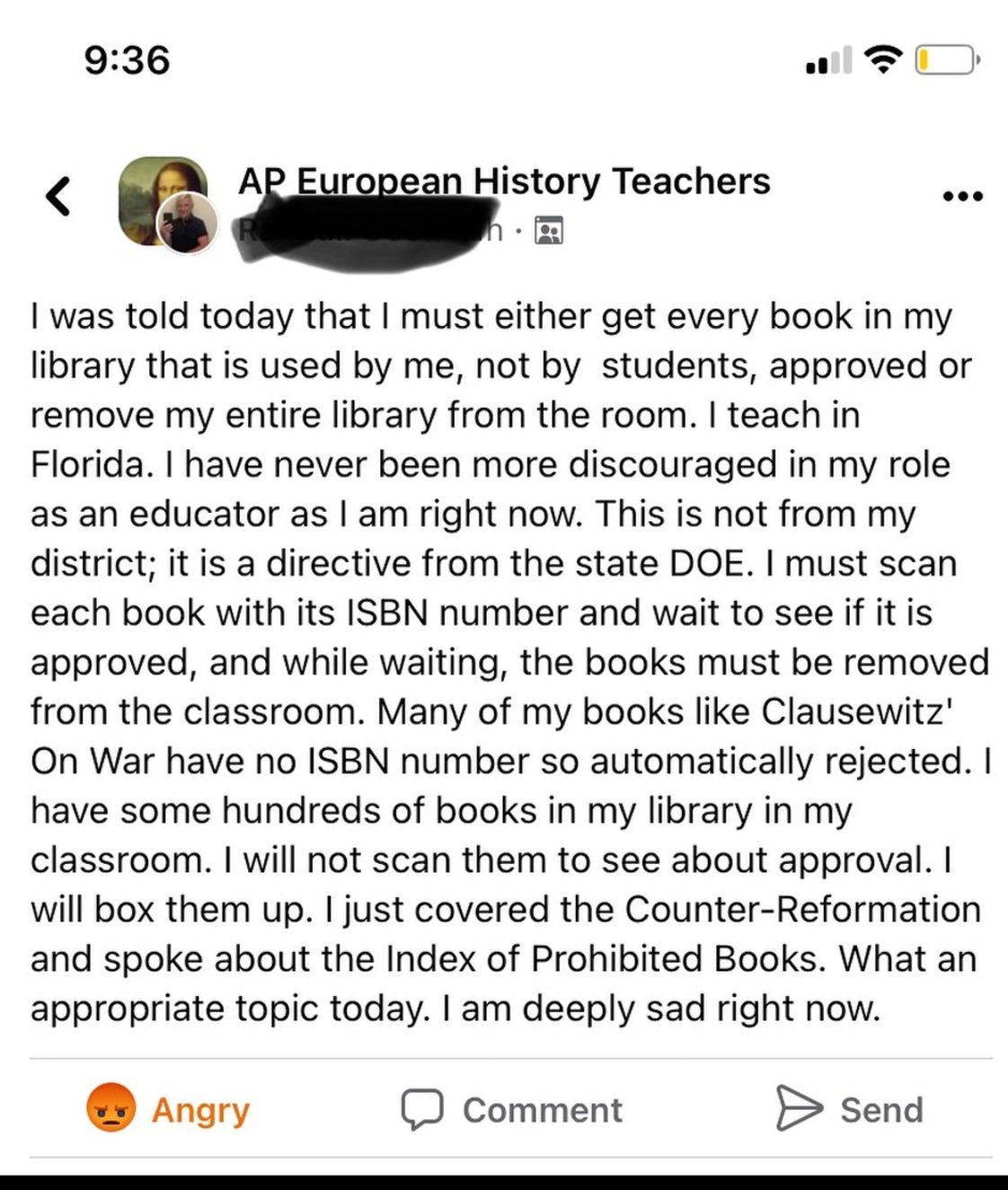
Please, don’t make make America Florida! Fascism starts with book censorship. In this case, a world history must remove his personal books because they are not on the state’s approved list. A book without an ISBN number can’t be in the list. We may assume that The Constitution, the Bible, and The Federalist Papers do not have ISBN numbers.

The more we learn about Ron DeSantis, the more obvious it is that he is unfit for any office due to his lack of ethics, his vindictiveness, and his authoritarianism. The Orlando Sentinel published an article about an investigation into the abusive behavior of a DeSantis appointee, who was appointed by DeSantis—without any background check, references or resume— to lead the state’s multi-billion dollar affordable housing program.

TALLAHASSEE — Gov. Ron DeSantis’ affordable housing executive director yelled and screamed at staff, made sexist comments, talked about their weight and threatened their jobs, employees of the Florida Housing Finance Corp. told an inspector general during an investigation.


The behavior of Mike DiNapoli, a former New York City financial adviser chosen by DeSantis to lead the corporation, created a hostile work environment that violated the organization’s policies, the corporation’s inspector general told board members Thursday.


“The conduct is severe and pervasive enough to create a work environment that a reasonable person would consider intimidating, hostile or abusive,” said Chris Hirst, the inspector general.


The investigative report into DiNapoli, which was not released publicly, was highly anticipated by those in Florida’s affordable housing community. Since the board approved hiring DiNapoli in February, 15 employees — 10% of the corporation’s workforce — were either fired by DiNapoli or quit.

DiNapoli was placed on paid administrative leave by the board in July. Last month, DeSantis reinstated him, with a spokesperson for the governor telling Politico that he never should have been suspended and that the investigation “has found nothing to justify the placement of Mr. DiNapoli on administrative leave….”

DeSantis’ press secretary lashed out at the board in a statement Thursday, calling members “clearly incapable of exercising prudent judgment.”

“If anyone wonders what the deep state looks like, this is it,” Jeremy Redfern said. “It’s clear to us that at least some members of this Board believe they can wield unchecked power to recklessly disparage a public official and tarnish his reputation without basic fairness and due process.”

He added, “We will explore every available tool to ensure proper management and oversight of the board and its staff, including the Inspector General, and to ensure further that this agency ultimately remains accountable to the people of Florida….”

DiNapoli also serves on the board of the First Housing Development Corp. of Florida, which has contracts with the corporation. Three of the corporation’s general counsels, who doubled as ethics officers, said it was a conflict of interest. Hirst agreed and concluded it was a violation of the corporation’s policies.

When asked about the conflict, DiNapoli said it was a “gray line,” and “an appearance of a conflict is not a conflict,” Hirst said….

Hirst also found that the corporation violated its hiring policies when it chose DiNapoli.

The corporation was supposed to advertise the executive director position, conduct interviews, do background checks and call work references. None of that happened, Hirst said. The corporation doesn’t even have an application or a resume on file for DiNapoli, he added.

Instead, DiNapoli was simply appointed by DeSantis, with the only letter of recommendation coming from James Uthmeier, DeSantis’ chief of staff who is currently leading DeSantis’ campaign for president.

The Times/Herald has previously reported that, before taking the job with the Florida Housing Finance Corp., DiNapoli had struggled with financial issues, including a bankruptcy, debtors garnishing his wages and a foreclosure on an Ocala home.

So DeSantis hired a guy with no background checks, not even a resume or references, to oversee the disbursement of billions of dollars for affordable housing. What could possibly go wrong?

Politicians should choose their words with care. When they whip up animus towards any group, there are mentally ill people who take them seriously and act out violently on their impulses.

That’s what a Black man said to DeSantis. He accused DeSantis of responsibility for the murder of three innocent Black people in a Dollar General store by unleashing a hate campaign against “woke” and against teaching the history of racism. And by making it easier to buy guns.

Gov. Ron DeSantis railed at a Black questioner in Jacksonville on Thursday who suggested his policies bore some blame for the racist shooting there last month that left three Black people dead.
“You have allowed people to hunt people like me,” the man said, leading DeSantis to angrily respond, “I’m not going to let you accuse me of committing criminal activity! I am not going to take that.”

The confrontation happened at the end of an event in which DeSantis and state Surgeon General Joseph Ladapo continued their longstanding campaign attacking masks, vaccine boosters and other COVID measures.

The man said the governor his policies have “allowed weapons to be put on the street in the hands of immature, hateful people that have caused the deaths of the people that were murdered.”

“You don’t get to come here and blame me for some madman,” DeSantis said as his supporters cheered. “That is not appropriate, and I’m not going to accept it. That is nonsense.”

DeSantis noted how gunman Ryan Palmeter was temporarily held for a mental health examination in 2017 under the Florida law known as the Baker Act.

“That guy was Baker Acted,” DeSantis told the questioner. “He should have been ruled ineligible [to own firearms], but they didn’t involuntarily commit him.”

DeSantis signed a bill this year allowing people to carry guns without getting a state permit.

The questioner was escorted out of the restaurant where the event was being held….

Behind a lectern sign reading “Mandate Freedom,” DeSantis and Ladapo slammed some of the COVID measures being done in other states in response to rising infections. They also attacked the new round of COVID booster shots expected to be made available soon.

“We will not allow the dystopian visions of paranoid hypochondriacs to control our health policies, let alone our state,” DeSantis said.

Ladapo, who was admonished by U.S. public health agencies earlier this year that his fueling of vaccine hesitancy is harming the public, told residents they should ignore expert guidance on vaccines if “you have an intuition about what the right thing is.”

Watch the number of COVID deaths in Florida. DeSantis and Lapado will both have blood on their hands for urging people not to get vaccinated.

Heather Cox Richardson, as usual, has a sharp take on political developments. You should subscribe to her blog.

She writes:

On Saturday, President Joe Biden and First Lady Dr. Jill Biden went to Florida, where he surveyed the damage, praised the Federal Emergency Management Agency (FEMA), and told the people of Florida: “Your nation has your back, and we’ll be with you until the job is done.”

White House press secretary Karine Jean-Pierre reiterated, “It doesn’t matter if it’s a red state or a blue state, the president’s going to show up and be there for the community.” Florida governor Ron DeSantis declined to meet with the president, apparently fearing a backlash from anti-Biden primary voters, but Republican senator and former Florida governor Rick Scott did meet with Biden and praised his rapid response to the hurricane.

Biden’s promise to the Republican-dominated state of Florida even in the face of DeSantis’s pettiness was a striking contrast to former president Trump’s withholding of federal aid from Malden and Pine City, Washington, almost exactly three years ago, when a September 2020 wildfire destroyed 15,000 acres and 85% of the buildings, including 65 homes. Trump held up Washington governor Jay Inslee’s request for a disaster declaration, which frees up federal funds, for more than four months out of spite at the Democratic governor. 

It was Biden who finally approved the declaration days after taking office. According to Emma Epperly and Orion Donovan Smith of the Spokane, Washington, Spokesman-Review, when he heard the declaration was finally in place, Malden Mayor Dan Harwood teared up in relief. “Our citizens are going to be able to go forward now,” he said. “We’ve been waiting for this day for a long time. It’s a very, very good day.”

Yesterday the three most senior civilian officials in the Department of Defense responsible for their branches—Secretary of the Navy Carlos Del Toro, Secretary of the Air Force Frank Kendall, and Secretary of the Army Christine Wormuth—wrote in the Washington Post that Senator Tommy Tuberville (R-AL, though it turns out he lives in Florida) is actively eroding “the foundation of America’s…military advantage” with his blanket hold on military promotions. 

Tuberville says he launched the hold in protest of the military’s policy of ensuring that military personnel can obtain reproductive health care, including abortions, but as the authors of the Post op-ed say, his policy “is putting our national security at risk.” More than 300 of our critical posts have acting officials in place, and three of our five military branches—the Army, Navy, and Marine Corps—have no Senate-confirmed service chief. 

In defense of his position, Tuberville has begun to attack the military leaders whose promotions he is opposing, much as former Fox News Channel personality Tucker Carlson lashed out repeatedly at Joint Chiefs of Staff chair Mark Milley for his support for diversity and inclusion in the military. In their op-ed, the secretaries warned of the danger of politicizing our military and noted that the damage Tuberville is inflicting on the service will echo for years as today’s colonels and captains gather that their service is not valued by members of Congress. 

Tonight, Secretary of the Navy Del Toro, who was born in Cuba, said on CNN: “I would have never imagined that…one of our own senators would actually be aiding and abetting communist and other autocratic regimes around the world. This is having a real negative impact and will continue to have a real negative impact on our combat readiness. That’s what the American people truly need to understand.”

Today marked the start of Texas attorney general Ken Paxton’s impeachment trial in the Texas Senate, which has taken on a meaning far larger than the fate of a single state official and become a fight over the future of the Republican Party. 

Paxton is a hard-right Republican who has based his political career on his identity as a Christian conservative advancing evangelicals’ culture wars. He has pushed Texas rightward since he took office in 2015, first challenging President Barack Obama’s Affordable Care Act and immigration orders, then championing Trump, then celebrating his wins against “woke Biden administration rules” and defending states’ rights. 

Paxton supported Trump’s efforts to overturn the results of the 2020 election, filing a lawsuit drafted by the Trump campaign to challenge other states’ elections and then, when the Supreme Court declined to hear that case, criticizing both the court and other states when he spoke at the January 6 rally at the Ellipse that preceded the attack on the U.S. Capitol. 

But Paxton has been embroiled in scandals since being indicted for securities fraud just months after he took office as the state’s top law enforcement officer. That trial has yet to take place, but now he is embroiled in other scandals that have led the Republican-dominated Texas House of Representatives to pass 20 articles of impeachment against him by a vote of 121 to 23. The House started impeachment proceedings after Paxton asked for $3.3 million in state funds to pay a settlement to four whistleblowers who accused him of abuse of office and bribery in 2020 and who were fired within a month. 

But the impeachment charges center around his ties to his friend and donor Nate Paul. Paxton is accused of helping Paul in exchange both for gifts and for hiring Paxton’s mistress.

The Texas Senate will conduct the impeachment trial. There are 31 members of the Senate, but one of them is Paxton’s wife, whom the Senate banned from voting after she refused to recuse herself. So to convict him, it will take 21 of the 30 state senators who can vote (his wife’s presence makes the conviction threshold 21 rather than 20). If all 12 Democrats in the Senate vote to convict, it will require 9 of the 18 voting Republicans to convict him. 

Robert Downen and Zach Despart of the Texas Tribune yesterday reported that the impeachment trial is expected to focus on Paxton’s infidelity to his wife. He told his staff about the extramarital affair at the center of his relationship with Nate Paul in 2018, when he promised it was over and he was recommitting to his marriage. But, in fact, he didn’t. To hide the affair from his wife and his deeply religious constituents, impeachment managers say, Paxton worked with Paul to get a job for his girlfriend and hide the relationship, and then used his office to help Paul weather lawsuits and bankruptcy.  

The Republican Party in Texas is split over Paxton much as the country is split over former president Donald Trump. Some say that Paxton’s extraordinary behavior warrants impeachment and trial and that, after all, a majority of Republicans in the Texas House were so concerned they impeached him. 

But others insist that he is, as he claims, a victim of political persecution. They maintain that a flawed man can do God’s will, and they support Paxton no matter what his failings out of support for his political crusades on their behalf. J. David Goodman reported yesterday in the New York Times that right-wing donors have embarked on an expensive, high-pressure campaign to convince Republicans in the Texas Senate to vote against conviction, threatening to primary anyone who votes against Paxton.

Still, his approval rating among Republicans has dropped by 19 percentage points since April, while his disapproval rate has more than tripled since last December. 

In other court news, a Florida judge this weekend struck down a state congressional map pushed through the legislature by Florida governor Ron DeSantis, saying it violates the state constitution by diluting Black voting power. The state will automatically appeal. 

Today, three Republican-appointed federal judges struck down Alabama’s new congressional map after the state legislature ignored a court order to redraw the state map to include a second majority Black district since the state map put in place after the 2020 census likely violated the 1965 Voting Rights Act. 

The judges wrote that they were “disturbed” by the state legislature’s refusal to correct its illegal maps. “We are not aware of any other case in which a state legislature—faced with a federal court order declaring that its electoral plan unlawfully dilutes minority votes and requiring a plan that provides an additional opportunity district—responded with a plan that the state concedes does not provide that district.”

The court will appoint a special master to draw Alabama’s congressional map, but Alabama attorney general Steve Marshall, a Republican, has already appealed the decision to the U.S. Supreme Court. 

In Wisconsin, where Republicans have called for impeaching Supreme Court justice Janet Protasiewicz for violating ethics codes by calling the state’s congressional maps “unfair” and “rigged,” a state judiciary disciplinary panel has dismissed those complaints. Republicans drew the congressional map in Wisconsin so fully in favor of their party that in 2018, Democratic candidates for the state assembly won 54% of the popular vote but Republicans “won” 63 of the assembly’s 99 seats, only three seats short of a supermajority that would enable them to override a veto by the Democratic governor. 

And finally, U.S. district judge Tim Kelly sentenced former Proud Boys leader Enrique Tarrio today to 22 years in prison. This is the longest sentence handed down for any of the January 6 rioters, though far shorter than the 33 years prosecutors had requested. Kelly also handed down sentences significantly below the guidelines for the crimes Proud Boys leaders committed: Joseph Biggs was sentenced to 17 years; Zachary Rehl, 15 years; and Ethan Nordean, 18 years. Dominic Pezzola, who was found not guilty of seditious conspiracy but guilty of other crimes, received a 10-year sentence. 

Tarrio is the last of the gang to be sentenced and was not present at the January 6 attack, underscoring the wide reach of a conspiracy conviction