Brendan Carr, selected as chairman of the Federal Communications Conmission, threatened to revoke the licenses of stations that were too negative in their coverage of the war in Iran.
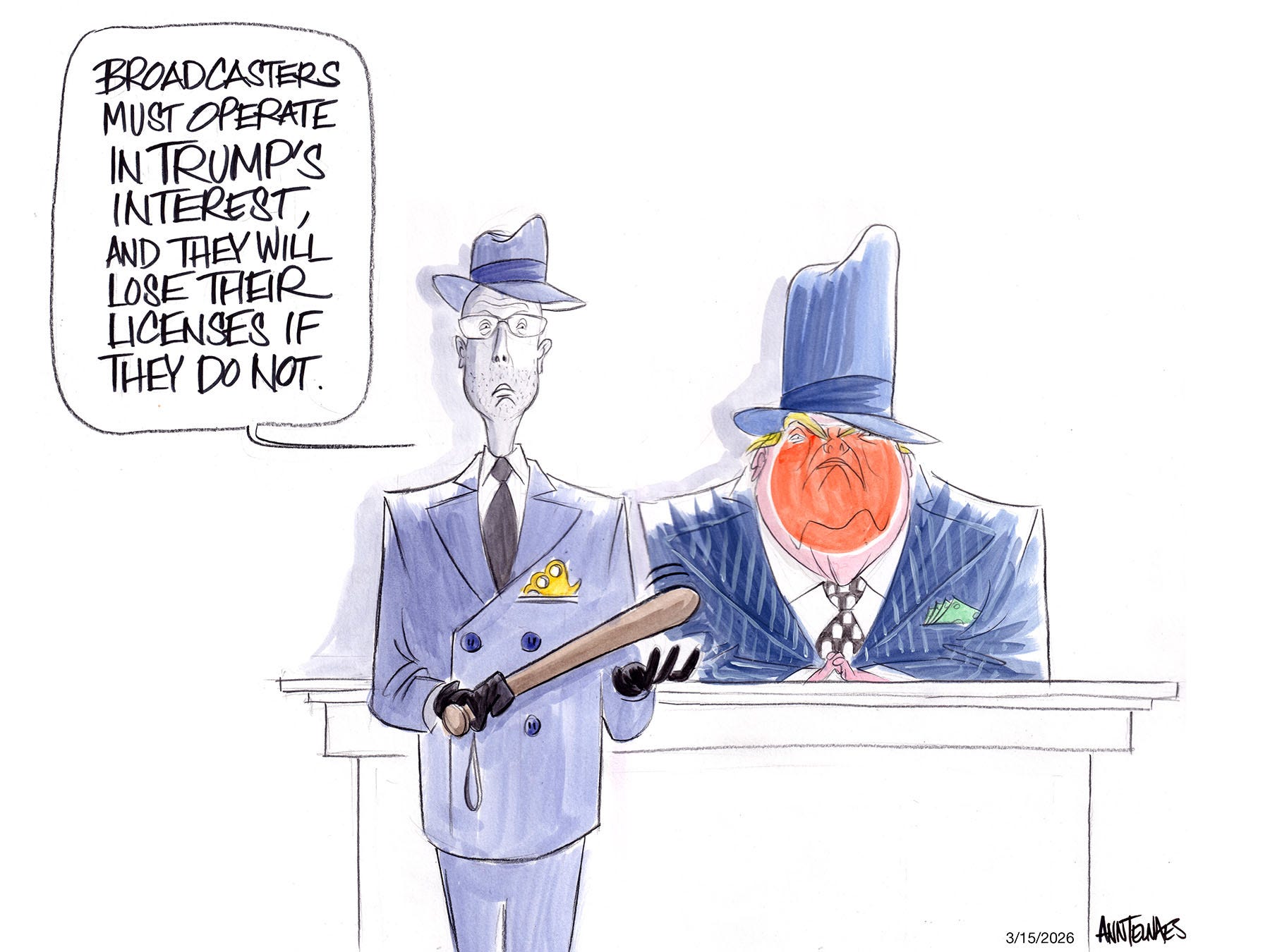
Ann Telnaes was an editorial cartoonist for The Washington Post. She drew a cartoon showing billionaires bowing down to Trump. One of them was Jeff Bezos, owner of the Post. Her editor wouldn’t publish her cartoon. She resigned.
In a startling attack on freedom of the press, Brendan Carr–chairman of the Federal Communications Commission–threatened to revoke the licenses of broadcasters whose coverage of the war on Iran is negative. With Trump ally, the billionaire Ellison family, buying control of CBS and CNN, Carr’s threat is ominous. One of the first steps of fascist leaders is to gain control of or silence the media.
The job of the media in a democracy is to inform the public, not to serve as a propaganda arm of the government.
President Donald Trump’s Federal Communications Commission chairman is threatening to revoke the licenses of news broadcasters over their coverage of the Iran war.
Brendan Carr, the head of the agency, warned broadcast news organizations on Saturday to “correct course,” following the president’s rants over news coverage of his war with Iran, including stories about U.S. aircraft tankers sustaining damage in a strike.
“Broadcasters that are running hoaxes and news distortions – also known as the fake news – have a chance now to correct course before their license renewals come up,” Carr said in a post on X, without naming any media outlets. “The law is clear. Broadcasters must operate in the public interest, and they will lose their licenses if they do not.”
The FCC did not immediately respond to MS NOW’s request for comment.
Carr referenced a Truth Social post from Trump Saturday morning denying reports that five U.S. Air Force refueling planes were struck at a military base in Saudi Arabia. Trump directed his screed at the The Wall Street Journal, which first reported the news, The New York Times and “other Lowlife ‘Papers’ and Media,” claiming they “actually want us to lose the War.”
In his own social media post later in the day, Carr pointed to Trump’s 2024 election win as an example of the lack of trust in the media from the American people.
“When a political candidate is able to win a landslide election victory after in the face of hoaxes and distortions, there is something very wrong,” the FCC chairman said. [Editor’s note:Trump did not win a landslide victory in 2024. Trump won 49.8% of the popular vote, while Harris won 48.3%.]
Carr’s threat was met with immediate blowback from free speech advocates and political figures.
The Foundation for Individual Rights and Expression, a First Amendment advocacy group, called Carr’s statement an “authoritarian warning,” adding, “Again and again, Carr’s tenure as FCC chairman has been marked by his shameless willingness to bully and threaten our free press. But even by Carr’s standards, today’s hypocrisy is shocking — and dangerous….”
Carr, an author of Project 2025 whom Trump hand-picked to run the FCC, has sought to use his powerful position to bend media outlets — and late-night talk show hosts — to the Trump administration’s will. Under his watch, the FCC has opened investigations into multiple news outlets and threatened to strip the licenses of broadcasting companies deemed to have covered the administration and the president unfavorably.
But his latest missive took the administration’s assault on what the president routinely calls the “fake news” a step further. Sen. Brian Schatz, D-Hawaii, said in an X post, “This is a clear directive to provide positive war coverage or else licenses may not be renewed. This is worse than the comedian stuff, and by a lot. The stakes here are much higher. He’s not talking about late night shows, he’s talking about how a war is covered.”
Trump and members of his administration have repeatedly bemoaned the media coverage of the war. Earlier this month, Defense Secretary Pete Hegseth accused the press of being too focused on American troops’ deaths than the military’s successes.
“But when a few drones get through or tragic things happen, it’s front-page news,” Hegseth said. “I get it; the press only wants to make the president look bad. But try for once to report the reality.”
“Some in this crew, in the press, just can’t stop,” he said.
Late on Friday night, Trump railed against coverage of the war, saying on Truth Social: “The Fake News Media hates to report how well the United States Military has done against Iran.”
This story could be told again and again. George Reyes was on his way to work. He is a citizen and a veteran. ICE agents stopped his vehicle, smashed his windshield, dragged him away, and jailed him for three days.
The author being detained by federal agents on July 10 / Credit: Blake Fagan via AFP
“A body of men holding themselves accountable to nobody ought not to be trusted by anybody.” – Thomas Paine
By George Retes
Last Wednesday, February 18, I officially launched my lawsuit against the federal government. For me, this was something that felt like it was never going to happen. Not because I didn’t want to or because I was afraid, but because I thought that was just the way the law works when you’re trying to hold federal officials—and the government that employs them—accountable for violating someone’s rights.
On July 10, 2025, I was driving to my job as a security guard at a licensed farm in Camarillo, CA. Federal immigration agents were lined across the road that led to the farm I worked at. I clearly stated my citizenship and fully complied with officers, even though they were all yelling contradictory orders and no one was clearly in charge. Yet, despite doing everything right, I was detained and treated as if I had no rights. Agents engulfed my car with tear gas, smashed my window, sprayed pepper spray in my face, and dragged me out. I was choking on gas, unable to breathe, and even though I wasn’t resisting, I had one agent kneeling on my back and another kneeling on my neck while my hands were already behind my back.
I was first taken to a Navy base, where the agents took my fingerprints, picture, and swabbed my DNA. I was then taken off the base to a detention center and held for three days without charges. No phone call. No lawyer. No medical care, even though my skin burned from the chemicals. I never even got to shower. Friday morning, I was put on suicide watch, which means they put me in a yellow concrete room with a concrete bed and tiny mattress on top. They left the light on 24/7. I was in a hospital gown, and a guard watched me. I was in those conditions from Friday morning to the point I was released. I was released with zero charges and no explanation for anything that happened.
After my release, the harm did not stop. Instead of correcting the record, officials from DHS, specifically DHS spokesperson Tricia McLaughlin, used social media to spread false and misleading statements about me, in an attempt to justify my detention and undermine my credibility.
I was wrongfully detained and then publicly misrepresented by the very agency that violated my rights. That is not transparency. That is damage control at the expense of the truth. And since they only respond through social media, I would like to ask them to answer these questions, not only to me, but to the world: Why didn’t I ever get a phone call? Or a shower? Or a lawyer? If your accusations are true, why was I released without charges?
Under a law called the Federal Tort Claims Act (FTCA), a person filing a lawsuit against the government must wait six months before they are even allowed to file suit. And even after all that, the chances of actually prevailing in your lawsuit are very low because of the so-called “discretionary function immunity” that the federal government gets. It is even harder to sue federal officials individually. Not because the court system is defending this, but because there is no clear law that allows people to sue individual federal officials for violating their rights.
There is another law that’s sadly relevant here: 42 USC 1983. As my attorneys wrote in Bloomberg Law, Section 1983 “allows constitutional claims to be brought against those acting under color of state law.” But, if, instead, an official is acting under color of federal law (which generally means an official working for the federal government), the result is “near-complete immunity from conventional lawsuits.”
All of that could be easily fixed by Congress. All Congress would have to do is amend the law to allow us to hold federal officials accountable for violating someone’s rights. The law already does this for state officials, so this change would be an easy fix that would hold all law enforcement to the same standards, implying that no one, no matter the badge, is above the law.
This week, I attended the State of the Union as a guest of Rep. Mark Takano (D-Calif.). I was honored and extremely grateful for the opportunity. Never did I think I would be in this situation, surrounded by these people, and yet here I was. By attending, I was a living reminder of government overreach and how it has impacted so many people, contrary to this administration’s claims that they are only going after “the worst of the worst.” I listened as the president painted DHS’s actions as appropriate simply because we need to fix the border issue. But this characterization is not true. This is not immigration enforcement; it’s madness.
When injustice becomes law, resistance becomes duty.
I’m fully aware that my lawsuit might fail; that the world might look at my story and choose to just move on; that the federal officials who did this to me might get off scot-free. But there’s another future possible here: one where we succeed in court, where people choose not to look away, where federal agents can’t unjustifiably detain a US citizen with impunity. That’s the future I choose to believe in, and the one I’m fighting to make real—not only for myself, but for every single person in this country.
What happened to me is not about politics. It is not about immigration policy. And it is not about one bad decision made in a chaotic moment. It is about power without accountability. If a US citizen, an Army veteran, someone who complied with officers’ directions, identified himself, and broke no law, can be treated this way—detained without charges, denied basic rights, physically restrained, and then publicly smeared to justify it—then no one in this country is as safe as they believe they are.
The Constitution does not only apply when it is convenient. Civil rights do not disappear because an agency makes a mistake. And truth does not stop mattering because it is uncomfortable. I am asking for accountability and my day in court, not just for myself, but for everyone who does not have a platform, a lawyer, or the ability to stand in front of you and tell their story. Because if this can happen to me, it can happen to anyone.
The measure of this country is not whether we admit when we are wrong, but whether we are willing to correct it.
George Retes is a US citizen and Army veteran who served in Iraq and was jailed by ICE and held for three days without an explanation.
Timothy Snyder left his endowed professorship at Yale University and is now ensconced at the University of Toronto, where he holds the inaugural Chair in Modern European History at the Munk School of Global Affairs and Public Policy. Snyder is known for his many books about European history.
Donald Trump, president of the United States. “Calling this meeting to order. That was a long speech that I just gave. State of the Union. Long speech. Not going to stand up and do that again next year. So let’s hear it. Plans to make sure I don’t have to. Plans to end the United States by a year from now. Around the table. Go. Start us off, Linda.”
Linda McMahon, Education. “Thank you, sir. Nothing is more important for the country than public schools. So we are destroying them by directing tax money away from public school parents and towards private education scams.”
Russ Vought, Management and Budget. “The republic depends on its institutions. As you know, sir, we are wrecking our civil service by firing those who are qualified and replacing them with political hacks. I don’t want to overstate my case, sir, but these are not just normal hacks. They are hackety-hacks, sir. They will use what remains of the government to hasten the process of its destruction. Hackety-hack, sir.”
Trump. “Good. Hack. Good. But maybe something faster.”
Scott Bessent, Treasury. “A government works on the basis of tax revenue. From the beginning of your administration, sir, we have been overseeing a shift whereby people who actually have the money won’t pay any taxes. Indeed, our oligarchs will be the happy recipients of whatever tax money we can scrape up from the middle and working classes. This wealth shift from the population at large to the wealthy few is inconsistent with the survival of a republic. This will help speed along the change Russ is talking about.”
Howard Lutnick, Commerce. “And there’s a next step, if I may, sir. When we empower the oligarchs they can help us. Big tax cuts make them happy and destructive. The endgame here, sir, is to have billionaires control extraterritorial zones, like Epstein Island, a place that I know well, but without any fear of taxation or any other form of government control. These little fiefs then replace the United States. This is the scenario and I do think we can bring it home within a year.”
Pam Bondi, Attorney General. “And a republic is based upon law. This is where Justice comes in. We can ruin law in a number of ways, such as investigating the people we ourselves murdered, or persecuting your personal enemies. A good way to kill our Constitution is to protect pedophile oligarchs, such as yourself, sir. I was attorney general in Florida while Epstein pioneered our future, sir, and I can see this through on a national scale. We can make this Epstein World, sir.”
Trump. “I like it. But that’s familiar stuff. I mean I live there now, right. Let’s see some movement. How about some color.”
RFK Jr, Health and Human Services. “There was a lot of color in the middle ages, sir. Our freedom and security are based on modern vaccinations and hygiene. We undo all of that and promote epidemics. We see good results already in Texas and South Carolina. Not just people dying but babies and children getting really colorful diseases like encephalitis. By the way, this also opens up wellness markets for the people Howard and Scott are talking about. It takes people a while to die and there is money to be made there.”
Doug Burgum, Interior. “I may have something even more basic than that, sir. Everything we know about human history indicates that rapid changes in climate can bring down whole civilizations. We are deliberately engineering one of those. By suppressing green energy we can generate rapid global warming and make human life unsustainable. And along the way we get that color. People turning against each other, guns out until we run out of ammunition, then clubs, starvation, the works, a real spectacle. And, as Bobby says, disease. Very colorful, sir.”
Lee Zeldin, Environmental Protection. “And, if I may add, sir, our campaign to fry the species gives us all good practice in telling big lies, which are needed for all of these plans. Also, the billionaires will be fine on their islands when all of this happens.”
Trump. “OK, that’s colorful, I get it, but I want something with bad guys. Like a movie. The warming thing doesn’t work as a movie. Do you remember The Day After Tomorrow. I don’t remember the Day After Tomorrow. I want enemies. Bad guys who win.”
Marco Rubio, State. “I can help there. You are right, sir, that a republic to survive has to defend itself against autocratic enemies. So we empower the autocrats in China and Russia. We break the international system that held them back. We prop up Moscow in Ukraine and we give Beijing our most sensitive technology, ideally by way of middlemen who enrich you, sir, personally. If I may say so, sir, your friends and family have been very helpful in all of this.”
Tulsi Gabbard, National Intelligence. “Intelligence is the eyes and ears of our republic, sir, and we want these eyes and ears to be penetrated by foreigners who wish for us to fail and die. So we have liftedour cyber-defenses and announced that we have done so. If I may add, sir, both Russia and China support your incredible leadership in their information ops. It’s as though we all want the same thing. I see it every day and it’s beautiful. Spirit of Aloha. We say hello and they say goodbye…”
Kristi Noem, Homeland Security. “Without disagreeing with any of that, I just wanted to add that a republic exists because people believe they belong to a single nation. So the most direct way to kill our republic is a civil war. This almost worked the last time; this time we are getting the federal government behind white supremacy. We are creating a giant national secret police force in order to invade cities and force a conflict.”
Pete Hegseth, Defense. “Kristi is right. The war we can win is against Americans. And now that we are bringing unsupervised AI to direct our weapons, we won’t have to start it ourselves. It will be automated, we just watch from those safe islands. You see, sir? Movies. Terminators. Squiddies. Remember Wargames, sir, shall we play a game? AI likes nuclear war, it will recommend it 95% of the time. Get me into a conventional war, I lose it quickly, and boom. That would save you from having to give the speech, sir.”
Trump. “I like it. No long speeches. No Union. Steal what we can and burn the rest. Or burn first and then steal? Works either way. Steal, burn. Either way. Burn, steal. To help out I will just be me. Steal, burn. Me. Burn, steal. Me.”
(Applause)
•••
The conversation is fictional, of course. In essence, though, this is little more than a review of the news of the last few days and weeks.
Trump is determined to punish states and cities that didn’t vote for him. So he sent large numbers of masked ICE agents to bully, beat, harass, and intimidate people in blue places, while recklessly killing two protestors.
He unleashed his fury on Minneapolis, sending in 3,000 ICE agents. They must have been trained to act like Brown Shirts because they do. They don’t just arrest people. They grab them, throw them to the ground, punch them, kick them, ziptie them, toss them into a van, picking up people who “look like” immigrants, and disappear them.
The people of Minneapolis resisted. They resisted with such determination that they forced Trump to back down. DHS announced that it will pull its occupying force out of Minneapolis. Everyone is waiting to see if ICE is really leaving. They will believe it when they see it.
Other cities and communities can learn from Minneapolis. The ICE bullies may soon be sent to your city, your community.
The resistance began immediately. People set up an alarm system, letting others know where ICE was operating. People protected their neighborhoods and communities. They turned out to blow whistles, to film ICE actions on their cell phones, and peacefully protest by their presence
Wherever ICE went, volunteers documented what they did. These videos proved to be powerful evidence of ICE brutality and lies.
Renee Good was murdered at one such protest. The White House and Department of Homeland Security called her a domestic terrorist and said she tried to run over an ICE agent, but multiple videos proved that they were lying.
Alex Pretti was murdered when he tried to help a fellow protestor who had been knocked on her back by ICE goons. He was filming with his cellphone. They called him a terrorist and an assassin, but again they were lying.
The people of Minneapolis treated each other as friends and neighbors and organized a powerful resistance. Volunteers organized to deliver food to people afraid to leave home. They drove people who were afraid to take public transit.
Schools protected their students as best they could. Many children from immigrant families were afraid to leave home. The schools went online to keep them learning. Schools stockpiled food for students and their families; volunteers delivered it. Teachers made home visits to check on students.
Columbia Academy, a middle school in Columbia Heights, a Minneapolis suburb, became “a food bank, a counseling hotline, a missing persons task force, an immigration resource center and a refuge.”
Leslee Sheri, the principal of the school in Columbia Heights, a five-school district, said:
“We are the first call,” said Sherk, a first-year principal who has worked in the district for two decades. “They don’t call the police. They don’t even sometimes call their neighbors or different organizations. They call the school.”
Neighbors helped neighbors. Neighbors helped strangers. The people of Minneapolis reacted with surprising solidarity in opposition to the aggressive militarization of their city.
They stood up, often in bitter cold, spoke out, protected the vulnerable, and demonstrated what democracy, courage l, and compassion looks like.
Italia Fittante is a high school literature teacher in Minneapolis. This essay was published by Education Week. Trump promised during his campaign to deport “the worst of the worst,” criminals, rapists, murderers. Instead he has put a target on the back of every immigrant, no matter how long they have lived here, no matter how much they have contributed to society. Our children are experiencing a reign of terror.
One of my seniors walked into my classroom after school yesterday. He needed an extension on his final project, and I could see he’d been working up the nerve to ask me.
His parents haven’t left the house in over a week for fear of being stopped by immigration agents, which means someone has to work. At 17, that someone is him. After school every weekday and all day on weekends, every week, because the bills don’t stop.
He carries his U.S. passport everywhere now, tucked in his pocket, transferred from his jeans to his school uniform and back again, refusing to let it out of his sight even in my classroom. He’s been stopped twice on his walk home from work by masked men and women in unmarked cars, demanding he prove his right to exist in the country where he was born.
He wants to go to medical school; he’s always dreamt of being a doctor. He told me about the university in Mexico holding a spot for him, the contingency plan he never thought he’d need. Just in case things get worse here and he has to follow his parents across the border, just in case his future is decided by policy instead of potential.
I told him to forget the deadline.
Another one of my seniors came to me early Tuesday morning before class started, her eyes hollowed out and bloodshot from lack of sleep. She was concerned about making up a reading quiz she had missed the day before.
In tears, she explained to me that she was working the register at a fast-food restaurant over the weekend when ICE agents burst through the doors midshift. They pushed past her, forced their way into the back of the restaurant, and violently detained two of her co-workers. Nobody knows where they went, when they’re coming back, or if they’re coming back at all.
She told me she hadn’t slept since the raid. This student, who immigrated with her family to the United States just three years ago, described being paralyzed with fear.
I told her to forget the quiz.
The past few weeks in Minnesota have been marked by relentless federal immigration operations. Agents operate openly and without restraint. This week alone, ICE detained multiple students from a neighboring district, one as young as 5 years old. Children and teenagers have been taken on their way to school, from driveways and from cars. My students live with the constant awareness that anyone they love could be taken at any moment. They themselves could be next.
What we’re asking these kids to do seems impossible. Show up. Focus. Read about the American Dream in Advanced Placement Literature while you wonder if your father will be deported before graduation. Solve for x while you’re solving how to pay the electric bill. Write your college application essay about overcoming adversity while doubting you’ll survive it.
They already come to school knowing they might die there. We’ve made peace with that somehow. Lockdown drills and barricading doors are routine. My students can tell you the difference between shots fired in the building versus shots fired nearby. At the beginning of the school year, two elementary students were killed during mass at a Catholic school just miles from us. Before the media even covered it, my students were calling their parents. I could hear them crying in the halls, in my classroom.
Some of them knew the victims. Now, they come to school and know which corner of each room has the best cover. They are 17 years old and fluent in survival tactics.
My students carry U.S. passports in their pockets like keys to a house where the locks keep changing, navigating their own city like it’s hostile territory. Their walks to and from school are haunted by the persistent possibility that they’ll come home to silence, their parents taken by masked strangers who leave no forwarding address.
We’re creating a generation of students from immigrant families who understand exactly how little this country values their safety.
They’re learning the lesson we’re teaching, even if it’s not the one we claim to be giving. They understand the message we’re sending when we demand their labor and their silence and their gratitude, all while treating their existence as conditional and their families as disposable. How can we expect them to love their country when those in power have made it clear their country doesn’t love them back?
The curriculum is clear. Documentation determines dignity, and borders determine which families matter. Authority needs no accountability, not when violence can be rebranded as policy if it advances “our” goals.
My students understand what’s happening because they’re living it. The stakes are clearer to them than to most adults I know. They don’t need explanations or sympathy or platitudes or extensions. They need safety without surveillance, because this country is theirs, too. No child should have to carry identification to prove their right to exist.
What sort of nation terrorizes children and calls it enforcement? That demands loyalty while offering nothing but fear? My students already know the answer. They learned it the moment they started carrying passports in their pockets.
The state of Minnesota asked a federal judge to stop the federal militarization in Minneapolis. In a much-anticipated ruling, she said no. The judge, appointed by Biden, said that a previous ruling about federal tactics had been overturned, and she thought it was a signal that any ruling favoring the state would be overturned.
A federal judge has rejected a bid by state and local officials in Minnesota to end Operation Metro Surge, the Trump administration’s massive deployment of thousands of federal agents to aggressively enforce immigration laws.
In a ruling Saturday, U.S. District Court Judge Katherine Menendez found strong evidence that the ongoing federal operation ”has had, and will likely continue to have, profound and even heartbreaking, consequences on the State of Minnesota, the Twin Cities, and Minnesotans.”
“There is evidence that ICE and CBP agents have engaged in racial profiling, excessive use of force, and other harmful actions,” Menendez said, adding that the operation has disrupted daily life for Minnesotans — harming school attendance, forcing police overtime work and straining emergency services. She also said there were signs the Trump administration was using the surge to force the state to change its immigration policies — pointing to a list of policy demands by Attorney General Pam Bondi and similar comments by White House immigration czar Tom Homan.
But the Biden-appointed judge said state officials’ arguments that the state was being punished or unfairly treated by the federal government were insufficient to justify blocking the surge altogether. And in a 30-page opinion, the judge said she was “particularly reluctant to take a side in the debate about the purpose behind Operation Metro Surge.”
The surge has involved about 3,000 federal officers, a size roughly triple that of the local police forces in Minneapolis and St. Paul. However, Menendez said it was difficult to assess how large or onerous a federal law enforcement presence could be before it amounted to an unconstitutional intrusion on state authority.
“There is no clear way for the Court to determine at what point Defendants’ alleged unlawful actions…becomes (sic) so problematic that they amount to unconstitutional coercion and an infringement on Minnesota’s state sovereignty,” she wrote, later adding that there is “no precedent for a court to micromanage such decisions.”
“If that injunction went too far, then the one at issue here—halting the entire operation—certainly would,” the judge said in her Saturday ruling.
Minnesota Attorney General Keith Ellison signaled his team would continue fighting to end the federal operation, writing in a statement that “this case is in its infancy and there is much legal road in front of us.”
“We know that these 3,000 immigration agents are here to intimidate Minnesota and bend the state to the federal government’s will,” he said. “That is unconstitutional under the Tenth Amendment and the principle of equal sovereignty. We’re not letting up in defending our state’s constitutional powers.”
Attorney General Pam Bondi on X called the decision “another HUGE” win for the Justice Department in its Minnesota crackdown and noted that it came from a judge appointed by former President Joe Biden, a Democrat.
“Neither sanctuary policies nor meritless litigation will stop the Trump Administration from enforcing federal law in Minnesota,” she wrote.
Minnesota Gov. Tim Walz and Minneapolis Mayor Jacob Frey have both called for federal agents to leave the city as the chaos has only intensified in recent weeks.
“This federal occupation of Minnesota long ago stopped being a matter of immigration enforcement,” Walz said at a press conference last week after two Customs and Border Patrol agents shot and killed 37-year-old nurse Alex Pretti. “It’s a campaign of organized brutality against the people of our state. And today, that campaign claimed another life. I’ve seen the videos from several angles. And it’s sickening.”
Backlash from Pretti’s killing has prompted Trump to pull back on elements of the Minneapolis operation.
Two CBP agents involved in the shooting were placed on administrative leave. CBP Commander Greg Bovino was sidelined from his post in Minnesota, with the White House sending border czar Tom Homan to the state in an effort to calm tensions. Officials also said some federal agents involved in the surge were cycling out of state, but leaders were vague about whether the size of the overall operation was being scaled back.
“I don’t think it’s a pullback,” Trump told Fox News on Tuesday. “It’s a little bit of a change.”
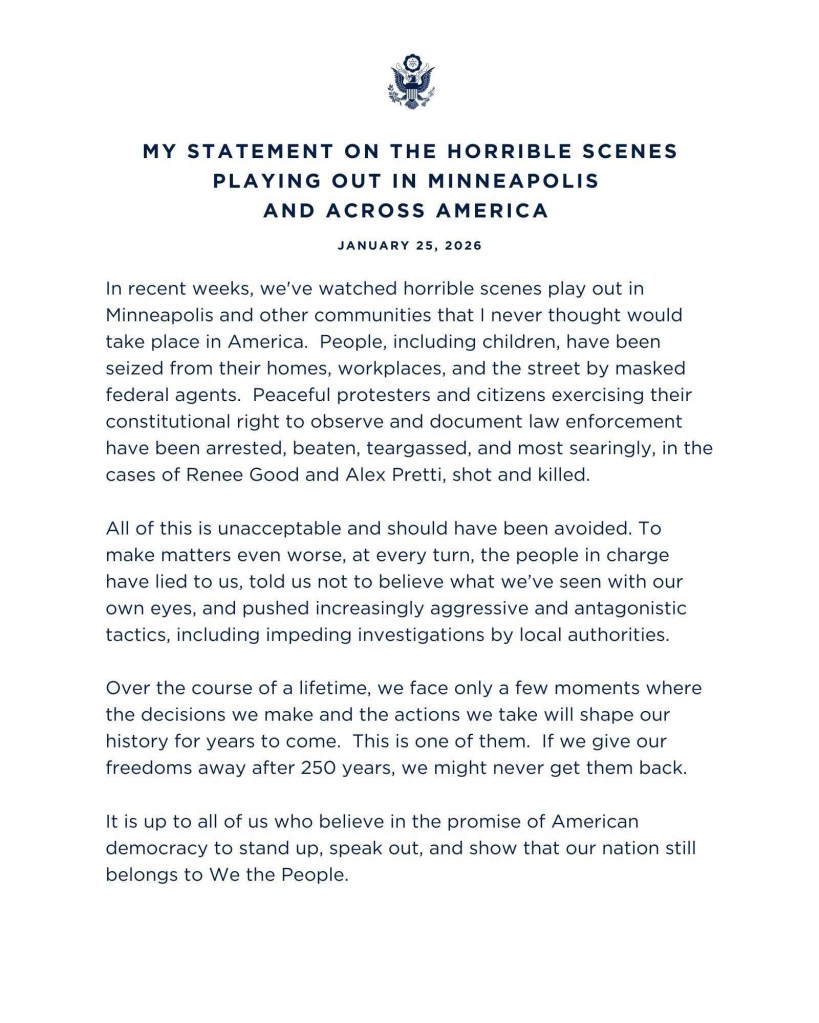
Former President Bill Clinton released the following statement about what’s happening in Minneapolis and other places, as Trump unleashes the armed, masked ICE agents to arrest, harass, and murder our fellow citizens in pursuit of undocumented immigrants .
Well said. Where are other retired Presidents, Vice-Presidents, Senators?
Please speak up, Former Presidents Bush and Obama.
The video is startling. Between 3-6 armed, masked ICE agents surround a man, wrestle him to the ground, throw punches at him while he seems to be completely immobilized.
Before that year is entirely forgotten, I want to say that it was one of the worst years in my life.
I learned in college that a sample of 1 is not useful for science, but it means plenty to me.
A year ago, a monstrous, lying braggart was sworn into office. A grifter and conman returned to fill his pockets and those of his family and friends, to double his net worth and to accept emoluments from foreign countries, send armed men to inflict brutality on blue cities, disregarding the Constitution.
In only one year, he has shredded our nation’s standing in the world, inflicted terror on our cities, alienated our allies, abandoned efforts to improve the environment, attacked our schools and universities, gloried in bigotry, and devastated the federal civil service.
He sends federal agents or the National Guard into urban districts, to terrorize the residents. People are snatched from their cars, their workplaces, the streets, even as they protest that they are citizens, that they have rights, that they want a lawyer. Their protests are ignored as a pack of masked men grab them, handcuff them, throw them to the ground, punch and kick them in their heads and bodies. Some are detained and disappeared into a network of prisons, then deported without due process. Some are imprisoned for days or weeks, then released.
Is this America? Never in my life have I been stopped by military officers and asked for my papers,
The cold-blooded murder of Renee Good was followed not by an investigation or apology but by smearing her and her wife as terrorists who were somehow responsible for her fate and deserved to die.
Who are these masked men? Why are they so violent? Are they Proud Boys? KKK? J6 insurrectionists?
Every day, I wonder if this is how decent Germans felt as Hitler took power and destroyed civil society.
What is happening to my country? To our Constitution? To the rule of law?
As I watch our values and rights degraded by power-mad politicians, I fight to preserve my body.
In the spring, I learned after my annual mammogram that I had breast cancer. I learned that I had invasive ductal cancer in my right breast, which required surgery. The post-surgery analysis revealed that not all the cancer was removed. The “margins” were not clear. So back I went for another surgery on the same site.
Radiation–five straight days of it–followed. it left me tired, but otherwise apparently successful.
I was reluctant to take a daily pill of anti-cancer medicine because of the numerous side effects. But I did and I suffered the predicted side effects. I had pain in my hips and joints. That was November.
Meanwhile I had a new mammogram. It showed that I had a new cancer, this time in my left breast. The surgeon recommended another surgery, and this time she got it all out. It was a tiny tumor, different from the first one. But a cancer nonetheless.
Radiation begins today, January 20, the first anniversary of Trump’s return to office. What a coincidence, cancer in my body, cancer in our nation.
It has been a nightmare year, for the country and for me personally. To make matters worse, our beloved dog Mitzi died. Through all of the personal trauma, my wife Mary stood by me steadfastly, through thick and thin, demonstrating her determination and love.
In a few weeks, we expect to get another dog. We will survive.
It remains to be seen whether our country will survive a second Trump term, another round of brutality inflicted on our norms, our values, our fellow citizens and our neighbors, our faith in our electoral system and our laws.



 Diane Ravitch's blog