Archives for category: Extremism

Ruth Ben-Ghiat is a professor at New York University and an authority on fascism and dictatorship. Here, she analyzes the shocking decision by Mike Johnson, the House Spraker, to release the tapes of the January 6 insurrection with the faces of participants blurred so they can’t be identified and prosecuted. If they are releasing tapes of criminal activity, why are they blurring the faces of criminals? To protect them.

She writes:

Authoritarianism revolves around the power to commit crimes with impunity. That is why protecting and promoting criminals and turning violent and corrupt activities into patriotic and necessary actions are always priorities of authoritarian parties and governments. The statement by Speaker of House Mike Johnson (R-LA) that House Republicans will blur footage from the Jan. 6 attack to help participants avoid being brought to justice is symptomatic.

When autocratic forces triumph, the rule of law becomes rule by the lawless. If Donald Trump returns to the White House, this will be the situation in the United States.

The party took a big step forward in the process of normalizing impunity when they made the methods and philosophy of the Jan. 6 attempted coup into party dogma. A 2022 GOP resolution decreed the assault on the Capitol to be “legitimate political discourse.” This rhetorical defense provides an “intellectual” rationale for the overturning of our democracy.

Normalizing impunity also means actively shielding participants in the coup attempt from being brought to justice and discrediting democratic institutions of justice in the eyes of the public. This is what keeper of the MAGA cult Johnson sought to do with his statement. “We have to blur some faces of persons who participated in the events of that day because we don’t want them to be retaliated against and to be charged by the DOJ,” he said.

As with everything Johnson says and does, this declaration was meant for an audience of one. It was a loyalty performance meant to reassure Trump that the GOP will defend those who tried to save him from the awful fate of accepting democratic precedent and leaving office when he was voted out.

Johnson’s statement also sends a strong message to MAGA thugs and fanatics that the Republican party will defend them if they engage in acts of political violence going forward. And it reduces the DOJ’s actions to hold criminals accountable to “retaliation.”

Crime, and the law, have a different meaning for authoritarians and their enablers. In the amoral and transactional world of leaders such as Trump, all means are justified to get to power and stay there. So, actions that might be defined as criminal in a democracy take on a different meaning in an autocracy. Elites and foot soldiers are rewarded for engaging in corruption, lying, and violence.

Creating an environment propitious to such violence is a key element of preparing for and managing autocracy. Spouting dehumanizing and violence-inciting rhetoric is not enough: you have to give people incentives to engage in corrupt and violent acts.

The promise and reality of pardons plays a role here. MAGA loyalist Rep. Paul Gosar (R-AZ) used the idea of a ” blanket pardon” to get people to participate in the insurrection. Trump has deployed this ever since. “If I run, and if I win, we will treat those people from January 6 fairly,” the former president stated at a Jan. 2022 rally. “And if it requires pardons, we will give them pardons, because they are being treated so unfairly.”

As I observed in an earlier Lucid essay, illiberal leaders have long used pardons to corrupt people, discourage dissent in and outside of the party, hide their crimes, and free up the most criminal and unscrupulous elements of society for service to the party and the state.

Benito Mussolini inaugurated this strategy. In 1925, soon after he declared himself dictator, he pardoned all “political criminals,” meaning the Blackshirts whose violence had helped him come to power in 1922 and intimated and killed people ever since. Murderers, specialists in torture, and more were now available to serve in Il Duce’s new militia or take jobs in the party and the state bureaucracy.

Five years after the 1973 coup destroyed Chilean democracy, dictator Augusto Pinochet amnestied all political criminals. Tellingly, the junta pardoned not just “authors” and “accomplices” of crimes, but also “concealers” of those crimes, so that military and security service agents who had committed human rights abuses now had their service records cleansed of incriminating evidence.

In blurring the faces of those who engaged in violent actions on behalf of an autocrat, and stating that they do not want those who assaulted the Capitol to be brought to justice, Johnson and the GOP place themselves in authoritarian tradition. They are releasing the altered footage because they need to consolidate a revisionist narrative about Jan. 6 for campaign purposes.

The DOJ has the unaltered footage, and living in a democracy means evidence of actions that incriminate those who commit violence on behalf of the powerful cannot easily be destroyed. The GOP intends to cleanse the DOJ if they return to power and likely scrub all such evidence. In the meantime, they must settle for blurring the faces of those they want to use for future anti-democratic actions. “We don’t want them…to be charged by the DOJ,” Johnson said. This is why.

If Trump and the GOP have their way, as of 2025 the DOJ would be remade to serve autocratic goals, protecting criminals rather than holding them accountable.

Conservative firebrand Bridget Ziegler insists she will stay on the Sarasota school board after the other members passed a resolution calling on her to resign. The board doesn’t have the legal power to force her removal. Only DeSantis does.

Ziegler is co-founder of Moms for Liberty and a national voice for traditional family values. She has led the crusade to censor books about sexuality and racism. She is an outspoken critic of homosexuality.

Students were not allowed to attend the meeting because of the nature of her activity: three-way sex with her husband and another woman.

Hypocrisy is not a crime.

Maybe now Bridget will stop denouncing gays. Or is that too much to hope?

Max Boot left the Republican Party when Trump became President. He now contributes to the Washington Post. He recently wrote that the GOP is returning to its 1930s policy of isolationism, egged on by MAGA and Trump, who never faults Putin. He is outraged that the Republicans are now blocking aid to Ukraine, using it as a chip to barter for a new border policy. Spending for Ukraine weapons is spent in the United States. More important, cutting Ukraine adrift would be a huge victory for Putin.

He writes:

It’s not often that I feel ashamed to be an American. But I was ashamed this week when the Senate refused to support a supplemental spending bill that would provide about $61 billion in urgently needed aid for Ukraine (along with $14 billion for Israel and $20 billion for border security). All of the Senate Republicans, even those who have previously supported Ukraine funding, voted to filibuster the bill. Their stated position: They won’t provide a penny for Ukraine unless Democrats agree to a sweeping, draconian overhaul of the United States’ immigration laws.


I’m sorry, that’s not how a serious political party — or a serious country — behaves during a world crisis. It’s like saying to President Franklin D. Roosevelt in 1941: We won’t support aid to Britain as it battles the Nazis unless Democrats repeal the Social Security Act or rewrite the labor laws.


Of course, most Republicans in those days were opposed to aiding Britain: A majority of Republicans in both houses voted against the Lend-Lease Act, enacted in early 1941, which allowed the U.S. government to provide critically needed war supplies to Britain and other nations deemed “vital to the defense of the United States” without demanding payment in cash. Thank goodness that in those days both houses were controlled by Democrats — and Senate rules did not require a 60-vote supermajority to get anything done.


Most Republicans abandoned their isolationism after the Japanese attack on Pearl Harbor on Dec. 7, 1941. The GOP commitment to internationalism was renewed after 1945 because of postwar Soviet aggression and then, after the end of the Cold War, by the 9/11 terrorist attacks. But since the end of the Iraq and Afghanistan wars, Republicans have been increasingly returning to their pre-Pearl Harbor roots.

The party’s leader, former president Donald Trump, has even embraced the “America First” slogan used by the original isolationists. And, just as so many of the 1930s isolationists, such as Charles Lindbergh, were sympathetic to Nazi Germany, Trump is sympathetic to Vladimir Putin’s Russia. Public opinion surveys have reflected a sharp drop-off in Republican support for Ukraine: In a Gallup poll published on Nov. 2, 62 percent of Republicans said the United States was doing too much to aid Ukraine, up from 50 percent in June.
Yet I confess that, until last week, I had remained naively hopeful that Congress would still do the right thing. After all, strong majorities in both houses had supported Ukraine funding bills in the past. Moreover, the current aid request is a pittance in the context of a $6.1 trillion federal budget (0.98 percent, to be exact), and most of the funds would be spent in the United States to support our own defense industry.


The new House speaker, Mike Johnson (R-La.), had initially voted for Ukraine aid before turning against it, but in recent weeks he sounded much more supportive of Ukraine, saying, “We can’t allow Vladimir Putin to march through Europe and we understand the necessity of assisting there.” Senate Minority Leader Mitch McConnell (R-Ky.), whose father was a U.S. Army soldier in Europe during World War II, has been a staunch supporter of Ukraine. “Honestly, I think Ronald Reagan would turn over in his grave if he saw we were not going to help Ukraine,” he said last month.


Yet now both leaders have taken the position that — as Johnson wrote this week — “supplemental Ukraine funding is dependent upon enactment of transformative change to our nation’s border security laws.” Good luck with that. The last time Congress enacted a major, bipartisan immigration bill was in 1986, when Reagan was in the White House. Lawmakers from both parties have been laboring for decades to craft another major bill. A decade ago, the bipartisan “Gang of Eight” thought they were close, only to have the deal fall apart. So it’s hard to take Republicans at face value when they insist on making aid to Ukraine dependent on breaking through decades of legislative logjams on immigration.

Why are they linking the two? The excuse heard from Republicans is that they can’t in good conscience support funding to defend Ukraine’s borders when our own borders are so insecure. They think that by invoking the common word “borders” they can pretend that the United States and Ukraine are in analogous situations. That would be true only if the Mexican Army were invading the southwestern United States to annex Arizona, New Mexico and Texas while announcing plans to march on Washington and destroy the United States as a sovereign country.


Needless to say, that hasn’t happened. What is happening is that millions of desperate immigrants are trying to enter the United States, legally and illegally, in pursuit of freedom and economic opportunity, just like the ancestors of most native-born Americans. The spike in undocumented immigration is a serious problem that needs to be addressed, but it can hardly be said to threaten the United States’ survival in the same way the Russian invasion threatens Ukraine’s.


By linking the two issues, Republicans are engaging in a bait-and-switch that gives them an excuse to do what their base wants — abandon Ukraine — while trying to blame Democrats for “jeopardizing security around the world,” as McConnell has charged.


As Sen. Brian Schatz (D-Hawaii) told the New York Times: “You can’t say ‘I’m for Ukraine, but only if I get this wholly unrelated policy enacted.’ You can’t be for stopping Putin from taking over a country by force and then vote against providing Ukraine the resources to do just that.”

It is still possible that Democrats and Republicans will reach agreement on Ukraine funding. But the odds of Ukraine aid being approved look dimmer today than at any point since the Russian invasion, even as the Office of Management and Budget warns that U.S. support for Kyiv is running out: “We are out of money — and nearly out of time.”

Ukrainians will fight on regardless, and they will look for help to Europe, which has already committed twice as much funding as the United States. But, even working together, Europe and the United States have struggled to keep up with Ukraine’s need for ammunition. There is no way that Europe alone can carry the whole load, especially not when Hungarian Prime Minister Viktor Orban — MAGA Republicans’ favorite foreign leader — is trying to block a $55 billion European Union aid package for Ukraine.


The United States has abandoned allies, such as South Vietnam and Afghanistan, before. But this time the costs of support are much lower (no U.S. soldiers are engaged in combat in Ukraine), and the stakes are far higher. Ukraine is fighting the largest war that Europe has seen since 1945. If it loses, Vladimir Putin may be emboldened to attack other neighboring states, such as the Baltic republics and even Poland, which are members of NATO. Other despots may be emboldened to aggression of their own, beginning with Chinese leader Xi Jinping in Taiwan. And then we really will be back to the pre-Pearl Harbor world — all thanks to the Republican Party returning to its isolationist roots.

Unless Congress reverses course, and soon, it could be consigning our democratic allies to slaughter — and making the world a far more dangerous place.

Rudy Guiliani admitted that he defamed two Georgia election workers by accusing them of fraudulently switching ballots. The two are mother and daughter Ruby Freeman and Shaye Moss. As a result of his repeated accusations on national television, which were repeated by Trump, calling them out by name, the pair were subjected to continual threats, harassment, and intimidation. They are suing Guiliani for a sum between $15.5 million and $43.5 million. Jury selection begins today.

The showdown between the financially strapped Giuliani and the two temporary poll workers he baselessly accused of ballot tampering in 2020 will highlight a major court battle over false claims that became central to former president Donald Trump’s efforts to stay in power and is now at the heart of two criminal cases against him.


U.S. District Judge Beryl A. Howell has already found Giuliani liable for more than a dozen defamatory statements against Ruby Freeman and Wandrea ArShaye “Shaye” Moss, who are mother and daughter, leaving a jury of eight only to decide how much he should pay in damages for violent threats and harassment the pair received. Howell previously ordered Giuliani to pay the women $230,000 in legal fees and sanctions for failing to turn over relevant information. She said those failures, combined with Giuliani’s own admissions, compelled her to rule without a trial that he defamed both women, intentionally inflicted emotional distress on them as part of a civil conspiracy, and owes punitive damages.

If you want to hear the details of what happened to them, watch this clip from the Rachel Maddow show. In addition to hearing their story, you will also hear testimony from the #2 official at the Justice Department, Richard Donahue, who testified to the January 6 Commission that he met with Trump and told him that the Justice Department had investigated all his claims of election fraud and found no evidence for them.

Many states have passed laws that ban the teaching of accurate history. Sometimes these laws ban “divisive concepts,” some ban anything that might cause students to feel uncomfortable, some find other language to warn teachers and textbook publishers to omit the shameful events of the past, especially the racist treatment of people of color.

In Florida, where the state went to great lengths to whitewash the teaching of Black history, one man has devoted himself to telling the truth. That man is Dr. Marvin Dunn. Dr. Dunn was a keynote speaker at the annual conference of the Network for Public Education. In the meanwhile, you can read his book A History of Florida Through Black Eyes.

In response to Dr. Dunn’s moving presentation, a friend of NPE sent me the following article about the Danville Massacre of 1883. We now know that Reconstruction was a period of impressive racial progress. Formerly enslaved people voted, opened small businesses, and asserted their newly won rights.

But the former Confederates found this rebalancing of racial relationships intolerable. The Danville Massacre put an end to a period of reconciliation and installed Jim Crow, cancelling out the gains of Reconstruction.

The author of the article could not remember learning about this important event in the state’s history.

Learning the truth about history doesn’t make children uncomfortable. It makes them informed.

Recently, I have read alarming articles about state universities eliminating majors in the humanities as a cost-cutting measure while expanding departments that grant degrees in computer science, business, and other job-related fields. Just last week, The Atlantic published an article about the downsizing of foreign languages, linguistics, and other majors at the University of West Virginia, even though the state has a surplus of nearly $2 billion. Other universities are cutting majors in history, the arts, and political science in favor of majors that enhance immediate employability.

Gayle Greene, professor emerita at Scripps College in Claremont, California, contends that such actions are short-sighted. Today—in a world of disinformation, fake news, and Artigiani intelligence—we need the humanitities more than ever so we can discern and weigh facts and reality. In this essay , she shows how tech titans like Bill Gates have encouraged the destructive trend of favoring job-ready degrees.

Greene writes:

“College is remade as tech majors surge and humanities dwindle,” announces Nick Anderson in the Washington Post, May 2023. “Remade” is an understatement, when more students today are majoring in computer science than in all the humanities– English, history, philosophy, languages, the arts— combined. And what for? In the past year, tech has laid off more than 200,000 workers, with more layoffs predicted.


There was a chorus of Cassandras warning against this remake: do not whittle education down to preparation for jobs that might not exist in a decade; do not sacrifice the humanities to STEM. But the hype was so loud, it drowned out the warnings. The STEM skills shortage was broadcast by business leaders, lobbyists, politicians, think tanks, media, and especially by Bill Gates, who spread the word far and wide. He announced to Congress, in 2008, “U.S. companies face a severe shortfall of scientists and engineers with expertise to develop the next generation of breakthroughs.” Obama echoed him in his 2012 State of the Union Address: “I hear from many business leaders who want to hire in the U.S. but can’t find workers with the right skills.” Obama reiterated the message in his 2011, 2013, and 2016 State of the Union Addresses, announcing, in 2013 a competition “to redesign America’s high schools,” rewarding those developing STEM classes to deliver “the skills today’s employers are looking for to fill jobs right now and in the future.”


The hype was hot air. “If a shortage did exist, wages would be rising” rather than staying flat as they have “for the past 16 years,” wrote Ron Hira et al in USA Today, 2014. Obama might have heeded him or Andrew Hacker, Ben Tarnoff, Matt Bruenig, Michael Teitelbaum, Gerald Coles, Walter Hickey, Michael Anft, who raised similar alarms. Or Paul Krugman, who warned, “the belief that America suffers from a severe ‘skills gap’ is one of those things that everyone important knows must be true, because everyone they know says it’s true”; it’s “a zombie idea… that should have been killed by evidence, but refuses to die.”


When an idea persists against all evidence, you have to ask: who profits? A 2012 Microsoft publication warned that the U.S. faces “a substantial and increasing shortage of individuals with the skills needed to fill the jobs the private sector is creating”—even though, in the summer of 2014, Microsoft laid off about 18,000 workers. Other companies,Boeing, IBM, Symantec, were also laying off thousands, sometimes rehiring them at lower salaries, even as they lamented the “lack of qualified applicants,” wrote Hacker.


The problem for a company like Microsoft has not been a lack of skilled workers, but that U.S. tech workers expect to be well paid. Foreign tech workers in the U.S. make about 57% what their U.S. counterparts make. Hence the tech industry’s push for easier immigration policies and H-1B visas, visas that allow U.S. businesses to temporarily employ foreign workers in specialty work like IT. If we don’t ease up on immigration policies, Gates told Congress in 2008, “American companies simply will not have the talent they need to innovate and compete.” Hence Gates’spush for coding and computer classes in schools and colleges. “Nothing would make programming cheaper than making millions more programmers,” wrote Tarnoff, “and where better to develop this workforce than America’s schools.”


The STEM skills shortage was the PR of an industry wanting a large pool of workers ready to work for less, an industry with enormous lobbying power. The campaign has been so successful that now hundreds of thousands of trained workers are newly unemployed in a market flooded by as many as qualified as they. It’s succeeded in bending higher education to its purposes, re-directing it to training for jobs, with tech jobs the most hyped–even though tech comprise less than 8% of the economy. Colleges and universities direct resources that way, private donors pour enormous sums that way, and students follow the money and the buzz, whatever their interests and talents. Humanities enrollments have plummeted, courses, programs, departments have been gutted, and tenured faculty let go.


But what even the most dire of Cassandras failed to see, even those working in AI, was the seismic upheaval AI was about to create.


*******

Obama might have been more cautious about dismantling an educational system that’s served the U.S. so well, a system widely believed to have been the engine of this country’s power and productivity. The U.S. still has the universities that rank highest internationally and have world-wide draw, in spite of the assaults higher education has lately endured. But he went ahead and based his educational policies on the vision of a technocrat (Gates’ word for himself) who sees the purpose of education as making a workforce that will allow U.S. industries “to compete in the global economy,” as Gates said in Waiting for Superman, 2010, a public-school-bashing documentary film he funded and starred in. Obama turned his education department over to the Gates foundation, as Lindsey Layton documented in the Washington Post, 2014: “top players in Obama’s Education Department who shaped theadministration’s policies came either straight from the Gates Foundation in 2009 or from organizations that received heavy funding from the foundation.”


With K-12, Obama uncritically adopted No Child Left Behind (NCLB), the test and assess regime George W. Bush inflicted on public schools in 2002 in the name of “reform”—even though NCLB was an acknowledged disaster by the time Obama took office. Schools could be closed if test scores declined— many were closed, especially in underprivileged areas, where kids don’t test well—which left teachers no choice but to teach to the test and strip curricula of subjects not tested, including literature, history, philosophy, the arts, languages, social sciences. The panic about test scores made a boondoggle for new ventures supplying materials for test- prepping, test-administering, test-scoring, and assessing. In fact, what test scores most reliably measure is how well kids take tests, which penalizes students from disadvantaged backgrounds and makes a mockery of claims that testing levels the playing field, the rationale for so-called reform.


Obama tightened the screws on Bush’s program, requiring states to agree to certain conditions to qualify for federal funding, each of them high on the Gates agenda. States had to agree to make room for more charter schools, and they did—more charters were founded on Obama’s watch than Bush’s. Gates claims that charters will create “choice” and “competition” and incentivize teachers to raise test scores. In fact they have not raised test scores, though they have succeeded in routing public funding to private interests, as they were meant to. States also had to agree to adopt a standardized curriculum. This came in the form of the Common Core State Standards, Gates’ brainchild, which wedded teaching even more closely to testing, assessing, and technology, since standardized material is easily computer-administered and scored. The Common Core has reduced reading and writing to decontextualized skills — “find the main point,” “identify the figures of speech”— which has been a major turnoff for kids. The moaning we hear lately about declining test scores is beside the point: the point is that kids are massively alienated from school because “drill, kill, bubble fill” is all they’re fed.


Gates has admitted that transforming K-12 is harder than he’d anticipated: “We really haven’t changed outcomes” (i.e. test scores). But he should not underestimate his impact. His perpetuation of the broken-public-schools narrative, his attack on teachers and tenure, his imposition of mechanization and measurement on an enterprise he knows nothing about, have driven teachers out of the profession in record numbers, with few lining up to take their places. Teachers have written and spoken against the Common Core, forming advocacy groups to resist it, and tens of thousands of parents have opted their kids out of testing— but the machine rolls on. The foundation “has influence everywhere, in absolutely every branch of education…federal, state, local,” with politicians, journalists, administrators, think tanks, summarizes Tom Loveless of the Brookings Institute.


Higher education has been harder to get hold of, on account of the respect it commands throughout the world. But harping on its failures to meet market needs has done much to skew it the Gates way. “The [Gates] foundation wants nothing less than to overhaul higher education, changing how it is delivered, financed, and regulated,” wrote Marc Parry, Kelly Field, and Becky Supiano, in a brilliant expose, “The Gates Effect.” It “would like college to be cheaper, more accessible, and more targeted towards the specific skills desired by employers. Instead of a broad education where a college student might take courses across a range of subjects, the new model has students demonstrating ‘competencies’ by passing tests in specific areas, and receiving a certificate upon completion.” Thefoundation “hasn’t just jumped on the bandwagon,” the authors conclude; “it has worked to build that bandwagon.”


And its stranglehold on mainstream media is murderous. As with K-12, “Gates buys up everyone and engineers the appearance of a consensus,” writes Diane Ravitch. Ravitch was in the first Bush education department and a proponent of No Child Left Behind, but turned against it when she realized its purpose was to route public resources to private interests; she has been a powerful advocate for public schools ever since. As with K-12, “the foundation has bought the research, bought the evaluations, bought the advocacy groups, and bought the media to report on what the foundation is doing. It has lavished support on education journals, while also saturating them with ads and ‘sponsored’ articles.” As with K-12, this creates the sense of a hue and cry from many quarters, of widespread agreement that higher education is broken, resists change, resists innovation, needs technology, needs to produce more STEM workers.


​**********

Fifty years ago, the humanities had a “national mandate,” writes Nathan Heller in a widely read New Yorker article, “The End of the English Major,” February 2023. The liberal arts had pride of place. Now the mandate has moved to STEM, with more than a little push from business interests keen to transform higher education to job preparation and right-wing anti-education agendas.


In 2013, Obama’s administration produced a “Scorecard,” an online tool to show “folks” where they can get “the most bang for the buck,” as he promised in his 2013 State of the Union address. The Scorecard has Gates’ fingerprints all over it. It ranks colleges according to number of graduates, speed to graduation, starting salaries, time taken to pay back student loans—which makes a college rise higher in the rankings for graduating a hedge fund manager than a teacher. And higher education has cooperated, inviting managerial administrators in to make education “more like business,” lean, mean, and cost effective. They’ve stripped away courses and programs with no “real world” value and cut back in areas they deem inessential— like teaching, which has been turned over to part-timers or online programs, while tenured faculty are let go, and with them, tenure. Administrators hire more administrators, offices and functionaries proliferate, and academia is saddled with a top-heavy bureaucracy that drains resources. Then along comes a pandemic that cuts into college enrolments and devalues any enterprise without immediate utilitarian value—and here we are. The humanities are beyond crisis; they’re “on life support,” writes James Engell, Harvard Magazine, February.


And the STEM bandwagon rolls on, powered by Gates lobbying, onto the floor of Congress, where the Higher Education Act, the federal law governing crucial policies such as accreditation and standards that qualify colleges for financial aid, is overdue for reauthorization. In May 2019, the Gates foundation established a new lobbying group, “Commission on the Value of Postsecondary Education,” to make sure Congress understands the “value” of postsecondary education, “value” defined in terms of graduates’ salaries and social mobility. Prior to this lobbying group, the foundation exerted its influence from behind the scenes, but launching a 501c (4) nonprofit enables them to “talk directly with legislators about laws,”explains Nick Tampio. In May 2021, the Commission published a 117-page report, Equitable Value: Promoting Economic Mobility and Social Justice through Postsecondary Education, which spells out elaborate systems of measurement and assessment to make sureschools render dollar for dollar return on investment. The foundation is now in a position to assure that federal funding gets routed to majors leading to jobs Gates sees as vital to the economy.


*********

In 2018, Benjamin Schmidt cautioned against remaking higher ed to meet alleged market needs because nobody could predict what jobs would look like in ten years. Now, with AI to do the work of many humans, we might ask what jobs will look like in ten months. In March, Goldman Sachs released a report estimating that “generative AI may expose 300 million jobs to automation,” work that “might be reduced or replaced by AI systems,” summarizes Benj Rfestfd in Ars Technica. An insider, “Scott,” comments on a NYT article, March 28, on likely effects of GPT (“generative pre-trained transformers” that produce human-like text and images):


As a software entrepreneur who is part of a think tank that studies AI, I can tell you that GPT is not overhyped… it impacts every job from manufacturing to knowledge work, and with some imagination even agriculture, food production and restaurants… People are focusing on a single job? You should start thinking of entire professions, industries and companies (thousands of which GPT will put out of business this year). Our politics are not ready for the disruption, deflation and unemployment.


“We have summoned an alien intelligence,” write Yuval Harari, Tristan Harris, and Aza Raskin in the NYT in March. Our first contact with AI, they note, the relatively simple manipulation of attention by social media, was catastrophic: it “increased societal polarization, undermined our mental health and unraveled democracy.” What comes next is anybody’s guess, but a lot of people are worried, including more than a thousand tech leaders and researchers who signed an open letter in March calling for a six-month moratorium on the development of GPT, citing its “profound risks to society and humanity.”


“It’s a completely different form of intelligence,” says Geoffrey Hinton, the “godfather of AI,” who resigned from Google so he could speak freely; and it’s likely to be “much more intelligent than us in the future.” It has the capacity to flood the internet with fake images and misinformation so convincing that we may “not be able to know what is true anymore”—which is dire for democracy. There are calls for regulation, including from Sam Altman, CEO of Open AI, the company that created GPT-4: “the current worries I have are of disinformation problems, economic shocks, or something else at a level far beyond anything we’re prepared for.”


Meanwhile the titans, Google, Amazon, Microsoft, Meta, are out of the gate, racing for the spoils.


​*********

How to deal with an alien intelligence that’s faster and smarter than we are? Killing the humanities has left us a bit understaffed in this department. By eliminating subjects that might teach us about ourselves and our fellow beings, we’re exacerbating the problems confronting society. Misinformation and conspiracy fantasies flourish, racism and hate crimes are on the rise, along with mortality rates, not only from Covid but “deaths of despair.” Quality of life in the U.S. has plummeted.


Many people fear that the STEM craze may be turning out graduates ignorant of the past and their world, ill equipped for the challenges of an increasingly uncertain future. Spending one’s college years mastering the practical skills of a specialized field does not cultivate a broad understanding of the world. Minds need to be developed all around, if they are to “understand human behavior” and achieve “emotional intelligence and mental balance”— the capacities Yuval Harari says young people most need as they face dizzying change. They’ll need, above all, ”the ability to keep changing,” qualities of adaptability and versatility cultivated by the kind of education we’ve trashed.


“Major in being human,” David Brooks advises young people who are wondering where to turn with AI threatening to steal their futures. Ask yourself, “which classes will give me the skills that machines will not replicate, making me more distinctly human?” Gravitate toward classes that will help you develop “distinctly human skills… that unleash your creativity, that give you a chance to exercise and hone your imaginative powers.” That would be the humanities, small, discussion-based classes where students learn about the past and creations of their kind, about what humankind has been and might be; where they learn to articulate their positions and see that others have positions too, that they can disagree yet get along—which goes a way toward learning to live in society. Find the human, urges Douglas Rushkoff in Team Human, and find the others who can help us resist the anti-human agenda and “restore the social connections that make us fully functioning humans.”


The stakes are high. A 2020 study, “The Role of Education in Taming Authoritarian Attitudes,” found that in all the countries surveyed, higher education correlated with resistance to authoritarianism, but it made the greatest difference in the United States, on account of our unique system of general education based in the liberal arts. Yet this is the system we’re letting go. Authoritarianism thrives on misinformation, on simplistic, us-them thinking. Democracy requires that people deal with complexity, think, question, interpret, inquire, sort out information from misinformation, push back against agendas being pushed on us, take nothing on authority. It requires that people know how to read their world, interpret, evaluate, inquire, consider context and consequences, and know how to seek sources other than social or corporate media. Decoding has a longer shelf life than the coding Gates is pushing. It’s crucial to democracy –and to employability, it turns out, since skills alone become rapidly obsolete.


To disinvest in the humanities is to disinvest in the human, to give up on the hope of a livable world and more humane future. Which is why it’s urgent to resuscitate the humanities and not outsource our humanity to Hal.

##################

Gayle Greene is Professor Emerita, Scripps College, Claremont, CA. Her most recent book is Immeasurable Outcomes: Teaching Shakespeare in the Age of the Algorithm (Johns Hopkins UP, 2023), which makes a case for the humanities by actually showing what goes on in a small discussion class.

Gaylegreene.org
What an embarrassment for the U.S. Department of Education!

Carol Burris writes on Valerie Strauss’s Washington Post blog, “The Answer Sheet,” that Secretary Miguel Cardona just awarded one of its largest grants ever to expand a Hillsdale College charter school in Ohio. Hillsdale is closely tied to the conservative Christian movement and to Republican leaders such as Donald Trump, Governor Ron DeSantis of Florida, and Governor Bill Lee of Tennessee.

Hillsdale’s history program is called “the 1776 curriculum,” intended to refute the ideas of journalist Nicole Hannah-Jones’ controversial “1619 Project.” Hannah-Jones argued that American history began with the arrival of African slaves in 1619. To counter her narrative, the Trump administration in its waning days created “the 1776 Commission” to produce a quick version of a patriotic history. On President Biden’s first day in office, he abolished the 1776 Commission. Hillsdale College, however, continued the work of writing a full U.S. history curriculum based on the work of the 1776 Commission and made it available to schools that wanted history as it used to be taught: with great men, high ideals, and unblemished patriotism.

Hillsdale is now associated with a chain of charter schools that have adopted its Christian worldview and the 1776 curriculum. As Burris, executive director of the Network for Public Education explains, a Hillsdale charter just won nearly $2 million from the federal Charter Schools Program. CSP is administered by the U.S. Department of Education. The charter made claims about its location and its demographics that are “misleading.”

Trying to think of an analogy to Secretary of Education Miguel Cardona giving a large grant to a Hillsdale charter school: imagine Secretary of Education Betsy DeVos giving $2 million to a charter school for transgender children. Neither seems likely. But one scenario happened.

Valerie Strauss introduces Burris’s column.

A recent federal audit had a bit of bad news for the U.S. Education Department’s Charter Schools Program (CSP), which has provided more than $2.5 billion in grants to help open or expand charter schools. The audit by the department’s Office of Inspector General found that the CSP office may not have had “reliable information needed to make informed decisions” about continuing funding for charter schools with program grants.

There was more in the audit, which you can read about here, but this post looks at a different problem facing the CSP: schools with highly problematic applications that win millions of dollars of federal money anyway.

Charter schools are publicly funded but privately operated, some of them as for-profit entities, and they educate about 7 percent of U.S. schoolchildren. The 30-year-old charter sector has been riddled with financial and other scandals over the years, although supporters say that the problems these schools face are expected growing pains and that they offer families an important option to schools in publicly funded districts. Critics say that they are part of the movement to privatize public education and that some states have lax charter school laws that do not properly regulate them.

This post was written by Carol Burris, an award-winning former New York high school principal and now executive director of the advocacy group called Network for Public Education, which is an alliance of organizations that advocates for the improvement of public education and seeks legislative reform of charter schools. Burris has written previously on the charter school program for Answer Sheet (for example, here and here). She has chronicled how the program spent hundreds of millions of dollars on charter schools that never opened or closed not long after opening.

Burris writes about the funding application of a charter school in Ohio, the Cincinnati Classical Academy, and says that her organization, along with a group of Ohio legislators and other organizations, have asked Education Secretary Miguel Cardona to rescind the school’s nearly $2 million CSP grant. I asked the school to comment and will add its response if I get one. I asked the Education Department about the letter, and a spokesman said this in an email:

“The U.S. Department of Education (Department) is committed to supporting state and local efforts to increase school diversity and reduce racial and socio-economic isolation in schools, including through the Charter School Program (CSP). There are multiple safeguards in place to ensure the integrity of CSP applications and funded grants. For example, all CSP applicants must provide attestations confirming the accuracy of information submitted in their application. False, fictitious, or fraudulent statements or claims may subject applicants to criminal, civil, or administrative penalties. Such safeguards are in place to help ensure charter schools serve communities well.”

By Carol Burris


An invitation to fiction writing. That is how Mike Winerip described the federal Charter School Program (CSP) grant process in a 2012 New York Times story, a characterization based on his investigation of a New Jersey charter school, which, despite three failed attempts to open and an application full of “misrepresentations,” had secured a CSP grant.

This issues didn’t go away. The All Football Club of Lancaster, Pa., an unauthorized charter school with no community support, submitted an often-incoherent application and yet won $1.2 million in 2020. A school run by a for-profit operator immersed in self-dealings and a segregation academy turned charter school cashed in on a North Carolina grant.

But the prize for the most inventive story to secure a CSP grant may belong to the Cincinnati Classical Academy (CCA), a Hillsdale College member school, for securing a nearly $2 million grant. CCA, which prides itself on teaching virtue, asked for the grant on the basis of its claim that it was closing the achievement gap and serving disadvantaged students, never reporting that only 16 percent of its students are economically disadvantaged and that 2 percent are Black — a starkly different student body from the overwhelmingly disadvantaged and majority-Black Cincinnati Public School students, who, CCA says, it wants to save from poverty.

Cincinnati Classical Academy


Cincinnati Classical Academy is located on a cul-de-sac in a leafy residential suburb of Cincinnati called Reading. The school’s website features a motto and a coat of arms, and plays a video showing the school building with a cross atop a tower at the entrance as well as a large American flag. It currently runs from kindergarten through seventh grade but says it plans to add a grade each year until it becomes a full K-12 school.

It takes considerable digging on its website to realize that CCA is a charter school, not a tuition-free Christian private academy. Its headmaster’s message speaks of morals, virtue and “old-fashioned” methods. Pictures of the gymnasium show a large crucifix on the wall next to an American flag. In a photograph of a school hallway lined with posters depicting the school’s virtues, Mary and the infant Jesus from Botticelli’s “Madonna of the Magnificat” illustrates the virtue of humility. To illustrate gratitude, CCA shows a family praying before a meal.

Nearly all of the uniformed children featured on the website are White. There is no mention of a provision for free lunch on the school’s webpage, which features catered lunches students can purchase in full or a la carte.

Although CCA is only in its second year, it has the status of being a member school of Hillsdale College’s K-12 initiative, which entitles it to free curriculum, training and consultation from the small, nondenominational, conservative Christian college in Michigan. Hillsdale President Larry Arnn is an ally of former president Donald Trump as well as of Trump’s former education secretary, Betsy DeVos, and “distinguished fellow” Christopher Rufo, an activist who has fueled the culture wars.

Hillsdale provides support for CCA through its Barney Charter School Initiative, which began in 2010 with a half-million-dollar contribution from the Barney Family Foundation and which has opened a few dozen charter schools across the country. Hillsdale College’s mission is to maintain “by precept and example the immemorial teachings and practices of the Christian faith,” while the mission of its K-12 charter schools includes a call for “moral virtue.” A Hillsdale K-12 civics and U.S. history curriculum released in 2021 praises conservative values, criticizes liberal ones and distorts civil rights history.

According to its 990 tax forms, the Barney Family Foundation gives to health and child-centered charities along with Americans for Prosperity, the Cato Institute, the Hoover Institution, the Heartland Institute, the State Policy Network, the Friedman Foundation for Educational Choice, the Heritage Foundation, and other right-wing foundations and think tanks.

Stephen Barney, a trustee emeritus on the Hillsdale College Board, has been one of its most generous donors. Between 2010 and 2019, the Network for Public Education identified more than $4 million earmarked for Hillsdale from Barney’s foundation, excluding unlisted donations in 2011 and or donations before or after those years.

Despite Hillsdale College’s frequent boasts of rejecting federal money (and the federal regulations that come with it, including Title IV provisions), the college’s affiliated charter schools eagerly dip into the federal Charter School Program through state entitlement grants. To date, the Network for Public Education has identified more than $16.75 million given to Hillsdale charters for school start-ups or expansions.
The grant to CCA is the first given directly by the federal department to a Hillsdale-connected charter school.

The questionable narrative

Applicants for Charter Schools Program Developer Grants fill out extensive applications in making the case for why their schools deserve the funds. According to the Federal Register, which calls for applications, the first purpose of the CSP is to “expand opportunities for all students, particularly for children with disabilities, English learners, and other traditionally underserved students, to attend charter schools.”

However, CCA caters to the well-served in disproportionately high numbers. State records show that it had no English language learners in 2022-2023 when it applied. Students with disabilities were enrolled at less than half the rate of the Cincinnati Public Schools. More than 80 percent of the students in Cincinnati Public Schools were economically disadvantaged compared to fewer than 17 percent at CCA. Other charter schools in Hamilton County had no problem attracting economically disadvantaged students; their average rate topped 85 percent.

The only category in which CCA exceeds a demographic of Cincinnati Public Schools is White students. More than 82 percent of CCA students are White, compared to 20 percent in the public school district.

So what can a school like this do to get a grant intended for schools that serve underserved kids? It didn’t reveal itself.

CCA cited Cincinnati Public Schools demographics to make its case in its application even though it is located in the Reading Community City School District, which is whiter, wealthier and has better ratings. Then it provided another handful of schools within five miles for comparison, none of which are in Cincinnati Public Schools. The school also talked in its application about closing the achievement gap and serving diverse, underserved students even though its unrevealed Black student population (2.4 percent) is so tiny the state does not even give it a gap-closing measure.

But where the school best revealed itself is in its list of goals and objectives. Not only did it fail to share its lack of diversity, it included no goals or objectives to address it. The application does not discuss the need to increase the number of English language learners, homeless children, students with disabilities, or students who get free or reduced-price lunches to level the enormous gap between the school’s proportions and the greater Cincinnati area.

If achieved, the goals in the application prepared by Kentucky’s Adkins and Company and signed off by the president of the school’s governing board will not disrupt the status quo. CCA will be able to meet them and keep the federal dollars flowing for four years while maintaining the reality projected on its website — that it is a magnet for White, Christian conservative families to escape the area’s diverse schools.

The CSP review process

If you have ever applied for a mortgage, you remember the extraordinarily detailed evidence you must provide to support every claim. That is not the case when “free government money” for charter schools is at stake.

The curious lack of a demographic profile of the school’s students was never a concern for the reviewers. CCA received the highest score of all applicants — 101. One of the three reviewers gave the school a perfect score. You can find the application and the reviewers’ scoring here.
Reviewers, who are solicited from the charter school world, were satisfied that “comprehensive data is provided, revealing the underperformance of Cincinnati public schools and underscoring the necessity for a high-quality alternative that offers families a viable choice,” even though the school is not a part of Cincinnati Public Schools.

The reviewers bought the same old narrative — a high-poverty district is bad, so bring in a charter school. They parroted back what the applicant said and praised Hillsdale College’s Barney Charter School Program.

Inexplicably, given the CSP’s checkered history, the Education Department increased the maximum amount of Developer Grants per charter school from $1.5 million to $2 million this year, and CCA got nearly every penny of the limit: a grant for $1,991,846. Grants are usually for five years, but CCA had been open for a year when it applied, so it got a four-year grant. The average amount per year is $300,000 but the Education Department gave CCA nearly half a million dollars a year — on the basis of claims that even cursory checks on state data or a visit to the school’s website would show to be untrue.

Back in Ohio, public education advocacy groups are outraged but not surprised. Bill Phillis, the executive director of the Ohio Coalition for Equity and Adequacy of School Funding, told me that the charter industry in his state “has been rife with financial and academic fraud and corruption.” He also said the CCA’s application for a development grant, with its “deception and disingenuous information,” is “typical of the charter industry in Ohio.”

The Network for Public Education sent a letter to U.S. Education Secretary Miguel Cardona protesting the grant and asking that it be rescinded. It was signed by Phillis’s coalition, along with U.S. Rep. Greg Landsman (D-Ohio), five state legislators who represent the area, the Ohio PTA, both state teachers unions, the Cincinnati NAACP, and more than a dozen public education, civil rights, local teacher associations and advocacy groups.

Other 2023 CSP awardees are being challenged. The St. Louis Board of Education has passed a resolution protesting the more than $35 million CSP grant received by the billionaire-funded Opportunity Trust to open more charter schools in Missouri — nearly all of which will, because of state law, be located in St. Louis or Kansas City. According to the St. Louis Post-Dispatch:

“The group misrepresented its relationship with SLPS in its application to the U.S. Department of Education, the resolution states. The school board “does not have a working relationship with the Opportunity Trust, does not collaborate with the Opportunity Trust and has opposed efforts by the Opportunity Trust to enact legislation to divert district funds to charter schools,” it [the resolution] reads.”

CSP grant applications that have been misleading and deceptive have still been rewarded with millions of taxpayer dollars from CSP. Whether the source of the problem is the department’s process, a less-than-rigorous application, the reviewer selection process or faulty regulations, awards that are based on disingenuous claims and deceit do not serve children or taxpayers well.

Until something changes, the statement that applicants sign — “I am aware that any false, fictitious, or fraudulent statements or claims may subject me to criminal, civil, or administrative penalties. (U.S. Code, Title 18, Section 1001)” — should be enforced, and the secretary should use his authority to terminate the grant.

In Bucks County, Pennsylvania, voters elected a new school board pledged to reverse the policies of their Moms-for-Liberty style predecessors. That meant ending censorship of library books and ending the ban on gay-friendly displays, among other things. The old school board gave the retiring superintendent a $700,000 going-away gift; the new one is trying to recover the gift.

The Philadelphia Inquirer reported:

The new Democrat-controlled Central Bucks school board moved quickly Monday to roll back some of its GOP-led predecessors’ most controversial actions — from suspending policies restricting library books to authorizing potential legal action into the former superintendent’s $700,000 payout.

What shape the new board’s actions will ultimately take isn’t yet clear. The board’s new solicitor, for instance, said earlier Monday that he needed to learn more about the separation agreement reached between the prior board and now-resigned superintendent Abram Lucabaugh before pursuing a lawsuit.

But the crowd that lined up outside the Central Bucks administrative building to witness the swearing-in of new members Monday was ready to celebrate regardless — cheering new leadership after what numerous speakers described as two years of “chaos,” bookended by highly contentious, big-money elections.

Republicans who cemented their majority in 2021 enacted bans on teacher “advocacy” in classrooms — including the display of Pride flags — and “sexualized content” in library books, and faced a federal complaint alleging the district had discriminated against LGBTQ students.

But Democrats swept the Nov. 7 school board elections — as they did in a number of area districts where culture-war issues had dominated debate.

“Two years ago, I stood in this room a broken woman,” said Silvi Haldepur, a district parent. But “this community banded together and stood up against the hate.”

Keith Willard, a social studies teacher, told the board it was “incredibly difficult” to work for the district when the previous board had “actively marginalized people” and pushed the “belief that staff are indoctrinating kids.”

“What I ask of this board is that you help steer the ship… and return the stewardship to the people that do the real work every day” — teachers and staff, said Willard, who drew a standing ovation.

The room again broke into applause as the board voted to suspend the library and advocacy policies,as well as a policy banning transgender students from participating in sports aligned with their gender identities — a measure the former board passed at its final meeting in the wake of last month’s elections.

Has the U.S. Supreme Court stripped away all limits on the right to buy and carry arms? We are soon to find out, as the Court just heard a case challenging restrictions on domestic violence abusers. A federal appeals court decided that even violent people should have the right to bear arms, because that is what the Founders wanted. Some states allow open carry of weapons; some require no background checks for purchasers. We may soon be living in the “O.K. Corral,” where shootouts are a common occurrence.

Rachel Barkow of the website CAFE analyzes the case and the likely ruling of the High Court. Barkow is a professor at the New York University School of Law, specializing in criminal law.

She writes:

Since 2008, there has been no greater obstacle to confronting America’s epidemic of gun violence than the Supreme Court. That was the year five justices on the Court decided the Heller case, which held, for the first time in the country’s history, that the Second Amendment of the Constitution protected an individual’s right to bear arms and was not, in spite of its plain language, cabined to protecting the collective right of a militia to bear arms. The Court’s majority claimed its view was consistent with the original meaning of the clause, but legal historians have demolished that claim. The Court’s decision was instead the product of an orchestrated campaign by the National Rifle Association over decades to shift opinion on the Constitution’s meaning. Heller was the culmination of those efforts and the decision drastically curtailed the ability of voters to limit gun possession because it entrenched a constitutional right to possess firearms. The actual holding of Heller covered only the ability to possess a gun inside one’s home for self-defense, but it was just the first step in the Court’s takeover of gun policy.

Despite widespread criticism by legal scholars and historians of the Court’s interpretation of the Second Amendment, the Court (pardon the pun) stuck to its guns. Last Term in Bruen, the Court expanded the scope of the Second Amendment by striking down a New York law that required people to show “proper cause” to get a permit to carry guns for self-defense in public. That decision not only expanded the right to bear arms to include carrying a weapon in public, but it also changed the manner in which the Court would analyze Second Amendment claims to make it even harder for sensible gun regulations to survive the Court’s review.

The Court, in an opinion authored by Justice Thomas, rejected the argument that a regulation that covers guns outside the home can be upheld if it promotes an important interest. Instead, “The government must affirmatively prove that its firearms regulation is part of the historical tradition that delimits the outer bounds of the right to keep and bear arms.”

In other words, no matter how much the government might want to address the scourge of gun violence and mass shootings, its hands are tied by what the Court believes white men in the 18th century would have wanted. Moreover, this is an inquiry that the Court typically gets wrong because it is not a body composed of trained historians, but of lawyers doing back-of-the-envelope history (derisively and accurately referred to as “law office history”) that typically just so happens to yield the very result a majority of justices would like to see.

That is how we have arrived at the surreal moment at the Court on Tuesday in which the justices heard arguments about whether the government can remove guns from domestic violence abusers. That is the issue in United States v. Rahimi, a case out of the Fifth Circuit, a conservative federal intermediate appellate court that covers Louisiana, Mississippi, and Texas. The Fifth Circuit believed it correctly followed the framework from Bruen and struck down a federal law that prevents people subject to domestic violence restraining orders from possessing firearms. To obtain such a restraining order, a court must find, after notice and a hearing, that a person presents a credible threat to their intimate partner or child, and that the order is necessary to protect the partner or child from “domestic gun abuse.”

In a sane world, the question of whether someone should lose access to weapons would turn on the adequacy of the procedures for making that determination and the evidence that the person poses a threat. In the Supreme Court’s world, in contrast, whether someone is stripped of access to guns depends solely on whether the government of the 18th century disarmed similarly situated people. According to the Fifth Circuit, the government’s evidence from the 18th century about taking guns from “dangerous” people was not sufficiently similar, so the federal law could not pass muster.

Will five justices of the Supreme Court agree with the Fifth Circuit that the historical record is too thin to support the domestic violence law? The Court’s three liberal justices will almost certainly side with the government. Justices Kagan and Sotomayor have already expressed their disagreement with the Court’s flawed framework for deciding these issues by joining Justice Breyer’s dissent in Bruen. Justice Jackson was not on the Court in Bruen, but she expressed skepticism about the Bruen framework in her questioning at oral argument in Rahimi. She got to the heart of the insanity of the matter when she asked Rahimi’s lawyer if the Court’s task, in his view, was to look for “the regulation of white Protestant men related to domestic violence,” or if it was possible to take the level of generality up a notch.

The question is whether at least two of the six conservative justices will agree, and all signs from the oral argument are that the government has amassed enough evidence to get five votes to uphold this particular law. Justice Barrett wrote an opinion when she was on the Seventh Circuit that recognized firearms can be removed from dangerous people, and her questions at argument suggested she sees Rahimi as falling into that category. Indeed, she talked about domestic violence as being in the heartland of danger. Justice Gorsuch also gave indications that the facts of this case would survive Second Amendment scrutiny because he kept carving out issues for future cases. It is likely other justices will join this decision as well, given the clear finding of danger under the facts of the case. Even Rahimi’s counsel had a hard time arguing his client was not a danger when asked at oral argument.

It is less clear that there are enough votes to shift the framework for deciding these cases so that the government in 2023 and beyond is not hamstrung by what the government did in the 18th century. Part of the debate at oral argument was over how specific a historical analog has to be to allow a gun regulation today. If the Court does not make clear that governments today can identify threats and dangers – even if the Framing generation did not identify those same threats and dangers – as suitable for disarmament, the government in Rahimi will have won a battle, but not the war, on gun violence. Whether gun regulations survive will depend on what five lawyers on the Supreme Court think.

The Court’s track record in Second Amendment cases does not inspire confidence. The Court got the history of the Second Amendment’s scope wrong in Heller. It is not an individual right but a collective one in the service of militias. The Court then made matters far worse in Bruen by broadening the scope of that right and preventing the government from regulating firearms unless the Framers passed a similar regulation. Everything comes down to an interpretation of 18th century America’s approach to guns, despite the fact that almost nothing about firearms is the same as it was at the time of the framing.

Nor does the Court limit itself to history so rigidly in other contexts. That is what led legal scholar Khiara Bridges to declare “the right to bear arms the most protected of rights in the Constitution.”

The Court’s inconsistent approach to originalism is the reason people can more easily lose their liberty than their right to keep a firearm. Although we are supposed to have a presumption of innocence in America and that is a concept firmly rooted in the original meaning of due process, if you are merely charged with a crime – not convicted – you can be locked in jail, according to the Supreme Court, as long as a judge thinks you are dangerous. No originalist should permit this, as the Framing generation did not condone incarceration on the basis that someone was merely accused of a crime and then deemed dangerous by a judge before conviction. Yet we have hundreds of thousands of people incarcerated on just this basis because the Court has not taken the same strict originalist approach to pretrial detention. We can only ponder why we ended up with a regime that would allow liberty to be taken away so cavalierly, but that treats gun rights as inviolate without a sufficiently precise historical analog.

The Framers were not so foolish as to place greater protections on guns than freedom. But the Supreme Court does not seem to understand the relevant history. Whatever the Court decides in Rahimi, we are a long way from a sensible constitutional framework for thinking about these issues as long as the inquiry will depend on the Court’s faulty historical analysis. Tragically, this is an area where the Court’s law office history is literally killing us.

The Center for Budget and Policy Priorities in D.C. issues reports on high-profile issues. This one should be in the hands of every legislator, school board member, and policymaker. It succinctly explains why states should not authorize vouchers.

Iris Hinh and Whitney Tucker wrote this report, which was published in June 2023. One conclusion is clear: vouchers inflict damage on public schools, attended by the vast majority of children, while helping affluent families. After this report appeared, Hinh joined the staff of the Senate Health, Education, Labor and Pensions Committee as an education policy advisor.

Hinh and Tucker write:

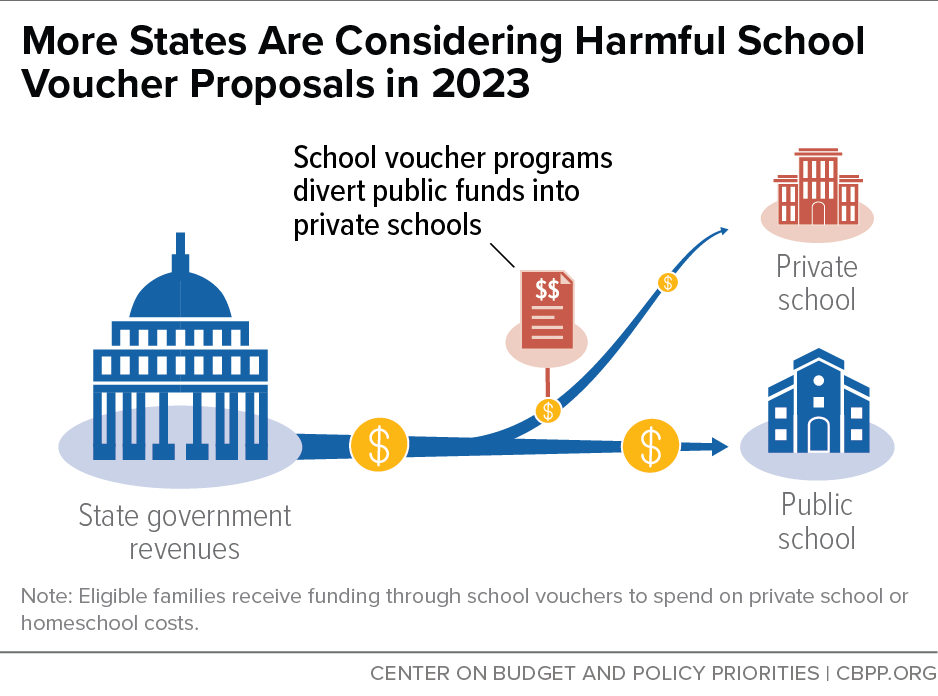
K-12 school vouchers are typically funded through state revenues and give families a set amount of money per eligible student to cover a portion of private school tuition. These vouchers divert money away from public schools, sometimes by directly re-routing education funding to private schools, and other times indirectly by making it harder to pay teachers, buy new textbooks, and provide quality after-school programming. The support for public schools is high: families overwhelmingly support their schools, and many teachers and other advocates for public education oppose vouchers.[1]

In the past few months, state lawmakers have expanded and created a record number of school voucher programs with little to no limits on eligibility. This will deplete available state revenues for public education and other critical services and do little to expand opportunity for students.

Regardless of whether school vouchers directly or indirectly divert funding from public schools to private education, state K-12 funding formulas depend on some metric of student count to allocate per-pupil funding. Some school districts can absorb some of the cuts with layoffs and reduced spending on textbooks and supplies. But fixed expenses such as air conditioning, school buses, and building maintenance can lead to funding shortfalls and layoffs.

In early 2023, these states created or expanded their school voucher policies:

  • Nebraska passed the state’s first voucher program, a K-12 tuition tax credit initially capped at $25 million annually, though the cap could rise to $100 million a year depending on demand for tax credits. Individuals and businesses can donate up to half of their taxes owed (with a maximum of $100,000); donations are funneled to scholarship granting organizations (SGOs), which pay private school tuition and other eligible expenses on behalf of students and their families. The tax credits reduce tax liability and thus, decrease the state revenues available for investments in public services, including public schools. Public school advocates are planning to challenge the bill on the 2024 ballot.
  • Arkansas’ LEARNS Act created, among other harmful policies for public education and teachers, an education savings account (ESA) program, which will phase in universal eligibility by the 2025-2026 school year and provide state-funded vouchers for families to use toward private school tuition and several other allowable expenses (like homeschooling, exam fees, and tutoring).
  • Florida broadened eligibility requirements to make its existing ESA program available to all students (rather than only students with disabilities or those from low-income families), with an estimated cost of $4 billion in the first year of implementation.
  • Iowa created an ESA that is initially targeted to families with lower incomes. But it will expand over time to include all students by the 2025-2026 school year and cost over $340 million per year when fully in effect.
  • South Carolina expanded the state ESA, lifting household income eligibility to 400 percent of the federal poverty level beginning in 2026-2027, but placing a 15,000-student cap on the program.
  • Utah created an ESA starting in the 2024-2025 school year that is available to all students but gives priority to students based on their household’s income.

Other states should not follow the paths of these states. For one, school vouchers primarily benefit wealthier students, families, and businesses. States with existing voucher programs — Arizona, Missouri, New Hampshire, and Wisconsin — have reported that most families who benefitted were already covering the costs of private schools and homeschooling prior to the voucher becoming available.

Wealthy people and companies also benefit when vouchers take the newer form of K-12 tuition tax credits. People and companies who donate to SGOs are allowed to opt out of paying tax to fund public needs and instead fund tuition scholarships at private K-12 schools. This tax incentive can provide state credits — up to 100 percent of the donation — to families with incomes over $200,000 and even allows businesses to profit from claiming federal expense deductions and avoiding capital gains tax.

Vouchers can also increase the likelihood that students experience discrimination and harm. Private schools are not required to offer the same federal civil rights protections for students as public schools. In fact, many voucher bills explicitly require families to waive students’ protections and rights under the federal Individuals with Disabilities Education Act for educational services that students with disabilities may need to learn.

Further, vouchers do not necessarily expand opportunities for students with the greatest needs. Students from families with low incomes often face barriers to navigating the voucher application and private school admission processes. Smaller, rural areas often rely on their local public schools as community hubs and primary sources of employment. Private schools can more easily push students out without recourse based on how they style their hair, what they wear, test scores, and subjective disciplinary action.

Voucher costs often grow beyond what is projected and thus, reduce overall revenues for other state spending. A recent study of school voucher programsin seven states shows how state voucher spending from 2008 to 2019 increased by hundreds of millions of dollars annually, while K-12 spending for public education declined despite public school enrollment increases. Arizona became the first state to implement a universal voucher program in 2022, and as of mid-March 2023, the ESA program is expected to cost the state at least $345 million more than initial projections for the first year. New Hampshire’s voucher program was estimated to cost $130,000 in 2021 and it now costs $14.7 million. And a few private schools in Iowa are already raising tuition only a few months after the new voucher program passed in January of this year.

Some state lawmakers understood the great cost at the expense of public services and stopped multiple school voucher bills this year. For example, 16 House Republicans broke with their party to defeat Georgia’s universal voucher proposal in the final hours of session. And Idaho Senate Republicans raised concerns about the long-term cost of a universal ESA bill, which also applied to subsequent voucher bills.

As some states continue to debate school vouchers during legislative sessions, state lawmakers should understand that their actions now and in the future will have large fiscal and harmful consequences for public education and student opportunities.

Another state that did NOT pass vouchers was Texas, even though Governor Greg Abbott called four special sessions of the legislature. Rural Republicans refused both bribes and threats and voted against vouchers because they wanted to protect their community schools.

More States Are Considering Harmful School Voucher Proposals in 2023

The graph above appeared in an earlier version of this report, published in March 2023.