Archives for category: Extremism

The following post by Jess Piper was reposted by the Network for Public Education. Jess Piper is a fearless rural mom in Missouri who supports public schools.

New post on Network for Public Education.

Jess Piper: Poisoned Water in Missouri Public Schools? Let The Kids Eat Cake.

Jess Piper is a powerful defender of public education on TikTok and other social platforms. In this post, she talks about a recent run-in with Jean Evans, head of Betsy DeVos’s advocacy group in Missouri.

As a former public school teacher, with 16 years in the classroom, and an outspoken advocate for rural public schools, I have had more than my fair share of dealings with Jean. A few stand out in particular: one in which she said that “educational freedom” in rural Missouri is not a brick and mortar building staffed with certified teachers, but one in which rural kids could attend online schools and hire private tutors. That sure would free up some time for these kiddos to go to work, am I right?

Yes, she knows there is no school choice in rural Missouri, but our kids don’t deserve it anyway. I mean, we are just hayseeds out here and what do we expect?

That response is very indicative of the thought pattern for the grifters who want to privatize public schools…whose intentions are to siphon taxpayer money to private hands. But, what I loathe, yet enjoy, so much about Jean Evans is her ability — no, her insistence— on saying the quiet part out loud.

Yes, she works for a billionaire to defund Missouri schools. Yes, she is willing to say that defunding rural schools will displace children and close their schools.

But, what else is she willing to say publicly?

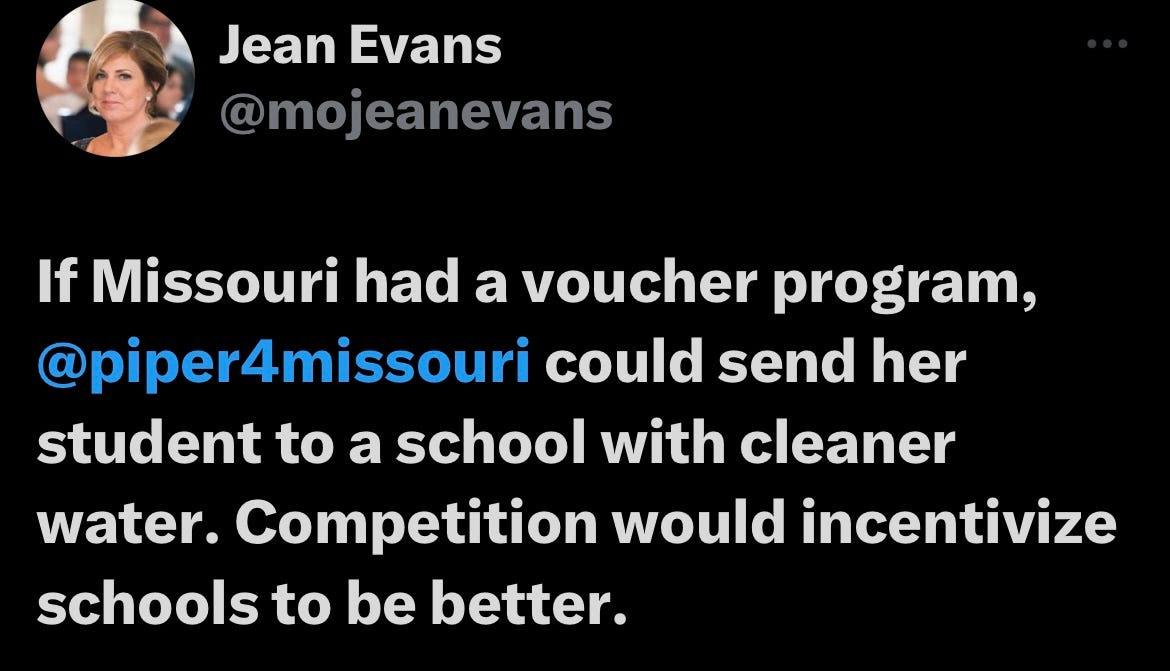
She was willing to tell me that the rural kids at my local public school would be deserving of clean drinking water if only Missouri would pass a voucher program. One may wonder if Jean herself snacked on too many lead paint chips as a child?

It all started with a letter from my local school reporting on the findings of lead in the water at the school. Most water sources were within EPA levels of lead in the water—not particularly great news, but I suspect most old schoolhouses reported much of the same. One faucet, in the nurse’s office, reported an elevated level more than four times the recommended limit. The school is addressing the water faucet and is attempting remediation. No children will drink this water.

I tweeted the findings and reminded my Twitter audience that over 80% of Missouri children test positive for lead in their blood. Jean responded by tweeting this:

Yes, if only we would expand Missouri’s current ESA scheme to defund schools and agree to a full-on voucher scheme, maybe the kids in my town wouldn’t be drinking poisoned water? If only rural folks would acquiesce to closing our schools and going along with the plan to keep our rural kids at home for online learning, and the occasional visit from a tutor, our kids wouldn’t be drinking lead.

Read the full post here.You can view the post at this link : https://networkforpubliceducation.org/blog-content/jess-piper-poisoned-water-in-missouri-public-schools-let-the-kids-eat-cake/

Geert Wilders is a Dutch politician who has espoused anti-Islamic views for many years. He has campaigned on a platform of putting Dutch people first and blocking immigration from Muslim countries. He has been called the Dutch Trump. In the recent parliamentary elections, his party came in first among a field of 15 parties. It won 37 of 150 seats and will need to persuade other parties to join in a coalition in order to govern. In the past, Wilders has promised to close mosques and Islamic schools, but he is already moderating his hardline views to win over partners. Wilders will need 76 votes—39 more than he has now— to form a new government.

The BBC reported:

Veteran anti-Islam populist leader Geert Wilders has won a dramatic victory in the Dutch general election, with almost all votes counted.

After 25 years in parliament, his Freedom party (PVV) is set to win 37 seats, well ahead of his nearest rival, a left-wing alliance.

“The PVV can no longer be ignored,” he said. “We will govern.”

His win has shaken Dutch politics and it will send a shock across Europe too…

He told the BBC that “of course” he was willing to negotiate and compromise with other parties to become prime minister.

The PVV leader won after harnessing widespread frustration about migration, promising “borders closed” and putting on hold his promise to ban the Koran…

A Wilders victory will send shockwaves around Europe, as the Netherlands is one of the founding members of what became the European Union.

Nationalist and far-right leaders around Europe praised his achievement. In France, Marine Le Pen said it “confirms the growing attachment to the defence of national identities”.

Mr Wilders wants to hold a “Nexit” referendum to leave the EU, although he recognises there is no national mood to do so. He will have a hard time convincing any major prospective coalition partner to sign up to that.

He tempered his anti-Islam rhetoric in the run-up to the vote, saying there were more pressing issues at the moment and he was prepared to “put in the fridge” his policies on banning mosques and Islamic schools.

The strategy was a success, more than doubling his PVV party’s numbers in parliament.

For Americans, the elections in the Netherlands and Argentina raise an urgent question: are these elections a portent of the persistence of far-right politics or are they the after-effects of the Trump era? Are they the future or an echo of the past?

Thom Hartmann analyzes the implications of the recent presidential election in Argentina. The victor was an unconventional candidate with bizarre ideas and minimal experience in office. We have already had our Trump. Now it’s Argentina’s turn.

Hartmann writes:

I hope I’m wrong, but I think I just saw the future of America if Republicans manage to sweep the 2024 elections, Trump or no Trump.

Argentina just embarked on a Grand Experiment, untried before in any developed country in the world; it’s one that multiple American billionaires have been pushing in the US ever since David Koch ran for VP on the Libertarian ticket in 1980.
When I arrived at the airport in Buenos Aires on Sunday morning this week, Election Day, I asked my cab driver who he’d be voting for and why.

The cab driver said he would assuredly vote for Javier Milei, because inglation was out of control and things couldn’t get worse.

I asked him about the Libertarian Congressman’s (and now newly elected president’s) plans to replace the national “Medicare for All” type of healthcare system Argentina has with American-style private, for-profit health insurance plans that people must finance out of their paychecks (if they have a job, otherwise they’re SOL); to end the nation’s free colleges; and his plan to turn all the nation’s public schools and prisons over to “entrepreneurs” to run for profit.

And what about his promise to end all government support for average people, including disability payments, unemployment insurance, and all forms of welfare? His saying that abortion is murder and he’ll re-criminalize it, along with ending women’s and queer rights?

He shrugged.

“Things can’t get any worse,” was his terse reply, adding that he’s driving an airport car as a second job because inflation has wiped out the income from his regular job. This working two and three jobs, he said, has become common across the country.

Argentina has been suffering from an ongoing economic crisis for decades, but it got really bad when the “currency crisis” hit the nation in 2018 after they complied with IMF demands, wiping out half the purchasing power of the peso virtually overnight.

Much like the United States, up until the 1960s Argentina had a top income tax bracket of 90%, which stabilized the economy and prevented massive wealth inequality. Subsequent administrations, including the military dictatorship, cut that down to 35%, like today’s US, with enough loopholes that, like America, most billionaires pay virtually nothing.

Like the US, they also cut taxation on capital gains (although they’ve taken them all the way down to zero), giving a huge boost to Argentina’s morbidly rich and stripping massive amounts of revenue from the federal government.

Their draconian tax cuts, like Reagan’s, drove huge federal deficits. Right wingers, citing the deficits, demanded cuts in social programs, but, until now, weren’t successful in gutting Social Security and other social programs in either country.

In part, because the US dollar is the world’s reserve currency, we can sell debt (treasuries) to finance our deficits; Argentina has a much harder time, because nobody else uses the peso and international investors are wary, so they’ve been pursuing a policy of printing money and borrowing from the IMF, which has debased their currency leading, in part, to today’s massive inflation.
Inflation this year has been over 100%, exacerbated by previous presidents experimenting with neoliberalism as demanded by the IMF, irresponsible borrowing, along with several years of climate change-induced drought which have badly damaged Argentina’s agricultural production, driving up food prices.

Milei’s opponent in Sunday’s runoff election was the nation’s finance minister, so he took much of the blame for the state of things while Milei — often referred to as “Argentina’s Trump” because he’s a wealthy former TV star, tantric sex instructor, and crackpot economist with no governmental experience other than his first year in parliament — promised to dump the rapidly devaluing peso and replace it with the US dollar. (He campaigned carrying around a chainsaw, saying he was going to take it to “welfare,” the “deep state,” and the nation’s social programs.)

When Milei won the top slot in the runoff election a few months ago, his victory caused the peso to fall further, as markets anticipated mass chaos resulting from the possible implementation of his plan to abandon the Argentinian currency if he won the general election. (It’s going to require huge cooperation from the IMF, and they don’t seem inclined to want to help.)

His primary win set off a run on the peso and produced a further currency devaluation (inflation is at 143% today) which, in turn, caused greater voter discontent. Ironically, that funneled more votes to Milei, who overwhelmingly (55%) won Sunday’s election.

The Libertarianism that Milei and American politicians like Rand Paul and Mike Lee embrace, as I’ve noted previously, is a political/economic system that was invented and named in the 1950s by a front group for the real estate lobby to rationalize their opposition to rent control, which was then spreading out of New York City and across America.

It basically argues, as Koch did in his 1980 campaign, that the only “commons” (things publicly owned and administered) a country can legitimately claim are the police and the courts.
They, in turn, have the primary job of making sure that property rights of wealthy people supersede all other rights, including the rights to healthcare, education, clean air and water, protection from abuse by employers, housing, and anti-poverty programs (including Social Security). All of these, Libertarians will tell you, are simply vestigial forms of socialism (or communism) and should be turned over to billionaires or giant corporations.
Libertarians’ key rationalization for this is that “private industry is always more efficient than government,” an argument that, while false, anybody who’s ever stood in line for an hour at the DMV can understand.

Ever since the 1980s, when Reagan embraced the libertarian worldview claiming that, “The nine most frightening words in the English language are, ‘I’m from the government and I’m here to help,’” the GOP has increasingly embraced Libertarian policies. Republican presidential candidates now compete for who can gut or shut down the most federal government agencies, from the EPA to the DOE to, well, ask Rick Perry.
Milei haș taken it so far as to say that poor people should feel free to sell their body parts, children, and organs to wealthy people on private, unregulated exchanges to pay their rent and medical expenses.

Billionaires and big corporations love Libertarianism because they end up with all the formerly-government-run sectors that they can then turn into profit centers to rip off the public. And shutting down regulatory agencies like the EPA, Interior, and USDA means they no longer have to pay for pollution controls, food safety systems, and other pesky protections for the “little people.”

Probably the example most Americans would recognize is Medicare Advantage, a privatized health insurance scam for seniors that makes billions in profits every week for our largest insurance companies while routinely refusing to pay for doctor’s visits, procedures, and even hospitalizations. It’s literally killing people by denying them care.

Milei ran on the promise of shutting down 10 of Argentina’s 18 federal agencies, throwing most of his countrymen, women, and children into the arms of the nation’s largest and richest corporations and the billionaires who own them.
He’s also a climate change denier, winning him — like Trump — the support of the nation’s fossil fuel industry, claiming the country’s drought and wildfire problems are part of natural climate variations.

Milei is a climate change denier, so count on Argentina to do nothing to mitigate climate change.

Milei claims that any attempts to “fix the problem of hunger” or “fix the problem of poverty,” or even deal with unemployment is “communism or socialism”; all of these problems should be left to billionaires and giant corporations to solve through private charity or minimum wage work.

Programs like public schools, the free college system that Argentina has that allows any capable student to become a doctor or lawyer at no cost, their national healthcare system, housing supports, Social Security, and even a minimum wage and unemployment insurance are “abhorrent,” Milei says. He claims that “social justice” is simply another word for “theft from rich people.”

Rightwing Republicans were giddy about Argentina’s new president.

Trump posted to his vanity Nazi-infested social media site, “MAKE ARGENTINA GREAT AGAIN!” while Vivek Ramaswamy tweeted, “May the spirits of {neoliberalism’s founders] Mises & Hayek be with you…”

Because Milei doesn’t have a parliamentary majority, it’s unlikely any effort to replace the peso with the dollar will to go anywhere, but all bets are off on his reconfiguring the federal government to trash the poor, gut social services, and privatize the nation’s schools, colleges, and medical system. Converting the country to dollars, however, would require a massive stock of the US currency that is simply unavailable within the country; the World Bank is suggesting they are unlikely to finance necessary reserves…

His victory is an international marker, of sorts, for America’s billionaires and largest corporations who share Milei’s desire to end liberal democracy and the so-called “welfare state” both in Argentina and around the world.

In its wake, expect to see the GOP double down on Milei-like language and policies as they try to drive America back toward their own libertarian ideal, which hundreds of years ago in Europe was simply known as “feudalism.”

Jeffrey Herf is a distinguished university professor of modern European history at the University of Maryland, College Park, and the author of Israel’s Moment: International Support for and Opposition to Establishing the Jewish State, 1945-1949 (Cambridge University Press, 2022).

Since I am posting this exposé of Hamas, let me make clear that I oppose the Netanyahu government. I oppose the indiscriminate bombing of Gaza. I deplore the wanton killing of civilians. I was sickened by the barbaric murders, rapes, pillage, and hostage-taking on October 7. I support a two-state solution (Hamas does not). I pray for a time when two self-governing states live side by side in peace.

In this article, Herf explores the sympathy of leftists and liberals in the West for Hamas, a terrorist organization. He analyzes the Hamas charter of 1988 and its revision in 2017, whose language was intended to place Hamas in the mainstream of leftist ideology about resistance to colonialism and to obscure its historic anti-Semitism and its determination to extinguish the state of Israel.

He begins:

The mass murders by Hamas on October 7 were the outcome of its core ideology, clearly expressed in its founding charter of 1988. That “ideology of mass murder” has its origins in the fusion of Nazism and Islamism that first took place in the 1930s and 40s, and then persisted in the Islamist politics of the Muslim Brotherhood in Egypt, of which Hamas is an offshoot. Hamas’ ability to gain supporters, first in the universities, now in the streets, rests as well on its revised charter of 2017, which draws on the anti-Zionism of the secular Left. Hence a close reading of the revised charter, whose language and arguments now echo on campuses and in the streets, is in order.

The authors of the Hamas charter of 1988 were explicit about their ideological connections to the radical antisemitic conspiracy theories that had emerged in 20th-century Europe, and to the virulent hatred of Jews, Judaism, and therefore Israel that they derived from their anti-modernist Islamist interpretation of Islam. Yet the deadly implications of this document received far too little attention in the mainstream media of the West, despite being easily accessible online in English and German translations. Instead, an objectively pro-Hamas Left began developing among academics in Europe, Britain, and the United States, as became apparent in 2014 during one of Hamas’ attacks on Israel. They found themselves in the peculiar position as leftists of repeating Hamas’ arguments.

They did so because they had adopted the view of Israel that had become the common coin of the international Left since the 1960s. According to that view, the Jewish state is in reality a colonialist and racist endeavor built on the expulsion of the indigenous population in 1948. Relying on that profound misinterpretation of the events surrounding Israel’s founding, they were willing to make common cause with an organization that is profoundly hostile to the modernist values that had long been associated with at least some segments of leftist politics.

Seventy years of Soviet and Palestine Liberation Organization (PLO) propaganda mischaracterizing Zionism and Israel, equally unbalanced UN resolutions, and New Left romance about third-world revolutions had placed Israel on the “wrong” side and the Palestinians on the “right” side of the global divide between oppressors and oppressed. In the course of doing so, a distinctive leftist form of antisemitism, expressed in the language of anti-Zionism and support for armed attacks on Israel, fostered an opening to support not only the secular PLO but also Hamas. In Britain, that support and leftist antisemitism gained political influence in 2015 when Jeremy Corbyn won election as the leader of the Labour Party. This bizarre fusion of the Islamist Right and the secular Left was the first time since the Hitler-Stalin pact that leftist organizations made common cause with a movement of the extreme right, and the only time I can recall when they supported a group rooted in religious fanaticism. Their shared antagonism to Israel surmounted the contrasting ideological starting points.

At the same time, the Hamas charter of 1988 remained an embarrassment at least for some leftist and liberal academics and intellectuals, for the anti-Zionist Left in the universities, and for activist organizations of the left. Its celebration of antisemitic conspiracy theories voiced by the Nazi regime was impossible to deny or justify, and its calls to take up arms against the Jews were unequivocal. Its selective quotations from the Koran offered very uncomfortable evidence that Hamas—in the tradition of Islamists from Haj Amin al-Husseini, Hassan al-Banna, and Sayyid Qutb, all associated with the Muslim Brotherhood—defined Islam as an inherently anti-Jewish religion. For those who thought like Karl Marx that religion was the opiate of the people, the Hamas charter of 1988 revealed that such a theologically induced drug had an Islamic component as well.

The revisions in the 2017 Hamas charter were intended to resolve those issues and present Hamas as a humanitarian organization that opposed Zionism, not Jews. The new language succeeded to the extent that leftist groups were celebrating the massacre of October 7, 2023, as soon as it happened.

Please open the link to read the rest of the article.

Jeb Bush, a founding father of the corporate reform movement, was governor of Florida from 1999 to 2007. He implemented a regime of high-stakes standardized testing, third grade retention, school report cards, and choice. He vigorously championed charter schools and tried to change the state constitution to allow vouchers for religious schools. Now he is concerned that the legislature might undermine high-stakes testing, so he penned this opinion piece for the Orlando Sentinel bragging about the success of his test-and-punish regime.

Yes, Florida’s fourth-grade NAEP scores are high. But he does not acknowledge that the scores are high because Florida “retains” third-graders who don’t pass the reading test. Holding these kids back artificially inflated the fourth-grade scores. By eighth grade, Florida’s scores are at the national average. Nothing to boast about there. The moral of the story: retention raises test scores by removing from the testing pool the kids who were retained (flunked).

The other curious omission in this article is voucher schools. Jeb is a huge fan of vouchers but voucher schools don’t take any state tests. How does he explain this? He doesn’t.

He wrote:

For more than two decades, Florida has remained committed to educational excellence by ensuring that transparency, accountability and opportunity define our K-12 system. We’ve consistently pushed the envelope, transforming Florida into a national leader. This has not happened by accident.

When I took office, nearly half of Florida’s fourth graders had significant reading deficiencies. Similarly, half of Florida’s fourth graders were significantly below grade level in math. Only half of high school students graduated on time.

In partnership with state lawmakers, we championed the A+ Plan in 1999 based on core principles of high expectations, standardized measurement, a clear and achievable system of accountability, rewards and consequences for performance, effective teaching in the classroom and more choices for families to customize an education for each student.

Today, Florida’s fourth graders rank third in the nation for reading achievement and fourth in the nation for math achievement. Our high school graduation rate is approaching 90%.

This is why it’s concerning that some lawmakers now seem eager to throw out or water down key components of the policies that led our students from the back of the pack to top in the nation.

I understand the goal of the Florida Senate’s recently unveiled deregulation package (Senate bills 7000, 7002and 7004). Cutting red tape and removing outdated regulations is a worthwhile effort.

But this cannot come at the cost of our state and students taking a step backward.

Lawmakers have proposed watering down our third grade literacy policy, removing the backstop of retention and paving the way to reinstate social promotion. Requiring that students objectively demonstrate they are reading successfully before being promoted to fourth grade has been a core part of Florida’s comprehensive early literacy policy — one that research has consistently supported.

Most parents believe their children are reading on grade level even when they are not. Florida’s retention policy raises expectations. We know there are grave later-life outcomes for struggling readers. Lowering expectations by watering down the retention requirement will not help students in third grade or beyond.

Moreover, abandoning the requirement that Florida students pass the tenth grade English Language Arts and Algebra I end-of-course assessments further reduces expectations and hampers Florida’s workforce development efforts. Removing this requirement may aid Florida’s graduation rates, but it will reduce the diploma to nothing more than a participation certificate.

If we expect less, we will get less. This cannot be the future we want for Florida.

Finally, part of the package would turn back recent gains for charter schools to be treated equitably alongside their traditional public school peers. The bill’s proposed changes would make it harder for charter schools to access vacant public school buildings and reduce the share of Title I funds made available to students attending charter schools. This is a step backward.

Maintaining Florida’s system of high expectations, clear accountability and robust choice is as important to our future as anything. We’ve spent two decades establishing, maintaining and building upon these ideals.

Now is not the time for lawmakers to get weak-kneed on policies that have played key roles in contributing to two decades of educational progress.

Jeb Bush was governor of Florida from 1999 to 2007. He is the founder and chair of ExcelinEd, ExcelinEd in Action and the Foundation for Florida’s Future.

Peter Greene has been following the debate over voucher legislation in Wyoming, where they have failed until now. Surely some Republicans must be following what happened to vouchers in Texas, where a significant number of Republicans representing rural districts voted them down to protect their community public schools. They knew their schools needed funding, not competition. What states like Wyoming need is a public referendum on vouchers: let the public decide. Could it be that the politicians know that no state referendum on vouchers has ever passed?

Greene writes:

Attempts have been made to sell a school voucher bill in the Wyoming legislature, like the Wyoming Freedom Scholarship Act (because “scholarship” and “freedom” are more popular terms than “voucher”) earlier this year, but they have all failed. Now a new variation on the theme is aiming at a place on the 2024 schedule.

Oddly enough, the bill comes from Speaker of the House Albert Sommers, a Republican who actually helped block the Freedom Scholarship Act. But he thinks this alternate form will work better. Opponents disagree. Actually, some supporters disagreed, too– State Senator Bo Biteman said this new version was too watered down and was a “crap sandwich,” and so, as we’ll see, GOP reps managed to un-water the bill.

Some key features.

The bill runs on $40 million taken from the general fund. Of that $40 million, $12 million (30%) goes to fund preschool education. Because if there’s one technique that voucher proponents have learned, it’s to team up your unpopular voucher plan with something that people want.

The rest of the funding would go to ESA vouchers.
The bill uses the usual foot-in-the-door feature of an income cap for receiving the vouchers. This bill sets the cap at 250% of federal poverty limit, which adds up to $75,000 for a family of four. Median household income in Wyoming is $68,000. One legislator unsuccessfully tried to boost this up to 350% ($105K). At this point, nobody should be fooled by the “we’re just doing this to rescue the poor kids” line, as we have seen multiple states modify their program with ever-increasing caps or simply getting rid of the cap entirely.

With that expansion of eligibility, we keep seeing voucher program costs explode to budget-busting extremes.

Voucher amount would be up to $5,000. According to the website Private School Review, average private school tuition in Wyoming is $8,719 per year.

In one feature that is not common to voucher laws, the bill proposes that the Department of Education would certify vendors eligible to be paid with the taxpayer-funded vouchers. (That was not part of the Freedom Scholarship Act.) But a legislator successfully added an amendment, typical of current voucher law, that the state can’t interfere with the private school’s curriculum or admission policies, meaning that the school could teach religion, flat earth science, creationism, and racial supremacy if it so desired, as well as discriminating against whatever applicants it so desired.

In practice, what that means is that religious schools can accept vouchers while offering religious indoctrination and religion-based discrimination (e.g. the Illinois voucher school that requires families to be born-again Christians)
And another legislator successfully stripped the portion of the bill that voucher-using students had to take the same state tests as public school students. Rep. Karlee Provenza pretty well captured what all these changes mean.

“When we remove that testing standard, we are moving away from saying is government money being well spent?” Provenza said. “We’re not regulating choice, we’re regulating accountability of our state funds.”

True enough, but current voucher theory says that a voucher bill isn’t non-crappy unless it’s stripped of accountability and oversight. So if Wyoming is going to have school vouchers, they should be as unaccountable and unregulated as possible. Kiss those dollars goodbye, taxpayers, and don’t ask where they went or how effectively they were spent. Freedom!

The bill will still have to clear some hurdles, including a state constitution that prohibits the use of “any portion of any public school fund” for private schools (Article 7, Section 8).

Wyoming voucher advocates have struggled with this, and the argument seems to boil down to:

1) Once we hand the money over to the parents, it is transformed into private money and so there’s no problem!

2) Supreme Court thinks public money should absolutely finance the exercise of religion, so if this makes it all the way to SCOTUS, they will be on our side.

So we’ll see. There are unique features to a voucher initiative in Wyoming. For one, funding vouchers by having “the money follow the child” would never fly, because Wyoming schools have wildly different per pupil costs. In 2019-2020, Laramie #1 spent $14,582 per student, but the very rural Sheridan district (90 students) spent $41,176 per student. That means Wyoming is better inclined to fund vouchers separately from public education. They could, in fact, be the first legislature to be honest and say, “We believe in choice so much that we are going to raise your taxes to fund it.”

For another, there’s that state constitution, exactly the same sort of challenge that sank a voucher proposal in Kentucky.

Other state constitutions, such as Florida and Ohio, ban public funding for religious schools, but that has not been an obstacle to GOP politicians.

Ron DeSantis clearly wants to have his own country, where he is el caudillo, the guy in charge of everything. Now that he has a supine supermajority in the Legislature and has named the majority on the Florida Supreme Court, what else does he need? His own army!

Never willing to say no to DeSantis, the Legislature appropriated millions for the governor to have a state guard (in addition to the National Guard, which is under federal control).

But that was not good enough for Ron. He wanted his Guard to be combat-ready. So he hired a private company to teach his Guard how to use weapons and explosives and to prepare for urban warfare.

The Orlando Sentinel reports:

The Florida company trains police and military members on tactical shooting, explosives and urban combat and is owned by a former Army green beret who supports the Republican governor’s presidential campaign. The governor, the State Guard and the Florida Department of Military Affairs, which oversees the agreement, didn’t respond to questions about the training services.

The state’s civilian force was initially sold as a unit that would help Florida’s overworked National Guard respond to emergencies within the state. Since then, its scope has been expanded to allow the state guard to respond to emergencies anywhere in the country, and some members have been granted the ability to make arrests and carry weapons….

In promotional videos, Stronghold SOF Solutions highlights training that teaches individuals how to use drones, explosives and precision shooting. The company, based in Destin with a training facility in Defuniak Springs, touts having trained various special forces units, including Army Rangers, and police officers. Its facilities include a shoot house, various firing ranges, an airfield and a targetry.

If DeSantis can’t be President, at least he will have his own combat-ready army.

An organization called Media Matters reviewed Twitter content and determined that the ads placed by major corporations were sometimes posted next to Nazi or other anti-Semitic tweets. Some of these corporations responded by suspending their ads, thus hurting Twitter’s revenues. Elon Musk has sued Media Matters.

My view: Musk owns Twitter (X); he can put up any content he wants. Media Matters is free to comment on the content of Twitter and warn reputable advertisers that their ads are being placed next to offensive content. Big advertisers are free to place their ads wherever they want and they are free to object to advertising alongside Nazi tweets. Everyone is free.

Greg Sergeant of The Washington Post reviewed the situation. If you are able to open his article, you will see the Nazi tweets.

He begins:

Elon Musk’s new lawsuit against Media Matters, which X Corp. filed late Monday, has been dismissed by legal experts as a frivolous effort to bully a prominent critic into silence. But some Republicans apparently see this as a feature, not a bug: They are allying themselves with Musk’s effort for precisely this purpose.

Musk’s suit charges that Media Matters deliberately and deceptively harmed X (formerly Twitter) with a widely-publicized investigation showing that posts containing pro-Nazi content appeared on X alongside advertisements from leading companies. That, along with a surge in antisemitic content, has advertisers fleeing the site, sparking a slide in ad revenue.

Republicans are eagerly rushing to Musk’s rescue — and not just rhetorically. Two GOP state attorneys general — Ken Paxton in Texas and Andrew Bailey in Missouri — have responded by announcing vaguely defined investigations into Media Matters.

Meanwhile, Trump adviser Stephen Miller is urging Republican law enforcement officials to probe Media Matters for “criminal” activity. And Mike Davis, who is touting himself as Donald Trump’s next attorney general, has declared that Media Matters staff members should be jailed.

The lawsuit, filed in federal court in Texas, doesn’t deny that the juxtapositions between ads and pro-Nazi postings are real. Rather, it accuses Media Matters of creating an account following only fringe content and endlessly refreshing it until it finally generated the juxtapositions. Those are “extraordinarily rare,” the suit says, but were deliberately engineered to disparage X, harm its revenue stream and interfere with its contracts with advertisers.

It’s a weak case, as experts point out. The Media Matters article said it had “found” the juxtapositions, which X calls “false,” insisting they were “manipulated” into existence. But even if you question Media Matters’s presentation of the facts, it still wouldn’t show that it did “all of this to harm X’s market value,” said Stephen Vladeck, a law professor at the University of Texas at Austin.

“If Media Matters doctored the images and couldn’t replicate those results, then maybe there would be a claim here,” Vladeck told me, stressing that it did prove “possible to see those ads” alongside Nazi-related content. He noted that Media Matters plausibly wrote about these juxtapositions not to hurt X, but because they’re “newsworthy.”

When I asked Angelo Carusone, the president of Media Matters for America, whether it’s misleading to say these images were “found,” he rejected the premise. He noted that Media Matters’s goal was to show that despite X’s assurances to the contrary, internal safeguards had failed to prevent those juxtapositions from actually happening.

“The point that we’ve been making is that the filters that they say exist are not working the way that they claim,” Carusone said of X. “Ads can and do run alongside extremist content.” That’s something those companies would surely want to know about — and avoid.

The lawsuit might get dismissed. But if not, Carusone said, Media Matters would probably pursue discovery, seeking to learn whether Musk and X executives “knew internally” that these juxtapositions were happening, what they communicated with advertisers about this, and how Musk internally discussed procedures for handling extremist content.

Discovery would also seek communications about Musk’s public antisemitism, Carusone said. Musk recently endorsed a posting that some Jewish communities are pushing “hatred against whites,” resulting in “hordes of minorities flooding” into Western countries — classic white genocide theory. Carusone noted that discovery could establish whether Musk’s “seeming endorsement of the white genocide worldview” was a major reason for “advertisers to reassess.”

Which brings us to a bigger point: Musk’s own antisemitic utterances — and his own website’s handling of antisemitic content — are plainly also key reasons companies are leaving. As First Amendment lawyer Ken White told me, it’s hard to imagine that the Media Matters report alone would have done this damage: “Much of the advertiser exodus resulted from Musk personally and eagerly endorsing explicitly antisemitic rhetoric.”

At the recent conference of the Network for Public Education, one of the truly outstanding speakers was Dr. Marvin Dunn, professor emeritus at Florida International University. Dr. Dunn has written several books about Black history in Florida, most notably A History of Florida Through Black Eyes. I read that book and realized that Dr. Dunn was the right recipient for NPE’s annual “David Award,” which goes to someone who spoke out and acted on behalf of justice against the powerful, regardless of the personal risks.

Dr. Dunn is not only an author but an active preservationist of Black history. To make sure that the massacre at Rosewood, Florida, would never be forgotten, he bought five acres there and regularly brings students and teachers to learn about it. He tells the story of visiting his land with his son; a “neighbor” tried to run them over in his truck. Dr. Dunn filed a complaint with the police, and the man was convicted and sentenced to 10 years in prison. Dr. Dunn asked to have the sentence reduced, and it was dropped to only one year. The audience was impressed by his generosity of spirit. However, Dr. Dunn tweeted several weeks later that the now-released felon hung a toy skeleton where Dr. Dunn could see it. You don’t need to study Critical Race Theory to know that Racism lives.

I think you will agree that his remarks are highly inspiring.

Randi Weingarten and her wife, Rabbi Sharon Kleinbaum, flew to Israel to commiserate with friends and to sit shiva for the nation. They express a strong commitment to both Israelis and Palestinians and a hope that they can one day live in peace as neighbors, in two independent states. They speak out against the Netanyahu government, whose harsh policies towards Palestinians have intensified hatred. They recognize the brutality of the October 7 massacre without qualification. I am not a Zionist but their views and mine are aligned. Neither terrorism nor indiscriminate bombing of civilians brings peace closer.

The progressive publication Haaretz interviewed them:

Rabbi Sharon Kleinbaum has traditionally had few qualms about being a member of a minority – as a lesbian rabbi, it is practically her brand. But in the days and weeks following the start of the Israel-Hamas war, she says it has been her identity as a liberal Zionist that has made her feel like a member of a minority.

Kleinbaum is the spiritual leader of New York’s Congregation Beit Simchat Torah, the world’s largest LGBTQ synagogue. The space she and wife Randi Weingarten have long occupied – as high-profile American-Jewish leaders who are deeply connected to Israel, but also outspoken advocates for Palestinian rights and opponents of the occupation – is not a comfortable place to be right now.

Even within the pioneering congregation Kleinbaum has led for more than 30 years, she says the atmosphere is tense and full of “tremendous anxiety,” as the war continues with no clear resolution in sight…

“You know, the LGBT world is so focused on non-binary thinking. We’ve rejected the binary about sexuality, we’ve rejected the binary about gender identity,” Kleinbaum notes. “And yet at the same time, so many in this world have adopted a very binary approach to Israel-Palestine issues.”

Her community, she adds, is not at all immune from the expectations of conflict in American culture, in which “the good guys are always weak and the bad guys are strong. And people want a two-hour Hollywood movie in which at the end of it, the good guys overcome and vanquish the bad guys, the lights go up and you walk outside. The message I keep bringing to the congregation is that life is not a Hollywood movie.”

She tries at every opportunity, she says, to explain to those on both extremes that simple solutions are not available, and “there is not a good guy or a bad guy; there is not one victim and one perpetrator.”

That message is not always welcome. In far-left progressive circles, there are those who “believe that Israel kind of deserved what it got” on October 7 and “what Hamas did was an act of justified violence.” The fact that she “completely rejects and totally condemns” such views has made some “very angry” with her, Kleinbaum says.

At the same time, she says others are upset with her “because I continue to insist on the full equality of the Palestinian people, and I continue to stand against the occupation. I will continue to stand by the truth that I’ve said forever and is not new: Israel cannot oppress people.”

Union head Weingarten says she often finds herself in a similar position. “On the same day, I will be criticized by someone from AIPAC for being a Palestinian lover, and criticized by somebody from one of our local union branches that I have not spoken out strongly enough against Israel.”

She has been slammed in union circles for standing up for Israel’s right to defend itself, including during a AFL-CIO meeting that The New York Times described as a “raw” debate among top union officials on the Israel-Hamas conflict. She was accused by the far left of “green-lighting Zionist war crimes.”

Kleinbaum and Weingarten spoke to Haaretz on the second day of a Thanksgiving week trip to Israel, following breakfast with members of what they call their “Israeli family”: Israelis who were members of Kleinbaum’s synagogue during stints in New York, former congregants who made aliyah and other friends.

The couple note that during their last visit, in April, their friends were wearing pro-democracy T-shirts protesting the proposed judicial overhaul. Now these same people wear T-shirts with photographs of hostages on them. Like so many other Israelis, their friends have suffered losses, and some had stopped by on their way to or from 30-day memorials of loved ones killed on October 7.

“We’re so horrified and condemn what Hamas did in the strongest and most horrific terms, and we feel like we’re making a shivah visit to the whole country,” Kleinbaum says…

Both women felt they needed to be in Israel now, Kleinbaum says, “to absorb the energy here and really listen to the perspective of people who are here and to … pay our shivah call after the biggest pogrom that has happened to the Jewish people since the Holocaust – and, just as importantly, also listen to Palestinian voices inside of Israel, and to listen to the voices that are fighting for shared society.” They intend to take those views back to New York.

“We have to keep telling the deep truths that those of us who are progressive Zionists understand: that there is no future except a shared future. And we have to keep reinforcing the message that this is the land with two peoples, two very complicated peoples, and that we continue to hope for a future in which both peoples can live with justice and peace and security,” Kleinbaum says.

She admits she doesn’t know where events will lead, but right now it “feels like we’re at an inflection point not only for the State of Israel, for Palestinians and Israeli Jews, but for the Jewish people. It feels like we’re at a very significant moment of Jewish history, including for Diaspora Jewish life…”

Both recognize that the failed leadership of Netanyahu and his cabinet of far-right ministers has alienated many progressive Jews.

Weingarten says “polls bear out that the Democratic Party is still supportive of Joe Biden’s approach to Israel and Gaza,” but there is still considerable pressure from those harshly critical of the amount of force used by the Israel Defense Forces, mounting calls for a unilateral cease-fire, along with a faction that does, in fact, challenge Israel’s right to exist.

Much of this, she believes, is a direct result of the images coming out of Gaza, and Israel’s decision not to widely circulate images of the horrors of October 7 in real time. Because of that decision, “the trauma, the massacre and the pogrom is just not well known and not understood in the same way as what happened to the [Gazan] hospitals” and the “sheer amount of death” in Gaza…

Biden is “a staunch ally of Israeli democracy and also supports Palestinians: he doesn’t support Israel to the detriment of the Palestinians, even though people accuse him of that. And if the Israeli right really doesn’t understand this, then they are really threatening the future of President Biden’s support. Because he cares deeply about Palestine; he cares about both people. That’s why he has said over and over again that there has to be a two-state solution,” Weingarten says…

And despite the fact that “extreme voices are the loudest right now and people are looking for simple solutions,” there are more people that share common ground with the president – particularly in America’s Jewish community.

“I believe that the majority of American Jews are actually looking for this vision,” Weingarten says. “They want to hear that they can stand with Israel, and stand with the rights of Palestinians. They don’t have to choose. And yes, today it’s a very narrow place to be. But I reject the binary that forces a simple choice. And even though it’s not an easy place to be, I believe if we keep standing in this place and pushing the message out there, more and more people will join us.”