Representative Gloria Johnson posted a series of tweets describing the hateful legislation that her colleagues in the Tennessee Legislature have passed. Her Twitter handle is @VoteGloriaJ
When I got home this weekend someone asked how things are going in Nashville, I’m not sure they were ready for my answer, but it went kind of like this…
We have a “Don’t Say Gay” bill worse than Florida’s and about 4 more bills to go along with it-all equally filled with hate. GOP and B list celebrities are accusing librarians and teachers of “grooming” kids.
We have a vigilante abortion bill worse than Texas’. A bill that makes your friends and family $10k if they rat you out. Heck, if you decide to abort your rapists baby, his family and friends can sue you for $10k.
Did you ever imagine TN would give more rights to a violent rapist than a victim of a violent rapist. He can choose the mother of his child, but she can’t choose not to have her rapist’s baby. That is pure evil folks. That is today’s GOP, they don’t believe women are equal.
We have a school funding formula that’s not ready for prime time. It takes away local control, doesn’t have details and is more than 50% rule making we won’t see until AFTER the vote. And counties will love the property tax it will inevitably bring in 3-4 years😬. #whenleeisgone
You may remember Fiona Hill. She was the nonpartisan Russia expert on the National Security Council who testified in Trump’s first impeachment trial. Politico interviewed her at length soon after Putin invaded Ukraine. Hill provides interesting political and historical insights into why Putin invaded Ukraine. She has been observing both Russia and Ukraine for many years, as well as Putin.
Hill says we are already in the midst of World War 3.
She warns:
Reynolds: The more we talk, the more we’re using World War II analogies. There are people who are saying we’re on the brink of a World War III.
Hill: We’re already in it. We have been for some time. We keep thinking of World War I, World War II as these huge great big set pieces, but World War II was a consequence of World War I. And we had an interwar period between them. And in a way, we had that again after the Cold War. Many of the things that we’re talking about here have their roots in the carving up of the Austro-Hungarian Empire and the Russian Empire at the end of World War I. At the end of World War II, we had another reconfiguration and some of the issues that we have been dealing with recently go back to that immediate post-war period. We’ve had war in Syria, which is in part the consequence of the collapse of the Ottoman Empire, same with Iraq and Kuwait.
All of the conflicts that we’re seeing have roots in those earlier conflicts. We are already in a hot war over Ukraine, which started in 2014. People shouldn’t delude themselves into thinking that we’re just on the brink of something. We’ve been well and truly in it for quite a long period of time.
But this is also a full-spectrum information war, and what happens in a Russian “all-of-society” war, you soften up the enemy. You get the Tucker Carlsons and Donald Trumps doing your job for you. The fact that Putin managed to persuade Trump that Ukraine belongs to Russia, and that Trump would be willing to give up Ukraine without any kind of fight, that’s a major success for Putin’s information war. I mean he has got swathes of the Republican Party — and not just them, some on the left, as well as on the right — masses of the U.S. public saying, “Good on you, Vladimir Putin,” or blaming NATO, or blaming the U.S. for this outcome. This is exactly what a Russian information war and psychological operation is geared towards. He’s been carefully seeding this terrain as well. We’ve been at war, for a very long time. I’ve been saying this for years…
What Russia is doing is asserting that “might makes right.” Of course, yes, we’ve also made terrible mistakes. But no one ever has the right to completely destroy another country — Putin’s opened up a door in Europe that we thought we’d closed after World War II.
Umair Haque is a technologist and future thinker whose writings are insightful. A few days ago, he posted an article asserting that World War III has already started, and we are asleep. It is well worth your while to read this article in full. He argues that Putin has cleverly sowed dissension in the U.S., in the U.K., and in Europe. Based on new evidence, he believes that Putin helped Trump win the election in 2016. Trump advanced Putin’s goals by threatening the future of NATO and bringing about division in the U.S. He also argues that Putin funded BREXIT, which weakened the Atlantic Alliance.
He writes:
Do you remember the story of the Trojan Horse? Troy accepted it as a gift, knowing full it shouldn’t have — because it was a gift to their gods, fine and beautiful. It was made irresistible by the Greeks. A Trojan horse was delivered to our societies in the West — one that glittered, too. It was made of Russian money, Russian oil, resources, finances. And we accepted it, without a second thought.
That was just after the fall of the USSR, as Putin came to power, in the late 2000s or so. What happened next? Our societies in the West began to destabilize, badly. A new far right movement began to emerge. It gained power and ascended in influence. Where had it come from? Nobody could quite say. And yet it spoke literally the language of Putin’s philosophers — figures like Dugin and Ilyin, who called for a “planetary confrontation” against “globalists” and spoke of the soil belonging to the pure of blood and true of faith.
This new far right movement had seemingly emerged from nowhere all across the West. From America to Britain to France and beyond. Mighty coincidence, no? An even bigger coincidence that it spoke the literal language of Putinism. An even bigger coincidence that it deployed the Kremlin’s Orwellian “firehose” model of propaganda: gaslight reality, turn it inside out, call the peaceful people the Nazis and fascists, call freedom the enemy of peace, bombard innocent people with those messages a million times a day on Facebook and Twitter. Carpet-bomb them with the inversion of reality — War is Peace, Freedom is Slavery, Ignorance is Strength — until their weary minds, baffled, finally gave out…and gave in.
What a coincidence. Of course, it was no coincidence at all. That the far right had suddenly emerged in the West all at once, in unison, like a choir of idiocy. That hate had begun to proliferate like a pandemic, and a kind of bilious populist rage was shaking the foundations of the Western world. That it used tactics from a literal Kremlin propaganda manual. As we know now, all this was funded, financed, organized, and coordinated by Russia.
But back then? The West was still innocent. That the first stages of World War III were beginning. Instead of worrying about these obvious links, the West still revelled in the easy money oligarchs gave it, as they bought up entire districts like Mayfair and Chelsea, and straddled Cannes and Nice in their superyachts. The West was still seduced by how the Trojan horse glittered and shone — even as the soldiers poured out.
What happened next? The attacks began. The big ones. All the disinformation and propaganda that was by now being poured across the West like a great toxic oil slick had a point. And now Russia smiled, and flicked a match.
Jim Sleeper is a lecturer in political science at Yale and an author. He wrote the following post in 2018, when the horrors of the Trump regime were fresh. It is still relevant.
Donald J. Trump isn’t a Nazi, although his father came close. It’s true that historical analogies between Trump’s policies and Hitler’s are often facile, and sometimes dangerously misleading. But here’s one that I’m not inclined to shrug off.
During a long stay in Berlin in 2009, I went often to the Grunewald railway station to have my coffee. It’s a picturesque little station, built in the 1899, fronted by a cobblestone square and surrounded by splendid, well-preserved villas of that period.
It’s also the point from which more than 50,000 Berlin Jews were shipped to concentration camps, a few hundred a week, from 1942 to 1945. At the station’s Track 17, a steel strip along the platform edge records, in raised letters, each week’s shipment of several hundred “Juden” to Theresienstadt, Minsk, Riga, Kaunas, Łódź and, later, directly to Auschwitz and other death camps.
It’s hard for most Americans, especially those of us whose parents fought in World War II, to imagine that people who boarded the trains had no idea of what lay ahead. Yet, although Jews had been vilified and some attacked on the streets since 1938, some things remained unthinkable to Berlin Jews, most of whom had been middle-class, law-abiding citizens since birth. They showed up at station on the appointed dates, children and luggage in tow, for what they’d been told would be deportation to resettlement and work centers. At worst, they expected something like what Japanese-Americans experienced in internment camps on our own West Coast during the same war.
Under the watchful eyes of German police, they took their seats in ordinary passenger coaches for many of these departures. Only later, far beyond Berlin, were they transferred to box cars. Some time after that, postcards they hadn’t written were sent to relatives or acquaintances whom they’d listed with the authorities, assuring them that all was well in their new locations.
One day in April of 2009, as I sipped my coffee at the Grunewald station alongside retirees in their 70s and near a beer-garden where younger Germans also overlooked the square, three police cars swept in and officers leapt out, commanding us, “Don’t Move.” Then approximately 45 young military officers in formal parade dress descended from a tourist bus. Their uniforms were attractive, but alien—clearly not German. As they milled about, one of the men seated near me asked a police officer, “Was is das?”
“Israelischen,” he answered. They were Israeli army officers.
A silence descended upon the square like nothing I’d ever felt, so thick you could have cut it with a knife. Not another word was spoken, but I thought that I sensed three dimensions in the quiet all around me. The first was straight out of Close Encounters of the Third Kind: “They’re here. They’ve come.” The second was of admiration, or at least respect, for these vibrant young officers, stunning negations of the image of “Juden” that some of these older men must have remembered from their infancy. The third dimension, I sensed from the tightened body language around me, carried a flicker of resentment at having to be reminded, instead of being left to sip one’s coffee in peace.
A black car with tinted windows ascended a ramp toward Track 17. The Israeli officers fell into formation and followed. They’d come to lay a wreath on Track 17 on Yom Ha’Shoah—Holocaust Remembrance Day. Ironically, I hadn’t remembered the day myself.
I recount this now because some Americans remind me of Berlin Jews who didn’t think the unthinkable when they should have. After watching the Trump administration tear apart weeping parents and children—on the initiative of its senior policy adviser, Stephen Miller, who’s Jewish—I’m thinking that although Trump has now found it politically expedient to halt the practice, more than a few of my fellow Americans were thinking, “Well, they deserve it, unlike me, a law-abiding citizen, and a veteran.”
Those Berlin Jews had been law-abiding citizens, too, at least until 1935, and more than a few were military veterans: Some 12,000 of the Jews who had served in the German military had fallen in World War I. In an irony beyond ironies, it was a Jewish lieutenant, Hugo Gutmann, who secured an Iron Cross, First Class, for a 29-year-old corporal under his command, Adolph Hitler.
We now know that German veterans of that war, Jews and non-Jews alike, were lied to and sent into harm’s way for no good reason. So were soldiers in the Nazi Wehrmacht 25 years later, whom my father, a corporal in the U.S. Army Combat Engineers, was ordered to supervise as prisoners as his 277th battalion clanked across northern Germany, because he spoke Yiddish, which is closely related to German.
He did it with mix of grief and revulsion. One day, when his battalion commandeered a Nazi-friendly baron’s estate in the town of Hohne, my father and others scouted a cottage behind the mansion and found a white-haired, well-spoken man who said he was a caretaker but whom the G.I.’s suspected was closer to the missing baron. As some of them prodded him down the hill toward the mansion, jabbing him roughly with their rifle barrels, my father said, suddenly, almost instinctively, “Cut that out.”
“Why? You should enjoy this Sleeper, you’re a Jew.”
“Cut it out, I said.” He had no illusions about Nazism. But he was a young American, emancipated from his ancestors’ European hell, and he thought he was fighting for a world better than one in which the tables of unjust power are merely turned, a world where justice—dare one say, “due process”?—is stronger than revenge.
Watching the fires that Trump is stoking week in, week out, I wonder when his supporters and enablers will see that the unthinkable could happen to them. I’m not inclined to alarmism, but what if, a couple of years from now, veterans who say they fought for an America where people are free to speak their minds decide to speak their own minds in ways Trump doesn’t like? How far might this admirer of Vladimir Putin go against Americans he thinks are his enemies? He’s already said that he wants to tighten libel laws; his ICE agents have developed arrest-and-detention tactics that a craven Congress would let him expand with the stroke of a pen; municipal police forces are more militarized than ever before.
Yes, historical analogies are risky. But, sipping coffee overlooking the Grunewald station’s charming cobblestone square, you’d never imagine what happened there if you hadn’t been told.
In 2014, Russia invaded Ukraine and took control of the Crimean Peninsula, which was then absorbed into Russia. Presently, Putin has stationed at least 100,000 troops on Ukrainian borders, and leaders in the West are fearful that he intends to invade and seize control of all Ukraine. Ukraine has a long and terrible history under Russian control. In the late 1920s and 1930s, Stalin collectivized Ukrainian agriculture and sent troops to export Ukrainian crops to Russia. Millions of Ukrainians were killed or starved to death in the ensuing famine. Historian Robert Conquest wrote a history of these events callled Harvest of Sorrow. It is a terrifying history. Today, it appears that Vladimir Putin wants to reassemble the Soviet Union. He once called its dissolution the worst geopolitical tragedy of the 20th century.
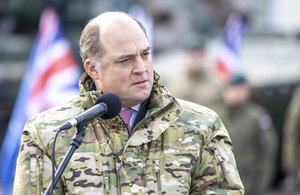
Secretary of State for Defence Ben Wallace discusses NATO, Ukraine and Russia.
Defence Secretary in Olsztyn, Poland.
I have lost count of how many times recently I have to had to explain the meaning of the English term “straw man” to my European allies. That is because the best living, breathing “straw man” at the moment is the Kremlin’s claim to be under threat from NATO. In recent weeks the Russian Defence Minister’s comment that the US is “preparing a provocation with chemical components in eastern Ukraine” has made that “straw man” even bigger.
It is obviously the Kremlin’s desire that we all engage with this bogus allegation, instead of challenging the real agenda of the President of the Russian Federation. An examination of the facts rapidly puts a match to the allegations against NATO.
First, NATO is, to its core, defensive in nature. At the heart of the organisation is Article 5 that obliges all members to come to the aid of a fellow member if it is under attack. No ifs and no buts. Mutual self-defence is NATO’s cornerstone. This obligation protects us all. Allies from as far apart as Turkey and Norway; or as close as Latvia and Poland all benefit from the pact and are obliged to respond. It is a truly defensive alliance.
Second, former Soviet states have not been expanded ‘into’ by NATO, but joined at their own request. The Kremlin attempts to present NATO as a Western plot to encroach upon its territory, but in reality the growth in Alliance membership is the natural response of those states to its own malign activities and threats.
Third, the allegation that NATO is seeking to encircle the Russian Federation is without foundation. Only five of the thirty allies neighbour Russia, with just 1/16th of its borders abutted by NATO. If the definition of being surrounded is 6% of your perimeter being blocked then no doubt the brave men who fought at Arnhem or Leningrad in the Second World War would have something strong to say about it.
It is not the disposition of NATO forces but the appeal of its values that actually threatens the Kremlin. Just as we know that its actions are really about what President Putin’s interpretation of history is and his unfinished ambitions for Ukraine.
We know that because last summer he published, via the official Government website, his own article “On the Historical Unity of Russians and Ukrainians”. I urge you to read it, if you have time, because while it is comprehensive on his arguments it is short on accuracy and long on contradictions.
We should all worry because what flows from the pen of President Putin himself is a seven-thousand-word essay that puts ethnonationalism at the heart of his ambitions. Not the narrative now being peddled. Not the straw man of NATO encroachment. It provides the skewed and selective reasoning to justify, at best, the subjugation of Ukraine and at worse the forced unification of that sovereign country.
President Putin’s article completely ignores the wishes of the citizens of Ukraine, while evoking that same type of ethnonationalism which played out across Europe for centuries and still has the potential to awaken the same destructive forces of ancient hatred. Readers will not only be shocked at the tone of the article but they will also be surprised at how little NATO is mentioned. After all, is NATO ‘expansionism’ not the fountain of all the Kremlin’s concerns? In fact, just a single paragraph is devoted to NATO.
The essay makes in it three claims. One: that the West seeks to use division to “rule” Russia. Two: that anything other than a single nation of Great Russia, Little Russia and White Russia (Velikorussians, Malorussians, Belorussians) in the image advanced in the 17th Century is an artificial construct and defies the desires of a single people, with a single language and church. Third, that anyone who disagrees does so out of a hatred or phobia of Russia.
We can dispense with the first allegation. No one wants to rule Russia. It is stating the obvious that just like any other state it is for the citizens of a country to determine their own future. Russia’s own lessons from such conflicts as Chechnya must surely be that ethnic and sectarian conflicts cost thousands of innocent lives with the protagonists getting bogged down in decades of strife.
As for Ukraine, Russia itself recognised the sovereignty of it as an independent country and guaranteed its territorial integrity, not just by signing the Budapest Memorandum in 1994 but also its Friendship Treaty with Ukraine itself in 1997. Yet it is the Kremlin not the West that set about magnifying divisions in that country and several others in the Europe. It has been well documented the numerous efforts of the GRU and other Russian agencies to interfere in democratic elections and domestic disputes is well documented. The divide and rule cap sits prettiest on Moscow’s head not NATO’s.
Probably the most important and strongly believed claim that Ukraine is Russia and Russia is Ukraine is not quite as presented. Ukraine has been separate from Russia for far longer in its history than it was ever united. Secondly the charge that all peoples in Belarus, Russia and Ukraine are descendants of the ‘Ancient Rus’ and are therefore somehow all Russians. But in reality, according to historian Professor Andrew Wilson in his excellent essay for RUSI entitled “Russia and Ukraine: ‘One People’ as Putin Claims?” they are at best “kin but not the same people”. In the same way Britain around 900AD consisted of Mercia, Wessex, York, Strathclyde and other pre-modern kingdoms, but it was a civic nation of many peoples, origins and ethnicities that eventually formed the United Kingdom.
If you start and stop your view of Russian history between 1654 and 1917 then you can fabricate a case for a more expansive Russia, perhaps along the lines of the motto of the Russian Tsar before the Russian Empire “Sovereign of all of Rus: the Great, the Little, and the White” – Russia, Ukraine and Belarus respectively. And crucially you must also forget the before and after in history. You must ignore the existence of the Soviet Union, breaking of the Russian-Ukrainian Friendship Treaty, and the occupation of Crimea. Far more than footnotes in history, I am sure you will agree.
Ironically, President Putin himself admits in his essay that “things change: countries and communities are no exception. Of course, some part of a people in the process of its development, influenced by a number of reasons and historical circumstances, can become aware of itself as a separate nation at a certain moment. How should we treat that? There is only one answer: with respect!” However, he then goes on to discard some of those “historical circumstances” to fit his own claims.
Dubious to say the least, and not in anyway a perspective that justifies both the occupation of Crimea (in the same way Russia occupied Crimea in 1783 in defiance of the Russo-Turkish Treaty of Kuchuk-Kainarji in 1774) or any further invasion of modern Ukraine, as an independent sovereign country.
The last charge against the West by many in the Russian Government is that those who disagree with the Kremlin are somehow Russophobes. Leaving aside that GRU officers deployed nerve agents on British streets or that cyber hacking and targeted assassinations emanate from the Russian state, nothing could be further than the truth.
Russia and the UK share a deep and often mutually beneficial history. Our allegiances helped to finally defeat Napoleon and later Hitler. Outside of conflict, across the centuries we shared technology, medicine and culture. During the 18th Century Russia and Britain were deeply tied. Between 1704 to 1854, from age of Peter the Great through Catherine the Great and well into the 19th Century the British were to be found as admirals, generals, surgeons, and architects at the highest level of the Russian Court. The father of the Russian Navy – one Samuel Greig – was born in Inverkeithing in Fife.
That shared admiration is still true today. The British Government is not in dispute with Russia and the Russian people – far from it – but it does take issue with the malign activity of the Kremlin.
So, if one cold January or February night Russian Military forces once more cross into sovereign Ukraine, ignore the ‘straw man’ narratives and ‘false flag’ stories of NATO aggression and remember the President of Russia’s own words in that essay from last summer. Remember it and ask yourself what it means, not just for Ukraine, but for all of us in Europe. What it means the next time…
It is the story of a family that managed to escape the Warsaw ghetto just as the Nazis began to eliminate the Jews who lived there. They encountered the face of evil, they looked down the barrel of the gun pointed at them by the Butcher of Krakow. They endured unimaginable hardships. The story is told by the family, mostly through the eyes of children.
Watching the film is an excellent way to learn about the Holocaust and to see heroism, courage, persistence, luck, and the kindness of strangers, all of which made this story of survival possible.
I strongly urge you to see it and to ask your children to watch as well. It will be shown again on December 12 and will be streaming.
The film was made possible by a GoFundMe campaign. It includes a dazzling array of archival footage, from prewar Poland and wartime.
Sandy Hook parents won a defamation lawsuit against rightwing media figure Alex Jones. Their children were murdered on December 14, 2012, in a massacre at Sandy Hook Elementary School in Newtown, Connecticut. A total of 20 children between the ages of six and seven were killed, along with six staff members, including the principal.
For years, Alex Jones has asserted that the massacre was staged and that the film footage showed child actors. His repeated slanders were deeply hurtful to the families who lost children and adult relations.
The parents of two first-graders slain in the Sandy Hook massacre have won a defamation lawsuit in Texas against conspiracy extremist and Infowars host Alex Jones.
The parents, who each sued Jones for more than $1 million for claiming, among other things, that the 2012 slaying of 26 first-graders and educators at Sandy Hook Elementary School was “staged,” “synthetic,” “manufactured,” “a giant hoax” and “completely fake with actors,” had been battling with Jones in Travis County District Court for pretrial documents he had been ordered to turn over to them.
On this day in 1692 eight citizens of the colony of Massachusetts were hanged for their supposed connections to witchcraft. Theirs were the last of the deaths caused by the Salem Witch Trials, preceded by 11 other hangings, plus five who died in prison, and one who was crushed to death for refusing to enter a plea.
A period that roughly spanned the spring and summer of 1692, the Salem Witch Trials started when two young girls began displaying bizarre behaviors — convulsing, shouting blasphemy, and generally acting like they were possessed. The girls were the daughter and niece of Samuel Parris, a minister relatively new to town but already divisive. He’d moved from Boston where an account of young children who were supposedly “bewitched” by a laundress was published. Parris had insisted on a higher salary and certain perks as the village reverend and insinuated in his sermons that those who opposed him were in cahoots with the Devil.
After the girls’ behavior gained attention and was pronounced the result of an evil spell, several other girls in town began acting strangely too … and began naming individuals in town as the cause. The town was whipped into a frenzy and soon dozens of people — women, men, and children — were accused of and often jailed for practicing or supporting witchcraft. Many of the accusations seemed to fall along the lines of existing feuds or were directed at people who were — because they were poor, not upstanding members of the church, or marginalized in some way — not likely to mount a convincing defense.
By the time the final eight people were hanged on September 22 word about the trials was spreading throughout the state. Within weeks the governor of Massachusetts declared “spectral evidence,” or visions of a person’s spirit doing evil when in fact their physical body was elsewhere, was inadmissible. Soon after he barred any further arrests, disbanded the local court, and released many of the accused. It wasn’t until the following spring that he finally pardoned those who remained in jail. A full decade passed before the trials of 1692 were officially declared illegal, another nine before the names of the accused were cleared from all wrongdoing and their heirs given a restitution, and 265 years before the state of Massachusetts apologized for the events of that most infamous witch hunt.
I recently learned of a rightwing website collecting complaints about school boards, presumably to encourage dissension and hostility at school board meetings.
The School Board Watchlist (SBWL) is America’s only national grassroots initiative dedicated to protecting our children by exposing radical and false ideologies endorsed by school boards and pushed in the classroom. SBWL finds and exposes school board leadership that supports anti-American, radical, hateful, immoral, and racist teachings in their districts, such as Critical Race Theory, the 1619 Project, sexual/gender ideology, and more. SBWL also provides information on how parents and students can get involved in their local school board and put an end to the racialization of the classroom.
This group wants vigilantes to report their school board if students learn about sexism, racism, and other realities of our past and present. This is McCarthyism revisited.
The House Republican conference just indulged in a sick joke: It assigned Rep. Marjorie Taylor Greene to the House Education and Labor Committee. Rep. Greene has identified with the bizarre QAnon conspiracy theorists who believe that Democrats and large sectors of the federal government are controlled by a Satanic ring of pedophiles. She has endorsed the vile claim that the massacres at Sandy Hook Elementary School in Newtown, Connecticut, in 2012, and at Marjory Stoneman Douglas High School in Parkland, Florida, in 2018, were staged or “false flag” operations, intended to build political support for gun control.
Andrew Ujifusa of Education Week reports:
A Washington Post story on Jan. 22 highlighted how, in response to a 2018 comment on Facebook that recent school shootings weren’t real, now-U.S. Rep. Marjorie Taylor Greene said, “That’s all true.” She expressed a similar sentiment about the 2018 shootings at Marjory Stoneman Douglas High School in Parkland, Fla., on Facebook in a separate comment that year that the social-media site later removed.
Several advocacy groups that support robust gun-control measures, including March For Our Lives-Parkland, Moms Demand Action, and Everytown for Gun Safety have called on Greene to resign in light of those comments, the Post reported. Greene also has made national headlines for months due to her support for QAnon, the name used for a range of conspiracy theories that have been termed a domestic terrorist threat by the FBI.
In response to questions from Education Week about Rep. Greene’s education priorities and concerns about her past comments on school shootings, spokesman Nick Dyer did not address her comments on the shootings.
“Congresswoman Greene is excited to join the House Education and Labor Committee. Rep. Greene is ready to get to work to reopen every school in America, expand school choice, protect homeschooling, champion religious freedom for student and teachers, and prevent men and boys from unfairly competing with women and girls in sports,” Dyer said in an email.
Earlier this month, Greene announced her support for legislation that would require schools to prevent “biological males” from competing in women’s sports, in order to demonstrate compliance with federal Title IX law...
A relatively large share of the Republicans slated to join the committee are freshmen. In fact, out of 24 total GOP members due to join the committee, 11 just started their first terms in Congress; go here for the list of new members about to join the panel. (Republicans announced new appointments to the committee on Monday, but technically they won’t be official until the GOP conference and full House approves them.)
Another prominent GOP freshman on the list is Rep. Madison Cawthorn, R-N.C., who spoke at Trump’s Jan. 6 rally in front of the White House shortly before a mob attacked the U.S. Capitol as lawmakers were voting to certify the presidential election results.

 Diane Ravitch's blog