Julie K. Brown is the reporter at the Miami Herald who broke the Jeffrey Epstein case wide open. She wrote a series in the newspaper revealing the cover-up of Epstein’s criminal activities called “Perversion of Justice.”
The newspaper says this about her series:
In her year-long investigation of Palm Beach multimillionaire Jeffrey Epstein, Miami Herald reporter Julie Brown tracked down more than 60 women who said they were victims of abuse and revealed the full story behind the sweetheart deal cut by Epstein’s powerhouse legal team. Since the Herald published ‘Perversion of Justice’ in November 2018, a federal judge ruled the non-prosecution agreement brokered by then Florida U.S. Attorney Alexander Acosta was illegal, and on July 6 Epstein was arrested on sex trafficking charges in New York state. On July 12, Acosta resigned as U.S. Secretary of Labor. And on Aug. 10, Epstein died by suicide in his Manhattan jail cell. Investigative journalism makes a difference.
Last week, a federal court in Manhattan ordered the release of the voluminous case files from Virginia’s Giuffre’s 2015 civil lawsuit against Ghislaine Maxwell.
The release of these files was in part the result of eight years of litigation by the Miami Herald and its parent company, McClatchy, which have been fighting for the material since I published my series “Perversion of Justice,” in 2018.
Last week, U.S. District Court Judge Judge Loretta Preska rejected Maxwell’s final arguments
to keep the files sealed, noting that the passage last year of the Epstein Files Transparency Act superseded any earlier grand jury arguments that Maxwell was using to keep the records from the public.
What does this mean, and what new information will we learn?
First some history. Virginia brought this defamation lawsuit against Maxwell back in 2015, after Maxwell publicly proclaimed that Virginia was a liar who had made up her allegations of being sexually abused by Jeffrey Epstein, Maxwell and other powerful men (including Epstein lawyer Alan Dershowitz and the former Prince Andrew.)
Giuffre, represented by the Boies-Schiller firm, sued Maxwell for defamation, asserting that she faced “public ridicule, contempt, and disgrace” when Maxwell went public with her statements. As part of the lawsuit, the lawyers gathered tens of thousands of pages of discovery, including depositions by Giuffre, Maxwell and dozens of other people. Part of the effort also involved Dershowitz, who together with social media influencer Michael Chernovich, tried unsuccessfully to unseal portions of the Giuffre-Maxwell case while it was still being litigated.
The lawsuit was settled in early 2017. I had been told the discovery contained damning evidence against Epstein, Maxwell and other men, and that it was worth trying to get the courts to unseal the documents on the grounds that they were never properly sealed in the first place.
Judicial records by law are supposed to be open to the public. In this case, the former judge (Robert Sweet, now deceased) issued a blanket sealing on all the documents because they contained “sensitive” and “private” information. Sweet placed a protective order on massive amounts of material, including hearings and judicial decisions made in the case — and voluminous evidence that Virginia presented to show that Epstein and Maxwell were operating an underage sex trafficking operation.
This is not the way sealing is supposed to happen, however. Each document that the lawyers want sealed has to be examined, and those requesting it be sealed must provide legal justification to the judge for doing so. This wasn’t done in this case.
Nearly all the evidence that Virginia’s lawyers uncovered about Epstein and Maxwell’s sex trafficking that came out during this civil case was kept secret.
Maxwell settled the case before it could go to trial, however — and paid Virginia somewhere in the neighborhood of $3-5 million. By settling it, she thought that all the evidence about her involvement would remain under seal.
But I convinced my editors to ask our lawyers to file a motion to intervene in the case in order to unseal the files.
An appeals court eventually ruled in our favor, and on August 9, 2019, thousands of pages were made public, including sworn statements by Virginia in which she alleged she was trafficked to Dershowitz, who represented Epstein; former Prince Andrew; former Maine Sen. George Mitchell; former New Mexico Gov. Bill Richardson; hedge fund manager Glenn Dubin; hotel magnate Tom Pritzker; the late MIT scientist Marvin Minsky. All of the men denied that they were involved with Giuffre.
Epstein was found dead in his Manhattan jail cell the following morning. …
This is only the opening of her post. The rest is behind a paywall. But the bottom line is that the release of the Maxwell files will add lots of fuel to the Epstein fire.
Today, The New York Times published an astonishing article about Putin’s attempt to destabilize NATO and the EU by driving tiny Moldova back into Russia’s orbit.
Moldova shares a border with Ukraine. Putin hopes to thwart the West by persuading Moldova to oust its pro-Western government.
Putin created an elaborate pro-Russian organization inside Moldova, spending millions of dollars to pay collaborators, agitators, and priests.
The Times‘ articleis a gift article with no pay wall. It begins:
It resembled in many ways a summer camp. Barbecues and beach volleyball games were on offer. A wellness spa was called “Relax and Have Fun.”
The men and women who attended the program at a resort complex in a remote part of Serbia also took part in more sinister activities, like learning to break through police cordons and set buildings on fire. They donned flak jackets and trained with assault rifles.
Their counselors, it turned out, were operatives with ties to Russia’s military intelligence service, known as the GRU. Their purpose, according to intelligence officials from three countries who described the activities, was to build a cadre of disciplined shock troops trained in election interference.
The target was tiny Moldova, a country of about three million people that carries outsize importance for President Vladimir V. Putin of Russia.
The Kremlin’s campaign included methods familiar elsewhere in the West, like hacking and disinformation. But in Moldova, its intervention went further than perhaps anywhere else outside Ukraine, and stands as one of the most extensive and audacious plots to date in Mr. Putin’s effort to destabilize the West, the three Western intelligence officials say.
Besides the camp in Serbia, Russian agents ran training programs in Bosnia and Moscow that were designed to turn pro-Russian Moldovans into foot soldiers. Moscow paid hundreds of Orthodox Moldovan priests to recruit voters and to push Russian narratives from the pulpit. And it spent hundreds of millions of dollars on a sophisticated vote-buying scheme financed by a Moldovan billionaire in exile and conceived and operated from Skolkovo, the Kremlin’s knockoff Silicon Valley outside Moscow.
Moscow’s campaign has not stopped. This spring, Russian missiles targeted energy infrastructure that provided service to Moldova, polluting waterways and disrupting electricity flows.
This article is based on interviews with activists who took part in the Russian effort; senior Moldovan law enforcement and security officials; and more than half a dozen European and American intelligence officials. The New York Times also reviewed thousands of documents related to Russia’s attempts to interfere in Moldova’s elections.
Many of those interviewed insisted on speaking anonymously, either to discuss sensitive security operations or because they feared retribution.
Details about Russian efforts in Moldova have emerged in court cases and local reporting, but the scope and extent of the campaign, including the vote-buying scheme and role of Russia’s intelligence services, has not been previously reported.
Publicly, Russian officials have denied interfering in Moldova’s affairs, and have dismissed accusations that Moscow is trying to undermine the West. Last December, Mr. Putin, in an address to military commanders, castigated European leaders for “stoking hysteria” over the threat from Russia.
Soon afterward, though, he gathered the leaders for a secret briefing to deliver the exact opposite message, according to officials from two countries with knowledge of the episode. Their goal for 2026, Mr. Putin told them, is “the collapse of NATO and the E.U. from within,” the people said.
The pro-Western government of President Maia Sandu has set European Union membership as a priority, making it a Kremlin target.Credit…Daniel Mihailescu/Agence France-Presse — Getty Images
Jan Resseger keeps a steady focus o what matters most in a decent society: the well-being of children. Trump and his minions don’t care. Not about children. Not about the rule of law. Not about democracy. Trump cares about greed and self-enrichment. He seems to care about his children. He cuts them in on the grift. His youngest son Barron is said to be worth $150 million. But he doesn’t care about yours.
The fact that he just issued guidance on childhood vaccinations, which reduces mandated vaccines and puts America’s most vulnerable at risk of serious illness and death, tells you all you need to know about this scientifically ignorant man.
Maggie Haberman and Jonathan Swan’s important new book, Regime Change, explores how the second Trump administration functions—the cast of characters, their relationships, and their operational style. A reader is also exposed, however, to the President’s and the administration’s big policy concerns—imposing tariffs, ridding the country of immigrants, ending nuclear weapons in Iran, proclaiming that everything is more affordable, and ending the public’s fixation on Jeffrey Epstein. These issues have also been widely covered broadly in the news.
Here are topics that do not appear at all in Regime Change‘s index: children, public education, CHIP, SNAP, Head Start, or Child Care. There is not even a mention of Trump’s tuition tax credit private school vouchers launched in the “One Big Beautiful Bill.” The issue of birthright citizenship is mentioned in the index only as a subhead under immigration, and in the book itself birthright citizenship is covered only in one sentence describing its proposed elimination by an early Trump executive order. In the index, there is only one page citation to the U.S. Department of Education itself, but the reference is to brief coverage of the administration’s attempt to eradicate “diversity, equity, and inclusion” at Harvard University.
The lack of regular news coverage—particularly in the local newspapers—about Trump’s damaging public education policy and the administration’s failure to protect children’s well-being and children’s rights does not, however, mean that these issues have been untouched by Trump administration policy. For those of us who do not need CHIP or SNAP, who can afford quality child care and preschool, whose children attend well-funded public schools, whose families have been citizens for generations, however, there is minimal exposure to the Trump administration’s threats to the institutions on which vulnerable families and children depend.
Just this past week the Trump administration took two steps that, if they do come to pass, will seriously impact some of our society’s most vulnerable children—poor children benefiting today from Head Start, and the children of immigrants from whom the President is once again trying to steal the protection of birthright citizenship. First Focus on Children’s President Bruce Lesley has identified what he calls the Trump administration’s “organized abandonment” of the needs and rights of our society’s most vulnerable children.
The Trump administration attempted to destroy Head Start. At the end of last week, the Trump administration formally proposed new federal administrative guidance to deregulate the quality of Head Start programs that currently serve 700,000 children across the United States. The destruction of Head Start had been predicted early last week but on Thursday in a notice in the Federal Register, the administration formally proposed radically diminishing 133 pages of rules that have shaped Head Start since it was established in 1965 as a centerpiece of Lyndon Johnson’s War on Poverty. The Center on Law and Social Policy explains that the proposed new rules are being disguised by the administration with language describing “an effort to ‘streamline,’ ‘enhance,’ and ‘modernize’” the program. Politico‘s Mackenzie Wilkes reports: “The Heritage Foundation has long called for the elimination of Head Start, but the conservative group published a report last month saying the program should be deregulated in many of the ways the proposed rule suggests while ‘officials work to end the program.’ ”
The Associated Press‘sMoria Balingit outlines the changes the new rules would prescribe: “Head Start… is currently governed by more than 100 pages of regulations… (which) require centers to have low staff-to-student ratios and a research-backed curriculum, among other things, and they ensure centers are providing wraparound services that are critical to children in poverty, including medical and dental screenings and parent coaching. The proposal would toss out nearly all of that rule book. Education Week”s Elizabeth Heubeck adds: “The new proposal would require (that) all classroom instruction be conducted in English, except for immersion programs operated on Native American tribal lands. An estimated 30-35% of children enrolled in the Head Start program are dual language learners.” The program would also exclude many non-citizen children and children in some immigrant families.
While Congress establishes federal departments and the specific offices within the departments, the legislative branch has no power over the executive branch’s right to establish formal administrative rules and guidance. It is possible that the rules announced in last week’s Federal Register can be challenged in court, and it is also possible, of course, that public outrage might cause the Trump administration to modify the new rules during the 60 day period when the public is invited to submit public comments before the rule becomes final. A future President, of course, could replace the Trump administration’s new rules.
President Trump signed two new executive orders to undermine birthright citizenship. Last Thursday, The Washington Post‘s Isaac Arnsdorf, Justin Jouvenal, and David Nakamura reported: “President Donald Trump took another stab at restricting automatic citizenship for people born in the United States after the Supreme Court rejected his earlier attempt. In two executive orders signed Thursday, Trump reached for different legal maneuvers to test the limits of the 14th Amendment’s guarantee of birthright citizenship. The first order said children would be ineligible if born to ‘alien enemies,’ members of foreign terrorist organizations, or foreign lobbyists. The second order said children of people who fraudulently request tourist visas for the purpose of giving birth in the U.S. would not become citizens… The new orders marked a fresh effort to… deliver on a campaign promise by expanding the categories of people who the administration argues fall outside the constitutional guarantee.”
The reporters quote legal experts who doubt that the first executive order could survive a legal challenge: “An estimated 15 million undocumented immigrants live in the U.S., while only a few thousand people are foreign lobbyists registered with the Justice Department. No significant populations of U.S. residents are designated as alien enemies or foreign terrorists, making that provision largely symbolic.”
The reporters attribute the second executive order to White House Deputy Chief of Staff, Stephen Miller, who has made stopping “birth tourism” a priority. They provide data to demonstrate that what is called “birth tourism” is relatively infrequent. “In 2024, fewer than 10,000 babies were born in the U.S. to people with foreign addresses, out of 3.6 million total live births.”
None of the legal experts the reporters quote believes that either of these executive orders would be upheld by the U.S. Supreme Court or would challenge in any way what Chief Justice John Roberts declared in his June 30, 2026 decision in Trump v. Barbara: “Children born in the United States to parents unlawfully or temporarily present are “subject to the jurisdiction” of the United States and are citizens at birth under the Fourteenth Amendment’s Citizenship Clause.”
First Focus on Children’s Bruce Lesley believes that both of last week’s executive orders are seriously misguided: “The legal question isn’t simply what the government thinks about immigration. It’s whether an innocent child can lose fundamental rights grounded in the Constitution because of something government officials allege about a parent’s conduct and intent… The latest effort to gut a fundamental constitutional operating principle since our nation’s founding has been written clearly in the Constitution since 1868, is being sold to the public with pathetic history and legal arguments the Supreme Court itself rejected 128 years ago and early this year. Every administration has the authority to enforce immigration laws. However, none has the authority to rewrite the Constitution… by redefining which babies they deem are precious and which are pushed into the shadows of our society.”
Although there has obviously been some news coverage of the week’s public policy initiatives impacting our society’s children, the well-being of our children is neither the top policy concern for officials in the Trump administration nor the top story for the reporters who track the administration’s agenda. Because the needs of children are definitely not the primary lens through which the Trump administration views and conceptualizes our society’s important needs, it is especially important to watch for news about children’s welfare, their rights, and the enormous institution of public schools that serves the mass of our children
Thom Hartmann is a diligent journalist who digs deep into the corruption of this regime.
On the deregulation of public lands: Trump is allowing destruction of parts of Big Bend National Park, to make way for its exploitation. No complaints from Texas Governor Greg Abbott.
— Trump has figured out a way to grift off the plight of immigrant kids. A Texas law firm with virtually no immigration experience, but multiple people close to Trump or accused of being open racists, just got a $150 million sole-source contract to replace the public defenders defending kids being held in Trump’s concentration camps for brown-skinned people. Meanwhile, ICE says that, sure, they’ll wear body cameras when they beat up and murder people, but they’ll only share those videos when they make them look good. Don’t expect to see any released that actually show criminal activity by armed, masked ICE thugs. Sounds over the top? Here’s their exact language: they’ll only release body camera footage when “it is in the best interests of the agency.” Trump has built his SA/SS force of violent, unaccountable modern-day Klan members to intimidate and even kill anybody who dares defy this regime, and it’s not about to start following the law or even behaving morally any time soon.
— Trumponomics is even worse than Hoovernomics or Reaganomics. Since he fired his statistics person at the Bureau of Labor Statistics and replaced her with a hand-picked toady, the numbers have been looking weird. For example, the regime reported 57,000 new jobs in May, then later quietly revised that down to 20,000 (although the headlines of 57,000 are still out there); they reported 129,000 new jobs for June, then quietly revised that down to 63,000 (ditto on the headlines). And this week we found that instead of the anticipated creation of 80,000 new jobs, the American economy actually lost 23,000 jobs last month (and expect that number to get worse when they “revise” it in 2 months). No matter how hard they try, they can’t keep Americans from noticing that housing, groceries, gas, transportation, drugs, medicine, and pretty much everything else are more expensive while billionaires and the Trump Crime Family get richer and Republicans continue to refuse to allow an increase in the minimum wage or the right to unionize. Eventually, reality catches up with politics, no matter how fast and furious Trump and his lickspittles try to keep us distracted or hating on each other, and hopefully it’s going to catch up in a big way this November.
— Over at Montana Dispatch, Ryan Busse lays out the five Big Lies Republicans are using to steal our public lands. Utah’s Republican Senator Mike Lee, for example, recently lied to his constituents that the Bear’s Ears and Grand Staircase Escalante national monuments President Obama designated were brought into being no public comment or input when, in fact, over 2.7 million people weighed in during the comment period. Another Big Lie is that we must let drilling companies exploit our public lands to become “energy independent,” a designation we reached during the Obama years. They’re also trying to tell us that the way to prevent forest fires isn’t to cut back on climate-change-causing CO2 from burning fossil fuels but, instead, to log those trees and leave behind nude wastelands (which actually catch on fire even more easily, because all the wood debris there is dead). Trump — who’s probably never walked through an old-growth forest in his life — tried pitching the lie that people can’t and don’t use our public lands for recreation like camping and fishing. And they try to tell us that we’re not subsidizing the oil and cattle industries with our public lands when in fact we’re handing them the equivalent of billions of dollars every year. Hopefully one of these days there’ll be a cost to these Republicans for the continuous streams of lies they keep pouring out on dozens of topics.
— Trump has figured out a new grift to let his oil company donors profit from his drawing down the National Oil Reserve. Here’s how it works. Normally, when we release oil from the strategic reserve we sell it on the open market at market prices. That would mean that the oil Trump’s releasing would go for around $100 a barrel, paid by the oil companies. When the oil shortage is over, the government would go onto the public market and buy the oil back for, say, $50 a barrel and refill the reserve. It actually makes a profit for the government. But what Trump’s doing is “loaning” our oil to the oil companies at no charge. They then sell it for $100 barrel and when it’s time to “return” the oil to the reserve they’ll buy it on the market at $50 a barrel (or however low it goes when the crisis is over). The entire profit — quite literally hundreds of millions of dollars — instead of going to us taxpayers, goes to the oil companies who funded Trump’s campaign for president. Lever News has the entire sordid story broken down on their site in an article by Freddy Brewster.
The confirmation of Todd Blanche as Attorney General of the United States has been kabuki theater of sorts. We were hopeful that three Republicans had the backbone to turn down this man who has broken the Department of Justice. Surely, the Senate would not confirm a man who is so subservient to Trump. The DOJ is supposed to be at arms’-length from the President. Blanche is under Trump’s thumb.
Blanche is the one who negotiated a deal to create a $1.776 billion slush fund for insurrectionists and Trump allies as well as a sweet deal for Trump, his sons, and their business NOT to be audited by the IRS, a gift to them of at least $100 million, probably more.
I imagined that there would be outrage towards the man who refused to release the Epstein files. The guy who spent two days interviewing sexual predator Ghislaine Maxwell, then arranged for her transfer to a minimum security prison where she received special treatment, as if she were a privileged guest, not a convicted pedophile.
Senators Susan Collins and Lisa Murkowski will vote against confirming Blanche. In Collins’ case, this is a pattern. She votes against her party only when her vote is not needed.
Most shocking are the “yes” votes of Senator Thom Tillis of North Carolina, John Cornyn of Texas, and–today–Bill Cassidy of Louisiana. All three were driven out of the senate by Trump. Till is resigned because Trump threatened to primary him. The other two were primaried by Trump choices and lost.
They had reason to stand against Trump, and they had reason to have a spine. But in the end, all three caved.
And Todd Blanche will head the nation’s Justice Department, where he will continue Trump’s agenda and his vendettas.
Bo French is an uber-bigot who is running for a seat on the Texas Railroad Commission. Don’t be misled by the title. The Railroad Commission has very little to do with railroads. It oversees the oil and gas industry in Texas and wields enormous power over an essential industry.
You might want to learn about Bo French, because he is running for an important statewide seat. Also because he voices the sentiments of the dark underbelly of American political life.
Last week Bo French, the Republican nominee for the Railroad Commission of Texas, sent out a bizarre fundraising email. Framed as a reminder of the 108th anniversary of the Communist overthrow of Russia, the email included an AI-generated image of his Democratic opponent, Jon Rosenthal, smiling in the chambers where the country’s then-ruling Romanov family was executed in 1918. Rosenthal, French’s campaign continued, has “much in common with the Marxist revolutionaries who brutally executed” the Romanovs, and has plans for his own “infernal revolution” of Texas. “My opponent has spent his time in office mocking Christianity, the Virgin Birth, and Christian Communion, while voting against religious liberty and for the spread of Islam,” the email continued.
If you’re wondering what, exactly, a century-old Russian coup has to do with the railroad commission, which regulates the state’s oil and gas industry, then you’re likely not alone. But among a small audience—those attuned to white supremacist dog whistles—the accusation almost certainly perked up some ears.
You see, Rosenthal is Jewish. And while French did not explicitly name the Bolshevik revolutionaries who overthrew Russia a century ago, the email appears to be nodding to an antisemitic conspiracy theory that claims there is a Jewish Communist cabal intent on controlling the world and stamping out Christianity. Known as Judeo-Bolshevism, the theory was crucial to Adolf Hitler’s rise and a key justification for the Holocaust. It remains central to the worldviews of many modern fascists, who maintain that communism—and, by extension, immigration—are tools used by Jews to destroy the West and white people.
In a statement to Texas Monthly, Rosenthal called French’s post “true to form.” The Texas House member from the Houston area and longtime mechanical engineer in the oil and gas industry continued: “While I’m working on substantive solutions for the people of Texas and our energy grid, his whole campaign is about pejorative and racist attacks.”
Neither French nor his campaign responded this week to numerous requests for an interview, or to clarify whether he intended to invoke the conspiracy theory. But his other recent posts make clear he has a deep familiarity with esoteric racist views that were once largely confined to fringe corners of the far right.
This week, in response to a video that purported to show nonwhite people trespassing in a restricted part of Yellowstone National Park, French posted a quote from “The Camp of the Saints”—an obscure French dystopian novel that depicts immigrants as diseased, feces-eating hordes and has enjoyed a recent resurgence among the global white nationalist movement. “Your universe has no meaning to them,” French wrote on X to his 80,000 followers, without revealing the source of the quote. “They will not try to understand. They will be tired, they will be cold, they will make a fire with your beautiful oak door . . .”
Citing fears of “gay race communism,” an impending “massacre of heritage Americans,” and the nation ending up like modern South Africa, French has called for the United States to “be Rhodesia,” the African pseudostate in the sixties and seventies in which Black people were violently oppressed by a ruling white minority. Rhodesia has inspired numerous racist killers—most infamously Dylann Roof, the self-described “Last Rhodesian” who massacred nine Black congregants at a South Carolina church in 2015.
“We are all Rhodesians now,” French wrote in January.
It wasn’t long ago that such views were largely relegated to the online backwater of the neo-Nazi movement or manifestos left by fascist mass shooters, according to Wendy Via, a veteran researcher of the far right and cofounder of the Global Project Against Hate and Extremism. “They are well-known to people who study extremism,” Via told me. “But they’re not well-known to even your average racist. These are the ideological basis for the white supremacist movement.”
Even if they’re not yet widely accepted, she said, such views are slowly being normalized by President Donald Trump, the scaling back of moderation on many social media websites, and the proliferation of the “great replacement” theory—which claims there is an intentional, often Jewish-driven, effort to demographically replace white people in Western countries. In May, for instance, Greg Bovino, the former Border Patrol commander-at-large under Trump, spoke to a global conference of neo-Nazi-affiliated activists and extreme far-right political figures who had gathered in support of the “remigration” movement, which seeks to forcibly remove people of color, including legal citizens, from their countries. (Detractors have another name for such efforts: “ethnic cleansing.”)
In Texas, French has been a key purveyor of similarly extreme rhetoric, and he helped make anti-Muslim and anti-immigrant bigotry mainstream in the broader state GOP. He’s called for 100 million people—nearly a third of the American population—to be deported, and for two nonwhite Texas House members to be stripped of their citizenship and removed from the country. He wants some Native Americans—“third world savages”—to be kicked out of America too. French says Texas needs to “ban Islam” and “round upevery Muslim” for deportation. Last week he toldhis followers it was “time to go round up all the Chinese and send them packing!” McCarthyism and the Christian Crusades, he argues, didn’t go far enough. And this week he referred to America’s “not in labor force” population—an economic term for nonworkers that includes retirees, students, and those with serious handicaps—as “low IQ parasites.”
The story of the John F.Kennedy Center for the Performing Arts is tragic. It was one of the nation’s finest venues for the arts. It contained an opera company, an orchestra, performances of all kind, and a beautiful art collection.
Soon after he was elected, Trump decided to impose his ideas, his board, his leadership on the Kennedy Center.
He quickly replaced the board, his board made him its president, and installed his own people. He fired the professional arts administrators and named Richard Grennell as its executive director, despite his lack of any experience in arts management.
Grennell laid off hundreds of employees. The board voted to add Trump ‘s name to the facade of the Center. Overnight, it became the Donald J. Trump and John F. Kennedy Center for the Performing Arts.
The rank politicization of the Center’s programming was deeply polarizing. Ticket sales plummeted. Artists cancelled their performances.
Where once the Kennedy Center was proudly nonpartisan, Trump purged anyone not aligned with his views and his cult.
Faced with a dwindling audience and boycotts by artists, the board announced that the Center would close for two years for”renovations.” Observers worried that Trump intended to tear the building down.
In response to a lawsuit followed by a Congressionally appointed member of the board, a federal judge ordered the board to remove Trump’s name from the facade, the signage, and everything else.
Today, the once vibrant Kennedy Center is mostly empty. The opera left. The symphony has no schedule. Few people visit.
Trump gutted the Kennedy Center. Did he do it on purpose or was it the result of incompetence? Was he envious of John F. Kennedy? Or did he miscalculate his ability to manage a performing arts center?
This article is an interview with long-serving volunteer tour guide. After it appeared, the Kennedy Center suspended the tours.
When I worked in the federal government during the administration of President George W. Bush, I learned a lot about how the civil service functions. I was Assistant Secretary for Education Research and Innovation in the U.S. Department of Education. A small number of people in my office were political appointees. The vast number were civil servants.
The highest ranking civil servants were designated SES–Senior Executive Service. Only the very best civil servants reached that rank. These are people with long and distinguished careers. They are the best of the best. Like most civil servants, they are nonpartisan and they have lifetime tenure.
Miles Taylor informs us that Trump has just turned these top civil servants into at-will employees. He can fire them for any reason or no reason.
This is part of his Project 2025 plan to remove resistance to his total control of the government.
Miles Taylor was Chief Of Staff in the Department of Homeland Security during Trump’s first term. He famously wrote an op-d for The New York Times with the byline “Anonymous,” describing his role in “the resistance” inside the Trump administration.
The president did something yesterday that almost no one noticed. He signed an order that will allow him to fully hijack (and politicize) the federal government, like never before.
While the country was looking elsewhere, Donald Trump signed an executive order on Wednesday to convert roughly 8,000 of the federal government’s most senior career officials into employees he can fire for any reason, or no reason at all.
The order is called “Implementing Schedule Policy/Career in the Excepted Service,” a name obviously engineered to be skimmed past. And surprisingly, almost everyone obliged. The coverage that followed dutifully reported that thousands of workers are now “easier to fire,” which is true and also misses the point entirely.
The point is that these are the top lieutenants across the federal government. In other words, these are the people serving right under Trump’s political appointees (the ones he assigns to run federal departments and agencies). Presidents get “their people” to reshape policy priorities. And Americans count on the rest of the government staff, the career officials, to carry out the workings of those agencies and follow the law faithfully and impartially. Trump has just upended that centuries-old system.
His executive order would, in effect, triple the number of people inside of government who he can personally toss out on a whim, as easily as his own top henchmen. It’s a breathtaking takeover of the machinery of state. And if it’s not challenged in the courts, it will make it easier for Trump to weaponize almost every agency under his purview.
The number of “political appointees” in the executive branch hovers around 4,000. Think of these as the top jobs. Each president comes in and spins up an HR operation to bring in ideologically-aligned folks to fill those roles, most of which are in charge of running key departments, agencies, boards, and commissions across the federal government. You can see them all here in what’s called the “Plum Book.” They serve at the pleasure of the president and can be hired and dismissed at will.
That was the kind of role I was in as DHS chief of staff in the first Trump administration. I wasn’t protected by anything other than the president’s favor. That’s why — when you make a decision to speak out about wrongdoing — you’ve got to be prepared to quit or be fired. You have no protections if you fall out of favor with the president. Unfortunately, that’s why you see so many Pam Bondis and Todd Blanches, eagerly doing whatever Trump wants. They know how easy it is to lose their job.
That four thousand number is important. It’s the practical measure of a president’s direct grip on the executive branch. Everyone underneath those positions, some two million civil servants, has historically been insulated from political whim by removal protections dating to the reforms that ended the spoils system back in the 1800s. Those protections are the entire reason a new president inherits a functioning government, rather than giant shell of a machine to reconfigure each time we have a national election.
Yet Trump just took 8,000 of those highest-ranking career officials and effectively turned them into potential shock troops. They are no longer protected workforce. The office directors, deputy directors, chiefs of staff, senior advisers, and people who draft regulations and decide who receives federal grants have been stripped of their protections, which means Trump can dispose of them whenever he wants and for whatever reason. Add that to the 4,000 appointees he already controls, and the universe of executive-branch officials who now serve entirely at his pleasure has, in functional terms, roughly tripled.
The White House disputes this with a smirk. These remain “career” positions, they insist. They are not technically political appointments. Strictly speaking, this is correct. But as the nonpartisan Partnership for Public Service put it, that’s “a distinction without a difference.” It’s now just a meaningless category. The president can toss them out as easily as his own, hand-picked loyalists. And surely the White House is already thinking about how they’ll short-circuit the “merit” process to restock those vacant roles with campaign aides and January 6 rioters.
The chilling effect has begun either way, before any of these 8,000 people have been replaced. An official who can now be fired this very afternoon for “subversion of presidential directives” — the order’s own language — does not need to be hand-picked to understand what is now expected of him or her. The threat does all the work. And the result is that Donald Trump has expanded the ranks of his political army almost instantly.
What just happened is almost certainly illegal. A coalition of federal employees unions are, I hope, prepared to fight hard. There already have been against similar orders. Here’s why they need to take this one down.
The president’s authority to pull positions out of the protected civil service comes from a provision of Title 5 that lets him make only “necessary exceptions” from the competitive service. That word, “necessary,” was something government managers were keenly aware of when I was in the executive branch. Job categories could only be reclassified in extenuating circumstances — basically where it was urgently necessary to create a position that wasn’t selected through the normal competitive service system.
Reclassifying 8,000 senior careerists to make them fireable at will is not “necessary” for good administration. It’s the total opposite of the merit-based system the laws exist to protect in the first place. Indeed, the rights being stripped away are supposed to be written in stone, e.g. the right to notice before firing, the right to appeal to an independent board, etc.. A president cannot use a magic wand to erase the very protections Congress wrote into law. They were put in place for this exact reason, that is, to prevent presidents from either party from simply firing all the top people across government and stuffing agencies with inexperienced, political bootlickers.
Upon reading it, I found the most revealing detail to be how the order was seemingly written to escape scrutiny. A rule this consequential would normally have to go through what’s called the Administrative Procedure Act, requiring a period of public comment, a reasoned justification, and review by a court that can strike it down as arbitrary, if needed. But Trump didn’t want that. He wanted to wave his wand. So the White House performed a quiet bit of engineering. They wrote the rule to make the president himself (not the Office of Personnel Management) the official who formally moves positions into this new category because the president, unlike an agency, is not technically bound by that Act. They might as well have admitted their goal was to break the law.
The famously brutal English king Henry VIII didn’t need to appoint every man in his court to make every man in his court afraid. All he had to do is make them aware that he might swing the axe at any time. In America, we’ve spent more than a century building a civil service so that the people who enforce our laws answer to the law and not to the mood of one man. Yesterday afternoon, Donald Trump tried to change that.
All I can tell you now is this: we’re going to help fight it. Stay tuned.
The person who is elected President usually says on election night that he will govern on behalf of the American people. He makes a point of obligation to be respectful for all Governors, to send FEMA to any state that has suffered from natural disasters, regardless of whether they vote for him or his rival.
Trump has said frankly that he hates his enemies. He sometimes doesn’t pretend to care about states that did not vote for him.
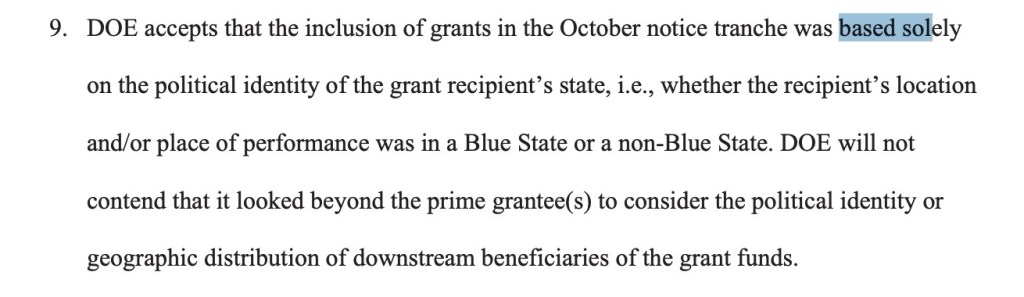
Aaron Parnas of the Parnas Perspective points outthat the Trump administrative made decisions about environmental grants based solely on whether the states supported him in the 2024 elections. This involved billions of dollars in grants.
Parnas wrote:
A major constitutional violation, confirmed in court. The Trump administration admitted in court filings this month that it canceled 284 Biden era clean energy grants worth billions of dollars based solely on whether the recipient state voted for Kamala Harris in 2024 and had two Democratic senators. A lawyer for the Energy Department conceded that none of the terminations were based on any programmatic, statutory, cost reduction, or performance related factor, directly contradicting Energy Secretary Chris Wright’s June congressional testimony that no decisions were made on politics. The Energy Department disputes any contradiction, saying Wright was distinguishing between the review process and the timing of the cancellations, but hundreds of additional grants the department had itself recommended for cancellation were left untouched simply because they sat in states that backed Trump.
Real projects and real money were caught in the fallout. The politically targeted cancellations halted funding for hundreds of energy projects, including electrical grid upgrades in California and Oregon, methane leak reduction efforts in Colorado, and clean hydrogen fuel hubs in California and the Pacific Northwest. The cuts came in October alongside a broader White House push to pressure Democratic lawmakers during a government funding standoff, with Trump publicly threatening to slash what he called Democrat agencies. Some grant recipients have since sued to try to recover their funding, and this is not the first time the Energy Department has admitted politics played a role, since a federal judge already ruled in two earlier cases that more than a dozen grants were improperly canceled for political reasons, though this latest admission is far broader and more detailed.
Democrats say it exposes a dangerous pattern with more to come. Senator Patty Murray and Representative Marcy Kaptur called the cancellations an outright un-American weaponization of government and accused the administration of corruptly abusing its power to punish states over how they voted. The controversy lands as the administration finalizes new rules, expected by October, that would give Trump’s political appointees direct control to review, block, or revoke federal grants across the entire government, worth more than a trillion dollars annually. Budget office director Russell Vought has defended the changes as necessary to ensure democratic control of spending, but critics, including antipoverty groups, scientists, and city leaders, have flooded the government with comments warning the rules would let the administration extend this kind of political targeting far beyond energy grants. Center on Budget and Policy Priorities fellow Devin O’Connor said the willingness to be this blatant in court should be taken as a serious warning about what the new framework could enable nationwide.
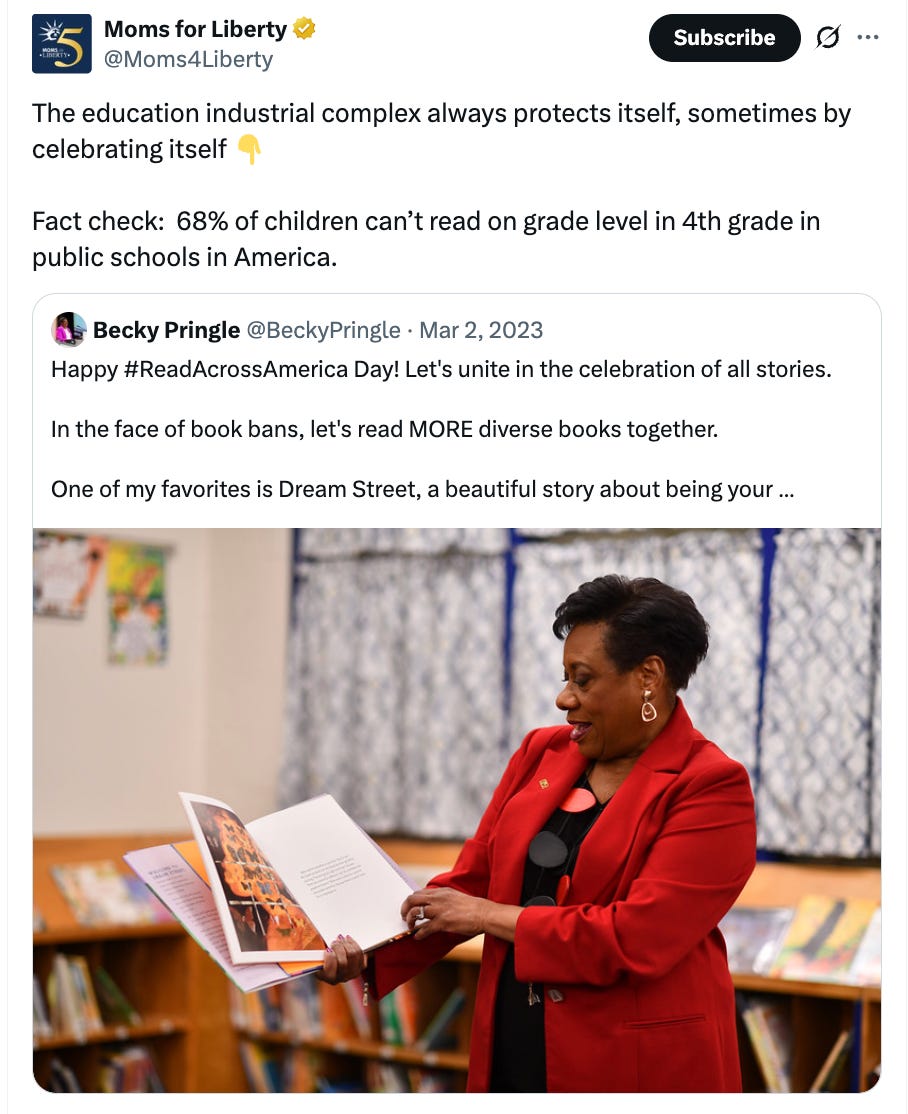
The biggest lie about American school kids is that most are “below grade level.” This lie is repeated so often by prominent figures that it is widely believed. But it’s not true. Those who believe it are wrong. Those who repeat it, knowing it’s not true, are liars.
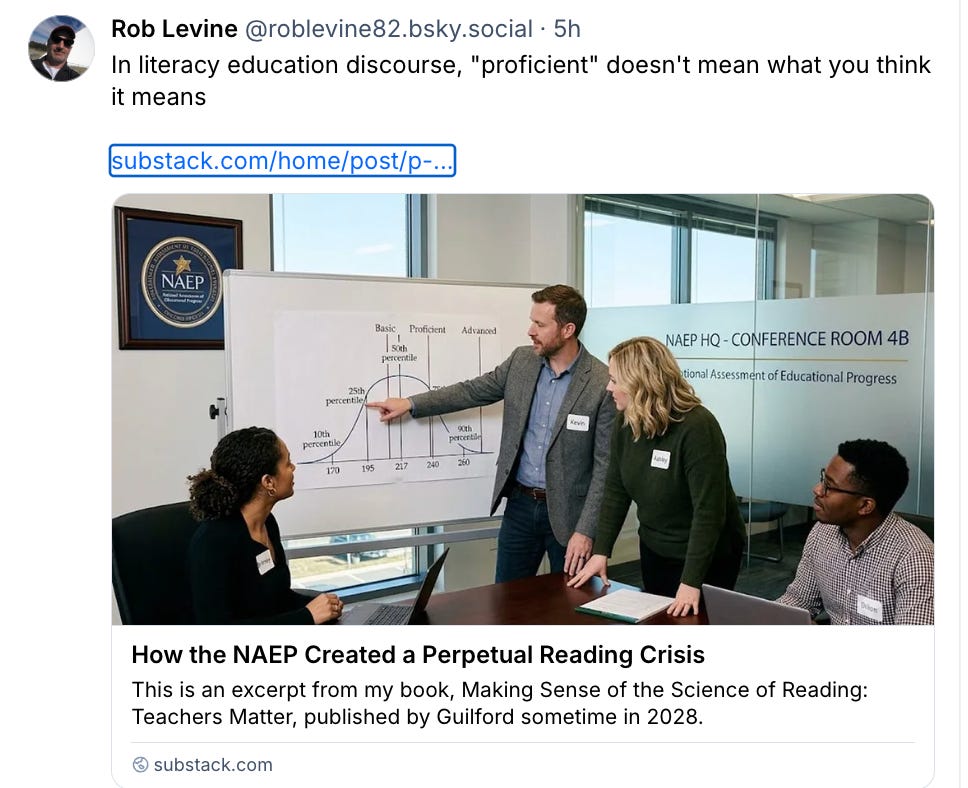
The source of the lie and the confusion is clear: the achievement levels in which NAEP scores are reported. The levels are “advanced,” “proficient,” “basic,” and “below basic.” When the media write about the latest release of NAEP scores, they frequently treat “proficient” as “grade level.”
But “proficient” is NOT “grade level.” It represents solid achievement, a rigorous aspirational goal. “Proficient” is equivalent to a solid A.
Every NAEP report on test scores says clearly in a footnote that “proficiency” is not the same as grade level. For example: “NAEP Proficient does not signify meeting grade-level expectations.” Yet the media and prominent commentators who should know better repeat the lie that most students are below grade level. The fact is that most students will never reach the high bar of “proficient.”
In 2023, as Bruce Lesley points out, Biden’s Secretary of Education–Miguel Cardona–testified to a Congressional committee that only one-third of American students were reading “at grade level.” I was flabbergasted. I couldn’t believe he said something so outrageous. I called Dr. Peggy Carr, who at that time was the Commissioner of Education Statistics. She was as surprised as I was that Secretary Cardona repeated the erroneous statistic. I asked Dr. Carr whether she had ever briefed him on understanding NAEP results; she had not.
I gave her an idea. Propose a change in name for “proficiency.” Change the name to “mastery.” No one would claim that “mastery” was the same as “grade level.” She liked the idea and promised to take it to the board. Whether she did, I don’t know. But nothing changed.
Bruce Lesley wrote this open letter to the National Assessment Governing Board, which oversees NAEP testing. Lesley is president of First Focus on Children and its partner organization First Focus Campaign for Children, bipartisan advocacy organizations dedicated to making children a priority in federal, state, and international policy. He has led both organizations since 2006 and 2009, respectively, building them into recognized national voices on child health, education, early childhood, economic security, budget and tax policy, immigration, children’s rights, and more recently, international child policy.
He wrote:
To the National Assessment Governing Board, the National Center for Education Statistics, and the leadership of the National Assessment of Educational Progress:
Every institution whose work affects children should begin with one question: “Is this good for children?”
By that standard, the National Assessment of Educational Progress (NAEP) has some important issues that deserve to be resolved. First and foremost, your achievement-level labels — “Basic,” “Proficient,” and “Advanced” — are being weaponized against the very children NAEP exists to serve, and you know it, because your own staff has been saying so for twenty-five years.
To be clear, this open letter is not a claim that NAEP’s underlying data is necessarily wrong, and it is not an argument against NAEP. The argument and request is narrower: you have a real and critically important ethical responsibility to correct the public misuse of your own data. NAEP should defend its credibility against those currently diminishing it.
This Week’s House Mark-Up Provides Another Example
On July 15, 2026, the House Education and Workforce Committee marked up a ten-bill package to facilitate the dismantling of the U.S. Department of Education.
In his opening statement, Chairman Tim Walberg (R-MI) argued that “too many children can’t read or do math at grade level,” and used that claim as a central justification for several of the bills. That claim is false.
Chairman Walberg was drawing on NAEP data — the statistic that roughly two-thirds of American fourth-graders do not score “Proficient” in reading, which is wrongly cited as evidence of failing to meet grade-level reading levels. For some, this is done out of confusion and, for others, to promote a political agenda to undermine public schools. In reality, NAEP proficient is aspirational and reflects a standard that is well above grade level.
Unfortunately, during the markup, multiple members of Congress repeated the same error. But again, NAEP Proficient is not grade level. It has never been grade level.
When the public, the press, the administration, and Congress repeatedly miscite this fact, the National Assessment Governing Board (NAGB) must do much more to clarify and correct misstatements about what it means.
The problem is two fold. One part of the problem is that “proficient” is used on many state and local assessments to mean “at grade level,” or what once upon a time would have been called a gentleman’s C; this leads to some honest confusion for some folks. The other part of the problem is folks who are invested in the narrative that public schools are failing and who benefit from the confusion surrounding the term.
Greene adds:
And every time NAEP scores are released, education journalists write piece after piece explaining “proficient” all over again, usually in the wake of some prominent person decrying the large number of students not “at grade level.”
That confusion is NAGB’s responsibility to address, and it has deserved attention for years, but all the more NOW.
This Is Not a Partisan Problem
Chairman Walberg and his colleagues’ misstatements are only the most recent officials to make this mistake (whether unintentionally out of confusion or internationally), and the pattern runs through both political parties.
Secretary Miguel Cardona, testifying before Congress in April 2023 under the Biden Administration, told lawmakers directly that only one-third of students were reading “on Grade level,” treating a NAEP proficiency figure as if it were a grade-level statistic, in nearly identical language.
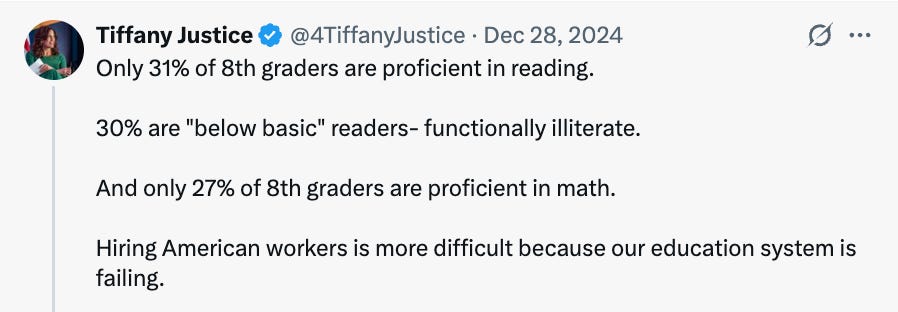
And Secretary Linda McMahon, in the current Trump Administration, has used more careful wording — noting that nearly 70% of eighth graders are “not proficient” in reading — but has paired that technically accurate phrase with language implying total system failure. A Snopes piece by Rae Deng described this claim as lacking its own level of reading comprehension because, again, it completely mischaracterizes what NAEP’s “proficient” standard means.
Outside advocacy groups have been considerably less careful than any of them.
Corey DeAngelis, a leading advocate for school privatization, vouchers, and against public education, has cited NAEP proficiency figures directly, without qualification, as evidence that public schools are a system-wide “disgrace.”
Greene captures these types of political misuse of NAEP data in this Substack post.
This confusion is intentional by people arguing for both the dismantling of public education and federal investments in children.
Unfortunately, NAGB’s silence has allowed that rhetorical usefulness to go unchecked under Republican and Democratic administrations alike, and it is being used right now, this week, on Capitol Hill to justify eliminating the very agency that funds and safeguards the data NAGB produces.
NAGB’s Own Experts Have Been Saying This for Years
In 2001, Mary Lynne Bourque and Susan Loomis — a staff member and a board member of the National Assessment Governing Board itself — wrote plainly that the Proficient achievement level “does not refer to ‘at grade’ performance,” and that performance at Proficient is not the same as being “proficient” in a subject as any ordinary person would use that word.
Chester “Checker” Finn, Jr., who chaired the panel that adopted the achievement levels in 1992, has been candid that the levels were designed to be aspirational — a description of where students should ideally arrive, not a diagnosis of where most currently stand.
NCES itself has attached a caution to NAEP score reports for years: the Proficient level “does not represent grade level proficiency as determined by other assessment standards.”
If NAEP’s own architects and NAGB’s own website already say this, it is past time to be diligent in correcting the record when people misuse and misstate what it means. It is also on NAGB to stop publishing results in a format that predictably, foreseeably, and repeatedly gets misread as a verdict on grade-level performance, especially when you can see exactly how that misreading gets used again and again.
The clearest confirmation of all of this comes from NCES’s own data. Researchers Gina Cervetti and Kathleen Hinchman mapped every state’s definition of fourth-grade “grade-level” reading proficiency directly onto the NAEP scale and found that, as of the most recent analysis, nearly every state’s own standard for grade-level reading lines up with NAEP’s Basic level, not NAEP’s Proficient level. That means the honest translation of the data runs the opposite direction from how Chairman Walberg and others use it: by the states’ own definitions of grade level, roughly two-thirds of American fourth graders are reading at or above grade level, not below it.
Cervetti and Hinchman are also blunt about what actually is a crisis in the data: not a reading crisis, but an equity crisis. In 2022, only 48% of students eligible for free or reduced-price lunch scored at or above NAEP Basic, compared with 76% of students who were not eligible — a 28-point gap that has persisted, largely unchanged, for decades.
That is a story about generational wealth and unequal access to housing, healthcare, and school resources, not a story about failing classrooms, and NAEP’s own framing continues to let people tell the wrong story with your numbers.
What Education Writers and Researchers Have Been Saying
Diane Ravitch, who served seven years on the National Assessment Governing Board under President Clinton, has called out the confusion between NAEP Proficient and grade level as one of the most damaging and persistent falsehoods in American education discourse, noting that NAEP itself explicitly warns against the equivalence you continue to permit others to make.
Greene has argued that cut scores like “Proficient” function as scaled, curved judgments dressed up as fixed standards — noting that if every child scored above a cut, the establishment reaction would be to declare the cut too easy, not to celebrate the achievement. That is not how a genuine, fixed criterion is supposed to behave, and it is worth NAGB’s honest reckoning.
Mark Weber, a New Jersey teacher and education researcher, has done careful public work mapping state proficiency standards onto the NAEP scale, and his conclusion undercuts a favorite talking point of your critics-turned-allies in this fight: there is no empirical evidence that closing the so-called “honesty gap” between state and NAEP proficiency rates does anything to improve student achievement. If setting state cut scores to match yours were actually the lever for better outcomes, we would expect to see it in the data. We do not. That matters because it means the standard is being imported into state accountability systems on faith, not evidence — exactly the kind of unsupported claim NAGB should be correcting rather than allowing to spread.
The Brookings Institution’s Brown Center on Education Policy has been making this same case for nearly two decades. Tom Loveless, the Brown Center’s longtime director, authored a 2007 report concluding bluntly that NAEP’s cut scores were set too high.
His 2016 Brookings piece, “The NAEP Proficiency Myth,” went further, noting that the achievement levels came under critical review from the U.S. Government Accountability Office, the National Academy of Sciences, and the National Academy of Education shortly after they were adopted — with the National Academy of Sciences review concluding the achievement levels were fundamentally flawed.
Loveless adds:
Advocates of the NAEP proficient standard want it to be for all students. That is ridiculous. Another way to think about it: proficient for today’s eighth graders reflects approximately what the average twelfth grader knew in mathematics in 1990. Someday the average eighth grader may be able to do that level of mathematics. But it won’t be soon, and it won’t be every student.
That is not a stray outside critique. That is respectable experts in the field, writing for decades, about the very categories NASB is still using today without correction.
One Point Should Not Separate “Failing” from “Successful”
NAGB also owes the public an honest accounting of what a cut score actually is. A cut score is a single point on a continuous scale, chosen somewhat arbitrarily by a panel, above which a child is declared “Proficient” and below which the same child, one point lower, is declared “Basic,” which is actually grade level.
Two children who are functionally indistinguishable in what they know and can do are sorted into entirely different public categories — one used as evidence that a school, a state, or a federal agency is failing, the other treated as evidence of success — because of a single point set by a committee, not because of any meaningful difference in the children themselves.
That is not a rounding error. It is the mechanism by which your data gets converted into political ammunition.
If NAGB cannot explain, in terms parents can understand, why the child who scores one point below the line is a different kind of learner than the child one point above it, then the line is doing rhetorical work the data was never built to support.
As the psychiatrist and educator William Glasser warned schools decades ago, chasing a point or two of movement on a test score is precisely the wrong institutional goal — and yet that is the goal NAEP’s cut scores hand every state, district, and school in the country by default.
Researcher Andrew Ho makes a similar point. He has identified proficiency cut scores as arbitrary markers, set through what he calls an “overwrought, judgmental, and ultimately political process,” not derived from any fixed line in human learning.
Ho has also documented a specific illusion that follows from that arbitrariness: because a large cluster of students always sits near the middle of the score distribution, a cut score placed close to that cluster will make small, ordinary shifts in performance look like dramatic gains or losses, purely as an artifact of how many students happen to sit right at the line — not because anything real changed in how much they learned. A researcher with no stake in the politics of this issue is describing the identical mechanism that turns your data into a rhetorical weapon: the closer the line sits to where children actually cluster, the more your data will appear to swing wildly for reasons that have nothing to do with children’s learning.
Criterion-Referenced in Name, Arbitrary in Practice
NAEP describes itself as a criterion-referenced assessment, distinct from norm-referenced tests like the SAT that simply rank students against one another. That distinction matters, and I want to represent it accurately rather than overstate it — NAEP does not “grade on a curve” in the way the SAT’s percentile scoring does.
However, the practical effect on families is not so different as the label suggests. NAEP’s cut scores were set by hand-picked panels making judgment calls about what students “should” know, not derived from an external, agreed-upon standard of competence, and independent evaluators — including a National Academies review in 2017 — have called for stronger evidence connecting NAEP performance levels to any real-world outcome at all.
A test that is criterion-referenced in name but whose criteria were set arbitrarily, and whose results still track family income and race as tightly as any norm-referenced test on the market, produces the same practical harm as the norming bias critics have long raised: it tells us more about a child’s zip code than about a fixed, meaningful standard of what that child knows.
Notably, NAGB has conceded the point this year. The 2026 NAEP reading framework — administered to students for the first time this spring — now explicitly disaggregates racial and ethnic subgroup results by socioeconomic status, on the premise, well documented for decades, that apparent racial differences in test scores largely track socioeconomic differences. That is a welcome and overdue acknowledgment.
But it is also, in effect, NAGB admitting in 2026 what critics have argued for years: that the results have been measuring wealth and family circumstance as much as they measure “proficiency,” all along. If that acknowledgment is real, it should extend backward, to how NAGB talks about every score ever published, not just forward, to a single new breakdown in the data tables.
The Test Itself Is Not Neutral
Even setting the cut scores aside, the content of the test carries its own bias, and NAEP’s own commissioned reviewers have said so. The NAEP Validity Studies Panel — a technical review body NCES itself created and funds — published an analysis by Gerunda Hughes in 2023 documenting that the statistical methods used to build NAEP-style test items can systematically disadvantage the very students the test is supposed to serve fairly.
When an item is answered correctly by nearly every student, it gets treated as a poor “discriminator” between high and low performers and is typically cut from the test in favor of harder items, even though that easy item may represent exactly the content that should be mastered.
In his book, Au cites researchers Kidder and Rosner, who examined more than 300,000 SAT test-takers and the pool of trial questions used to build future exams and found that some trial questions were answered correctly by Black students, or by Latino students, more often than by White students. Those questions were then discarded — not because they were poor measures of the content, but because they failed to reproduce the racial score gap the rest of the test already produced. A question only “counted” as valid if high-scoring test-takers, who are disproportionately White, tended to get it right in pretesting.
My mother has verified the same process when she was asked to be on a panel to evaluate whether the item questions were “fair”. The publishers of the Texas State assessment at the time ran through the questions and kept throwing out questions as biased toward Black or Hispanic children if they scored the same or close to the scores of White children.
In contrast, questions in which there was a substantial gap in favor of White students were not flagged – thus, “norming” the disparity in test score outcomes into subsequent tests. Although my mother repeatedly objected, she was overruled throughout the day and, not surprisingly, never asked back to be a reviewer.
The result, as Au describes it, is a self-reinforcing loop: item selection is calibrated to match existing racial score gaps, which locks those same gaps into every future version of the test, all without anyone ever explicitly considering race in the selection criteria.
NAEP is a different test administered by a different organization, and I am not asserting that NAEP’s item-selection process has been documented to work in the same way. But NAEP uses the same category of item statistics that made this outcome possible on the SAT, and NAGB’s own validity panel has already flagged the risk. Given what is now documented on a test as consequential as the SAT, NAGB owes the public a direct, public answer to a direct question: has anyone checked whether NAEP’s item-selection process does the same thing?
There is also cultural and geographic bias. As the son of an English teacher and a math teacher, it should be no surprise that I did fairly well on standardized tests throughout my life. But I vividly recall a reading passage from the PSAT that focused on nautical issues and the definition of a “flotilla.”
Having grown up in El Paso, Texas, a city located hundreds of miles from any coastline, the passage and vocabulary word were unfamiliar to any of us taking the test in the desert borderlands. On the other hand, we would crush a passage referring to “tortillas.” NAEP’s own reviewers have a name for this: cultural validity, the idea that a test cannot cleanly separate what a child knows from what a child has been exposed to.
Research that NAEP’s own validity panel cites has found that when students are allowed to choose among reading passages on different topics, rather than being assigned a single passage that may be unfamiliar or uninteresting to them, some groups of students — including Black eighth graders and Hispanic twelfth graders in the panel’s own cited study — score much higher. That is evidence that some of what NAEP currently measures is exposure and familiarity, not just reading ability, and it argues for reform in how passages and vocabulary are chosen, not just in how results are labeled.
Again, the validity panel’s report contains proof that this is a design choice, not a fact of nature. In 1972, the psychologist Robert Williams built a test called the Black Intelligence Test of Cultural Hegemony, using vocabulary and content drawn from Black American culture instead of the dominant culture’s frame of reference. When Black and White teenagers took it, Black students substantially outscored White students by substantial margins.
Nothing about the underlying children changed between that test and the SAT. What changed was whose knowledge and cultural fluency the test happened to be built around.
That single fact should end, permanently, any claim that a test’s outcomes reveal some fixed truth about which children “can” or “cannot” read, think, or reason. What these tests reliably measure is often which cultural and economic frame of reference a child was raised in, and how well that frame matches the one test-makers chose to build around — which is another way of describing accumulated wealth, school funding, and generational inequity, not a verdict on a child’s mind.
That is real, and policies that address school finance inequity, child poverty, childhood hunger, and adverse childhood experiences (ACEs) deserve real policy attention. These issues would undoubtedly do more to improve educational outcomes in this country rather than privatization of public schools or the elimination of the Department of Education.
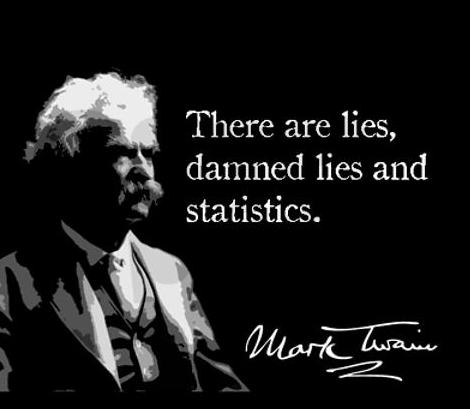
Claims that two-thirds of American children cannot read at grade level are simply false, and their interpretation by policymakers and advocates is harming children. There is an old warning that was popularized by author Mark Twain but attributable to British Prime Minister Benjamin Disraeli about three kinds of falsehood — “lies, damned lies, and statistics.”
In this case, even a true number, presented without its context, can mislead more effectively than an outright fabrication. NAEP’s “proficiency” level is an aspirational one, but the grade-level story built on top of it is doing real harm. NAGB is a position to explain the difference, and the public is not, until you tell them.
The Damage Is Not Abstract: What Gets Tested Is What Gets Taught
This is not a technical quibble.
Every time “below Proficient” gets reported to the public as “can’t read” or “can’t do math,” it becomes ammunition for defunding public schools and for portraying millions of children — disproportionately low-income children and children of color — as failures because of a label your board itself has said should not be read that way.
It also reshapes what happens inside the classroom. When reading and math scores on tests built around NAEP cut points become the metric by which schools, teachers, and even state superintendents are judged, instructional time follows the incentive:
Short, decontextualized passages crowd out real books — my children were taught how to write a brief constructive response (BCR) before they were even taught what a paragraph was.
Science, government, history, the arts, and physical education are pushed to the margins of the elementary school day because they are not tested and therefore not rewarded.
Children end up narrower, not better educated, in the very subjects that make them informed citizens — and NAEP’s own cut-score architecture is a direct contributor to that narrowing, whether or not that was your intent.
NAGB tried a partial fix in 2018, adding the word “NAEP” before each level — “NAEP Proficient” rather than “Proficient” — so people would stop equating your terms with generic ones.
James Harvey, executive director of the National Superintendents Roundtable, was right to call that gesture insufficient at the time. Harvey said:
…the American people should understand that the misleading term “proficient” sets a performance benchmark beyond the reach of most students in the world.
Harvey argued “proficient” should be changed to something like “high” to avoid being “fooled.”
His point has been proven many times, including this week when a sitting congressional committee chairman, citing NAEP-adjacent data to justify eliminating a federal agency, still used the word “grade level” as if it meant what NAEP’s Proficient level does not mean.
The Perverse Incentive NAEP Has Inspired: Grade Retention As Score Manipulation
The clearest evidence that NAEP’s cut scores create perverse incentives and “manufactured” crises, rather than honest information, is what states have started doing in response to them: holding back third-graders who miss an early-literacy cut score, in order to produce a fourth-grade NAEP cohort that looks better on paper.
Education professor and researcher Paul Thomas has documented this closely in states such as Mississippi, where fourth-grade reading gains celebrated as a “Mississippi miracle” tracked closely with a mandatory third-grade retention policy.
A child who is nine years old competing against classmates who are eight will predictably score higher on a test built around the same content; that is a fact about test administration, not about literacy. Furthermore, those same “gains” have been shown to fade by eighth grade, once the retained cohort catches up in age to its peers without having genuinely caught up in learning.
This is worth NAGB’s own honest reckoning, not because the research on retention is unanimous — reasonable analysts, including some closely tied to NAEP’s own governing board, dispute how much of Mississippi’s gain is genuine instructional improvement versus retention’s effect on cohort composition — but because NAEP’s achievement levels are the mechanism creating the incentive either way.
States are not retaining eight-year-olds because it is good for those children. They are retaining them because a single cut score on a single test has been elevated to a measure of whether a state’s education policy is working. The cost of that incentive falls on children: retained students who show a short-term score bump can, over time, experience the opposite of what was intended — greater disengagement, higher rates of dropping out before graduation, and the well-documented psychological toll of being told, at eight or nine years old, that they failed.
William Glasser spent much of his career, in Schools Without Failure, and later in The Quality School, explaining exactly why this backfires. He argued that standardized testing reduces learning to disconnected, memorized facts at the expense of critical thinking and real application — and that the “right answer, wrong answer” format of a multiple-choice test teaches children that education is a hunt for a single predetermined answer rather than a process of genuine understanding.
In the schools Glasser held up as models, closed-book tests were replaced with open-book, collaborative assessments that actually resembled the problems students would face outside school. His deeper claim, grounded in what he called Choice Theory, is that people — including children — are driven by needs for freedom, power, and simple enjoyment in their work, and that using test scores to rank, shame, or coerce students destroys the very motivation that produces quality work in the first place.
Labels matter. When children repeatedly hear that two-thirds of them “cannot read at grade level,” many internalize failure that is not supported by the evidence. Parents lose confidence in neighborhood schools. Teachers become demoralized. Policymakers propose increasingly radical structural changes to fix a crisis that has been inaccurately described.
Glasser also warned explicitly against making small, arbitrary numerical gains — his example was raising a test score by a point or two — the primary institutional goal of a school, insisting instead on building a genuine culture of quality. That is precisely the trap a single-point NAEP cut score sets for states, and it is the trap third-grade retention policies walk students directly into.
That is the opposite of what an assessment meant to serve children should produce, and it deserves your acknowledgment, not your silence.
What We Are Asking You To Do, Now
Issue a direct, public correction each time a federal official misstates NAEP Proficient as “grade level,” the way you would correct any other material misuse of your data. Silence is not neutrality; it is acquiescence in the misuse.
Publish, prominently and alongside every score release, the state-by-state mapping showing that “grade level” as states themselves define it corresponds to NAEP Basic, not NAEP Proficient — the analysis your own data already supports and that outside researchers have had to do on your behalf.
Publish a plain-language document — “What NAEP Proficient Does, and Does Not, Mean” — and require it alongside every score release, every webpage, every press briefing, and every congressional testimony that cites NAEP data. Most of this letter’s argument could be prevented by a single page NAGB.
Stop using “Basic,” “Proficient,” and “Advanced” as headline labels without their NAEP qualifier in every release, chart, and public statement — not as a footnote, but as a mandatory part of the label itself, displayed with the same prominence as the number.
Retire “Basic,” “Proficient,” and “Advanced” altogether in favor of terms that do not already carry a plain-English meaning your data does not support. If the words themselves are the problem, changing a modifier in front of them has not been enough.
Extend the honesty of the 2026 reading framework’s socioeconomic disaggregation backward, not just forward. If you now accept that racial gaps in your data are substantially explained by family socioeconomic status, say so plainly every time a racial achievement gap is reported, and stop letting that gap be cited as evidence of school failure without that context.
Commission and publish the external validity evidence the National Academies asked for in 2017 — a transparent accounting of what your cut scores do and do not predict, so the public can evaluate the standard rather than take your word for its meaning.
Publicly acknowledge the perverse incentive your cut scores have created for third-grade retention policies, and commission independent, longitudinal research — tracking students well past eighth grade, through high school graduation — before any state is permitted to point to NAEP gains as proof that retaining eight-year-olds is good policy.
Act on your own validity panel’s 2023 findings, and answer the question the SAT evidence now raises. Publicly disclose whether NAEP’s item-selection process has ever been audited for the same self-reinforcing bias documented on the SAT — where trial questions that marginalized students answered correctly were discarded for failing to reproduce the existing score gap — and commit to an independent audit if it has not. Explain how tests are “normed” from one year to the next and made comparable in a manner that is understandable to the public.
Kids can’t wait for another year of this same correction being offered and ignored, or for another cohort of eight-year-olds to be held back so a state’s chart can look better. NAGB has the power to end the confusion your own board identified more than two decades ago. Please do so. Kids deserve it.