Greg Olear is a gifted journalist and thinker who has a terrific blog. He writes about politics, literature and whatever he wants.
This is his obituary for Mitch McConnell, who has been a toxic force in our nation’s politics. Mitch is probably not dead yet but we should remember his toxic legacy.
Olear writes:
What with Donald Trump losing wars to Iran, using the Justice Department and the FBI as his vendetta agencies, sic’ing his murderous ICE Gestapo on innocent residents, building concentration camps, hawking presidential pardons, fucking up the global economy, destroying our institutions, bulldozing the White House, bankrupting farmers, plundering on a galactic scale, withholding the money he owes to the woman he raped, fluffing Putin and Netanyahu, spewing crazy shit, and behaving every day like a complete and total asshole…
…and with the erstwhile Senate Majority Leader off the grid for a full month with some undisclosed medical issue and presumed dead…
…and with the media focusing its attention on the Renfieldian Lindsey Graham, who we know for sure bought the farm…
…with all of that, it’s easy to forget just how much demonstrable harm Mitch McConnell has done did to the people of the United States and to American democracy.
Since his funeral appears to be imminent, it’s only right that we give the Turtle his (dead) flowers.
When Donald Trump put his short orange fingers on Lincoln’s Bible in January of 2017, Mitch McConnell was already one of the worst Americans to ever draw breath. As of that date, no individual in my lifetime—not Nixon, not Kissinger, not even Ronald Reagan—had done more damage to the United States than the malevolent Gentleman from Kentucky.
I wrote a short piece about it on my now-defunct online magazine in July of 2017, under the title “Worst Americans: Mitch McConnell.” It read:
Rather than participating in the governance of the country through the time-honored tradition of compromise, he spent eight years as a living, breathing roadblock. The current Senatorial system of obstructionism has his fingerprints all over it.
He engaged in a SCOTUS staring contest with Obama concerning the Merrick Garland nomination and did not blink until Neil Gorsuch, a pro-corporation-anti-human conservative of the worst kind, was sworn in. This will have malefic impact on our country for the rest of my natural life.
When debriefed on the extent to which malignant Russian intelligence forces were compromising the presidential campaigns and the election, he threatened to accuse Obama of playing partisan politics if he went public with the bombshell. Once again, Obama acquiesced. With the election over, and no Constitutional clause for an invalidation of the result, he is in a position to make noise about this act of war by an enemy power. He has done nothing.
His wife, Elaine Chao, is the daughter of the Taiwanese shipping magnate James S.C. Chao, who is responsible for both personally enriching his son-in-law and for contributing to his campaigns, which would be fine if not for the big cocaine bust nobody paid any attention to. Elaine Chao serves in Trump’s cabinet, because of course.
He censured Elizabeth Warren for attempting to read a letter by Coretta Scott King at the confirmation hearing of inveterate racist and Putinist collaborator Jeff Sessions.
He is the prime mover in the Senate of the campaign to repeal Obamacare. The toxic healthcare bill he’s floated would throw 23 million people off insurance and lead to thousands of deaths and bankruptcies. It would also have a deleterious effect on the economy, as many thousands of jobs would vanish if the ACA were repealed. He doesn’t care. At all.
The story of his recovery from polio being financed by the government is bogus, but he did suffer from the disease as a child, and he did recover thanks to a program put in place by FDR. That he is actively seeking to deny medical care to so many sick children (that’s who’s on Medicaid, mostly: children) speaks volumes about his loathsome character.
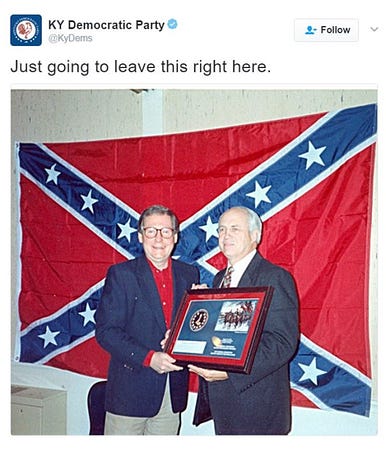
He’s sympathetic to the Confederacy.
Worst of all, and quite unlike almost every Republican involved with Trump, he’s astonishingly good at his job. He wants us to die and go bankrupt and be ruled by the laws of the Christian right and continue to have our elections stolen by the Kremlin. And he’s savvy enough to make it happen. As GOP strategist Rick Wilson said, “Washington is littered with the bodies of people who underestimate Mitch McConnell.”
He’s the worst person in America. And arguably the most dangerous.
That’s hardly an exhaustive list. And it was written far too early to cite the second impeachment, which McConnell handled even more abominably than he did the first.
[O]ur system of government gave the Senate a specific task. The Constitution gives us a particular role. This body is not invited to act as the nation’s overarching moral tribunal. We’re not free to work backward from whether the accused party might personally deserve some kind of punishment….
[F]ormer President Trump is constitutionally not eligible for conviction….But after intense reflection, I believe the best constitutional reading shows that Article II, Section Four, exhausts the set of persons who can legitimately be impeached, tried, or convicted. It’s the president, it’s the vice-president and civil officers. We have no power to convict and disqualify a former office holder who is now a private citizen.
Thus did McConnell concoct a technicality that allowed Trump to run for office again in 2024—even though, as Mitch well knows, under Section 3 of the Fourteenth Amendment, Trump is ineligible to serve.
In December of 2019, in “Obstruction is the New Secession,” one of the first pieces at PREVAIL, I expounded upon McConnell’s role as sand in the gears of democracy:
DEMOCRACY IS NOT, and was never intended to be, a zero-sum game. The winners are not supposed to take everything. Change comes slowly and incrementally—often frustratingly so, for progressives. But the flip side is that the United States has worked pretty damned well for a quarter millennium, becoming arguably the greatest nation the world has ever known, because of the willingness of its political parties to compromise.
In the run-up to the Civil War, Congress bent over backwards brokering one compromise after another, in a valiant attempt to preserve the union. These compromises infuriated Northern abolitionists (“This word compromise, when applied to human rights and constitutional rights, I abhor,” trumpeted Thaddeus Stephens in 1850), just as they vexed the Southern slaveholders. Ultimately, the peace did not hold—the differences between slave and free were irreconcilable—but the point is that, in an era when members of Congress sometimes kicked the shit out of each other, politicians still went to great lengths to compromise.
Compromise only works when both political parties are willing to budge. If one of those parties abdicates its responsibility to represent the American people, if it exists simply to obstruct the work of the other—if it flat-out refuses to compromise, ever, about anything—the US system of government, always a fragile thing, breaks down.
After the election of 1860, the Southern states said, “Fuck it. We’re not working with Abraham Lincoln no mater what,” and they seceded from the Union. After the election of 2008, Mitch McConnell and the Republicans said, “Fuck it. We’re not working with Barack Obama no matter what,” and proceeded to obstruct every single thing he tried to do, large or small, national security be damned. To avoid compromise, the South chose Civil War. To avoid compromise, McConnell allowed Moscow to sabotage the 2016 election. Both acts are tantamount to treason. (That the Party of Lincoln slowly morphed into the Party of Obstruction is a sad irony).
Obama, after spending most of his first year in office coaxing the recalcitrant Republicans to work with him, eventually gave up, and, like Lincoln, used the vast powers of the office to take action without the rival party’s input. This worked, sure, but it was not without consequences. As I wrote in “Obama the Terrible” in February of 2014, after the story broke about the president’s drone strikes on suspected terrorists:
If a terrorist can be blown to smithereens at the whim of a single individual, then so can I, and so can you. If a terrorist can be held indefinitely without trial, then so can I, and so can you….
Today, the man with his finger on the button is the genial Barack Obama, a man I voted for, a man I like and admire, a man whose judgment I trust. The president strikes me as grounded, guarded, pragmatic, and smart. Whatever some may believe, Obama is not Hitler. But the next guy might be. And therein lies the terror. Not recognizing this clear and present danger is Obama’s greatest failing as president.
While he has not yet gone to these terrifying lengths, the despotic Donald Trump has certainly exploited the “executive order” precedents set by the frustrated Obama. The GOP refusal to compromise—to so much as allow a vote on Supreme Court nominees and House bills!—begat both Obama’s executive power grab and the “sweeping and systematic” Russian interference in the 2016 election (in Mueller’s words), which McConnell through his cynical inaction aided and abetted. The result is Donald Trump—corrupt, venal, vain, petty, criminal, installed and controlled by Vladimir Putin—presiding over the most powerful executive branch in recent memory.
Many factors contributed to this outcome, yes. But the root of the problem is the Republicans’ refusal to compromise. The GOP are not small-d democrats any longer. Mitch McConnell and his confederates are the modern heirs of Christopher Memminger, Robert E. Lee, and Jefferson Davis. Which should come as no surprise:
Fortunately, the Confederate States of America did not have a state TV network spewing pro-slavery propaganda to North and South. There was no Fox & Friends to normalize the brutal war crimes of Nathan Bedford Forrest. Sean Hannity was not there to fawn over James Henry Hammond and extol the virtues of the Mudsill Theory. Nor did Jeff Davis have a Rudy Giuliani scurrying around Transylvania, calling into question Robert Lincoln’s ties with the Pullman Palace Car Company. If so, the Civil War might have played out quite differently.
The GOP does not want to Make America Great Again; it wants to make America white again—and, especially, to keep the White House white. This is a tall order. Like the antebellum South, the demographics do not favor the GOP. The country is becoming more diverse each year. White people will soon be a minority in the United States. The demographic shift could well turn Texas blue—which would be the death knell for the Republican Party. A blue Texas plus blue California, New York, Illinois, and New Jersey mean a Democrat POTUS for the foreseeable future.
McConnell surely understands this. He knows he’s running on borrowed time. If he can’t control the executive branch, or Congress, he has to infiltrate the judiciary—the only one of the three branches whose members, conveniently, serve for life. So far, this objective has succeeded beyond his wildest dreams. Obstruction has seen to that.
When it became clear that McConnell would never allow the Senate to vote to confirm Merrick Garland, President Obama should have gotten creative. FDR would have ordered Garland to take the seat after a waiting period of 60 days—something, anything to ensure not only that Garland took his rightful place on SCOTUS, but that the politics of obstruction failed spectacularly. Instead, Obama avoided a fight, assuming that Hillary Clinton would win and it would all be moot. This colossal error, an obvious blunder even at the time, guarantees a conservative judiciary—and perhaps, depending on the fragile health of Ruth Bader Ginsberg, an extremely conservative one—for decades.
The lesson is this: If the new president finds herself with a blue House and a blue Senate, she needs to be relentless. She needs to move quickly, decisively, and fearlessly. Yes, she should attempt to engage the GOP. But at the first whiff of obstruction, she should ignore them completely going forward. It is not her responsibility to beg them to do their fucking jobs. Let the Republicans go to Canossa if they want a seat at the table—and once they are at the table, let them do more than refuse to play along. The politics of obstruction must be eradicated, just as the Confederacy was. Traitors should have no voice in the government of the people, by the people, and for the people.
The irony is, since I wrote that six and a half years ago, Donald Trump has eradicated the politics of obstruction. Ruling by executive order, by decree, by lawfare and intimidation, he has plowed through the feeble roadblocks set up by the opposition. By controlling the executive and judicial branches, he has made Congress moot.
The other irony is, even in semi-death, McConnell continues his life’s work of obstruction.
Yes, Trump has eclipsed Mitch McConnell as the worst American of my lifetime. So have other monsters Donald has empowered: Elon Musk, Peter Thiel, Stephen Miller, etc.
But without Addison Mitchell McConnell III, there would be no Donald Trump. Remember this: Mitch fed the cancer. He nurtured the tumor. He prevented the oncologists and surgeons from administering treatment. And knowing he possessed the singular cure, he chose to sit on his hands as the terminal disease ate away at our democracy.
That is the sum of his life’s work. That is his ignominious legacy.
When Elon Musk started his Department of Governmental Efficiency (DOGE), one of his first targets was USAID, the U.S. Agency for International Development, the agency that sent food, medicine and health workers to the world’s neediest nations.
Musk and his DOGE shut down USAID. On February 3, 2025, Musk boasted on Twitter:
We spent the weekend feeding USAID into the wood chipper. Could [have] gone to some great parties. Did that instead.
Clearly, Musk was very proud of what he did. American farmers complained that they lost $2 billion in sales that had previously been purchased by USAID to ship abroad to needy people.
Immediately, there were dire predictions that people would die without the food and medicine provided by the U.S.
Musk at first ignored the critics, but eventually insisted that no child had died as a result of closing down USAID.
Elon Musk is newly minted as humanity’s first trillionaire, but the world’s richest man seems grumpy. And he definitely is not a fan of mine.
“Kristof is lying through his teeth,” he announced on social media this week.
I got on his nerves for pushing back at his claims that his demolition of the United States Agency for International Development last year did not cost lives. The fracas began after Representative Ro Khanna, a California Democrat, said that Musk had “possibly sentenced to death” a large number of children, and Musk retorted that it was “time to sue this liar.”
“There is not even a single dead child!” Musk protested on social media. I noted that I had met many families of children who had died — and that’s when he concluded that I was lying.
Musk’s assertion that not a single child died is absurd, yet he doubled down: “They cannot cite a single name of someone who died out of the ‘millions’ they falsely claim have died. Not a single name!”
On X, I began to give Musk some names. Let me elaborate:
Jibia was a 10-year-old girl, ranking third out of 58 students in her fourth-grade class in Rwamwanja, Uganda. Aid cuts meant that the local clinic ran out of $2 bed nets to protect from mosquitoes, as well as anti-malaria medicines. Jibia died of malaria last July, her mother told me outside the family home. Medical records confirmed that, and health workers told me that she would have been fine without the aid cuts: Replacing her tattered bed net with a new one could have prevented malaria, and in any case drugs would have helped her to recover promptly.
Yamah Freeman hemorrhaged while pregnant with her third child in her village in Liberia. The United States had provided ambulances to the local hospital, but the aid cuts under Musk and President Trump meant that the ambulances had no fuel. The strongest young men in the village placed her on their shoulders and raced down the path toward town, shouting encouragement to her as they ran, but she bled to death along the way. Her parents and sister told me about this, and I visited her grave.
Achol Deng, 8, had been infected with H.I.V. at birth in South Sudan but had been kept alive by American-provided medicines costing just 12 cents a day. The dismantling of U.S.A.I.D. and the resulting chaos meant that she lost her caseworker and access to medicines, and soon died of an opportunistic infection, health workers told me.
I could keep going. A Boston University researcher estimated that the aid cuts have cost more than 750,000 lives worldwide. A study published in The Lancet, the British medical journal, forecast that at present rates, the aid defunding will cost 9.4 million lives by 2030.
These figures may not be accurate; we just don’t have solid mortality data, and the aid cuts have also reduced data collection. What I can say after visiting numerous impoverished villages is that aid cuts are unquestionably costing the lives of many children.
Some prominent conservatives leaped to the defense of Musk, saying in effect: Why is it our job to save the lives of children in South Sudan? Why don’t rich liberals write checks? Why don’t other countries do more?
Those are fair questions. But if any of us came across an ambulance that had run out of gas with a hemorrhaging woman inside, surely we would happily hand over a $10 bill to save her life.
Until Trump’s second term, American aid cost just 23 cents for every $100 of gross national income and saved a life approximately once every 10 seconds. Seems like a bargain to me. Certainly it appears wiser than spending billions of dollars on a war with Iran.
I say “wiser” because all this is not just about compassion but also about self-interest. Aid money serves national security and protects us from diseases. I’ve noted that the current Ebola outbreak in Africa may have gotten out of control precisely because we cut aid spending in the region.
Yes, other countries should do more, impoverished countries should be less corrupt, and our own aid can be allocated more wisely. But note that some countries in Europe are significantly more generous than America, spending up to 10 times as much on aid as a share of national income as we do.
Should liberals donate more to humanitarian causes? Sure. But compassion isn’t a liberal impulse — it’s a human one. It was evangelicals and Republicans who in 2003 started the single best aid program ever, the President’s Emergency Plan for AIDS Relief, or PEPFAR; it has saved more than 26 million lives so far. Some of the most heroic aid workers I’ve met in dangerous locations have been Christian missionaries, from nuns to doctors; they would dispute the idea that empathy is woke.
It’s reasonable to ask how much we should spend or how we should reform the system. But why would anyone begrudge $2 bed nets or $4 malaria vaccines to save children’s lives?
So let me offer a challenge to Musk: Come with me on a reporting trip to South Sudan or Somalia or Mozambique. Meet starving children whose lives can be easily saved. Hold them. Look into their eyes. Talk to their terrified moms.
You’ll understand that these kids are just like ours, except that they didn’t do as well in the lottery of birth — and that just because we can’t save every child’s life doesn’t mean we should save none of them.
Back in the late 1960s, opponents of the war in Vietnam used to torment President Lyndon B. Johnson by shouting at him,
Hey, hey, LBJ,
How many kids did you kill today?
I can’t think of a word that rhymes with “Musk.” Can you?
Tuesday morning in Houston, Lorenzo Salgado Araujo did what he’d done nearly every morning for 35 years. He woke at 5 a.m., kissed his wife goodbye, loaded his van, and drove off to pick up his construction crew in Magnolia Park, the neighborhood that’s anchored Houston’s Mexican American community for a century.
He’d raised three sons in that city; they became a teacher and two engineers. He had no criminal record, and he was partway through the legal process of getting a work permit, biometrics and fingerprints already done.
By 7 a.m. he was lying face down on Canal Street with a bullet in his abdomen, crying out for help in Spanish while a federal agent knelt over him talking on the phone. He died at Ben Taub Hospital, the same hospital where two of his sons were born. The Harris County medical examiner has ruled the manner of his death a “homicide.”
ICE says he rammed their vehicle and “weaponized” his van to run down an officer, who fired in self-defense. His family says he almost certainly thought the unmarked cars tailing him were thieves after his work tools, because the men following him wore no insignia identifying them as law enforcement.
The League of United Latin American Citizens says photographs of the vehicles show little visible damage, which is a strange thing for a van that supposedly rammed a law enforcement vehicle hard enough to justify lethal force. David Bier of the libertarian Cato Institute reviewed newly surfaced footage and concluded it appears to show ICE initiating contact with Salgado Araujo’s vehicle, not the other way around; Norm Ornstein looked at the same evidence and called it “cold-blooded murder.”
The federal government has released no body camera footage, no dash camera video, and no photos of the damage it claims exists. The three eyewitnesses who were in the van, including Salgado Araujo’s own brother, are in ICE custody and can’t speak out. The Harris County District Attorney is trying to investigate, but her office says access to key evidence “remains under federal control.”
The president of Mexico announced this week that her government will pursue legal action against the United States over the killing. The historical inversion packed into that sentence is complete: Mexico is now appealing to international bodies to protect its citizens from American police violence.
Which brings us to the question people keep asking me on my radio show and on social media: “Are we in a police state yet?” And the question underneath it, the one that really matters: “How would we know?”
I lived in Germany for years, working with Salem International, some of that time in the little village of Höchheim hard up against the East German border, where the guard towers and the death strip were part of the landscape you saw on your way to buy bread.
I crossed through Checkpoint Charlie into East Berlin in 1986 and felt what a mature police state does to ordinary people: the lowered voices indoors, the glance over the shoulder before anybody said anything real. (If you’ve never experienced that world, watch the brilliant film The Lives of Others; it captures the East German surveillance state better than anything else on film.)
My spiritual mentor and employer in Germany, Gottfried Müller, had been an intelligence officer in Hitler’s army who renounced Nazism, was captured by the British in Iran, and spent most of the war in prison; he devoted the rest of his life to peace work.
And my dear old friend Armin Lehmann, who was the teenage Hitler Youth courier in the Führerbunker who delivered the news to Hitler that the war was lost (I still have a picture of him with Hitler, that’s on the cover of his book), spent his last decades in America as a peace activist.
Both men told me essentially the same story about how it began. It started getting scary, they noted, when the regime began to explicitly come after verbotener Gedanke, “forbidden thought.” For example, the radio stations, they said, used to encourage ordinary Germans to call in — to the shows and to the police — and “out” their neighbors who weren’t sufficiently loyal to the regime. Informing became one of the highest expressions of patriotism.
The Germans even have a word for the process by which their entire society was brought into line during 1933 and 1934: as Timothy Snyder notes, it’s Gleichschaltung, a coordination, a synchronization.
Germany didn’t become a police state in a day, and there was never an announcement.
There was just a series of Fridays, each one slightly worse than the last, until one day the question, “Are we in a police state?” had become dangerous to ask out loud.
So instead of waiting for an announcement that’s never coming, let’s do what Herr Müller would have done and run through the inventory necessary to create a fascist police state:
— A police state is a nation where the police answer to the leader rather than to the law, and where nobody outside the leader’s circle is permitted to hold them accountable. It’s a nation where they can arrest, beat, torture, imprison, and even kill with both anonymity and impunity.
In January, ICE officer Jonathan Ross reportedly shot Renee Good, a 37-year-old mother of three, through the window of her car in Minneapolis, and Border Patrol agents killed Alex Pretti, an ICU nurse, on a public street days later. Within hours, then-Homeland Security Secretary Kristi Noem was calling both dead Americans “domestic terrorists,” a slander she refused six times under oath to retract.
Murder is a state crime, and in America state investigators have always worked police shootings alongside the feds. Not this time. The FBI agreed to a joint investigation with Minnesota’s Bureau of Criminal Apprehension the morning Good was killed, then reversed itself the same day after Trump declared Minnesota officials “crooked.”
Hennepin County Attorney Mary Moriarty called the categorical withholding of all evidence “unprecedented in American history.” Now the same machinery has closed around the killing of Lorenzo Salgado Araujo in Houston. It won’t be the last time.
— A police state imprisons its dissidents, and it makes the sentences spectacular so everyone else gets the message.
On June 23, federal judges in Fort Worth sentenced eight members of a local book club who held a July 4, 2025 protest outside the Prairieland ICE detention center to a combined 450 years in prison, a figure the Justice Department bragged about in its own press release. Benjamin Song, who fired at an officer after the officer drew his weapon on the crowd, got 100 years.
Maricela Rueda, a doula and mother who was acquitted by the jury of every violent count against her, got 70 years in prison. Five others who were likewise acquitted of the attempted murder and firearms charges got 50 years apiece, because prosecutors persuaded the jury that wearing black and using the Signal messaging app constituted “material support for terrorism.”
And Daniel Sanchez Estrada, a Denton teacher and poet who wasn’t even at the protest, got 30 years for moving a box of anti-fascist political zines at his wife’s request, literature the prosecutors admitted was protected by the First Amendment.
For comparison, Proud Boy leader Enrique Tarrio was sentenced to 22 years for orchestrating the seditious conspiracy of January 6th, and Trump pardoned him anyway. In this America, leading an armed attempt to overthrow the government earns you a pardon, while a book club that protests ICE earns its members what amounts to life without parole.
— A police state criminalizes thought itself, as well as any expression of or action on that thought, no matter how “otherwise legal” it may be.
Last September, Trump signed NSPM-7, a national security directive that names “anti-Americanism, anti-capitalism, and anti-Christianity” as “indicators of domestic terrorism” and calls anti-fascism the “organizing rallying cry” of domestic terrorists. Consider how many of the roughly 75 million Americans who voted against Trump it could plausibly cover.
In December, then-AG Pam Bondi ordered every federal law enforcement agency to mine five years of data for anything “Antifa-related” by average Americans and hand it to the FBI, and directed the Bureau to publicize its domestic terrorism call-in tip line and establish a cash reward system for informants.
When Herr Müller and Armin told me about German radio hosts urging listeners to inform on their neighbors, I thought I was hearing history, but it turns out I was hearing a forecast, and the American version pays cash.
— A police state knocks on your door in reaction to your opinions, should you dare to express them out loud or in print.
In January, a Rochester software professional named David Streever sent a three-paragraph email to then-ICE Director Todd Lyons after watching the videos of ICE killings in Minneapolis.
“You are a monstrous human being and will go down in history as America’s Reinhard Heydrich, the butcher,” he wrote. “You will torment yourself until your last day on Earth.”
The email contains no threat of any kind, just a prophecy about a man’s conscience, the kind of furious letter Americans have been writing to powerful officials since before there was a Constitution to protect the practice.
Five months later, two federal agents rang his doorbell while he was in Finland with his seven-year-old daughter and handed his wife a document headed “WARNING NOTICE” and “YOU MAY BE IN VIOLATION OF FEDERAL LAW.” When he flew home, an agent showed up at his New York City hotel, a hotel whose location his wife had never disclosed, meaning Homeland Security found him anyway.
He’s now suing with the help of FIRE, the Foundation for Individual Rights and Expression, which could, like the Southern Poverty Law Center and multiple DC law firms, cause the Trump regime to put FIRE in their crosshairs next.
That same week, federal agents confronted Paigelynne Gonyea while she was working the polls during New York’s primaries, over an Instagram post about the already-publicly-identified officer who killed Renee Good. Federal agents questioned this poll worker, at her polling place, during an election, about her opinion of a federal agent who killed an American citizen on live video for the world to see.
— A police state builds a security force loyal to the leader and his oligarch cronies rather than the nation.
Pentagon documents reviewed by The Washington Post describe a new National Guard “quick reaction force” of roughly 23,500 troops across all fifty states, trained for domestic riot control, with the first units ordered ready by last January 1 and the rest by April, timed neatly to the midterms.
Trump has claimed “unfettered authority” to deploy troops into American cities, boasting “I could send the Army, Navy, Air Force, Marines, I can send anybody I wanted,” while governors are cut out of the chain of command and Pete Hegseth has barred military personnel from even talking to Congress without approval.
Vladimir Putin built exactly this in 2016; he called it Rosgvardiya, and its job was never national defense but regime preservation. Hitler built his version too, and it started small, as a “protection detail,” which in German is Schutsstaffel. History remembers it as the SS.
— A police state needs a compliant press, and you don’t have to nationalize the networks when you can simply arrange for a friendly morbidly rich oligarch to buy them.
— A police state rewrites the past, because people who remember accurate history make poor subjects.As George Orwell wrote of fascism: “Who controls the past controls the future: who controls the present controls the past.”
In March of last year Trump signed an executive order called “Restoring Truth and Sanity to American History,” and the sanitizing began: the National Park Service was ordered to strip signs and exhibits about slavery from national parks, including “The Scourged Back,” the famous photograph of the whip-scarred back of a man named Peter who escaped enslavement in Louisiana, and materials about John Brown’s raid at Harpers Ferry.
In Philadelphia, the administration went to court to replace the interpretive panels at the President’s House telling the story of the nine human beings George Washington enslaved there.
Trump himself complained that the Smithsonian was “OUT OF CONTROL” because its museums discussed “how bad Slavery was,” and this past weekend, on the Fourth of July no less, the White House released a report declaring that the National Museum of American History “cannot be trusted” to tell America’s story, faulting its director for, among other sins, wanting to move the museum away from an “America First mentality.”
Herr Müller and Armin lived through the original version of this, too: within months of taking power the Nazis had burned the books, purged the universities and museums of “un-German” scholarship, and rewritten the textbooks so that German children would grow up inside a glorious past that never existed. Control what people remember and you control what they’ll accept.
— And finally, a police state controls the vote.
In January, FBI agents raided Fulton County’s election warehouse and seized more than 650 boxes of 2020 ballots and voter rolls on an affidavit that omitted the state findings debunking its own claims, with then-DNI Tulsi Gabbard on scene and Trump personally on the phone with the agents.
On Tuesday, the same day Lorenzo Salgado Araujo was killed, the Justice Department sent letters to the election chiefs of all fifty states threatening each of them individually with criminal prosecution if noncitizens are found on their rolls, giving them five days to respond, this after the department lost eleven straight court cases trying to seize those very rolls.
Yesterday, Trump removed from office all of the members of the Federal Election Assistance Commission, an independent, bipartisan agency created by Congress that has the power to call out and punish election fraud, illegal campaign tactics and spending, and vote-rigging when it’s committed by candidates, parties, or state or local officials. It’s now effectively shut down.
And when senators asked, under oath, whether ICE agents would be kept away from polling places this November, both Kristi Noem and her successor and former plumber Markwayne Mullin refused to rule it out, while the White House press secretary said she “can’t guarantee” it and Steve Bannon openly muses that ICE at the airports was a “test run” for ICE at the polls.
So, are we in a police state yet?
Armin and Herr Müller taught me that we’re asking the wrong question — or at least at the wrong moment — because nobody ever wakes up one morning and notices, “Gee, I guess I’m inside a police state…”
Instead, a police state gets assembled around you, one component at a time, while officials assure you that each component is perfectly normal and even necessary to “maintain order” or, more insidiously, to “preserve freedom.”
Milton Mayer, in his 1955 book They Thought They Were Free, described how good, decent Germans came to accept fascism. He was a Chicago reporter who, following World War II, went to Germany to interview ten “average Germans” to try to learn how such a terrible thing could have happened and, hopefully, thus prevent it from ever happening here.
The stories he heard are so familiar to me, as I heard the same things over and over when living in Germany in the 1980s while talking with people who’d kept their heads down through the 1930s and early 1940s just to survive day-to-day.
“What happened here was the gradual habituation of the people,” a German college professor told Mayer, “little by little, to being governed by surprise; to receiving decisions deliberated in secret; to believing that the situation was so complicated that the government had to act on information which the people could not understand, or so dangerous that, even if the people could understand it, it could not be released because of national security….”
As Mayer’s professor friend noted, and Mayer recorded in his book:
“This separation of government from people, this widening of the gap, took place so gradually and so insensibly, each step disguised (perhaps not even intentionally) as a temporary emergency measure or associated with true patriotic allegiance or with real social purposes. And all the crises and reforms (real reforms, too) so occupied the people that they did not see the slow motion underneath, of the whole process of government growing remoter and remoter. …
“To live in this process is absolutely not to be able to notice it — please try to believe me — unless one has a much greater degree of political awareness, acuity, than most of us had ever had occasion to develop. … [O]ne no more saw it developing from day to day than a farmer in his field sees the corn growing. One day it is over his head.”
In this conversation, Mayer’s friend suggests that he wasn’t making an excuse for not resisting the rise of the fascists but was simply pointing out what happens when you keep your head down and just assume that ultimately the good guys will win:
“You see,” Mayer’s friend continued, “one doesn’t see exactly where or how to move. Believe me, this is true. Each act, each occasion, is worse than the last, but only a little worse. You wait for the next and the next. …
“But of course this isn’t the way it happens. In between come all the hundreds of little steps, some of them imperceptible, each of them preparing you not to be shocked by the next. Step C is not so much worse than Step B, and, if you did not make a stand at Step B, why should you at Step C? And so on to Step D.
“And one day, too late, your principles, if you were ever sensible of them, all rush in upon you. The burden of self-deception has grown too heavy, and some minor incident, in my case my little boy, hardly more than a baby, saying ‘Jew swine,’ collapses it all at once, and you see that everything, everything, has changed and changed completely under your nose.”
In a police state, everything seems the same, Mayer’s friend told him. You still go to work, cash your paycheck, have friends over, go to the movies, enjoy a meal out. The regime even backs down from time to time, making things seem ever more normal. Little victories, you tell yourself.
Except, as the German professor told Mayer, they’re not. One day, he said, you inevitably realize that:
“The world you live in — your nation, your people — is not the world you were in at all. The forms are all there, all untouched, all reassuring, the houses, the shops, the jobs, the mealtimes, the visits, the concerts, the cinema, the holidays.
“But the spirit, which you never noticed because you made the lifelong mistake of identifying it with the forms, is changed. Now you live in a world of hate and fear, and the people who hate and fear do not even know it themselves; when everyone is transformed, no one is transformed. Now you live in a system which rules without responsibility even to God.”
So, here we are. The unaccountable killings, the show trials, the informant bounties, the door knocks over emails, the leader’s praetorian guard, the captured press, the rewritten history, and now the reach for the ballots themselves: every component is now built, tested, and humming.
But what we still have, and what the DDR and the Third Reich did not, is one more election in which the machine’s operators can be stripped of their power by the people they’re trying to frighten.
That’s precisely why they’re working so hard on the machinery of that election, and precisely why the single most subversive act available to a free American this year is to vote, and to help everyone you know do the same.
So call the Capitol switchboard at 202-224-3121 and tell your senators and representative to defend state authority over elections, demand independent investigations of the killings of Renee Good, Alex Pretti, and Lorenzo Salgado Araujo, and put a statutory ban on federal agents at the polls.
Check your registration right now at vote.org, because voter roll purges are already happening in Red states.
Sign up to be a poll worker in your county; they want poll workers intimidated, and the answer to that is more of us, not fewer.
Program the Election Protection hotline into your phone, 866-OUR-VOTE, and share it.
Support the people fighting this in court, from FIRE to the Blue state attorneys general.
And if this piece helped you see the machinery used to construct a police state more clearly, please share it and support independent media like my Hartmann Report, because a free press that can’t be bought by billionaires is one component of democracy they haven’t figured out how to seize.
Trump pardoned the convicted criminals who were sentenced because of their actions on January 6, 2021. Those who committed the most serious crimes were accused of seditious conspiracy and did not receive a pardon. They are leaders of the Proud Boys, a group of right wing extremists. They were later pardoned by Todd Blanche.
(CNN) — A federal judge on Friday dismissed the seditious conspiracy case against several Proud Boys members — granting a request from Trump’s Justice Department and undoing one of the Biden administration’s most celebrated victories against those who it said inspired the January 6, 2021, attack on American democracy.
US District Judge Timothy Kelly, a Trump appointee, begrudgingly agreed to drop the case against the four members, saying he “lacks the authority to compel the Executive to pursue a prosecution, full stop.”
“President Trump’s views about the prosecution of those who attacked the U.S. Capitol on January 6—whether those views are based on fact or fiction—are well known, as is his intention to extend clemency to them through the Executive Order,” Judge Kelly said, referring to Trump on his first day back in office signing an order commuting their sentences.
Trump’s order granted pardons to over 1,000 people convicted in the attack but left in place the convictions of the four Proud Boys members — Ethan Nordean, Joseph Biggs, Zachary Rehl and Dominic Pezzola.
In April, the Justice Department under Todd Blanche moved to vacate their convictions.
Dismissing the case against the Proud Boys associates erases some of the most serious convictions from the sprawling investigation of the US Capitol riot, one of the largest federal investigations in US history. Nordean, Biggs and Rehl were found guilty in 2023 of seditious conspiracy and a range of other charges. Pezzola was found not guilty of seditious conspiracy but convicted on other charges related to January 6.
The US district judge who sits in Washington, DC, said in his order that the Trump administration sought to “treat this case essentially the same way it has all January 6 cases, without regard for the seriousness of the conduct at issue or even whether the case was initiated after President Biden took office or, like this one, while President Trump was still in power.”
“The decisions to issue the Executive Order and to abandon this prosecution—even after the Government secured convictions for serious crimes relating to the attack on the Capitol on January 6—are solely the Executive’s,” Kelly continued. “No one should mistake the Court’s granting of the Government’s motion for its agreement with those decisions.”
Rehl, one of the Proud Boys members, celebrated the dismissal in a post on X, saying, “Finally, it’s all over! January 6th can now be a thing of the past for me!”
Enrique Tarrio, the former leader of the group who had also been pardoned by Trump, was also quick to boast on X Friday night: “Justice is served! Proud Boys don’t lose. We win. This is our victory.”
Trump has long lambasted the January 6 prosecutions as an injustice against his supporters, even referring to those in jail as “hostages.”
The president has repeatedly called January 6, 2021, “a day of love and peace” and claimed his supporters posed “zero threat.” His comments are contradicted by hundreds of video clips of Trump supporters beating police with flagpoles, batons, wooden clubs and baseball bats; deploying stun guns and chemical sprays; and engaging in hand-to-hand combat with police officers.
The judge, calling the insurrection “a perilous event,” said it was “an attack on people, including police officers, many of whom were injured. It was an attack on a coordinate branch of government—Congress—that the Founders saw fit to give a place of primacy in Article I of the Constitution. And it was an attack on the Constitution’s mechanism to facilitate the peaceful transfer of power from one president to the next, what President Reagan called ‘nothing less than a miracle.’”
Closing his order with a somber warning, Kelly said, “Moving forward, if this Nation’s experiment in self-government is to last another 250 years, the American people—no matter their partisan preferences—will have to act together to preserve, protect and defend that miracle through our constitutional framework.”
Jan Resseger is a perceptive observer of policy and a passionate defender of children. She writes on this post about the myriad ways in which Trump’s signature legislation harms children. This bill will make many children hungrier, poorer, and less healthy.
She writes:
Huge omnibus laws filled with myriad amendments and unrelated provisions are always passed without sufficient public attention to the details and long term consequences. House Resolution 1, which the President has called the “One Big Beautiful Bill” was an omnibus tax and reconciliation law. President Trump signed HR 1 into law just a year ago on the 4th of July. The law poses a number of threats to the well-being of children and to public schooling. Many of us who follow public education policy are well aware of the Trump administration’s expansion of the privatization of public education with the new tuition tax credit school voucher program buried in HR 1, but other provisions of this federal law have also begun imperiling the welfare of our society’s most vulnerable children. The damage will only expand in the coming months and years.
The Center on Budget and Policy Priorities recently updated threats to children’s welfare in HR1: “Already the law is raising costs for families and taking away health coverage, food assistance, and other essentials from people who are already struggling to afford to meet their basic needs—all while showering more tax breaks on the wealthiest households and funding a violent immigration detention and deportation agenda. The law’s harm will only deepen as its more than $1 trillion in cuts for Medicaid and the Affordable Care Act… marketplaces fully take effect and states fully implement SNAP eligibility restrictions and take drastic measures ahead of the federal government’s significant shift of SNAP costs to states… (T)he law’s cuts will expand the still-deep inequities long experienced by those who face the most economic discrimination and poverty, including Black, Latino, and Indigenous people and families with people who are immigrants.”
For political reasons, many of HR 1’s punitive provisions were delayed so that they will kick in only after the 2026 midterm election. The provisions with some of the most serious implications for families with children include future cuts to Medicaid and the Children’s Health Insurance Program (CHIP). The Center on Budget and Policy Priorities predicts: “The harmful… megabill will take health coverage away from millions of people and dramatically raise health care costs for millions more. The law cuts $1.1 trillion from Medicaid and ACA marketplaces… The work requirement… will take away coverage for childless adults and some parents who can’t prove that they are participating in countable ‘community engagement’ activities at least 80 hours per month.”
KFF adds: “For the first time, the law conditions Medicaid eligibility for Medicaid expansion enrollees on meeting work and reporting requirements. These work requirements, which will go into effect in January 2027, or sooner at state option, represent the largest source of enrollment declines in the law.”
There are, however, two areas in which HR 1 has already seriously impacted families with children.
Sharp Drop in SNAP Participation It has been widely predicted that millions of families who need food assistance will, by 2028, loose access to food stamps (SNAP) due to the provisions of HR 1. The Center on Budget and Policy Priorities’ Dottie Rosenbaum and Joseph Llobrera report, however, that the sharp drop in access to SNAP has actually begun in 2026:
“Millions of people are losing food assistance through SNAP due to the 2025… HR 1. This includes many children and others not targeted by HR 1’s eligibility restrictions. In fact, more people are losing SNAP, and faster, than the Congressional Budget Office (CBO) predicted. The latest data show that about 4.7 million fewer people (including 808,000 children) participated in SNAP in March 2026 compared to the average month in fiscal year 2025… The most likely reason is the impact of HR 1’s shifting of enormous new SNAP costs to states, which they owe starting in fiscal year 2028. CBO estimated the cost shift mandate would have no impact until 2028, but it has already led many states to erect barriers to people’s SNAP participation, such as requiring more paperwork and imposing other requirements that states often don’t have the staff to administer.” In 2028, HR 1 requires states to start paying part of SNAP costs, and states are already trying to make participation “harder to navigate” with “more paperwork, shortening certification periods or adding more case reviews.” (Emphasis is mine.) HR 1 ‘s SNAP requirements will reduce future coverage among parents by adding a work requirement for parents and caregivers of children who are 14 years old or over.
This week the Center for American Progress released a report demonstrating that HR 1 may eventually also reduce free school meals for children and school districts that now qualify: “When children lose access to SNAP and Medicaid, they may also lose their direct certification for free school meals. This harm expands beyond individual impacts. As a result, schools participating in the Community Eligibility Provision CEP may fall below the 25 percent of direct certified students required to qualify for the CEP, ending free school meals for the entire school or district.”
Spending on Immigration Last July, the American Immigrant Council summed up how HR 1 would help fund the President’s expanded immigration enforcement—what we have watched during the past year: “H.R. 1 provides $170.7 billion in additional funding for immigration- and border enforcement-related activities to the Department of Homeland Security (DHS) and its sub-agencies, Immigration and Customs Enforcement (ICE) and Customs and Border Protection (CBP, as well as for the Department of Defense (DOD) for activities related to the military’s presence along parts of the southern border.”
The Center for Law and Social Policy (CLASP) details some of the consequences so far for children in immigrant families across the United States: “This historic ballooning of immigration enforcement funding has turbocharged family separations and child and family detention, threatening child safety and well-being. An estimated 205,000 children, 145,000 of whom are U.S. citizens, have experienced having a parent in detention… Moreover, the high level of disenrollment in SNAP and Medicaid is in part due to HR 1’s exclusion of lawfully present immigrants, such as asylum seekers and refugees, as well as the chilling effect on people whose children are likely eligible but are disenrolling because they are concerned about their participation being used against them in immigration proceedings.”
Research has shown for decades that family poverty and problems like hunger and homelessness contribute to achievement gaps as children enter school. Thirty years ago in The Manufactured Crisis, David Berliner and Bruce Biddle declared: “the larger the proportion of citizens who live in poverty, the greater challenge for public schools.” (p. 220)
More recently the National Education Policy Center’s Kevin Welner explained the correlation of children’s economic circumstances with their school achievement: “Those of us who work in or with schools never question the enormous impact that a teacher or school can have on a student. But this essential truth coexists with another truth: that differences between schools account for a relatively small portion of measured outcome differences. That is, opportunity gaps in the U.S arise primarily outside of schools. This should not be a surprise. Poverty, concentrated poverty, and racialized poverty are pervasive features of America. School improvement efforts cannot directly help children and their families overcome decades of policies that perpetuate systemic racism and economic inequality. When children are born in the United States, their educational and life outcomes can all be predicted based on their parents’ education, income and wealth… Inequality in the U.S. is stark and enduring.”
The tangled issues buried in the mammoth HR 1, what President Trump calls the “One Big Beautiful Bill,” threaten the well-being of millions of poor children enrolled in our nation’s urban and rural public schools. It will be urgently important for educators and public school advocates to press Congress to correct the bill’s myriad injustices.
Trump boasted about the U.S. Supreme Court decision Trump v. Slaughter gave him more power than any other President. That decision removes protection from members of independent commissions. With the exception of the Federal Reserve Board (which regulates the banking system and whose stability is crucial to the economy), Trump now has the power to fire any member of any independent commission without cause. He can stack those commissions with his cronies, with people who have no expertise but will do whatever he wants.
What’s the point of having “independent” commissions if they are not independent of political influence?
Thom Hartmann wrote that the Court majority just rolled back the Pendleton Act of 1883, which created the Civil Service:
The six unscrupulous Republicans on the Supreme Court — over the loud objections of the three true constitutionalists on the Court — are aggressively dragging America back not just to the 1950s but, as of yesterday, to the 1830s.
Arguably the most depraved president in American history, Andrew Jackson (aka “The Indian Killer” a title he gave himself), Trump’s favorite, whose picture he hung in the Oval Office, invented what came to be called the “Spoils System.”
If you wanted a job in the federal government, or a favorable ruling from one of the then-few federal agencies, all you had to do was give a big enough gift to President Jackson, or pledge your loyalty to him instead of the Constitution and the people, and your wish would be granted…
The Federal Reserve protects the nations’ banking system and thus ensures stability and prosperity for America’s billionaires and the companies that made them that way. By blowing up Trump’s attempt to remove the Fed’s one Black governor (presumably as part of his and Hegseth’s Make America White Again campaign), the Republicans on the Court defended America’s oligarchs.
The other federal agencies, like the FTC, mostly protect you and me. They oversee our environment, consumer product safety, the purity of our food and drugs, and so on. If anything, America’s oligarchs consider them a pain in the ass.
If Democrats win the Presidency and control of both houses of Congress in 2028, they can write new laws reviving limits on Presidential power, protecting merit-based appointments, and strengthening the federal civil service.
Until that happens, Trump can fire any member of the Federal Trade Commission,
When it comes to supporting its public schools, Florida ranks dead last in the nation. Not only was it dead last of all states, it was at the very bottom in 2024 and 2025.
Florida betrays its state constitution, which contains a clear mandate to create and protect strong public schools.
Article IX, Section 1(a) states:
“The education of children is a fundamental value of the people of the State of Florida. It is, therefore, a paramount duty of the state to make adequate provision for the education of all children residing within its borders. Adequate provision shall be made by law for a uniform, efficient, safe, secure, and high quality system of free public schools that allows students to obtain a high quality education…”
Under the misleadership of Republican politicians like Jeb Bush and Ron DeSantis, Florida has diverted billions of dollars to privately governed charter schools and unaccountable vouchers for private and religious schools and home schooling. Bush and DeSantis have ignored and abandoned Florida’s state constitution.
And among all the states, Florida’s school rank dead last.
Based on the NPE report Public Schooling in America 2026, Carol Burris, executive director of the Network for public Education, wrote:
This is the third consecutive year that Florida’s statehouse has earned last place when it comes to supporting public schools. Florida’s lawmakers don’t merely encourage privatization through charters, vouchers, and homeschools; they actively engineer conditions that undermine public schools and worsen the environment for teaching and learning.
The damage from Florida’s universal voucher program is staggering. Close to four billion dollars in state education funding now flows annually to voucher programs — nearly one in four state education dollars diverted away from public schools, including to families whose children never set foot in a public school. And the funding mechanism puts the burden directly on school districts, which must absorb the loss.
Meanwhile, Florida continuously revises its school rating standards to ensure more public schools are labeled as failing, while simultaneously incentivizing and subsidizing charter expansion. Its Schools of Hope program even allows charters to colonize unused space inside public school buildings. Success Academy’s Eva Moskowitz teamed up with a Florida billionaire to help draft the enabling legislation, then used it to muscle her chain into the Miami charter market with generous public funding in tow.
Fifty percent of Florida’s charter sector is run by for-profit operators — one of the highest shares in the nation. Only Michigan has more. Florida is home to Academica, the largest for-profit charter chain in the country, and to Charter Schools USA. Both profit from the real estate they build and lease back to their own branded schools.
Charter schools claim to be equally open to all students. That is not the case in Florida, which lost points for the numerous enrollment privileges its laws permit. Florida is one of a small number of states that allow company-based charter schools. The Villages, the largest retirement community in the country, has its own charter school, and it functions less like a school of choice than a company store. The school was created by the community’s developer, and at least one parent must be employed by The Villages or a company that services it. If that parent quits or is fired, the child must leave immediately. For a low-wage service worker who might want to change jobs, the school becomes a trap — a reason to stay put rather than pursue something better.
Florida sinks to the bottom not only because of its weak charter and voucher laws and the financial incentives it offers to expand privatization, but because it actively undermines its public schools through policy and funding decisions at every turn. Florida lost every possible point on school funding — whether measured by cost-of-living-adjusted teacher salaries, equitable funding distribution, or funding based on capacity to pay. It has low teacher satisfaction, high student-to-teacher and student-to-counselor ratios, weak anti-bullying laws, and it still permits corporal punishment.
Of 102 possible points, Florida disgracefully earned only 14. You can read our full NPE 2026 report card here.
Dan Froomkin writes a blog called Press Watch. He calls out reporters who fudge the facts or distort the story by omission or commission. In this post, he critiques the press for refusing to acknowledge that Trump is racist and wants to expel 350,000 Haitians because they are Black.
This issue is important because it played an important role in the Supreme Court decision about whether to cancel the Haitians’ Temporary Protected Status. Lawyers for Haitians argued that his actions were motivated by his racism. The Supreme Court disagreed.
Froomkin believes that the press took the familiar stance of bothsiderism. Some think he’s racist, others think he’s not.
Justice Elena Kagan, who wrote the dissent for the three liberal judges, argued that Trump’s racism was undeniable, and she cited numerous vile and racist statements he had made.
The legal and moral question at the heart of Thursday’s 6-3 Supreme Court opinion giving Donald Trump the go-ahead to deport over 350,000 mostly Haitian immigrants was a simple one: Was Trump’s decision motivated even in part by racial animus?
And that, in turn, came down to the question: Were Trump’s past statements about Haiti racist?
That is not a tough one.
Trump has accused Haitians of eating their neighbor’s pets. He has called Haiti a “shithole” country and has said he preferred immigrants from “nice” predominantly white countries. He has said that most Haitian immigrants “probably have AIDS.” He has said nonwhite immigrants are “poisoning the blood of our country.”
Even the mainstream political journalists who bend over backwards not to call Trump a racist outright have acknowledged that some of his comments about Haiti in particular qualify as racist smears and as elements of a racist and inflammatory narrative.
But after Justice Samuel Alito wrote in the majority opinion that none of Trump’s statements about Haiti were “overtly racial,” I had a bad feeling that our top political journalists would wimp out and treat Alito’s assertion as debatable –- as one of two plausible sides of a political argument –- rather than as the bald-faced, ridiculous lie that it is.
I was worried that rather than state the obvious, they would throw up their hands and say, effectively, “You decide whether what Trump said is racist or not. You decide whether his statements on race represent reasonable, legitimate political discourse. We’re not going to judge.”
Readers, I was right to worry.
Our elite political media is now bothsidesing racism.
Most of the coverage of Thursday’s Supreme Court decision -– to the extent that it raised the issue of racial animus at all — consisted of, literally, both sides. Reporters briefly quoted Alito’s opinion, briefly quoted Justice Elana Kagan’s blistering dissent, and left it at that. Jump ball.
The Supreme Court on Thursday confronted two questions that have also confounded many Americans for the past decade: How seriously should people take President Trump’s wild, coarse and ugly statements? And are some of them marred by racial animus?
Like the country itself, the court was deeply divided on both.
This is pure poppycock. The question about Trump’s racial animus has not “confounded” many Americans. His animus is on display almost daily.
Who thinks Trump’s “wild, coarse and ugly statements” are some sort of joke? Nobody.
Indeed, everybody in touch with reality knows very well that Trump holds “racial animus.” Even Alito and the five other Trump acolytes on the high court know that, they just choose to lie about it.
To the extent that the country is “deeply divided,” it is between a minority of people who share Trump’s views and an overwhelming majority (I hope) who don’t.
And that shouldn’t be a “both sides” issue. Journalists should have the integrity to call out racist language and racist acts by name, and to cast racism as a societal ill.
The coverage should have made it clear that Alito was making an indefensible argument.
Here’s what the top of my “news analysis” would have looked like:
The six hard-right justices who control the Supreme Court on Thursday gave Donald Trump the go-ahead to deport hundreds of thousands of legal Haitian and Syrian immigrants, insisting – against a mountain of evidence – that Trump’s decision-making was not even slightly motivated by racial animus.
The Opinion
If you haven’t read the key sections of Alito’s opinion and Kagan’s dissent, they are really worth your time. The opinion approves the termination of Temporary Protected Status (TPS) for immigrants from Haiti and Syria, taking away their legal status and making them subject to deportation.
In his discussion of Trump’s comments, Alito split hairs:
The President’s comments fall into four main categories. First, many express strong objections to the immigration that this country has experienced in recent decades and to many of the immigrants who have come here, particularly those who have come to or stayed in the United States illegally. These statements associate these immigrants with crime and other social ills. Second, some statements express great displeasure with TPS. They note, among other things, that TPS designations have often been far from temporary and that aliens who are allowed to stay in the United States under the program are not vetted like other aliens who seek admission. Third, some statements broadly denigrate the countries for which TPS designations have been granted—including Haiti—portraying them as hellish places in which to live. And fourth, some statements malign Haitians who have come to the United States.
Then he concluded:
None of the cited statements by either the President or the Secretary was overtly racial, and in substance all expressed policy views that could rest on race-neutral justifications. For example, one may oppose TPS and favor tighter restrictions on immigration for economic or other reasons that have nothing to do with race. And a person without racial bias can provide a harshly unfavorable description of living conditions in some of the countries with TPS designations. The criteria for TPS designations guarantee that many, if not most, designated countries have such characteristics.
Alito casually shrugged off Trump’s “heated language” as the new normal. (The case, Mullin v. Doe, was formerly known as Trump v. Miot):
In offering the cited statements as proof that the termination of Haiti’s TPS termination was motivated by race, Miot respondents seek to capitalize on the statements’ heated language. Political discourse by prominent public figures is increasingly couched in terms that would have scandalized the public just a short time ago, and the statements cited by Miot respondents—especially those concerning Haiti and Haitian immigrants to this country—exemplify this development. But whatever one may think of the cited statements, they are insufficient to show that the termination of Haiti’s TPS designation was based on the race of the Haitian people.
Interestingly enough, Alito personally distanced himself from Trump’s statements, expressing empathy for Haitians and writing that “there is no justification for denigrating the character of Haitians who suffer from and bear no responsibility for their country’s ills.”
I agree that there is no justification. But there is an explanation. And that explanation is that Trump is racist.
The Dissent
Kagan, in dissent, wrote that the Haitian plaintiffs had provided clear evidence that race played a role in Trump’s decision:
The evidence they have offered includes statements by the President so repellent and racially inflected that the majority declines to put them in print. (Indeed, one measure of the President’s way of speaking about Haitians is to compare it with the majority’s, which is unfailingly respectful.)
So here are some of those statements. Haitians are “eating the dogs . . . . They’re eating the cats. They’re eating—they’re eating the pets of the people that live [in Springfield, Ohio].” And: Haitians are also eating “other things too that they’re not supposed to be.” And: Haitians in the United States “probably have AIDS.” And:Haiti is a “shithole country,” which is “filthy, dirty, [and] disgusting.” And: Haitian immigration is “like a death wish for our country.” And: Haitians, along with some others, are “poisoning the blood” of our country. And: “Why is it we only take people from shithole countries” like “Haiti [and] Somalia”? “Why cannot we have some people from Norway [and] Sweden?”
The majority briefly replies that those remarks are not “overtly racial,” but it is hard to know what that means. Haitians are Black. (Norwegians and Swedes not so much.) The references—of filth, disease, and primitiveness—are shot through with racial stereotypes and tropes. It is hard to imagine the statements being made today of any White community. No very “sensitive inquiry” …. is needed to see them for what they are; judges, as we often say, are “not required to exhibit a naiveté from which ordinary citizens are free.”
The statements fairly shout, in their racial undertones and overtones alike, that race entered into the President’s resolve to remove Haitians from this country.
No reasonable person could read Kagan’s dissent and take Alito’s opinion at face value.
Alito and the other Republicans on the Supreme Court have given constitutional protection to the openly racist and white supremacist policies of the Trump administration.
And he concluded:
The decision to ignore Trump’s racism means that the Republicans on the Supreme Court are racist. I don’t claim to know what’s in their hearts, but more to the point, I don’t care. I can see their racist actions. And their actions affirm, time and again, Trump’s own overt racial biases. It has been clear for a long time that that affirmation must be interpreted as an endorsement.
He wrote that “the court effectively blessed Trump’s bigotry toward Haitians and dealt potentially catastrophic damage to federal civil rights laws.” He called attention to the “echoes of Nazi Germany when the president says that a minority group is ‘poisoning the blood’ of our country.” And he concluded:
In the end, it comes as no real surprise that the Supreme Court’s conservative majority takes no issue with Trump’s description of Haiti as a “shithole country,” nor that it finds no racist motivation in describing Haitians as eating people’s pets or poisoning the blood of the American Volk. They don’t see Trump’s remarks or actions as racist because they apparently agree with him.
It’s the Whole Party
If you’re going to write about politics and racism, one of the most important stories to tell is that not just Trump, but the entire Republican Party – inspired and liberated by Trump — is becoming more and more overtly racist. And that includes the Republicans on the high court.
As I wrote in October, “It’s becoming increasingly clear that white supremacy is one of the core animating principles of the Republicans who control all three branches of government.”
Case in point, Rep. Tom Emmer of Minnesota, who as majority whip is the third-ranking Republican in the House, proudly acknowledgedovertly racist views on Thursday at a Faith and Freedom Coalition event on Capitol Hill.
“Minnesotans are so afraid that you’re gonna call us a racist, you’re gonna call us an Islamophobe…. You know what?… I’m done being careful, even the least bit careful,” he said. Somalis “don’t assimilate,” he said, “And if they don’t assimilate, then they should go the hell back to where they came from.”
This is a change. Ten years ago, Emmer was bragging about how quickly Somalis assimilated and saying he supported them “wholeheartedly.”
Racism is now rampant in one of our two political parties. But that’s not an excuse for journalists to treat it like an issue with two legitimate sides -– or to cover it up.
Catherine Rampell of The Bulwarkwarns that the Trump administration hopes to roll back the rights of people with disabilities. The administration wants to promote institutionalization, rather than home care or community-based care.
He and those around him have no sympathy for the struggles of people with disabilities to be treated with dignity. She recalls that in one of his first press conferences as a candidate, he mocked a reporter with disabilities, fluttering his arms and hands in the air. For others, that would have ended their campaign, but Trump lacks any sense of shame.
Rampell writes:
Last week the Department of Justice published a memo authorizing states to institutionalize more people with disabilities. This basically means plucking more people out of society and shutting them into nursing homes, psychiatric hospitals, segregated schools, and sheltered workshops, rather than funding community- or home-based care where they have more autonomy.
“This is at its core about the belonging and inclusion of people with disabilities in our communities,” says Alison Barkoff, a health law professor at George Washington University who worked on disability policy under Presidents Barack Obama and Joe Biden. “This is about moving forward from a very shameful part of our history when we locked people with disabilities away from society.”
THE TRUMP ADMINISTRATION HAS MADE clear that it wishes to purge America of some of its undesirables. That includes, for instance, deporting 100 million people (a third of the population). But for those he can’t expel, he hopes to simply hide away.
The DOJ policy would turn back the clock on decades of law and Supreme Court precedent. SinceOlmstead v. L.C.,¹ in 1999, states have been required to support disabled people in the most integrated setting possible that is appropriate to their needs. Institutionalization is supposed to be the last resort.
The consequences of this change could be enormous. Community- and home-based care services involve having a home health aide visit a person for, say, a few hours a week at home, rather than sealing them off in a closed facility. They help disabled people achieve both personal and financial independence. This kind of support empowers people to care for themselves, maintain relationships with friends and family, and hold jobs. And there has generally been bipartisan political backing for policies that, for example, enable children with disabilities to live with their parents whenever possible.
The actual legal enforceability of this memo is still unclear. Perhaps because it may not have originated with actual lawyers. Stephen Miller was reportedly behind it, Bloomberg reported, though the White House has officially denied his involvement.²
Even before this memo, states have been slashing disability services for some time as a result of the Medicaid cuts in Trump’s One Big Beautiful Bill. The law’s advocates professed that the cuts would safeguard safety-net programs for the “most vulnerable Americans,” but so far children and people with disabilities are among the biggest victims. More than half of states have already cut home- and community-based services that support elderly people with disabilities living in their homes.
The irony is that, in the long run, these changes may be more costly, since institutionalization tends to be much more expensive than letting people stay in their homes with supportive care.
“The states are a little bit playing Russian roulette,” says Barkoff. “They’re saying: ‘Is this a person who is going to find some way to navigate these cuts, and find family or friends to fill in? Or is it someone who’s going to end up costing me three times as much because they end up in a nursing home or in the emergency room?’”
The DOJ memo is part of a sweeping series of changes from this administration that affect how disabled people learn, live, work, and otherwise interact with society.
The administration also announced last week that it was reassigning the Education Department’s responsibilities for special education and civil rightsto the Department of Health and Human Services, raising concerns about whether children will continue to have access to free, appropriate public education.
HHS, after all, is run by Secretary Robert F. Kennedy Jr., who has spoken in degrading and even vaguely eliminationist terms about people with intellectual disabilities and neurodevelopmental conditions. Last summer, for instance, Kennedy lamented that autistic people would never lead productive lives: “And these are kids who will never pay taxes, they’ll never hold a job, they’ll never play baseball, they’ll never write a poem, they’ll never go out on a date. Many of them will never use a toilet unassisted.”³
Shortly after those remarks, another HHS official, NIH Director Dr. Jay Bhattacharya, announced plans to create a compulsory “registry” of people with autism, using confidential private and government health records without consent—purportedly for the purpose of better studying the condition. These kinds of government lists, when compiled in authoritarian regimes, have not always worked out well for those appearing on them. After public outcry from the disability rights community, the agency eventually walked back the plans.
Elsewhere the administration has ended or suppressed programs intended to help people with disabilities. For example, the government canceled surveys tracking factors that can help disabled people find employment. It has tried to prevent Head Start providers from using the word “disability” when describing their programs, which forced at least one provider to cancel staff training on working with kids with autism spectrum disorder.⁴ And it withdrew guidance for businesses about their obligations under the Americans with Disabilities Act.
Not all of this can be laid at the feet of Miller, odious though he may be. After all, his boss launched his political career by appearing to mock a New York Times reporter with a physical disability; and both Trump and his top civil rights appointee regularly use a slur for people with mental disabilities.
Long ago Trump promised Americans a new “Golden Age.” And he’s been clear from the get-go who he believes belongs in it, and who does not.
Thom Hartmann is a brilliant researcher, author, journalist, and blogger. He writes incisively about American politics.
In this post, he explains that the decision by the U.S. Supreme Court on immigration was not about who gets to cross the border but whether the President can ignore laws passed by Congress. Therightwing majority of six is constructing and reinforcing the theory of the “unitary executive,” which makes the Presidency more powerful than the other two branches. Since the Reagan era, rightwingers have embraced this idea. This was not the intent of the Founders, who designed a government in which there was no sovereign, no king.
The rightwing majority on the Court are Originalists when it serves their purposes (didn’t everyone carry a gun whenever they went shopping?), but they are not shy about ignoring the Founders when it serves their purposes.
He writes:
Something happened inside the Supreme Court chamber on Thursday that almost never happens: Justice Sonia Sotomayor was so disgusted by what the six radical, on-the-take Republican appointees had just done that she read her dissent aloud from the bench, and Justice Samuel Alito, who’d written the majority opinion, snapped back at her in real time, a breach of the Court’s normally stage-managed decorum that left veteran reporters in the room visibly startled in slack-jawed amazement.
On the surface they were fighting about asylum seekers. But Sotomayor understood, as Alito surely did, that the real question wasn’t who gets to cross the border: it was whether the laws Congress writes still mean anything once a neofascist, imperial president (like Alito and his peers want) decides he’d rather not follow them because he’s above the law.
Back in 1980, a bipartisan Congress passed the Refugee Act to bring American law in line with our promise not to send the persecuted back to be killed, and it laid out a specific, mandatory set of steps.
Under the law Congress wrote that year, a noncitizen who reaches our border and says she fears persecution gets referred for an asylum interview to determine the legitimacy of her fear of violence or death in her home country or the country she’s fleeing. The word Congress chose to write into the law was the administration “shall,” not “may,” hold that hearing and a judge “shall” make that determination.
On Thursday the Republicans on the Court, however, ruled that Trump can erase or effectively ignore that law by simply ordering border agents to physically block people on the Mexican (or, presumably, Canadian or at an airport arrival) side of the line, so they never technically “arrive in the United States” and the law never kicks in.
Sotomayor called the reasoning illogical, because it is. A person standing at the threshold of a port of entry has plainly arrived. The Republican Trump toadies on the Court, however, pretended otherwise so Trump’s racial enforcers could essentially ignore both the intention and the letter of the law that elected members from both parties in Congress wrote.
The second ruling is even worse, albeit quieter.
Congress (whose job is to write laws for the United States) created Temporary Protected Status (TPS) in 1990 for people who can’t safely go home, and it built in court review of whether an administration followed the required procedures before yanking that status away.
The Trump administration recently tried to strip TPS protections from hundreds of thousands of Black Haitians and brown-skinned Syrians as part of its “Make America White Again” program, and multiple lower courts found it had ignored those procedures the law requires, noting that Trump’s Haiti decision, in particular, was tainted by racial animus (hate of Black people from what Trump calls “shithole countries”).
As Amy Howe of SCOTUSblog wrote about Justice Elana Kagan’s reaction:
“Kagan called it ‘plain to see’ that race played a role in the decision to terminate the TPS designation for Haiti. ‘The evidence’ that the Haiti TPS beneficiaries ‘have offered,’ she stressed, ‘includes statements by the President so repellent and racially inflected that the majority declines to put them in print.’ But those ‘statements fairly shout,’ she said, ‘in their racial undertones and overtones alike, that race entered into the President’s resolve to remove Haitians from this country.’”
The Republican majority didn’t even bother to say if the Trump regime had or had not complied with the plain letter and clear intent of the law Congress passed. Instead, the six corrupt Republicans on the Court declared that no court anywhere in America is allowed to even ask if Trump, et al, are breaking that particular law (an oversight process by a court called “judicial review”).
As the American Immigration Council pointed out, that means even an openly illegal decision is now insulated from any review by any judge in the country, closing the courthouse door in a way that, in my opinion, even the most conservative of the Founders would have found astonishing and plainly unconstitutional.
Congress, in other words, wrote a law that told the courts to check the legitimacy of asylum seekers claims to determine if they can or cannot stay here and apply for legal status; writing such laws is what the Constitution requires of an elected Congress.
But the six radical justices that rightwing billlionaires have spent decades and hundreds of millions of dollars to get on the Supreme Court told all the rest of the courts in America to simply look away and ignore the law. They’re not allowed to enforce it any more, even though Congress passed it and a president signed it.
Robert Reich put his finger on it yesterday afternoon, noting in his excellent newsletter that:
“[A] majority of the current Supreme Court — the abominable Roberts Court — has bent over backwards to ignore those laws.
“This must be seen for what it really is — a systemic effort by the six Republican appointees on the court to shrink congressional authority and enlarge the authority of the executive branch.
“If there was any doubt before, there should be none now: The Supreme Court is part of the anti-democracy movement led by Trump and the billionaires behind him.”
This agreement with Trump’s racist efforts to purge America of Black and brown refugees aren’t only losses for those would-be immigrants. As Reich points out, these decisions are stripping power from Congress, from the basic idea that the people’s elected representatives get to write laws that the Constitution requires a president to obey.
The Court’s defenders will tell you I’m being unfair in that assessment, claiming that the justices are just neutral umpires reading statutes as written. But that’s a lie, and recent history proves it.
Just a few years later, the same conservative bloc reasoned its way to blocking Joe Biden’s student debt relief, insisting Congress would never hand a president that kind of authority without saying so in unmistakable language.
When a Democratic president acts, in other words, they read laws Congress has passed with a magnifying glass and demand crystal-clear permissions. But when Trump (or, presumably, future Republican presidents) wants to shred the asylum process or wants his immigration purges of nonwhite people placed beyond the reach of any judge, the magnifying glass disappears and the words suddenly bend whichever way Trump wants.
These six lawyers in robes started from the outcome that today’s captured hard-right MAGA Republican Party and its white supremacist Dear Leader wants and reverse-engineered their reasoning to reach it, and the reasoning changes from case to case because the only thing that has to stay fixed is who wins.
As Sotomayer wrote, pointing to that magnifying glass in her dissent to yesterday’s Mullin v. Al Otro Lado decision:
“The Court’s illogical interpretation [of Congress’ written law] is driven almost entirely by a fixation on a single word: ‘in.’”
And the consequences of these decisions aren’t merely academic: people will die because of the actions these corrupt Republicans just took allowing the President and his whiteness enforcers to ignore the statutes that Congress wrote, both parties passed, and presidents signed into law. As Sotomayor also wrote in her dissent:
“One woman who had fled Honduras after receiving death threats from gang members was beaten, cut, and knocked unconscious by an unknown man after being turned back from a port of entry. Another asylum seeker who was turned back at a port three times was later raped in the presence of her child.
“Those living in migrant camps were subjected to break-ins, robberies, and assaults, ‘fac[ing] serious harm at the hands of criminal organizations, including kidnapping, extortion, physical violence, and sexual assault.’ Some were ‘murdered in Mexico while waiting for an opportunity to be processed by U. S. officials.’
“Desperate to flee these conditions and secure the opportunity to apply for asylum, ‘[s]ome attempted to reach U. S. soil by other means,’ including by attempting to cross the border between ports of entry by trekking through deserts or swimming across the Rio Grande. Often, these efforts had tragic ends.
“One couple that grew discouraged after a month of waiting in a camp near the border decided to cross the river and ask for asylum once they reached U. S. soil, but they were caught in a swift current and drowned. Another woman also drowned, along with her 2-year-old son, after she gave up waiting in a tent camp and attempted to swim across the river. Hundreds of others have met a similar fate, and many more died crossing the desert along the southern border, all making 2020 and 2021 some of the ‘deadliest year[s] for migrant crossings’ in various regions of the southern border.”
I lived and worked in Germany in the 1980s, and you couldn’t be there in those years without feeling how the entire postwar refugee framework — in America and across postwar Europe — grew out of one unbearable lesson, that turning desperate people away at the door and sending them back to die is something decent nations swore they’d never do again.
In 1939, the United States turned away the St. Louis, a ship carrying 937 Jewish refugees fleeing Hitler’s Nazi Germany purge of all “non-Aryan” people. The ship returned to Europe where the Nazis seized its passengers, ultimately murdering 254 of them in the “detention centers” Germany ran in occupied countries.
Americans were horrified and humiliated as the story became known well after the war, and the Refugee Act of 1980 was our nation writing the promise that we’d never repeat such a horror into law; it passed with broad bipartisan support.
On Thursday of this week five unelected men and one unelected woman in robes decided that promise is now optional for a president who welcomes white South African “refugees” but wants to purge American of people whose skin is darker than his.
I’ve argued for years, including in The Hidden History of the Supreme Court and the Betrayal of America, that Republicans on this Court long ago seized powers the Framers never gave it, and have — since Nixon flipped the court to the right and appointed Lewis Powell (of Powell Memo infamy) in 1972 — spent the last fifty years using them on behalf of the morbidly rich and the party that serves them.
From Buckley in 1976 and Bellotti (written by Powell himself in 1978) through Citizens United in 2010, this generation’s Republican justices — each carefully placed on the Court by big money interests since the 1980s — rewrote our democracy and turned it into an auction; earlier this term they even gutted what was left of the Voting Rights Act to help solidify raw GOP political power.
Now they’re telling Congress its laws are merely suggestions whenever a Republican president disagrees.
Justice Louis Brandeis warned us a century ago that, “[W]e can have democracy in this country or we can have great wealth concentrated in the hands of the few, but we can’t have both.” The morbidly rich men who put these justices on the Court made their choice, and the justices are delivering for them, tearing another bite out of our democracy with every decision.
The good news is that the branch the Court just tried to sideline is the one closest to you. Ahilan Arulanantham, who argued the Syrian case, urged Congress to act to overrule the Court, and he’s right, because Congress can restore judicial review, can rewrite these statutes in language even Sam Alito can’t twist, can expand and rebalance the Court itself, and can be made to do all of it if enough of us demand it.
Call your senators and representative at 202-224-3121 and tell them a Court declaring Congress irrelevant is a five-alarm constitutional emergency: we need a judicial code of ethics for SCOTUS so they have the follow the same laws as all other federal judges must; impeachment hearings for Thomas, Alito, Kavanaugh, and Roberts; 18-year term limits; and a rapid expansion of the Court to at least 13 members to bring it into line with previous, historic ratios to other senior courts.
None of this changes unless ordinary people refuse to let it stand. So get loud, stay in it, and if this piece helped you understand what really happened yesterday, share it and send people to hartmannreport.com so more of us understand exactly what we’re up against, exactly who to hold responsible, and how.