Archives for category: Ethics

Thom Hartmann wrote an excellent description of our very expensive and often ineffective healthcare industry. Because we have swallowed the industry propaganda that “Medicare for All” would be “socialist,” that it would be hobbled by bureaucracy, we have allowed for-profit companies to dominate the marketplace.

As a result, we have a very expensive healthcare system, in which people’s claims for coverage are frequently denied. Many people pay through the nose and don’t get the medical care they need because of their insurance companies.

His article is titled: “When Profits Kill: The Deadly Costs of Treating Healthcare as a Business.”

Hartmann wrote:

The recent assassination of the CEO of UnitedHealthcare — the health insurance company with, reportedly, the highest rate of claims rejections (and thus dead, wounded, and furious customers and their relations) — gives us a perfect window to understand the stupidity and danger of the Musk/Trump/Ramaswamy strategy of “cutting government” to “make it more efficient, run it like a corporation.”

Consider health care, which in almost every other developed country in the world is legally part of the commons — the infrastructure of the nation, like our roads, public schools, parks, police, military, libraries, and fire departments — owned by the people collectively and run for the sole purpose of meeting a basic human need.

The entire idea of government — dating all the way back to Gilgamesh and before — is to fulfill that singular purpose of meeting citizens’ needs and keeping the nation strong and healthy. That’s a very different mandate from that of a corporation, which is solely directed (some argue by law) to generate profits.

The Veterans’ Administration healthcare system, for example, is essentially socialist rather than capitalist. The VA owns the land and buildings, pays the salaries of everybody from the surgeons to the janitors, and makes most all decisions about care. Its primary purpose — just like that of the healthcare systems of every other democracy in the world — is to keep and make veterans healthy. Its operation is nearly identical to that of Britain’s beloved socialist National Health Service.

UnitedHealthcare similarly owns its own land and buildings, and its officers and employees behave in a way that’s aligned with the company’s primary purpose, but that purpose is to make a profit. Sure, it writes checks for healthcare that’s then delivered to people, but that’s just the way UnitedHealthcare makes money; writing checks and, most importantly, refusing to write checks.

Think about it. If UnitedHealthcare’s main goal was to keep people healthy, they wouldn’t be rejecting 32 percent of claims presented to them. Like the VA, when people needed help they’d make sure they got it.

Instead, they make damn sure their executives get millions of dollars every year (and investors get billions) because making a massive profit ($23 billion last year, and nearly every penny arguably came from saying “no” to somebody’s healthcare needs) is their real business.

On the other hand, if the VA’s goal was to make or save money by “being run efficiently like a company,” they’d be refusing service to a lot more veterans (which it appears is on the horizon).

This is the essential difference between government and business, between meeting human needs (social) and reaching capitalism’s goal (profit).

It’s why its deeply idiotic to say, as Republicans have been doing since the Reagan Revolution, that “government should be run like a business.” That’s nearly as crackbrained a suggestion as saying that fire departments should make a profit (a doltish notion promoted by some Libertarians). Government should be run like a government, and companies should be run like companies.

Given how obvious this is with even a little bit of thought, where did this imbecilic idea that government should run like a business come from?

Turns out, it’s been driven for most of the past century by morbidly rich businessmen (almost entirely men) who don’t want to pay their taxes. As Jeff Tiedrich notes:

“The scariest sentence in the English language is: ‘I’m a billionaire, and I’m here to help.’”

Rightwing billionaires who don’t want to pay their fair share of the costs of society set up think tanks, policy centers, and built media operations to promote their idea that the commons are really there for them to plunder under the rubric of privatization and efficiency.

They’ve had considerable success. Slightly more than half of Medicare is now privatized, multiple Republican-controlled states are in the process of privatizing their public school systems, and the billionaire-funded Project 2025 and the incoming Trump administration have big plans for privatizing other essential government services.

The area where their success is most visible, though, is the American healthcare system. Because the desire of rightwing billionaires not to pay taxes have prevailed ever since Harry Truman first proposed single-payer healthcare like most of the rest of the world has, Americans spend significantly more on healthcare than other developed countries.

In 2022, citizens of the United States spent an estimated $12,742 per person on healthcare, the highest among wealthy nations. This is nearly twice the average of $6,850 per person for other wealthy OECD countries.

Over the next decade, it is estimated that America will spend between $55 and $60 trillion on healthcare if nothing changes and we continue to cut giant corporations in for a large slice of our healthcare money. 

On the other hand, Senator Bernie Sanders’ single-payer Medicare For All plan would only cost $32 billion over the next 10 years. And it would cover everybody in America, every man woman and child, in every medical aspect including vision, dental, psychological, and hearing. 

Currently 25 million Americans have no health insurance whatsoever.

If we keep our current system, the difference between it and the savings from a single-payer system will end up in the pockets, in large part, of massive insurance giants and their executives and investors. And as campaign contributions for bought off Republicans. This isn’t rocket science.

And you’d think that giving all those extra billions to companies like UnitedHealthcare would result in America having great health outcomes. But, no.

Despite insanely higher spending, the U.S. has a lower life expectancy at birth, higher rates of chronic diseases, higher rates of avoidable or treatable deaths, and higher maternal and infant mortality rates than any of our peer nations.

Compared to single-payer nations like Canada, the U.S. also has a higher incidence of chronic health conditions, Americans see doctors less often and have fewer hospital stays, and the U.S. has fewer hospital beds and physicians per person.

No other country in the world allows a predatory for-profit industry like this to exist as a primary way of providing healthcare. Every other advanced democracy considers healthcare a right of citizenship, rather than an opportunity for a handful of industry executives to hoard a fortune, buy Swiss chalets, and fly around on private jets.

This is one of the most widely shared graphics on social media over the past few days in posts having to do with Thompson’s murder…

Sure, there are lots of health insurance companies in other developed countries, but instead of offering basic healthcare (which is provided by the government) mostly wealthy people subscribe to them to pay for premium services like private hospital rooms, international air ambulance services, and cosmetic surgery. 

Essentially, UnitedHealthcare’s CEO Brian Thompson made decisions that killed Americans for a living, in exchange for $10 million a year. He and his peers in the industry are probably paid as much as they are because there is an actual shortage of people with business training who are willing to oversee decisions that cause or allow others to die in exchange for millions in annual compensation.

That Americans are well aware of this obscenity explains the gleeful response to his murder that’s spread across social media, including the refusal of online sleuths to participate in finding his killer.

It shouldn’t need be said that vigilantism is no way to respond to toxic individuals and companies that cause Americans to die unnecessarily. Hopefully, Thompson’s murder will spark a conversation about the role of government and the commons — and the very real need to end the corrupt privatization of our healthcare system (including the Medicare Advantage scam) that has harmed so many of us and killed or injured so many of the people we love.

For five days, the public was obsessed with the search for the man who murdered the CEO of United Healthcare. For a while, he seemed to be a mastermind, evading the surveillance state that so closely monitored his movements. But then he was caught while eating breakfast at a McDonald’s in Altoona, PA.

There is no excuse for murder. None, unless you are acting in self-defense, which Luigi Mangione was not. He has ended the life of Brian Thompson, the CEO of UHC, and simultaneously destroyed his own life. He is likely to spend the rest of his life in prison. Couldn’t he have thrown a bucket of red paint in protest? Or a cream pie?

The health insurance industry in this country is a mess. Most insurance companies operate for profit, and their actions seem to based on the prospect of profit, not the well-being of their customers. The industry makes obscene profits, based on its frequent denials of reimbursement.

This post was written by Qasid Rashid. When he learned that his child had a deadly disease, he sought help from his insurance company but was repeatedly denied any help. Read the story. It shows how repellent privatized for-profit insurance is. The insurance company was willing to let the child die rather than pay the cost of her desperately needed treatment.

He and his wife wrote:

This article is a deeply personal and vulnerable piece about our daughter Hannah Noor. It is primarily written by my wife Ayesha Noor. We are sharing this not because our daughter’s story is special, but sadly, because her story is all too common. Every year thousands of children and adults suffer incomprehensible pain, suffering, and even death. They suffer not because we lack the means to treat them, but because exploitative insurance companies, incompetent bureaucrats, and apathetic politicians deny them access to the life saving care they need. In light of recent events [See: America’s Violent Health System], we are sharing this story to bear witness to the preventable suffering of so many, the deadly violence imposed upon them, and to give hope that even in the darkest of times things can get better if we demand it. Let’s Address This.

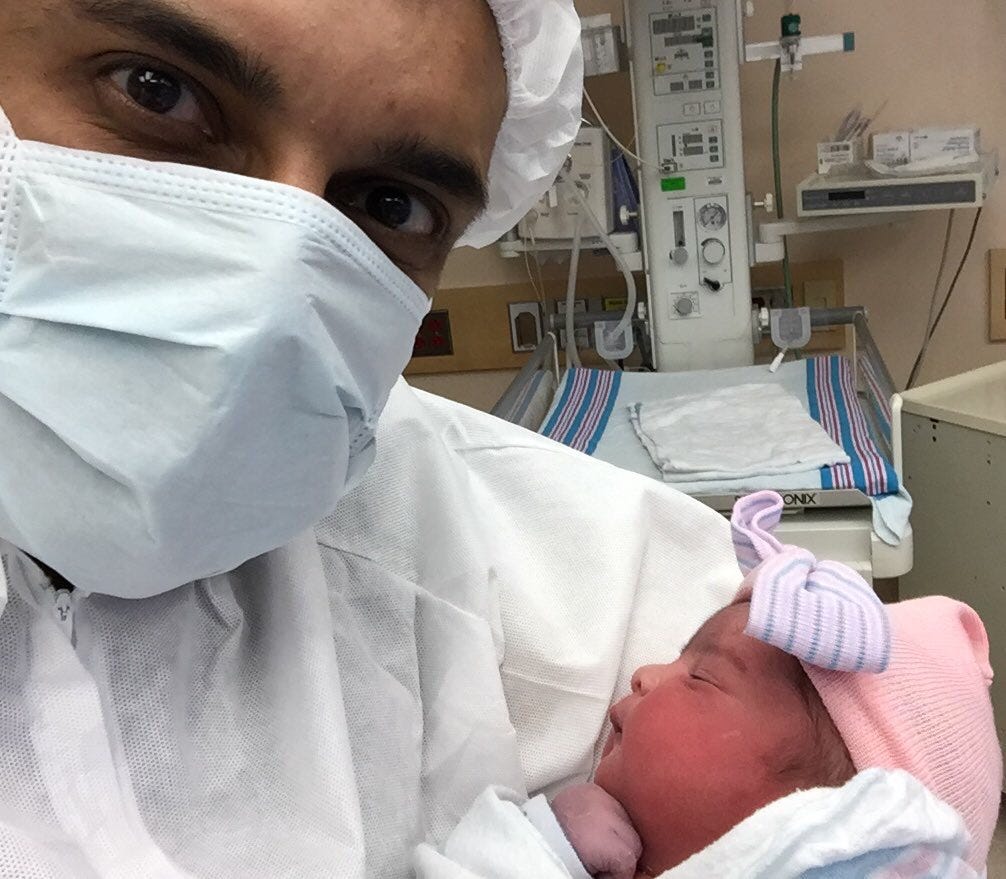
Hannah Noor (Pictured Right) at 5 hours old.

A Scream in the Dark

It was just after her sixth birthday in 2021 when our daughter screamed from her bed in the middle of the night. We rushed to her room to find she had thrown up all over her bed. We cleaned her up, changed her sheets, and blamed the incident on the Oreos she’d eaten after dinner. The next day she complained of a stomach ache and rushed to the bathroom, experiencing diarrhea. Like most parents, we dismissed it as a passing bug—kids get diarrhea now and then. But something felt different this time, even though it was her first experience.

When it happened again just a short time later, the stomach pain was more severe. She screamed, cried, and rushed to the bathroom, but this time there was blood—so much blood. It terrified us. Before we could even make it to urgent care, she had another episode with even more bleeding. We hurried her in, only to be told by the nurse practitioner to “keep her hydrated” and that it was probably a stomach virus. But again, something in our gut told us otherwise.

This was just before Thanksgiving 2021, and I convinced myself she’d recover over the break and be able to return to school. She loved school, as most kindergarteners do. But the bleeding continued. The pain worsened. More urgent care and pediatrician visits followed, but answers did not. By now, our once energetic and chatty daughter was pale, frightened, and visibly losing weight.

Navigating Through the Dark

We reached out to a close friend who happened to be a pediatric gastroenterologist. His questions and careful listening indicated it was not a simple virus, but he didn’t say much directly. He urged us to connect with the GI team at Children’s National Hospital in Washington D.C. Unfortunately, we were met with insurance hurdles and skepticism from her pediatrician. Weeks passed, and her condition deteriorated until, thanks to our friend’s intervention, we finally secured an appointment with a pediatric GI doctor in December.

Hannah Noor, now frail and scared, was put on iron supplements, and an colonoscopy was scheduled for January. She now weighed just 30 pounds—skin and bones, and we feared the worst. Her fear of eating, going to the bathroom, or even moving too much consumed her days. Our winter break became a period of sleepless nights, endless tears, and prayers. We felt like prisoners trying to navigate through treacherous terrain while blindfolded and shackled.

The preparation for the scope was grueling—a 24-hour liquid diet. To make matters worse, a severe snowstorm in early January 2022 left us without power for three days. Despite the chaos, we made it to the hospital. As I held her tiny hand, she bravely went under anesthesia. Hours later, the doctors confirmed what we feared: Hannah had ulcers all over her colon.

Inflammatory Bowel Disease (IBD) was the diagnosis—a chronic, lifelong condition that would require extensive management. Even as the doctor explained, I couldn’t fully grasp the gravity of it. I naively asked, “How long will she need the medication?” The doctor replied—“Do you understand what it means to have IBD? This is for life.”

It shattered me. My world crumbled.

Steroids, with their array of side effects, initially helped stabilize her condition, and she was subsequently started on mesalamine. However, managing IBD is never straightforward. Moving homes and finding a new doctor compatible with our insurance became an uphill battle. Procuring mesalamine was a nightmare, as our insurance kept on requiring prior-authorization—a term we’d never even heard before. Evidently, even though our doctor had prescribed a specific medication to save our daughter’s life, the insurance company required their non-medically trained admins to agree that our board certified physician knew what she was doing in prescribing the medication she prescribed. Spoiler: They disagreed and repeatedly denied the critical medication our daughter needed.

Making matters worse, moving meant we were in between doctors. Desperate to try anything to improve Hannah’s quality of life, we spent hours consulting with a nutritionist to see if dietary changes could make a difference. We invested extensive time and resources into a gluten-free diet, but it did not help at all; in fact, it made her averse to eating. We also tried the FODMAP diet, which was recommended during a flare, but it added to the confusion of what she should or shouldn’t eat. Every day became a battle over something as simple as food—one filled with uncertainty and frustration. Despite our efforts, Hannah’s condition remained unpredictable, with debilitating flares continuing to disrupt her life. By late 2023, we had pursued every imaginable route to find a way to protect our daughter’s health and life, and yet felt exhausted and at a dead end. 

It was clear that only one option remained—she needed a quickly advancing form of therapy known as biological treatment. This would be a direct IV infusion of medication to stabilize the IBD, every six to eight weeks, forever. 

A Dark Dead End

We were at the end of the road. If we couldn’t access biologic treatment, there was nowhere left to go. But what we hoped would finally bring us closure and healing, resulted in yet another emotional roller coaster and painful circus—our insurance corporation blocked us. Turns out, insurance corporations block more than 51% of patients whose doctors prescribe them biologic treatment to save their lives.

The recommended biologic promised not a cure, but a chance at living a healthy life. Our insurance rejected us outright reasoning that we hadn’t tried other medications first—a policy called “step therapy.” Despite our daughter’s life threatening condition, they wanted us to try every other variation of every other possible medication—knowing full well they would likely fail just as much and make our daughter suffer, vomit, bleed, and lose weight. But that did not matter to them, because that was the preferable path to ensure they “maximized shareholder value.” 

Our doctor stepped in and conducted a peer-to-peer direct meeting with the insurance company to show all the data, blood tests, and medical reports to prove that our daughter needed biologics to live. To show without a shadow of a doubt that the yet untried medications they demanded we try were not substantively different than the plethora of medications we had tried and had not worked. Yet, that meeting also went in vain. The insurance company still refused to approve our claim. And Hannah Noor’s condition worsened. She was pale, swollen from steroids, in pain, losing weight, and back to missing school.

We finally contemplated paying for the biologic treatment out of pocket. We knew it would only require six doses a year. How much could one dose be, after all? We checked and our hearts sank once more. Each dosage cost and administration would run into the tens of thousands of dollars. A year’s supply to keep our daughter alive would run into the hundreds of thousands. We certainly did not have that kind of money. We were cornered and desperate.

We contemplated what any parents might. Do we sell the house and cars and move into a small apartment? Do we set up a GoFundMe? Do we borrow money from family and friends? Do we take out a second mortgage?

Do we file for medical bankruptcy, as 500,000 Americans do annually? 

But we soon learned another sinister result of hyper-privatization of health insurance—even if we had the excessive means to pay the hundreds of thousands of dollars out of pocket, the hospital would not accept the funds. Why? The industry is such that not only do insurance companies deny 51% of claims, they have enacted policies forbidding people from paying for the critical medication they need out of pocket, lest the insurance company lose control and revenue. “Either you pay us, or you pay no one,” is a line you’d expect out of a mafia handbook—not out of a health provider. This is not health insurance, this is health exploitation.

A Spark of Light in the Darkness

In that moment of confusion we happened to run into to a fellow parent who, now is a great friend, and learned her children shared a similar medical struggle. She suggested calling the biologic manufacturers directly and applying for their patient assistance program. An idea that seems so obvious now, but something we did not even know was a possibility then.

The application process was tedious, and even then, it was initially rejected. But after weeks of back-and-forth, countless phone calls, and sleepless nights, a miracle happened—we finally secured approval. We let out a cathartic sigh of relief after more than two years of suffocation. And to be sure, the approval was not through our insurance company, who never even bothered to offer such an option, likely because it would cost them money. Rather, the approval was from the drug manufacturer directly. To this day our health insurance company has refused to budge on their cruel and calloused “maximizing shareholder value” decision to deny our daughter the medicine she needs to live.

On March 6, 2024—more than two months after the doctor first prescribed it, a period in which our daughter suffered horrific and unimaginable pain, bleeding, and vomiting—Hannah Noor received her first infusion at Comer Children’s Hospital in Chicago. And since then, everything has changed. Her spark of light returned. Our daughter was back. 

The Light We Create

A process that should have only taken 30-60 days from the night we heard that scream in the dark, took us on a 28 month torturous journey to finally see light again. Hannah Noor’s journey since starting biologic treatment has been a blessing. She’s eating, playing, drawing, and even learning karate (currently a Yellow Belt). The last three years of her life had been a torture for her, but now she is finally thriving as any 9-year-old girl should. Though the fear of flares always looms, we refuse to let it dictate our lives. Herbal and homeopathic treatments complement her medical regimen, and her strength inspires us daily.

As for our insurance company? Those corporate leeches also denied covering the hospital costs as well. Fortunately, despite that high price tag still running into the thousands, we tightened our belts and found a way to pay for that out of pocket, and continue to pay for that out of pocket. (We were shocked there wasn’t some additional insurance rule preventing us from paying our hospital directly). Despite us paying our insurance premiums every single month without exception, our insurance company has not covered a single penny of our daughter’s critical healthcare needs. The care she needs to live. But at least they’re maximizing shareholder value.

This story isn’t just about one child’s struggle with IBD; it’s about the systemic barriers hundreds of millions of families face every single day. From insurance denials to inaccessible care, to step therapy nonsense, to prior authorization red tape, the system fails the most vulnerable. What if we didn’t speak English? What if we couldn’t afford out-of-pocket costs for tests and treatments? What if one of our close friends didn’t just happen to be a national expert on this particular rare disease, and couldn’t leverage his relationships to get us access to a world leading expert? What if we didn’t have a network of supportive friends to recommend new ways to acquire this life saving medicine? 

A Brighter Future Is Possible

We named our daughter Hannah Noor because Hannah was the mother of Mary Mother of Jesus, and Noor means light. We couldn’t think of a more beautiful name for our only daughter, and she has lived up to it every day of her life. 

In these darkest of times, she is the Light of our eyes.

Hannah Noor (now 9) at a recent family vacation in Lahore, Pakistan. Here she is giggling at a cat that wandered over to say meow, which Hannah Noor reminded us means “hello” in cat language.

Hannah Noor’s story highlights a flawed and cruel system that places profits over people. Yet it also underscores the power of advocacy, persistence, and community. To every parent navigating the complexities of chronic illness: stay strong, fight relentlessly for your child, and lean on the resources available, like the Crohn’s and Colitis Foundation, and do not underestimate support groups on Facebook. If I can be of any support, do not hesitate to reach out at ayesha [dot] noor @ gmail.com.

Hannah Noor is living proof that even in the darkest moments, there is hope. She teaches us daily to believe in miracles—and to fight for them when necessary. It is also a reminder that our for profit exploitative health insurance system will always only serve the wealthy elites, the stock market, and whatever private investor who decides to buy and sell these corporations. They will not serve the people. Not our beautiful baby girl, nor the nearly 70,000 Americans who die annually due to lack of care, nor the 500,000 Americans who are forced to file for medical bankruptcy every single year. It is by the sheer grace of the Almighty that we still have our wonderful Light with us today. But for so many parents and families, the end result is not so fortunate.

Perhaps the most frustrating part about all of this is that the medication to save our child’s life existed all along. But because some calloused business person decided her life wasn’t profitable enough and worth saving, it was an acceptable cost to reject her claim and let her die.

It is our responsibility to demand better, not just for our daughter, but for all the daughters, sons, and children out there. We do not suffer from a lack of resources, but from an excess of greed. We can ensure high quality, accessible, and affordable healthcare for all people in this country—but we cannot ensure the satiation of greed for the billionaire corporations, corrupt politicians, and elitists who care more about shareholder value than the survival of innocent children. We have to choose one side. And we choose the children of this great country—we hope you do too.

Heather Cox Richardson ably sums up the Republicans’ irresponsibility yesterday, as they tried to rewrite the events of January 6 and cowered at the feet of Elon Musk.

Loudermilk was himself involved in the story of that day after video turned up of him giving a tour of the Capitol on January 5 despite its being closed because of Covid. During his tour, participants took photos of things that are not usually of interest to visitors: stairwells, for example. Since then, he has been eager to turn the tables against those investigating the events of January 6.

Yesterday, Representative Barry Loudermilk (R-GA) released an “Interim Report on the Failures and Politicization of the January 6th Select Committee.” As the title suggests, the report seeks to rewrite what happened on January 6, 2021, when rioters encouraged by former president Donald Trump attacked the U.S. Capitol. Loudermilk chairs a subcommittee on oversight that sits within the Committee on House Administration. The larger committee—House Administration—oversees the daily operations of the House of Representatives, including the Capitol Police. Under that charge, former House speaker Kevin McCarthy permitted MAGA Republicans to investigate security failures at the Capitol on January 6.

Loudermilk turned the committee’s investigation of security failures into an attack on the House Select Committee to Investigate the January 6th Attack on the U.S. Capitol, more commonly known as the January 6th Committee. Yesterday’s report singled out former representative Liz Cheney (R-WY), who has taken a strong stand against Trump’s fitness for office after his behavior that day, as the primary villain of the select committee. In his press release concerning the interim report, Loudermilk said that Cheney “should be investigated for potential criminal witness tampering,” and the report itself claimed that “numerous federal laws were likely broken by Liz Cheney” and that the FBI should investigate that alleged criminality.

The report seeks to exonerate Trump and those who participated in the events of January 6 while demonizing those who are standing against him, rewriting the reality of what happened on January 6 with a version that portrays Trump as a persecuted victim.

Trump’s team picked up the story and turned it even darker. At 2:11 this morning, Trump’s social media account posted: “Liz Cheney could be in a lot of trouble based on the evidence obtained by the subcommittee, which states that ‘numerous federal laws were likely broken by Liz Cheney, and these violations should be investigated by the FBI.’ Thank you to Congressman Barry Loudermilk on a job well done.”

To this, conservative writer David Frum responded: “After his successful consolidation of power, the Leader prepares show trials for those who resisted his failed first [violent attempt to overthrow the government].”

Liz Cheney also responded. “January 6th showed Donald Trump for who [he] really is—a cruel and vindictive man who allowed violent attacks to continue against our Capitol and law enforcement officers while he watched television and refused for hours to instruct his supporters to stand down and leave.” She pointed out that the January 6th committee’s report was based on evidence that came primarily from Republican witnesses, “including many of the most senior officials from Trump’s own White House, campaign and Administration,” and that the Department of Justice reached the similar conclusions after its own investigation.

Loudermilk’s report “intentionally disregards the truth and the Select Committee’s tremendous weight of evidence, and instead fabricates lies and defamatory allegations in an attempt to cover up what Donald Trump did,” Cheney wrote. “Their allegations do not reflect a review of the actual evidence, and are a malicious and cowardly assault on the truth. No reputable lawyer, legislator or judge would take this seriously.”

CNN aired clips today of Republican lawmakers blaming Trump for the events of January 6.

Last night, Trump also filed a civil lawsuit against pollster J. Ann Selzer, her polling company, the Des Moines Register, and its parent company Gannett over Selzer’s November 2 poll showing Harris in the lead for the election. Calling it “brazen election interference,” the suit alleges that the poll violated the Iowa Consumer Fraud Act. Robert Corn-Revere, chief counsel for the Foundation for Individual Rights and Expression, told Brian Stelter, Katelyn Polantz, Hadas Gold, and Paula Reid of CNN: “This absurd lawsuit is a direct assault on the First Amendment. Newspapers and polling firms are not engaged in ‘deceptive practices’ just because they publish stories and poll results President-elect Donald Trump doesn’t like. Getting a poll wrong is not election interference or fraud.”

Conservative former representative Joe Walsh (R-IL) wrote: “Trump is suing a pollster and calling for an investigation of [Liz Cheney]. Don’t you dare tell me he’s not an authoritarian. And don’t you dare look the other way. Donald Trump is un-American. The resistance to him from Americans must be steadfast & fierce.”

This afternoon, Trump’s authoritarian aspirations smashed against reality.

The determination of the MAGA extremists in the House to put poison pills in appropriations measures over the past year meant that the Republicans have been unable to pass the necessary appropriations bills for 2024 (not a typo), forcing the government to operate with continuing resolutions. On September 25, Congress passed a continuing resolution that would fund the government through December 20, this Friday. Without funding, the government will begin to shut down…right before the holidays.

At the same time, a farm bill, which Congress usually passes every five years and which outlines the country’s agriculture and food policies including supplemental nutrition (formerly known as food stamps), expired in 2023 and has been continued through temporary extensions.

Last night, news broke that congressional leaders had struck a bipartisan deal to keep the government from shutting down. The proposed 1,500-page measure extended the farm bill for a year and provided about $100 billion in disaster relief as well as about $10 billion in assistance for farmers. It also raised congressional salaries and kicked the government funding deadline through March 14. It seemed like a last-minute reprieve from a holiday government shutdown.

But MAGA Republicans immediately opposed the measure. “It’s a total dumpster fire. I think it’s garbage,” said Representative Eric Burlison (R-MO). They are talking publicly about ditching Johnson and voting for someone else for House speaker.

Trump’s sidekick Elon Musk also opposed the bill. Chad Pergram of the Fox News Channel reported that House speaker Mike Johnson explained on the Fox News Channel that he is on a text chain with Musk and Vivek Ramaswamy, both of whom are unelected appointees to Trump’s proposed “Department of Government Efficiency” charged with cutting the U.S. budget.

Johnson said he explained to Musk that the measure would need Democratic votes to pass, and then they could bring Trump in roaring back with the America First agenda. Apparently, Musk was unconvinced: shortly after noon, he posted, “Any member of the House or Senate who votes for this outrageous spending bill deserves to be voted out in 2 years!” Later, he added: “No bills should be passed Congress [sic] until Jan 20, when [Trump] takes office.”

This blueprint would shut down the United States government for a month, but Musk—who, again, does not answer to any constituents—seems untroubled. ″‘Shutting down’ the government (which doesn’t actually shut down critical functions btw) is infinitely better than passing a horrible bill,” he tweeted.

Pergram reported that Musk’s threats sent Republicans scrambling, and Musk tweeted: “Your elected representatives have heard you and now the terrible bill is dead. The voice of the people has triumphed! VOX POPULI VOX DEI.”

But Trump and Vice President–elect J.D. Vance seem to recognize that shutting down the government before the holidays is likely to be unpopular. They issued their own statement against the measure, calling instead for “a streamlined bill that doesn’t give Chuck Schumer and the Democrats everything they want.”

Then Trump and Vance went on to bring up something not currently on the table: the debt ceiling. The debt ceiling is a holdover from World War I, when Congress stopped trying to micromanage the Treasury and instead simply gave it a ceiling for borrowing money. In the last decades, Congress has appropriated more money than the country brings in, thus banging up against the debt ceiling. If it is not raised, the United States will default on its debt, and so Congress routinely raises the ceiling…as long as a Republican president is in office. If a Democrat is in office, Republicans fight bitterly against what they say is profligate spending.

The debt ceiling is not currently an issue, but Trump and Vance made it central to their statement, perhaps hoping people would confuse the appropriations bill with the debt ceiling. ”Increasing the debt ceiling is not great but we’d rather do it on Biden’s watch. If Democrats won’t cooperate on the debt ceiling now”—again, it is the Republicans who threaten to force the country into default—“what makes anyone think they would do it in June during our administration. Let’s have this debate now.”

Senator Chris Murphy (D-CT) explained: “Remember what this is all about: Trump wants Democrats to agree to raise the debt ceiling so he can pass his massive corporate and billionaire tax cut without a problem. Shorter version: tax cut for billionaires or the government shuts down for Christmas.”

President and Dr. Biden are in Delaware today, honoring the memory of Biden’s first wife, Neilia, and his one-year-old daughter Naomi, who were killed in a car accident 52 years ago today, but White House press secretary Karine Jean-Pierre issued a statement saying:

“Republicans need to stop playing politics with this bipartisan agreement or they will hurt hardworking Americans and create instability across the country. President-elect Trump and Vice President–elect Vance ordered Republicans to shut down the government and they are threatening to do just that—while undermining communities recovering from disasters, farmers and ranchers, and community health centers. Triggering a damaging government shutdown would hurt families who are gathering to meet with their loved ones and endanger the basic services Americans from veterans to Social Security recipients rely on. A deal is a deal. Republicans should keep their word.”

Josh Marshall of Talking Points Memo pointed out the relationship between Trump’s authoritarianism and today’s chaos on Capitol Hill. Trump elevated Musk to the center of power, Marshall observes, and now is following in his wake. Musk, Marshall writes, “is erratic, volatile, impulsive, mercurial,” and he “introduces a huge source of unpredictability and chaos into the presidency that for once Trump doesn’t control.”

Ron Filipkowski of MeidasNews captured the day’s jockeying among Trump’s budding authoritarians and warring Republican factions over whether elected officials should fund the United States government. He posted: “The owner of a car company is controlling the House of Representatives from a social media app.”

Richardson refers to Musk as “Trump’s sidekick.” It might be more accurate to refer to Trump as “Musk’s sidekick.” Musk is setting the agenda, Trump is obeying. The only other time in our history when a President ceded his authority was when Woodrow Wilson had a massive stroke and his wife filled in.

Carol Burris, executive director of the Betwork for Public Education, describes the devastating advance of privatization in West Virginia. In 2019, the teachers of West Virginia banded together and went on strike, closing down every school in the state.

Burris writes:

West Virginia is closing its public schools. Seven schools will close in the next few years due to declining enrollment. These schools will join the 53 that closed in the past five years, and there are an additional 25 that counties have proposed or approved to close.

These numbers are not small in the context of West Virginia. The National Center for Education Statistics reported only 643 public schools with enrollment in the state in 2023-2024.

West Virginia’s population and student enrollment were in decline. In 2015, there were 277,452 students in West Virginia public schools. By 2020, enrollment was down to 253,930. In 2021, however, the drop seemed to level off—the public schools lost only 1,100 students the next year.

And then school privatization began.

In 2019, the legislature passed a charter law. It was cautious. Three charter schools were allowed to open as pilot schools under the control of districts, but none opened.

And then greed kicked in. The for-profit operators wanted to open schools in the state. In 2021, the legislature expanded the number of charters to ten a year, not including online schools, which they then approved. The authority to approve them was given to a politically appointed state board.

Six charter schools were rapidly approved, five of which are open.

Three of those five are run by for-profit corporations. In 2023-2024, those three for-profit-run charters enrolled 87% of the charter school students in the state. 

Charter schools in West Virginia operate on the “money follows the child” system, depleting school district budgets. That money accounts for a whopping 99% of state per-pupil funding, even though most charter students (70%) attend low-cost, low-quality online schools run by for-profits.

To add insult to injury to the state’s public schools, the U.S. Department of Education, under Secretary Cardona, awarded $12.2 million to the state’s charter board to open new charter schools or expand existing ones in West Virginia.

Over $905,000 was given to open a “classical” academy run by the notorious for-profit ACCEL. ACCEL already operates two of the state’s five charter schools. The new school will be operated on a sweeps contract, violating 2022 CSP regulations. Three of the existing five charter schools would be given funds to expand.

I registered a complaint with the U.S. Department of Education regarding West Virginia’s violation of its own regulations. I have not received a response. 

If that were not enough, this fall, the West Virginia legislature passed a law allowing charter schools to access the state building fund—giving them their own privileged funding stream.

In 2022, the same year that the law to expand charter schools was enacted, the state passed a voucher law called the Hope Scholarship, heralded by Ed Choice as one of the most expansive voucher laws in the country. That law gives vouchers to fund homeschooling, private schooling, tutoring, and “enrichment” activities for students who do not attend a public or charter school.

The scholarship is worth 100% of the average per-pupil state funding. There are no income limits. Beginning in 2026, any student, including a private school student or home-schooled student who has never attended public school, can apply.

In 2023-2024, West Virginians used a voucher. In 2024-2025, the number jumped to 10,000.

Let’s do the math.

During the 2021-2022 school year, there were 252,830 students in public schools. That was the year before charters and the voucher law. In 2023-2024, that number dropped to 243,560. 

Just when West Virginia enrollment had begun to stabilize, 2,277 students were siphoned off along with funding to charter schools, and 6,000 students received vouchers. In West Virginia, privatization through charter schools and vouchers is now the primary source of public school enrollment and funding decline.

As charter schools continue to expand, thanks in part to the federal Charter School Program, and vouchers become accessible to 100% of students in the state, school closings will accelerate. 

For the right-wing Libertarians who run education policy for the Republican Party, this is not a bug; this is the main feature. 

David Pepper blasts the Republican legislators in Ohio for relieving private voucher schools of any burdens associated with transparency and accountability, while simultaneously threatening to close the public schools with the lowest test scores every year.

He writes about the dangerous shenanigans of the gang in the Legislature that hates public schools:

So the bill that impressed me was an attempt to do something about this growing black hole. 

Specifically, the bill would have:

2) required that private schools receiving vouchers administer the same standardized tests that public school students take, allowing an apples to apples comparison of the private school’s performance;

1) required that private schools receiving vouchers provide an annual report on how they are spending the public dollars they receive (and post that report on-line);

3) required that schools provide data on the income of students/families that receive vouchers along with other scholarships. (In states like Ohio, where they have removed all income limitations on vouchers recipients, the vast majority of voucher recipients were already attending, and could already afford, the private school they now use the voucher to pay for).

Again, these would be the bare minimum of safeguards for this out-of-control approach.

Which is, of course, exactly why the provisions were ultimately stripped out of the bill that ultimately passed the House Education Committee (where the original bill had been submitted).

Note: One of the points made by private school advocates was that the tests used to measure public school outcomes were not a good measure of the work they did.

So as the billions flow to private schools through vouchers, we taxpayers still don’t know how the funds are actually being spent. And we still don’t have an apples-to-apples comparison to see if all this unaccountable money is actually leading to improved or worse education results. (Other data show the answer is “worse”).

But for Public Schools…Shut them Down

So that’s the treatment of private schools receiving public dollars via vouchers. 

But wouldn’t you know it? For Ohio’s publicschools, constantly the target of attack and criticism, we see the exact opposite approach.

Rushing through the current “lame duck” Ohio legislative session is a brand new bill that takes seriously the same standardized tests the voucher-funded private schools convinced lawmakers they need not take (remember, they testified it’s not a good measure of their work). So seriously, the new bill proposes that all Ohio public school buildings that fall in the bottom five and 10 percent of two measures (both determined by standardized tests) for three years be shut down

Under the bill, local school boards would be forced either “to fire its principal and majority of staff or turn over operations to a private entity, charter, or another district.”

Public school advocates have pointed out many of the flaws of this approach, including that many of the entities that would “take over” these schools have no experience providing K-12 education at all. They’ve also pointed out that this approach bears similarities to the failed top-down approach from a 2015 bill which created Academic Distress Commissions for struggling districts. After stripping away local control, the Commissions did not generate improvements, and the approach was ultimately repealed.

But bigger picture, of course, is the differential treatment of the two systems: One type of publicly funded Ohio schools doesn’t have to provide even the bare minimum of accountability and transparency, while the other set would face turmoil and even shutdowns for failing to meet certain criteria not applied to the first group. 

It’s yet another blatant tipping of the scales towards privatizing public education.

Take Action

They are trying to rush this bill through the Ohio Senate’s Education Committee tomorrow. Here are steps you can take to stop it:

  • Contact your State Rep. Tell them the Ohio Senate is trying to pass a massive new school closure bill (SB 295) without any input from the House. Ask them, “Shouldn’t the House get a say on this issue??”
  • WHAT TO SAY:
    • SB 295 would remove local control from elected school board members and parents
    • The state should not be making big, closed-door decisions with little to no community involvement.
    • Our students deserve safe, equitable, fully-resourced, engaging schools in their own area! In most cases, closing local schools is bad for our communities and bad for Ohio. In ALL cases, parents and students should be heavily involved in the decision-making processes!
  • FOR MORE INFORMATION:

Kristy Greenberg is a veteran prosecutor in the U. S. Attorney’s office in New York. She is the former deputy chief of the criminal division of the Southern District of New York. She is currently a legal analyst for MSNBC.

She explains why President Biden was right to pardon his son Hunter. I agree with her. Can you imagine how the Trump administration would have demeaned and humiliated Hunter Biden once they got their clutches on him? With Trump zealots in charge of the Justice Department and the FBI, Hunter would not stand a chance. Already, Republicans in Congress are saying they are not finished with Hunter, despite the pardon. House Republicans have a blood lust going for Hunter.

Greenberg writes:

Critics have argued that President Joe Biden’s pardon of his son Hunter was political nepotism—bad for the country, selfish, the height of privilege. But the actual story is the very opposite of nepotism: Hunter Biden was treated worse than an ordinary citizen because of his family connections. It’s good for the country when the president acts against injustice; President Biden rightly condemned the injustice of his son’s prosecution. His pardon was necessary to prevent Donald Trump’s Justice Department from targeting Hunter for years to come.

I worked as a federal criminal prosecutor for the U.S. Attorney’s Office for the Southern District of New York for 12 years, during which time I supervised and prosecuted many gun and tax cases. President Biden argues that the gun and tax charges Hunter was convicted of should never have been brought. I agree. When I served as deputy chief for the Southern District of New York’s Criminal Division, my job was to approve charging and non-prosecution decisions on gun and tax cases. I would not have approved the felony gun and tax charges brought against Hunter Biden; such charges are rarely—if ever—brought in similar circumstances.

Prosecutors charged Hunter with lying about his drug addiction when he purchased a firearm, and with possessing that firearm while he was a drug addict. They were wrong to do so. As a first-time offender with no criminal record or history of violent behavior who possessed a gun for only 11 days and didn’t use it, he did not pose a public-safety risk to warrant federal gun charges. The public interest is served by treating addiction, not weaponizing it. In a gross display of addiction-shaming, prosecutors used Hunter’s own words from his memoir about overcoming drug addiction against him at trial. They forced his former romantic partners to testify and dredge up details of his addiction. The prosecution’s trial presentation was cruel and humiliating.

Nor should prosecutors have charged Hunter with failing to pay $1.4 million in taxes during the period when he suffered from drug addiction. The IRS’s primary goal—to recover unpaid taxes—was satisfied when Hunter fully repaid the taxes he owed with interest and penalty. Felony tax charges are unwarranted here given that the tax amount is not exorbitant, his nonpayment occurred while he was using illegal drugs, and he fully repaid his taxes. A civil resolution or tax-misdemeanor charges would have been appropriate.

Notably, there had been a fair non-felony plea deal between Trump-appointed Delaware U.S. Attorney David Weiss and Hunter, but congressional Republicans worked to crush it. They opened an investigation into the DOJ’s plea negotiations, held hearings with testimony from IRS case agents and prosecutors, and attempted to intervene in the case before the plea. Amid intense political pressure from Republicans, Weiss killed the deal, requested and obtained special-counsel status, and charged Hunter with gun and tax felonies. As President Biden stated in announcing Hunter’s pardon, a number of his opponents in Congress took credit for bringing political pressure on the process. President Biden is correct that Hunter was treated differently; most criminal defendants do not have members of Congress interfering in their cases to lobby for harsher treatment. That is not how our criminal-justice system is supposed to work.

If there were reason to believe that Hunter had committed any of the more serious crimes that reportedly were under investigation—bribery, money laundering, or illegal foreign lobbying, I would be far less sympathetic to the president’s pardon. But Hunter was never charged with these more serious offenses. Weiss investigated Hunter for six years; that’s an unusually long time for a criminal investigation focused on one individual. If after six years Weiss still does not have a real case against Hunter, then it doesn’t exist. (Complicating matters is the fact that this past February, Weiss charged Alexander Smirnov—a former FBI informant and the GOP’s star witness against Hunter—for falsely accusing President Biden and Hunter of receiving bribes from Ukrainian businessmen.)

The absence of a credible case against Hunter does not mean that a Trump DOJ wouldn’t bring bogus charges against him. During his campaign, Trump vowed that, if elected, he would appoint a special prosecutor to “go after” “the Biden crime family.” In nominating Pam Bondi for attorney general and Kash Patel for FBI director, Trump has further signaled how serious he is about using the DOJ as an instrument of personal revenge. At the 2020 Republican convention, Bondi argued that President Biden and his son were corrupt. Recently, Patel proposed using the law “criminally or civilly” against Trump’s political rivals. When he announced the pardon, President Biden stated, “In trying to break Hunter, they’ve tried to break me—and there’s no reason to believe it will stop here. Enough is enough.” He’s right.

Now is not the time to cling to norms that Trump is poised to shatter. Political prosecutions are coming, and I fear that our democratic institutions will not withstand them.

That’s why President Biden’s pardon should not be his last. President Biden should use his pardon power to protect others from political prosecution just as he used it to protect his son. He should condemn Trump’s plan for political prosecutions. He should pardon Trump’s political enemies preemptively to stymie the Trump DOJ’s politically motivated investigations. In particular, public servants who have drawn Trump’s ire for doing their job should not have to spend precious time and money defending themselves against Trump’s lies. Nor should they have to endure the reputational hit, the safety risk, or the emotional toll of political prosecutions. President Biden alone has the power to stop other needless political prosecutions before they begin. He should use it.

Margaret Sullivan, the last public ombudsman for The New York Times, wrote on her blog that ABC News was wrong to settle with Trump for $15 million for “defaming” him. On television, ABC’s George Stefanopolous said that Trump had been found liable for raping E. Jean Carroll. Trump said that was wrong and malicious because he had been found guilty of “sexual assault,” not rape.

She points out that when she was chief editor of The Buffalo News, the paper had a longstanding policy of fighting every claim of defamation or libel. They did so to discourage future lawsuits and send a message: we will vigorously oppose lawsuits. If you sue, prepare for a long battle.

Trump’s lawyers claimed that Stephanopoulos was wrong to say that Trump was found guilty of rape and that he had defamed Trump. ABC settled before trial and agreed to pay $15 million for the future Trump Presidential Library and $1 million for Trump’s legal fees.

Media experts were stunned. Not only did ABC abandon its First Amendment defense, but it abandoned a viable claim that Stephanopooulos was right to use the language he did.

Judge Lewis Kaplan, who presided over the Carroll defamation case, said:

“The finding Ms. Carroll failed to prove she was ‘raped’ within the meaning of the N.Y. Penal Law does not mean she failed to prove Mr. Trump ‘raped’ her as many people commonly understand the word ‘rape’. Indeed, as the evidence at trial… makes clear, the jury found Mr. Trump in fact did exactly that.”

By settling–and at such a hefty price–ABC has encouraged Trump and other politicians to continue to sue journalists and their employers.

Sullivan believes ABC might well have won if they continued to fight:

ABC News should never have caved. They might well have prevailed if they had hung in there. The legal bar is very high for libeling a public figure, and Trump is the ultimate public figure. Instead, this outcome encourages Trump in his attacks on the press — and he needs no encouragement. 

As one law professor told the Times, what ABC News did was very unusual. News organizations generally don’t settle “because they fear the dangerous pattern of doing so and because they have the full weight of the First Amendment on their side.”

Why did ABC News throw in the towel? It‘s hard to know for sure, but gets easier if you are aware that the news organizations is owned by Disney, a huge corporation with a lot of turf to protect. As the Times reported, the Disney executive who oversees ABC News had dinner with Trump’s top aide, Susan Wiles, just days before the settlement, as “part of a visit by several ABC News executives to Florida to meet with Mr. Trump’s transition team.”

Was this settlement, which includes ABC’s public expressions of regret, a simple case of kissing the ring? It sure looks that way. Trump has sworn to get revenge on his enemies and he values, above all, loyalty and kowtowing. 

But loyalty and kowtowing isn’t the job of the press, which is supposed to represent the public in holding powerful people and institutions accountable.

After his victory, Trump threatened to sue the Des Moines Register for posting a poll before the election that showed Biden beating him in Iowa. He also threatened to sue Bob Woodward, “60 minutes,” and the Pulitzer Prizes. This is the mischief that ABC News unleashed.

Last night Trump’s lawyers sued the Des Moines Register for publishing Ann Seltzer’s poll. The implications are frightening. The media publishes polls frequently during campaigns. They may be right, they may be wrong. If they are wrong, will candidates sue them for “election interference”? How did Trump suffer any damages by publication of that poll? He won Iowa by 13 points.

Win or lose, Trump has a strategy: to strike fear in the hearts of every journalist who dares to write critically about him.

Be sure to read Jeff Tiedrich’s condemnation of ABC’s capitulation. He attributes the deal to Disney’s overriding principle: “Protect the mouse.”

Jan Resseger lives in Ohio. Before retiring, Jan staffed advocacy and programming to support public education justice in the national setting of the United Church of Christ—working to improve the public schools that serve 50 million of our children; reduce standardized testing; ensure attention to vast opportunity gaps; advocate for schools that welcome all children; and speak for the public role of public education.  Jan chaired the National Council of Churches Committee on Public Education for a dozen of those years.

Jan recently wrote this post for the National Center on Education Policy at the University of Colorado.

She writes:

I suppose many of us think about the classes we wish we had signed up for in college.  Right now, as somebody who believes public schools are among our nation’s most important and most threatened public institutions, I wish that in addition to enrolling in The Philosophy of Education, I had also taken a class in political philosophy—or at least Political Science 101. How have groups like the Heritage Foundation, the Lynde and Harry Bradley Foundation, Betsy DeVos’s American Federation of Children and their proxies like Moms for Liberty managed to discredit public schooling and at the same time spawn an explosion of vouchers, which, according to the editors of last year’s excellent analysis, The School Voucher Illusion: Exposing the Pretense of Equity, are failing to serve our society’s poorest children even as they are destroying the institution of public schooling?

Here are that book’s conclusions: “As currently structured, voucher policies in the United States are unlikely to help the students they claim to support. Instead, these policies have often served as a facade for the far less popular reality of funding relatively advantaged (and largely White) families, many of whom already attended—or would attend—private schools without subsidies. Although vouchers are presented as helping parents choose schools, often the arrangements permit the private schools to do the choosing… Advocacy that began with a focus on equity must not become a justification for increasing inequity. Today’s voucher policies have, by design, created growing financial commitments of taxpayer money to serve a constituency of the relatively advantaged that is redefining their subsidies as rights—often in jurisdictions where neighborhood public schools do not have the resources they need.” (The School Voucher Illusion: Exposing the Pretense of Equity, p. 290)

As I watch the wave of school privatization washing across conservative states and read about universal school choice as one of the priorities of presidential candidate Donald Trump as well as a goal of the Heritage Foundation’s Project 2025, I find myself wishing I had a better grasp of how our society has gone off the rails.  I wonder what I would have learned about the difference between democracy and extreme individualism in that political theory class I missed, and I find myself trying to catch up by reading—for example—on the difference between a society defined by individualist consumerism and a society defined by citizenship.

Back in 1984, the late political theorist Benjamin Barber published Strong Democracy, a book defining the principles our federal and state constitutions and laws are presumed to protect:  “Strong democracy … rests on the idea of a self-governing community of citizens who are united less by homogeneous interests than by civic education and who are made capable of common purpose and mutual action by virtue of their civic attitudes and participatory institutions rather than their altruism or their good nature. Strong democracy is consonant with—indeed depends upon—the politics of conflict, the sociology of pluralism, and the separation of private and public realms of action… The theory of strong democracy… envisions… politics as… the way that human beings with variable but malleable natures and with competing but overlapping interests can contrive to live together communally not only to their mutual advantage but also to the advantage of their mutuality…  It seeks to create a public language that will help reformulate private interests in terms susceptible to public accommodation… and it aims at understanding individuals not as abstract persons but as citizens, so that commonality and equality rather than separateness are the defining traits of human society.” (Strong Democracy, pp 117-119)

In that same book, Barber describes the consumer as a representative of extreme individualism—the opposite of the public citizen: “The modern consumer is the… last in a long train of models that depict man as a greedy, self-interested, acquisitive survivor who is capable nonetheless of the most self-denying deferrals of gratification for the sake of ultimate material satisfaction. The consumer is a creature of great reason devoted to small ends… He uses the gift of choice to multiply his options in and to transform the material conditions of the world, but never to transform himself or to create a world of mutuality with his fellow humans.” (Strong Democracy, p. 22)

Two decades later, Barber published Consumed, in which he explores in far more detail the danger of a society defined by consumerism rather than strong democracy. As his case study he contrasts parent-consumers who prioritize personal choice to shape their children’s education and parent-citizens: “Through vouchers we are able as individuals, through private choosing, to shape institutions and policies that are useful to our own interests but corrupting to the public goods that give private choosing its meaning.  I want a school system where my kid gets the very best; you want a school system where your kid is not slowed down by those less gifted or less adequately prepared; she wants a school system where children whose ‘disadvantaged backgrounds’ (often kids of color) won’t stand in the way of her daughter’s learning; he (a person of color) wants a school system where he has the maximum choice to move his kid out of ‘failing schools’ and into successful ones. What do we get?  The incomplete satisfaction of those private wants through a fragmented system in which individuals secede from the public realm, undermining the public system to which we can subscribe in common. Of course no one really wants a country defined by deep educational injustice and the surrender of a public and civic pedagogy whose absence will ultimately impact even our own private choices… Yet aggregating our private choices as educational consumers in fact yields an inegalitarian and highly segmented society in which the least advantaged are further disadvantaged as the wealthy retreat ever further from the public sector.  As citizens, we would never consciously select such an outcome, but in practice what is good for ‘me,’ the educational consumer, turns out to be a disaster for ‘us’ as citizens and civic educators—and thus for me the denizen of an American commons (or what’s left of it).” (Consumed, p. 132)

Barber concludes: “It is the peculiar toxicity of privatization ideology that it rationalizes corrosive private choosing as a surrogate for the public good.  It enthuses about consumers as the new citizens who can do more with their dollars… than they ever did with their votes. It associates the privileged market sector with liberty as private choice while it condemns democratic government as coercive.” (Consumed, p. 143)  “The consumer’s republic is quite simply an oxymoron… Public liberty demands public institutions that permit citizens to address the public consequences of private market choices… Asking what “I want’ and asking what ‘we as a community to which I belong need’ are two different questions, though neither is altruistic and both involve ‘my’ interests: the first is ideally answered by the market; the second must be answered by democratic politics.” “Citizens cannot be understood as mere consumers because individual desire is not the same thing as common ground and public goods are always something more than an aggregation of private wants…. (W)hat is public cannot be determined by consulting or aggregating private desires.” (Consumed, p. 126)

So that is today’s lesson from the political philosophy class I was never able to fit into my schedule in college: “Freedom is not just about standing alone and saying no. As a usable ideal, it turns out to be a public rather than a private notion… (N)owadays, the idea that only private persons are free, and that only personal choices of the kind consumers make count as autonomous, turns out to be an assault not on tyranny but on democracy. It challenges not the illegitimate power by which tyrants once ruled us but the legitimate power by which we try to rule ourselves in common. Where once this notion of liberty challenged corrupt power, today it undermines legitimate power… It forgets the very meaning of the social contract, a covenant in which individuals agree to give up unsecured private liberty in exchange for the blessings of public liberty and common security.” (Consumed, pp.119-123)

Houston’s public schools were taken over in 2023 by the state because one (1) high school was persistently getting low scores. One! That school happened to have a disproportionate number of students with disabilities, students who were English learners, students who were impoverished, as compared to other high schools in the district .

The Texas Education Agency engaged in a hostile takeover. Governor Abbott may have wanted to teach the blue district of Houston a lesson, and he did. His hand-picked State Commissioner imposed a new superintendent, Mike Miles, and replaced the elected school board. Houston lost democratic control of its schools.

Miles was a military man and a graduate of the Broad Superintendents Academy, whose graduates were steeped in top-down methods and taught to ignore constituents. Miles was superintendent in Dallas, where he had a rocky three-year tenure. He then led a charter chain in Colorado.

Miles proceeded to impose a new lockstep curriculum and to fire administrators and principals who did not please him.

Members of the public complained bitterly about being disregarded, ignored, belittled. Miles plowed ahead.

New test scores came out, and the scores went up. Miles felt triumphant. See, he said, I was right! The Houston schools needed a leader who didn’t listen to the public.

But when Miles and the state’s puppet board put a $4.4 billion bond issue on the ballot last month, parents urged others not to vote for it. In the only place where parents had a say, they organized against the bond issue. It went down to a defeat.

On November 5, Houston voters rejected a proposed $4.4 billion bond that would pay for critical school construction, renovation and infrastructure projects, as well as safety and security improvements, by a wide margin, 58% to 42%. It appears most of those voting against the measure did so not in opposition to the bond itself, but out of deep distrust for Miles and the district’s leaders. For weeks the rallying cry repeated publicly by opponents, including the Texas Federation of Teachers, was simply “no trust, no bond.” 

Miles said it had nothing to do with him. But he was wrong. It was a referendum on his leadership. He lost.

Public education requires community engagement. It requires parent involvement. Committed parents will fight for their schools. They want to know who’s leading their schools, they want to be heard. Miles still doesn’t understand the importance of listening. He thinks that the goal of schooling is higher scores, regardless of how many people are alienated. He doesn’t understand the importance of building community. And without it, he failed.

It’s time to consign the Broad Academy philosophy of leadership to the dust bin of history. Districts don’t need military command and control. They need educators who have a clear vision of what education should be, who care about ALL students, and who understand how to build community.

It is absolutely appropriate to study about religion in history classes in public schools. History has been deeply influenced by religious groups, for good and ill.

But it is not okay to promote religion in public schools. That’s indoctrination.

State leaders in red states want to restore religious practice into the schools, despite the fact that students come from many different faith traditions, or none at all.

This movement is led by evangelical Christians.

Chalkbeat reports:

The Texas State Board of Education gave its approval to a Bible-infused curriculum for elementary students in the latest test of the line between church and state in public school classrooms. Proponents of the new curriculum say they’re not looking to proselytize or convert students. The Bible is a foundational text of western civilization, and understanding it is key to understanding everything from common phrases in the English language to major developments in history and society, they argue.

“Scrubbing biblical references from school curriculum may seem like a step toward inclusivity, but given how deeply such phrases and allusion are embedded in the language, such an effort would more likely impose a form of illiteracy on students,” American Enterprise Institute senior fellow Robert Pondiscio wrote earlier this year in The 74.

But opponents say the curriculum goes much further than simply helping students understand Biblical references. Jewish Texans and other religious minorities say the curriculum treats Christianity as a default truth. Writing in The Forward, Caryn Tamber-Rosenau, a Jewish Biblical scholar based in Houston, argues that the curriculum imposes 21st century American sensibilities on a challenging, ancient textwhile ignoring “the actual biblical material in favor of grafting onto biblical Israel what Protestant Christians do in churches today — what a coincidence.”

The Bluebonnet Learning curriculum is optional, but school districts will get a financial incentive for adopting it. 

Meanwhile, a federal judge found that Louisiana’s law requiring that schools display the Ten Commandments is unconstitutional, but an appeals court said the law will be on hold only in the school districts that sued. Most schools in the state will have to display the Biblical mandates while the court case works its way through the system. 

And Oklahomans are suing over a requirement that schools in that state teach the Bible — and not just any Bible. The state’s request for proposals was so narrow that one of the few Bibles that fit the requirement was a $60 edition endorsed by president-elect Donald Trump.

Just think: Trump will get a cut on every Bible sold to the state of Oklahoma!