Archives for category: Ethics

This important article appeared on the blog called “Inside Medicine,” which appears on Substack. It describes the terrible consequences of Elon Musk’s decision to eliminate USAID. Many of us are still wondering how he got the authority to dismantle an agency authorized and funded by Congress. Many of us wonder why the Republicans in Congress ceded their Constitutional powers to this one man.

Musk said merrily that he was “feeding it to the woodchipper.” He strutted onstage at a Trump rally, waving a bejeweled chainsaw to flaunt his power. What a cruel and callous man he is. How little he cares about human life. He tells us we must procreate (I think he means whites), yet he is completely uncaring about the people who will die because he cut off medical services, medicine, and food to those in need.

Inside Medicine is written by Dr. Jeremy Faust, MD, MS, a practicing emergency physician, a public health researcher, writer, spouse, and girl Dad. He blends his frontline clinical experience with original and incisive analyses of emerging data to help readers make sense of complicated and important issues. Thanks for supporting it!

This past week, Dr. Atul Gawande briefed US Senators on the effects that the destruction of USAID is already having. Here are the facts we need to know. 

Over the last couple of months, the Inside Medicine community has been fortunate to hear and learn about USAID directly from Dr. Atul Gawande. 

Today, I’m sharing the first public release of Dr. Gawande’s latest update provided to members of the United States Senate, remarks that were delivered in person in Washington, D.C. last week. 

This is essential and up-to-date information that we all need to know. When people ask what the human costs of this administration’s brazen actions have been, we must respond with facts. Well, here they are…


First, a quick reminder: Inside Medicine is 100% supported by reader upgrades.

Thank you!👇

(And, as always, if you can’t upgrade due to financial considerations, just email me and it’s all good). 


Do you have any idea where things stand with USAID? With everything else going on, I realized that even I needed an update. So, I again reached out to our friend Dr. Atul Gawande, who, until noon on January 20, 2025, ran global health for USAID.

Here’s where things stand: While the Supreme Court ruled last month that the Trump administration still has to pay its bills for work already completed by USAID contractors, that was not exactly a high bar to clear—and even that decision was a narrow 5-4 ruling. Meanwhile, all of the contract terminations and personnel purges have been permitted to go through while the overall issues are litigated. Therefore, the reality is that even if the courts eventually determine that the complete gutting of USAID was not lawful, it will already be a fait accompli—that is, practically impossible to reverse. 

So, what of USAID’s crucial work remains, and what has—in Elon Musk’s own words—already been ‘fed to the wood chipper’? In testimony to members of the US Senate this past week, Dr. Gawande summarized what has already been destroyed by callous and brutal DOGE-directed terminations since January. We are only just beginning to be able to estimate the number of deaths these cuts will cause in the coming months and years, but unless something changes, it will surely amount to millions of human lives lost. A particularly depressing aspect is that these are senseless deaths (not to mention other suffering from disease and poverty), without reasonable or accurate justifications, as Dr. Gawande explicitly delineated in his presentation. 

I’m grateful that Atul has provided his remarks for publication here in Inside Medicine. Please read his words and share them. 


Senate Roundtable on The Dangerous Consequences of Funding Cuts to U.S. Global Health Programs.

Tuesday, April 1 from 2:30-3:30PM. U.S. Senate Visitors’ Center, Room 200/201.

Testimony of Atul Gawande, MD, MPH:

I was the Assistant Administrator for Global Health at USAID during the last administration. It was the best job in medicine most people haven’t heard of. I led 800 health staff in headquarters working alongside more than 1600 staff in 65-plus countries. With less than half the budget of my Boston hospital system – about $9 per U.S. household – they saved lives by the millions and contained disease threats everywhere.

Before my departure on January 20, I briefed this committee about several major opportunities ahead for the next few years. Among them were three breakthroughs. The journal Science had just declared one of them the scientific breakthrough of 2024. American scientists had developed a drug called Lenacapavir that could prevent or treat HIV with a single injection that lasted six months and perhaps even a year. Deploying this game-changer in high-risk communities through PEPFAR could finally bring an end to HIV as a devastating public health threat.

Similarly, USAID launched a trial of a four-dose pill that could prevent tuberculosis in exposed individuals and dramatically reduce cases – while three TB vaccines complete testing.

And USAID was just about to scale up a novel, inexpensive package of existing drugs and treatments that was found to reduce severe hemorrhage after childbirth – the leading cause of maternal death – by 60%.

American companies, nonprofits, and scientists played key roles in these breakthroughs, and they were poised to transform global health over the next five to ten years. The next administration had no reason not to pursue these objectives. Congress had already funded them. There was nothing partisan about them at all.

But instead of saving millions of lives, we got surgery with a chainsaw. The new administration not only shuttered this work, they fired the staff of the entire agency, terminated 86% of its programs, and kneecapped the rest – all against Congressional directives. They dismantled the US’s largest civilian force advancing global stability, peace, economic growth, and survival. And they have done it in a way maximized loss of life and mismanagement of taxpayer dollars.

Here are few specific examples of the global health damage:

● Our 50-country network for stronger surveillance to deadly diseases from bird flu to swine fever – gone.

● Our emergency response system that cut response times to global outbreaks from >2 weeks to <48 hours – gone.

● AIDS programs to prevent new cases of HIV in high-risk populations – gone.

● Programs for preventing child and maternal deaths that reached 93 million women and children under 5 in 2023 and added 6 years of life on average – cut 92%.

● Lifesaving tuberculosis programs – cut 56%.

● Lifesaving water and sanitation programs – cut 86%.

● Funding for Gavi, the global vaccine alliance, which was set to vaccinate half a billion children — terminated and, if not restored, will cost 500,000 lives a year and drive higher exposure to measles in the US.

The damage is already devastating. And it is all part of a larger dismantling of America’s world-leading capacity for scientific discovery, health care delivery, and public health that goes well beyond USAID. They are using the same playbook to purge staff and destroy programs in across our entire domestic infrastructure in government, universities, and medical center. And they are inserting political controls on NIH science research, FDA approvals, and CDC guidance.

For the sake of power, they are destroying an enterprise that added more than 30 years to US life expectancy and made America the world leader in medical technology and innovation. We need you in Congress to stop this process. USAID cannot be restored to what it was. But we must salvage what we can of our health, science, and development infrastructure and stop the destruction.

Thank you, Dr. Gawande!

Not so very long ago, when North Carolina had forward-looking governors like Terry Sanford and James Hunt, North Carolina was considered the best state in the South for its public schools and universities.

Since the Tea Party takeover in 2010, the Republican-dominated legislature has done its worst to shed that reputation. Now it strives to be a state that ignores and underfunds public schools while pouring money into substandard charter schools and segregated voucher schools.

Where once North Carolina boasted of having more National Board Certified teachers than any other state, it now treats teachers disrespectfully, underpaying them and driving out some of its best teachers.

North Carolina is in a race to the bottom, hoping to fall behind Mississippi, Alabama, even Florida, in its maltreatment of the teaching profession. The state Republicans don’t want its children to be well-educated.

Just recently, the Republican leaders in the State Senate decided to increase class sizes and to lower the percentage of licensed and certified teachers in its classroom.

The North Carolina News & Observer reported:

Legislation filed Monday by state House Republican education leaders would eliminate class-size requirements in schools and allow school districts to hire unlicensed teachers. The “Public School Operational Relief” bill would change class-size requirements in elementary schools to class-size “recommendations.” House Bill 806 also would only require 50% of the teachers in a public school to have a license — down from the 100% requirement for traditional public schools.

The bill comes at a time when schools are struggling to find enough teachers. A state report released last week showed the teacher turnover rate was 9.88%, meaning nearly one out of every 10 teachers left the profession between March 2023 and March 2024.

If adopted, the bill would have major ramifications for how North Carolina public schools educate their students. Three of the legislation’s primary sponsors are the Republican co-chairs of the House K-12 Education Committee: Rep. David Willis of Union County, Rep. Brian Biggs of Randolph County and Rep. Tricia Cotham of Mecklenburg County. The bill’s fourth primary sponsor is Rep. Heather Rhyne, a Lincoln County Republican and House Majority Freshman Leader.

Eliminating school class-size requirements Under state law, class sizes are capped in K-3 class sizes with no limits for other grade levels. Charter schools are exempt from the class-size limits. State GOP lawmakers lowered K-3 class size limits in 2017, saying it would help improve instruction.

But school districts, such as Wake County, have complained it’s led to them reassigning students and putting enrollment caps at some elementary schools.

Currently, the state funds one teacher for every 18 students in kindergarten, 16 students in first grade and 17 students in second and third grades. Individual classrooms are allowed to go three students above that number. The bill would make K-3 the same as grades 4-12, with class size limits being recommendations only.

Lowering the number of licensed teachers under current law, school districts are required to have all their teachers be licensed. This includes people who have received temporary licenses allowing them to teach while they meet their training requirements.

Nearly half of all the new teachers in North Carolina enter classrooms under alternative licensure routes, according to the state Department of Public Instruction. Charter schools are only required under state law to have 50% of their teachers be licensed. The new bill would have all public schools — charter schools and traditional public schools — use the 50% teacher licensure requirement in each school.

While the bill says school districts can hire unlicensed teachers, it says you’d need to be a college graduate to teach the core subject areas of mathematics, science, social studies, and language arts.

The legislation could run afoul of a 2022 N.C. Supreme Court ruling requiring the state to transfer funds to public schools to help provide every student with a sound, basic education and access to highly qualified teachers. But a pending ruling by the Supreme Court could throw out the 2022 ruling in the Leandro case.

Read more at: https://www.newsobserver.com/news/politics-government/article303662976.html#storylink=cpy

Vermont, a traditionally liberal state, has a moderate (non-MAGA) Republican governor, Phil Scott, and a Democratic-controlled legislature. Governor Scott appointed Zoie Saunders as Education Secretary. When the U.S. Department of Education recently directed every state to certify that it had banned DEI programs (diversity, equity, and inclusion) programs, Saunders asked the state’s districts to comply. Instead, she faced a widespread revolt by the state’s education organizations, and she issued a new directive, revoking her earlier request for compliance.

Ethan Weinstein of the VtDigger reported:

But just three days later, after initially defending and clarifying the decision in the face of public backlash, Education Secretary Zoie Saunders backtracked late Monday afternoon, informing superintendents the state would instead send a single statewide certification. 

“To be clear, the Agency of Education and the Attorney General’s Office continue to support diversity, equity, and inclusion practices in our schools. Our communication on Friday was intended to make you aware of the directive from the U.S. Department of Education regarding Title VI,” Saunders wrote Monday afternoon, “and to reinforce that diversity, equity, and inclusion practices are lawful and supported in Vermont. In no way, did AOE direct schools to ban DEI.”

So why all the confusion? 

On Friday, Saunders told school district leaders they had 10 days to submit their certification, but also said the agency believed certification required only that districts “reaffirm … compliance with existing law.”

That communication came in response to President Donald Trump and his administration, who have threatened to withhold funding to public schools that fail to comply with the expansive directive. 

A letter dated April 3 from the U.S. Department of Education said noncompliance with the diversity programming ban could result in schools losing a crucial stream of money meant to support economically disadvantaged students, known as Title I, among other sources of federal dollars. The letter cited Title VI of the Civil Rights Act of 1964, which prohibits discrimination in schools based on “race, color or national origin,” and also cited a 2023 U.S. Supreme Court Case against Harvard University and the University of North Carolina that restricted affirmative action. 

Saunders, in the letter to district leaders, wrote that the federal restriction includes “policies or programs under any name that treat students differently based on race, engage in racial stereotyping, or create hostile environments for students of particular races.”

Programs highlighting specific cultures or heritages “would not in and of themselves” violate federal regulations, the letter said. “We do not view this Certification to be announcing any new interpretation of Title VI,” Saunders wrote, adding that the agency’s “initial legal review” determined the federal letter only required the state to “reaffirm our compliance with existing law.”

But guidance from the federal education department cited by Saunders seems to restrict a variety of practices, arguing that school districts have “veil(ed) discriminatory policies” under initiatives like diversity programming, “social-emotional learning” and “culturally responsive” teaching. 

Following news of the agency’s letter to districts, Saunders released an initial public statement around 3 p.m. on Monday saying the federal demands would not require Vermont’s schools to change practices. And in that communication, Vermont’s top education official gave no indication the agency would alter its request for districts to confirm their compliance with Trump’s directive.

“The political rhetoric around this federal directive is designed to create outrage in our communities, confusion in our schools, and self-censorship in our policy making. But we are not going to allow the chaos to control how we feel, or how we respond,” Saunders said in the statement. “Our priority is to protect Vermont’s values, preserve essential federal funding, and support schools in creating positive school environments free from the type of bullying and manipulation we see in our national politics today.” 

In the same press release, Vermont Attorney General Charity Clark said Vermont was in compliance with federal law.

“We will continue to protect Vermonters against any unlawful actions by the federal government,” Clark said.

One neighboring state, meanwhile, took a different tack. Soon after the Trump administration sent states last week’s letter, New York announced it would not comply. 

Vermont and other states’ responses to the federal government are due April 14, and the state agency said last week that its response was supposed to include school districts’ “compliance issues” and “the Agency’s proposed enforcement plans” for those districts. 

Before Saunders, in consultation with Clark, decided to rescind the state’s request for districts’ certifications, the Agency of Education’s actions drew criticism from the public education community. 

Representatives from the Vermont School Boards Association, Vermont Principals’ Association, Vermont Superintendents Association and Vermont-NEA, the state teachers’ union, met with state leaders Monday. They later penned a letter to Saunders and Clark calling Vermont’s approach to the federal directive “not workable.”

“Expecting individual superintendents to certify compliance based on a cover letter (that they have not yet seen) that clarifies the legal boundaries of their certification will lead to a patchwork of responses that could put Vermont and local school districts at risk,” the organizations wrote. 

The coalition urged Vermont to follow New York’s lead and reject the certification process. That strong approach, they wrote, “would also send a powerful message to students and families across the state.”

Hours later, the Agency of Education appeared to heed their advice. In her late afternoon message to superintendents, Saunders wrote that “AOE has received feedback throughout the day regarding the need for clarity on the intent of the certification and the state’s specific response.”

“We understand that many in the community are concerned because of the political rhetoric surrounding DEI,” she added. 

News of Saunders’ initial Friday letter spread quickly on social media over the weekend. Already, plans for a Wednesday protest had circulated online.  

At least one district, Winooski, said it wouldn’t comply with the certification.

“I notified the Secretary that I will not be signing anything,” Wilmer Chavarria, the district’s superintendent, wrote in an email to staff shared with VTDigger. “I also requested that the state grow some courage and stop complying so quickly and without hesitation to the politically-driven threats of the executive.”

Winooski’s school board will address the compliance certification at a regularly scheduled board meeting Wednesday, according to Chavarria’s message. 

In Vermont, ethnic studies have been a larger part of the education landscape since the passage of Act 1 in 2019. The law, which the Legislature approved unanimously and Gov. Phil Scott signed, required public schools to incorporate ethnic studies into their curricula. The legislation charged a panel with making suggestions for better including the history and contributions of underrepresented groups in Vermont’s classrooms.

Correction: A previous version of this story attributed a quote directly to Charity Clark that was in fact a statement released by the Vermont Agency of Education and Vermont Attorney General’s Office.

Following a federal directive that schools ban “illegal” diversity, equity and inclusion-related programs, the Vermont Agency of Education last Friday asked school districts to submit compliance certifications. 

Neal Goswami, Acting Editor-in-Chief, VTDigger

Ethan Weinstein

VTDigger’s state government and politics reporter. More by Ethan Weinstein

Jennifer Berkshire has been writing insightfully about the rightwing attacks on public schools and on education for many years. She has written for national magazines and collaborated with education historian Jack Schneider to create a podcast “Have You Heard?”) and to write two excellent books: A Wolf at the Schoolhouse Door and The Education Wars (which is also the title of her blog).

This post is the first of two that “connects the dots.” I am posting them together as they provide an excellent critique of the logic of today’s education policy changes. She explains the Republican animus towards public schools and education and their desire to eliminate the U.S. Departnent of Education.

She writes:

If you read the coverage regarding this week’s ‘bloodbath’ at the Deparment of Education, there is little sense to be made of the savage layoffs and shuttering of whole units. In reports like this one, this one, and this particularly half-baked take, the general tone is a sort of ‘how could this be happening?’ bafflement. But there is a brutal logic to rendering much of the Department inoperable. Since Trump’s first term, the intellectual architects of Trumpism have been laying the groundwork for what is essentially a roll-back of the modern civil rights era. In other words, we don’t have to speculate wildly about what these folks are up to because they’ve been telling us non-stop for the past six years. We need to pay attention.

They’re kneecapping the knowledge agencies

If it feels like DOGE is devoting a disproportionate amount of effort to dismantling agencies and departments that create, distribute, and legitimize knowledge, that’s because it’s true. A fascinating new analysis of DOGE layoffs finds that so-called knowledge agencies have borne the brunt of the chainsaw. This has nothing to do with ‘efficiency’ but instead reflects the belief of influential thinkers in the Trump-o-sphere that these are precisely the agencies and departments that have been captured by the woke mind virus and require elimination.

If you’ve managed to make it this far without encountering the ‘insights’ of Curtis Yarvin aka Mencious Moldbug, congratulations. But Yarvin’s argument that democracy is over, and that we’d be better served by a technocratic monarch, has found favor with the likes of JD Vance; its Yarvin’s case for demolishing ‘the cathedral,’ the knowledge institutions at the heart of modern life, that we’re living through right now.

The goal is to send fewer kids to college.

The AP posted a panicked story this week about the student loan website crashing in the wake of the ED layoffs. Make it too onerous for students to access information about paying for college, the story implied, and they just might give up and stay home. To which some high-profile Trump ‘intellectuals’ might respond: ‘good!’ In an interview with the Wall Street Journal last year, activist Christopher Rufo stated that his goal is reduce the number of students who attend college by half. Scott Yenor, an influential advisor to Ron DeSantis, wants to see the number reduced to less than 10 percent, and has argued repeatedly that too many women attend college. Various GOP proposals, meanwhile, could reduce the volume of student loans by one third.
The idea that we’d make it harder and more expensive for kids to attend college after a few decades of ‘college for all’ thinking may be hard to wrap your head around. But the likes of Rufo and Yenor view this experiment as a collosal failure. In their view, college campuses are filled with students who don’t belong there, representing the sort of social engineering that they’re now determined to unwind. The anti-DEI purges currently remaking campuses reflect the general sentiment on the right these days that colleges, entirely captured by the ‘woke,’ are indoctrinating youngsters. But at the heart of these efforts is an even more retrograde cause: making college elite again.

They believe in natural hierarchies and race science.

The creepiest story I read this week had nothing to do with education but with the effort to rebuild the US semiconductor industry known as the CHIPS program. Employees in the CHIPS program office have been undergoing a now-familiar ritual: demonstrating their intellectual worth and abilities to Trump officials.

In late February, Michael Grimes, a senior official at the Department of Commerce and former investment banker at Morgan Stanley, conducted brief interviews with employees of the CHIPS Program Office, which oversees the grants.

In interactions some described as “demeaning,” Mr. Grimes asked employees to justify their intellect by providing test results from the SAT or an IQ test, said four people familiar with the evaluations. Some were asked to do math problems, like calculate the value of four to the fourth power or long division.

What does demanding IQ or SAT test results from engineers have to do with the dismantling of the Departmet of Education? Everything. If you start from the assumption that IQ is, not just fixed, but genetically determined, as many Trump intellectuals do, there is little case to be made for public schools that try to equalize outcomes—it can’t be done. Far better to shovel cash at the would-be ‘cognitive elite’ (an apt description of vouchers for the well-to-do, when you think about it) than to redistribute resources to the ‘lessers.’ It’s a bleak and brutal view of the world and one that holds increasing sway on the right.

They believe that race-based data powers the ‘civil rights regime’

In his fantastic new book, Dangerous Learning: the South’s Long War on Black Literacy, legal scholar Derek Black argues that a vision of racial equality is woven through education policy. Writes Black: “Education bureaucracy disaggregates every aspect of education by race–from basic attendance, test scores, and graduation rates to suspensions, expulsions, advanced placement opportunities, access to qualified teachers, and more.” But this is precisely why the data collectors have borne the brunt of the DOGE-ing of the Department of Education. 

Read the likes of Richard Hanania, whose argument that ‘woke’ is essentially just civil rights law, inspired Trump’s early executive order rolling back affirmative action in federal hiring, and you get a much clearer picture of what’s happening right now. As Hanania argues, “[g]overnment should not be into the race, sex, and LGBT bean counting business.” His colleague, the afforementioned Scott Yenor, goes even farther. Yenor wants to see states criminalize the collection of data on the basis of race or sex as a challenge to what he describes as “the country’s corrupting ‘civil rights’ regime.” 

So while federally-funded education research may have just been decimated, at least the researchers themselves aren’t being rounded up—yet.

They’re rolling back civil rights

At the heart of the Trumpist intellectual project is a relatively straight-forward argument. The civil rights revolution in this country went too far and it’s time to start rolling it back. As Jack Schneider and I argue in our recent book, The Education Wars, the role that public schools have historically played in advancing civil rights makes them particuarly vulnerable in this moment of intense backlash. It’s why the administration has moved with such ferocity against the most recent effort to extend civil rights through the schools—to transgender students. And it’s why the cuts to the Department of Education have fallen so heavily on its civil rights enforcement role. Of the agency’s civil rights offices across the country, only five are still open.

The OCR is one of the federal government’s largest enforcers of the Civil Rights Act of 1964, investigating thousands of allegations of discrimination each year. That includes discrimination based on disability, race and gender.

Not anymore…


SCOTUS, Explained is a newsletter written by senior correspondent Ian Millhiser. Check out more developments on the United States Supreme Court on our site.

Friends,

We just wrapped up another busy sitting at the Supreme Court — this week, the Court looks very likely to give another big win to religious employers, and maybe a little less likely to blow up Medicaid in order to spite Planned Parenthood.

But, rather than send you my write-ups of those two arguments, I will invite you instead to consider that it is unwise for Trump to target John, Brett, and Amy’s friends and law school classmates.

—Ian

Trump’s single most arrogant action

All nine of the Supreme Court justices are lawyers. All of them have friends and law school classmates in private practice. All of them sit at the apex of a legal system that depends on lawyers to brief judges on the matters those judges must decide. Many of them were themselves litigators at large law firms, where their livelihood depended on their ability to advocate for their clients without fear of personal reprisals.

So it’s hard to imagine a presidential action that is more likely to antagonize the justices President Donald Trump needs to uphold his agenda, not to mention every other federal judge who isn’t already in the tank for MAGA, than a series of executive orders Trump has recently issued. These actions aim to punish law firms that previously represented Democrats or clients opposed to Trump.

The lawyers targeted by these orders are the justices’ friends, classmates, and colleagues. It would likely be easy for, say, Chief Justice John Roberts or Justice Brett Kavanaugh to empathize with law partners who do the exact same work they once did.

The striking thing about all the law firm executive orders is that they barely even attempt to justify Trump’s decision with a legitimate explanation for why these orders are lawful.

The order targeting law firm Perkins Coie attacks the firm for “representing failed Presidential candidate Hillary Clinton” in its second sentence. The order targeting WilmerHale accuses it of engaging “in obvious partisan representations to achieve political ends,” as if Democrats do not have the same right to hire lawyers who advocate on their behalf that everyone else does.

The order targeting Jenner & Block justifies that attack because the firm once hired Andrew Weissmann, a prominent television legal commentator who, in the executive order’s words, engaged “in partisan prosecution as part of Robert Mueller’s entirely unjustified investigation” into Trump. Weissmann left Jenner in 2021.

The sanctions laid out in these orders, moreover, are extraordinary. They attempt to bar the firms’ attorneys and staff from federal buildings, preventing lawyers representing criminal defendants from engaging in plea bargaining with federal prosecutors — and potentially preventing lawyers who practice before federal agencies from appearing before those agencies at all. They also seek to strip security clearances from the firm’s lawyers, and to strip federal contracts from companies that employ the targeted law firms.

It’s hard to think of a precedent for this kind of sweeping attack on a business that did some work for a president’s political opponents. During the second Bush administration, a political appointee in the Defense Department criticized lawyers who represent Guantánamo Bay detainees and suggested that their firms’ clients should look elsewhere for legal representation. But that official apologized shortly thereafter. And he resigned his position three weeks after his widely criticized comments.

George W. Bush himself did not attempt anything even resembling the sanctions Trump now seeks to impose on law firms.

As Perkins Coie argues in a lawsuit challenging the order against that firm, these sanctions are an existential threat to the firms Trump is targeting. Perkins says that it “has nearly 1,000 active matters that require its lawyers to interact with more than 90 federal agencies,” and it fears it can’t continue many of those representations if it isn’t even allowed into the building to meet with government officials. Similarly, the firm says many of its biggest clients, including its 15 biggest clients, “have or compete for government contracts” that could be canceled unless those clients fire the firm.

Trump, in other words, is claiming the power to exterminate multibillion-dollar businesses, with over a thousand lawyers and as many support staff, to punish them for things as innocuous as representing a Democrat in 2016.

It’s hard to count all the ways these orders violate the Constitution. Perkins, in its lawsuit, alleges violations of the First Amendment right to free speech and free association, due process violations because it was given no hearing or notice of the sanctions against it, separation of powers violations because no statute authorizes Trump to sanction law firms in this way, and violations of their clients’ right to choose their own counsel — among other things.

The Trump administration has not yet filed a brief laying out its response to these arguments, but in a hearing, one of its lawyers claimed that the Constitution gives the president inherent authority to “find that there are certain individuals or certain companies that are not trustworthy with the nation’s secrets.”

Normally, when a litigant wants the courts to permit something that obviously violates existing law, they try to raise the issue in a case that paints them in a sympathetic light. But Trump has chosen to fight this fight on the most unfavorable ground imaginable.

There may be a perverse logic to Trump’s decision to fight on such unfavorable terrain. If he wins the right to punish law firms for representing a prominent Democrat a decade ago, it is unlikely that the Supreme Court will stop him from doing anything at all in the future. Most lawyers will be too scared of retaliation to even bring lawsuits challenging Trump’s actions. Already, one of the firms targeted by Trump, Paul Weiss, appears to have caved to him by agreeing to do $40 million worth of free legal work on causes supported by Trump’s White House. (Like Perkins, Wilmer and Jenner sued to block the orders targeting them.)

And, of course, if Trump’s endgame is to openly defy the courts, an obviously unconstitutional executive order targeting law firms that are in the business of suing the government is a good way to bring about that endgame quickly.

These stunning executive orders dare the courts to either make themselves irrelevant, or to trigger what could be the final showdown over the rule of law.

The anti-Thurgood Marshall strategy

If you want to understand how litigants normally proceed when they want to convince the courts to make audacious changes to the law, consider Sweatt v. Painter (1950), a case brought by future Justice Thurgood Marshall a few years before he successfully convinced the justices to declare public school segregation unconstitutional in Brown v. Board of Education (1954).

Marshall’s goal was to convince the justices that, as they eventually concluded in Brown, “separate education facilities are inherently unequal,” even if a state attempted to equalize the resources provided to segregated Black and white schools. Before he brought the much more difficult challenge to K-12 segregation, however, Marshall chose a more favorable ground to fight for integrated educational facilities: law schools.

In Sweatt, a Black man was denied admission to the University of Texas Law School solely because of his race. Rather than integrate UT, Texas opened a new law school for aspiring Black lawyers, and argued that this facility solved the constitutional problem because now Black law students could receive a similar education to the one they would receive at the state’s flagship university.

But the justices, all of whom were lawyers, understood the subtle hierarchies of the legal profession — in which where you go to law school can determine the entire trajectory of your career — all too well to be fooled by this arrangement.

As the Court’s unanimous decision explained, “the University of Texas Law School possesses to a far greater degree those qualities which are incapable of objective measurement but which make for greatness in a law school” — qualities like a reputation for excellence, and an alumni network full of successful lawyers eager to lend a hand to UT’s graduates.

Marshall, in other words, understood that, by appealing to the professional sensibilities of the justices, he could make them see that the concept of “separate but equal” is at odds with itself. And once those justices took the easy step of empathizing with law students denied access to an elite school, it was much easier to get them to see themselves in grade school students shunted into an inferior elementary school.

Trump has done the exact opposite of what Marshall did in Sweatt. And that means that the same empathy that Marshall’s clients benefited from in Sweatt and Brown is likely to cut against Trump.

Not only that, but the justices who will ultimately hear this case are likely to have unique sympathy for lawyers attacked by a politician seeking to discredit them, because many of them experienced just that in their confirmation hearings.

When Chief Justice John Roberts was nominated to the Supreme Court, for example, one of the few controversies surrounding his nomination was whether the positions he took as a lawyer representing a client could be attributed to him personally. Roberts had been a judge for only about two years when he was nominated for the Supreme Court, so his judicial record was quite thin, and some Democrats and their allies hoped to point to his work as a lawyer to discredit him. Among other things, they pointed to a brief Roberts signed as a Justice Department lawyer, which argued that Roe v. Wade should be overruled.

The White House and Senate Republicans’ defense of Roberts at the time was that a lawyer’s job is to represent their clients’ interests, even if they do not agree with the client. So it is unfair to attribute a former client’s views to their lawyer. And this was an excellent defense! The Constitution gives everyone a right to hire legal counsel to represent them before the courts. This entire system breaks down if lawyers who represent unpopular clients or positions face professional sanction for doing so.

The point is that the most powerful judge in the country, like numerous other judges who’ve had their careers probed by the Senate Judiciary Committee, has a very personal stake in the question of whether lawyers can be punished because the wrong elected officials don’t like their clients.

That does not mean that the author of the Court’s unconscionable Trump immunity decision will suddenly have an epiphany and turn against Donald Trump. But if Trump’s goal is to turn Roberts (and numerous other judges) against him, attacking lawyers who stand in very similar shoes to the ones Roberts wore 20 years ago is a pretty good way to do it.

📲  For more thoughts from Ian Millhiser, follow him on the platform he refuses to call “X” or on Threads.

Trump has said repeatedly that “many people” have urged him to run for a third term. Who does he talk to other than sycophants?

He made clear in a recent interview that his people are looking for ways to circumvent the 22nd Amendment, which says “No person shall be elected to the office of the President more than twice…” Could that be any clearer?

One of Trump’s first executive orders attempts to eliminate birthright citizenship, which is explicitly guaranteed in the first sentence of the 14th Amendment, so it’s obvious that Trump has no respect for the Constitution despite having taken an oath to support and defend it. I would say that his failure to put his hand on the Bible explains his indifference to the Constitution but he is also indifferent to the Bible (unless he is selling it).

Of course, Trump wants a third term! What a great job he has! He can punish, insult, even prosecute his enemies. He can force powerful law firms to cower before him, he can threaten universities unless they abolish courses that he doesn’t like, he has the powers of a king because the U.S. Supreme Court said he has “absolute immunity” for anything he does as President. He could order the military to murder his critics and say it was for “national security.” Absolute immunity!

Better still, he doesn’t have to work! He flies home to Mar-a-Lago every weekend to golf. He signs a few executive orders every day. His crew of mean-spirited, hateful people does the heavy lifting; they write the executive orders. They think of new ways to diminish federal programs that help people in need. They are hard at work thinking up ways to reduce the number of people who get Medicare orcSocial Security.

Really, what Trump have to do other than sign executive orders? Not much. His staff knows not to bore him with intelligence briefings.

It’s true that he has to tolerate Little X, Elon’s snot-nosed kid, who put a booger on the Resolute Desk. (Trump was not content to order the cleaning of the historic desk, he sent it out to be completely refinished, all because of a booger.)

Great job! All expenses paid. Full-time security for Trump and all his family, and he “works” fifteen minutes a day signing executive orders that his mean team wrote.

The USA was a great country while it lasted. Will he name it Trumplandia after he has taken Canada and Greenland?

Politico analyzed four ways he could try for a third term:

  1. Repeal or revise the 22nd Amendment. But that seems highly unlikely since it would require 3/4 of the states to ratify any change in the Constitutuon.
  2. Sidestep the Constitution by having JD Vance run for President and Trump as Vice President, with Vance pledging to resign if elected so Trump can be President again.
  3. Ignore the Constitution. Trump could run again, a subservient Republican national Committee would endorse him, and a supplicant Supreme Court would comply.
  4. Defy the Constitution. Refuse to leave office. Call a national emergency and suspend another election.

All the stuff of Fascism. But none of it beyond Trump’s egotism.

Andrew Tobias writes about the stock market, politics, and life in general. In this column, he echoes what I have long believed. Wherever Trump goes, chaos follows. I am undecided about the reason for this phenomenon. On one hand, I think Trump loves chaos because he wants all eyes to be on him all the time. As a malignant narcissist, he demands your full attention so he creates a daily distraction–like renaming the Gulf of Mexico–or a daily disaster–like slapping tariffs on every other nation (except Russia and Belarus) and crashing the global economy. He is an overgrown 3-year-old whose narcissism, bigotry, and ignorance of the Constitution or history are destroying our government, our values, and the world’s respect for our nation.

Here is his latest:

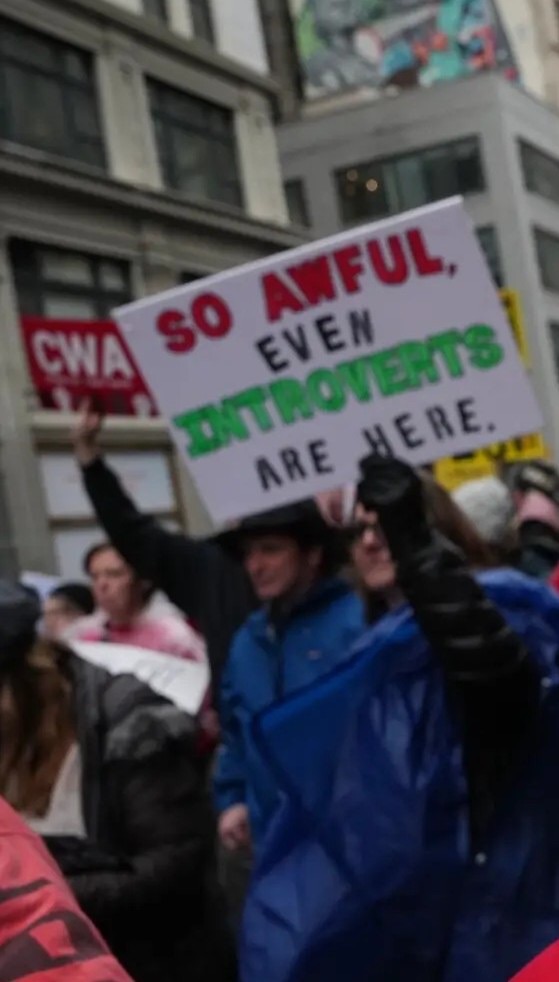
Bob’s Sandwich / So Awful, Even Introverts Are Here

Condensed from the Winnipeg Free Press:


Chaos follows Trump’s ‘Liberation Day’

. . . Trump claims that the U.S. is being raped and pillaged — his words — by foreign nations, that Americans were subsidizing economies all over the world, because Americans buy more foreign products than foreign nations buy American.

But there’s a clear problem with that analysis. A trade deficit is not a debt or a subsidy.

Let’s say you want a good sandwich. Bob can make it better or more cheaply or more conveniently than you can.

You pay Bob $5. Bob hands you your sandwich.

Yes, Bob gets your money, but you get the sandwich you wanted at the price you were willing to pay. You arguably have a $5 trade deficit with Bob, because Bob didn’t buy anything from you.

Donald Trump would argue that you’re propping Bob up with a $5 subsidy.

But you didn’t subsidize Bob. Bob did not steal anything from you. You didn’t give Bob a gift — you chose to buy his sandwich for your own reasons.

Much the way Americans have chosen to buy products from Canada or any other nation — because the value or quality was worth the money.

Trump has decided to add a tariff, a tax on Bob’s sandwiches.

A host of economists have suggested what’s likely to come next — significant inflation for American consumers, chaos in the global supply chain, and, most likely, layoffs and business closures. Stock markets are already delivering their verdicts.

The irony is that, as president, Trump’s ability to levy tariffs is tangential at best — he has had to manufacture emergencies to justify his actions. And there’s been a gross failure by the legislative branch in the United States to rein him in and represent the interests of their own constituents.

The real question now is whether anyone in America will stand up to him.

The damage to Canada’s relationship is obvious and will be long-lasting — one can only imagine what that damage will be to the reputation of the U.S. globally.

The damage to America — and Americans — may be incalculable.

Tobias continues:

Which is why so many Americans joined more than 1,200 protests throughout the country yesterday, many carrying home-made signs like this one:

Mine said:

NATO NOT PUTIN

on the front and . . .

 . . on the back.

There were lots about Social Security and Medicare and Veterans and Fascists and . . .

LEASH YOUR DOGE

One of my favorites summed it up:

WAY TOO MUCH FOR ONE SIGN 

Inflation rising, recession looming, stocks plunging, measles spreading, medical research slashed . . . and tariffs slapped on islands from whom we import nothing (including the one with only penguins) . . . but not on Russia (from whom we imported $3.27 billion worth of goods last year).

Lauren Villagran of USA Today wrote about the inhumane conditions for women in an ICE detention center called Krome. Krome is one of about 130 such centers around the country. It is managed by a for-profit company called Akima Infrastructure Protection, which has a contract for $685 million. Given the horrible living conditions, DOGE and Musk might want to check out waste, fraud, and abuse. We taxpayers are paying a lot for such a tawdry facility.

Villagran writes.

Immigrant women say they were held “like animals” in ICE detention and subjected to conditions so extreme they feared for their lives.

Chained for hours on a prison bus without access to food, water or a toilet. Told by guards to urinate on the floor. Held “like sardines in a jar,” as many as 27 women in a small holding cell. Sleeping on a concrete floor. Getting one three-minute shower over three or four days in custody.

“We smelled worse than animals,” one detainee said. “More girls were coming every day. We were screaming, begging them, ‘You can’t let them come.’ They didn’t have space.”

Four women were held in February at the Krome North Processing Center in Miami – a detention center reserved for men. U.S. Immigration and Customs Enforcement took the women into custody on alleged immigration violations, but none has a criminal background, according to a review of law enforcement records. They shared their experiences with USA TODAY on condition of anonymity, fearing retaliation by the government because they are still detained.

The allegations come after two men at Krome died in custody on Jan. 23 and Feb. 20.

USA TODAY provided ICE and its parent agency, the Department of Homeland Security, with a detailed list of the allegations on March 11. A day after publication, on March 24, an ICE spokesperson responded with an emailed statement saying the agency can’t substantiate specific allegations without the names of the individuals.

“ICE takes its commitment to promoting safe, secure, humane environments for those in our custody very seriously,” the statement said. “These allegations are not in keeping with ICE policies, practices and standards of care.”

The government’s own investigators have repeatedly found serious problems in immigration detention centers around the country. The problems have persisted through Democrat and Republican administrations and range from fatal medical neglect to improper use of force.

Last year, a report on unannounced inspections at 17 detention centers from 2020 to 2023 – bridging the Trump and Biden administrations – found that “regardless of time, location, detainee population and facility type, ICE and facility staff have struggled to comply with aspects of detention standards.”

But the women’s allegations at Krome, which was one of the 17 centers reviewed in the report, suggest detention conditions have deteriorated rapidly as the new Trump administration works to deliver on the president’s promises for tougher immigration enforcement.

ICE reported holding 46,269 people in custody in mid-March, well above the agency’s detention capacity of 41,500 beds. Immigration detention is “non-punitive,” according to ICE policy, in recognition that most immigration violations are civil, not criminal.

Mich González, an immigration attorney representing the family of the Ukrainian man who died Feb. 20 in Krome custody, visits the facility regularly to meet with clients. The guards there “are overwhelmed,” he said.

“Guards themselves have made those comments to us: ‘It shouldn’t be like this,'” said González, founding partner of Sanctuary of the South.

The shift from a “flexible” immigration policy to a “very aggressive” one means “the system simply can’t process all of these people,” said Miami-based immigration attorney Nenad Milosevic.

Krome is overwhelmed and understaffed, he said. “I know the conditions are extremely bad, and they’re not supposed to be that way.”

‘He didn’t want to scare me more’

One of the four women wanted to explain what she went through to her fiance. She wrote what she remembered on paper and titled it “Hell on Earth.”

She dialed out on a scratchy phone line and asked him to record her as she read from her notes.

“The officer only say that I am going to spend the night in Miami,” she said, using the English she learned during nearly two decades in the United States. “Now remembering his face, like I knew he knew that I am going to go through hell and he didn’t want to scare me more.”

This account is based on that 15-minute audio recording detailing the alleged mistreatment, as well as numerous telephone and video interviews with the woman and her fiance and with three other detained women, their family members and attorneys, as well as the two attorneys who independently witnessed the deteriorating conditions.

All four women described being chained at the wrist, waist and chest and loaded onto a prison bus, where they were held, in one case, for six hours; in another, for 11 or 12 hours.

“They took us to a bigger bus,” the woman said in the audio recording. “They checked us, and then they put like chains on us, hands to waist, connected. It was very scary because they chained my chest super-tight and I couldn’t breathe properly. I was really scared because I thought, ‘I’m not going to be able to breathe.'”

There was no access to a toilet, so guards told the women – whose accounts in some cases occurred on different days or different buses – to urinate or defecate on the floor. They watched, helpless, as some did.

“A man in the back of the bus – we were separated with a door – he was screaming, ‘Somebody wants a bathroom,'” the woman said in the audio. “And somebody peed there. It stank so badly.”

She described her first impression of Krome as “a really chaotic-looking place.” Guards rushed the women through a corridor, past the male dormitories where men pressed their faces to the glass, “wildly staring … like they had never seen women before.”

“We were pushed in a room, filled with women, like sardines in a jar,” she said. “I will never forget those first seconds when I heard the door behind me locked.”

Open the link to continue reading.

Laurie Roberts, columnist for The Arizona Republic, asked the question that is the title of this post. Why indeed? Charters and vouchers, we were promised, would “save poor kids from failing schools” but all too often, school choice is far worse than the neighborhood public school.

When you see the abysmal test scores for this online school, you understand why the operators of voucher schools demand exclusion from state testing. This charter school has horrible scores, but as Trump often reminds us, “parents know best.” Except when they don’t.

Roberts looks beyond the promises and follows the money. That’s always a good strategy.

Roberts writes:

Pity poor Primavera Online Charter School.

It seems dastardly “activists” are trying to shut down this fine academic institution — to deny the school the $80 million in public money it needs annually to provide students with a “D” education.

It’s “lawfare”, we are told. An attack on President Donald Trump’s agenda and a sneak attempt to shut down school choice.

“The voters of this country have spoken loud and clear … that President Trump’s agenda, which includes school choice, is highly favored by the voters,” Jesse Binnall, the school’s lawyer, declared. “Instead of getting on board with this policy, you have some people that are trying to use various versions of lawfare … in order to get in the way of school choice.”

Binnall and Primavera CEO Damian Creamer, surrounded by some of the state’s elected leaders, held a press conference outside the state Capitol on Wednesday to bemoan Primavera’s plight as the Arizona Board of Charter Schools considers shutting down the online alternative school.

No less than U.S. Rep. Andy Biggs stood with them.

Biggs, who has enjoyed more than $32,000 in campaign contributions from Creamer, according to Open Secrets.

Creamer also has donated to a who’s who of Republican state legislators, which likely explains why some of them showed up to support him on Wednesday.“We hope that everyone is going to do the right thing,” Binnall continued. “But, unfortunately, we know activists have infected this process far too much.”

Primavera gravy train could be slowing down

Earlier this month, the charter school board — a board dominated by appointees of former Republican governor and school choice champion Doug Ducey — took the first step toward revoking the school’s charter.

This, after 12News reporter Craig Harris — yeah, he’s the “activist” to whom Binnall was referring — began asking questions about why we’re paying Creamer tens of millions of dollars to fail children.

The state Board of Education has slapped Primavera with a “D” rating in each of the last three years. It is the only charter school in the state to rate three straight D grades.

The charter board, meanwhile, has given Primavera its second worst rating — Does Not Meet Standard — over the last two years and its worst rating — Falls Far Below Standard — four times since 2017.

Yet, the school continues to rake in our money. Nearly $80 million last year.

Of that, Harris reports that Primavera paid $54 million to its parent company, StrongMind, for curriculum and management.

StrongMind has just one shareholder: Creamer.

Just $12.4 million of that $80 million went to teachers, with another $6 million for advertising.

In all, Harris has reported that Creamer has pocketed at least $24 million in public money via shareholder distributions and direct payments since 2017.

We are paying $80 million for this?

Now, however, the gravy train appears to have run its course. So the push is on — with a little oomph from politicians who have enjoyed Creamer’s contributions — to make sure it doesn’t get derailed.

“We have to be confident that these people who serve … the people of Arizona are going to do the right thing for the children of Arizona,” said Binnall, who also has worked for Trump.

Creamer maintains his school, which caters to at-risk students, would have earned a grade of “C” had it been judged as an alternative school. But he’s the one who failed to apply for the designation.

Even so, the school’s record of academic achieved has dropped even as its enrollment has jumped to 8,000 students.

According to state assessment results, the percentage of students rated proficient in English has dropped from 36% in 2022 to 23% last year.

Math proficiency dipped from 13% in 2022 to 9%.

The only thing booming is Creamer’s bank account.

But, sure, it’s lawfare to question whether we should be doling out $80 million every year to this school.

“We hope that everyone is going to do the right thing,” attorney Binnall said. “But, unfortunately, we know activists have infected this process far too much.”

Reach Roberts at laurie.roberts@arizonarepublic.com. Follow her on X (formerly Twitter) at @LaurieRobertsaz, on Threads at @LaurieRobertsaz and on BlueSky at @laurieroberts.bsky.social.

Michael C. Bender reports in The New York Times that the Trump administration is threatening to cancel funding from schools that refuse to eliminate programs or courses that teach DEI. The administration has turned civil rights enforcement upside down and inside out. For decades, civil rights law meant protection of racial minorities and women, who were often targets of discrimination, exclusion, or unfair treatment. This administration worries most about the rights of white students.

Secretary of Education Linda McMahon clearly doesn’t know that federal law prohibits any federal official from interfering with or trying to influence curriculum.

“20 USC 1232a: Prohibition against Federal control of education. Text contains those laws in effect on April 2, 2025

§1232a. Prohibition against Federal control of education

No provision of any applicable program shall be construed to authorize any department, agency, officer, or employee of the United States to exercise any direction, supervision, or control over the curriculum, program of instruction, administration, or personnel of any educational institution, school, or school system, or over the selection of library resources, textbooks, or other printed or published instructional materials by any educational institution or school system, or to require the assignment or transportation of students or teachers in order to overcome racial imbalance.

What Secretary McMahon proposes is illegal.

Bender writes:

The Trump administration threatened on Thursday to withhold federal funding from public schools unless state education officials verified the elimination of all programs that it said unfairly promoted diversity, equity and inclusion.

In a memo sent to top public education officials across the country, the Education Department said that funding for schools with high percentages of low-income students, known as Title I funding, was at risk pending compliance with the administration’s directive.

The memo included a certification letter that state and local school officials must sign and return to the department within 10 days, even as the administration has struggled to define which programs would violate its interpretation of civil rights laws. The move is the latest in a series of Education Department directives aimed at carrying out President Trump’s political agenda in the nation’s schools.

At her confirmation hearing in February, Education Secretary Linda McMahon said schools should be allowed to celebrate the Rev. Dr. Martin Luther King Jr. But she was more circumspect when asked whether classes that focused on Black history ran afoul of Mr. Trump’s agenda and should be banned.

“I’m not quite certain,” Ms. McMahon said, “and I’d like to look into it further.”

More recently, the Education Department said that an “assessment of school policies and programs depends on the facts and circumstances of each case.”

Programs aimed at recognizing historical events and contributions and promoting awareness would not violate the law “so long as they do not engage in racial exclusion or discrimination,” the department wrote.

“However, schools must consider whether any school programming discourages members of all races from attending, either by excluding or discouraging students of a particular race or races, or by creating hostile environments based on race for students who do participate,” the Education Department said.

It also noted that the Justice Department could sue for breach of contract if it found that federal funds were spent while violating civil rights laws.

The federal government accounts for about 8 percent of local school funding, but the amounts vary widely. In Mississippi, for example, about 23 percent of school funding comes from federal sources, while just 7 percent of school funding in New York comes from Washington, according to the Pew Research Center.

“Federal financial assistance is a privilege, not a right,” Craig Trainor, the acting assistant education secretary for civil rights, said in a statement. “When state education commissioners accept federal funds, they agree to abide by federal anti-discrimination requirements.”