Archives for category: Ethics

Jan Resseger reminds us of the purpose of public education by quoting Derek Black’s new book Dangerous Learning, in which he writes that “public schools are the place where children—regardless of status—share a common experience, come to appreciate the public good, and prepare for equal citizenship. The purpose of public education has always been to sustain a republican form of government.” The Trump administration does not want to “sustain a Republican form of government.” It blabbers on about parents’ rights, not the common good. It is determined to destroy the U.S. Department of Education because it protects the rights of students, especially the most vulnerable. Ironically, the claims for “parents’ rights,” has been turned into a battering ram against students’ rights.

Jan writes:

In his newest book, Dangerous Learning, constitutional law scholar Derek Black explores one of the most basic reasons our public schools, our society’s most extensive and inclusive civic institution, are essential: they are an enormous system whose promise is to serve the needs and protect the rights of nearly 50 million children and adolescents.  Justice cannot be achieved solely through the protection of parents’ rights, by which parents vie to advance their own children’s needs.

Black writes: “As rhetoric, educational freedom sounds good.  As a practical matter, it falls well short of freedom for all. It does not even attempt to ensure that private education works for children. At best, it is agnostic toward the school environments students enter. At worst, it uses public funds to facilitate patterns and values that America has spent the past half century trying to tame…  Public schools to be sure, are far from perfect. They have never fully met the needs of all students and all communities. But those shortcomings are clearly understood as problems to fix. They are seen as bugs, not features, of public education, which has operated for two centuries on the premise that public schools are the place where children—regardless of status—share a common experience, come to appreciate the public good, and prepare for equal citizenship. The purpose of public education has always been to sustain a republican form of government. And public schools are the only place in society premised on bridging the gaps that normally divide us—race, wealth, religion, disability, sex, culture, and more. The founders of the American public education system believed that rather than inhibiting liberty, a common public education is essential to it.” (Dangerous Learning, pp. 182-183)

Widespread educational justice across the nation cannot be achieved solely through the laws of the states. At the federal level, Brown v. Board of Education, and federal laws like the 1964 Civil Rights Act, and the Individuals with Disabilities Education Act have for three quarters of a century been tools by which the federal government could challenge and rectify injustice in public schools.  In 1979, the U.S. Department of Education was founded to pull together many of the programs designed to increase opportunity for children in states whose public schools had failed to protect their educational rights due to their race, ethnicity, or disability—the work of the Office for Civil Rights, and programs supporting English language learners and special education for disabled students, for example.  The Education Department also increased investment in school districts which states had inadequately funded—Title I for school districts serving concentrations of poor children, for example, and grants for Full-Service Community Schools and 21st Century After-School Programs.

The Trump administration has, however, avoided acknowledging the history of educational injustice as the President has consistently promoted the goal of shutting down the U.S. Department of Education and “returning education to the states.”  When she was confirmed as Education Secretary last March, Linda McMahon declared: “President Trump pledged to make American education the best in the world, return education to the states where it belongs, and free American students from the education bureaucracy through school choice. I intend to make good on that promise.”  McMahon has laid off staff whose positions were created by Congress, threatened to send specific programs to other federal departments, and cancelled a raft of specific, congressionally allocated grant funding —all contrary to federal law. Many of these threats have been temporarily stayed by the courts; others are quietly moving forward.

Last week, McMahon took a new step to weaken the Department’s reach—by agreeing to waive federal rules that prescribe how federal funding can be spent and allowing states to combine at their discretion funding from specific federal grant lines. For the Associated Press, Colin Binkley explained: “The Trump administration is giving Iowa more power to decide how it spends its federal education money, signing off on a proposal that is expected to be the first of many as conservative states seek new latitude from a White House promising to ‘return education to the states.’ Iowa was the first state to apply for an exemption from certain spending rules.”  Binkley describes Education Secretary McMahon’s justification for giving Iowa control of spending federal dollars from four different grant programs: “McMahon told The Associated Press that the new flexibility will free up time and money now devoted to ensuring compliance with federal rules. With fewer strings attached, states can pool their federal dollars toward priorities of their choosing, including literacy or teacher training….”

For K-12 Dive, Kara Arundel lists four separate programs established by the federal Every Student Succeeds Act whose funding streams Iowa has been permitted to combine: Title II, Part A—Supporting Effective Instruction; Title III, Part A—English Language Acquisition; Title IV, Part A—Student Support and Academic Enrichment; and Title IV, Part B—21st Century Community Learning Centers (after-school programs). Arundel describes Iowa’s Republican Governor Kim Reynolds expressing gratitude for giving her state more freedom: “Iowa Gov. Kim Reynolds, speaking at the press conference, said the state is ‘confident that we can do even more by reallocating compliance resources. Iowa will begin shifting nearly $8 million and thousands of hours of staff time from bureaucracy to actually putting that expertise and those resources in the classroom.’ “

Several writers, looking at the modesty of last week’s Iowa waiver to consolidate grants are not yet anticipating that the Iowa situation bodes massive deregulation of federal funding.  Education Week’s Mark Lieberman explains: “The waiver approval appears to mark the first time since the 2015 passage of the Every Student Success Act that the federal government has used its authority under that law to allow a state to consolidate funding. But, in contrast with proposals the state put forward roughly a year ago, the new federal approval touches only 5% of Iowa’s overall allocation of federal education funds, the part that’s set aside for the state education agency. The bulk of federal dollars that flow to school districts each year—$900 million worth—will retain their current structure and spending and reporting requirements.”

Binkley reassures the public: “Iowa’s new plan leaves Title I funding untouched.”

Lieberman quotes Anne Hyslop, who now leads All4Ed, and who worked in the Department during the Obama administration: “This announcement could signal an acknowledgment from the department that its legal authority to flatten discrete funding programs and implement unrestricted block grants without congressional approval is limited, said Anne Hyslop… It also foreshadows an uphill battle for other states aiming to convert federal education funding to block grants, including Indiana, which submitted a request for that flexibility, along with relief from certain school accountability requirements in October.”

Chalkbeat’s Erica Meltzer adds States already control most aspects of education. Federal funding makes up about 10% of overall education spending, and those dollars do come with restrictions and reporting requirements that aim to ensure money is spent appropriately… Iowa’s waiver doesn’t allow districts to consolidate most of their federal funding, which would have represented a much larger pot of money.

However, the reporters acknowledge that, in the context of the Trump administration’s goal to return education to the states, the Department may increasingly grant waivers that limit federal oversight.  Will Iowa’s waiver be the first step as the Department of Education reduces guardrails that protect students’ civil rights?

Meltzer reports that the new waiver, “does allow Iowa school districts to take advantage of a 1999 federal provision called  Ed-Flex to roll over more money year over year to make it easier to invest in big-ticket items and longer-term strategies….”  Lieberman adds: “Separate from the waiver approval, McMahon also simultaneously announced she’s approved Iowa to join 10 other states currently participating in the department’s Ed-Flex program, which gives state education agencies the authority to waive certain spending regulations for individual districts… The 10 states currently participating are Delaware, Georgia, Indiana, Kansas, Massachusetts, North Carolina, Pennsylvania, Texas, Vermont and Wisconsin. Iowa is the first state to gain the distinction since McMahon became secretary.”

Meltzer concludes by cautioning readers: “(T)he Education Department still needs to ensure money is being appropriately spent, which is more challenging after massive layoffs.” She quotes Hyslop worrying: “(T)he U.S. Department of Education right now lacks the capacity to do meaningful oversight of how this program is being implemented or the waiver process in general.”

Specifically, Meltzer warns that one of the federal grants Iowa was allowed to merge supported English language instruction, a step that could well reflect the Trump administration’s attack on immigrants or its anti-DEI initiatives: “Advocates are particularly concerned that Iowa’s new block grant consolidates Title III funds that are required to go to English learners…. The Trump administration laid off most of the staff at the Education Department who support those students, and rescinded a guidance document considered to be the ‘bible’ in that field.” She quotes the Education Trust’s Nicholas Munyan-Penney: “I think of red tape equaling protections for students… We want to make sure that students have access to the protections and resources they need to be successful.”

Will 2026 be the year that the Department of Education expands the use of waivers to undercut the federal oversight of funds that protect equality of educational opportunity across our nation?  We will need to watch carefully as the chaotic education policy in McMahon’s Department of Education continues into its second year.
Perhaps the strangest feature of Trump’s invasion of Venezuela is that he left the leadership of the regime in place, removing only Maduro and his wife. Four of the six Venezuelan leaders who were indicted for criminal activities are now running the country.

On the one hand, Trump avoids the problem of a renegade army and security apparatus, which can help repress the citizenry while the U.S. schemes to steal their oil.

On the other, the Maduro regime continues to be thuggish and corrupt.

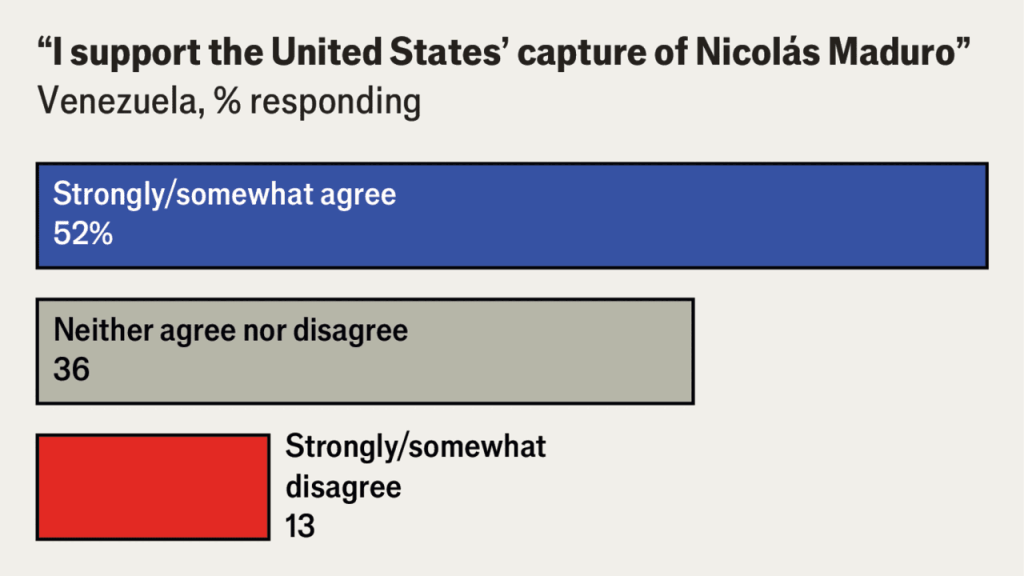
The Economist magazine conducted a poll in Venezuela and found that most people were pleased that Maduro is gone.

The polling shows that Mr Maduro, who presided over torture and economic collapse and brazenly stole the presidential election in 2024, was deeply hated. Just 13% of respondents even mildly opposed his capture. Strikingly, more than half of them said their opinion of America had improved after the raid.

Its deputy editor Robert Guest wrote this commentary in the January 10-16 issue::

Outside a supermarket in Caracas a few years ago, I saw national guardsmen checking people’s identity before they were allowed in. The logic was that, courtesy of the revolutionary government, the state-owned shop sold essential groceries at below-market prices. So you needed men with truncheons and tear-gas to make sure shoppers only came in on their state-appointed shopping days.

Nicolás Maduro’s dictatorship was one of the most thuggish in the world. It was also one of the most economically incompetent. When I walked into that shop, half the shelves were bare and none of the groceries that were supposed to be on sale for less than they cost to make were, in fact, available. A combination of price controls, socialist dogma and industrial-scale corruption had dramatically impoverished a once-prosperous country. The economy shrank by 69% under Mr Maduro—a swifter decline than would normally occur during an all-out civil war. Small wonder Venezuelans in Miami danced in the streets when Donald Trump kidnapped Mr Maduro and whisked him to a courtroom in New York. But they were not dancing in Caracas, for fear of being arrested and tortured. For though the despot is gone, the rest of the regime is still in place.

Margaret Hoover is host of a weekly program about public affairs every Friday night on PBS. It’s called “Firing Line,” the same title as William Buckley’s talk show of decades back.

Margaret, a direct descendant of Herbert Hoover, is a Republican but is not especially conservative.

On this program, she interviews Elliot Abrams.

Elliot Abrams is an expert on foreign affairs and national security. He worked for President Reagan, President George H.W. Bush, and President Trump, in his first term. Abrams is known as a hawk.

What’s fascinating about the conversation is that Abrams is highly critical of Trump’s invasion.

He acknowledges that Maduro was a ruthless, brutal dictator who ran the Venezuelan economy into the ground and caused millions of Venezuelans to flee the country. Some of maduro’s top leaders have hidden bank accounts in which they have stowed hundreds of millions of dollars.

He asks why Trump failed to consult Congress.

He wonders why Trump ordered the arrest of Maduro and his wife but not the others who were indicted and are now running the country.

He wonders why Trump left the leaders of this corrupt regime in place. He assumes they will wait Trump out and continue to reap the rewards of their corruption. Given the cost and difficulty of reviving Venezuela’s oil industry, he doubts that any of the major American oil companies will risk doing so.

It’s a fascinating conversation. I urge you to watch.

I saw the show where Rachel Maddow tried to understand why Trump sent troops to invade Venezuela, kidnap its President Nicolas Maduro and his wife, and bring them to the U.S. to stand trial.

She reviews the usual reasons and determines that each of them is insufficient.

What’s the real reason? Open the link and see.

In an interview with The New York Times, President Trump explained his hostility towards the civil rights laws meant to end discrimination against racial minorities and women and to expand opportunities for them in the workplace and in education.

He believes that civil rights protections have hurt white men. That is the rationale for his aggressive campaign to purge policies of DEI (diversity, equity, and inclusion) from all institutions receiving federal funding.

Trump is indifferent to the long history of slavery, racism, Jim Crow laws, bigotry, and segregation that harmed minorities, especially African Americans. He is equally indifferent to the long history of sexism and misogny that restricted the careers of women.

Erica Green reports:

President Trump said in an interview that he believed civil rights-era protections resulted in white people being “very badly treated,” his strongest indication that the concept of “reverse discrimination” is driving his aggressive crusade against diversity policies.

Speaking to The New York Times on Wednesday, Mr. Trump echoed grievances amplified by Vice President JD Vance and other top officials who in recent weeks have urged white men to file federal complaints with the Equal Employment Opportunity Commission.

When asked whether protections that began in the 1960s, spurred by the passage of the Civil Rights Act, had resulted in discrimination against white men, Mr. Trump said he believed “a lot of people were very badly treated.” 

“White people were very badly treated, where they did extremely well and they were not invited to go into a university to college,” he said, an apparent reference to affirmative action in college admissions. “So I would say in that way, I think it was unfair in certain cases.”

He added: “I think it was also, at the same time, it accomplished some very wonderful things, but it also hurt a lot of people — people that deserve to go to a college or deserve to get a job were unable to get a job. So it was, it was a reverse discrimination.”

Trump’s approach is calibrated to appeal to white men who blame their grievances on laws that protect racial minorities and women.

Carrying out Mr. Trump’s agenda is the Equal Employment Opportunity Commission, which was formed in 1965 under the Civil Rights Act. The commission’s chair, Andrea Lucas, issued a striking video message last month underlining the agency’s new posture.

“Are you a white male who has experienced discrimination at work based on your race or sex?” Ms. Lucas said in the video posted on X. “You may have a claim to recover money under federal civil rights laws. Contact the E.E.O.C. as soon as possible. Time limits are typically strict for filing a claim.”

“The E.E.O.C. is committed to identifying, attacking, and eliminating ALL forms of race and sex discrimination — including against white male applicants and employees,” she said.

In the video, Ms. Lucas pointed white men to the commission’s F.A.Q. on “D.E.I.-related discrimination,” which notes that D.E.I. “a broad term that is not defined” in the Civil Rights Act.

The Equal Employment Opportunity Commission is the nation’s primary litigator of workplace discrimination, and for decades has been a resource for minorities, women and other groups who have historically faced discrimination. But Ms. Lucas has endeavored to make it one of Mr. Trump’s most powerful tools against D.E.I., with a particular focus on remedying perceived harms against white men.

Trump has combatted DEI in universities by threatening to cut off the funding of institutions that implement affirmative action for students and faculty and that have programs to encourage minorities.

On Wednesday, Renee Macklin Good was fatally shot by a federal ICE agent. Becca Good, her wife, shared the following statement with MPR News.

#

First, I want to extend my gratitude to all the people who have reached out from across the country and around the world to support our family.

This kindness of strangers is the most fitting tribute because if you ever encountered my wife, Renee Nicole Macklin Good, you know that above all else, she was kind. In fact, kindness radiated out of her.

Renee sparkled. She literally sparkled. I mean, she didn’t wear glitter but I swear she had sparkles coming out of her pores. All the time. You might think it was just my love talking but her family said the same thing. Renee was made of sunshine.

Renee lived by an overarching belief: there is kindness in the world and we need to do everything we can to find it where it resides and nurture it where it needs to grow. Renee was a Christian who knew that all religions teach the same essential truth: we are here to love each other, care for each other, and keep each other safe and whole.

Like people have done across place and time, we moved to make a better life for ourselves. We chose Minnesota to make our home. Our whole extended road trip here, we held hands in the car while our son drew all over the windows to pass the time and the miles.

What we found when we got here was a vibrant and welcoming community, we made friends and spread joy. And while any place we were together was home, there was a strong shared sense here in Minneapolis that we were looking out for each other. Here, I had finally found peace and safe harbor. That has been taken from me forever.

We were raising our son to believe that no matter where you come from or what you look like, all of us deserve compassion and kindness. Renee lived this belief every day. She is pure love. She is pure joy. She is pure sunshine.

On Wednesday, January 7th, we stopped to support our neighbors. We had whistles. They had guns.

Renee leaves behind three extraordinary children; the youngest is just six years old and already lost his father. I am now left to raise our son and to continue teaching him, as Renee believed, that there are people building a better world for him. That the people who did this had fear and anger in their hearts, and we need to show them a better way.

We thank you for the privacy you are granting our family as we grieve. We thank you for ensuring that Renee’s legacy is one of kindness and love. We honor her memory by living her values: rejecting hate and choosing compassion, turning away from fear and pursuing peace, refusing division and knowing we must come together to build a world where we all come home safe to the people we love.

Yesterday Trump gave an unusual two-hour interview to reporters from The New York Times.

One reporter asked Trump whether he felt constrained by international law or by Congress, and he answered that he did not.

Here is his response:

President Trump declared on Wednesday evening that his power as commander in chief is constrained only by his “own morality,” brushing aside international law and other checks on his ability to use military might to strike, invade or coerce nations around the world.

Asked in a wide-ranging interview with The New York Times if there were any limits on his global powers, Mr. Trump said: “Yeah, there is one thing. My own morality. My own mind. It’s the only thing that can stop me.”

“I don’t need international law,” he added. “I’m not looking to hurt people.”

I immediately thought of Marlon Brando in The Godfather.

Nobody constrains the godfather. Only his own morality. And you know what that means.

In few words, Trump boldly expressed The Trump Doctrine. He will take action without deference to Congress, the Constitution, or the United Nations. Nothing will hold him back except his “own morality,” says a man who is famous for lying, cheating, and ignoring the law. A man who dodged the draft, cheated on all three of his wives, refused to release his tax returns, went bankrupt multiple times (while playing the role of a business genius), a man whose multiple businesses have folded (Trump steaks, Trump wines, Trump airlines, Trump University, Trump vodka, among other failed ventures).

Like you, I have seen multiple videos of the killing of Renee Good by an ICE agent in Minneapolis.

This one, which appeared on TikTok, shows beyond doubt that the ICE agent was never in danger. She was told both to leave and to get out of the car.

She was leaving. The ICE agent shot three times. She was murdered.

Like many of you, I sat glued to the television on January 6, 2021, and watched the terrible events unfold. I had seen Trump’s tweet a few weeks earlier, urging his followers to show up on January 6 and promising that it would be “wild.”

They did show up. Thousands of them. Some dressed in military gear, some in bizarre costumes, some armed. All eager to “stop the steal.” As Trump promised, it was indeed wild.

Trump had gone through 60 court cases, appealing the vote in different states. Every court ruled against him. Trump-appointed judges ruled against him. There was no evidence of fraud. The US Supreme Court ruled against his claims–twice. His closest advisors told him he lost. But he listened only to those who told him the election was rigged, like Rudy Giuliani, the My Pillow Guy, Sidney Powell, etc.

When his supporters showed up on January 6, he gave a passionate speech, telling them that the election had been stolen. He urged them to march to the Capitol, where the ceremonial counting of the electoral vote was taking place, and said he would march with them.

He didn’t march with them, though he wanted to. He returned to the White Hiuse, where he sat back and watched his loyal fans attack the U.S. Capitol, smash its windows, break through its doors, assault Capitol police, and ransack the seat of our government.

It was the worst day in our history because never before had an American president rallied his passionate fans and called on them to attack the seat of our government. Never before had a mob of American citizens tried to overturn a free and fair election by violence.

Trump demonstrated that he is a sore loser. He was beaten by Joe Biden fair and square. He refused to accept that he lost. He continues to claim that he won.

He is either delusional or the world’s biggest crybaby and liar.

I will never forget that day of infamy. Yes, it was wise than Pearl Harbor. It was worse than 9/11. On those days, we were attacked by foreign powers and terrorists. On January 6, our democracy was attacked by Americans.

I recommend that you read Jeffrey Goldberg’s excellent article in The Atlantic. The link is a gift article.

This is what Glenn Kessler wrote:

Trump rallying a crowd before the Jan. 6 attack on the Capitol: “You will have an illegitimate president. That is what you will have, and we can’t let that happen.”

A version of this article was posted in October behind a paywall as part of the “On Trump’s Bullshit” series. I am making it available to all subscribers on the fifth anniversary of the Jan. 6 attack on the U.S. Capitol.

In October, Donald Trump posted on social media what appeared to be a message to Attorney General Pam Bondi: “The Biden FBI placed 274 agents into the crowd on January 6…What a SCAM – DO SOMETHING!”

When Bondi launches her investigation, she’ll soon discover an uncomfortable fact: Joe Biden wasn’t president on Jan. 6, 2021. Trump was — and he sought to block Biden from taking office. (And it was his government that deployed agents after the riot began.)

The post is emblematic of Trump’s most astonishing piece of bullshit — his effort to rewrite the history of the Jan. 6 attack on the U.S. Capitol that he orchestrated and encouraged. 

Trump knew he faced criminal liability for his role in obstructing the peaceful passage of power after his 2020 defeat, so it’s quite possible he ran for president mainly to derail the investigation. As a tactic, it was successful. Through repeated legal challenges, he managed to delay the trial until after the November election. When he won, the Justice Department was required to drop the case because of an existing policy that a sitting president cannot be prosecuted.

Then, as soon as he became president, Trump pardoned more than 1,500 people convicted or charged in connection with the riot, while commuting the sentences of fourteen members of the Proud Boys and Oath Keepers, two far-right groups.

Trump now routinely refers to the “January 6 hoax,” attempting to erase the event altogether.

Even more amazing, Trump has managed to convince many of his supporters that a riot that resulted in $2.7 billion in property damage, security expenses, and other related costs, according to the Government Accountability Office, was a “beautiful day” and “a day of love.” The rioters assaulted 140 law enforcement officers, while 123 people were charged with using a deadly or dangerous weapon or causing serious bodily injury to law enforcement.

The reality is that Trump incited the brutal assault on the Capitol, starting with his lie that he won the 2020 election. His refusal to accept the election results, despite his convincing losses in key battleground states, set the stage for a day of outrage by his supporters.

The final report of Special Counsel Jack Smith documented how Trump tried to browbeat Republican state officials in battleground states to alter the results or nullify them. Thankfully, people such as Georgia Secretary of State Brad Raffensperger —who Trump demanded to “find 11,780 votes” — or Michigan Senate Majority Leader Mike Shirkey — who bluntly told Trump he lost because he had underperformed with educated females — refused to yield to his pressure.

So did Vice President Mike Pence. Trump wanted Pence, who had the ceremonial role of presiding over the Electoral College count, to overturn the election by rejecting votes for Biden from six battleground states. Pence knew he didn’t have the authority to do so, despite the theories offered by what he called Trump’s “gaggle of crackpot lawyers.”

But the most damning evidence of Trump’s misconduct are his own actions on January 6, after the crowd he urged to march on the Capitol turned into a mob. 

As the scale of the attack became clear, Trump was reluctant to try to calm the situation, even as his staff pleaded with him to tell the rioters to leave the Capitol. Trump’s tweets were so inadequate, in the view of staff members, that many resolved to resign. Even his children Ivanka and Donald Jr. found the tweets to be inappropriate. Nearly three hours passed before Trump finally told the rioters to “go home.”

The House select committee report on the Jan. 6 attack shows that Trump learned only 15 minutes after he concluded his remarks on the National Mall at 1:10 p.m. that the Capitol was under attack. Less than half an hour later, the Metropolitan Police Department officially declared a riot. Minutes later, rioters broke into the Capitol and swarmed the building.

Yet it was not until 2:24 that Trump issued his first written tweet — and it made things worse.

Trump wrote: “Mike Pence didn’t have the courage to do what should have been done to protect our Country and our Constitution, giving States a chance to certify a corrected set of facts, not the fraudulent or inaccurate ones which they were asked to previously certify. USA demands the truth!”

According to the House committee’s report: “Evidence shows that the 2:24 p.m. tweet immediately precipitated further violence at the Capitol. Immediately after this tweet, the crowds both inside and outside of the Capitol building violently surged forward. Outside the building, within 10 minutes thousands of rioters overran the line on the west side of the Capitol that was being held by the Metropolitan Police Force’s Civil Disturbance Unit, the first time in the history of the DC Metro Police that such a security line had ever been broken.”

One minute after the tweet, the Secret Service evacuated Pence to a secure location at the Capitol. According to Smith’s report, when an advisor at the White House rushed to the dining room to inform Trump, the president replied, “So what?”

Contemporaneous White House reactions were damning.

Deputy national security adviser Matthew Pottinger told the House committee that the 2:24 p.m. tweet convinced him to resign that day. “I read it and was quite disturbed by it,” he told the committee. “I was disturbed and worried to see that the President was attacking Vice President Pence for doing his constitutional duty. So the tweet looked to me like the opposite of what we really needed at that moment, which was a de-escalation. … It looked like fuel being poured on the fire.”

White House counsel Pat Cipollone, in his deposition with the committee, said: “My reaction to it is that’s a terrible tweet, and I disagreed with the sentiment. And I thought it was wrong.”

The committee report says that Trump’s daughter Ivanka rushed to the Oval Office dining room, where Trump was watching coverage of the riot on Fox News. “Although no one could convince President Trump to call for the violent rioters to leave the Capitol, Ivanka persuaded President Trump that a tweet could be issued to discourage violence against the police,” the report said.

At 2:39, Trump issued this tweet: “Please support our Capitol Police and Law Enforcement. They are truly on the side of our Country. Stay peaceful!”

The tweet did not condemn the violence or tell rioters to leave the Capitol. As Trump well knew, the crowd was not peaceful at the time.

Even so, the committee’s report said that Trump had resisted using the word “peaceful.” It quotes Sarah Matthews, who was the deputy White House press secretary, about a conversation she had with Ivanka after Matthews expressed concern the tweet did not go far enough. “In a hushed tone [she] shared with me that the President did not want to include any sort of mention of peace in that tweet and that it took some convincing on their part, those who were in the room,” Matthews told the committee.

Trump rejected staff requests to urge people who entered the Capitol illegally to leave immediately. Instead, at 3:13 p.m., when he issued a third tweet, he still did not tell people to go home. “I am asking for everyone at the U.S. Capitol to remain peaceful,” he said. “No violence! Remember, WE are the Party of Law & Order — respect the Law and our great men and women in Blue. Thank you!”

The violence continued.

Finally, at 4:17 p.m., almost three hours after the attack began, Trump posted a video that encouraged people to leave the Capitol — while repeating many of his lies about a stolen election. By then it was clear Trump had failed to derail Biden’s election.

“Down at the Capitol, the video began streaming onto rioters’ phones, and by all accounts including video footage taken by other rioters, they listened to President Trump’s command,” the report said. “ ‘Donald Trump has asked everybody to go home,’ one rioter shouted as he ‘deliver[ed] the President’s message.’ ‘That’s our order,’ another rioter responded. Others watching the video responded: ‘He says, go home.’ ”

Just after 6 pm, Trump offered one more tweet that appeared to justify the violence on one of the darkest days in American history: “These are the things and events that happen when a sacred landslide election victory is so unceremoniously & viciously stripped away from great patriots who have been badly & unfairly treated for so long. Go home with love & in peace. Remember this day forever!”

It was a sickening, celebratory tweet on a horrific day — convincing even more White House officials to quit — and no amount of Trump bullshit can erase his conduct from the annals of history.

·

Harvard University’s President Alan Garber said in a recent discussion that faculty activism in their classes chilled students’ free speech and created a repressive climate on campus.

An article in The Harvard Crimson reported on President Garber’s comments.

Harvard President Alan M. Garber ’76 said the University “went wrong” by allowing professors to inject their personal views into the classroom, arguing that faculty activism had chilled free speech and debate on campus.

In rare and unusually candid remarks on a podcast released on Tuesday, Garber appeared to tie many of higher education’s oft-cited ills — namely, a dearth of tolerance and free debate — to a culture that permits, and at times encourages, professors to foreground their identity and perspectives in teaching.

“How many students would actually be willing to go toe-to-toe against a professor who’s expressed a firm view about a controversial issue?” he said.

The remarks mark Garber’s most explicit public acknowledgement that faculty practices have contributed to a breakdown in open discourse on campus — and that he is committed to backtracking toward neutrality in the classroom…

Though Garber has carved some exceptions to the policy — notably when he, in his personal capacity, condemned a Palestine Solidarity Committee post marking the anniversary of the Oct. 7 attack — he has increasingly emphasized restraint, particularly in the classroom.

“I’m pleased to say that I think there is real movement to restore balance in teaching and to bring back the idea that you really need to be objective in the classroom,” he said….

In his responses, Garber echoed the sentiment of a Faculty of Arts and Sciences reportreleased last January, which affirmed professors’ right to “extramural speech” but warned that instructors must proactively encourage disagreement in the classroom to avoid alienating students…

Instead of relying primarily on punishment, Garber touted changes to University orientations — including the addition of a module on discussing controversial topics — alongside the expansive reports produced by Harvard’s twin task forces on combating bias toward Jewish, Israeli, Muslim, Arab, and Palestinian affiliates.

“It’s about learning how to listen and how to speak in an empathetic way,” he said.