Archives for category: Equity

Jan Resseger writes here about the failure of ranking and rating schools by test scores and other metrics. These rankings cause parents to flee low-rated schools, making them even more segregated by income and race. If “reformers” intended to help struggling schools, they didn’t. They made it harder for those schools to improve.

She writes:

Here is the lead in a story in the Washington City Paper (Washington, D.C.) that describes not only  how public school ratings and rankings work in the nation’s capital but also their impact in every public school district in the United States.  Read this carefully:

“Before the pandemic shut down D.C. schools, each public school, like each student, got a report card. Every fall the school report card included a STAR rating, from one through five. The rating was based on a formula designed and used by the Office of the State Superintendent of Education (OSSE), D.C.’s education agency. Federal law requires OSSE to identify the ‘bottom 5 percent’ of District schools, so that they can receive additional funding. In effect, OSSE’s STAR Framework ratings used a measurement of need to indicate a measurement of quality.  And as a measurement of quality, the formula failed.” (Emphasis is mine.)

The author of the commentary is Ruth Wattenberg, who formerly served on the Washington, D.C. State Board of Education (SBOE). She explains that the 2015 federal education law, the Every Student Succeeds Act—the version that replaced the 2002, No Child Left Behind Act—requires all states to assign school ratings which are said to be a measure of need for the bottom 5 percent of “struggling” schools. However, in a place like Washington, D.C. with universal school choice, while ESSA requires states to rate schools to target the bottom scorers for improvement, parents use the ratings as an advertisement for the best schools in the system—perhaps the only evidence some parents consider as they choose a school for their children.

The ratings are always understood by the general public as a measure of school quality.

In a large city school district, when parents choose a school according to the ratings, these measures help resegregate the school district by income and race. Wattenberg explains: “In D.C., where families can choose to send their kids to any public school in the district, this flawed rating system is especially consequential. ‘Many kids have left their neighborhood schools’ because of the ratings, says Sheila Carr… grandparent of current D.C. students… A small exodus can trigger budget, staffing, and program cuts that have the potential to drive more families away from a particular school, triggering yet more cuts.  A decade ago Carr remembers, this meant multiple school closings. Although DCPS (D.C. Public Schools) has avoided more closures recently, enrollments at some schools are way down. Anacostia High School enrolls just 287 students.”

Across metropolitan areas where numerous suburban school districts surround the central city, the ratings redline the poorer and most segregated school districts and encourage anybody who can afford it to seek the the school districts with the highest ratings: the homogeneously white and wealthy exurban school districts.

Across the states, legislatures and departments of education have developed their own rating systems to comply with the federal mandate, but these systems almost always feature each district’s aggregate standardized test scores, which have been documented to reflect primarily family income.  Wattenberg explains the research she and her colleagues explored as they set out to redesign their rating system: “One expert showed us how high-poverty schools disproportionately got low ratings, even when test scores reported that their students had learned more than average. Education researcher and D.C. public school parent Betsy Wolf concluded that ‘our accountability system measures family income more than it measures school quality.’ Based on these findings, the SBOE resolved in 2022 that the rating system was ‘fundamentally flawed’ and recommended eliminating it… Education and poverty expert Sean Reardon says that average test scores ‘are the results of all the opportunities kids have had to learn their whole lives, at home, in the neighborhood, in preschool and in the school year.  So it’s misleading to attribute average test scores solely to the school where they take the test.’”

Apparently in Washington, D.C. the board came up with a new system that is not likely to be much better: “At the SBOE’s early January meeting, some parents’ hopes of pushing to revamp the report cards faded. OSSE surfaced its new report card, and, instead of labeling schools with stars, the new proposal assigns each school a number, one to 100, called an ‘accountability score.’ The number will still be highlighted on each school’s online profile and on the central School Report Card, where it will be among the first and primary impressions of a school that parents will see.  The formula that produces the new accountability score, while slightly revised and less toxic, is still biased against low-income schools. It is still the same formula OSSE uses to identify the neediest schools for the U.S. Department of Education.”

Wattenberg adds: “Less biased data on school quality measures educational practices and conditions known to promote student learning, such as teacher retention and the extent to which a school offers instruction on a variety of subjects, including social studies, science, and the arts, rather than an overly narrow focus on math and reading (which is what end-of-year tests focus on). Survey data showing student perceptions, such as the extent to which students feel academically challenged and supported is also an effective metric.”

From a parent’s point of view, the new summative grade tells no more about the teachers or the curriculum or students’ experiences at school.  It is really no different than the five star rating system Wattenberg remembers in Washington, D.C.’s previous system.  Here in Ohio, where I live, we have a five star system, which is no better than the A, B, C, D, F system we had before we got the new five stars.  In Washington, DC,  the new 1-100 rating number Wattenberg describes being earned by each school will only cue up competative parents to go for the highest rated schools in a giant competition. Most people choosing a school on the basis of the ratings will not be able to discern how the metric balances all the variables in each school or whether the rating really say anything about what is happening at the school.

Having attended school in a small Montana town, where we all went to the same middle school and high school, and having parented two children who attended our neighborhood elementary and middle school and came together at our community’s only high school here in a Cleveland, Ohio inner suburb, I prefer the old and more radical solution to the whole problem of school choice driven by metrics published in the newspaper or school report cards. In fact, for the majority of families in the United States, neighborhood schools are still the norm. A system of neighborhood schools embodies the idea that parents’ responsibility is to help their children embrace the opportunities at the school where they are assigned.

As parents when my children were in elementary school, we used the PTA meetings as places to strategize about how we could better support innovations and special programs to make school more fun and challenging for all the students.  A district-wide school support agency in our community provides a tutoring program for students who need extra help, and there is a community supported, district-wide music camp for a week in June when the high school orchestra director and his staff, along with a raft of graduates from the high school music program, help students from across the middle schools to prepare for joining the high school band and orchestra.  People from across the school district turn out for the concert that culminates the summer music camp.

This kind of community involvement connects parents with the community’s public schools in a qualitative way.  When people engage personally with a school, the teachers and the students, parents can learn so much more about a school than any metric can expose.

At the very least, it is time for the U.S. Department of Education to stop demanding that states rate and rank their public schools.  Wattenberg is correct that the ratings—a measurement of need—are misinterpreted by the press and misunderstood by the public as a measurement of quality.

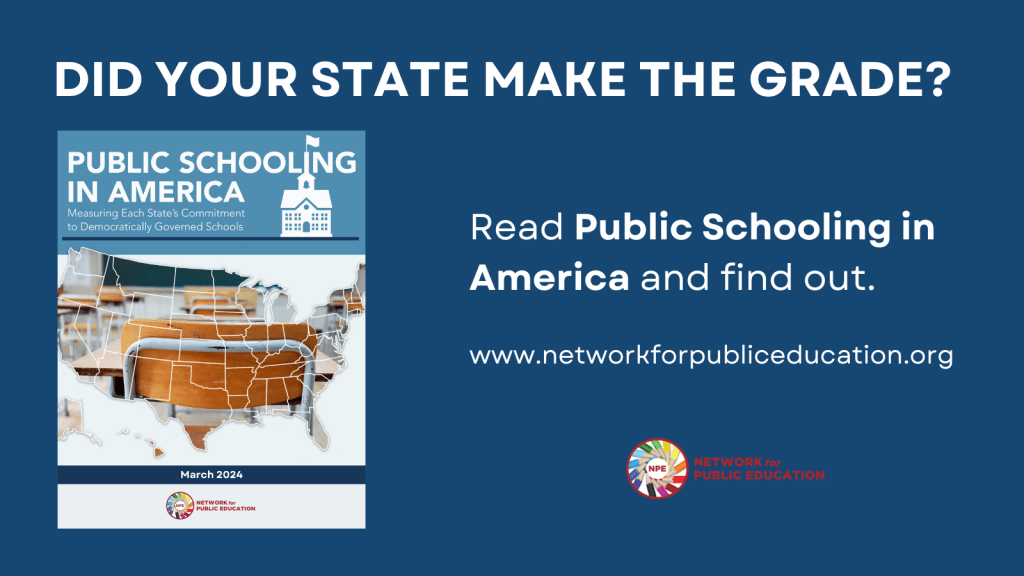
The Network for Public Education released a report card today grading the states on their support for democratically-governed public schools. Which states rank highest in supporting their public schools? Open the report to find out.

Measuring Each State’s Commitment to
Democratically Governed Schools

EXECUTIVE SUMMARY


Neighborhood public schools remain the first choice of the overwhelming majority of Ameri-
can families. Despite their popularity, schools, which are embedded in communities and gov-
erned by elected neighbors, have been the target of an unrelenting attack from the extreme
right. This has resulted in some state legislatures and governors defunding and castigating
public schools while funding alternative models of K-12 education.

This 2024 report, Public Schooling in America: Measuring Each State’s Commitment to
Democratically Governed Schools
, examines these trends, reporting on each state’s commit-
ment to supporting its public schools and the children who attend them.

What We Measure

We measure the extent of privatization in each state and whether charter and voucher laws
promote or discourage equity, responsibility, transparency, and accountability. We also rate
them on the strength of the guardrails they place on voucher and charter systems to protect
students and taxpayers from discrimination, corruption and fraud.

Recognizing that part of the anti-public school strategy is to defund public schools, we rate
states on how responsibly they finance their public schools through adequate and equitable
funding and by providing living wage salaries for teachers.

As the homeschool movement grows and becomes commercialized and publicly funded,
homeschooling laws deserve public scrutiny. Therefore, we rate states on laws that protect
children whose families homeschool.

Finally, we include a new expansive category, freedom to teach and learn, which rewards
states that reject book bans, and the use of unqualified teachers, intolerance of LGBTQ stu-
dents, corporal punishment, and other factors that impinge on teachers’ and students’ rights.

How does your state rank?

Tim Slekar has been active in the fight against privatization of public education for more than a decade. He has created videos, written articles, posted on blogs, and recently he has run a regular radio show. He’s always fighting for public schools, teachers, and students against the long and ugly arm of corporate reform.

He writes:

Dear Advocates for Democracy and Education,

As BustEDpencils expands to a daily radio show on Civic Media, we’re not just talking about education; we’re championing the cornerstone of a healthy democracy—robust public schools. Our show is a clarion call to defend and rejuvenate public education, the bedrock of informed citizenship and democratic engagement.

By tuning in daily, you’re not just listening; you’re actively participating in safeguarding our public schools. Each episode is a step towards a more informed, democratic society, where public education is celebrated and protected as a vital public good.

And we’re not stopping at the airwaves. We’re planning to bring the heart of our message into your communities with live appearances. These events will be more than just talks; they’ll be rallies for public education, celebrating its critical role in maintaining a thriving democracy.

Join this urgent mission. Tune in, engage, and prepare to welcome us into your community. Together, let’s ensure that public education remains a pillar of our democratic society.

In Solidarity for Public Education and Democracy,

Tim and Johnny

P.S. Every listener, every conversation, every community we visit is crucial in our fight to preserve and enhance public education. This journey is about more than just a radio show; it’s about nurturing the very roots of our democracy.

Timothy D. Slekar PhD
412-735-9720
timslekar@gmail.com
https://civicmedia.us/shows/busted-pencils

Thom Hartmann continues to amaze me, with his steady production of powerful articles. This one is especially important for the readers of this blog, whose primary purpose is to strengthen and protect our public schools.

Thom Hartmann writes:

In 1776, British economist Adam Smith published The Wealth of Nations, a book that laid out the principles that modern economies have operated under for centuries (with the exception of the Reagan Revolution years of 1981-2021). In addition to arguing for a strong domestic manufacturing base and high taxes on the wealthy, Smith pointed out that one of the things that most directly constitutes the wealth of a nation is its educated workforce and well-informed populace (as a result of that education).

From Thomas Jefferson creating the first tuition-free American college (the University of Virginia), to Horace Mann’s advocacy of public schools in the late 19th century, right up until 1954, this was an uncontroversial position. It’s why every developed country on Earth has a vibrant public school system and — with the exception of the US since Reagan ended free college in California — most developed countries offer free or near-free college to their citizens.

But in 1954, the US Supreme Court upset the education apple cart by declaring in their Brown v Board case that “separate but equal” schools, segregated by race, were anything but “equal.” That decision fueled two movements that live on to this day.

The first was the rightwing anti-communist movement spearheaded by the John Birch Society, which was heavily funded back then by Fred Koch, the father of Charles and David Koch. They put up billboards across the country demanding that Americans rise up and “Impeach Earl Warren,” who was then the Chief Justice of the Supreme Court, for requiring “communist” racial integration of our schools.

The second was the private, all-white “academy” movement that has morphed over the years into charter schools and the “school choice” movement of today. It received a major boost when the white supremacist co-founder of neoliberalism, Milton Friedman, published a widely-read and influential article in 1955explicitly calling for what he called “education vouchers” to fund all-white private schools to “solve the national crisis” the Court had created.

In 1958 when the Virginia Supreme Court went along with the US Supreme Court’s Brown v Board decision and ordered that state’s schools desegregated, the governor shut downevery public school in the state. Prince Edward County’s schools were still closed in 1964, when they were finally ordered to open by the courts.

Hundreds of “segregation academies” opened across the South; in Mississippi, for example, 41,000 white students left public schools to attend these academies in just the one year of 1969. Parents had to pay the tuition themselves, but they were willing to do so to avoid their children having to interact with Black, Hispanic, or Asian kids.

The turning point for the Republican Party was 1964, when President Johnson and a Democratic Congress passed and signed into law the Civil Rights Act. Shortly thereafter, one Southern Democratic politician after another changed party affiliation to the GOP so they could continue to argue against “forced integration” of public schools.

The Republican war on public schools burst into the open with the Reagan Revolution, when Education Secretary Bill Bennett oversaw a 30 percent cut in federal aid to public schools following Reagan’s promise to abolish the Department altogether. Every Republican running for president since has made a similar promise or claimed the need to end the Education Department.

Bill Bennett wasn’t shy about explaining why it was necessary to gut public schools, after the Supreme Court had ordered they must be racially integrated. Bennett wanted to privatize public education — as did Trump’s former Education Secretary, billionaire Betsy DeVos — and is probably most famous for his statement that gives us a clue as to why this idea of ending public education is so persistent in the GOP:

“If you wanted to reduce crime,” Bennett said on the radio, “you could, if that were your sole purpose; you could abort every Black baby in this country, and your crime rate would go down.”

LISTEN NOW · 0:17

Could it be that it’s all about keeping white children away from Bennett’s Black babies? Is simple racism what’s animating the GOP’s antipathy toward public education?

One clue is that the idea of ending public education in America goes back even farther than Bennett or Reagan to a single moment and a single court decision. 

When I was born, in 1951, Republicans loved public schools. Republican President Dwight Eisenhower led the charge to build gleaming new public schools all across the United States: I attended one, as did perhaps a majority of my generation.

But then came the Supreme Court, with their Brown v Board decision.

In 1957, President Eisenhower ordered the Little Rock, Arkansas, public schools desegregated. The “Little Rock Nine” — nine Black children trying to desegregate Little Rock Central High School — became nationally famous when Governor Orval Faubus prevented them from entering the school that fall, provoking Eisenhower to call up federal troops to escort the children to class.

Faubus called a referendum — an election — and the good citizens of Little Rock voted 19,470 to 7,561 to shut down their entire school system rather than comply with Eisenhower’s order. That, in turn, led back to the Supreme Court, which, in the fall of 1958, ruled unanimously in Cooper v Aaron that the Brown v Board desegregation order was, in fact, now the law of the land for public education.

In response, whites-only private schools and “academies” began springing up across the nation, many run by all-white churches. (Jerry Falwell tried, in 1966, to open an all-white school; in 1980 he became Reagan’s main advisor on merging the white supremacist faction of evangelical Christians — also triggered by Brown v Board — into the GOP.)

Thus, in 1958 the governor of Virginia closed all the public schools in racially mixed Warren County, Norfolk, and Charlottesville; Prince Edward County’s public schools remained closed for a full five years.

While that’s the foundational history of what has become the GOP’s war on public education, for most of the past 40 years Republicans have merely claimed vague libertarian principles when they try to explain what they ironically call “school choice.”

It wasn’t until Donald Trump gave them permission — and showed them how politically potent it could be — to unleash their inner racists that the GOP went public with overt white supremacy as a core value for the party.

While Critical Race Theory (CRT) was a little-known 1993 analysis of structural racism pioneered by Kimberlé Crenshaw and Derrick Bell taught only in law school, rightwing influencer Christopher Rufo popularized the term with an appearance on Tucker Carlson’s Fox “News” show.

From there, it echoed around the GOP for a few months before catching fire across rightwing hate radio, podcasts, and Fox. Pretty soon white supremacist militia members were showing up at school board meetings threatening members that “we know where you live.”

Republicans anxious to stoke the fears of their white racist base began inveighing against teaching CRT in public schools — even though such a thing had never happened — and passing laws so loosely worded as to bar any meaningful teaching or classroom discussion of America’s racial history.

All-white private schools funded with taxpayer dollars have become the darlings of Republicans. In most cases these schools don’t need to flout the law by declaring their segregated status: Black, Asian, and Hispanic parents most often simply aren’t interested in enrolling their children in schools that proudly proclaim they will not allow a drop of “CRT,” true American history, or real science education in their classrooms.

The issue of privatizing public schools came up in Arizona in 2018 with a statewide ballot initiative that would extend free school vouchers to every student in the state: it was defeated by voters by a 2:1 ratio. Writing for The Arizona Republic, columnist Laurie Roberts was unambiguous in her description of the state’s voters’ horror at the ballot initiative:

“Actually, they didn’t just reject it. They stoned the thing, then they tossed it into the street and ran over it. Then they backed up and ran over it again.”

Republicans in the heavily gerrymandered state, though, didn’t much care about the will of the voters. Appealing exclusively to their white racist “Christian” base, they pushed what was essentially that same proposal through the GOP-controlled state legislature and it was signed into law last year by Republican then-Governor Doug Doocey.

In giving every student in the state the ability to opt out of public education with a taxpayer-funded voucher, Doocey established a new benchmark in the war against racially integrated public schools that was matched this year by Florida, Arkansas, Iowa, and Utah.

Legislation to gut public schools and replace them with vouchers for private schools have failed in six states so far (Georgia, Texas, IdahoVirginiaKentucky, and South Dakota), but Republicans are not letting go. This year voucher bills were introduced in at least 24 states.

The fact that most of the nation’s public school teachers are union members has given Republicans another good reason, in their minds, to do everything possible to destroy public schools. As Trump’s former Secretary of State Mike Pompeo claimedlast year, in the minds of Republicans the American Federation of Teachers’ President Randi Weingarten is “the most dangerous person in the world.”

Republicans also love the fact that voucher programs mostly subsidize upper-income families, while educationally ghettoizing the children of low-income parents. Vouchers almost never cover all the costs of attending a private school, so they primarily serve as a government handout to the mostly upper-middle-class white families who already wanted to send their kids to today’s version of the segregation academies.

Once the public schools are largely dead, Republicans will begin lobbying to “reduce spending” by cutting the amount allocated for the vouchers, locking the emerging two-tier status of publicly funded education into place.

For the moment, though, private schools are a booming industry as a result of the GOP’s embrace of Friedman’s vouchers. In Florida, for example, they have virtually no rules or standards for the over-one-billion-dollars the state shovels into its private schools: while public schools must disclose their graduation rates, how they spend their money, and let anybody examine their curriculum, private academies have no such rules in many Republican-controlled states, even though they’re receiving public monies.

Many private schools across the country operate with untrained and uncertified “teachers,” have no clear standards for graduation, and refuse to teach “controversial” subjects like evolution, climate science, and the racial history of America.

Which brings us to organized religion, the other recipient of big bucks because of the school voucher movement. Schools affiliated with churches are now raking in billions every month across the US, and Republicans — who continue to push for unconstitutional things like mandatory public school prayer — pander daily to fundamentalists who don’t want their kids exposed to science or history.

Six corrupt Republicans on the Supreme Court legalized this practice of shoveling taxpayer funds to churches and religious schools in their notorious Carson v Makin decision last year. As Justice Sonya Sotomayor wrote in her dissent:

[In just five short years this Court has] “shift[ed] from a rule that permits States to decline to fund religious organizations to one that requires States in many circumstances to subsidize religious indoctrination with taxpayer dollars.” This decison “continues to dismantle the wall of separation between church and state that the framers fought to build.”

Which is exactly what the GOP wants. As SenDem recently wrote for Daily Kos:

“Laura Ingraham claimed that ‘a lot of people are saying it’s time to defund government education or at least defund it by giving vouchers to parents.’ Fox’s Greg Gutfeld similarly declared that private school vouchers are needed because public schools are ‘a destructive system’ and described teachers as ‘KKK with summers off.’

“Sen. Marco Rubio of Florida has called public schools ‘a cesspool of Marxist indoctrination.’ Donald Trump declared, ‘public schools have been taken over by the radical left maniacs.’ And Rep. Marjorie Taylor Greene of Georgia called them taxpayer-funded indoctrination centers that need to end, which is a bit ironic since she is the poster child for the necessity of funding public education.”

Sweden has been flirting with libertarianism for a few decades and was the first developed country to offer American-style school vouchers to all kids so they could attend private, for-profit public schools. Just a month ago, their government proclaimed the experiment a disaster and is trying to figure out how to shut down the private schools and re-establish a public education system.

Public schools were the great social and economic leveler for the last century of American history; Republicans want to end that and instead advantage wealthy children over their lower-income peers, particularly those whose skin is darker than Trump’s spray tan.

Public schools (and free college) made it possible for America to produce an explosion of invention and innovation throughout the mid-20th century; now other countries are surpassing us, as the dumbing-down of our kids has become institutionalized in Red state after Red state.

And public schools gave many students their first experience of interacting with people who look different from them and grew up under different circumstances, awakening many young people to the discrimination and unfairness inherent in how America has historically treated minorities.

All of which explains why Republicans so badly want to put an end to public education in America.

You might well wonder, as I did, why Republicans in Congress were conducting hearings about anti-Semitism in our nation’s elite private universities. That is normally the job of the Office of Civil Rights in the U.S. Department of Education. Historically and recently, Republicans have not been known as a party that worries overmuch about anti-Semitism or other forms of bigotry.

As a matter of fact, as this article in The Hill shows, the Republicans’ real concern is to stamp out DEI programs (diversity, equity, and inclusion) in higher education. Two of the three elite university presidents who were grilled by Rep. Elise Stefanik resigned, and she crowed about her victory. The conservative media treated Harvard University President Claudine Gay as an unqualified diversity hire. Liz Magill of the University of Pennsylvania also resigned after the hearing.

From the article:

Republicans say their departures are just the beginning of needed reforms at the schools.

“This is only among the very first steps on a very long road to recovering or returning to higher education its true and original purposes, which is truth-seeking,” said Jay Greene, senior research fellow in the Center for Education Policy at the Heritage Foundation.

Conservatives cheered the departures, which came after the two, as well as the Massachusetts Institute of Technology’s Sally Kornbluth, faced questions on campus antisemitism before the House Committee on Education and the Workforce.

Neither Elise Stefanik nor Jay Greene has shown interest in anti-Semitism in the past, to my knowledge. Neither issued statements to denounce the young fascists who marched with tiki torches in Charlottesville and chanted “The Jews will not replace us.” If they reacted to the slaughter of Jews at the Tree of Life synagogue in Pittsburgh, I am not aware of it.

An even bigger joke is for anyone at the Heritage Foundation to celebrate “truth-seeking,” when Heritage oversaw planning for the next term of Donald Trump, who has a well-documented record of telling thousands of lies. Heritage Foundation, clean your own house. Before you lecture others about “truth-seeking,” look in the mirror.

“Two down. One to go,” tweeted committee member Elise Stefanik (R-N.Y.). “Accountability is coming.”

“The long overdue forced resignations of former Presidents Claudine Gay and Liz Magill are just the beginning of the tectonic consequences from their historic morally bankrupt testimony to my questions,” Stefanik added in a statement to The Hill, mentioning an official probe into the schools that the panel has announced.

“The investigation will address all aspects of a fundamentally broken and corrupt higher education system — antisemitism on campus, taxpayer funded aid, foreign aid, DEI, accreditation, academic integrity, and governance,” she said, using an acronym for diversity, equity and inclusion programs…

But their biggest target recently has been DEI programs, making the case that they have been more harmful than helpful to students…

Greene said he is hopeful “additional people are going to have to be removed, both leaders of universities and their underlings, because they’re also significant actors in this. It’s not just at the top, but it’s kind of throughout these institutions.”

He also specifically called for the dismantling of DEI efforts on campus and disciplines such as gender studies, another popular GOP target.

Such efforts have been in motion long before the shake-ups at UPenn and Harvard.

In Texas, a law banning diversity programs at public universities took effect in the new year. And last year, Florida Gov. Ron DeSantis (R) also signed a bill to defund DEI programs at public universities.

A tracker by the Chronicle of Higher Education last year found 40 bills had been introduced in states across the country to try to restrict DEI programs, diversity statements and mandatory diversity training at schools.

It’s disgusting to see a feigned concern about anti-Semitism used as a stalking horse to dismantle DEI programs and as a pretext for inserting Big government into the policy making process in private higher education.

As long as Republicans control either House of Congress, we can anticipate the rise of a new McCarthyism, purging the curriculum and professors.

At last, Rep. Stefanik, have you no shame?

Arthur Camins is a retired educator. This post appeared in The Daily Kos.

Open the link to read the article in full.

He writes:

Liar, Liar. Pants on Fire. The lies from the powerful, especially Republicans, have risen to stunningly Orwellian 2 + 2 = 5 levels. The lies that protect their wealth and power have been quite successful at gaining wide acceptance. They keep at it because they know most of us reject a grossly inequitable society in which only some people enjoy a stable secure life. Inevitably, the truth seeps through the cracks in their wall of deceptions. Most Americans want fairness and access to decisions that affect our lives. The purveyors of self-protecting fabrications are afraid of the truth. Increasingly, they resort to authoritarianism, outlawing truth-telling, spreading misinformation, and blocking democratic processes.

The well-trod lies are designed to sound like common sense but are demonstrably false. They include:

Providing parents with choices through school vouchers and charter schools improves achievement and equity.

No, they support the privileged, starve and undermine public education, and get the rest of us to fight amongst ourselves for scraps.

The competitive free market will reduce costs and provide choices to consumers to improve education, healthcare, and housing.

No, the free market never reduced the cost of any of these or made these necessities affordable to everyone. Instead, the free market continues to make profits for a few, provides higher quality for those with money to spare, and leaves the rest of us with lower quality or nothing at all.

People are poor because they are lazy or stupid, so social support is a waste of money.

No, our economic and social systems ensure that there are haves and have-nots, haves pass on unearned wealth to their children, that taxes on the rich remain unfair, while trying to convince the rest of us that our struggles are our fault.

Taxing wealth reduces the incentive to innovate and slows economic growth.

No, the United States taxed wealth at far higher rates in the past without stopping us from becoming the world’s largest and most innovative economy. Increasing inequity disincentivizes and slows innovation by keeping too many of us struggling to make ends meet.

These are the lies that the powerful repeat again-and-again, wherever and whenever they can. They assume we are gullible, will fall back, and accept our fate. Our lives do not need to be this way if we organize and if we vote.

The 2024 election is a critical test for voters. Will we accept our inequitable, powerless fate or fight back? Report after report tells us that so many people will, in disgust, stay home that the authoritarian, wealth-protecting, anti-democratic liars will win control of Congress and the presidency. Life’s necessities still cost too damn much, so hearing from Democrats that the inflation, employment, and average wages are getting better falls on deaf ears. Voters–especially the young adults and people of color who Democrats need to win– see that in 2023, our country once again finds money for war but too little to help people. The enduring perception is that no one is on their side.

If Democrats want to win elections, they need to tell the unvarnished truth: The biggest, most enduring lie is that inequity is inevitable. Democrats: Don’t tell people to trust you. Tell them to organize! Tell them:

Do you want to know what Democrats should say? Open the link.

One of the most memorable books I have read is The Spirit Level: Why Greater Equality Makes Societies Stronger, by Richard Wilkinson and Kate Pickett. They argue that the happiest societies are the ones with the most equality. If this is true, and the authors persuaded me that it is, then our economic policies should aim to reduce income inequality and wealth inequality. But we have gone in the other direction, with government policy increasing inequality. Lobbyists for the 1% have funded political campaigns to lower their taxes, gut unions, and protect inherited wealth. Their campaigns on the surface are about culture war issues (abortion, drugs, race, gay rights), but what they are really promoting are tax cuts for the rich.

Thom Hartmann posted this chapter from his book The Hidden History of Monopolies: How Big Business Destroyed the American Dream.

He writes:

As productivity continued to rise, due to increasing automation and better technology, so too would everyone’s wages. Or so went the theory.

The glue holding this logic together was the then-top marginal income tax rate. In 1963, just before the Time article was written, the top marginal income tax rate was 90%. What that did was encourage CEOs to keep more money in their businesses: to invest in new technology, to pay their workers more, to hire new workers and expand.

After all, what’s the point of sucking millions and millions of dollars out of your business if it’s going to be taxed at 90% (or even the 74% that President Lyndon Johnson lowered it to in 1966)?

According to this line of reasoning, if businesses were suddenly to become way more profitable and efficient thanks to automation, then that money would flow throughout the business—raising everyone’s standard of living and increasing everyone’s leisure time, from the CEO to the janitor.

But when Reagan dropped that top tax rate down to 28%, everything changed. Now, as businesses became far more profitable, there was a far greater incentive for CEOs to pull those profits out of the company and pocket them, because they were suddenly paying an incredibly low tax rate.

And that’s exactly what they did.

All those new profits, thanks to automation, that were supposed to go to everyone, giving us all bigger paychecks and more time off, went to the top.

Suddenly, the symmetry in the productivity/wages chart broke down. Productivity continued increasing, since technology continued improving, and revenues and profits kept increasing with it.

But wages stayed flat.

And, again, since greater and greater profits could be sucked out of the company and taxed at lower levels, there was no incentive to reduce the number of hours everyone had to work.

In the 1950s, before that Time magazine article predicting the Leisure Society was written, the average American working in manufacturing put in about 42 hours of work a week. Today, the average American working in manufacturing puts in about 40 hours of work a week. This means that even though productivity has increased 400% since 1950, Americans in manufacturing are working, on average, only two fewer hours a week.

If productivity is four times higher today than in 1950, then Americans should be able to work four times less, or just 10 hours a week, to afford the same 1950s lifestyle when a family of four could get by on just one paycheck, own a home, own a car, put their kids through school, take a vacation every now and then, and retire comfortably.

That’s the definition of the Leisure Society: 10 hours of work a week, and the rest of the time spent with family, with travel, with creativity, with whatever you want. And if our tax laws and our corporate anti-monopoly laws that restrained the worst corporate bad behavior had stayed the same as they were in 1966, we might well be either working 10 hours a week for around $50,000 a year in income, or working 40-hour weeks for over $200,000 a year.

But all of this was washed away by the Reagan tax cuts. Those trillions of dollars that would have gone to workers? They went into the estates and stock portfolios of the top 1%. Combine this with Reagan’s brutal crackdown on striking PATCO (Professional Air Traffic Controllers Organization) members that kicked off a three-decades-long assault on another substantial pillar of the middle class—organized labor—and life today is anything but leisurely for working people in America.

More Unequal than Rome

Instead of leisure, working people got feudalism.

From 1947 to 1981, all classes of Americans saw their incomes grow together; as a result of the Reagan tax cuts, that era ended and a new era of Reaganomics began. Since then, only the wealthiest among us have gotten rich from economic boom times.

Today, workers’ wages as a percentage of GDP are at an all-time low. Yet, corporate profits as a percentage of GDP are at an all-time high.

The top 1% of Americans own 40% of the nation’s wealth. In fact, just 4 Americans own more wealth than 150 million other Americans combined, and they pay lower taxes than anybody in the bottom half of American families economically.30

Walmart, Inc., the world’s largest private employer, personifies this inequality best. It’s a corporation that in 2011 gained more revenue than any other corporation in America. It raked in $16.4 billion in profits. It pays its employees minimum wage.

And the Walmart heirs, the Walton family, who occupy positions six through nine on the Forbes 400 Richest Americans list, own roughly $100 billion in wealth, which is more than the bottom 40% of Americans combined. The average Walmart employee would have to work 76 million 40-hour weeks to have as much wealth as one Walmart heir.

Through some interesting historical analysis, historians Walter Scheidel and Steven Friesen calculated that inequality in America today is worse than what was seen during the Roman era.31 Thus the top 1%, just like the Roman emperors, got their Leisure Society, and they’ve used their financial power to capture the US government to protect their Leisure Society.

Christiane Amanpour interviewed Robi Damelin, an Israeli peace activist, about her organization’s work to replace hatred with compassion. Damelin’s teenage son was killed by a Palestinian sniper 21 years ago, and she has dedicated her life since then to building a parents group of both Israelis and Palestinians.

She advocates listening to the stories of others. She recognizes the terrible suffering of Palestinians, and she works with Palestinian friends to foster understanding.

The hope for the future of both Israelis and Palestinians lies with enlightened leadership, which neither side has now. Damelin remains steadfast in believing that change will come, built on a mutual desire to end the cycle of fear and death.

Damelin speaks for me, and I hope, for most people. She wants peace and dignity for all sides, and an end to shouting and hatred, which only breeds more shouting and hatred.

Please watch the interview. It is inspiring.

What an embarrassment for the U.S. Department of Education!

Carol Burris writes on Valerie Strauss’s Washington Post blog, “The Answer Sheet,” that Secretary Miguel Cardona just awarded one of its largest grants ever to expand a Hillsdale College charter school in Ohio. Hillsdale is closely tied to the conservative Christian movement and to Republican leaders such as Donald Trump, Governor Ron DeSantis of Florida, and Governor Bill Lee of Tennessee.

Hillsdale’s history program is called “the 1776 curriculum,” intended to refute the ideas of journalist Nicole Hannah-Jones’ controversial “1619 Project.” Hannah-Jones argued that American history began with the arrival of African slaves in 1619. To counter her narrative, the Trump administration in its waning days created “the 1776 Commission” to produce a quick version of a patriotic history. On President Biden’s first day in office, he abolished the 1776 Commission. Hillsdale College, however, continued the work of writing a full U.S. history curriculum based on the work of the 1776 Commission and made it available to schools that wanted history as it used to be taught: with great men, high ideals, and unblemished patriotism.

Hillsdale is now associated with a chain of charter schools that have adopted its Christian worldview and the 1776 curriculum. As Burris, executive director of the Network for Public Education explains, a Hillsdale charter just won nearly $2 million from the federal Charter Schools Program. CSP is administered by the U.S. Department of Education. The charter made claims about its location and its demographics that are “misleading.”

Trying to think of an analogy to Secretary of Education Miguel Cardona giving a large grant to a Hillsdale charter school: imagine Secretary of Education Betsy DeVos giving $2 million to a charter school for transgender children. Neither seems likely. But one scenario happened.

Valerie Strauss introduces Burris’s column.

A recent federal audit had a bit of bad news for the U.S. Education Department’s Charter Schools Program (CSP), which has provided more than $2.5 billion in grants to help open or expand charter schools. The audit by the department’s Office of Inspector General found that the CSP office may not have had “reliable information needed to make informed decisions” about continuing funding for charter schools with program grants.

There was more in the audit, which you can read about here, but this post looks at a different problem facing the CSP: schools with highly problematic applications that win millions of dollars of federal money anyway.

Charter schools are publicly funded but privately operated, some of them as for-profit entities, and they educate about 7 percent of U.S. schoolchildren. The 30-year-old charter sector has been riddled with financial and other scandals over the years, although supporters say that the problems these schools face are expected growing pains and that they offer families an important option to schools in publicly funded districts. Critics say that they are part of the movement to privatize public education and that some states have lax charter school laws that do not properly regulate them.

This post was written by Carol Burris, an award-winning former New York high school principal and now executive director of the advocacy group called Network for Public Education, which is an alliance of organizations that advocates for the improvement of public education and seeks legislative reform of charter schools. Burris has written previously on the charter school program for Answer Sheet (for example, here and here). She has chronicled how the program spent hundreds of millions of dollars on charter schools that never opened or closed not long after opening.

Burris writes about the funding application of a charter school in Ohio, the Cincinnati Classical Academy, and says that her organization, along with a group of Ohio legislators and other organizations, have asked Education Secretary Miguel Cardona to rescind the school’s nearly $2 million CSP grant. I asked the school to comment and will add its response if I get one. I asked the Education Department about the letter, and a spokesman said this in an email:

“The U.S. Department of Education (Department) is committed to supporting state and local efforts to increase school diversity and reduce racial and socio-economic isolation in schools, including through the Charter School Program (CSP). There are multiple safeguards in place to ensure the integrity of CSP applications and funded grants. For example, all CSP applicants must provide attestations confirming the accuracy of information submitted in their application. False, fictitious, or fraudulent statements or claims may subject applicants to criminal, civil, or administrative penalties. Such safeguards are in place to help ensure charter schools serve communities well.”

By Carol Burris


An invitation to fiction writing. That is how Mike Winerip described the federal Charter School Program (CSP) grant process in a 2012 New York Times story, a characterization based on his investigation of a New Jersey charter school, which, despite three failed attempts to open and an application full of “misrepresentations,” had secured a CSP grant.

This issues didn’t go away. The All Football Club of Lancaster, Pa., an unauthorized charter school with no community support, submitted an often-incoherent application and yet won $1.2 million in 2020. A school run by a for-profit operator immersed in self-dealings and a segregation academy turned charter school cashed in on a North Carolina grant.

But the prize for the most inventive story to secure a CSP grant may belong to the Cincinnati Classical Academy (CCA), a Hillsdale College member school, for securing a nearly $2 million grant. CCA, which prides itself on teaching virtue, asked for the grant on the basis of its claim that it was closing the achievement gap and serving disadvantaged students, never reporting that only 16 percent of its students are economically disadvantaged and that 2 percent are Black — a starkly different student body from the overwhelmingly disadvantaged and majority-Black Cincinnati Public School students, who, CCA says, it wants to save from poverty.

Cincinnati Classical Academy


Cincinnati Classical Academy is located on a cul-de-sac in a leafy residential suburb of Cincinnati called Reading. The school’s website features a motto and a coat of arms, and plays a video showing the school building with a cross atop a tower at the entrance as well as a large American flag. It currently runs from kindergarten through seventh grade but says it plans to add a grade each year until it becomes a full K-12 school.

It takes considerable digging on its website to realize that CCA is a charter school, not a tuition-free Christian private academy. Its headmaster’s message speaks of morals, virtue and “old-fashioned” methods. Pictures of the gymnasium show a large crucifix on the wall next to an American flag. In a photograph of a school hallway lined with posters depicting the school’s virtues, Mary and the infant Jesus from Botticelli’s “Madonna of the Magnificat” illustrates the virtue of humility. To illustrate gratitude, CCA shows a family praying before a meal.

Nearly all of the uniformed children featured on the website are White. There is no mention of a provision for free lunch on the school’s webpage, which features catered lunches students can purchase in full or a la carte.

Although CCA is only in its second year, it has the status of being a member school of Hillsdale College’s K-12 initiative, which entitles it to free curriculum, training and consultation from the small, nondenominational, conservative Christian college in Michigan. Hillsdale President Larry Arnn is an ally of former president Donald Trump as well as of Trump’s former education secretary, Betsy DeVos, and “distinguished fellow” Christopher Rufo, an activist who has fueled the culture wars.

Hillsdale provides support for CCA through its Barney Charter School Initiative, which began in 2010 with a half-million-dollar contribution from the Barney Family Foundation and which has opened a few dozen charter schools across the country. Hillsdale College’s mission is to maintain “by precept and example the immemorial teachings and practices of the Christian faith,” while the mission of its K-12 charter schools includes a call for “moral virtue.” A Hillsdale K-12 civics and U.S. history curriculum released in 2021 praises conservative values, criticizes liberal ones and distorts civil rights history.

According to its 990 tax forms, the Barney Family Foundation gives to health and child-centered charities along with Americans for Prosperity, the Cato Institute, the Hoover Institution, the Heartland Institute, the State Policy Network, the Friedman Foundation for Educational Choice, the Heritage Foundation, and other right-wing foundations and think tanks.

Stephen Barney, a trustee emeritus on the Hillsdale College Board, has been one of its most generous donors. Between 2010 and 2019, the Network for Public Education identified more than $4 million earmarked for Hillsdale from Barney’s foundation, excluding unlisted donations in 2011 and or donations before or after those years.

Despite Hillsdale College’s frequent boasts of rejecting federal money (and the federal regulations that come with it, including Title IV provisions), the college’s affiliated charter schools eagerly dip into the federal Charter School Program through state entitlement grants. To date, the Network for Public Education has identified more than $16.75 million given to Hillsdale charters for school start-ups or expansions.
The grant to CCA is the first given directly by the federal department to a Hillsdale-connected charter school.

The questionable narrative

Applicants for Charter Schools Program Developer Grants fill out extensive applications in making the case for why their schools deserve the funds. According to the Federal Register, which calls for applications, the first purpose of the CSP is to “expand opportunities for all students, particularly for children with disabilities, English learners, and other traditionally underserved students, to attend charter schools.”

However, CCA caters to the well-served in disproportionately high numbers. State records show that it had no English language learners in 2022-2023 when it applied. Students with disabilities were enrolled at less than half the rate of the Cincinnati Public Schools. More than 80 percent of the students in Cincinnati Public Schools were economically disadvantaged compared to fewer than 17 percent at CCA. Other charter schools in Hamilton County had no problem attracting economically disadvantaged students; their average rate topped 85 percent.

The only category in which CCA exceeds a demographic of Cincinnati Public Schools is White students. More than 82 percent of CCA students are White, compared to 20 percent in the public school district.

So what can a school like this do to get a grant intended for schools that serve underserved kids? It didn’t reveal itself.

CCA cited Cincinnati Public Schools demographics to make its case in its application even though it is located in the Reading Community City School District, which is whiter, wealthier and has better ratings. Then it provided another handful of schools within five miles for comparison, none of which are in Cincinnati Public Schools. The school also talked in its application about closing the achievement gap and serving diverse, underserved students even though its unrevealed Black student population (2.4 percent) is so tiny the state does not even give it a gap-closing measure.

But where the school best revealed itself is in its list of goals and objectives. Not only did it fail to share its lack of diversity, it included no goals or objectives to address it. The application does not discuss the need to increase the number of English language learners, homeless children, students with disabilities, or students who get free or reduced-price lunches to level the enormous gap between the school’s proportions and the greater Cincinnati area.

If achieved, the goals in the application prepared by Kentucky’s Adkins and Company and signed off by the president of the school’s governing board will not disrupt the status quo. CCA will be able to meet them and keep the federal dollars flowing for four years while maintaining the reality projected on its website — that it is a magnet for White, Christian conservative families to escape the area’s diverse schools.

The CSP review process

If you have ever applied for a mortgage, you remember the extraordinarily detailed evidence you must provide to support every claim. That is not the case when “free government money” for charter schools is at stake.

The curious lack of a demographic profile of the school’s students was never a concern for the reviewers. CCA received the highest score of all applicants — 101. One of the three reviewers gave the school a perfect score. You can find the application and the reviewers’ scoring here.
Reviewers, who are solicited from the charter school world, were satisfied that “comprehensive data is provided, revealing the underperformance of Cincinnati public schools and underscoring the necessity for a high-quality alternative that offers families a viable choice,” even though the school is not a part of Cincinnati Public Schools.

The reviewers bought the same old narrative — a high-poverty district is bad, so bring in a charter school. They parroted back what the applicant said and praised Hillsdale College’s Barney Charter School Program.

Inexplicably, given the CSP’s checkered history, the Education Department increased the maximum amount of Developer Grants per charter school from $1.5 million to $2 million this year, and CCA got nearly every penny of the limit: a grant for $1,991,846. Grants are usually for five years, but CCA had been open for a year when it applied, so it got a four-year grant. The average amount per year is $300,000 but the Education Department gave CCA nearly half a million dollars a year — on the basis of claims that even cursory checks on state data or a visit to the school’s website would show to be untrue.

Back in Ohio, public education advocacy groups are outraged but not surprised. Bill Phillis, the executive director of the Ohio Coalition for Equity and Adequacy of School Funding, told me that the charter industry in his state “has been rife with financial and academic fraud and corruption.” He also said the CCA’s application for a development grant, with its “deception and disingenuous information,” is “typical of the charter industry in Ohio.”

The Network for Public Education sent a letter to U.S. Education Secretary Miguel Cardona protesting the grant and asking that it be rescinded. It was signed by Phillis’s coalition, along with U.S. Rep. Greg Landsman (D-Ohio), five state legislators who represent the area, the Ohio PTA, both state teachers unions, the Cincinnati NAACP, and more than a dozen public education, civil rights, local teacher associations and advocacy groups.

Other 2023 CSP awardees are being challenged. The St. Louis Board of Education has passed a resolution protesting the more than $35 million CSP grant received by the billionaire-funded Opportunity Trust to open more charter schools in Missouri — nearly all of which will, because of state law, be located in St. Louis or Kansas City. According to the St. Louis Post-Dispatch:

“The group misrepresented its relationship with SLPS in its application to the U.S. Department of Education, the resolution states. The school board “does not have a working relationship with the Opportunity Trust, does not collaborate with the Opportunity Trust and has opposed efforts by the Opportunity Trust to enact legislation to divert district funds to charter schools,” it [the resolution] reads.”

CSP grant applications that have been misleading and deceptive have still been rewarded with millions of taxpayer dollars from CSP. Whether the source of the problem is the department’s process, a less-than-rigorous application, the reviewer selection process or faulty regulations, awards that are based on disingenuous claims and deceit do not serve children or taxpayers well.

Until something changes, the statement that applicants sign — “I am aware that any false, fictitious, or fraudulent statements or claims may subject me to criminal, civil, or administrative penalties. (U.S. Code, Title 18, Section 1001)” — should be enforced, and the secretary should use his authority to terminate the grant.

Peter Greene has been following the debate over voucher legislation in Wyoming, where they have failed until now. Surely some Republicans must be following what happened to vouchers in Texas, where a significant number of Republicans representing rural districts voted them down to protect their community public schools. They knew their schools needed funding, not competition. What states like Wyoming need is a public referendum on vouchers: let the public decide. Could it be that the politicians know that no state referendum on vouchers has ever passed?

Greene writes:

Attempts have been made to sell a school voucher bill in the Wyoming legislature, like the Wyoming Freedom Scholarship Act (because “scholarship” and “freedom” are more popular terms than “voucher”) earlier this year, but they have all failed. Now a new variation on the theme is aiming at a place on the 2024 schedule.

Oddly enough, the bill comes from Speaker of the House Albert Sommers, a Republican who actually helped block the Freedom Scholarship Act. But he thinks this alternate form will work better. Opponents disagree. Actually, some supporters disagreed, too– State Senator Bo Biteman said this new version was too watered down and was a “crap sandwich,” and so, as we’ll see, GOP reps managed to un-water the bill.

Some key features.

The bill runs on $40 million taken from the general fund. Of that $40 million, $12 million (30%) goes to fund preschool education. Because if there’s one technique that voucher proponents have learned, it’s to team up your unpopular voucher plan with something that people want.

The rest of the funding would go to ESA vouchers.
The bill uses the usual foot-in-the-door feature of an income cap for receiving the vouchers. This bill sets the cap at 250% of federal poverty limit, which adds up to $75,000 for a family of four. Median household income in Wyoming is $68,000. One legislator unsuccessfully tried to boost this up to 350% ($105K). At this point, nobody should be fooled by the “we’re just doing this to rescue the poor kids” line, as we have seen multiple states modify their program with ever-increasing caps or simply getting rid of the cap entirely.

With that expansion of eligibility, we keep seeing voucher program costs explode to budget-busting extremes.

Voucher amount would be up to $5,000. According to the website Private School Review, average private school tuition in Wyoming is $8,719 per year.

In one feature that is not common to voucher laws, the bill proposes that the Department of Education would certify vendors eligible to be paid with the taxpayer-funded vouchers. (That was not part of the Freedom Scholarship Act.) But a legislator successfully added an amendment, typical of current voucher law, that the state can’t interfere with the private school’s curriculum or admission policies, meaning that the school could teach religion, flat earth science, creationism, and racial supremacy if it so desired, as well as discriminating against whatever applicants it so desired.

In practice, what that means is that religious schools can accept vouchers while offering religious indoctrination and religion-based discrimination (e.g. the Illinois voucher school that requires families to be born-again Christians)
And another legislator successfully stripped the portion of the bill that voucher-using students had to take the same state tests as public school students. Rep. Karlee Provenza pretty well captured what all these changes mean.

“When we remove that testing standard, we are moving away from saying is government money being well spent?” Provenza said. “We’re not regulating choice, we’re regulating accountability of our state funds.”

True enough, but current voucher theory says that a voucher bill isn’t non-crappy unless it’s stripped of accountability and oversight. So if Wyoming is going to have school vouchers, they should be as unaccountable and unregulated as possible. Kiss those dollars goodbye, taxpayers, and don’t ask where they went or how effectively they were spent. Freedom!

The bill will still have to clear some hurdles, including a state constitution that prohibits the use of “any portion of any public school fund” for private schools (Article 7, Section 8).

Wyoming voucher advocates have struggled with this, and the argument seems to boil down to:

1) Once we hand the money over to the parents, it is transformed into private money and so there’s no problem!

2) Supreme Court thinks public money should absolutely finance the exercise of religion, so if this makes it all the way to SCOTUS, they will be on our side.

So we’ll see. There are unique features to a voucher initiative in Wyoming. For one, funding vouchers by having “the money follow the child” would never fly, because Wyoming schools have wildly different per pupil costs. In 2019-2020, Laramie #1 spent $14,582 per student, but the very rural Sheridan district (90 students) spent $41,176 per student. That means Wyoming is better inclined to fund vouchers separately from public education. They could, in fact, be the first legislature to be honest and say, “We believe in choice so much that we are going to raise your taxes to fund it.”

For another, there’s that state constitution, exactly the same sort of challenge that sank a voucher proposal in Kentucky.

Other state constitutions, such as Florida and Ohio, ban public funding for religious schools, but that has not been an obstacle to GOP politicians.