Archives for category: Environment

Anand Giridharadas is a remarkable thinker and writer. In this post, he ties together the legacy of a very wealthy man who funded the fight against climate change and the terrible fate of his great-granddaughter Janie, who died in the flood in the Hill Cihntry of Texas.

He wrote:

In April 2013, Joe Barton, a Republican congressman from Texas, made a statement that transcended the traditional obscurity of House Subcommittee on Energy and Power proceedings to trigger national headlines. “Republican Congressman Cites Biblical Great Flood To Say Climate Change Isn’t Man-Made,” declared BuzzFeed.

In a hearing about the Keystone pipline, Representative Barton, whom The New Yorker once described as one of “Washington’s most vociferous — and, arguably, most dangerous — climate change deniers,” played the denier’s game of delinking human activity from weather events: “I would point out that if you’re a believer in the Bible, one would have to say the Great Flood is an example of climate change and that certainly wasn’t because mankind had overdeveloped hydrocarbon energy.”

Three months later, Barton received a campaign contribution from William Herbert Hunt, an oil baron in Dallas. It was neither the beginning nor the end of their alliance. According to the Open Secrets database, Hunt had already donated to Barton about ten times since 2005. And Hunt would go on to donate to Barton another half dozen times, as well as to the Texas Freedom Fund, a political action committee linked to Barton. Though most of Hunt’s donations were to Barton, he also donated to other climate deniers and foes of environmental protection, such as Christi Craddick, David McKinley, Dan Sullivan, and Dan Patrick, who once said former President Barack Obama “thinks he can change the weather…because he thinks he’s God.”

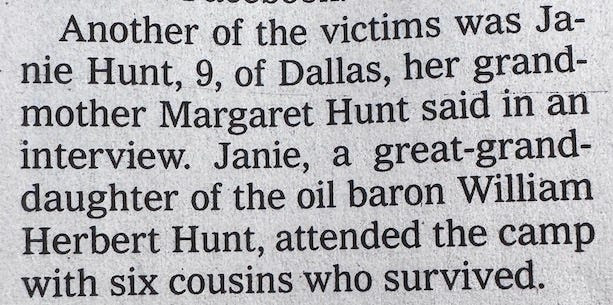
I have not been able to get the Hunt family out of my heart after I learned from The New York Times over the weekend that one of William Herbert Hunt’s great-grandchildren, Janie Hunt, all of 9, was among the dozens tragically killed in those Texas floods that were biblical in proportion, if not in explanation. Remarkably, Janie was one of seven cousins who attended the camp, and the only one to die.

Now, I know how the internet works. I know people pounce on news items like this to make heartless, cruel comments. The object of this essay is very different from that.

I am a father, and I know what I’d do to protect my children’s lives. The answer is anything. I hope I live one day to become a great-grandfather. William Herbert Hunt, according to this Dallas Morning News obituary, passed in April 2024, at 95, a life long enough that he got to enjoy more than 72 years of married life, see his children and grandchildren grow and thrive, and even get to see 35 great-grandchildren of his line.

I have to imagine that Hunt, like me, would have done anything, absolutely anything, for his family. I even have to imagine that, if, by impossible magic, you could go back in time and a little birdie could whisper that one day a catastrophic flood, made more probable by climate changemade worse by fossil fuels, would claim one of his great-grandchildren at summer camp, Hunt might have reconsidered fundamental things.

I have to believe that, because I refuse to believe that being an oilman makes you any less human. When the equation is made that simple, anyone would do the right thing. Anyone would do what it takes to save their own flesh and blood. But when it becomes more abstracted — when one’s activities indirectly cause X, which indirectly causes Y, which sometimes makes Z happen more often than usual — the mind loses its clarity. When no individual happening can be definitively linked to climate change, the deniability, the not-knowing, grows easier still. Suddenly a human being can go from doing anything to save their kin to doing nothing to save everyone’s. A person who, I have to imagine, would have given his own life for his great-granddaughter’s donates to those who have fought for a world that makes deaths like hers more likely.

Source: OpenSecrets.org

I am not writing to accuse one man. On the contrary, this story of a great-grandfather and his great-granddaughter is a story of a whole country and its descendants. As always, some will say the death of children should not be politicized. I hear that. But, also, what is politics for if it’s not a debate about stopping the death of children?

I have sat with this story since I read the Times paragraph above. It has given me a pit in my stomach. I guess what one does with that is write. There is no glib I-told-you-so here. This is about what kind of great-grandparent all of us want to be, collectively. Do we want to put our heads down, do our work, justify it however we can justify it, donate to people who defend our interests, ignore the gathering evidence that we are on a path that will kill many of us and, at some point, take down the livable world?

Or do we want to be the kind of great-grandparent who right now is acting to save great-grandchildren who aren’t even born yet, but who one day, beside some river, surrounded by inner tubes and kayaks and Crocs and flip-flops and cabins and bunk beds and singalongs and brightly colored blankets — the kind of elder who defends those lives and their right to glorious summers even before we know their names?

What does it take to be that kind of great-grandparent now? It takes fighting back against the war on science that makes it harder for climate scientists and weather forecasters to do their jobs. It takes pushing back against extractive industries and their political protectors who would sell our future for a song, and who have made it unsafe for young girls to enjoy a Christian camp. It takes a campaign of media and organizing to educate people about the fact that a cabal of wealthy, well-connected corporate overlords is profiting at the expense of a future of carefree summers.

I am still sitting with the pit in my stomach. My heart goes out to the Hunt family, to those six surviving cousins who must be feeling so many awful things that children should never have to. They are feeling things many others have already had to feel, and that more and more of us are going to be feeling if we continue down this road.

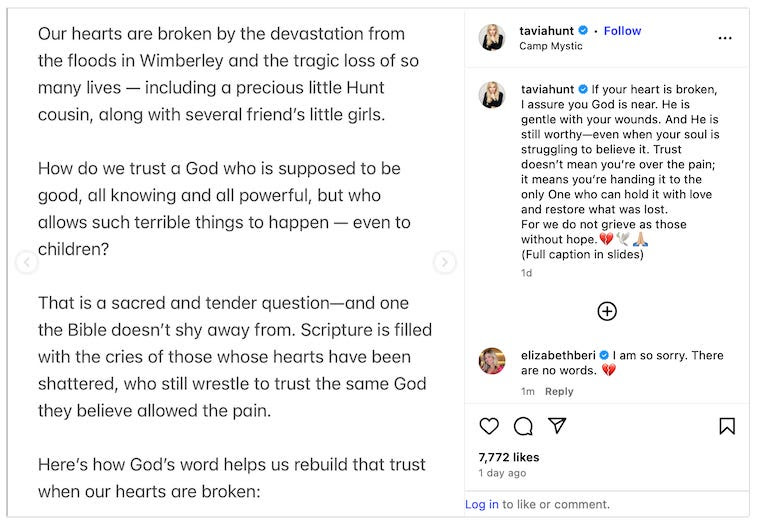
On Instagram, an adult cousin of Janie, Tavia Hunt, who is the wife of Clark Hunt, the owner of the Kansas City Chiefs football team, shared the family’s pain and raised the old Jobian question of how to sustain faith in the wake of such inexplicable tragedy.

I am not a religious person, but my heart goes out to her, too. And, whether or not you believe in the god she cites above, it is also, of course, people who let things happen in this world we live in. It is also we who allow things to happen to us. And part of me wonders if, even hopes that, there might be an awakening from a story that connects cause to effect, upstream to downstream, more clearly than usual in a crisis that has long suffered from nebulousness. Perhaps this family, out of this horror, can help rouse the rest of us to become the great-grandparents our descendants deserve.

Since this is a mostly education blog, I have covered the budget debate by focusing on what the GOP is doing to maim public schools and enrich private (especially religious schools). In the past, Republicans were strong supporters of public schools. But the billionaires came along and brought their checkbooks with them.

The rest of the Ugly bill is devastating to people who struggle to get by. Deep cuts to Medicaid, which will force the closure of many rural hospitals. Cuts to anything that protects the environment or helps phase out our reliance on fossil fuels. Well, at least Senator Schumer managed to change the name of the bill, new name not yet determined.

One Republican vote could have sunk the bill. But Senator Murkowski got a mess of pottage.

David Dayen writes in The American Prospect:

Welcome to “Trump’s Beautiful Disaster,” a pop-up newsletter about the Republican tax and spending bill, one of the most consequential pieces of legislation in a generation. Sign up for the newsletter to get it in your in-box.

By the thinnest of margins, the U.S. Senate completed work on the One Big Beautiful Bill Act on Tuesday morning, after Sen. Lisa Murkowski (R-AK) decided that she could live with a bill that takes food and medicine from vulnerable people to fund tax cuts tilted toward the wealthy, as long as it didn’t take quite as much food away from Alaskans.

The new text, now 887 pages, was released at 11:20 a.m. ET. The finishing touches of it, which included handwritten additions to the text, played out live on C-SPAN, with scenes of the parliamentarian and a host of staff members from both parties huddled together.

At the very end, Senate Minority Leader Chuck Schumer knocked out the name “One Big Beautiful Bill Act” with a parliamentary maneuver, on the grounds that it was ridiculous (which is hard to argue). It’s unclear what this bill is even called now, but that hardly matters. The final bill passed 51-50, with Vice President JD Vance breaking the tie.

Murkowski was able to secure a waiver from cost-sharing provisions that would for the first time force states to pay for part of the Supplemental Nutrition Assistance Program (SNAP). In order to get that past the Senate parliamentarian, ten states with the highest payment error rates had to be eligible for the five-year waiver, including big states like New York and Florida, and several blue states as well. 

The expanded SNAP waivers mean that in the short-term only certain states with average or even below-average payment error rates will have to pay into their SNAP program; already, the language provided that states with the lowest error rates wouldn’t have to pay. “The Republicans have rewarded states that have the highest error rates in the country… just to help Alaska, which has the highest error rate,” thundered Sen. Amy Klobuchar (R-MN), offering an amendment to “strike this fiscal insanity” from the bill. The amendment failed along party lines.

The new provision weakens the government savings for the bill at a time when the House Freedom Caucus is calling the Senate version a betrayal of a promise to link spending cuts to tax cuts. But those House hardliners will ultimately have to decide whether to defy Donald Trump and reject the hard-fought Senate package, which only managed 50 votes, or to cave to their president.

In addition, Murkowski got a tax break for Alaskan fishing villages and whaling captains inserted into the bill. Medicaid provisions that would have boosted the federal share of the program for Alaska didn’t get through the parliamentarian; even a handwritten attempt to help out Alaska on Medicaid was thrown out at the last minute. But Murkowski still made off with a decent haul, which was obviously enough for her to vote yes.

All Republicans except for Sens. Rand Paul (R-KY), Thom Tillis (R-NC), and Susan Collins (R-ME) voted for the bill. Tillis and Collins are in the two most threatened seats among Republicans in the 2026 midterm elections; Tillis decided to retire rather than face voters while passing this bill. Paul, a libertarian, rejected the price tag and the increase in the nation’s debt limit that is folded into the bill.

Other deficit hawks in the Senate caved without even getting a vote to deepen the Medicaid cuts. That could be the trajectory in the House with Freedom Caucus holdouts. But the House also has problems with their handful of moderates concerned about the spending slashes in the bill.

The bill was clinched with a “wraparound” amendment that made several changes, including the elimination of a proposed tax on solar and wind energy production that would have made it impossible to build new renewable energy projects. The new changes now also grandfather in tax credits to solar and wind projects that start construction less than a year after enactment of the bill. Even those projects would have to be placed in service by 2027. The “foreign entities of concern” provision was also tweaked to make it easier for projects that use a modicum of components from China to qualify for tax credits.

The bill still phases out solar and wind tax credits rather quickly, and will damage energy production that is needed to keep up with soaring demand. But it’s dialed down from apocalyptic to, well, nearly apocalyptic. And this is going to be another source of anger to the Freedom Caucus, which wanted a much quicker phase-out of the energy tax credits.

The wraparound amendment also doubled the size of the rural hospital fund to $50 billion. The Senate leadership’s initial offer on this fund was $15 billion. Overnight the Senate rejected an amendment from Collins that would have raised the rural hospital fund to $50 billion. Even at that size—which will be parceled out for $10 billion a year for five years—it hardly makes up for nearly $1 trillion in Medicaid cuts, which are permanent. The hospital system is expected to buckle as a result of this legislation, if it passes.

Some taxes, including a tax on third-party “litigation finance,” were removed in the final bill. But an expanded tax break for real estate investment trusts, which was in the House version, snuck into the Senate bill at the last minute.

The state AI regulation ban was left out of the final text after a 99-1 rejection of it in an amendment overnight.

The action now shifts to the House, where in addition to Freedom Caucus members concerned about cost, several moderates, including Reps. David Valadao (R-CA) and Jeff Van Drew (R-NJ), have balked at the deep spending cuts to Medicaid and other programs.

John Merrow was the education correspondent for PBS for many years. Now, in retirement, he continues to write and help us think through the existential moments in which we live.

He writes:

More than five million demonstrators in about 2000 communities stepped forward to declare their opposition to Donald Trump, on June 14th. “No Kings Day” was also Trump’s 79th birthday, Flag Day, and the anniversary of the creation of the American army.

So now we know what many of us are against, but the central question remains unanswered: What do we stand FOR? What do we believe in?

Just as FDR called for Four Freedoms, the Democratic party needs to articulate its First Principles.  I suggest three: “The Public Good,” “Individual Rights,” and “Rebuilding America after Trump.” 

 THE PUBLIC GOOD: Democrats must take our nation’s motto, E pluribus unum, seriously, and they must vigorously support the common good.  That means supporting public libraries, public parks, public schools, public transportation, public health, public safety, public broadcasting, and public spaces–almost anything that has the word ‘public’ in it.

INDIVIDUAL RIGHTS: Because the fundamental rights that are guaranteed in our Constitution are often subject to interpretation, debate, and even violent disagreement, Democrats must be clear.  Free speech, freedom of worship, habeas corpus, and other fundamental rights are not up for debate, and nor is a woman’s right to control her own body.  

Health care is a right, and Democrats must make that a reality.  

Conflict is inevitable–think vaccination requirements–and Democrats should come down on the side of the public good.  

Because Americans have a right to safety, Democrats should endorse strong gun control measures that ban assault weapons that have only one purpose–mass killing. 

REBUILDING AMERICA AFTER TRUMP:  The Trump regime was and continues to be a disaster for a majority of Americans and for our standing across the world, but it’s not enough to condemn his greed and narcissism, even if he goes to prison.  Let’s first acknowledge that Trump tapped into serious resentment among millions of Americans, which further divided our already divided country.  

The challenge is to work to bring us together, to make ‘one out of many’ in the always elusive ‘more perfect union.’  The essential first step is to abandon the ‘identity politics’ that Democrats have practiced for too long.  Instead, Democrats must adopt policies that bring us together, beginning with mandatory National Service: 

National Service: Bring back the draft for young men and women to require two years of (paid) National Service, followed by two years of tuition or training credits at an accredited institution.  One may serve in the military, Americorps, the Peace Corps, or other helping organizations.  One may teach or work in distressed communities, or rebuild our national parks, or serve in other approved capacities.  JFK famously said “Ask not what your country can do for you. Ask what you can do for your country.”  Let’s ask BOTH questions.  

Additionally: 1) Urge states to beef up civic education in public schools, teaching real history, asking tough questions.  At the same time, federal education policies should encourage Community schools, because research proves that schools that welcome families are more successful across many measures.

2) Rebuild Our Aging Infrastructure: This is urgent, and it will also create jobs.

3) Adopt fiscal and monetary policies to address our burgeoning national debt. This should include higher taxes on the wealthy, emulating Dwight Eisenhower. 

4) Adopt sensible and realistic immigration policies that welcome newcomers who arrive legally but close our borders to illegal immigration.

5) Rebuilding America also means rebuilding our alliances around the world.  Democrats should support NATO and Ukraine, and rejoin efforts to combat climate change. 

Henry David Thoreau wrote: “In wildness is the preservation of the world.” Thoreau understood that as humans we need to be nourished by contact with or immersion in the natural world. Environmentalists understand this. They fight the inexorable march of what we call progress, which clear-cuts forest and paves over what once were boundless plains. Today, most of us get into a car and drive for hours to connect to wilderness. And we find solace in those encounters.

Most presidents take pride in the number of acres of wilderness that they have saved for future generations and the number of national monuments they designated to preserve unique natural formations. Not Trump. Trump has been openly hostile to environmental protection and to any measures that reduce the risks of climate change.

Yesterday the administration announced that it was opening up 58 million acres for commercial development.

Lisa Friedman wrote in The New York Times:

The Trump administration said on Monday that it would open up 58 million acres of back country in national forests to road construction and development, removing protections that had been in place for a quarter century.

Agriculture Secretary Brooke Rollins announced plans to repeal the 2001 “roadless rule” that had preserved the wild nature of nearly a third of the land in national forests in the United States. Ms. Rollins said the regulation was outdated.

“Once again, President Trump is removing absurd obstacles to common-sense management of our natural resources by rescinding the overly restrictive roadless rule,” Ms. Rollins said in a statement. She said the repeal “opens a new era of consistency and sustainability for our nation’s forests.”

Environmental groups said the plan could destroy some of America’s untouched landscapes and promised to challenge it in court.

The unspoiled land in question includes Tongass National Forest in Alaska, North America’s largest temperate rainforest; Reddish Knob in the Shenandoah Mountains, one of the highest points in Virginia; and millions of acres of the Frank Church-River of No Return Wilderness in Idaho.

“Most Americans value these pristine backcountry areas for their sense of wildness, for the clean water they provide, for the fishing and hunting and wildlife habitat,” said Chris Wood, the chief executive of Trout Unlimited, an environmental group.

Businesses are eager to chop down the timber. There’s profit in those untouched forests, maybe even tracts for homes. The word “pristine” in not in their vocabulary.

Heather Cox Richardson describes the legal corruption that is now out in the open.

Yesterday at the meeting of the leaders of the Group of Seven (G7), a forum of democracies with advanced economies, President Donald Trump told reporters: “The UK is very well protected. You know why? Because I like them, that’s why. That’s the ultimate protection.”

Commenters often note that Trump talks like a mob boss, but rarely has his organized-crime style of governance been clearer than in yesterday’s statement.

Also yesterday, Ana Swanson and Lauren Hirsch of the New York Times reported that Trump has taken unprecedented control over U.S. Steel. Japan’s Nippon Steel has been trying to take over U.S. Steel since 2023, but the Biden administration blocked the deal for security reasons. In order to move it forward, Commerce Secretary Howard Lutnick demanded an agreement that gives to the president and his successors, or a person the president designates, a single share of preferred stock, known as class G, or “gold.” The deal gives the president permanent veto power over nearly a dozen actions the company might want to take, as well as power over its board of directors.

Swanson and Hirsch note that the U.S. government historically takes a stake in companies only when they are in financial trouble or when they play a significant role in the economy. “We have a golden share, which I control, or the president controls,” Mr. Trump told reporters on Thursday. “Now I’m a little concerned whoever the president might be, but that gives you total control.”

This kind of deal echoes those of the authoritarians Trump appears to admire. His ongoing support for Russian president Vladimir Putin was on display at the G7, when he echoed Russian talking points that blamed European countries and the United States for Putin’s war against Ukraine, rather than acknowledging that it was Russia that attacked Ukraine after giving assurances that it would respect Ukrainian sovereignty in exchange for Ukraine’s giving up the Soviet nuclear weapons stored there.

Also yesterday, Rene Marsh and Ella Nilsen of CNN reported that officials from the Environmental Protection Agency under Trump have been telling staff in the Midwest—which the authors note has a legacy of industrial pollution—to “stop enforcing violations against fossil fuel companies.” At the same time, the Department of Justice has cut its environmental division significantly, leaving “no one to do the work.”

Trump vowed that if he were reelected he would slash the oil and gas regulations he claims are “burdensome.” Now, one EPA enforcement staffer told Marsh and Nilsen, “The companies are scoffing at the cops. EPA enforcement doesn’t have the leverage they once had.”

Also yesterday, outdoor journalist Wes Siler reported in Wes Siler’s Newsletter that while language inserted in the Republicans’ budget reconciliation bill requires the sale of up to 3.3 million acres of publicly owned land, an amendment authorizes the sale of 258 million acres more over the next five years. The amendment comes from the Senate Energy and Natural Resources Committee and was written by Senators Mike Lee (R-UT) and Steve Daines (R-MT).

It includes Bureau of Land Management and U.S. Forest Service lands in 11 states: Alaska, Arizona, California, Colorado, Idaho, New Mexico, Nevada, Oregon, Utah, Washington, and Wyoming. As Siler notes, while the measure does not currently include national monument lands, the Department of Justice under Trump is arguing that the president can revoke national monument protections. If it did so, that would make another 13.5 million acres available for purchase.

Siler notes the process for selling those lands calls for an enormous rush on sales, “all without hearings, debate, or public input opportunities.”

Today, Eliot Brown of the Wall Street Journal reported that Mukesh Ambani, the richest man in India, is now one of the many wealthy foreign real estate developers “pouring money” into the Trump Organization. Brown noted that the Trump family is aggressively developing its businesses while Trump is in the White House, reaching past real estate into cryptocurrency and other sectors.

The growing power of international oligarchs to use the resources of the government for their own benefit recalls a speech Robert Mueller, then director of the Federal Bureau of Investigation, gave in New York City in 2011. In it, he explained that globalization and modern technology had changed the nature of organized crime. No longer regional networks with a clear structure, he said, organized crime had become international, fluid, and sophisticated, with multibillion-dollar stakes. Its operators were cross-pollinating across countries, religions, and political affiliations, sharing only their greed. They did not care about ideology; they cared about money. They would do anything for a price.

These criminals “may be former members of nation-state governments, security services, or the military,” he said. “They are capitalists and entrepreneurs. But they are also master criminals who move easily between the licit and illicit worlds. And in some cases, these organizations are as forward-leaning as Fortune 500 companies.”

These criminal enterprises, he noted, were working to corner the market on oil, gas, and precious metals. And to do so, Mueller explained, they “may infiltrate our businesses. They may provide logistical support to hostile foreign powers. They may try to manipulate those at the highest levels of government. Indeed, these so-called ‘iron triangles’ of organized criminals, corrupt government officials, and business leaders pose a significant national security threat.”

The FBI’s increasing focus on organized crime and national security is what prompted its interest in the connections between the Trump campaign and Russia in 2016.

The willingness of Republicans to enable Trump’s behavior is especially striking today, since June 17 is the anniversary of the 1972 Watergate break-in. On that day, operatives associated with President Richard M. Nixon’s team tried to tap the headquarters of the Democratic National Committee in Washington’s Watergate complex. Early in the morning of June 17, 1972, Frank Wills, a 24-year-old security guard, noticed that a door lock had been taped open. He ripped off the tape and closed the door, but on his next round, he found the door taped open again. He called the police, who found five burglars in the Democratic National Committee headquarters located in the building.

The story played out over the next two years with Nixon insisting he was not involved in the affair, but in early August 1974 a tape recorded just days after the break-in revealed Nixon and an aide plotting to invoke national security to protect the president. Republican senators who had not wanted to convict their president of the charges of impeachment being considered in the House knew the game was over. A delegation of them went to the White House to tell Nixon they would vote to convict him.

On August 9, 1974, Nixon became the first president in U.S. history to resign.

Chris Geidner of LawDork notes that despite the lawmakers in our own era who are unwilling to stop Trump, “the pushback…is very real.” Geidner notes not just the No Kings Day protests of the weekend, but also a lawsuit by the American Bar Association (ABA) suing Trump for his attacks on law firms and lawyers, calling Trump’s actions “unprecedented and uniquely dangerous to the rule of law.”

Geidner also notes that lower court judges are upholding the Constitution, and he points especially to U.S. District Judge William Young, an appointee of Republican president Ronald Reagan. In a hearing yesterday, Young insisted on holding the government accountable “for both Trump’s actions and the follow-up actions from those Trump has empowered to act.”

Young called cuts to funding for National Institutes of Health research grants “illegal” and “void” and ordered the NIH to restore the funds immediately. “I am hesitant to draw this conclusion—but I have an unflinching obligation to draw it—that this represents racial discrimination and discrimination against America’s LGBTQ community. That’s what this is. I would be blind not to call it out. My duty is to call it out.”

“I’ve never seen a record where racial discrimination was so palpable,” Young said during the hearing. “I’ve sat on this bench now for 40 years. I’ve never seen government racial discrimination like this.” He added: “You are bearing down on people of color because of their color. The Constitution will not permit that.… Have we fallen so low? Have we no shame?”

We have a president who does not believe in climate change. Trump appointed Lee Zeldin to destroy the Environmental Protection Agency, which was created by President Richard Nixon. His mega-donors in the fossil fuel industry are very happy with his policies of climate change denial.

But climate change is real.

CNN reports:

Coral reefs

Warming oceans have caused the worst coral reef bleaching event in recorded history. According to a new report, harmful bleaching has grown to include 84% of the ocean’s reefs — and it’s not clear when the crisis will end. Last year was Earth’s hottest year on record and most of that heat went into the oceans. Such high temperatures are deadly to corals, which protect coastlines from erosion and storms. Coral reefs are also known as the “rainforests of the sea” because they support high levels of biodiversity. “We’re looking at something that’s completely changing the face of our planet and the ability of our oceans to sustain lives and livelihoods,” Mark Eakin, corresponding secretary for the International Coral Reef Society, said. Although efforts are underway to conserve and restore coral, scientists say it’s essential that we reduce emissions from burning the fossil fuels that are warming the planet. 

Trump’s war on our federal government continues unabated. Among his least noticed targets is data collection. If we don’t collect data, we don’t know where to focus our efforts and where we are succeeding or failing. Trump is not smart enough to figure this out on his own. Someone put this malevolent plan in action on his behalf. We know he is destroying our government, firing essential personnel, closing down Congressionally authorized agencies by eliminating their staff. But we don’t yet know why. He is not cutting waste, fraud, and abuse. He is literally disabling every department. Is he the Manchurian Candidate or is it Musk? The attack on data collection appears to be a direct hit on knowledge.

Alec MacGillis of Pro Publica wrote this report:

More children ages 1 to 4 die of drowning than any other cause of death. Nearly a quarter of adults received mental health treatment in 2023, an increase of 3.4 million from the prior year. The number of migrants from Mexico and northern Central American countries stopped by the U.S. Border Patrol was surpassed in 2022 by the number of migrants from other nations.

We know these things because the federal government collects, organizes and shares the data behind them. Every year, year after year, workers in agencies that many of us have never heard of have been amassing the statistics that undergird decision-making at all levels of government and inform the judgments of business leaders, school administrators and medical providers nationwide.

The survival of that data is now in doubt, as a result of the Department of Government Efficiency’s comprehensive assault on the federal bureaucracy.

Reaction to those cuts has focused understandably on the hundreds of thousands of civil servants who have lost their jobs or are on the verge of doing so and the harm that millions of people could suffer as a result of the shuttering of aid programs. Overlooked amid the turmoil is the fact that many of DOGE’s cuts have been targeted at a very specific aspect of the federal government: its collection and sharing of data. In agency after agency, the government is losing its capacity to measure how American society is functioning, making it much harder for elected officials or others to gauge the nature and scale of the problems we are facing and the effectiveness of solutions being deployed against them.

The data collection efforts that have been shut down or are at risk of being curtailed are staggering in their breadth. In some cases, datasets from past years now sit orphaned, their caretakers banished and their future uncertain; in others, past data has vanished for the time being, and it’s unclear if and when it will reappear. Here are just a few examples:

The Department of Health and Human Services, now led by Robert F. Kennedy Jr., laid off the 17-person team in charge of the National Survey on Drug Use and Health, which for more than five decades has tracked trends in substance abuse and mental health disorders. The department’s Administration for Children and Families is weeks behind on the annual update of the Adoption and Foster Care Analysis and Reporting System, the nationwide database of child welfare cases, after layoffs effectively wiped out the team that compiles that information. And the department has placed on leave the team that oversees the Pregnancy Risk Assessment Monitoring System, a collection of survey responses from women before and after giving birth that has become a crucial tool in trying to address the country’s disconcertingly high rate of maternal mortality.

The Centers for Disease Control and Prevention has eviscerated divisions that oversee the WISQARS database on accidental deaths and injuries — everything from fatal shootings to poisonings to car accidents — and the team that maintains AtlasPlus, an interactive tool for tracking HIV and other sexually transmitted diseases.

The Environmental Protection Agency is planning to stop requiring oil refineries, power plants and other industrial facilities to measure and report their greenhouse-gas emissions, as they have done since 2010, making it difficult to know whether any of the policies meant to slow climate change and reduce disaster are effective. The EPA has also taken down EJScreen, a mapping tool on its website that allowed people to see how much industrial pollution occurs in their community and how that compares with other places or previous years.

The Office of Homeland Security Statistics has yet to update its monthly tallies on deportations and other indices of immigration enforcement, making it difficult to judge President Donald Trump’s triumphant claims of a crackdown; the last available numbers are from November 2024, in the final months of President Joe Biden’s tenure. (“While we have submitted reports and data files for clearance, the reporting and data file posting are delayed while they are under the new administration’s review,” Jim Scheye, director of operations and reporting in the statistics unit, told ProPublica.)

And, in a particularly concrete example of ceasing to measure, deep cutbacks at the National Weather Service are forcing it to reduce weather balloon launches, which gather a vast repository of second-by-second data on everything from temperature to humidity to atmospheric pressure in order to improve forecasting.

Looked at one way, the war on measurement has an obvious potential motivation: making it harder for critics to gauge fallout resulting from Trump administration layoffs, deregulation or other shifts in policy. In some cases, the data now being jettisoned is geared around concepts or presumptions that the administration fundamentally rejects: EJScreen, for instance, stands for “environmental justice” — the effort to ensure that communities don’t suffer disproportionately from pollution and other environmental harms. (An EPA spokesperson said the agency is “working to diligently implement President Trump’s executive orders, including the ‘Ending Radical and Wasteful Government DEI Programs and Preferencing.’” The spokesperson added: “The EPA will continue to uphold its mission to protect human health and the environment” in Trump’s second term.) The White House press office did not respond to a request for comment.

Laura Lindberg, a Rutgers public health professor, lamented the threatened pregnancy-risk data at the annual conference of the Population Association of America in Washington last week. In an interview, she said the administration’s cancellation of data collection efforts reminded her of recent actions at the state level, such as Florida’s withdrawal in 2022 from the CDC’s Youth Risk Behavior Survey after the state passed its law discouraging classroom discussion of sexual orientation. (The state’s education secretary said the survey was “inflammatory” and “sexualized.”) Discontinuing the survey made it harder to discern whether the law had adverse mental health effects among Florida teens. “States have taken on policies that would harm people and then are saying, ‘We don’t want to collect data about the impact of the policies,’” Lindbergsaid. “Burying your head in the sand is not going to be a way to keep the country healthy.” (HHS did not respond to a request for comment.)

Making the halt on data gathering more confounding, though, is the fact that, in some areas, the information at risk of being lost has been buttressing some of the administration’s own claims. For instance, Trump and Vice President JD Vance have repeatedly cited, as an argument for tougher border enforcement, the past decade’s surge in fentanyl addiction — a trend that has been definitively captured by the national drug use survey that is now imperiled. That survey’s mental health components have also undergirded research on the threat being posed to the nation’s young people by smartphones and social media, which many conservatives have taken up as a cudgel against Big Tech.

Or take education. The administration and its conservative allies have been able to argue that Democratic-led states kept schools closed too long during the pandemic because there was nationwide data — the National Assessment of Educational Progress, aka the Nation’s Report Card — that showed greater drops in student achievement in districts that stayed closed longer. But now NAEP is likely to be reduced in scope as part of crippling layoffs at the Department of Education’s National Center for Education Statistics, which has been slashed from nearly 100 employees to only three, casting into doubt the future not only of NAEP but also of a wide array of long-running longitudinal evaluations and the department’s detailed tallies of nationwide K-12 and higher education enrollment. The department did not respond to a request for comment but released a statement on Thursday saying the next round of NAEP assessments would still be held next year.

Dan Goldhaber, an education researcher at the University of Washington, cast the self- defeating nature of the administration’s war on educational assessment in blunt terms: “The irony here is that if you look at some of the statements around the Department of Education, it’s, ‘We’ve invested X billion in the department and yet achievement has fallen off a cliff.’ But the only reason we know that is because of the NAEP data collection effort!”

Shelly Burns, a mathematical statistician who worked at NCES for about 35 years before her entire team was laid off in March, made a similar point about falling student achievement. “How does the country know that? They know it because we collected it. And we didn’t spin it. We didn’t say, ‘Biden is president, so let’s make it look good,’” she said. “Their new idea about how to make education great again — how will you know if it worked if you don’t have independent data collection?”

“Reality has a well-known liberal bias,” Stephen Colbert liked to quip, and there have been plenty of liberal commentators who have, over the years, taken that drollery at face value, suggesting that the numbers all point one way in the nation’s political debates. In fact, in plenty of areas, they don’t.

It’s worth noting that Project 2025’s lengthy blueprint for the Trump administration makes no explicit recommendation to undo the government’s data-collection efforts. The blueprint is chock full of references to data-based decision-making, and in some areas, such as immigration enforcement, it urges the next administration to collect and share more data than its predecessors had.

But when an administration is making such a concerted effort to stifle assessments of government and society at large, it is hard not to conclude that it lacks confidence in the efficacy of its current national overhaul. As one dataset after another falls by the wayside, the nation’s policymakers are losing their ability to make evidence-based decisions, and the public is losing the ability to hold them accountable for their results. Even if a future administration seeks to resurrect some of the curtailed efforts, the 2025-29 hiatus will make trends harder to identify and understand.

Who knows if the country will be able to rebuild that measurement capacity in the future. For now, the loss is incalculable.

Jesse CoburnEli HagerAbrahm LustgartenMark OlaldeJennifer Smith Richards and Lisa Song contributed reporting.

The New York Times published a leaked plan to reorganize the Trump State Department; Rubio disowned it. Its goal is to align the State Department and foreign policy with Trump’s “America First” agenda. It’s a very scary vision of Fortress America, cut off from the rest of the world, with no concern for democracy, climate change, human rights, or Africa.

The Times reported:

A draft of a Trump administration executive order proposes a drastic restructuring of the State Department, including eliminating almost all of its Africa operations and shutting down embassies and consulates across the continent.

The draft also calls for cutting offices at State Department headquarters that address climate change and refugee issues, as well as democracy and human rights concerns.

The purpose of the executive order, which could be signed soon by President Trump, is to impose “a disciplined reorganization” of the State Department and “streamline mission delivery” while cutting “waste, fraud and abuse,” according to a copy of the 16-page draft order obtained by The New York Times. The department is supposed to make the changes by Oct. 1.

Some of the proposed changes outlined in the draft document would require congressional notification and no doubt be challenged by lawmakers, including mass closures of diplomatic missions and headquarters bureaus, as well as an overhaul of the diplomatic corps. Substantial parts of it, if officials tried to enact them, would likely face lawsuits.

Elements of the executive order could change before final White House review or before Mr. Trump signs it, if he decides to do so. Neither the State Department nor the White House National Security Council had immediate comment on the draft order early Sunday.

Secretary of State Marco Rubio wrote a short comment on social media after this article was published calling it “fake news…”

Major structural changes to the State Department would be accompanied by efforts to lay off both career diplomats, known as foreign service officers, and civil service employees, who usually work in the department’s headquarters in Washington, said current and former U.S. officials familiar with the plans. The department would begin putting large numbers of workers on paid leave and sending out notices of termination, they said.

The draft executive order calls for ending the foreign service exam for aspiring diplomats, and it lays out new criteria for hiring, including “alignment with the president’s foreign policy vision.”

The draft says the department must greatly expand its use of artificial intelligence to help draft documents, and to undertake “policy development and review” and “operational planning.”

The proposed reorganization would get rid of regional bureaus that help make and enact policy in large parts of the globe.

Instead, the draft says, those functions would fall under four “corps”: Eurasia Corps, consisting of Europe, Russia and Central Asia; Mid-East Corps, consisting of Arab nations, Iran, Pakistan and Afghanistan; Latin America Corps, consisting of Central America, South America and the Caribbean; and Indo-Pacific Corps, consisting of East Asia, Southeast Asia, India, Bangladesh, Sri Lanka, Nepal, Bhutan and the Maldives.

One of the most drastic proposed changes would be eliminating the bureau of African affairs, which oversees policy in sub-Saharan Africa. It would be replaced by a much smaller special envoy office for African affairs that would report to the White House National Security Council. The office would focus on a handful of issues, including “coordinated counterterrorism operations” and “strategic extraction and trade of critical natural resources.”

The draft also said all “nonessential” embassies and consulates in sub-Saharan Africa would be closed by Oct. 1. Diplomats would be sent to Africa on “targeted, mission-driven deployments,” the document said.

Canada operations would be put into a new North American affairs office under Mr. Rubio’s authority, and it would be run by a “significantly reduced team,” the draft said. The department would also severely shrink the U.S. embassy in Ottawa.

Trump signed an executive order declaring all state laws that address climate change to be null and void. He claims that efforts to protect the environment are a hindrance to energy production. So ignoring climate change is important to national security because we need oil and gas more than we need clean air and water.

Remember when Trump said he was eliminating the Departnent of Education because states should manage their own schools and the federal government should get out of the way? Why can’t states make decisions about clean air, clean water, and auto efficiency?

Doktor Zoom at the Wonkette blog alerts us to the elimination of a federal program to plant trees.

If you have worried that “from little acorns, DEI will grow,” you will be pleased. If you fear that planting trees is the first step towards a “Green New Deal,” you can relax. Words like “justice” and “equity” alerted the AI censor to the risks. The federal government grant to plant trees has been axed. Put in Elon musk’s wood chipper, so to speak.

Doktor Zoom writes:

Rejoice, America! Donald Trump’s war on wokeness has chalked up another victory over the forces of Marxism and divisiveness, so we will never again be torn apart by racial hatred aimed at white people. In the name of combating Diversity, Equity, and Inclusion (this is the new rightwing code for Black people and gay people existing in public) as ordered by the Great Leaderhis first day in office, the US Forest Service in February cancelled all unspent funds in a $75 million grant that had already started planting trees in communities all over America. You probably thought that trees were green, but it turns out that these particular trees were also anti-white, at least according to the Trump administration. 

The program was meant to help grow trees in neighborhoods that lacked them, to provide shade, make the places nicer, reduce the “urban heat island effect” that makes cities more miserable in the summer, and even capture some carbon. The grant, from funds in Joe Biden’s Inflation Reduction Act, was administered by the revolutionary cadres at the National Arbor Day Foundation, which distributed the money to around 100 cities, nonprofits, and tribes. 

As NPR reported Friday, such dangerous slight improvements to the lives of some Americans had to be stamped out, as the Forest Service explained in a form letter advising the affected green freaks that the tree ride was over. The program, the letter said, “no longer aligns with agency priorities regarding diversity, equity and inclusion.” And so the program had to be not just nipped in the bud but destroyed, root and branch. 

Wonkette knows our readers’ fertile imaginations will keep germinating hope, letting a thousand flowers of resistance bloom.

Oh yes, and let’s once more remind you, dear reader, that pulling back the funds doesn’t merely breach a contract between the Forest Service and the Arbor Day Foundation, it’s also blatantly unconstitutional, because Congress appropriated the funding for the IRA, and Trump has no legal authority to stop it from going for its intended purpose. 

Arbor Day Foundation Executive Director Dan Lambe said the sudden termination of the program uprooted some terrific efforts, telling NPR that the project had been an opportunity to join with partners to “plant trees in communities, to create jobs, to create economic benefits, to create conservation benefits, to help create cooler, safer, and healthier communities.” Now, it seems, these communities will have to do without the magic of frondship. 

Among the local tree-planting programs shut down was an effort to 1,600 plant trees in the Lower 9th Ward of New Orleans. The city lost some 200,000 trees in Hurricane Katrina, and replanting was an important part of improving climate resilience, since trees not only cool urban neighborhoods, they also help slow stormwater and improve air quality. 

The project in the majority Black Lower 9th Ward was managed by local nonprofit Sustaining Our Urban Landscape, or SOUL, which had a $1 million Forest Service grant for urban forestry. SOUL Executive Director Susannah Burley suspects that the labeling of the tree planting program as a crime of “equity” may have at least partly been due to the kind of boneheaded CTRL-F search for wokeness that we’ve seen in other parts of the War On DEI: 

“That has nothing to do with this grant funding. The word ‘equity’ is pervasive in the grants that were funded by this, but in a totally different context,” Burley said, adding that in this context, equity meant planting trees in neighborhoods without them.

“Funding would have allowed us to finish planting the Lower 9th Ward, which is a really big deal,” Burley said. “That’ll be the third neighborhood that we’ve planted every street.”

Nobody in the Trump administration ever explains anything, so it’s possible that seeking to have an equal distribution of trees wasn’t at the root of the cancellation. More likely, it was because the urban forestry grant was part of Biden’s Justice40 initiative, which sought to direct 40 percent of the benefits of his administration’s major climate programs to help disadvantaged communities, especially those that bore the brunt of pollution and damage from fossil fuels. While that often meant minority communities, like those in Louisiana’s “Cancer Alley,” it also included places that were in economic peril because they’d depended on fossil fuels for most of their jobs, like majority-white towns where coal mines or coal-fired power plants had closed. 

The NPR story also looks at municipal forestry projects in infamously woke inner-city ghettos like Butte, Montana (90.8 percent white), and the small town of Talent, Oregon (population 6,332, 86.5 percent white). In Talent, a scary DEI grant of about $600,000 was supposed to go to replanting parts of town scorched by the 2020 Almeda Wildfire, including mobile home parks where greenery has been slow to come back, but thank goodness, Donald Trump ensured the place will continue looking like a lifeless post-fire hellscape for the foreseeable future. 

Maybe both communities should simply be thankful Trump hasn’t decided to help them out by flooding them.

Ladd Keith directs the University of Arizona’s Heat Resilience Initiative, and points out that trees in urban areas are a great investment, resulting in far more benefits than they cost, in the form of improved health, lower utility bills, and even higher property values, not that Trump wants anyone but himself seeing those. 

Keith dared to suggest that planting trees in low-income communities wasn’t actually some sort of pinko-greenie plot to harm wealthy white people who don’t also get money for trees in suburbs, seeing as how they have ‘em already. 

“Our governments historically have disinvested in low-income communities, and so it’s our responsibility to make that right now,” Keith said. “These grants allocated to these lower-income communities to plant trees would have done a little bit of justice, in bringing that urban canopy back up to more on par with higher-income neighborhoods.”

God God, man, you’re talking about arboreal reparations!! We were about to make a joke about Trump eliminating funding for the U of Arizona, my graduate alma mater, but then we remembered that’s exactly what the fucker is already doing, so good luck, Dr. Keith. 

Considering that the clawback of funding for this modest program is insanely unconstitutional, we hope there will be lawsuits by states and nonprofits harmed by it. Trees should be an uncontroversial good. But in the larger picture of Trump’s attempts to undo democracy, and to make sure Americans can never have nice things, this one may get lost in the chaos. That would be a damn shame. Maybe some of the donors who have been quietly filling in part of the funding gap for other frozen climate resilience efforts will help out. 

God damn what that man is doing. God damn the people who fell for, or willingly embraced, his lies. We want our trees back, goddamn it. 

But eventually this Trump winter must end, and if the roots are strong, all will be well again in the garden.