William Phillis, former deputy state superintendent of education in Ohio, is appalled by the waste and corruption in the charter sector. The state constitution requires a common school system, and charter schools and vouchers violate the state constitution. Ohio has had some of the biggest financial scandals in charter world (think ECOT), yet the Republican legislature continues to demand more funding for charters and vouchers. In this post, he likens charters to the one-room schools that were closed down long ago. He also notes that half of the 600 charters authorized in Ohio have closed.
William Phillis writes:
Charter Schools Conceptually and In Practice Are a Scourge on the Education Landscape In Ohio
Not all charter schools and their management companies are rife with fraud and corruption. Nor are all charters low-performing. Nor do all of them shortchange students to stack-up shameless profits. Nor do all of them practice nepotism in hiring, cherry-picking students, and closing without notice. However, the charter industry, as a whole, is rife with all of the above. Even if the charter industry would be free of all these negatives (and more), the concept and practice of chartering is wrong-headed.
The charter industry is inefficient within its own parameters and causes the whole of provisions for education to be inefficient. Historically the state has allocated between 34 to 45 percent of its General Revenue Fund (GRF) to K-12 education. Currently, about 40% of the state GRF is allocated to K-12 education.
Due to the demands of other state programs and services, the percentage of the state General Revenue Budget allocated to K-12 education will not likely increase substantially in the future.. Tax funds siphoned away from school districts for charters (and vouchers) duplicates facilities and programs which causes inefficient use of tax funds and reduces educational opportunities for students in both districts and charters.
Since 1900, the state forced school districts to consolidate to expand educational opportunities and to use tax dollars more efficiently. In 1900 there were about 3500 school districts. Ten thousand one room school buildings were in operation. Now there are 612 districts and no one room schools in operation. However, the state has issued more than 600 charters to private individuals, 300 or so of which have closed. Most charters serve less students than the school districts that the state forced to close. If smaller is finer, then why doesn’t the state force deconsolidation of school districts?
The smaller charter enrollments typically reduce breadth of programs and opportunities for students. The charters duplicate programs and services which exacerbates the inefficiencies. What are state officials thinking?
Charter schools are largely deregulated. For the sake of students and taxpayers there is no justification for a differential between public schools and charters in the matter of regulations. The original idea of chartering was that some teachers and parents would propose to a board of education that they would create innovative, creative programming and demonstrate better results in exchange for reduced regulations. As an industry, charters have been neither creative nor innovative. Nor has the charter industry outpaced traditional public schools in academic performance; however, reduced regulations have spawned fraud and corruption coupled with little or no accountability and transparency.
Charter schools have no constitutional basis.
The charter school experiment in Ohio has been rife with fraud and corruption and low performance. Billions in tax funding has been stolen and wasted. The experiment is a failure. There is no justification for this experiment to continue.
The New Orleans Tribunepulled the mask off the charade of reform in New Orleans. The much-heralded experiment of turning every public school into a charter school is a failure. In the latest state ratings, more than half the schools received a grade of D or F.
The newspaper’s editorial board writes:
It has been said that the definition of insanity is to do the same thing over and over again and expect different results.
Well, NOLA Public Schools must be certifiably insane; because here we are — 17 years deep into a so-called education reform movement; and this year’s recently released school performance scores continue to reveal the what we have long known — this reform was and is a farce and a failure.
In the wake of Hurricane Katrina, laws were rewritten to make the takeover of public schools in Orleans Parish easier. The minimum school performance score needed to escape being considered a failing school was raised from 60 to 87.4 so that more public schools in New Orleans could be taken over by the Recovery School District. Veteran teachers were summarily fired without cause. School buildings and resources were turned over to quasi-private charter management organizations. Our children were and still are bussed all over the city.
Then in 2019, the reformers really dug in, and the Orleans Parish School Board got out of the business of operating schools all together, turning over every campus to a charter operator and an unelected and unaccountable board.
And all of this for what?
If any of this maneuvering would have resulted in success, we would have nothing to say.
But there are 65 charter schools loosely operating under the cavalier control of the Orleans Parish School Board, and based on the 2022 school performance scores released in November by the Louisiana Department of Education, more than half of them are D and F schools. In other words, they are failing or close to it. In fact, if the SPS of 87.4 that was purposefully raised to take over public schools in 2005 were applied right now all but four of the 65 NOLA public schools could be taken over TODAY!
Let’s say it again, another way — if the same standard that was intentionally changed to takeover and destroy public education in Orleans Parish in 2005 were applied to the 65 public charter schools operating under NOLA Public Schools today, a full 61 of those schools would be considered failing by the state RIGHT NOW!
All of the teachers and administrators should be fired without cause; their buildings and resources should be turned over to the RSD; their students and the money that follows them should be scattered to the wind.
Of course, that’s not going to happen. In order to mask the failure of this corporate takeover of public education masquerading as a reform movement, the minimum SPS has been lowered over the last decade and half, indicative of the fact that this so-called reform has never been about improving educational outcomes for our children.
And the Board of Elementary and Secondary Education has refused to revisit its accountability policy.
That is because this reform is and has always been about power and control over resources, contracts, assets and the dollars that follow every student. It was never about the students….
So we ask: Where’s the reform . . . the change . . . the miracle results touted as the public school system in Orleans Parish was pillaged and plundered in the wake of Hurricane Katrina?
We know the truth. The miracle was a mirage…It’s time to recall this reform! It is time to return public education in New Orleans to real local control so that another generation of children are not left by the wayside.
The New Orleans Tribune is an African American newspaper, so its views will be ignored by the powers that control the legislature and the state Board of Elementary and Secondary Education.
Dr. Helen F. Ladd is one of the most eminent economists of education, possibly the most eminent. She has written important studies that document the importance of poverty in the lives of children and its impact on their educational outcomes. She has written critically about No Child Left Behind. And she has written international studies of school choice with her husband Edward Fiske, a veteran journalist.
I sponsor an annual lecture series on education at Wellesley College, my alma mater, and was delighted when Sunny Ladd, as she is known, accepted my invitation to be the first post-pandemic lecturer. She prepared this paper, which has been published by the National Education Policy Center.
She maintains that charter schools disrupt sound educational policy making.
This an overview of her important paper:
As publicly funded schools of choice operated by private entities, charter schools differ from traditional public schools in that they have more operational autonomy, their teachers are not public employees, and they are operated by nonprofit or for-profit private entities under renewable contracts. The main sense in which they are public is that they are funded by taxpayer dollars. This policy memo describes how charter schools disrupt four core goals of education policy: establishing coherent systems of schools, attending to child poverty and disadvantage, limiting racial segregation and isolation, and ensuring that public funds are spent wisely. The author recommends that policies be designed both to limit the expansion of charters and to reduce the extent to which they disrupt the making of good education policy.
The Parent Coalition for Student Privacy urges you to write a letter on behalf of your child or everyone’s children to the Federal Trade Commission. The deadline is November 21.
Right now, the Federal Trade Commission is collecting comments from the public about how their oversight of the use of personal data by commercial enterprises can be improved. As you know, many parents are rightly concerned that too many vendors that collect personal student data at the behest of schools and districts have recklessly allowed that data to breach, and/or have used it for advertising, sale, or other commercial purposes. The comment period to the FTC has been extended through this Monday, Nov. 21, 2022, and we encourage all parents to submit comments by the end of that day.
Since the pandemic, the risky use of digital programs and apps in schools has soared. Most of these programs are operated and owned by for-profit companies who have been collecting personal student data without parental consent, sufficient oversight, restrictions, and/or security protections. As a result, the number of student data breaches has exploded.
This is in part because the existing data security provisions in federal law are weak or non-existent. The Children’s Online Privacy Protection Act, or COPPA, only requires “reasonable” security without the FTC having defined that term, while FERPA does not specify any security standards at all. And too many vendors are using personal data to target ads to students or their families, and/or to build new programs and services around, which are clearly commercial and not educational purposes.
We encourage you to submit your comments here; no later than this Monday at 11:59 pm. Let the FTC know that they should use all their authority to ensure that student data is safe and secure and used ONLY for educational purposes. A sample email is below, but please edit it any way you like. MOST important is for you to add any examples of when your children’s data was breached or improperly used. Please also share any such experiences with us, to aid us in our work going forward, by emailing us atinfo@studentprivacymatters.org
A sample email message is below. Thanks!
______
To the FTC:
I am a parent and am very concerned about how the number of student data breaches has skyrocketed in recent years, through hacking, ransomware, and other cybersecurity events. Moreover, too often school vendors are also using and abusing student data for commercial uses. I urge you to require enforceable contracts that require encryption, as well as other strong security standards for the collection, disclosure, and use of student data. Also, these contracts must prohibit vendors from accessing or using any data they do not need for the purposes of carrying out their contracted services, and the information they do collect should be deleted as soon as possible, preferably at the conclusion of each school year or at the very least, when students graduate or leave the district.
I also urge you to strongly prohibit the use of student data for any commercial purpose, including allowing vendors to sell it, to use it to target ads, and/or to use it to develop new products or services.
A hard-right faction took control of the 4th-largest school district in South Carolina last night and immediately got to work smashing anything that wasn’t nailed to the floor.
On the same night they were sworn in to the Berkeley County School Board, a slate of candidates backed by Moms for Liberty and the local Republican Party fired the district’s first Black superintendent, fired the district legal counsel, voted to cut property taxes, approved a ban on “critical race theory” in the classroom, and set up a panel to begin reviewing and banning books containing sexual content that they deem inappropriate.
I was there when it happened, part of an overflow crowd of community members who told the board what they were doing was shameful. We might as well have delivered our little speeches to a brick wall. What we witnessed last night was more like vandalism than leadership.
I live-tweeted the meeting last night if you want to take a closer look. Because this newsletter has a national(-ish) audience, I wanted to share some broad observations that might be helpful as conservatives put all of our schools in their crosshairs.
They came prepared
The temptation is to think of our political opponents as stupid or insane. They might in fact be both, but we can’t think strategically about defeating them without assuming a base level of cunning on their part.
The Berkeley County Republican Party is a well-oiled machine. From the moment the newly elected conservative super-majority members took their seats in the boardroom last night, it was obvious they had a plan and they were sticking to it.
The new members didn’t deliver any flashy soundbites. They hardly discussed their policy proposals at all, aside from a running narrative by their newly installed board chair, Mac McQuillin. McQuilin is one of the longer-serving board members and knows Robert’s Rules of Order. He knew when to call a vote, and his allies on the board dutifully cast their votes in a 6-member bloc. On a 9-member board, they didn’t need to bother with persuading the other side.
This is called party discipline, and Democrats are terrible at it. Progressive activists and politicians could learn a thing or two about tactics here.
They take cues from the national level
Two rallying cries of conservative activists in this country right now are banning uncomfortable discussions of history under the guise of “critical race theory” and forbidding students from learning about the existence of trans people. The messaging is clear and consistent from Tucker Carlson’s mouth to your racist cousin’s ears.
Unlike with Statehouse-level legislation, where watchdog groups like ALEC Exposed track the spread of “model legislation” from the American Legislative Exchange Council, we don’t have a robust way of tracking the spread of billionaires’ pet projects at the level of local school boards (Or maybe we do! Let me know if you have a good resource).
Read enough local news and you start to see the patterns, though. Conservative county council and school board members have no qualms about copying and pasting policies from each other.
Earlier this month in South Carolina, the Horry County School Board set aside a “restricted access” section of school libraries where students can’t read books without parental permission. Book bans and “library consideration policies” were on the agenda in Lexington 3 and Beaufort County school districts this week too, borrowing ideas from Florida’s latest book ban laws.
Following the template, Berkeley County’s school board voted last night to approve a similar book-banning regime, effectively overriding policies that were written by the district’s own school librarians last year.
This is good news. In multiple ways, the US News & World Report rankings of schools, colleges, and graduate schools are misleading. Harvard Law School and Yale Law School certainly don’t need to have the blessing of US News. I’m hoping that other schools and universities refuse to be ranked by an invalid and useless measure.
CNN reports:
Yale and Harvard law schools, two of the premier law schools in the country, announced they are parting ways with U.S. News & World Report’s rankings of best law schools. The schools are bowing out after criticizing the publication’s methodology, arguing that the list actively perpetuates disparities in law schools. Given the elite status of Yale and Harvard, the move is significant and could signal a greater shift away from college rankings. For years, policymakers and those working in higher education have dismissed the rankings, though they are still referenced by potential students and their families. The decisions have been met with praise, but some questioned whether the move, if followed by other schools, would make it more difficult for the average person to choose to which colleges to apply.
Colleges and universities have been critical of the U.S. News ranking system for decades, saying that it was unreliable and skewed educational priorities, but they had rarely taken action to thwart it, and every year almost always submitted their data for judgment on their various undergraduate and graduate programs.
Now both Yale and Harvard law schools have announced that they will no longer cooperate. In two separate letters posted on their websites, the law school deans excoriated U.S. News for using a methodology that they said devalued the efforts of schools like their own to recruit poor and working-class students, provide financial aid based on need and encourage students to go into low-paid public service law after graduation.
A tweet by Mark Wiggins, a pro-public education lobbyist in Texas, spread the news that the Republican-dominated State Board of Education came out against vouchers.
*NO VOUCHERS*
As one of its 2023 legislative priorities, majority Republican @TXSBOE urges #txlege to reject vouchers in all their forms. #txed
This post is so important that it is the only one I have scheduled today. Please read it and share it with your friends, your local newspaper, your local radio station, your elected representatives, social media, anyone who cares about the future of our society. This is not a reprint. The author, Josh Cowen, wrote this post for this blog.
Josh Cowen, a professor at Michigan State University, has been studying vouchers for more than 20 years. He has been a member of the teams conducting major studies of vouchers. When I read his article in The Hechinger Report, where he declared that he was convinced that vouchers were disastrous for students who use them, I wanted to know more about him and his experience. I wanted to ask him, “Why did you change your mind?” That’s the question that’s been asked of me hundreds of times. I have a simple answer and a complicated answer: the simple answer is “I was wrong.” The complicated answer is contained in my recent books, starting with The Death and Life of the Great American School System: How Testing and Choice Are Undermining Education.
I invited Josh to explain his views for my blog, and he graciously accepted. I consider this piece to be one of the most important statements I have posted in the decade this blog has been live. Please note two points he makes:
One, vouchers harm the children who leave public schools to use them.
Two, most of the early voucher research was conducted by researchers who were partisan supporters of vouchers.
Josh Cowen writes:
It’ll be a few more days for the final election results to be tallied nationwide, but it seems clear that with midterm wins by voucher supporters in places like Oklahoma, Texas and even Pennsylvania—where even the Democratic gubernatorial victor is on record in cautious favor—voucher opponents are going to have to keep working hard to block public funding of private and religious schools.
School vouchers have devastating effects on student outcomes. Full stop. That’s something even the nation’s voucher advocate-in-chief Betsy DeVos has had to admit, because the data are so stark.
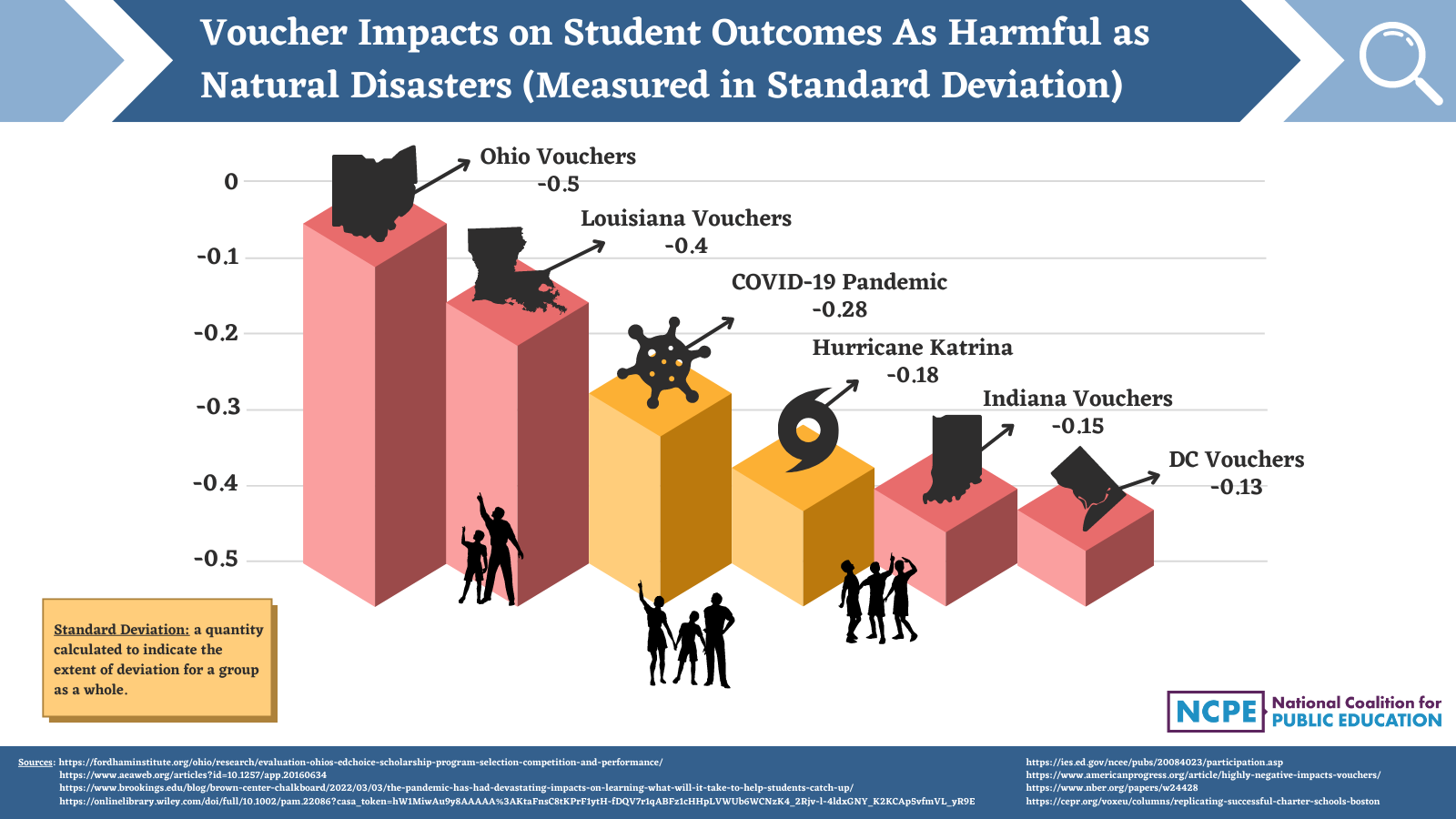
Large-scale independent studies in D.C.,Indiana, Louisiana, and Ohio show that for kids who left public schools, harmful voucher impacts actually meet or exceed what the pandemic did to test scores. That’s also a similar impact in Louisiana to what Hurricane Katrina did to student achievement back in 2005.
Think about that next time you hear a politician or activist claim we need taxpayer support for private schools to offset what the pandemic did to student learning. Here, their cure would in test score terms be quite literally worse than the disease.
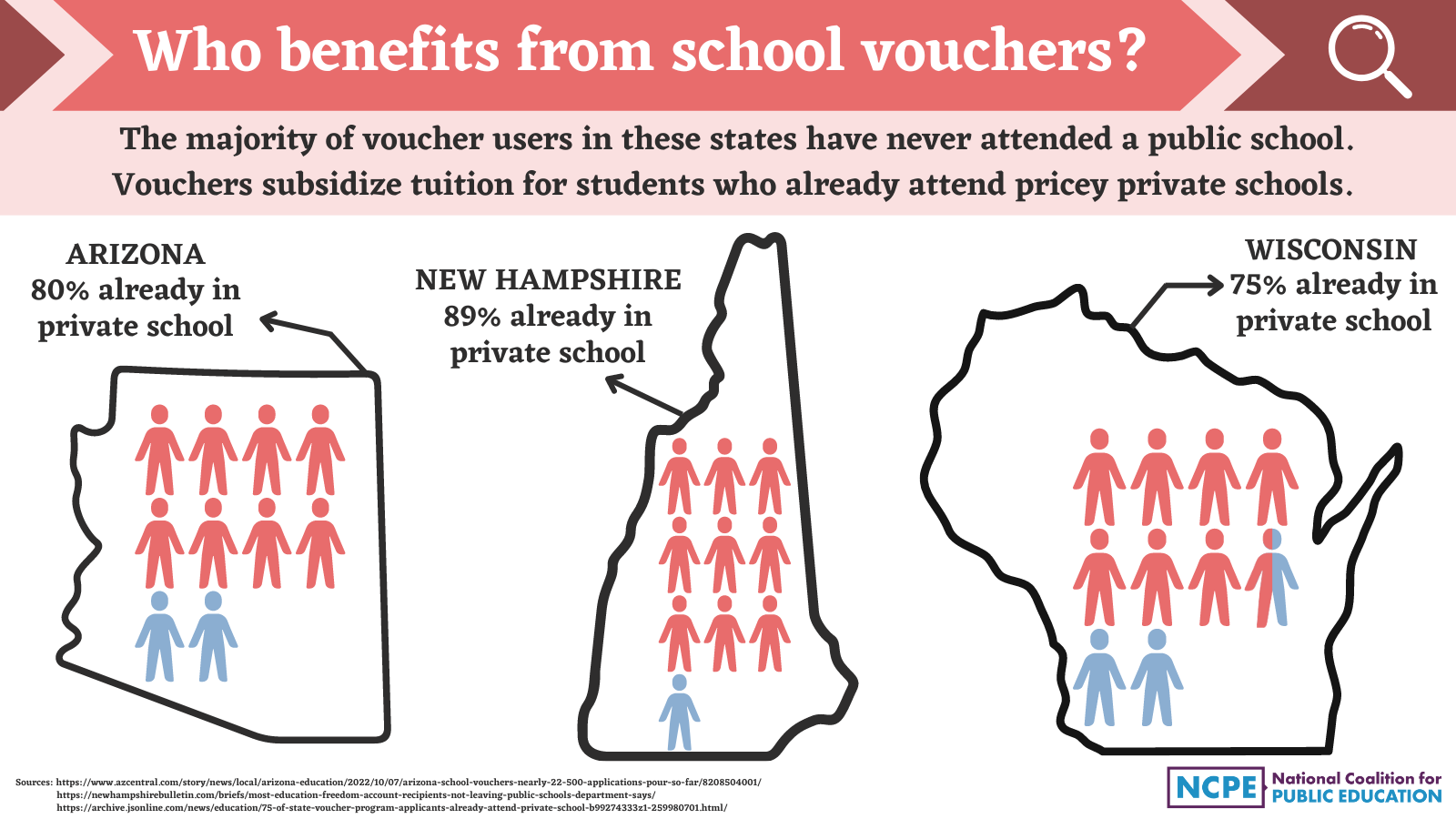
There’s another data point you need to know up front: vouchers overwhelmingly fund children who were already in private school without them. In states that have released those numbers—Arizona, New Hampshire, and Wisconsin—we know more than 75% of voucher applicants came from private schools.
The bottom-line: most kids using vouchers didn’t need them to go to private school, and the few kids who actually did use vouchers to transfer sectors schools suffer average test score drops on par with what a once-in-a-generation pandemic did to test scores too.
If you’re a picture person, our friends at the National Coalition for Public Education were kind enough to put their considerable talents into two graphics based on these data I provided to them.
Notice the citations these graphs include. They’re the same as the hyperlinks above. These data come from independent sources and from non-partisan journalists. That’s a critically important part of this story.
And then there’s this, before we get into the details: the same people pushing vouchers are the same people working to undermine fair elections and the right to vote.
None of these are metaphors, and this is not a drill.
So how did we come to this?
1. A Quick History of Voucher Research
First let’s talk about the evidence.
I came into the school voucher research community early. It was around 2001 or so, as a young graduate student assistant for a study of privately funded vouchers led by the conservative professor Paul E. Peterson who was based at both Harvard and the conservative Hoover Institution at Stanford (never heard of Hoover? Think Condoleeza Rice.)
Peterson and his protégé Jay Greene had already done one study of Milwaukee’s publicly funded voucher program, as well as the one in Cleveland that was about to be the subject of the U.S. Supreme Court’s first favorable ruling on voucher funding. That work generally showed positive results for vouchers. As did the research of a young academic named Cecilia Rouse, who is now President Biden’s chief economist.
But they were small programs. What policymakers and researchers call a “pilot phase.” Back then when both parties cared at least nominally about evidence, you wouldn’t expand a program like vouchers without testing it. So those early tests seemed somewhat positive.
The first research I joined was Peterson and team’s next project: multi-site studies in Dayton, New York City, and Washington D.C. Those programs were also pilot-size. And the New York site in particular showed some limited evidence of voucher success. But overall the lead researchers focused as much on things like parental satisfaction and measures of civic engagement as metrics. That work resulted in a book called The Education Gap. You can find my name in the credits if you own a copy. If you don’t own one, don’t waste your money.
No one knew it at the time, but the mixed results documented in The Education Gap were to be the best vouchers were ever going to do—and ever have done since by an academic based team looking at voucher test scores.
Just a short time later in 2005, I joined a new voucher evaluation led by Patrick Wolf, another Peterson protégé and contributor to The Education Gap. Wolf was by then ensconced with Jay Greene at the University of Arkansas Department of Education Reform, a Walton Family-funded academic group that was about to train a new generation of voucher advocates. Most notably Corey DeAngelis, now at Betsy DeVos’s 501(c)4 voucher lobbying group American Federation for Children.
The Milwaukee evaluation, which was officially done for the state of Wisconsin, lasted from 2005-2010. We found no evidence in five years that voucher kids outperformed public school kids. Two exceptions: we found limited evidence that graduation rates and college enrollment were somewhat higher for the voucher kids. We also found that voucher kids improved when the state required private schools to participate in the same No Child Left Behind-style accountability systems as public schools. In particular once voucher schools knew their performance would be made public they—shockingly!—improved their outcomes.
At the same time as the Milwaukee evaluation, Patrick Wolf and other Arkansas colleagues were working on a new evaluation of Washington D.C.’s federally funded voucher program. That study showed no difference in test scores, but large positive graduate results.
That pattern of “no test score benefits, some attainment benefits” has stuck in the research narrative even among voucher skeptics. But as I recently explained in a piece for the Brookings Institution, it’s just that: a narrative. Other studies in New York, Louisiana and Florida all show no real advantages for vouchers on educational attainment.
And certainly nothing to offset the cataclysmic results that began to come out after the early-stage evaluations I just described. The newer D.C.,Indiana, Louisiana, and Ohio studies that took place after 2013 and have showed pandemic and Katrina-sized harm to student test scores are all of at-scale voucher programs.
What do I mean by “at scale?” I mean that despite limited evidence in those pilot programs, vouchers have been steadily expanding across the country, and within states. So those D.C., Indiana Louisiana and Ohio studies represent our best understanding to date of what happens when you expand vouchers beyond the initial test phase. The answer: horrific impacts on student outcomes.
There are a number of reasons this could be, but I tend to argue we need not overthink this. Vouchers just don’t work. The kids who stand to gain from private schooling were and are already there. For the vast majority of kids, they’re better off in public schools. That’s what the latest voucher research shows.
As an example of what I mean: consider that in Wisconsin (which has not had a statewide study since ours ended in 2010), 41% of voucher-receiving schools have opened and then closed and failed since public funding began in the early 1990s.
That’s what happens when policymakers divert tax dollars to private schools: it’s like venture capitalism for education. It’s like Theranos but for private schooling. New providers race to gobble up new taxpayer money, but most of them have no business near kids.
Now, to fully understand why these terrible policies exist and in fact have never spread faster and further than they are today, we need to understand the politics. And to understand the politics, we need to understand the money.
On the one hand it’s pretty simple. Once you understand that the same people pushing vouchers are the same people funding groups that insist Donald Trump won the election and are now organizing a similar “Big Lie” for 2022’s results, you understand a lot. But read on.
2. Funding Vouchers, Funding Election Lies
It’s difficult to tell how much money has been spent to advocate for school vouchers over the years. But we know perhaps the biggest single funder—perhaps even larger than Betsy DeVos herself—is the Lynde and Harry Bradley Foundation. The Bradley Foundation is a little-known group based in Wisconsin and they’ve given tens of millions of dollars to voucher activism over the years.
Bradley not only funds voucher activism, it funds voucher research too. It was a major funder of the Milwaukee evaluation I was part of and described above. I don’t think they directly influenced our results, but generally speaking you don’t want activism and research funding to mix. Think about it this way: should the Sackler family fund research on the addictive properties of oxycontin? Should Exxon fund studies about the existence of climate change?
For me though, the real problem today is that the Bradley Foundation is hardly limiting itself to supporting research and political advocacy for private schooling. As the New Yorker’s Jane Mayer has meticulously documented in her reporting on financing behind Big Lie activism sowing doubts about President Biden’s 2020 victory, the Bradley Foundation is the convening funder around those activities—the “extraordinary force”, in Mayer’s words, funding and coordinating the Big Lie and other efforts to undermine the integrity of democratic elections.
Bradley is not alone. The Heritage Foundation, a right-wing organization known for its pro-voucher advocacy is, according to Mayer, “working with the American Legislative Exchange Council (ALEC)—a corporate-funded nonprofit that generates model laws for state legislators—on ways to impose new voting restrictions.”
In recent months, Heritage has also distributed talking points that under the guise of objective research attack school diversity and inclusion and directly question health care support for LGBTQ children. Heritage has recently released a report-card style rubric rating state laws on a so-called “Education Freedom” index for tax-supported private tuition. That report card includes the extent to which issues like diversity or sexual preference are components of public school teaching curricula.
The author of each of these documents is a Heritage Senior Fellow named Jay P. Greene. The same Jay Greene who while a conservative scholar at the University of Arkansas was co-director of that Bradley-funded voucher project that hired me back in 2005.
Greene is not alone in the Heritage-Bradley nexus. Cleta Mitchell, a lawyer who participated in Donald Trump’s infamous phone call to the Georgia Secretary of State demanding evidence that would overturn the state’s election results, was actively training poll watchers to question voters leading up to the 2022 midterms in places like my own state of Michigan. The night before the election, the New York Times even ran a story about Mitchell’s work in Michigan. The headline read: “Fueled by Falsehoods, a Michigan Group is Ready to Challenge the Vote.”
Mitchell is a known elections conspiracy theorist, according to CNN, and figures prominently in Mayer’s New Yorker reporting on broader election-related organizing. In her spare time Mitchell is on the Board of Directors of—wait for it!—the Lynde and Harry Bradley Foundation. She’s actually an officer on the Board too.
Michigan is important because we have a voucher proposal waiting to go to the state legislature—even though voucher opponent Gretchen Whitmer has won reelection. That proposal, backed by billionaire and privatization advocate Betsy DeVos, exploits a quirk in the state law allowing lame-duck Republicans to pass the voucher plan without the governor’s signature.
The spokesman for the DeVos voucher campaign is a man named Fred Wszolek. Wszolek is also the strategist for a group that tried unsuccessfully to prevent abortion access from becoming enshrined in the Michigan state constitution. And he heads a political action committee (PAC) called Michigan Strong, which has worked to elect now-defeated DeVos-backed GOP gubernatorial candidate Tudor Dixon.
Also working for Dixon was Kyle Olson of the Education Action Group, an entity devoted to right-wing education reform that’s received money from Charles Koch, the DeVos Family and Harry Bradley—he of the Bradley Foundation.
That’s just one example, but you get the idea: the same people working to push school vouchers are the same people working to undermine elections. And in some cases even reproductive rights.
3. So Why Now?
I’ve spent the last six months writing column after column in opinion pages across the country trying to warn ordinary readers who aren’t education lifers about the dangers of vouchers. You can read samples here or here or here or here if you like. There are more than 10 in all.
Because of my long career working in the middle of all these voucher advocates and researchers, I’ve been asked multiple times what changed my mind. Or, more specifically, why am I speaking out today?
I hope the story I’ve told you above answers some of that. But the reality is, I was also doing other things. I had a young family, other research interests, and other professional tasks like editing the country’s premier education policy journal.
Most of all I had a naïve sense that the facts would speak for themselves. Remember, those pandemic-sized voucher failures began appearing back in 2013. I was an associate professor then, newly arrived at Michigan State University after receiving tenure at the University of Kentucky.
To me, after a decade of mixed-at-best results that I outlined here, I assumed that catastrophic results like those in Louisiana—and then confirmed in Indiana, Ohio, and D.C.—would have killed vouchers a thousand times over.
It’s sort of quaint now, that assumption of mine. In my research community, which is centered in the Association for Education Finance and Policy, we talk a lot about using evidence to inform policy. It’s a nice idea, but vouchers are the big, glaring and alarming counterpoint. We have never seen such one-sided, consistently negative research results as we have for school vouchers in the education research community.
And yet they thrive.
To me, the piece to that puzzle is politics. Negative voucher results aren’t the only thing to happen since 2013.
2016 happened. Donald Trump happened. January 6th happened. Dobbs v. Jackson happened.
Voucher advocates are overwhelmingly on one side of those events. And they’ve racked up some wins.
We know voucher programs exist today not for how they might help some kids, but for how they might exclude others. We know private schools taking public money can and often do discriminate against certain children. In Florida for example, one private school barring LGBTQ kids has received $1.6 million so far in taxpayer funding. In Indiana, more than $16 million has gone to schools refusing to admit LGBTQ kids—or even kids with LGBTQ parents!—or about 1 out of every 10 private schools on the taxpayer dime.
I wish I had come around earlier to the level of alarm I’m raising today. Others have even without having to take a kind of road to Damascus like I did.
I’m a tenured full professor now. I’ve had a successful career working hard to bring evidence to public policy. I firmly believe that school vouchers are a fundamental threat not just to student learning, but also to democracy and to human rights.
So on vouchers I’ve come to the same view any number of us would if we stumbled onto a massive fraud in our workplace, or if we saw a young child being bullied simply for being who they are. None of it is okay.
And if you see something, you have to say something.
We have been following the activities of various rightwing groups that purport to represent parents. Many if not all are funded by Dark Money, meaning their funders are anonymous. “Parents Defending Education” is now active in Massachusetts, suing districts for events related to race, gender, and sexual orientation. As the article notes, PDE has a staff of 13, some with a Koch background, and is represented by a Trump-connected lawyer. The goal of such groups is to undermine public confidence in public schools and in the judgment of professional educators. The ultimate goal is to heighten the teacher shortage and encourage privatization of schools.
The Boston Globe story begins:
An increasingly active right-leaning non-profit called Parents Defending Education filed a federal civil rights complaint against Newton North High School last month, alleging that a student-led theater production broke the law by limiting auditions to people of color only.
The same group sued Wellesley Public Schools last year for alleged illegal discrimination when Wellesley High School hosted a forum for Asian students and students of color to discuss a mass shooting at an Asian massage parlor in Atlanta. The teacher who organized the session wrote that it was “not for students who identify only as White.”
So far, the national group has identified 43 “incidents” in which they say Massachusetts schools inappropriately – or even illegally – taught students about race, sexual orientation or gender, setting school districts across the Commonwealth on edge that they might be sued next.
“I’ve never seen anything like this before in all my years here,” said Wellesley School Superintendent David Lussier, who settled the lawsuit with the organization in February. “They try to go after superintendents and get people fired.”
Parents Defending Education did not return repeated requests for comment, but supporters say the group offers a vital counterweight to an education system steeped in liberal values.
“I think it’s good because, for a long time, education has been very one-sided,” said Jennifer McWilliams, a consultant to Parents Defending Education who runs her own advocacy group in Indiana. “Schools have decided that they need to teach children morals, values, attitude and worldview over academics.”
The two-year-old organization, based in Washington D.C., urges parents across the country to report incidents in which they believe schools are dividing students on racial lines or inappropriately teaching students about sex or gender roles. The group states on its website that education must be based on “scholarship and facts” and says ethnic studies divides “children into oppressor and ‘oppressed’ groups,” while teaching white students “guilt and shame.”
And the organization has a sizable, well-connected staff to promote their agenda. Parents Defending Education’s website lists 13 staff members including Nicole Neily, former president of an organization affiliated with the Koch Brothers called Speech First and Aimee Viana, a former Trump Administration appointee.
Schools have long been battlegrounds in the nation’s culture wars, but experts say Parents Defending Education marks something new: an attempt to nationalize the agenda. The group has been promoting conservative values across the country, enlisting local groups with names like Moms for Liberty and No Left Turn in Education along the way.
“We see increased coordination, national coordination among groups of all political stripes and partisan stripes, thanks to social media,” said Meira Levinson, a professor at Harvard’s Graduate School of Education. “The right more than the left seems to have mastered techniques of developing language that then can be replicated in legislation, or policy across different municipalities and state governments.”
For Massachusetts educators facing criticism from Parents Defending Education, it suddenly feels like the group is everywhere. The group criticized Brookline schools in April after teachers organized a walkout to protest a Florida measure opponents have characterized as the “Don’t Say Gay” bill. In June, the organization condemned Milton for teaching a lesson about the country’s first openly gay politician Harvey Milk and the importance of the letters LGBTQ.
“Who the hell wants to go into this profession anymore if this is going to be the type of community that we’re serving and the type of pressure that we’re going to experience,” Wellesley Educators Association President Kyle Gekopi said. “It’s really been forcing a lot of people to question their choices.”
Most recently, Parents Defending Education filed a federal civil rights complaint on Oct. 4 against Newton North High School.
The group alleged to the United States Department of Education that the school violated the Civil Rights Act of 1964 and the Equal Protection Clause of the 14th Amendment. Both are meant to protect people from discrimination based on race, color or national origin in programs or activities that receive federal financial assistance. That protection extends to white students, they say.
Parents Defending Education claims the school’s student-led production, “Lost and Found: Stories of People of Color by People of Color,” restricted auditions to only students of color. The show, which organizers described as “a no-cut, cabaret-style show for students of color,” was meant to “provide a safe community space for students of color to express themselves through the performing arts.”
But Newton Public Schools put out a statement stressing that “no one is turned away or excluded from participating” in the play.
Educators far beyond Newton are nervously watching the case unfold. Brian Fitzgerald, president of the Plymouth County Education Association, said Parents Defending Education remind him of activists in past decades who have fought to curtail sex education, making it difficult to teach students about health.
“My fear is that they’re going to impact the ability of a student to learn,” Fitzgerald said.
Gary Rubinstein is a high school math teacher and blogger. He has been following Success Academy charter chain, which has been nationally acclaimed for its high test scores. In his latest post, Rubinstein examines the case of a student who thrived at Success Academy until the pandemic, but struggled when the school switched to remote learning. Read the story and answer the question, was she treated fairly by her school?
Success Academy is known for its high 3-8 standardized test scores and its extreme rigidity. In a way, the rigidity is part of what causes them to have such high test scores. They demand compliance from their students and from the families of those students. When a student or the family of a student is not conforming to the expectations of the school, that student or family are going to be harassed, humiliated, and punished until they either fall into line or ‘voluntarily’ transfer to another school.
The heartbreaking saga of a girl I will call ‘Carla’ began pleasantly enough eight years ago when she was accepted into Success Academy Springfield Gardens as a kindergartener. From kindergarten through fourth grade, she thrived at the school. Her fourth grade report card grades were mostly the highest or second highest category, except for writing where she was struggling….
In fifth grade, she started having problems academically, though not catastrophically, and then as we all know, the pandemic hit and schools in New York went remote for the next year and a half. For the end part of fifth grade and all of sixth grade, Carla struggled to learn remotely. She had various connection issues and would wait in zoom waiting rooms endlessly. She was really traumatized by the pandemic year and was eager to return to in person classes for her seventh grade year.
But she was still suffering the effects of the 18 months of remote learning. She was having mental health issues and was seeing a therapist about them. At school she was failing several classes. Carla is a very hard working student and someone who really tries her best and her parents work very hard to support her needs and to keep on top of what assignments Carla was missing. Everyone knows that Success Academy has one trick in their playbook which is to make students repeat grades for failing courses. So Carla managed to improve most of her grades but she still failed two subjects, writing and science and was told that she would have to pass those two courses in summer school or she would have to repeat the entire seventh grade.
How Success Academy can make such a threat is incomprehensible to me. For elementary school grades it makes more sense, but in a secondary school setting, why not just retake the courses that you failed? But that wasn’t the threat, it was that she had to pass both courses with a 70 or higher or she would be repeating the entire seventh grade, including all the classes that she had passed.
Please read the rest of the post to learn what happened to Carla? Was it fair? Was it just? What do you think?


 Diane Ravitch's blog